
Life, 1925-12-25 · page 25 of 37
Life — December 25, 1925 — page 25: what you’re looking at
What you’re looking at
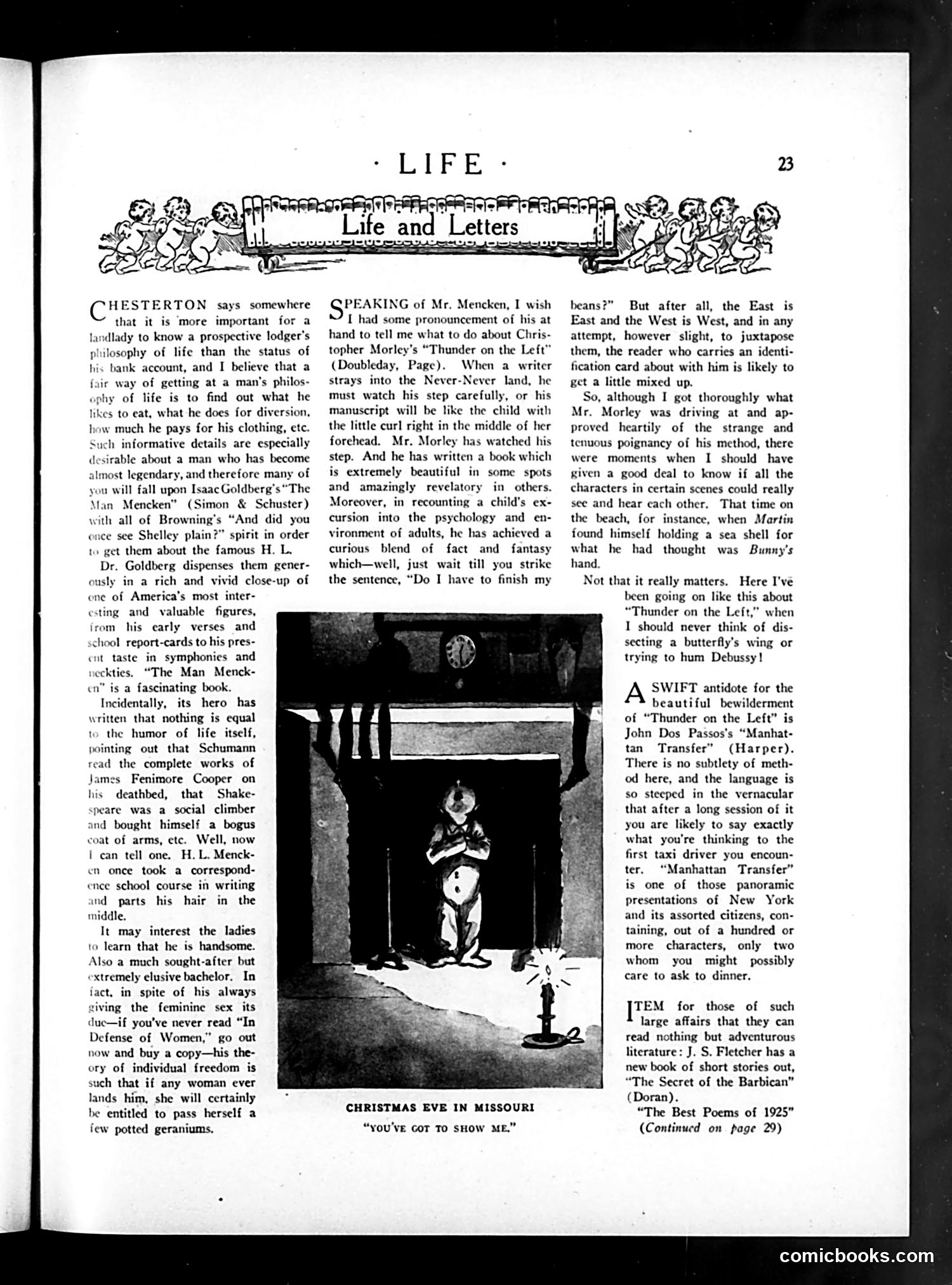
This page combines book reviews with a photograph captioned "Christmas Eve in Missouri — 'You've Got to Show Me.'" **The photograph** depicts what appears to be a child on Christmas Eve, likely illustrating the Missouri saying "show me" (skepticism/demand for proof rather than belief). The image supports the reviewer's discussion of Christopher Morley's *Thunder on the Left*, a fantasy novel about a child's encounter with adult psychology. **The reviews discuss:** - Isaac Goldberg's biography of H.L. Mencken, a prominent American social critic - Morley's novel, praised for blending "fact and fantasy" but criticized for potentially confusing readers about what characters can perceive - Dos Passos's *Manhattan Transfer*, described as a stark, vernacular-heavy antidote to Morley's dreamlike quality **The satire** is gentle—poking fun at Mencken's legendary status while revealing mundane details (he parts his hair in the middle), and gently mocking readers who demand literal logic from experimental fiction. The "show me" caption reflects skepticism about fantastical narrative methods.
📄 Transcribed text from this page (OCR, searchable)
Machine-transcribed from the original scan — historical spelling and the odd misread are preserved.
HESTERTON says somewhere that it is ‘more important for a landlady to know a prospective lodger’s philosophy of life than the status of his bank account, and I believe that a fair way of getting at a man’s philos- ophy of life is to find out what he likes to eat, what he does for rsion, how much he pays for his clothing, etc. Such informative details are especially desirable about a man who has become almost legendary, and therefore many of you will fall upon Isaac Goldberg's “The Man Mencken” (Simon & Schuster) with all of Browning’s “And did you once see Shelley plain?” spirit in order to get them about the famous H. L. Dr. Goldberg dispenses them gener- ously in a rich and vivid close-up of one of America’s most inter- esting and valuable figures, irom his early verses and chool report-cards to his pres- cnt taste in symphonies and neckties. “The Man Menck- cn” is a fascinating book. Incidentally, its hero has written that nothing is equal to the humor of life itself, pointing out that Schumann read the complete works of James Fenimore Cooper on his deathbed, that Shake- speare was a social climber and bought himself a bogus coat of arms, etc, Well, now | can tell one. H.L. Menck- cn once took a correspond- ence school course in writing ind parts his hair in the middle, It may interest the ladies to learn that he is handsome. Also a much sought-after but extremely elusive bachelor. In iact, in spite of his always giving the feminine sex its due—if you've never read “In Defense of Women,” go out now and buy a copy—his the- ory of individual freedom is such that if any woman ever lands him, she will certainly be entitled to pass herself a few potted geraniums, PEAKING of Mr. Mencken, I wish I had some pronouncement of his at hand to tell me what to do about Chri: topher Morley’s “Thunder on the Left” (Doubleday, Page). When a writer strays into the Never-Never land, he must watch his step carefully, or his manuscript will be like the child with the little curl right in the middle of her forehead. Mr. Morley has watched his step. And he has written a book which is extremely beautiful in some spots and amazingly revelatory in others. Moreover, in recounting a child's ex- cursion into the psychology and en- vironment of adults, he has achieved a curious blend of fact and fantasy which—well, just wait till you strike the sentence, “Do I have to finish my CHRISTMAS EVE IN MISSOURI “YOU'VE GOT TO SHOW ME.” beans?” But after all, the East is East and the West is West, and in any attempt, however slight, to juxtapose them, the reader who carries an identi- fication card about with him is likely to gct a little mixed up. So, although I got thoroughly what Mr. Morley was driving at and ap- proved heartily of the strange and tenuous poignancy of his method, there were moments when I should have given a good deal to know if all the characters in certain scenes could really see and hear cach other. That time on the beach, for instance, when Martin found himself holding a sea shell for what he had thought was Bunny's hand. Not that it really matters. Here I've been going on like this about “Thunder on the Left,” when I should never think of dis- secting a butterfly’s wing or trying to hum Debussy! SWIFT antidote for the beautiful bewilderment of “Thunder on the Left” is John Dos Passos’s “Manhat- tan Transfer” (Harper). There is no subtlety of meth- od here, and the language is so steeped in the vernacular that after a long session of it you are likely to say exactly what you're thinking to the first taxi driver you encoun- ter, “Manhattan Transfer” is one of those panoramic presentations of New York and its assorted citizens, con- taining, out of a hundred or more characters, only two whom you might possibly care to ask to dinner. TEM for those of such large affairs that they can read nothing but adventurous literature: J. S. Fletcher has a new book of short stories out, “The Secret of the Barbican” (Doran). “The Best Poems of 1925” (Continued on page 29) comicbooks.com