
A complete issue · 46 pages · 1925
Life — October 8, 1925
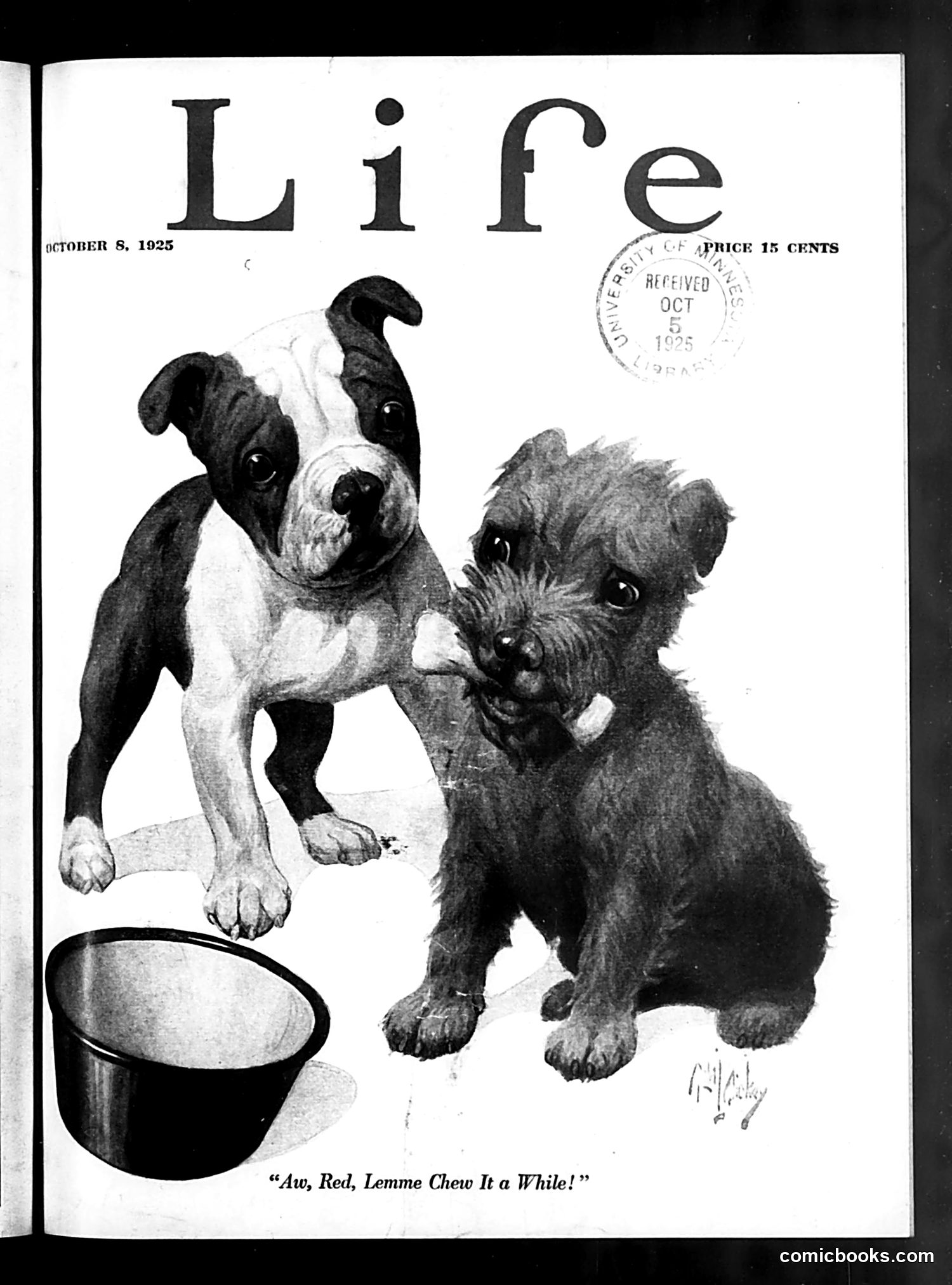
This is a cover illustration featuring two dogs beside a food bowl, captioned "Aw, Red, Lemme Chew It a While!" The cartoon appears to be a simple humorous domestic scene rather than political satire. It depicts two dogs—one black and white, one darker and smaller—in a dispute over access to a shared food bowl. The caption suggests negotiation or pleading between the animals. This type of content was typical for Life magazine's covers during the 1920s, which frequently featured gentle animal humor and domestic comedy aimed at general audiences. The illustration uses anthropomorphism (giving animals human characteristics like dialogue) to create relatable, lighthearted entertainment rather than making pointed political commentary.
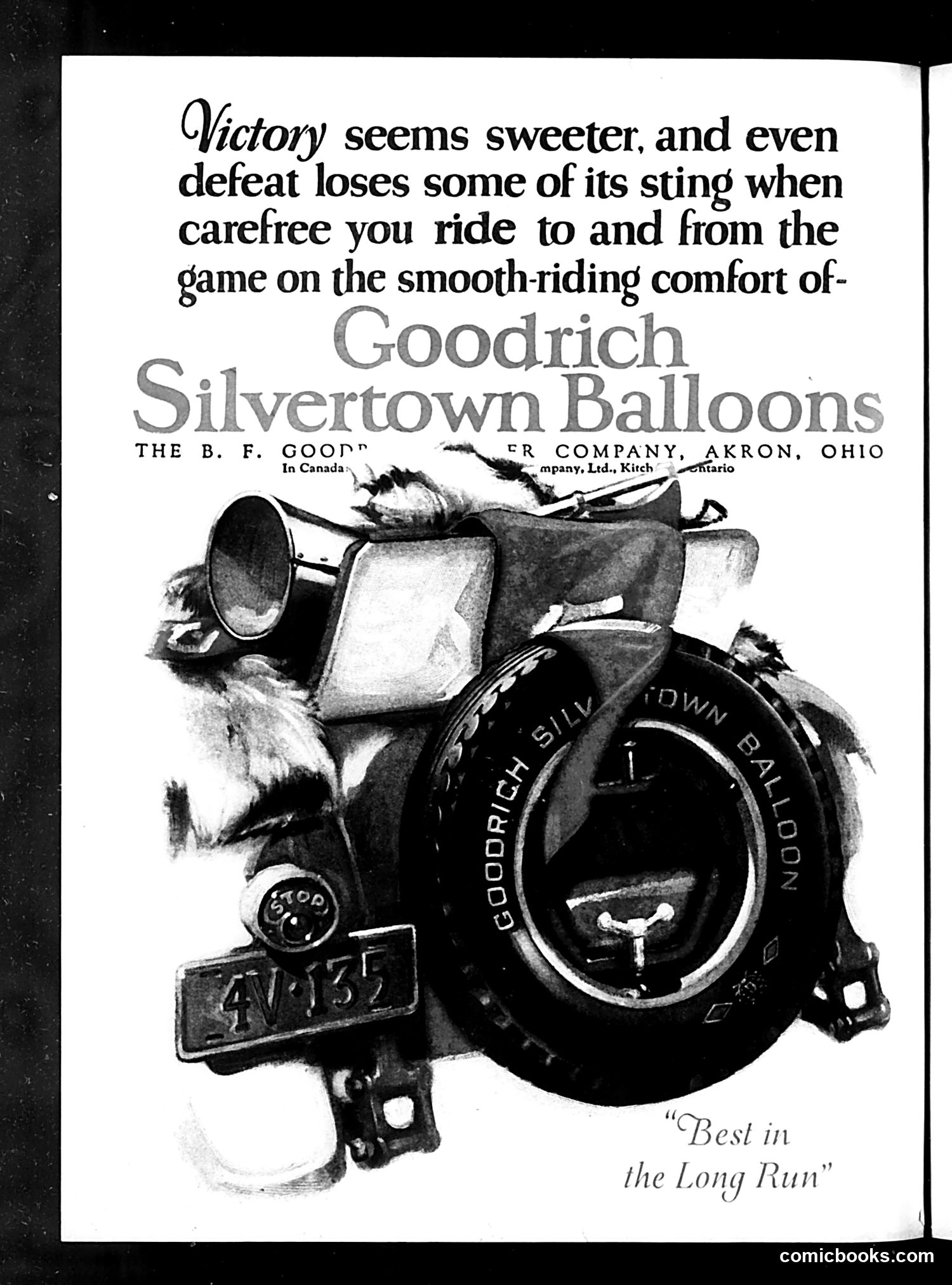
This is a **vintage automobile advertisement**, not political satire. It promotes Goodrich Silvertown Balloons (tires) manufactured by B.F. Goodrich Company in Akron, Ohio. The ad uses sports-related messaging to appeal to motorists: the headline references victory and defeat at "the game," suggesting that smooth-riding comfort from these tires makes any journey—whether to a winning or losing event—more pleasant. The tagline "Best in the Long Run" emphasizes tire durability and reliability. The illustration shows a vintage automobile tire with associated gear mounted on what appears to be a vehicle, alongside period sporting equipment (megaphone, pennant). This is straightforward commercial advertising typical of early-to-mid 20th century magazines, using sports enthusiasm to market automotive products.
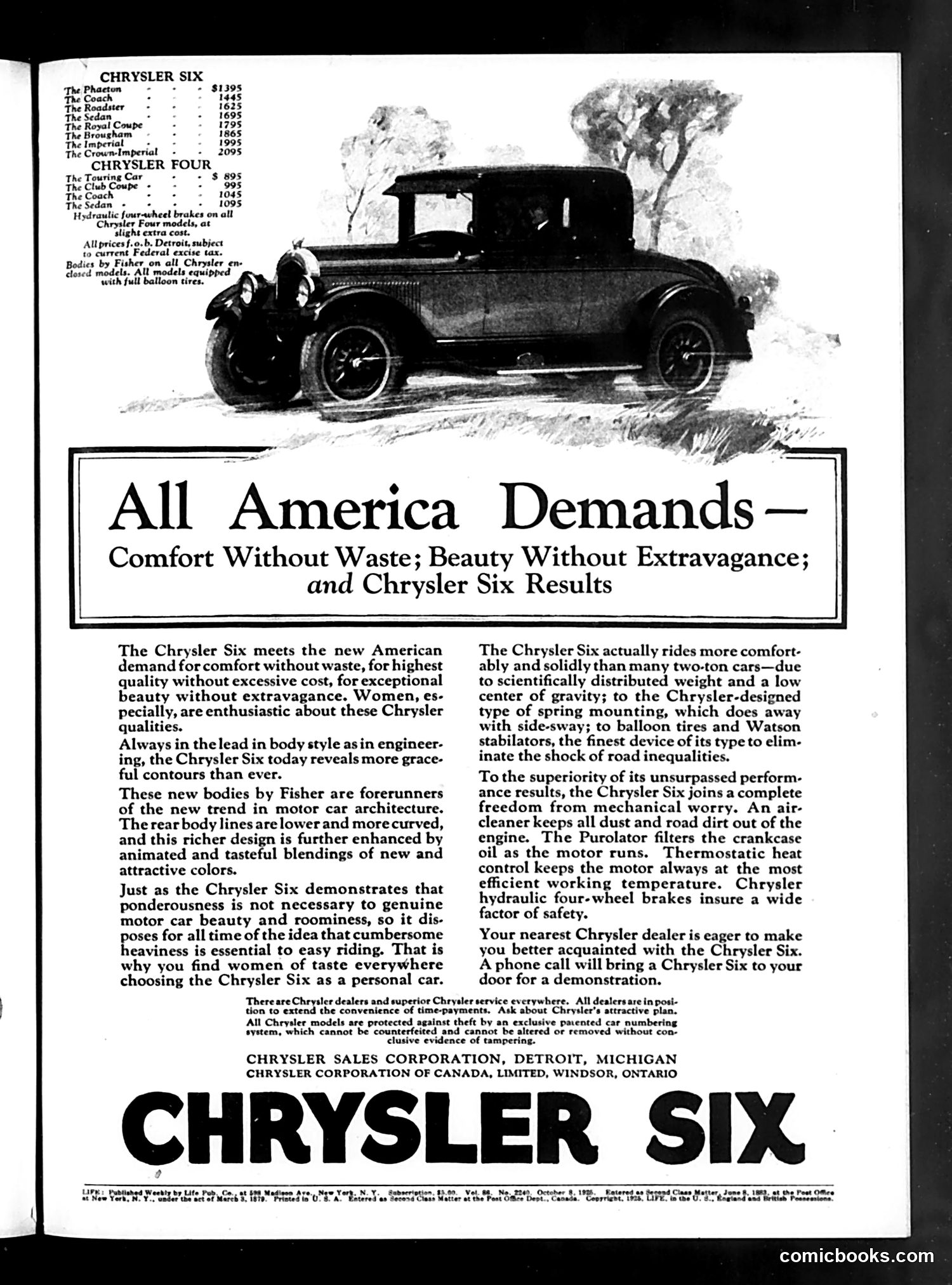
This page is **primarily an advertisement**, not satire or a political cartoon. It's a 1920s Chrysler Six automobile advertisement from *Life* magazine. The ad promotes the Chrysler Six car through the tagline "All America Demands—Comfort Without Waste; Beauty Without Extravagance." The accompanying illustration shows a sleek touring car in a landscape setting, emphasizing elegant design rather than ostentatious luxury. The text highlights practical features: scientific weight distribution, spring suspension, air filtration, and hydraulic brakes. The messaging appeals to middle-class American values of efficiency and value—comfort achieved through engineering rather than excess spending. This reflects 1920s consumer culture where automobiles were becoming more accessible to non-wealthy Americans, positioning the Chrysler Six as the sensible choice for quality-conscious buyers.
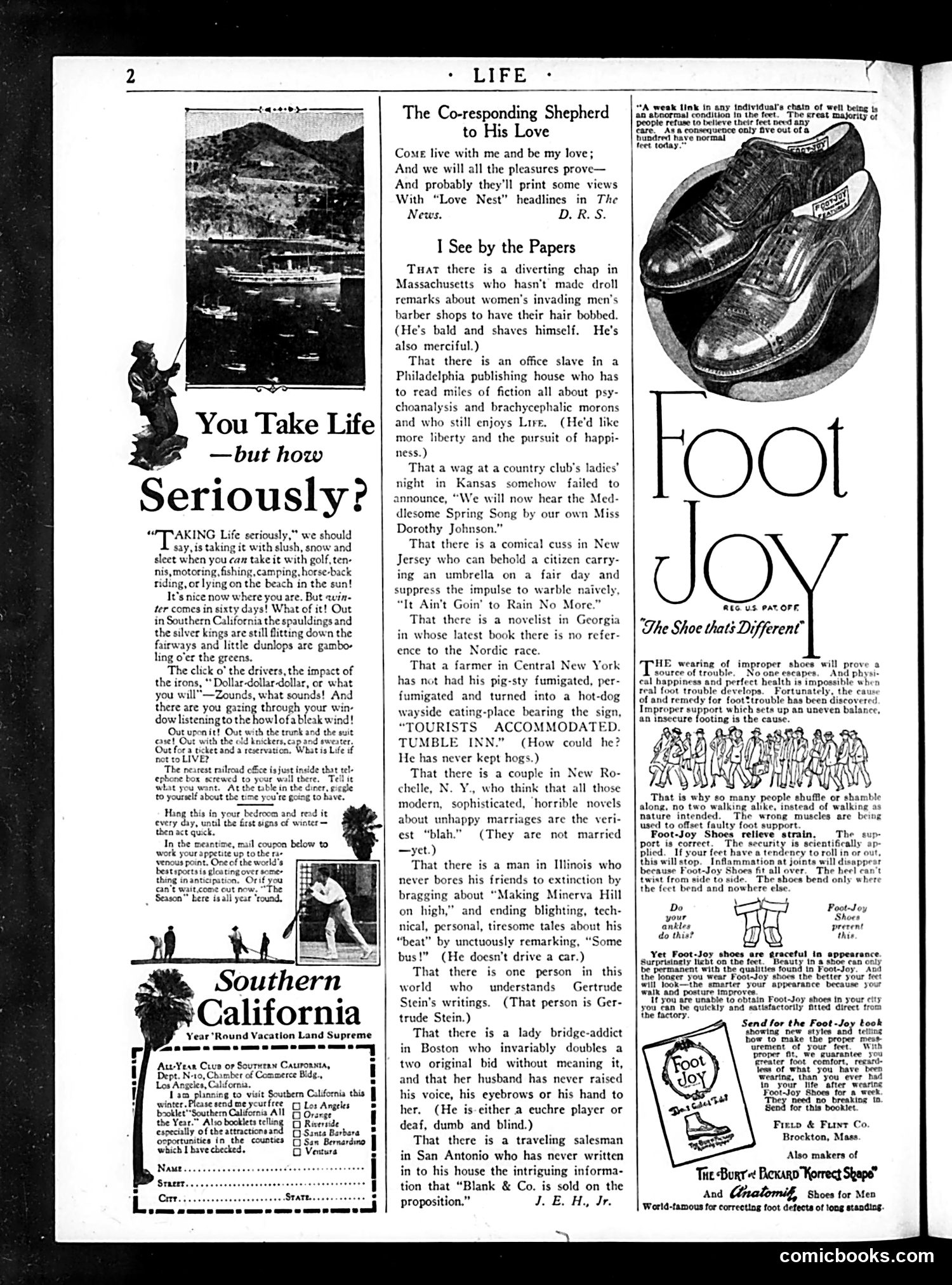
This page combines satirical commentary with advertising. The main article "You Take Life—but how Seriously?" mocks various American quirks through anecdotes: a Massachusetts barber who comments on women's hair-bobbing, a Philadelphia publisher enjoying psychoanalysis, Kansas ladies' club members, and others. The humor targets contemporary social pretensions and contradictions—people claiming sophistication while behaving absurdly. The "Foot Joy" shoe advertisement occupies significant space, promoting orthopedic footwear with claims about proper arch support and appearance. The ad directly addresses foot problems, suggesting widespread concern about shoe-related health issues in this era. The Southern California tourism ad promotes vacation travel, reflecting post-WWI leisure culture. Overall, the page reflects 1920s American social anxieties about propriety, health consciousness, and leisure activities.
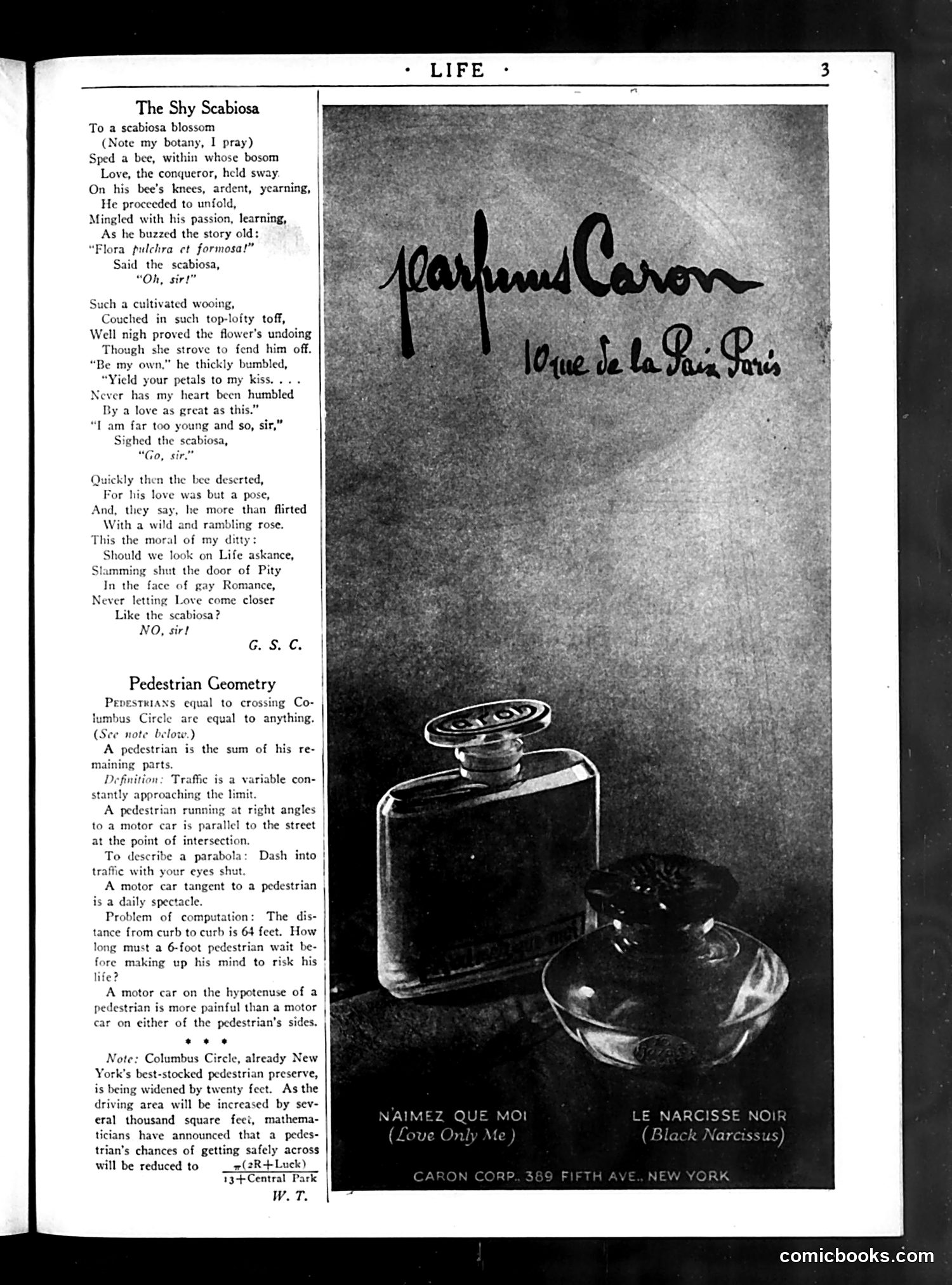
This page contains two distinct sections: **"The Shy Scabiosa"** (left): A humorous poem by G.S.C. using floral metaphor. A bee courts a scabiosa flower, but she demurs, claiming youth and inexperience. The moral warns against excessive romanticism, suggesting we should reject "Life askance" and keep "Love" at distance "Like the scabiosa?" **"Pedestrian Geometry"** (bottom left): Satirical commentary on urban pedestrian safety. It presents tongue-in-cheek "definitions" treating pedestrians mathematically—as geometric problems and traffic variables. It references Columbus Circle (being widened by twenty feet) and mocks urban planners' calculations about pedestrian safety odds. **Advertisement** (right): A perfume ad for Caron's "Naimez que Moi" (Love Only Me) and "Le Narcisse Noir" (Black Narcissus), with an elegant bottle illustration.
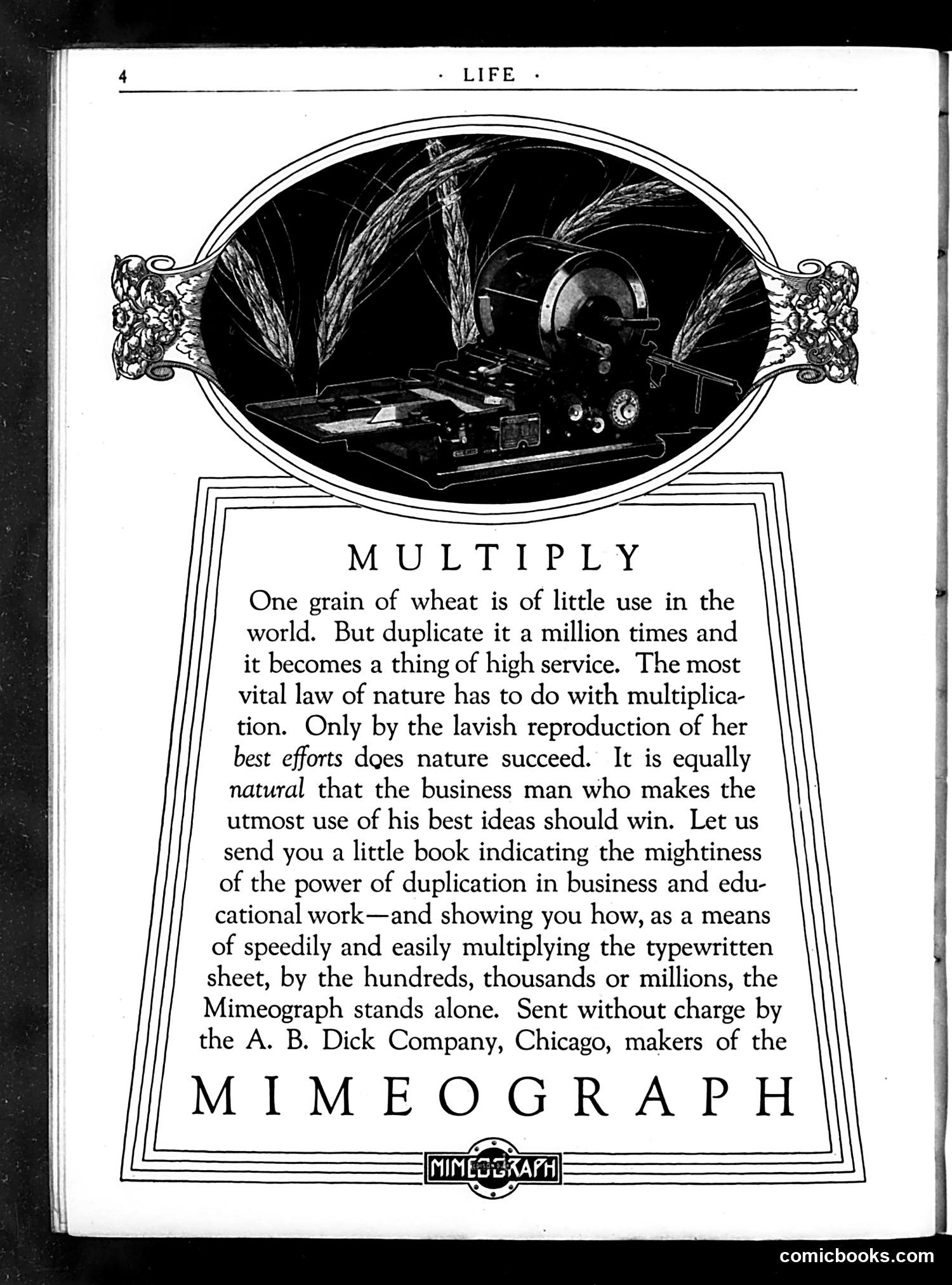
This is primarily an **advertisement**, not satire or editorial content. The A.B. Dick Company is marketing the **Mimeograph**, an early duplicating machine, to businesspeople and educators. The ad uses an analogy to nature—one grain of wheat multiplied becomes valuable—to argue that duplicating typewritten documents in bulk serves important business and educational purposes. The oval illustration shows the mimeograph machine itself with wheat stalks, visually reinforcing this multiplication metaphor. The pitch promises the booklet will demonstrate how the Mimeograph can "speedily and easily" reproduce documents by "hundreds, thousands or millions." This is straightforward commercial messaging typical of early-20th-century trade magazines, with no political satire intended.
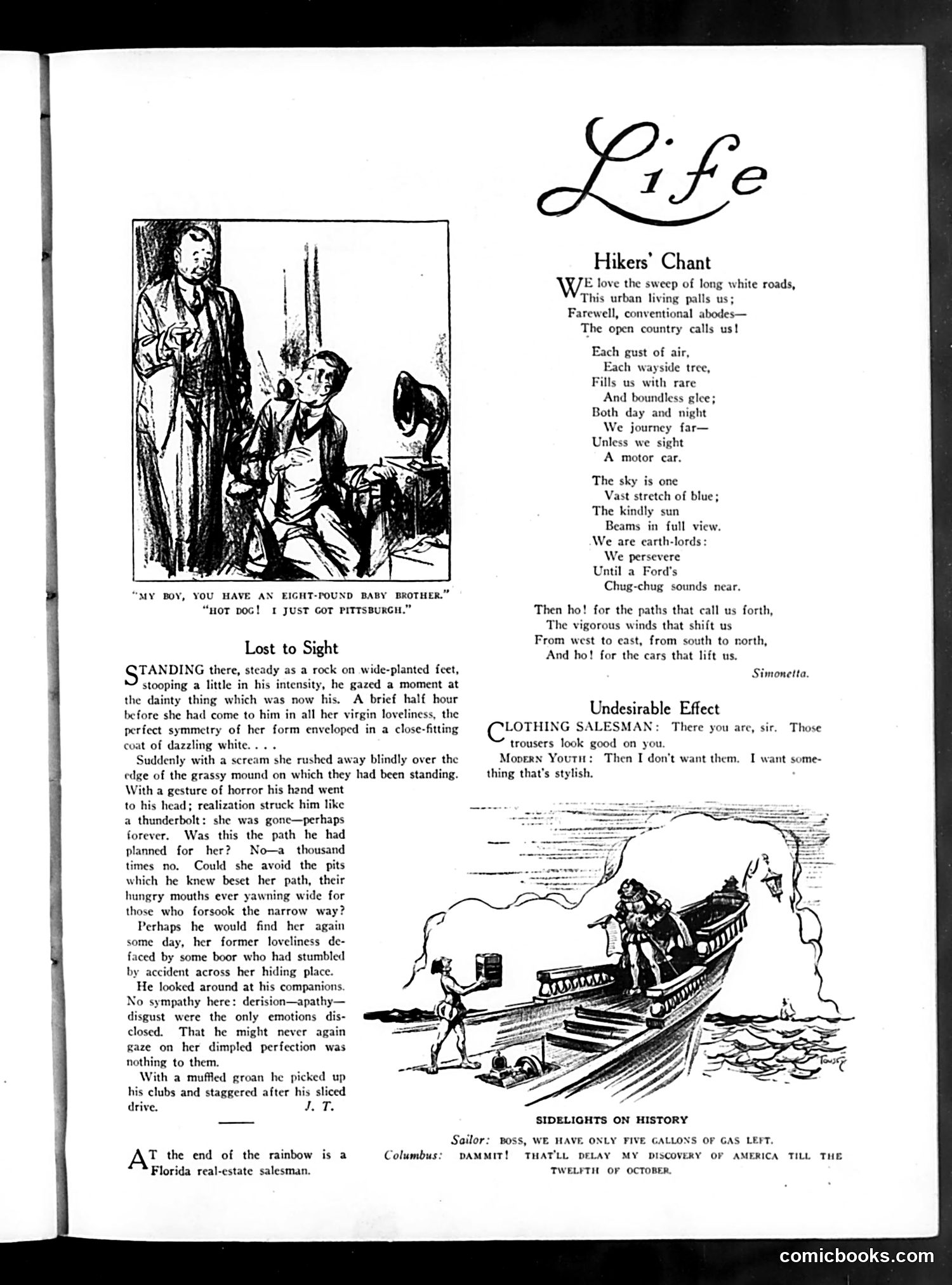
This page contains three distinct pieces: **"Lost to Sight"** (top left): A story about a man watching a woman disappear over a hill. The narrative explores his regret and uncertainty about her fate, with romantic undertones suggesting he may have misjudged or lost an opportunity with her. **"Hikers' Chant"** (top right): A poem celebrating outdoor hiking and automobile travel, reflecting early-20th-century enthusiasm for recreational motor cars and escape from urban life. **"Undesirable Effect"** (middle): A brief comic dialogue where a clothing salesman recommends fashionable trousers, but a modern youth rejects them as unstylish—satirizing generational fashion disagreements. **"Sidelights on History"** (bottom): A humorous cartoon showing a sailor and Columbus discussing gas supplies during ocean exploration, anachronistically applying modern fuel concerns to historical discovery.
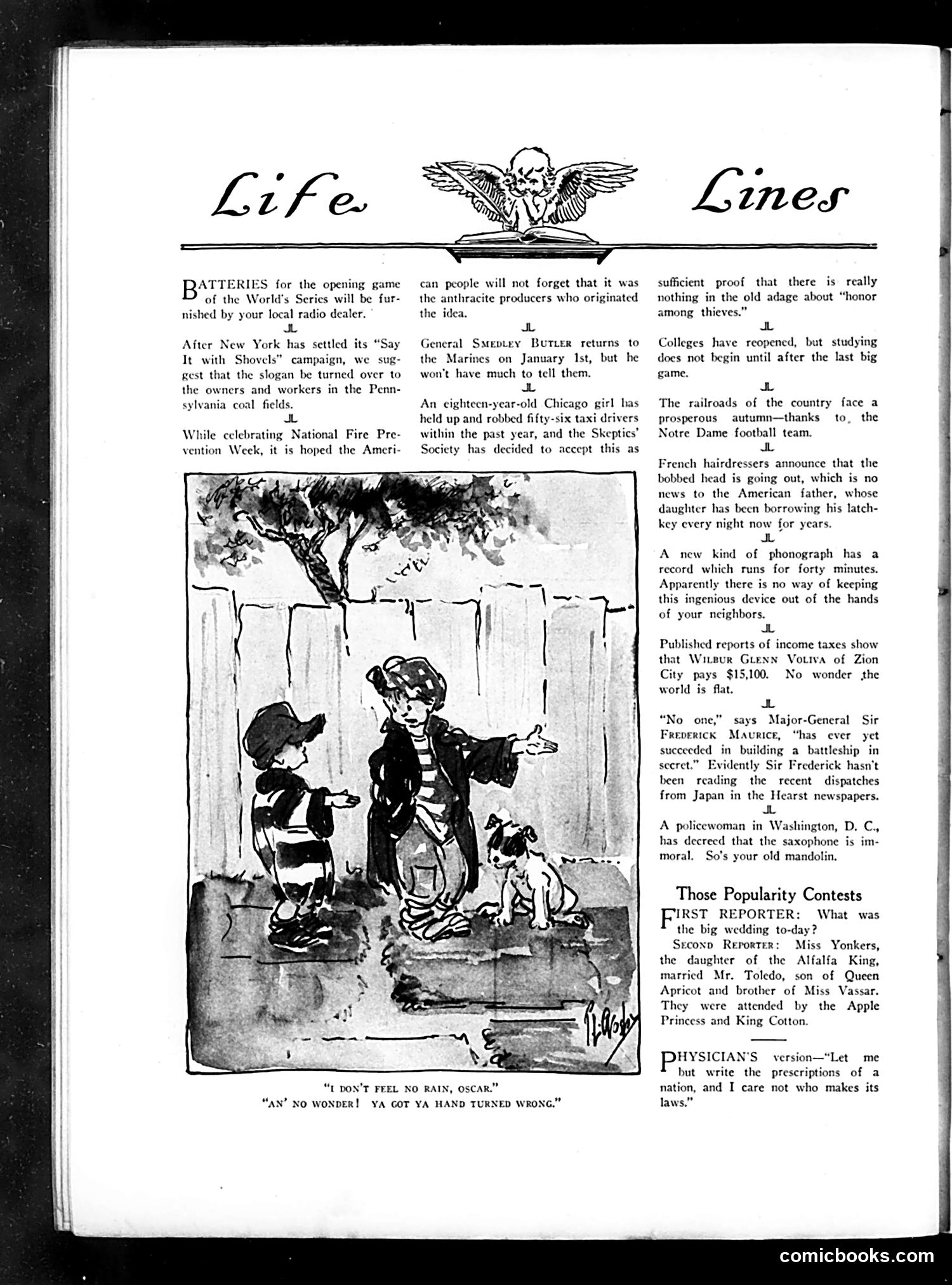
This page contains miscellaneous short humor items and a cartoon illustration. The main cartoon shows two children and a dog in the rain. One child says "I don't feel no rain, Oscar," and the other responds "An' so wonder! Ya got ya hand turned wrong." The joke appears to be a dialect-based gag about the child holding an umbrella incorrectly (turned inside-out or backwards), which explains why neither child feels protected from the rain. The humor relies on working-class or immigrant speech patterns ("don't feel no," "An' so wonder"). The surrounding "Life Lines" section contains brief satirical commentary on contemporary 1910s-1920s topics: World Series batteries, National Fire Prevention Week, taxi robberies in Chicago, French fashion trends, and political figures like General Smedley Butler. The items mock various aspects of American life and current events through brief, caustic observations.
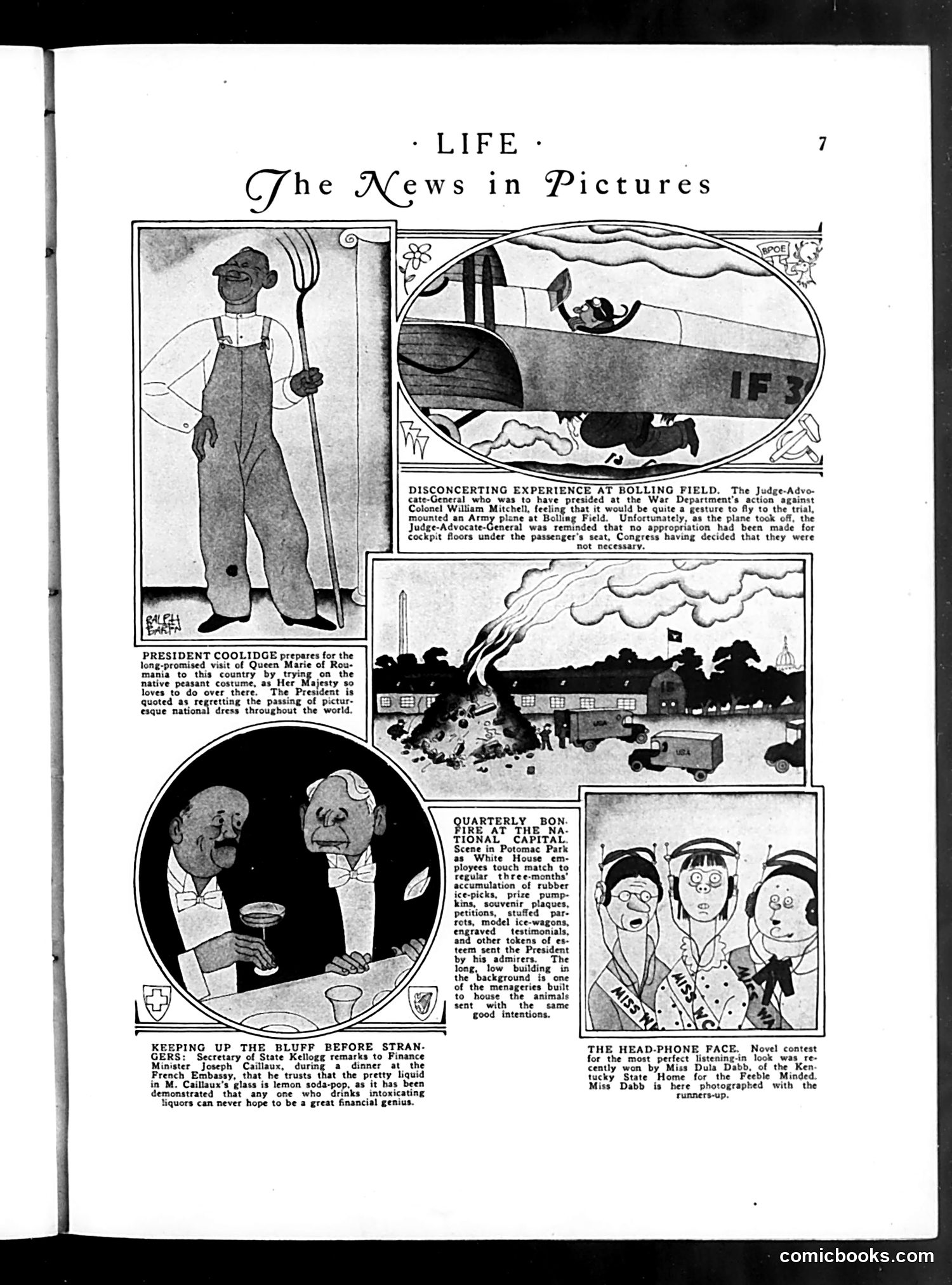
This page presents satirical commentary on early 1920s American politics and society: 1. **President Coolidge and Queen Marie**: The top-left cartoon mocks Coolidge preparing for Queen Marie of Romania's visit, satirizing his awkwardness with foreign dignitaries. 2. **Bolling Field Aviation Incident**: The airplane cartoon depicts a judge's uncomfortable experience at a military trial flight—satire about bureaucratic absurdity and Congressional oversight. 3. **Kellogg's Financial Humor**: The circular portrait shows Secretary of State Kellogg with another figure, joking about financial trust and banking genius—likely satirizing post-war economic confusion. 4. **White House Rubber Bonfire**: A large explosion depicts the National Zoo's quarterly disposal of rubber goods, poking fun at government waste and institutional absurdity. 5. **"Head-Phone Face" Contest**: The bottom cartoon mocks a beauty contest winner with distorted facial features from headphone use—social satire about emerging technology's physical effects.
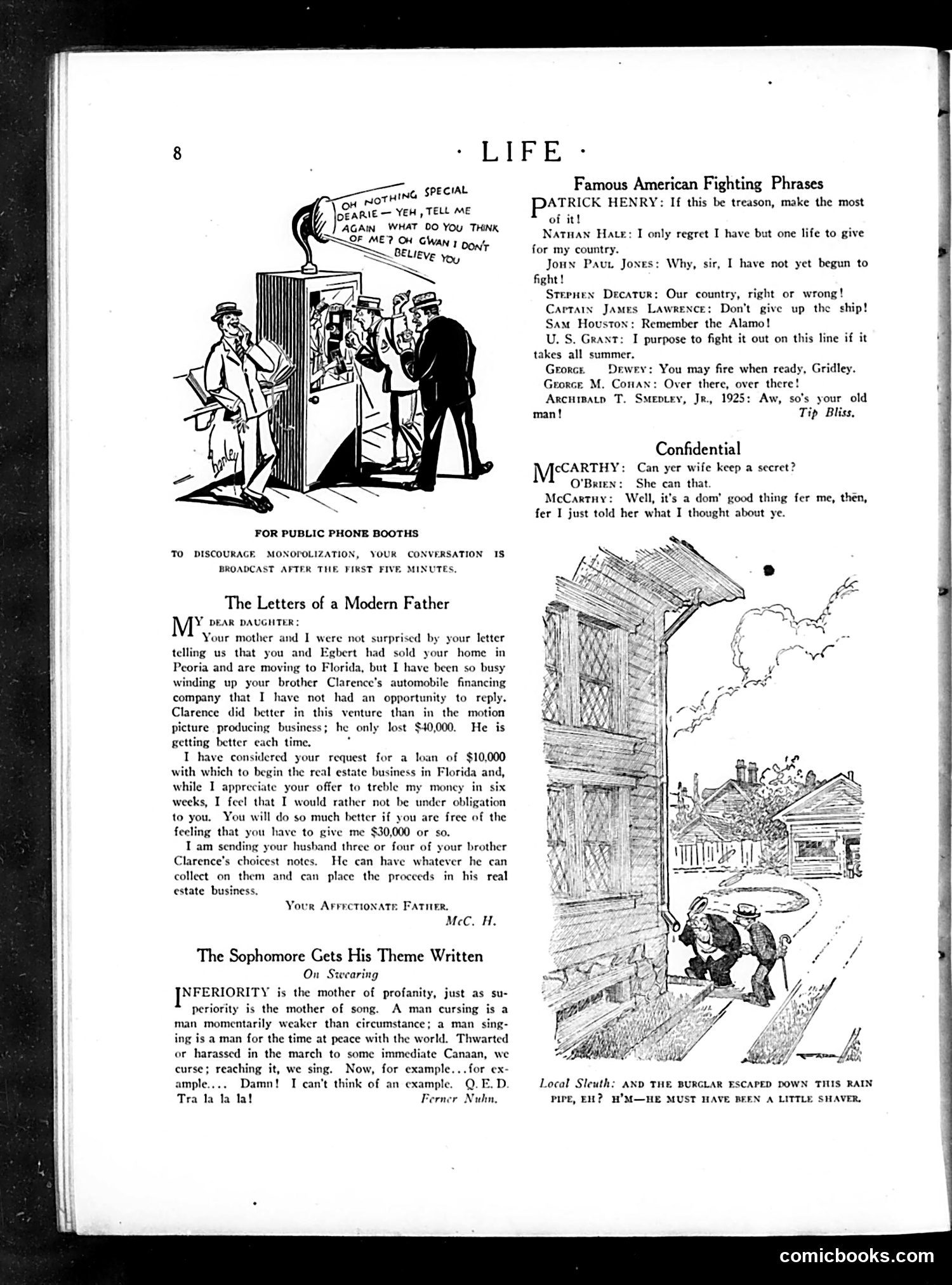
**Top Cartoon - Public Phone Booths:** This satirical cartoon depicts men crowded into a telephone booth while one monopolizes the call. The caption warns that "to discourage monopolization, your conversation is broadcast after the first five minutes." The joke targets a common social frustration of the era: people hogging public phones during the early 20th century when telephone access was limited. The satire suggests an absurd solution—public humiliation through broadcast—to enforce fair sharing of this then-precious resource. **Remaining Content:** The page includes "Famous American Fighting Phrases" (patriotic quotations), a humor section titled "Confidential" featuring McCarthy and O'Brien's joke about wives keeping secrets, a father's letter about financial matters, and a short essay on swearing by a "Sophomore."
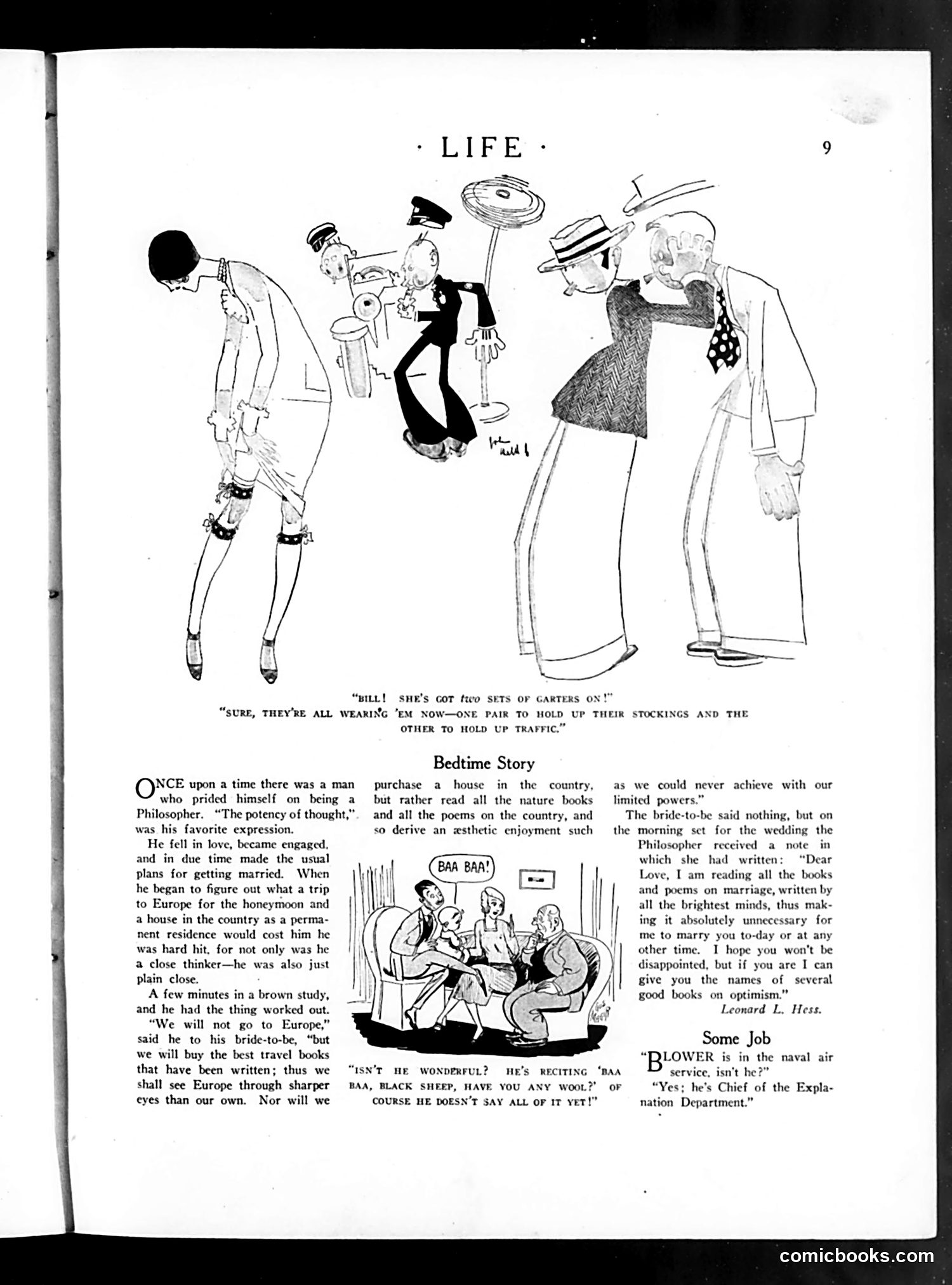
This page contains two separate pieces of humor: **Top Cartoon:** A visual gag about women's fashion. Men discuss a woman's garters, with one saying she's wearing two pairs—one to hold up stockings, the other "to hold up traffic," implying her appearance attracts male attention. **"Bedtime Story":** A satirical tale about an intellectual who fell in love. He planned to buy travel books to educate his bride-to-be about Europe. She rejected his intellectual approach with a note suggesting marriage shouldn't require "optimism" about self-improvement through reading. The story mocks pretentious intellectualism in romance. **"Some Job":** A brief joke about "Blower" working in the naval air service's Explanation Department—apparently involving sheep and wool, though the context remains unclear from this excerpt. The magazine targets 1920s social attitudes about courtship, intellectualism, and gender roles.
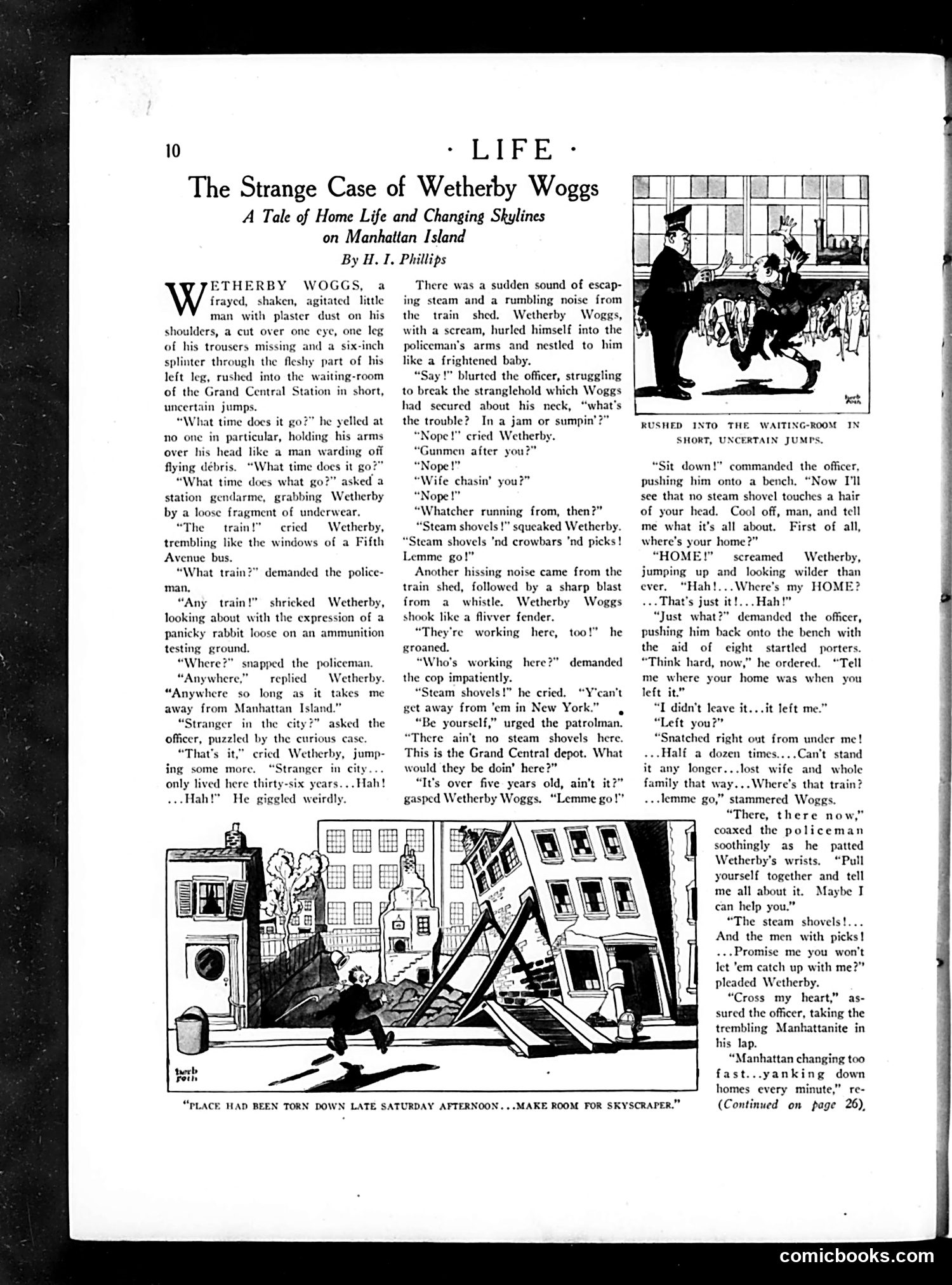
This is a humorous short story by H.I. Phillips about a disheveled man named Wetherby Woggs who appears at Grand Central Station in NYC covered in plaster dust, missing clothing, and disoriented. The satire concerns **urban housing instability during rapid Manhattan development**. Woggs's home has literally been demolished ("torn down late Saturday afternoon...make room for skyscraper"), and he's been displaced so suddenly he's confused and partially buried in construction debris. The officer's response—dismissing his homelessness as a minor inconvenience requiring him to "cool off"—satirizes **bureaucratic indifference to working-class displacement** caused by NYC's aggressive real estate development and modernization in this era. The accompanying illustrations show both Woggs's frantic arrival and the city's relentless vertical expansion destroying residential neighborhoods.
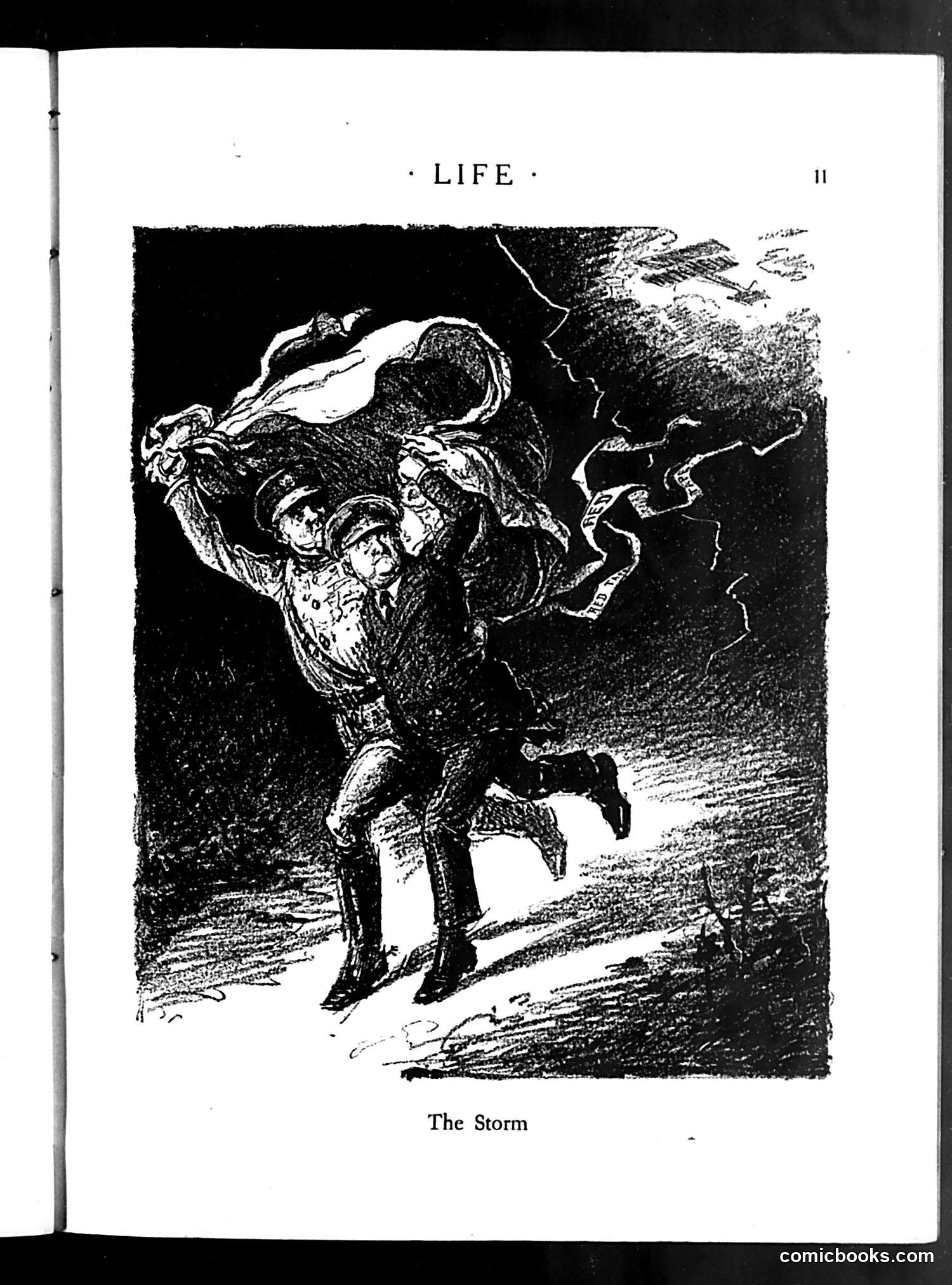
This illustration depicts a soldier struggling against severe weather, holding what appears to be a flag or banner aloft while fighting through wind and rain. The soldier is depicted in military uniform with boots, appearing to advance despite the harsh conditions. The image is titled "The Storm" and likely served as political or social commentary on military perseverance, possibly referencing a contemporary conflict or military campaign. Without additional context or dating information visible on the page, the specific historical reference remains unclear—it could relate to World War I, another period conflict, or metaphorically represent navigating difficult national circumstances. The romantic, heroic framing suggests admiration for military resilience against adversity.
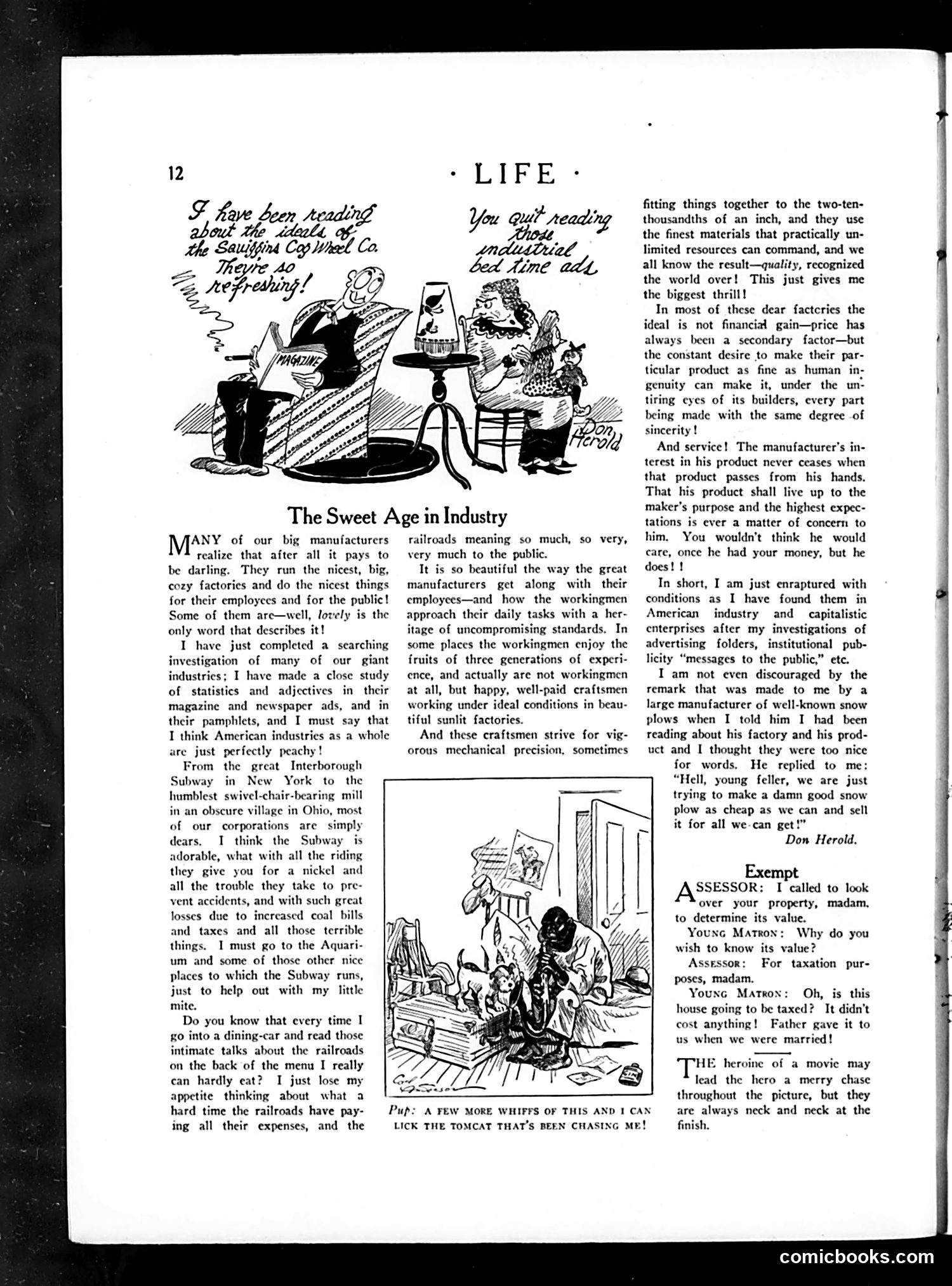
This page celebrates American manufacturing excellence and worker conditions. The main cartoon shows a businessman enthusiastically reading about the "Boston Cop Wheel Co" while relaxing—depicting satisfied consumption of industrial news. The accompanying article praises factories for their precision, quality standards, and worker treatment. The author describes visiting multiple industries and finding craftsmen taking pride in their work, working under "ideal conditions in beautiful full suit factories." A secondary cartoon shows a property assessor arriving to tax a modest home, with a young matron bewildered by unexpected taxation. The "Assessor" dialogue at bottom mocks bureaucratic interruption of domestic life. Overall, the page represents early 20th-century American optimism about industrial progress, worker dignity, and manufacturing superiority—themes aligned with Life magazine's satirical celebration of commercial culture.
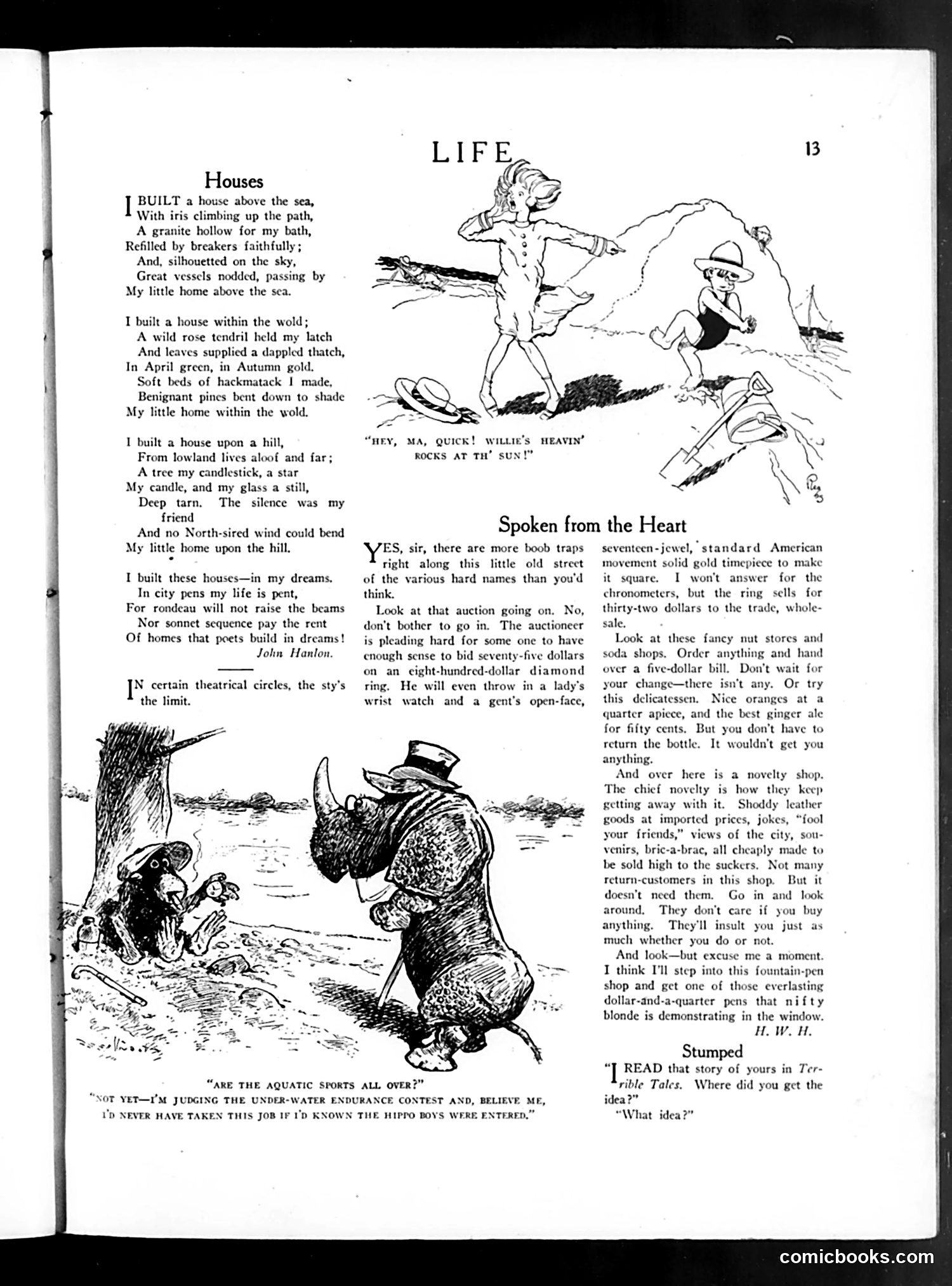
This page contains two unrelated cartoons and a short prose piece titled "Spoken from the Heart." The upper cartoon depicts children at a beach, with one child exclaiming "HEY, MA, QUICK! WILLIE'S HEAVIN' ROCKS AT TH' SUN!" It's a humorous domestic scene capturing childish behavior. The lower cartoon shows a rotund gentleman in formal dress speaking to a small figure by water, captioned "ARE THE AQUATIC SPORTS ALL OVER?" The response reads: "NOT YET—I'M JUDGING THE UNDER-WATER ENDURANCE CONTEST AND, BELIEVE ME, I'D NEVER HAVE TAKEN THIS JOB IF I'D KNOWN THE HIPPO BOYS WERE ENTERED." The joke appears to reference some contemporary athletic competition or event, though the specific reference is unclear today.
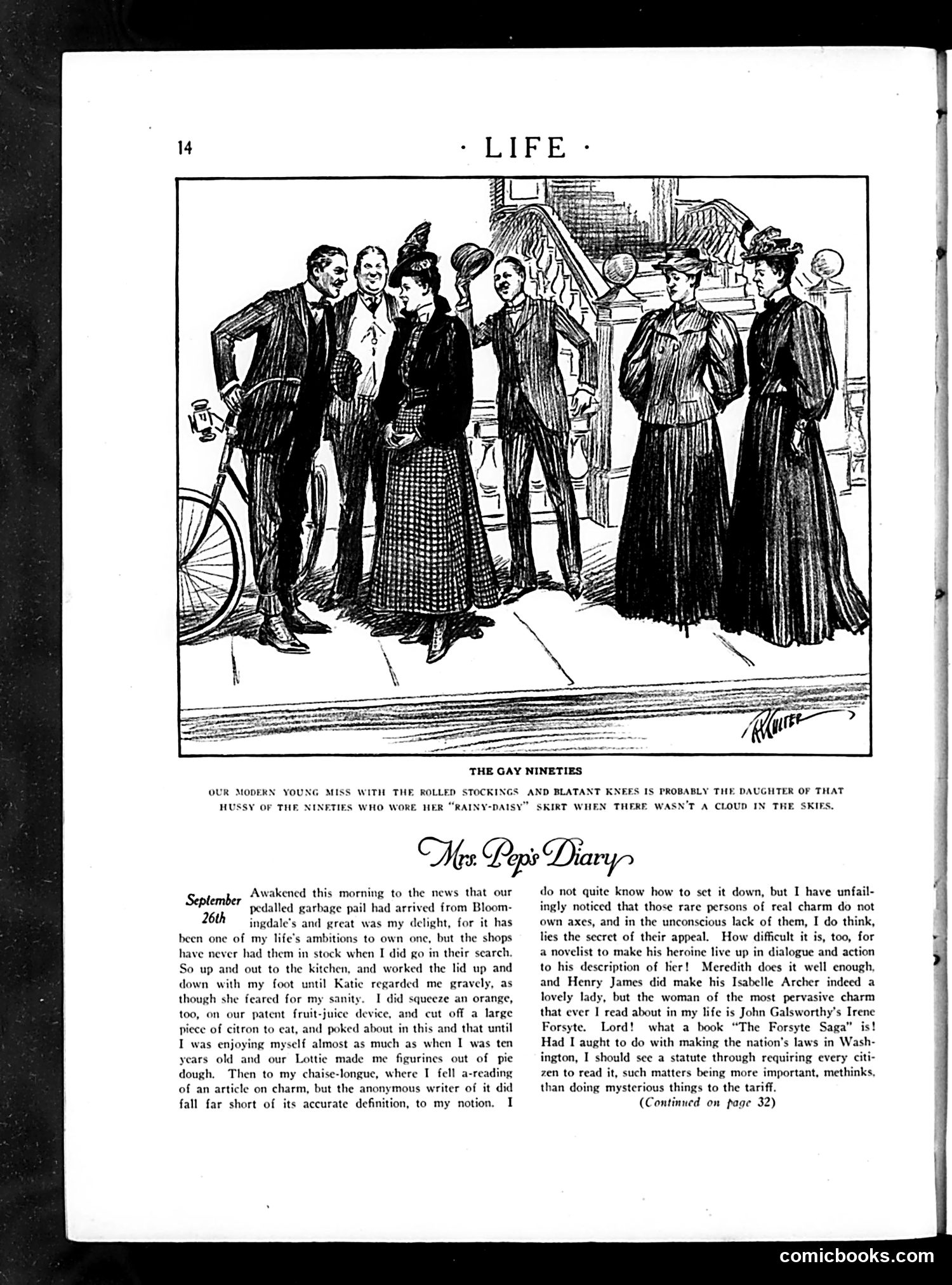
This cartoon satirizes the fashion and social behavior of young women in the 1890s. The caption contrasts modern young women wearing "roller stockings and blatant knees" with their 1890s counterparts who wore long "rainy-daisy" skirts that concealed their legs. The joke targets contemporary (1920s) female fashion as more revealing and socially daring than previous generations. The illustration shows men and women interacting casually on a street, with women in modest floor-length skirts, implying that the 1890s represented stricter propriety. Below, "Mrs. Pop's Diary" begins a serialized column dated September 26th, discussing literature and charm. The satire critiques modern women's liberation through fashion as a departure from Victorian-era modesty standards.
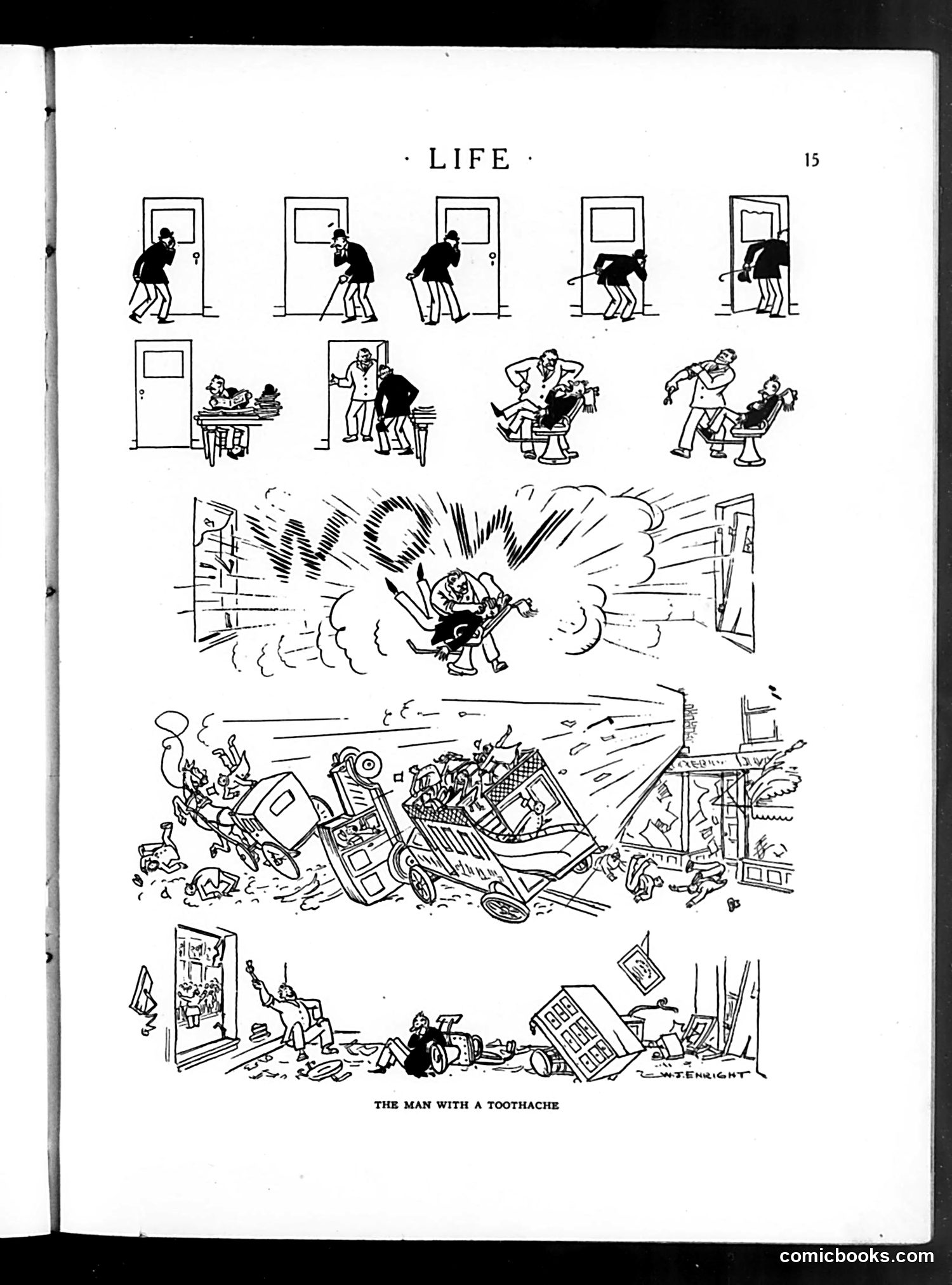
This satirical comic strip from *Life* magazine illustrates the escalating chaos caused by a simple toothache. The sequence shows: **Top panels**: A man experiencing tooth pain, progressing from mild discomfort to increasingly frantic behavior at his door. **Middle panels**: The pain driving him to distraction—sitting with others, growing more agitated. **Large central panel**: An explosion of destruction as the man's pain causes complete mayhem around him. **Bottom panel**: The aftermath—wreckage, debris, and destruction surrounding the suffering patient. The satire uses physical comedy and exaggeration to mock how disproportionately people react to minor ailments. It's a timeless joke about the universal experience of dental pain making someone unbearable to be around, transforming an ordinary person into a destructive force. The humor relies on visual escalation rather than topical reference.
The page features editorial text discussing doomsday prophecies and global instability. The main cartoon (top) depicts a skeletal Death figure looming over a fallen person, illustrating concerns about impending catastrophe. The text references Sir Arthur Conan Doyle's warnings of "a great catastrophe" transmitted through spiritualist mediums, which the editor treats with skepticism. The editorial dismisses sensationalist prophecies while acknowledging real geopolitical tensions: Germany's overcrowding, Japan's position, China's instability, British imperial complications, and Russian upheaval. The cartoons below (small figures) appear to show comic characters reacting anxiously to these warnings. The piece ultimately argues that while serious problems exist, apocalyptic predictions from spiritualists and astrologers shouldn't prevent rational problem-solving by administrators and military leaders.
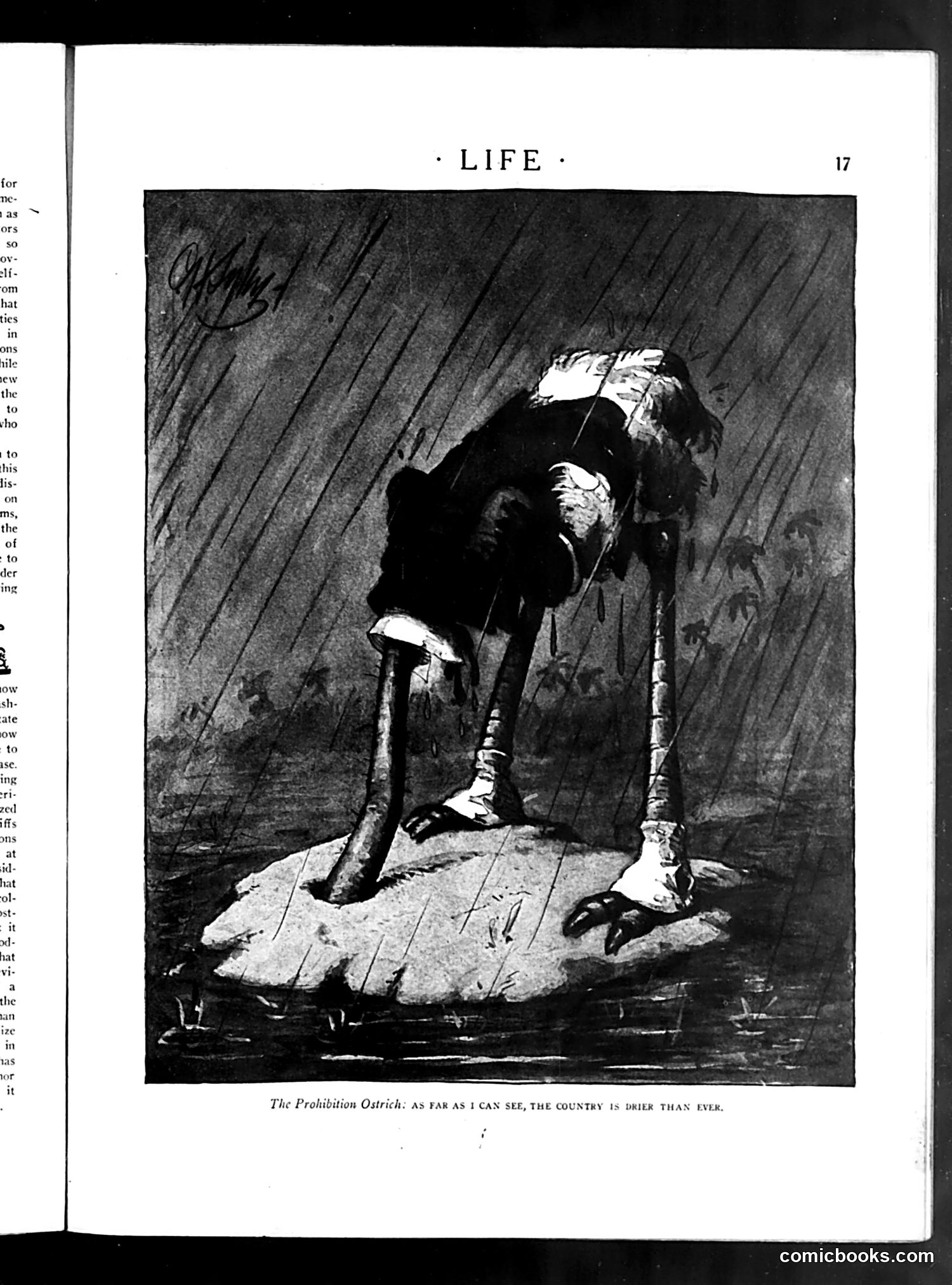
This is a political cartoon satirizing Prohibition-era hypocrisy. The image depicts an ostrich with its head buried in sand—a visual metaphor for willful ignorance. The caption reads: "The Prohibition Ostrich: as far as I can see, the country is drier than ever." The joke critiques government and public officials who claimed Prohibition was succeeding while ignoring obvious evidence of widespread illegal alcohol consumption. Like the ostrich burying its head, authorities pretended not to see the reality of bootlegging, speakeasies, and continued drinking—hence "drier than ever" is clearly false. This reflects widespread contemporary skepticism about whether Prohibition was actually working, despite official pronouncements of success.
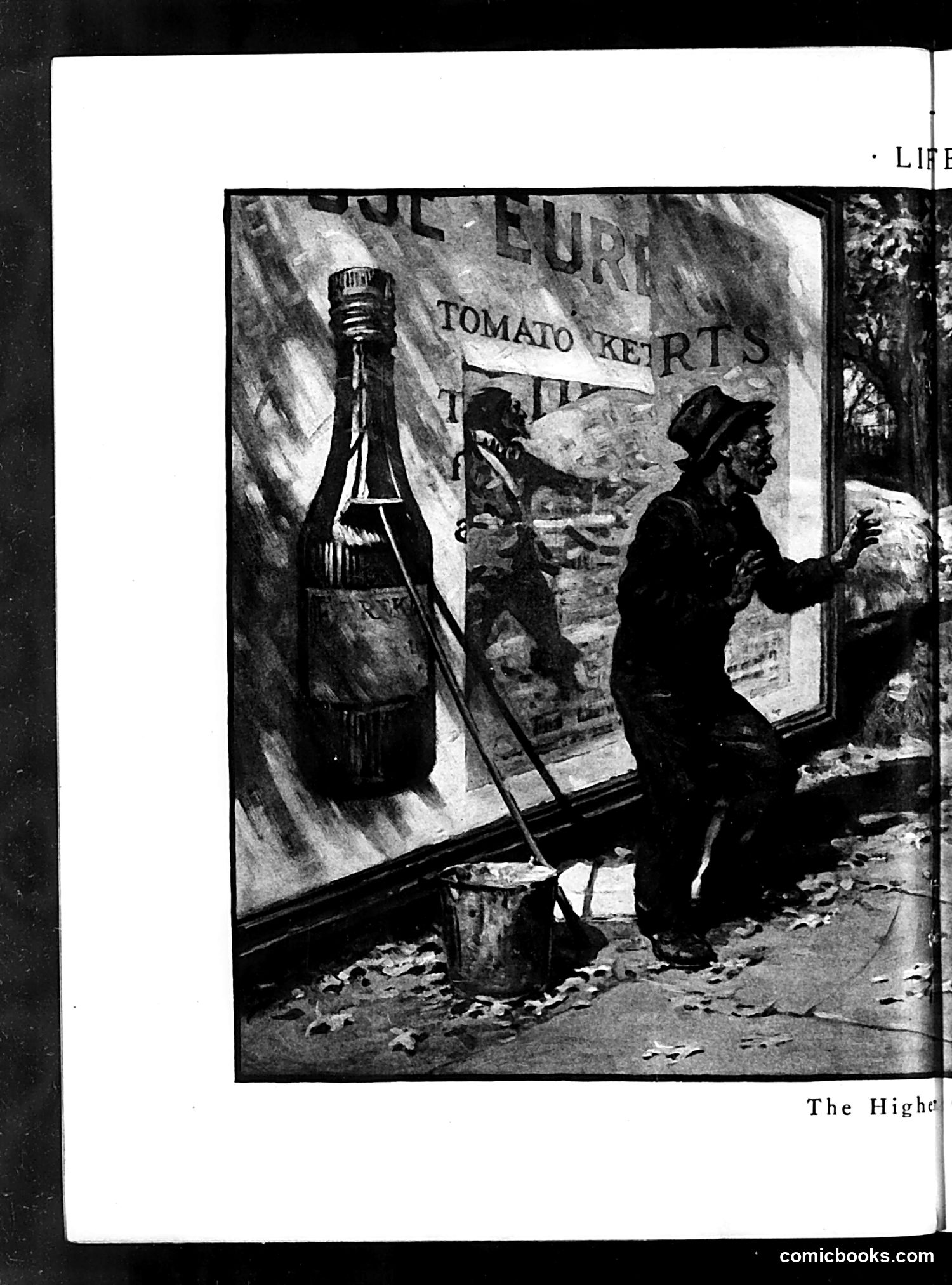
This appears to be a satirical illustration showing two figures examining a large bottle of tomato ketchup displayed in a shop window. The window bears text reading "TOMATO KETCHUP" (partially visible). The satire likely mocks consumer behavior or commercial advertising practices—possibly critiquing how ordinary people are drawn to mass-produced goods, or commenting on commercialism itself. The exaggerated poses and the prominence of the bottle suggest the figures are mesmerized or foolishly attracted to the product. Without additional context from the surrounding text or publication date, the precise political or social target remains unclear. The style and black-and-white reproduction suggest this is from the early-to-mid 20th century, when *Life* magazine regularly published such consumer-culture satire.
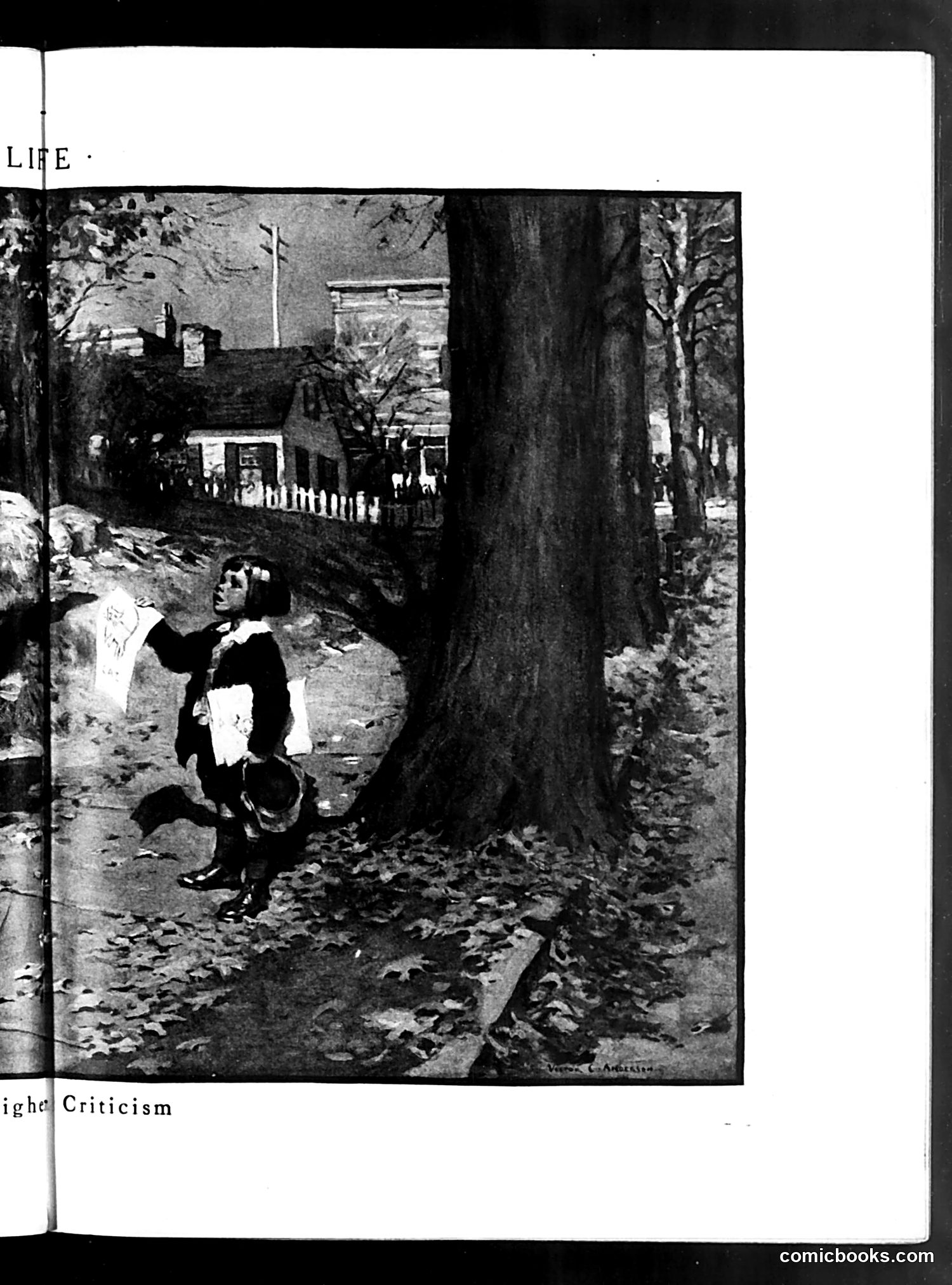
This appears to be a page from *Life* magazine showing a black and white photograph rather than a cartoon. The image depicts a person kneeling beneath a large tree in what appears to be a cemetery or graveyard setting. A white cross is visible in the background, along with a small house with a fence and bare trees suggesting autumn or winter. The visible text fragment reads "ight Criticism" (likely "Light Criticism" or similar), though without the full caption or article text, the specific satirical point is unclear. The somber, religious imagery—the cross, the graveyard, the kneeling figure—suggests the piece comments on spiritual or moral matters, but the exact subject and target of the satire cannot be determined from the image alone.
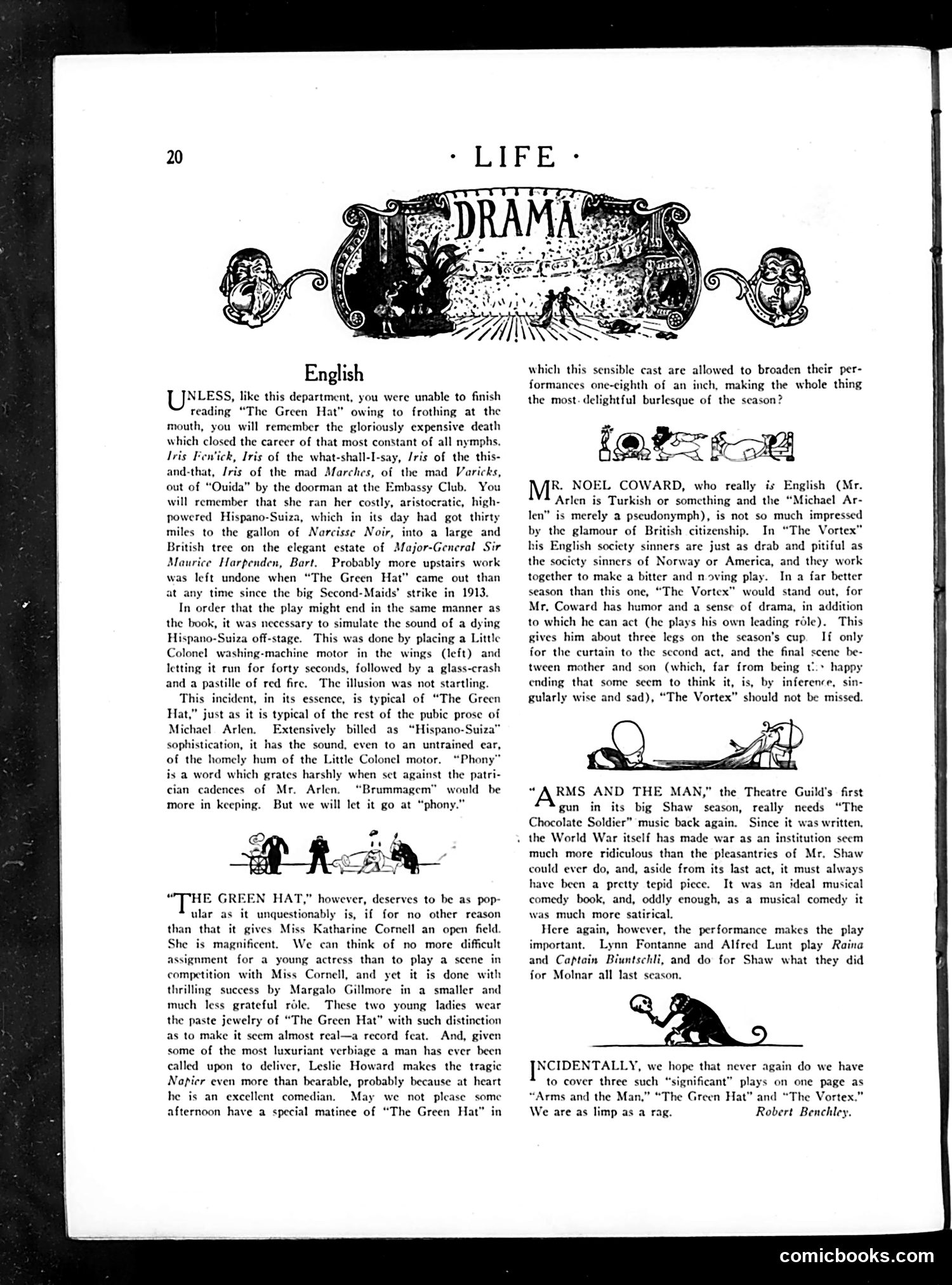
This page reviews three Broadway plays through satirical theater criticism. The main target is **"The Green Hat,"** adapted from Michael Arlen's novel about wealthy, dissolute aristocrats. The reviewer mocks the production as phonily glamorous—comparing its attempt at sophistication to a cheap "Little Colonel washing-machine motor" masquerading as a sophisticated Hispano-Suiza automobile. The elaborate sound effect (washing machine motor, glass crash, red fire) meant to simulate a car crash typifies the artificiality. The satire works on two levels: **Arlen himself** is ridiculed as a Turkish writer (not truly English, despite his pseudonym) trafficking in hollow "Brummagem" (fake/cheap) sophistication. Yet the **cast**—especially Katharine Cornell—is praised for elevating mediocre material through genuine talent. By contrast, **Noël Coward's "The Vortex"** receives genuine praise: Coward, actually English, brings wit and moral seriousness to similar society settings, avoiding pretense. The comparison positions authentic artistry against fashionable emptiness—a typical Life magazine critique of 1920s cultural pretension.
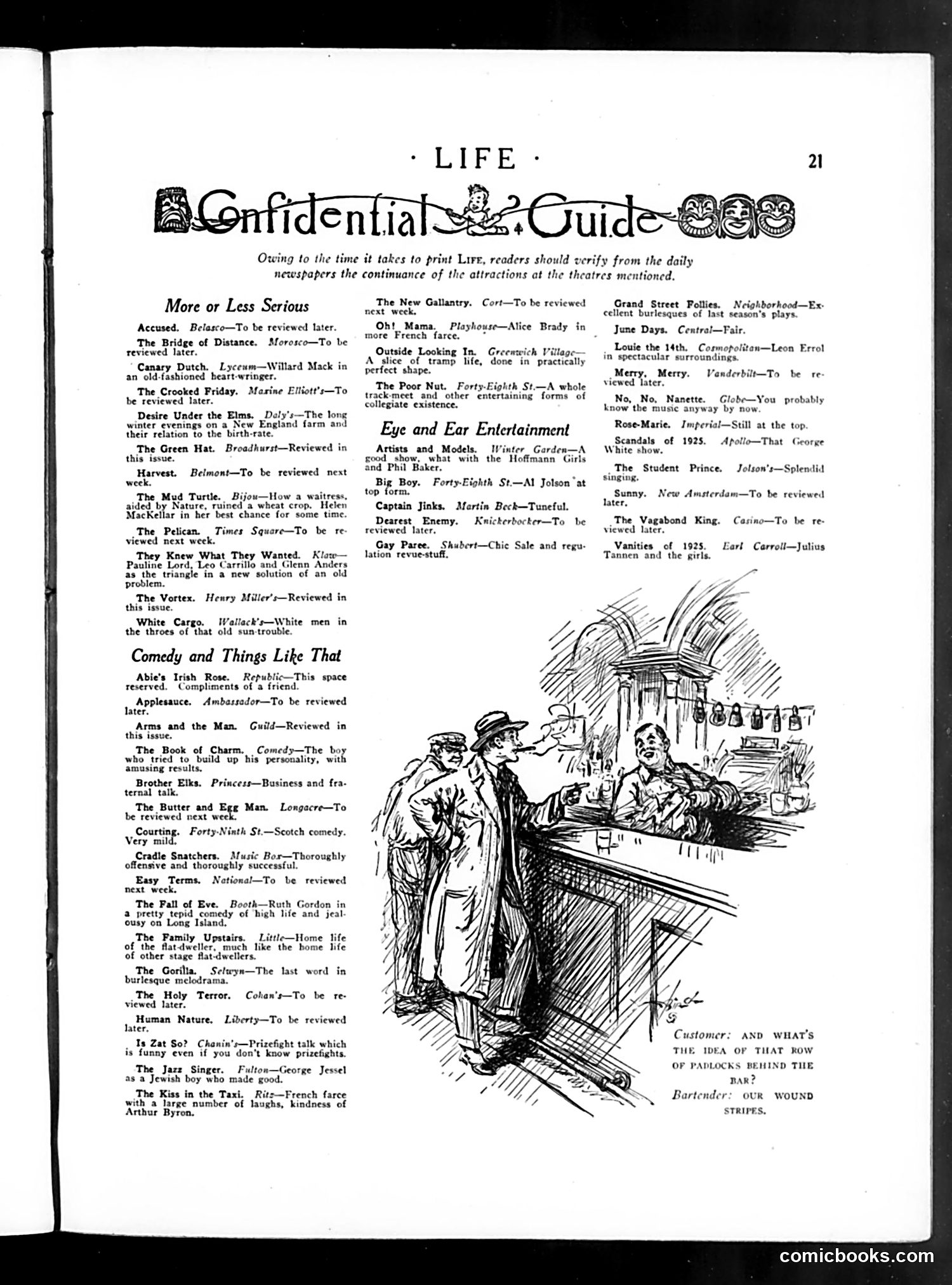
This page is a **theatre review guide** listing Broadway shows currently running, organized by genre (serious dramas, comedies, musical entertainment). It's not primarily satirical—it's a practical listing for readers. The cartoon below depicts a **Prohibition-era joke**. A customer asks a bartender about "that row of padlocks behind the bar," with the bartender responding "our wound stripes." The satire: During Prohibition (1920-1933), bars operated illegally as speakeasies. The "wound stripes" reference compares the padlocks to military decorations—suggesting the bar's repeated police raids and closures are like battle wounds or medals of honor from fighting law enforcement. It's dark humor about organized crime's role in illegal alcohol service and the cat-and-mouse game between speakeasies and authorities. The joke assumes readers understand Prohibition's prevalence and the speakeasy culture of 1920s urban life.
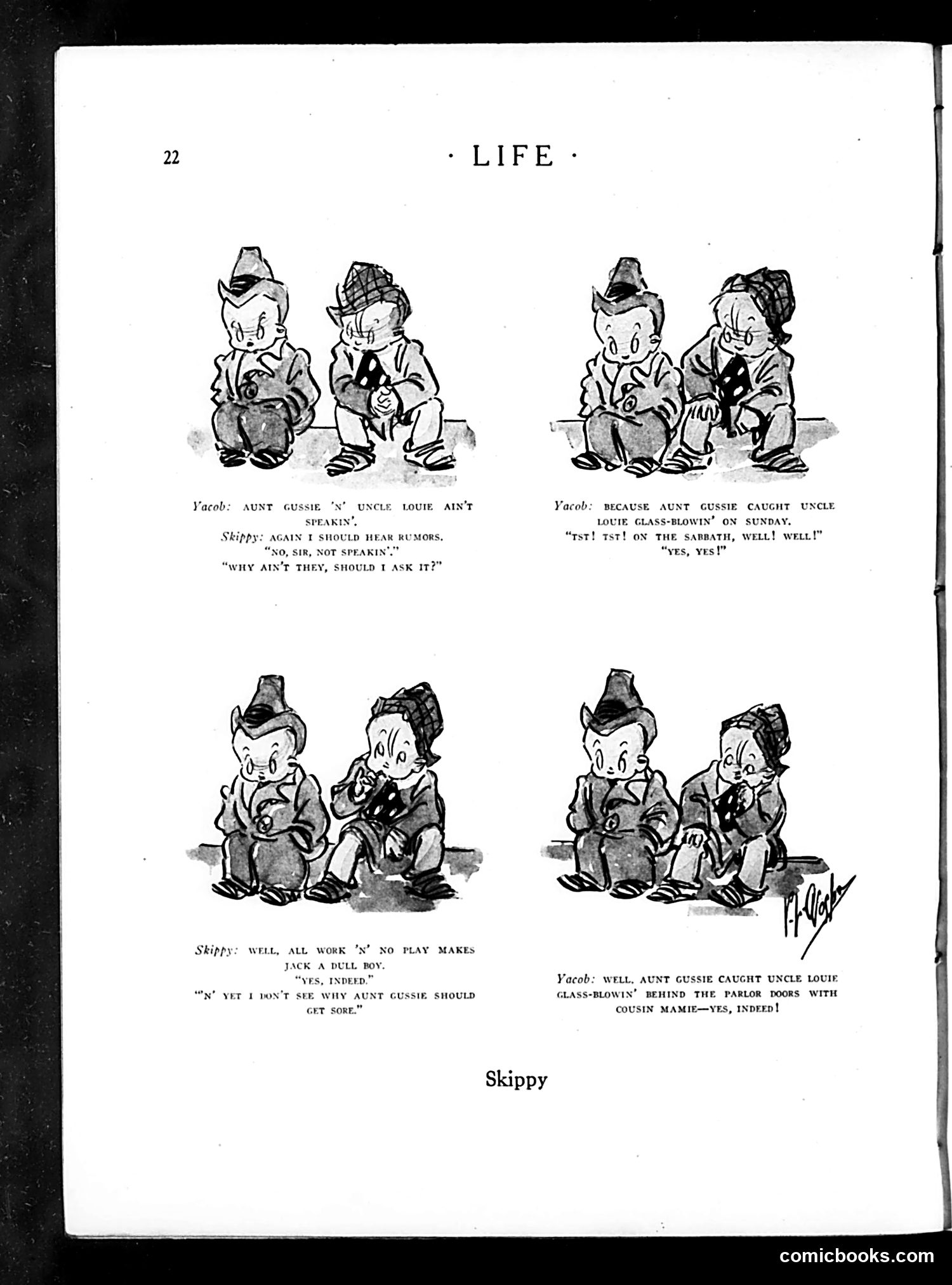
This comic strip satirizes Jewish immigrant culture and Sabbath observance circa early 20th century. Two boys (Yacob and Skippy) discuss why relatives aren't speaking. Yacob explains Aunt Gussie caught Uncle Louie performing glassblowing—work—on Sunday/the Sabbath, violating religious law. Skippy quips that work prevents dullness, questioning why Gussie is upset. The humor relies on ethnic stereotyping: the characters' accented dialect ("ain't," "n'"), the reference to traditional Jewish Sabbath restrictions, and the implicit critique that immigrants rigidly cling to Old World rules while assimilating American values. The final panel adds innuendo—catching Uncle Louie "behind parlor doors with Cousin Mamie"—suggesting scandalous behavior excuses the religious violation. The satire mocks both strict religious observance and the generational/cultural tensions within immigrant communities.
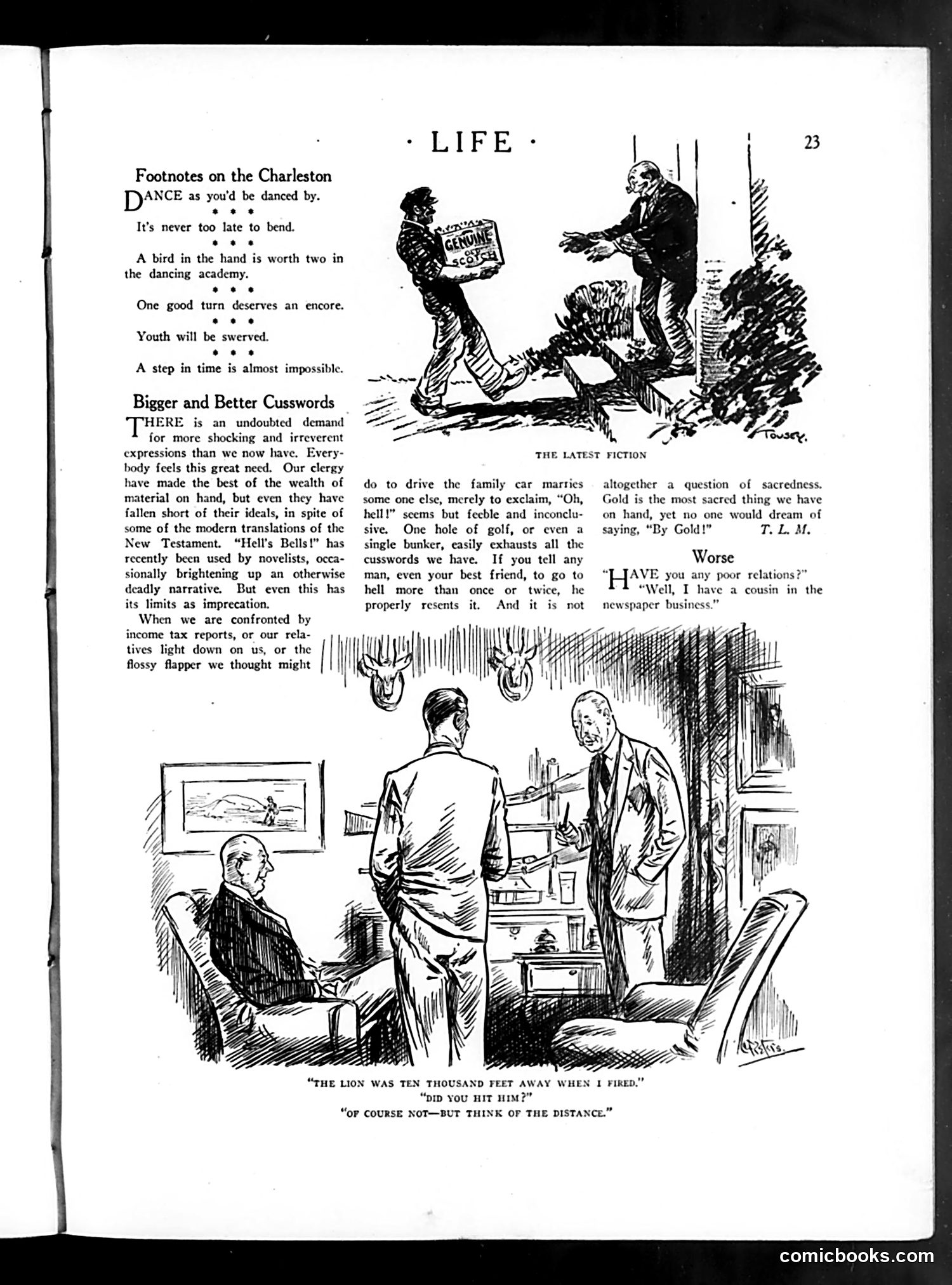
This page from *Life* magazine contains three separate satirical pieces reflecting 1920s social attitudes: **"Footnotes on the Charleston"** mocks the popular Charleston dance craze through absurdist aphorisms ("Youth will be swerved"), poking fun at both the dance itself and those obsessed with dancing academies. **"Bigger and Better Cusswords"** satirizes social hypocrisy regarding profanity. The author notes clergy and novelists use mild expletives like "Hell's Bells!" but argues modern frustrations (income taxes, lost romance, bad golf) demand stronger language. The piece implies society arbitrarily restricts cursing while venerating money—highlighting absurd moral priorities. **"The Latest Fiction"** cartoon mocks exaggerated hunting stories. Two men discuss a hunter's claim of firing at a distant lion; when asked if he hit it, he admits "no" but boasts about the impressive distance—exemplifying the tall-tale tradition of prioritizing the story's grandeur over actual accomplishment. All three pieces reflect 1920s anxieties about modernization, changing morality, and generational conflict.
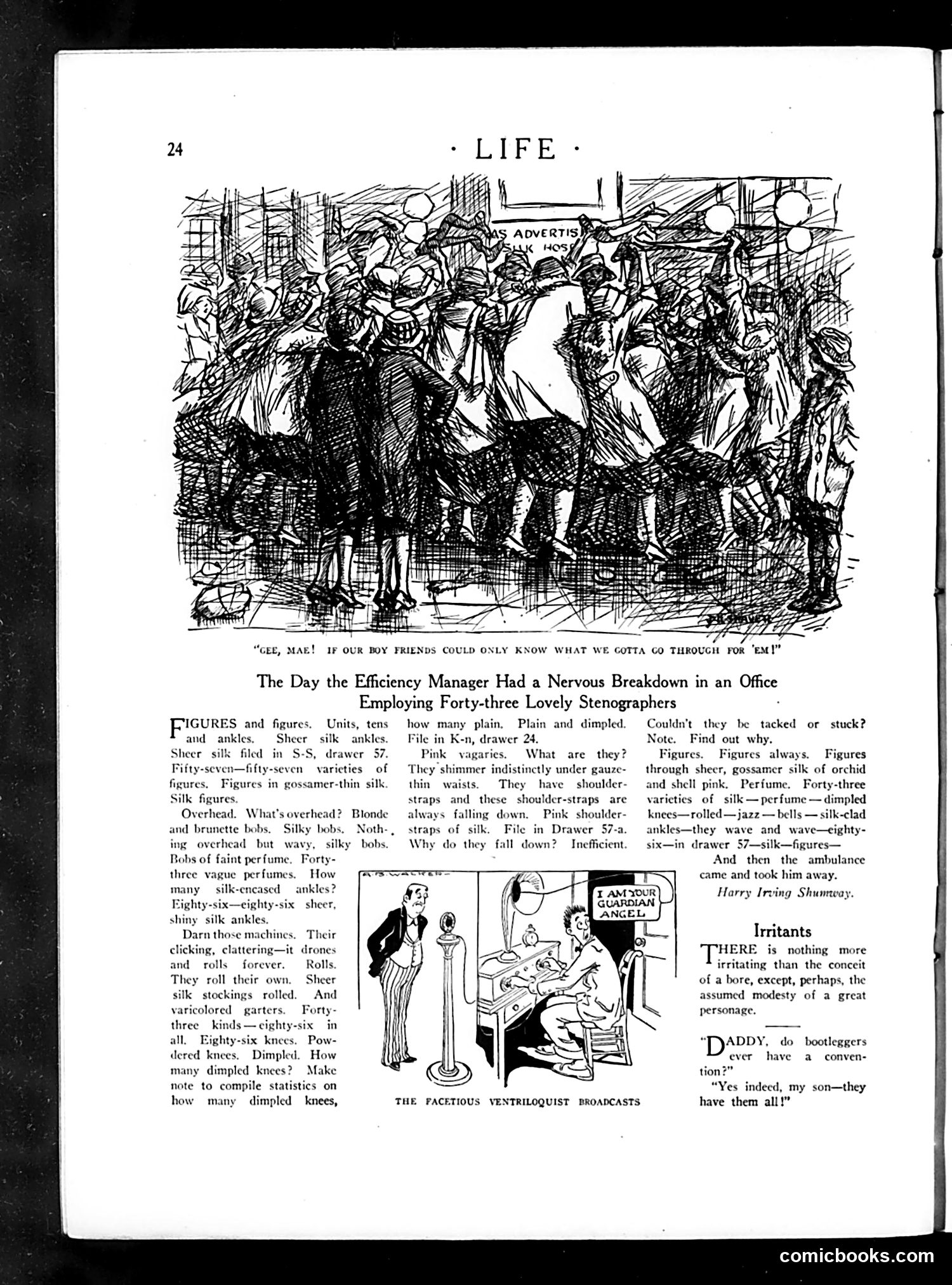
This 1920s *Life* magazine page satirizes workplace inefficiency and male anxiety about women in offices. The main cartoon depicts an "efficiency manager" overwhelmed by managing 43 female stenographers (secretaries). The humor targets his nervous breakdown caused by obsessing over minutiae—silk stockings, shoulder-straps, perfume, dimpled knees—quantifying female employees' physical attributes rather than their work. The satire works on multiple levels: it mocks both the obsessive "efficiency" management craze of the era and the male gaze that reduces working women to decorative bodies. The opening caption ("If our boy friends could only know...") suggests these stenographers endure absurd scrutiny from authority figures. The smaller cartoon about a "ventriloquist broadcaster" and the "Irritants" section are unrelated humor pieces. Overall, the page reflects anxieties about women entering the workforce—portraying male managers as comically unable to manage professional environments once women are present.
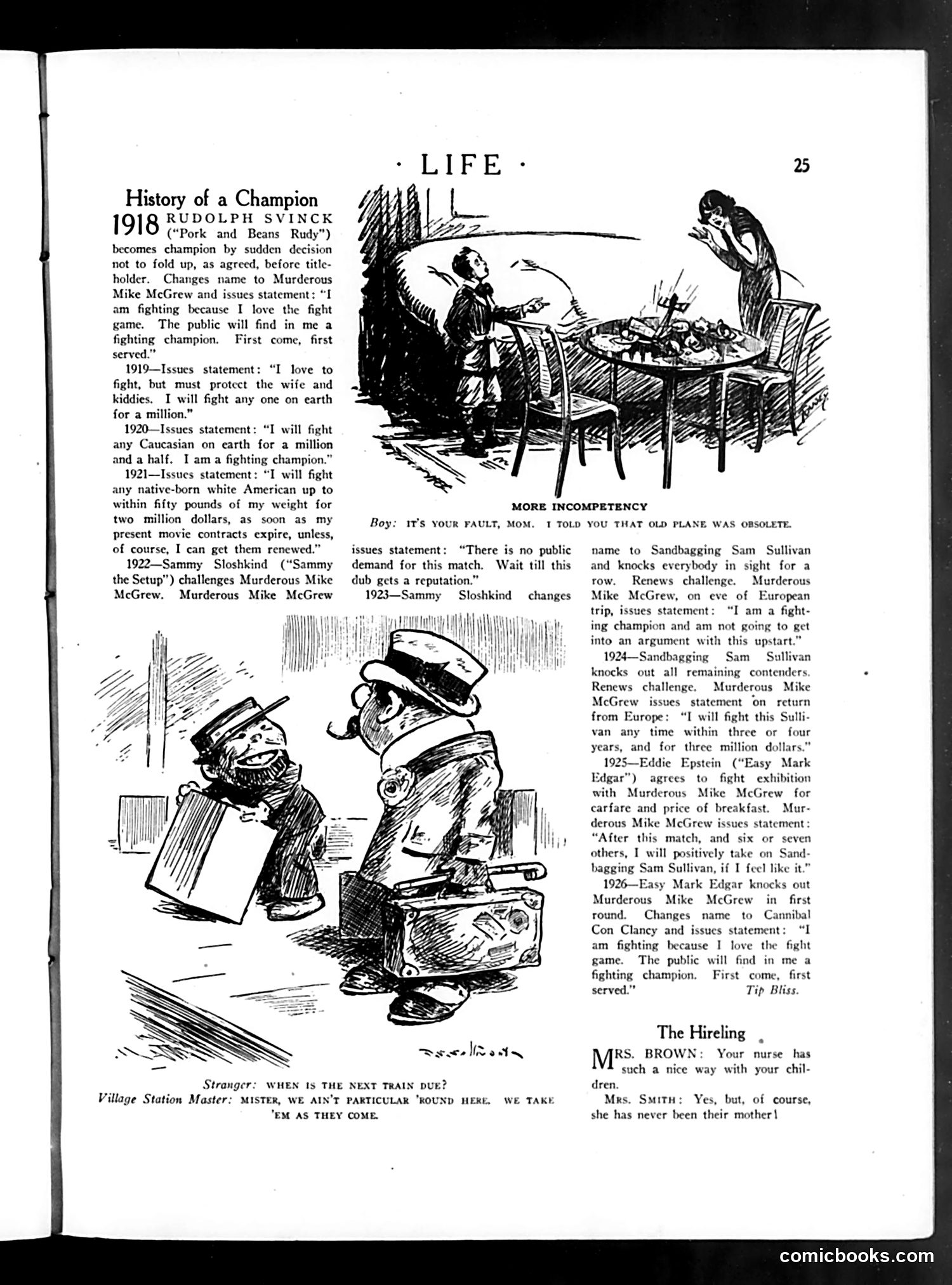
This page satirizes boxing and fighter behavior through the fictional "History of a Champion." The joke tracks how "Rudolph Svinck" (later "Murderous Mike McGrew") constantly makes excuses to avoid fighting, despite claiming to love boxing. Each year he issues contradictory statements—first willing to fight anyone for a million dollars, then adding racial restrictions, then citing movie contracts, then claiming lack of public demand. When finally defeated by "Easy Mark Edgar," he simply reinvents himself as "Cannibal Con Clancy" and repeats the same cycle. The satire mocks boxers' self-serving contradictions and their pattern of ducking real challengers while maintaining a public image as fearless fighters. It's commentary on the professional boxing world's phoniness and backpedaling. The other cartoons on the page (the train station master, the airplane joke, the nurse anecdote) are separate, unrelated gags typical of Life magazine's humor format.
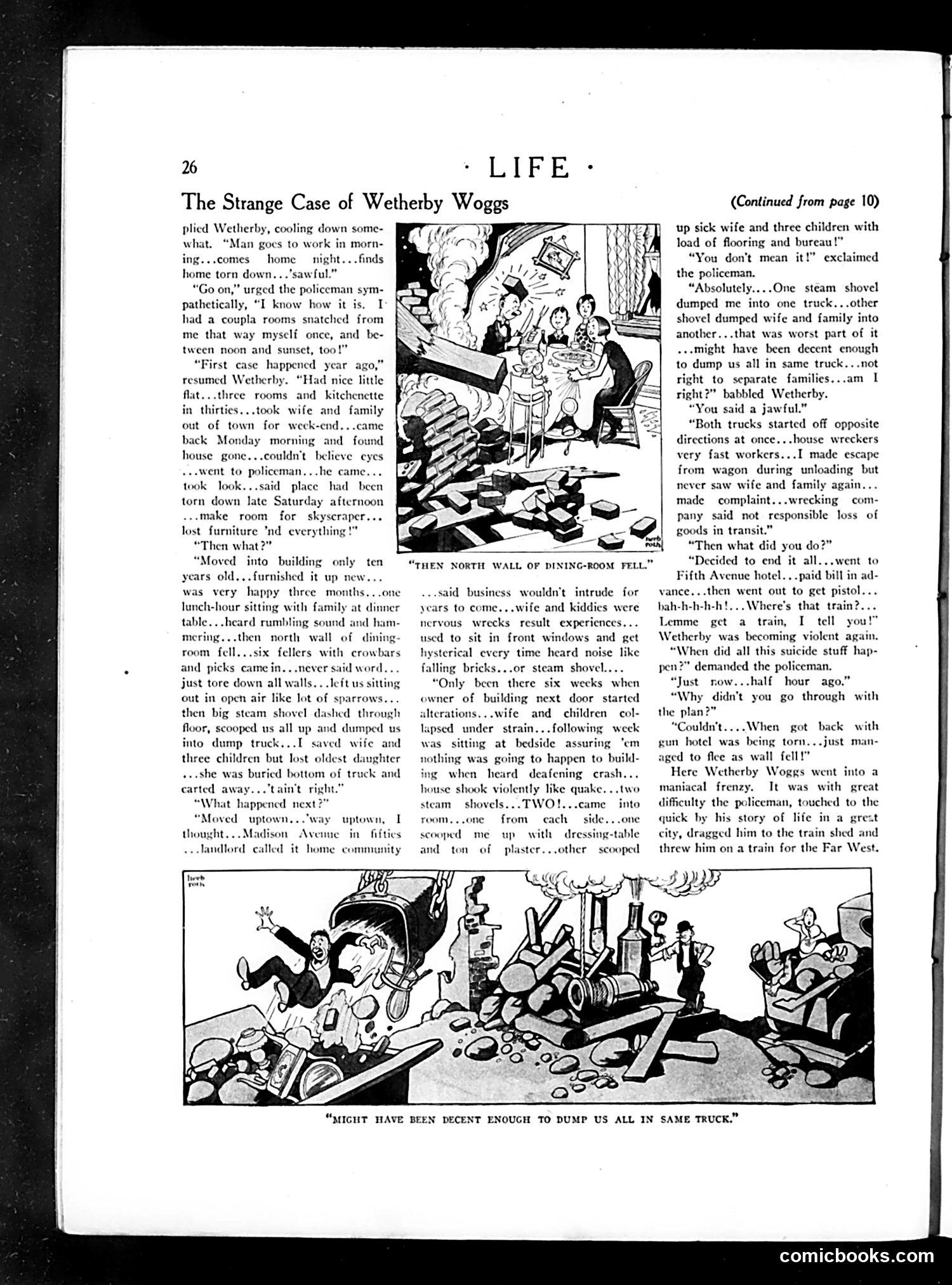
This satirical story mocks the frenetic pace of 1920s-30s urban development in New York City. Wetherby Woggs is an ordinary man repeatedly displaced as buildings around him are demolished for skyscrapers and "progress." Each time he relocates, the same thing happens—his new home is torn down almost immediately. The joke centers on the absurdity of unchecked demolition and real estate speculation: Woggs loses his apartment, furniture, and even his daughter in the chaos. When he finally decides to end his life over this misery, a building collapses while he's retrieving a gun, forcing him to flee yet again. The satire critiques both the callous indifference of property developers (who refuse liability for displaced families) and the city's prioritization of construction over human welfare. A sympathetic policeman—himself a victim of similar displacement—validates Woggs's frustration, suggesting this was a widespread urban experience for ordinary residents.
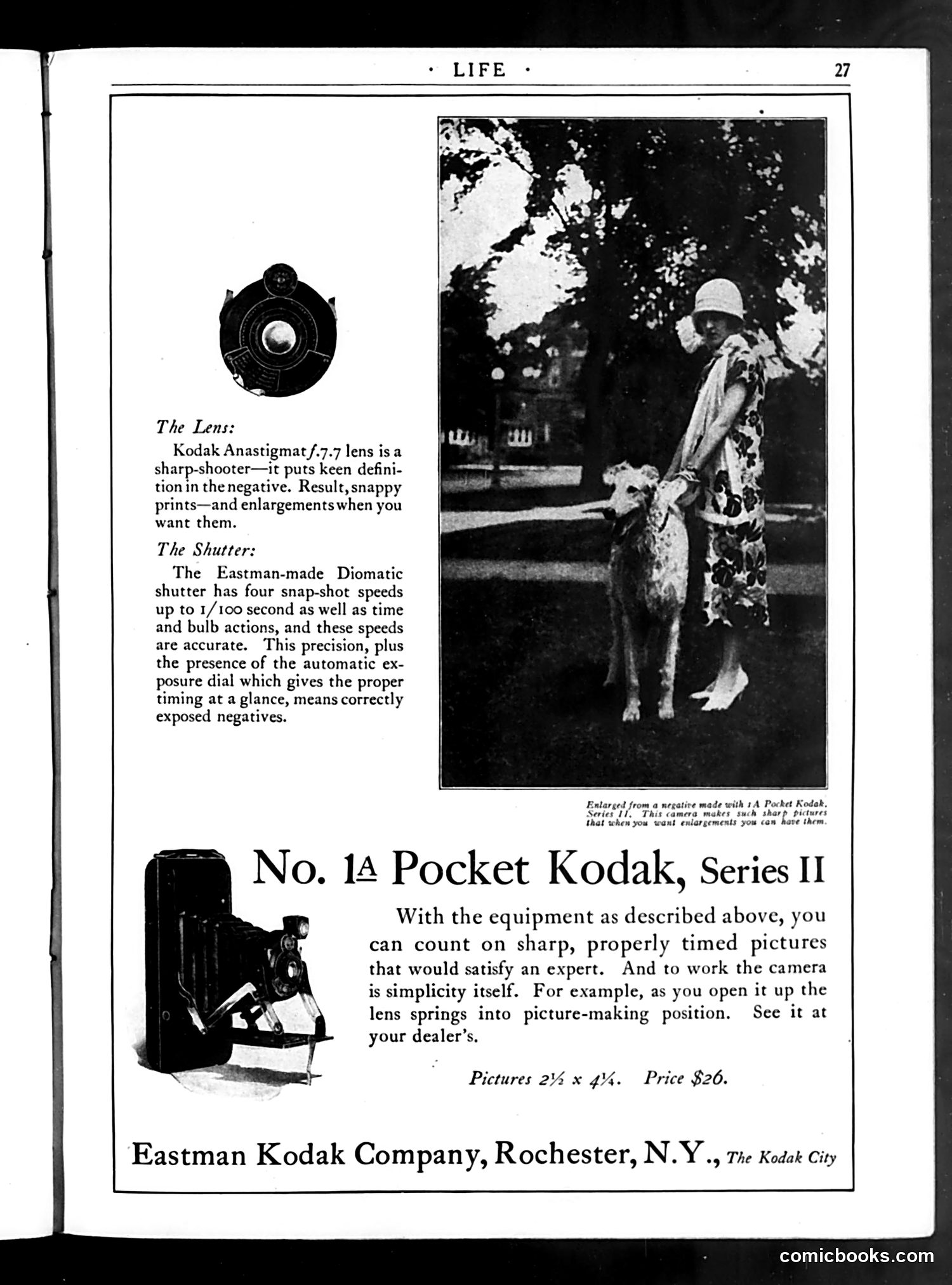
This page is primarily a **product advertisement** for the No. 1A Pocket Kodak camera, not a political cartoon or satirical content. The ad features technical specifications (lens, shutter speeds) and includes a photograph of a woman with a dog to demonstrate the camera's picture quality. The accompanying text emphasizes the camera's simplicity and professional results—key selling points for consumer photography in the early 20th century. The only potentially "comic" element is implicit: the advertisement appears in *Life* magazine, which was known for satirical humor, creating a contrast between the magazine's typical comedic content and straightforward product promotion. However, there is no actual satire, caricature, or political reference on this page—it's simply commercial advertising using a domestic snapshot to showcase camera capability.
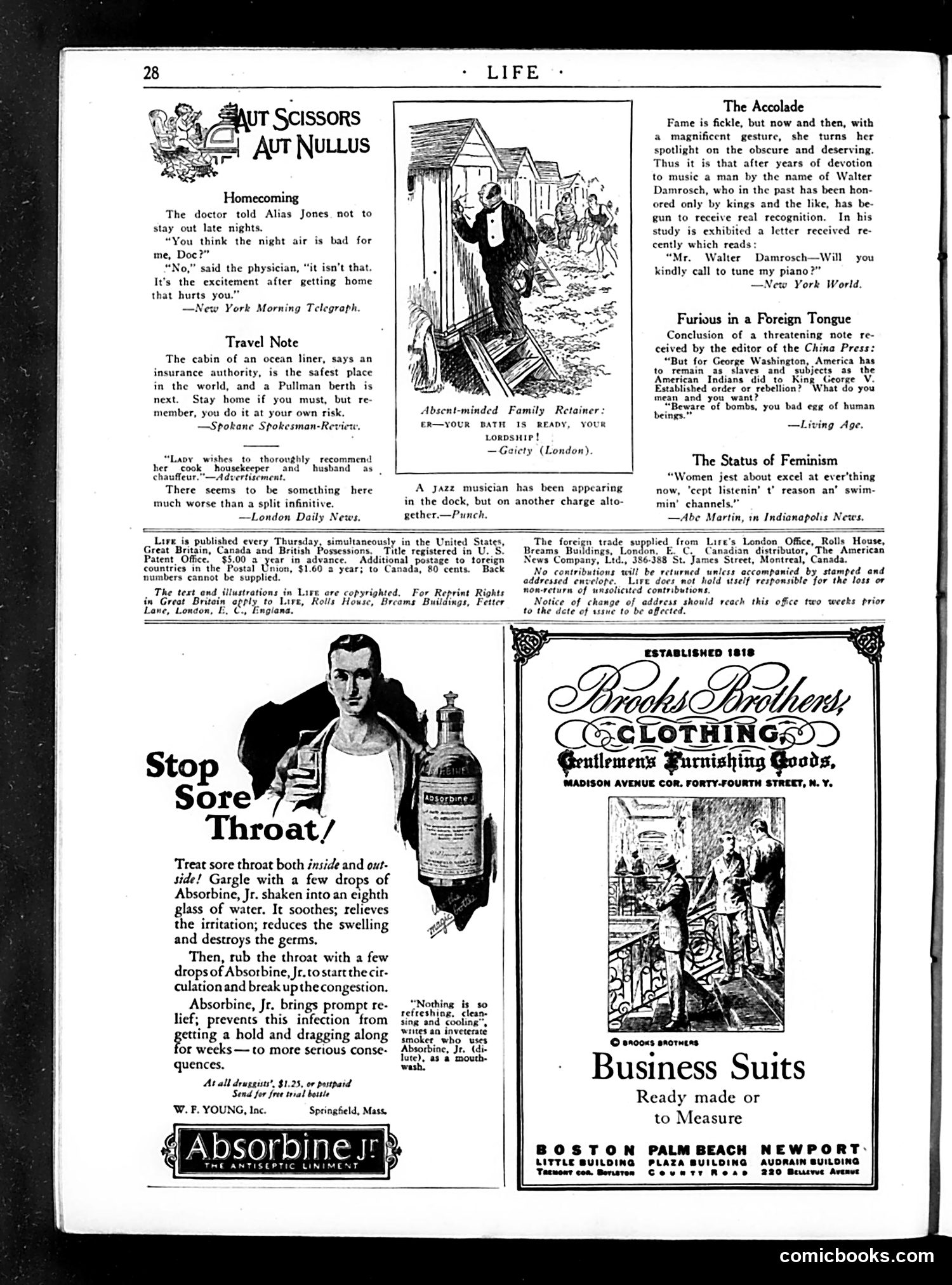
This page from *Life* magazine contains several brief satirical pieces typical of the publication's humor section: **"Homecoming"** jokes about a doctor's real concern—the marital excitement after a husband returns home late, not the night air itself. The humor lies in the unstated implication about domestic life. **"Absent-minded Family Retainer"** shows a servant addressing his employer formally as "your lordship" while the household is in chaos—satirizing the absurdity of maintaining class pretense amid disorder. **"The Accolade"** celebrates conductor Walter Damrosch receiving recognition: a society woman's request to tune her piano. The satire is that after years of artistic achievement, his "real" recognition comes from a mundane domestic task—mocking how celebrities are valued. **"The Status of Feminism"** quotes a colloquial voice claiming women excel at everything except listening to reason and swimming—a sexist joke presented as folk wisdom, reflecting period attitudes toward women's liberation. The page is primarily text-based humor with period advertisements for Absorbine Jr. (throat treatment) and Brooks Brothers clothing.
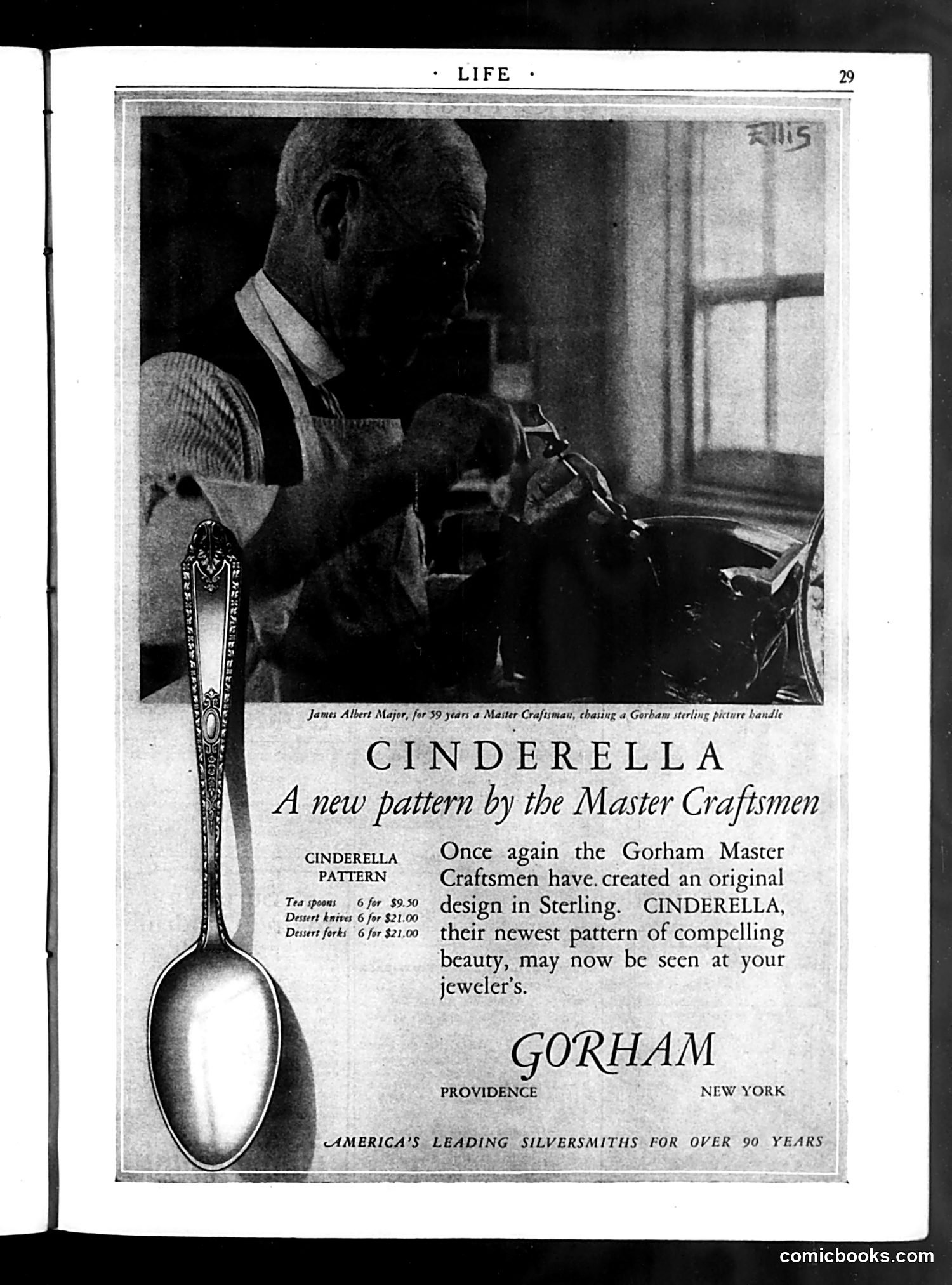
This is **not a cartoon or satire page** — it's a full-page advertisement for Gorham silverware, a legitimate jewelry company. The page advertises the "Cinderella" pattern, a new sterling silver flatware design. The image shows James Albert Major, identified as a master craftsman with 59 years experience, working on ornamental silver handles. Pricing is listed for tea spoons, dinner knives, and dessert forks. The "Cinderella" name is simply a commercial product title, not a political or social reference. Gorham positions itself as "America's Leading Silversmiths for over 90 years," targeting affluent consumers who could afford luxury tableware. This represents typical early 20th-century *Life* magazine content: upscale advertising mixed with editorial material.
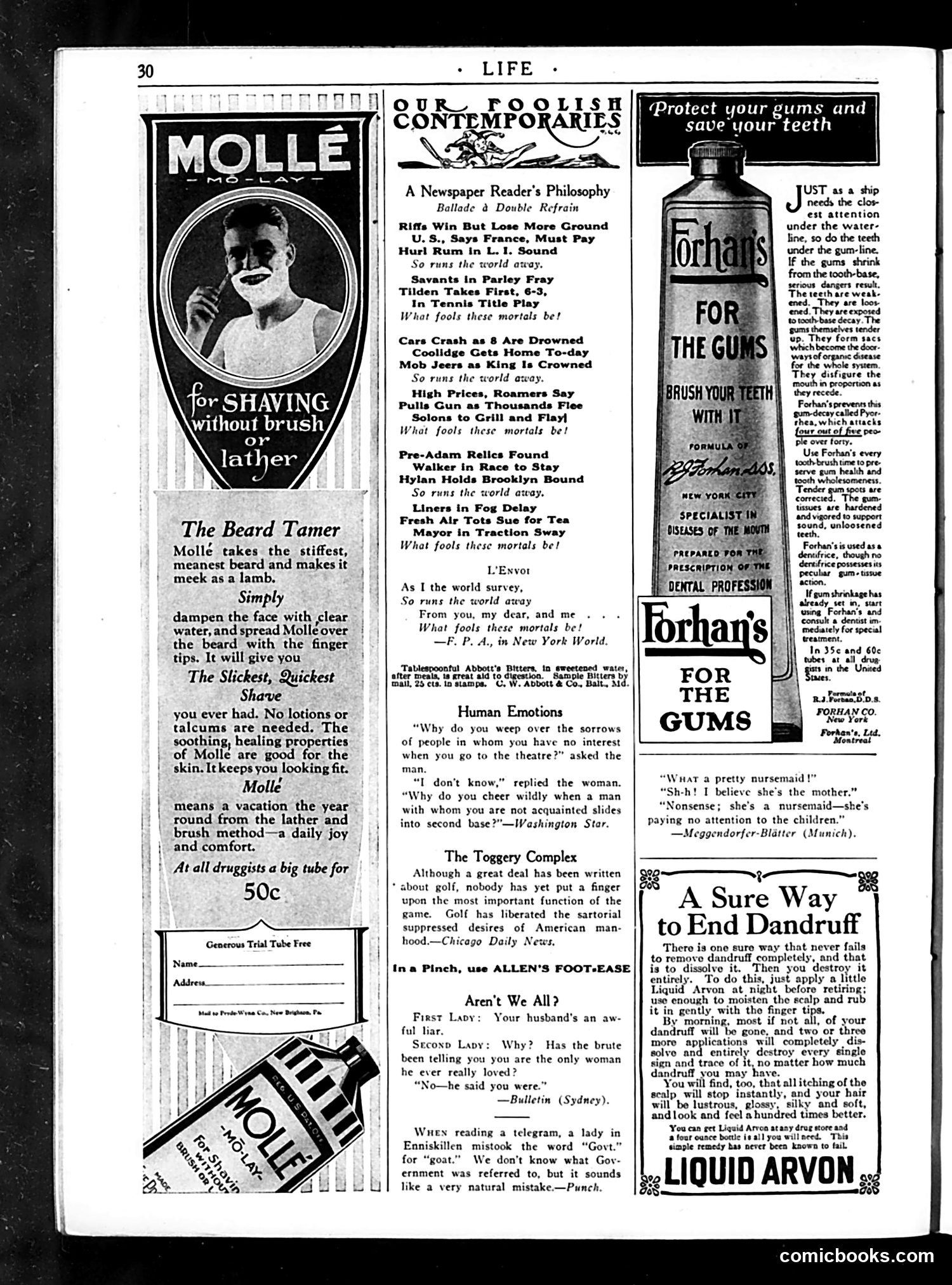
This page is primarily **advertising** interspersed with light satirical content typical of 1920s Life magazine. **Main Features:** The left column advertises **Mollé shaving cream**, emphasizing convenience and skin benefits—a standard grooming product pitch. The center contains **"Our Foolish Contemporaries,"** a satirical column mocking newspaper headlines of the day. Using a poetic refrain structure ("So runs the world away"), it ridicules the sensationalism and chaos of contemporary news—from political upheaval (Coolidge, French reparations) to crime, accidents, and frivolous society gossip. The satire targets journalism itself for amplifying human folly. Below are brief humorous anecdotes about theater emotions, golf culture, and marital dynamics—light social commentary. The right column advertises **Forhan's dental products**, claiming special gum-tissue benefits—a targeted health ad. **Context:** This reflects 1920s anxiety about modern life's pace, media sensationalism, and emerging consumer culture addressing everyday insecurities.
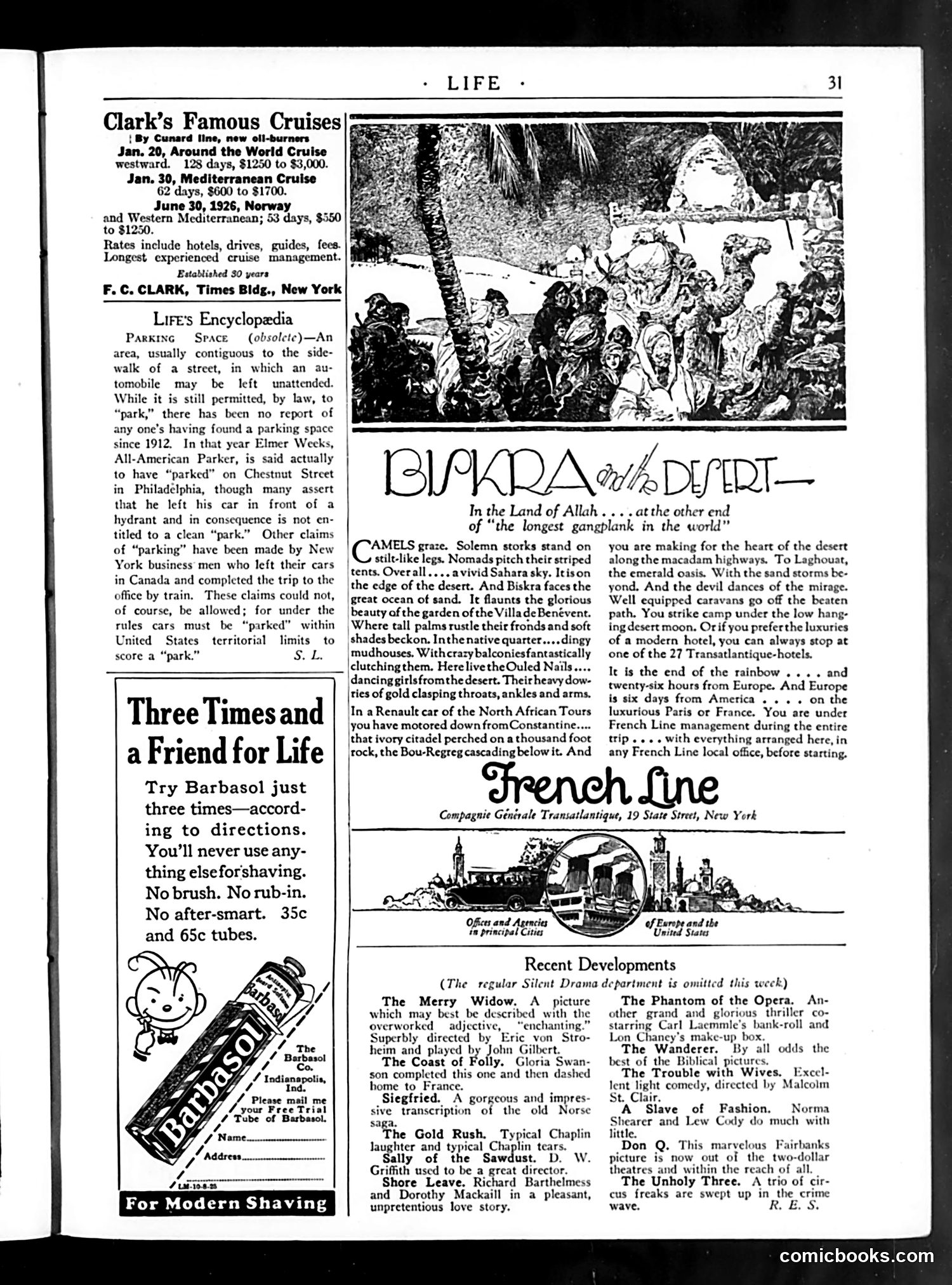
This page is primarily **advertising and entertainment listings**, not political satire. Key elements: **Advertisements:** - Clark's cruise packages (luxury travel to Mediterranean, around the world) - Barbasol shaving cream (promoting "modern" brushless shaving) - French Line steamship company (advertising transatlantic voyages to Europe) **Editorial Content:** - "Life's Encyclopedia" entry on "Parking Space (obsolete)" — a humorous definition mocking the 1920s urban parking crisis, claiming no one has successfully parked since 1912 except "Elmer Weeks" in Philadelphia - "Recent Developments" — brief film reviews of contemporary movies (*The Merry Widow*, *Siegfried*, *The Gold Rush*) - "Biskra and the Desert" — travel promotion for North African tourism via Renault cars and French steamships **Social Context:** The parking joke reflects genuine 1920s frustrations with automobile congestion in American cities. The luxury travel ads target wealthy readers during the prosperous pre-Depression era.
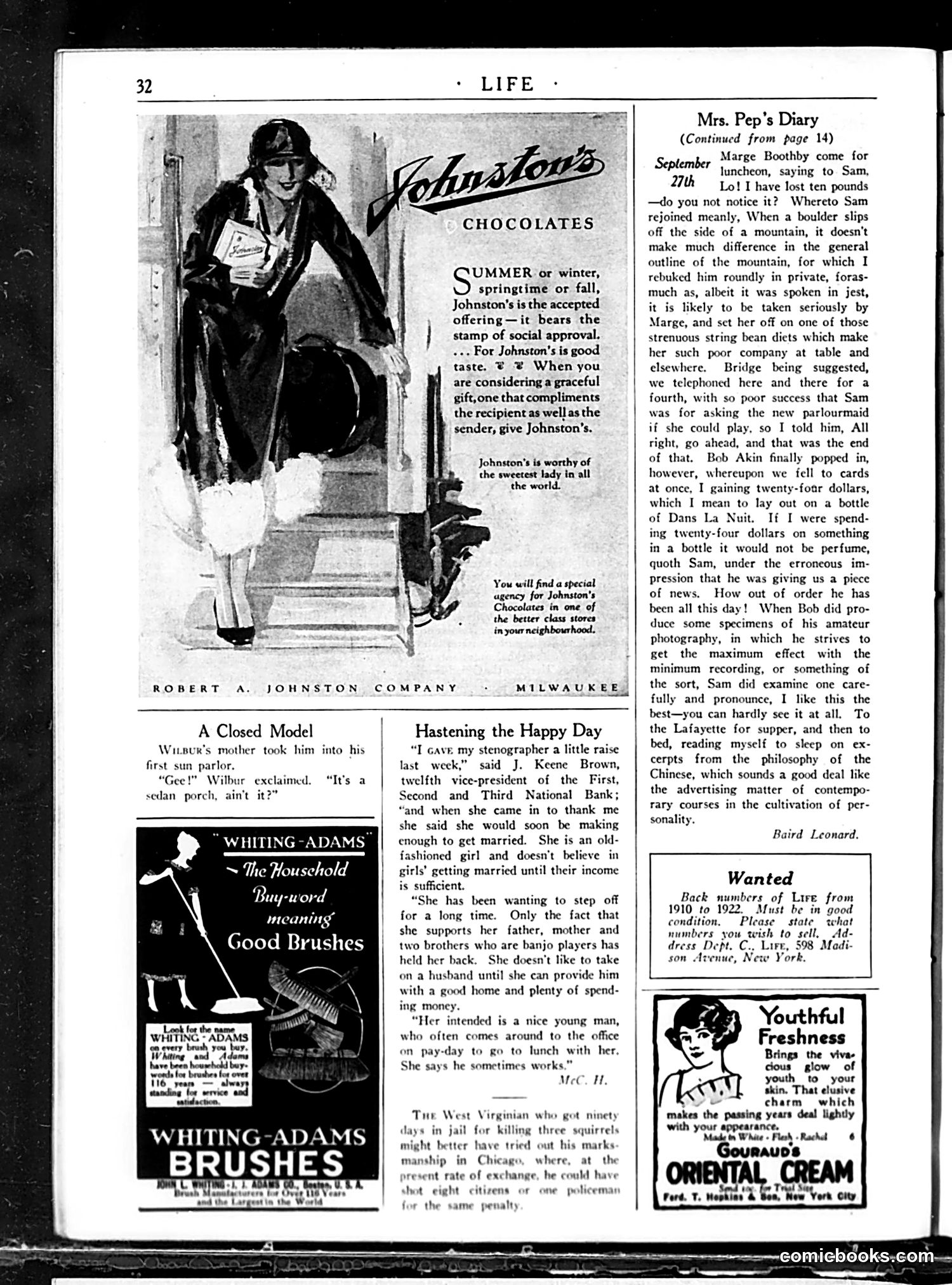
This page mixes advertisements with satirical humor pieces typical of Life magazine's format. **Main Content:** The page features three satirical anecdotes mocking social pretense: 1. **"A Closed Model"**: A joke about a mother showing her son a sun parlor, which he mistakes for a "sedan porch"—humor based on class confusion and outdated slang. 2. **"Hastening the Happy Day"**: A banker's self-congratulatory story about giving his stenographer a raise, ironically revealing she supports her entire family while her unemployed fiancé only visits on paydays. The satire targets male obliviousness to economic realities and false generosity. 3. **Chicago squirrel-hunting joke**: Dark humor comparing shooting squirrels to shooting Chicago citizens, mocking the city's crime and corruption. **"Mrs. Pep's Diary"**: A gossipy society column featuring petty domestic drama—her husband's insults, card games, perfume purchases—satirizing upper-class women's shallow concerns. **Advertisements** for Johnston's Chocolates, Whiting-Adams brushes, and Gouraud's Oriental Cream fill remaining space, typical of period magazines. The overall tone is gentle mockery of American middle and upper-class social pretensions.
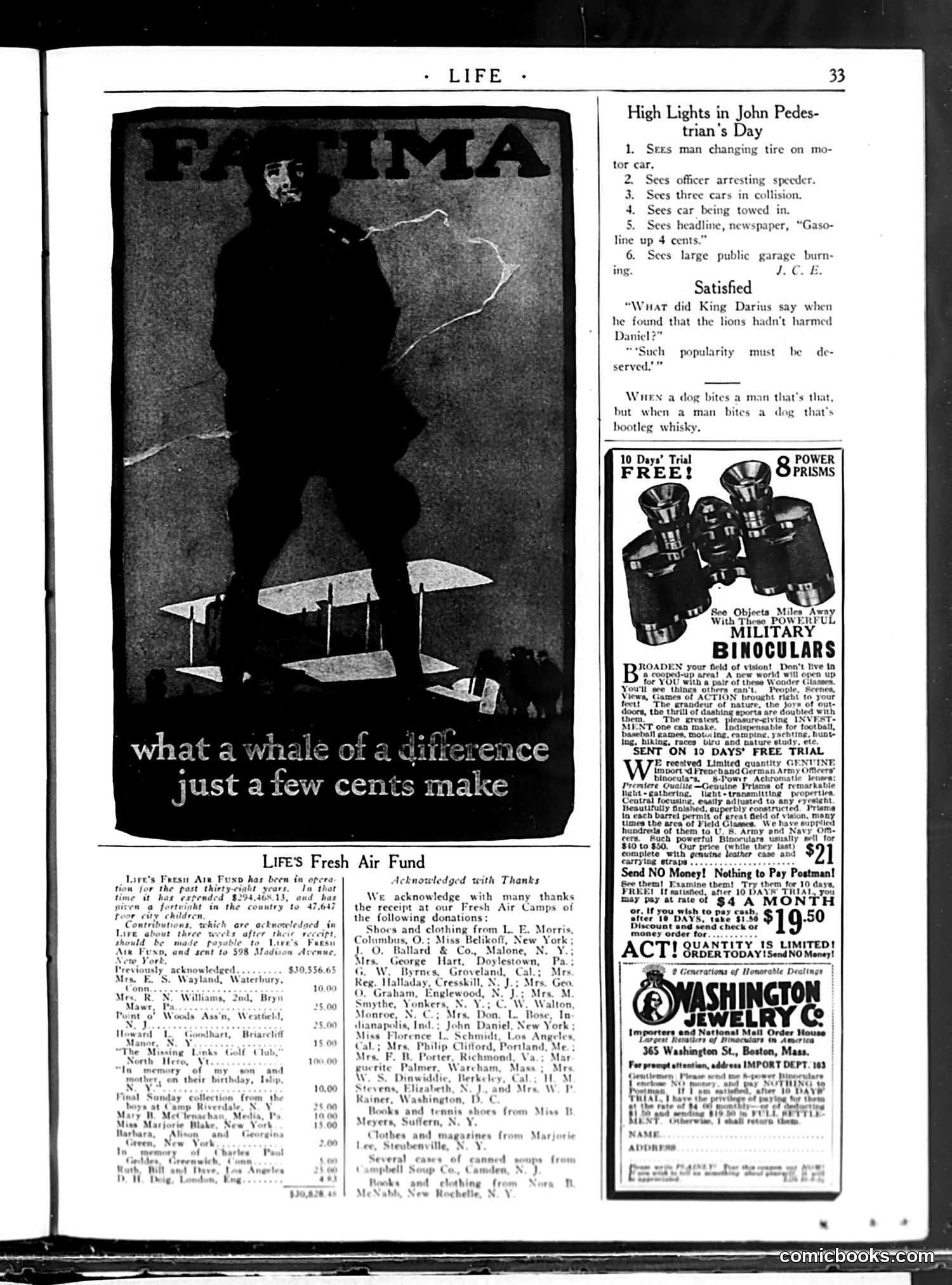
This page contains **no significant political cartoon**. Instead, it features: 1. **A large advertisement** (top left) for Life's Fresh Air Fund, showing a silhouetted figure against a map of South America, with the tagline "what a whale of a difference just a few cents make." This promotes Life magazine's charitable program sending poor urban children to countryside camps. 2. **Charitable donation acknowledgments** listing contributors of shoes, clothing, and supplies to the Fresh Air Camps—a genuine philanthropic initiative. 3. **Brief humorous items** ("High Lights in John Pedestrian's Day," "Satisfied") offering light social commentary on urban traffic hazards and biblical allusions. 4. **Product advertisements** for military binoculars and jewelry, typical of 1920s magazine content. The page is primarily **fundraising and advertising material** rather than satirical commentary. The Fresh Air Fund represents Progressive-era charitable work aimed at urban poverty.
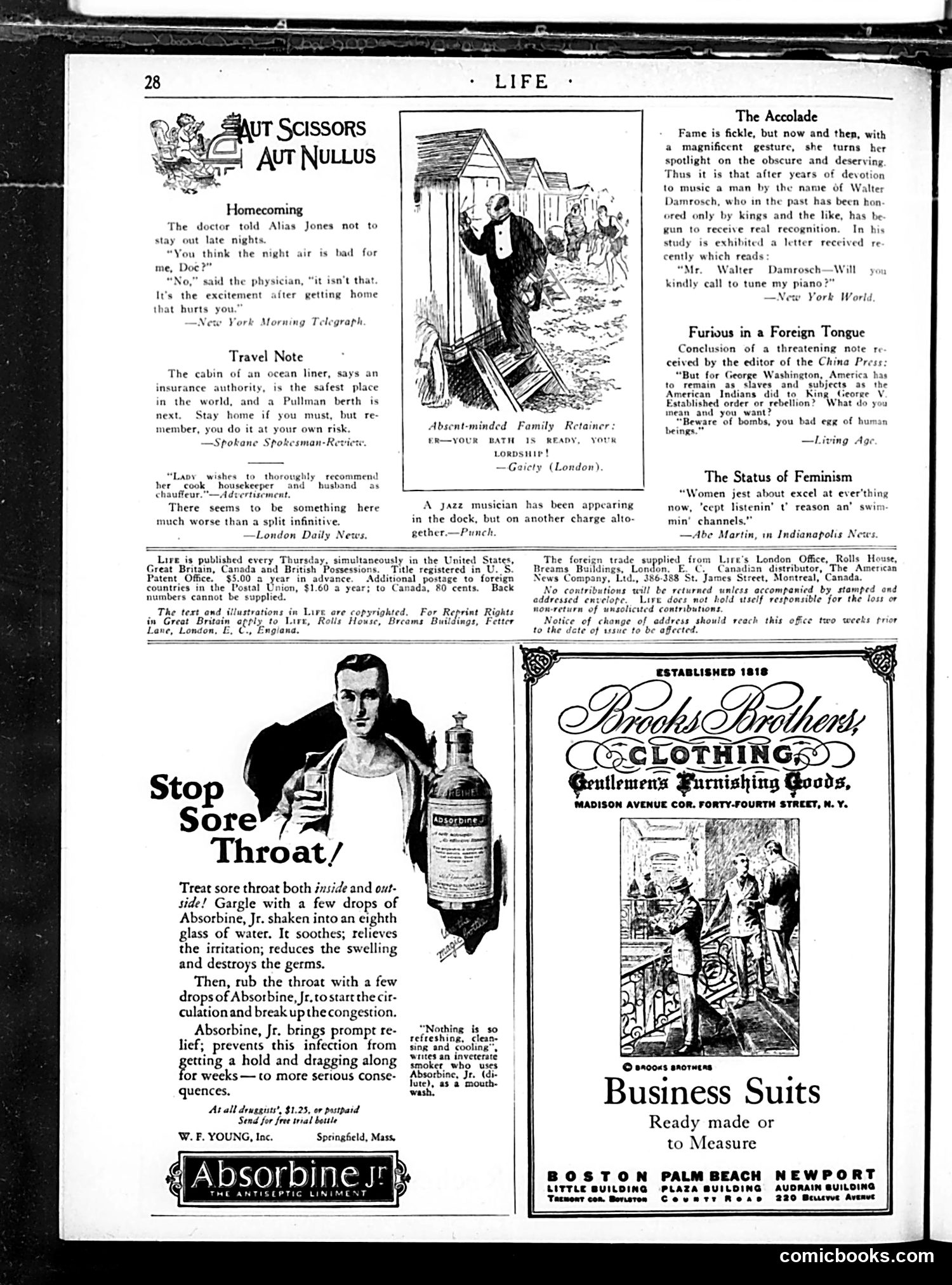
This page from *Life* magazine (appears to be early 1920s) contains satirical commentary on contemporary American life alongside advertisements and comics. **Main Cartoon**: The "Absent-minded Family Retainer" depicts a formally-dressed figure (likely a butler or servant) carrying what appears to be a bathtub down a residential street, captioned "Your bath is ready, your lordship!" The satire mocks the British class system and servants' obsequious formality—*Life* frequently ridiculed British aristocratic pretense. **Brief Satire Pieces**: These include jokes about: - A doctor's warning against nightlife excitement (play on words) - Travel safety ironies - Jazz musicians appearing in court - Feminist commentary about women's capabilities **Advertisements** dominate the lower half—including Absorbine Jr. (medicinal liniment) and Brooks Brothers clothing, reflecting period commercial interests. The overall tone is light social commentary typical of *Life*'s satirical approach: poking fun at class systems, emerging jazz culture, and gender roles of the era.
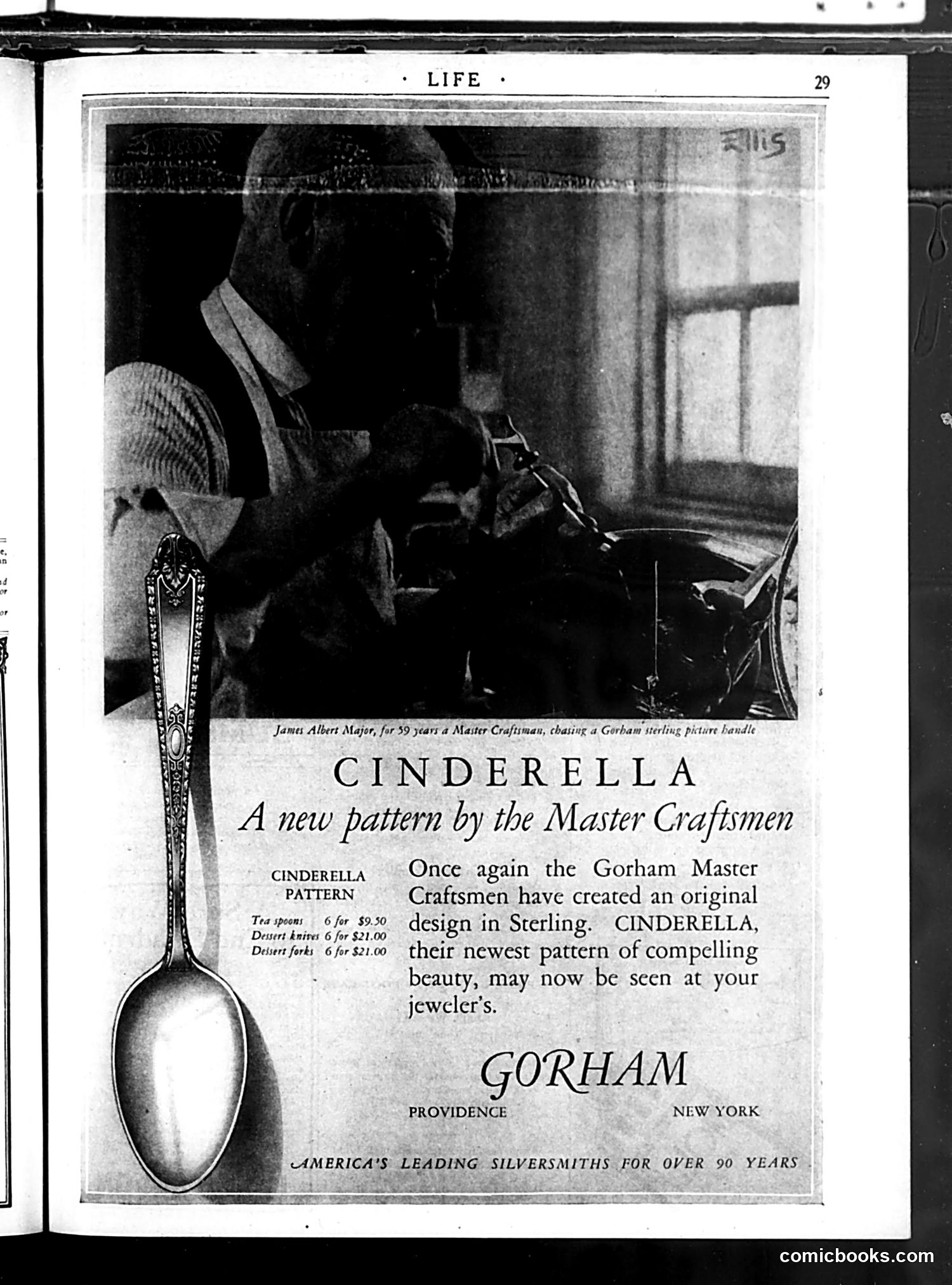
This is a Gorham silverware advertisement, not political satire. It features James Albert Major, identified as a master craftsman with 59 years of experience, demonstrating the creation of a sterling silver picture handle. The ad promotes Gorham's new "Cinderella" pattern of flatware and serving pieces, emphasizing the craftsmanship of their master artisans. A detailed photograph of an ornate spoon handle is displayed on the left. The advertisement appeals to consumers' appreciation for quality American manufacturing and traditional silversmithing skills. Gorham positions itself as "America's leading silversmiths for over 90 years," marketing the new pattern as an original design of "compelling beauty" available at jewelers.
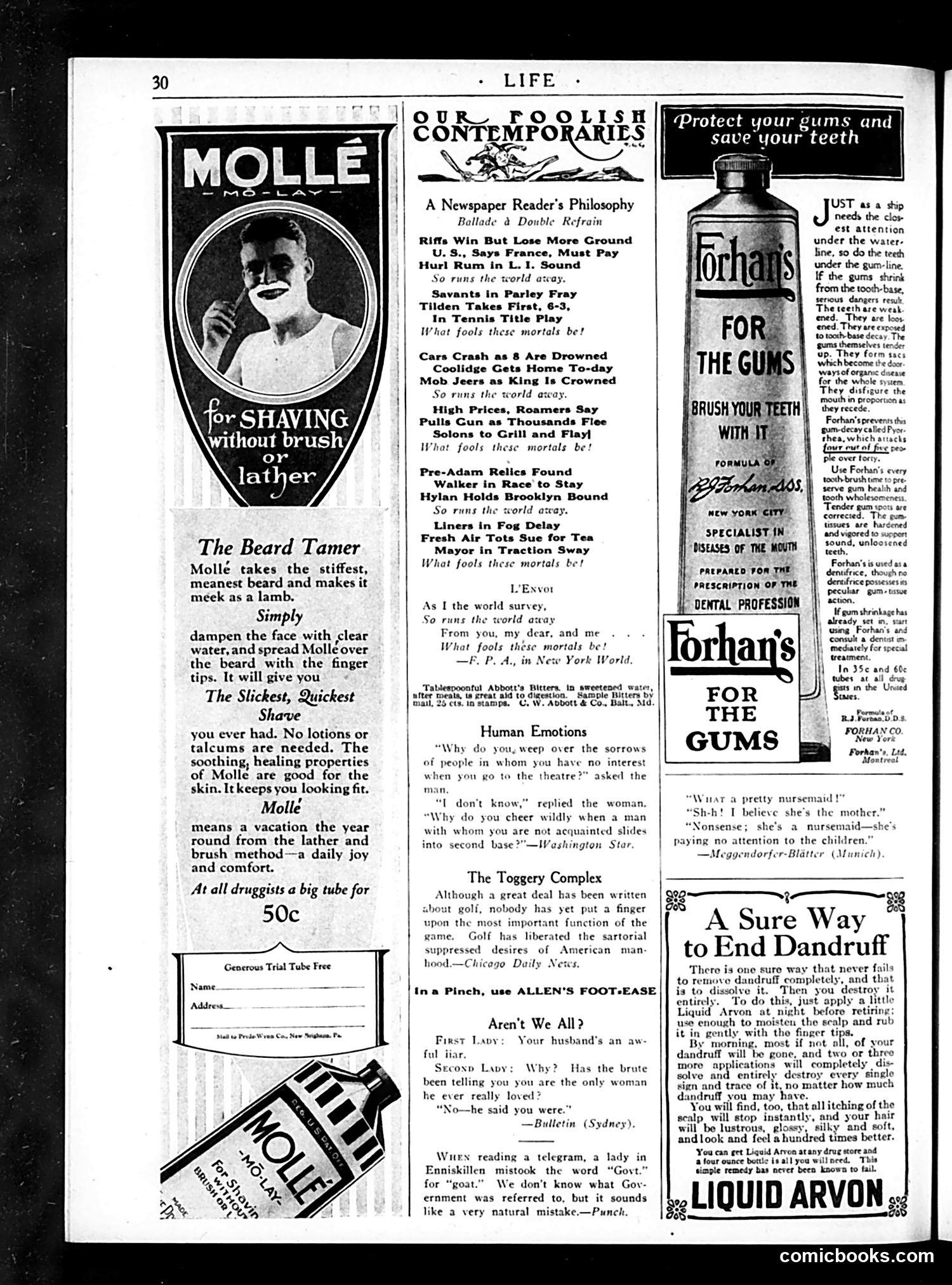
This is primarily an **advertising and humor page** from Life, a satirical magazine. The left side features product ads (Mollé shaving cream, Forhan's toothpaste, Liquid Arvon dandruff treatment). The center section presents **"Our Foolish Contemporaries,"** a satirical column mocking newspaper headlines of the day. Using the refrain "So runs the world away" (from Shakespeare), it ridicules sensational news stories—political scandal, crime, sports drama, and human interest pieces—suggesting press coverage is trivial and absurd. The recurring line "What fools these mortals be!" emphasizes the mockery. Below this are brief **humorous anecdotes** about human nature: a woman crying at theater tragedies while cheering at baseball games (emotional inconsistency), and a telegram mishap where "Govt." was read as "goat." The satire's point: **newspapers sensationalize mundane or contradictory human behavior**, making readers question what's truly newsworthy. This reflects early 20th-century criticism of yellow journalism and mass media's priorities.
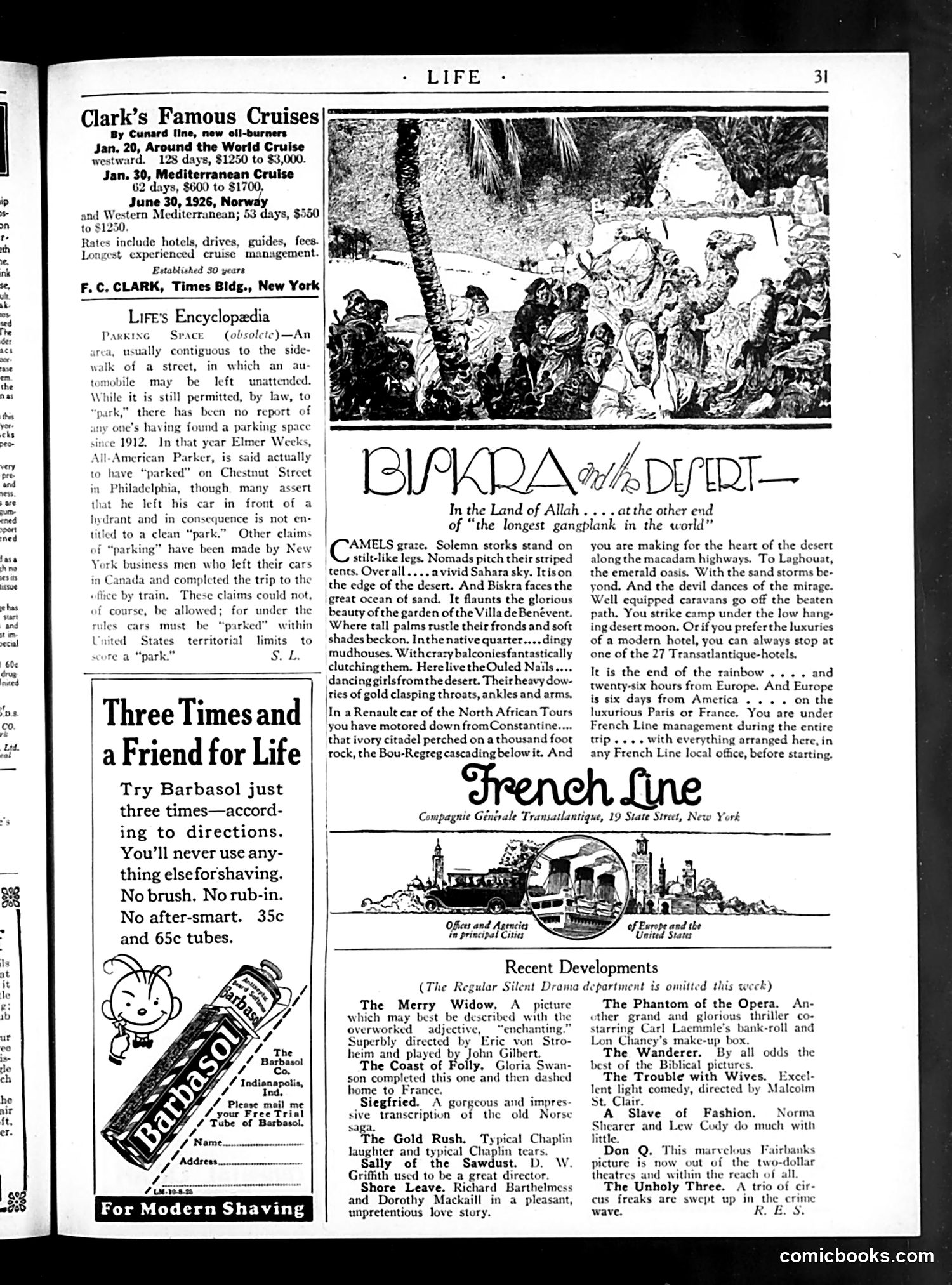
This page is primarily **advertising and entertainment content**, not political satire. It contains: **Main features:** - Travel advertisements (Clark's Cruises, French Line steamship service to North Africa) - "Life's Encyclopedia" - a humorous satirical definition of "Parking Space (obsolete)" that jokes about the difficulty of finding parking in American cities, even referencing the first documented case in 1912 - A Barbasol shaving cream advertisement - "Recent Developments" - brief film reviews of contemporary movies **The satire:** The "Parking Space" entry gently mocks urban congestion and the near-impossibility of parking in 1920s cities like Philadelphia and New York. The "(obsolete)" label suggests parking spaces have become mythical. **Context for modern readers:** This reflects 1920s automobile culture anxiety—cars were becoming common but urban infrastructure hadn't caught up. The humor assumes readers would recognize parking frustration as a shared urban experience.
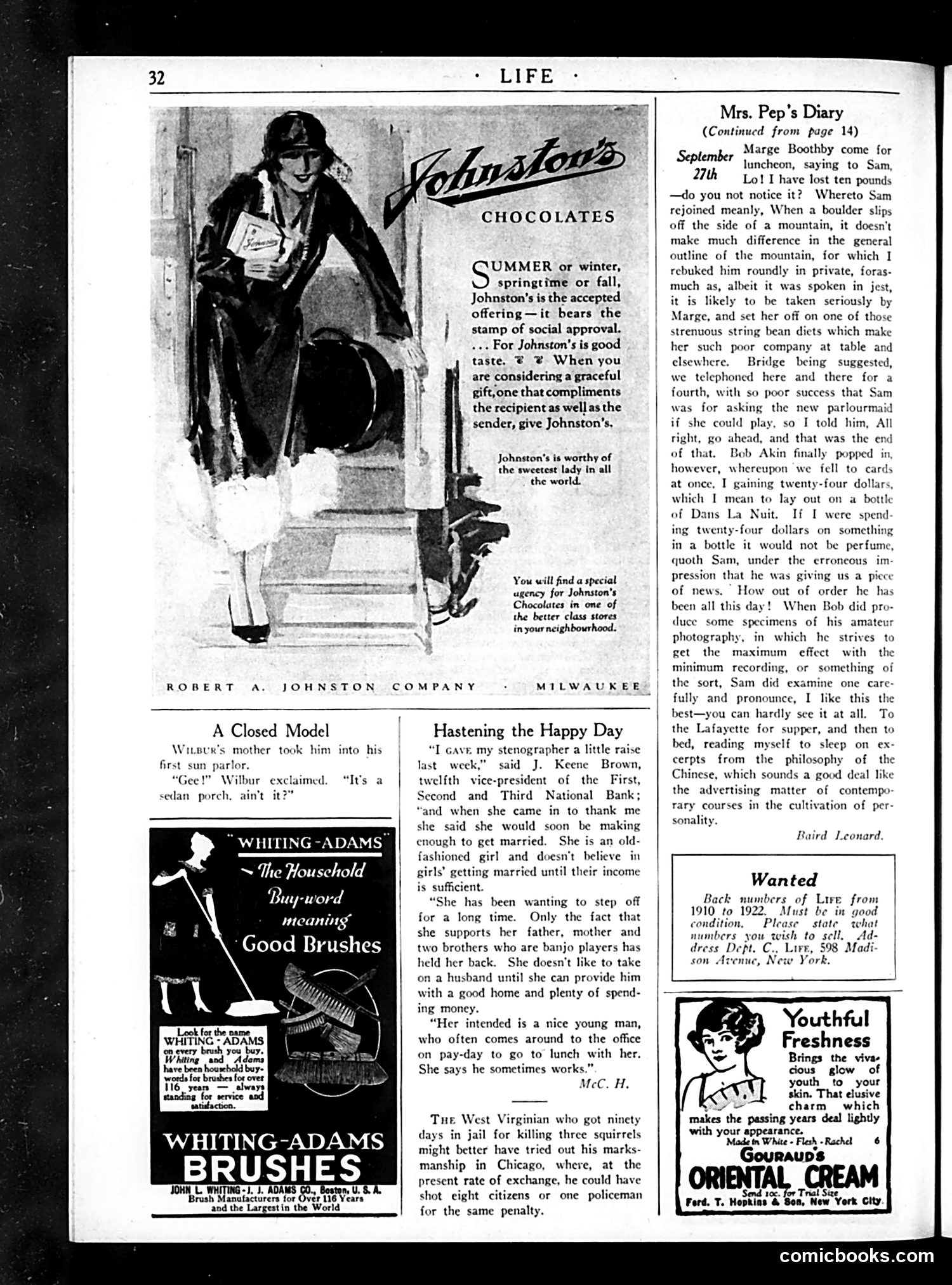
This page consists primarily of **advertisements and humorous short pieces** rather than political satire. The main content includes: **"A Closed Model"** — A brief joke about a young man calling a sun porch (a fashionable indoor feature of the era) a "sedan porch," confusing architectural terminology with automobile terminology. The humor relies on 1920s class consciousness about modern conveniences. **"Hastening the Happy Day"** — A satirical piece mocking Depression-era attitudes about marriage and economic status. A banker describes his stenographer as "old-fashioned" for refusing marriage until she can financially support a husband—commentary on how economic hardship inverted traditional gender roles regarding financial responsibility. **Chicago joke** — Dark humor comparing the relative value of human life in Chicago (suggesting it's cheaper than squirrel life based on sentencing disparities), likely referencing Chicago's notorious crime and violence during Prohibition. The remainder consists of **product advertisements** (Johnston's Chocolates, Whiting-Adams Brushes) and **diary entries** from a society column called "Mrs. Pep's Diary," chronicling trivial upper-class social activities.
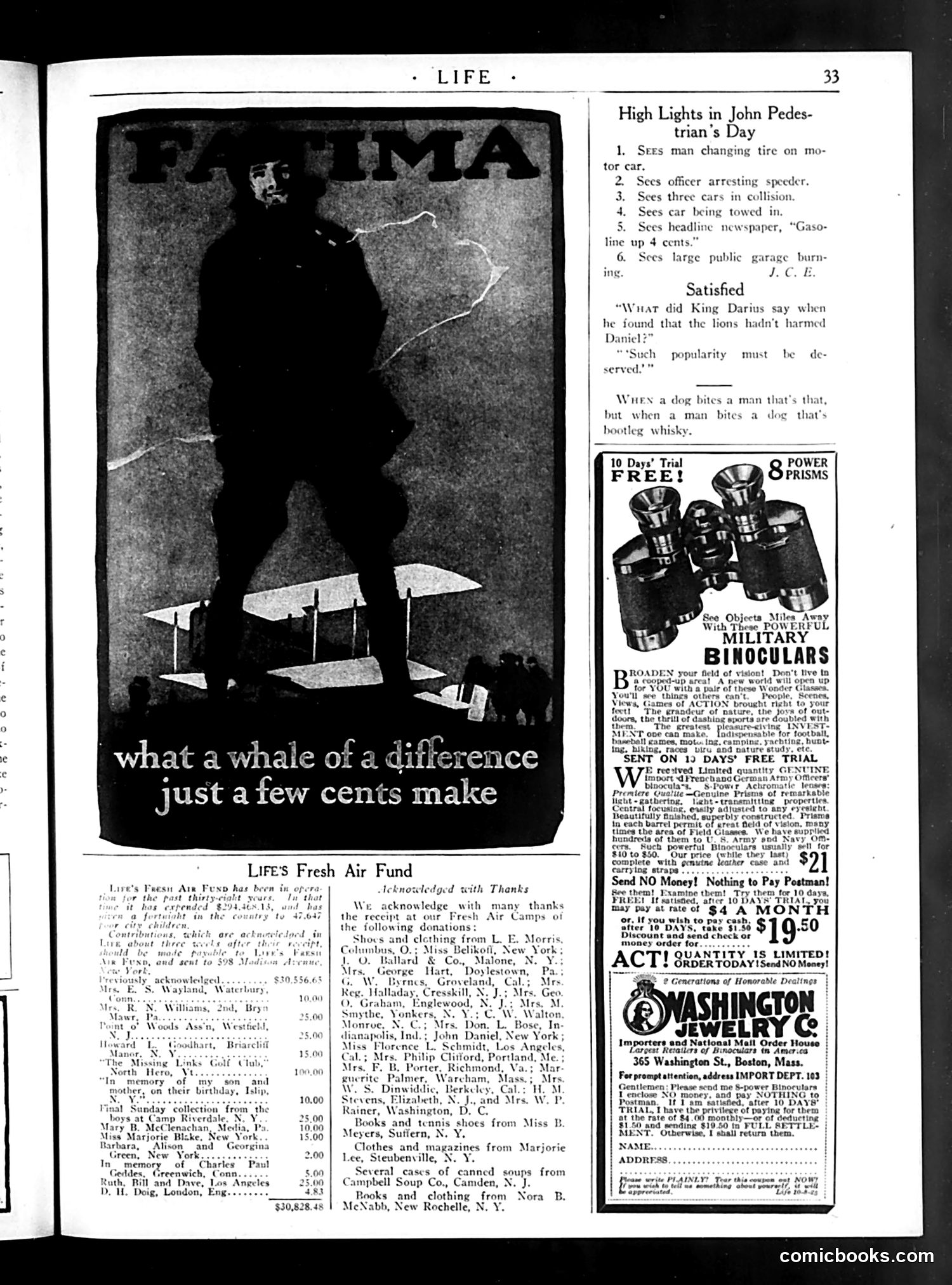
This page contains **Life's Fresh Air Fund** charity appeal (left) and advertisements (right), with minimal satirical content. ## Main Content: The **large silhouette illustration** shows a rotund man standing on tiny airplanes, with the caption "what a whale of a difference just a few cents make." This advertises Life's Fresh Air Fund, which had operated for 38 years sending urban children to camps. The "whale of a difference" suggests that small donations ($30,828.43 total acknowledged here) meaningfully improve poor children's lives. Below are **donor acknowledgments**—a list of individuals and companies who contributed shoes, clothing, books, and food. The page includes separate joke items: - "High Lights in John Pedestrian's Day" lists mundane urban accidents (car fires, collisions, garage fires) culminating in a headline about gasoline prices rising 4 cents—satirizing Americans' obsession with gas costs. - A Bible joke about King Darius and lions. ## Advertisements: Military binoculars (mail order, 10-day free trial) and Washington Importers branding dominate the right side—typical 1920s magazine advertising.
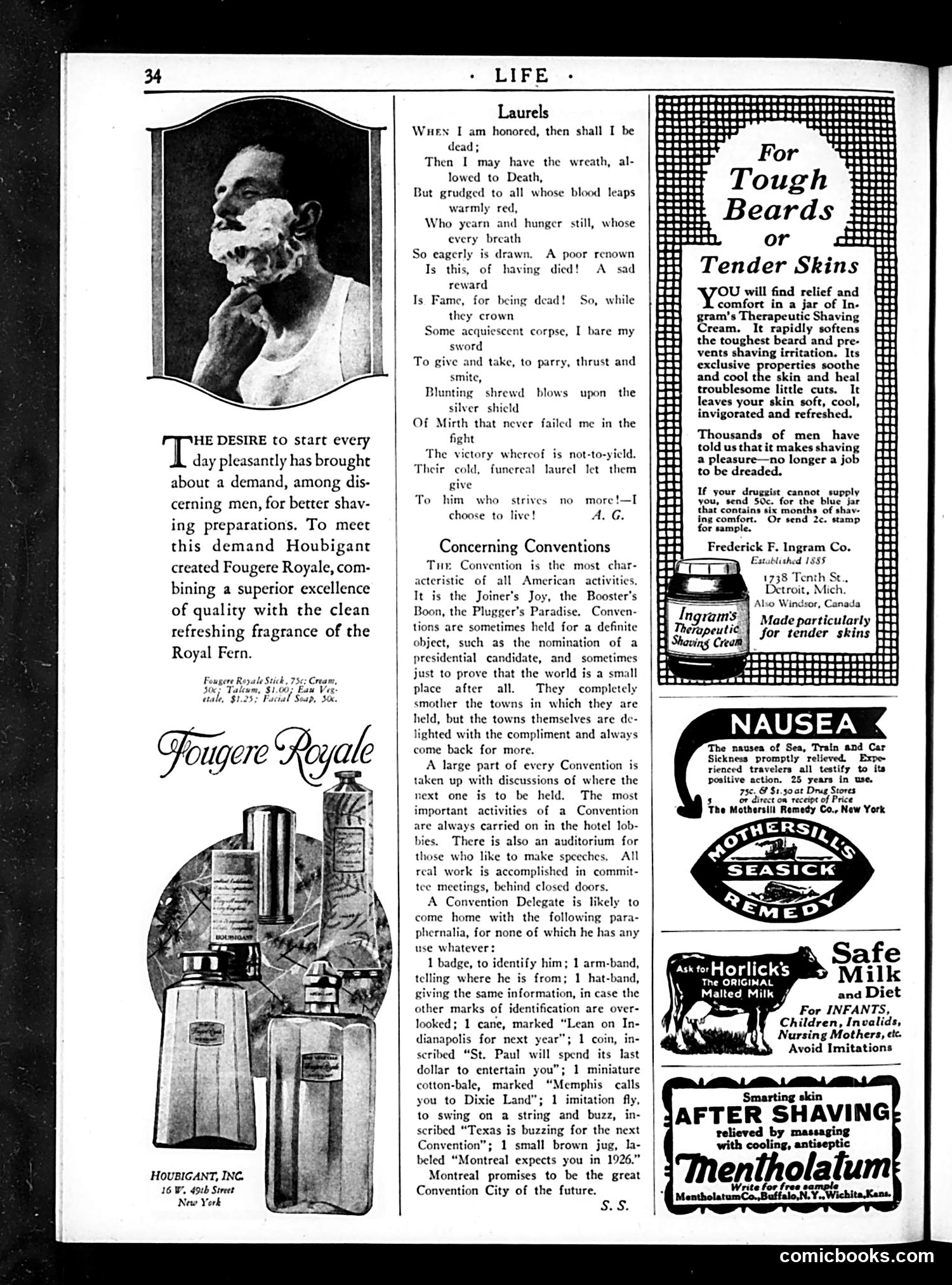
This page combines advertising with light satirical commentary on American conventions and culture. **Main Content:** The poem "Laurels" celebrates active living over posthumous fame—choosing to "live" rather than receive honors only after death. The accompanying portrait appears to be a notable figure, though the identity isn't specified in the visible text. **"Concerning Conventions"** offers tongue-in-cheek observations about American convention culture—a major social phenomenon of the era. The satire mocks how conventions generate souvenirs (badges, arm-bands, canes), how real business happens in hotel lobbies rather than auditoriums, and how cities compete to host future conventions. The specific references to Indianapolis, St. Paul, Memphis, Texas, and Montreal suggest this reflects actual convention competition from the 1920s. **Advertisements:** The page is dominated by product ads (Fougere Royale shaving cream, Ingram's shaving cream, Nausea remedy, Horlick's malted milk)—typical for Life magazine of this period. The conventions satire captures early 20th-century American enthusiasm for civic boosterism and competitive city promotion.
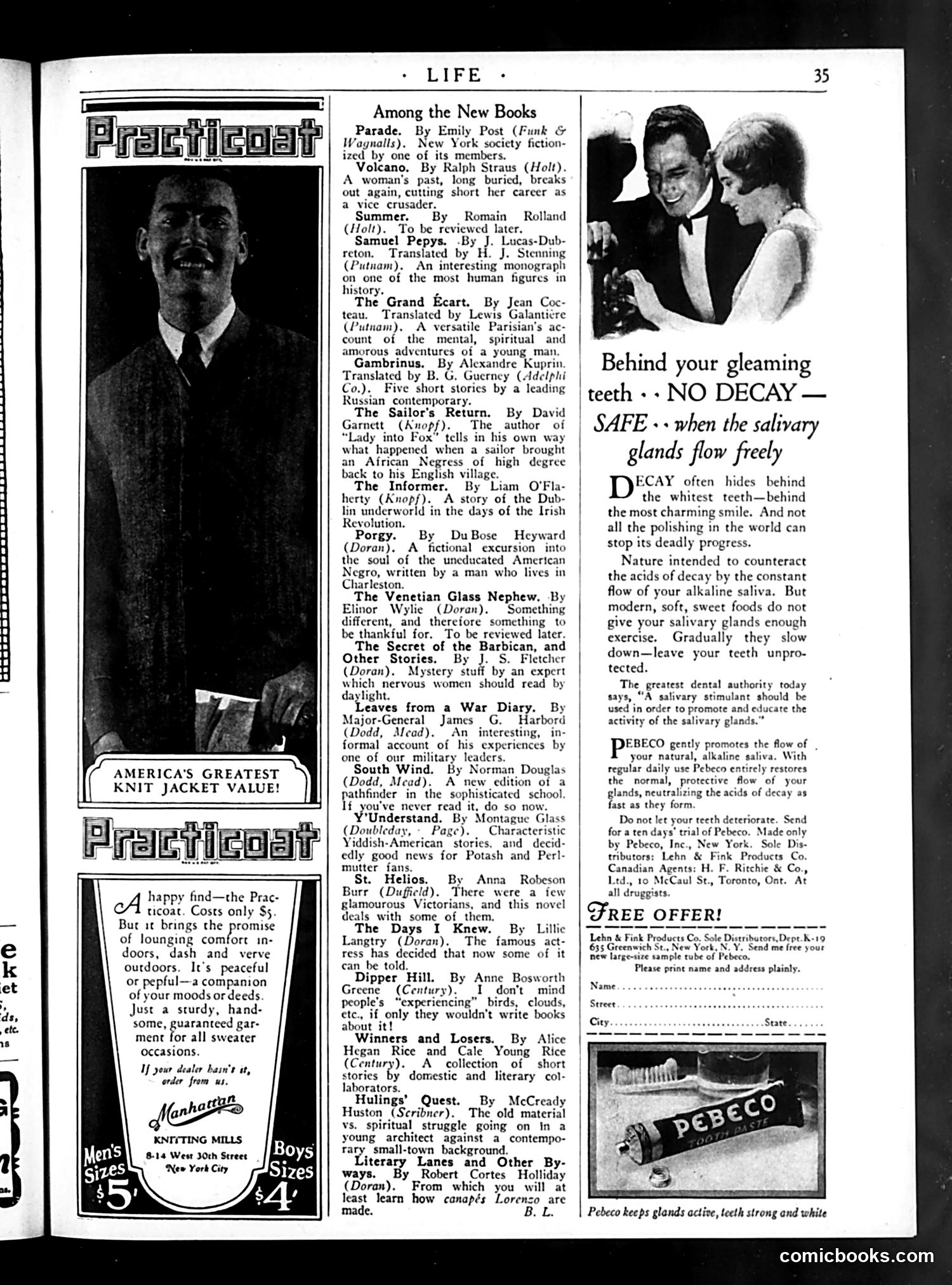
This page combines book reviews with period advertising. The left side features **Practicoat knitting mills advertisements** promoting an affordable ($5) versatile jacket for men and boys. The bulk of the page lists contemporary book reviews from the 1920s, including works by Emily Post, Romain Rolland, and DuBose Heyward's *Porgy*—notably described as exploring "the soul of the uneducated American Negro." The tone reflects era-typical attitudes toward literature and race. The right side contains a **Pebeco toothpaste advertisement** with the headline "NO DECAY—SAFE" when salivary glands flow freely. This represents vintage dental marketing claiming scientific backing for saliva's protective properties—a common advertising claim of the period before modern fluoride dentistry. No political cartoons appear on this page. It's primarily a literary review section mixed with period consumer advertising typical of Life magazine's format during the 1920s.
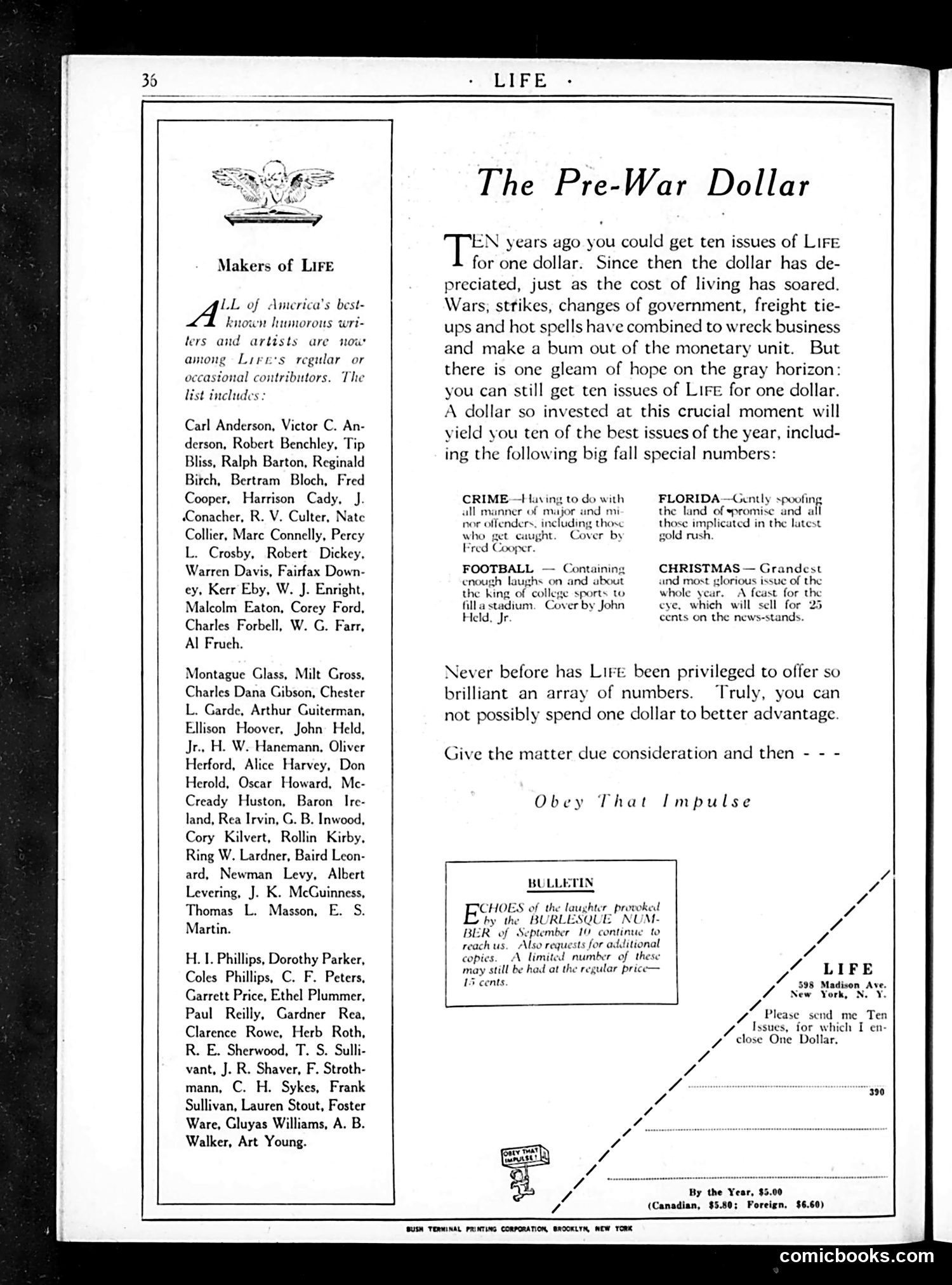
This page is primarily an advertisement disguised as editorial content. It promotes a subscription offer for *Life* magazine while lamenting economic inflation. **The Pitch:** Ten years prior, readers could buy ten issues for one dollar. Due to wars, strikes, government changes, and labor disputes, the dollar has depreciated and living costs have soared. Yet *Life* still offers this same deal—ten issues for one dollar—framed as an exceptional value. **The Satire:** The ad ironically calls the dollar a "bum" (worthless), then immediately tries to convince readers that spending it on *Life* is the smartest investment possible. The phrase "Obey That Impulse" uses mock-authoritarian language typical of era advertising. **Context for Modern Readers:** This reflects post-WWI economic instability (likely mid-1920s). The mention of "wars, strikes, changes of government" references real economic turbulence. The left sidebar lists *Life's* prominent humor writers and artists—social proof of quality. Special issues promised (Crime, Football, Christmas, Burlesque) suggest *Life* positioned itself as essential entertainment during uncertain times.
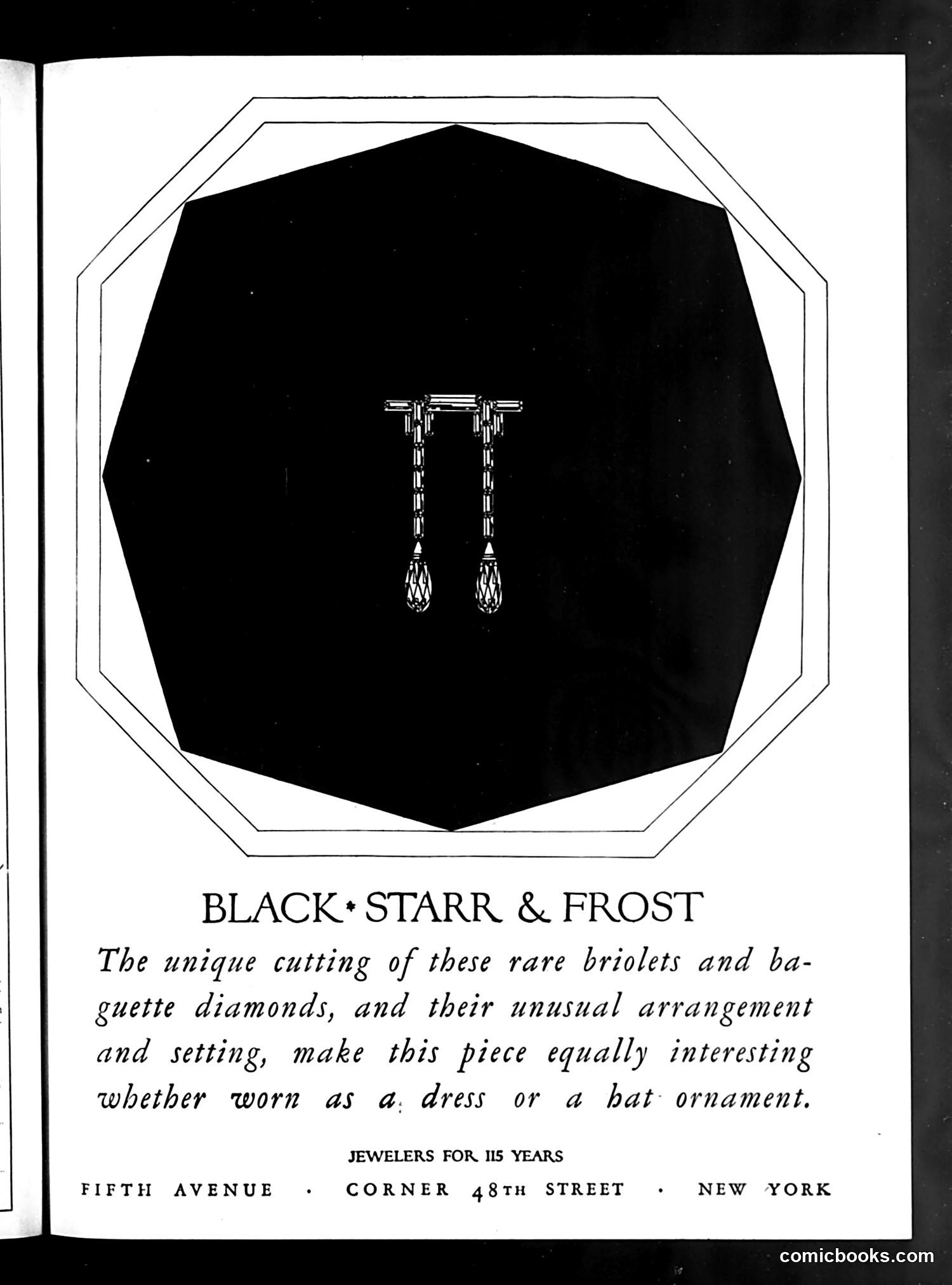
This is an advertisement, not a cartoon or satirical content. Black, Starr & Frost was a prominent New York jewelry firm advertising an elegant piece featuring rare diamond cuts (briolets and baguettes). The ad emphasizes the piece's versatility—it can be worn either as dress jewelry or as a hat ornament, which was common for high-end accessories of the era. The stark black octagonal frame with delicate dangling earrings or brooch depicted creates visual impact typical of luxury jewelry advertising. The firm's 115-year history and prestigious Fifth Avenue location suggest this targets wealthy consumers. There is no political satire or cartoon commentary present on this page.
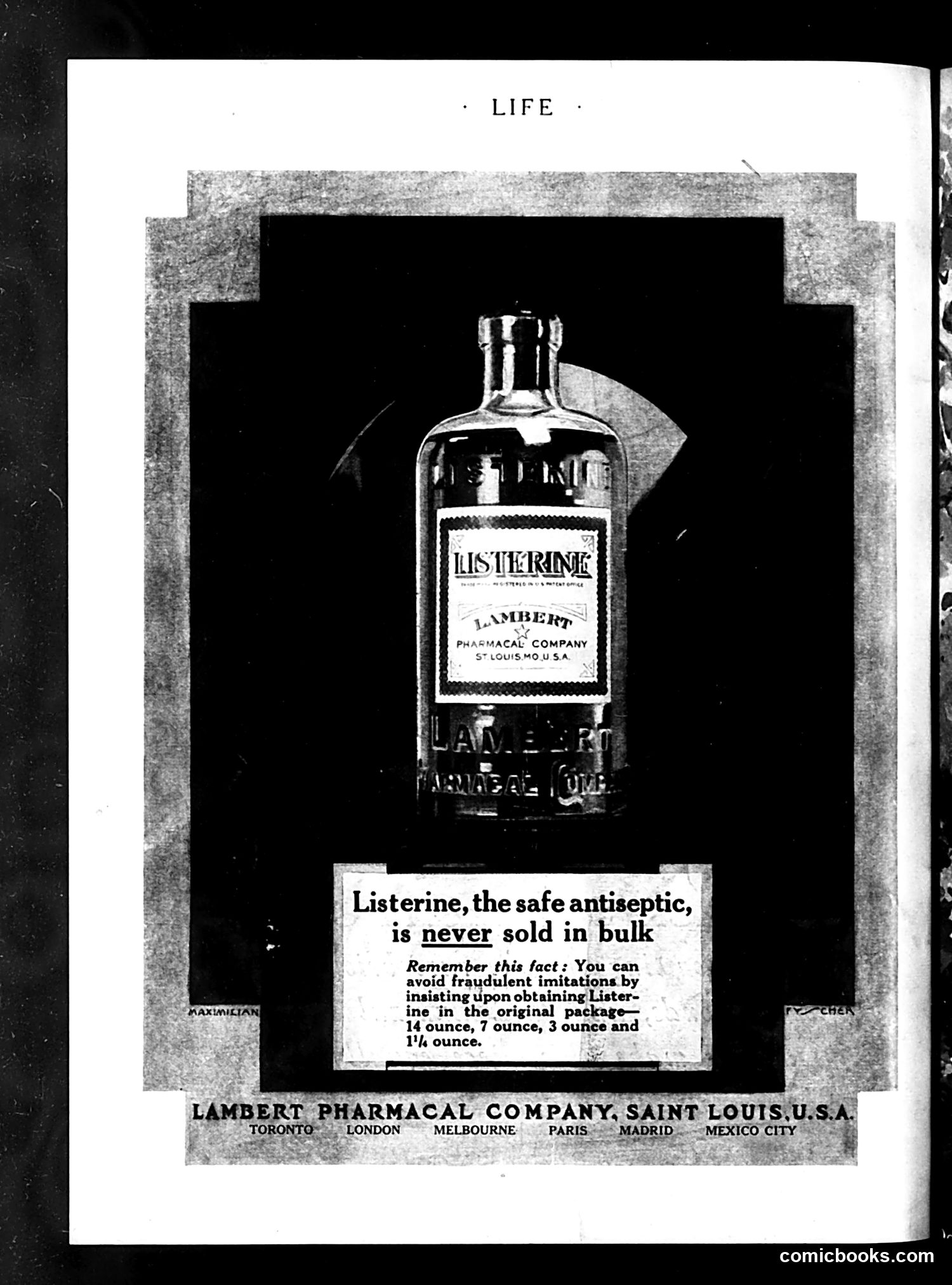
This is primarily a **product advertisement**, not political satire. It appears in *Life* magazine and promotes Listerine antiseptic mouthwash manufactured by Lambert Pharmacal Company (Saint Louis, USA). The ad features a large bottle of Listerine and includes a **consumer-protection message**: warning buyers to avoid counterfeit imitations by purchasing only the official packaging sizes (14 ounce, 7 ounce, 3 ounce, and 1¼ ounce). This reflects early 20th-century concerns about **patent medicine fraud and product counterfeiting**—serious issues before modern FDA regulations. The emphasis on "never sold in bulk" and "original package" suggests competitors were selling inferior knock-offs in unmarked containers. The global office locations listed (Toronto, London, Melbourne, Paris, Madrid, Mexico City) indicate Listerine's international reach during this era.