
Life, 1925-10-08 · page 18 of 46
Life — October 8, 1925 — page 18: what you’re looking at
What you’re looking at
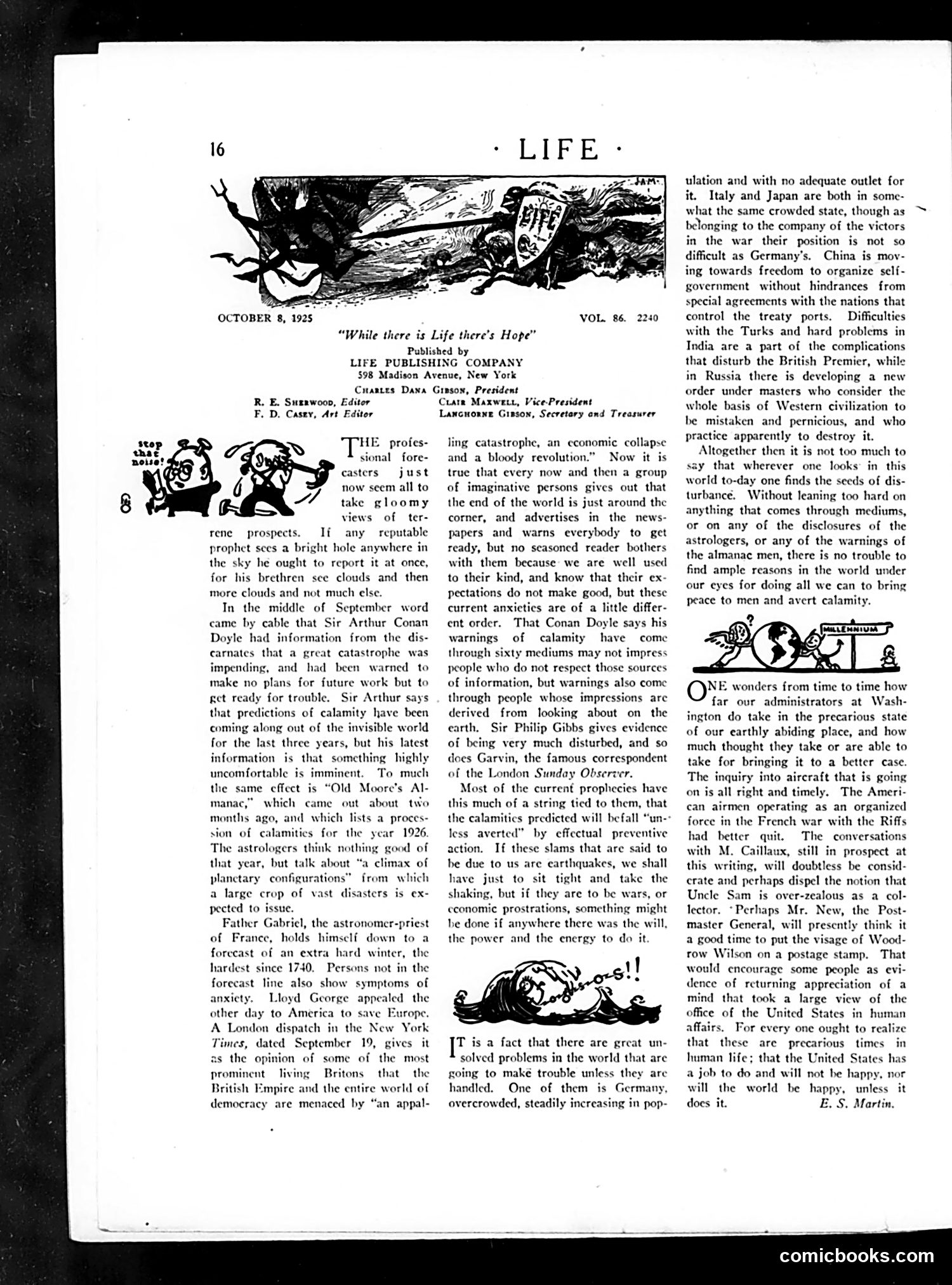
The page features editorial text discussing doomsday prophecies and global instability. The main cartoon (top) depicts a skeletal Death figure looming over a fallen person, illustrating concerns about impending catastrophe. The text references Sir Arthur Conan Doyle's warnings of "a great catastrophe" transmitted through spiritualist mediums, which the editor treats with skepticism. The editorial dismisses sensationalist prophecies while acknowledging real geopolitical tensions: Germany's overcrowding, Japan's position, China's instability, British imperial complications, and Russian upheaval. The cartoons below (small figures) appear to show comic characters reacting anxiously to these warnings. The piece ultimately argues that while serious problems exist, apocalyptic predictions from spiritualists and astrologers shouldn't prevent rational problem-solving by administrators and military leaders.
📄 Transcribed text from this page (OCR, searchable)
Machine-transcribed from the original scan — historical spelling and the odd misread are preserved.
OCTOBER 8, 1925 VOL. 86. 2240 “While there is Life there’s Hope” Published by LIFE PUBLISHING COMPANY $98 Madison Avenue, New York Cmaates Dana Grnson, President R. E. Susawoop, Editor F. D. Casey, Art Editor > HE profes- sional fore- casters just now seem all to take gloomy views of ter- rene prospects. If any reputable prophet sees a bright hole anywhere in the sky he ought to report it at once, for his brethren sce clouds and then more clouds and not much else. In the middle of September word came by cable that Sir Arthur Conan Doyle had information from the dis- carnates that a great catastrophe was impending, and had been warned to make no plans for future work but to get ready for trouble. Sir Arthur says that predictions of calamity have been coming along out of the invisible world for the last three years, but his latest information is that something highly uncomfortable is imminent. To much the same effect is “Old Moore's Al- which came out about two months ago, and which lists a proces- sion of calamities for the year 1926. The astrologers think nothing good of that year, but talk ‘a climax of planetary configurations” from) which a large crop of vast disasters is ex- pected to issue. Father Gabriel, the astronomer-priest of France, holds himself down to a forecast of an extra hard winter, the hardest since 1740. Persons not in the forecast line also show symptoms of anxiety, Lloyd George appealed the other day to America to save Europe. A London dispatch in the New York Times, dated September 19, gives it as the opinion of some of the most prominent living Britons that — the British Empire and the entire world of democracy are menaced hy “an appal- od U a7 mana Ciate Maxwatt, Vice-President Lancnorxe Giasox, Secretary and Treasurer ling catastrophe, an economic collapse and a bloody revolution.” Now it is true that every now and then a group of imaginative persons gives out that the end of the world is just around the corner, and advertises in the news- papers and warns everybody to get ready, but no scasoned reader bothers with them because we are well used to their kind, and know that their ex- pectations do not make good, but these current anxictics are of a little differ- ent order. That Conan Doyle says his warnings of calamity have come through sixty mediums may not impress people who do not respect those sources of information, but warnings also come through people whose impressions are derived from looking about on the earth, Sir Philip Gibbs gives evidence of being very much disturbed, and so does Garvin, the famous correspondent of the London Sunday Observer. Most of the current prophecies have this much of a string tied to them, that the calamities predicted will befall “un-- less averted” by effectual preventive action. If these slams that are said to be due to us are earthquakes, we shall have just to sit tight and take the shaking, but if they are to be wars, or cconomic prostrations, something might be done if anywhere there was the will, the power and the energy to do it. ! T is a fact that there are great un- solved problems in the world that are going to make trouble unless they are handled. One of them is Germa overcrowded, steadily increasing in pop- ulation and with no adequate outlet for it. Italy and Japan are both in some- what the same crowded state, though as belonging to the company of the victors in the war their position is not so difficult as Germany's. China is mov- ing towards freedom to organize self- government without hindrances from special agreements with the nations that control the treaty ports. Difficulties with the Turks and hard problems in India are a part of the complications that disturb the British Premier, while in Russia there is developing a new order under masters who consider the whole basis of Western civilization to be mistaken and pernicious, and who practice apparently to destroy it. Altogether then it is not too much to say that wherever one looks: in this world to-day one finds the seeds of dis- turbance. Without leaning too hard on anything that comes through mediums, or on any of the disclosures of the astrologers, or any of the warnings of the almanac men, there is no trouble to find ample reasons in the world under our eyes for doing all we can to bring peace to men and avert calamity. NE wonders from time to time how far our administrators at Wash- ington do take in the precarious state of our earthly abiding place, and how much thought they take or are able to take for bringing it to a better case. The inquiry into aircraft that is going on is all right and timely. The Ameri- can airmen operating as an organized force in the French war with the Riffs had better quit. The conversations with M. Caillaux, still in prospect at this writing, will doubtless be consid- crate and perhaps dispel the notion that Uncle Sam is over-zealous as a col- lector. “Perhaps Mr. New, the Post- master General, will presently think it a good time to put the visage of Wood- row Wilson on a postage stamp. That would encourage some people as evi- dence of returning appreciation of a mind that took a large view of the office of the United States in human affairs. For every one ought to realize that these are precarious times in human life; that the United States has a job to do and will not be happy, nor will the world be happy, unless it does it. E, S. Martin. comicbooks.com