
Life, 1925-10-08 · page 14 of 46
Life — October 8, 1925 — page 14: what you’re looking at
What you’re looking at
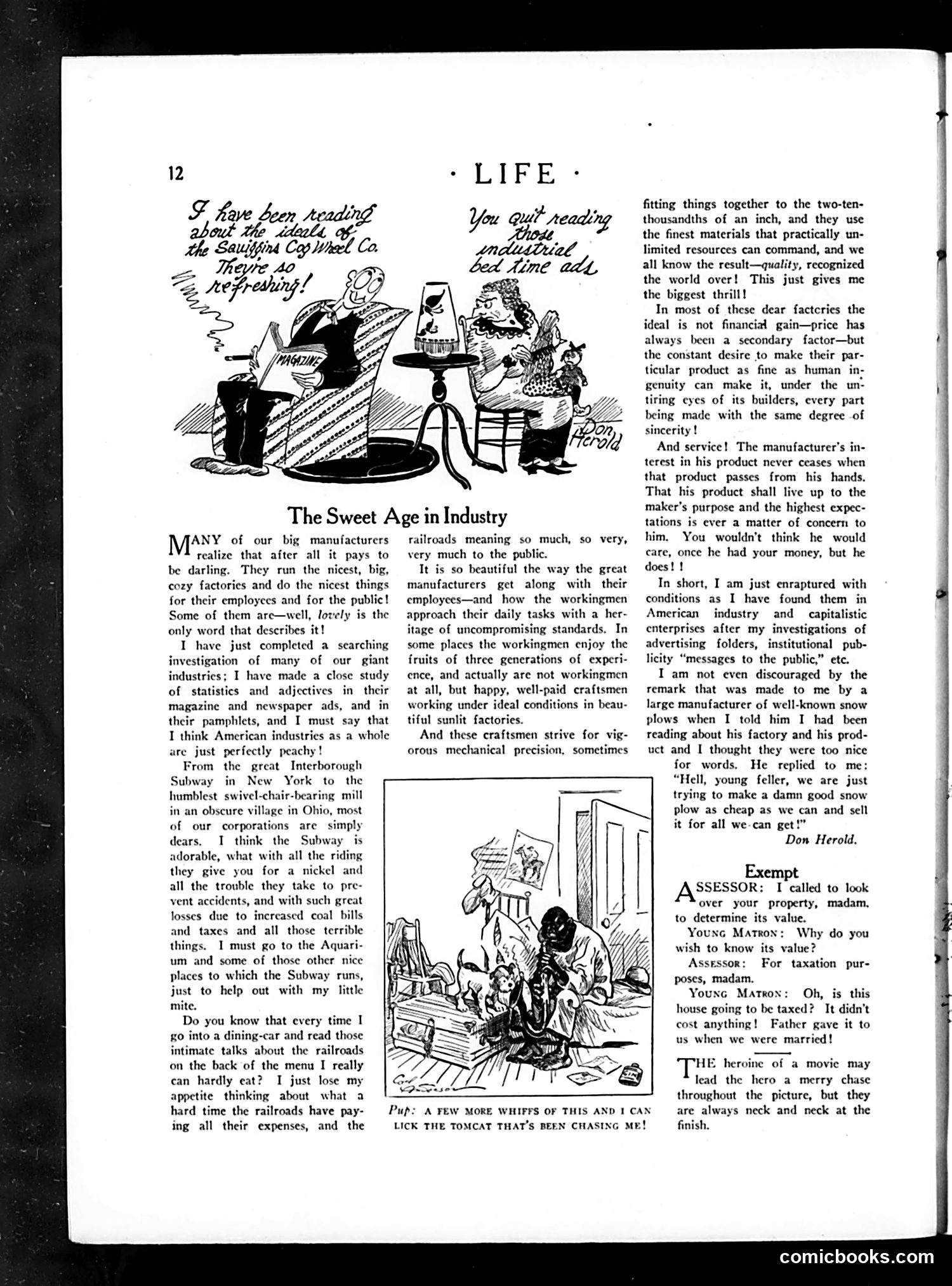
This page celebrates American manufacturing excellence and worker conditions. The main cartoon shows a businessman enthusiastically reading about the "Boston Cop Wheel Co" while relaxing—depicting satisfied consumption of industrial news. The accompanying article praises factories for their precision, quality standards, and worker treatment. The author describes visiting multiple industries and finding craftsmen taking pride in their work, working under "ideal conditions in beautiful full suit factories." A secondary cartoon shows a property assessor arriving to tax a modest home, with a young matron bewildered by unexpected taxation. The "Assessor" dialogue at bottom mocks bureaucratic interruption of domestic life. Overall, the page represents early 20th-century American optimism about industrial progress, worker dignity, and manufacturing superiority—themes aligned with Life magazine's satirical celebration of commercial culture.
📄 Transcribed text from this page (OCR, searchable)
Machine-transcribed from the original scan — historical spelling and the odd misread are preserved.
12 g, fave Me Peer Siar ge Sui pnd Ce LIFE You out Aeading Aitiial ye; dine ad, The Sweet Age in Industry ANY of our big manufacturers realize that after all it pays to be darling. They run the nicest, big, cozy factories and do the nicest things for their employees and for the public! Some of them arc—well, lovely is the only word that describes it! I have just completed a searching investigation of many of our giant industries; I have made a close study of statistics and adjectives in’ their magazine and newspaper ads, and in their pamphlets, and I must say that I think American industries as a whole are just perfectly peachy! From the great Interborough Subway in New York to the humblest swivel-chair-bearing mill in an obscure village in Ohio, most of our corporations are simply dears, I think the Subway is adorable, what with all the riding they give you for a nickel and all the trouble they take to pre- vent accidents, and with such great losses due to increased coal bills and taxes and all those terrible thi I must go to the Aquari- um and some of those other nice places to which the Subway runs, just to help out with my little mite. Do you know that every time I go into a dining-car and read those intimate talks about the railroads on the back of the menu I really can hardly eat? I just lose my appetite thinking about what a railroads meaning so much, so very, very much to the public. It is so beautiful the way the great manufacturers get along with their employees—and how the workingmen approach their daily tasks with a her- itage of uncompromising standards. In some places the workingmen enjoy the fruits of three generations of expecri- ence, and actually are not workingmen at all, but happy, well-paid craftsmen working under ideal conditions in beau- tiful sunlit factories. And these craftsmen strive for vig- orous mechanical precision, sometimes Poa 0 hard time the railroads have pay- Pup: A FEW MORE WHIFFS OF THIS AND I CAN fitting things together to the two-ten- thousandths of an inch, and they use the finest materials that practically un- limited resources can command, and we all know the result—quality, recognized the world over! This just gives me the biggest thrill! In most of these dear factcries the ideal is not financial gain—price has always been a secondary factor—but the constant desire to make their par- ticular product as fine as human in- genuity can make it, under the un tiring eyes of its builders, every part being made with the same degree of sincerity ! And service! The manufacturer's in- terest in his product never ceases when that product passes from his hands. That his product shall live up to the maker's purpose and the highest expec- tations is ever a matter of concern to him. You wouldn't think he would care, once he had your money, but he does! ! In short, I am just enraptured with conditions as I have found them in American industry and capitalistic enterprises after my investigations of advertising folders, institutional pub- licity “messages to the public,” etc. I am not even discouraged by the remark that was made to me by a large manufacturer of well-known snow plows when I told him I had been reading about his factory and his prod- uct and I thought they were too nice for words. He replied to me: “Hell, young feller, we are just trying to make a damn good snow plow as cheap as we can and sell it for all we-can get!” Don Herold, Exempt ASSESSOR: I called to look over your property, madam, to determine its value. Younc Matron: Why do you wish to know its value? Assessor: For taxation pur- poses, madam. Younc Matrox: Oh, is this house going to be taxed? It didn't cost anything! Father gave it to us when we were married! HE heroine of a movie may lead the hero a merry chase throughout the picture, but they are always neck and neck at the ing all their expenses, and the LICK THE TOMCAT THAT'S BEEN CHASING ME! finish. comicbooks.com