
Life, 1925-10-08 · page 22 of 46
Life — October 8, 1925 — page 22: what you’re looking at
What you’re looking at
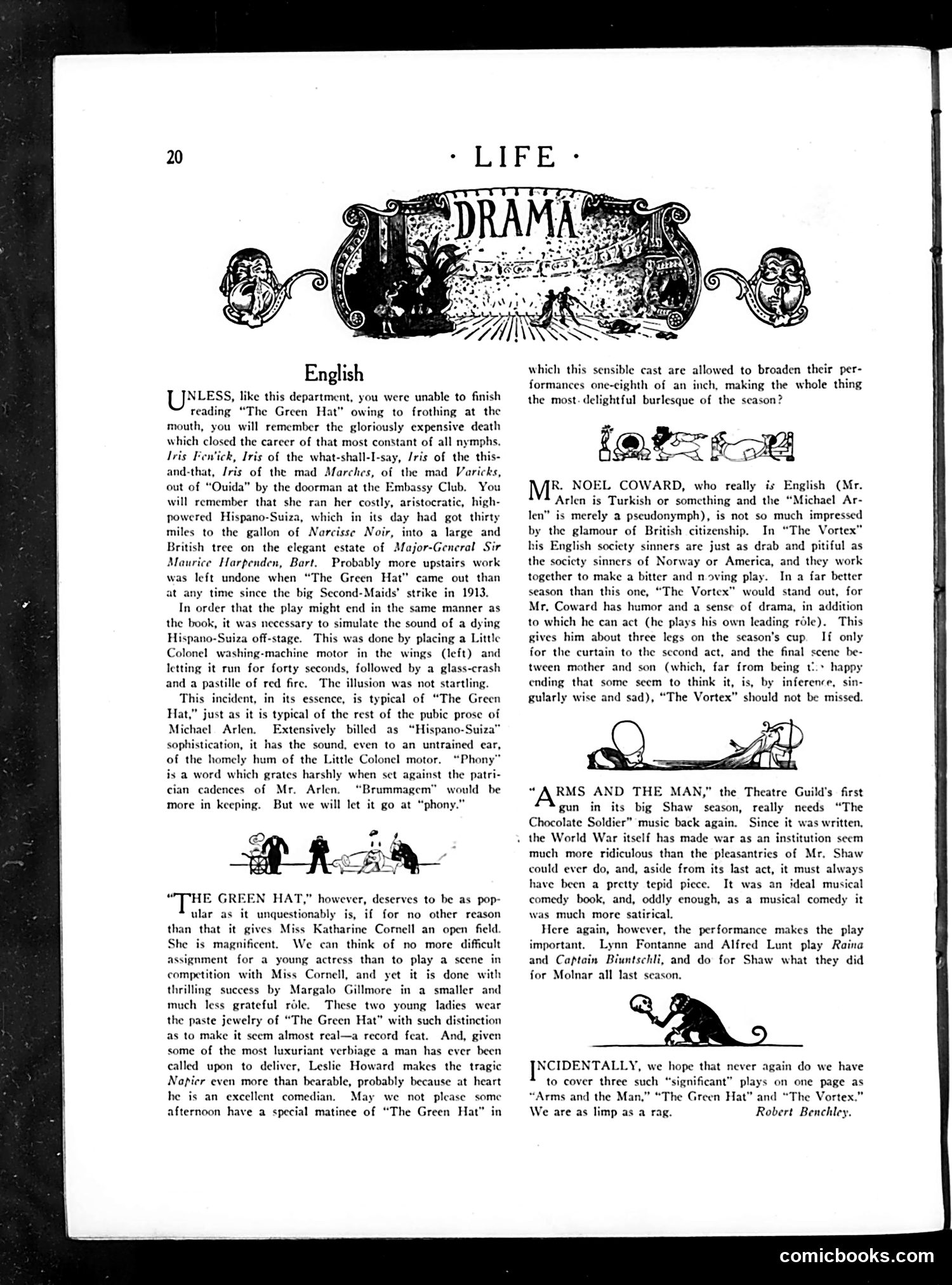
This page reviews three Broadway plays through satirical theater criticism. The main target is **"The Green Hat,"** adapted from Michael Arlen's novel about wealthy, dissolute aristocrats. The reviewer mocks the production as phonily glamorous—comparing its attempt at sophistication to a cheap "Little Colonel washing-machine motor" masquerading as a sophisticated Hispano-Suiza automobile. The elaborate sound effect (washing machine motor, glass crash, red fire) meant to simulate a car crash typifies the artificiality. The satire works on two levels: **Arlen himself** is ridiculed as a Turkish writer (not truly English, despite his pseudonym) trafficking in hollow "Brummagem" (fake/cheap) sophistication. Yet the **cast**—especially Katharine Cornell—is praised for elevating mediocre material through genuine talent. By contrast, **Noël Coward's "The Vortex"** receives genuine praise: Coward, actually English, brings wit and moral seriousness to similar society settings, avoiding pretense. The comparison positions authentic artistry against fashionable emptiness—a typical Life magazine critique of 1920s cultural pretension.
📄 Transcribed text from this page (OCR, searchable)
Machine-transcribed from the original scan — historical spelling and the odd misread are preserved.
USLESS, like this department, you were unable to finish reading “The Green Hat” owing to frothing at the mouth, you will remember the gloriously expensive death which closed the career of that most constant of all nymphs. Jris Fen'ick, Iris of the what-shall-I-say, /ris of the this- and-that, Jris of the mad Marches, of the mad Varicks, out of “Ouida” by the doorman at the Embassy Club. You will remember that she ran her costly, aristocratic, high- powered Hispano-Suiza, which in its day had got thirty miles to the gallon of Narcisse Noir, into a large and British tree on the elegant estate of Major-General Sir Maurice Harpenden, Bart. Probably more upstairs work was left undone when “The Green Hat" came out than at any time since the big Second-Maids’ strike in 1913. In order that the play might end in the same manner as the book, it was necessary to simulate the sound of a dying Hispano-Suiza off-stage. This was done by placing a Little Colonel washing-machine motor in the wings (left) and letting it run for forty seconds, followed by a glass-crash and a pastille of red fire. The illusion was not startling. This incident, in its essence, is typical of “The Green Hat,” just as it is typical of the rest of the pubic prose of Michael Arlen, Extensively billed as “Hispano-Suiza” sophistication, it has the sound, even to an untrained ear, of the homely hum of the Little Colonel motor. “Phony” is a word which grates harshly when sct against the patri- cian cadences of Mr. Arlen. “Brummagem” would be more in keeping. But we will let it go at “phony HE GREEN HAT,” however, deserves to be as pop- ular as it unquestionably is, if for no other reason than that it gives Miss Katharine Cornell an open field. She is magnificent. We can think of no more difficult assignment for a young actress than to play a scene in competition with Miss Cornell, and yet it is done with thrilling success by Margalo Gillmore in a smaller and much less grateful rile. These two young ladies wear the paste jewelry of “The Green Hat” with such distinction as to make it scem almost real—a record feat. And, given some of the most luxuriant verbiage a man has ever been called upon to deliver, Leslie Howard makes the tragic Napier even more than bearable, probably because at heart he is an excellent comedian. May we not please some afternoon have a special matinee of “The Green Hat” in which this sensible cast are allowed to broaden their per- formances one-cighth of an inch, making the whole thing the most. delightful burlesque of the season? L@2= fA M NOEL COWARD, who really is English (Mr. Arlen is Turkish or something and the “Michael Ar- len” is merely a pscudonymph), is not so much impressed by the glamour of British citizenship. In “The Vortex” his English society sinners are just as drab and pitiful as the society sinners of Norway or America, and they work together to make a bitter and noving play. In a far better season than this one, “The Vortex” would stand out, for Mr, Coward has humor and a sense of drama, in addition to which he can act (he plays his own leading role). This gives him about three legs on the season's cup. If only for the curtain to the sccond act, and the final scene be- tween mother and son (which, far from being t.+ happy ending that some seem to think it, is, by inference, sin- gularly wise and sad), “The Vortex” should not be missed. ARMS | AND THE MAN,” the Theatre Guild's first gun in its big Shaw season, really needs “The Chocolate Soldier” music back again. Since it was written, « the World War itself has made war as an institution seem much more ridiculous than the pleasantries of Mr. Shaw could ever do, and, aside from its last act, it must always have been a pretty tepid piece. It was an ideal musical comedy book, and, oddly enough, as a musical comedy it was much more satirical. Here again, however, the performance makes the play important. Lynn Fontanne and Alfred Lunt play Raina and Captain Biuntschli, and do for Shaw what they did for Molnar all last season. NCIDENTALLY, we hope that never again do we have to cover three such “significant” plays on one page as “Arms and the M. The Green Hat” and “The Vortex.” We are as limp as a rag. Robert Benchley. comicbooks.com