
A complete issue · 41 pages · 1925
Life — September 10, 1925
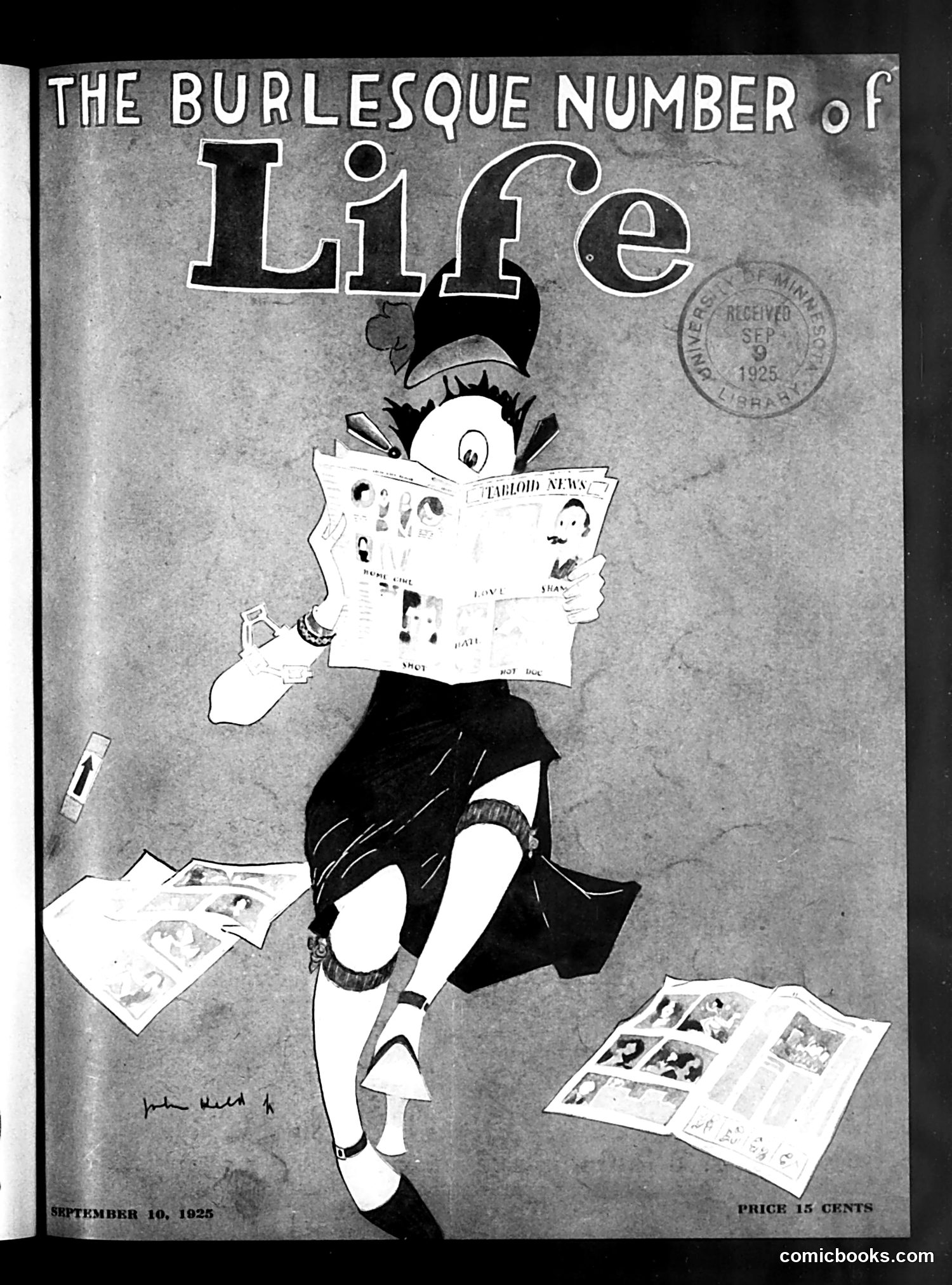
This is the cover of *Life* magazine from September 10, 1925. The illustration depicts a flapper—a young woman embodying 1920s modernity—reading a newspaper titled "Harold News" while surrounded by scattered papers and magazines. The satire appears to target contemporary celebrity gossip culture and the public's obsession with "Harold" (likely a reference to a well-known figure of the era, though the specific person isn't entirely clear from the image alone). The cartoon mocks how newspapers and magazines sensationalize celebrity news, with the flapper eagerly consuming this trivial content. The title "The Burlesque Number of Life" suggests the entire issue satirizes or parodies contemporary entertainment and popular culture obsessions of the Jazz Age.
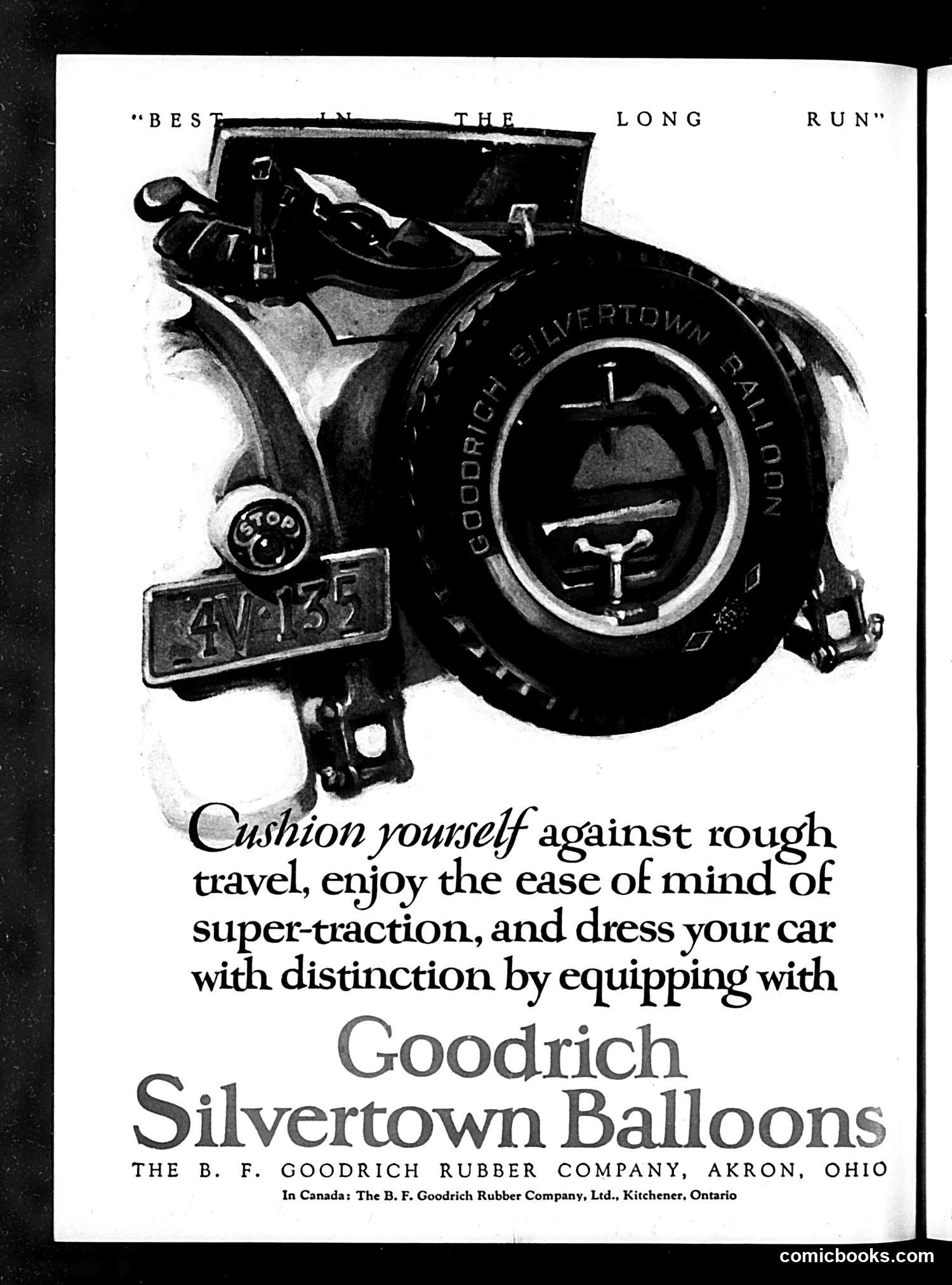
This page is primarily a **vintage advertisement**, not political satire. It advertises Goodrich Silvertown Balloons (tires) from The B.F. Goodrich Rubber Company in Akron, Ohio. The ad features a detailed illustration of a car tire with visible tread and the license plate "4V132." The tagline "Best in the Long Run" emphasizes durability. The sales pitch promises comfort ("cushion yourself against rough travel"), reliability ("ease of mind of super-traction"), and aesthetic appeal ("dress your car with distinction"). This reflects early 20th-century automobile advertising's focus on tire quality as a luxury feature—an era when reliable tires were genuinely important for vehicle safety and comfort.
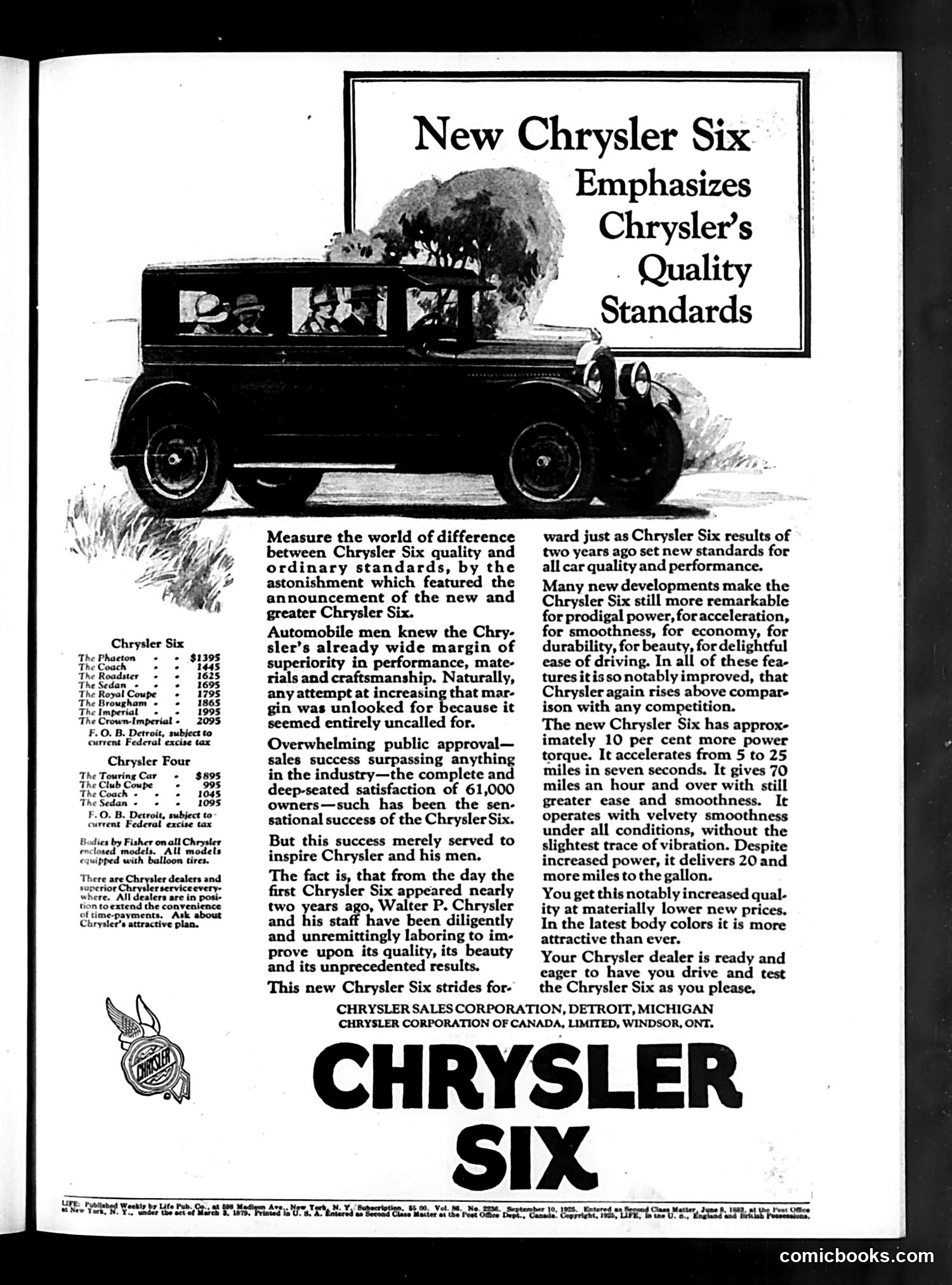
This page is **primarily an advertisement**, not editorial satire. It promotes the Chrysler Six automobile, emphasizing quality standards and performance improvements. The ad features a vintage car illustration with a large tree, positioned to suggest reliability and established strength. The text highlights that the Chrysler Six has achieved superior market success—61,000 owners—and credits Walter P. Chrysler's engineering improvements over two years, including increased horsepower, acceleration, and fuel economy. There is **no political cartoon or satire present**. The Chrysler logo and model pricing list (ranging from $895-$1863) suggest this appeared during the 1920s automotive boom. This is straightforward commercial advertising emphasizing product superiority and brand prestige to contemporary consumers.
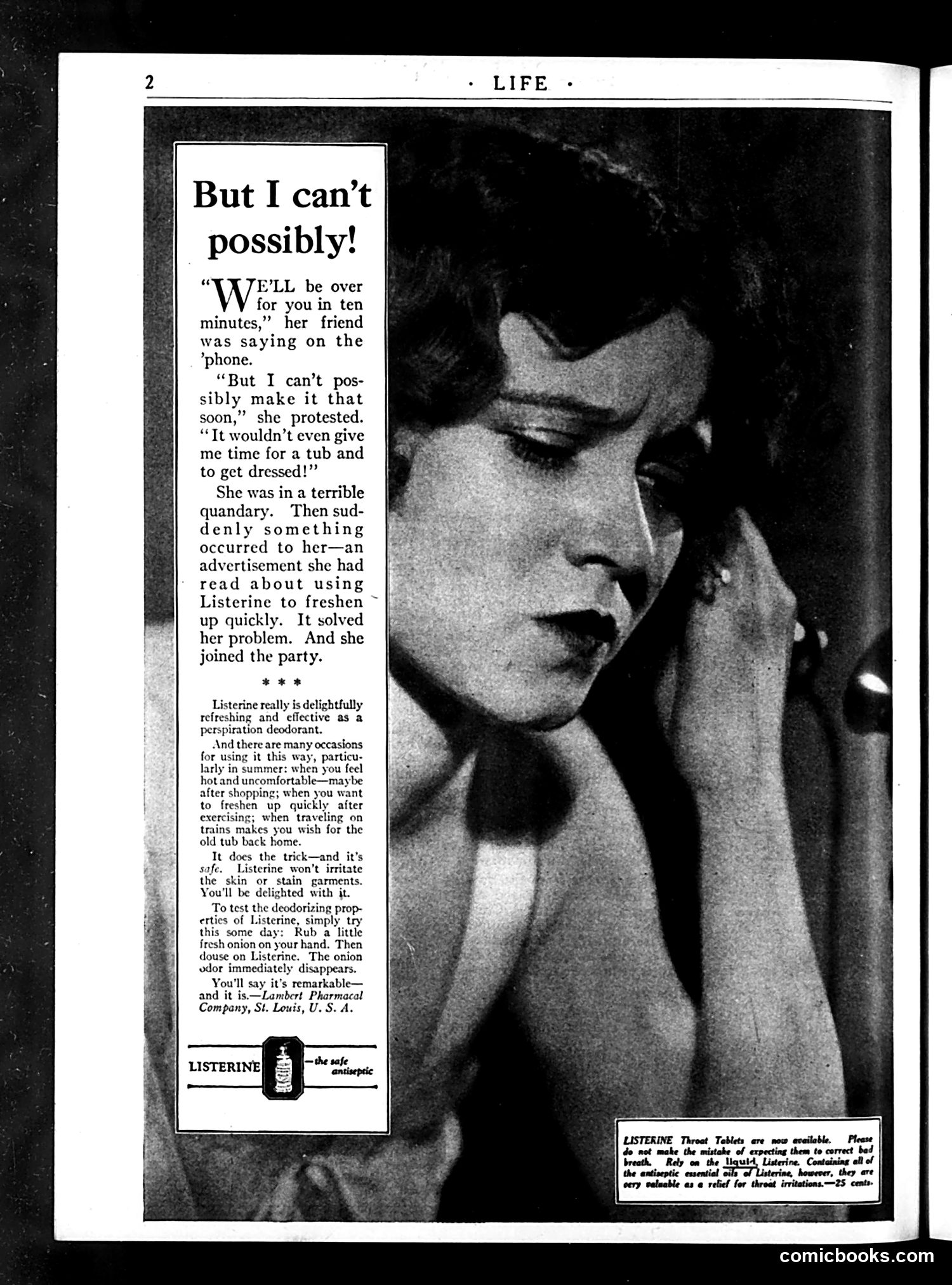
This is a **Listerine advertisement**, not a political cartoon. The page shows a woman in apparent distress with the headline "But I can't possibly!" The ad depicts a social scenario: a friend invites her to a party in ten minutes, but she protests she lacks time to bathe and dress. The advertisement's solution is to use Listerine mouthwash as a quick "freshening up" product—positioning it as a perspiration deodorant for occasions when full bathing is impractical. The narrative demonstrates a common advertising strategy of the era: creating anxiety about social acceptability, then offering a product as a solution. The emphasis on using Listerine to address hygiene concerns quickly reflects early-to-mid 20th-century marketing that conflated personal cleanliness with social success and acceptability.
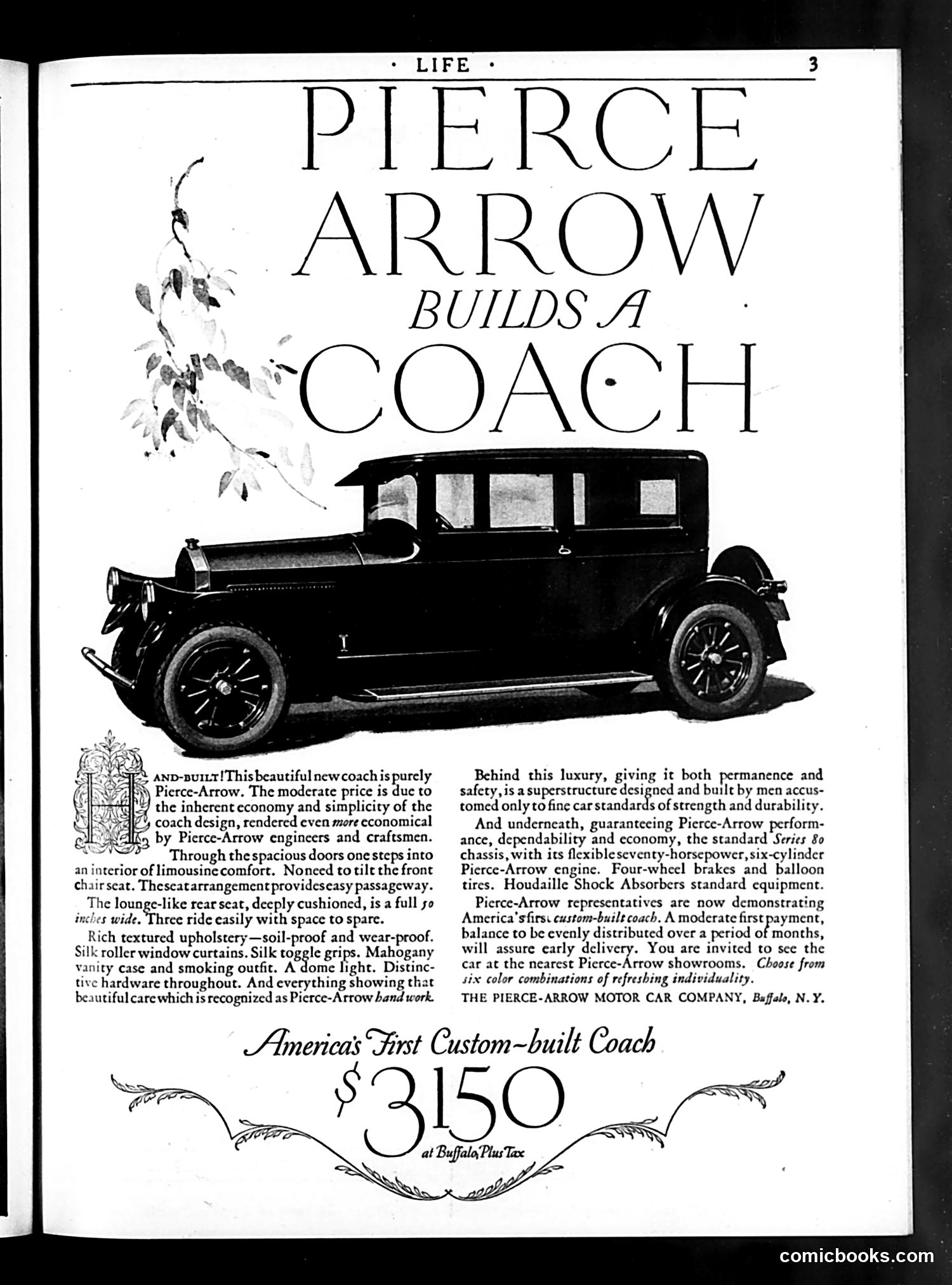
This is primarily a **product advertisement**, not political satire. It's a full-page ad for the Pierce-Arrow Motor Car Company promoting their new coach model. The ad emphasizes luxury features—limousine comfort, silk curtains, mahogany interior—while highlighting the "moderate price" of $3,150 through "Pierce-Arrow economy and simplicity of coach design." The text stresses durability, safety features (four-wheel brakes, balloon tires), and the vehicle's status as "America's First Custom-built Coach." The decorative branch illustration in the upper left and ornamental flourishes are period design elements. This represents typical early 20th-century automobile marketing targeting affluent buyers seeking prestige and reliability rather than satire or political commentary.
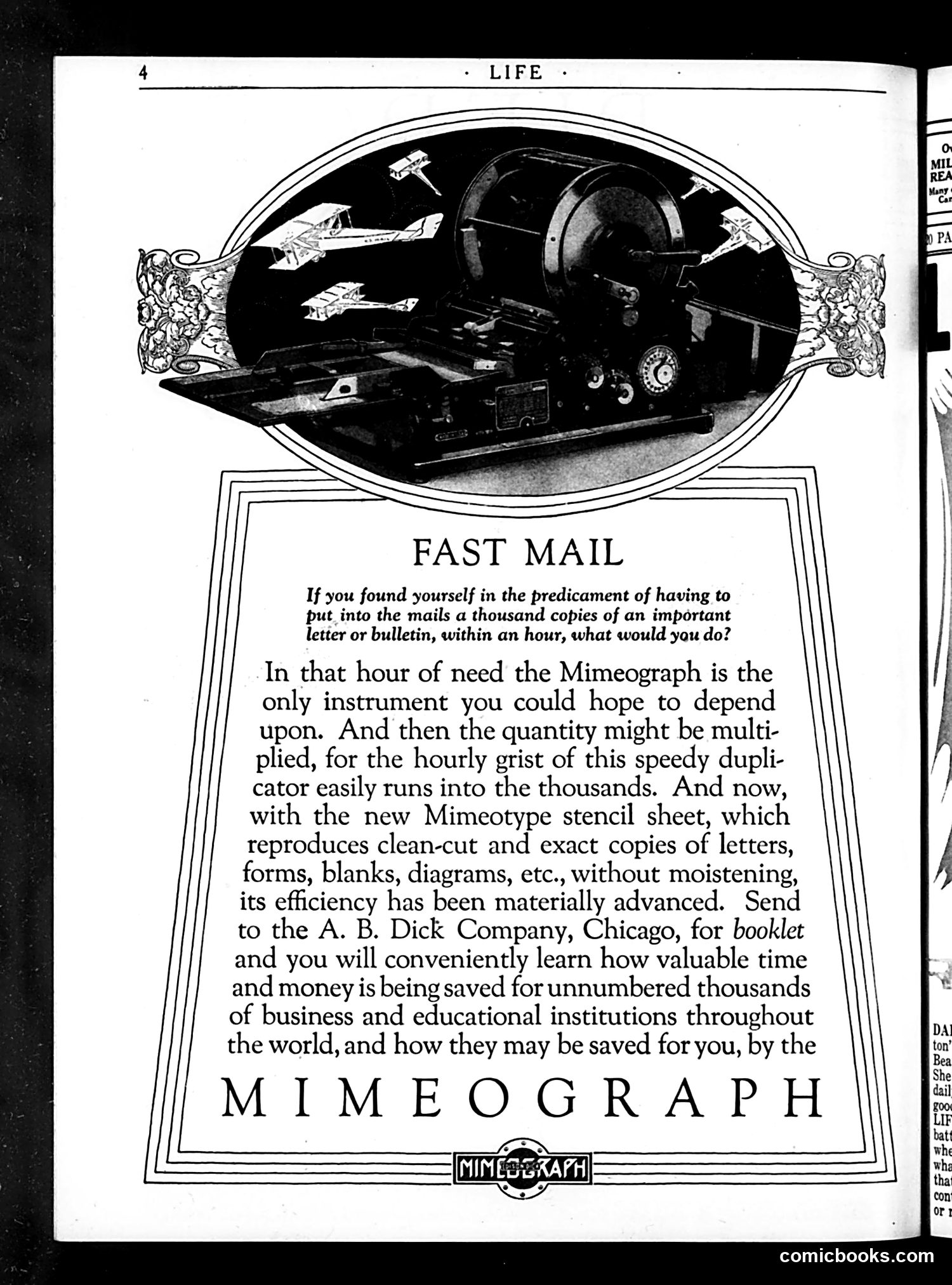
This is an advertisement for the Mimeograph machine, a pre-digital duplicating device. The page presents a hypothetical business scenario: if you needed to quickly produce 1,000 copies of an important letter or bulletin within an hour, what would you do? The ad argues the Mimeograph is the answer, highlighting its ability to produce "clean-cut and exact copies" using stencil sheets without moistening. The imagery shows the machine itself—a drum-based duplicator that was standard office equipment for much of the 20th century. This is straightforward product advertising rather than satire. The A.B. Dick Company (Chicago manufacturer) emphasizes time and cost savings for "business and educational institutions," appealing to efficiency-conscious organizations of the era when speed printing was genuinely valuable and innovative.
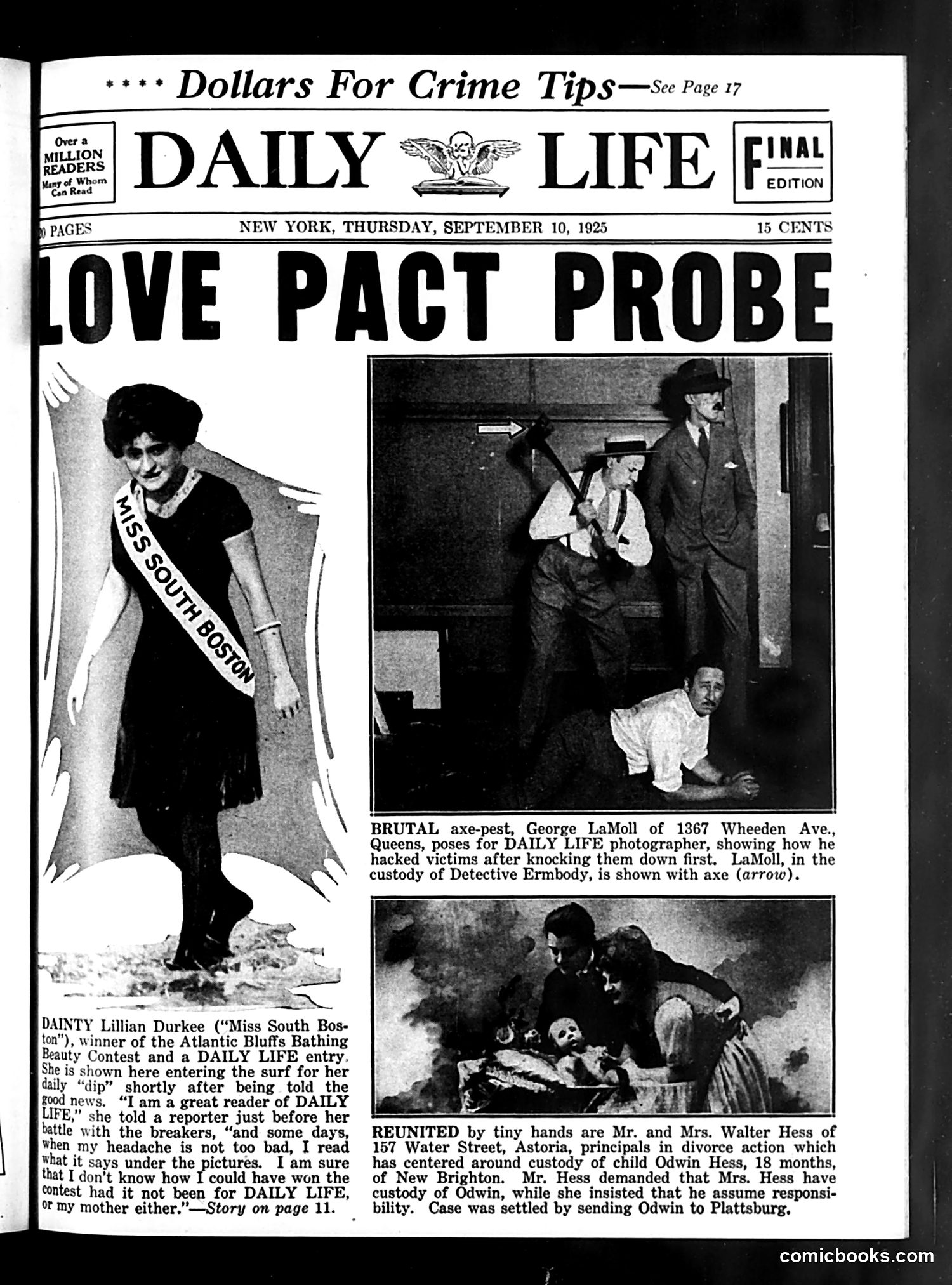
This page covers three sensational news stories typical of 1920s tabloid journalism: 1. **"Miss South Boston"** (left): Lillian Durkee, a beauty contest winner, is shown entering the surf. The caption notes she credited Daily Life with helping her win, attributing her success to reading the magazine. 2. **"Brutal axe-pest"** (top right): George LaMoll, accused of attacking victims with an axe, is shown in police custody with Detective Ermbody. This appears to be crime reporting on an active criminal case. 3. **"Reunited"** (bottom): Mr. and Mrs. Walter Hess are pictured after settling a custody dispute over their 18-month-old child, Odwin, involving a woman named "Miss Odwin" from New Brighton. The page exemplifies 1920s sensationalist journalism mixing crime, human interest, and celebrity coverage.
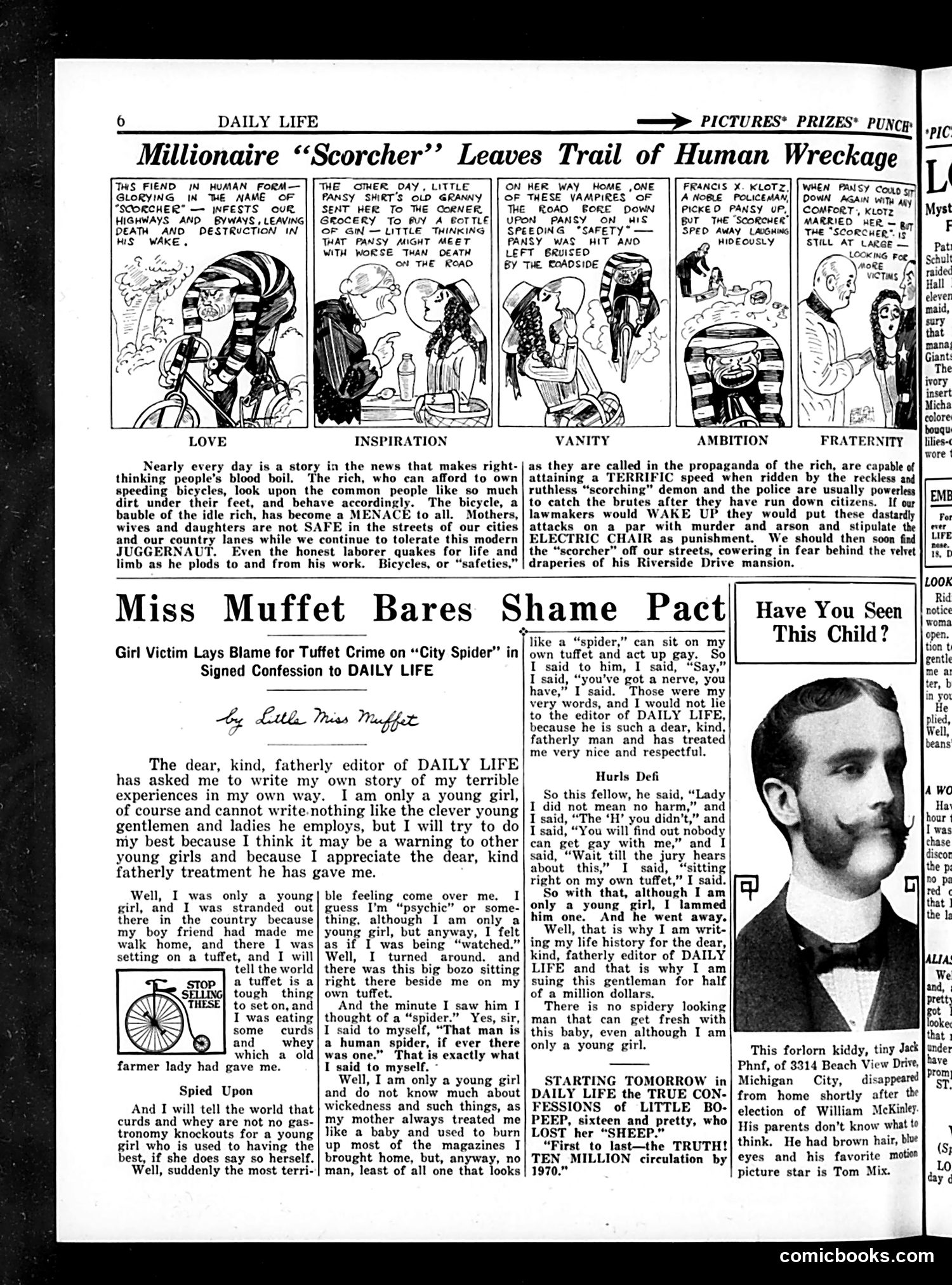
This page contains a five-panel satirical comic strip titled "Millionaire 'Scorcher' Leaves Trail of Human Wreckage." Each panel (Love, Inspiration, Vanity, Ambition, Fraternity) depicts the destructive consequences of a wealthy man's reckless bicycle riding on ordinary people. The accompanying editorial text criticizes rich cyclists who endanger the public, calling them a "menace to all." It advocates for legal restrictions and potentially capital punishment for such dangerous behavior. Below this is a confessional article where "Little Miss Muffet" recounts being victimized by a man nicknamed the "City Spider"—apparently a sexual predator. She's writing to warn other young girls. The page satirizes both wealthy irresponsibility and predatory behavior toward vulnerable youth, reflecting Progressive-era concerns about urban dangers and class-based harm.
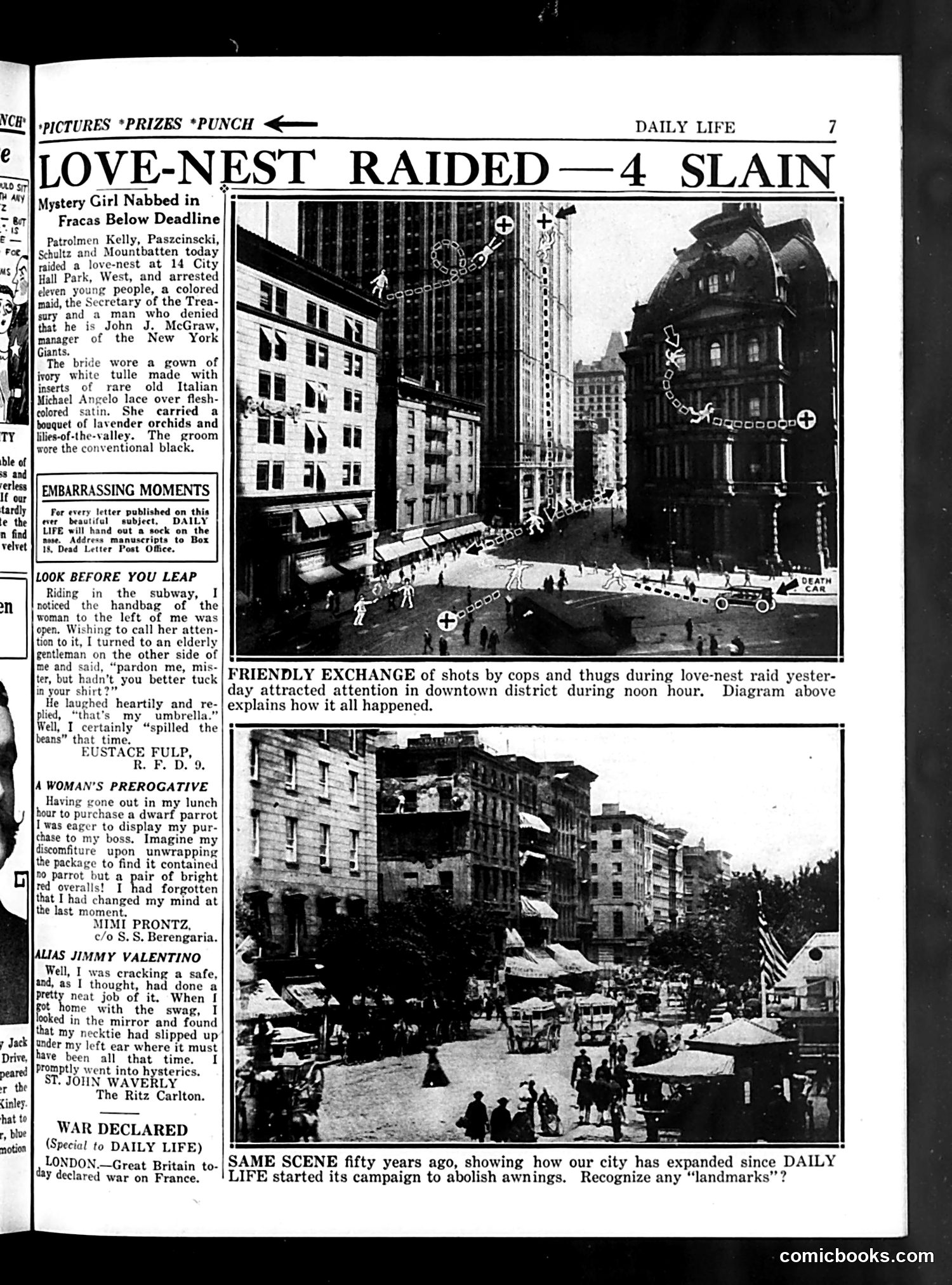
This page reports on a sensational crime incident: a "love-nest raid" that resulted in four deaths in downtown New York. The main headline announces "Mystery Girl Nabbed in Fracas Below Deadline," referring to a woman involved in what appears to be a shooting between police and criminals during a daytime raid on a residence. The two photographs document the scene—showing the building where the incident occurred and a street view from fifty years prior, meant to illustrate urban development. The caption notes this comparison was part of Life's campaign against awnings. Below are humorous reader letters under sections like "Embarrassing Moments" and "A Woman's Prerogative," typical of the magazine's satirical format featuring everyday anecdotes and social commentary rather than political cartoons.
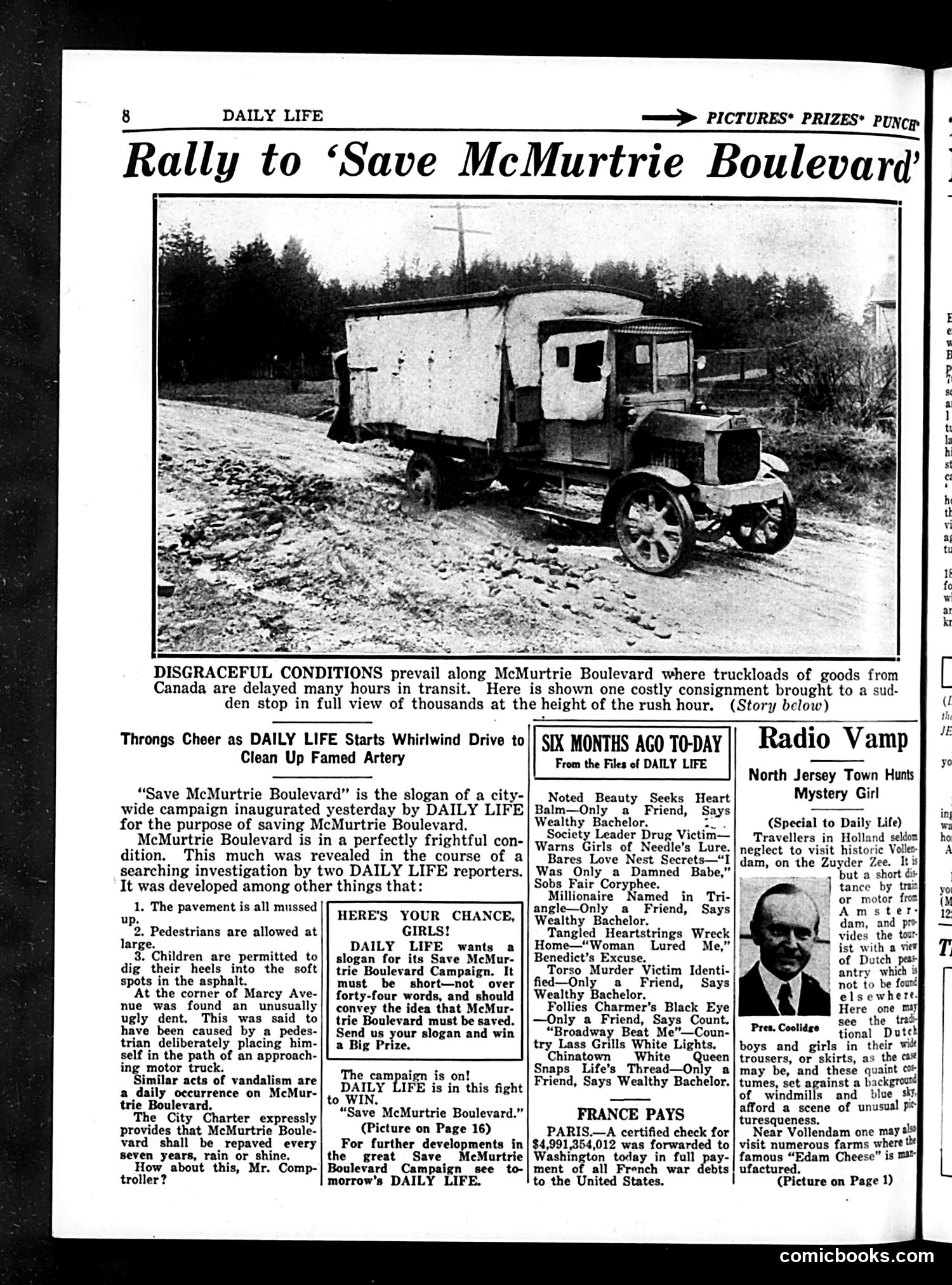
This page documents a **satirical civic campaign by DAILY LIFE magazine** to repair McMurtrie Boulevard, a neglected road where Canadian trucking goods are delayed. The photograph shows a dilapidated truck stuck on a poorly maintained street. The magazine is running a humorous **"Save McMurtrie Boulevard" slogan contest**, inviting readers to submit catchphrases to promote road repair. The text lists various submitted slogans, most romantic or whimsical in tone—treating serious infrastructure neglect as comedy. The satire targets **urban neglect and bureaucratic inaction**: rather than directly demanding repairs, the magazine uses public mockery and participatory humor to pressure officials into maintenance. It's a clever example of **early 20th-century advocacy journalism** using satire to highlight civic problems.
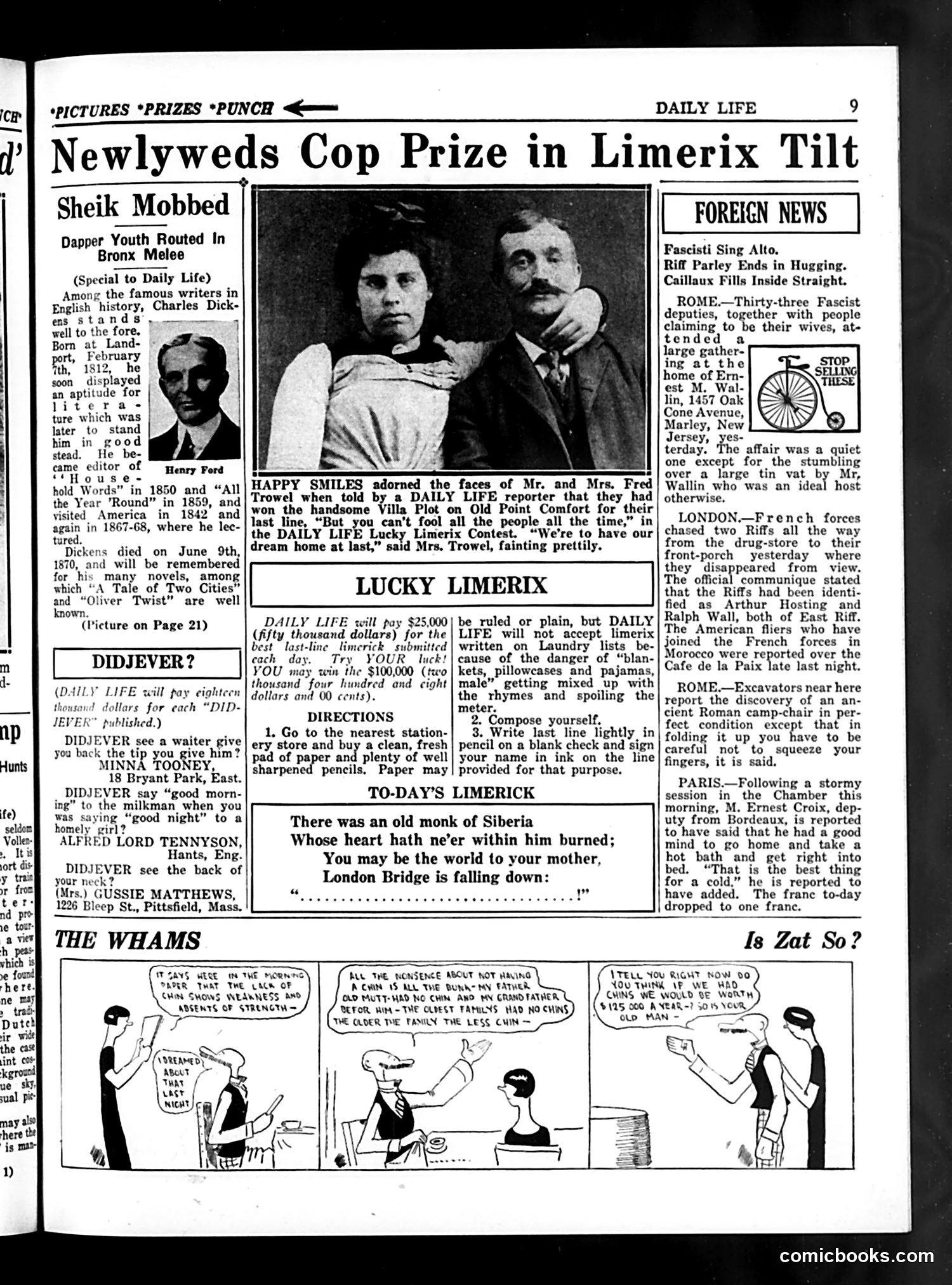
This page features a **Lucky Limericks contest** where Daily Life readers submit humorous five-line poems for cash prizes ($25,000 grand prize). The contest rules require limericks about specified topics, written on laundry lists. The main illustration shows **Mr. and Mrs. Fred Trowel**, who won a villa for submitting a limerick. The accompanying "To-Day's Limerick" references a Russian monk whose "heart hath ne'er within him burned" and mentions London Bridge falling. **"The Whams" cartoon** (bottom) depicts a domestic argument about money, with a woman complaining about financial hardship while her husband dismisses her concerns—typical Depression-era satire about class anxiety and marital conflict over household finances.
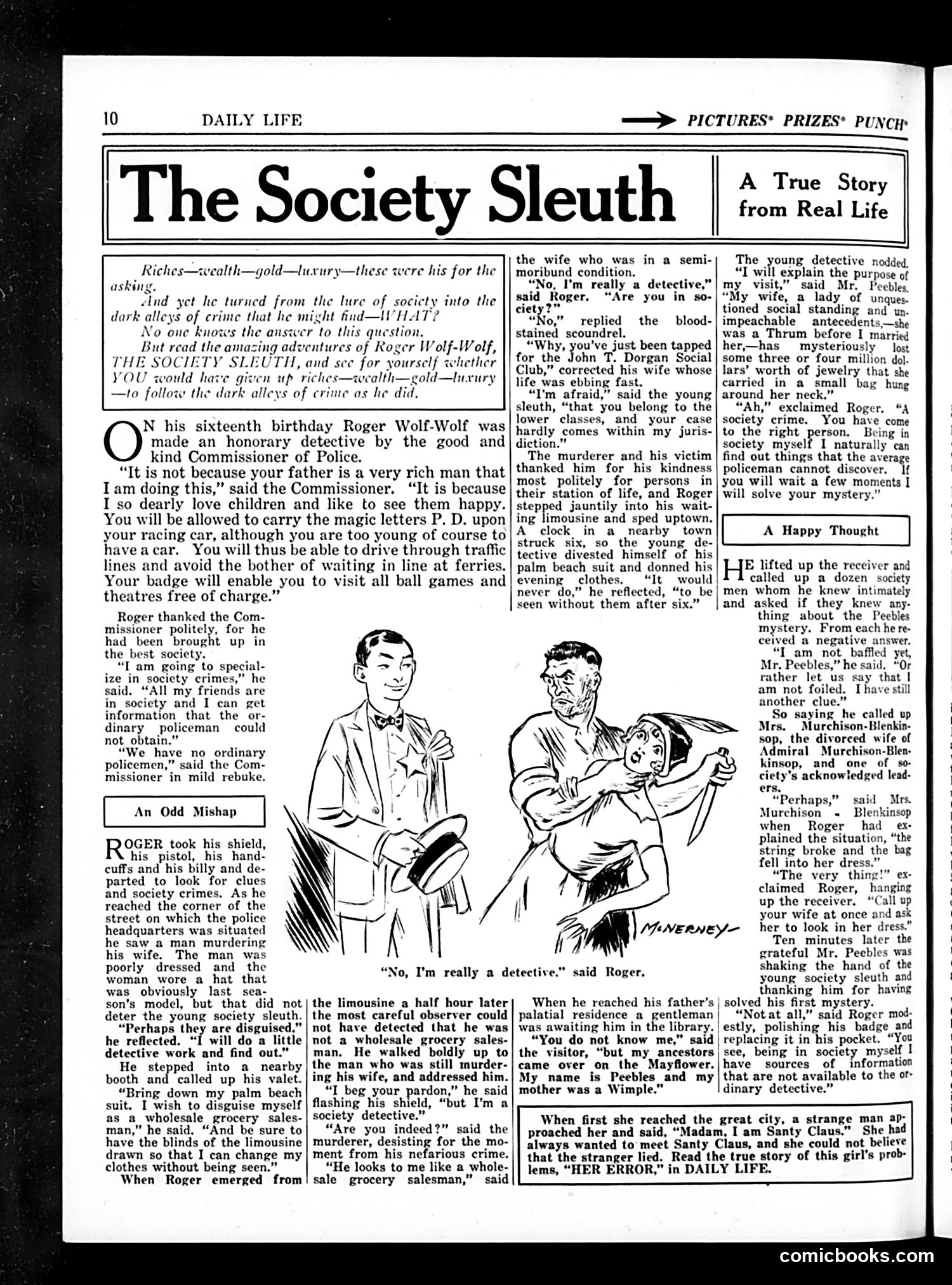
This is a serialized detective fiction story from Life magazine, not a political cartoon. The narrative follows Roger Wolf-Wolf, a sixteen-year-old amateur detective from a wealthy family who specializes in "society crimes"—mysteries among the upper classes. The story establishes the premise: Roger's father, a police commissioner, encourages his son to investigate high-society cases where ordinary police lack access. The illustrations show Roger in formal dress, establishing his privileged social standing as key to his detective work. The humor derives from the incongruity of a young, inexperienced boy attempting serious detective work within exclusive social circles. The page includes a mystery subplot involving Mrs. Blenkinsop and stolen jewelry, setting up the adventure for readers to follow.
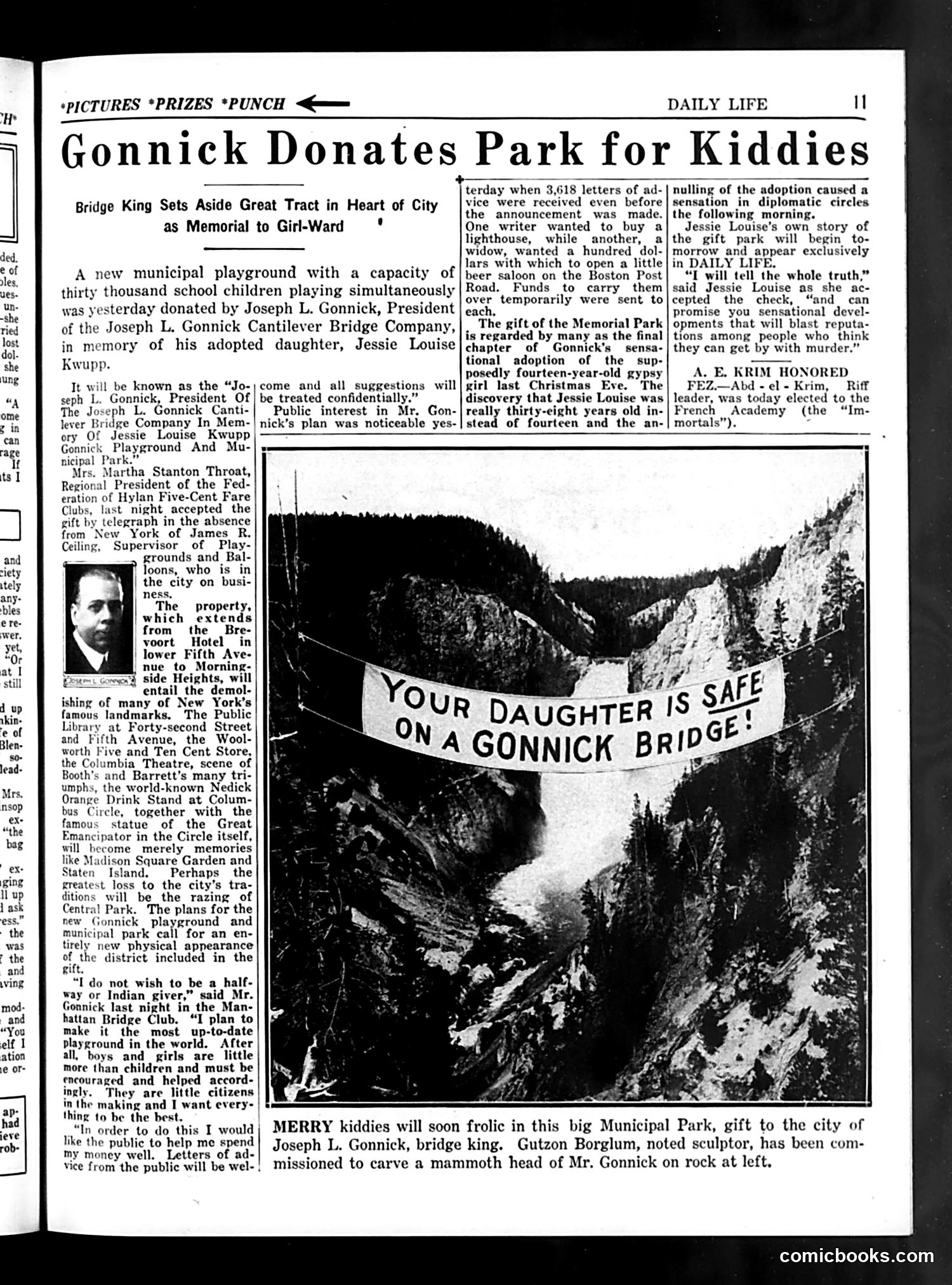
This page satirizes Joseph L. Gonnick, President of the Joseph L. Gonnick Cantilever Bridge Company, who donated a large municipal playground to the city. The accompanying photograph shows a dramatic mountain gorge with a banner reading "YOUR DAUGHTER IS SAFE ON A GONNICK BRIDGE!" The satire operates on two levels: First, it mocks Gonnick's self-promotional advertising disguised as philanthropy—the bridge company's safety slogan appears prominently in what should be straightforward news coverage. Second, it suggests the playground donation is similarly motivated by commercial interest rather than genuine civic virtue. The juxtaposition implies Gonnick uses charitable acts primarily to market his bridges and engineering company to the public.
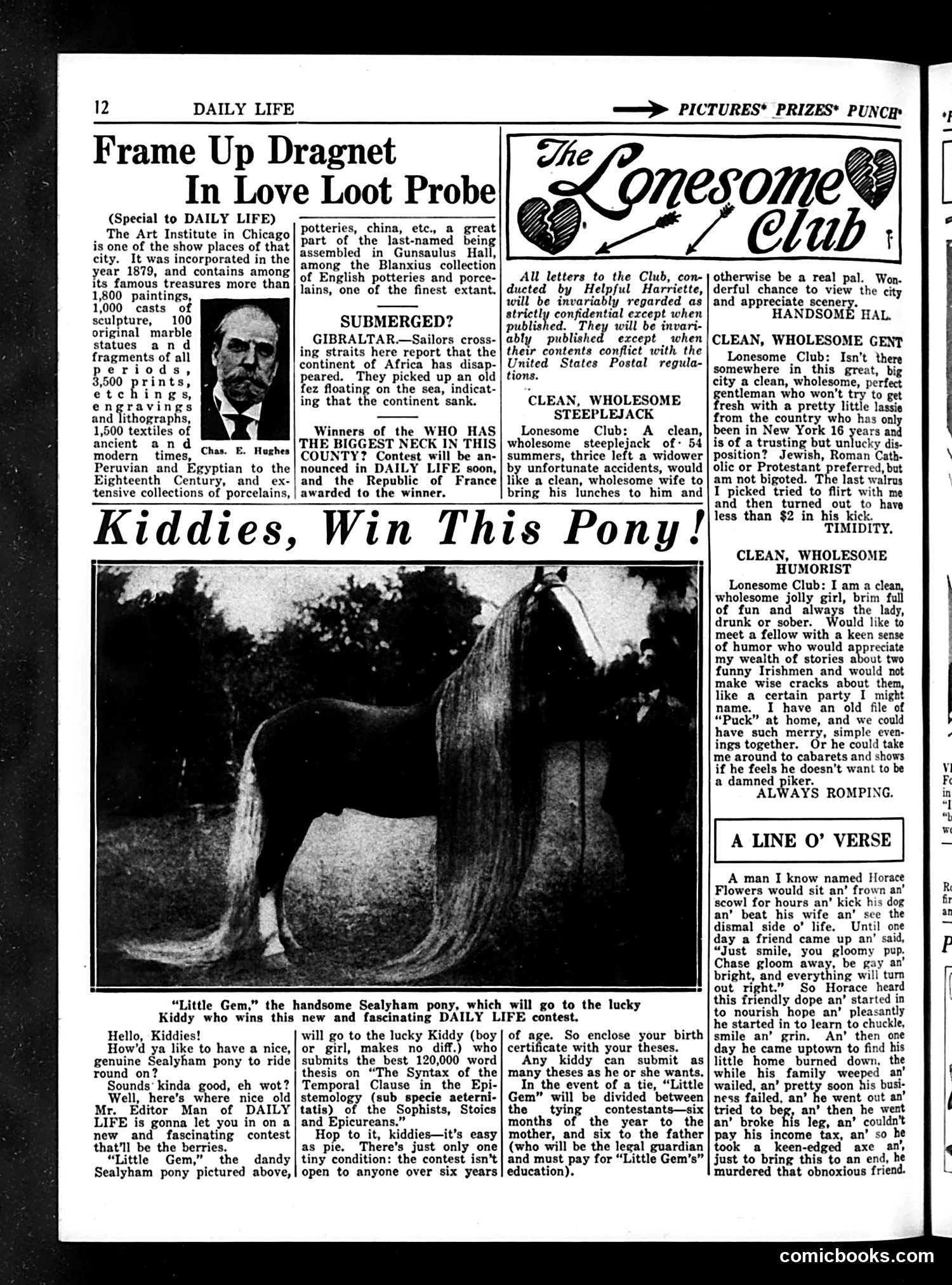
This is primarily a **contest announcement and personal ads page**, not political satire. The main feature announces a pony-giveaway contest for children. The prize is "Little Gem," a Sealyham pony pictured prominently. Children must submit birth certificates and compete based on criteria including age, education, and local guardian approval. The prize will be divided among winners across months. The page also includes **"The Lonesome Club,"** a personal ads section where lonely individuals seek companionship—featuring ads from a clean-living gentleman seeking a wife, and a humorous woman seeking a like-minded companion. A poem titled **"A Line O' Verse"** occupies the bottom, telling a humorous story about a man named Horace Flowers. The content reflects early 20th-century Life magazine's mix of contests, advice columns, and light verse aimed at general readership.
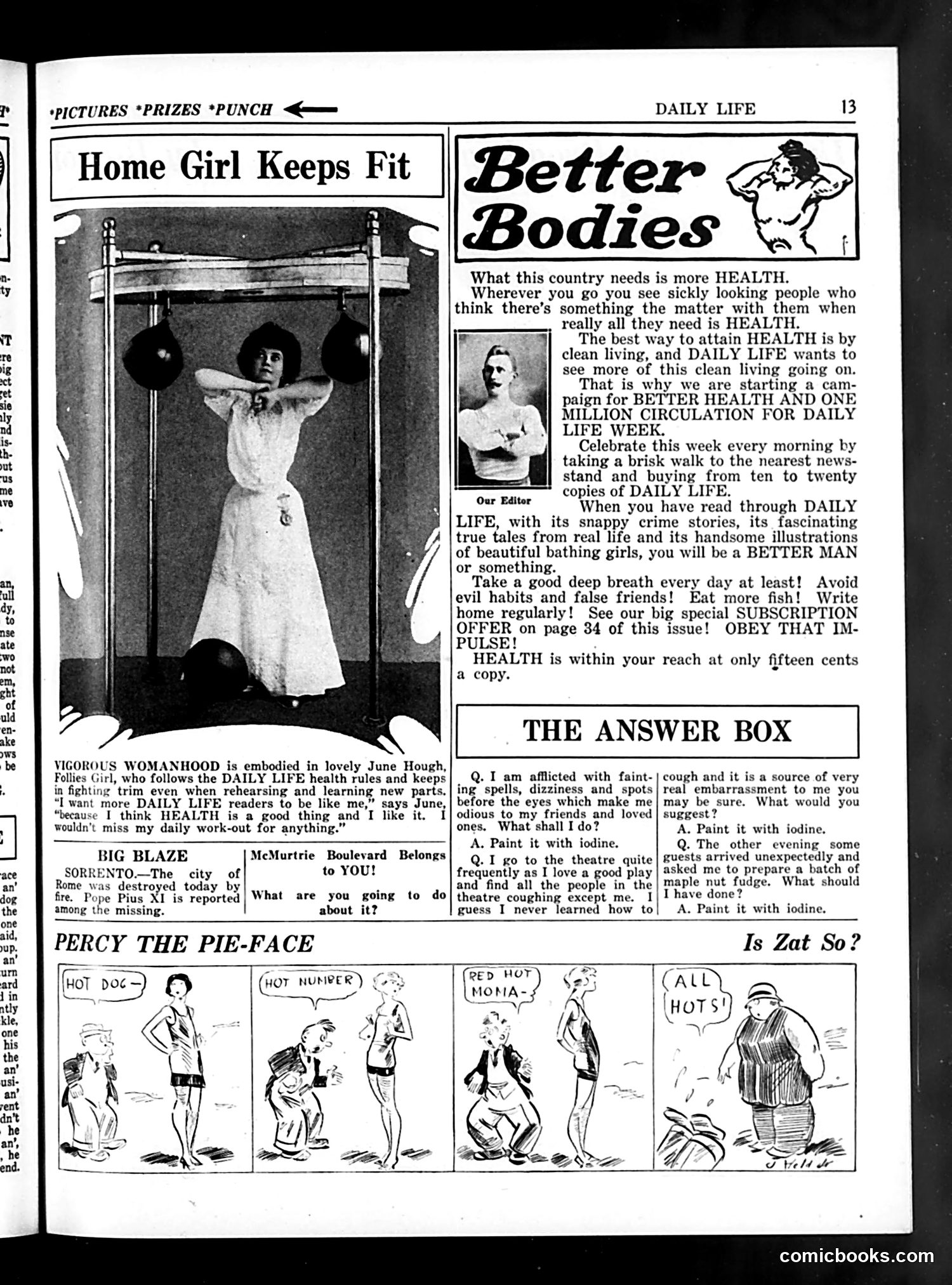
This page contains health and lifestyle content typical of early 20th-century magazines. **"Home Girl Keeps Fit"** features June Hough, a "Follies Girl," demonstrating exercises. The accompanying text celebrates her as embodying "vigorous womanhood" through Daily Life's health rules, appealing to readers' aspirations for fitness. **"Better Bodies"** is a health advocacy column promoting Daily Life's circulation by linking newspaper reading to personal wellness—a self-promotional strategy common in period magazines. **"Percy the Pie-Face"** is a comic strip showing a beach scene where a man encounters women in swimwear. The joke appears to turn on reactions to his appearance versus theirs, playing on period attitudes about male-female attractiveness standards and beach culture. The overall theme emphasizes health, fitness, and modern leisure activities.
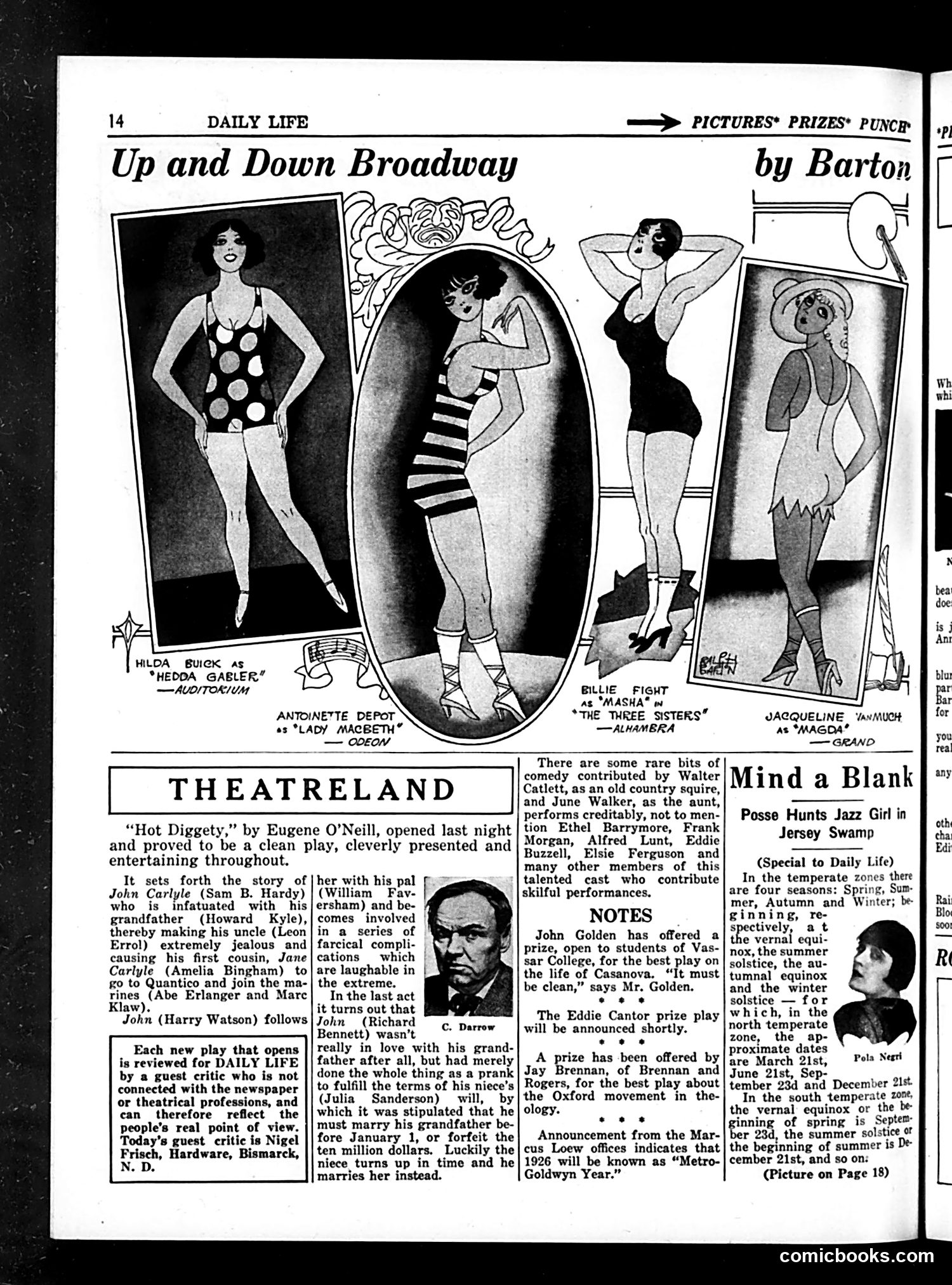
This entertainment column features photographs of Broadway performers in various theatrical productions. The layout showcases actresses in costume for shows including "Hedda Gabler," "Lady Macbeth," "The Three Sisters," and "Magda." The "Theatreland" section below reviews "Hot Diggety" by Eugene O'Neill, praising it as "a clean play, cleverly presented and entertaining throughout." It describes the plot involving characters named Leo Curdle, Jane Cordale, and their romantic entanglements. The column includes theater notes about prize plays and upcoming announcements from film studios. This appears to be standard entertainment journalism documenting Broadway productions and casting of the 1920s era, rather than political satire or social commentary.
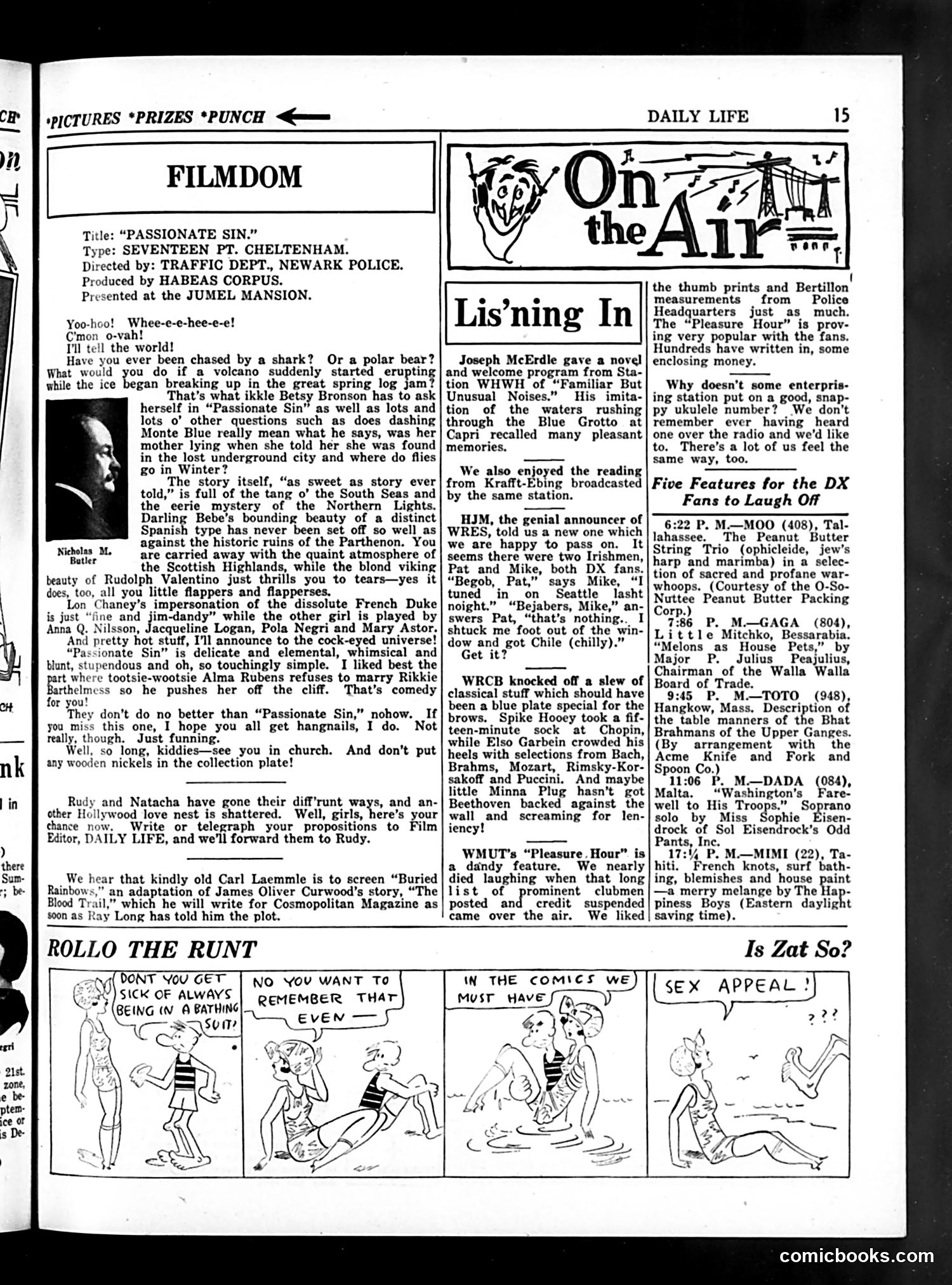
This page contains entertainment commentary and a comic strip rather than political satire. **"Filmdom" section**: Reviews the film "Passionate Sin," a 17-minute Cheltenham production. The reviewer uses humorous exaggeration—comparing the plot's absurdity to scenarios like volcanoes during ice ages—to mock what appears to be a melodramatic or poorly-constructed silent film. The satire targets overly earnest low-budget cinema. **"Rollo the Runt" comic strip**: A four-panel beach humor strip about swimming. The joke plays on social convention: a boy avoids swimming to maintain modesty ("being in a bathing suit"), but when he sees girls in swimwear doing it, he joins in. The final panel's "SEX APPEAL!" caption suggests the humor derives from attraction overriding propriety—a gentle comment on teenage behavior and social conventions of the era. Neither piece contains significant political content.
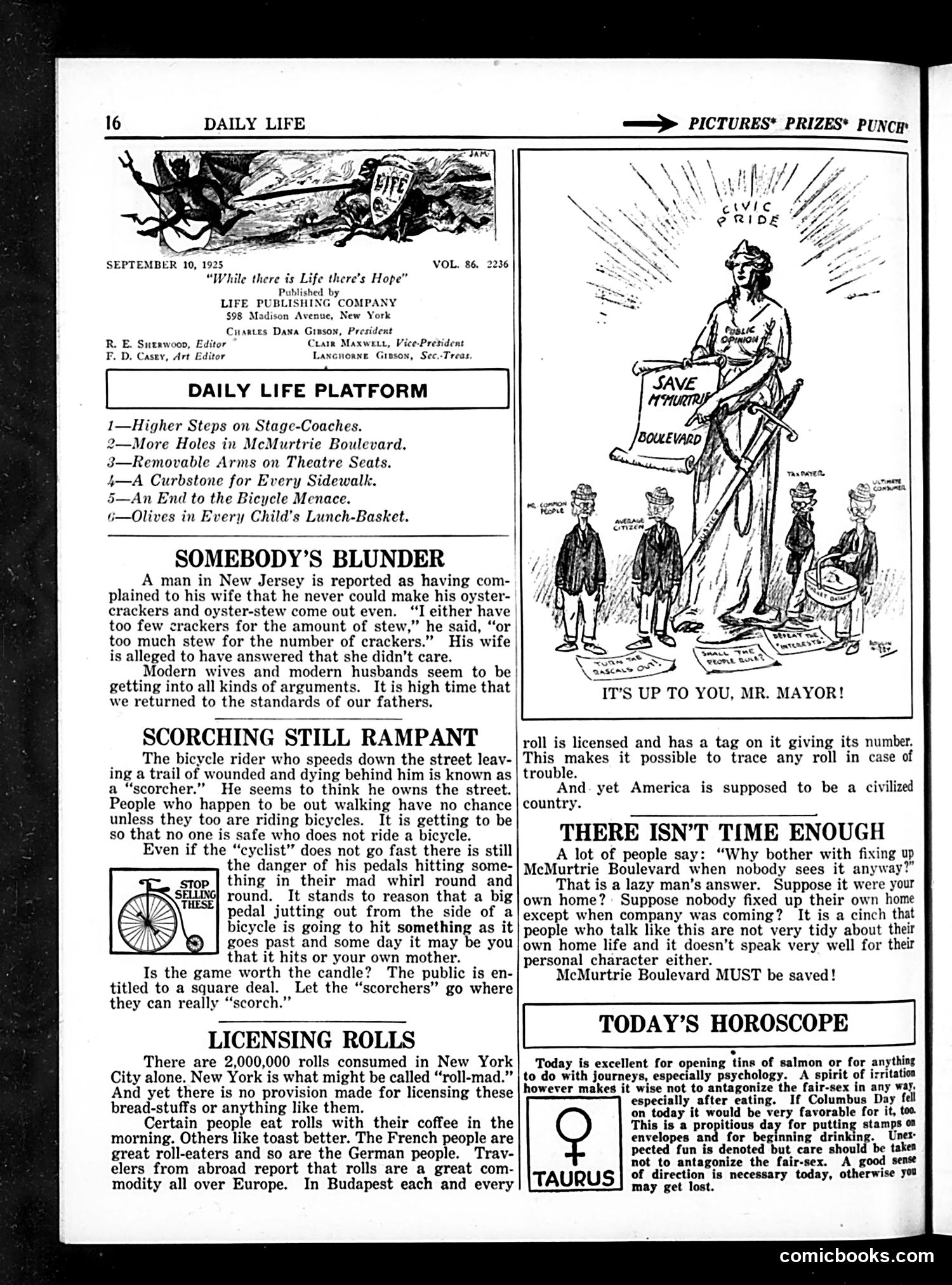
The main cartoon titled "It's Up to You, Mr. Mayor!" depicts a tall female figure labeled "Civic Pride" holding a sword, standing over several smaller male figures (likely representing city officials or citizens). She points to a sign reading "Save McMurtie Boulevard," clearly referencing a local infrastructure dispute. The satirical point: the cartoon criticizes civic leaders' inaction regarding deteriorating McMurtie Boulevard. By personifying "Civic Pride" as a powerful woman literally towering over the men, the artist mocks their failure to address public concerns. The phrase "It's Up to You, Mr. Mayor!" places direct responsibility on leadership. The accompanying text articles—about bicycle riders ("scorching"), unlicensed bread rolls, and boulevard maintenance—all satirize urban governance failures and public indifference to civic responsibility in 1920s America.
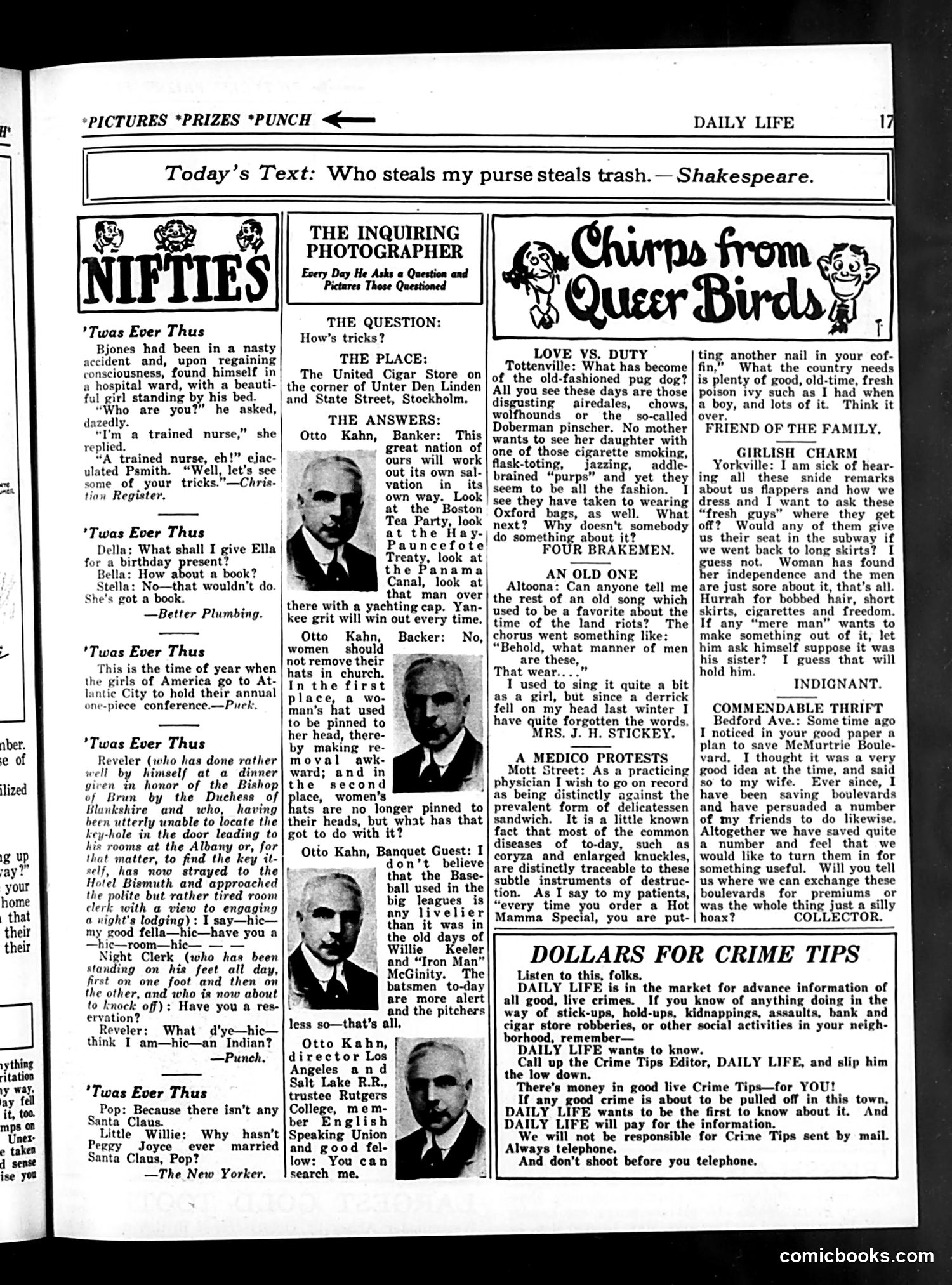
This page from Life magazine contains several humor pieces typical of the 1920s satirical format. The main feature, "The Inquiring Photographer," repeatedly interviews Otto Kahn, a famous banker and philanthropist of the era. The joke is that no matter the question—about patriotism, church etiquette, baseball equipment, or anything else—Kahn gives similarly vague, self-satisfied responses that reveal nothing. The cartoonist is mocking Kahn as a type: the wealthy, verbose public figure who speaks confidently while saying nothing of substance. The surrounding "Twas Ever Thus" jokes satirize everyday social pretension and misunderstanding: a drunk man confusing a hotel for his reservation; a father explaining Santa's nonexistence; a nurse-patient flirtation. The right columns contain reader letters addressing social anxieties of the period—changing fashion standards, disappearing dog breeds, and new jazz-age behavior—voiced by correspondents concerned about tradition and decorum.
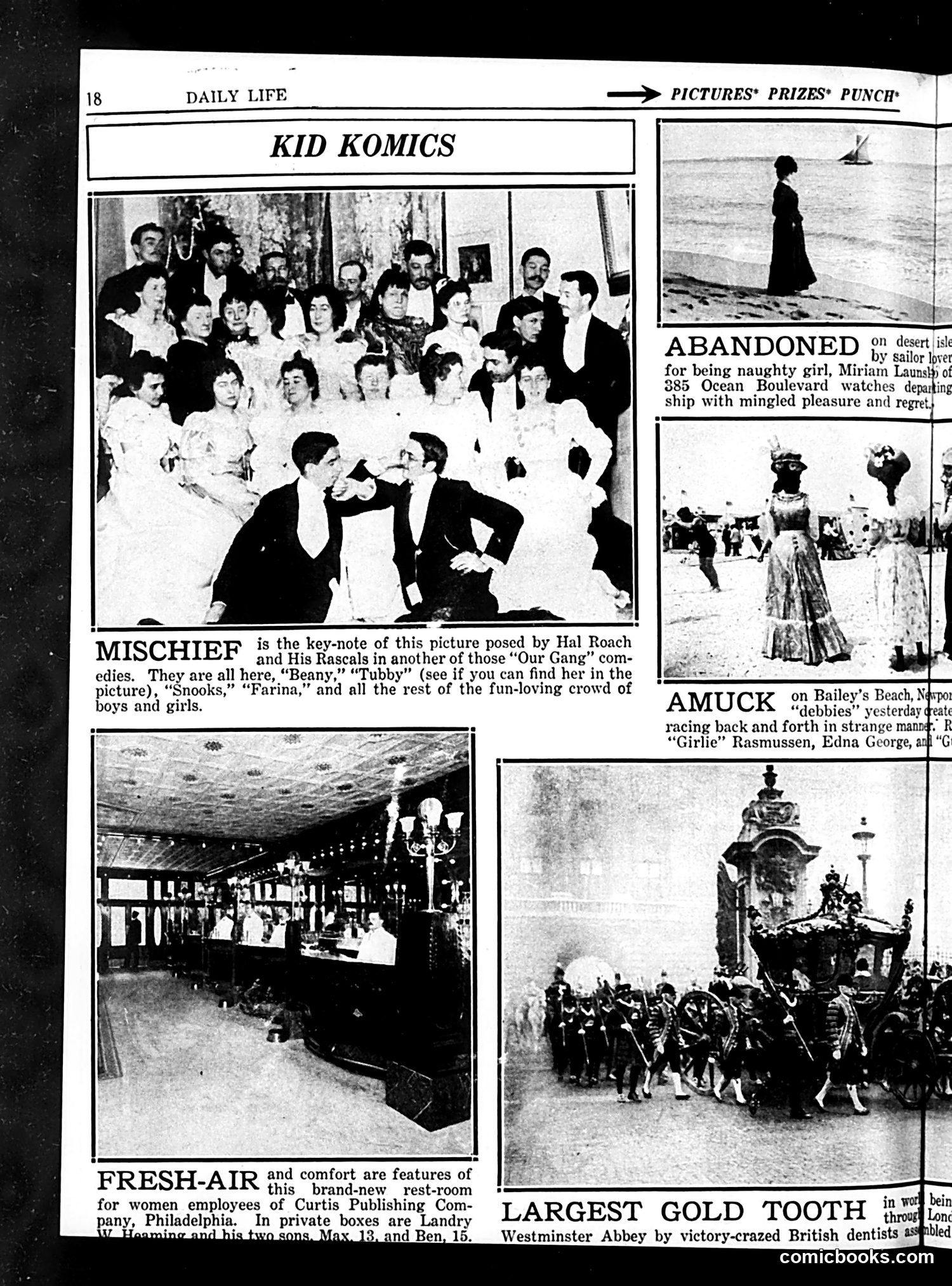
This is a **entertainment and society page** from Life magazine, not political satire. It features photographs of popular culture moments: **"Mischief"**: A posed still from Hal Roach's "Our Gang" (Little Rascals) comedies—a hugely popular children's film series. The caption identifies cast members like "Beany," "Tubby," "Snooks," and "Farina," inviting readers to spot them in the crowded party scene. **"Abandoned"**: A humorous photo of a girl named Miriam Launb watching a departing ship, captioned as being left behind by a sailor for misbehavior. **"Amuck"** and **"Fresh-Air"**: Additional society/lifestyle photographs of notable people at beaches and social venues. **"Largest Gold Tooth"**: References a novelty item at Westminster Abbey created by British dentists. The page is primarily **light entertainment and gossip**, showcasing popular figures and amusing moments from daily life rather than delivering political commentary or satire.
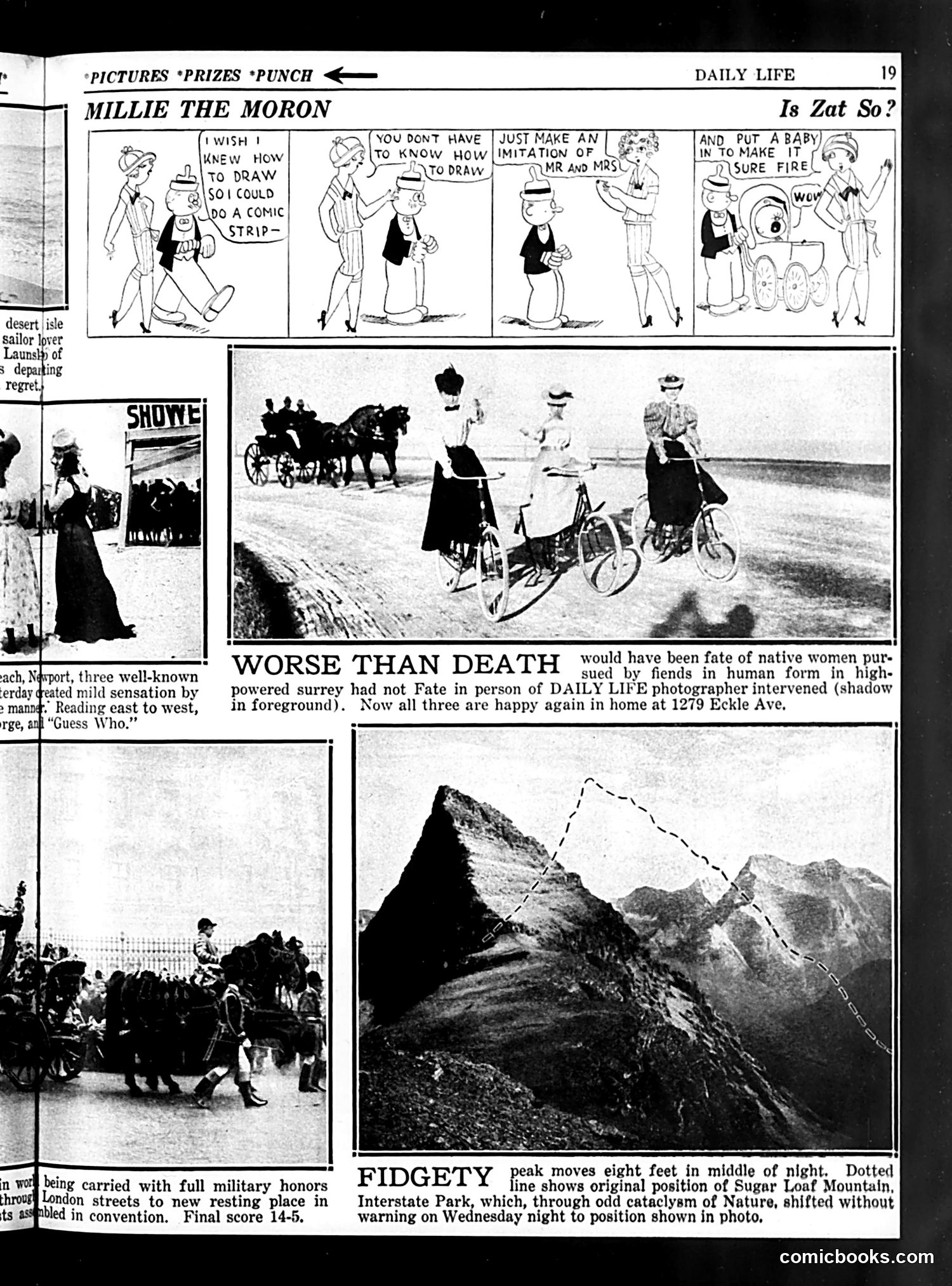
**"Millie the Moron"** is a satirical comic strip mocking female incompetence. The unnamed female character wishes to learn cartooning but lacks basic drawing ability—the joke plays on stereotypes of women as intellectually deficient ("moron"). The strip's humor depends entirely on this prejudicial framing. **"Worse Than Death"** appears to be a humorous photo-essay about three women rescued from danger by a Daily Life photographer while being pursued in a "high-powered surrey" (carriage). The melodramatic headline ironically references Victorian-era "fate worse than death" (sexual assault), treating their rescue as comedic domestic news. **"Fidgety"** presents a geologically impossible claim: Sugar Loaf Mountain supposedly shifted position overnight in Interstate Park, shown via before/after mountain photographs. This is clearly fabricated satire—Life was mocking either geological pseudoscience or readers' gullibility. The page exemplifies early 20th-century Life magazine's blend of crude gender stereotyping, manufactured "human interest" stories, and absurdist humor targeting both women and scientific credibility.
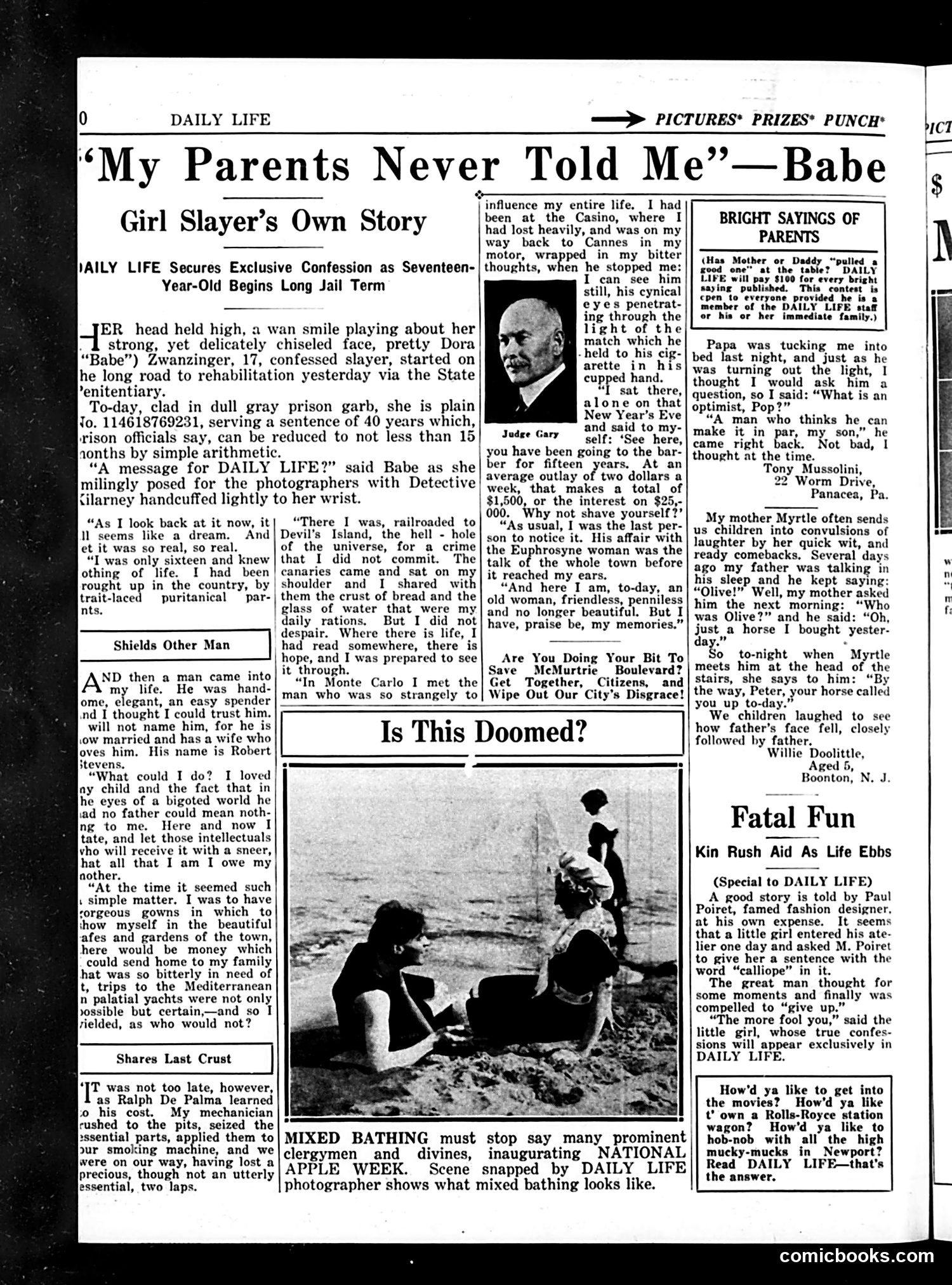
This is a satirical magazine page that juxtaposes genuine crime reporting with absurdist humor to mock sensationalist journalism. **Main Content:** "Girl Slayer's Own Story" presents Dora "Babe" Zwanziger, a 17-year-old imprisoned for murder. The confessional narrative—written in overwrought, melodramatic prose—parodies tabloid journalism's breathless style. Her story shifts bewilderingly between Devil's Island references and Monte Carlo casinos, suggesting either fabrication or the magazine's mockery of unreliable narratives. **The Satire:** The page ridicules how newspapers exploit crime stories for circulation while presenting criminals as romantic antiheroes. The florid language ("trait-laced puritanical parents," "cynical eyes") mimics yellow journalism conventions. **Side Sections:** "Bright Sayings of Parents" and "Fatal Fun" offer unrelated filler typical of era publications. The "Mixed Bathing" caption about clergy opposing the practice reflects period moral debates. The overall effect—clashing between sensationalism and trivial content—satirizes how print media sensationalizes crime while lacking serious engagement with social issues.
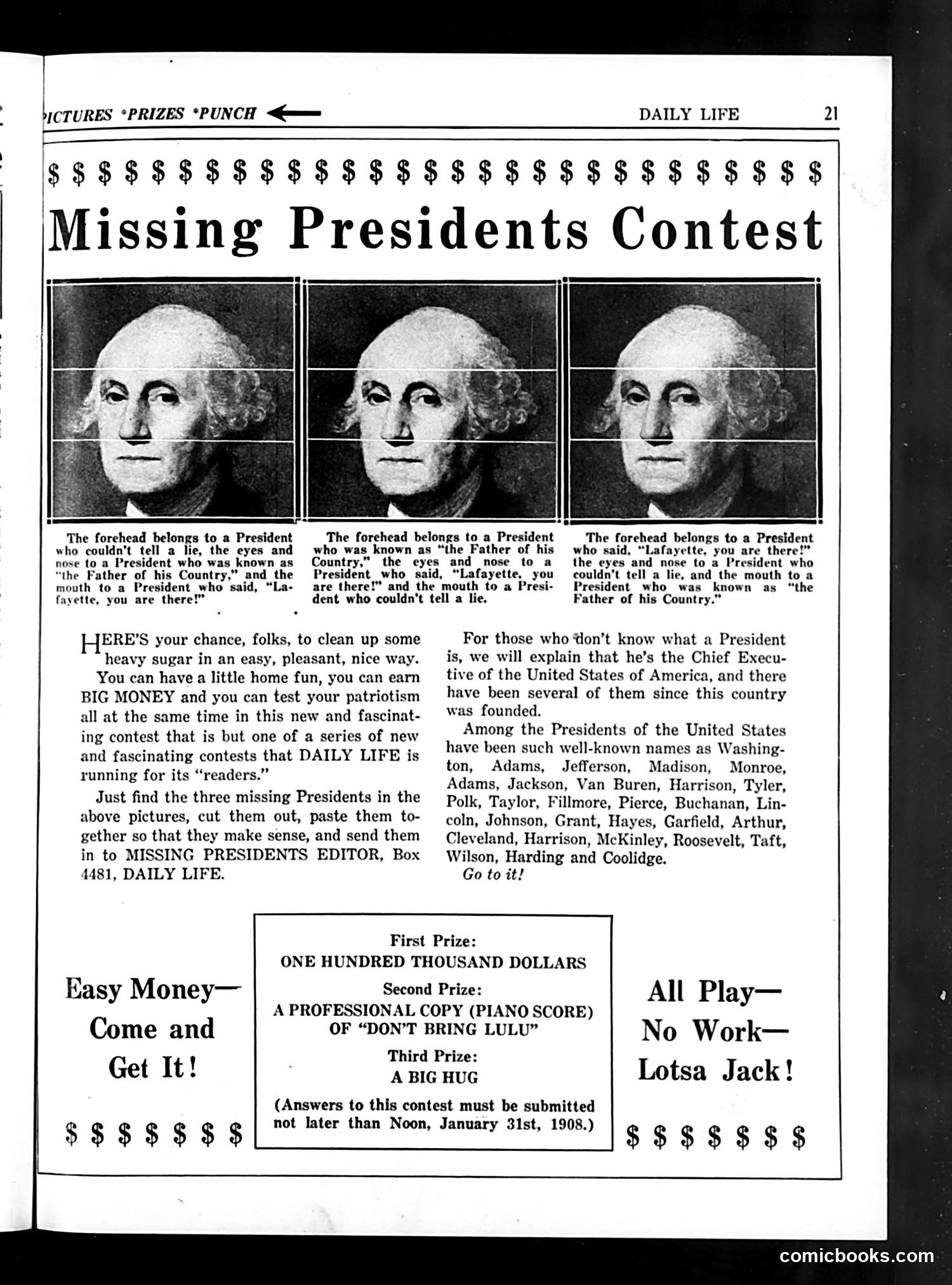
This is a *satirical puzzle contest* from *Life* magazine (January 1908). Three identical portraits are divided horizontally into three sections—forehead, middle, and mouth—each attributed to different U.S. Presidents based on famous quotes or epithets: - "Couldn't tell a lie" = George Washington - "Father of his Country" = Washington - "Lafayette, you are there!" = likely James Monroe or another early president The joke mocks both the public's historical ignorance and the magazine's own contests. By mixing identical faces with different presidential attributions, *Life* satirizes how interchangeable these historical figures seem to ordinary readers—essentially asking readers to solve an impossible puzzle by rearranging the same face. The exaggerated prize amounts ($100,000—an enormous sum in 1908—for "easy money" requiring "no work") further mock the get-rich-quick schemes and frivolous contests proliferating in popular media.
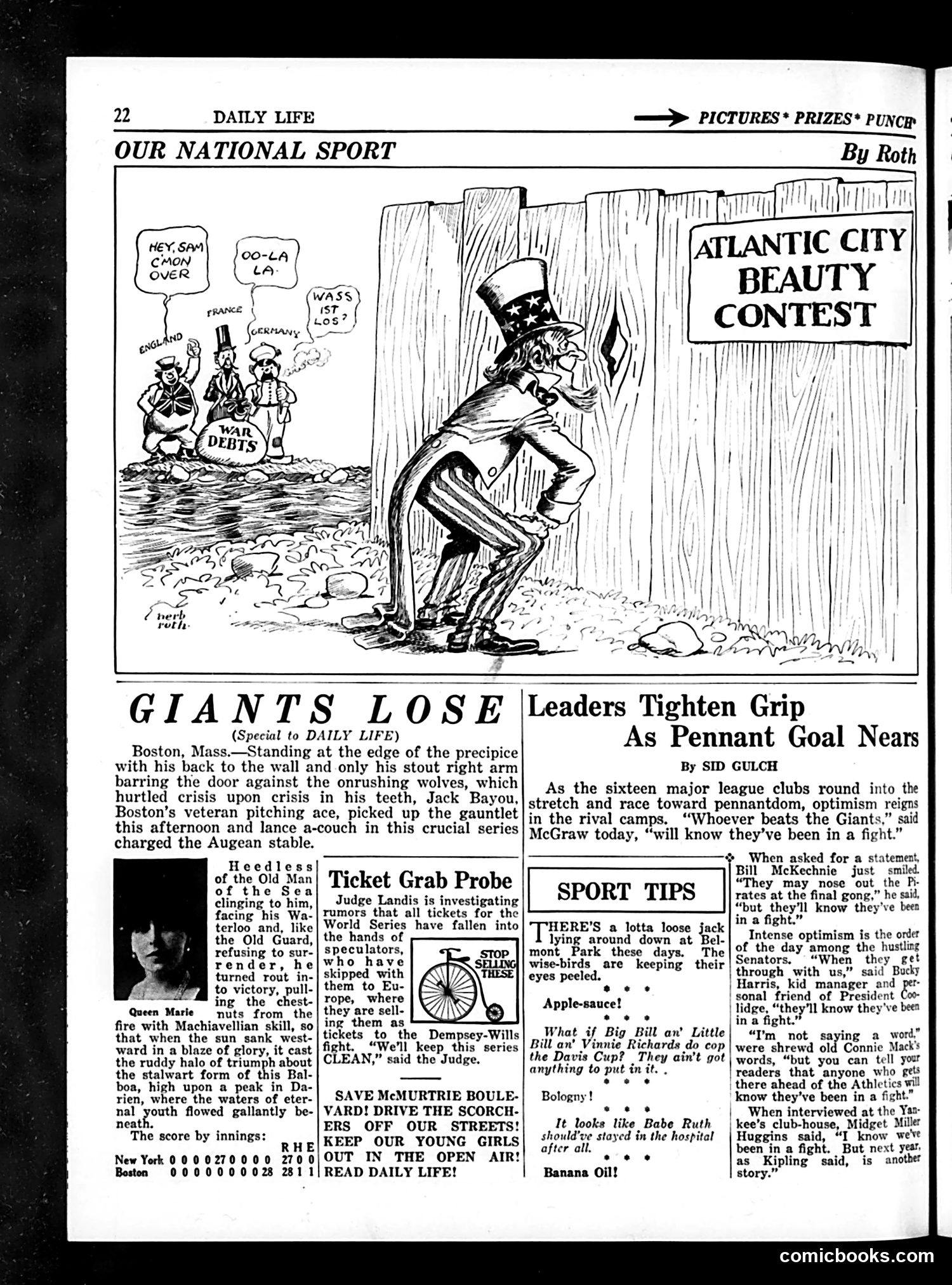
This page contains sports coverage and satirical commentary typical of 1920s Life magazine. **Main Cartoon (top):** Uncle Sam, depicted as a boxer in an "Atlantic City Beauty Contest," stands exhausted against a wall. Across the water, European figures (labeled England, France, Germany) labeled "War Debts" call out mockingly ("Hey Sam, c'mon over!" / "Oo-la-la" / "Wass ist los?"). The satire: America, having won WWI, now faces pressure from Allied nations to forgive war debts—a major post-war political controversy. **Sports Coverage:** Baseball articles discussing the Giants' loss and pennant race. The recurring joke in manager quotes—"they'll know they've been in a fight"—is repeated so often it becomes absurdist humor. **"Sport Tips" Section:** Mock wisdom about horse racing, boxing (Dempsey-Wills fight), and baseball star Babe Ruth, interspersed with period slang dismissals ("Banana Oil!" / "Bologny!" meaning "nonsense"). The satire satirizes both genuine political anxieties and sports journalism's overwrought rhetoric.
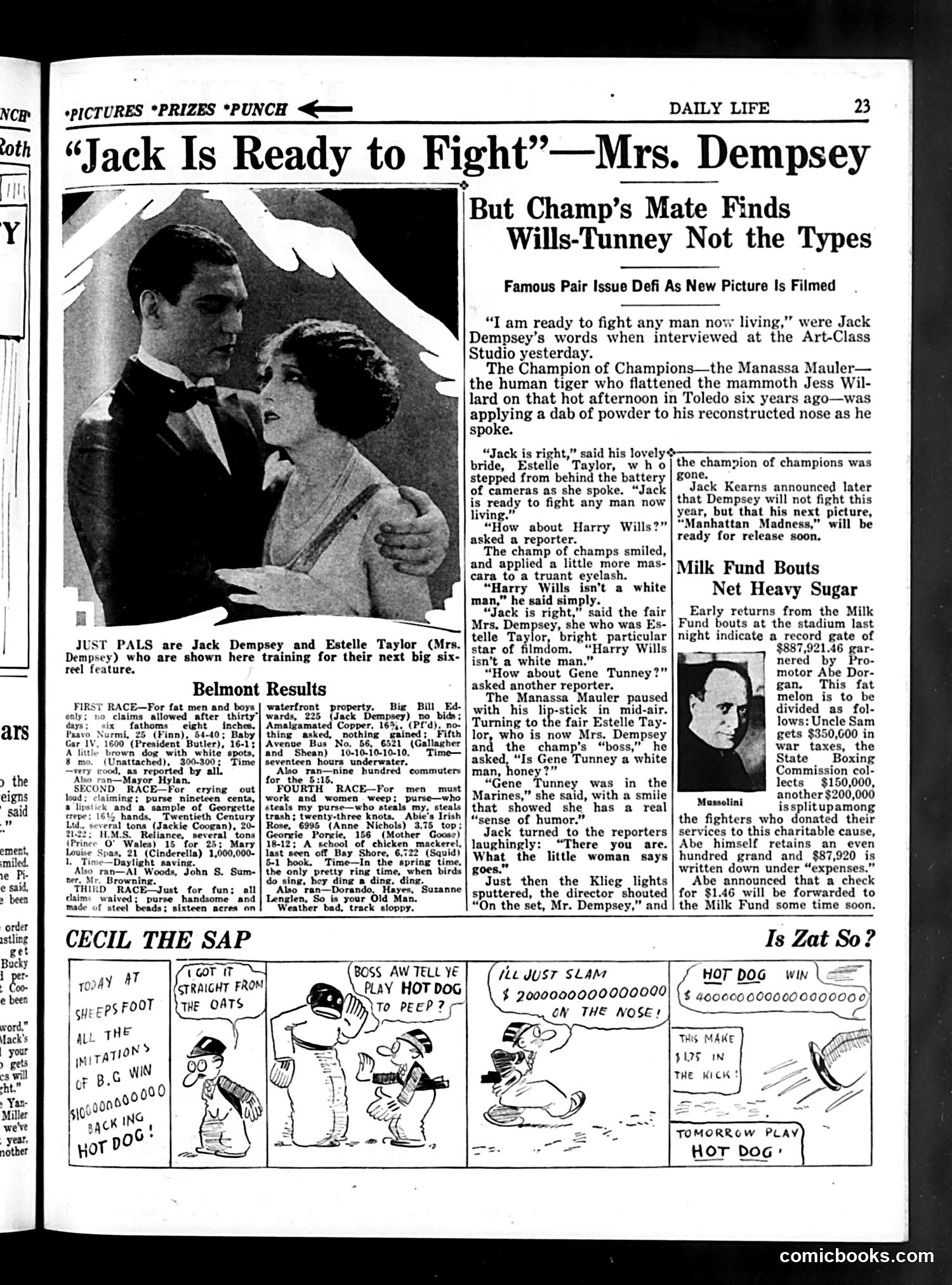
This page satirizes boxer **Jack Dempsey** and his wife **Estelle Taylor** (a film actress), who are filming a movie together. The headline mocks Dempsey's public challenge to fight "any man now living"—a common boxing boast of the era. The satire targets Dempsey's refusal to fight Black boxer **Harry Wills** and his evasiveness about fighting **Gene Tunney** (a white boxer). When asked about Tunney, Dempsey defers to his wife, who dismisses Tunney by noting he was in the Marines—a trivial non-answer. The piece ridicules how Dempsey uses his wife as a convenient excuse to avoid commitments, and mocks his vanity (applying makeup on set). The **"Cecil the Sap"** comic strip below is unrelated sports humor about a hot dog bet. The satire exposes Dempsey's hollow bravado and racial discrimination in boxing, while also poking fun at Hollywood culture and marital dynamics of the era.
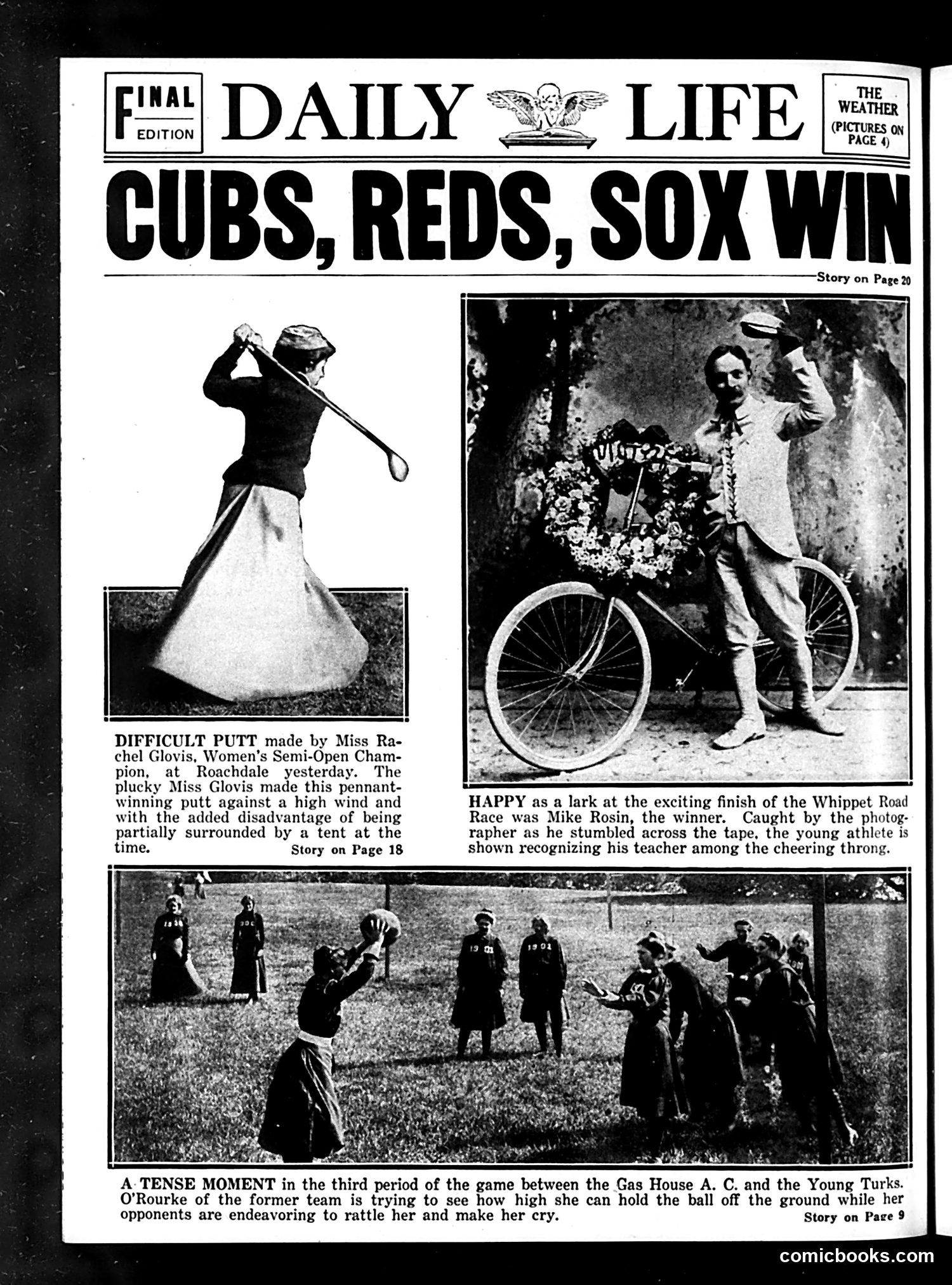
This is not satire but rather a **sports and leisure section** from Life magazine's final edition. The page covers three contemporary athletic events: 1. **Women's Golf**: Miss Rachel Glovis attempting a difficult putt at a Women's Semi-Open Championship, notable for being played in challenging conditions (high wind, tent obstruction). 2. **Whippet Road Race**: A bicycle race won by Mike Rosin, captured crossing the finish line and recognizing his teacher in the crowd. 3. **Women's Sports/Athletic Competition**: A competitive moment between the Gas House A.C. and Young Turks teams, focusing on a player's ball-handling skill while opponents attempt to intimidate her. The page reflects **early 20th-century coverage of women's athletics**—golf, cycling, and team sports—presenting these activities as newsworthy entertainment. The emphasis on women's competitive achievements was notable for the era.
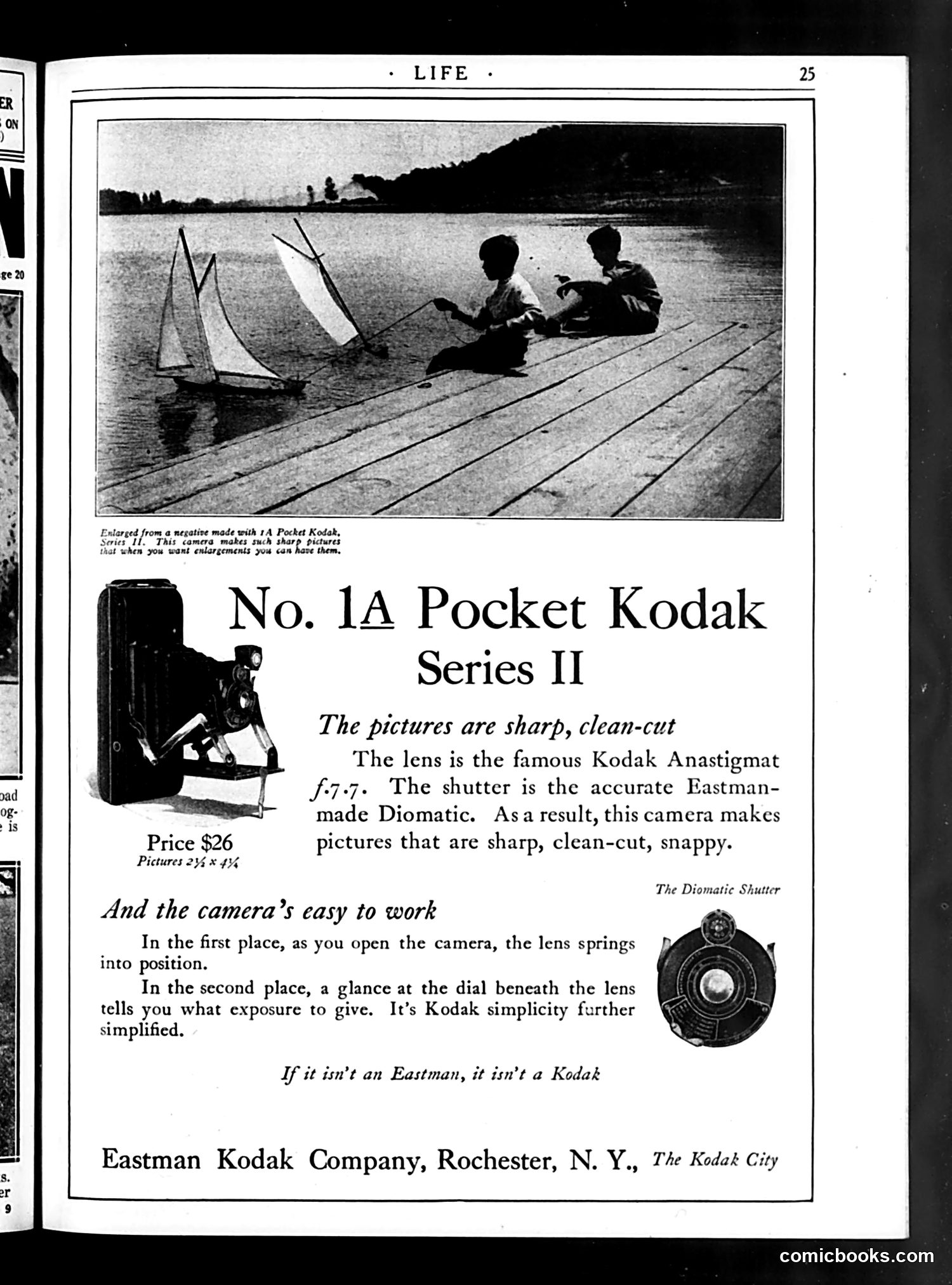
This is not a political cartoon or satire—it's a **straight advertisement** for the No. 1A Pocket Kodak Series II camera, priced at $26. The photograph at top shows two children operating a toy sailboat from a dock, serving as lifestyle imagery to demonstrate the camera's picture quality. The caption claims the enlarged photo was taken with the earlier Pocket Kodak Series I, proving the camera produces sharp, enlargeable images. The ad emphasizes ease of use: the lens springs into position automatically, and a dial indicates proper exposure settings. It features the Kodak Anastigmat lens and Eastman-made Diomatic shutter. The slogan "If it isn't an Eastman, it isn't a Kodak" reinforces brand authenticity. This represents early consumer camera marketing—positioning photography as accessible to ordinary people, particularly families and children.
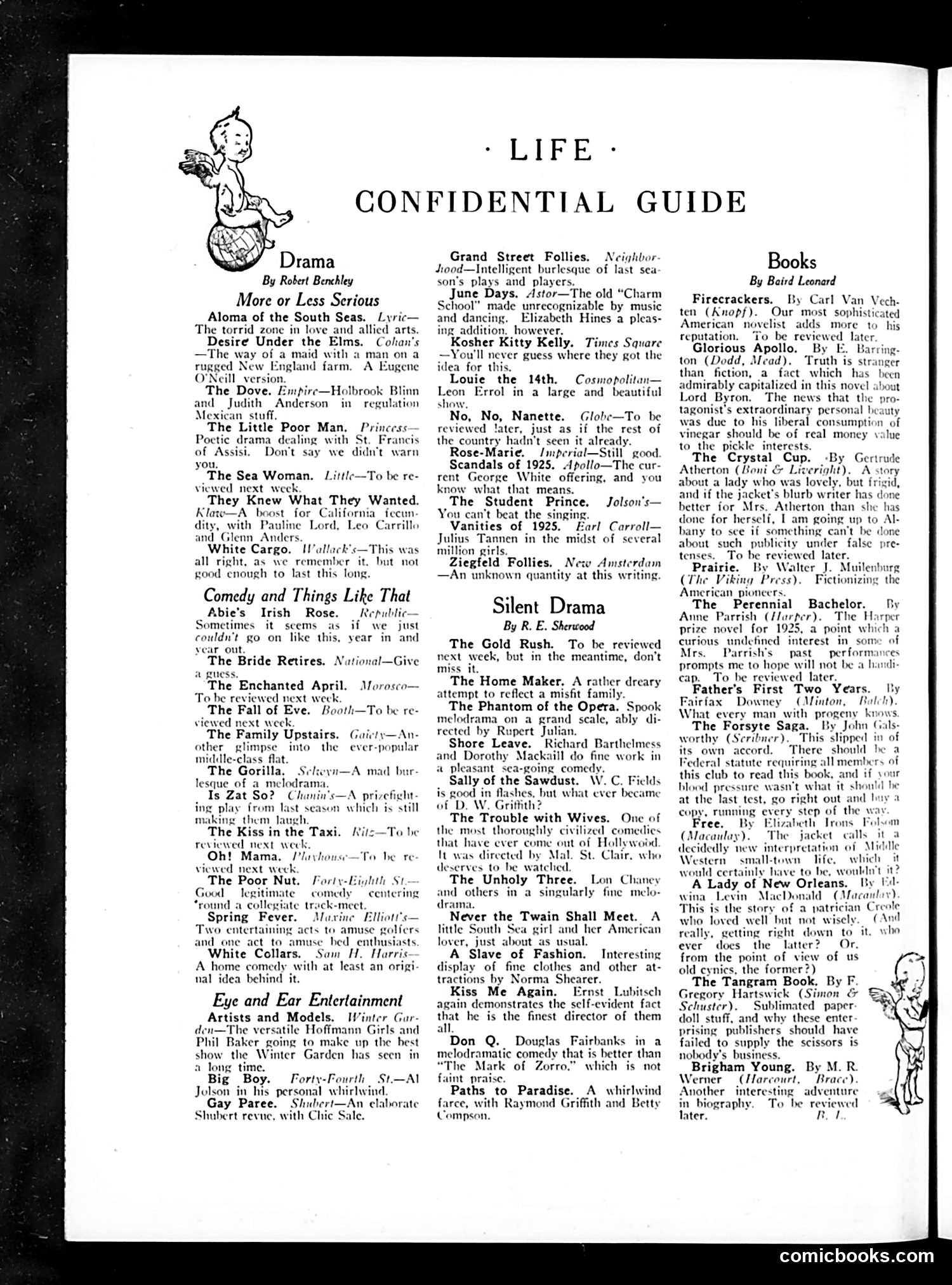
This page is a **theater and film review guide** from Life magazine's "Confidential Guide" section. It lists current Broadway plays and movies with brief, often sarcastic commentary. The reviews are written by prominent critics: Robert Benchley covers drama, R.E. Sherwood reviews silent films. The tone is consistently irreverent—for example, *Abie's Irish Rose* receives the withering comment that "it seems as if we just couldn't go on like this, year in and year out," suggesting audience fatigue with a long-running play. Notable references include W.C. Fields in *Sally of the Sawdust* and Lon Chaney in *The Unholy Three*. The guide mocks predictable material ("You'll never guess where they got the idea") and praises innovation sparingly. The small decorative illustrations are typical of Life's visual style—a cherub and a seated figure in the margins. This is essentially **entertainment journalism aimed at sophisticated, urban readers** who appreciated acerbic wit alongside cultural recommendations.
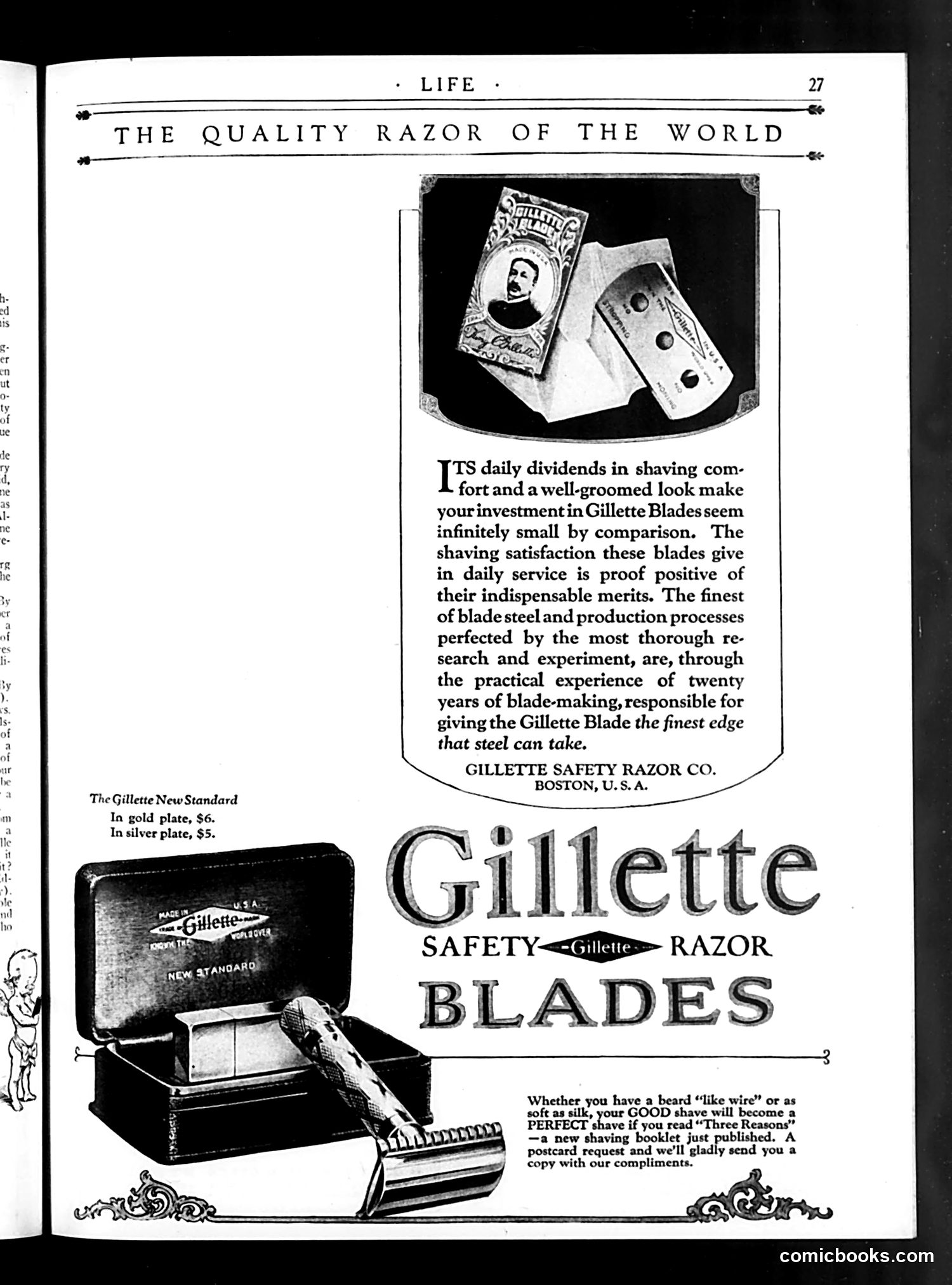
This is primarily a **Gillette Safety Razor advertisement**, not a political cartoon. The page promotes Gillette Blades as "the quality razor of the world" to readers of *Life* magazine. The ad emphasizes product superiority through claims of "twenty years of blade-making" expertise and "the finest edge that steel can take." It positions razor blades as a worthwhile investment despite modest cost—appealing to early 20th-century consumers concerned with grooming and masculinity. The visual elements show the product packaging and a safety razor handle. The lower section mentions a booklet called "Three Reasons," offering promotional material about shaving regardless of beard type ("like wire" or "soft as silk"). There is **no political satire or caricature** visible here. This is straightforward commercial messaging typical of *Life* magazine's advertising content from this era, targeting male readers with promises of quality craftsmanship and social respectability through proper grooming.
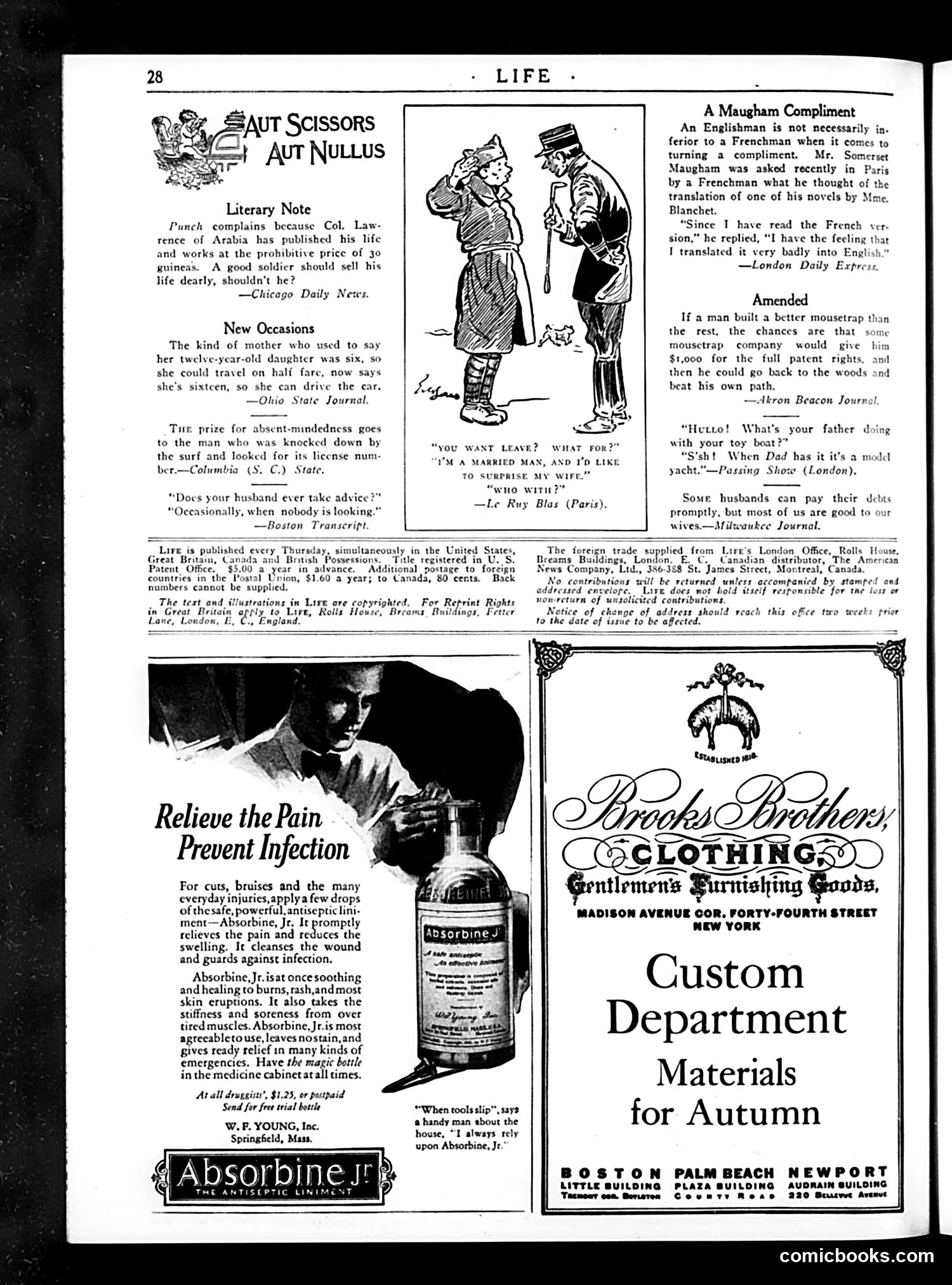
This page from *Life* magazine is primarily a humor and satire section with short jokes reprinted from other publications, plus advertisements. The central cartoon shows a man in a top hat stopping a woman, asking "You want leave? What for? I'm a married man, and I'd like to surprise my wife. Who with?" This is a play on marital infidelity—the joke hinges on the woman's implied suggestion that the man take leave (time off) to spend with his wife being reinterpreted as his plan to surprise *another* woman instead. The surrounding text snippets mock contemporary social behaviors: mothers lying about daughters' ages to get train fare discounts, absent-minded people, and marital dynamics. References include Col. Lawrence of Arabia's expensive autobiography and Somerset Maugham's backhanded compliment about a French translation of his novel. The advertisements for Absorbine Jr. liniment and Brooks Brothers clothing occupy the lower portion. This is largely a humor compilation page rather than political satire—the jokes target everyday domestic and social absurdities recognizable to early 20th-century readers.
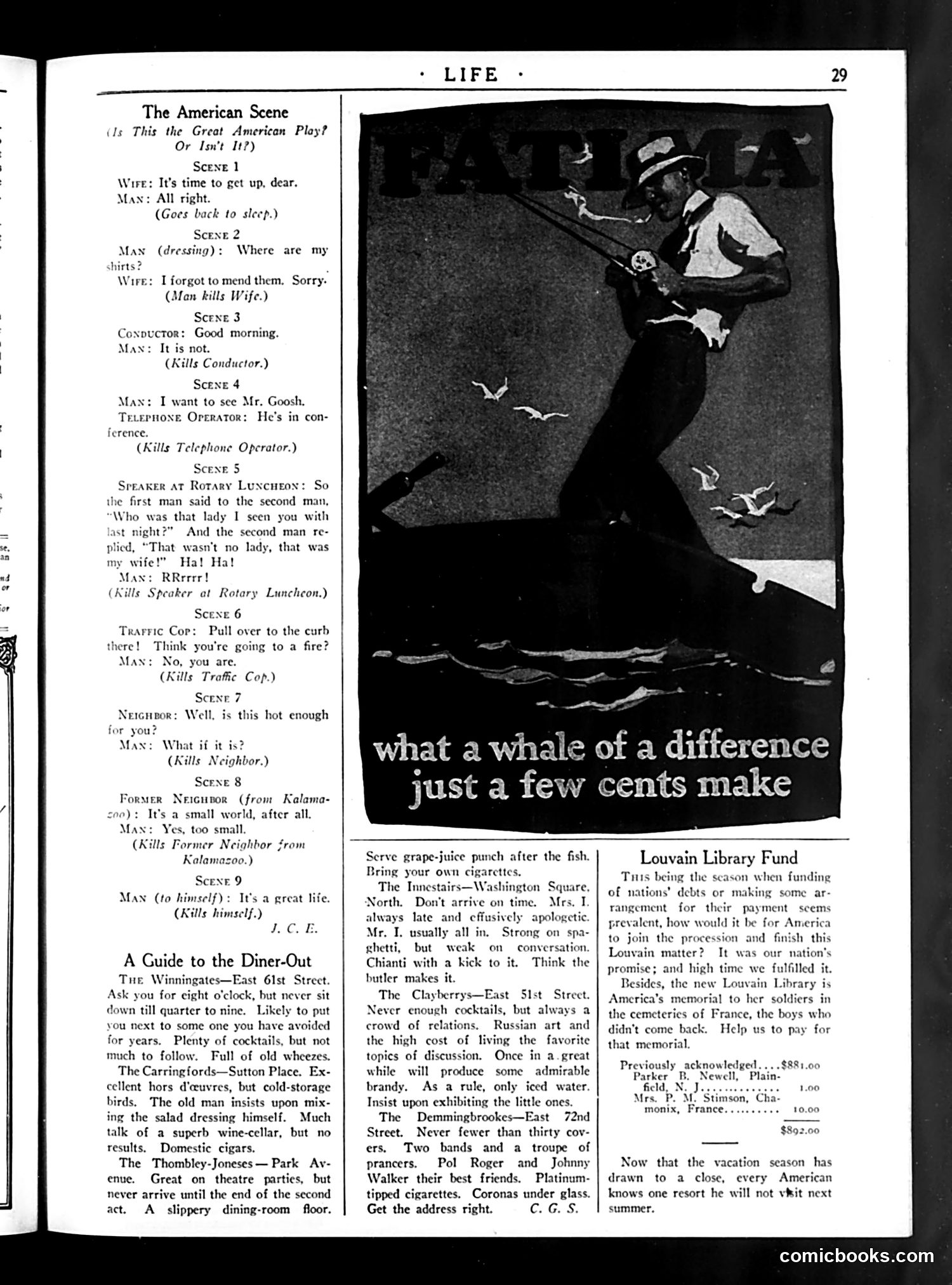
This dark comic sketch satirizes American domestic violence and social frustration during the early 20th century. A nameless man, irritated by trivial annoyances—a wife's forgetfulness, a conductor's rudeness, a traffic cop's authority, even banal small talk—responds to each with murder, escalating absurdly until he kills himself. The satire mocks the contemporary American tendency toward rage and violence over minor inconveniences, portraying an exaggerated "everyman" whose casual brutality represents societal anxieties of the era. Each scene builds darkly: domestic complaint, workplace friction, social interaction—all trigger lethal overreaction. The final scene, where the man congratulates himself ("It's a great life") before suicide, underscores the bitter irony: his violent spree ends in self-destruction. This reflects post-WWI American cynicism about modern life's pressures and the masculinity expected to endure them silently—until breaking catastrophically.
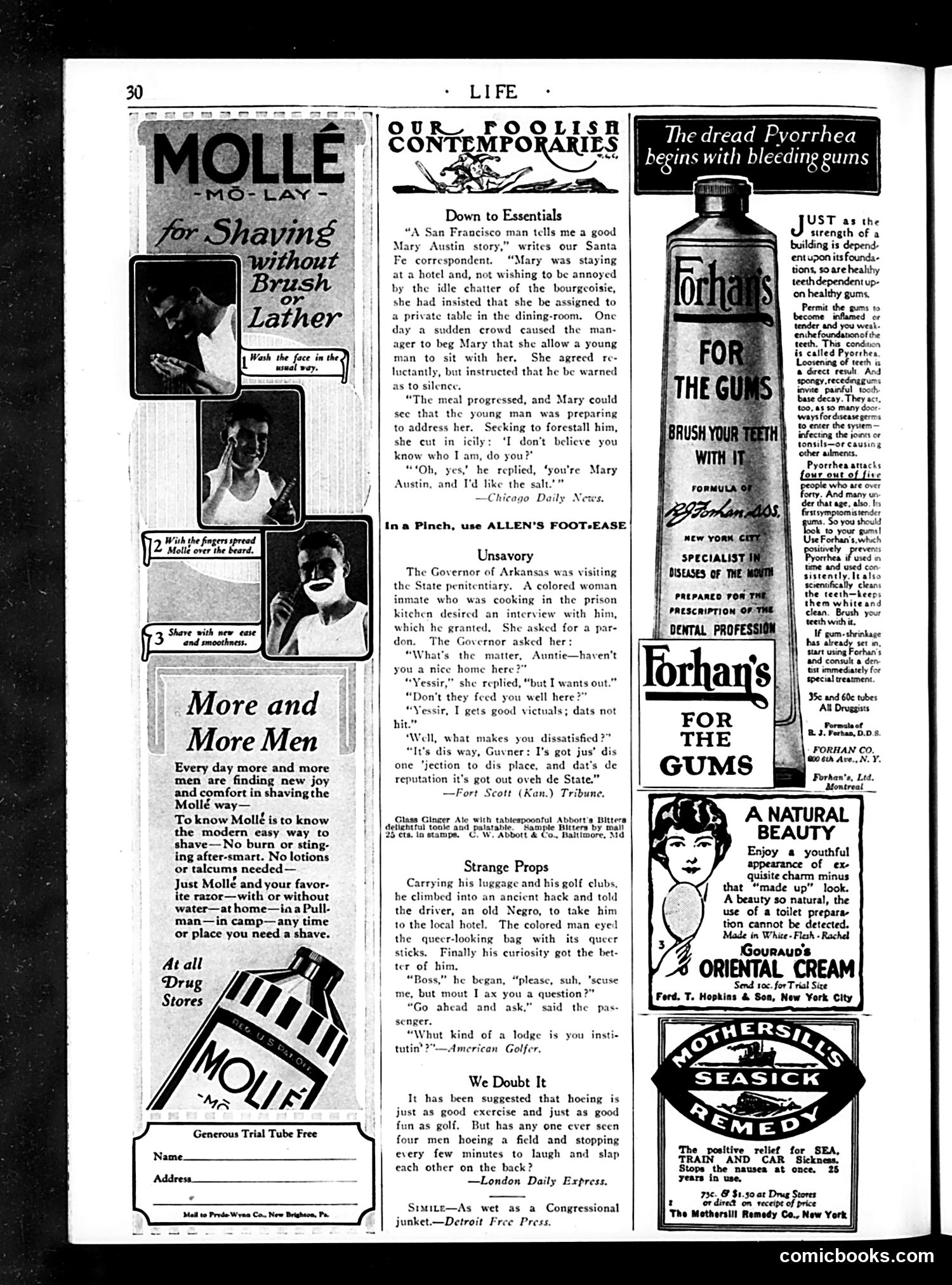
This page is primarily **advertising and humor columns**, not political satire. The content includes: **Left side**: Mollé shaving cream ads with instructional images on proper shaving technique—a common early-20th-century consumer product pitch. **Center**: Three brief humorous anecdotes mocking social pretension and racial stereotypes typical of the era: - A wealthy woman (Mary Austin, likely a real person) dismissing someone, only to be deflated by his casual response - A prison cook complaining about confinement despite good food—playing on racist dialect humor - A wealthy golfer confusing a caddy who mistakes his golf clubs for some kind of "lodge" equipment **Right side**: Patent medicine advertisements for Forhan's toothpaste and Oriental Cream—common in period magazines making dubious health claims. The humor relies on deflating pretension and ethnic caricature. There's no sophisticated political message—just light satirical vignettes and commercial pitches typical of Life magazine's format in the 1910s-1920s.
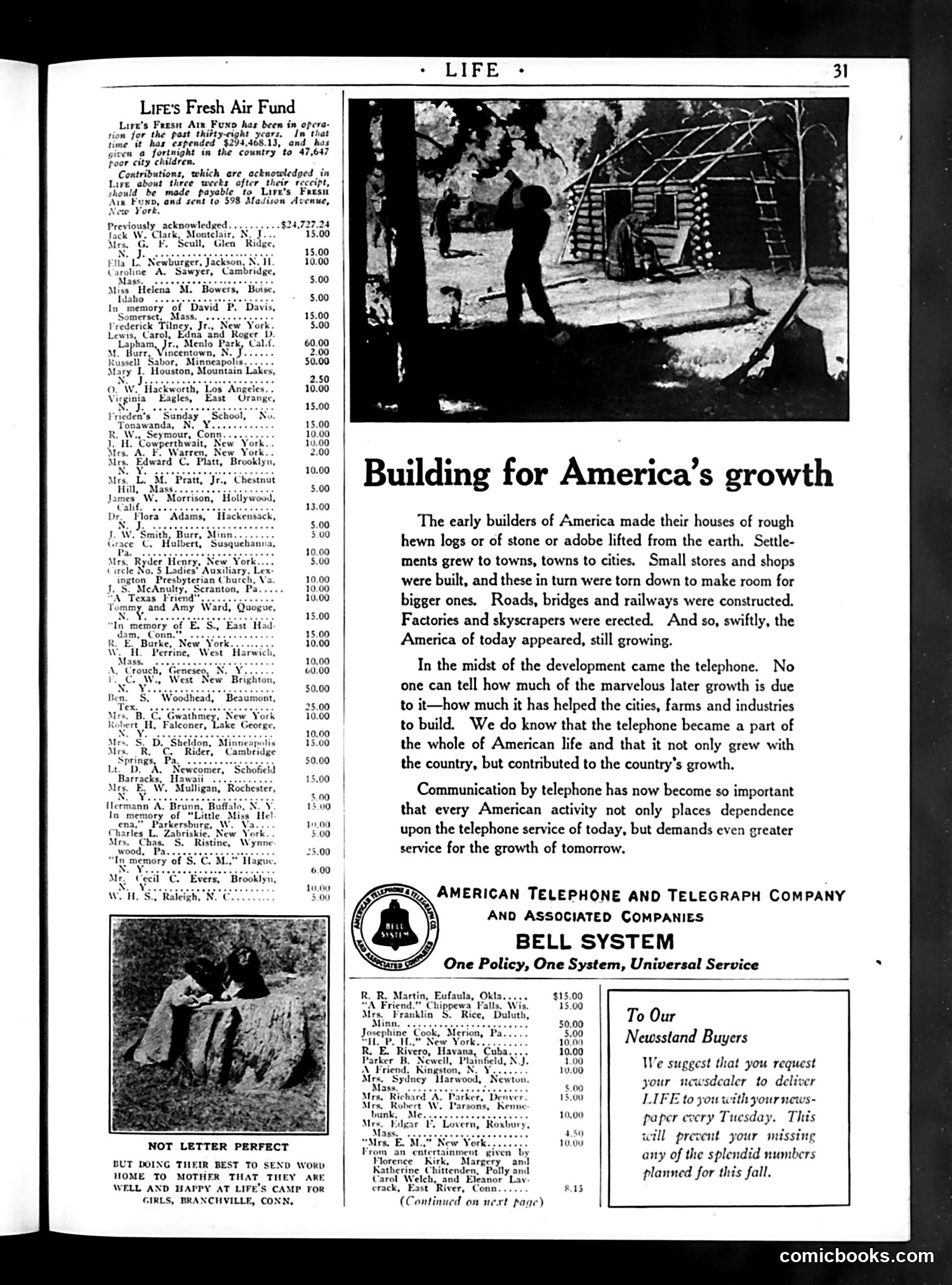
This page combines charitable fundraising with corporate advertising—not primarily satirical content. **Left side:** A listing of contributions to Life's Fresh Air Fund, an established charity (operating 38 years) that sends poor city children to the countryside. The modest donation amounts ($2-$60) reflect Depression-era giving. A photo captioned "NOT LETTER PERFECT" shows children at Life's camp in Branchville, Connecticut, humorously depicting their rustic activities. **Right side:** A full-page advertisement for the Bell System (American Telephone & Telegraph Company), disguised as editorial content titled "Building for America's Growth." It presents a nationalist narrative: American progress from log cabins to skyscrapers supposedly owes much to the telephone's role in facilitating growth. The ad concludes by claiming telephone service is now essential to all American activity. **The juxtaposition** is notable: charitable work helping poor children alongside corporate messaging about progress and infrastructure—typical of 1930s-40s magazine advertising that blurred editorial and promotional content.
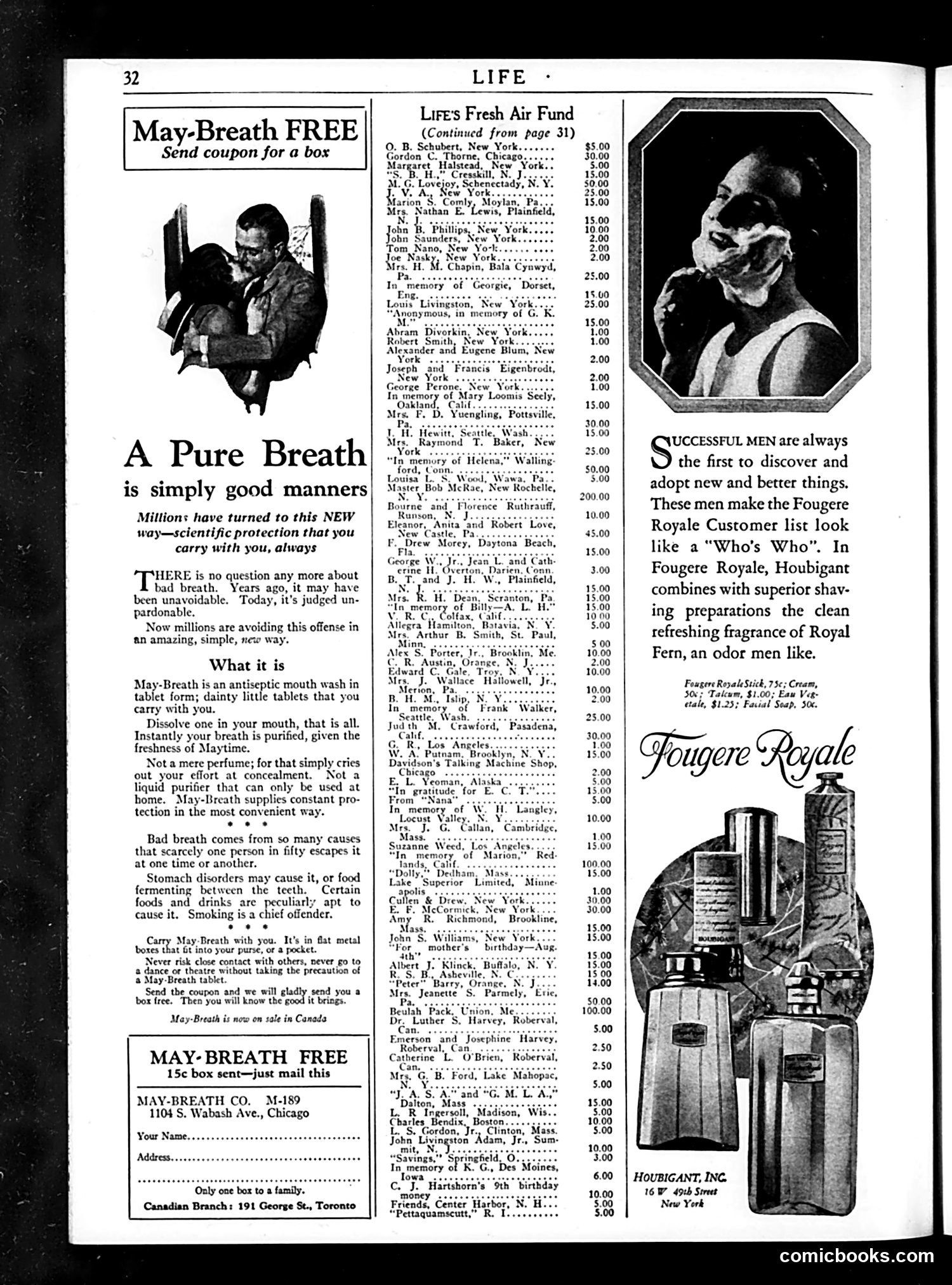
This page is primarily **advertising and charitable notices**, not political satire. The left side features a **May-Breath mouthwash advertisement**—a commercial product marketed as an "antiseptic mouth wash in tablet form" for combating bad breath. The copy appeals to social anxiety: bad breath is "judged unpardonable," and users should "never risk close contact with others" without it. This reflects 1920s-era consumer culture capitalizing on personal hygiene insecurities. The right side showcases a **Fougere Royale cologne advertisement**, targeting successful men who adopt "new and better things." It positions the product as a status symbol for discerning gentlemen. The center column lists donations to **Life's Fresh Air Fund**—a charitable initiative (continued from the previous page) supporting disadvantaged children's access to fresh air and outdoor recreation. There is **no political cartoon or satire** on this page. It's a straightforward mix of commercial advertising and charitable fundraising typical of Life magazine's business model.
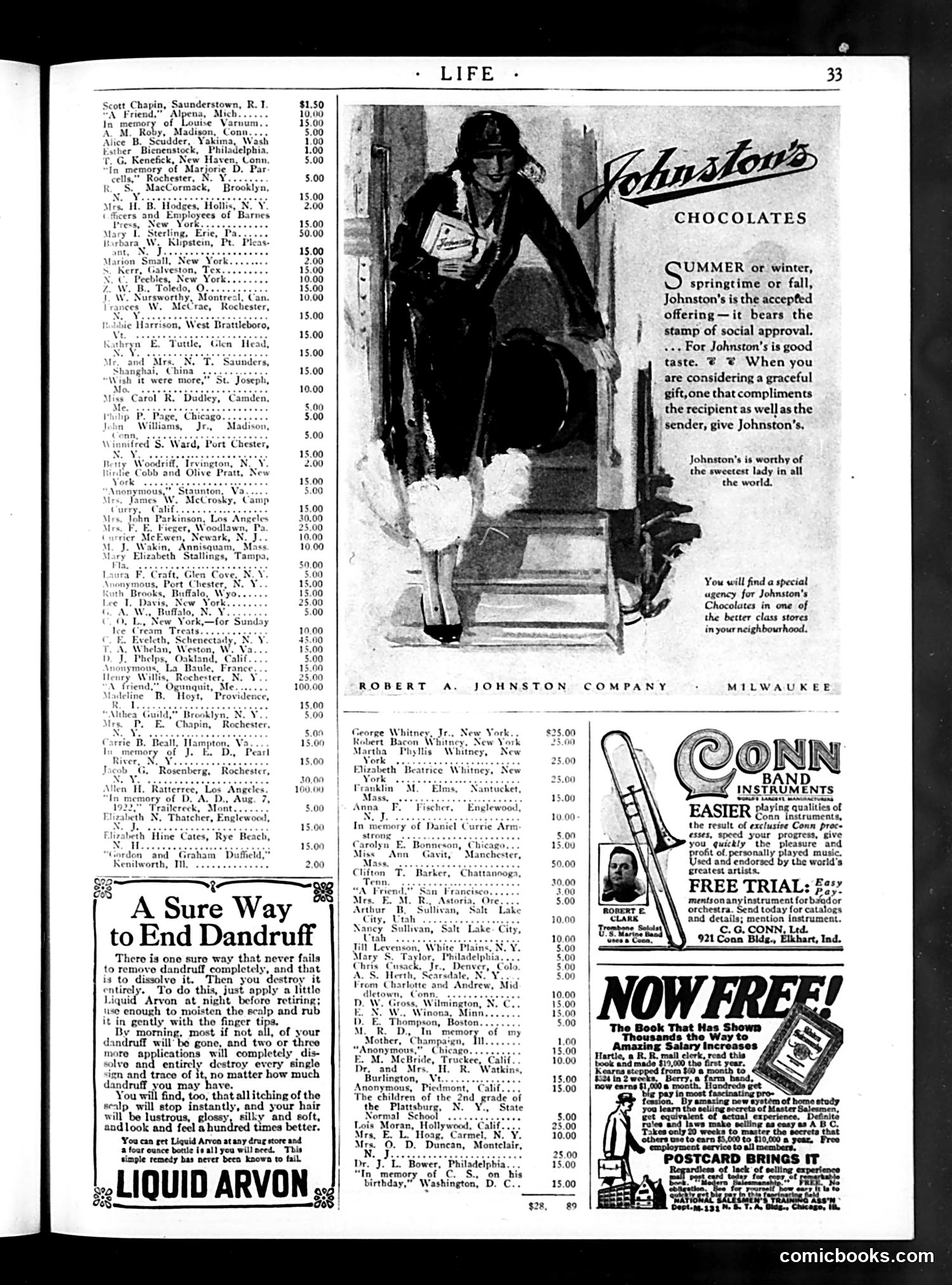
This page is primarily **advertising and notices**, not political satire or comics. The main content consists of: 1. **Charitable donation acknowledgments** (left column)—a list of names and monetary contributions, likely to a charitable cause (the specific charity isn't visible on this excerpt). 2. **Three advertisements**: - **Liquid Arvon** (dandruff treatment): a standard patent medicine ad promising to dissolve dandruff - **Johnston's Chocolates**: positioned as an upscale gift for social occasions, with imagery of an elegant woman - **Conn Musical Instruments**: advertising instruments available on trial, aimed at amateur musicians There are **no political cartoons or satirical commentary** visible here. This appears to be a standard editorial/advertising page from the magazine, likely from the 1920s based on aesthetic and product types. The donations list suggests Life was supporting a specific charitable effort at this time, but without additional context, the specific cause remains unclear.
This appears to be primarily an **advertisement page** rather than editorial content or political cartoon. The large text reading "IT'S YOUR TURN" and "Life" is a subscription solicitation directed at readers. The ad mentions LIFE magazine's regular features and invites new subscribers to "start" reading it. A "SPECIAL OFFER" section lists subscription rates for different durations (Canadian, Foreign, etc.). The page includes the LIFE magazine masthead address (Madison Avenue, New York) and subscription pricing details. **No political figures or satirical cartoons are clearly visible.** This is fundamentally a promotional page designed to convert magazine readers into paid subscribers, likely from an early-to-mid 20th century issue of LIFE magazine.
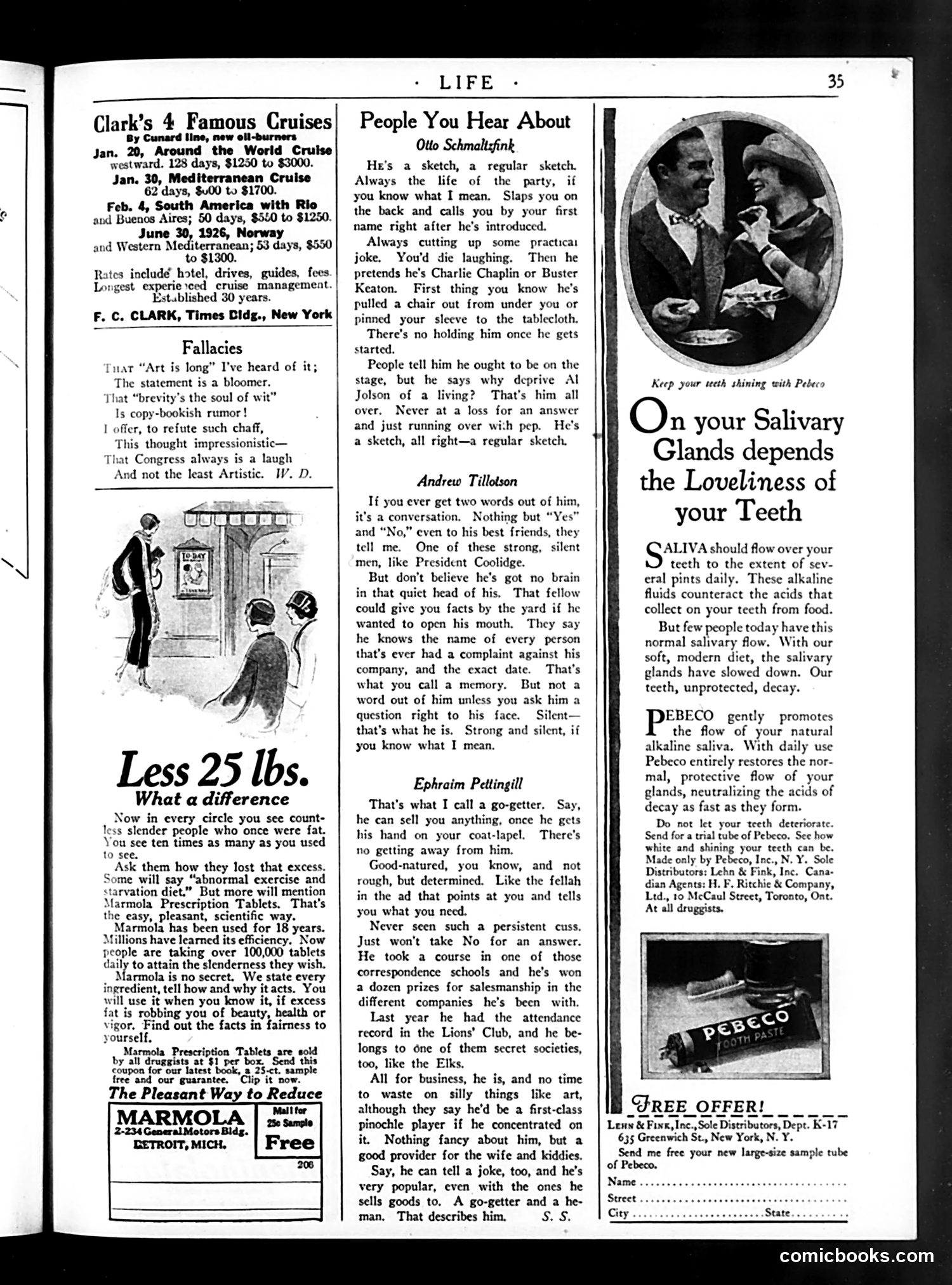
This page contains **advertisements and social commentary**, not political satire. The main content includes: **Advertisements:** - Clark's cruise line offerings (luxury ocean voyages) - Marmola diet tablets (weight-loss medication) - Pebeco toothpaste **"People You Hear About" Section:** Character sketches of three social types: - **Otto Schmaltzfink**: the class clown/practical joker who does impressions - **Andrew Tillotson**: the strong, silent type reminiscent of President Coolidge (known for taciturn public persona) - **Ephraim Pettingill**: the aggressive salesman The sketches satirize recognizable American personality archetypes of the 1920s. The Coolidge reference dates this clearly to his presidency (1923-1929). These are gentle, affectionate social observations rather than biting political commentary—typical of Life magazine's satirical humor aimed at recognizing oneself or acquaintances in exaggerated character types.
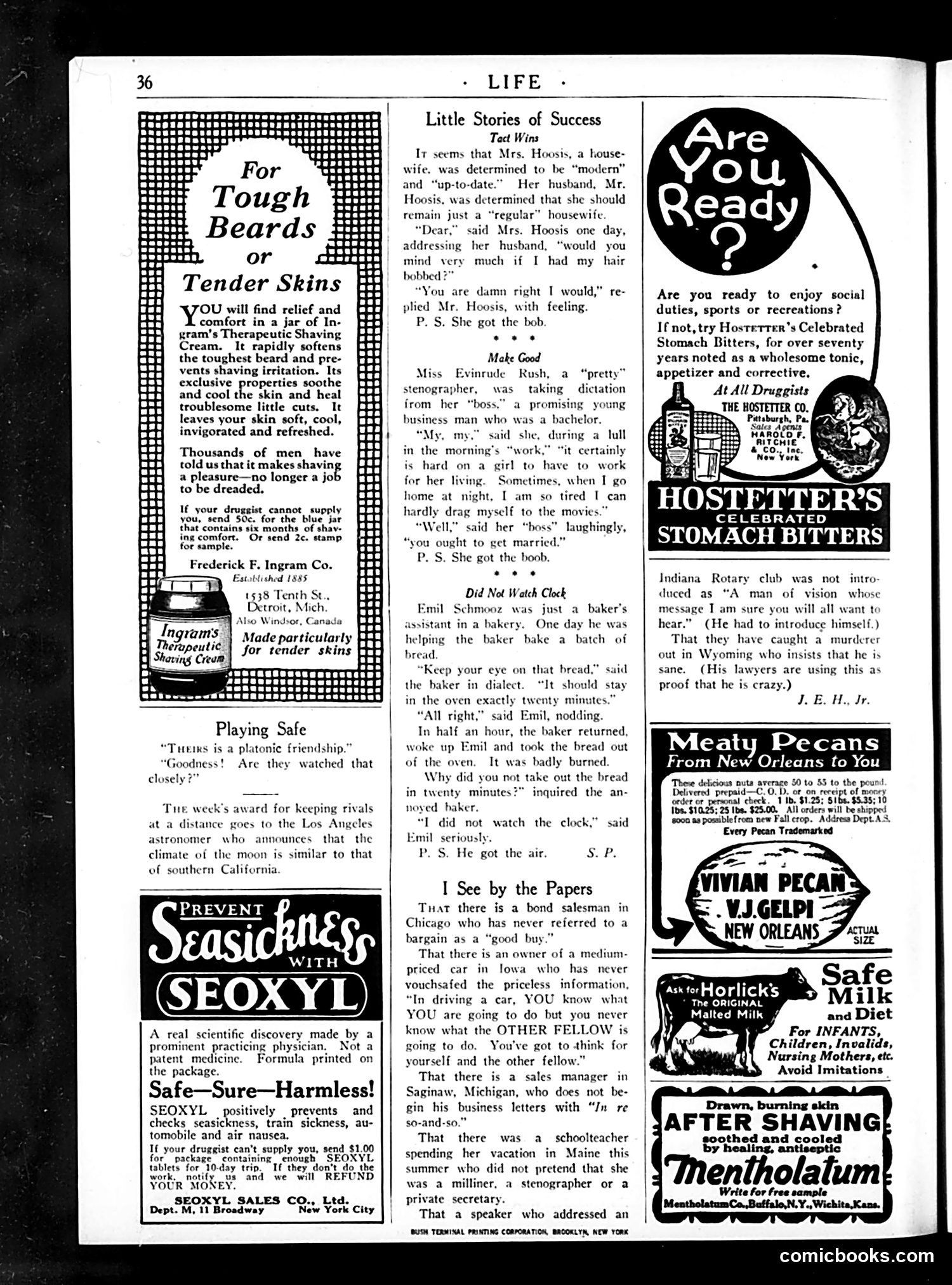
This page is primarily **advertising mixed with light humor**—not political satire. The content reflects 1920s social attitudes: **The humor pieces** ("Little Stories of Success") are gentle morality tales about getting ahead through tact and obedience. In "Tact Wins," a wife wanting a modern bob haircut gets her way through persistence despite her husband's objection—the "joke" being she manipulates him. "Make Good" shows a stenographer catching a bachelor's attention by complaining about work, implying women's role is domestic. These reflect period gender dynamics where women's ambitions were treated as comic. **"I See by the Papers"** mocks clichéd business-speak—salesmen's predictable phrases about car-driving and letter openings. It's gentle satire of corporate conformity. **The advertisements** (Ingram's Shaving Cream, Seoxyl for nausea, Horlick's Malted Milk, Menthol atum) represent typical early-20th-century patent medicine marketing, claiming scientific backing while making vague health promises.
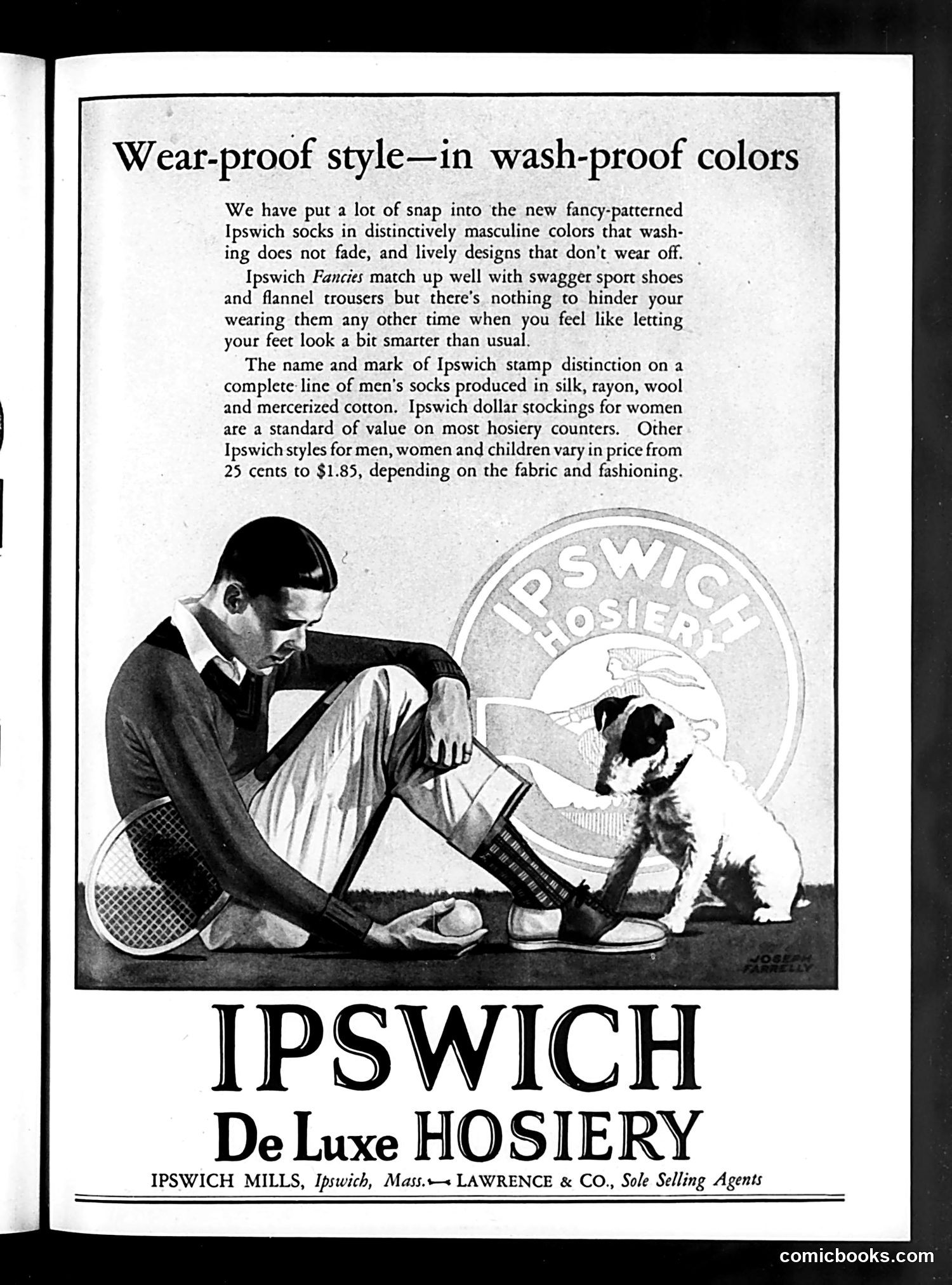
This is a straightforward **advertisement, not satire or political commentary**. It promotes Ipswich De Luxe Hosiery socks. The image shows a young man in casual sportswear (including patterned socks) sitting with a small dog, positioned next to the Ipswich Hosiery logo. The visual is meant to convey casual elegance and youthfulness—the man appears relaxed and fashionable. The ad's central claim is practical: Ipswich socks feature "wash-proof colors" and designs that don't fade or wear away, addressing a genuine consumer concern of the era when fabric dyes were less stable. The text emphasizes the socks work for both athletic wear ("swagger sport shoes and flannel trousers") and everyday occasions. Pricing ranges from 25 cents to $1.85 depending on material (silk, rayon, wool, cotton). There is no hidden meaning or satire here—it's a vintage advertisement emphasizing durability and style as selling points.
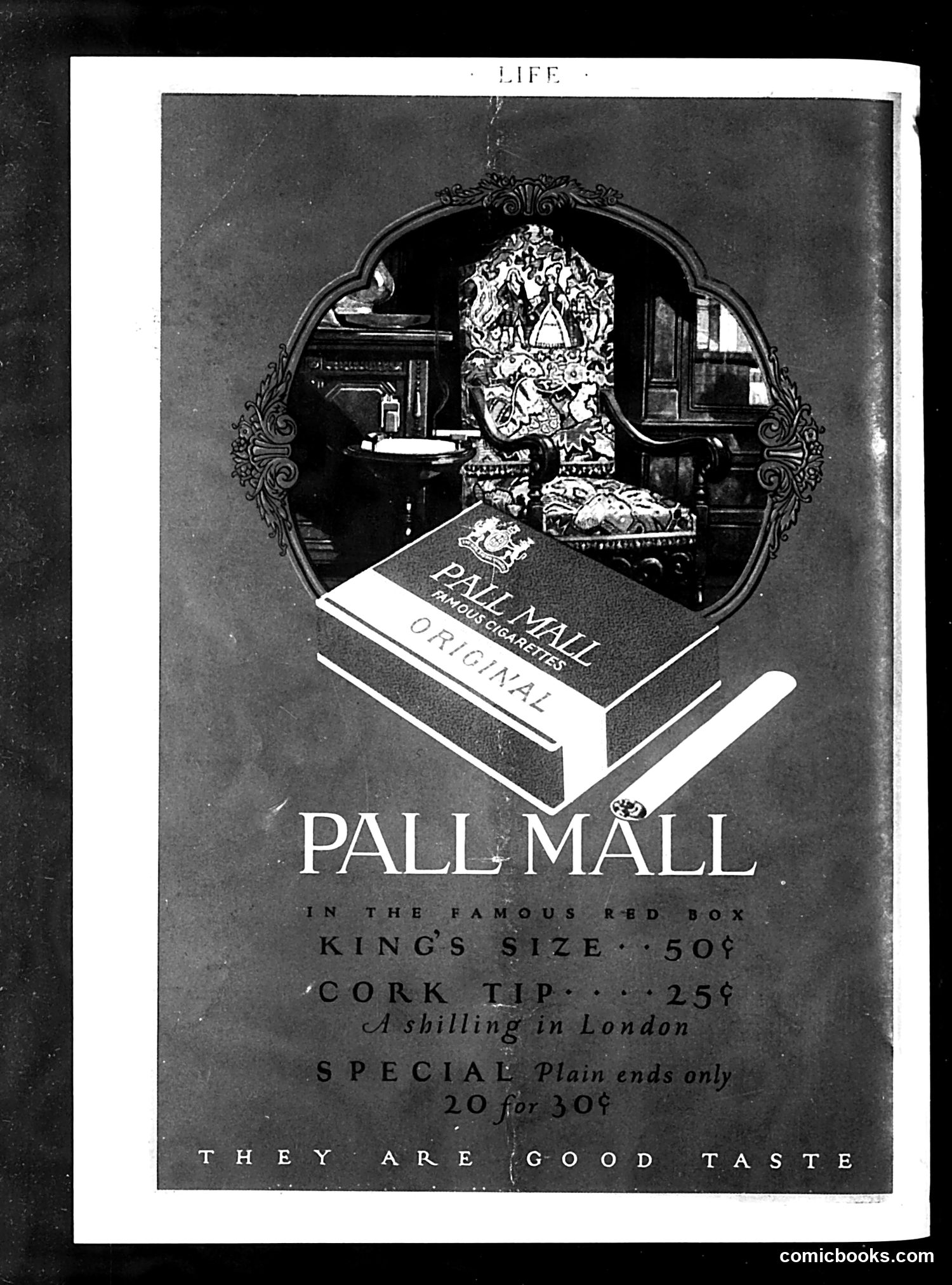
This is a cigarette advertisement from *Life* magazine, not political satire. It promotes Pall Mall cigarettes in various sizes and price points (King's Size at 50¢, Cork Tip at 25¢, and a special bulk offer of 20 for 30¢). The ad features an ornate circular frame showing an elegantly furnished interior—likely meant to evoke sophistication and refined taste. The tagline "They are good taste" suggests that smoking Pall Malls signals social status and refinement. The phrase "A shilling in London" provides transatlantic pricing context, while "Plain ends only" specifies the cigarette style being advertised. This represents early-20th-century tobacco marketing before health warnings.

I can see this is a very dark, low-contrast image from what appears to be a historical publication. The only clearly legible text is "comicbooks.com" at the bottom right, which is a modern watermark from a website, not original content from the Life magazine page. The image itself is too dark and unclear for me to reliably identify any cartoon figures, caricatures, political references, or satirical content. While there appear to be some faint facial features visible on the right side, the contrast and image quality make it impossible to accurately describe what is depicted or what historical/political context it might reference without risk of misrepresenting the content. To properly analyze this page, a clearer or higher-contrast version would be necessary.