
Life, 1925-09-10 · page 12 of 41
Life — September 10, 1925 — page 12: what you’re looking at
What you’re looking at
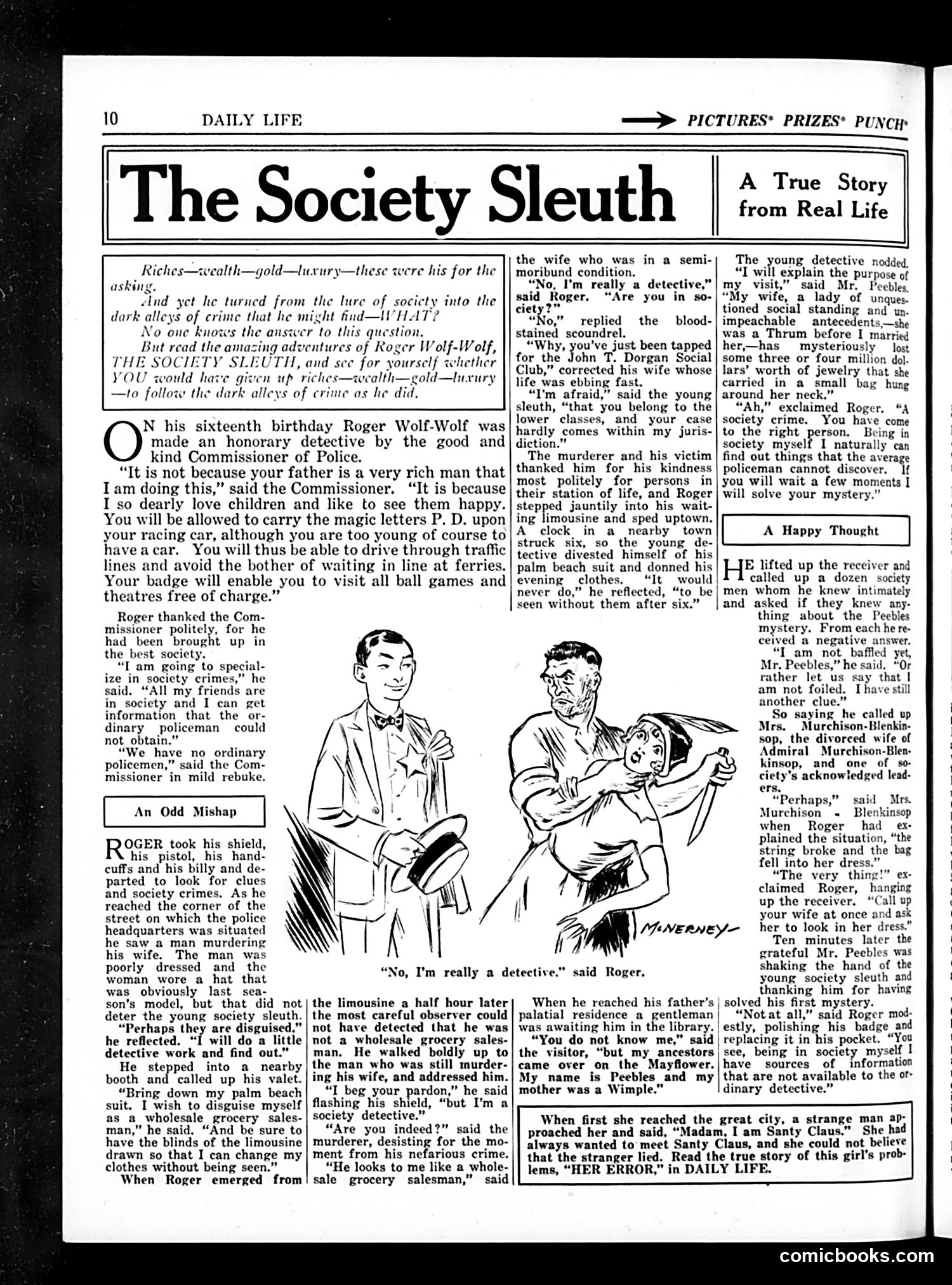
This is a serialized detective fiction story from Life magazine, not a political cartoon. The narrative follows Roger Wolf-Wolf, a sixteen-year-old amateur detective from a wealthy family who specializes in "society crimes"—mysteries among the upper classes. The story establishes the premise: Roger's father, a police commissioner, encourages his son to investigate high-society cases where ordinary police lack access. The illustrations show Roger in formal dress, establishing his privileged social standing as key to his detective work. The humor derives from the incongruity of a young, inexperienced boy attempting serious detective work within exclusive social circles. The page includes a mystery subplot involving Mrs. Blenkinsop and stolen jewelry, setting up the adventure for readers to follow.
📄 Transcribed text from this page (OCR, searchable)
Machine-transcribed from the original scan — historical spelling and the odd misread are preserved.
DAILY LIFE Riches—wealth—gold—luxury—these asking, vere his for the clnd yet he turned from the lure of socicty into the dark alleys of crime that he might find—IVHAT? No one knows the answer to this question. But read the amazing adventures of Roger Wolf-Wolf, THE SOCIETY SL YOU would have gi :UTH, ren up rich and see for yourself whether —iwealth—gold—lnrury —to follow the dark alleys of crime as he did. made an honorary detective by the good and O: his sixteenth birthday Roger Wolf-Wolf was kind Commis ioner of Police. “It is not because your father is a very rich man that Iam doing this,” said the Commissioner. “It is because I so dearly love children and like to see them happy. You will be allowed to carry the magic letters P. D. upon your racing car, although you are too young of course to have a car. You will thus be able to drive through traffic lines and avoid the bother of waiting in line at ferries. Your badge will enable you to visit all ball games and theatres free of charge.” Roger thanked the Com- missioner politely, for he had been brought up in the best society. “I am going to special- ize in society crimes,” he said. “All my friends are in society and I can get information that the or- dinary policeman could not obtain.” “We have no ordinary policemen,” said the Com- missioner in mild rebuke. An Odd Mishap OGER took his shield, his pistol, his hand- cuffs and his billy and de- parted to look for clues and society crimes. As he reached the corner of the street on which the police headquarters was situated he saw a man murdering his wife. The man was poorly dressed and the woman wore a hat that was obviously last sea- deter the young society sleuth. “Perhaps they are disguised,” he reflected. “I will do a little detective work and find out.” He stepped into a_ nearby booth and called up his valet. “Bring down my palm beach suit. I wish to disguise myself as a wholesale grocery sales- man,” he said. “And be sure to have the blinds of the limousine drawn so that I can change my clothes without being seen.” When Roger emerged from \ son’s model, but that did not} ay \\ ~~ x me Th | ——> PICTURES’ PRIZES* PUNCH: The Society Sleuth the wife who was in a semi- moribund condition. “No, I'm really a detective,” said Roger. “Are you in so- ciety?” replied the blood- stained scoundrel. y, you’ve just been tapped ohn T. Dorgan Social Club,” corrected his wife whose life was ebbing fast. “I'm afraid,” said the young sleuth, “that you belong to the lower clas: and your case hardly comes within my juris- diction.” The murderer and his victim thanked him for his kindness most politely for persons in their station of life, and Roger stepped jauntily into his wait- ing limousine and sped uptown, A clock in a nearby town struck six, so the young de- tective divested himself of his palm beach suit and donned his evening clothes. “It would never do,” he reflected, seen without them after six.” (9 “No, I'm really a detective,” said Roger. the limousine a half hour later the most careful observer could not have detected that he was not a wholesale grocery sales- man. He walked boldly up to the man who was still murder- ing his wife, and addressed him. “I beg your pardon,” he said flashing his shield, “but I’m a society detective.” “Are you indeed?” said the murderer, desisting for the mo- | ment from his nefarious crime. “He looks to me like a whole- sale grocery salesman,” said When he reached his father’s palatial residence a gentleman was awaiting him in the library. “You do not know me,” said the visitor, “but my ancestors came over on the Mayflower. My name is Peebles and my mother was a Wimple.” When first she reached the great city, a strange id, “Madam, I am Santy Claus.” proached her and said, S1NERNEY— A True Story from Real Life The young detective nodd “1 will explain the paren my visit,” said Mr. Peebles, “My wife, a lady of unques. tioned social standing and un. impeachable antecedents,—she was a Thrum before I married her,—has mysteriously Jost some three or four million dol- lars’ worth of jewelry that she carried in a small bag hung around her neck.” “Ah,” exclaimed Roger. “A society crime. You have come to the right person. Being in society myself I naturally can find out things that the average policeman cannot discover. If you will wait a few moments | will solve your mystery.” A Happy Thought HE lifted up the receiver and | called up a dozen society | men whom he knew intimately and asked if they knew any- thing about the Peebles mystery. From each he re- ceived a negative answer. “I am_ not baffled yet, Mr. Peebles,” he rather let us sa am not foiled. I have still another clue.” So saying he called up Mrs. Murchison-Blenkin- sop, the divorced wife of Admiral Murchison-Blen- kinsop, and one of so- ciety’s acknowledged lead- ers. “Perhaps,” said Mrs. Murchison + Blenkinsop when Roger had _ex- plained the situation, “the string broke and the bag fell into her dress.” “The very thing!” ex- claimed Roger, hanging up the receiver. “Call up your wife at once and ask her to look in her dress.” Ten minutes later the grateful Mr. Peebles was shaking the hand of the young society sleuth and thanking him for having | solved his first mystery. | “Not at all,” said Roger mod- lestly, polishing his badge and | replacing it in his pocket. “You see, being in society myself I have sources of information that are not available to the or- dinary detective.” man ap- She had always wanted to meet Santy Claus, and she could not believe that the stranger lied. ad the true story of this girl’s prob- lems, “HER ERROR,” in DAILY LIFE. comicbooks.com