
Life, 1925-09-10 · page 28 of 41
Life — September 10, 1925 — page 28: what you’re looking at
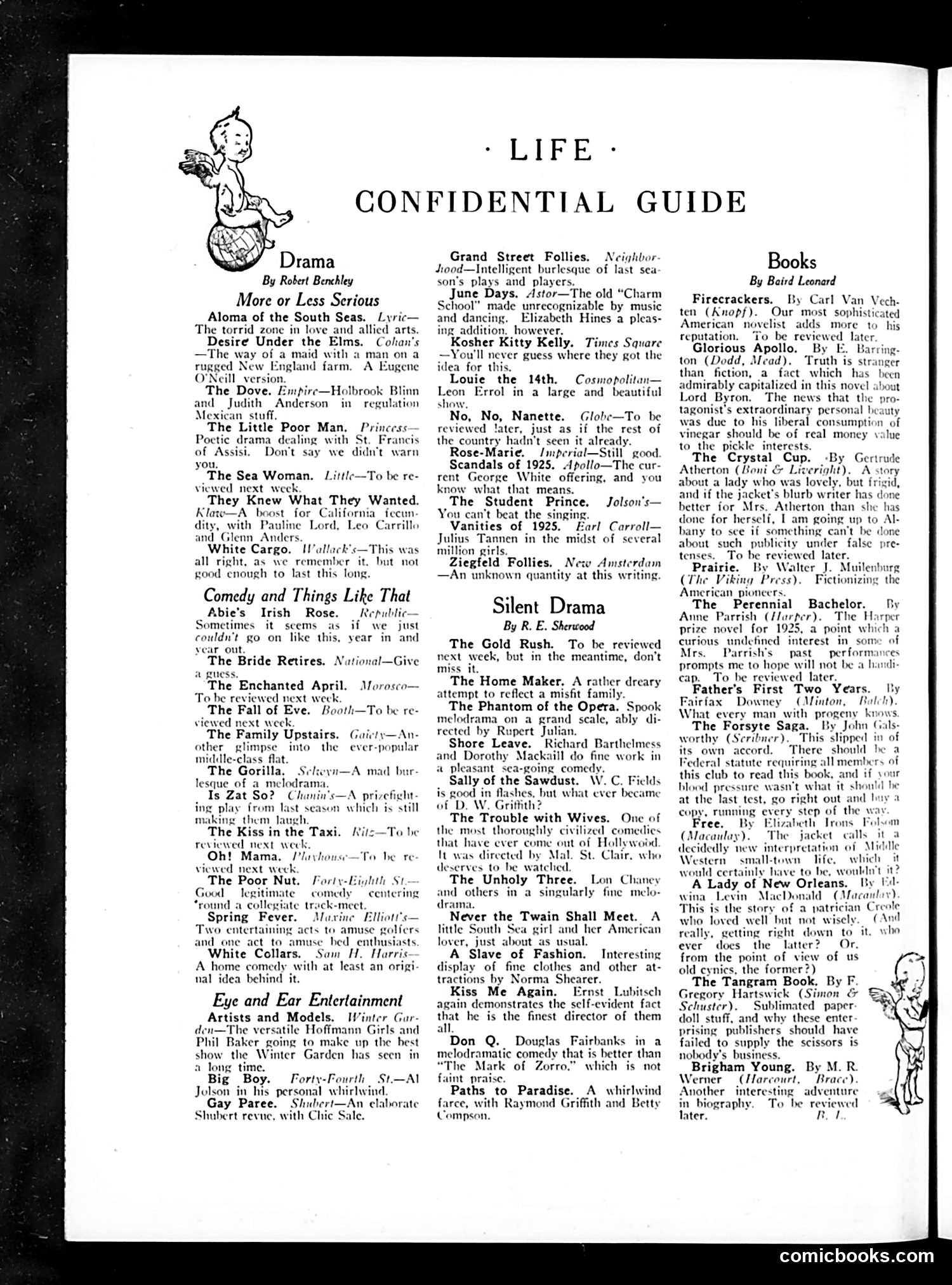
What you’re looking at
This page is a **theater and film review guide** from Life magazine's "Confidential Guide" section. It lists current Broadway plays and movies with brief, often sarcastic commentary. The reviews are written by prominent critics: Robert Benchley covers drama, R.E. Sherwood reviews silent films. The tone is consistently irreverent—for example, *Abie's Irish Rose* receives the withering comment that "it seems as if we just couldn't go on like this, year in and year out," suggesting audience fatigue with a long-running play. Notable references include W.C. Fields in *Sally of the Sawdust* and Lon Chaney in *The Unholy Three*. The guide mocks predictable material ("You'll never guess where they got the idea") and praises innovation sparingly. The small decorative illustrations are typical of Life's visual style—a cherub and a seated figure in the margins. This is essentially **entertainment journalism aimed at sophisticated, urban readers** who appreciated acerbic wit alongside cultural recommendations.
📄 Transcribed text from this page (OCR, searchable)
Machine-transcribed from the original scan — historical spelling and the odd misread are preserved.
By Robert Benchley More or Less Serious Aloma of the South Seas. Lyric— The torrid zone in love and allied arts. Desire Under the Elms. Colian's —The way of a maid with a man on a rugged New England farm. A Eugene Y'Neill_ version. The Dove. Empire—Holbrook Blinn and Judith Anderson in regulation Mexican stuff. The Little Poor Man. Prin Poetic drama dealing with St of Assisi. Don't say we didn't warn you. The Sea Woman. viewed next week. They Knew What They Wanted. Klaw—A boost for California fecun dity, with Pauline Lord, Leo Carrillo and Glenn_Anders, hite Cargo. Huallack’s—This was all right, as we remember it, but not good enough to last this long. Comedy and Things Like That Abie’s Irish Rose. — Republic— Sometimes it seems as if we just couldn't go on like this, year in and year out. The Bride Retires. 2 guess, The Enchanted April. To be reviewed next week. The Fall of Eve. Booth—To be re- viewed next week. The Family Upstairs. other glimpse into the middle-class flat. The Gorilla. S. lesque_of a melodrama, Is Zat So? ing play from last se making them Jaugh. The Kiss in the Taxi. reviewed next week, Ih! Mama, Playhouse viewed next weck _The Poor Nut. xl legitimate “round a collegiate track-mee Spring Fever. Mux liott's— Two entertaining acts to amuse golf and one act to amuse hed enthusiasts. White Collars. Sam H. Harris A home comedy with at least an origi- nal idea behind it. Eye and Ear Entertainment Artists and Models. Winter Gar- Phe versatile Hoffmann Girls and Phil Baker going to make up the best show the Winter Garden has seen in a long time. Big Boy. Forty-Fourth St—Al Jolson in his personal whirlwind. Gay Paree. Shube: n elaborate Shubert revue, with Chie Sale. Little—To be re- National—Give Morosco— Gaiety—An- ever-popular yn—A mad bur- ‘'s—A privefight- » which is still Ritz—To be he re ighth SL centering Forty comedy LIFE CONFIDENTIAL GUIDE Grand Street Follies. 4iood—Intelligent burlesque o son's plays and players. June Days. Astor—The old “Charm School” made unrecognizable by music and dancing. Elizabeth Hines a pleas- ing addition, however. Kosher Kitty Kelly. Times Square —You'll never guess where they got the idea for this. Louie the 14th. Cosmopolitan— Leon Errol in a large and beautiful show. No, No, Nanette. Globe—To be reviewed !ater, just as if the rest of the country hadn't seen it already. Rose-Marie. /mpcrial—Still_ good. Scandals of 1925. Apollo—The cur- rent George White offering, and you know what that means. The Student Prince, You can't beat the singin; Vanities of 1925. Earl Carroll— Julius Tannen in the midst of several million girls. Ziegfeld Follies. New Amsterdam —An unknown quantity at this writing. cighbor last sea Jolson's— Silent Drama By R. E. Shercood The Gold Rush. To be reviewed next week, but in the meantime, don’t miss it. The Home Maker, A rather dreary attempt to reflect a misfit_family. The Phantom of the Opera. Spook melodrama _on a grand scale, ably di- rected by Rupert Julian. Shore Leave. Richard Barthelmess and Dorothy Mackaill do fine work in ca going comedy. Sally of the Sawdust. W. C. Fields is good in flashes, but what ever became of D. W. Griffith? The Trouble with Wives. Onc the most thoroughly civilized comedies that have ever come out of Hollywood It was direeted by Mal. St. Clair, who deserves to be watched. The Unholy Three. Lon Chaney and others in-a singularly fine melo- drama. Never the Twain Shall Meet. A little South Sea girl and her American lover, just about as usual. A Slave of Fashion. Interesting display of fine clothes and other at- tractions by Norma Shearer. Kiss Me Again. E Lubitsch again demonstrates the self-evident fact um he is the finest director of them all. Don Q. Douglas Fairbanks in a melodramatic comedy that is better than “The Mark of Zorro.” which is not faint praise. Paths to Paradise. A whirlwind farce, with Raymond Griffith and Betty Compson. Books By Boird Leonard Firecrackers. By Carl Van Vech- ten (Knopf). Our most sophisticated American novelist. adds more to_ his reputation. To be reviewed later. Glorious Apollo. By Barring- ton (Dodd, Mead), Truth is stranger than fiction, a fact. which has been admirably capitalized in this novel about Lord Byron, The news that the pro- tagonist’s extraordinary personal by s due to his liberal consumption of vine} should be of real money value to the pickle interests. The Crystal Cap Atherton (Boni about a lady who ae lovely, but { and if the jacket’s blurb writer has d better for Mrs, Atherton than she has done for herself, | am going up to Al- bany to see if something can't be about such publicity under false 1 tenses. To be reviewed later. Prairie. By V Mui (The Viking Pr tionizing the American _pioncers. The Perennial Bachelor. fy Anne Parrish (Harper). The Harper prize novel for 1925, a point which a curious undefined interest in| some of Mrs. Parrish’s past performances prompts me to hope will not be a handi- cap. To he reviewed later. Father's First Two Years. ly Fairfax Downey (Minton, Balch). What every man with Progeny knows. The Forsyte Saga. By John Gals. worthy (Scribner). This slipped in of its own accord. here should he a Federal statute requirin members this club to read this book, and if vow blood pressure wasn’t what it should be at the last test, go right out and buy a copy, running eve f the way Free. By Elizal Irons Fels (Macaulay). ‘The jacket calls it a decidedly new interpretation of Middle Western small-town life, which it would certainly have to be, wouldn't it? Lady of New Orleans. By lid- wina Levin MacDonald (Macaulay) who loved well but not wisely, really, getting right down to it, ever docs the latter? from the point of view of us old cynics, the former?) The Tangram Book, By F. Gregory Hartswick (Simon & Schuster). Sublimated paper: doll stuff, and why these enter prising publishers should have failed to supply the scissors is nobody's business, Brigham Young. By M. R. Werner (Harcourt, Brace). Another interesting adventure in biography. To be reviewed later. R comicbooks.com