
A complete issue · 36 pages · 1925
Life — August 27, 1925
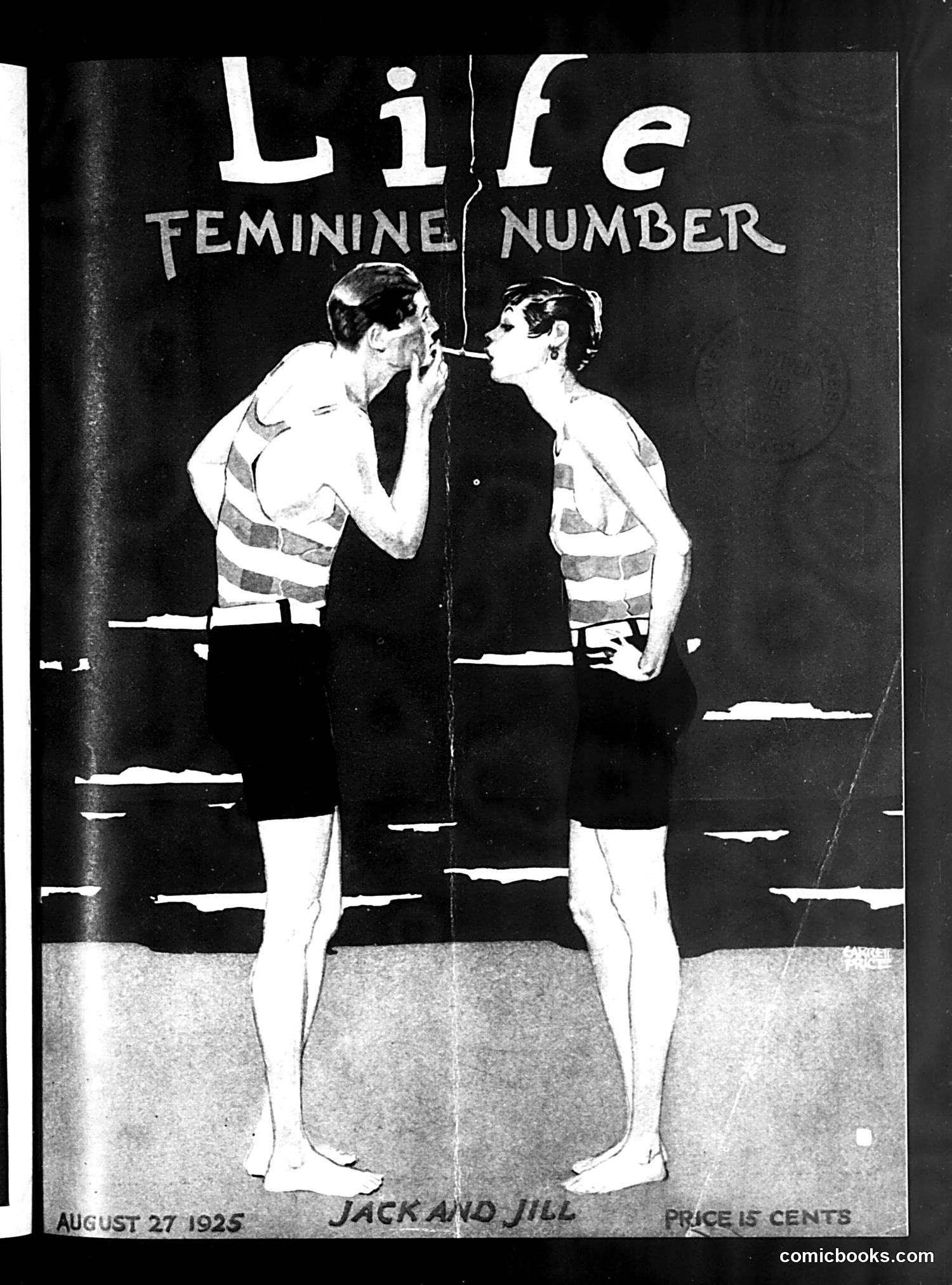
This is the "Feminine Number" issue of Life magazine. The cartoon depicts two figures in underwear looking at their mirror reflections, titled "Jack and Jill." The satire appears to play on the nursery rhyme while commenting on 1920s gender presentation and vanity culture. The 1925 date places this during the Jazz Age, when women's fashion and social roles were rapidly changing. The dual mirror reflection likely satirizes contemporary concerns about self-image and consumerism—popular topics for Life's satirical humor. The "Feminine Number" framing suggests the issue focuses on women's interests, though the cartoon's exact satirical point about gender or identity remains somewhat ambiguous without additional context from the magazine's editorial stance.
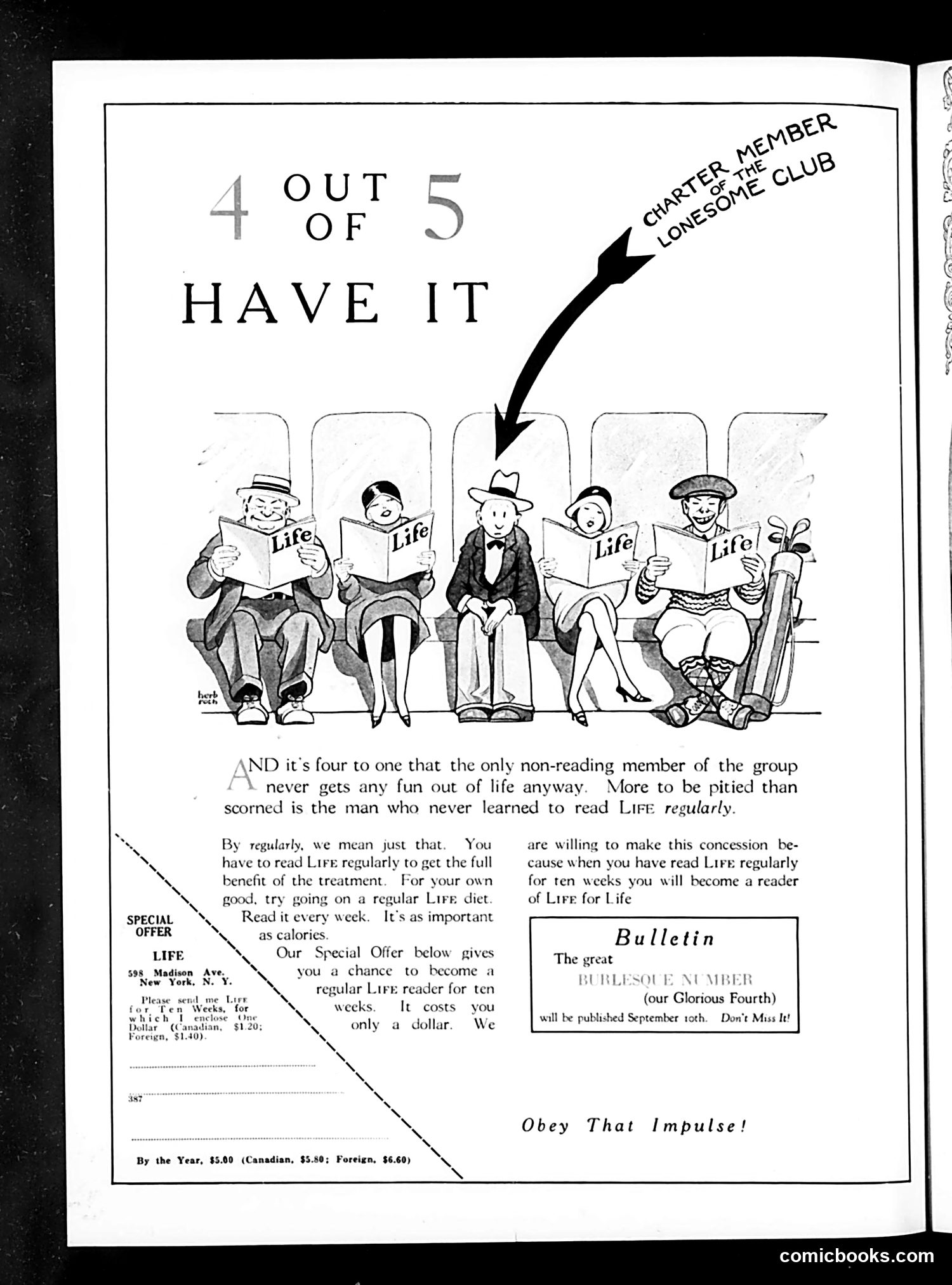
This is primarily a **Life magazine advertisement promoting magazine subscriptions**, not a political cartoon. The illustration shows five figures sitting together reading *Life* magazine. The central figure—identified by an arrow as a "Charter Member of the Lonesome Club"—is the only one **not reading** *Life*. The satire is straightforward: the non-reader is isolated and missing out on enjoyment, while the four readers are engaged and entertained. The accompanying text reinforces this message: reading *Life* regularly is presented as essential to getting "fun out of life." The ad offers a special promotional rate (one dollar for ten weeks) to encourage subscriptions. This is a self-promotional piece using humor to market the magazine to potential readers, not commentary on any specific political or social event.
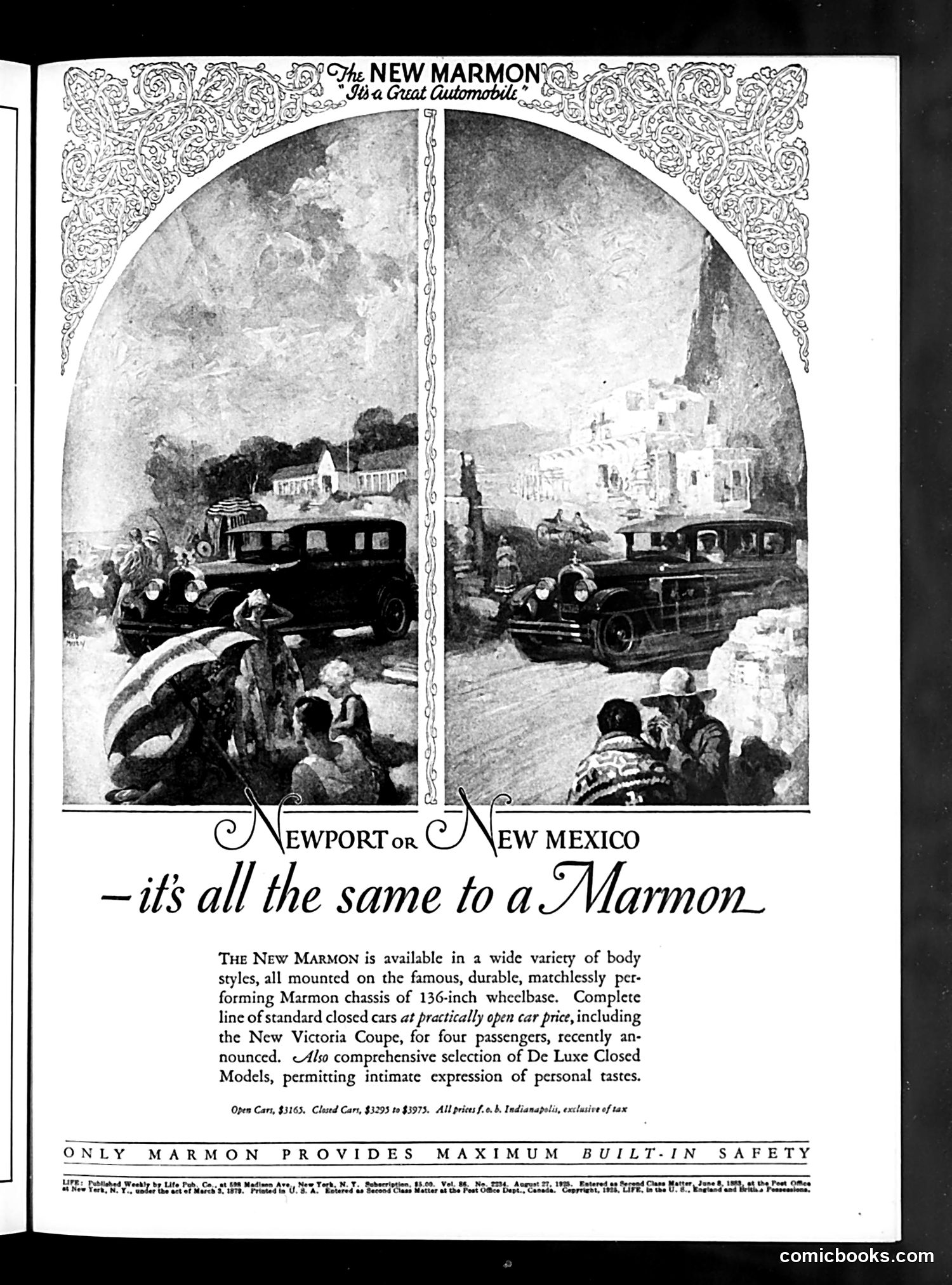
This page is **primarily an advertisement**, not political satire. It promotes the New Marmon automobile, emphasizing its reliability across different terrains and climates. The two side-by-side images contrast exotic locations—Newport (likely Newport, Rhode Island, an affluent coastal resort) and New Mexico—to suggest the Marmon performs equally well in diverse environments. The caption "it's all the same to a Marmon" reinforces this message of versatility and durability. The decorative border and composition mimic Life magazine's satirical style, but the content is straightforward product marketing. The ad highlights the car's 136-inch wheelbase, various body styles, and pricing ($1,165–$1,975), targeting middle-to-upper-class buyers by associating the vehicle with sophisticated American locations.
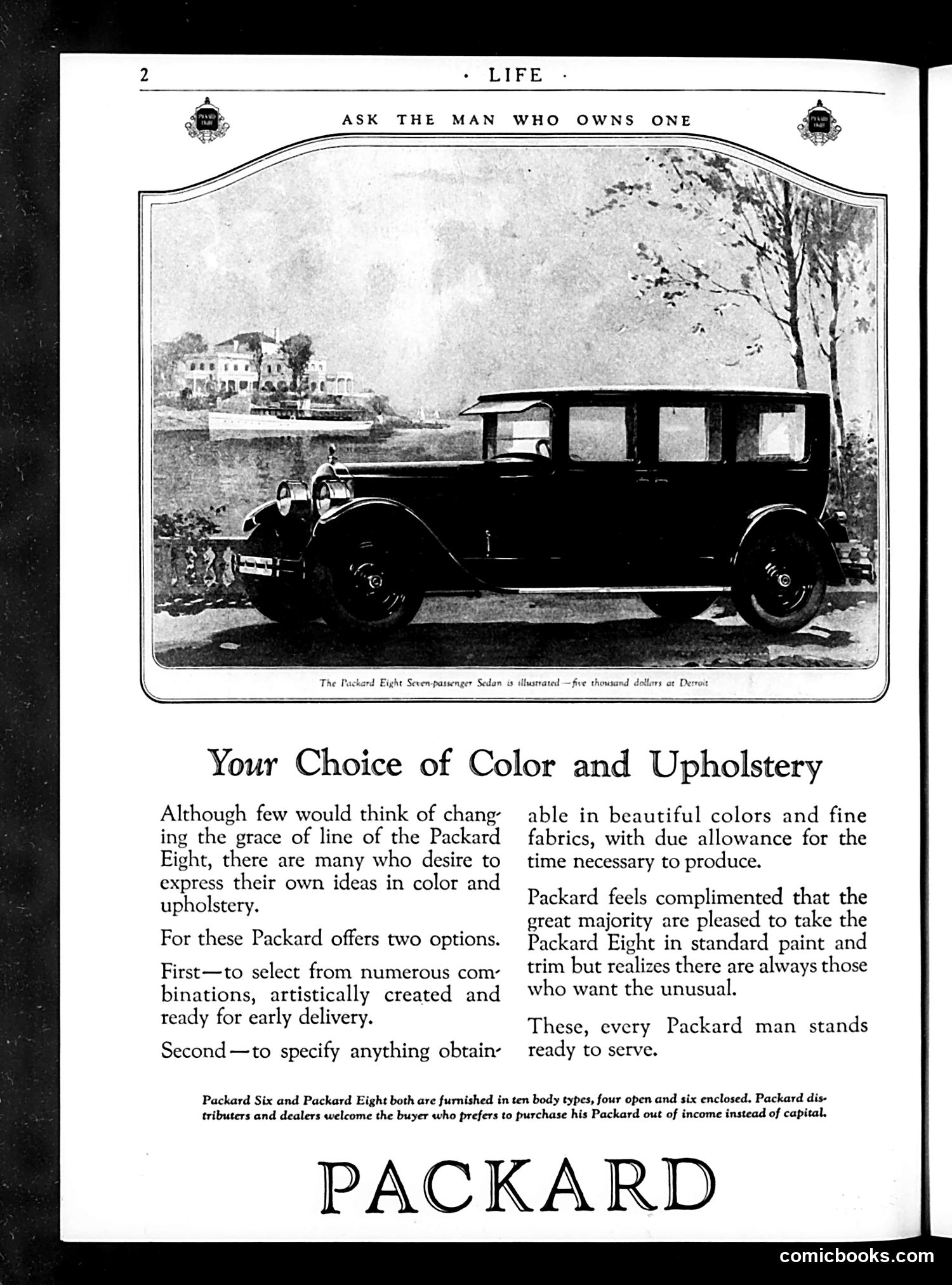
This is primarily a **Packard automobile advertisement**, not political satire. The page shows a luxury sedan positioned beside a scenic riverside estate, designed to appeal to wealthy buyers. The ad's messaging targets affluent consumers by emphasizing customization: buyers can select from pre-made color and upholstery combinations, or specify entirely custom options. This positions Packard as a luxury brand catering to individualistic, discerning customers. The phrase "Ask the Man Who Owns One" (visible at top) was Packard's actual advertising slogan, suggesting reliability through owner testimony. The small text notes Packard offers ten body types in both open and enclosed versions, and welcomes buyers preferring installment purchases over capital outlay—indicating this targets the wealthy but expanding middle class of the 1920s-30s era.
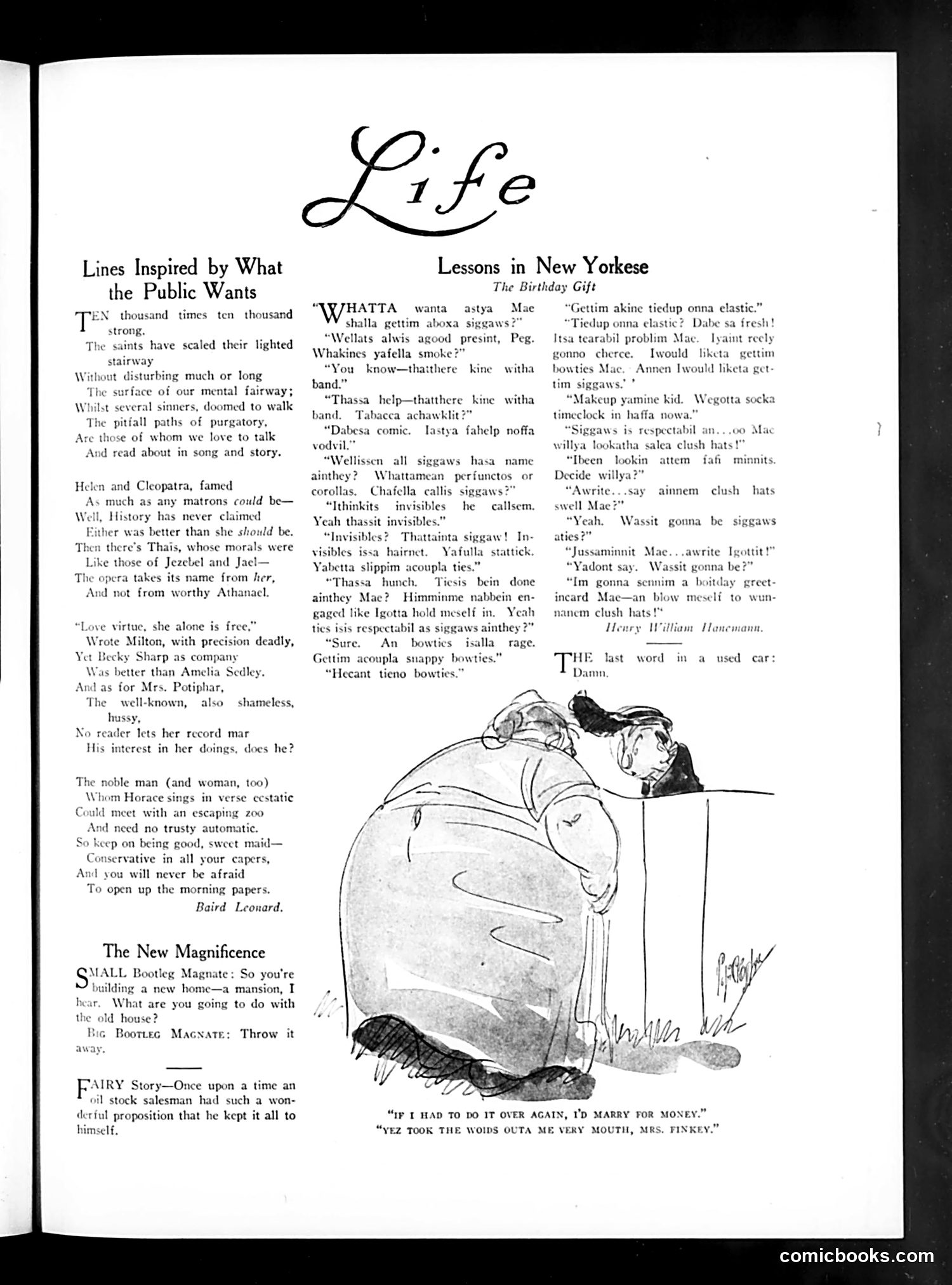
This page contains literary and humorous content rather than political cartoons. The main illustration depicts "The last word in a used car"—showing a heavily damaged, oversized vehicle with two figures inside. The caption reads: "If I had to do it over again, I'd marry for money" and "Yez took the woids outa me very mouth, Mrs. Finkey." The joke satirizes used car sales and marriage by suggesting that purchasing a decrepit vehicle is as regrettable as choosing a spouse for love rather than financial security. The dialogue in working-class dialect reinforces the satire's targeting of ordinary people's purchasing decisions and marital choices. The surrounding text includes unrelated literary pieces and social commentary, typical of Life's miscellaneous content format.
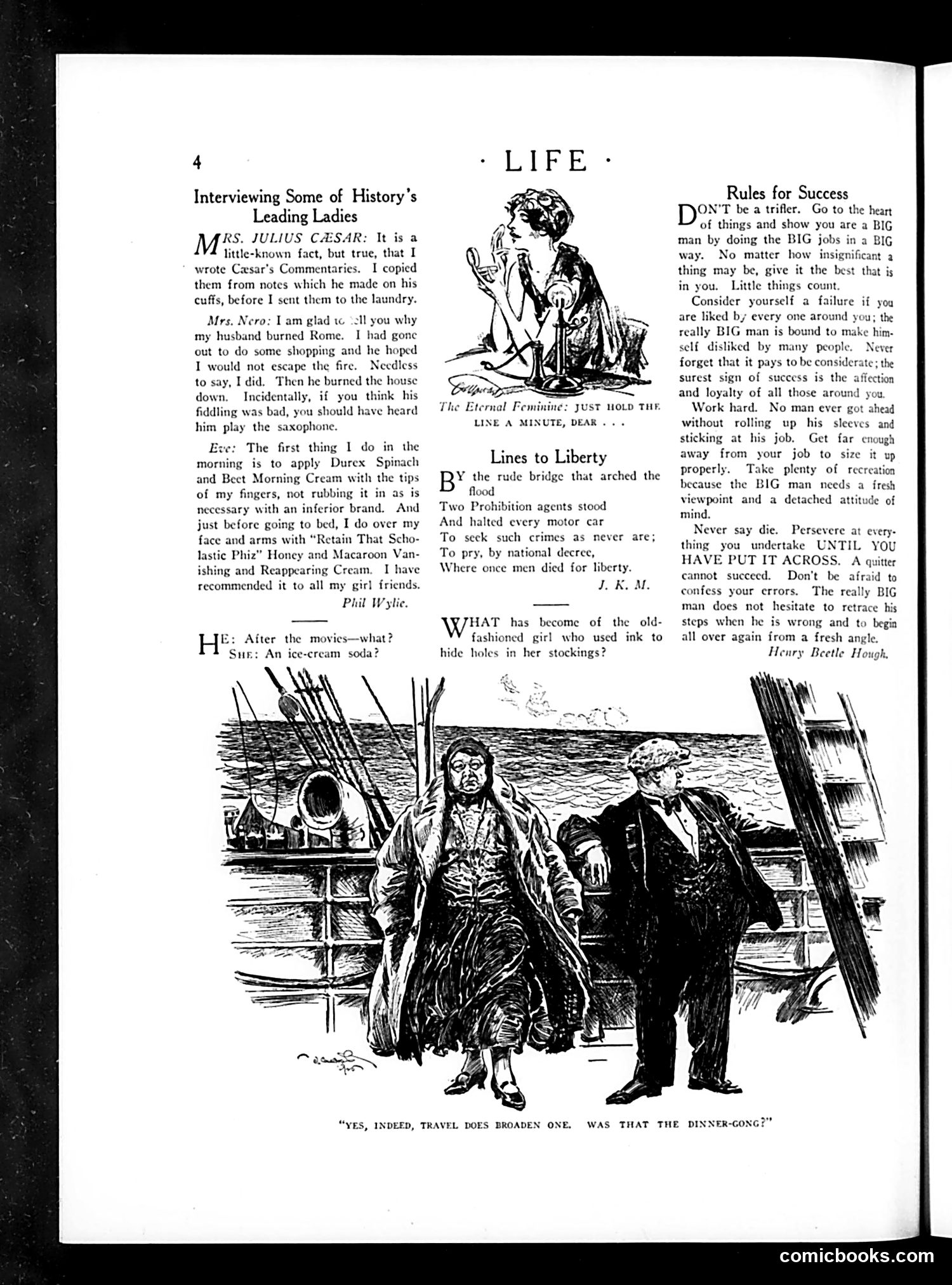
This page contains several unrelated humor pieces typical of Life magazine's format. The main cartoon depicts two figures at a dock—a woman in worn clothing and a man in a suit. The caption reads: "Yes, indeed, travel does broaden one. Was that the dinner-gong?" The satire appears to target class differences and travel experiences: while wealthy people traveled for cultural enrichment, working-class individuals experienced travel as merely laborious displacement. The woman's shabby appearance suggests she traveled out of necessity (perhaps immigration or displacement) rather than leisure, making the dinner-gong reference—associated with refined dining—ironically absurd for her circumstances. The page also includes vintage humor pieces about interviews with historical figures and advice columns on success, typical of the magazine's satirical approach to contemporary society.
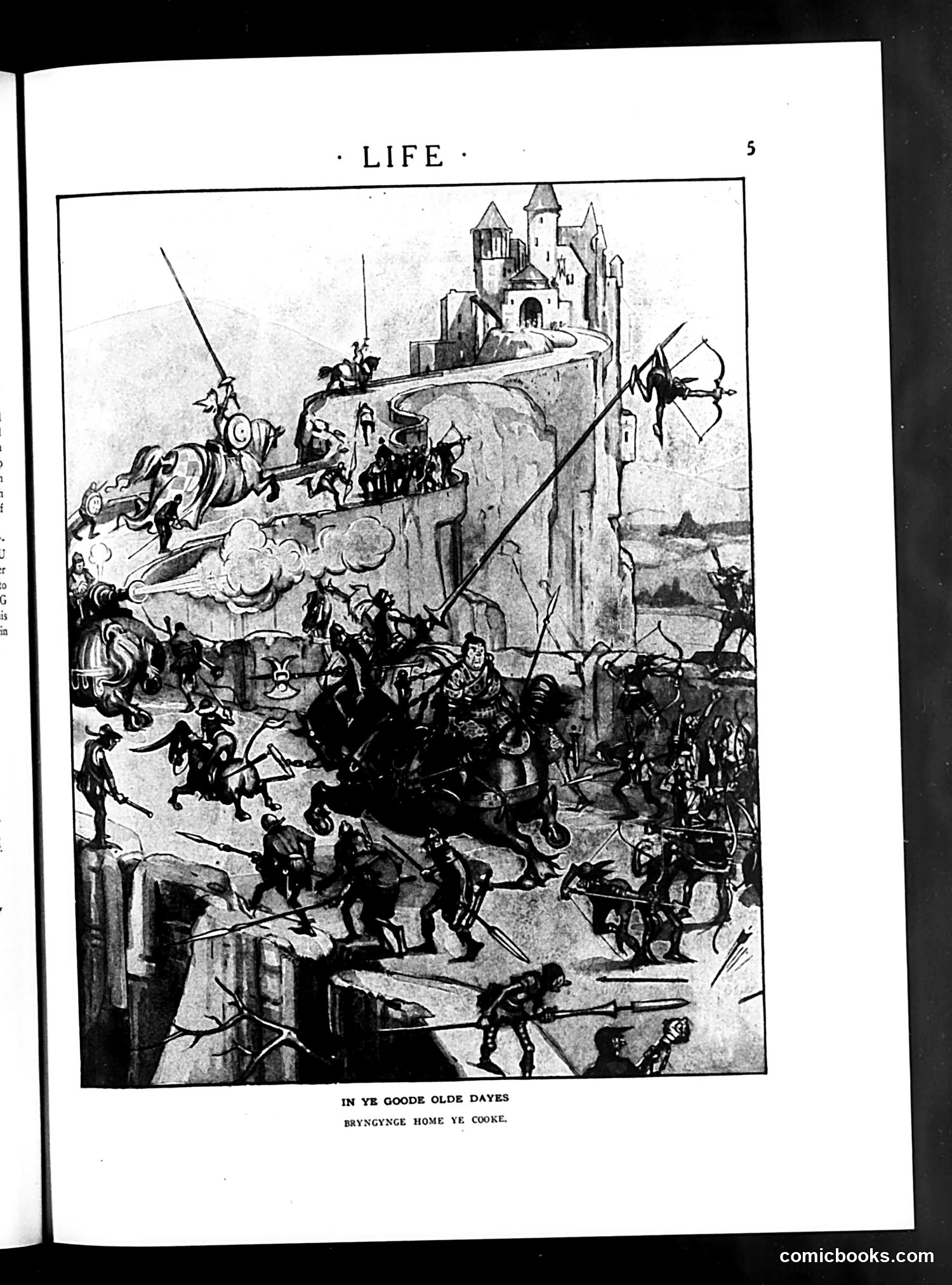
This illustration depicts a medieval fantasy scene titled "IN YE GOODE OLDE DAYES / BRYNGYINGE HOME YE COOKE." The image shows a castle on a hilltop with various figures engaged in what appears to be a chaotic medieval battle or skirmish scene below. The satire likely mocks contemporary domestic or culinary situations by ironically contrasting them with romanticized "olde days" imagery. The deliberately archaic spelling suggests mockery of nostalgic sentimentality about the past. The title's reference to "bringing home ye cooke" (cook) combined with the violent medieval setting implies the cartoon comments on domestic tensions or kitchen-related conflicts, using exaggerated historical pastiche for comedic effect. Without additional context, the specific contemporary target remains unclear, though the approach typifies *Life* magazine's satirical deflation of idealized historical narratives.
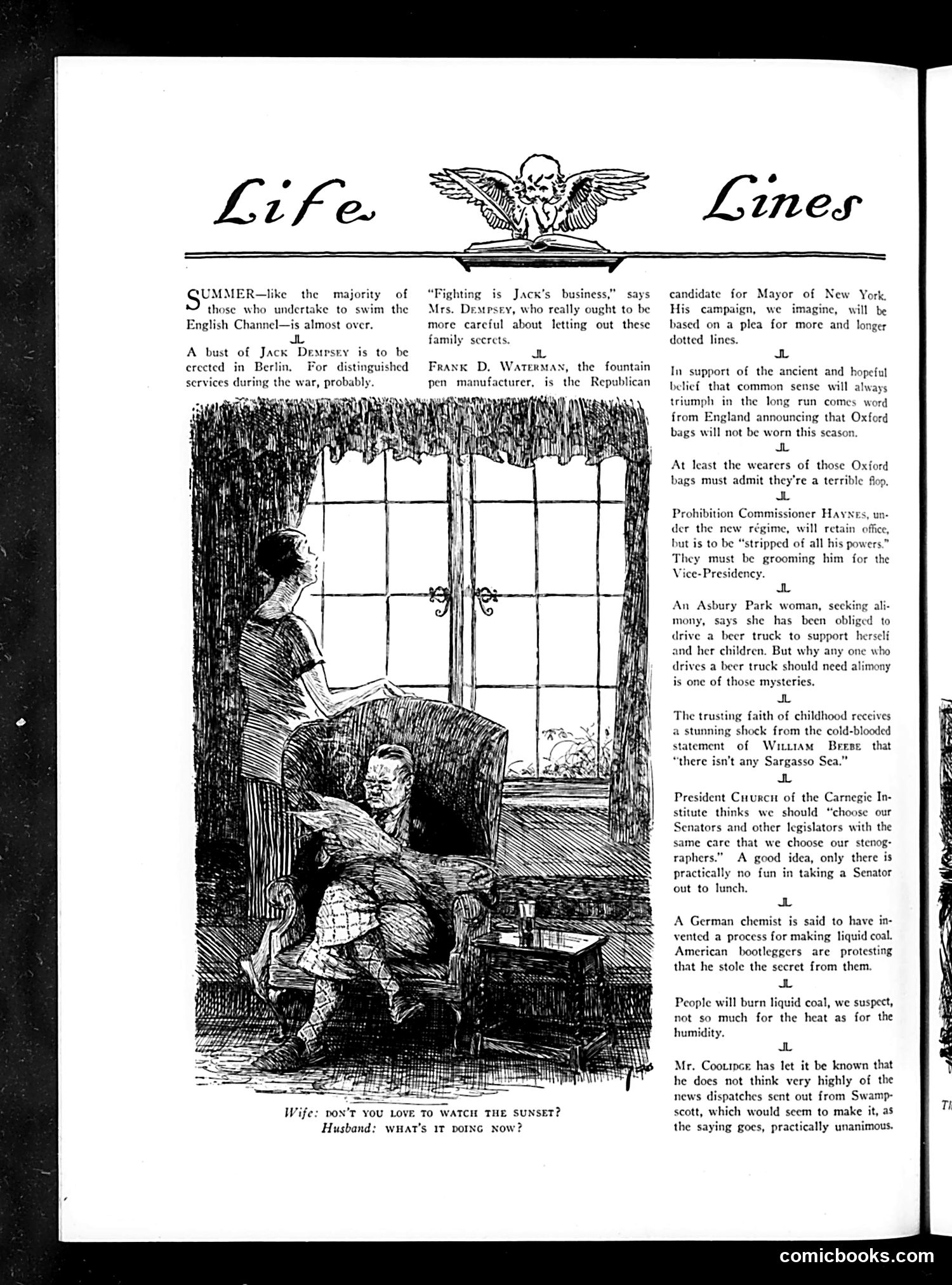
This page contains a domestic cartoon captioned "Wife: don't you love to watch the sunset? Husband: what's it doing now?" The humor satirizes marital disconnection—the husband ignores romantic moments, presumably absorbed in newspapers or other distractions. The surrounding "Life Lines" column offers social commentary on contemporary issues: - **Jack Dempsey** (boxer): A Berlin monument is being erected to honor his WWI service - **Oxford bags** fashion trend: Described as a "terrible flop" - **Prohibition Commissioner Haynes**: Criticized as needing to be "stripped of all his powers" - **William Beebe** (naturalist): Mocked for claiming no "Sargasso Sea" exists - **Liquid coal**: German chemical innovation that American bootleggers allegedly want to steal The page satirizes 1920s American politics, fashion, and social hypocrisy around Prohibition.
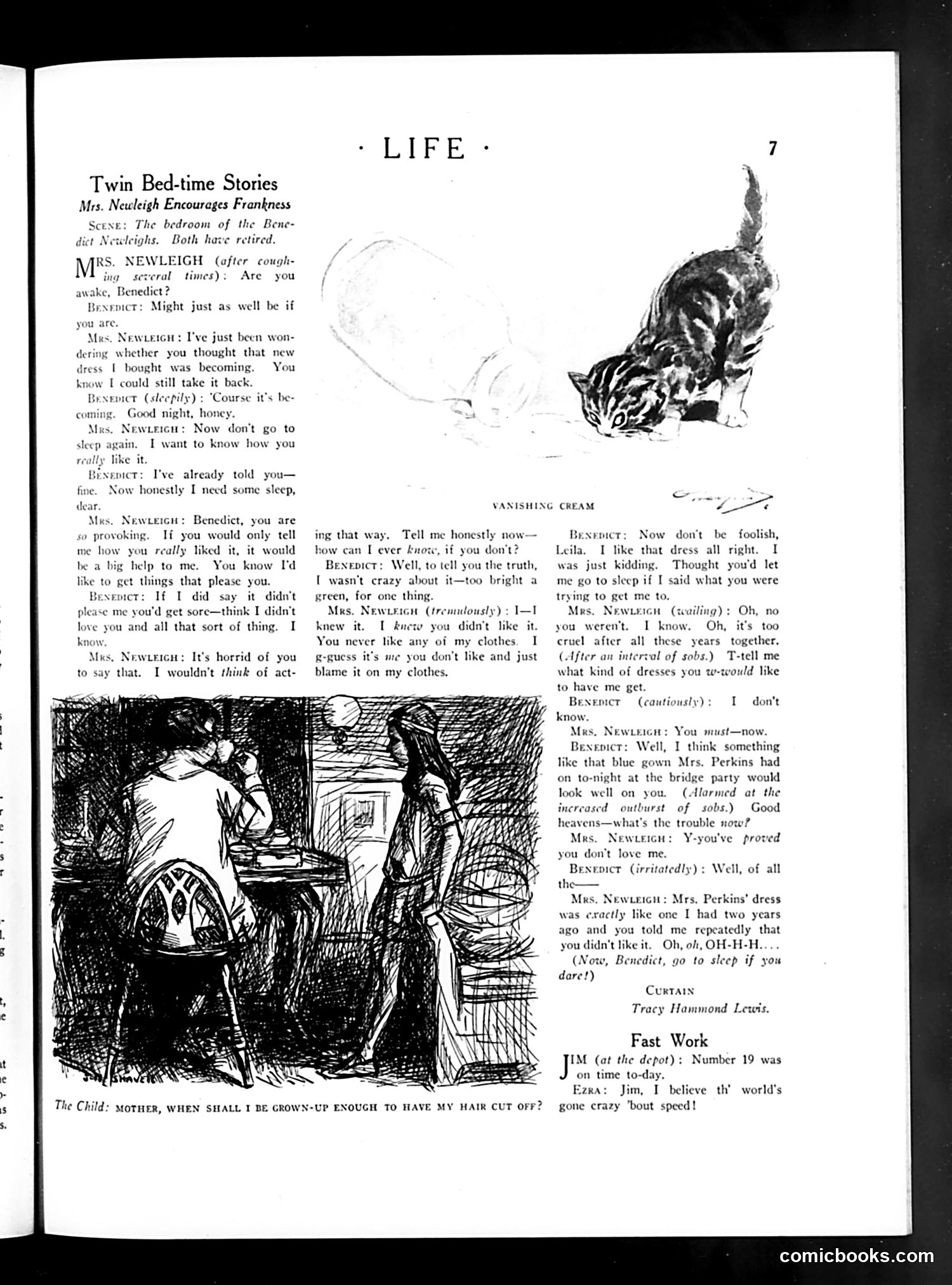
This page contains a satirical bedroom dialogue between Mrs. and Mr. Newleigh, with accompanying sketch illustrations. The humor centers on marital discord over clothing and appearance. Mrs. Newleigh pressures her husband to compliment a new dress, while he resists and makes critical comments. The satire mocks conventional domestic expectations—specifically, the wife's desire for validation and the husband's reluctant, grumbling compliance with social niceties. The sketch shows the couple in their bedroom, capturing the awkward tension of the exchange. A separate illustration titled "Vanishing Cream" depicts a cat, likely a visual pun on the cosmetics/beauty theme. Below is another titled "Fast Work," unrelated to the main piece. The humor reflects early 20th-century gender dynamics and marital stereotypes common to Life's satirical approach.
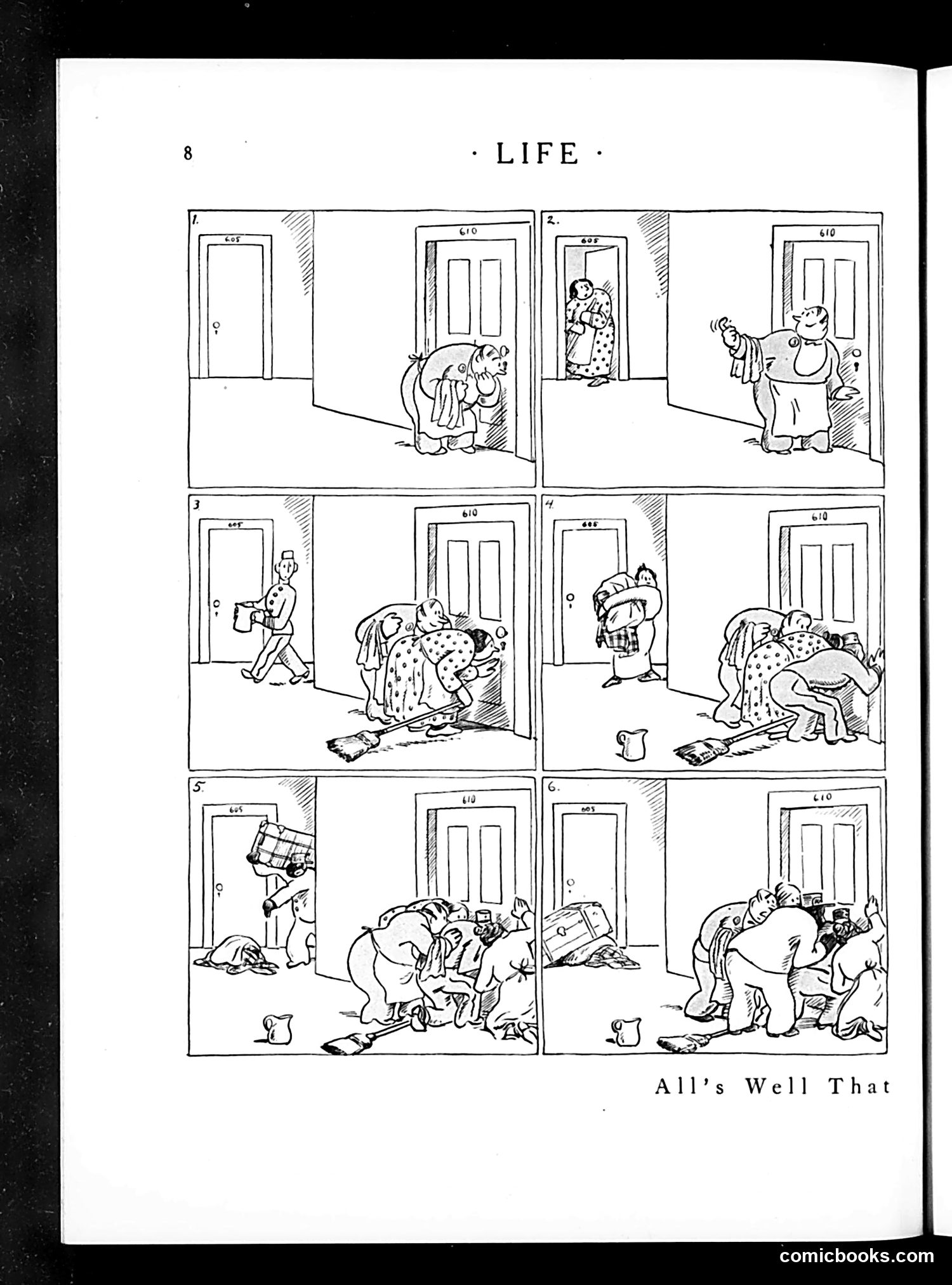
This six-panel comic depicts domestic chaos escalating absurdly. A woman repeatedly enters her home to find increasingly disastrous scenes: children being disciplined, belongings scattered, furniture overturned, and eventually the entire interior ransacked with objects strewn everywhere. The humor derives from the contrast between the woman's initial composed reactions (panels 1-2) and the mounting disorder, suggesting either negligent childcare or a catastrophically messy household. The phrase "All's Well That" (likely completing "All's Well That Ends Well") ironically undercuts the visual pandemonium. This appears to be satirizing domestic management struggles, possibly critiquing either absent fathers, overwhelmed mothers, or the general chaos of managing children and housework—common Life magazine topics addressing middle-class American family life and gender roles.
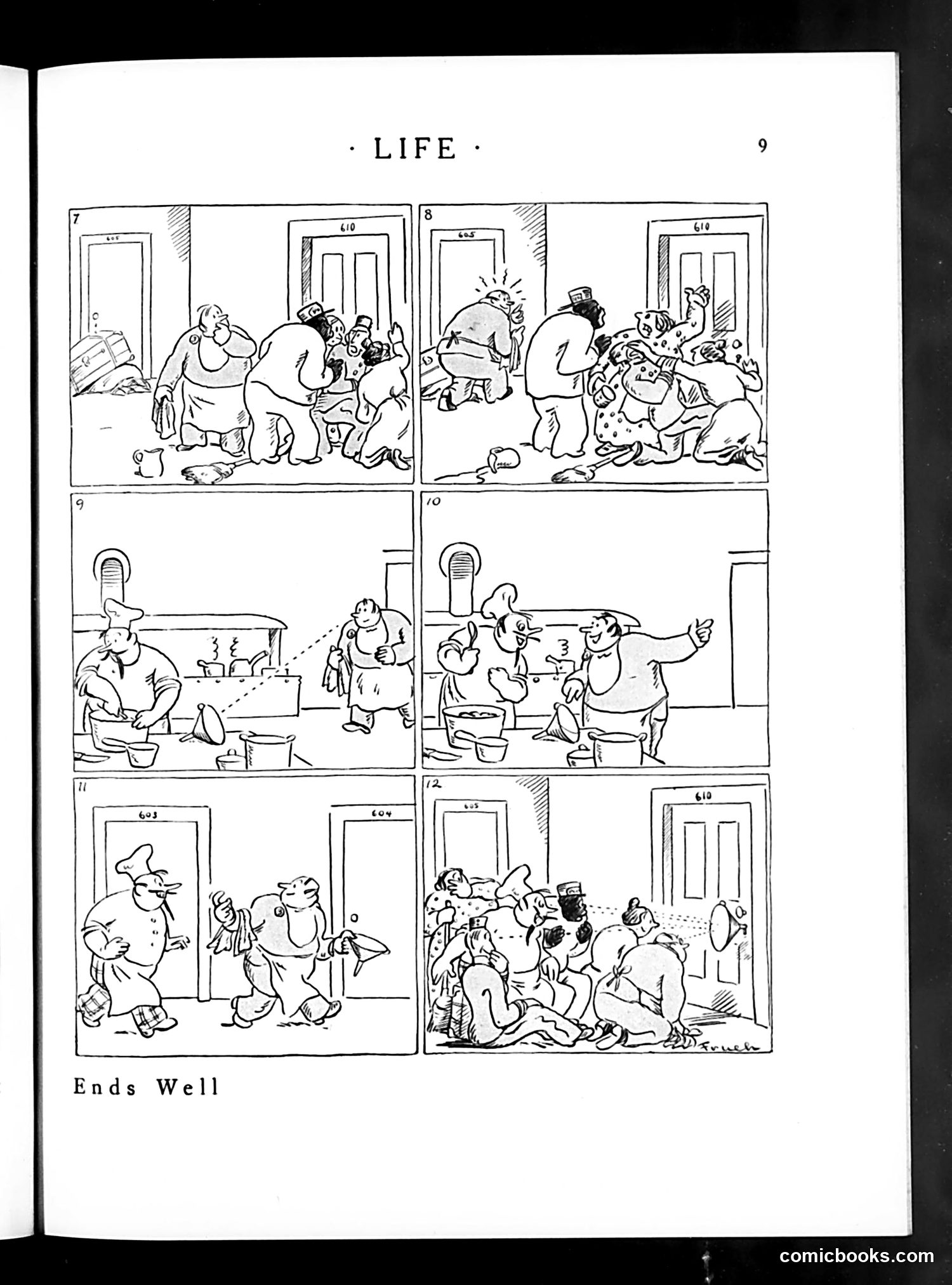
This six-panel comic tells a slapstick story of household mayhem. The narrative appears to show: **Panels 7-8**: A crowded apartment with multiple visitors arriving, creating confusion and disorder. **Panels 9-10**: A kitchen scene where cooking goes awry—someone appears to be managing food preparation amid chaos. **Panels 11-12**: The situation escalates into complete pandemonium, with figures scrambling and fighting over what appears to be food or household items. The title "Ends Well" suggests ironic commentary—the chaos doesn't actually resolve positively despite the optimistic title. This reflects common Life magazine humor: satirizing ordinary domestic life through exaggeration, depicting middle-class households as inherently disorganized and accident-prone. The broad slapstick style and crowded compositions were typical of early-to-mid 20th century American comic humor.
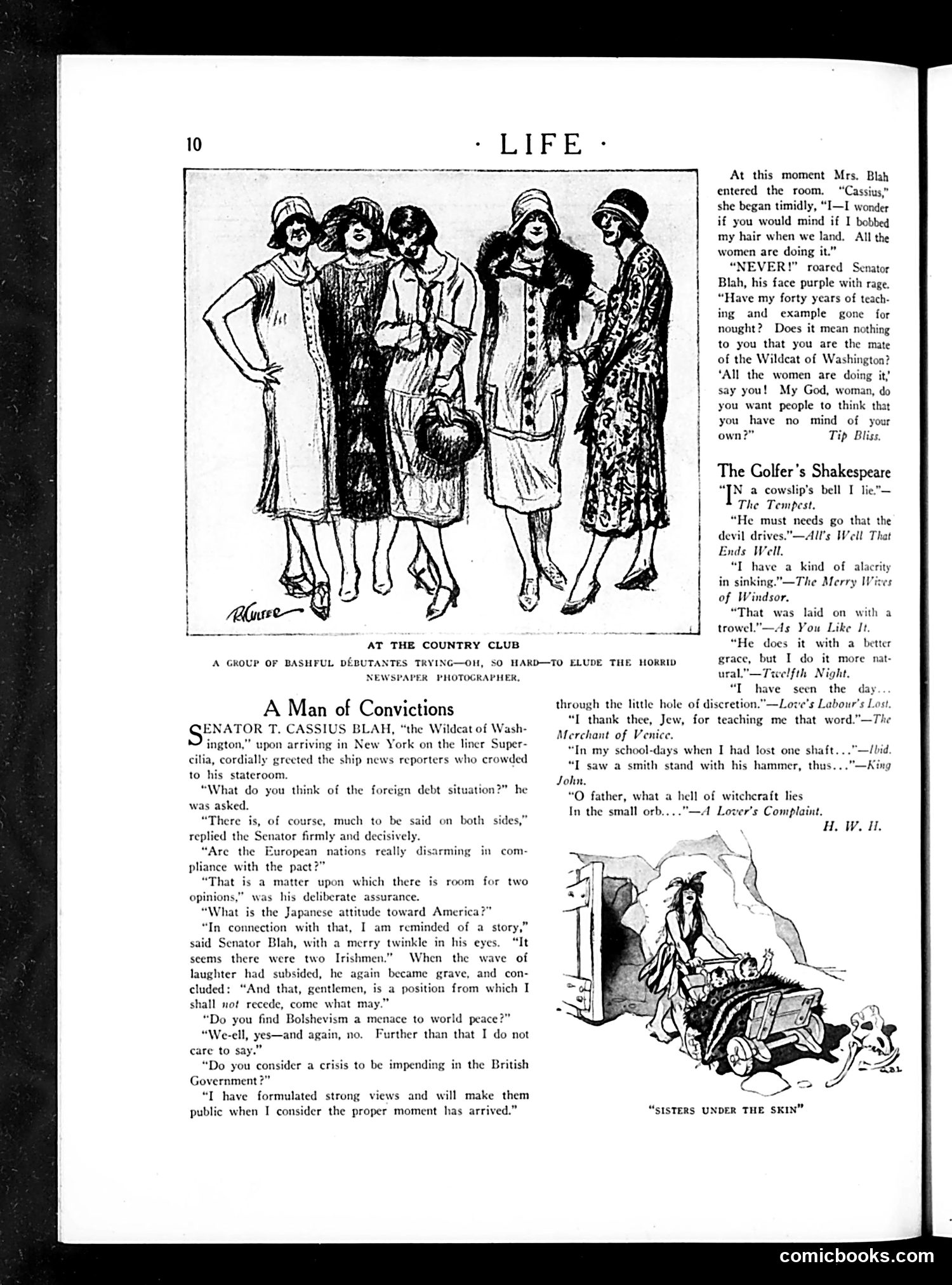
The top cartoon shows five women at a country club, labeled "A GROUP OF BASHFUL DEBUTANTES TRYING—OH, SO HARD—TO ELUDE THE HORRID NEWSPAPER PHOTOGRAPHERS." The main article features Senator T. Cassius Blah, "the Wildcat of Washington," arriving in New York to meet newspaper reporters. The satire mocks his evasive responses about pressing issues—the foreign debt, European disarmament, Japanese-American relations, Bolshevism, and a British Government crisis. Blah exemplifies a politician of "convictions" who claims strong views but refuses to commit publicly, saying he'll act "when the proper moment has arrived." The piece satirizes political evasiveness and non-committal posturing on major issues facing the post-WWI era.
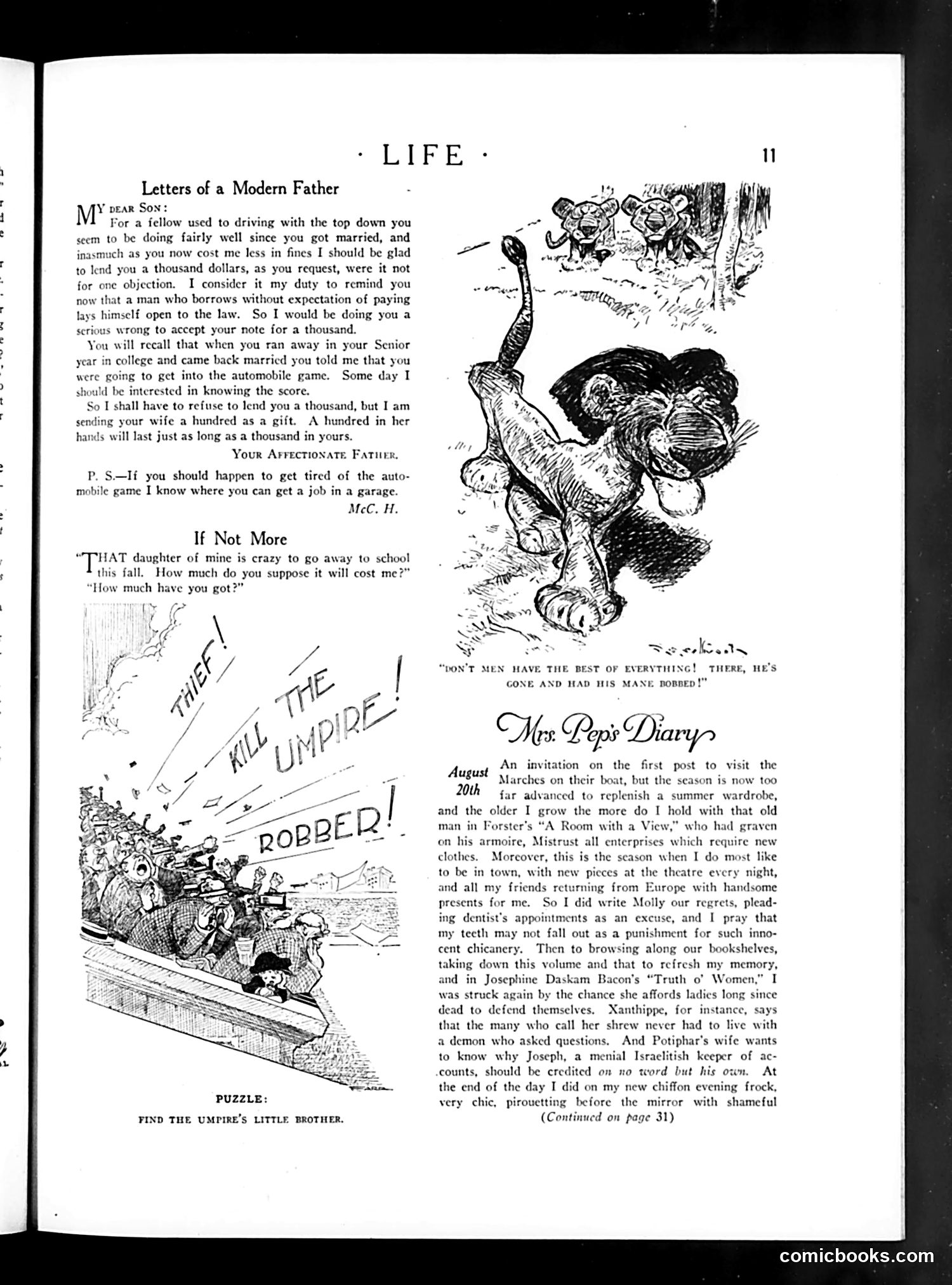
This page contains three satirical pieces reflecting early 20th-century concerns: **"Letters of a Modern Father"** mocks parental anxiety about automobiles. A father warns his son about the dangers of the new automobile "game," offering money as an incentive to avoid it—suggesting cars were viewed as reckless, fashionable dangers to young men. **"If Not More"** cartoon depicts a daughter's school expenses as an invasion/robbery, with military imagery ("KILL THE UMPIRE! ROBBER!"). It satirizes how expensive girls' education was becoming—treating educational costs as financial assault on the family budget. **"Mrs. Pep's Diary"** discusses summer social obligations and women's fashion concerns, reflecting upper-class leisure culture anxieties about wardrobes and social propriety. Overall, the page humorously captures early 1900s middle/upper-class parental and social concerns.
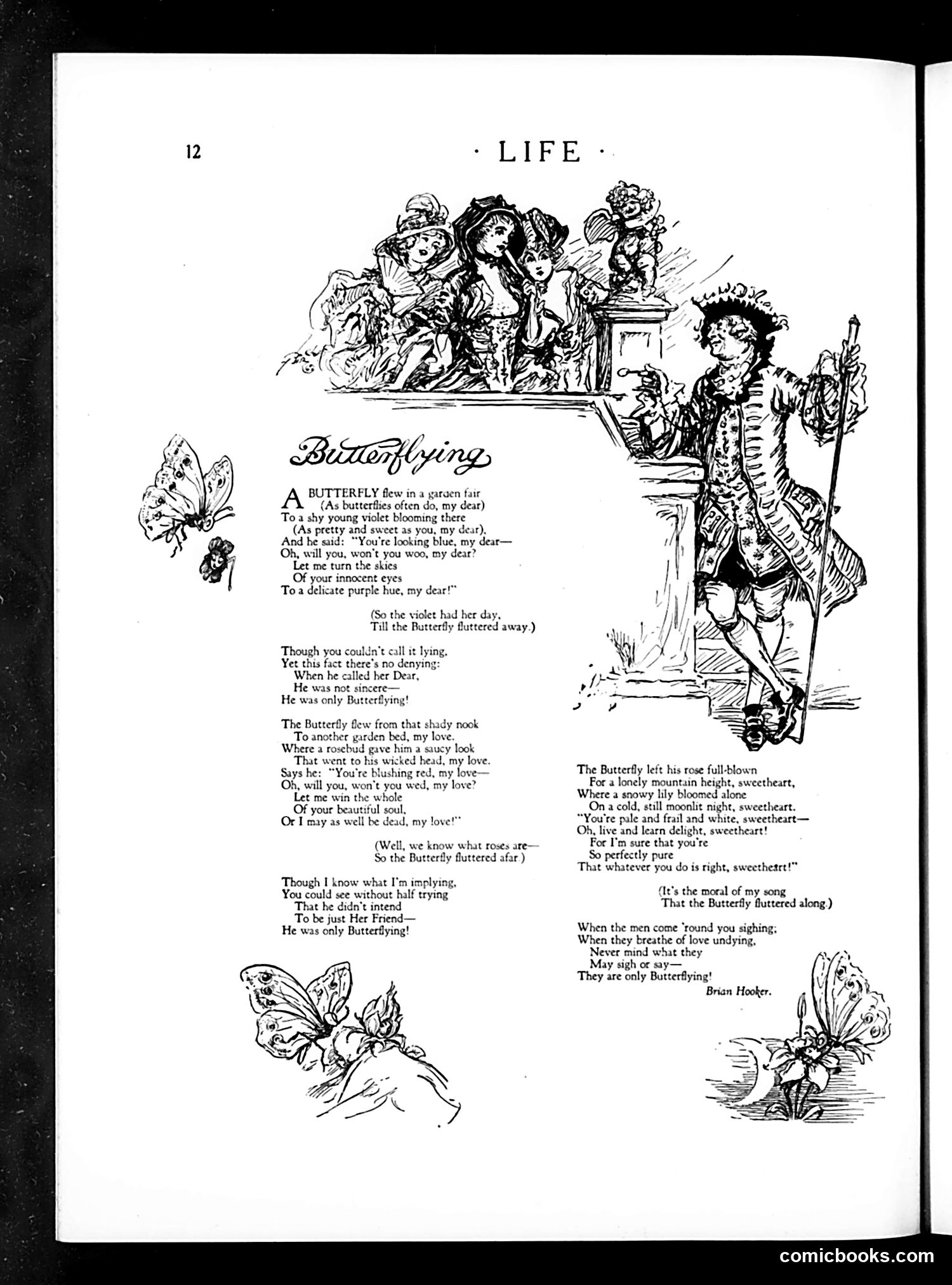
This page presents a whimsical poem by Brian Hooker titled "Butterflying," illustrated with period engravings of elegantly dressed figures and butterflies. The poem uses the metaphor of a butterfly charming a violet to describe romantic flirtation. A butterfly tells the violet he'll change her eye color from blue to purple, flatters her appearance, then abandons her—behavior the poem characterizes as mere "Butterflying" (casual, non-committal courtship). The narrative follows the violet's heartbreak as she watches the butterfly pursue other flowers. The poem's moral: such behavior by men toward women is ultimately harmless—"They are only butterflying!"—a satirical commentary on how Victorian society dismissed male romantic fickleness as natural, inconsequential behavior rather than genuine deception or betrayal.
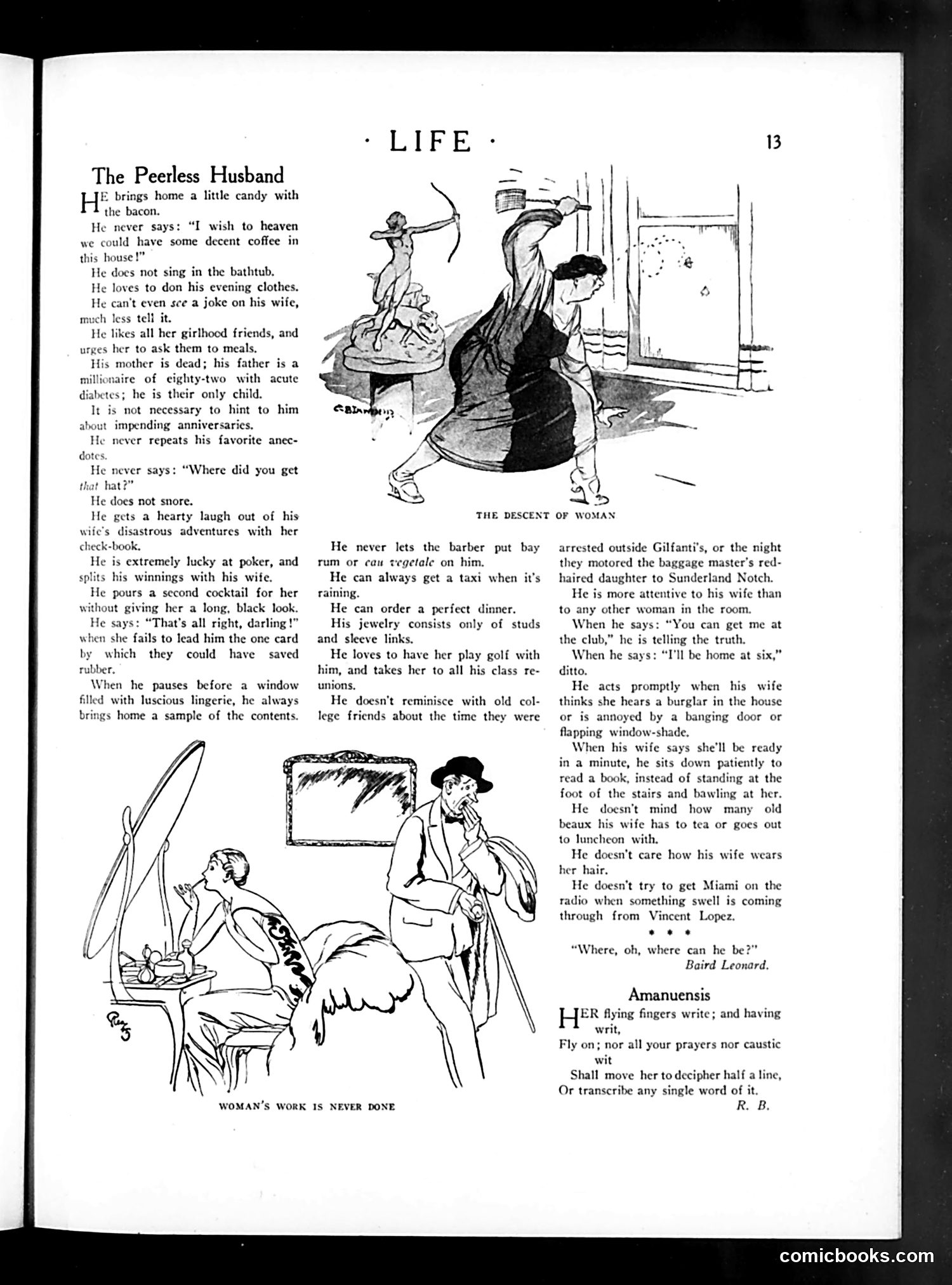
This page satirizes the "ideal husband" through ironic praise. The text catalogs a man's virtues while the illustrations undermine them. He brings home candy but never improves the home; he enjoys poker luck but his wife funds his habits; he's attentive yet dismissive of her concerns. The upper cartoon shows "The Descent of Woman"—a man shooting an arrow at a classical female statue, suggesting modern marriage diminishes women's dignity. The lower cartoon depicts "Woman's Work Is Never Done," showing a woman juggling household duties while a man arrives home. The satire targets early 20th-century gender dynamics: husbands presented as thoughtless yet praised as "peerless," while wives labor endlessly with minimal appreciation or partnership.
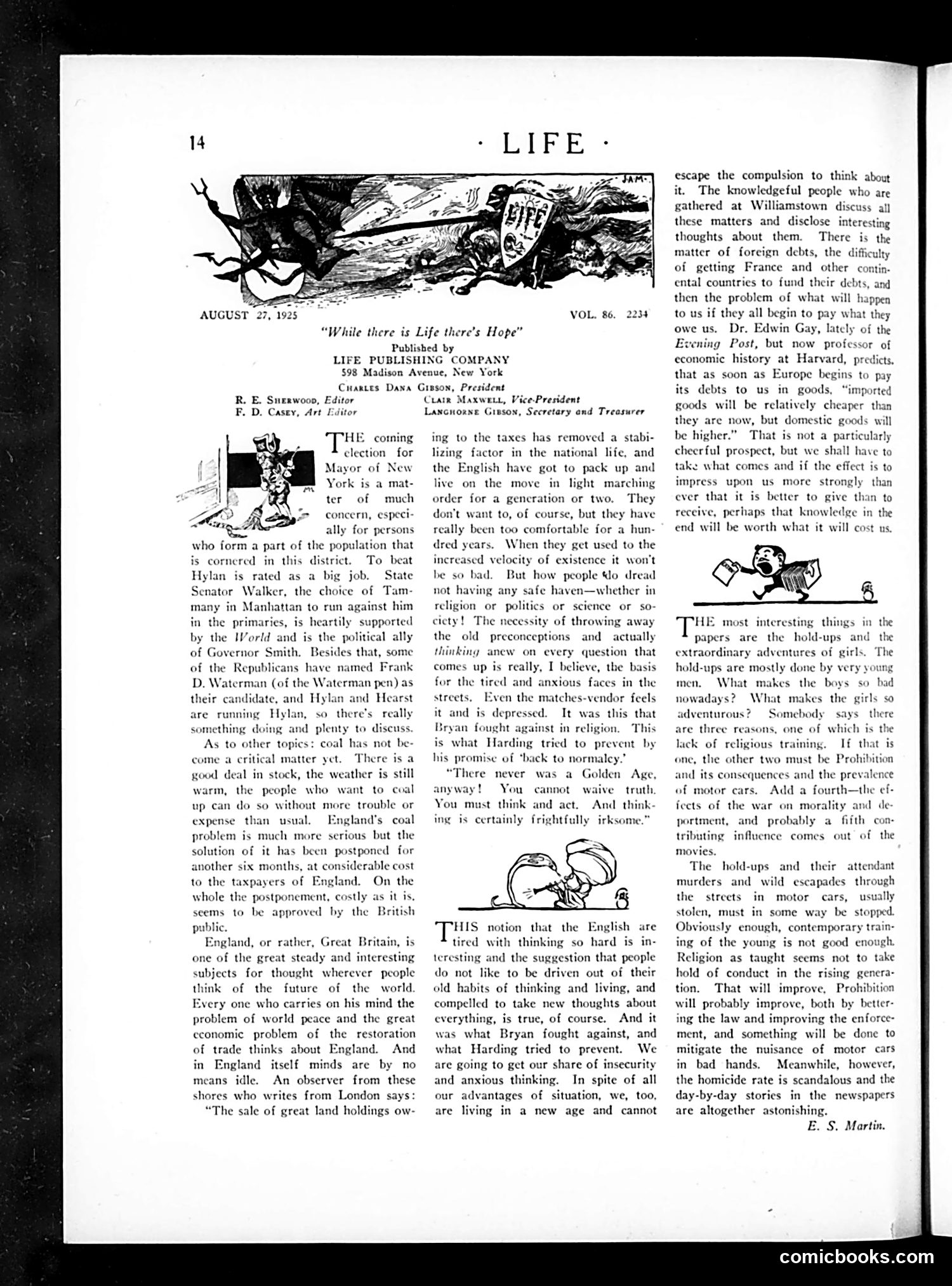
This page contains editorial commentary on the 1925 New York mayoral election. The text discusses concerns about candidate selection, mentioning State Senator Walker as the choice of Tammany Hall, and Frank D. Waterman and others as Republican alternatives. The main satirical point targets the English and their "hard thinking"—the article mocks the notion that the English are naturally thoughtful people who resist new ideas. It argues this belief is itself flawed, and that in reality, people across societies struggle with accepting change and new thinking. The small cartoon illustrations appear to punctuate these arguments but are too small to read clearly. The piece, signed by E.S. Martin, criticizes cultural stereotypes while discussing contemporary American political anxieties about corruption and governance.
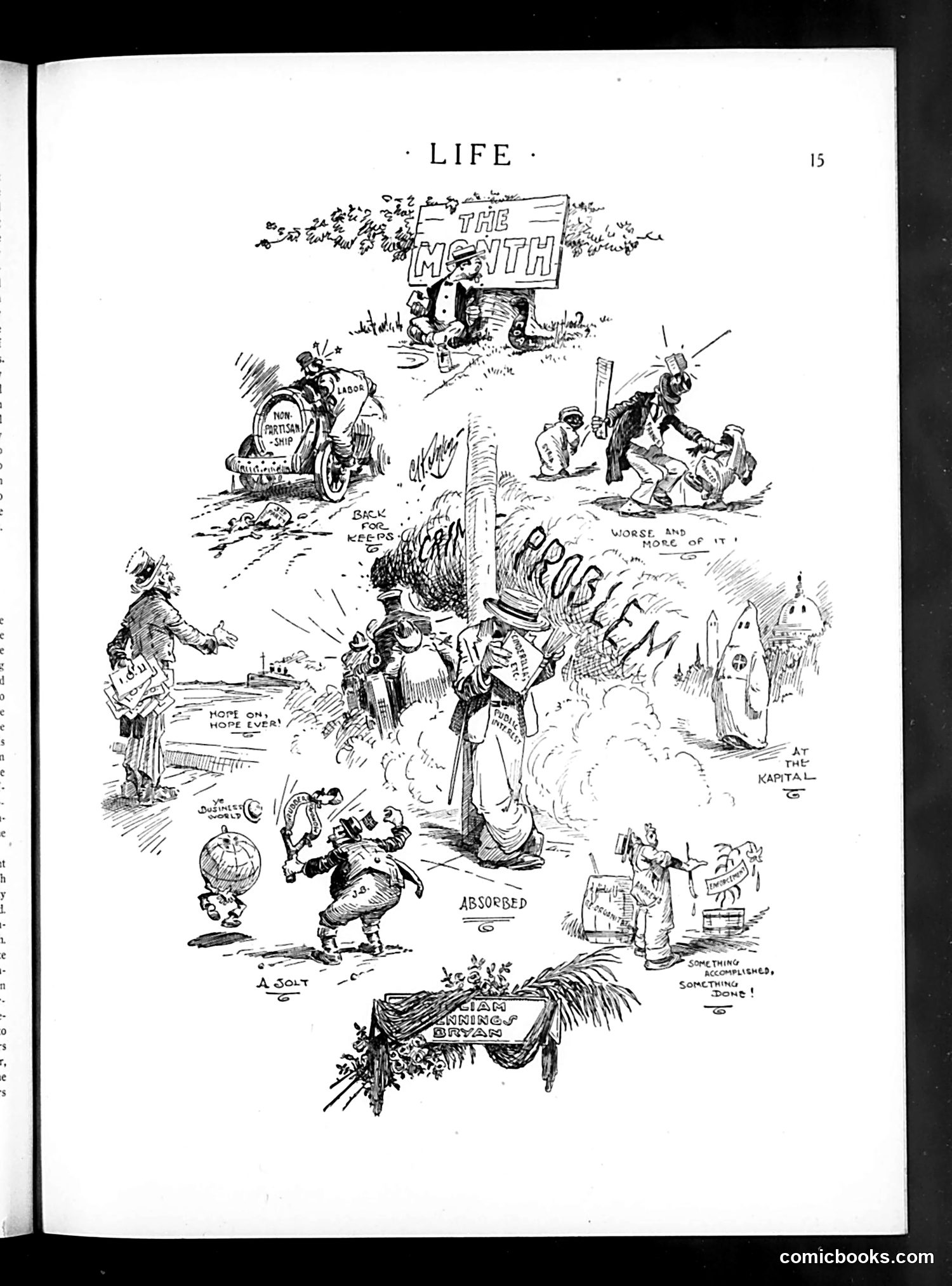
This is a composite satirical illustration titled "The Month" depicting various contemporary social and political situations. The cartoons show: - A motorist labeled "Fordism" (likely referencing Henry Ford's assembly-line manufacturing) - References to domestic life ("Home on the Range") - Military or conflict imagery ("At the Kapital") - A figure labeled "A Bolt" and another "Absorbed" - Various scenes suggesting chaos, labor disputes, or social upheaval - Text fragments like "Back for Keeps," "Worse and Worse of It," "Something Accomplished, Something Done" The overall composition appears satirizing early 20th-century American life—industrial production, domestic concerns, international tensions, and social turbulence. Without specific dates or clearer labels, the exact historical events referenced remain unclear, though the tone suggests commentary on contemporary anxieties and absurdities.
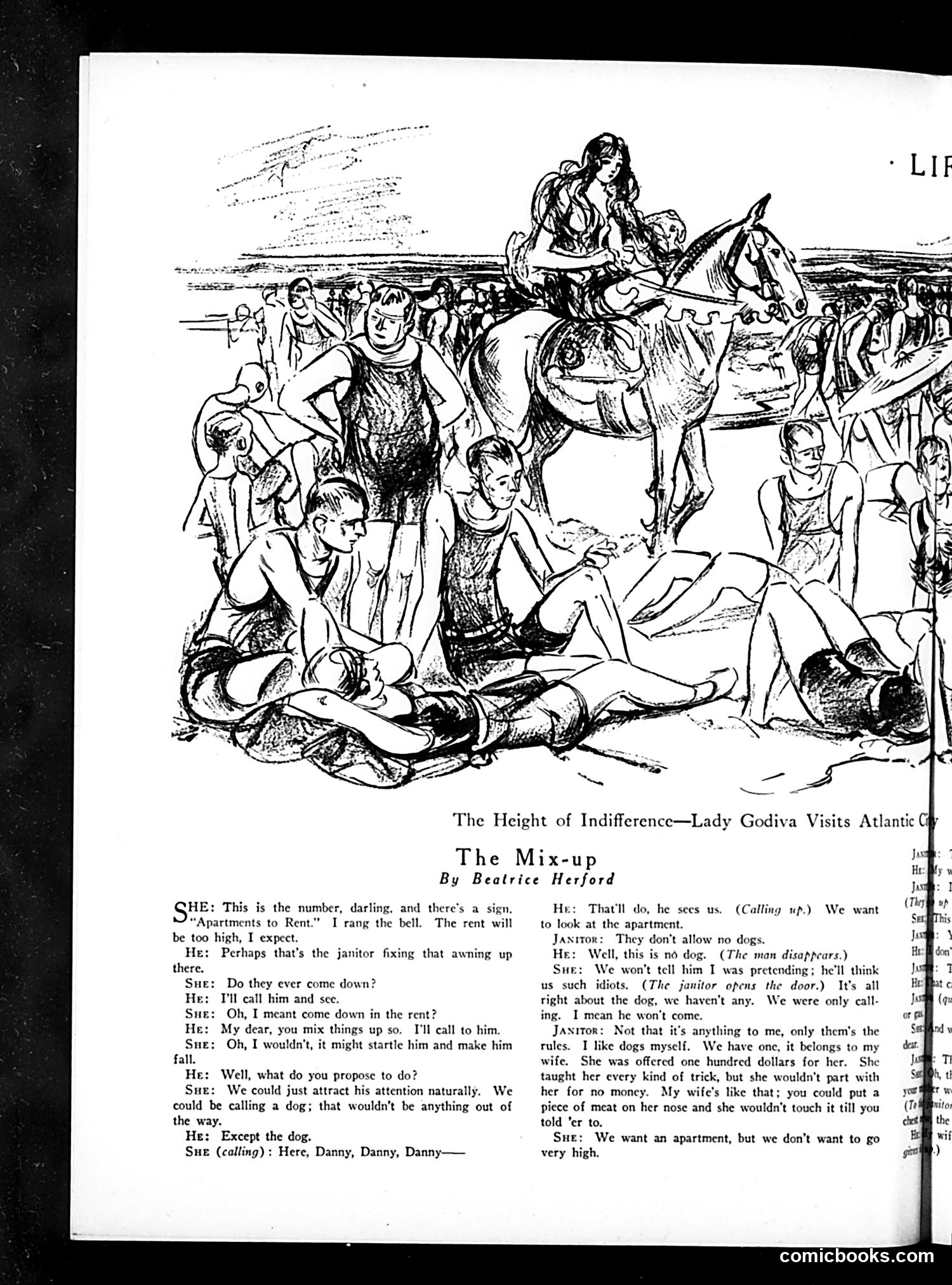
This page from *Life* magazine contains a satirical sketch titled "The Mix-up" by Beatrice Herford. The cartoon above depicts a beach scene with various beachgoers, while the text below presents a comedic dialogue between a man and woman discussing apartment hunting. The satire centers on **social class pretense and urban apartment-hunting frustrations**. The couple wants a nice apartment but can't afford high rent. A key joke involves their disagreement over a dog: the man dismisses the dog as an obstacle ("that wouldn't be anything out of the way"), while the woman reveals her expensive dog was a gift—establishing a class-consciousness joke about conspicuous consumption and marital financial dynamics. The janitor subplot adds working-class friction to their apartment search troubles. The humor relies on period-specific urban life frustrations recognizable to early 20th-century readers.
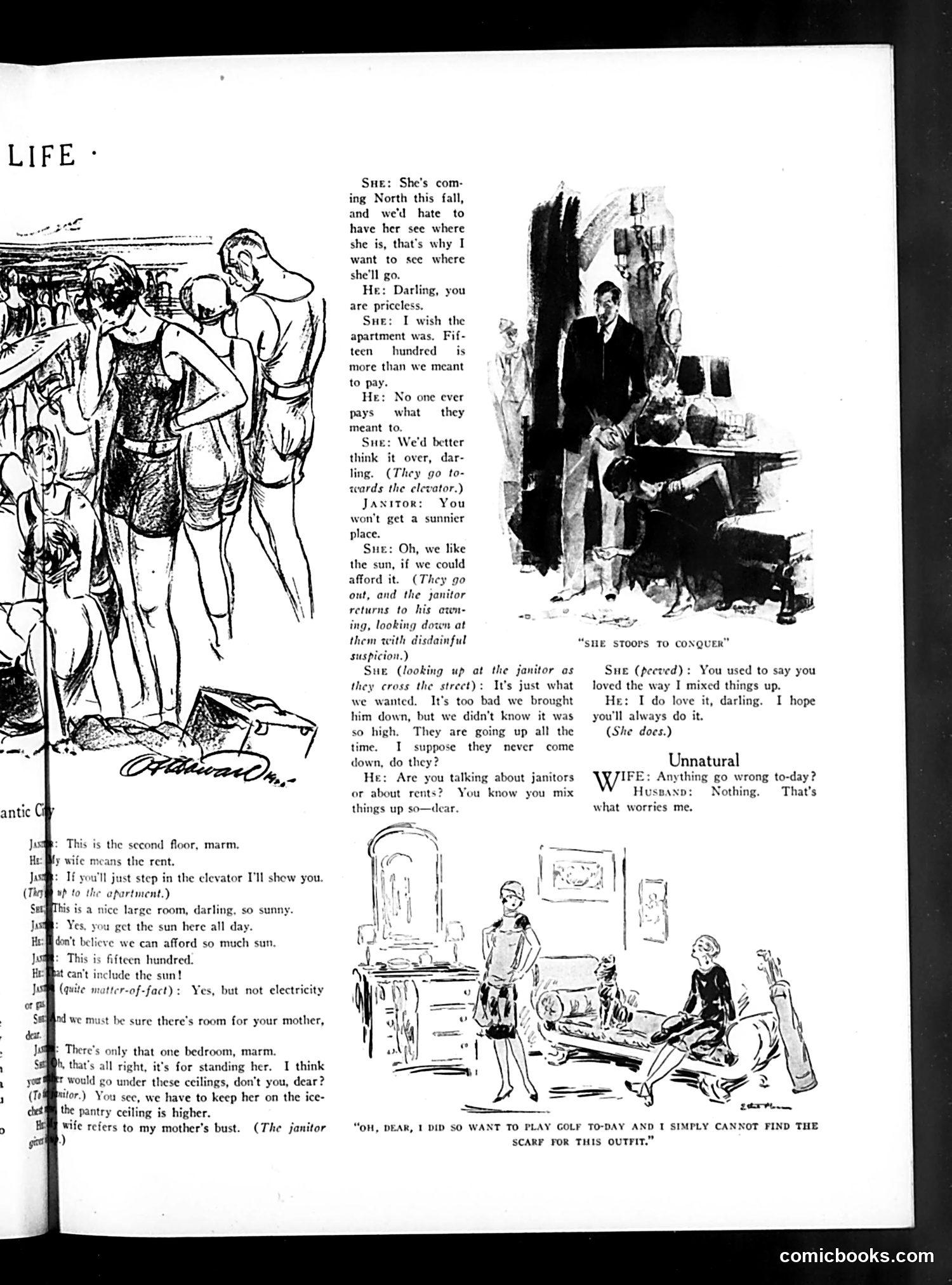
This page contains two satirical pieces about 1920s upper-middle-class domestic life. **Top section ("She Stoops to Conquer"):** A couple tours an expensive apartment ($1,500/month) with a dismissive janitor. The satire targets young married couples' financial anxieties—they can barely afford the rent, worry about impressing the husband's visiting mother, and complain about the cost while simultaneously admiring the apartment. The janitor's "disdainful suspicion" mocks working-class judgment of struggling wealthy people. **Bottom section ("Unnatural"):** A husband expresses worry that nothing went wrong today—suggesting domestic life has become so predictably comfortable that the absence of crisis feels threatening. The accompanying cartoon shows a wife frantic over a missing golf scarf, highlighting the trivial concerns of leisure-class women. Both pieces satirize 1920s prosperity-era anxieties: financial strain despite apparent wealth, class consciousness, and the boredom of affluent domestic life.
This is a humorous travel letter from Budapest by Robert Benchley, reviewing Hungarian theatrical productions. The piece satirizes the absurdity of experiencing foreign plays without understanding the language. Benchley notes the irony that more Hungarian plays run in New York than Budapest itself. He describes attending shows featuring obscure Hungarian titles and unfamiliar actors, emphasizing that without Hungarian fluency, audiences cannot distinguish one play from another—yet the plots are universally recognizable musical comedy tropes (mistaken identities, romantic entanglements in modiste shops, comic porters). The humor centers on how theater transcends language: the familiar conventions of musical comedy—flirtation, wives discovering husbands, servants in love—require no translation. Benchley mocks the formulaic nature of such entertainment, where chaotic plots climax with improbable revelations (a postman revealed as a mill-owner's son), making language irrelevant to the absurdity. The piece gently satirizes both Hungarian theatrical conventions and the universal predictability of commercial stage comedy.
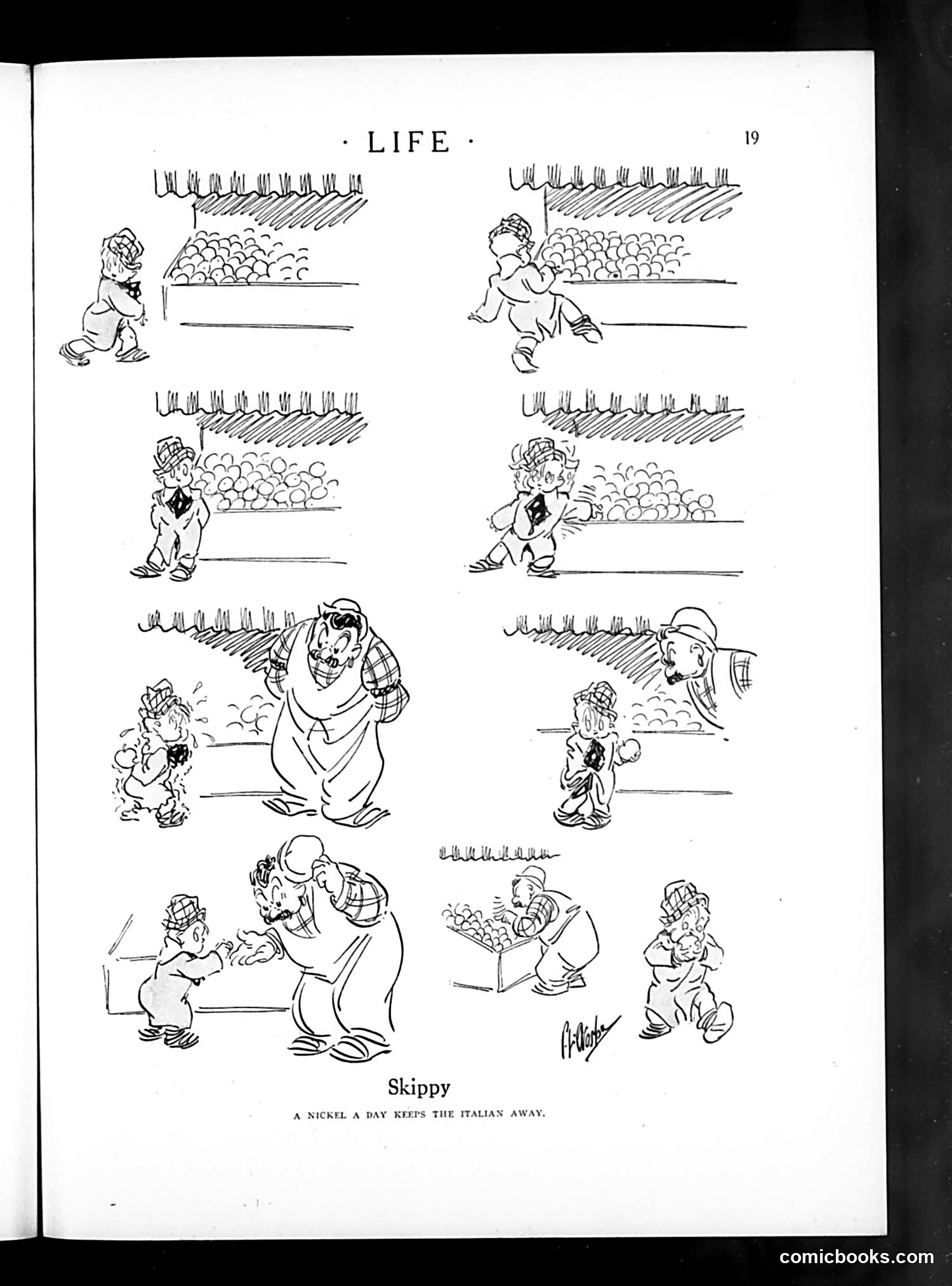
This comic strip appears to be from Life magazine's satirical section. The narrative follows a young boy (Skippy) who uses a nickel to keep away an Italian character—depicted as a large, menacing figure in the sequential panels. The caption's pun references the saying "an apple a day keeps the doctor away." The humor relies on ethnic stereotyping common to early 20th-century American satire, portraying Italian immigrants as threatening or undesirable. The strip depicts Skippy using money as a deterrent, playing on stereotypes about Italian immigrants and economic vulnerability. This reflects the xenophobic attitudes prevalent in American media during the era of significant Italian immigration.
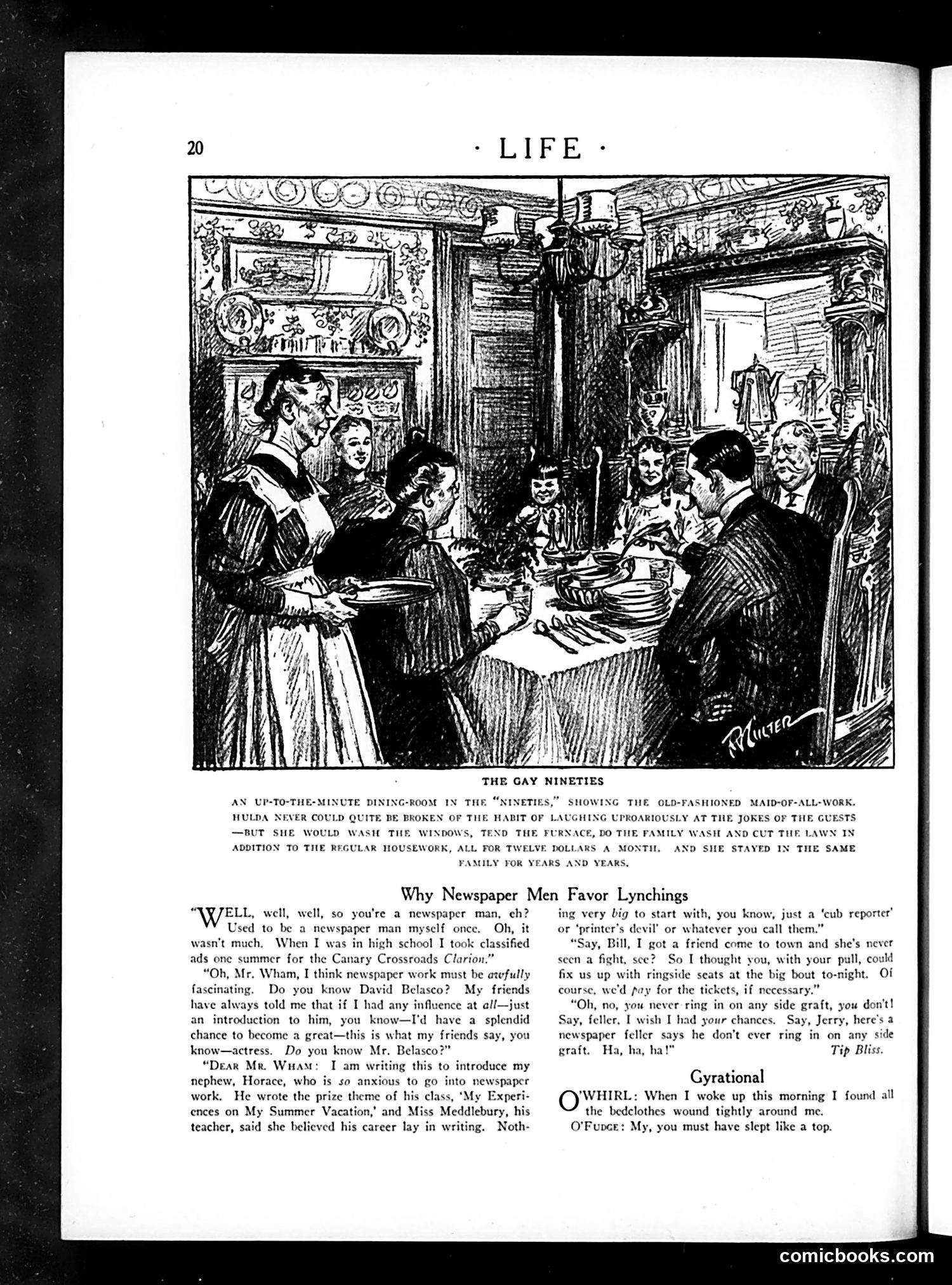
The top illustration depicts a domestic dining scene titled "The Gay Nineties," sarcastically contrasting modern convenience with exploitation. It shows "Hulda," a maid-of-all-work earning twelve dollars monthly, performing multiple household duties (washing, furnace-tending, laundry, lawn care) while servants laugh at dinner guests' jokes. The satire critiques how working-class domestics were underpaid yet remained loyal for years. Below, "Why Newspaper Men Favor Lynchings" satirizes journalists' cynicism and corruption. Through dialogue, it mocks how newspaper men accept bribes and favors (ringside boxing tickets, introductions to theatre producer David Belasco), suggesting they exploit their professional connections for personal gain. The title implies journalists might sensationalize violent crimes for profit. The small "Gyrational" joke at bottom is unrelated wordplay. Overall, the page critiques class exploitation and professional corruption in 1890s America.
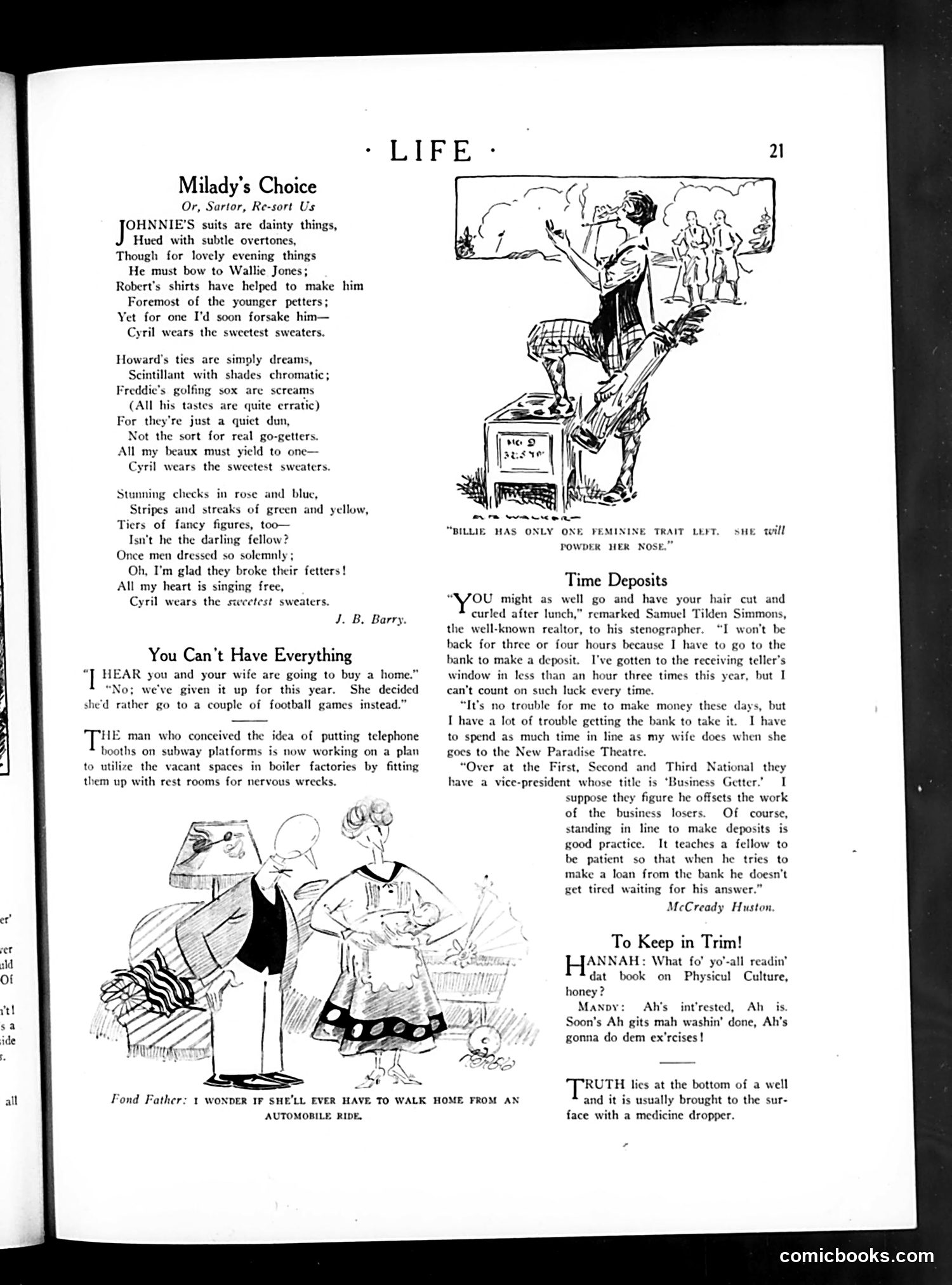
This page contains three satirical pieces mocking 1920s social trends: **"Milady's Choice"**: A poem lampooning young women's fashion obsession. A woman catalogs various suitors by their clothing—Johnny's suits, Robert's shirts, Howard's ties—ultimately choosing Cyril for his "sweetest sweaters." The satire targets both the superficiality of female mate-selection and the era's newfound male fashion consciousness (a departure from earlier "solemn" dress codes). **"You Can't Have Everything"**: Brief jokes about priorities and modern life—a couple choosing football games over homeownership; an absurdist jab at subway telephone booths and factory rest rooms for "nervous wrecks." **"Time Deposits"**: A banker complains that depositing money takes longer than withdrawing it, inverting normal expectations. The satire critiques banking inefficiency and—implicitly—postwar economic anxiety. **"Fond Father" cartoon**: A father worries his daughter won't experience the traditional indignity of walking home from a car date—satirizing how automobiles have eliminated this courtship consequence. The overall tone reflects Jazz Age anxieties about changing social norms, consumer culture, and modern inconvenience.
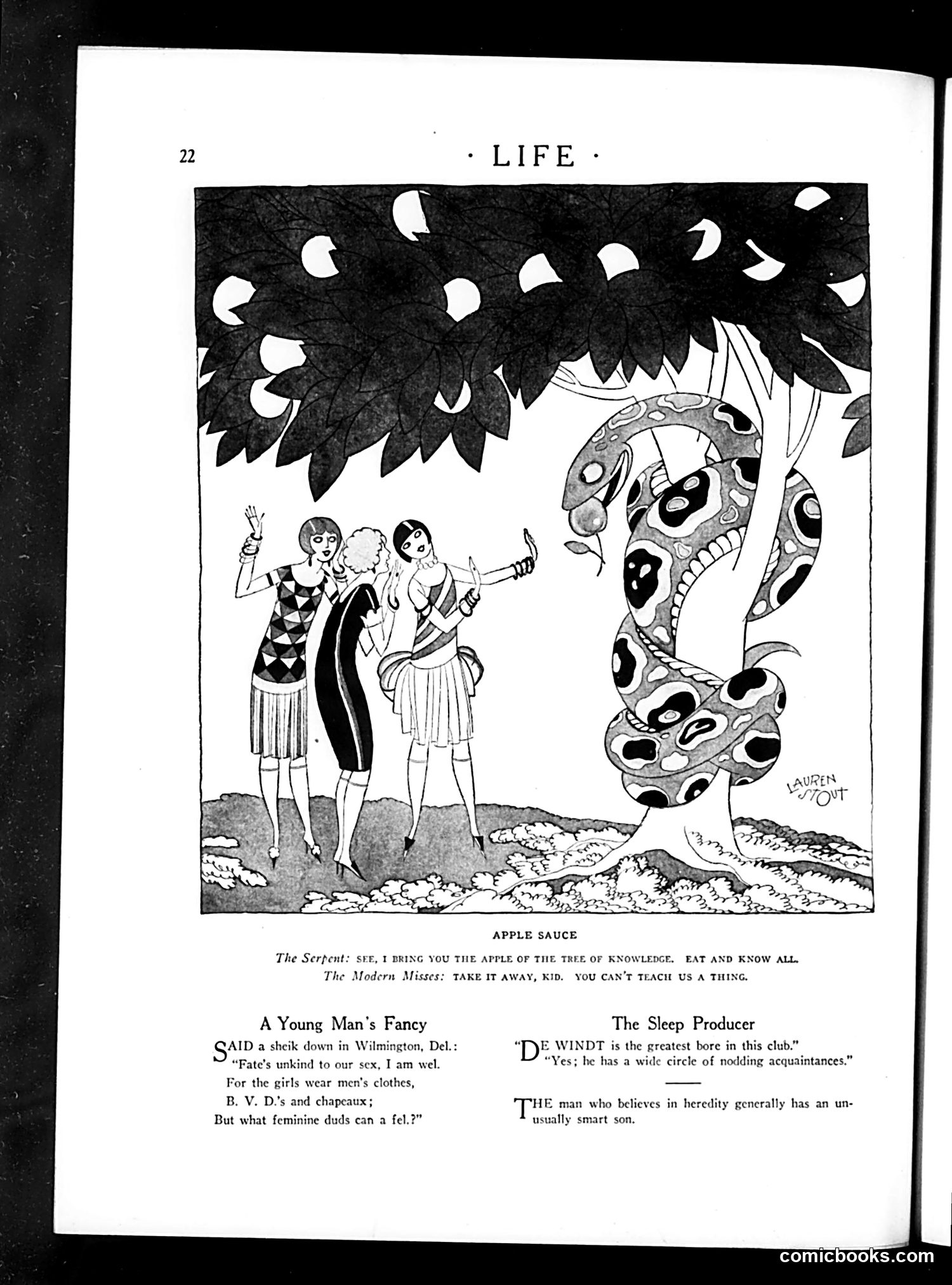
The main cartoon "Apple Sauce" satirizes 1920s youth culture. The serpent offers the biblical "apple of knowledge," but the two young women dismissively reject it with "You can't teach us a thing"—mocking the era's "modern misses" who adopted flapper fashion and attitudes, presenting themselves as worldly and unteachable despite their youth. Below are three brief jokes: "A Young Man's Fancy" complains that women now wear men's clothing (B.V.D.'s were men's underwear), making it hard to distinguish feminine from masculine dress. "The Sleep Producer" mocks a bore named Windt. The final quip suggests men who believe in heredity are surprised when their sons turn out smart anyway—implying inherited traits don't guarantee intelligence. The page reflects Jazz Age anxieties about changing gender roles and youthful irreverence toward tradition.
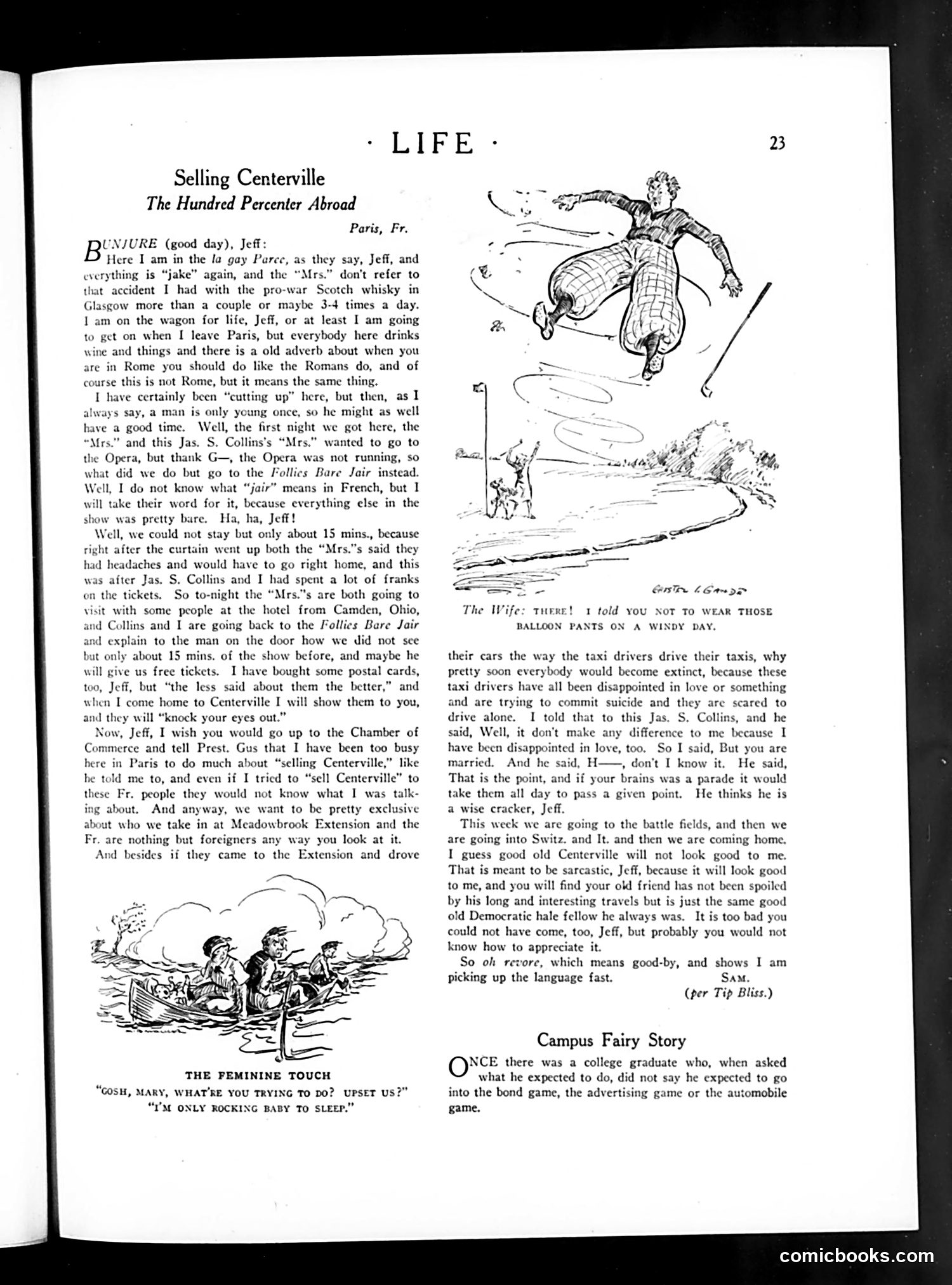
This page satirizes American provincialism and pretension through a letter from "Jeff" in Paris. The humor operates on several levels: **Main Satire:** Jeff represents the "Hundred Percenter"—an American nationalist type obsessed with "selling Centerville" (his hometown). Despite being sent to promote his town abroad, he's too busy enjoying himself and dismissive of the French to accomplish anything. The joke: Americans abroad claim cultural superiority while being ignorant and self-absorbed. **Social References:** - The casual alcoholism ("pro-war Scotch whisky," breaking his wagon) reflects Prohibition-era hypocrisy - "Follies Bare" (likely Folies Bergère) represents risqué entertainment; the wives' quick departure is comedic prudishness - Wartime references ("battle fields," "Switz.") suggest post-WWI travel **Cartoons:** Two small illustrations provide visual jokes—one about rocking a baby (marital discord), another about "balloon pants" in wind (slapstick humor). The satire mocks American insularity disguised as patriotism.
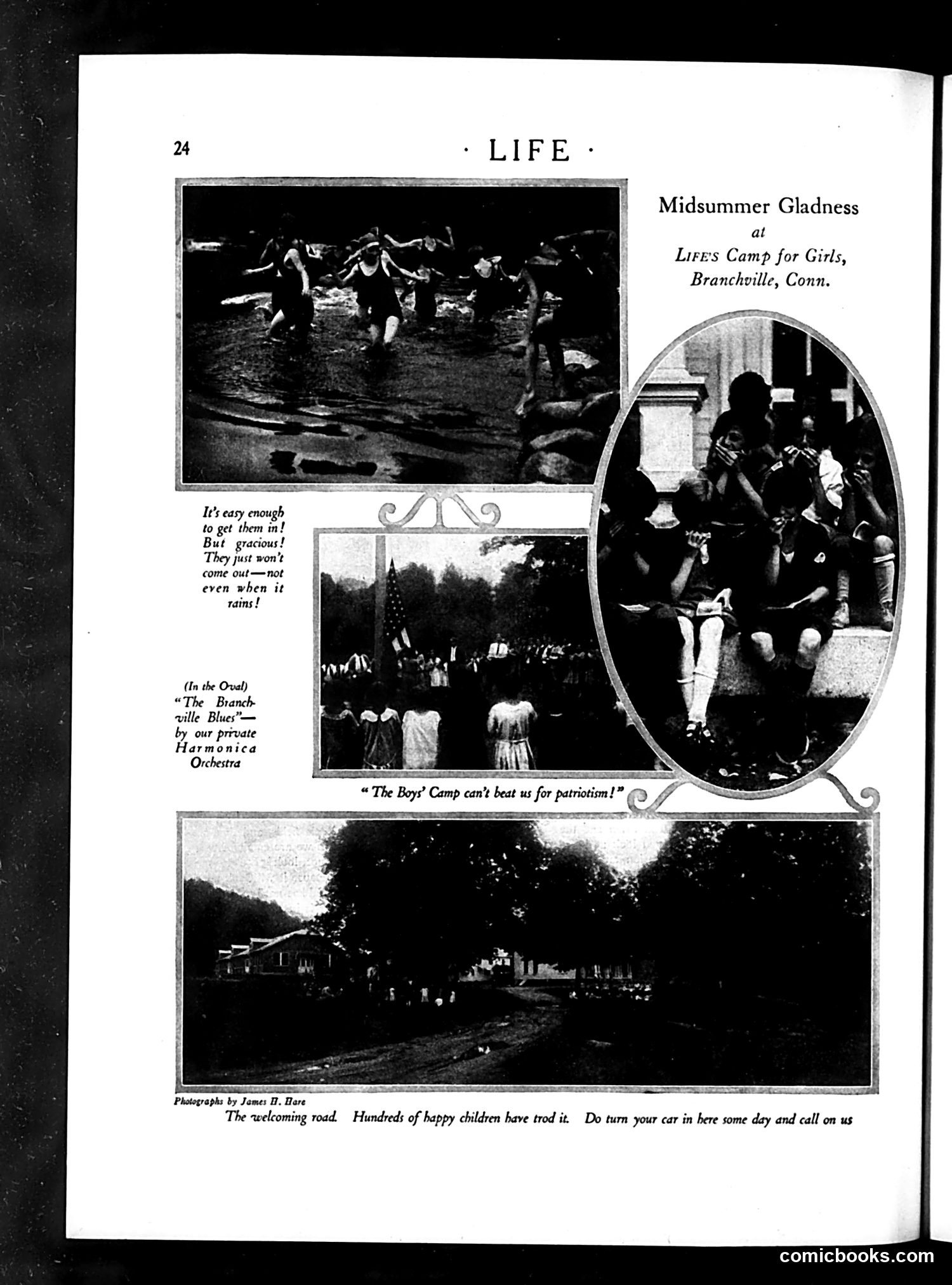
This is a promotional feature for Life's Camp for Girls in Branchville, Connecticut—not political satire, but gentle humor about summer camp culture. The page uses humorous captions to advertise the girls' camp. The joke is that girls are so enthusiastic about camp activities (shown in photos of swimming, outdoor gatherings, and indoor socializing) that they refuse to leave, even in rain. A competing "Boys' Camp" is mentioned playfully, with girls boasting their camp is more patriotic. The photographs by James H. Hare document typical camp scenes: water activities, what appears to be a patriotic gathering or flag ceremony, girls socializing indoors, and the camp's welcoming entrance road. This represents early-20th-century American recreational culture—organized summer camps as fashionable institutions for children. The patriotic reference likely reflects post-WWI American sentiment emphasizing youth development and civic virtue through organized activities.
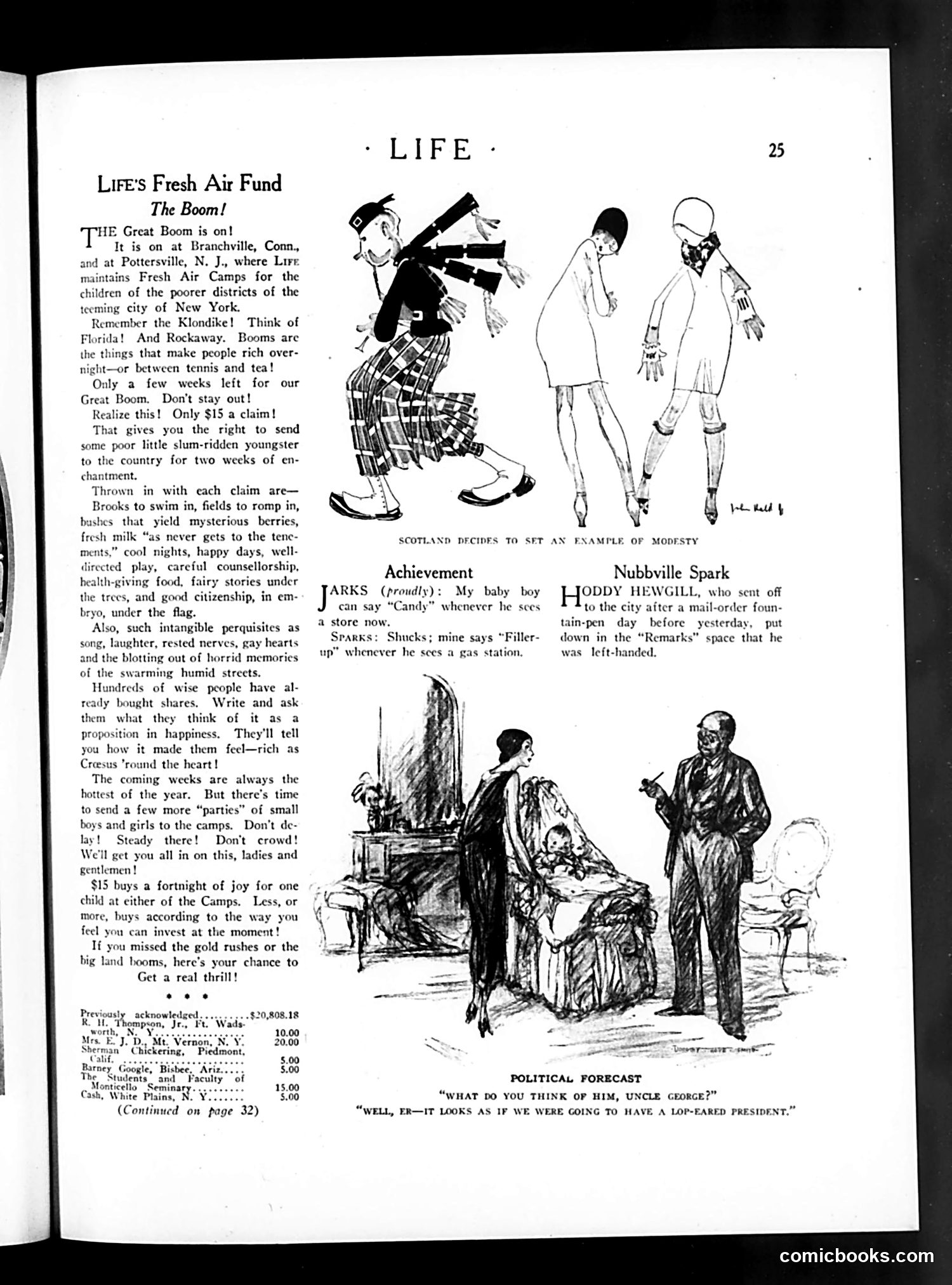
**Main Content: Fresh Air Fund Appeal** Life magazine is promoting its charitable "Fresh Air Fund," which sends poor New York City children to summer camps in rural Connecticut and New Jersey. The appeal uses "Boom" language (evoking gold rushes and Florida land speculation) to encourage readers to "invest" $15 to sponsor a child's two-week country vacation. This is genuine philanthropy wrapped in period marketing language. **Cartoons:** 1. **"Scotland Decides to Set an Example of Modesty"** (top): Scottish figures in kilts appear embarrassed about their traditional dress, suggesting European modesty standards versus American excess—likely commentary on American materialism during the prosperous 1920s. 2. **"Political Forecast"** (bottom): An adult and child discuss a political figure, with the adult concluding "we were going to have a lop-eared president." The caricature suggests ridicule of a specific politician's appearance, though the identity isn't definitively stated in visible text. The page mixes earnest charitable work with satirical social commentary typical of Life magazine's editorial approach.
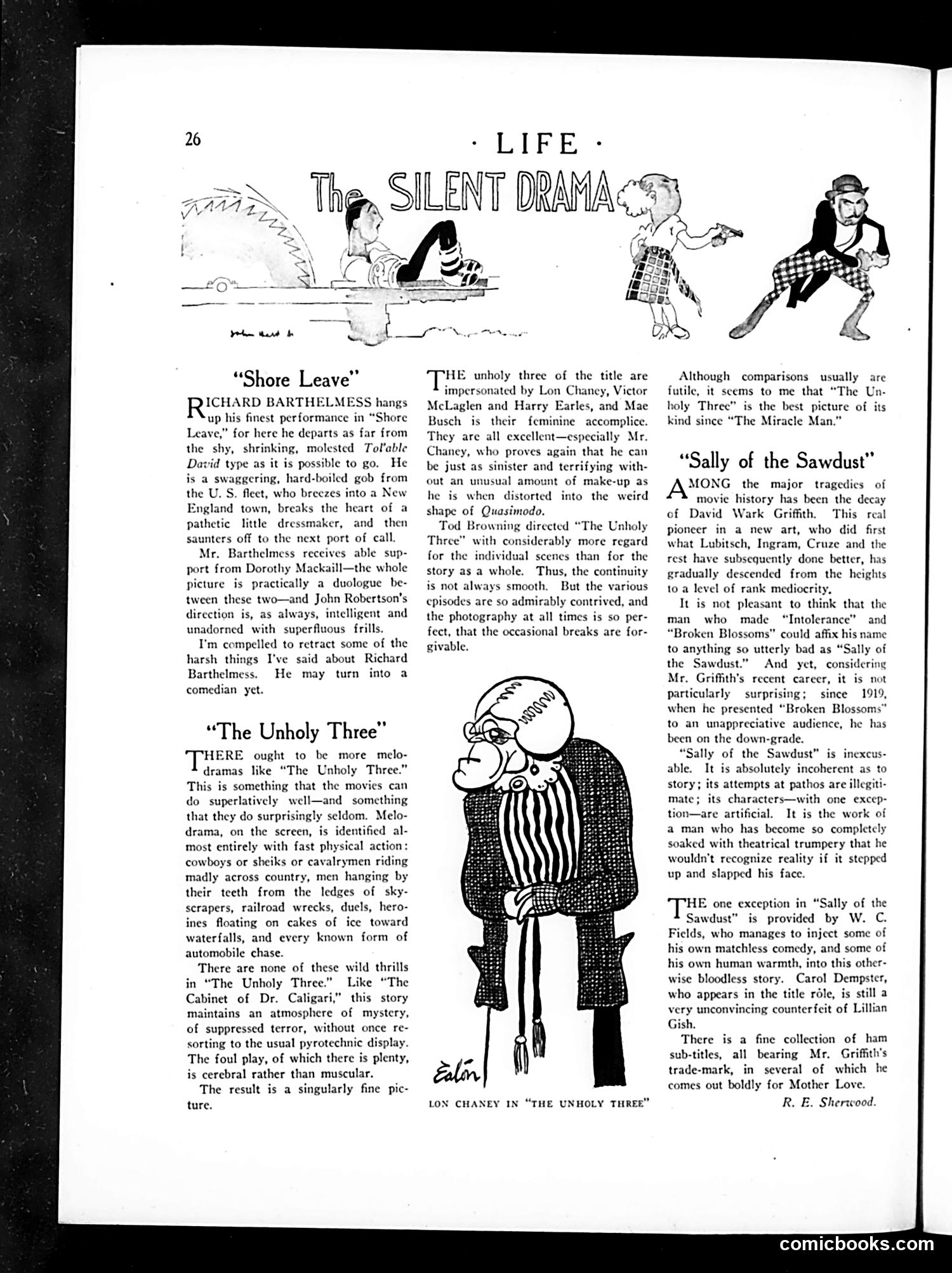
This page reviews three silent films. "Shore Leave" stars Richard Barthelmess as a cocky U.S. Navy sailor who seduces and abandons a small-town dressmaker—the reviewer grudgingly admits Barthelmess delivers a strong performance, even suggesting he might become a comedian. "The Unholy Three," directed by Tod Browning and starring Lon Chaney, Victor McLaglen, and Harry Earles, is praised as superior melodrama emphasizing psychological suspense over physical action—contrasting favorably with typical chase-and-stunt spectacles. The reviewer compares it favorably to *Caligari*. "Sally of the Sawdust," directed by D.W. Griffith, receives harsh criticism. The reviewer laments Griffith's career decline since his masterpieces *Intolerance* and *Broken Blossoms* (pre-1919), calling this film incoherent and theatrically overwrought—though W.C. Fields provides the sole redeeming performance.
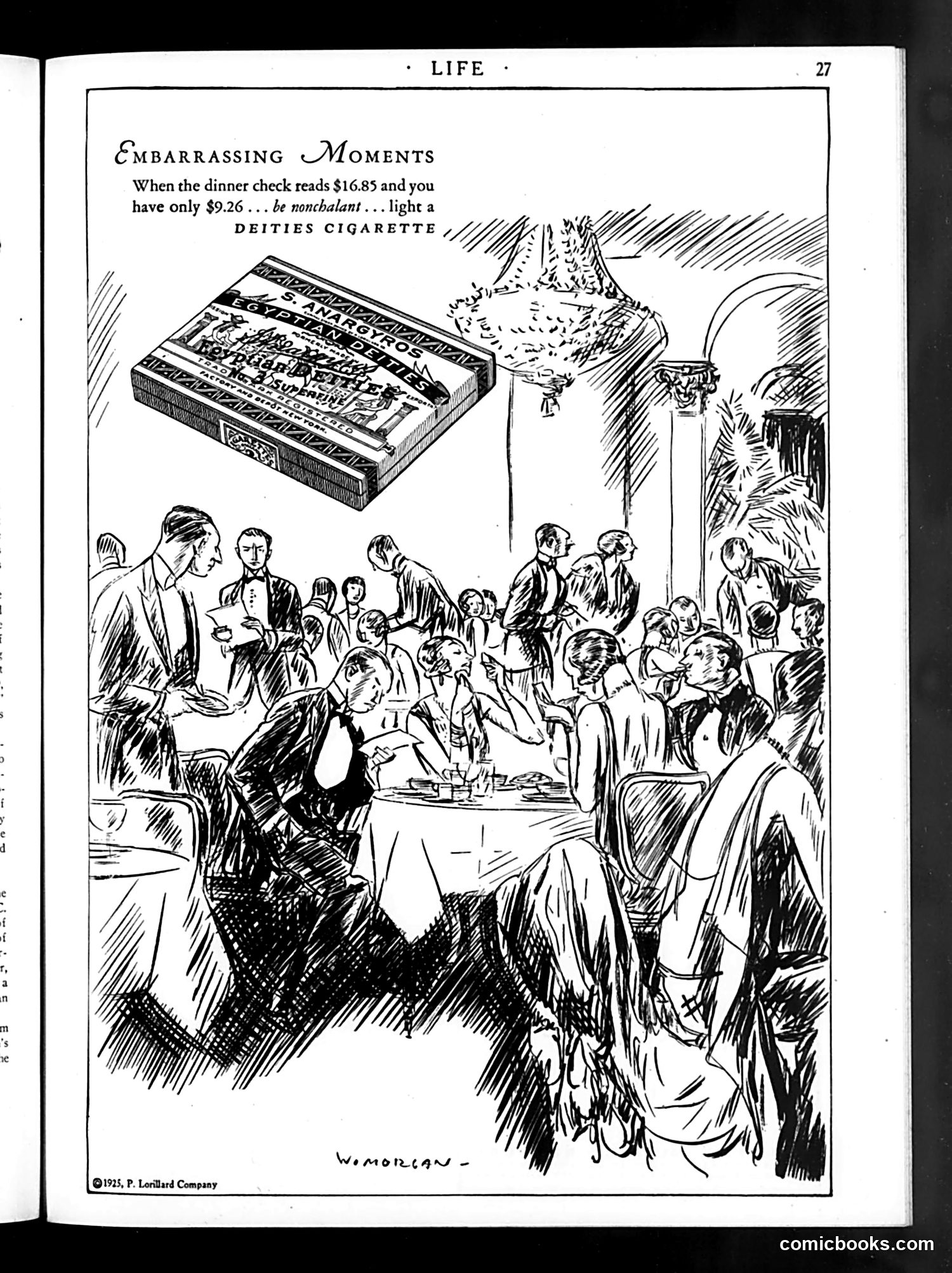
This is a single-panel cartoon satirizing an awkward social situation. The scene depicts a fancy dinner party where a man, having discovered the bill is $16.85 but possessing only $9.26, attempts to recover his dignity by lighting a Deities cigarette—presented as a sophisticated, nonchalant gesture to distract from his financial embarrassment. The humor relies on class anxiety: the man's pretense of casual elegance (smoking an expensive cigarette brand) masks his inability to pay the full bill. The cartoon mocks both the performative nature of upper-class etiquette and the anxiety of maintaining appearances despite financial shortfall. It's a Depression-era or post-war commentary on status consciousness and the gap between aspirations and means. The P. Lorillard Company credit indicates this functions as advertising disguised as editorial content.
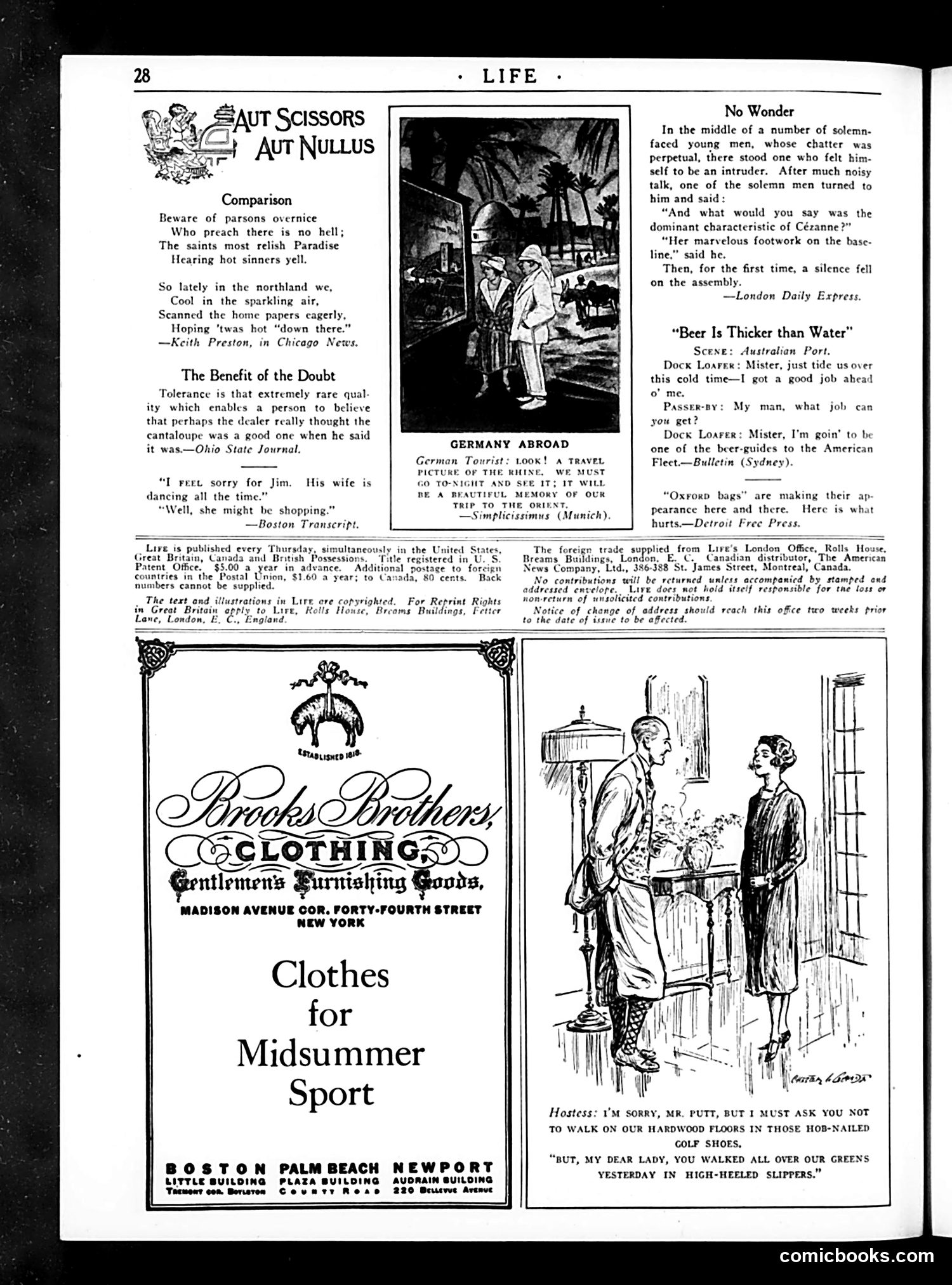
This page contains satirical humor pieces typical of Life's format. The main cartoons illustrate social ironies: **"Germany Abroad"** depicts a German tourist marveling at a Rhine landscape, mocking German tourists' earnest enthusiasm for scenic travel—a gentle jab at Germanic cultural stereotypes. **"Beer Is Thicker than Water"** shows Australian dock workers using kinship with Americans to cadge money, exploiting supposed Anglo-Saxon solidarity. The humor lies in the opportunistic appeal to shared heritage. **The Golf Shoe Exchange** presents a hostess-guest confrontation where both parties point out the other's hypocrisy: she complained about his hobnailed golf shoes damaging her hardwood floors, but she wore high heels on his grass. It's mutual social criticism wrapped in etiquette. The page's poetry and short quips ("Aut Scissors, Aut Nullus") mock various pretensions—religious hypocrisy, art world pretension, and romantic clichés. The Brooks Brothers advertisement occupies the lower half, typical of Life's advertising model.
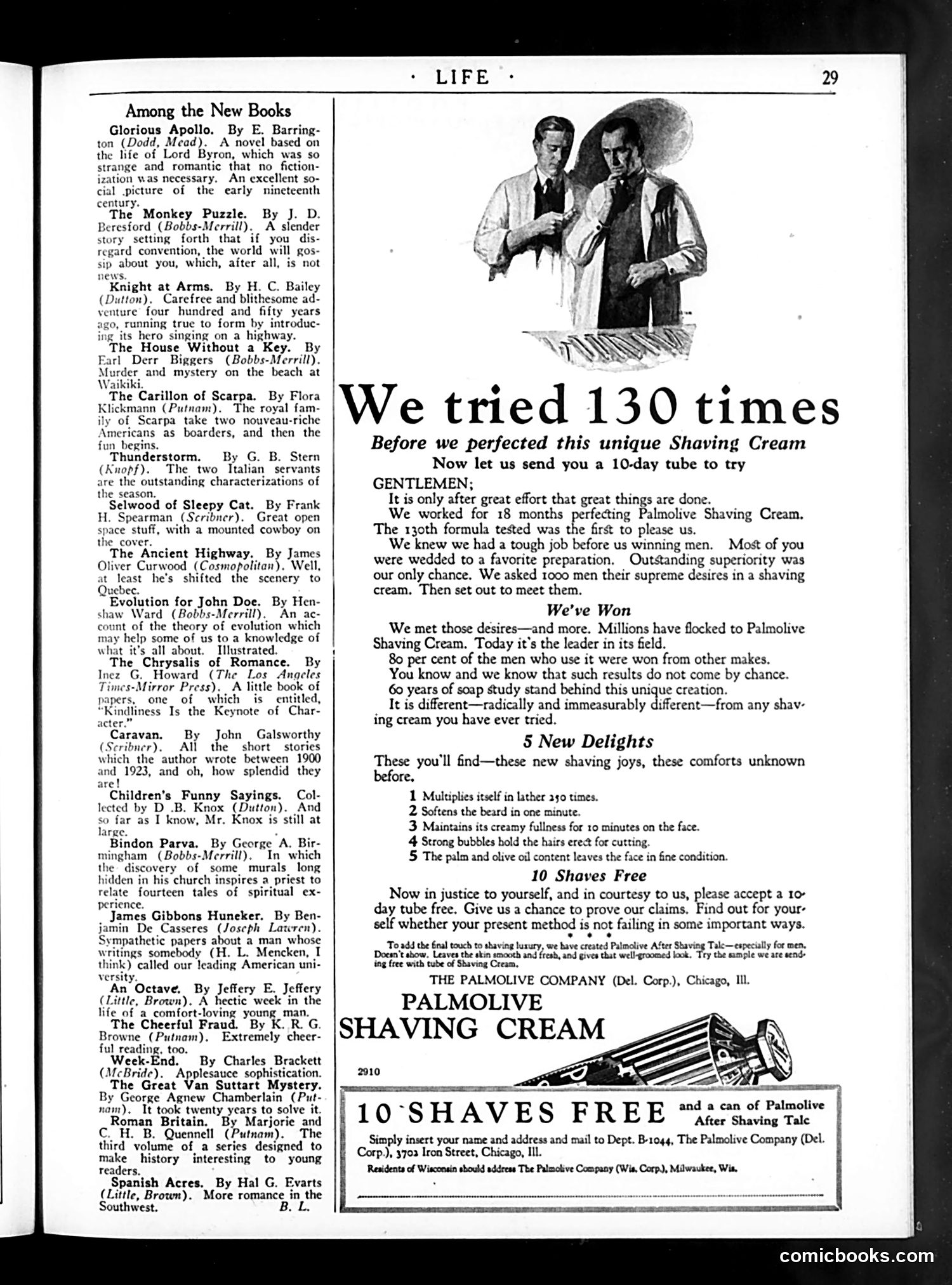
This page consists primarily of **book reviews** (left column) and a **Palmolive Shaving Cream advertisement** (right side). There is no political cartoon. The book reviews are brief, witty capsule summaries of contemporary 1920s literature—novels about Lord Byron, mysteries, romance, and adventure tales. The tone is satirical and irreverent; for example, one review notes a book about ignoring convention teaches readers "what it's all about" as if this were obvious. The advertisement uses a humorous framing device: claiming the company tested the formula "130 times" before perfecting it. This appears designed to appeal to masculine pride and skepticism—the ad addresses men directly, acknowledges they're "wedded" to competing products, and promises this cream meets their actual desires. The illustration shows two men in conversation, likely representing the typical male consumer. The page reflects 1920s consumer advertising tactics: pseudo-scientific claims, appeals to exclusivity and superiority, and free samples to convert skeptics.
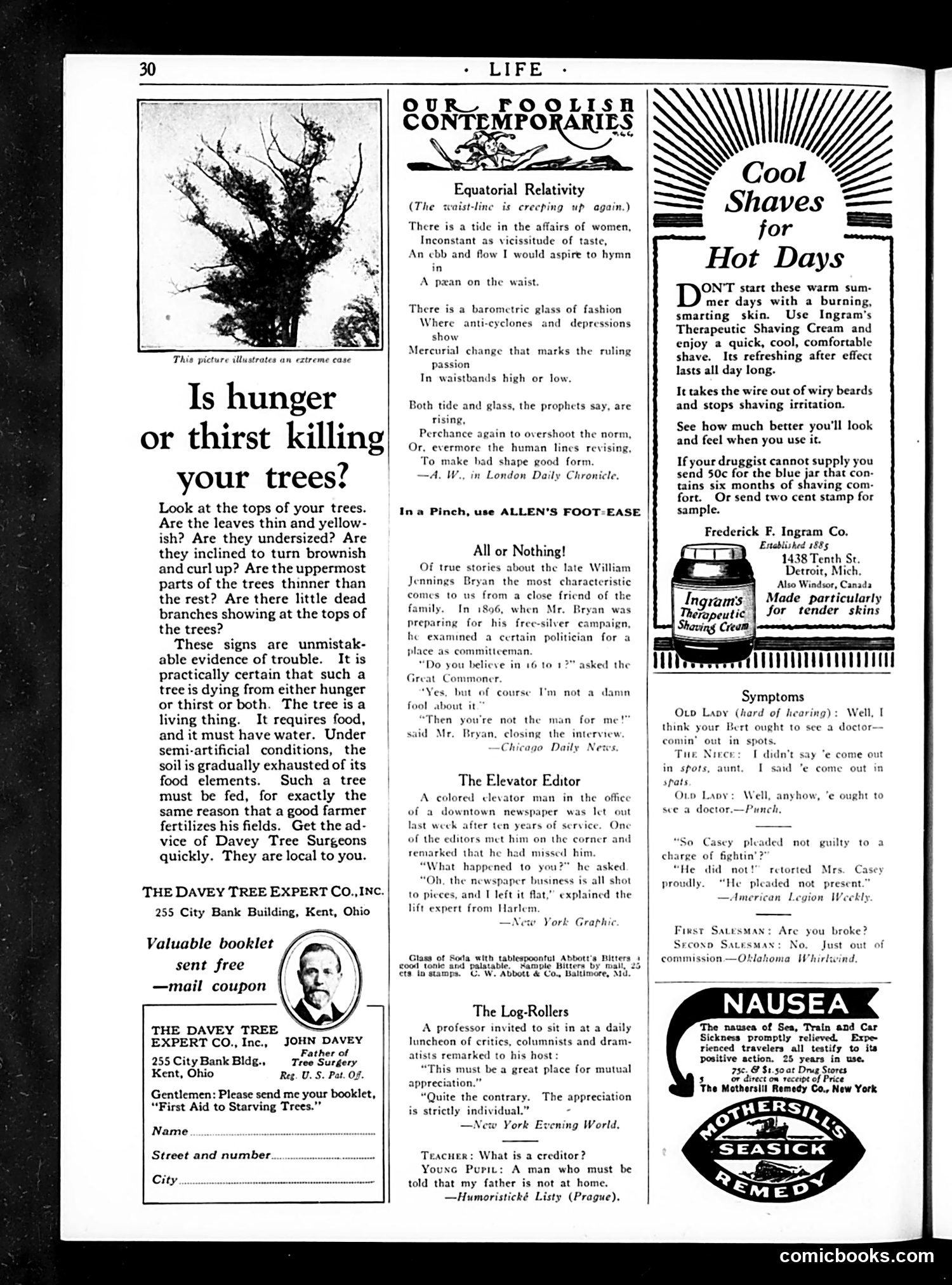
This page is primarily **advertising and humor content** rather than political cartooning. The main elements are: **Left side:** A tree-care advertisement from the Davey Tree Expert Company, using a diseased tree photograph to warn about trees dying from malnutrition or thirst—a straightforward commercial appeal with a mail-in coupon. **Center:** A section titled "Our Foolish Contemporaries" collecting humorous anecdotes and poems from various newspapers. These include light social satire: a poem about women's waistline fashions rising and falling, anecdotes about William Jennings Bryan's strict political orthodoxy, an elevator operator losing his job, and a professor's dry observation about mutual back-scratching among critics. **Right side:** Advertisements for Ingram's shaving cream and Mothersill's seasickness remedy. The humor is gentle and topical rather than pointed—mostly poking fun at social foibles, fashion trends, and journalistic pretension. Nothing here requires substantial historical context beyond recognizing Bryan as a famous political figure.
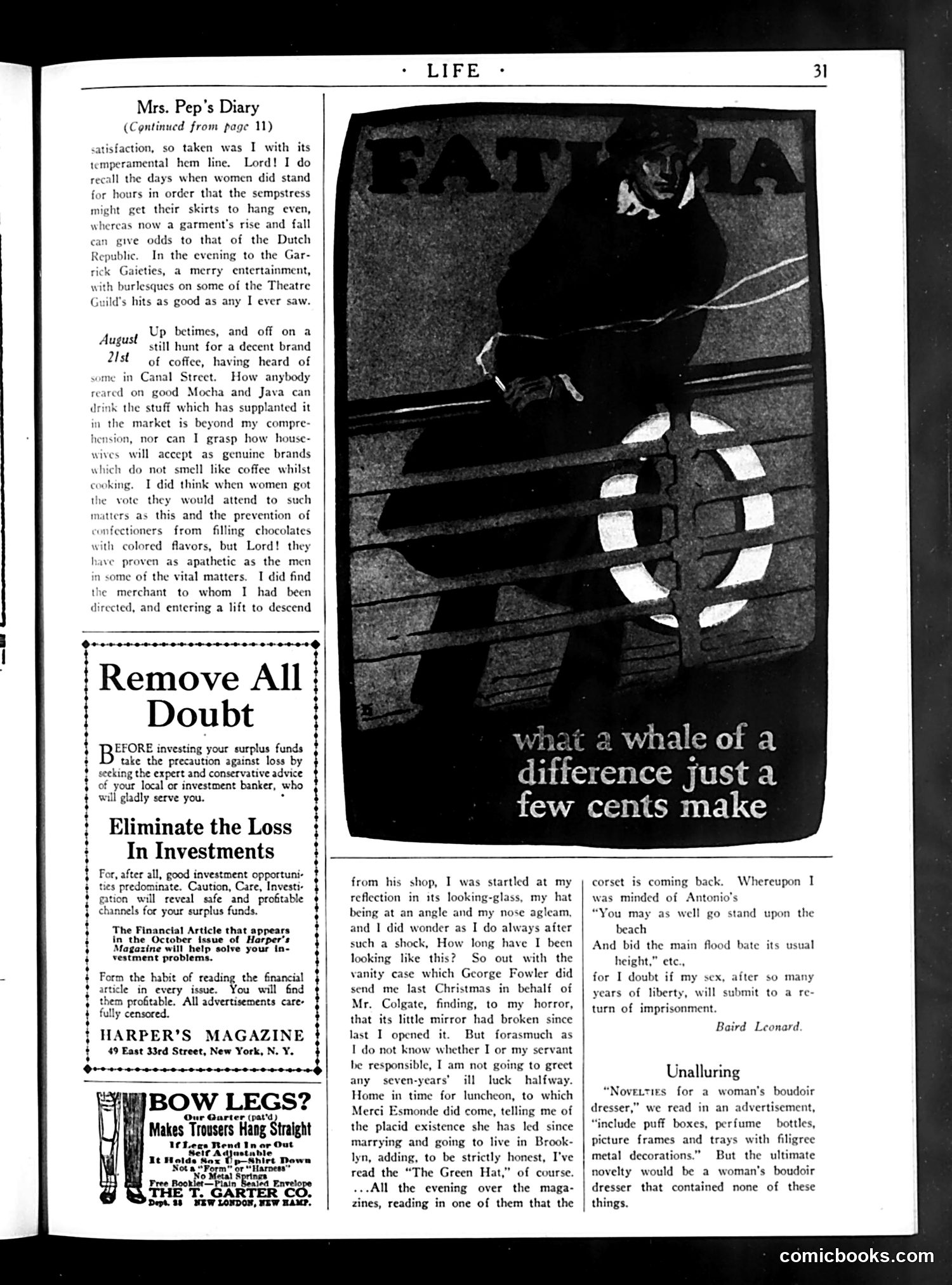
This page combines satirical diary entries with advertisements and commentary on 1920s women's issues. **Mrs. Pep's Diary** is a serialized humor column mocking upper-class female concerns. The August 21st entry satirizes women's apathy toward substantive reform: the diarist notes that despite gaining voting rights, women remain indifferent to important matters like coffee quality and chocolate adulteration, proving "as apathetic as the men." **The cartoon image** (top right) shows a woman examining her reflection, captioned "What a whale of a difference just a few cents make"—likely advertising cosmetics or personal grooming products by emphasizing minor improvements in appearance. **Bottom section** continues the diary's satirical tone, mocking women's vanity and fashion cycles, particularly the anticipated return of restrictive corsets. The final "Unalluring" blurb jokes that ideal boudoir furniture would contain *nothing*—poking fun at decorative excess. The surrounding advertisements (investment advice, Harper's Magazine, leg-straightening devices) represent the magazine's commercial interests alongside its social commentary.
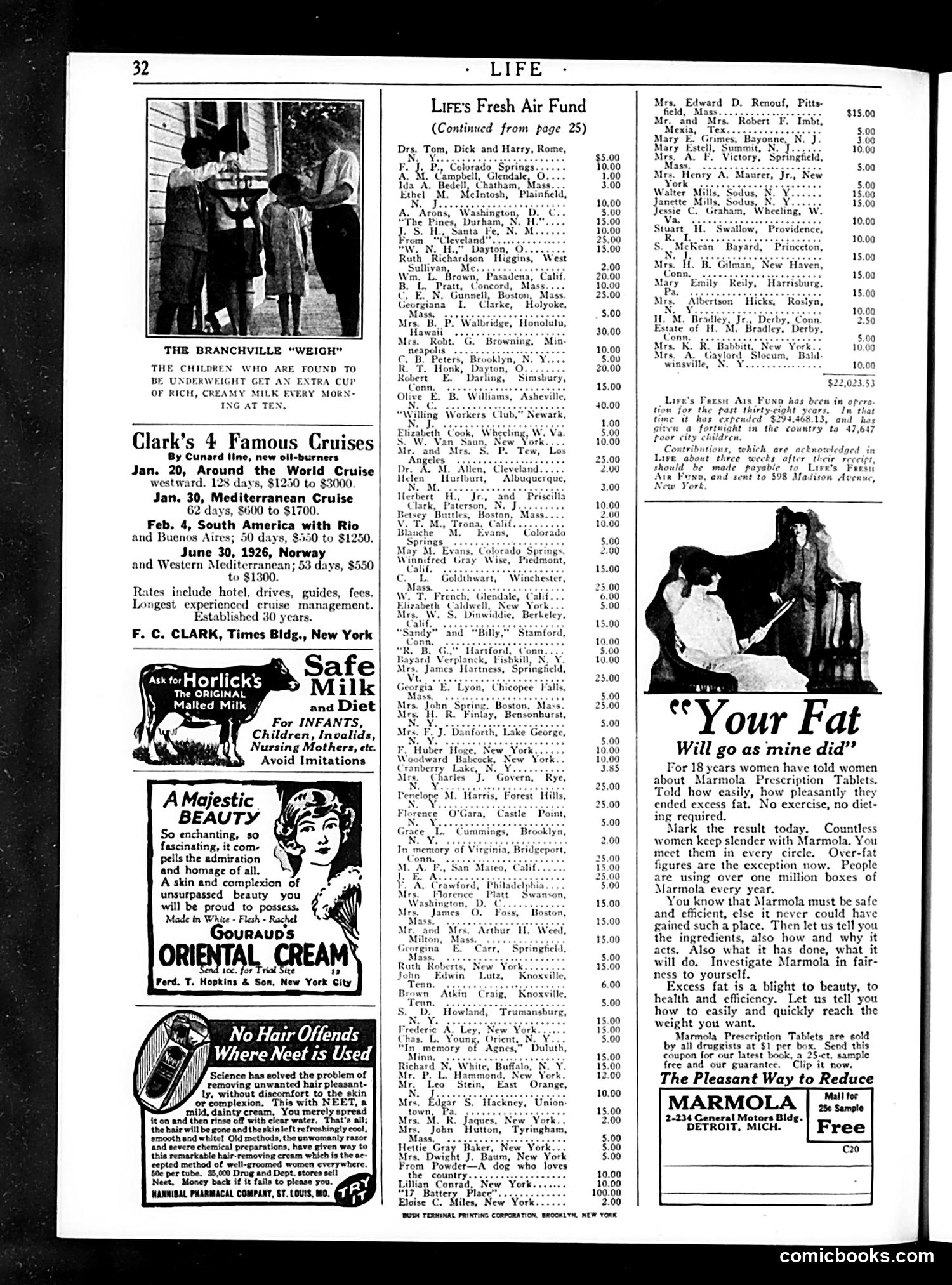
This page is primarily **advertising and charitable giving records**, not editorial content or satire. The main feature is "Life's Fresh Air Fund" (continued from previous page)—a charitable program that has operated for 38 years, providing countryside retreats to poor city children. The page lists donors' names and contribution amounts ($2-$25), totaling over $22,000 raised. The photograph captioned "The Branchville 'Weigh'" shows children being weighed to identify underweight cases who receive extra milk rations—documenting the Fund's welfare work. The surrounding advertisements promote cruises, malted milk products, beauty creams, and hair removal—typical 1920s consumer goods targeting women. These ads reflect period concerns about appearance and health supplements. There is **no political satire or editorial cartoon** on this page. It functions as a public service announcement combined with commercial advertising, characteristic of Life's dual role as both satirical magazine and advertising vehicle.
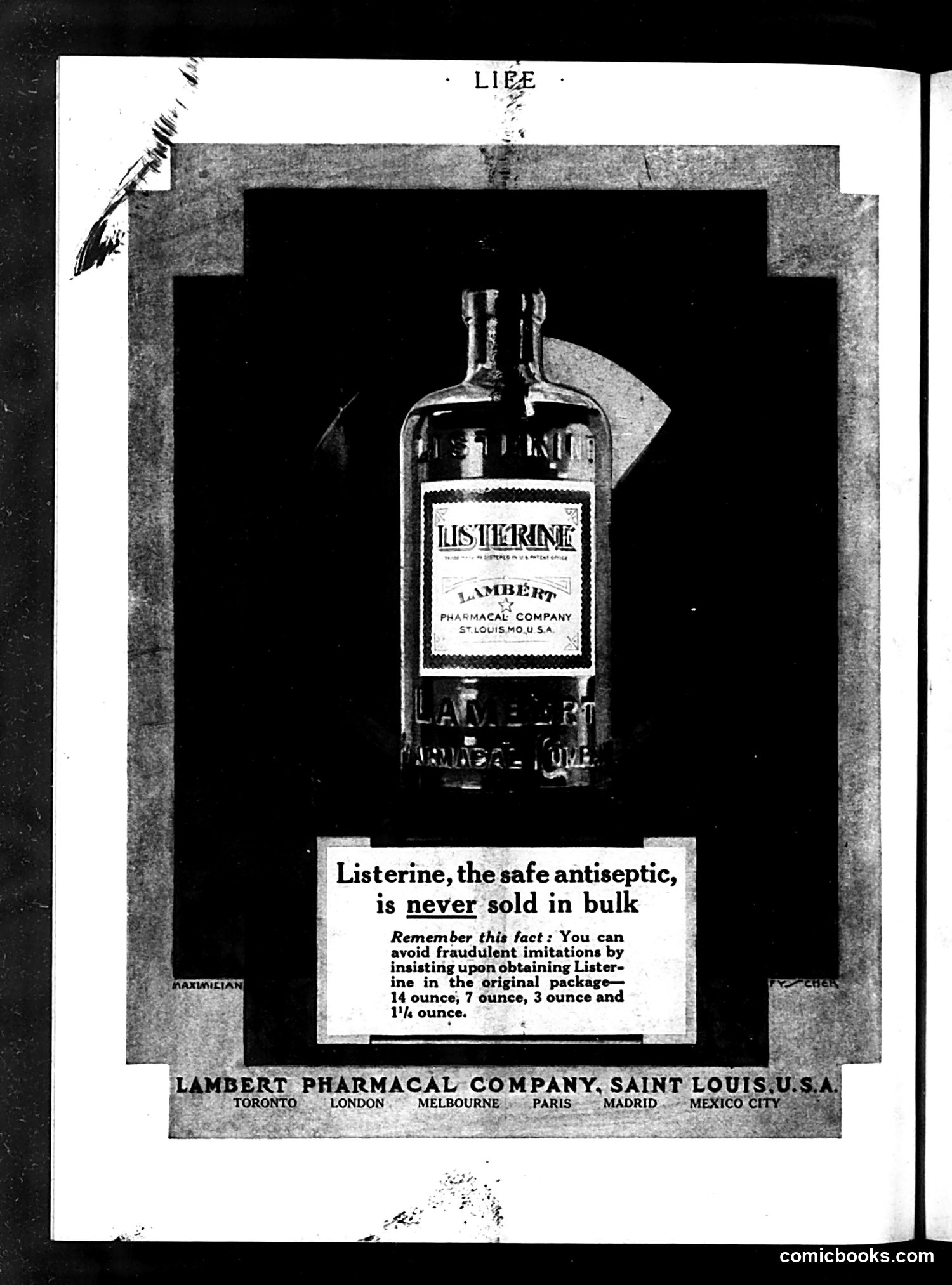
This page is **not a cartoon or satire** — it's a **vintage advertisement** for Listerine antiseptic mouthwash by the Lambert Pharmacal Company (Saint Louis, USA), circa early 20th century. The ad features a product photograph of a Listerine bottle and serves a practical consumer-protection function: warning buyers against counterfeit imitations by emphasizing that genuine Listerine comes only in specific original packaging sizes (14 ounce, 7 ounce, 3 ounce, and 1½ ounce). The company lists international offices (Toronto, London, Melbourne, Paris, Madrid, Mexico City), indicating Listerine's global reach. This reflects a historical period when product counterfeiting was common and trademark protection was important for establishing brand authenticity and consumer trust.