
Life, 1925-08-27 · page 16 of 36
Life — August 27, 1925 — page 16: what you’re looking at
What you’re looking at
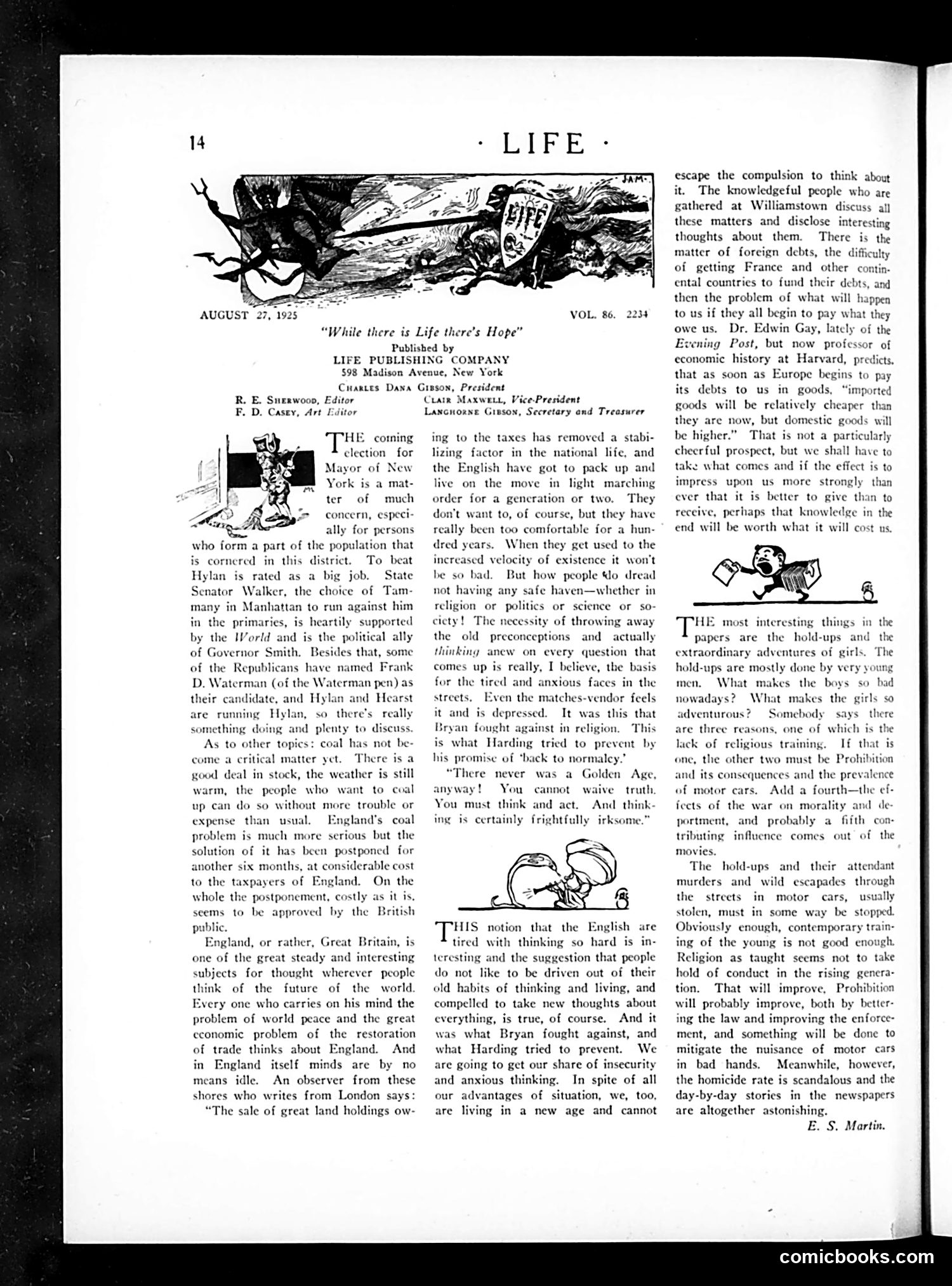
This page contains editorial commentary on the 1925 New York mayoral election. The text discusses concerns about candidate selection, mentioning State Senator Walker as the choice of Tammany Hall, and Frank D. Waterman and others as Republican alternatives. The main satirical point targets the English and their "hard thinking"—the article mocks the notion that the English are naturally thoughtful people who resist new ideas. It argues this belief is itself flawed, and that in reality, people across societies struggle with accepting change and new thinking. The small cartoon illustrations appear to punctuate these arguments but are too small to read clearly. The piece, signed by E.S. Martin, criticizes cultural stereotypes while discussing contemporary American political anxieties about corruption and governance.
📄 Transcribed text from this page (OCR, searchable)
Machine-transcribed from the original scan — historical spelling and the odd misread are preserved.
VOL. 86. 2234 “While there is Life there’s Hope” Published by LIFE PUBLISHING COMPANY $98 Madison Avenue, New York Cutantes Dana Gisson, President R. E. Sugawoon, Editor F. D. Casey, Art Editor HE coming election for Mayor of New 4 York is a mat- Vy ter of much concern, espe > 2 ue ally for persons who form a part of the population that is cornered in this district. To beat Hylan is rated as a big job. State Senator Walker, the choice of Tam- many in Manhattan to run against him in the primaries, is heartily supported by the World and is the political ally of Governor Smith. Besides that, some of the Republicans have named Frank D. Waterman (of the Waterman pen) as their candidate, and Hylan and Hearst are running Hylan, so there's really something doing and plenty to discuss As to other topics: coal has not be- come a critical matter yet. good deal in stock, the weather is still warm, the people who want to coal up can do so without more trouble or expense than England's coal problem is much more serious but the solution of it has been postponed for There is a usual. another six months, at considerable cost to the gland. On the whole the postponement, costly as it is. to be approved by the British taxpayers of seems public. Sngland, or rather, Great Britain, is of the great steady and interesting subjects for thought wherever people think of the future of the world Every one who carries on his mind the problem of world peace and the great economic problem of the restoration of trade thinks about England. And in England itself minds are by no means idle. An observer from these shores who writes from London says: “The sale of great land holdings ow- Cian Maxwett, Vice-President Lancnoane Gipson, Secretary ond Treasurer ing to the taxes has removed a stabi- lizing factor in the national life, and the English have got to pack up and live on the move in light: marching order for a generation or two. They don’t want to, of course, but they have really been too comfortable for a hun- When they get used to the increased velocity of existence it won't dred years, be so bad. But how people lo dread not having any safe haven—whether in religion or politics or sci ! nce OF so- cic the think The necessity of throwing away old preconceptions and anew on every question that comes up is really, I believe, the basis actually for the tired and anxious faces in the streets. Even the matches-vendor feels it and is depressed. It was this that inst in religion. This is what Harding tried to prevent. by his promise of ‘back to normalcy.” “There never anyway! You You must think ing is certainly fr Bryan fought a: was a Golden Age, cannot waive truth nd act. And think- tfully irksome.” HIS notion that the glish are tired with thinking so hard is in- teresting and the suggestion that people do not like to be driven out of their old habits of thinking and living, and compelled to take new thoughts about everything, is true, of course. And it was what Bryan fought against, and what Harding tried to prevent. We are going to get our share of insecurity and anxious thinking. In spite of all our advantages of situation, we, too, are living in a new age and cannot escape the compulsion to think about it. The knowledgeful people who are gathered at Williamstown discuss all these matters and disclose interesting thoughts about them. There is the matter of foreign debts, the difficulty of getting France and other cor ental countries to fund their debts, a then the problem of what will happen to us if they all begin to pay what they owe us. Dr. Edwin Gay, lately of the Evening Post, but now professor of economic history at Harvard, predicts, that as soon as Europe begins to pay its debts to us in goods, “imported goods will be relatively cheaper than they are now, but domestic goods will be higher.” That is not a particularly cheerful prospect, but we shall have to take what comes and if the effect is to impress upon us more strongly than ever that it is better to give than to receive, perhaps that knowledge in the end will be worth what it will cost us. THE most interesting things in the papers are the hold-ups and the extraordinary adventures of girls, The hold-ups are mostly done by very young What makes the boys so bad nowadays? What makes the girls so men, adventurous? Somebody there are three reasons, one of which is the lack of religious training. If that is one, the other two must be Prohibition says and its consequences and the prevalence of motor c: Add a fourth—the ef- fects of the war on morality portment, and probably fifth tributing and de con- influence comes out of the movies. The hold-ups and = their attendant murders and wild escapades through the streets in) motor usually stolen, must in some way be stopped. Obviously enough, contemporary train- ing of the young is not good enough. Religion as taught seems not to take hold of conduct in the rising genera- tion. That will improve, Prohibition will probably improve, both by better- ing the law and improving the enforce- ment, and something will be done to mitigate the nuisance of motor cars in bad hands. Meanwhile, however, the homicide rate is scandalous and the day-by-day stories in the newspapers are altogether astonishing. E. S. Martin. cars, comicbooks.com