
Life, 1925-08-27 · page 20 of 36
Life — August 27, 1925 — page 20: what you’re looking at
What you’re looking at
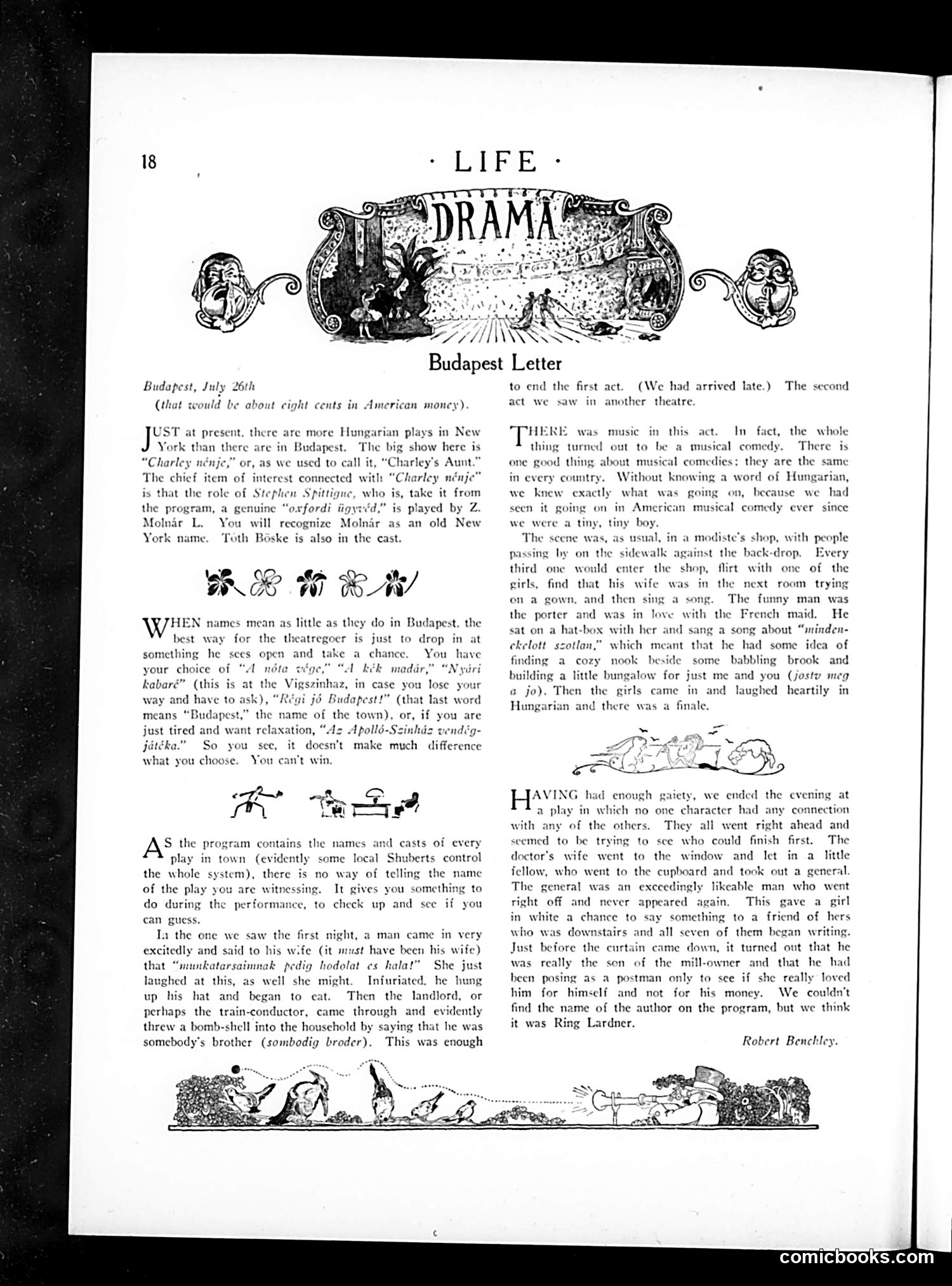
This is a humorous travel letter from Budapest by Robert Benchley, reviewing Hungarian theatrical productions. The piece satirizes the absurdity of experiencing foreign plays without understanding the language. Benchley notes the irony that more Hungarian plays run in New York than Budapest itself. He describes attending shows featuring obscure Hungarian titles and unfamiliar actors, emphasizing that without Hungarian fluency, audiences cannot distinguish one play from another—yet the plots are universally recognizable musical comedy tropes (mistaken identities, romantic entanglements in modiste shops, comic porters). The humor centers on how theater transcends language: the familiar conventions of musical comedy—flirtation, wives discovering husbands, servants in love—require no translation. Benchley mocks the formulaic nature of such entertainment, where chaotic plots climax with improbable revelations (a postman revealed as a mill-owner's son), making language irrelevant to the absurdity. The piece gently satirizes both Hungarian theatrical conventions and the universal predictability of commercial stage comedy.
📄 Transcribed text from this page (OCR, searchable)
Machine-transcribed from the original scan — historical spelling and the odd misread are preserved.
7 7 //1\\W SS ~~ Budapest Letter Budapest, July 26th (that would be about cight cents in American mone. UST at present. there are more Hungarian plays in New York than there are in Budapest. The big show here is “Charley nénj Charley’s Aunt.” The chief item of interest connected with “Charley nénje” is that the role of Stephen Spittigue, who is, take it from the program, a genuine “oxfordi jigytd,” is played by 2 Molnar L. You will recognize Molnar an old New York name. Toth Béske is also in the cast. ” or, as we used to call it, ae OF WRAY V HEN names mean as little as they do in Budapest, the best way for the atregoer is just to drop in at something he sces open and take your choice of “A néta vége,” k kabaré” (this is at the way and have to ask), “Régi j6 Budapest!” (that last word chance. Vigszinhaz, in case you lose your means “Budapest,” the name of the town), of, if you are Apollé-Szinhds ver just tired and want relaxation, ‘ n’t_make much difference jatéka.” D you see, d what you choose. You can't win. ins the names and casts of every play in town (evidently some local Shuberts control the whole system), there is no way of telling the name of the play y ¢ witnessing. It gives you somethi do during the perforn to check up and sce can guess. Ta the one we saw the first night, excitedly and said to his wife (it must have been his wife) that “munkatarsaimnak pedig hodolat es hala!” She just laughed at this, as well she might. Infuriated. he hung up his hat a to eat. Then the landlord, or perhaps the train-conductor, came through and evidently threw a bomb-shell into the household by saying that he was somebody's brother (sombodig broder), This was enough a man came in very to end the first act. (We had arrived late.) The second act we saw in another theatre. "THERE was music in this act. In fact, the whole a musical comedy. There is they are the same thing turned out to be one good thing about musical comedies : in every country. Without knowing a word of Hungarian, we knew what was going on, because we had sical comedy ever since exactly seen it going on in American we were a tiny, tiny boy, The scene was, as usual, in a modiste’s shop, with people st the back-drop. Every third one would enter the shop, flirt. with of the passing by on the sidewalk a girls, find that his wife was in the next room trying on a gown, and then sing a song. The funny man was the porter and was in love with the French maid. He sat on a hat-box with her and sang a song about “minden- lott ssotlan,” which meant that he had some idea of finding a brook and building a little bungalow for just me you (josty meg @ jo). Then the girls came in and laughed heartily in Hungaria y, we ended the evening at y in which no one character had any connection of the others. They all went right ahead and scemed to be trying to sce who could finish first. The doctor's wife went to the window and let in a little cozy nook beside some babbling and there was a finale. ~ ine ad enough gai fellow, who went to the cupboard and te out a general The general was an exceedingly likeable man who went right off and never appeared aga This gave a girl in white a chance to say something to a friend of hers who w all seven of them be; i Just before the curtain came down, it turned out that he was really the sen of the mill-owner and that he had been posing as a postman only to see if she really loved him for himself and not for his mone: We couldn't find the name of the author on the program, but we think it was Ring Lardner. downstairs a Robert Benchley. comicbooks.com