
Life, 1925-08-27 · page 28 of 36
Life — August 27, 1925 — page 28: what you’re looking at
What you’re looking at
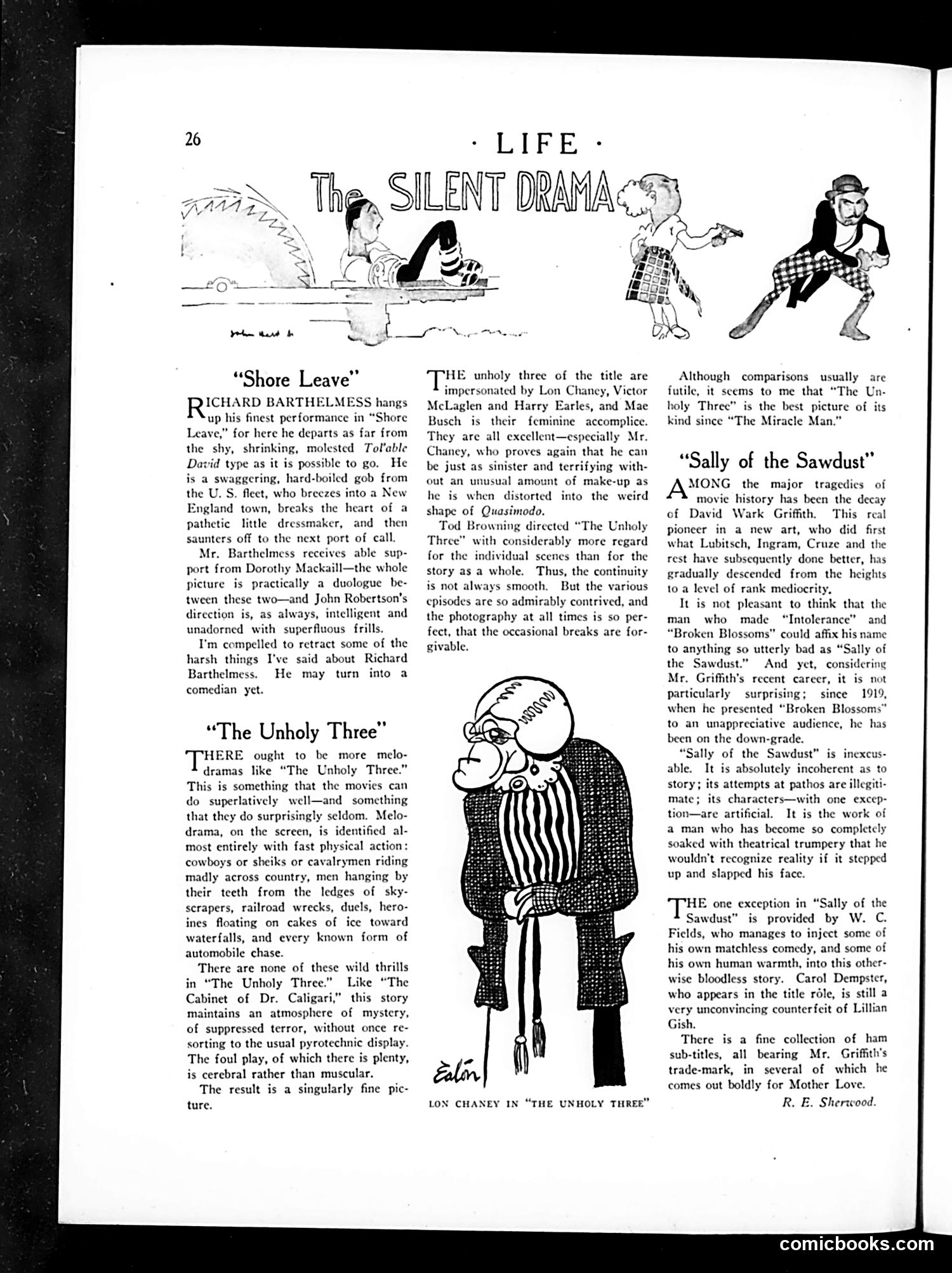
This page reviews three silent films. "Shore Leave" stars Richard Barthelmess as a cocky U.S. Navy sailor who seduces and abandons a small-town dressmaker—the reviewer grudgingly admits Barthelmess delivers a strong performance, even suggesting he might become a comedian. "The Unholy Three," directed by Tod Browning and starring Lon Chaney, Victor McLaglen, and Harry Earles, is praised as superior melodrama emphasizing psychological suspense over physical action—contrasting favorably with typical chase-and-stunt spectacles. The reviewer compares it favorably to *Caligari*. "Sally of the Sawdust," directed by D.W. Griffith, receives harsh criticism. The reviewer laments Griffith's career decline since his masterpieces *Intolerance* and *Broken Blossoms* (pre-1919), calling this film incoherent and theatrically overwrought—though W.C. Fields provides the sole redeeming performance.
📄 Transcribed text from this page (OCR, searchable)
Machine-transcribed from the original scan — historical spelling and the odd misread are preserved.
“Shore Leave” ICHARD BARTHELMESS hangs up his finest performance in “Shore Leave,” for here he departs as far from the shy, shrinking, molested Tol’able David type as it is possible to go. He is a swaggering, hard-boiled gob from the U. S. fleet, who breezes into a New England town, breaks the heart of a pathetic little dressmaker, and then saunters off to the next port of call, Mr. Barthelmess receives able sup- port from Dorothy Mackaill—the whole picture is practically a duologue be tween these two—and John Robertson's direction is, as always, intelligent and unadorned with superfluous frills. I'm compelled to retract some of the harsh things I've said about Richard Barthelmess. He may turn into a comedian yet. “The Unholy Three” HERE ought to be more mek dramas like “The Unholy Three.” This is something that the movies can do superlatively well—and something that they do surprisingly seldom. Melo- drama, on the screen, is identified al- most entirely with fast physical action: cowboys or sheiks or cavalrymen riding madly across country, men hanging by their teeth from the ledges of sky- scrapers, railroad wrecks, duels, hero- ines floating on cakes of ice toward waterfalls, and every known form of automobile chase. There are none of these wild thrills in “The Unholy Three.” Like “The Cabinet of Dr. Caligari,” this story maintains an atmosphere of mystery, of suppressed terror, without once re- sorting to the usual pyrotechnic display. The foul play, of which there is plenty, is cerebral rather than muscular. The result is a singularly fine pic- ture, HE unholy three of the title are impersonated by Lon Chaney, Victor McLaglen and Harry Earles, and Mae Busch is their feminine accomplice. They are all excellent—especially Mr. Chaney, who proves again that he can be just as sinister and terrifying with- out an unusual amount of make-up as he is when distorted into the weird shape of Quasimodo. Tod Browning directed “The Unholy Three” with considerably more regard for the individual scenes than for the story as a whole. Thus, the continuity is not always smooth. But the various episodes are so admirably contrived, and the photography at all times is so per- fect, that the occasional breaks are for- givable. LON CHANEY “THE UNHOLY THREE” Although comparisons usually are futile, it seems to me that “The Un- holy Three” is the best picture of its kind since “The Miracle Man.” “Sally of the Sawdust” MONG the major tragedies of movie history has been the decay of David Wark Griffith. This real pioneer in a new art, who did first what Lubitsch, Ingram, Cruze and the rest have subsequently done better, has gradually descended from the heights to a level of rank mediocrity, It is not pleasant to think that the man who made “Intolerance” and “Broken Blossoms” could affix his name to anything so utterly bad as “Sally of the Sawdust.” And yet, considering Mr. Griffith's recent career, it is not particularly surprising; since 1919, when he presented “Broken Blossoms” to an unappreciative audience, he has been on the down-grade. “Sally of the Sawdust” is inexcus- able. It is absolutely incoherent as to story; its attempts at pathos are illegiti- mate; its characters—with one excep- tion—are artificial. It is the work of a man who has become so completely soaked with theatrical trumpery that he wouldn't recognize reality if it stepped up and slapped his face. THe one exception in “Sally of the Sawdust” is provided by W. C. Fields, who manages to inject some of his own matchless comedy, and some of his own human warmth, into this other- wise bloodless story. Carol Dempster, who appears in the title rdle, is still a very unconvincing counterfeit of Lillian Gish. There is a fine collection of ham sub-titles, all bearing Mr. Griffith's trade-mark, in several of which he comes out boldly for Mother Love. R. E. Sherwood. comicbooks.com