
A complete issue · 36 pages · 1925
Life — August 20, 1925
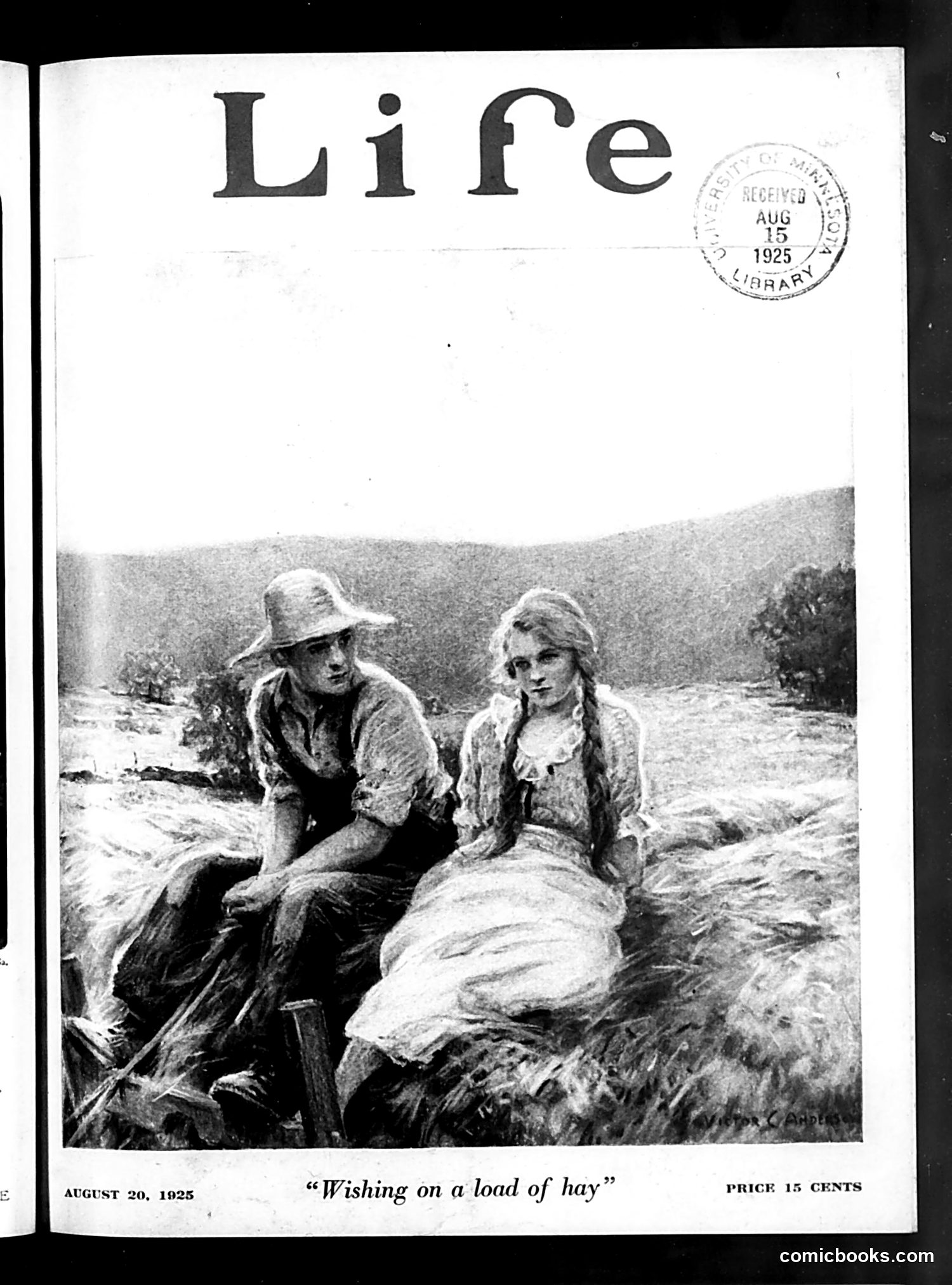
This cover depicts a rural scene titled "Wishing on a load of hay." The image shows a man and woman sitting together on hay in a countryside setting with hills in the background. The caption appears to reference a folk tradition or superstition about making wishes on hay loads. However, without additional context from the magazine's interior text or contemporary sources, the specific satirical point remains unclear. It may reference rural customs, courtship rituals, or romantic folk beliefs of the 1920s era. The photograph's composition—two figures in an intimate rural setting—suggests the humor likely involves either outdated country traditions or the contrast between rural and urban American life, common themes in Life's satirical commentary during this period.
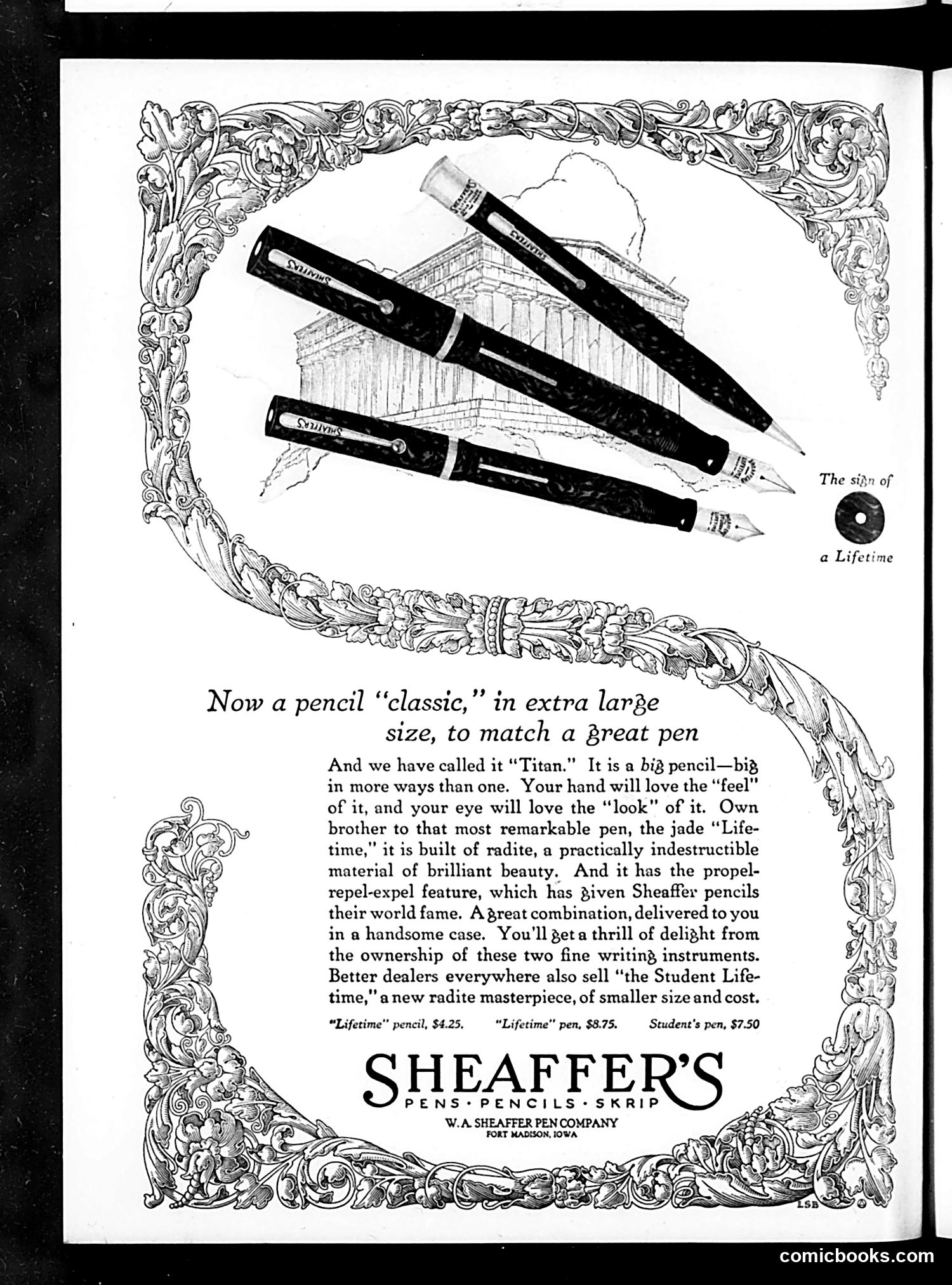
This is **not a cartoon or satire page** — it's a **straightforward advertisement** for Sheaffer writing instruments from the W.A. Sheaffer Pen Company (Fort Madison, Iowa). The ad promotes three products: the "Lifetime" pen ($8.75), the "Lifetime" pencil ($4.25) called "Titan" (described as an extra-large classic pencil), and a "Student Lifetime" pen ($7.50). The decorative ornamental border and formal layout are typical of early 20th-century advertising design. The text emphasizes the products' durability ("practically indestructible radite material") and aesthetic appeal. There is no political or social satire here — merely vintage commercial promotion for premium writing tools.
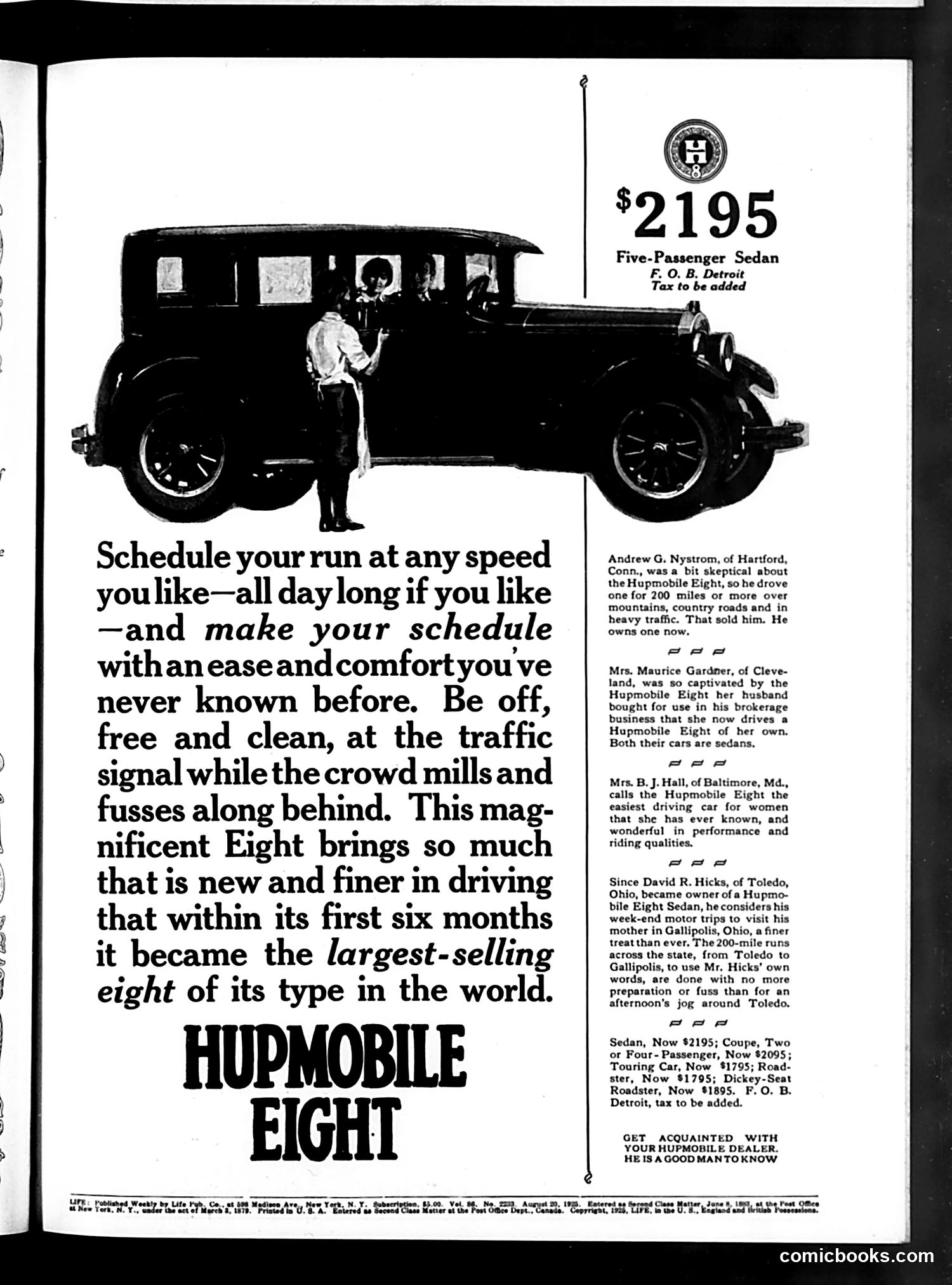
This is **not a political cartoon or satire** — it's a straightforward automobile advertisement from Life magazine. The page promotes the Hupmobile Eight, a five-passenger sedan priced at $2,195 (F.O.B. Detroit, tax additional). The ad emphasizes the car's ease of driving and comfort, claiming it became "the largest-selling eight of its type in the world" within six months of release. The right column includes customer testimonials from owners in Connecticut, Michigan, Ohio, and Toledo who praise the vehicle's performance and driving qualities. The silhouetted illustration shows a man standing beside the sedan, a typical advertising device of the era. This is straightforward 1920s-era automotive marketing, not satirical content.
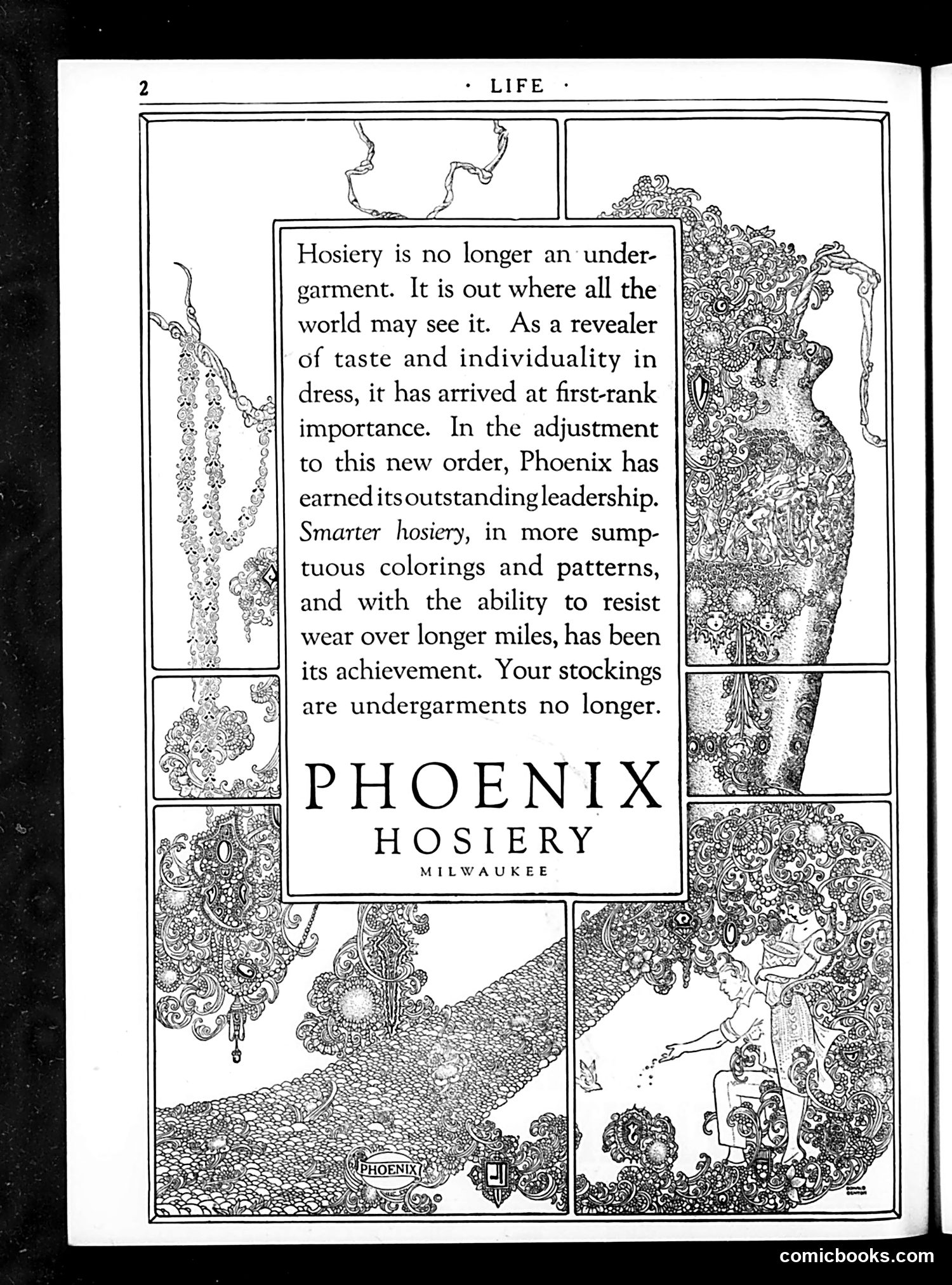
This is **not a cartoon or satire**, but rather a **straightforward advertisement** for Phoenix Hosiery from Milwaukee. The ad promotes a significant fashion shift: hosiery transitioning from hidden undergarment to visible fashion statement. The elaborate decorative illustrations surrounding the text showcase ornate stocking patterns and designs, emphasizing that stockings now display personal taste and individuality. The advertisement claims Phoenix leads this market trend, offering "smarter hosiery" in "sumptuous colorings and patterns" that are durable for "longer miles" of wear. The key message: stockings are fashion accessories deserving attention, no longer merely functional undergarments. This reflects early-to-mid twentieth-century fashion evolution when women's legs and stockings became increasingly visible and fashionable.
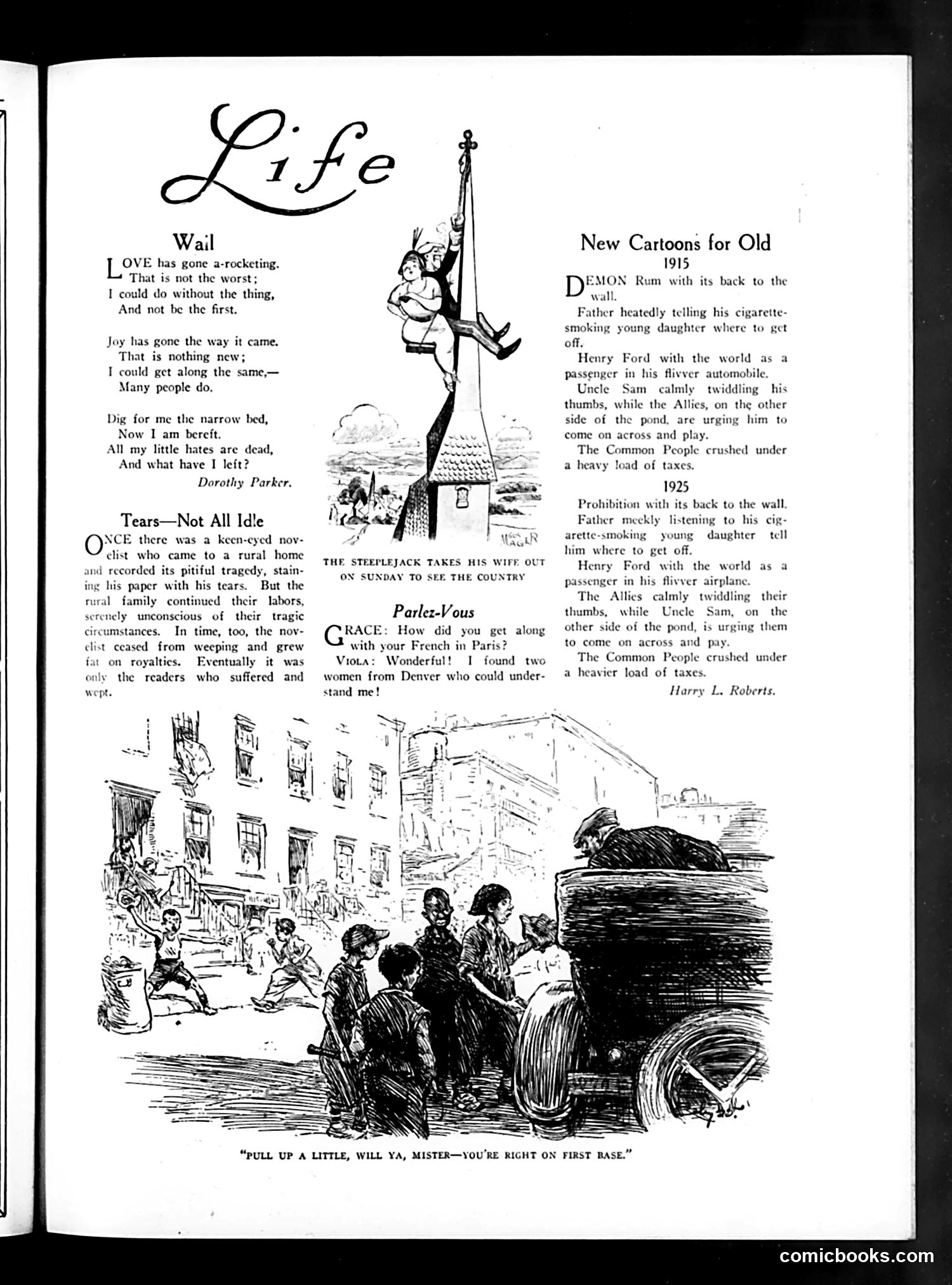
This page contains a poem "Wail" by Dorothy Parker lamenting lost love and joy, followed by "Tears—Not All Idle," a story about a newspaper's documentation of industrial tragedy. The "New Cartoons for Old" section presents social commentary comparing 1915, 1925, and the present day. Each era depicts similar scenarios with updated references: a man climbing a pole (likely representing escape or ambition), and children playing near urban poverty. The cartoons satirize how social problems—particularly working-class struggle and taxation burden—persist unchanged across decades despite claims of progress. The bottom illustration shows children in a poor urban neighborhood, with the caption "Pull up a little, will ya, mister—you're right on first base," suggesting baseball as metaphor for social mobility or childhood play amid poverty.
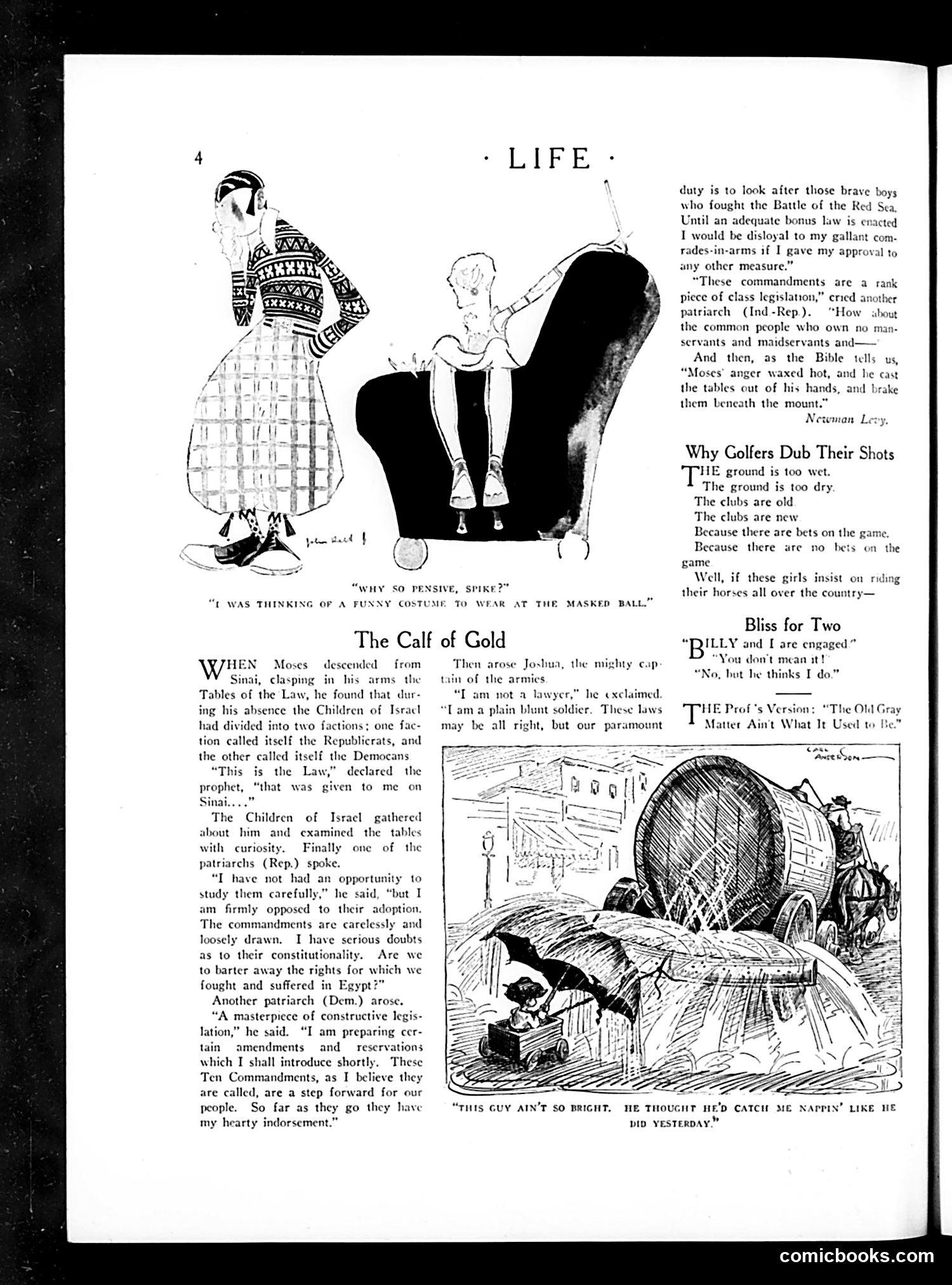
**Top Cartoon:** Titled "Why So Pensive, Spike?" — depicts a woman in ornate dress examining golf clubs while a man sits dejected. The caption references "a fancy costume to wear at the masked ball," suggesting social satire about fashion priorities during leisure activities. **Main Article: "The Calf of Gold"** — discusses Moses and the Children of Israel's religious disputes. A patriarch critiques the Ten Commandments as "carelessly and loosely drawn," questioning their constitutional validity and advocating amendments. This appears to satirize contemporary legislative debates by framing them through biblical analogy. **Bottom Section:** Brief humorous items including "Bliss for Two" (engagement joke) and "The Prof's Version" (illustrated gag about someone failing to catch naps). The page blends social satire with religious and political commentary typical of early 20th-century Life magazine humor.
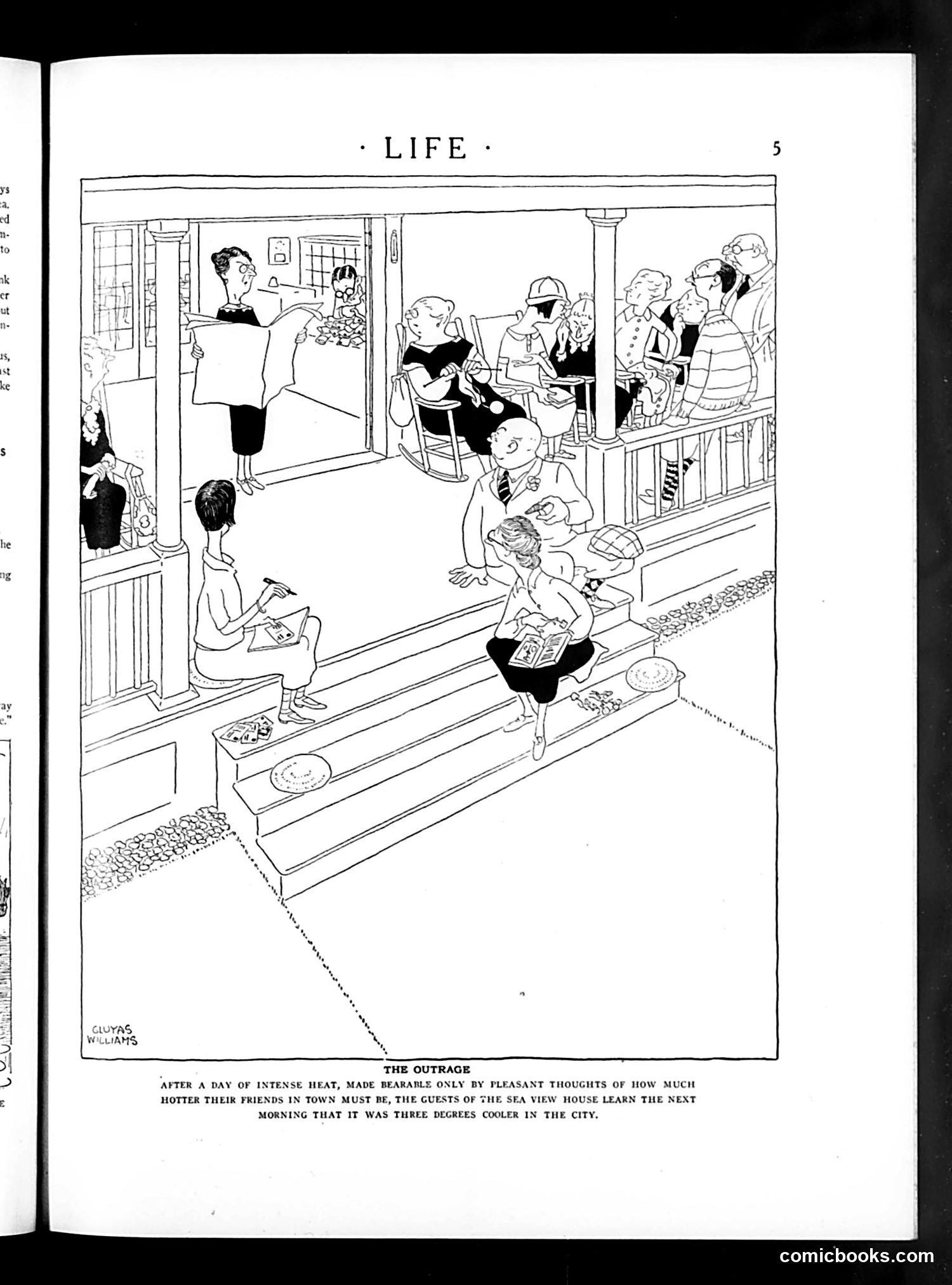
This single-panel cartoon by Clayas Williams depicts a seaside house scene where guests have just discovered the temperature difference between town and their beachfront location. The caption explains the satirical premise: after enduring intense urban heat, these wealthy visitors expected relief at their oceanside retreat—only to learn it was actually three degrees cooler in the city. The humor targets upper-class summer leisure culture and the gap between expectations and reality. The figures' exaggerated reactions (some appearing shocked or dismayed on the steps) emphasize their sense of betrayal. This satirizes both the pretensions of seasonal vacation homes and the somewhat absurd complaints of the well-to-do seeking respite from heat they could largely escape through other means.
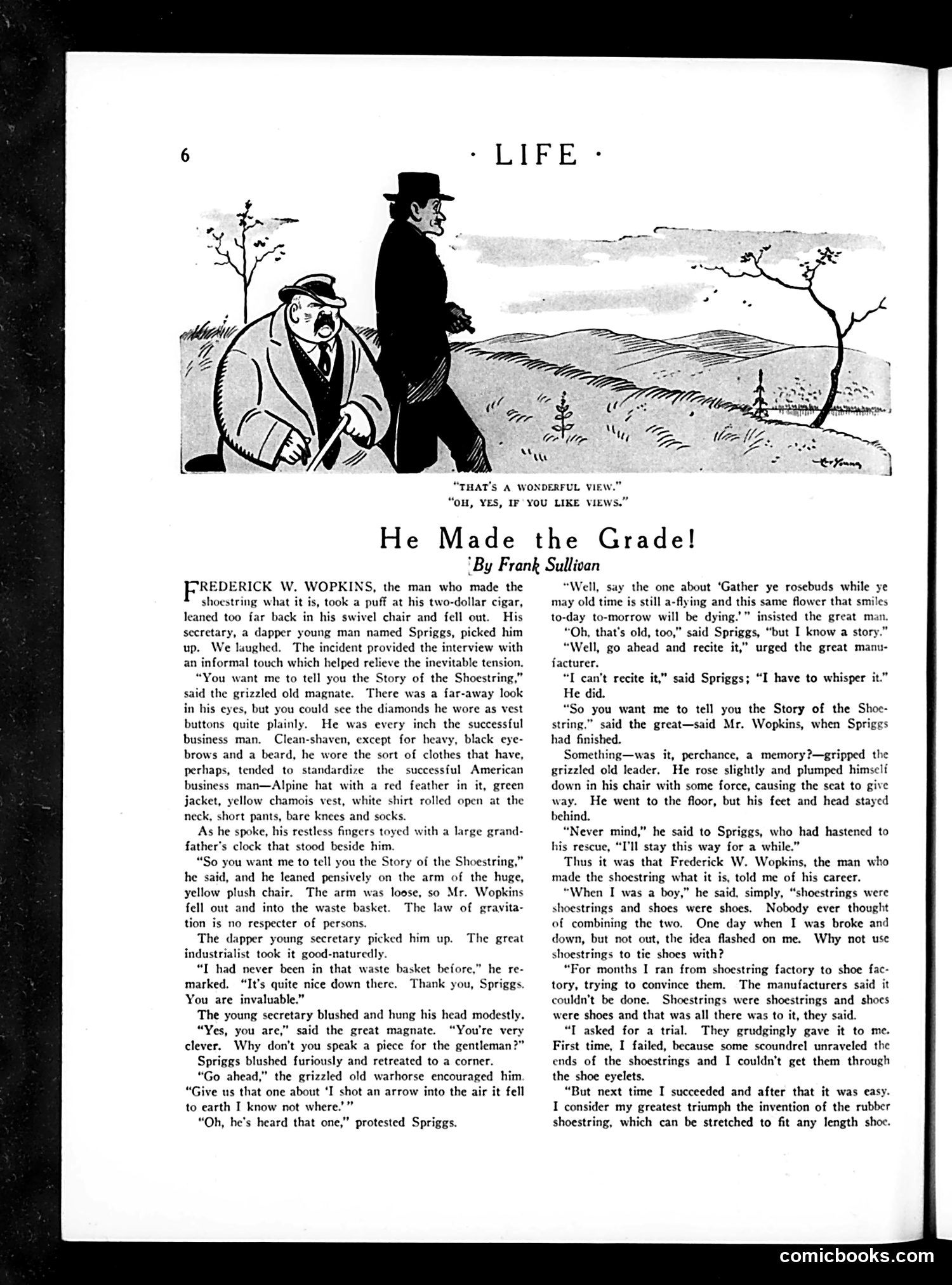
This page presents a short story by Frank Sullivan about Frederick W. Wopkins, a successful industrialist who invented the shoesting. The accompanying cartoon depicts two men in conversation about a landscape view. The story satirizes American business culture and the "self-made man" narrative. Wopkins, described as wearing fashionable clothes and having "clean-shaven" appearance (except for a beard), represents the successful entrepreneur. The humor centers on his invention of the rubber shoestring—a mundane, practical product—being presented as a major industrial triumph worthy of storytelling. The narrative mocks how American businessmen mythologize ordinary innovations and their own careers, turning simple problem-solving (combining shoestrings with shoes) into grand tales of entrepreneurial triumph. It's gentle satire of business boastfulness and the American success story.
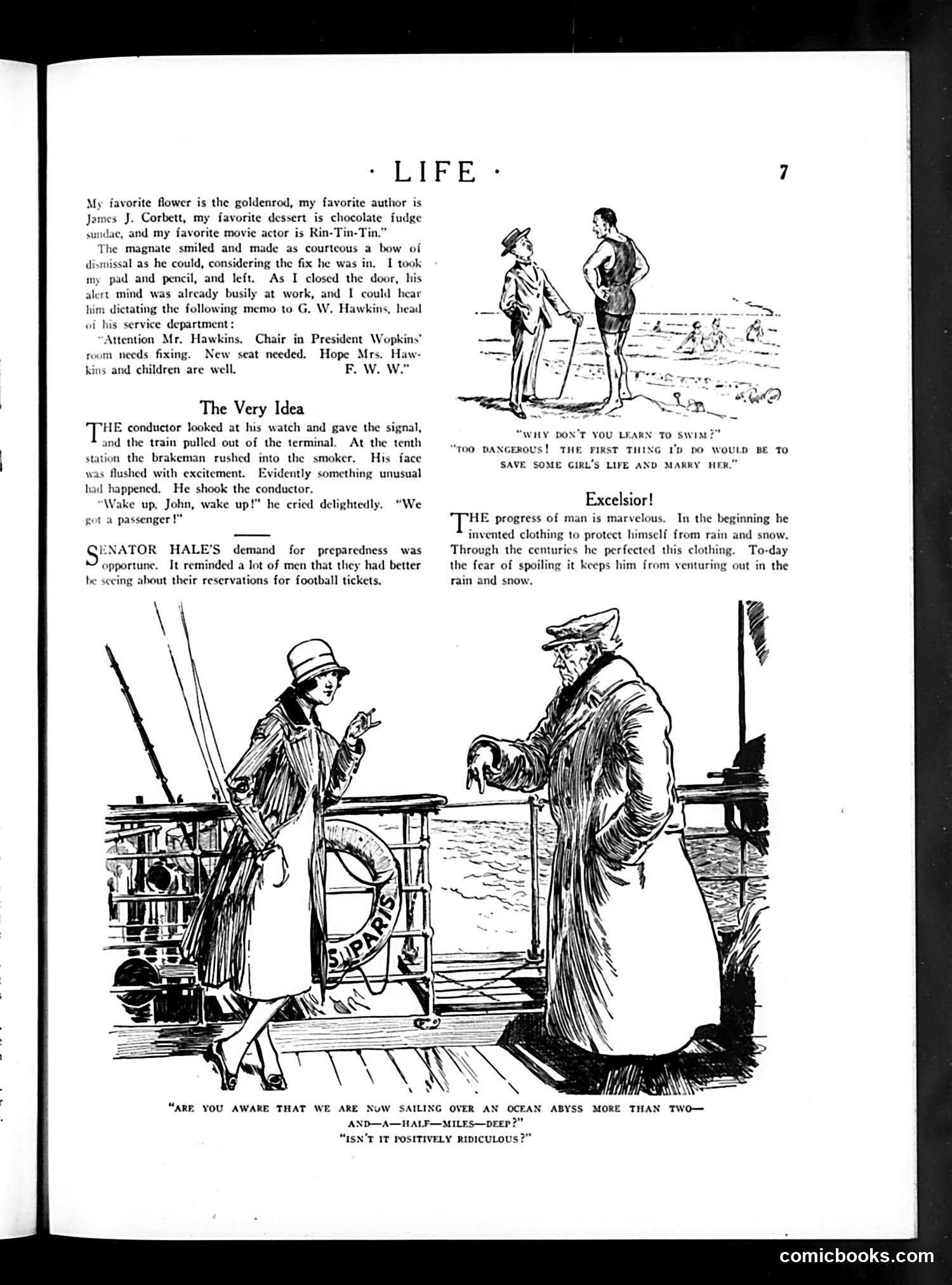
This page contains three separate satirical pieces. The top cartoon mocks a man refusing to learn swimming by claiming he'd "save some girl's life and marry her"—satirizing male anxiety about unintended romantic consequences. The middle section, titled "The Very Idea," depicts a train conductor waking a sleeping passenger, joking that Senator Hale's demand for "preparedness" reminded men to check their football ticket reservations—mocking peacetime military readiness rhetoric as absurdly overblown. The bottom cartoon shows two sailors discussing their ship's position over a dangerously deep ocean abyss, with one calling it "positively ridiculous"—likely satirizing naval incompetence or reckless maritime practices, though the specific historical context remains unclear without a date. All three pieces employ gentle, humorous social commentary typical of early 20th-century satirical journalism.
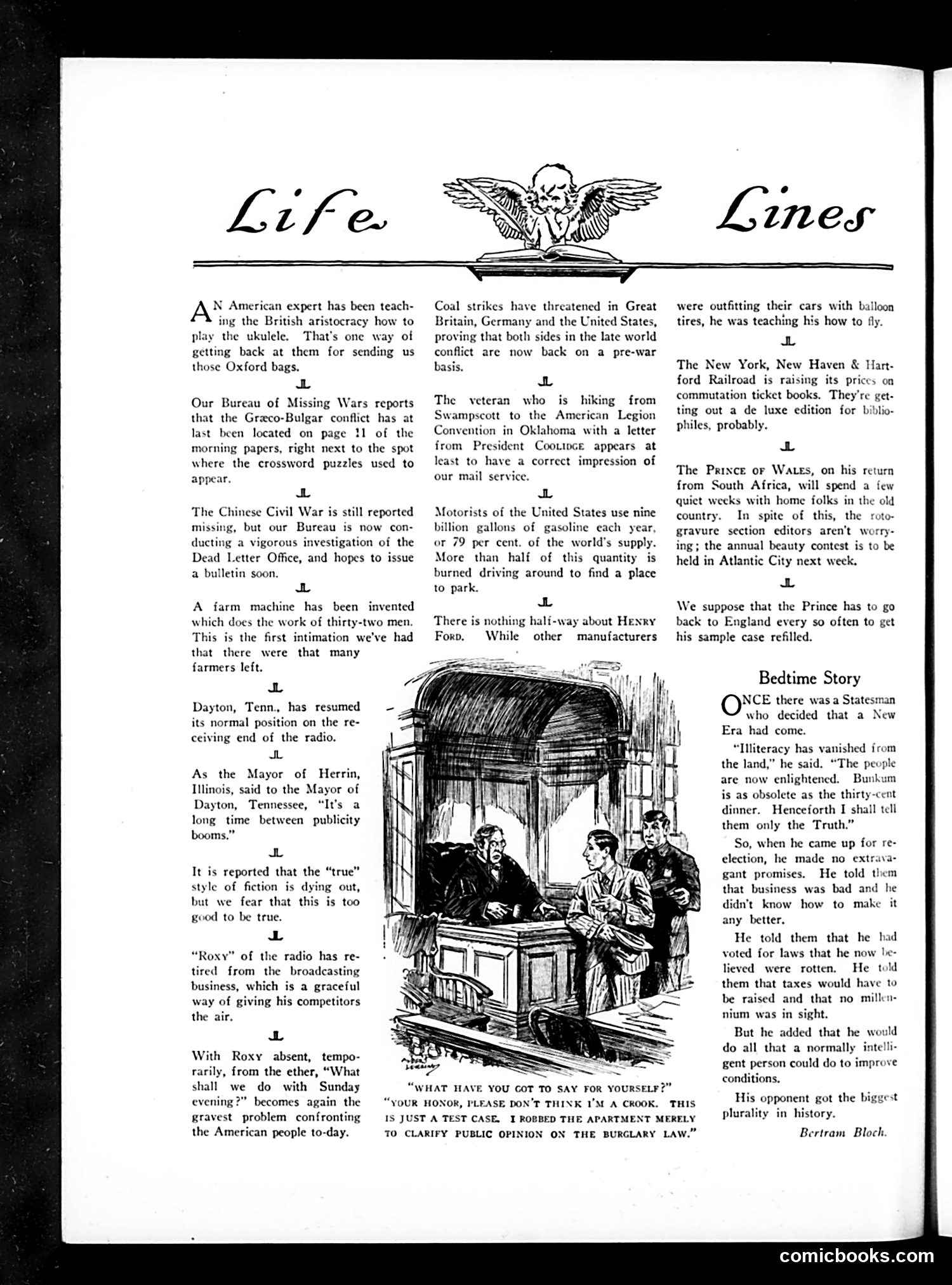
This page contains several short news items and a cartoon titled "Bedtime Story." The cartoon depicts a man (identified as a "Statesman") speaking to two others, with a caption about him claiming to have "robbed the apartment merely to clarify public opinion on the burglary law." The satire satirizes political hypocrisy: a politician justifies dishonest or illegal actions by claiming they serve the public good or clarify important issues. The "bedtime story" framing suggests this is a tall tale or fiction—politicians' self-serving rationalizations presented as bedtime stories. The surrounding "Life Lines" section covers various contemporary topics: British aristocracy and ukuleles, coal strikes, Chinese Civil War, farm machinery innovations, and radio broadcasting. These establish the magazine's satirical tone toward early 20th-century American politics and society.
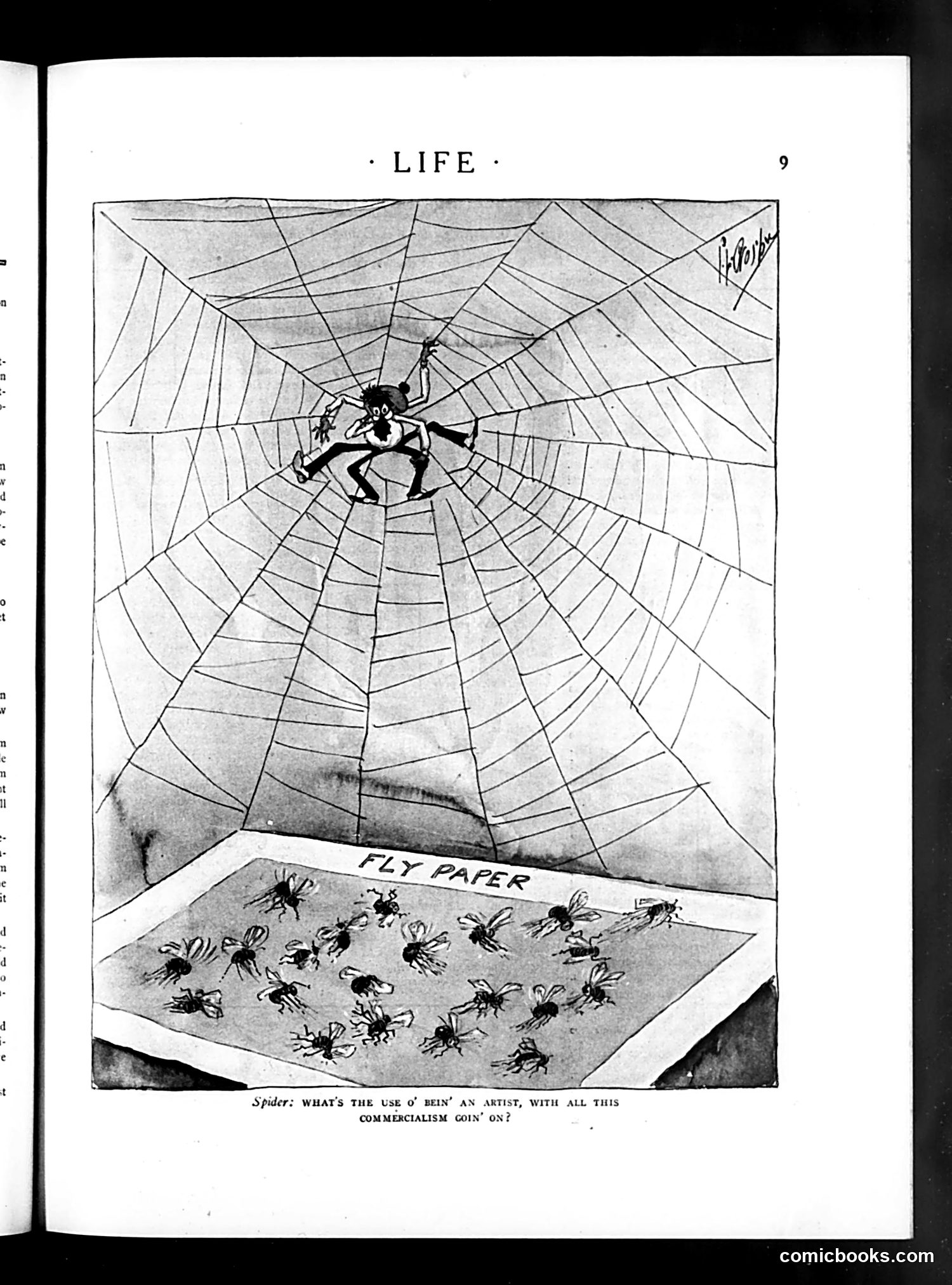
This satirical cartoon depicts an artist trapped in a spider's web, surrounded by flies labeled "FLY PAPER" below. The spider's caption reads: "What's the use of bein' an artist, with all this commercialism goin' on?" **The satire:** The cartoon criticizes the commercialization of art in early 20th-century America. The artist, caught in the web like prey, represents creative professionals ensnared by commercial demands (the "flies" and "fly paper"). The spider—likely representing commercial interests, advertising, or mass-market forces—traps artists, preventing them from pursuing pure artistic endeavor. The joke's bitterness suggests Life magazine's critique of how capitalism compromises artistic integrity, a common concern among intellectuals and artists of this era.
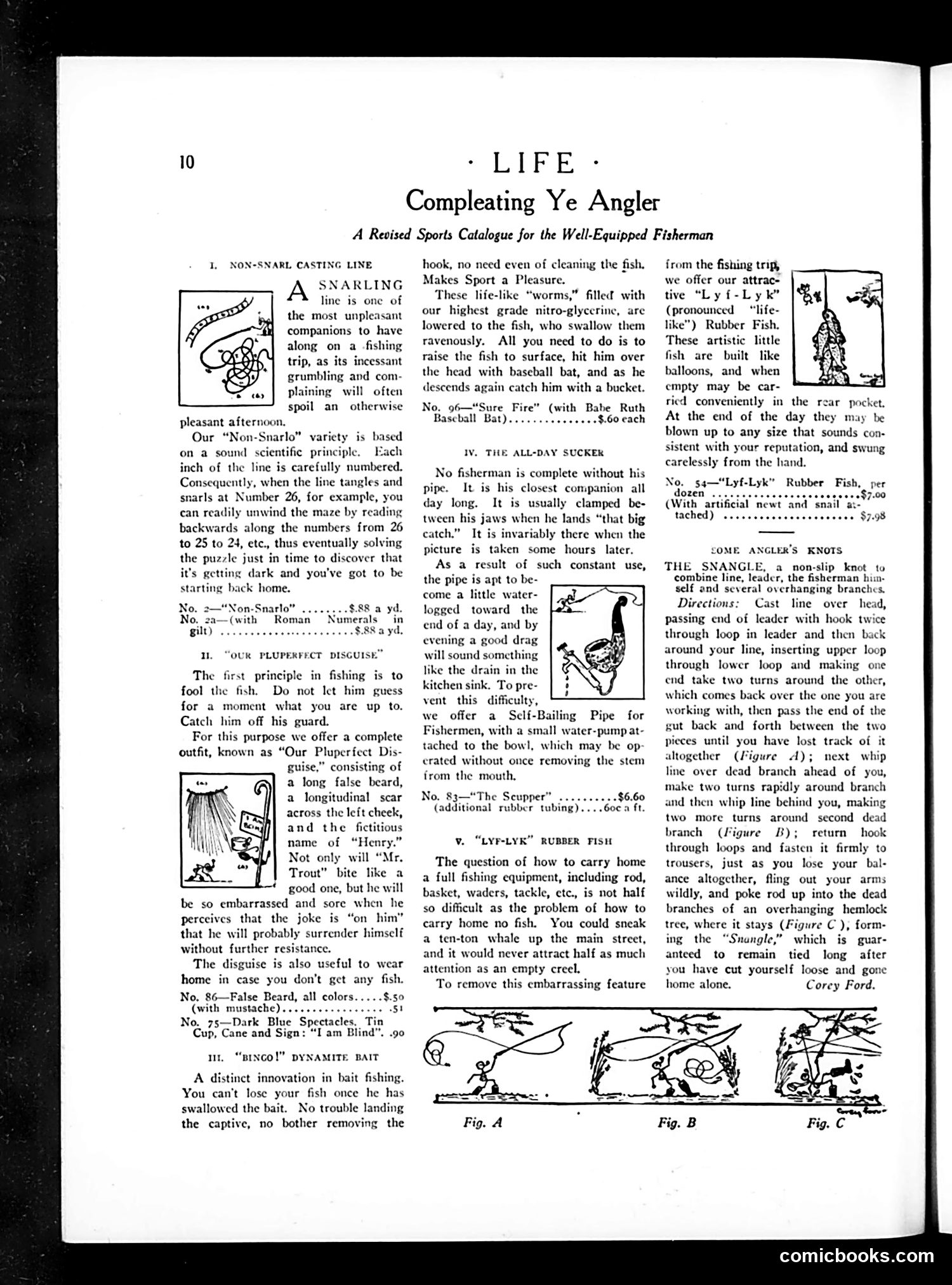
This page is **not political satire** but rather a humorous sports catalog from Life magazine advertising fishing equipment and techniques for anglers. The content includes: - **Non-snarl casting line** with a joke about tangled fishing lines ruining trips - **"Bingo" dynamite bait** - a novelty product for catching fish without removing them from water - **Rubber fish lures** designed to carry home without actual fish - **A fake beard disguise** ("The Perfect Disguise") so embarrassed fishermen who caught nothing wouldn't be recognized The satire targets **fishing trip failures** - the common experience of anglers returning empty-handed. The joke products (dynamite, rubber fish, disguises) mock both fishing incompetence and male vanity about sporting prowess. This reflects early 20th-century Life's characteristic blend of consumer culture humor and gentle mockery of middle-class masculine pursuits.
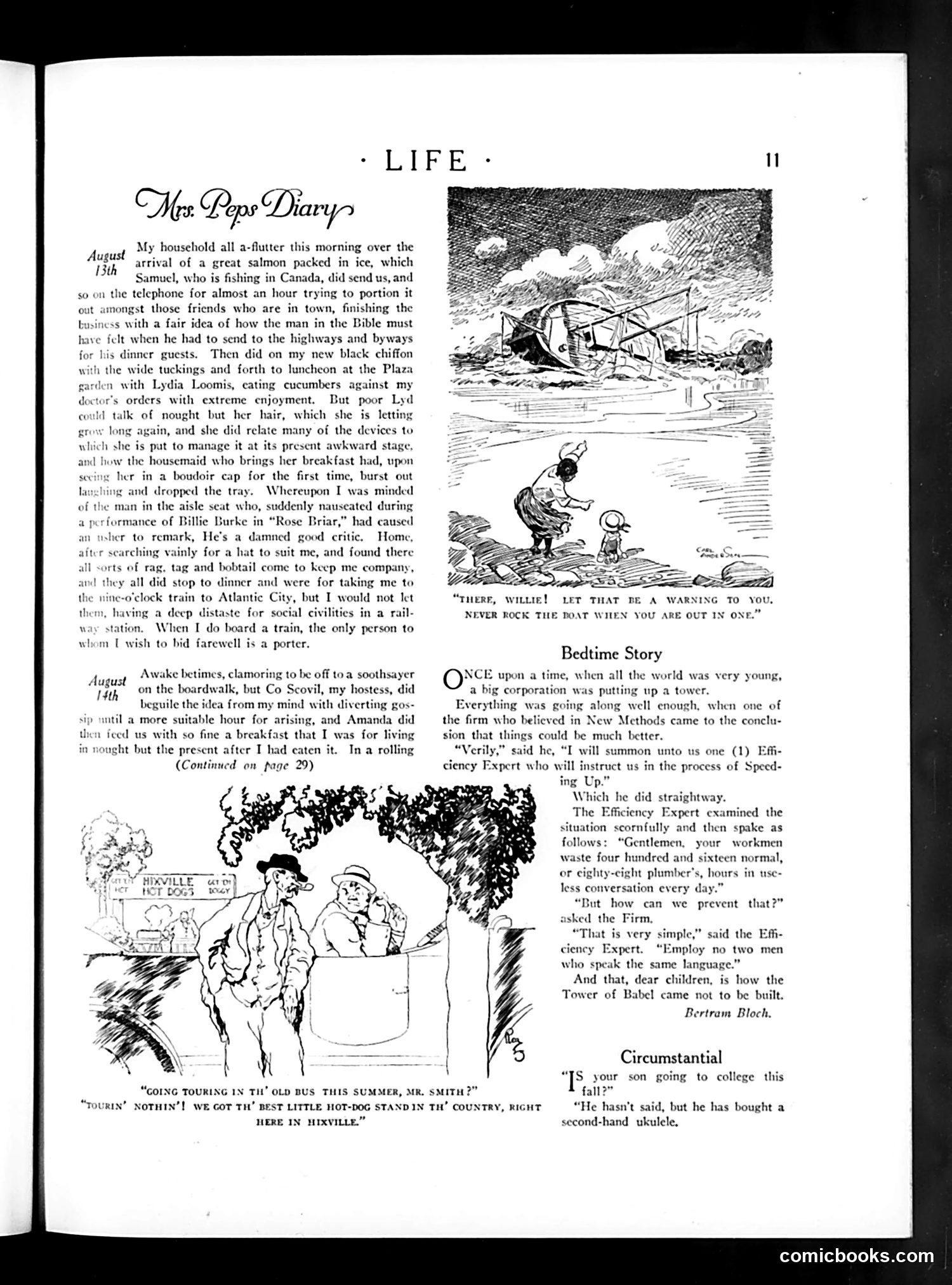
This page contains three distinct pieces: **"Mrs. Pep's Diary"** (upper left): A domestic humor column describing household activities—receiving a salmon from Canada, managing servants, and social commentary on guests and dinner plans. It's gentle satire of upper-middle-class domestic life and etiquette. **Boating cartoon** (center): A father warns his son about rocking the boat, a literal illustration of the common idiom about not causing trouble or disruption. **"Bedtime Story"** (right): A business parable about an "Efficiency Expert" advising a corporation to prevent worker conversation to increase productivity—satirizing corporate obsession with efficiency and control, with a reference to the Tower of Babel as cautionary tale. **"Circumstantial"** (bottom right): A brief joke about a son not attending college because his parents bought him a ukulele instead. The page represents typical Life magazine content: domestic humor, visual puns, and social satire.
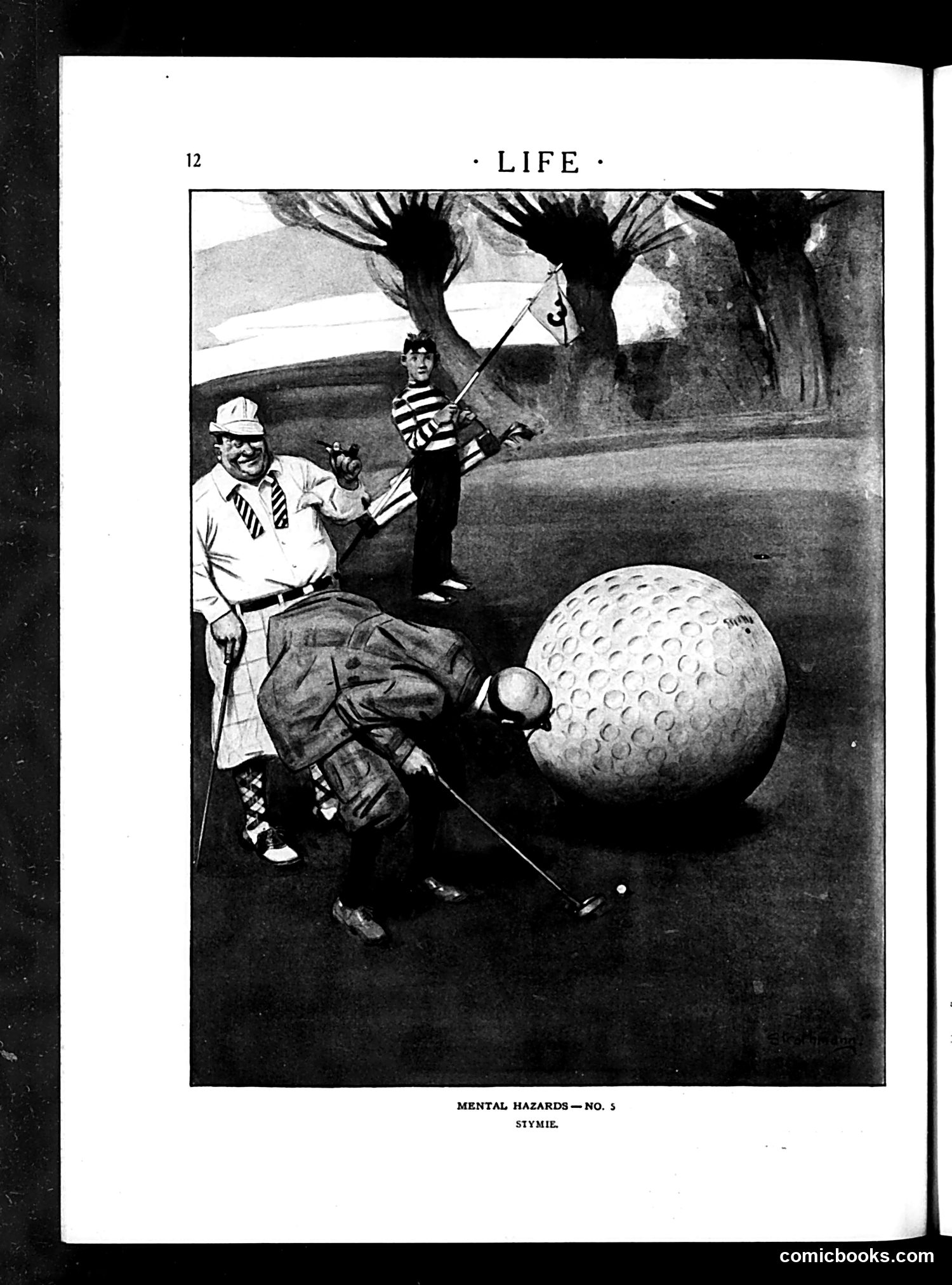
This page from *Life* magazine presents "Mental Hazards — No. 5: Stymie," a golf-themed satirical cartoon. The image shows three figures on a golf course: a golfer in light-colored clothing and hat preparing to putt, a child in striped shirt holding a flag, and another figure crouching near an enormous golf ball marked with dimples. The cartoon satirizes golf psychology by depicting "stymie"—a golf term for an obstructed putting line. The exaggerated, oversized ball comically visualizes the mental obstacle golfers face. The series title suggests this is part of a recurring feature about psychological challenges in sports. The humor targets golfers' anxiety and how mental perception can magnify obstacles into seemingly insurmountable problems.
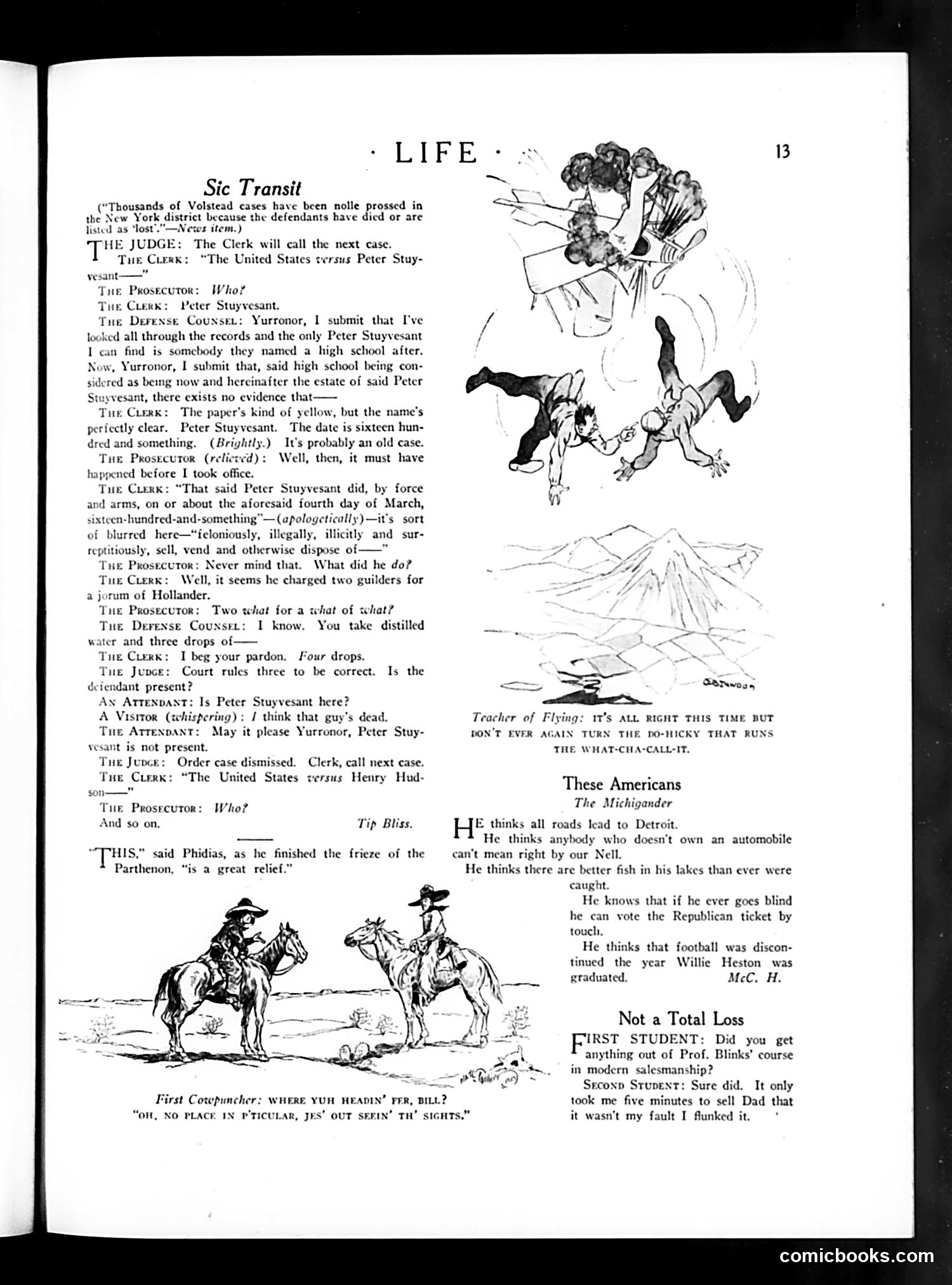
**Sic Transit** (top section): A courtroom satire mocking legal proceedings. The clerk cannot locate a defendant "Peter Stuyvesant" in records, yet the case proceeds anyway. The prosecutor and judge engage in absurdist dialogue about charging someone for "guilders" and mixing "distilled water" into evidence. The satire targets bureaucratic incompetence and the legal system's willingness to prosecute cases based on unclear or nonexistent documentation. **These Americans/The Michigander** (right): Stereotypical humor about Midwesterners' provincial attitudes—beliefs about Detroit's centrality, automobile ownership, superior fishing, and voting Republican by reflex. **Not a Total Loss** (bottom): A student joke about a failed business course. The page demonstrates LIFE's characteristic blend of institutional critique and light social satire circa the early 20th century.
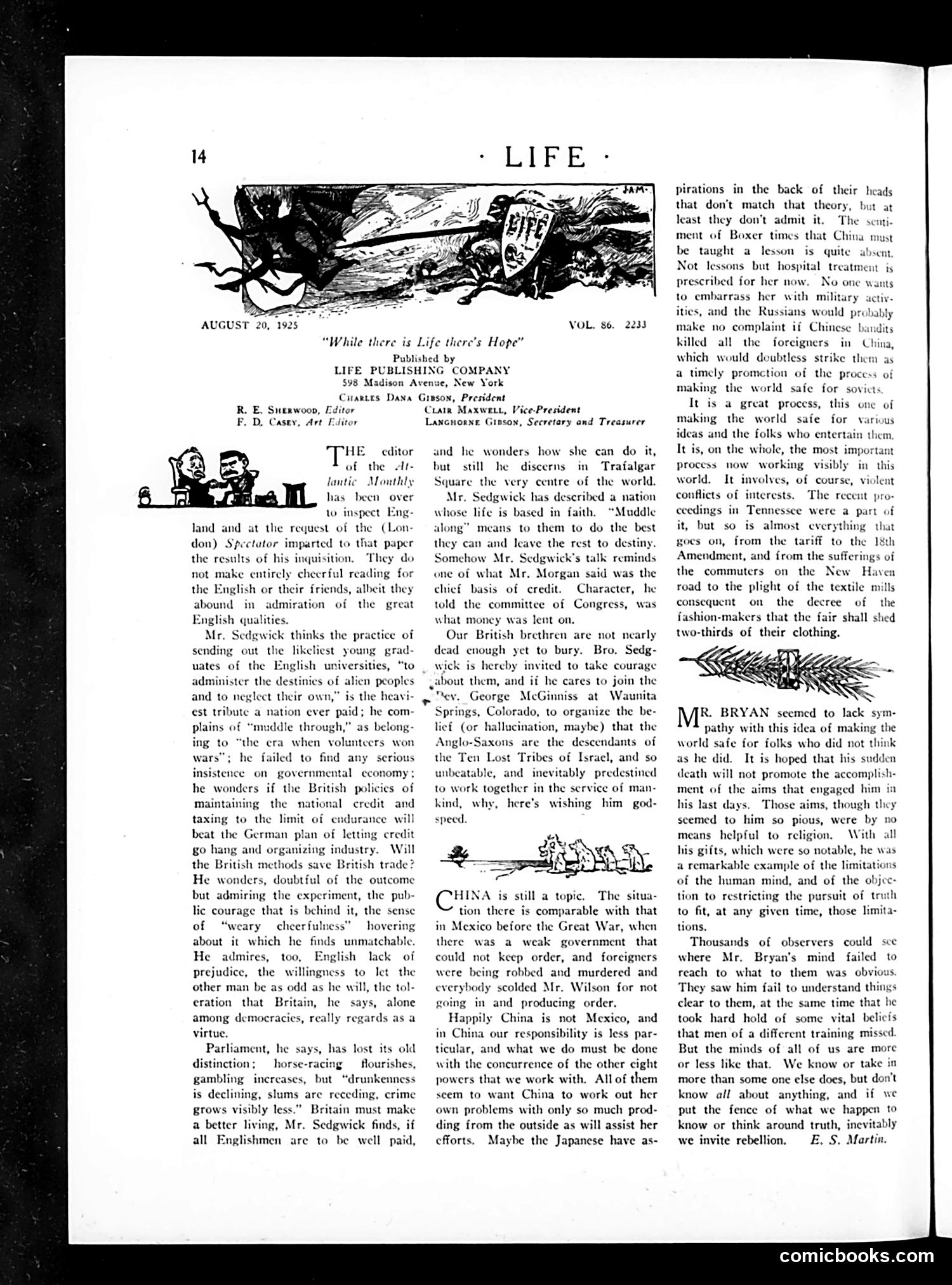
This page contains editorial commentary rather than a cartoon. The main illustration at the top appears to show a figure lying down, though details are unclear. The text discusses international politics, particularly regarding China and foreign intervention. The editor critiques British policy in China and mentions Mr. Bryan's "world safe for folks" initiative—likely referencing William Jennings Bryan's idealistic foreign policy vision. The piece addresses the Chinese government's weakness, foreign exploitation, and the question of whether outside powers should intervene in China's internal affairs. There's satire directed at Bryan's limitations in understanding complex geopolitical realities. The commentary reflects 1920s American debates about isolationism versus intervention in Asian affairs, particularly China's political instability during the warlord period.
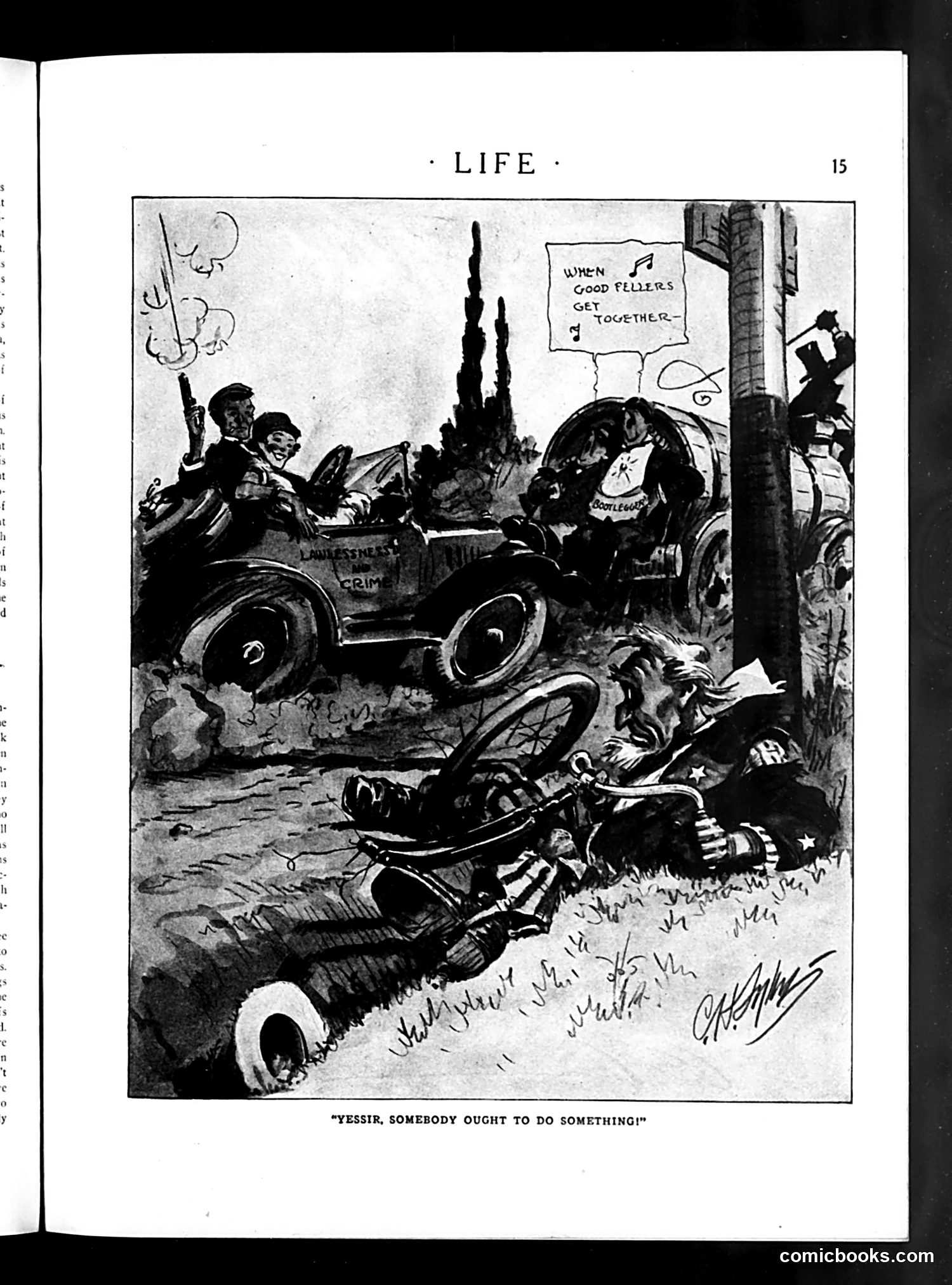
This cartoon satirizes poor driving and reckless motorists. The scene shows a car that has struck a pedestrian (depicted lying on the ground), while occupants in the vehicle sing "When good fellies get together" — a popular song reference suggesting camaraderie. A bystander shouts "Yessir, somebody ought to do something!" highlighting public frustration with dangerous driving. The humor (dark by modern standards) comes from the disconnect: the drivers are celebrating friendship while causing harm, and the bystander's complaint suggests helplessness against a growing traffic problem. This likely reflects 1920s-30s concerns about automobile safety and reckless drivers, when traffic deaths were rising and safety regulations were minimal. The cartoon mocks both dangerous drivers and the inadequate response to the problem.
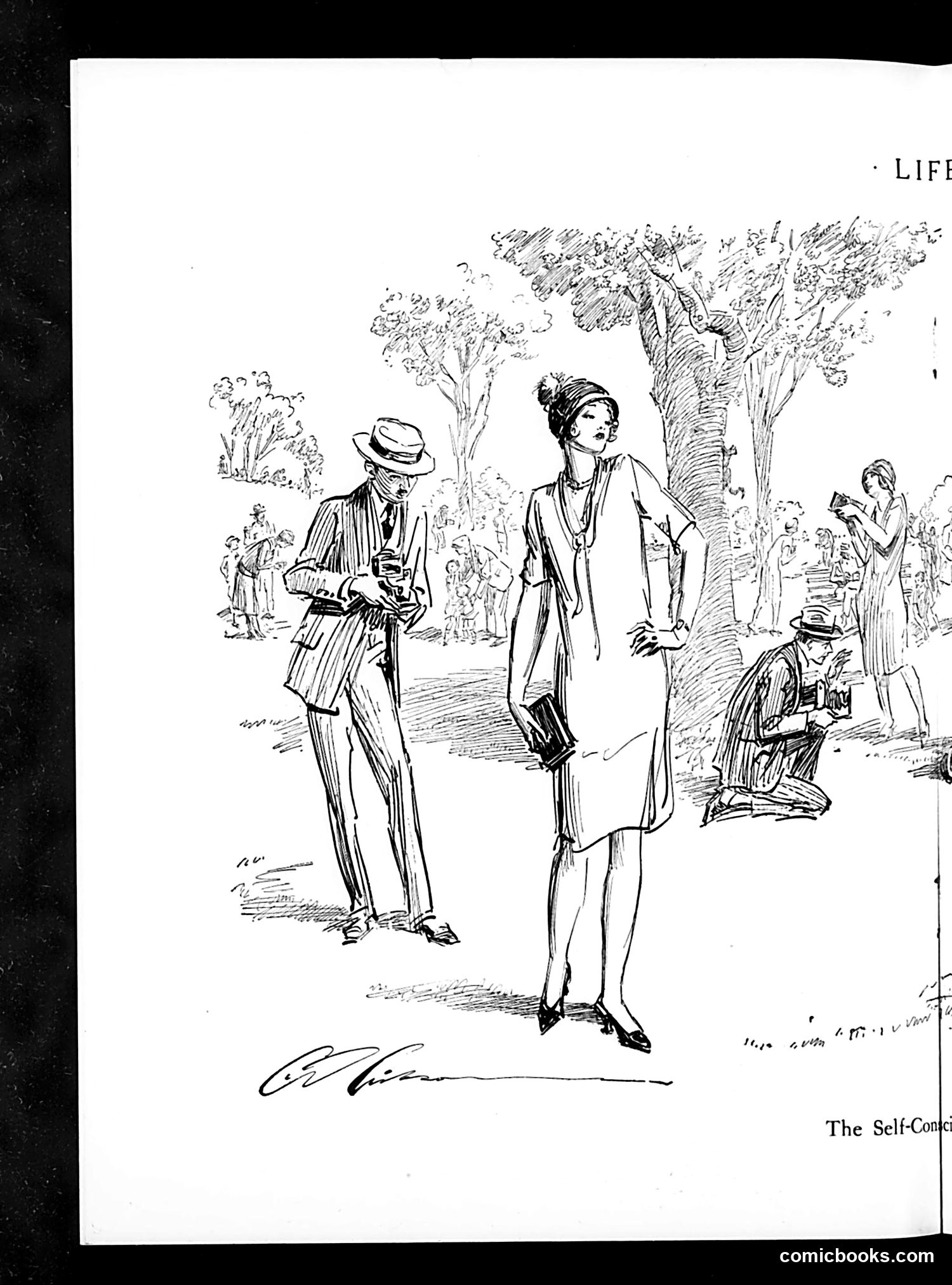
This Life magazine page shows a pen-and-ink illustration depicting a social scene in what appears to be a park or public garden. A well-dressed man in a suit and hat stands conversing with a tall woman in fashionable dress, while various other figures populate the background beneath trees. The partial caption reads "The Self-Conte[...]" (likely "The Self-Contained" or similar), suggesting the cartoon satirizes self-conscious or affected behavior in polite society. The composition and styling suggest early-to-mid 20th century social satire, probably mocking bourgeois pretension or courtship rituals. However, without the complete caption or fuller context, the specific satirical point remains unclear. The artwork is signed, indicating it's by a contributing cartoonist to Life magazine.
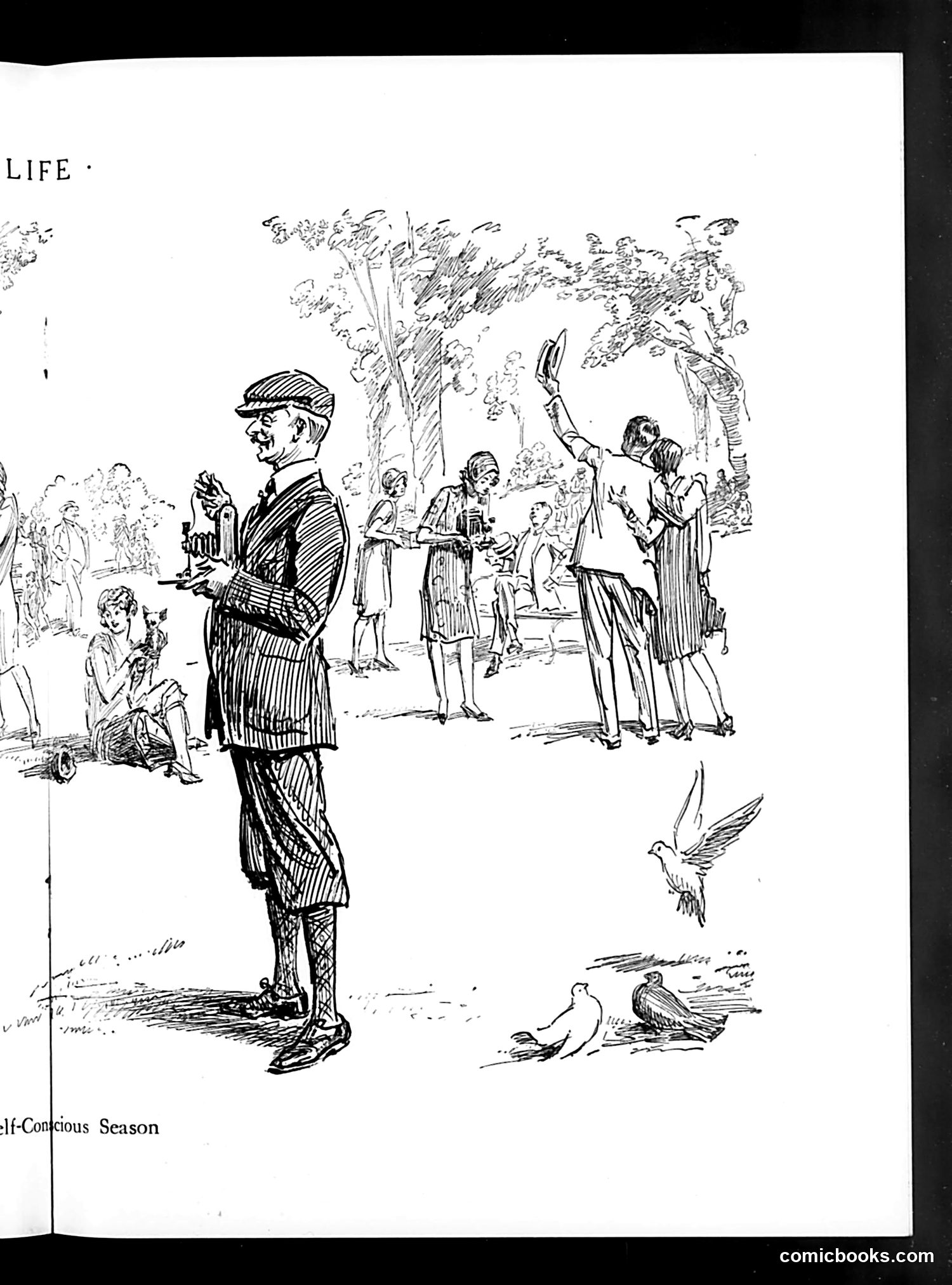
This page, titled "Life," shows a satirical cartoon labeled "Self-Conscious Season." The illustration depicts a well-dressed man in the foreground (wearing a cap, jacket, and knickers) who appears self-aware or awkward, surrounded by children and adults in a park setting. Birds are scattered about, and trees frame the background. The satire likely mocks adult self-consciousness during recreational seasons—possibly spring or summer—when adults feel exposed or scrutinized in public spaces with children present. The man's prominent, isolated positioning suggests he's the subject of social observation or judgment. The casual, natural setting contrasts with his formal attire and rigid posture, emphasizing discomfort. The exact historical context remains unclear without additional information, but the cartoon appears to comment on social anxiety and changing norms around public behavior and social propriety in early 20th-century America.
This page critiques Russian and Austrian theatrical productions in post-WWI Vienna. The author praises a Russian production of Shaw's *St. Joan* at the Kammerspiele, directed by Tairoff, for its irreverent approach—treating the play as burlesque with clownish characters and crude sets. The satire suggests Shaw himself would approve of mocking historical pretension. By contrast, the author attacks Max Reinhardt's *Juarez and Maximilian* at Vienna's Theater in der Josephstadt as overblown and amateurish despite lavish production values. The piece argues that even amateur companies (like Scarborough's Beechwood Players) execute better stagecraft. The underlying point: substance matters more than expensive spectacle. Russian irreverence and directness outperforms Austrian grandeur. This reflects post-war skepticism toward old theatrical conventions and wealthy producers' pretensions.
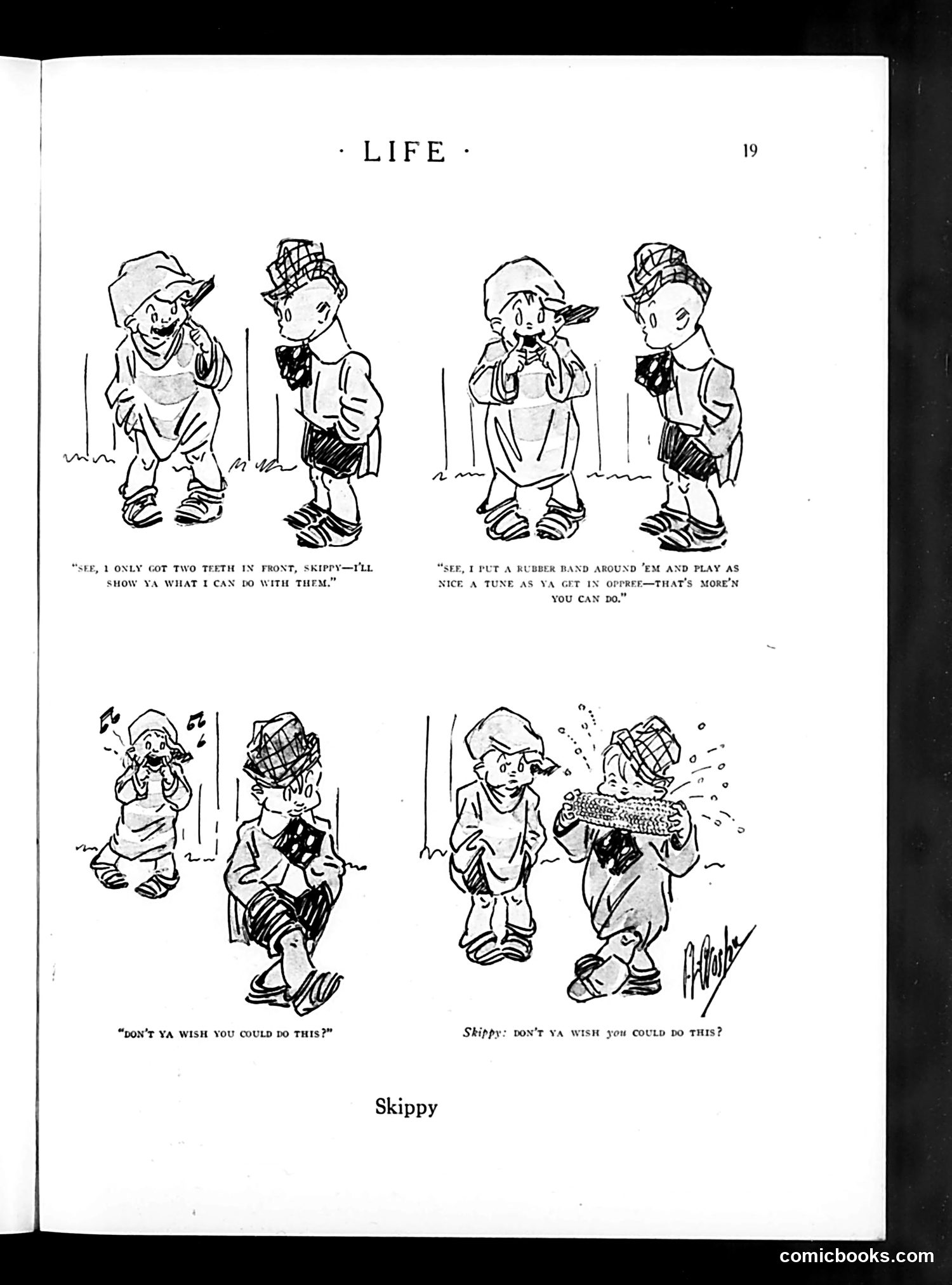
This is a humorous children's comic strip featuring two young boys. The character Skippy (identified in the caption) demonstrates crude musical talent by using a rubber band stretched around his two front teeth as a makeshift instrument, producing sounds he compares favorably to opera ("oppree"). The joke relies on childhood humor: Skippy's absurd claim that his teeth-and-rubber-band contraption produces music comparable to professional opera—clearly ridiculous to adult readers. The other boy's envious response ("Don't ya wish you could do this?") adds ironic humor, as the reader understands that this "skill" is entirely worthless and silly. The satire targets nothing political or social; rather, it's gentle comedy about boyish ingenuity and childish pride in trivial accomplishments. The informal dialect reflects early-20th-century vernacular speech for comedic effect.
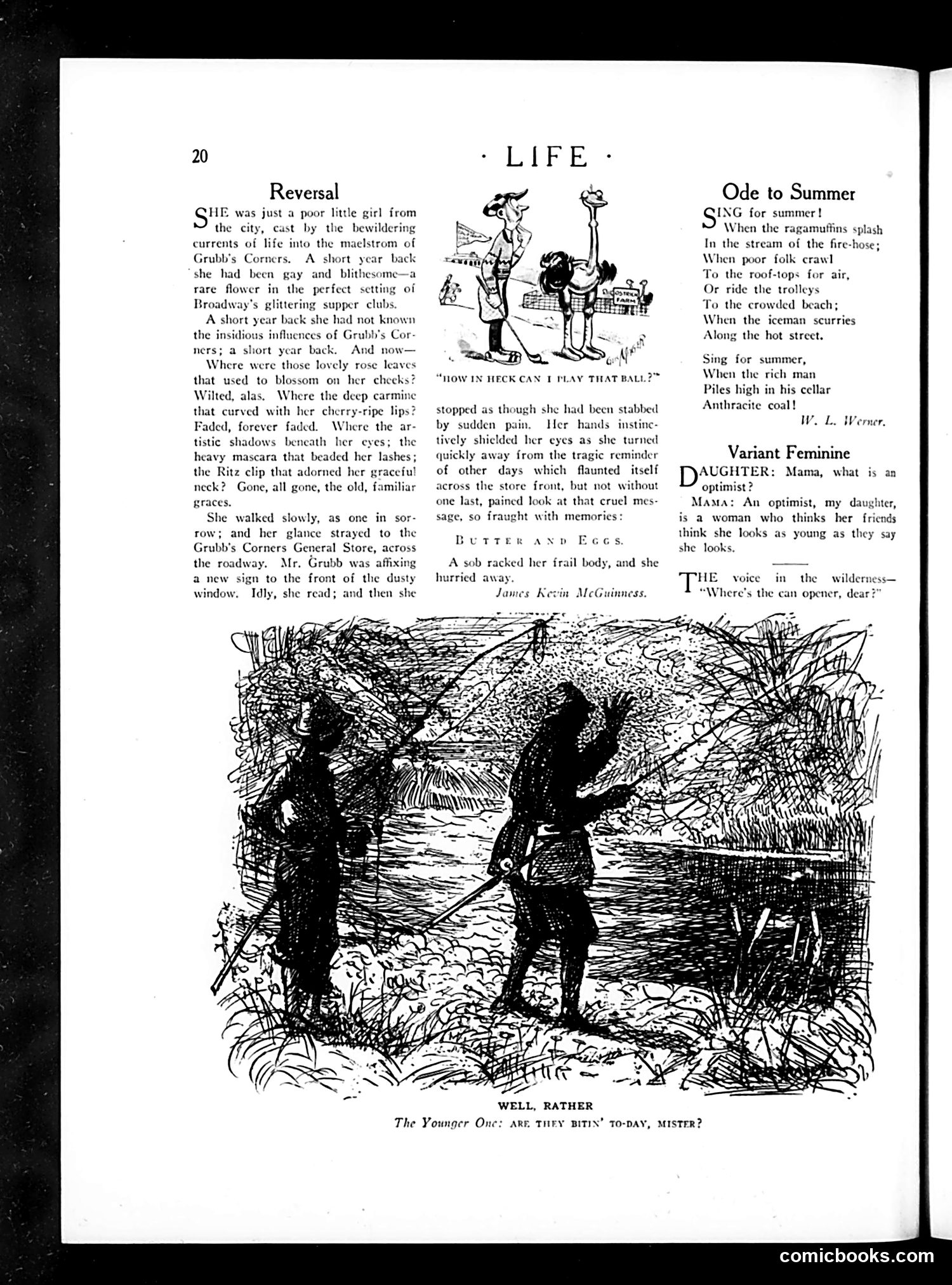
This page contains three distinct pieces of satirical content: **"Reversal"** tells of a city girl who moved to rural "Grubb's Corners" and has lost her urban sophistication—her makeup, style, and vitality have faded. The joke inverts the typical narrative: instead of finding wholesome renewal in country life, she's devastated upon seeing a store sign advertising "Butter and Eggs," a cruel reminder of her lost cosmopolitan lifestyle. The satire mocks both urban vanity and rural simplicity. **"Ode to Summer"** ironically praises summer by cataloging working-class hardships (people seeking air on rooftops, crowded beaches) while ending with a jab at the wealthy: they're frantically stockpiling anthracite coal in summer—an absurd image suggesting anxiety about winter shortages. The satire criticizes class disparity during economic uncertainty. **"Variant Feminine"** is a brief joke about female optimism, suggesting women delude themselves about their appearance based on flattery from friends. The cartoon showing two figures by water with the caption "Are they bitin' to-day, mister?" appears to illustrate fishing humor, though context is limited.
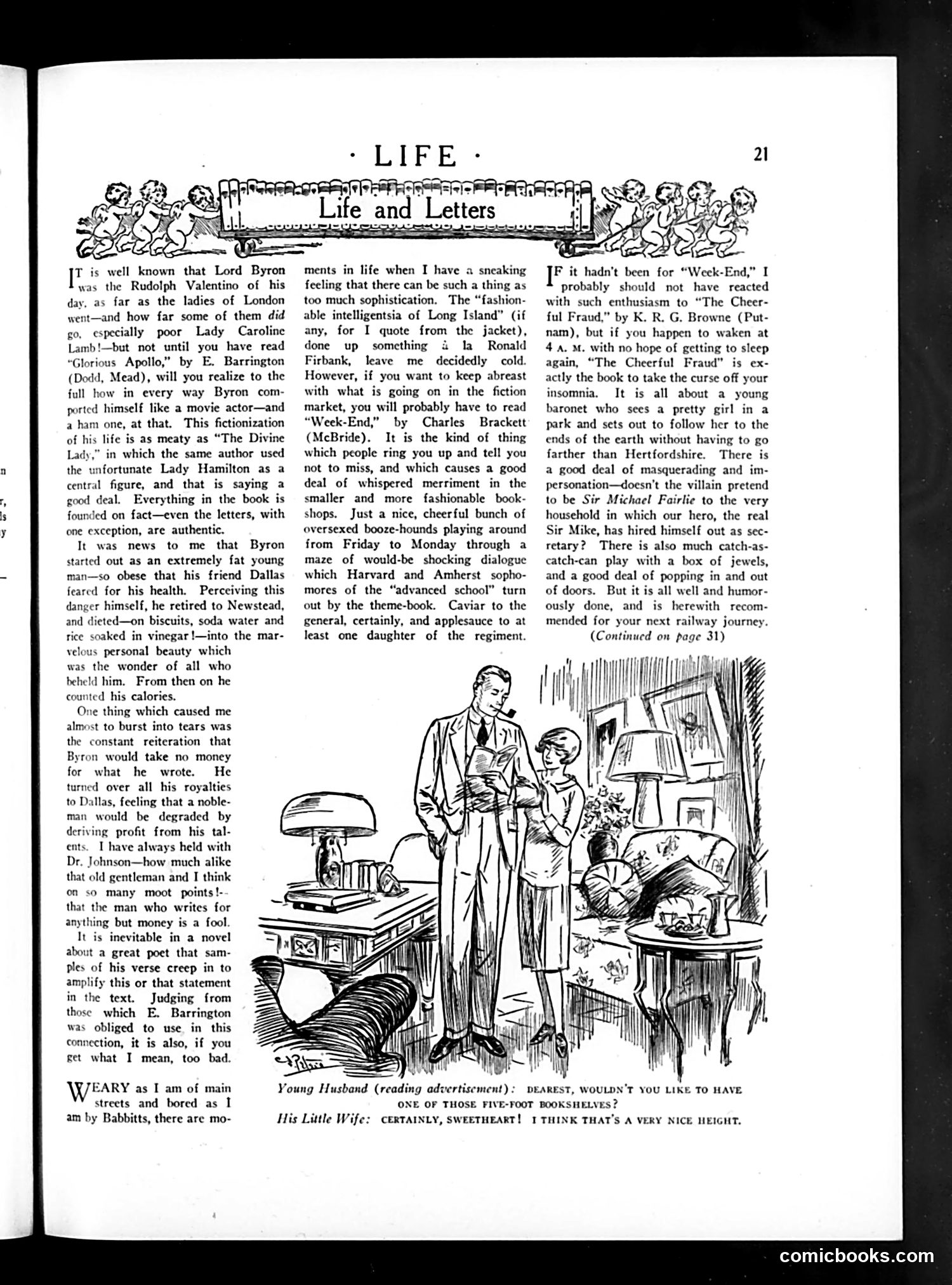
This page contains a literary review column discussing three contemporary novels. The main text reviews E. Barrington's "Glorious Apollo" (a Byron biography), Charles Brackett's "Week-End," and K.R.G. Browne's "The Cheerful Fraud." The accompanying cartoon satirizes domestic consumerism. A husband reads an advertisement to his wife while she reclines, discussing five-foot bookshelves as home décor. The joke targets early 20th-century affluent Americans' embrace of conspicuous consumption—displaying tall bookshelves as fashionable furniture rather than for actual reading. The reviewer adopts a sardonic, sophisticated tone, mocking literary pretension while simultaneously defending commercial writing (disagreeing with Byron's noble refusal of royalties). The overall page reflects 1920s-era cultural anxieties about modernism, sophistication, and middle-class aspiration.
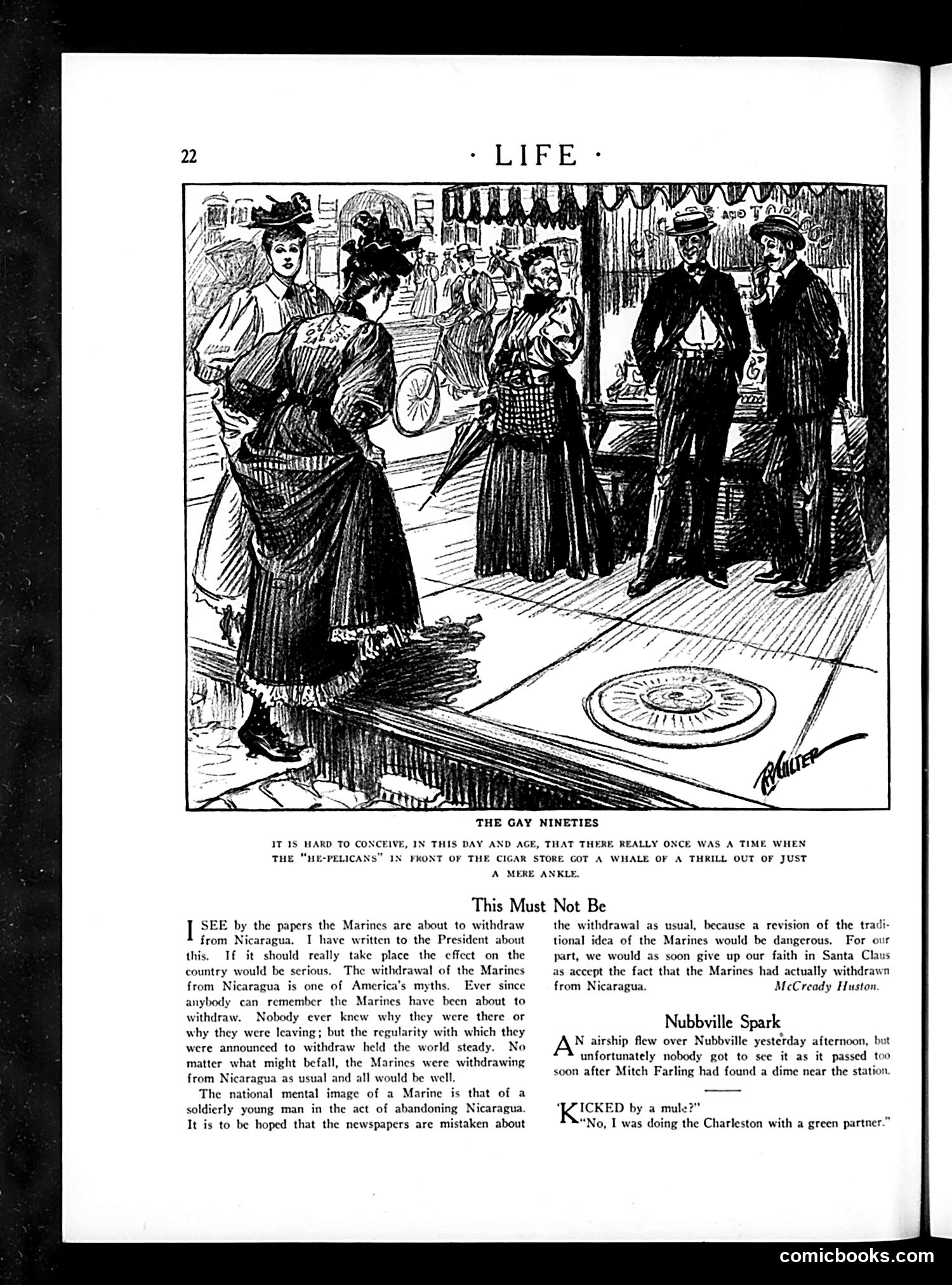
**The Cartoon:** "The Gay Nineties" depicts fashionably dressed 1920s women and men on a street, with the caption mocking how men once got excitement from merely glimpsing a woman's ankle. The joke satirizes the dramatic shift in social morality and fashion—women now wore shorter skirts and danced the Charleston, making the Victorian-era prudishness seem absurdly quaint. **The Articles:** McCready Huston's piece humorously complains about reported Marine withdrawals from Nicaragua, treating it as a recurring myth so constant that Americans rely on it for psychological stability—like Santa Claus. He suggests actually withdrawing would dangerously disrupt the national worldview. The "Nubbville Spark" items are brief humorous anecdotes: one about missing an airship, another joking that someone got kicked by a mule while doing the Charleston with an inexperienced dance partner. Together, the page reflects 1920s concerns: social change, American military interventionism treated as permanent policy, and the era's new dance crazes.
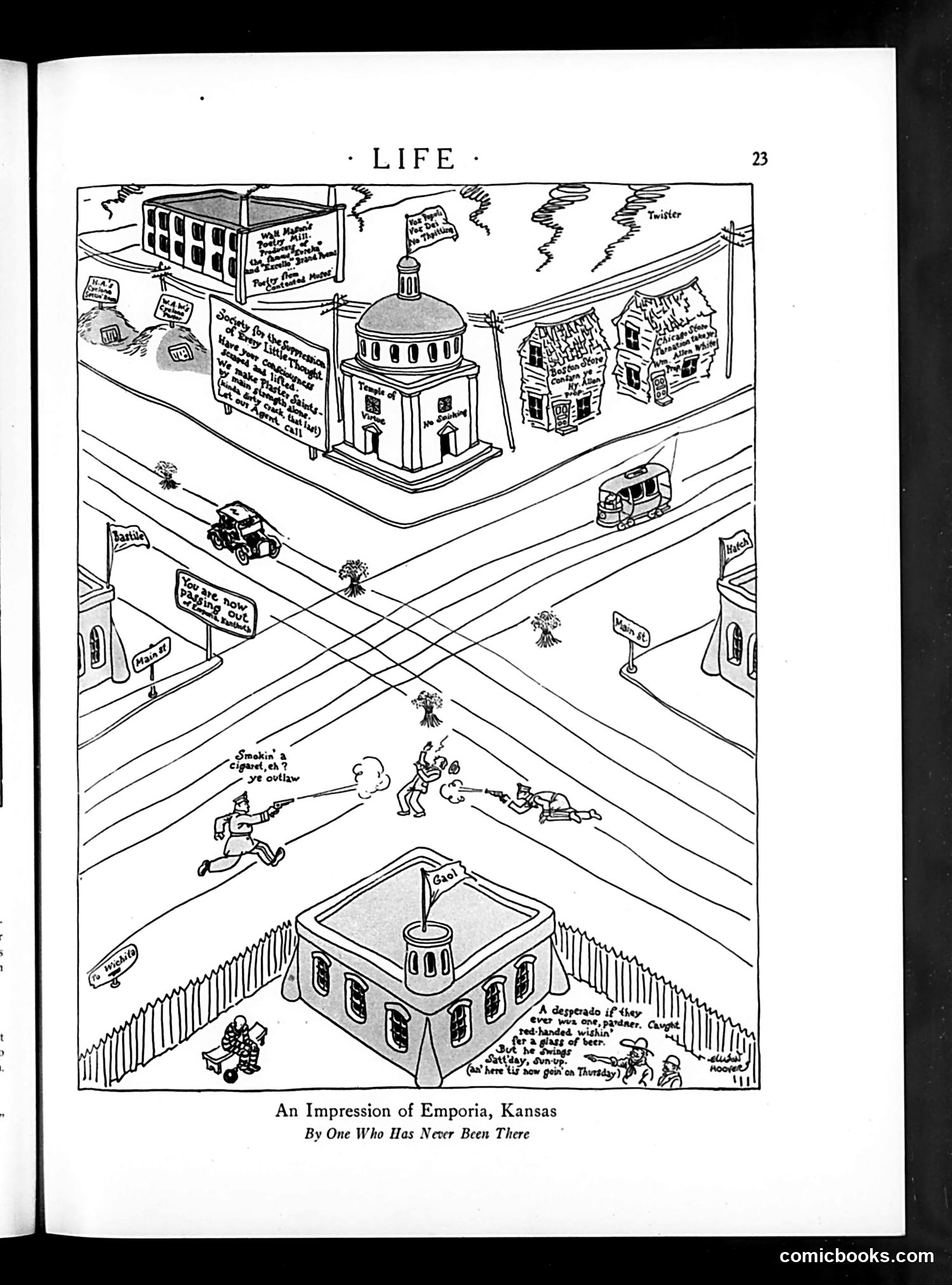
This satirical cartoon depicts an imaginary bird's-eye view of Emporia, Kansas, subtitled "By One Who Has Never Been There"—the humor relies on exaggerated, absurd details presented as fact. The image shows a central Capitol-like building surrounded by chaotic scenes: speeding vehicles, people wielding guns in streets, a jail, saloons, and various signs. The satire appears to mock provincial American towns, portraying them as lawless, violent, and culturally backward compared to urban centers. The cartoonist exaggerates typical stereotypes of Midwestern frontier towns—gunfights, drunkenness, crime—to satirize either Emporia specifically or small-town America generally. The subtitle's claim that the artist has "never been there" emphasizes the joke: this is pure prejudiced fantasy, not observation, ridiculing both the town and the author's unfounded assumptions.
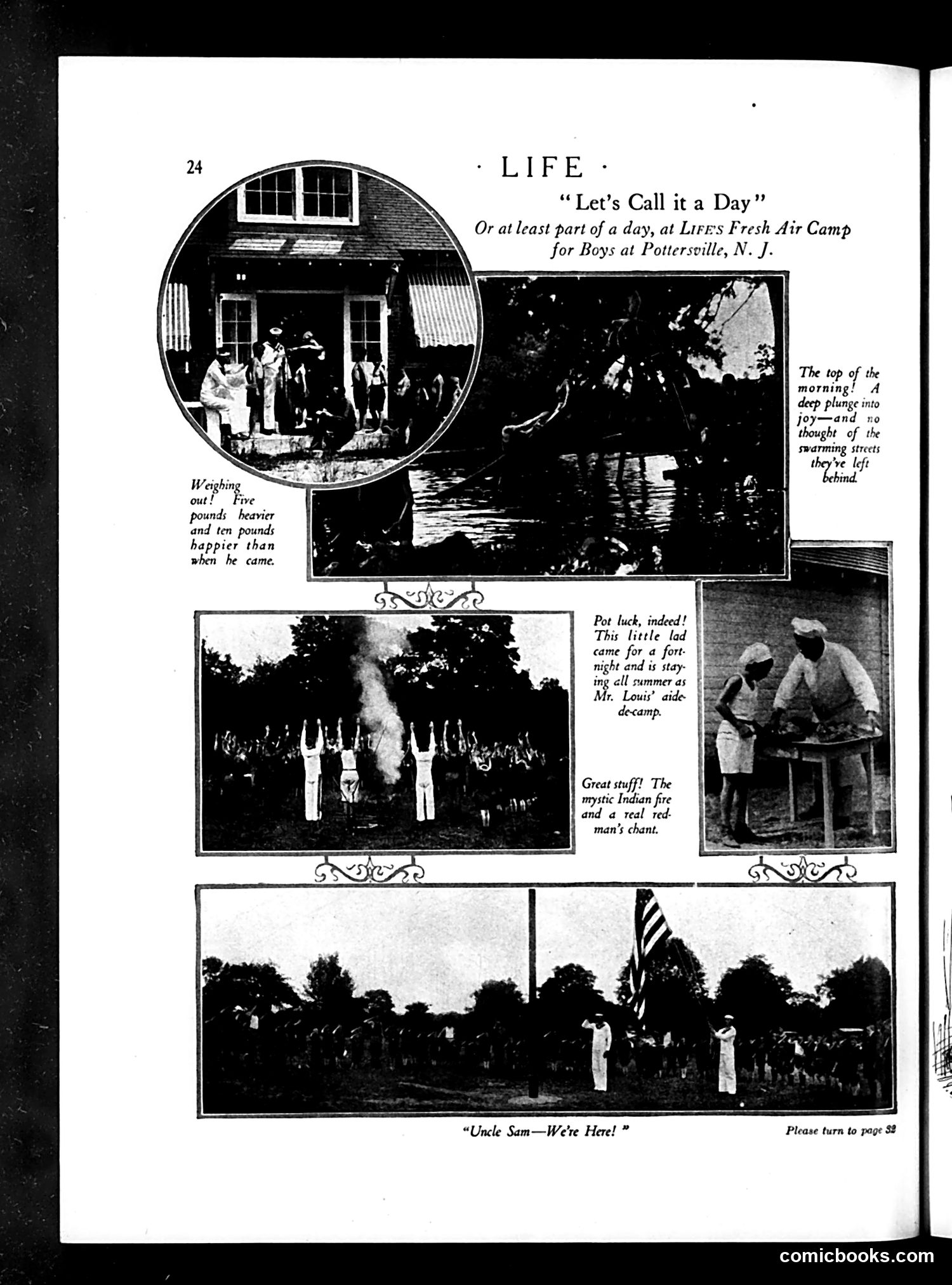
This is a straightforward promotional article, not satire or political commentary. It documents LIFE magazine's coverage of a Fresh Air Camp for Boys in Pottersville, New Jersey—a charitable program that brought urban children to the countryside for summer recreation and health. The images show typical camp activities: boys being weighed (gaining weight suggests improved health and nutrition), swimming, a campfire with what appears to be Native American-themed activities, and a formal flag ceremony. The captions celebrate the boys' physical improvement and enjoyment. The "Uncle Sam—We're Here!" caption at bottom suggests patriotic themes common to American youth programs of this era. This appears to be straightforward human-interest journalism celebrating a wellness program for disadvantaged urban youth, not satirical commentary.
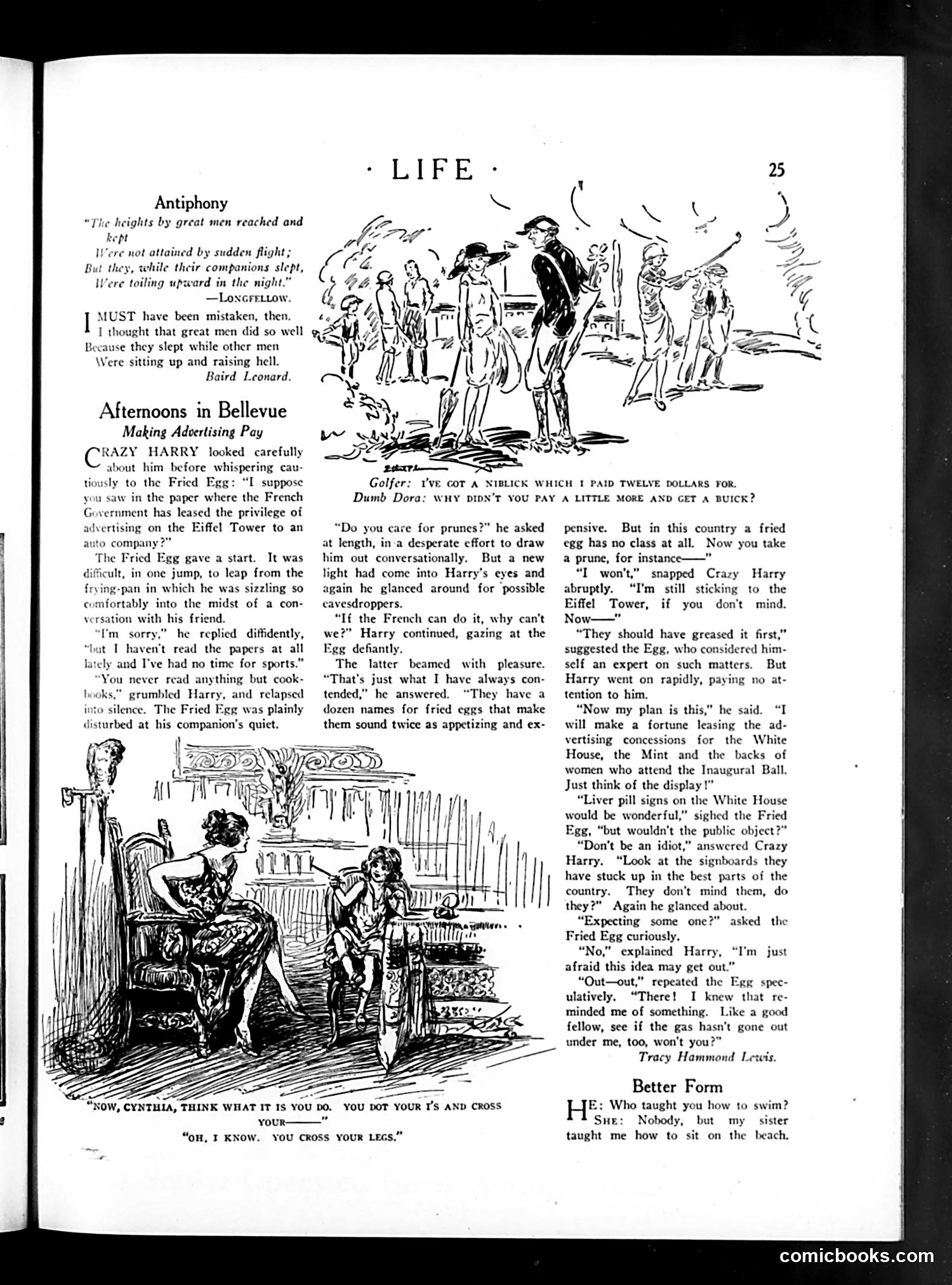
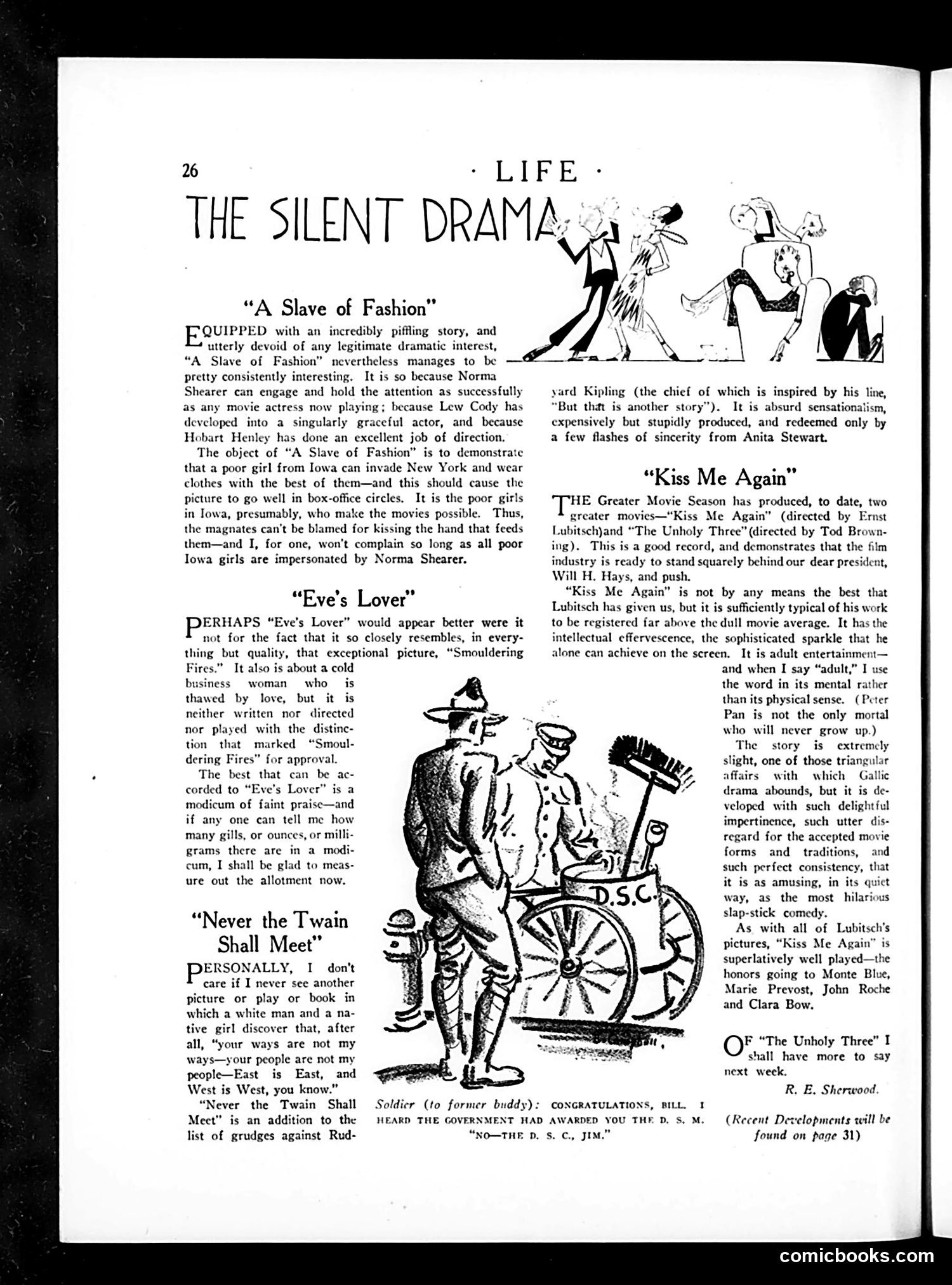
This page reviews four silent films. The critic praises **"A Slave of Fashion"** (starring Norma Shearer) as superficially thin but entertaining, noting the studio cynically targets poor Iowa farm girls as their core audience. **"Eve's Lover"** is dismissed as an inferior copy of the superior film "Smouldering Fires"—both feature the same plot (cold businesswoman melted by love). **"Never the Twain Shall Meet"** is attacked for recycling Rudyard Kipling's orientalist cliché about insurmountable cultural differences between white colonizers and native women, calling it "absurd sensationalism." **"Kiss Me Again"** (directed by Ernst Lubitsch) receives highest praise for adult sophistication and wit, despite its slight triangular love plot. The cartoon shows a soldier correcting another: the government awarded him the D.S.C. (Distinguished Service Cross), not the D.S.M.—a minor military decoration mix-up joke.
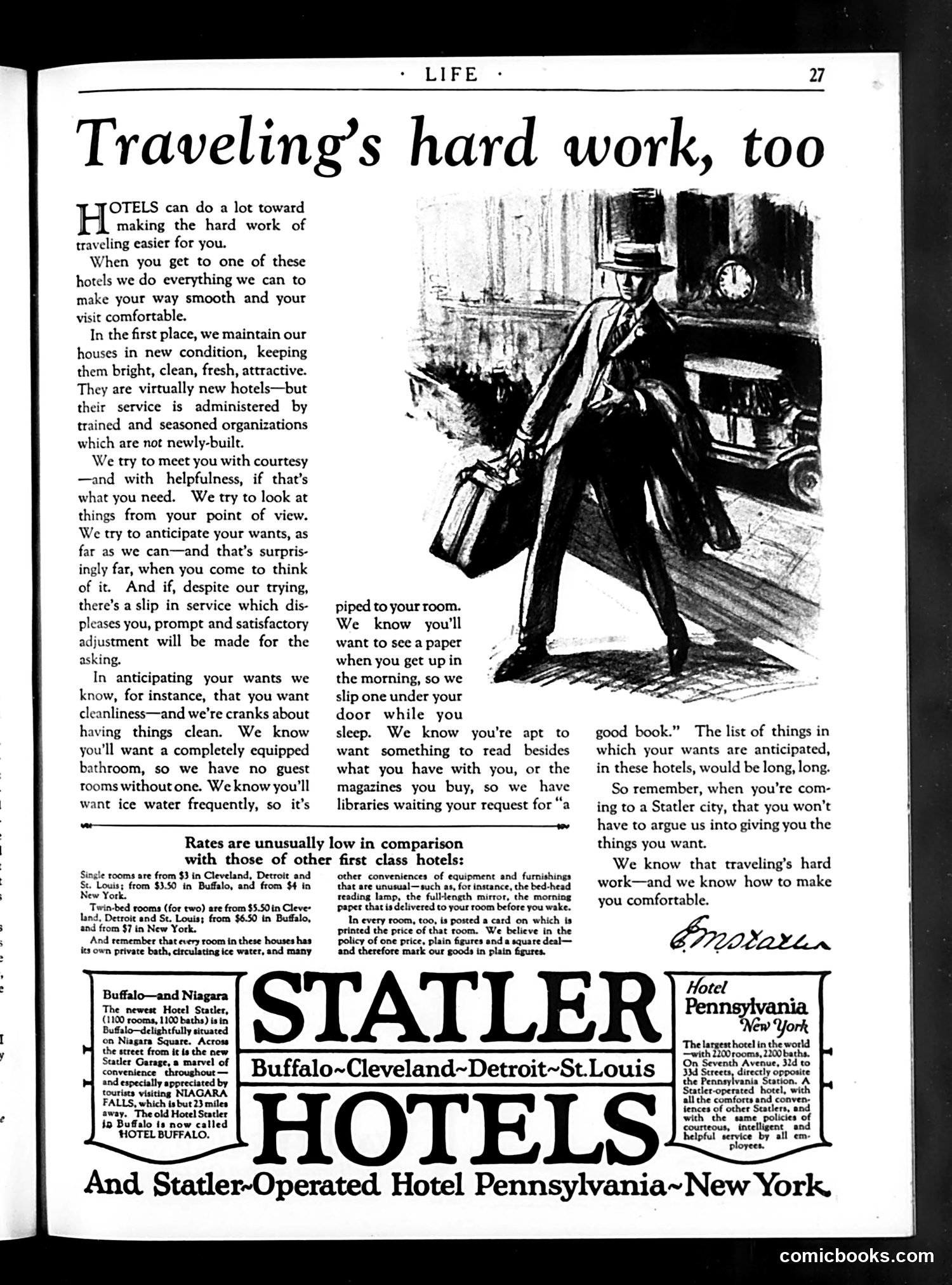
This page is **primarily advertising**, not satire. It's a Statler Hotels advertisement disguised as editorial content in Life magazine. The illustration shows a well-dressed traveling businessman arriving at a hotel with his luggage—a common visual shorthand for the modern business traveler of the early 20th century. The text is a first-person pitch from the hotel chain explaining their service philosophy: clean rooms, private bathrooms, ice water service, morning newspapers delivered under doors, and lending libraries. The appeal is to comfort and anticipation of guests' needs. The "satire" is gentle: the article's title, "Traveling's hard work, too," humorously acknowledges that even leisure or business travel requires effort, positioning the hotel as a solution to traveler fatigue. This is standard early advertising rhetoric—identifying a problem (exhausting travel) and offering comfort as the solution. The rates listed ($3-7 for rooms) are presented as "unusually low," targeting middle-to-upper-class travelers concerned with value during this era.
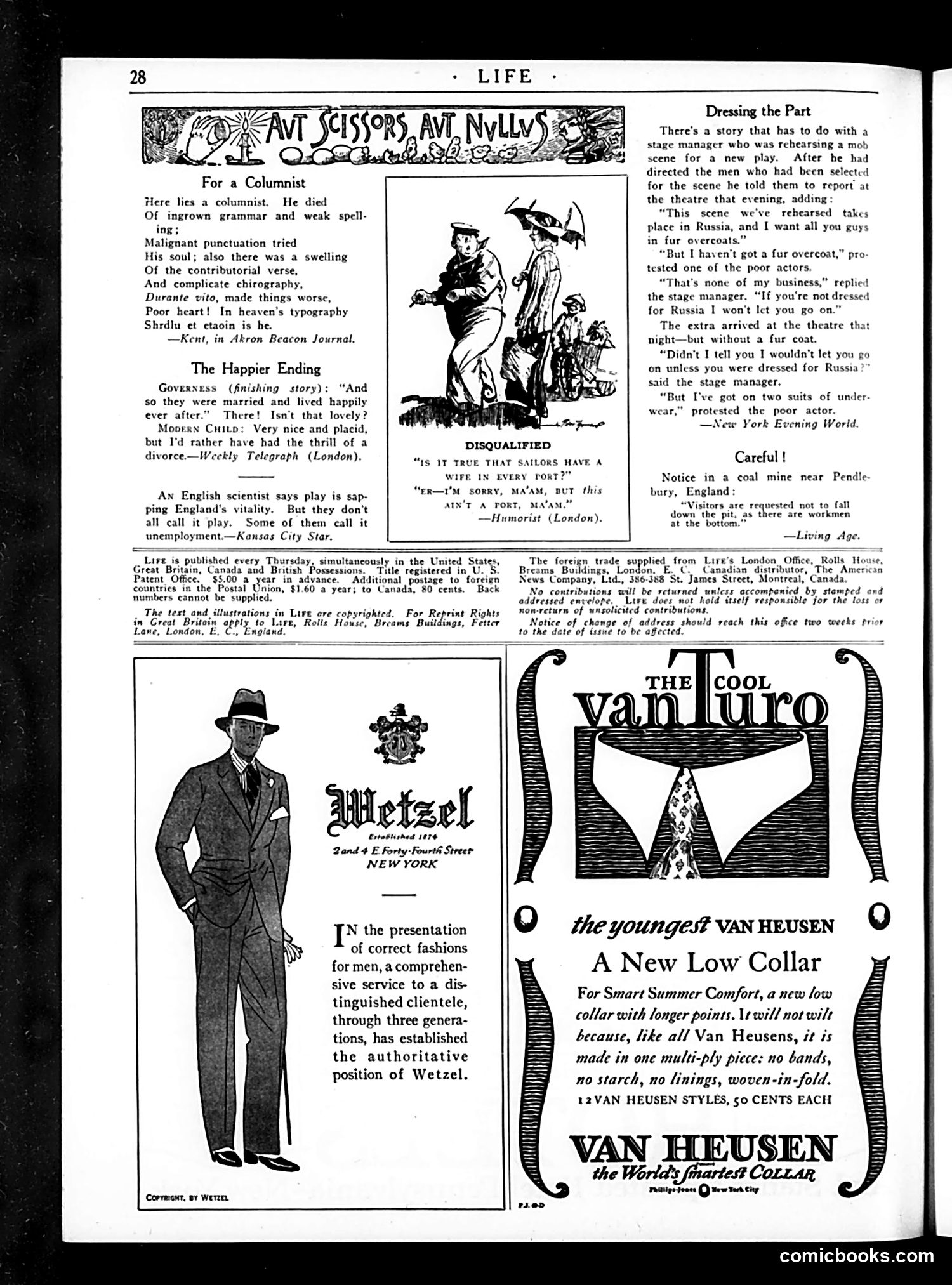
This page contains several short humorous pieces typical of Life's satirical style: **"For a Columnist"** is a mock obituary mocking poor editorial standards—misspelling, weak grammar, bad punctuation, and overly complex writing. It's a dig at contemporary journalists. **"Dressing the Part"** jokes about a stage manager's absurd literalism: he insists actors wear fur coats for a Russian scene, then refuses entry to an extra without one. The humor lies in the manager's inflexibility and the poor actor's resourcefulness (wearing two underwear suits instead). **"The Happier Ending"** presents a child preferring divorce drama to fairy-tale happiness—commentary on modern cynicism or changing values. The remaining items are brief quips: a scientist claims theatre weakens England; sailors supposedly have wives in every port (but not in the inland town where this conversation occurs); a coal mine posts an absurdly obvious safety notice. The page is largely filler material—short jokes and anecdotes from various publications—interspersed with period advertisements for Wetzel men's fashions and Van Heusen collars.
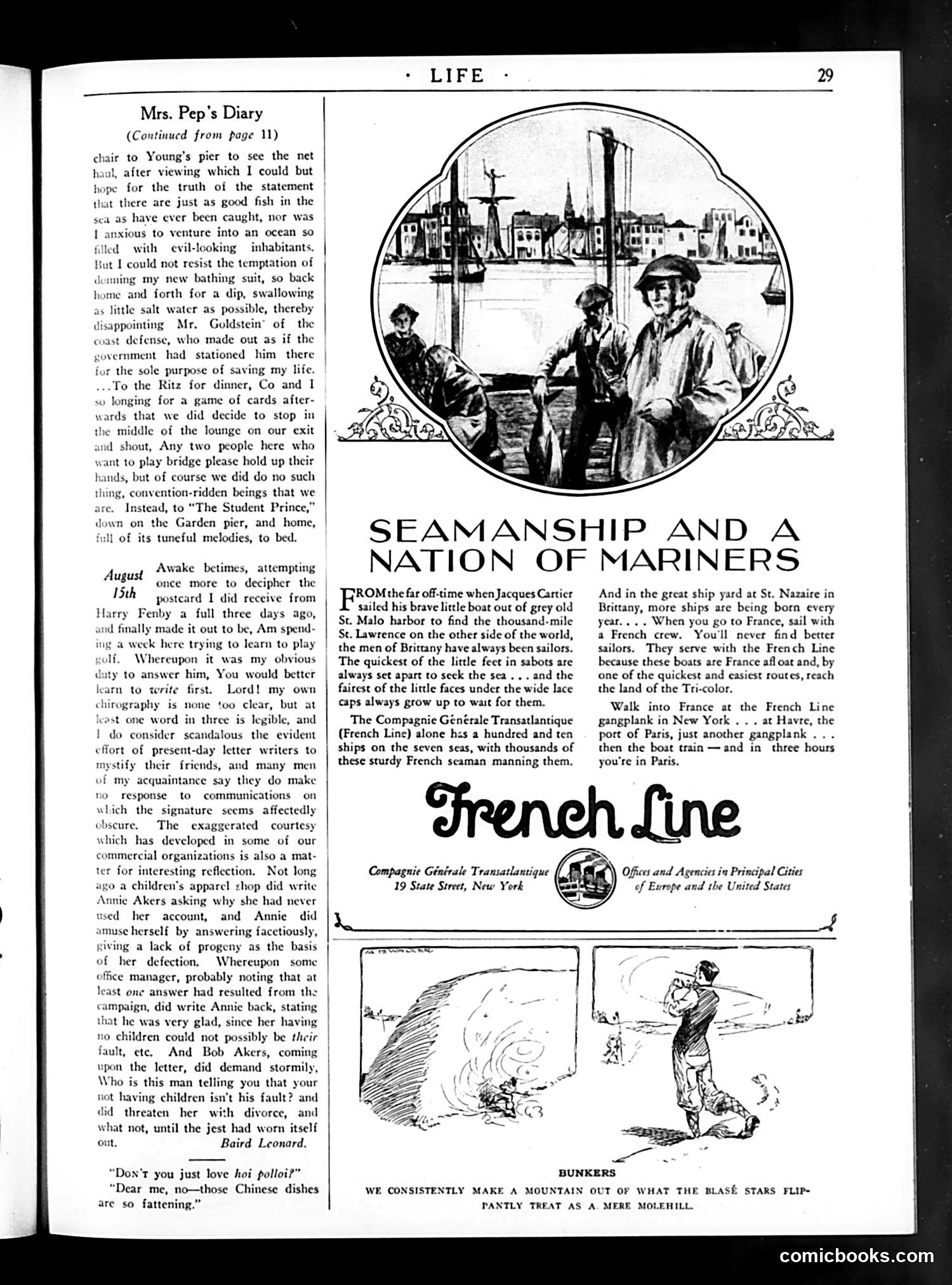
This page contains two distinct elements: **Mrs. Pep's Diary** (left column): A humorous personal account of summer social activities—bathing, dining at the Ritz, attending theater. The diary uses light satire to mock upper-class convention-consciousness and absurd polite behavior, such as a woman's facetious letter exchange with a store manager about her childlessness, which nearly causes marital discord. The final joke mocks pretentious use of French phrases ("hoi polloi"), with the punchline being ignorance about the phrase's meaning and association. **Seamanship and a Nation of Mariners**: A full-page advertisement for the French Line (Compagnie Générale Transatlantique). The ad romanticizes French maritime heritage dating to Jacques Cartier, emphasizing the company's fleet size and skilled French sailors. The illustration depicts sailors in a small boat near a harbor city. This is commercial advertising disguised as cultural content, promoting French ocean travel. The page blends light domestic satire with nationalist commercial messaging typical of 1920s American magazines.
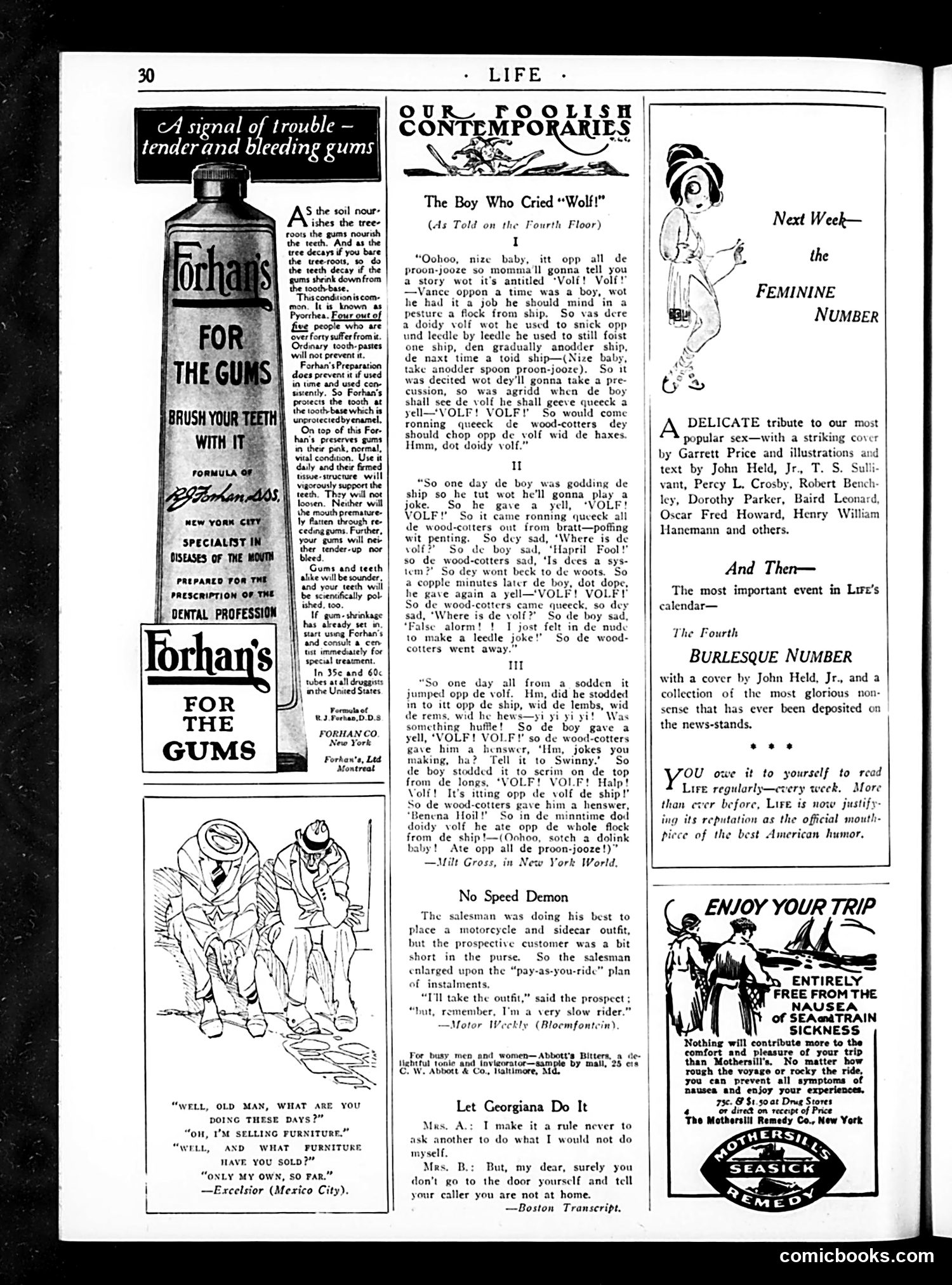
This page is primarily **advertising with light humor content**, typical of Life magazine's format. The main advertisement (left side) promotes **Forhan's toothpaste for gum disease**, describing pyorrhea—a then-common dental condition affecting older adults. The copy emphasizes scientific prevention, reflecting early 20th-century marketing that leveraged medical authority. The central humor piece, **"The Boy Who Cried Wolf"** (retold by humorist Milt Gross), uses **heavy Yiddish-inflected dialect** for comedic effect. This was standard comedic practice of the era, though such caricatured "immigrant dialect" humor would be considered offensive today. The story follows the classic fable but renders it in exaggerated accent to amuse contemporary readers familiar with Jewish immigrant communities. The bottom cartoon is a brief **joke about installment purchasing**—the salesman pitches a motorcycle using the "pay-as-you-ride" plan, playing on financial struggles during economically uncertain times. The page reflects early 20th-century American attitudes toward ethnicity, dentistry, and consumer credit.
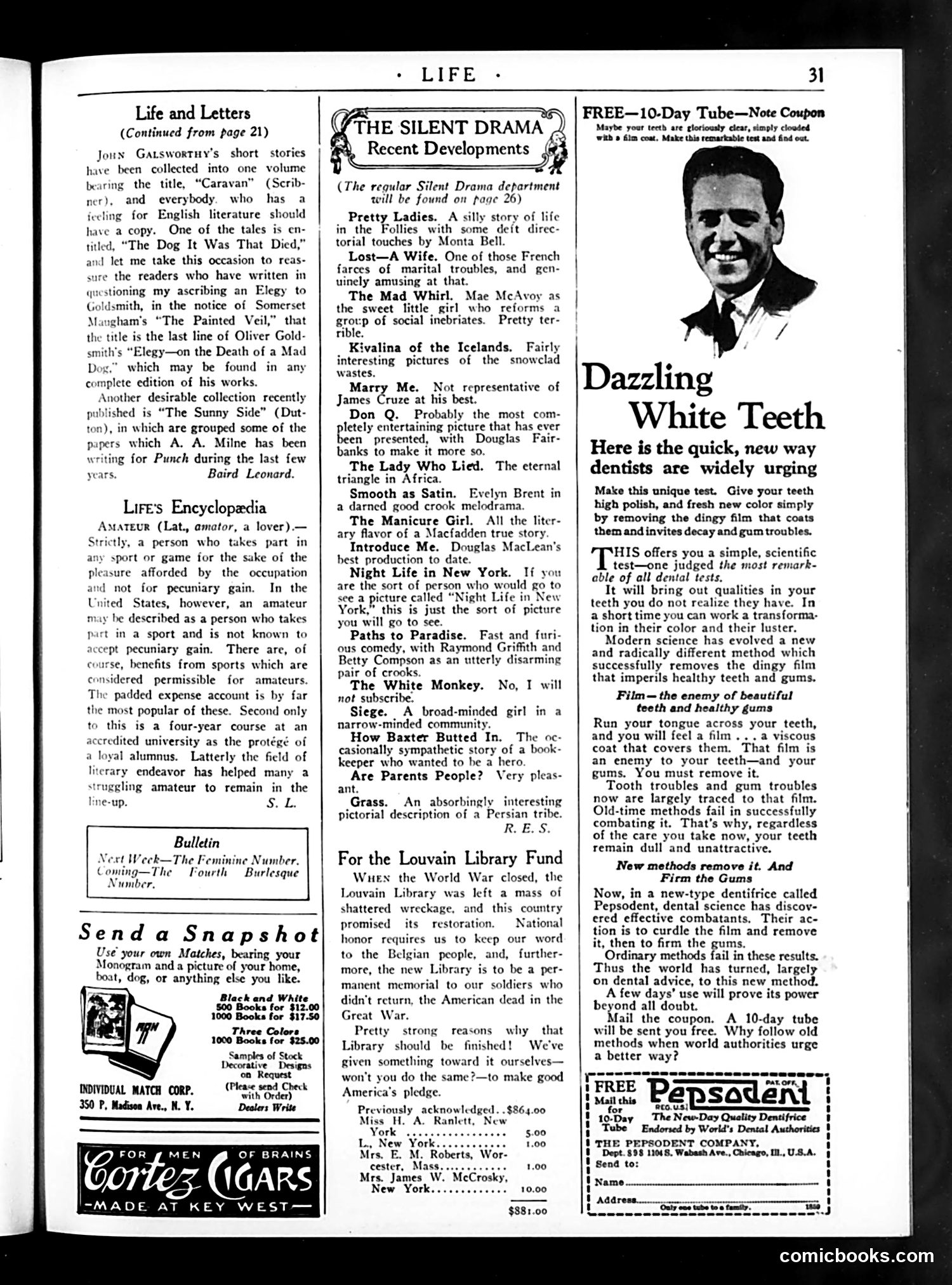
This page is primarily **book/film reviews and advertisements** rather than political cartoons. The main content includes: 1. **Literary reviews** of John Galsworthy's short story collection "Caravan" and A.A. Milne's "The Sunny Side" 2. **Life's Encyclopedia entry** on "Amateur"—a satirical definition mocking American sports culture, specifically the "padded expense account" and four-year university scholarships given to athletes by alumni, presented as hypocritical loopholes to the amateur ideal 3. **"The Silent Drama"** section reviewing silent films, including titles with Douglas Fairbanks and Mae McAvoy 4. **Advertisements** for match printing services and Cortez cigars 5. **Right column**: A Pepsodent toothpaste advertisement featuring a headshot photograph and marketing copy about teeth whitening The satirical definition of "amateur" is the only genuinely editorial content—mocking how American institutions circumvent amateurism rules through indirect payments to athletes.
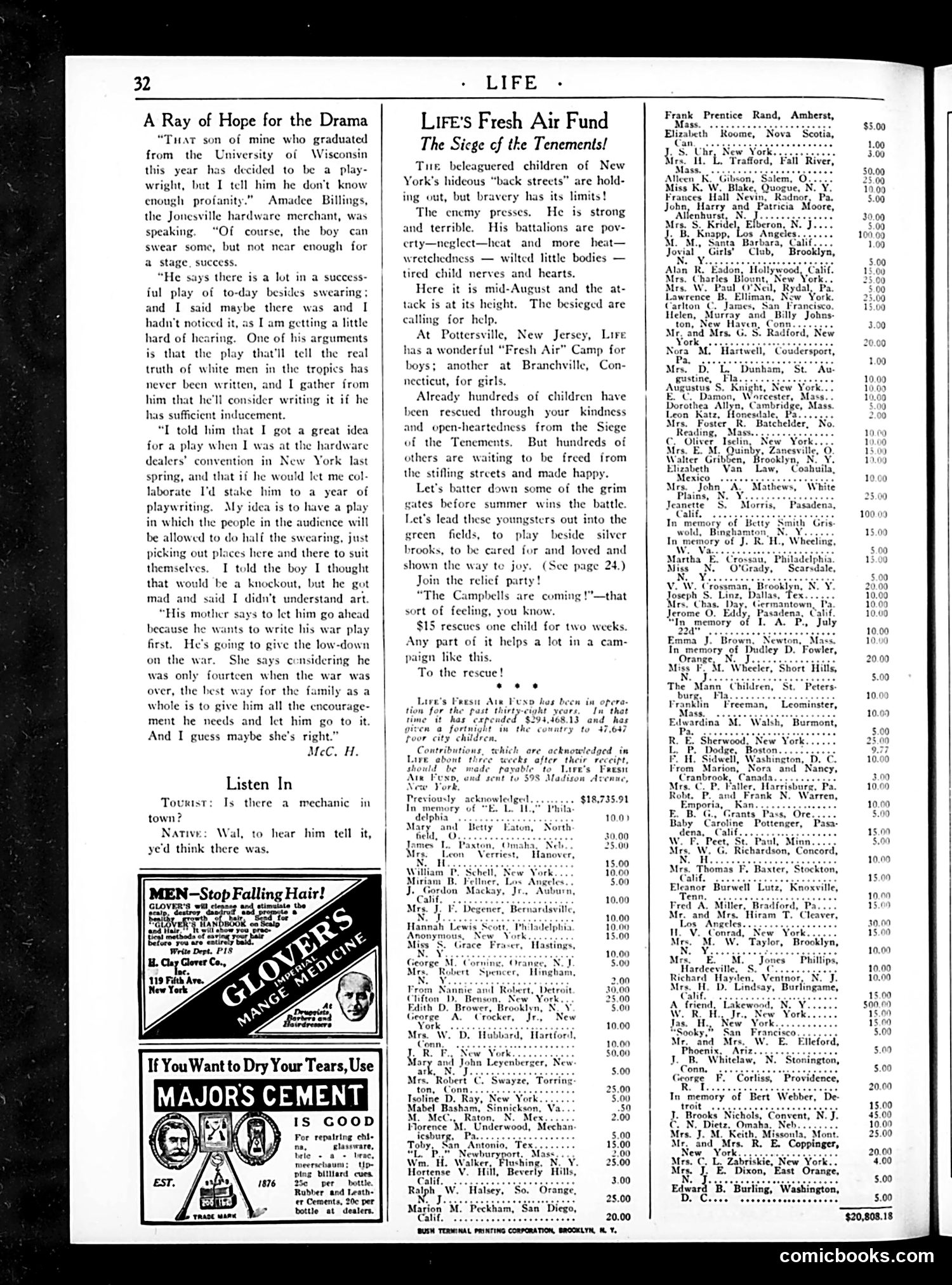
This page from *Life* magazine contains primarily **fundraising content** rather than political satire. The dominant feature is "Life's Fresh Air Fund," a charitable appeal for poor children trapped in New York tenements during summer heat. The campaign uses dramatic language—describing poverty as a literal "siege" with "battalions" of neglect and heat attacking defenseless children. It solicits $15 donations to send one child to countryside camps in New Jersey or Connecticut for two weeks of relief. The page also includes a humorous anecdote titled "A Ray of Hope for the Drama," where a small-town hardware merchant discusses his college-graduate son's playwriting ambitions, joking that modern stage success requires excessive profanity and war stories. This gently mocks both contemporary dramatic trends and provincial American attitudes toward art. Small advertisements for "Glover's Mange Medicine" and "Major's Cement" fill remaining space—typical period advertising. The substantial donation list ($18,735.91 raised) suggests this was a serious fundraising effort, likely from the 1910s-1920s when tenement conditions were a prominent social concern.
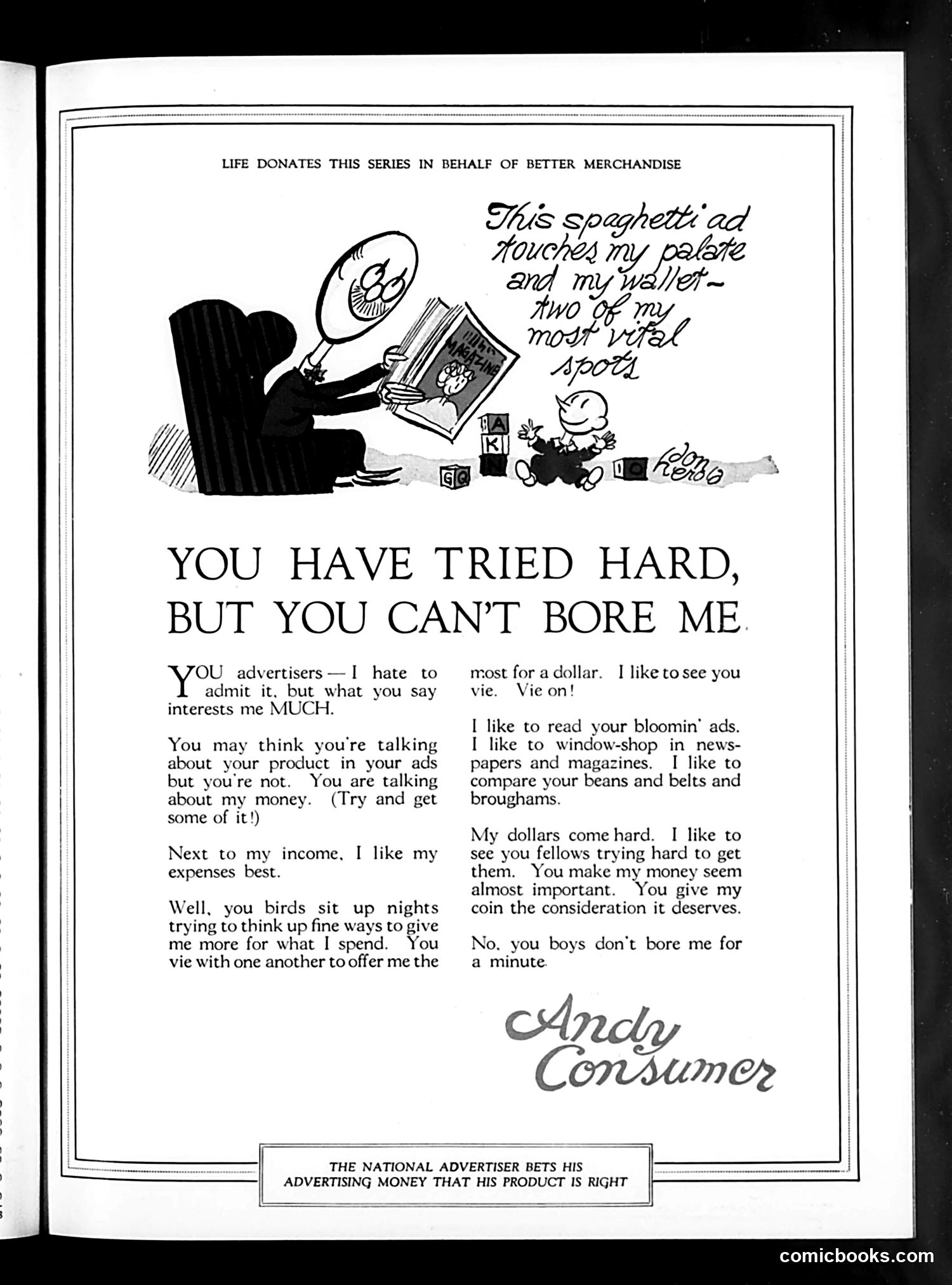
This is a satirical advertisement from *Life* magazine celebrating advertising and consumer culture. The piece personifies "Andy Consumer"—an everyman figure shown reading ads while surrounded by toys and products. The satire targets advertisers' self-perception. Rather than promoting products directly, Andy argues that ads actually appeal to consumers' financial interests and desire for value. He praises advertisers for competing to offer "the most for a dollar" and for treating consumer spending as worthy of serious consideration. The humor lies in the inversion: Andy claims advertisers don't bore him because they're essentially flattering him by treating his money as important. The footer suggests advertisers "bet" their budgets on product quality. This appears to be part of *Life*'s "Better Merchandise" campaign promoting honest advertising. The piece satirizes both consumer vanity and advertising claims, while ultimately endorsing competitive consumer capitalism as mutually beneficial.
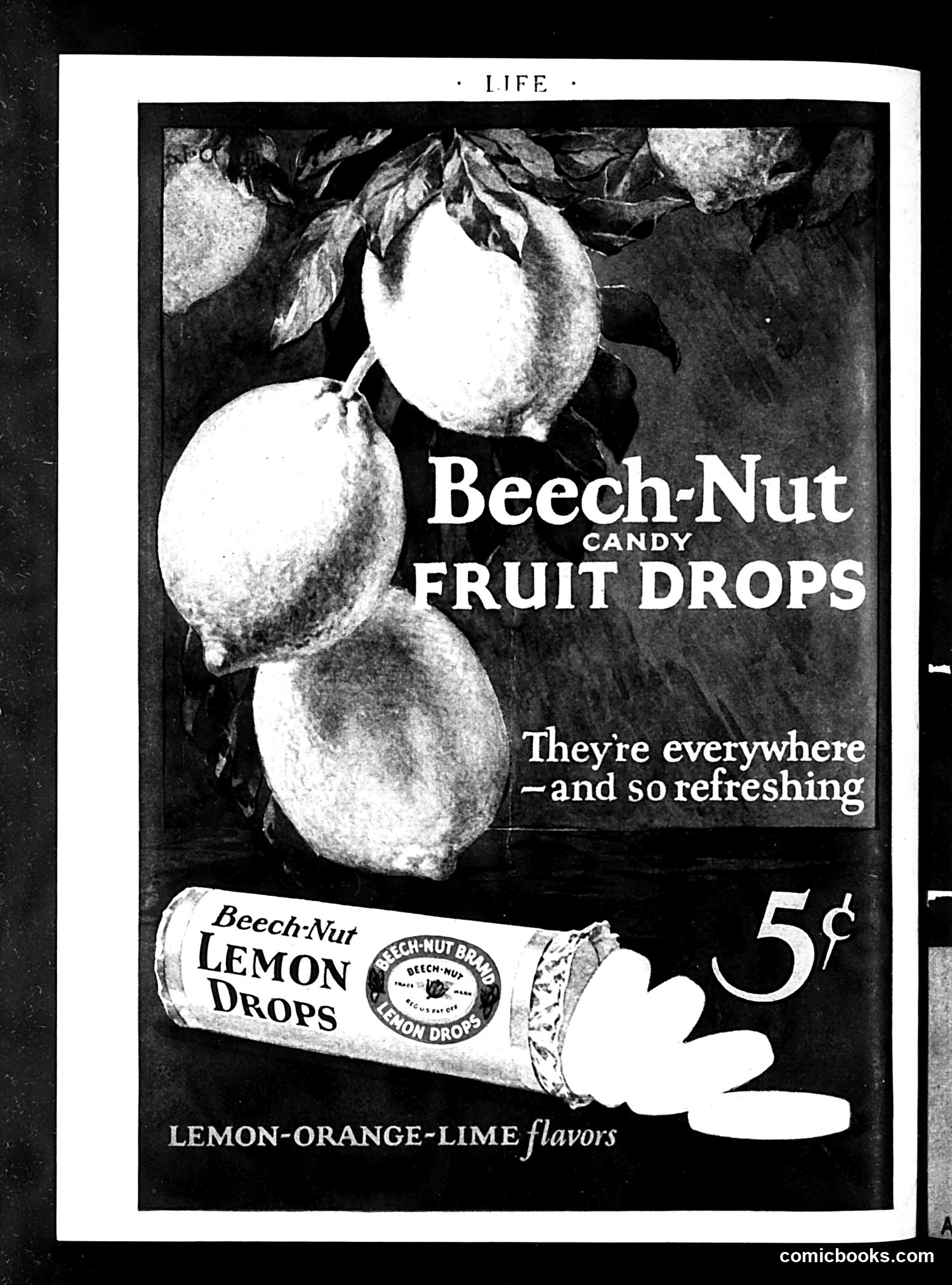
This is a **vintage advertisement**, not a political cartoon. It promotes Beech-Nut brand candy fruit drops at 5 cents, featuring lemon, orange, and lime flavors. The ad uses an attractive photograph of pears on a branch to evoke freshness and natural fruit flavor. Below is an image of the actual candy product in its wrapper. The tagline "They're everywhere—and so refreshing" suggests the candy's widespread availability and appeal. There is no satire, political commentary, or caricature present. This is straightforward commercial advertising typical of early-to-mid 20th century product promotion in *Life* magazine, relying on appetizing imagery and simple messaging to drive consumer interest in an inexpensive confection.