
Life, 1925-08-20 · page 8 of 36
Life — August 20, 1925 — page 8: what you’re looking at
What you’re looking at
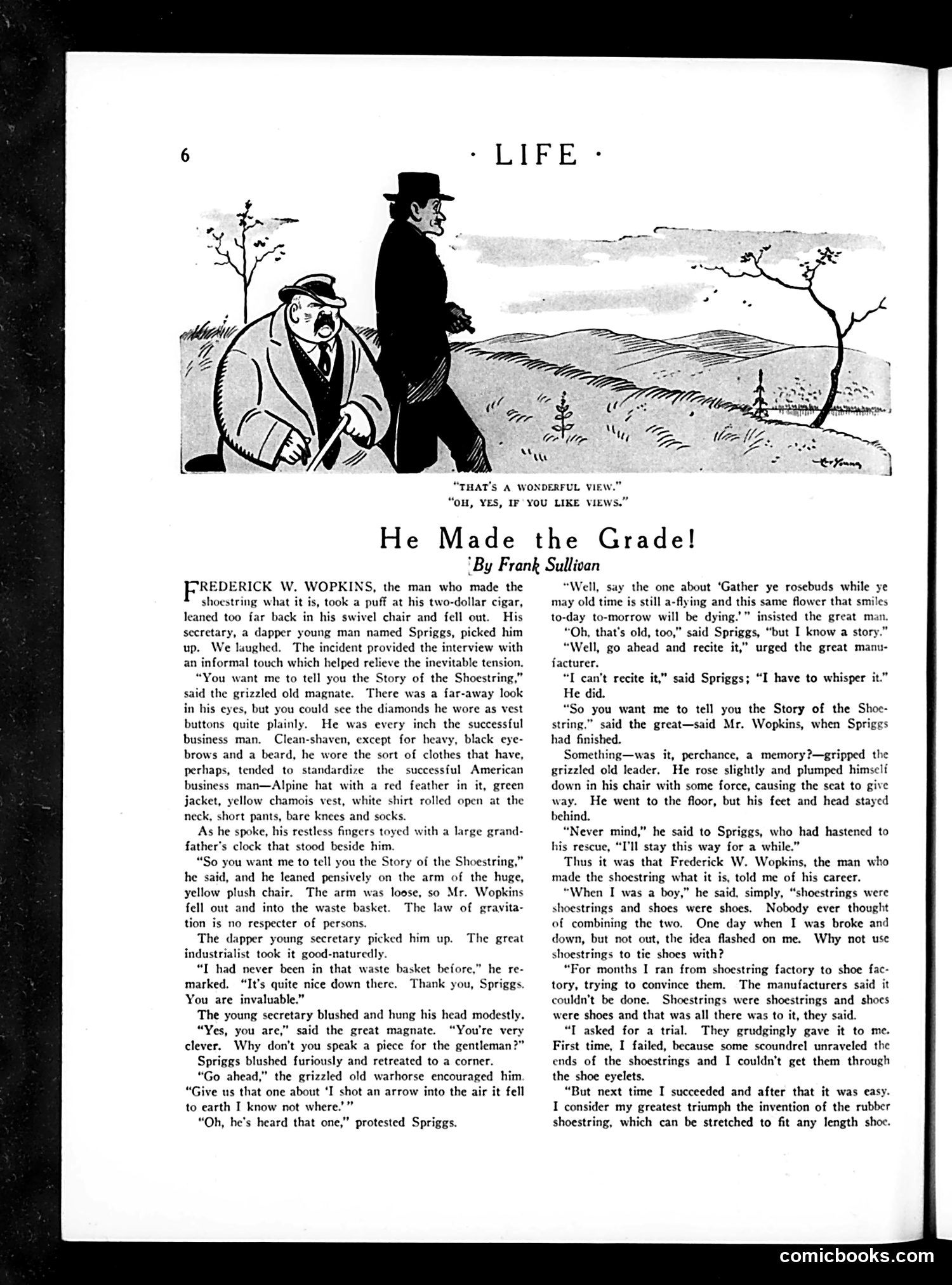
This page presents a short story by Frank Sullivan about Frederick W. Wopkins, a successful industrialist who invented the shoesting. The accompanying cartoon depicts two men in conversation about a landscape view. The story satirizes American business culture and the "self-made man" narrative. Wopkins, described as wearing fashionable clothes and having "clean-shaven" appearance (except for a beard), represents the successful entrepreneur. The humor centers on his invention of the rubber shoestring—a mundane, practical product—being presented as a major industrial triumph worthy of storytelling. The narrative mocks how American businessmen mythologize ordinary innovations and their own careers, turning simple problem-solving (combining shoestrings with shoes) into grand tales of entrepreneurial triumph. It's gentle satire of business boastfulness and the American success story.
📄 Transcribed text from this page (OCR, searchable)
Machine-transcribed from the original scan — historical spelling and the odd misread are preserved.
He Made the Grade! ‘By Frank Sullioan REDERICK W. WOPKINS, the man who made the shoestring what it is, took a puff at his two-dollar cigar, leaned too far back in his swivel chair and fell out. His secretary, a dapper young man named Spriggs, picked him up. We laughed. The incident provided the interview with an informal touch which helped relieve the inevitable tension, “You want me to tell you the Story of the Shoestring,” said the grizzled old magnate. There was a far-away look in his eyes, but you could see the diamonds he wore as vest buttons quite plainly. He was every inch the successful business man. Clean-shaven, except for heavy, black eye- brows and a beard, he wore the sort of clothes that have, perhaps, tended to standardize the successful American business man—Alpine hat with a red feather in it, green jacket, yellow chamois vest, white shirt rolled open at the neck, short pants, bare knees and socks. As he spoke, his restless fingers toyed with a large grand- father’s clock that stood beside him. “So you want me to tell you the Story of the Shoestring,” he said, and he leaned pensively on the arm of the huge, yellow plush chair, The arm was loose, so Mr. Wopkins fell out and into the waste basket. The law of gravita- tion is no respecter of persons. The dapper young secretary picked him up. The great industrialist took it good-naturedly. “I had never been in that waste basket before,” he re- marked. “It’s quite nice down there. Thank you, Spriggs. You are invaluable.” The young secretary blushed and hung his head modestly. “Yes, you are,” said the great magnate. “You're very clever. Why don’t you speak a piece for the gentleman?” Spriggs blushed furiously and retreated to a corner. “Go ahead,” the grizzled old warhorse encouraged him “Give us that one about ‘I shot an arrow into the air it fell to earth I know not where.’” “Oh, he's heard that one,” protested Spriggs. “Well, say the one about ‘Gather ye rosebuds while ye may old time is still a-flying and this same flower that smiles to-day to-morrow will be dying.’” insisted the great man. “Oh, that's old, too,” said Spriggs, “but I know a story.” “Well, go ahead and recite it,” urged the great manu- facturer. “I can't recite it,” said Spriggs; He did. “So you want me to tell you the Story of the Shoe- string.” said the great—said Mr. Wopkins, when Spriggs had finished. Something—was it, perchance, a memory?—gripped the grizzled old leader. He rose slightly and plumped himscli down in his chair with some force, causing the seat to give way. He went to the floor, but his feet and head stayed behind. ever mind,” he said to Spriggs, who had hastened to his rescue, “I'll stay this way for a while.” Thus it was that Frederick W. Wopkins, the man who made the shoestring what it is, told me of his career. “When I was a boy,” he said, simply, “shoestrings were shoestrings and shoes were shoes. Nobody ever thought of combining the two. One day when I was broke and down, but not out, the idea flashed on me. Why not use shoestrings to tie shoes with? “For months I ran from shoestring factory to shoe fac- tory, trying to convince them. The manufacturers said it couldn't be done. Shoestrings were shoestrings and shoes were shoes and that was all there was to it, they said. “T asked for a trial. They grudgingly gave it to me. First time, I failed, because some scoundrel unraveled the ends of the shoestrings and I couldn't get them through the shoe eyelets. “But next time I succeeded and after that it was easy. I consider my greatest triumph the invention of the rubber shoestring, which can be stretched to fit any length shoe. ‘I have to whisper it.” comicbooks.com