
Life, 1925-08-20 · page 20 of 36
Life — August 20, 1925 — page 20: what you’re looking at
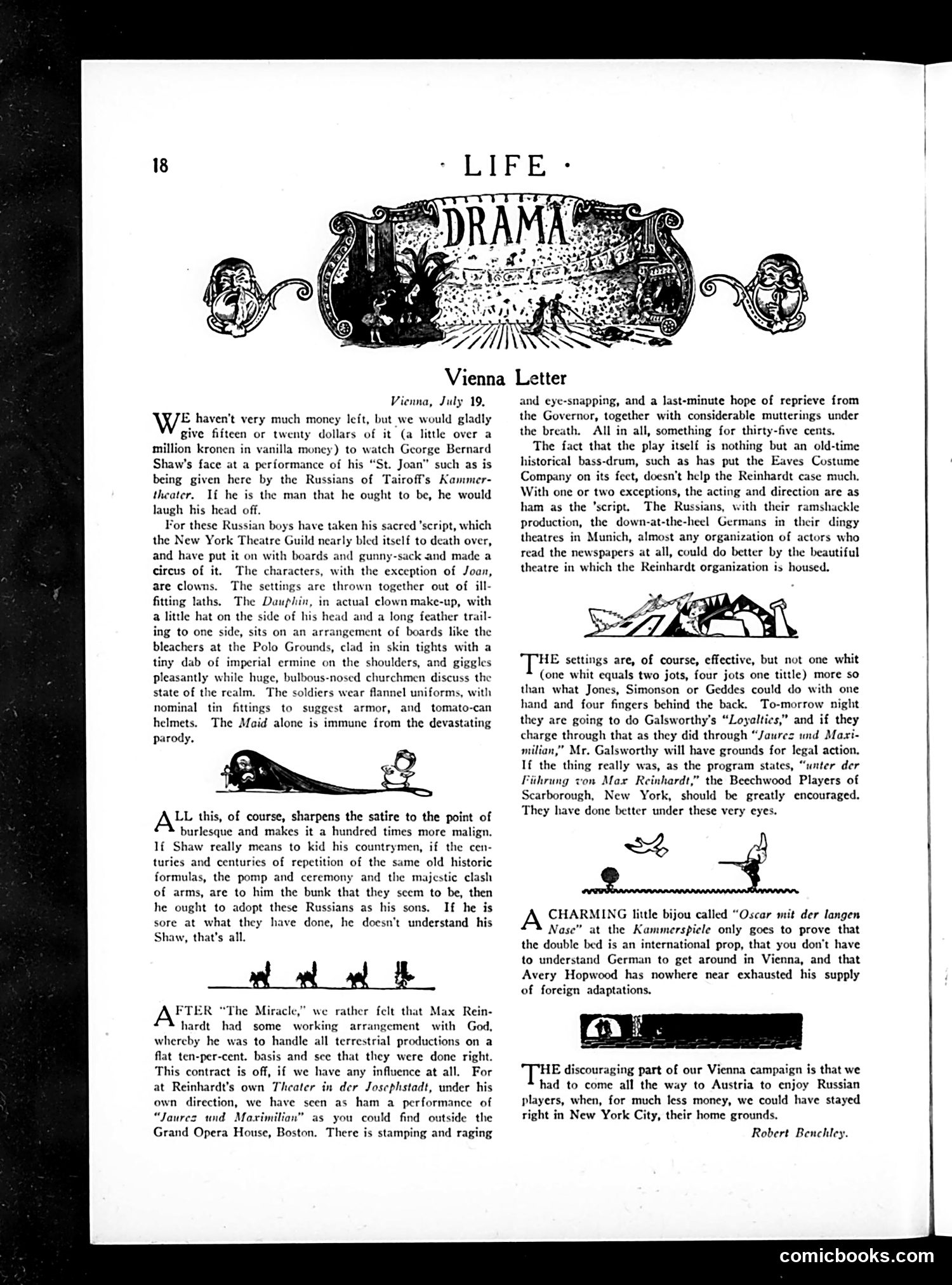
What you’re looking at
This page critiques Russian and Austrian theatrical productions in post-WWI Vienna. The author praises a Russian production of Shaw's *St. Joan* at the Kammerspiele, directed by Tairoff, for its irreverent approach—treating the play as burlesque with clownish characters and crude sets. The satire suggests Shaw himself would approve of mocking historical pretension. By contrast, the author attacks Max Reinhardt's *Juarez and Maximilian* at Vienna's Theater in der Josephstadt as overblown and amateurish despite lavish production values. The piece argues that even amateur companies (like Scarborough's Beechwood Players) execute better stagecraft. The underlying point: substance matters more than expensive spectacle. Russian irreverence and directness outperforms Austrian grandeur. This reflects post-war skepticism toward old theatrical conventions and wealthy producers' pretensions.
📄 Transcribed text from this page (OCR, searchable)
Machine-transcribed from the original scan — historical spelling and the odd misread are preserved.
Vienna, July 19, WE haven't very much money left, but we would gladly give fifteen or twenty dollars of it (a little over a million kronen in vanilla money) to watch George Bernard Shaw's face at a performance of his “St. Joan” such as is being given here by the Russians of Tairoff's Kammer- theater. If he is the man that he ought to be, he would laugh his head off. For these Russian boys have the New York Theatre Guild n and have put it on with board: circus of it. The characters, with the exception of Joan, are clowns. The settings are thrown together out of ill- fitting laths. The Daupiin, in actual clown make-up, with a little hat on the side of his head and a long feather trail- ing to one side, sits on an arrangement of boards like the bleachers at the Polo Grounds, clad in skin tights with a tiny dab of imperial ermine on the shoulders, and giggles pleasantly while huge, bulbous-nosed churchmen discuss the state of the realm. The soldiers wear flannel uniforms, with nominal tin fittings to suggest armor, and tomato-can helmets. The Maid alone is immune from the devastating parody, aken his sacred ‘script, which rly bled itself to death over, 1 gunny-sack and made a LL this, of course, sharpens the satire to the point of burlesque and makes it a hundred times more malign. 1f Shaw really means to kid his countrymen, if the cen- turies and centuries of repetition of the same old historic formulas, the pomp and ceremony and the majestic clash of arms, are to him the bunk that they scem to be, then he ought to adopt these Russians as his sons. If he is sore at what they have done, he doesn't understand his Shaw, that’s all. _ wo ig we 2 FTER “The Miracle,” we rather felt that Max Rein- hardt had some working arrangement with God, whereby he was to handle all terrestrial productions on a flat ten-per-cent. basis and sce that they were done right. This contract is off, if we have any influence at all. For at Reinhardt’s own Theater in der Josephstadt, under his own direction, we have seen as ham a performance of “Jaurez wid Maximilian” as you could find outside the Grand Opera House, Boston. There is stamping and raging Vienna Letter and eye-snapping, and a last-minute hope of reprieve from the Governor, together with considerable mutterings under the breath. All in all, something for thirty-five cents. The fact that the play itself is nothing but an old-time historical bass-drum, such as has put the Eaves Costume Company on its fect, doesn’t help the Reinhardt case much, With one or two exceptions, the acting and direction are as ham as the ‘script. The Russians, with their ramshackle production, the down-at-the-heel Germans in their dingy theatres in Munich, almost any organization of actors who read the newspapers at all, could do better by the beautiful theatre in which the Reinhardt organization is housed. THE settings are, of course, effective, but not one whit (one whit equals two jots, four jots one tittle) more so than what Jones, Simonson or Geddes could do with one hand and four fingers behind the back. To-morrow night they are going to do Galsworthy’s “Loyalties,” and if they charge through that as they did through “Jaurez und Maxi- milian,” Mr. Galsworthy will have grounds for legal action. If the thing really was, as the program states, “wtter der Fithrung von Max Reinhardt,” the Beechwood Players of Scarborough, New York, should be greatly encouraged. They have done better under these very eyes. 3% A CHARMING little bijou called “Oscar mit der langen Nase” at the Kammerspicle only goes to prove that the double bed is an international prop, that you don’t have to understand German to get around in Vienna, and that Avery Hopwood has nowhere near exhausted his supply of foreign adaptations. THE discouraging part of our Vienna campaign is that we had to come all the way to Austria to enjoy Russian players, when, for much less money, we could have stayed right in New York City, their home grounds. Robert Benchley. comicbooks.com