
Life, 1925-08-20 · page 28 of 36
Life — August 20, 1925 — page 28: what you’re looking at
What you’re looking at
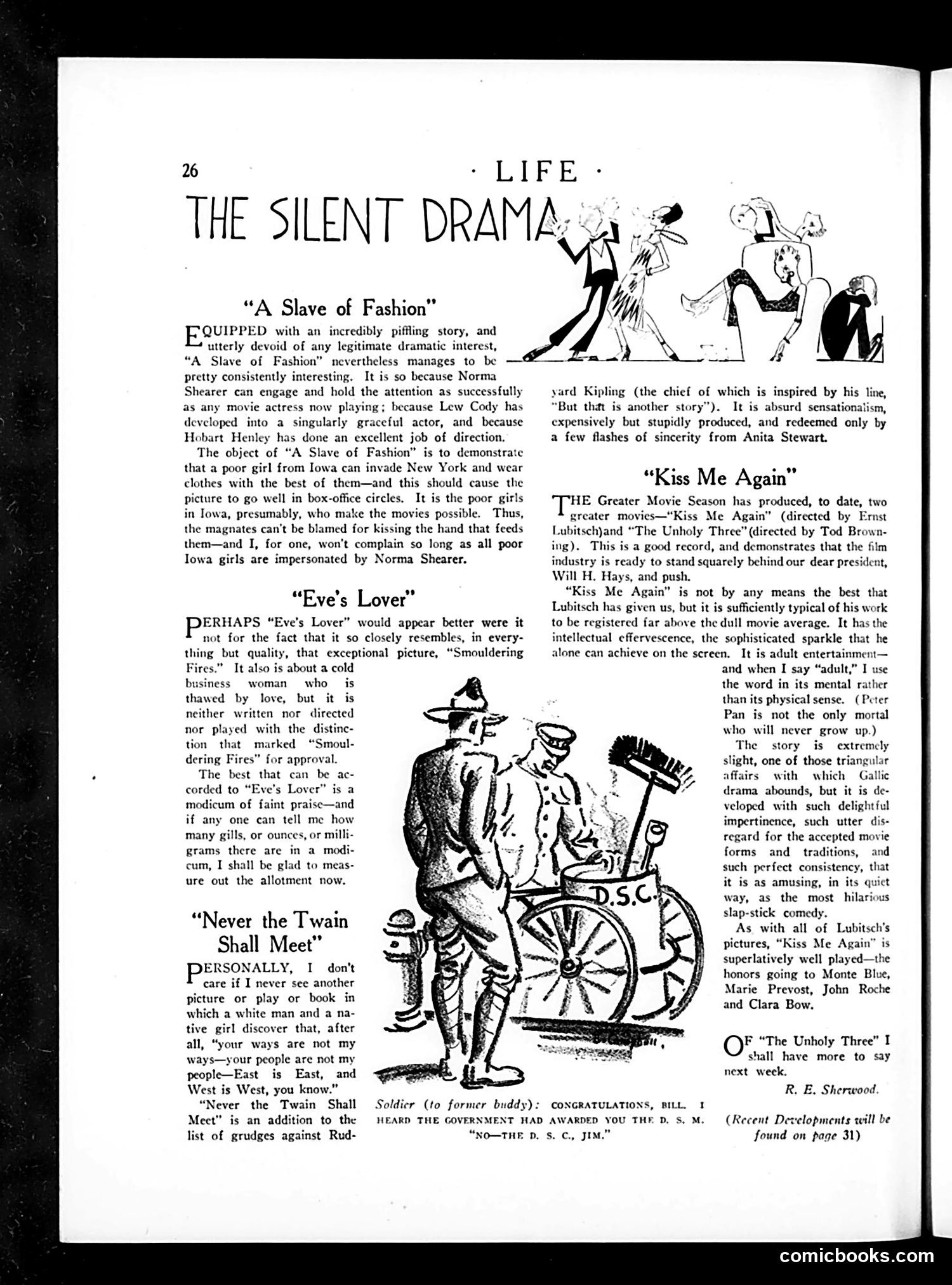
This page reviews four silent films. The critic praises **"A Slave of Fashion"** (starring Norma Shearer) as superficially thin but entertaining, noting the studio cynically targets poor Iowa farm girls as their core audience. **"Eve's Lover"** is dismissed as an inferior copy of the superior film "Smouldering Fires"—both feature the same plot (cold businesswoman melted by love). **"Never the Twain Shall Meet"** is attacked for recycling Rudyard Kipling's orientalist cliché about insurmountable cultural differences between white colonizers and native women, calling it "absurd sensationalism." **"Kiss Me Again"** (directed by Ernst Lubitsch) receives highest praise for adult sophistication and wit, despite its slight triangular love plot. The cartoon shows a soldier correcting another: the government awarded him the D.S.C. (Distinguished Service Cross), not the D.S.M.—a minor military decoration mix-up joke.
📄 Transcribed text from this page (OCR, searchable)
Machine-transcribed from the original scan — historical spelling and the odd misread are preserved.
“A Slave of Fashion” FQuipPeD with an incredibly piffling story, and utterly devoid of any legitimate dramatic interest, “A Slave of Fashion” nevertheless manages to be — pretty consistently interesting. It is so because Norma Shearer can engage and hold the attention as successfully as any movie actress now playing; because Lew Cody has developed into a singularly graceful actor, and because Hobart Henley has done an excellent job of direction. The object of “A Slave of Fashion” is to demonstrate that a poor girl from Iowa can invade New York and wear clothes with the best of them—and this should cause the picture to go well in box-office circles. It is the poor girls in Iowa, presumably, who make the movies possible. Thus, the magnates can’t be blamed for kissing the hand that feeds them—and I, for one, won't complain so long as all poor Iowa girls are impersonated by Norma Shearer. “Eve's Lover” ERHAPS “Eve's Lover” would appear better were it not for the fact that it so closely resembles, in every- thing but quality, that exceptional picture, “Smouldering Fires.” It also is about a cold business woman who is thawed by love, but it is neither written nor directed nor played with the distine- that marked “Smoul- dering Fires” for approval. The best that can be ac- corded to “Eve's Lover” is a modicum of faint praisc—and if any one can tell me how many gills, or ounces, or milli- grams there are in a modi- cum, I shall be glad to meas- ure out the allotment now. tion “Never the Twain Shall Meet” PERSONALLY, I don't care if I never see another picture or play or book in which a white man and a na- tive girl discover that, after all, “your ways are not my ways—your people are not my people—East is East, and West is West, you know.” “Never the Twain Shall Mect” is an addition to the list of grudges against Rud- Soldier (to former buddy): HEARD THE GOVERNMENT HAD AWARDED YOU THF D. S, M, “NO—THE D. S. C., JIM.” yard Kipling (the chief of which is inspired by his line, “But that is another story”). It is absurd sensationalism, expensively but stupidly produced, and redeemed only by a few flashes of sincerity from Anita Stewart. “Kiss Me Again” HE Greater Movie Season has produced, to date, two greater movics- ss Me Again” (directed by Ernst Lubitsch)and “The Unholy Three” (directed by Tod Brown- ing). This is a good record, and demonstrates that the film industry is ready to stand squarely behind our dear president, Will H. Hays, and push. “Kiss Me Again” is not by any means the best that Lubitsch has given us, but it is sufficiently typical of his work to be registered far above the dull movie average. It has the intellectual effervescence, the sophisticated sparkle that he alone can achieve on the screen. It is adult entertainment— and when I say “adult,” I use the word in its mental rather than its physical sense. (Peter Pan is not the only mortal who will never grow up.) The story is extremely slight, one of those triangular affairs with which Gallic drama abounds, but it is de- veloped with such delightful impertinence, such utter dis- regard for the accepted movie forms and _ traditions, and such perfect consistency, that it is as amusing, in its quict way, as the most hilarious slap-stick comedy. As _ with all of Lubitsch’s pictures, “Kiss Me Again” is superlatively well played—the honors going to Monte Blue, Marie Prevost, John Roche and Clara Bow. F “The Unholy Three” I shall have more to say next week, R. E. Sherwood. CONGRATULATIONS, BILL. I (Recent Developments will be found on page 31) comicbooks.com