
Life, 1925-08-20 · page 23 of 36
Life — August 20, 1925 — page 23: what you’re looking at
What you’re looking at
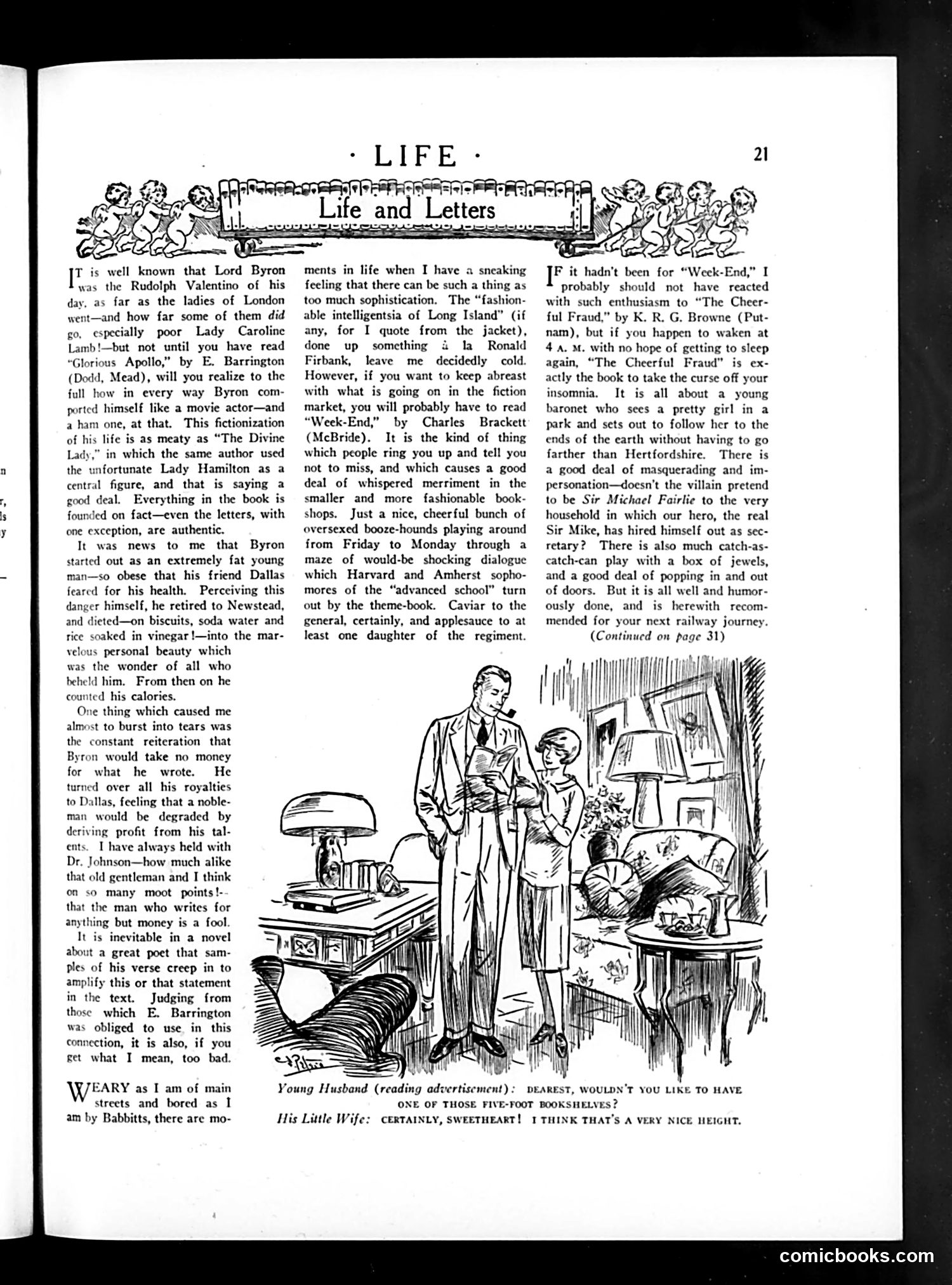
This page contains a literary review column discussing three contemporary novels. The main text reviews E. Barrington's "Glorious Apollo" (a Byron biography), Charles Brackett's "Week-End," and K.R.G. Browne's "The Cheerful Fraud." The accompanying cartoon satirizes domestic consumerism. A husband reads an advertisement to his wife while she reclines, discussing five-foot bookshelves as home décor. The joke targets early 20th-century affluent Americans' embrace of conspicuous consumption—displaying tall bookshelves as fashionable furniture rather than for actual reading. The reviewer adopts a sardonic, sophisticated tone, mocking literary pretension while simultaneously defending commercial writing (disagreeing with Byron's noble refusal of royalties). The overall page reflects 1920s-era cultural anxieties about modernism, sophistication, and middle-class aspiration.
📄 Transcribed text from this page (OCR, searchable)
Machine-transcribed from the original scan — historical spelling and the odd misread are preserved.
cree Le' Litetand Sec oe [ is well known that Lord Byron was the Rudolph Valentino of his day, as far as the ladies of London went—and how far some of them did go, especially poor Lady Caroline Lamb!—but not until you have read “Glorious Apollo,” by E. Barrington (Dodd, Mead), will you realize to the full how in every way Byron com- ported himself like a movie actor—and a ham one, at that. This fictionization of his life is as meaty as “The Divine Lady,” in which the same author used the unfortunate Lady Hamilton as a central figure, and that is saying a good deal, Everything in the book is founded on fact—even the letters, with one exception, are authentic. It was news to me that Byron started out as an extremely fat young man—so obese that his friend Dallas feared for his health. Perceiving this danger himself, he retired to Newstead, and dieted—on biscuits, soda water and tice soaked in vinegar !—into the mar- velous personal beauty which was the wonder of all who beheld him. From then on he counted his calories. One thing which caused me almost to burst into tears was the constant reiteration that Byron would take no money for what he wrote. He turned over all his royalties to Dallas, feeling that a noble- man would be degraded by deriving profit from his tal- ents. I have always held with Dr. Johnson—how much alike that old gentleman and I think on so many moot points !- that the man who writes for anything but money is a fool. It is inevitable in a novel about a great poet that sam- ples of his verse creep in to amplify this or that statement in the text. Judging from those which E. Barrington was obliged to use in this connection, it is also, if you get what I mean, too bad. EARY as I am of main streets and bored as I am by Babbitts, there are mo- ments in life when I have a sneaking feeling that there can be such a thing as too much sophistication. The “fashion- able intelligentsia of Long Island” (if any, for I quote from the jacket), done up something 4 la Ronald Firbank, leave me decidedly cold. However, if you want to keep abreast with what is going on in the fiction market, you will probably have to read “Week-End,” by Charles Brackett (McBride). It is the kind of thing which people ring you up and tell you not to miss, and which causes a good deal of whispered merriment in the smaller and more fashionable book- shops. Just a nice, cheerful bunch of oversexed booze-hounds playing around from Friday to Monday through a maze of would-be shocking dialogue which Harvard and Amherst sopho- mores of the “advanced school” turn out by the theme-book. Caviar to the general, certainly, and applesauce to at least one daughter of the regiment. Young Husband (reading advertisement F it hadn't been for “Week-End,” I probably should not have reacted with such enthusiasm to “The Cheer- ful Fraud,” by K. R. G. Browne (Put- nam), but if you happen to waken at 4 a. M. with no hope of getting to sleep again, “The Cheerful Fraud” is ex- actly the book to take the curse off your insomnia. It is all about a young baronet who sees a pretty girl in a park and sets out to follow her to the ends of the earth without having to go farther than Hertfordshire. There is a good deal of masquerading and im- personation—doesn’t the villain pretend to be Sir Michael Fairlie to the very household in which our hero, the real Sir Mike, has hired himself out as sec- retary? There is also much catch-as- catch-can play with a box of jewels, and a good deal of popping in and out of doors. But it is all well and humor- ously done, and is herewith recom- mended for your next railway journey. (Continued on page 31) DEAREST, WOULDN'T YOU LIKE TO HAVE ONE OF THOSE FIVE-FOOT BOOKSHELVES? His Little Wife: CERTAINLY, SWEETHEART! 1 THINK THAT'S A VERY NICE HEIGHT. comicbooks.com