
A complete issue · 36 pages · 1925
Life — August 6, 1925
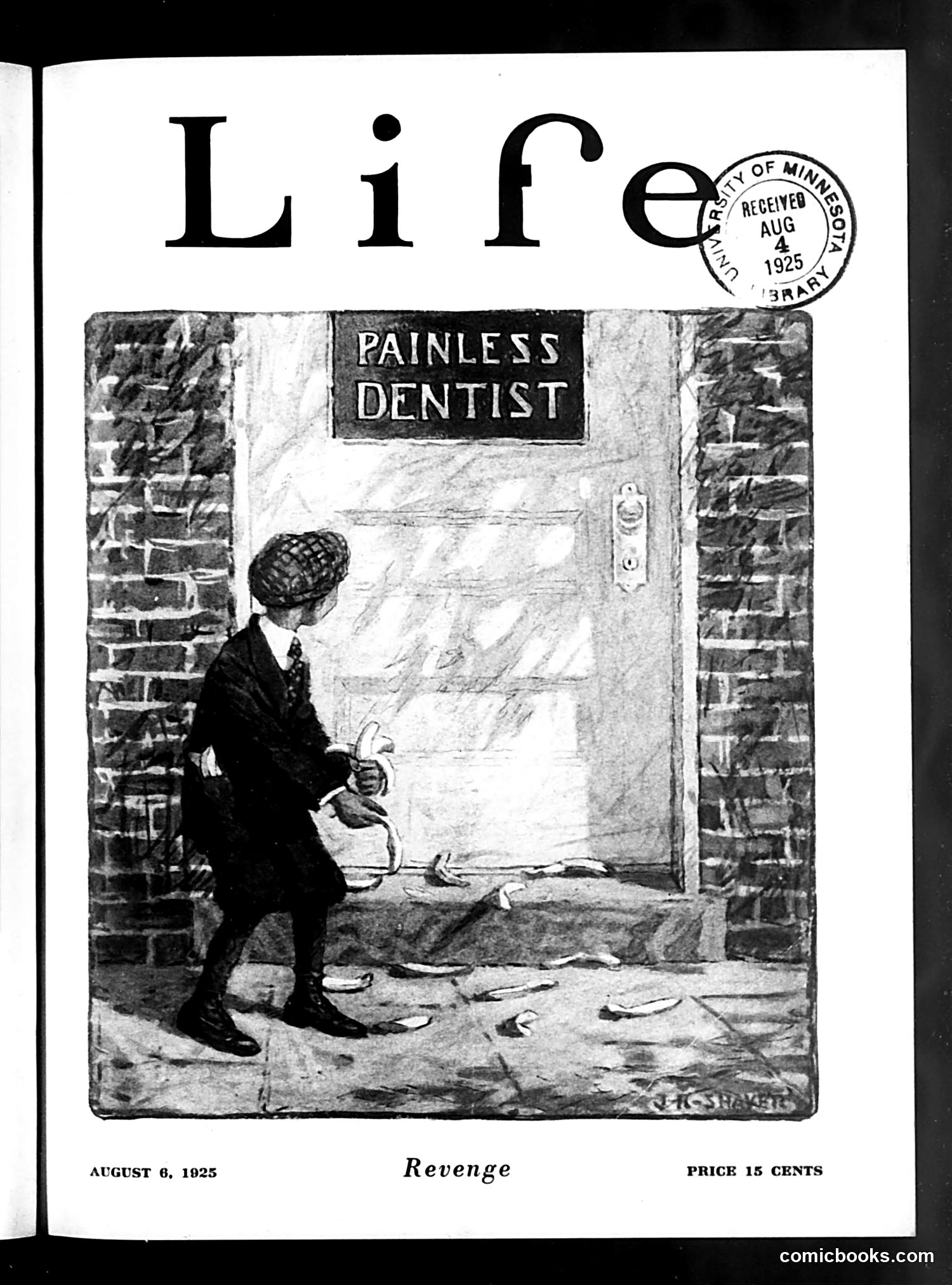
This satirical cover depicts a man in formal attire standing outside a "Painless Dentist" office, surrounded by extracted teeth scattered on the ground. The title "Revenge" suggests dark humor about dental extraction. The joke appears to be a visual pun: the man has apparently extracted so many teeth from the dentist that he's taking literal "revenge" by leaving them scattered outside the office—a humorous inversion of the usual patient-dentist relationship where the dentist extracts teeth from patients. The "painless dentist" sign adds irony, as the imagery suggests anything but painless destruction. This represents early 20th-century satirical humor common to Life magazine, playing on everyday anxieties about dental work and professional service.
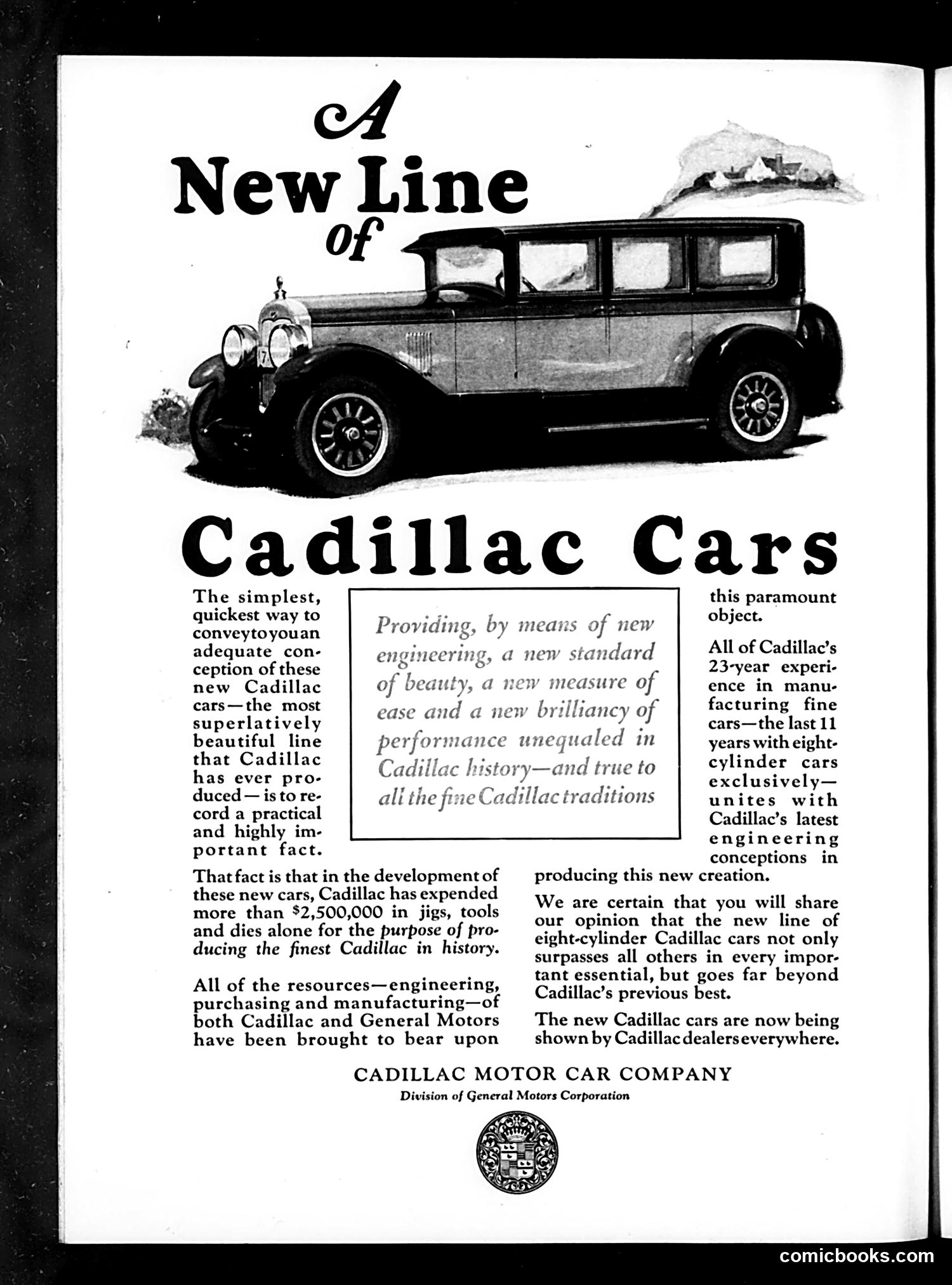
This page is **primarily an advertisement**, not satirical content. It's a Cadillac Motor Car Company ad promoting their new eight-cylinder car line. The ad emphasizes engineering innovation and manufacturing investment (claiming over $2.5 million spent on development). It appeals to status and tradition, positioning the new Cadillac as maintaining "fine Cadillac traditions" while offering superior beauty, ease, and performance. The illustrated automobile shows a luxury sedan typical of the 1920s era, with the period's characteristic dual headlights and spoke wheels. The small illustration of a ship atop the car appears decorative, suggesting prestige and travel. There is no political satire or social commentary—this is straightforward marketing of a luxury American automobile to wealthy consumers.
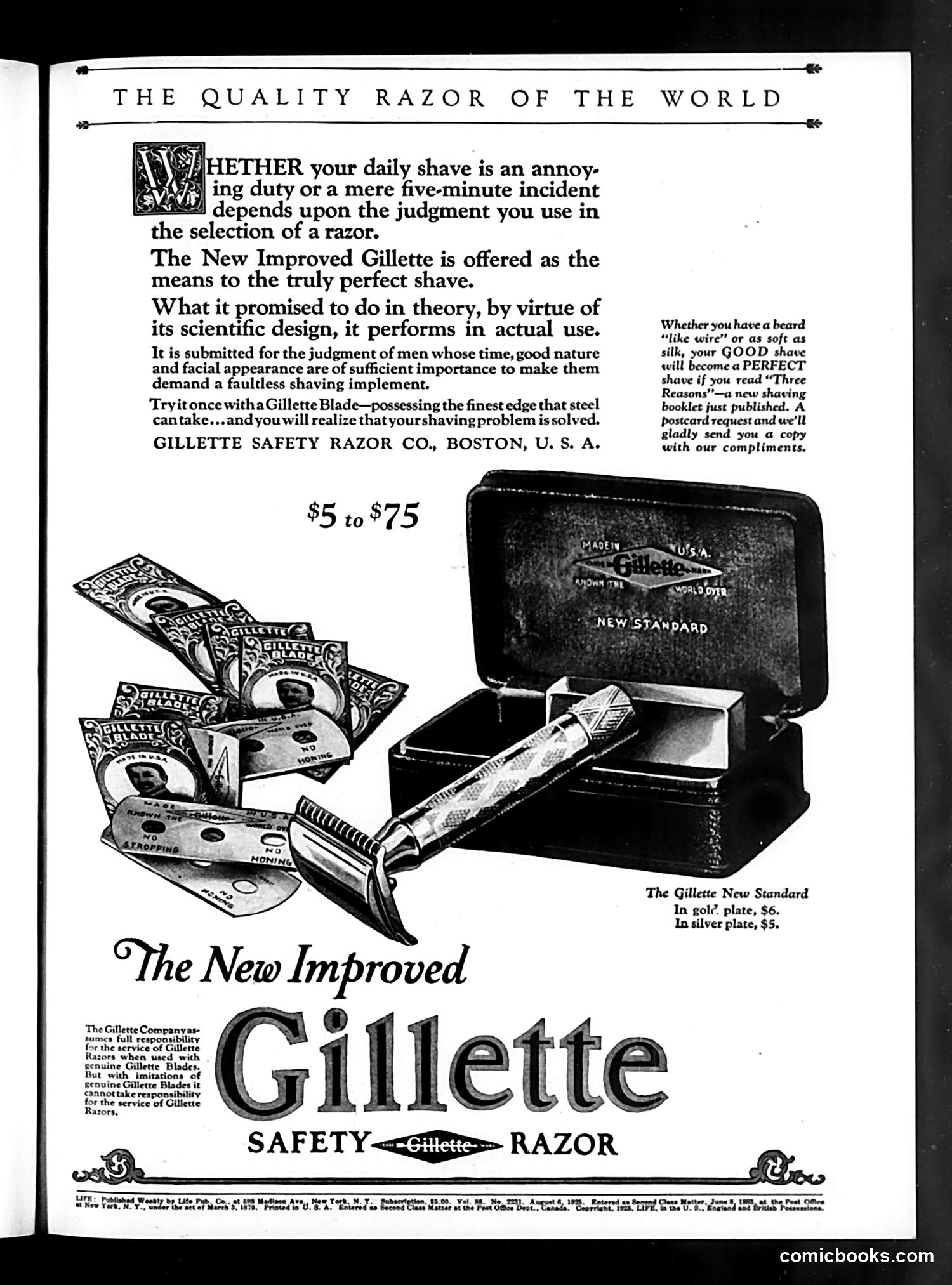
This is **not a political cartoon or satirical content**—it's a straightforward **advertisement for Gillette Safety Razors** from an early 20th-century issue of *Life* magazine. The page promotes "The New Improved Gillette" safety razor, priced from $5 to $75. It features product photography showing the razor itself and its packaging/case, along with accompanying blades. The advertisement uses period-typical marketing language emphasizing the razor's scientific design and superior shaving quality. The small boxed notice at upper right advertises a complementary booklet titled "Three Reasons"—a common marketing tactic of that era. There is no satire, political commentary, or cartoon content on this page. It is purely commercial advertising.
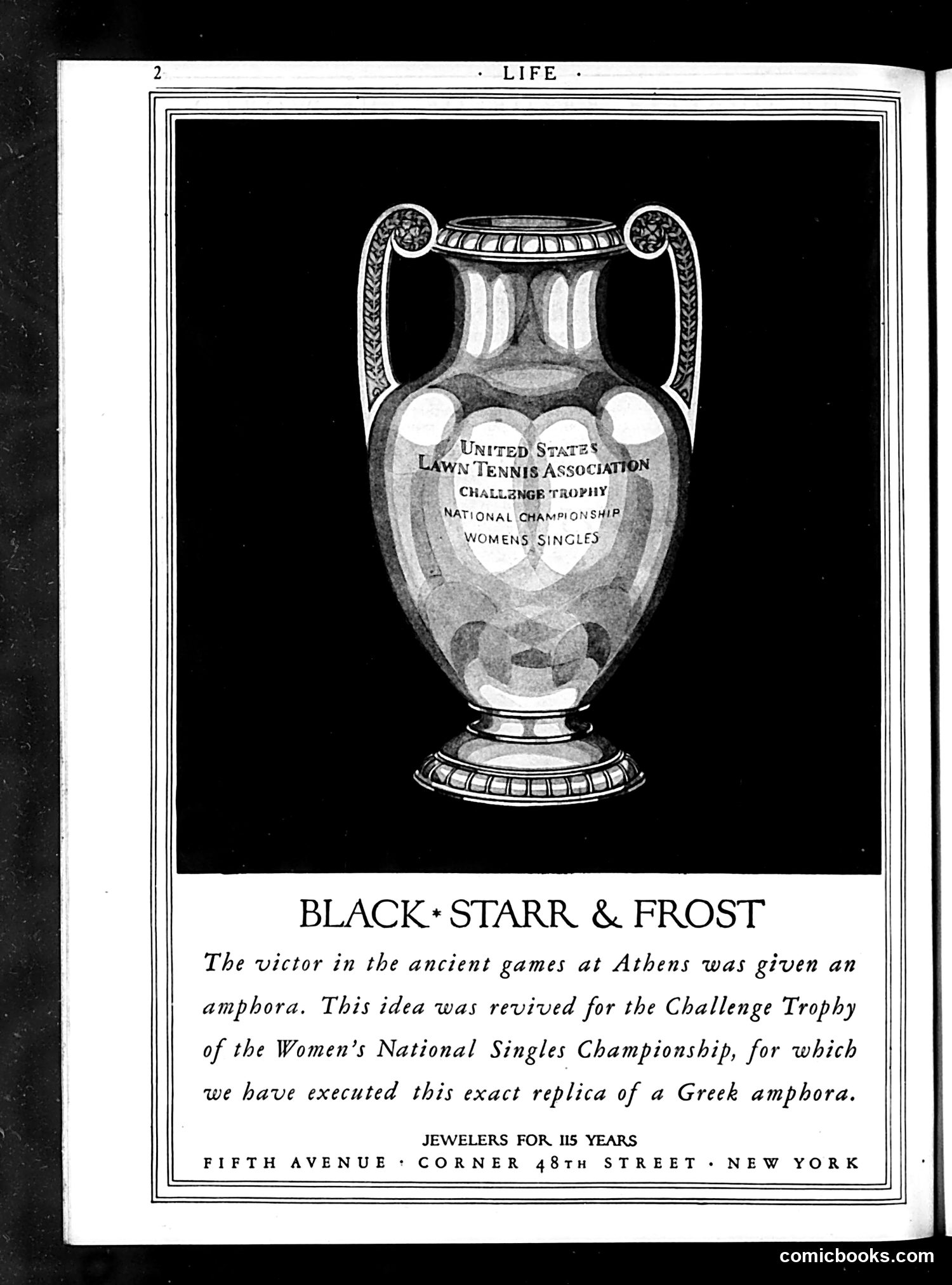
This is primarily **advertising content, not satire or commentary**. The page showcases a trophy for the United States Lawn Tennis Association's Women's National Singles Championship. The ad is from **Black, Starr & Frost**, a New York jewelry firm (Fifth Avenue at 48th Street), advertising their creation of this trophy. The design copies an ancient Greek amphora (two-handled vessel), referencing the classical Olympic tradition of awarding victors with amphorae. The text explicitly explains this historical inspiration—connecting women's tennis championship to ancient athletic honor. This represents early-twentieth-century elite sports sponsorship and jewelry marketing, positioning the firm as craftsmen capable of creating prestigious ceremonial objects. It's a straightforward product advertisement rather than political or social satire.
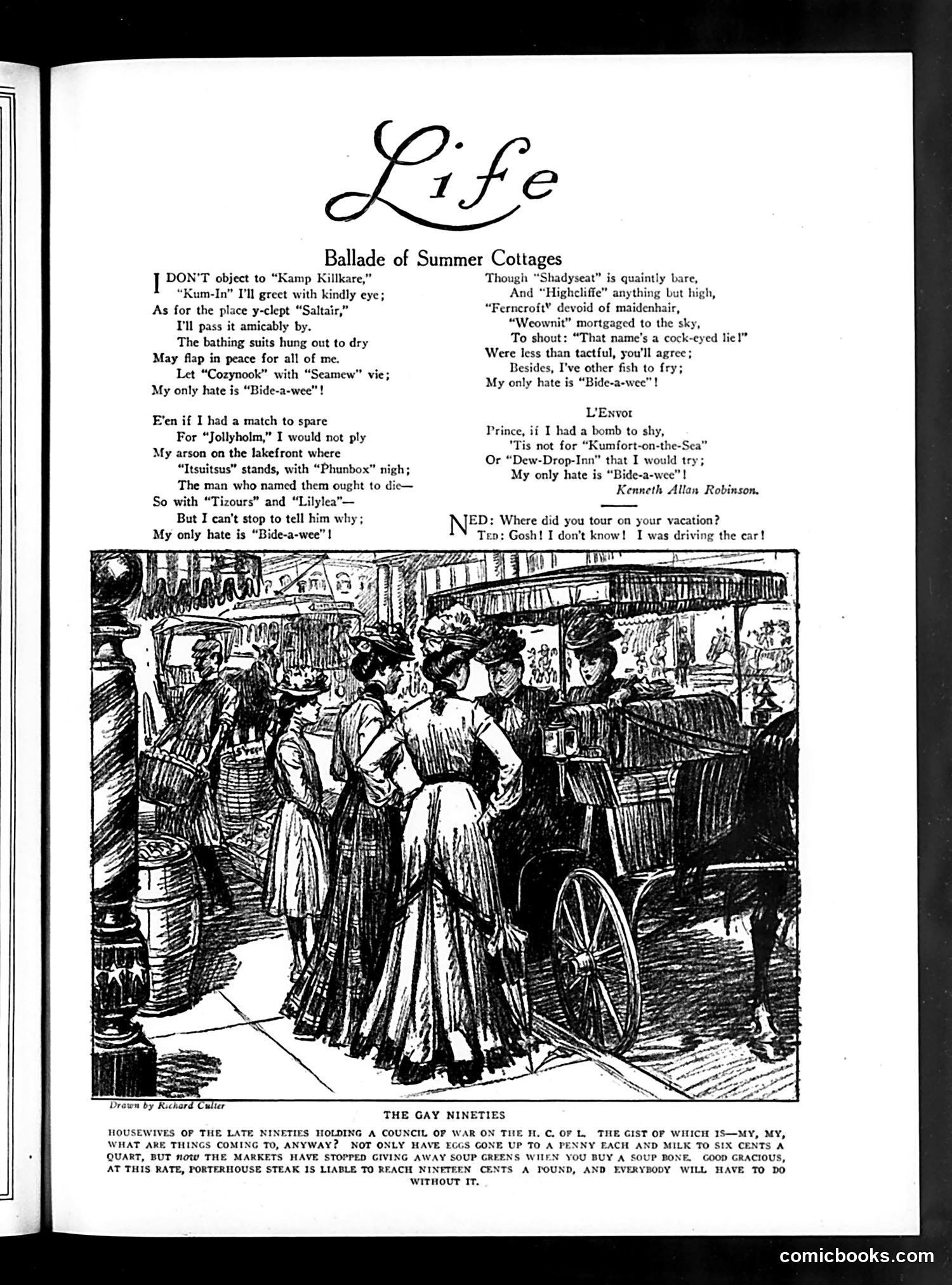
This page satirizes late-1890s summer cottage culture and rising costs of living. The poem "Ballade of Summer Cottages" by Kenneth Allon Robinson mocks fashionable resort destinations with absurd names ("Kamp Killkare," "Saltair," "Cozynook"). The verse complains about expensive, uncomfortable accommodations and ridiculous place-names, establishing the refrain "My only hate is 'Bide-a-wee'!" The accompanying illustration depicts well-dressed 1890s women at a seaside resort, illustrating the social scene the poem critiques. The caption about "housewives of the late nineties" discusses wartime economics—rising food prices and shortages (eggs, milk, soup greens). The satire targets both pretentious summer leisure culture and practical household management challenges of the era, suggesting affluent women's concerns about maintaining their lifestyle amid economic pressures.
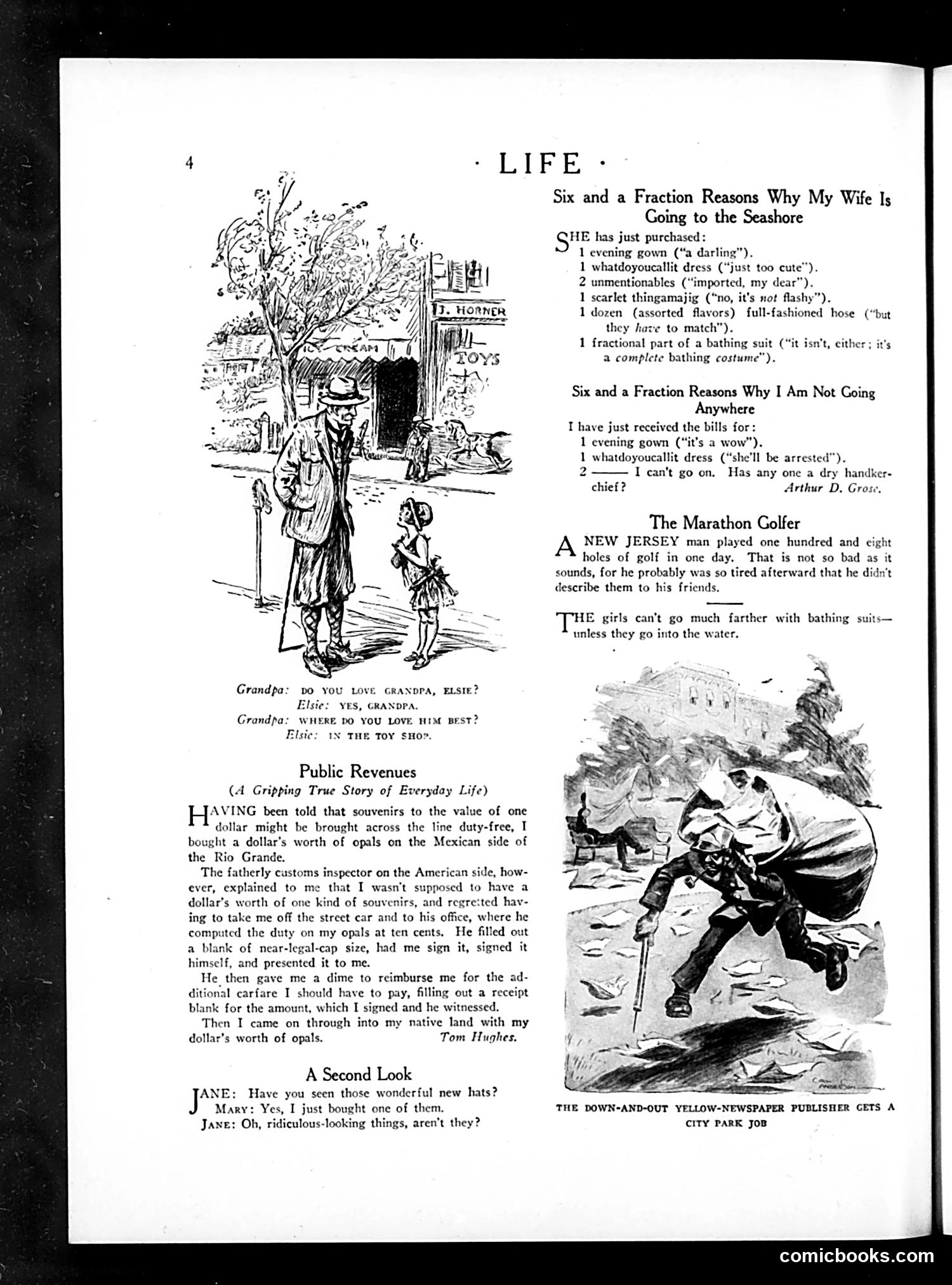
This page contains three satirical pieces typical of early 20th-century American humor: **"Six and a Fraction Reasons"** jokes about a wife's seashore shopping spree versus her husband's mounting bills—poking fun at gender spending differences. **"The Marathon Golfer"** mocks a New Jersey man's excessive golfing (108 holes in one day), satirizing the obsessive leisure habits of affluent Americans. **"Public Revenues"** recounts a bureaucratic absurdity: a customs inspector charges tariffs on souvenirs and opals, creating circular paperwork. The satire targets government inefficiency and petty over-regulation. **"A Second Look"** is a brief dialogue joke about fashionable new hats. The accompanying illustrations use period pen-and-ink style. Overall, the page satirizes consumerism, leisure culture, spousal finances, and government bureaucracy—concerns relevant to Life's middle-class readership.
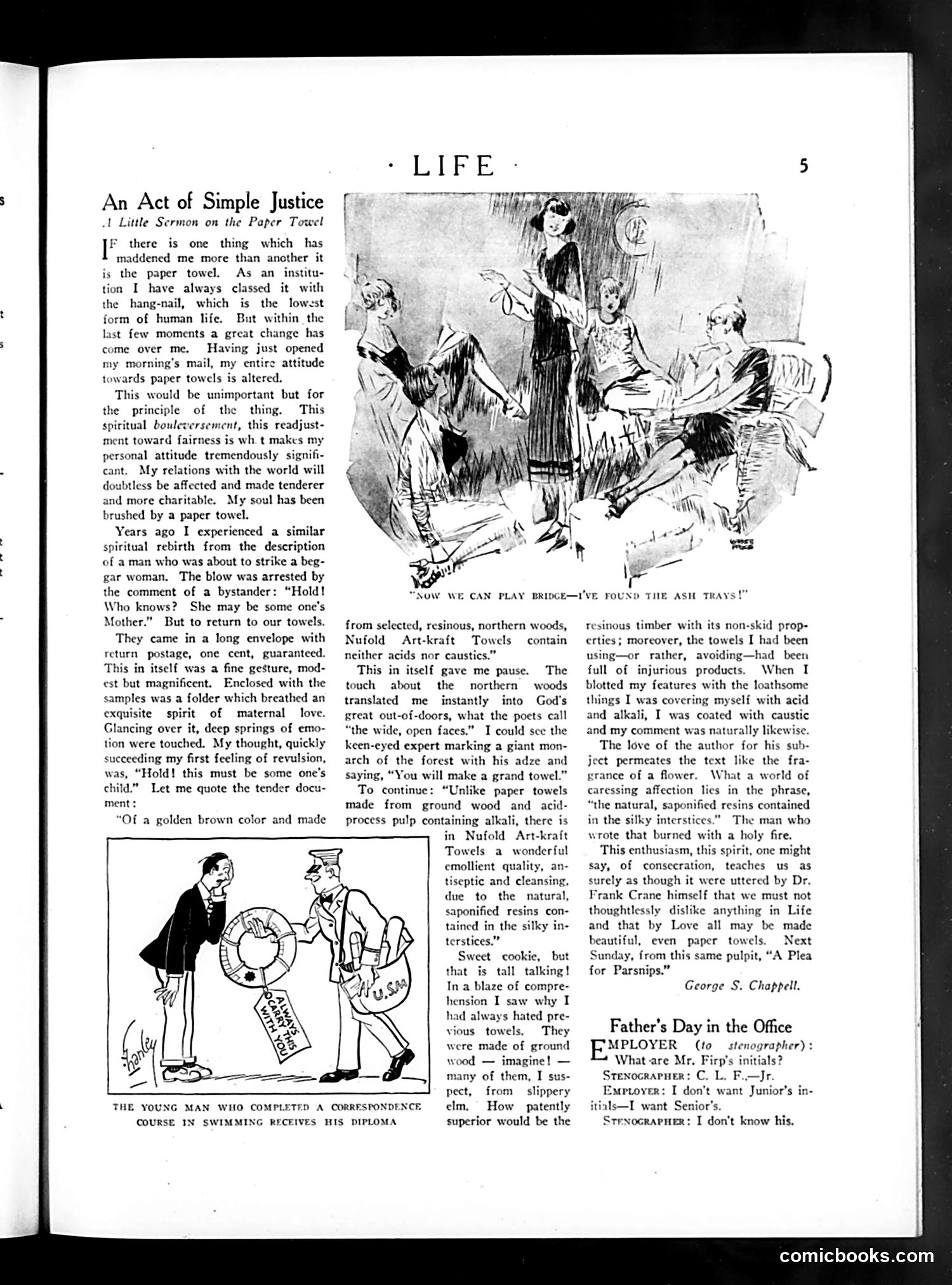
This page contains two distinct pieces: **"An Act of Simple Justice"** is an essay by George S. Chappell praising paper towels, specifically Bufold Art-kraft brand. The top illustration shows women discovering ash trays (caption: "Now we can play bridge—I've found the ash trays!"), celebrating the practical cleanliness paper towels provide. Chappell argues paper towels represent thoughtful design and conservation—turning a mundane product into a moral lesson about how "Love all may be made beautiful." **"Father's Day in the Office"** is a brief comic dialogue between an employer and stenographers debating whether to acknowledge "Mr. Fiero's" initials, poking gentle fun at office workplace dynamics and the uncertainty of workplace etiquette. The lower cartoon shows a man receiving a swimming diploma, satirizing absurd correspondence courses that promise credentials without genuine qualification.
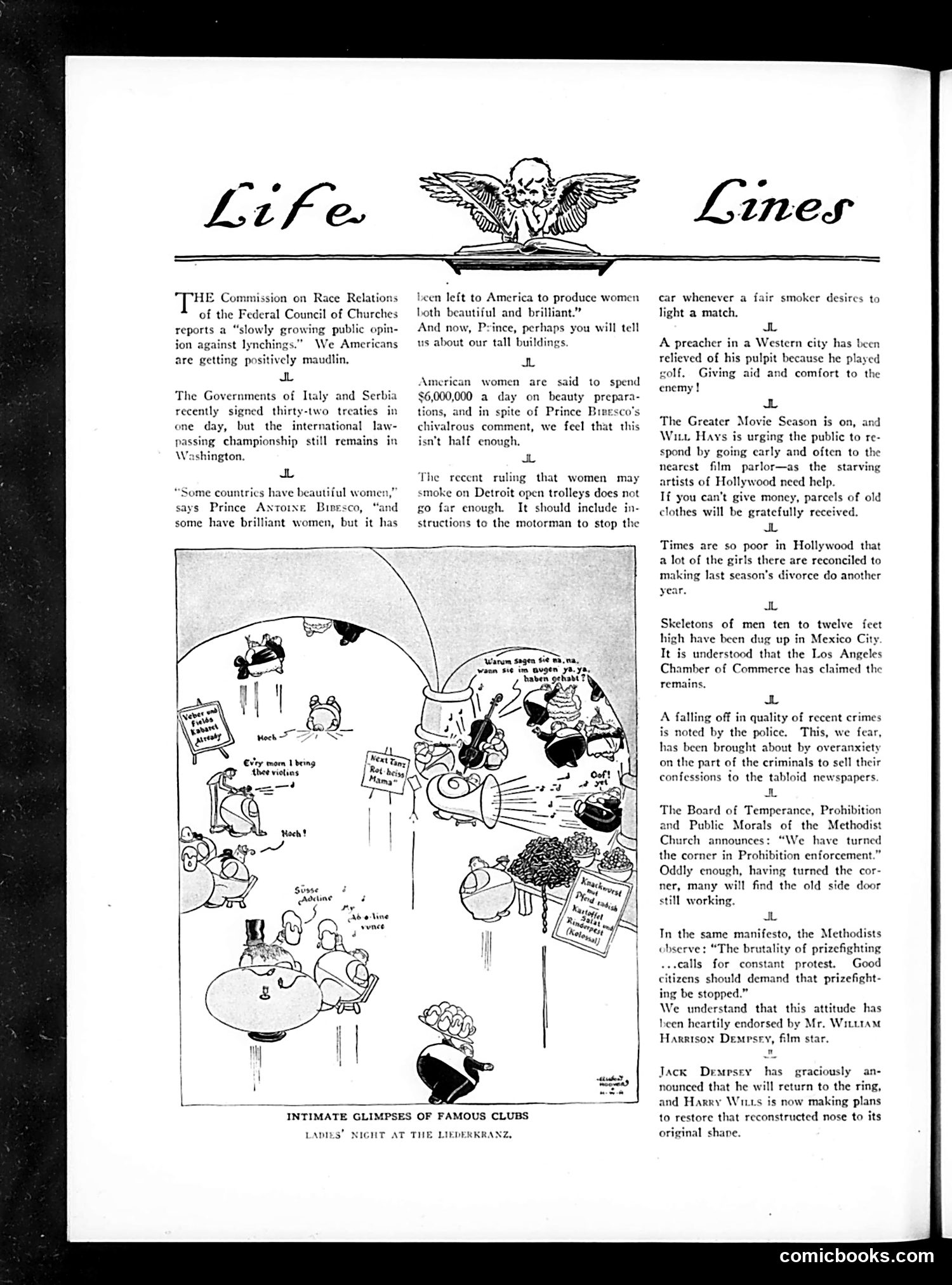
This satirical page mixes brief social commentary with a humorous cartoon titled "Intimate Glimpses of Famous Clubs: Ladies' Night at the Lieberkranz." The cartoon depicts a chaotic nightclub scene with exaggerated figures engaging in various activities—dancing, drinking, socializing—rendered in a comedic, caricatured style typical of 1920s humor. The Lieberkranz appears to be a real establishment being satirized for its ladies' night atmosphere. The text snippets mock various American social issues: women's spending on beauty, tall buildings, movie industry employment, Hollywood divorce rates, and Prohibition enforcement. References to Prince Antoine Bibesco and film star William Harrison Dempsey indicate this targets celebrity culture and upper-class behavior. The overall tone is lighthearted social criticism of contemporary American excess and vice during the Jazz Age.
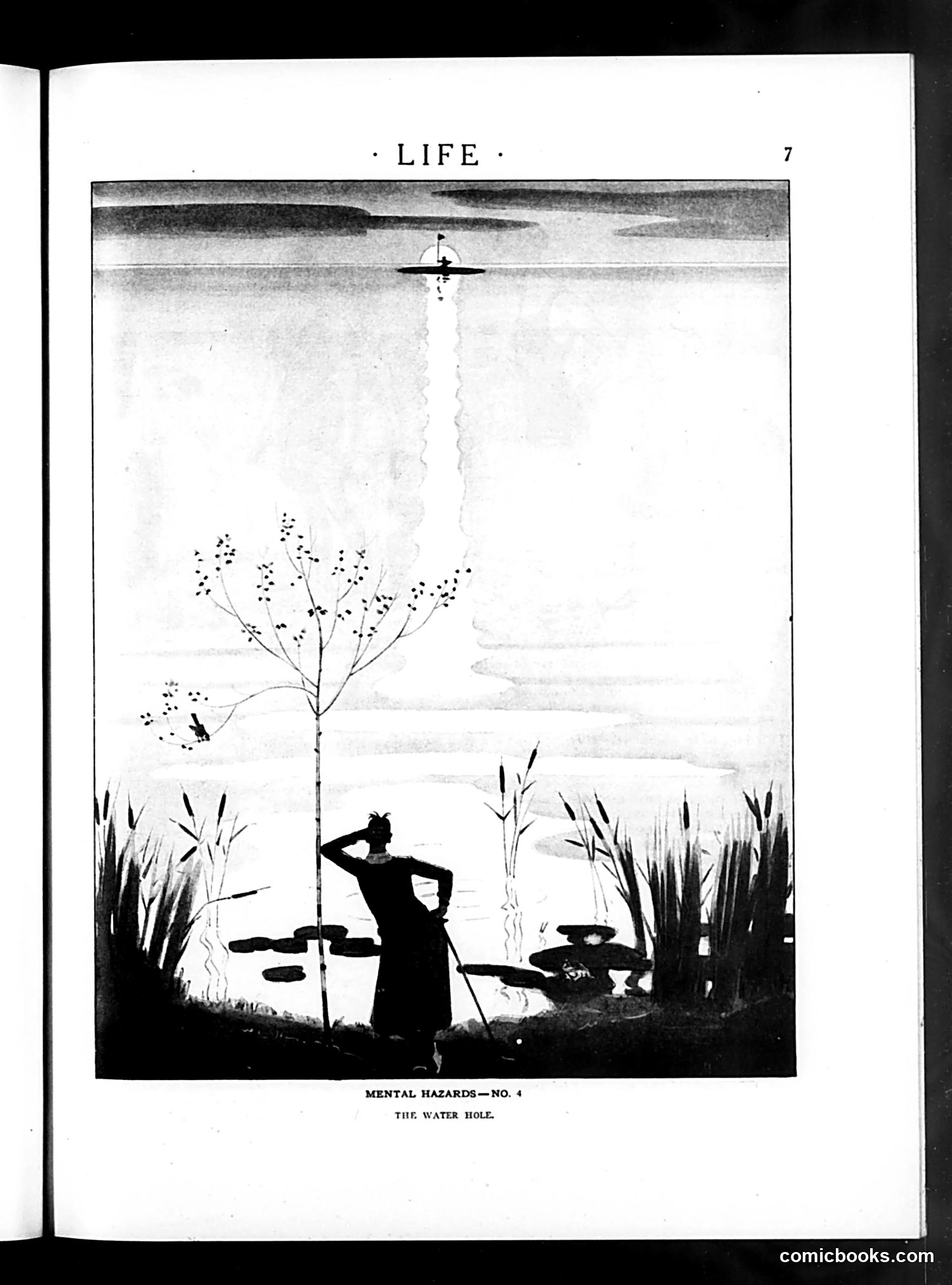
This illustration from *Life* magazine is titled "Mental Hazards—No. 4: The Water Hole." It depicts a silhouetted figure standing beside a deep water well or hole in the ground, appearing to contemplate it while gazing upward. The figure seems uncertain or apprehensive about the water source below. This appears to be part of a series addressing psychological or practical dangers. The "water hole" likely references contaminated drinking water—a genuine public health hazard of the early 20th century before modern sanitation standards. The satirical point critiques either people's irrational fear of water sources or, conversely, their dangerous complacency about water safety. The figure's body language suggests anxiety or hesitation about using the water, capturing contemporary concerns about hygiene and disease transmission through contaminated wells.
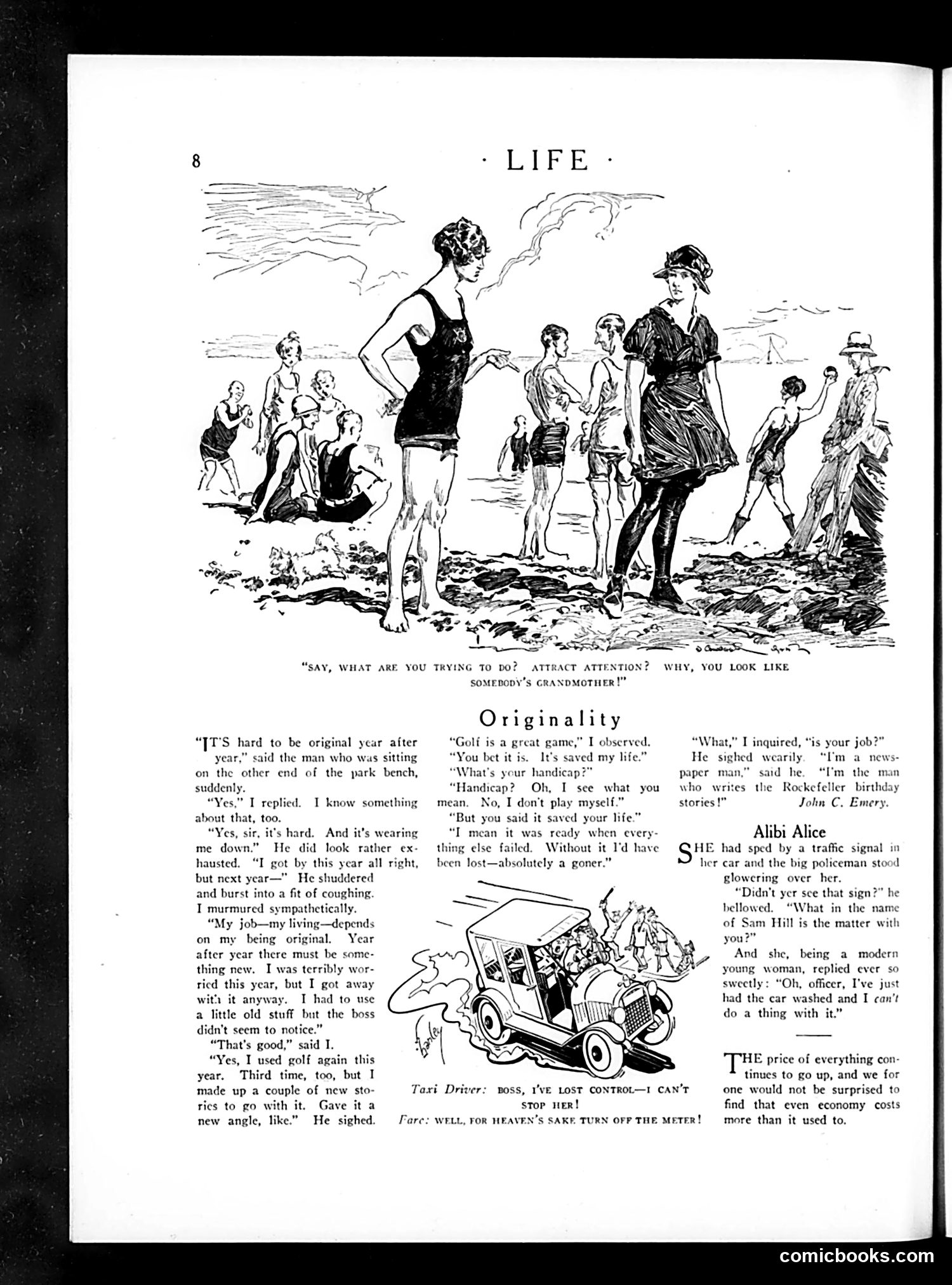
This page contains three satirical pieces about 1920s social life and economics: **"Originality"** mocks the difficulty of being original in fashion and leisure activities. A man complains that even his "jobs—my living" must be original yearly, yet he's exhausted inventing new golf stories and angles. The satire targets the pressure for constant novelty in modern life. **"Alibi Alice"** depicts a young woman caught by a traffic officer with a damaged car, flippantly claiming she "just had the car washed" and can't do anything with it. The satire critiques modern young women's casual, irresponsible attitudes. **The taxi cartoon** shows a chaotic car crash, satirizing both the driver's loss of control and rising costs ("economy costs more than it used to"), reflecting post-WWI economic inflation concerns. The beach scene illustration above depicts 1920s bathing culture and social observation.
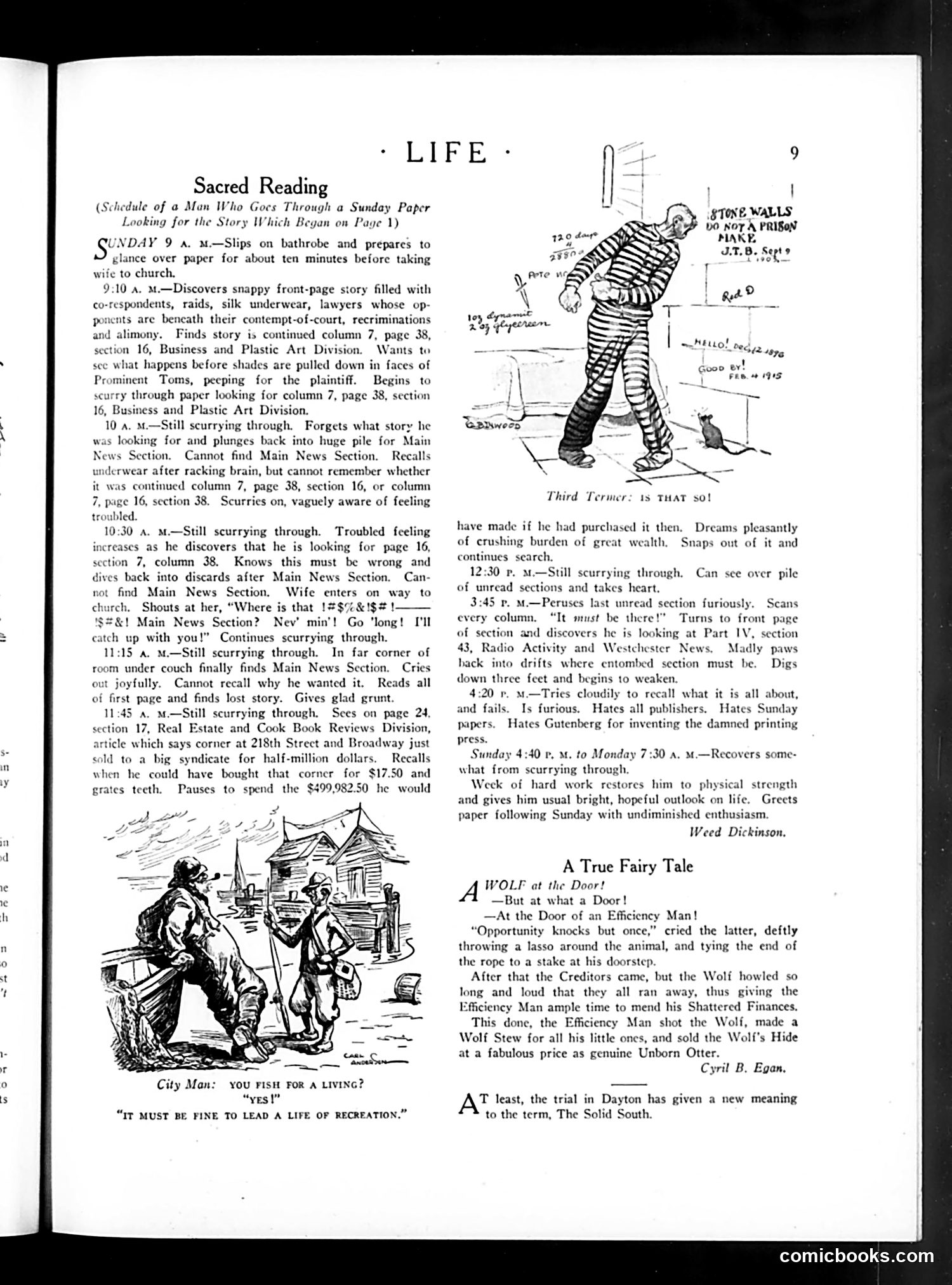
This page contains two distinct pieces: **"Sacred Reading"** is a humorous schedule tracking a man's frantic Sunday morning searching through a newspaper for a specific story. The satire mocks how readers frantically hunt through dense Sunday papers—flipping between sections, getting lost, unable to locate articles they remember starting. It captures the frustration of newspaper navigation before digital search functions. **"A True Fairy Tale"** (bottom) depicts an "Efficiency Man" and a Wolf, illustrated with a sketch of two figures near a doorstep. The tale appears to satirize contemporary "efficiency expert" culture—the Wolf represents competition or threat, while the Efficiency Man represents the self-help/business optimization movement popular in early 20th-century America. The moral seems to mock how these modern solutions prove inadequate against real problems.
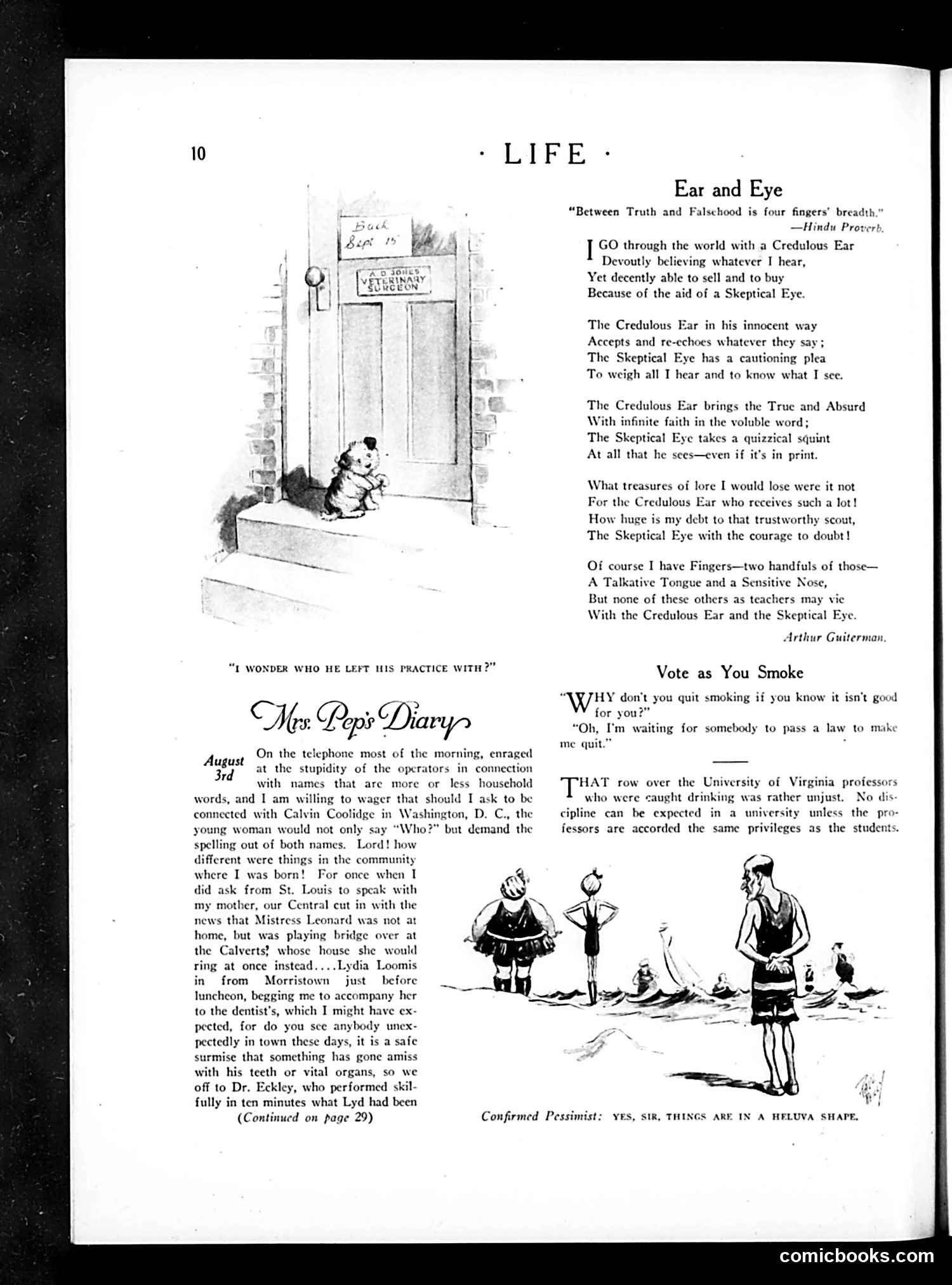
This page contains three distinct pieces of satirical content: 1. **"Ear and Eye" (poem by Arthur Guiterman)**: A philosophical poem contrasting the "Credulous Ear" (gullible listener) with the "Skeptical Eye" (critical observer), using the Hindu proverb "Between Truth and Falsehood is four fingers' breadth." It advocates for healthy skepticism. 2. **"Mrs. Pep's Diary" (August 3rd entry)**: A humorous anecdote about telephone operators' frustration with callers asking to be connected to "Calvin Coolidge in Washington, D.C." The joke mocks both the operators' exasperation and the absurdity of random people trying to reach the President. 3. **"Vote as You Smoke"**: A cartoon satirizing University of Virginia professors caught drinking during Prohibition, questioning why they wouldn't quit smoking if concerned about rules—mocking selective rule-following.
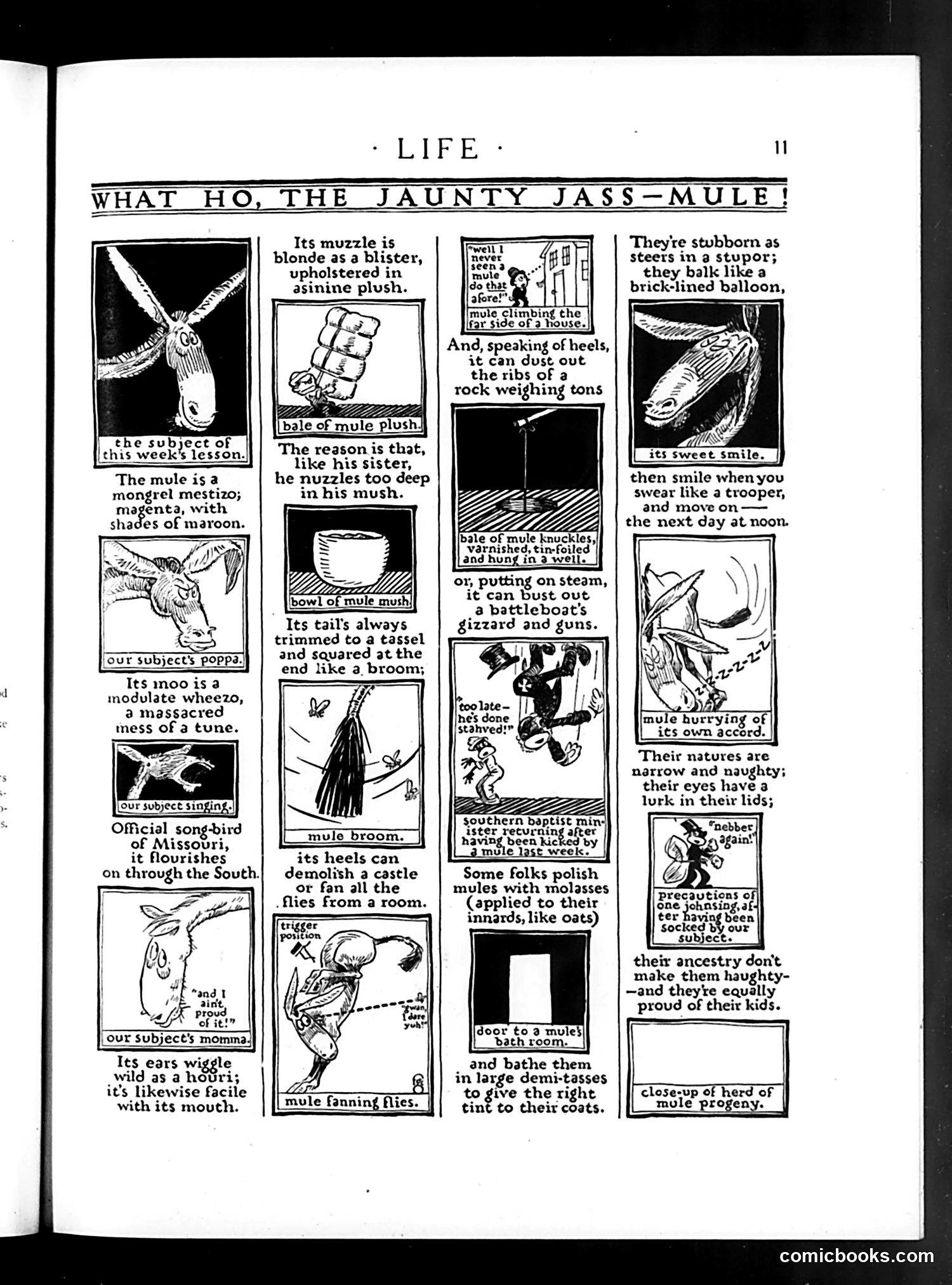
This is a humorous illustrated feature about mules, presented as a satirical "lesson." The page catalogs exaggerated mule characteristics through comic drawings and text: their tough muzzles, stubborn temperament, powerful heels, and distinctive braying sound. The satire appears to mock both mules themselves and the earnest "educational" format of the piece. References to the mule as "Official song-bird of Missouri" and comparisons of their stubbornness to "steers in a stupor" are absurdist jokes. The final captions about mules' "naughty" nature and their proud lineage suggest gentle mockery of rural American animal husbandry and Southern dialect ("jass" likely representing "jazz"). Overall, it's lighthearted Americana humor using exaggeration and whimsy.
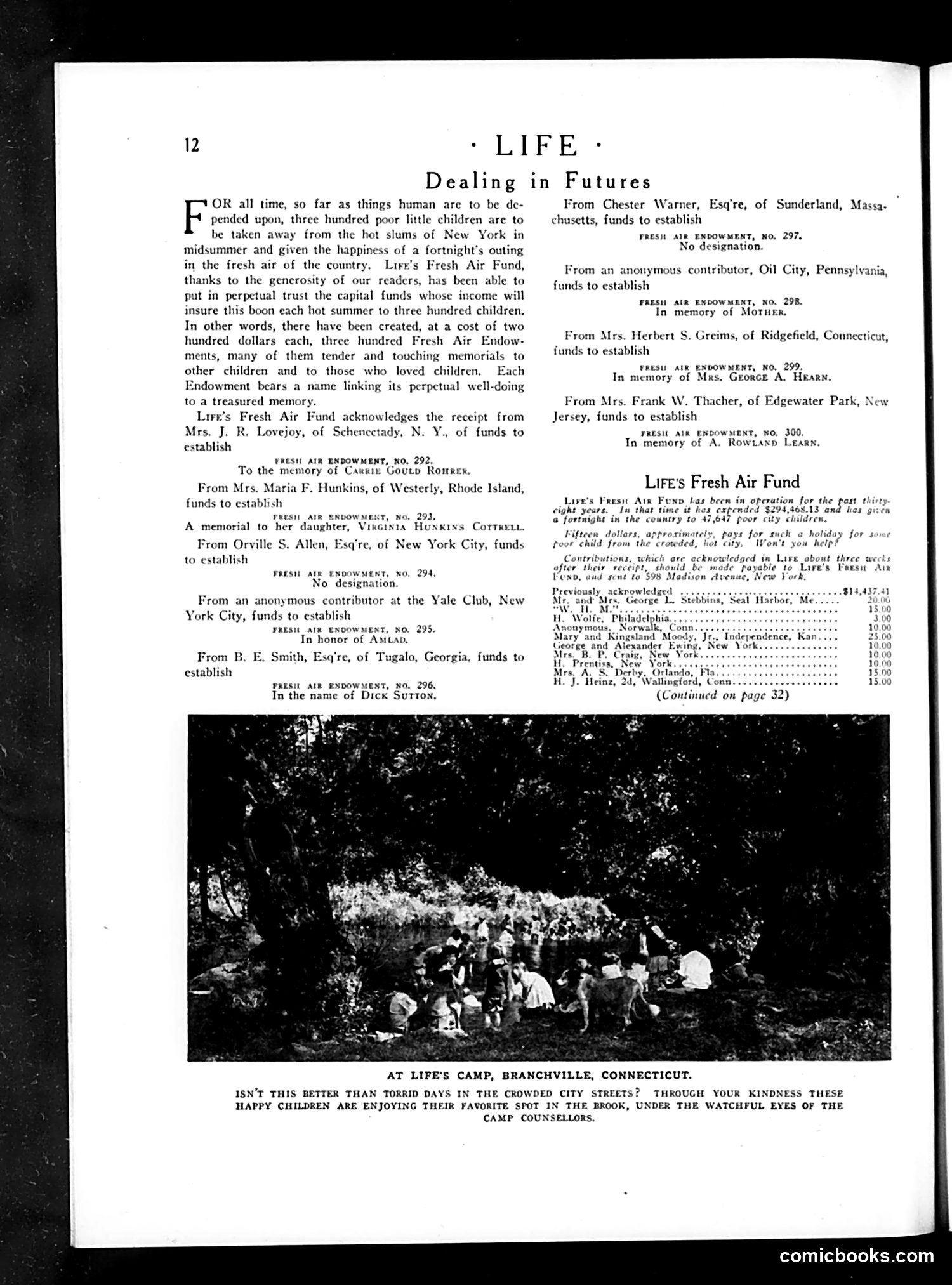
This page is primarily **not a cartoon but rather fundraising content** for Life's Fresh Air Fund, which provided summer outings for poor children from New York City. The text describes the fund's charitable work: removing children from "hot slums of New York in midsummer" to provide healthy outdoor experiences. Various donors are listed with their contributions. The photograph shows children at Life's Camp in Branchville, Connecticut, enjoying recreational activities outdoors. The caption emphasizes the contrast between crowded city streets and this wholesome camp environment, positioning the Fresh Air Fund as a humanitarian service. **This is advocacy journalism disguised as news**, promoting philanthropy and Progressive-era social welfare reform through emotional appeal to readers' generosity.
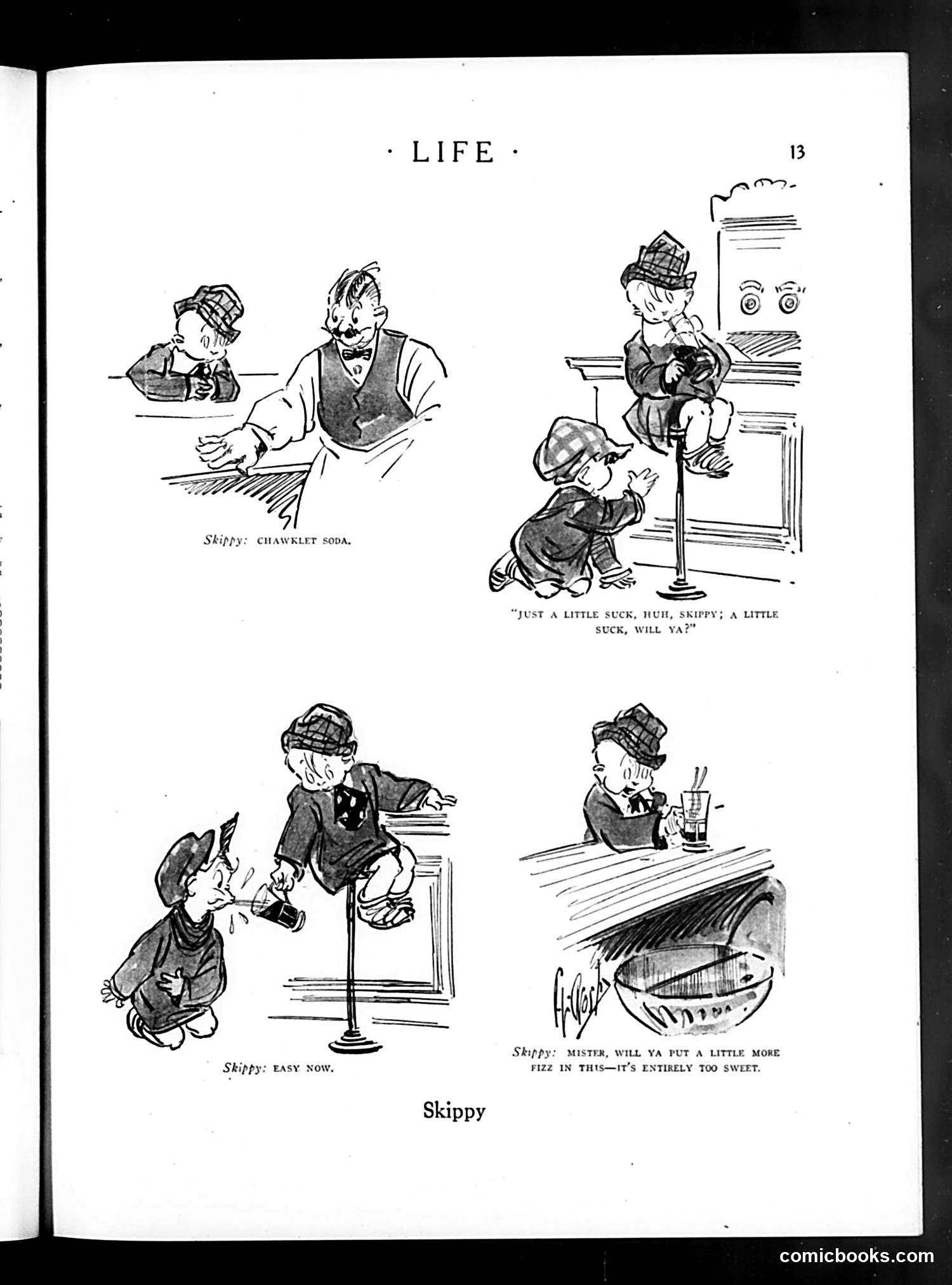
This is a humorous comic strip featuring a character named Skippy (a mischievous young boy in a flat cap). The page shows four sequential scenes depicting Skippy's interaction with a soda fountain attendant: 1. **Top left**: Skippy orders a "chalklet soda" 2. **Top right**: He persuades the attendant to give him "just a little suck" of the drink 3. **Bottom left**: The attendant warns "Easy now" as Skippy drinks 4. **Bottom right**: Skippy requests more fizz, claiming it's "entirely too sweet" The humor relies on Skippy's manipulative charm and the attendant's exasperated responses to the boy's persistent demands. This appears to be gentle domestic comedy about childhood persuasion tactics rather than political satire—typical of Life magazine's popular humor content from this era.
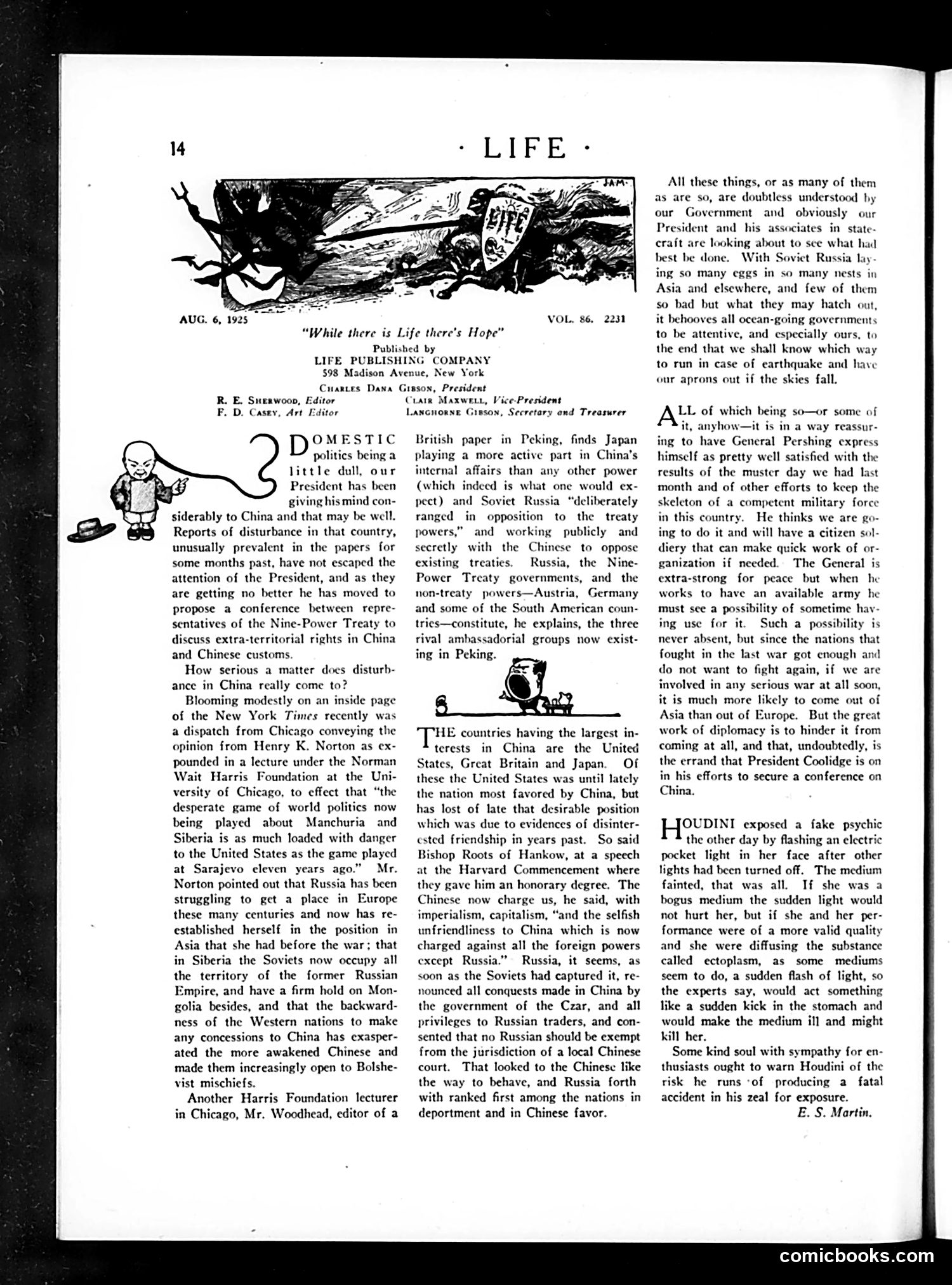
This page contains editorial commentary on international politics, particularly U.S.-China relations and the influence of foreign powers (Britain, Japan, Russia) in Chinese affairs. The two cartoons depict **small, caricatured figures** in exaggerated poses—likely representing diplomats or political actors—engaged in scheming or plotting. The text references President Coolidge's attention to Chinese disturbances and mentions concerns about Soviet Russia's territorial ambitions in Siberia and Mongolia. The article discusses how Russia, despite being disfavored in China compared to the U.S., Britain, and Japan, ranked highest in actual influence and "favor"—a satirical observation about realpolitik contradicting official diplomatic postures. A secondary item mocks spiritualist mediums, referencing Houdini's skepticism about fake psychics.
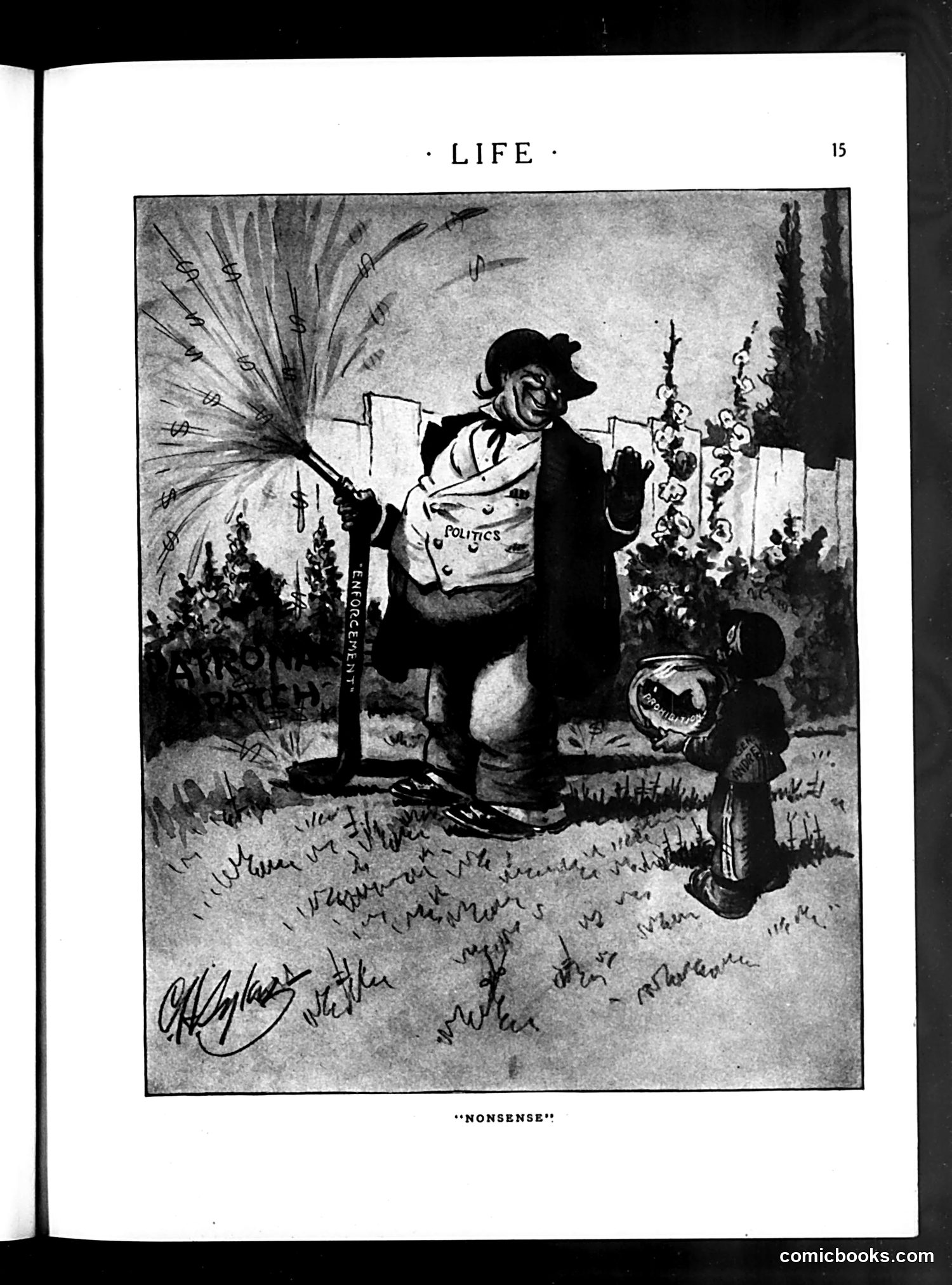
This satirical cartoon depicts a figure labeled "Politics" (visible on the character's vest) spraying nonsense like water from a fire hose or umbrella. The spray is numbered, suggesting mass-produced or quantified falsehoods. A small child holding what appears to be a container labeled "Journalism" stands nearby, seemingly collecting or being affected by this spray. The cartoon critiques how political rhetoric floods the public sphere with meaningless statements, while suggesting journalism either passively receives these claims or fails to filter them effectively. The artist appears to be lamenting the gap between political speech and truthful information—a timeless concern, though the specific historical political context remains unclear without additional documentation.
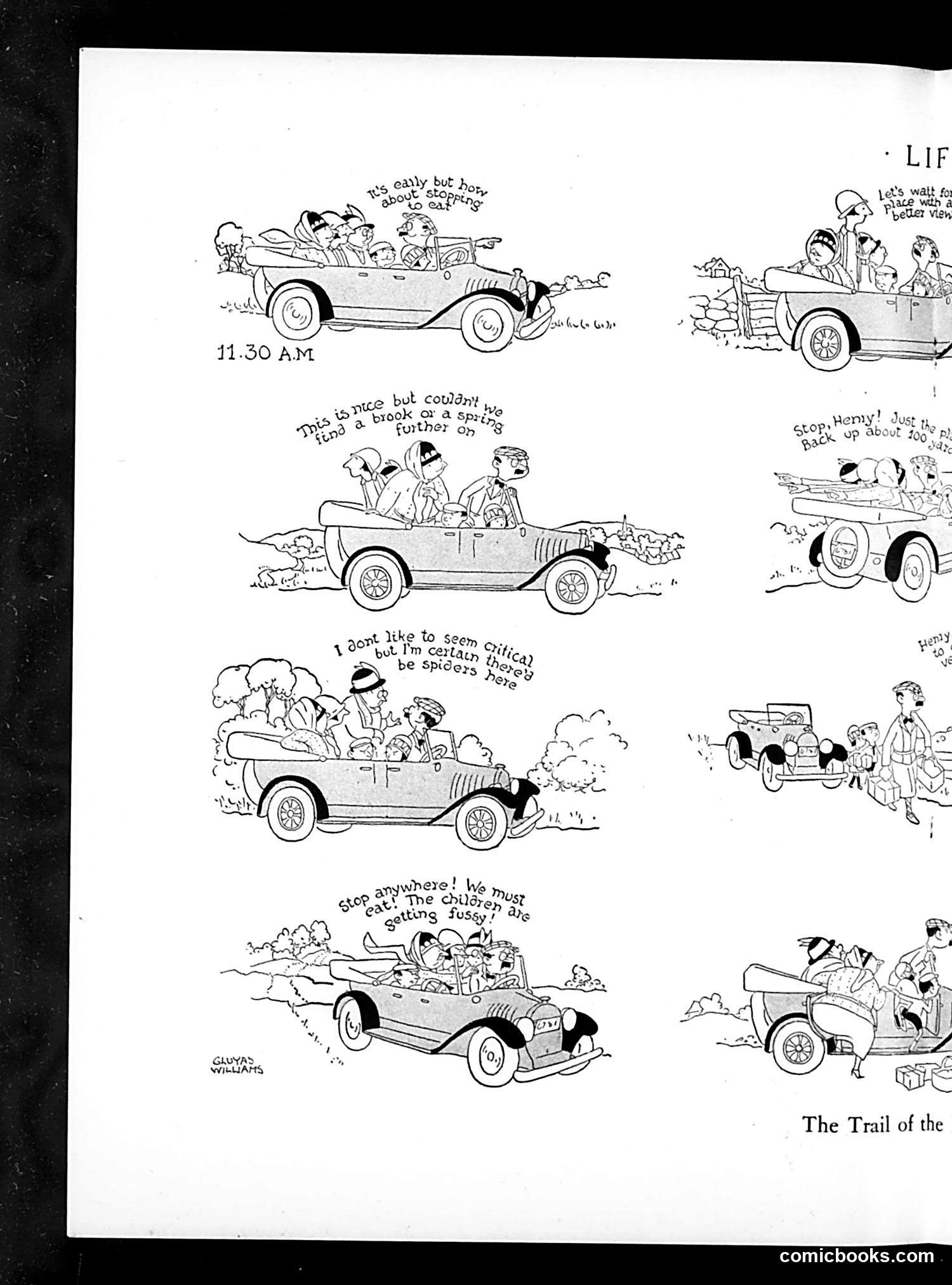
This is a humorous comic strip by Gluyas Williams depicting a family automobile journey, likely from the 1920s-30s based on the car style. The strip shows the progression of a road trip throughout the day, starting at 11:30 AM. The satire targets the romanticized notion of leisurely family motoring. Each panel reveals the reality: initial optimism ("gally but how about stopping to eat") deteriorates into complaints about breakdowns ("couldn't find a break on a spring"), concerns about dust and dirt ("spiders here"), and ultimately exhausted children ("children are getting fussy"). The joke highlights the gap between the era's promotional vision of carefree automobile recreation and the messy, frustrating reality of early car travel—mechanical problems, road conditions, dust, discomfort, and restless passengers. It's social commentary on how modern transportation promised freedom but often delivered headaches.
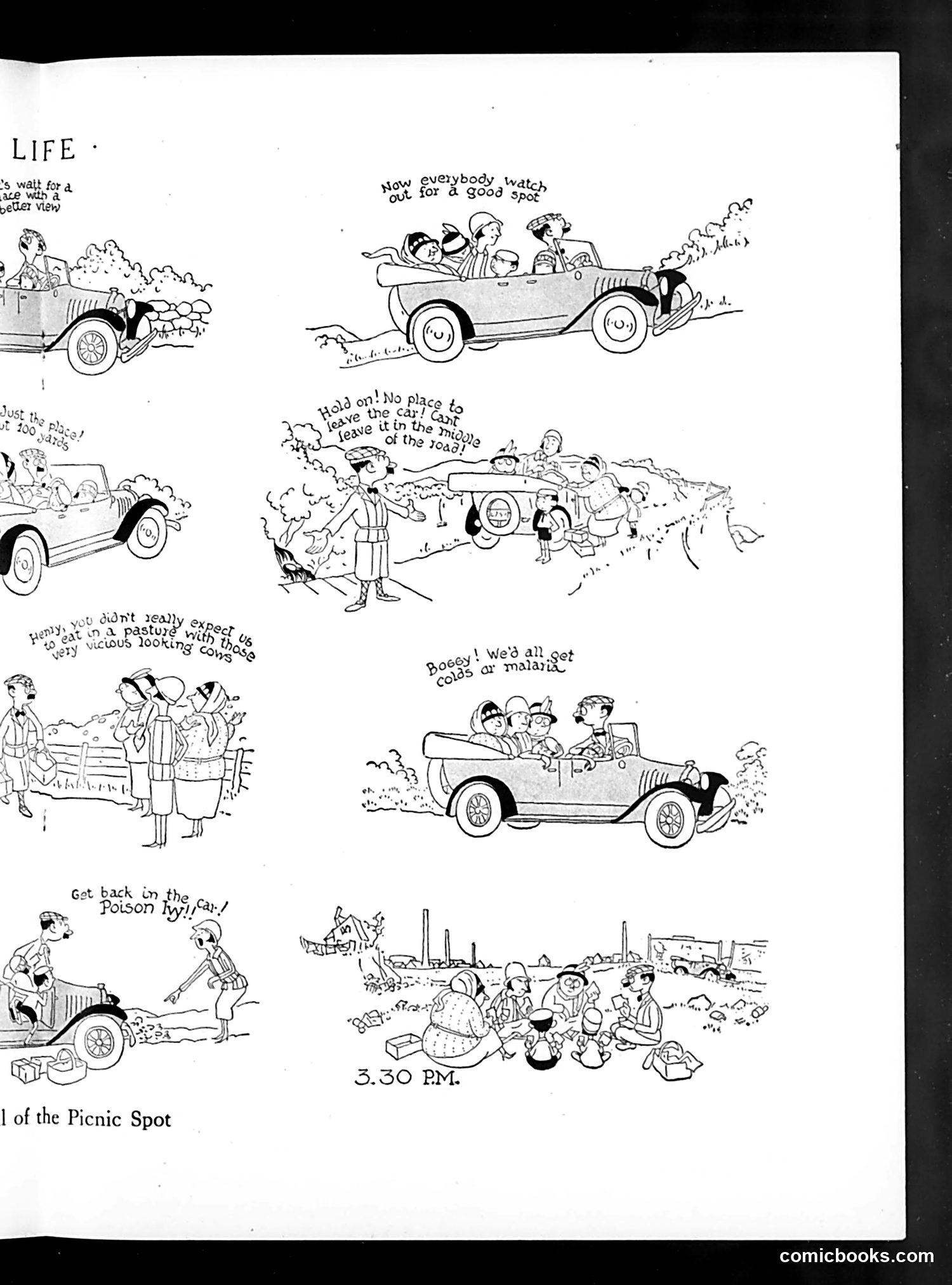
This page satirizes an early 20th-century automobile outing that goes hilariously wrong. The comic strip follows a group attempting a country picnic via car—a then-modern leisure activity. The sequence shows: people excitedly watching for "a good spot," the car full of passengers, someone warning "no place to leave the car," discovering an unsuitable pasture with "vicious looking cows," everyone catching colds ("Boogey! We'd all get colds or malaria"), and the final 3:30 PM scene showing the group huddled at an industrial site instead of a pastoral idyll. The satire mocks the gap between automobile-age leisure fantasies and messy reality—the promise of freedom and nature undercut by practical disasters, bad weather, dangerous livestock, and ending nowhere near an ideal picnic spot. It's humor about the vulnerability of early motorists and the difficulty of controlling recreational experiences.
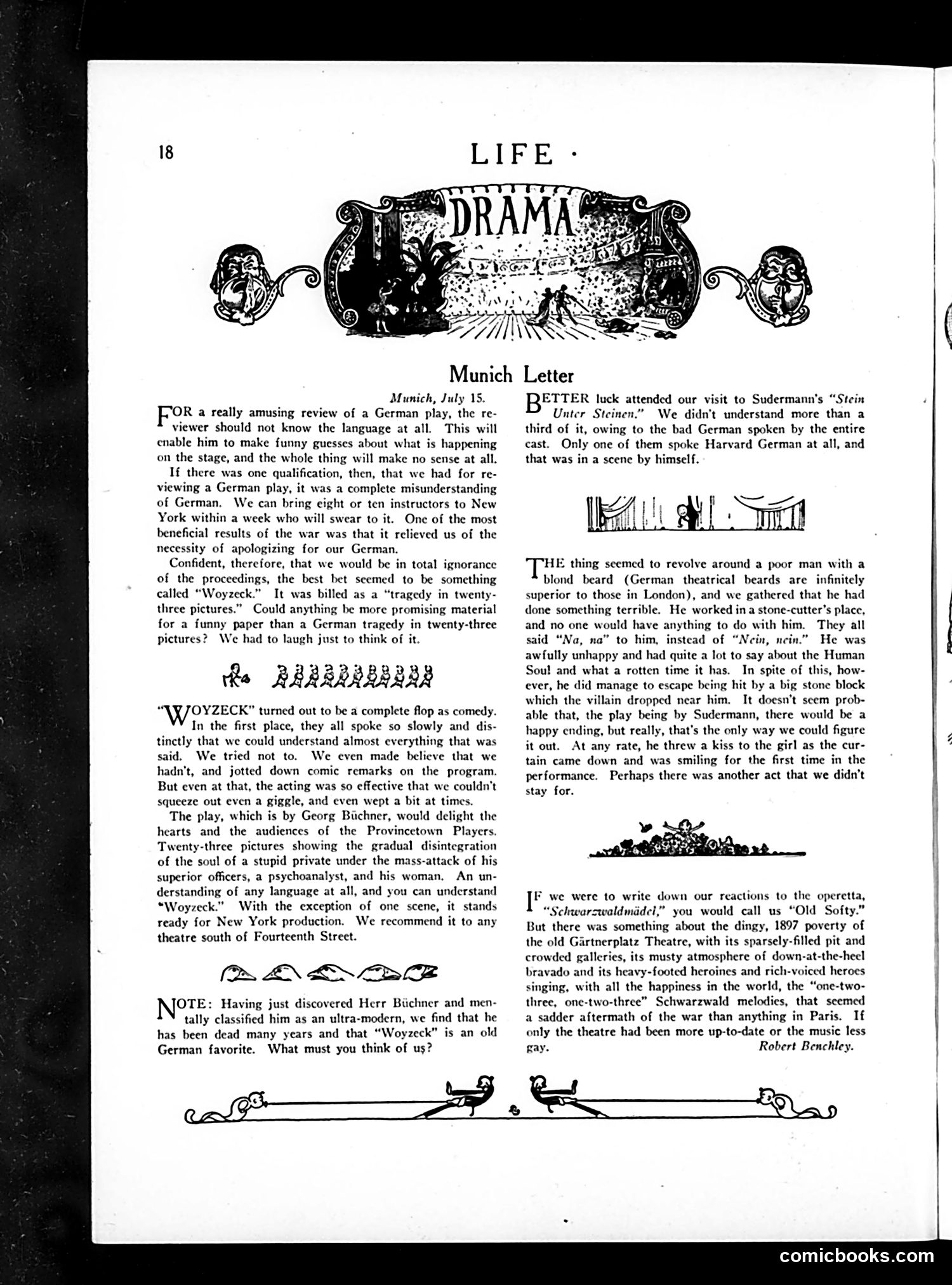
This is a humorous dispatch from Life magazine's Munich correspondent reviewing German theater productions. The satire operates on multiple levels: **The Main Joke:** The author admits to not understanding German, then pretends this incomprehension qualifies him to review German plays. He jokes that not knowing the language actually *improves* the comedic experience—he can invent funny interpretations of what's happening onstage. **The Plays Reviewed:** - *Woyzeck* by Georg Büchner: A tragedy about a soldier's psychological disintegration. The joke is that the author expected it to be absurdly funny precisely *because* it's a serious German tragedy presented in twenty-three picture-scenes, but the acting was so effective it actually moved him to tears—ruining his plan to mock it. - *Stein Unter Steinen* (Sudermann): A melodrama about a disgraced stoneworker; the author admits understanding only fragments due to poor German pronunciation by the cast. **The Satire's Target:** Post-WWI American attitudes toward German culture. The opening quip about the war relieving Americans of "apologizing for our German" suggests wartime animosity. The piece gently mocks both American ignorance and pretentious theater criticism.
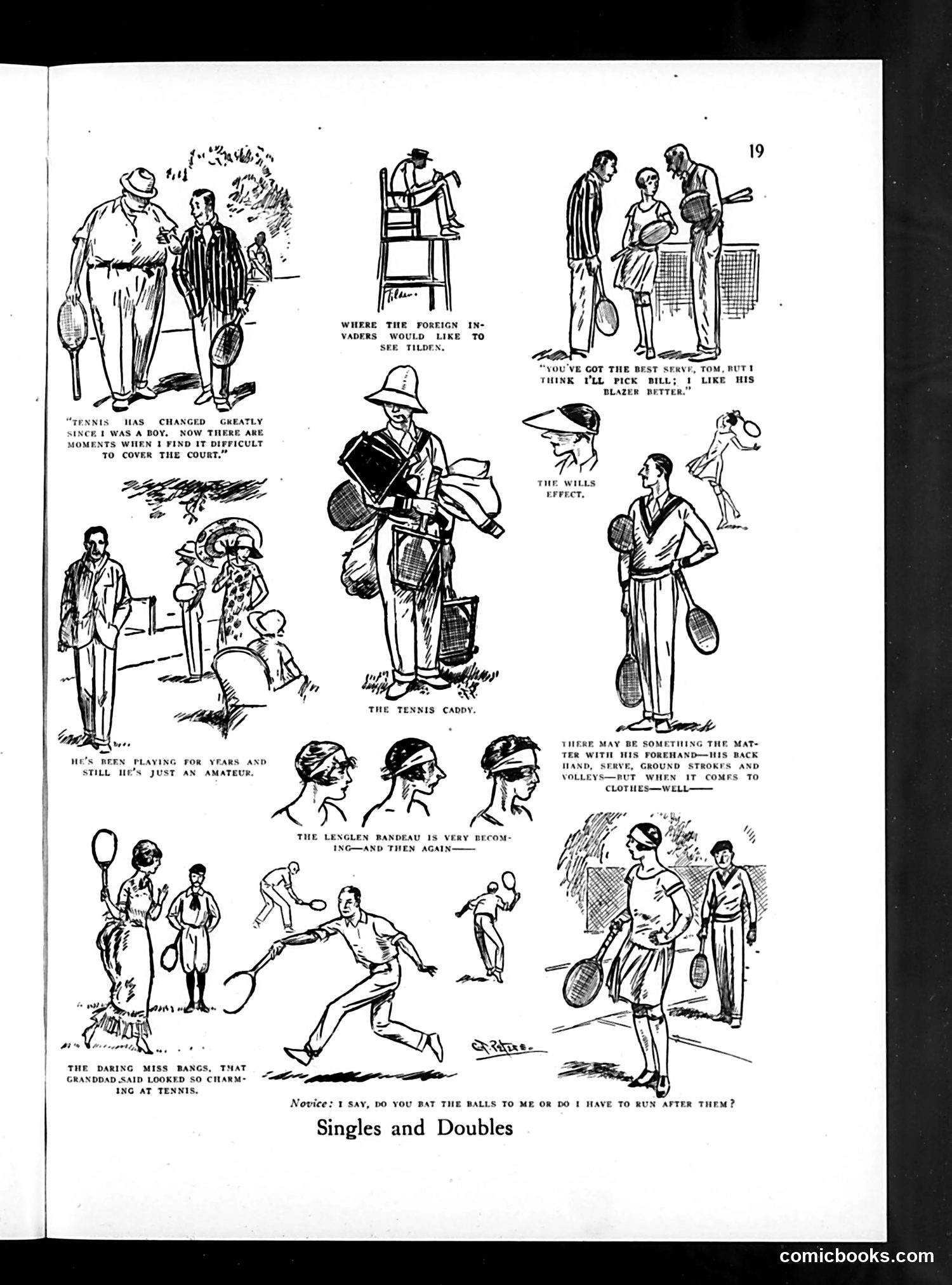
This page satirizes early 20th-century tennis culture and its social pretensions. The cartoons mock several aspects: **The Fashion Obsession**: Multiple panels highlight how appearance—blazers, headbands ("Lenglen bandeau"), clothing—matters more to players than actual skill. One character picks a player based on his stylish blazer rather than ability. **Generational Complaints**: An older player laments that tennis has "changed greatly" and he struggles to cover the court, contrasting modern play with his youth. **The "Wills Effect"**: References what appears to be a popular tennis player (likely Helen Wills), whose influence shapes fashion and playing style. **Amateur vs. Professional Pretense**: A long-time amateur player still hasn't mastered basics despite years of play. **Gender and Propriety**: References to "daring" female players and their fashion choices suggest contemporary anxieties about women's athletic participation and changing social norms. The overall satire targets tennis's transformation from serious sport into a venue for displaying wealth, fashion, and social status.
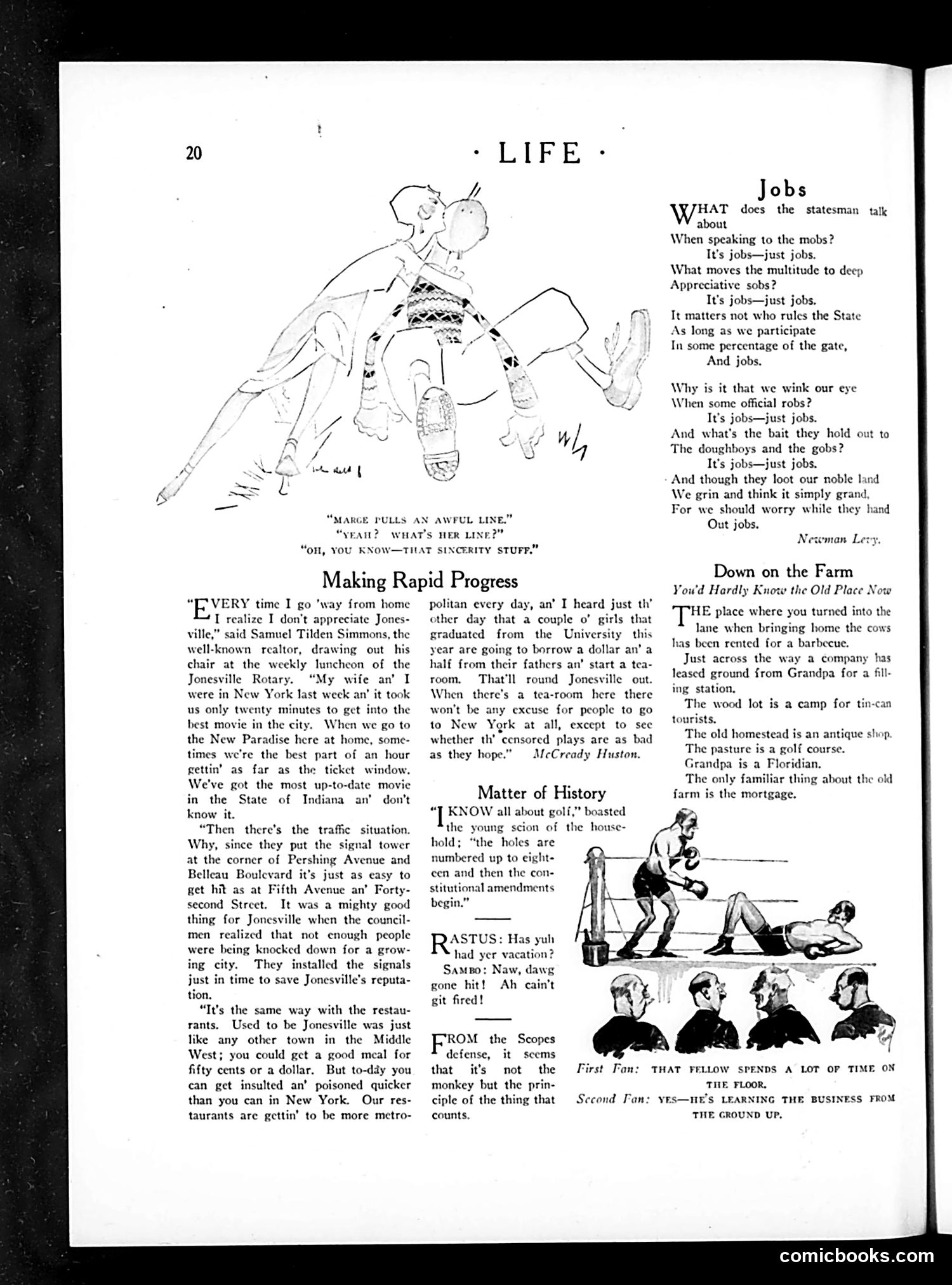
This page from *Life* magazine contains satirical commentary on American life in the 1920s, mixing social humor with political observation. **"Making Rapid Progress"** mocks small-town boosterism. A Jonesville realtor paradoxically praises his town by claiming it's becoming *worse*—adopting urban problems like traffic deaths and overpriced, poor-quality restaurants. The joke is that locals mistake these markers of "progress" for genuine improvement, while actually losing what made their town livable. **"Matter of History"** references the famous Scopes "Monkey Trial" (1925), where a young man's confident knowledge of golf is undermined when he conflates golf holes with constitutional amendments—suggesting modern education confused trivial knowledge with serious civics. **The jobs poem** critiques working-class political apathy: voters support any politician promising employment, ignoring corruption ("wink our eye / When some official robs") as long as they get paid. **"Down on the Farm"** laments rural commercialization: the family farm has been subdivided into tourist camps, antique shops, and gas stations, with only the unpaid mortgage remaining—a commentary on agricultural decline and land speculation in the 1920s.
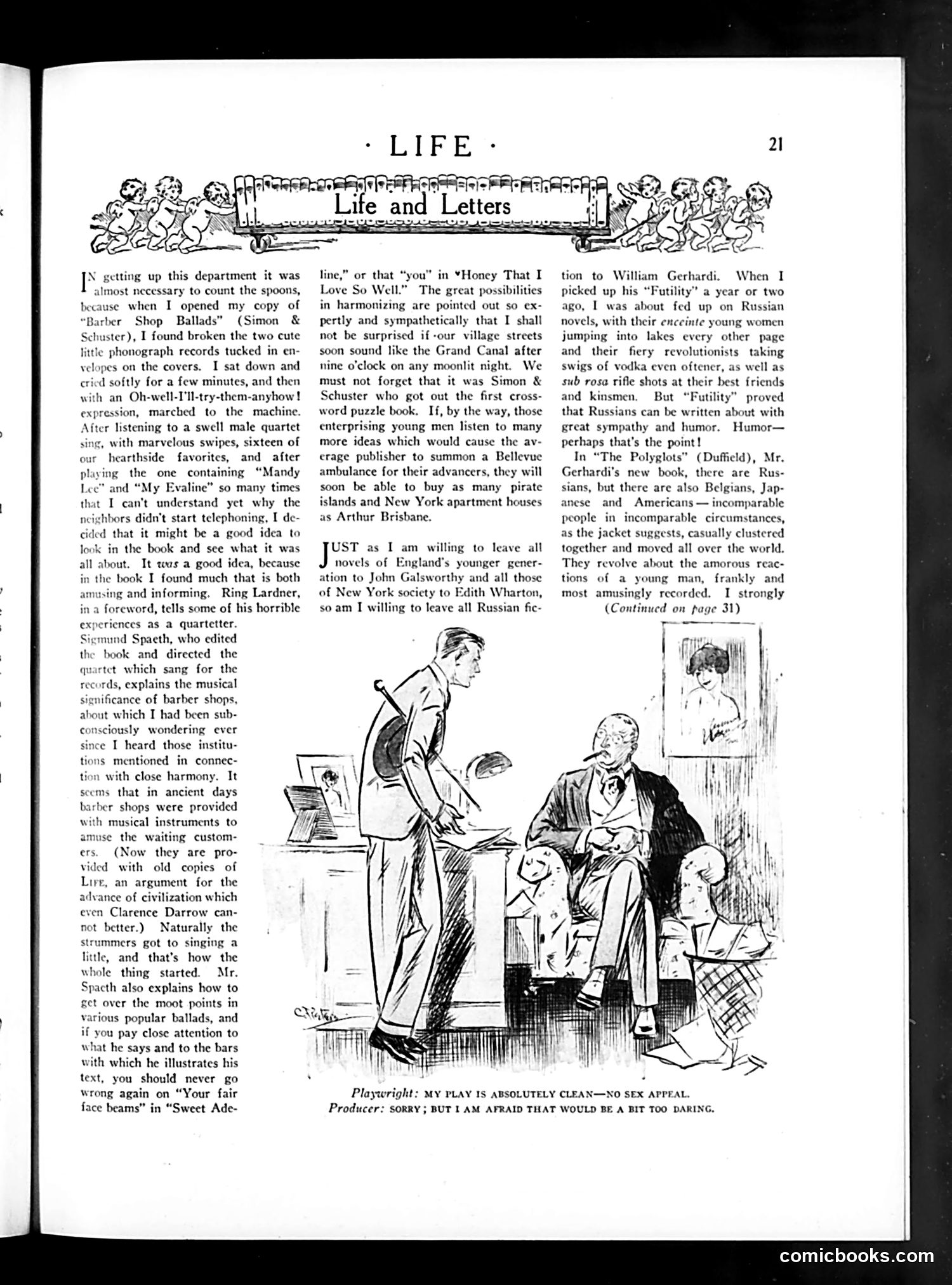
This page contains a literary column reviewing books, with one cartoon illustrating a publishing industry joke. **The Cartoon**: A playwright pitches his work to a producer, claiming it's "absolutely clean—no sex appeal." The producer replies he's "afraid that would be a bit too daring." The satire criticizes 1920s Broadway's apparent obsession with sexual content—the joke being that wholesomeness would actually be the *scandalous* choice for contemporary theater audiences. **The Text**: The column reviews "Barber Shop Ballads" (a book with phonograph records), praising its explanation of barbershop quartet harmony traditions. It also discusses William Gerhardi's novels "Futility" and "The Polyglots," praising Gerhardi for treating Russian characters with humor rather than the melodramatic clichés typical of Russian fiction (doomed heroines, vodka-swinging revolutionaries). The piece reflects 1920s literary and entertainment culture, when barber shop singing was still popular entertainment and Russian literature dominated serious fiction discussions.
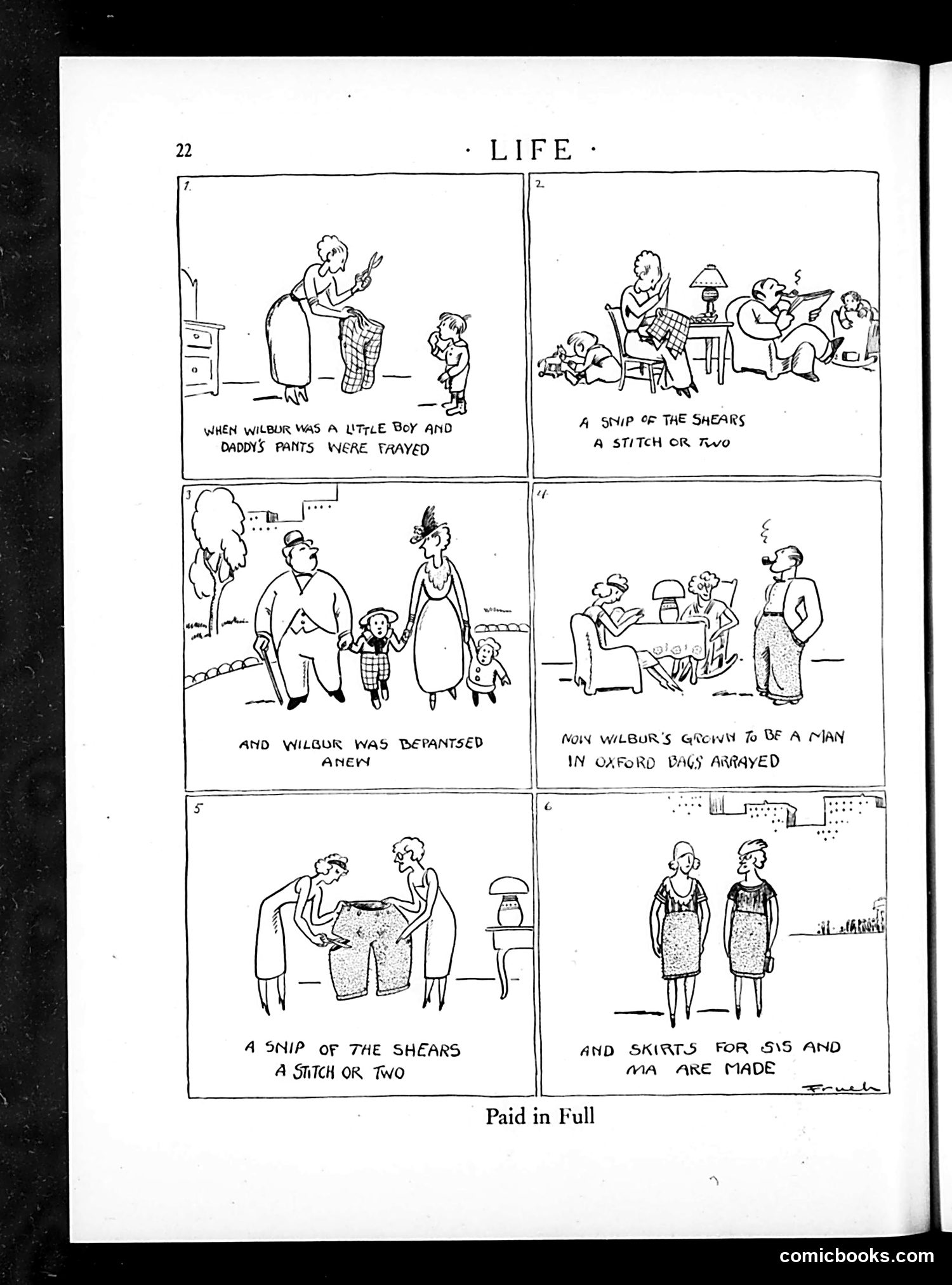
This satirical comic traces a man named Wilbur's life through clothing economics. As a boy, his father's frayed pants are recycled—cut and stitched into Wilbur's clothes. As an adult, Wilbur receives fashionable "Oxford bags" (a 1920s-30s trouser style). The joke: Wilbur later repurposes fabric scraps to make skirts for his sisters and mother, completing the cycle of thrift and resourcefulness. **The satire** mocks the contradiction between aspiring to modern fashion (Oxford bags) while still practicing Depression-era or post-WWI austerity measures (remaking old fabric). It's both gentle domestic humor and social commentary on economic constraints—clothing gets perpetually recycled across family members, suggesting economic necessity trumps style. The title "Paid in Full" implies the family debt or obligation cycles endlessly.
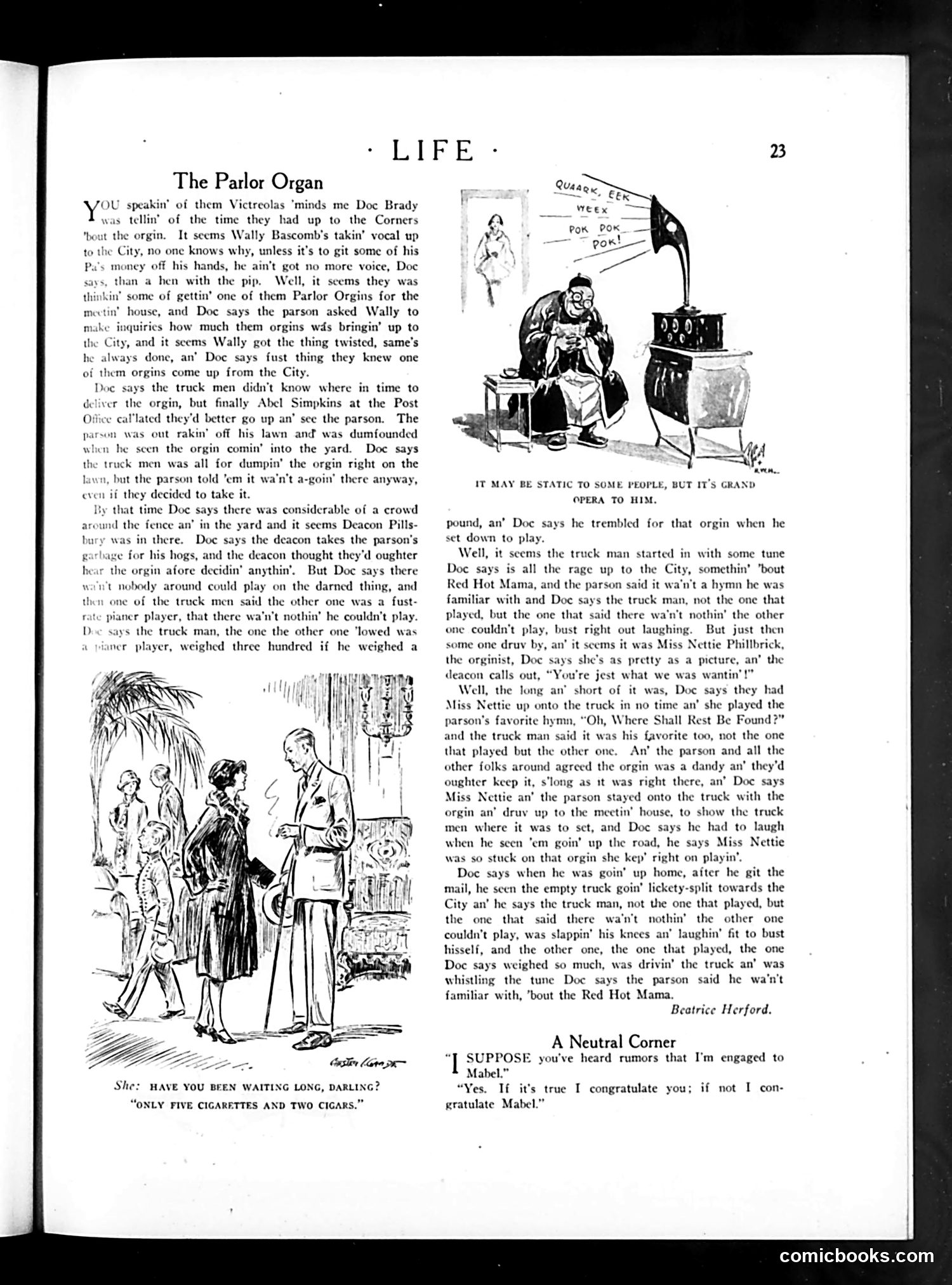
This page contains two distinct pieces of humor: **"The Parlor Organ"** is a rambling tall tale written in rural dialect about a mix-up when a church tries to order a parlor organ. A country boy named Wally misunderstands instructions, leading to an actual organ being delivered. Two truck drivers attempt to play it—one claims he can play anything but clearly cannot; the other is heavy and actually competent. When the attractive local organist, Miss Nettie Phillbrick, arrives and plays hymns beautifully, the incompetent driver laughs at his own failure. The joke relies on rural miscommunication and the comedic contrast between boastful incompetence and humble skill. **"A Neutral Corner"** is a brief, unrelated joke about a man named Mabel who is engaged—the punchline plays on the traditionally feminine name, implying surprise or confusion about the engagement announcement. The cartoons are lighthearted, character-driven humor typical of *Life* magazine's early 20th-century satirical style, poking gentle fun at rural America and social pretension rather than serious political commentary.
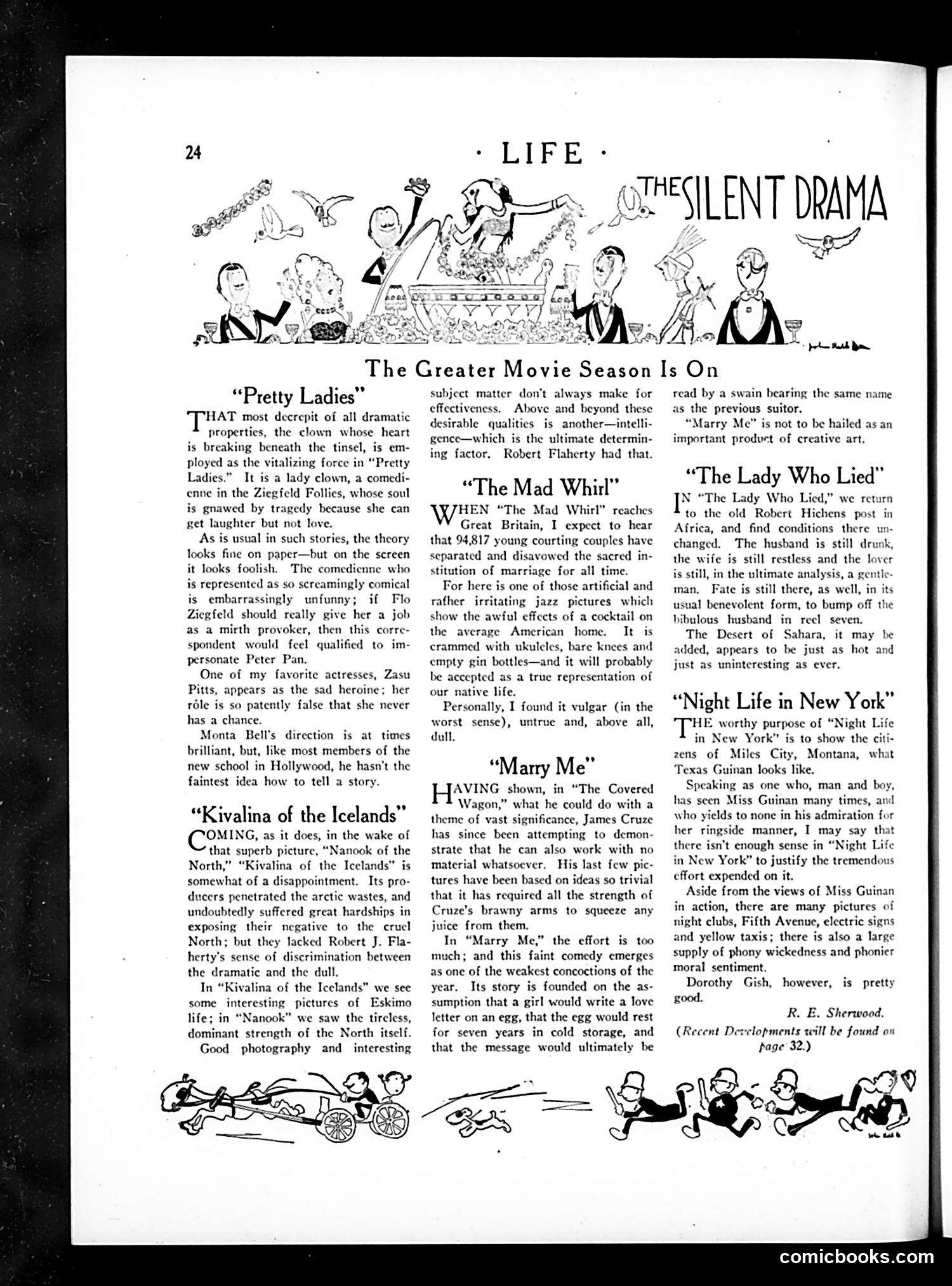
This page reviews five silent films opening in "The Greater Movie Season." The critic—R.E. Sherwood—evaluates contemporary movies with sharp skepticism: **"Pretty Ladies"** features Zasu Pitts as a tragic clown from the Ziegfeld Follies. Sherwood dismisses the premise (sad heart beneath comic exterior) as foolish on screen, criticizing both the lead's unfunniness and director Monta Bell's incompetence at storytelling. **"Kivalina of the Icelands"** is compared unfavorably to Robert Flaherty's acclaimed "Nanook of the North"—good photography alone doesn't substitute for intelligence and artistic discrimination. **"The Mad Whirl"** satirizes Jazz Age excess (cocktails, ukuleles, bare knees, gin bottles) in American homes. Sherwood finds it vulgar and fears British audiences will accept it as authentic American life. **"Marry Me"** and **"The Lady Who Lied"** receive dismissal for weak plots (an egg containing a love letter; a tired colonial romance formula). The decorative header illustrates "Silent Drama" performers in theatrical poses, reflecting the page's focus on cinema's visual storytelling during the silent film era.
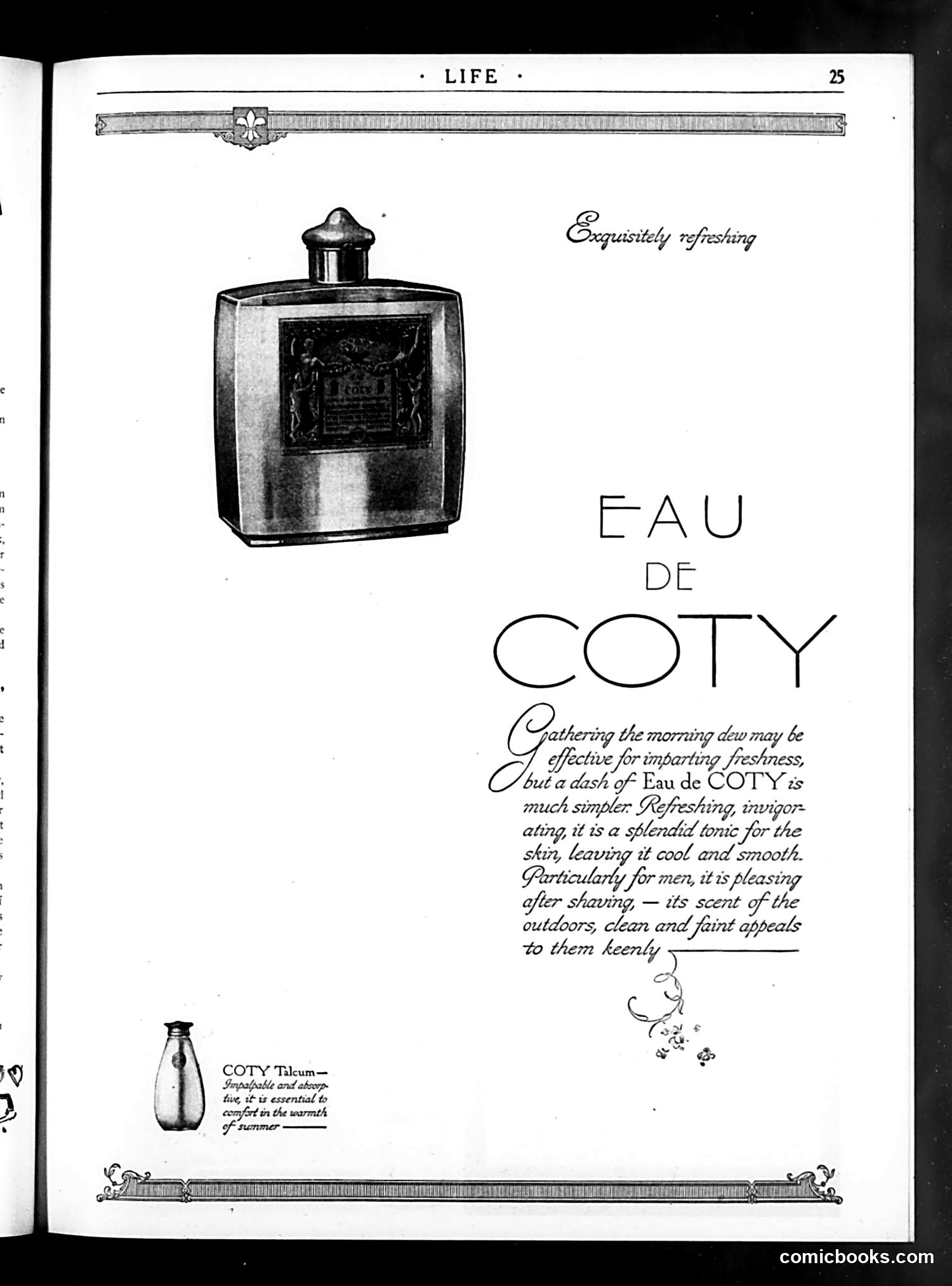
This is **not a cartoon or satire**—it's a **cosmetics advertisement** for Eau de Coty fragrance, appearing in Life magazine. The page promotes Coty's eau de cologne and talcum powder as summer toiletries. The ad emphasizes practicality over aesthetics: rather than gathering morning dew (a poetic, old-fashioned beauty method), one should simply use Coty's product for refreshment and skin tone. Notably, the copy specifically targets **men**, claiming the scent appeals to them "keenly" after shaving, with its "clean" outdoor character. This reflects early 20th-century marketing that positioned such grooming products as masculine and practical rather than frivolous or feminine—a significant rhetorical move when men's cosmetics faced social resistance. The elegant bottle design and refined typography reinforce the product's aspirational positioning as sophisticated and modern.
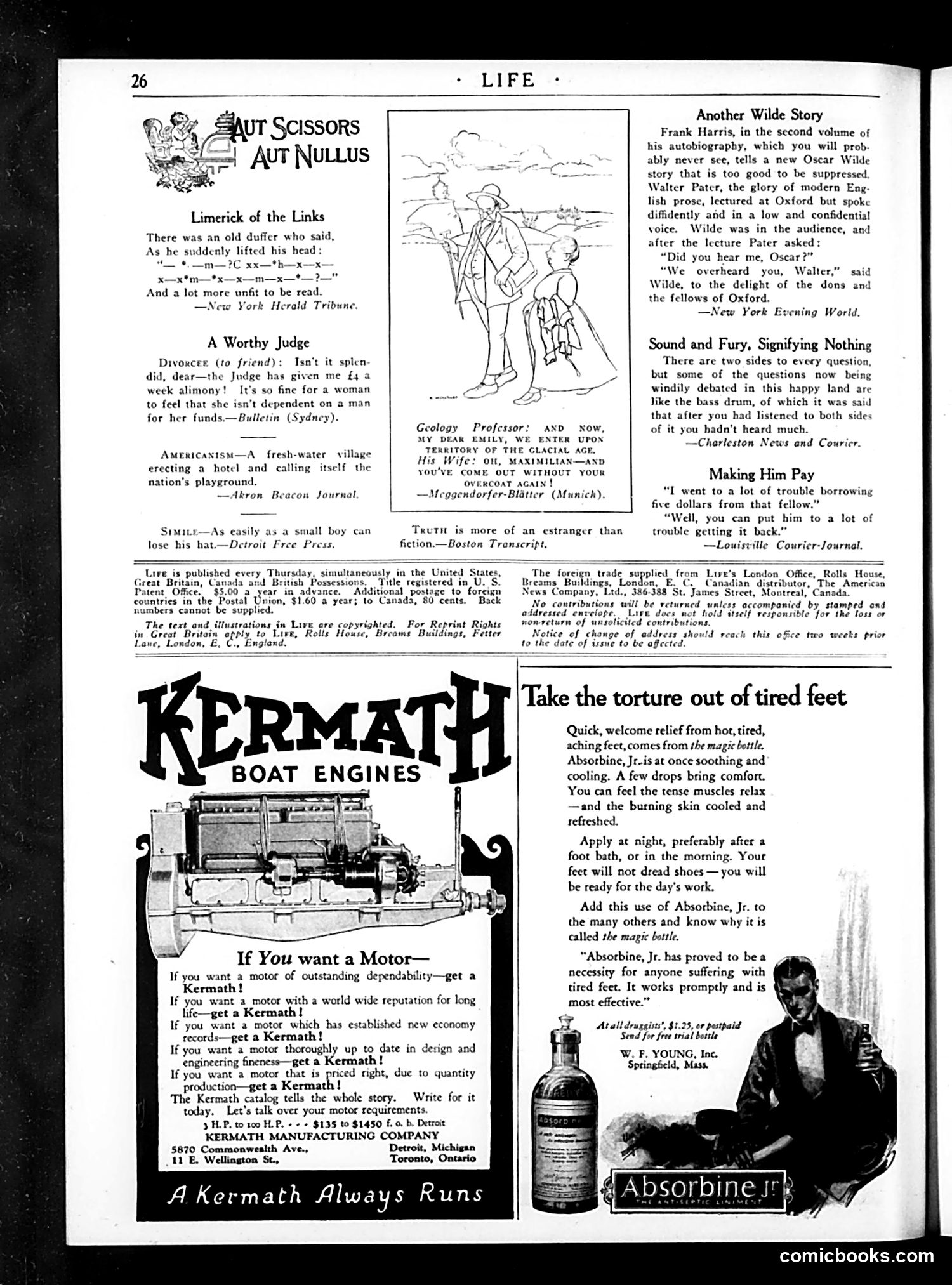
This page contains miscellaneous short humor pieces typical of Life's satirical format. Key items include: **"The Oscar Wilde Story"**: References Frank Harris's autobiography and recounts an anecdote where Oscar Wilde witily corrects Walter Pater at Oxford, saying "We overheard you, Walter" rather than "I heard you"—a dig at Pater's mumbling delivery. This celebrates Wilde's quick wit. **"A Worthy Judge"**: A woman celebrates receiving alimony, claiming independence from men—likely satirizing the irony that her "independence" depends entirely on court-mandated male support. **Golf and geology jokes**: Mock absent-minded duffers and professorial types. The page is dominated by **advertisements** for Kermath boat engines and Absorbine Jr. liniment—reflecting Life's revenue model. The satire is light, focused on social types (judges, professors, golfers) rather than specific political targets.
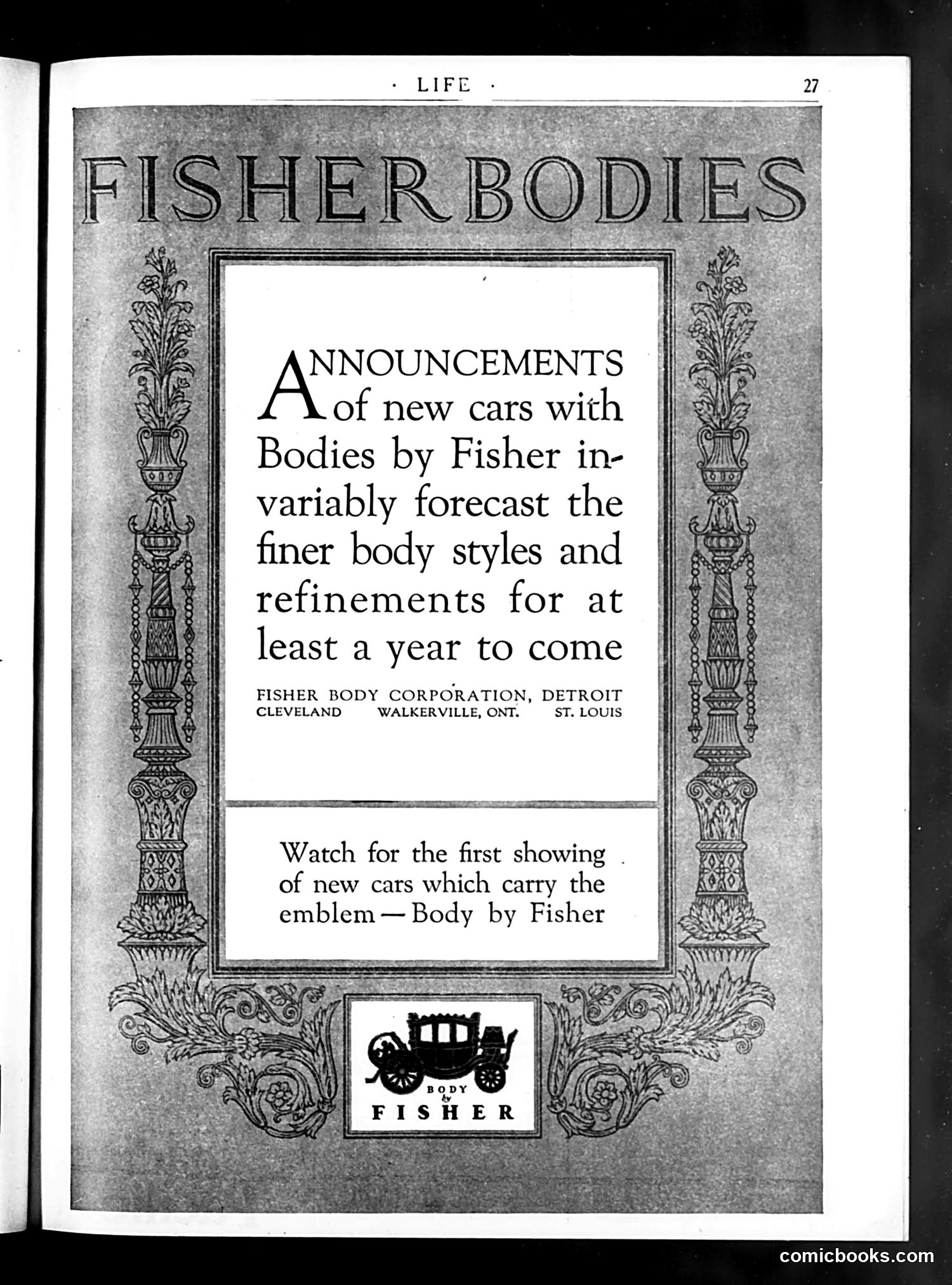
This is a full-page advertisement, not satire or political content. It announces Fisher Body Corporation's car bodies, with headquarters in Detroit, Cleveland, Walkerville (Ontario), and St. Louis. The ad claims that Fisher's new car body designs reliably predict automotive styling trends for the coming year. The ornate decorative border features classical urns and scrollwork, lending prestige to the product. At bottom is Fisher's logo—a horse-drawn carriage—which identifies their branded bodies on new cars. This represents early automotive industry advertising, positioning Fisher Body as a trendsetting manufacturer whose aesthetic choices influence the broader market. The "Body by Fisher" emblem functions as a quality seal for consumers.
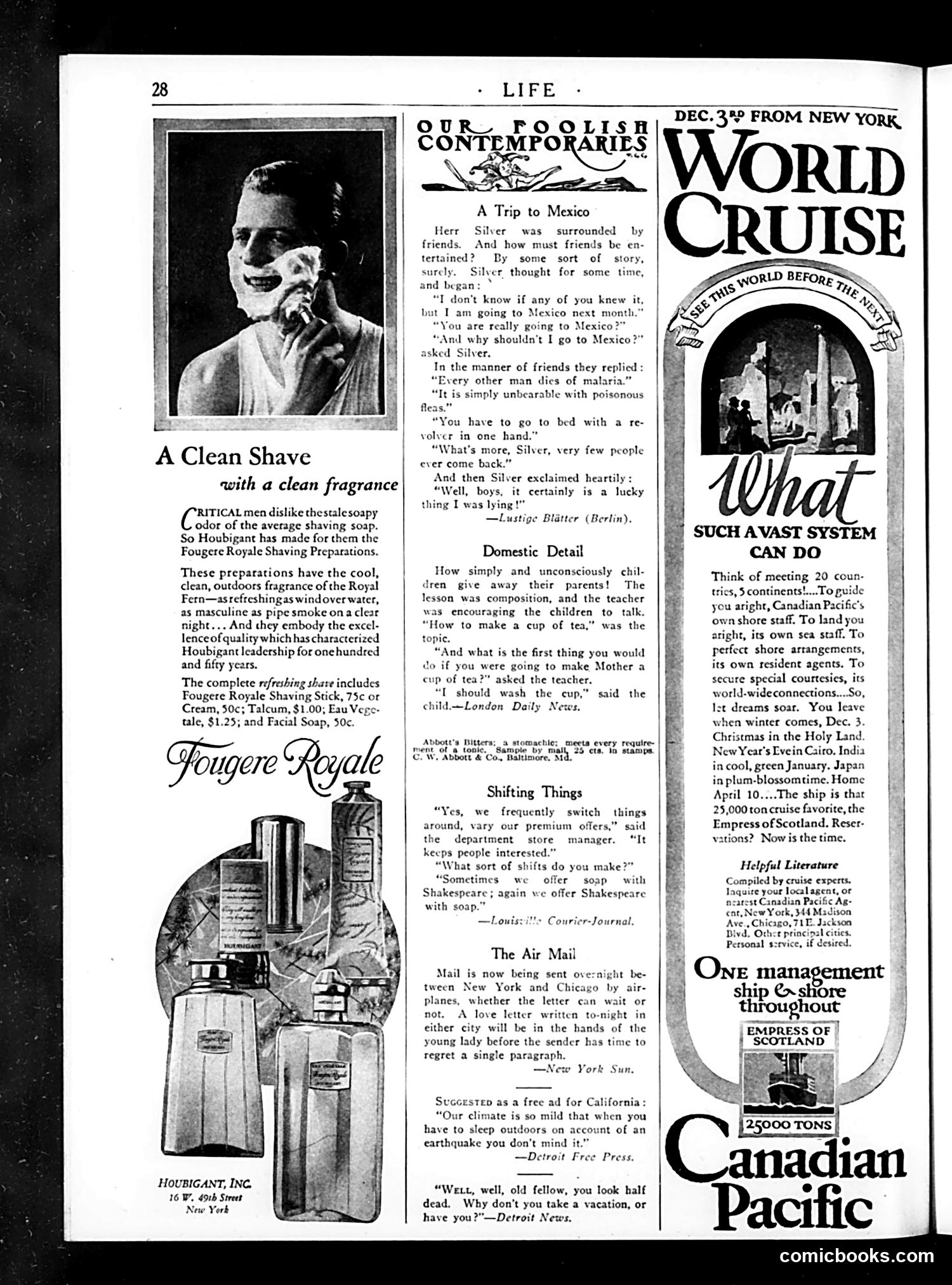
This page showcases Life's humor section featuring short anecdotes mocking contemporary absurdities. "A Trip to Mexico" depicts a man named Herr Silver who announces a Mexico trip, prompting friends to list horrifying dangers (malaria, poisonous fleas, needing a revolver). Silver's punchline reveals he was lying—the joke satirizes how travel stories get exaggerated with dire warnings. Other brief pieces mock similar social conventions: a child innocently reveals parents' habits, a store manager admits deliberately shuffling merchandise to maintain customer interest, and a California booster absurdly suggests earthquakes aren't bad because the climate's pleasant. The page also contains period advertisements (Fougere Royale shaving products, Canadian Pacific cruise line) typical of Life's revenue model. The humor reflects 1920s concerns about travel safety, parental dignity, consumer manipulation, and regional American stereotypes.
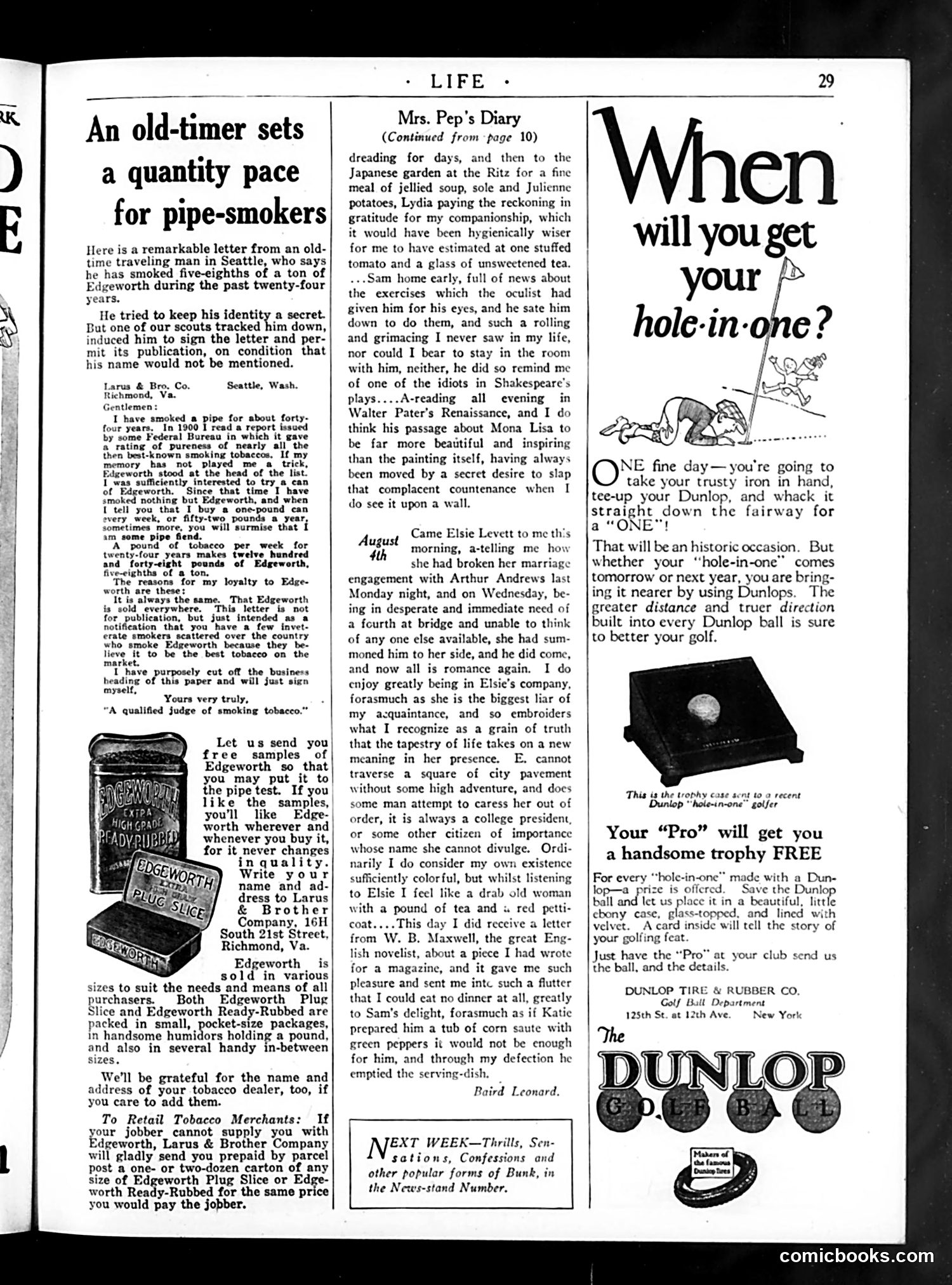
This page combines **tobacco advertising with social commentary** typical of Life's satirical approach. The main content is a testimonial letter from a Seattle pipe-smoker claiming to have consumed five-eighths of a ton of Edgeworth tobacco over 24 years—presented as remarkable dedication to a single brand. The satire targets **consumer culture and brand loyalty**: the letter's anonymous author is portrayed as almost comically devoted, buying a pound weekly for decades. Life presents this as worthy of publication, gently mocking both the smoker's obsessive habit and the tobacco industry's marketing tactics that cultivate such loyalty. The accompanying **Dunlop golf ball advertisement** and "Mrs. Pep's Diary" (a society gossip column) fill the page, reflecting 1920s-era leisure culture. Together, these elements satirize upper-middle-class consumption patterns—tobacco, golf equipment, and social pretension—characteristic of Life's role as a publication for educated readers skeptical of commercialism.
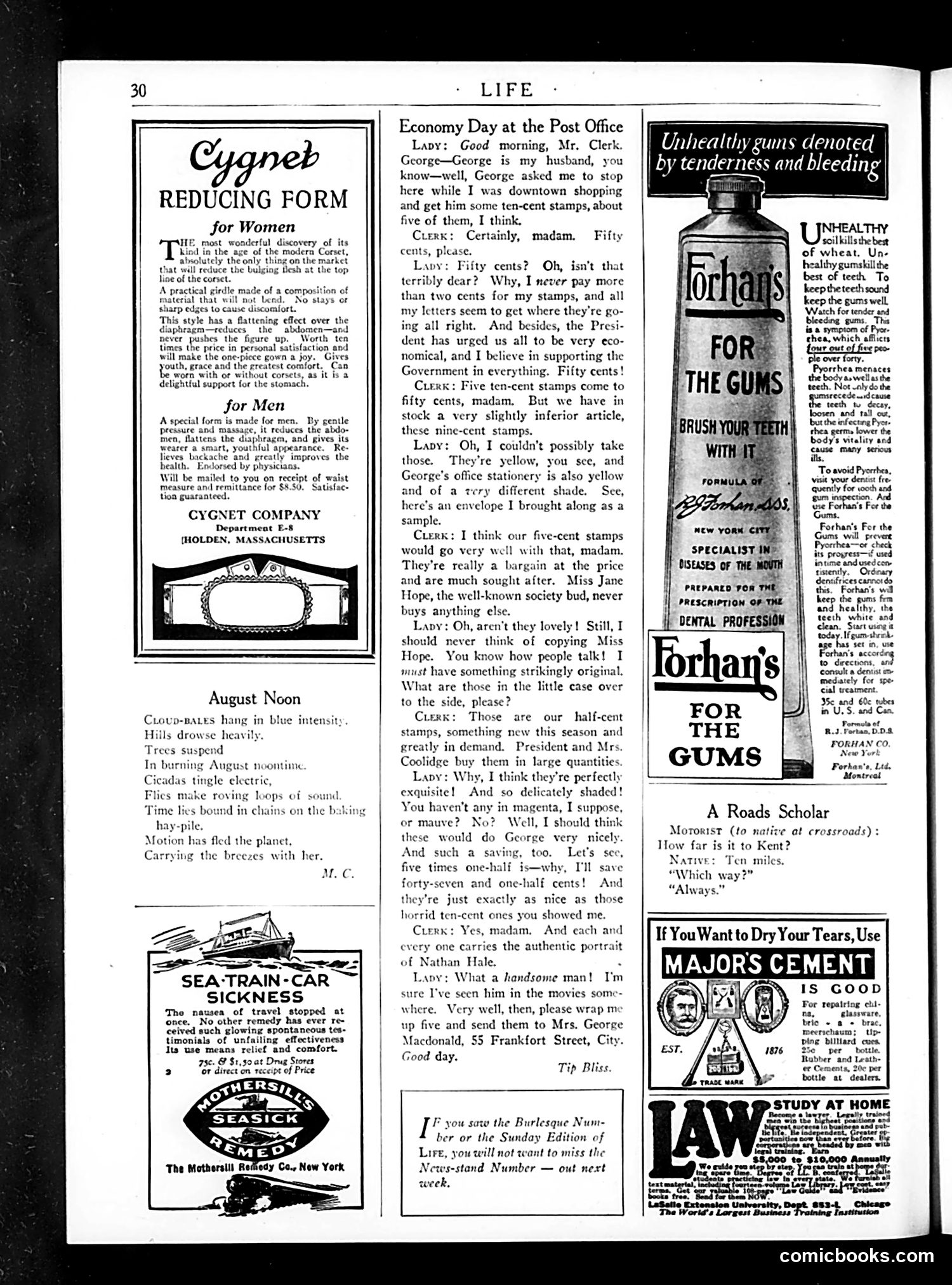
This satirical dialogue mocks a woman's contradictory approach to government economy. She enters the post office seeking ten-cent stamps for her husband but, upon learning the cost, complains it's too expensive. When the clerk offers cheaper alternatives, she rejects them—the nine-cent stamps don't match her husband's stationery color, and she won't copy socialite Miss Jane Hope by buying five-cent stamps. She finally settles on half-cent stamps (supposedly new and purchased by President Coolidge), seduced by their aesthetic appeal and the savings, despite their impracticality. The joke: she champions supporting the government's economy drive yet makes absurd purchasing decisions based on vanity and fashion rather than actual economy. The cartoon satirizes how ordinary citizens justify wasteful spending through self-deception, undermining genuine conservation efforts.
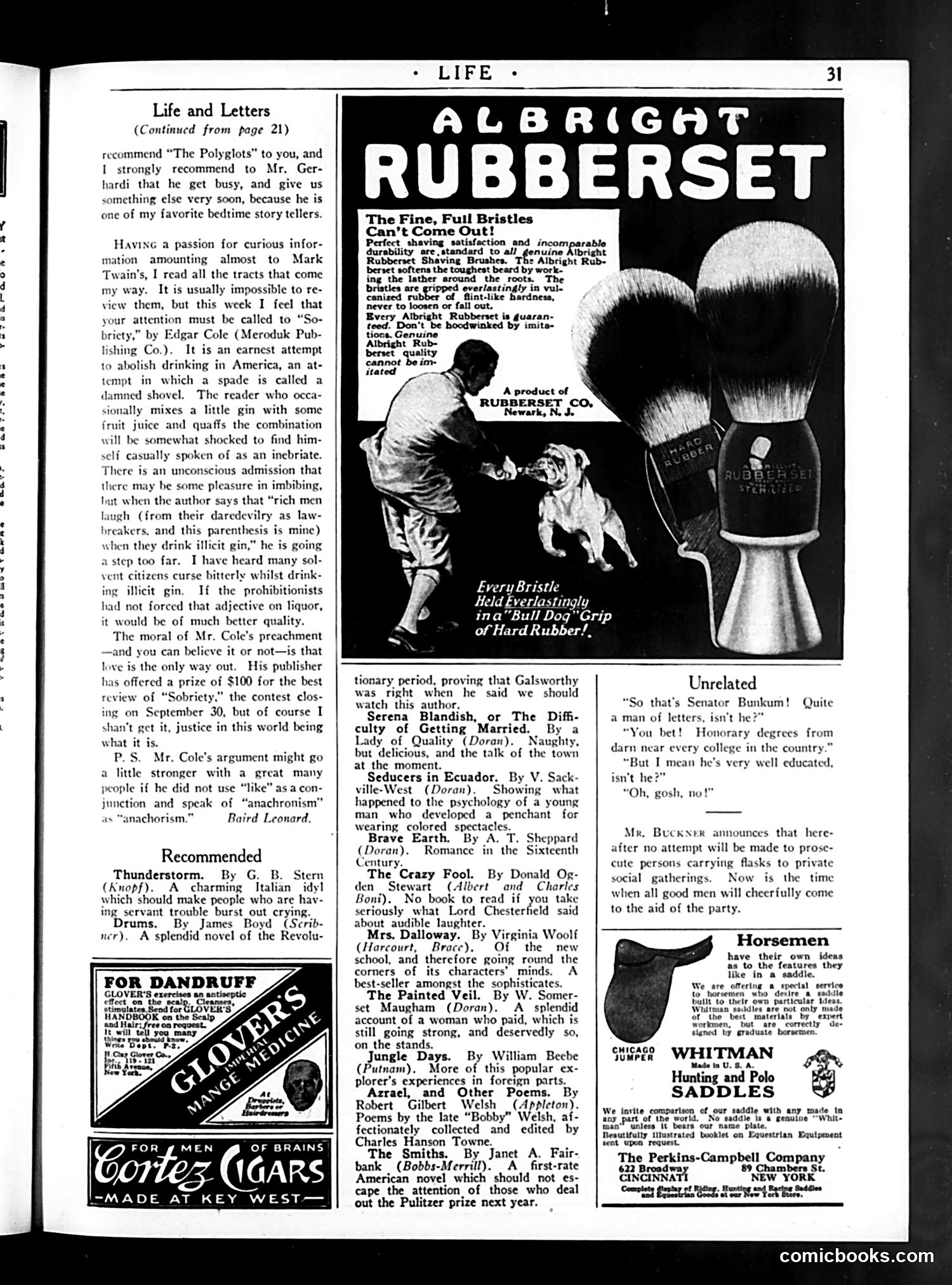
This is primarily a **book review and advertising page** from Life magazine's literary section. The left column contains earnest book recommendations and a letter discussing *Sobriety* by Edgar Cole—an anti-drinking tract. The reviewer sarcastically notes the author calls casual drinkers "inebriates," pointing out the book's heavy-handed Prohibition-era moralizing. The large right-side advertisement features an **Albright Rubberset shaving brush**—not a cartoon but a product ad with a man and bulldog demonstrating the brush's durability. The "bull dog grip" is the selling point: bristles won't fall out. The page reflects **1920s American culture**: Prohibition sentiment (the book reviews), product advertising's confidence in illustrated endorsements, and literary sophistication among the magazine's educated readership. There are no political cartoons here—mostly ads and book talk typical of Life's mixed editorial-commercial format.
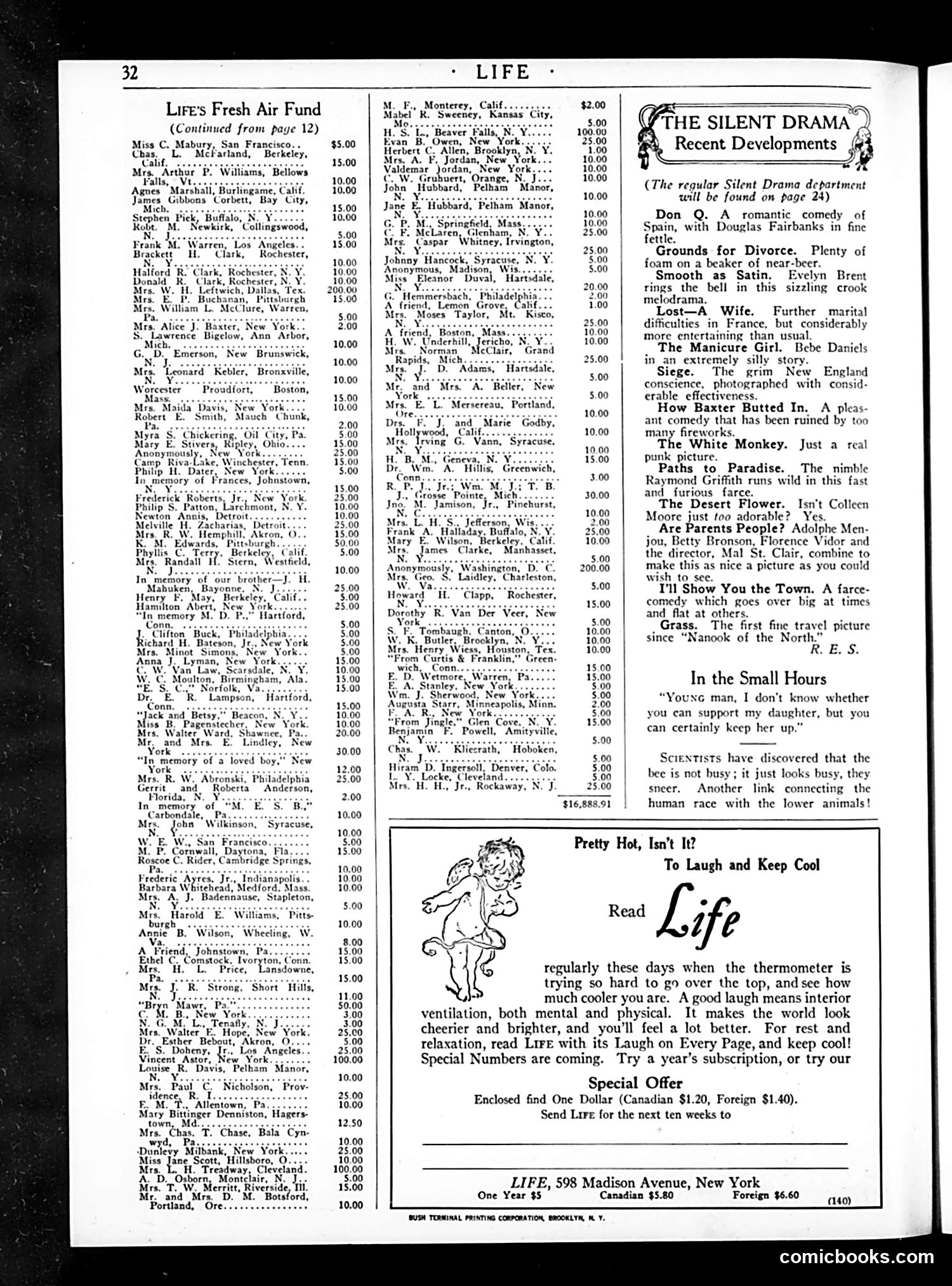
This page consists primarily of **Life's Fresh Air Fund** — a charitable fundraising list documenting donations from readers across America. The amounts range from $2 to $200, with contributors identified by name and location. The right side contains **"The Silent Drama: Recent Developments,"** brief capsule reviews of silent films then in theatrical release, including *Don Q* (Douglas Fairbanks), *Grounds for Divorce*, and *The Manicure Girl* (Bebe Daniels). These reviews use punchy, witty descriptions typical of Life's satirical house style. Below that is an advertisement promoting Life magazine subscriptions, featuring a cherubic cartoon figure and copy encouraging readers to "Laugh and Keep Cool" during hot weather by reading Life regularly. The page reflects Life's dual role: **serious charitable advocacy** (the Fresh Air Fund supported working-class children's vacations) alongside **entertainment criticism and self-promotion** — capturing the magazine's identity as both social commentator and humor publication.
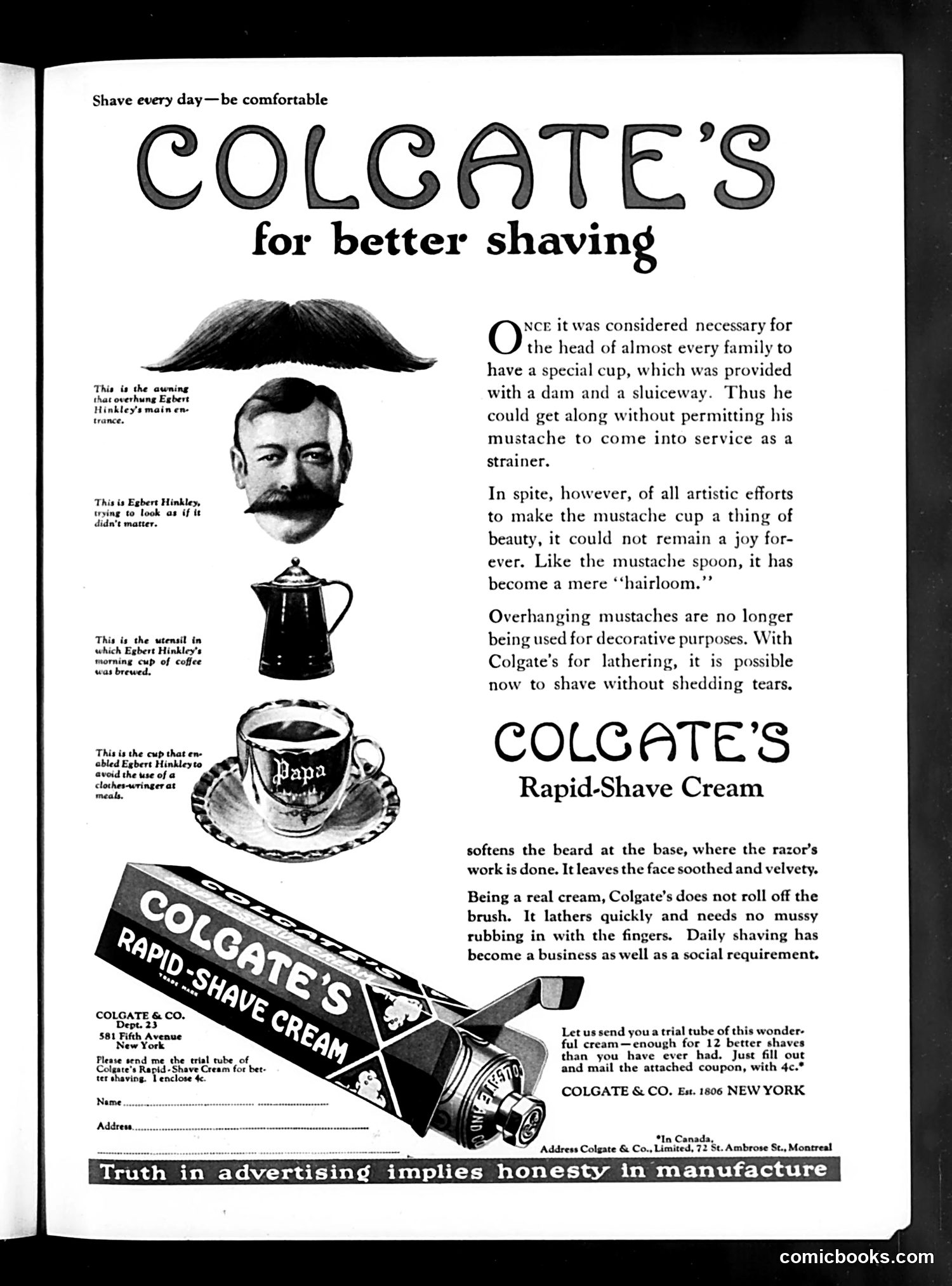
This is primarily a **product advertisement**, not political satire. The page uses humor to market shaving cream by mocking outdated grooming customs. The joke centers on **Egbert Hinkley**, a fictional character shown with an extravagant handlebar mustache. The ad humorously illustrates how men once needed special equipment—a mustache cup with a dam and sluiceway, even a mustache spoon—to prevent their facial hair from interfering with eating and drinking. These items are dismissed as mere "hairlooms" (pun on "heirloom"). The satire targets **outdated Victorian masculine vanity**: the exaggerated mustache was once a status symbol requiring elaborate maintenance. Colgate's Rapid-Shave Cream promises to make daily shaving comfortable and practical, positioning the product as modern and sensible against old-fashioned affectation. The appeal is to contemporary masculinity: shaving daily is now a "social requirement," not a decorative indulgence. The advertisement mocks the past while selling practicality.
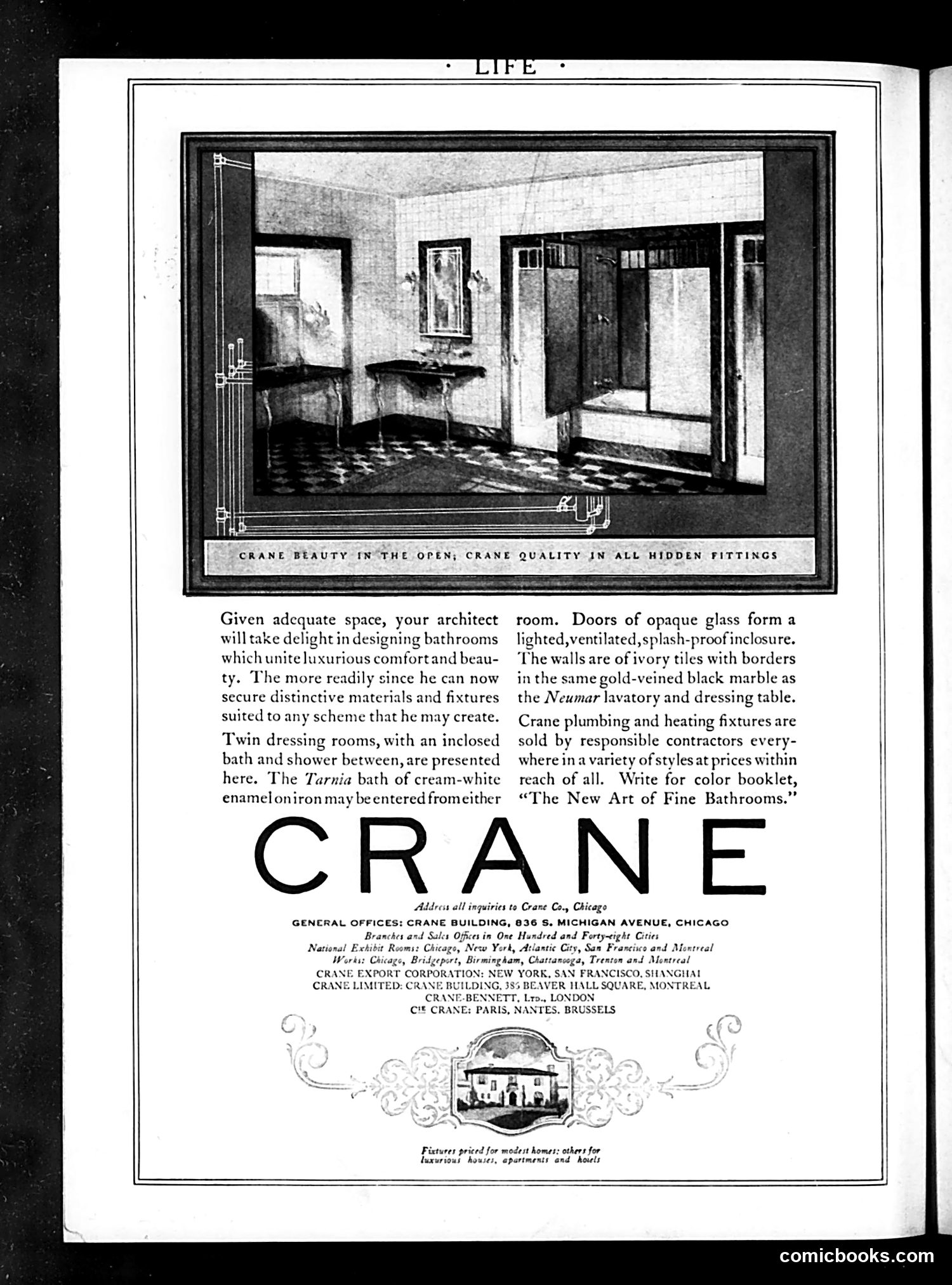
This is **not a political cartoon or satire**—it's a full-page advertisement for Crane plumbing fixtures from Life magazine. The image shows a modernist bathroom design featuring twin dressing rooms with an enclosed bath and shower between them. The advertisement emphasizes luxury bathroom design made accessible through Crane's products: the "Tarnia" cream-enamel bath, ivory tiles with gold-veined black marble borders, and opaque glass doors. The pitch targets middle-class homeowners: Crane offers fixtures "at prices within reach of all," positioning quality plumbing as democratic luxury. The tagline "Beauty in the Open; Quality in All Hidden Fittings" suggests both aesthetic appeal and reliable unseen infrastructure. This reflects 1920s-era consumer culture, where indoor plumbing was still becoming standard in American homes, and modernist design aesthetics were marketed as attainable for modest budgets.