
Life, 1925-08-06 · page 23 of 36
Life — August 6, 1925 — page 23: what you’re looking at
What you’re looking at
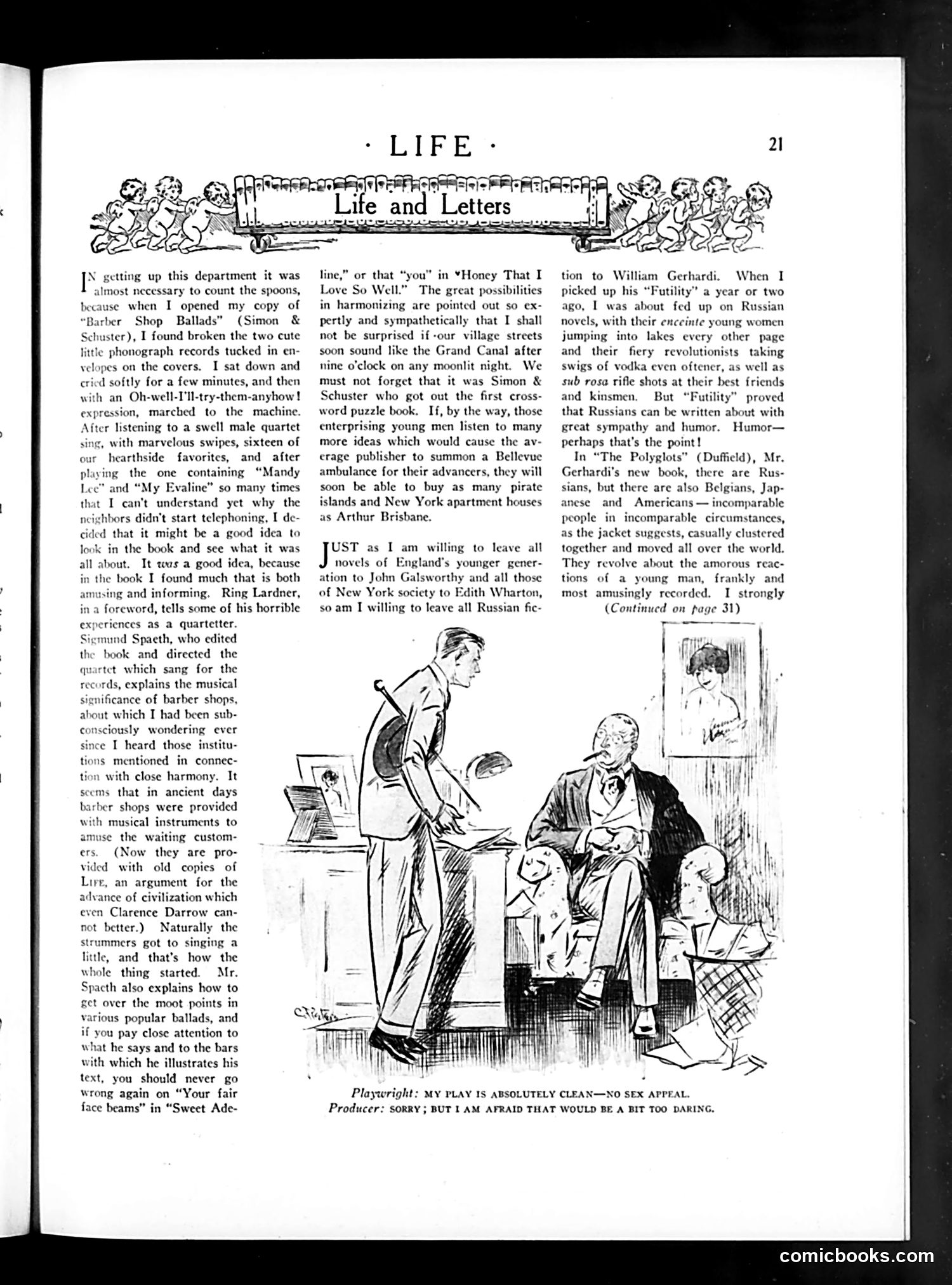
This page contains a literary column reviewing books, with one cartoon illustrating a publishing industry joke. **The Cartoon**: A playwright pitches his work to a producer, claiming it's "absolutely clean—no sex appeal." The producer replies he's "afraid that would be a bit too daring." The satire criticizes 1920s Broadway's apparent obsession with sexual content—the joke being that wholesomeness would actually be the *scandalous* choice for contemporary theater audiences. **The Text**: The column reviews "Barber Shop Ballads" (a book with phonograph records), praising its explanation of barbershop quartet harmony traditions. It also discusses William Gerhardi's novels "Futility" and "The Polyglots," praising Gerhardi for treating Russian characters with humor rather than the melodramatic clichés typical of Russian fiction (doomed heroines, vodka-swinging revolutionaries). The piece reflects 1920s literary and entertainment culture, when barber shop singing was still popular entertainment and Russian literature dominated serious fiction discussions.
📄 Transcribed text from this page (OCR, searchable)
Machine-transcribed from the original scan — historical spelling and the odd misread are preserved.
- LIFE > ‘Life and Letters pas a a ee, IS getting up this department it was almost necessary to count the spoons, because when I opened my copy of “Barber Shop Ballads” (Simon & Schuster), I found broken the two cute little phonograph records tucked in en- pes on the covers. I sat down and 1 softly for a few minutes, and then an Oh-well-I'll-try-them-anyhow ! expression, marched to the machine. er listening to a swell male quartet , with marvelous swipes, sixteen of hearthside favorites, and after playing the one containing “Mandy Lee” and “My Evaline” so many times that I can't understand yet why the hbors didn’t start telephoning, I de- cided that it might be a good idea to look in the book and see what it was all about. It was a good idea, because the book I found much that is both amusing and informing. Ring Lardner, a foreword, tells some of his horrible experiences as a quartetter. Sigmund Spaeth, who edited the book and directed the quartet which sang for the records, explains the musical znificance of barber shops, about which I had been sub- consciously wondering ever nce I heard those institu- s mentioned in connec- tion with close harmony. It seems that in ancient days barber shops were provided musical instruments to amuse the waiting custom- ers. (Now they are pro- vided with old copies of Lire, an argument for the advance of civilization which even Clarence Darrow can- not better.) Naturally the mmers got to singing a little, and that's how the whole thing started. Mr. Spacth also explains how to get over the moot points in various popular ballads, and if you pay close attention to what he says and to the bars with which he illustrates his text, you should never go wrong again on “Your fair face beams” in “Sweet Ade- or that “you” in YHoney That I 5 The great possibilities in harmonizing are pointed out so ex- pertly and sympathetically that I shall not be surprised if-our village streets soon sound like the Grand Canal after nine o'clock on any moonlit night. We must not forget that it was Simon & Schuster who got out the first cross- word puzzle book. If, by the way, those enterprising young men listen to many more ideas which would cause the av- erage publisher to summon a Bellevue ambulance for their advancers, they will soon be able to buy as many pirate islands and New York apartment houses as Arthur Brisbane. UST as I am willing to leave all novels of England's younger gener- ation to John Galsworthy and all those of New York society to Edith Wharton, so am I willing to leave all Russian fic- tion to William Gerhardi. When I picked up his “Futility” a year or two ago, I was about fed up on Russian novels, with their enceinte young women jumping into lakes every other page and their fiery revolutionists taking swigs of vodka even oftener, as well as sub rosa rifle shots at their best friends and kinsmen. But “Futility” proved that Russians can be written about with great sympathy and humor. Humor— perhaps that’s the point! In “The Polyglots” (Duffield), Mr. Gerhardi’s new book, there are Rus- sians, but there are also Belgians, Jap- and Americans — incomparable people in incomparable circumstances, as the jacket suggests, casually clustered together and moved all over the world. They revolve about the amorous reac- tions of a young man, frankly and most amusingly recorded, I strongly (Continued on page 31) anese Playwright: MY PLAY 18 ABSOLUTELY CLEAN—NO SEX APPEAL. Producer: SORRY ; BUT 1 AM AFRAID THAT WOULD BE A BIT TOO DARING, comicbooks.com