
Life, 1925-08-06 · page 20 of 36
Life — August 6, 1925 — page 20: what you’re looking at
What you’re looking at
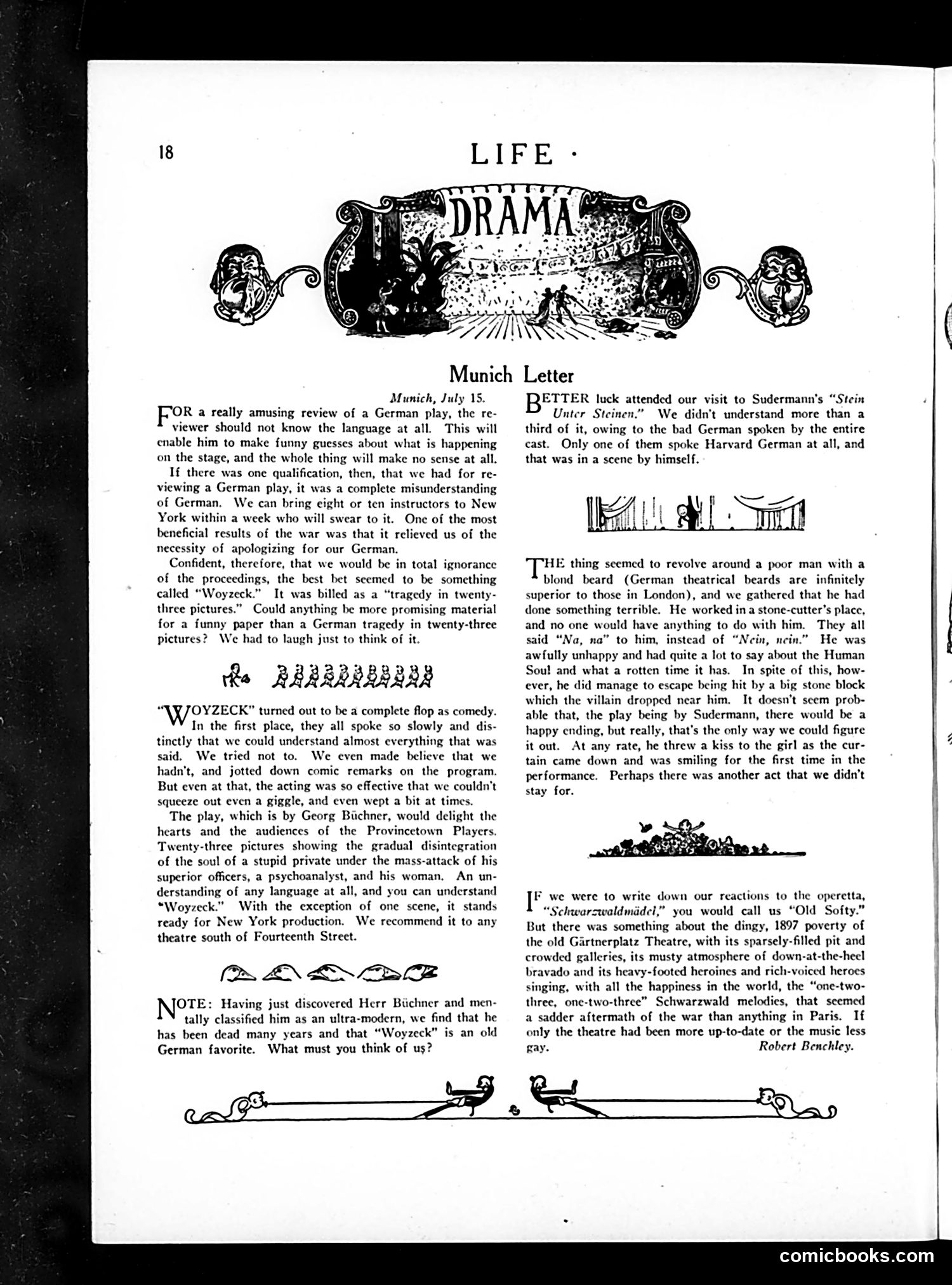
This is a humorous dispatch from Life magazine's Munich correspondent reviewing German theater productions. The satire operates on multiple levels: **The Main Joke:** The author admits to not understanding German, then pretends this incomprehension qualifies him to review German plays. He jokes that not knowing the language actually *improves* the comedic experience—he can invent funny interpretations of what's happening onstage. **The Plays Reviewed:** - *Woyzeck* by Georg Büchner: A tragedy about a soldier's psychological disintegration. The joke is that the author expected it to be absurdly funny precisely *because* it's a serious German tragedy presented in twenty-three picture-scenes, but the acting was so effective it actually moved him to tears—ruining his plan to mock it. - *Stein Unter Steinen* (Sudermann): A melodrama about a disgraced stoneworker; the author admits understanding only fragments due to poor German pronunciation by the cast. **The Satire's Target:** Post-WWI American attitudes toward German culture. The opening quip about the war relieving Americans of "apologizing for our German" suggests wartime animosity. The piece gently mocks both American ignorance and pretentious theater criticism.
📄 Transcribed text from this page (OCR, searchable)
Machine-transcribed from the original scan — historical spelling and the odd misread are preserved.
Munich, July 15. For a really amusing review of a German play, the re- viewer should not know the language at all. This will enable him to make funny guesses about what is happening on the stage, and the whole thing will make no sense at all. If there was one qualification, then, that we had for re- viewing a German play, it was a complete misunderstanding of German. We can bring eight or ten instructors to New York within a week who will swear to it. One of the most beneficial results of the war was that it relieved us of the necessity of apologizing for our German. Confident, therefore, that we would be in total ignorance of the proceedings, the best bet seemed to be something called “Woyzeck.” It was billed as a “tragedy in twenty- three pictures.” Could anything be more promising material for a funny paper than a German tragedy in twenty-three pictures? We had to laugh just to think of it. the RARBRRERIRS ‘ OYZECK” turned out to be a complete flop as comedy. In the first place, they all spoke so slowly and dis- tinctly that we could understand almost everything that was said. We tried not to. We even made believe that we hadn't, and jotted down comic remarks on the program. But even at that, the acting was so effective that we couldn't squeeze out even a giggle, and even wept a bit at times. The play, which is by Georg Bichner, would delight the hearts and the audiences of the Provincetown Players. Twenty-three pictures showing the gradual disintegration of the soul of a stupid private under the mass-attack of his superior officers, a psychoanalyst, and his woman. An un- derstanding of any language at all, and you can understand “Woyzeck.” With the exception of one scene, it stands ready for New York production. We recommend it to any theatre south of Fourteenth Street. Px &\ &> BLE NOTE: Having just discovered Herr Biichner and men- tally classified him as an ultra-modern, we find that he has been dead many years and that “Woyzeck” is an old German favorite. What must you think of us? Munich Letter ETTER luck attended our visit to Sudermann’s “Stein Unter Steinen.” We didn’t understand more than a third of it, owing to the bad German spoken by the entire cast. Only one of them spoke Harvard German at all, and that was in a scene by himself. HE thing seemed to revolve around a poor man with a blond beard (German theatrical beards are infinitely superior to those in London), and we gathered that he had done something terrible. He worked ina stone-cutter’s place, and no one would have anything to do with him. They all said “Na, na” to him, instead of “Nein, nein.” He was awfully unhappy and had quite a lot to say about the Human Sou! and what a rotten time it has. In spite of this, how- ever, he did manage to escape being hit by a big stone block which the villain dropped near him. It doesn’t seem prob- able that, the play being by Sudermann, there would be a happy ending, but really, that’s the only way we could figure it out. At any rate, he threw a kiss to the girl as the cur- tain came down and was smiling for the first time in the performance. Perhaps there was another act that we didn’t stay for. we were to write down our reactions to the operetta, ‘chwarzwaldmiadel,” you would call us “Old Softy.” But there was something about the dingy, 1897 poverty of the old Gartnerplatz Theatre, with its sparsely-filled pit and crowded galleries, its musty atmosphere of down-at-the-heel bravado and its heavy-footed heroines and rich-voiced heroes singing, with all the happiness in the world, the “one-two- three, one-two-three” Schwarzwald melodies, that seemed a sadder aftermath of the war than anything in Paris. If only the theatre had been more up-to-date or the music less gay. Robert Benchley. comicbooks.com