
Life, 1925-08-06 · page 7 of 36
Life — August 6, 1925 — page 7: what you’re looking at
What you’re looking at
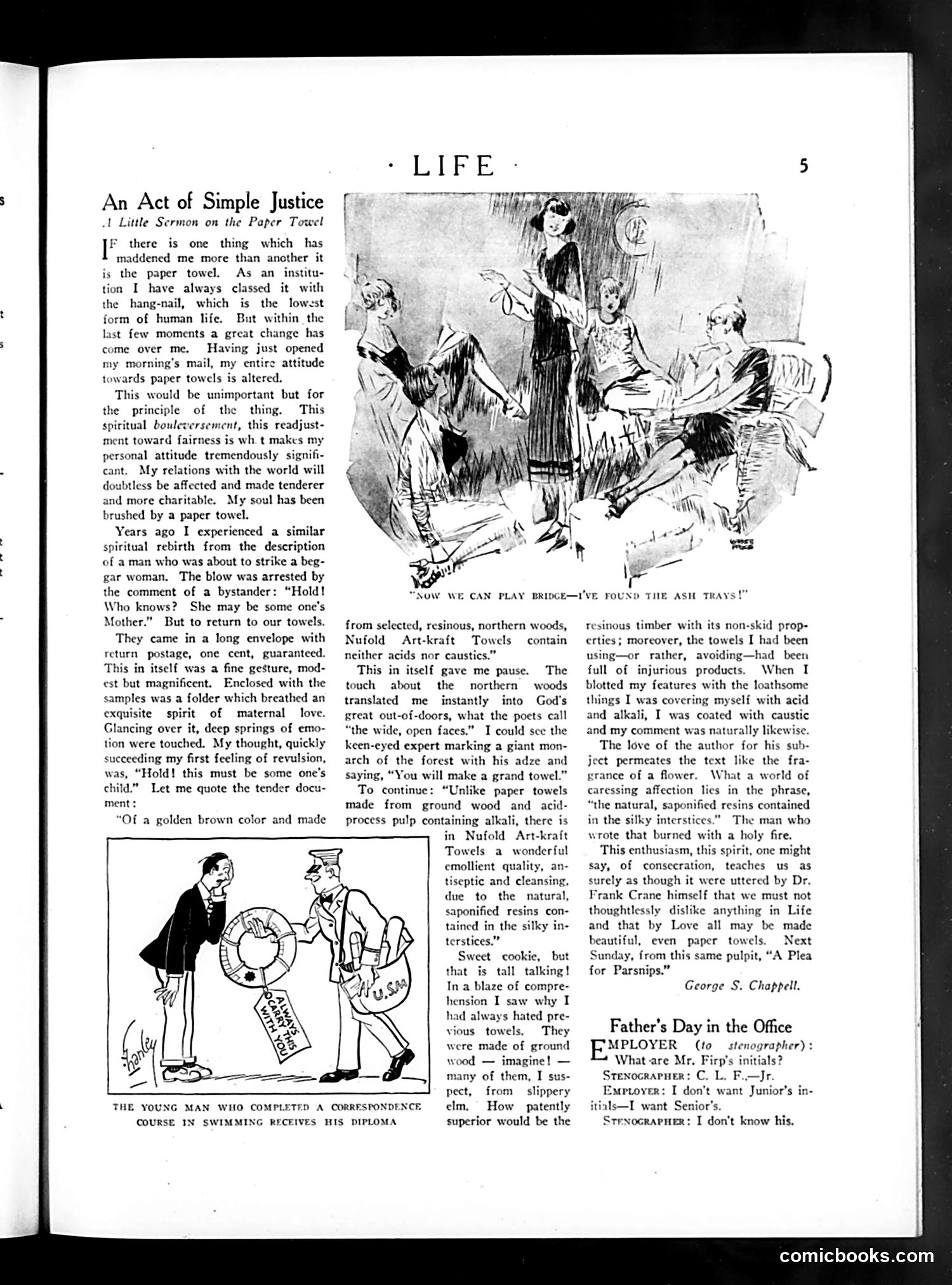
This page contains two distinct pieces: **"An Act of Simple Justice"** is an essay by George S. Chappell praising paper towels, specifically Bufold Art-kraft brand. The top illustration shows women discovering ash trays (caption: "Now we can play bridge—I've found the ash trays!"), celebrating the practical cleanliness paper towels provide. Chappell argues paper towels represent thoughtful design and conservation—turning a mundane product into a moral lesson about how "Love all may be made beautiful." **"Father's Day in the Office"** is a brief comic dialogue between an employer and stenographers debating whether to acknowledge "Mr. Fiero's" initials, poking gentle fun at office workplace dynamics and the uncertainty of workplace etiquette. The lower cartoon shows a man receiving a swimming diploma, satirizing absurd correspondence courses that promise credentials without genuine qualification.
📄 Transcribed text from this page (OCR, searchable)
Machine-transcribed from the original scan — historical spelling and the odd misread are preserved.
An Act of Simple Justice «1 Little Sermon on the Paper Towel I there is one thing which has maddened me more than another it is the paper towel. As an_ institu- tion I have always classed it with the hang-nail, which is the lowest form of human life. But within the last few moments a great change has come over me. Having just opened my morning's mail, my entire attitude towards paper towels is altered. This would be unimportant but for the principle of the thing. This spiritual bouleversement, this readjust- ment toward fairness is wh. t makes my personal attitude tremendously signifi- cant. My relations with the world will doubtless be affected and made tenderer and more charitable. My soul has been brushed by a paper towel. Years ago I experienced a similar spiritual rebirth from the description of a man who was about to strike a beg- gar woman, The blow was arrested by the comment of a bystander: “Hold! Who knows? She may be some one's Mother.” But to return to our towels. They came in a long envelope with return postage, one cent, guaranteed. This in itself was a fine gesture, mod- est but magnificent. Enclosed with the samples was a folder which breathed an exquisite spirit of maternal love. Glancing over it, deep springs of emo- tion were touched. My thought, quickly succeeding my first feeling of revulsion, was, “Hold! this must be some one’s child.” Let me quote the tender docu- ment: “Of a golden brown color and made THE YOUNG MAN WHO COMPLETED A CORRESPONDENCE COURSE IN SWIMMING RECEIVES HIS DIPLOMA “NOW WE CAN PLAY BRIDGE—I'VE FOU from selected, resinous, northern woods, Nufold Art-kraft Towels contain neither acids nor caustics.” This in itself gave me pause. The touch about the northern woods translated me instantly into God's great out-of-doors, what the poets call “the wide, open faces.” I could sce the keen-eyed expert marking a giant mon- arch of the forest with his adze and saying, “You will make a grand towel.” To continue: nlike paper towels made from ground wood and acid- process pulp containing alkali, there is in Nufold Art-kraft Towels a wonderful emollient quality, an- tiseptic and cleansing, due to the natural, saponified resins con- tained in the silky in- terstices.”” Sweet cookie, but that is tall talking! In a blaze of compre- hension I saw why I had always hated pre- vious towels, They were made of ground wood — imagine! — many of them, I sus- pect, from slippery elm. How patently superior would be the THE ASH TRAYS!” resinous timber with its non-skid prop- erties; moreover, the towels I had been using—or rather, avoiding—had been full of injurious products. When I blotted my features with the loathsome things I was covering myself with acid and alkali, I was coated with caustic and my comment was naturally likewise. The love of the author for his sub- ject permeates the text like the fra- grance of a flower. What a world of caressing affection lies in the phrase, “the natural, saponified resins contained in the silky interstices.” The man who wrote that burned with a holy fire. This enthusiasm, this spirit, one might say, of consecration, teaches us as surely as though it were uttered by Dr. Frank Crane himself that we must not thoughtlessly dislike anything in Life and that by Love all may be made beautiful, even paper towels. Next Sunday, from this same pulpit, “A Plea for Parsnips.” George S. Chappell. Father’s Day in the Office MPLOYER $ (to stenographer): What are Mr, Firp's initials? Stenocraruer: C, L. F..—Jr. proyer: I don’t want Junior's in- itials—I_ want Senior's. Stenocraruer: I don’t know his. comicbooks.com