
Life, 1925-08-06 · page 26 of 36
Life — August 6, 1925 — page 26: what you’re looking at
What you’re looking at
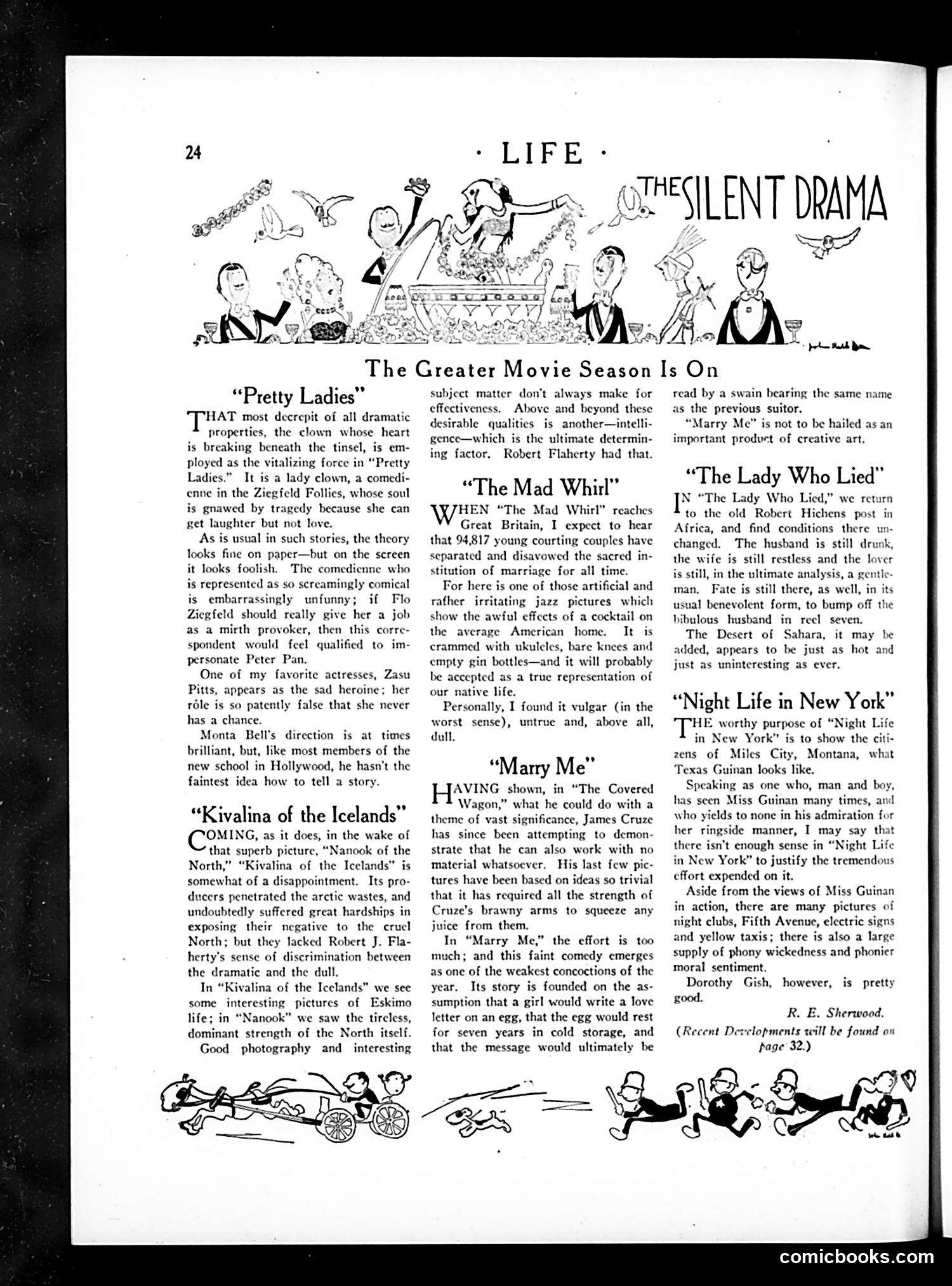
This page reviews five silent films opening in "The Greater Movie Season." The critic—R.E. Sherwood—evaluates contemporary movies with sharp skepticism: **"Pretty Ladies"** features Zasu Pitts as a tragic clown from the Ziegfeld Follies. Sherwood dismisses the premise (sad heart beneath comic exterior) as foolish on screen, criticizing both the lead's unfunniness and director Monta Bell's incompetence at storytelling. **"Kivalina of the Icelands"** is compared unfavorably to Robert Flaherty's acclaimed "Nanook of the North"—good photography alone doesn't substitute for intelligence and artistic discrimination. **"The Mad Whirl"** satirizes Jazz Age excess (cocktails, ukuleles, bare knees, gin bottles) in American homes. Sherwood finds it vulgar and fears British audiences will accept it as authentic American life. **"Marry Me"** and **"The Lady Who Lied"** receive dismissal for weak plots (an egg containing a love letter; a tired colonial romance formula). The decorative header illustrates "Silent Drama" performers in theatrical poses, reflecting the page's focus on cinema's visual storytelling during the silent film era.
📄 Transcribed text from this page (OCR, searchable)
Machine-transcribed from the original scan — historical spelling and the odd misread are preserved.
dors The Greater Movie Season Is “Pretty Ladies” HAT most decrepit of all dramatic properties, the clown whose heart is breaking beneath the tinsel, is em- ployed as the vitalizing force in “Pretty Ladi It is a lady clown, a comedi- enne in the Ziegfeld Follies, whose soul is gnawed by tragedy because she can get laughter but not love. As is usual in such stories, the theory looks fine on paper—but on the screen it looks foolish. The comedienne who is represented as so screamingly comical is embarrassingly unfunny; if Flo Ziegfeld should really give her a job as a mirth provoker, then this corre- spondent would feel qualified to im- personate Peter Pan. One of my favorite actresses, Zasu Pitts, appears as the sad heroine; her role is so patently false that she never has a chance. Monta Bell's direction is at times brilliant, but, like most members of the new school in Hollywood, he hasn't the faintest idea how to tell a story. “Kivalina of the Icelands” COMING; as it does, in the wake of that superb picture, “Nanook of the North,” “Kivalina of the Icelands” is somewhat of a disappointment. Its pro- ducers penetrated the arctic wastes, and undoubtedly suffered great hardships in exposing their negative to the crucl North; but they lacked Robert J. Fla- herty’s sense of discrimination between the dramatic and the dull. In “Kivalina of the Icelands” we see some interesting pictures of Eskimo life; in “Nanook” we saw the tircless, dominant strength of the North itself. Good photography and _ interesting subject matter don’t always make for effectiveness, Above and beyond these desirable qualities is another—intelli- gence—which is the ultimate determin- ing factor, Robert Flaherty had that. “The Mad Whirl” HEN “The Mad Whirl” reaches Great Britain, I expect to hear that 94,817 young courting couples have separated and disavowed the sacred in- stitution of marriage for all time. For here is one of those artificial and rather irritating jazz pictures which show the awful effects of a cocktail on the average American home. It is crammed with ukuleles, bare knees and empty gin bottles—and it will probably be accepted as a true representation of our native life. Personally, I found it vulgar (in the worst sense), untrue and, above all, dull, “Marry Me” H4viNG shown, in “The Covered Wagon,” what he could do with a theme of vast significance, James Cruze has since been attempting to demon- strate that he can also work with no material whatsoever. His last few pic- tures have been based on ideas so trivial that it has required all the strength of Cruze’s brawny arms to squeeze any juice from them. In “Marry Me,” the effort is too much; and this faint comedy emerges as one of the weakest concoctions of the year. Its story is founded on the as- sumption that a girl would write a love letter on an egg, that the egg would rest for seven years in cold storage, and that the message would ultimately be SS i LENT DRAMA of Of On read by a swain bearing the same name as the previous suitor. “Marry Me” is not to be hailed as an important product of creative art. “The Lady Who Lied” I ‘The Lady Who Lied,” we return to the old Robert Hichens post in Africa, and find conditions there un- changed. The husband is still drunk, the wife is still restless and the lover is still, in the ultimate analysis, a gentle- man. Fate is still there, as well, in its usual benevolent form, to bump off the hibulous husband in reel seven. The Desert of Sahara, it may be added, appears to be just as hot and just as uninteresting as ever. “Night Life in New York” TH 2 worthy purpose of “Night Life in New York” is to show the citi- zens of Miles City, Montana, what Texas Guinan looks like, Speaking as one who, man and boy, has seen Miss Guinan many times, and who yields to none in his admiration for her ringside manner, I may say that there isn’t enough sense in “Night Life in New York” to justify the tremendous effort expended on Aside from the views of Miss Guinan in action, there are many pictures of night clubs, Fifth Avenue, electric signs and yellow taxis; there is also a large supply of phony wickedness and phonier moral sentiment. Dorothy Gish, however, is pretty good. R. E. Sherwood. (Recent Developments will be found on page 32.) comicbooks.com