
A complete issue · 36 pages · 1925
Life — March 5, 1925
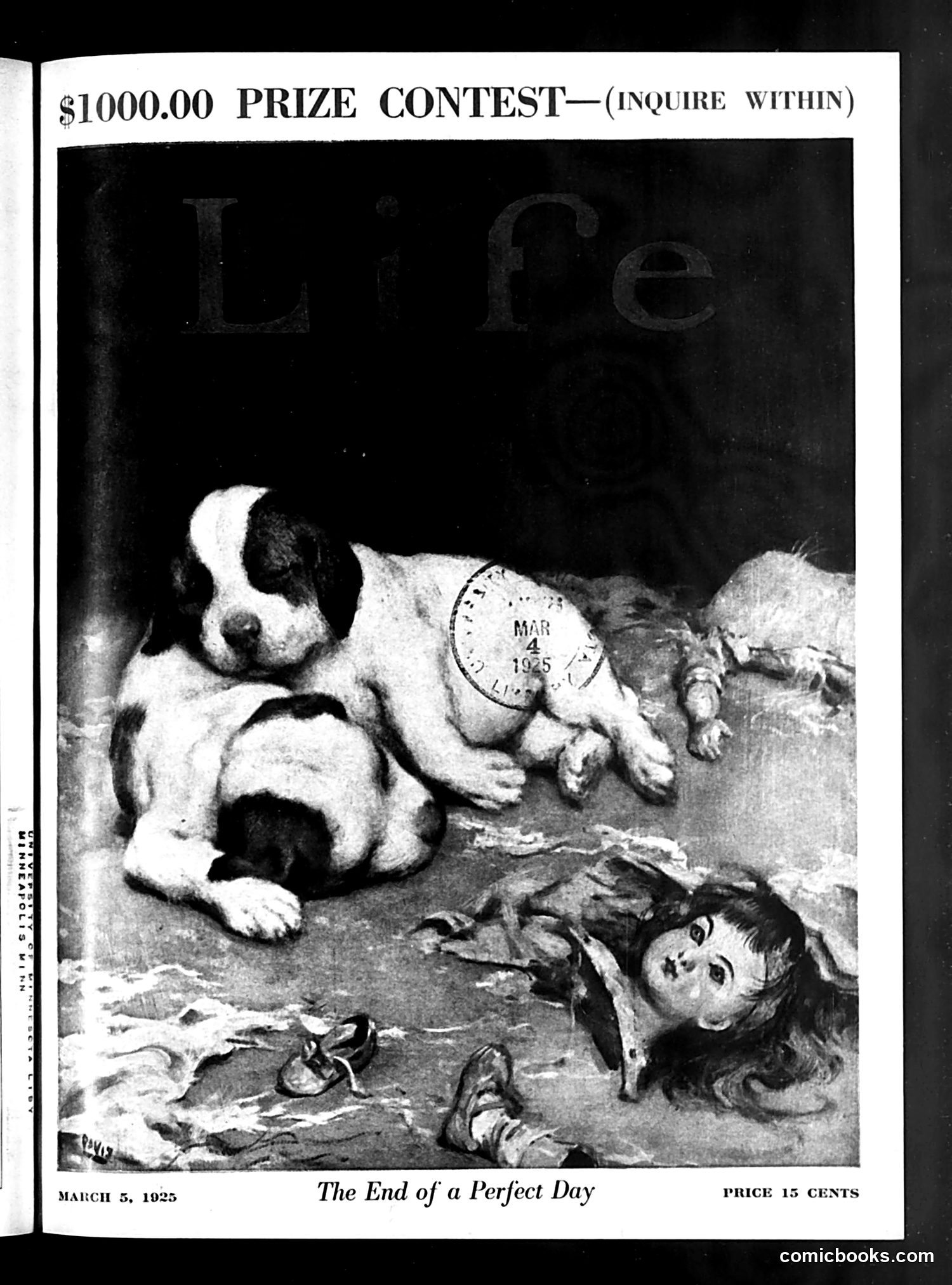
This is a humorous domestic scene rather than political satire. The image shows a dog and child peacefully sleeping together on the ground, surrounded by scattered toys and shoes—the mess of a day's play. The title "The End of a Perfect Day" is ironic: what appears "perfect" to the tired child and dog (who've exhausted themselves playing) represents chaos and disorder to an adult viewer. The joke satirizes the gap between children's perception of an ideal day (full of uninhibited play and mess) versus parental concerns about cleanliness and tidiness. The "$1000.00 PRIZE CONTEST" header indicates Life magazine ran competitions asking readers to caption or interpret such images, typical editorial content for the era.
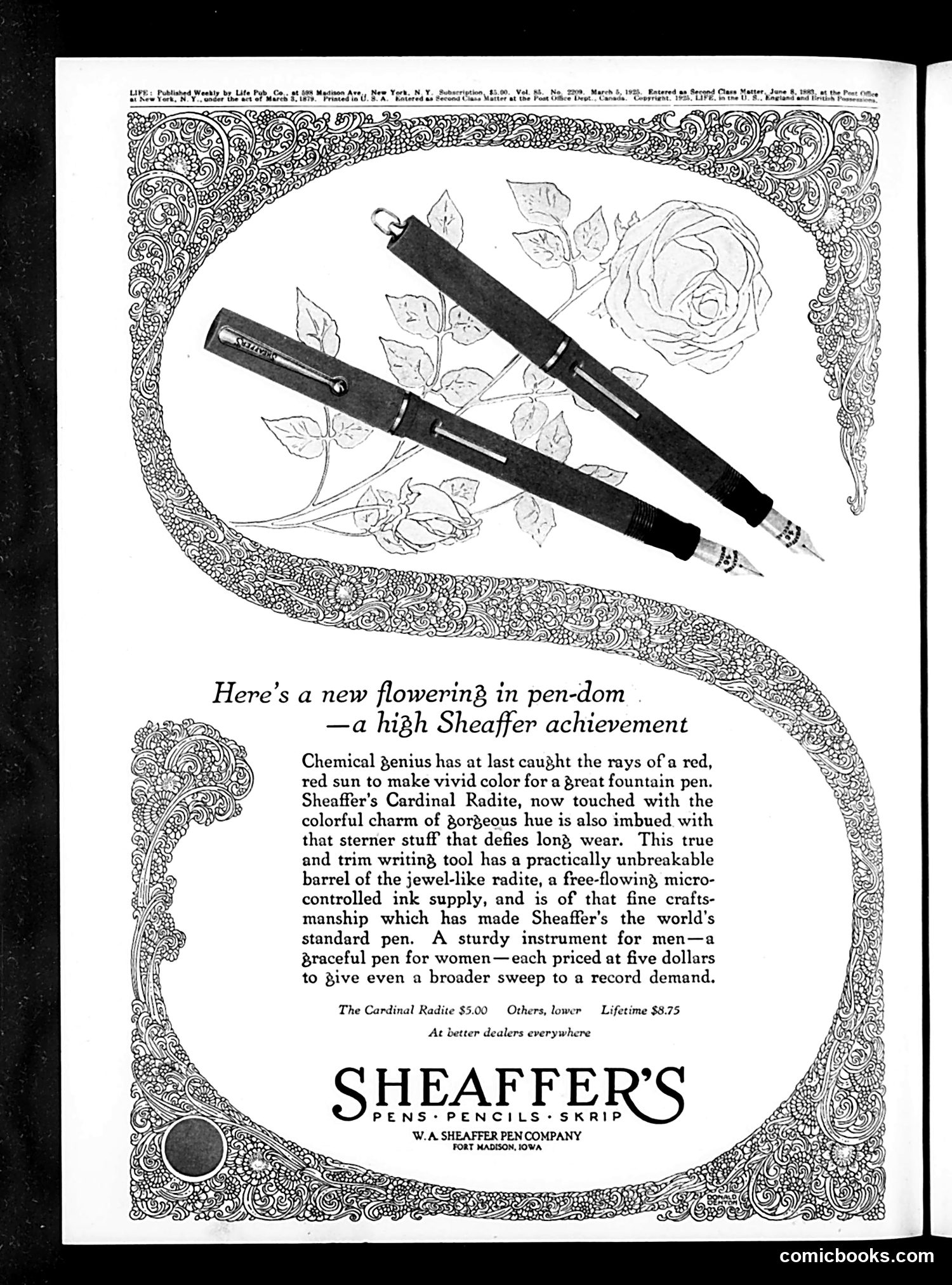
This page is primarily **advertising, not satire or political commentary**. It's a Sheaffer fountain pen advertisement from *Life* magazine (March 5, 1925, based on the header). The ad promotes Sheaffer's new "Cardinal Radite" fountain pen in red ink. The copy uses flowery language about chemical innovation ("Chemical genius has at last caught the rays of a red, red sun") to market the pen's vivid color and durability. The decorative border and rose illustrations create an elegant aesthetic targeting both male and female consumers. The phrase "flowering in pen-dom" is a pun playing on the floral imagery. Prices ($5 standard, $8.75 lifetime model) reflect 1920s luxury goods positioning. This represents typical high-end advertising from the era.
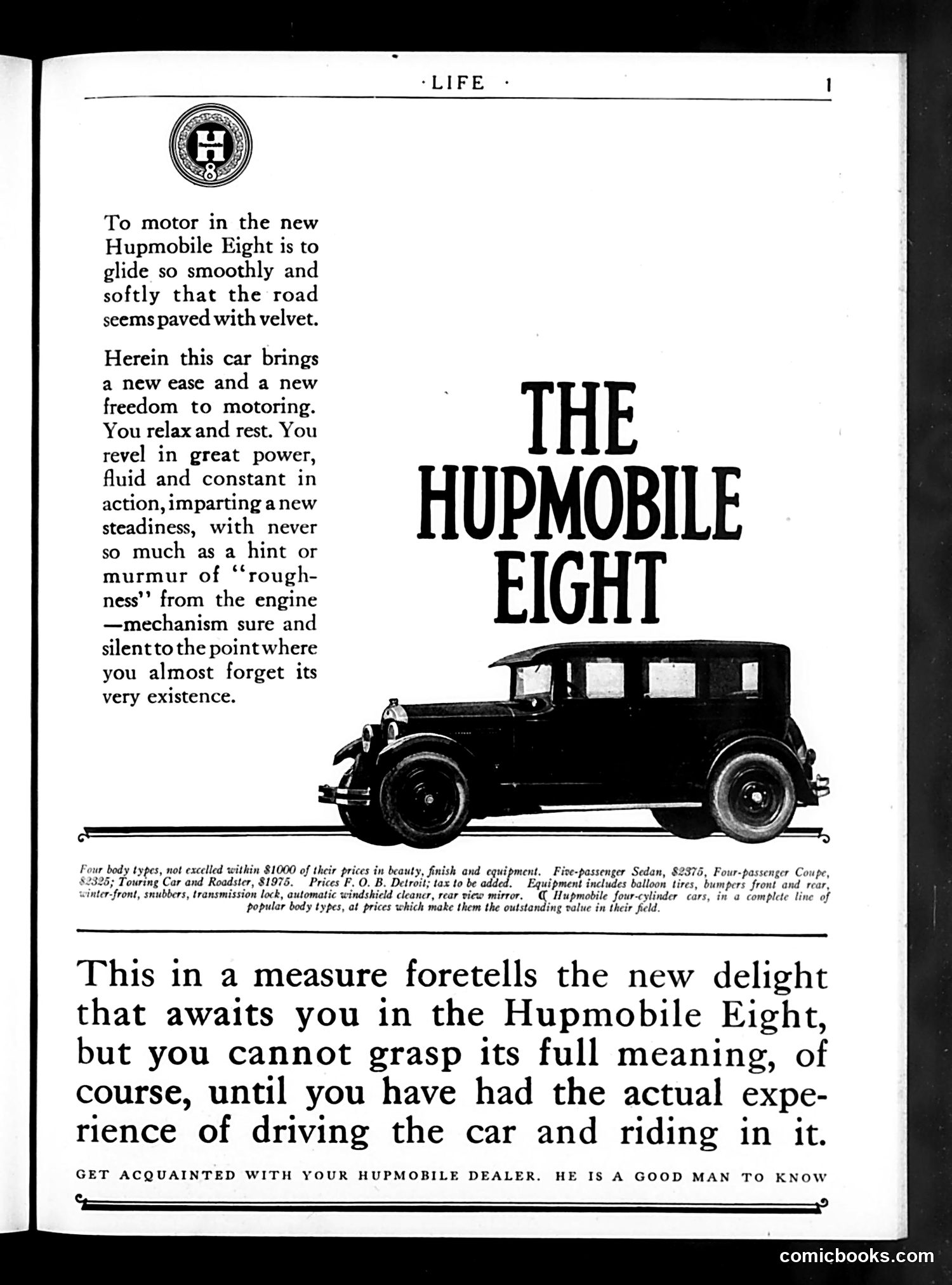
This is **not a satirical cartoon page, but an automobile advertisement** for the Hupmobile Eight, which appeared in Life magazine (then a humor/general interest publication that also carried ads). The ad uses poetic, evocative language to market the car's smooth ride and powerful engine—describing it as gliding on "velvet" with an engine so quiet you "almost forget its very existence." The image shows a side-profile illustration of a 1920s sedan in silhouette. The accompanying text emphasizes comfort, reliability, and engineering excellence as selling points. This represents early automotive marketing that emphasized technical sophistication and luxury to appeal to middle-class American buyers during the automobile boom era. No satire or political commentary is present—it's straightforward product promotion.

This page is **primarily an advertisement**, not editorial content or satire. It's a Phoenix Hosiery company ad from Milwaukee promoting silk stockings for men, women, and children. The ad poses a rhetorical question ("Which wears longer, a man's or a woman's stocking?") as a hook, then answers by emphasizing Phoenix's superior durability and elegance. The ornate decorative border frames the product pitch. There is **no political cartoon or satire** present. The page reflects early 20th-century marketing conventions: associating hosiery with luxury ("finest silk"), durability ("wearability"), and aspirational lifestyle. The gendered product comparison was common advertising strategy of the era, though unremarkable by modern standards. The ornamental design indicates this was a premium magazine advertisement targeting affluent readers.
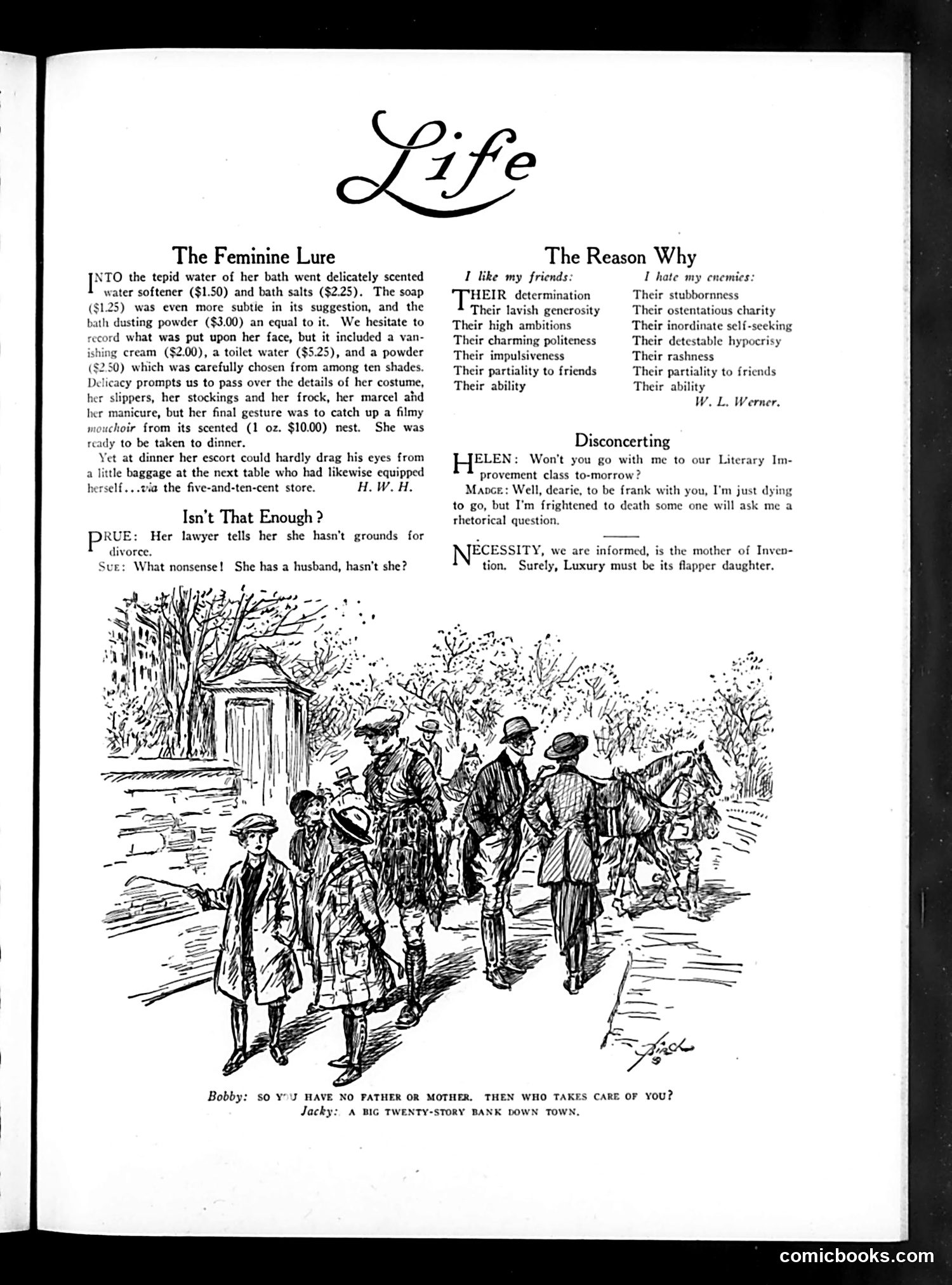
This page contains **social satire and humor pieces** rather than political cartoons. The content mocks upper-class feminine consumerism and gender relations: **"The Feminine Lure"** ridicules women's expensive beauty routines—detailed costs for bath salts, soaps, and powders totaling hundreds of dollars—while a man remains indifferent ("could hardly drag his eyes"). **"The Reason Why"** presents contrasting lists of liked versus hated traits, suggesting relationship frustrations based on personality clashes. **"Isn't That Enough?"** jokes about divorce proceedings. **The main illustration** depicts a group of travelers (possibly soldiers or workers) on a country road. The caption about "no father or mother" suggests commentary on orphans or displaced persons, though the specific historical context remains **unclear**. The page reflects early 20th-century anxieties about wealth, marriage, and social mobility.
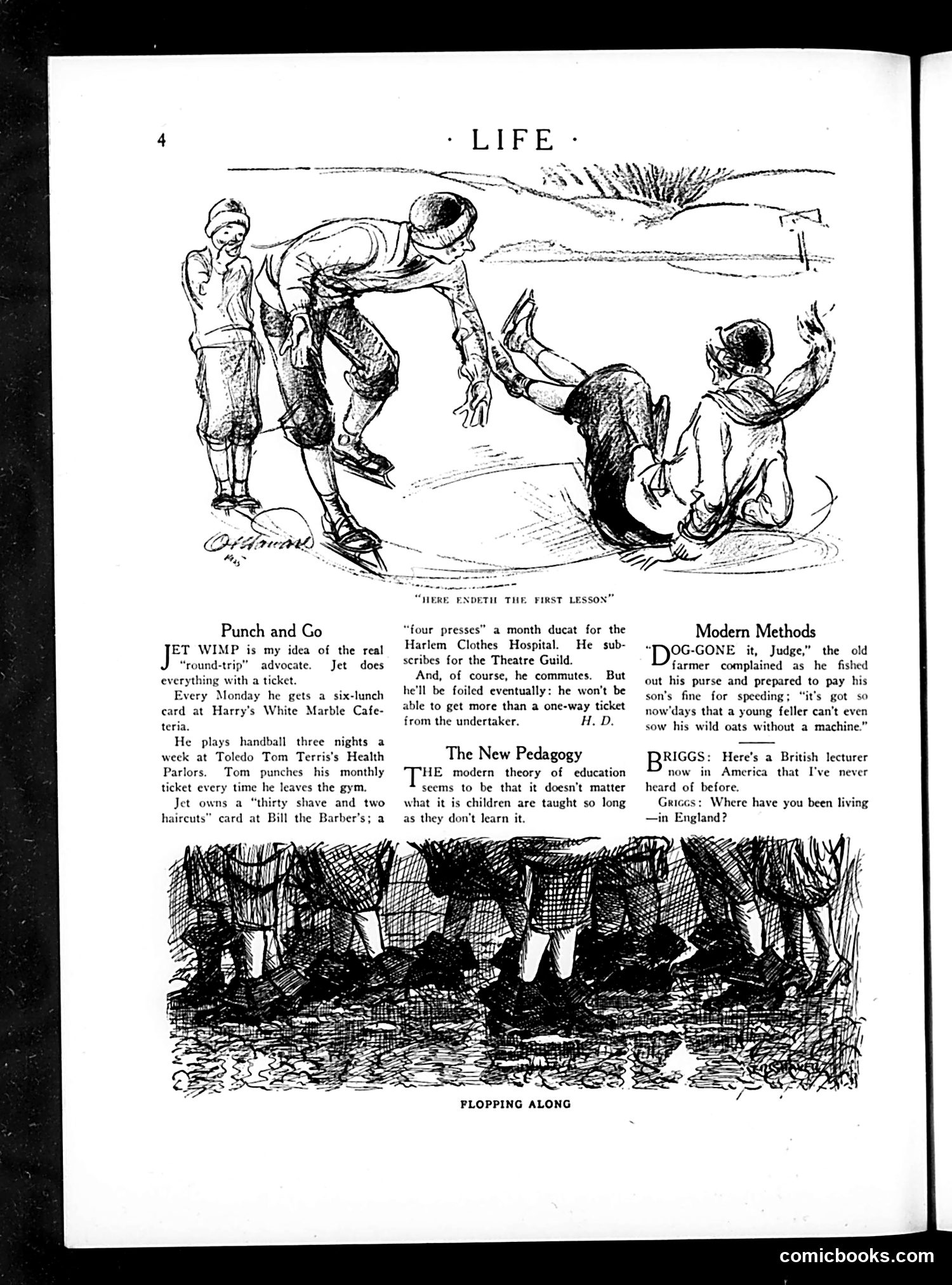
This page contains three separate satirical pieces: **"Here Endeth the First Lesson"** (top): A sketch mocking ice-skating instruction, showing adults teaching children an awkward skating technique. **"Punch and Go"**: Brief commentary on "Jet Wimp," someone who frequents Harry's White Marble Cafeteria and plays handball at Toledo Tom Terris's Health Parlors—satirizing a shallow lifestyle centered on leisure activities and grooming. **"Modern Methods"**: A British lecturer in America is mocked for his outdated notion that farmers should "pay fines for speeding," ignorant of American mechanization. The satire targets Old World attitudes toward modern American efficiency. **"Flopping Along"** (bottom): An illustration of children wading in mud, likely criticizing progressive education theories that prioritize play over structured learning—"The New Pedagogy" section critiques this approach. The page satirizes social pretension, outdated thinking, and progressive education fads.
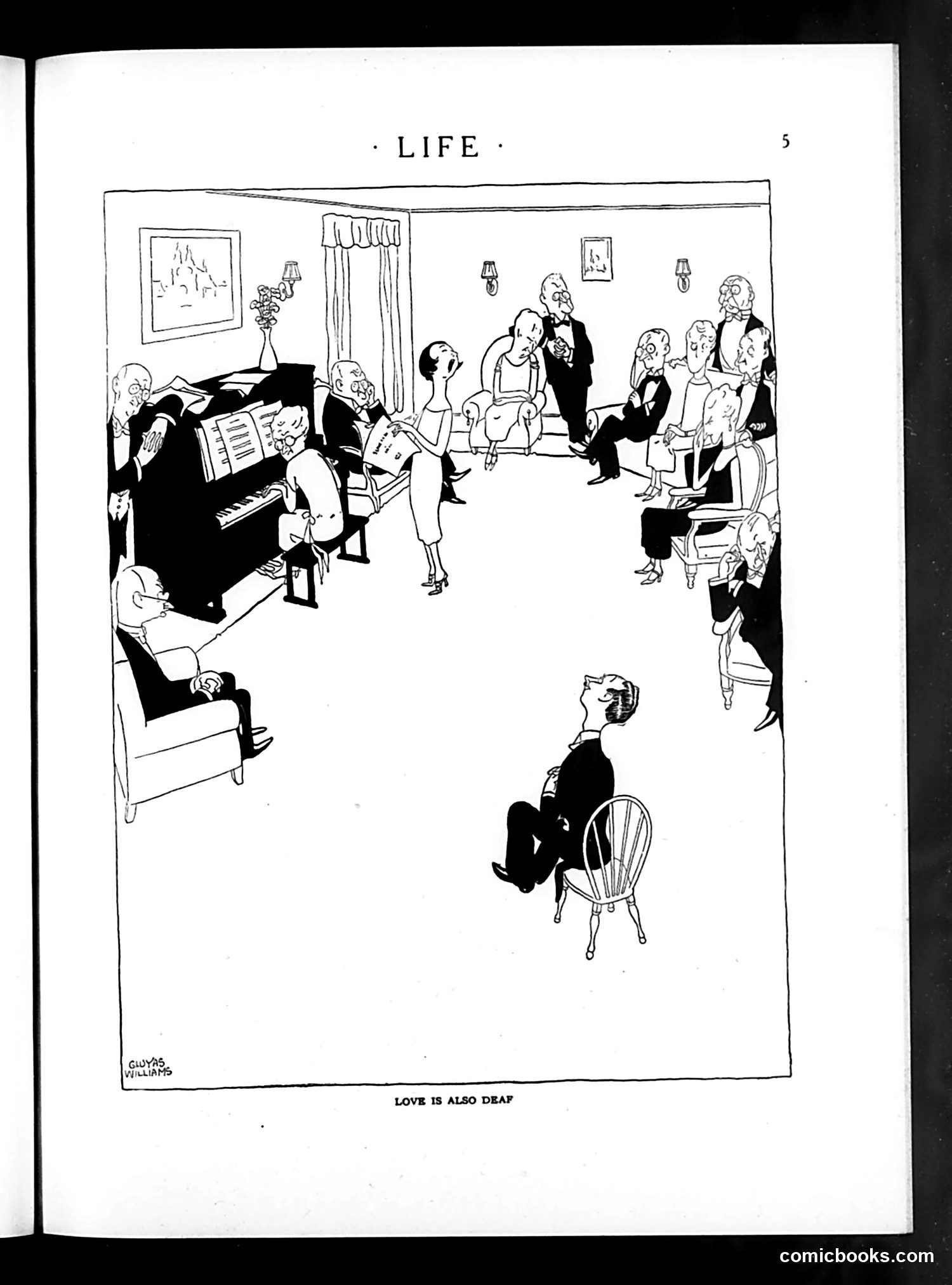
This cartoon from *Life* magazine depicts a formal social gathering where a man sits alone in the center of the room while well-dressed guests socialize around him. The caption reads "LOVE IS ALSO DEAF." The joke plays on the common phrase "love is blind," subverting it to "love is also deaf." The isolated man appears to be playing piano enthusiastically while everyone else ignores him—suggesting that even in love or social situations, people can be deaf (inattentive) to an unwanted musician or boring performance. The satire mocks social gatherings where someone performs eagerly but receives no appreciation, and perhaps more broadly criticizes how people selectively ignore what doesn't interest them, even in intimate settings. The cartoon humorously captures the awkwardness of unrequited attention or talent gone unappreciated.
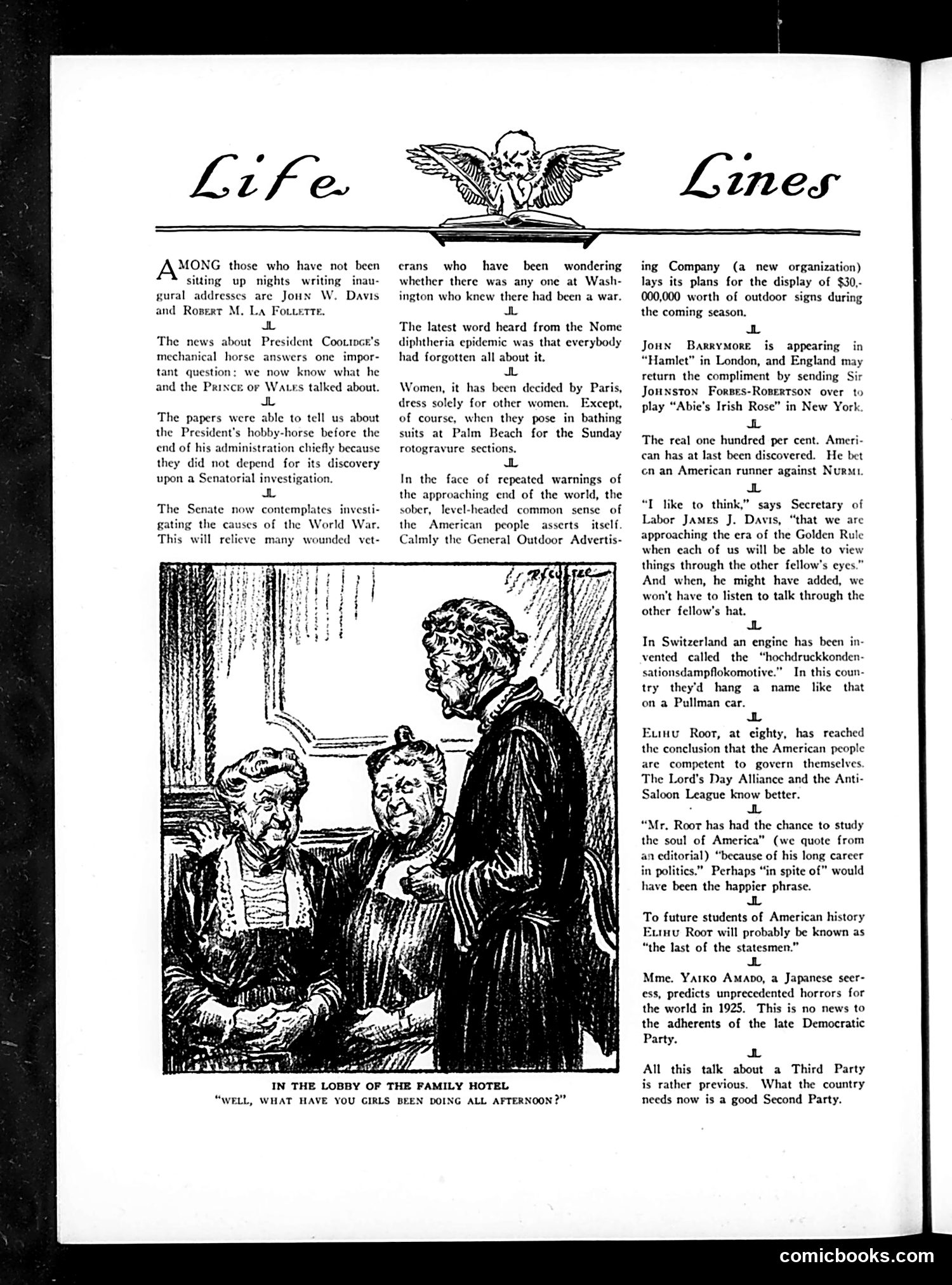
This satirical column contains brief social and political commentary. The cartoon depicts three figures in a hotel lobby; the caption reads "Well, what have you girls been doing all afternoon?" — likely satirizing idle wealthy hotel guests or gossiping socialites. The text references contemporary 1920s concerns: President Coolidge's mechanical horse (presumably a technological curiosity), diphtheria epidemics, Paris fashion trends, and General Outdoor Advertising Company's billboard expansion plans. Most notably, the column mocks Elihu Root (an aging statesman) and references Mme. Yajko Amado's predictions of "unprecedented horrors" in 1925, alongside commentary on a potential "Third Party" in American politics—all delivered with the magazine's characteristic witty, gossipy tone targeting educated urban readers.
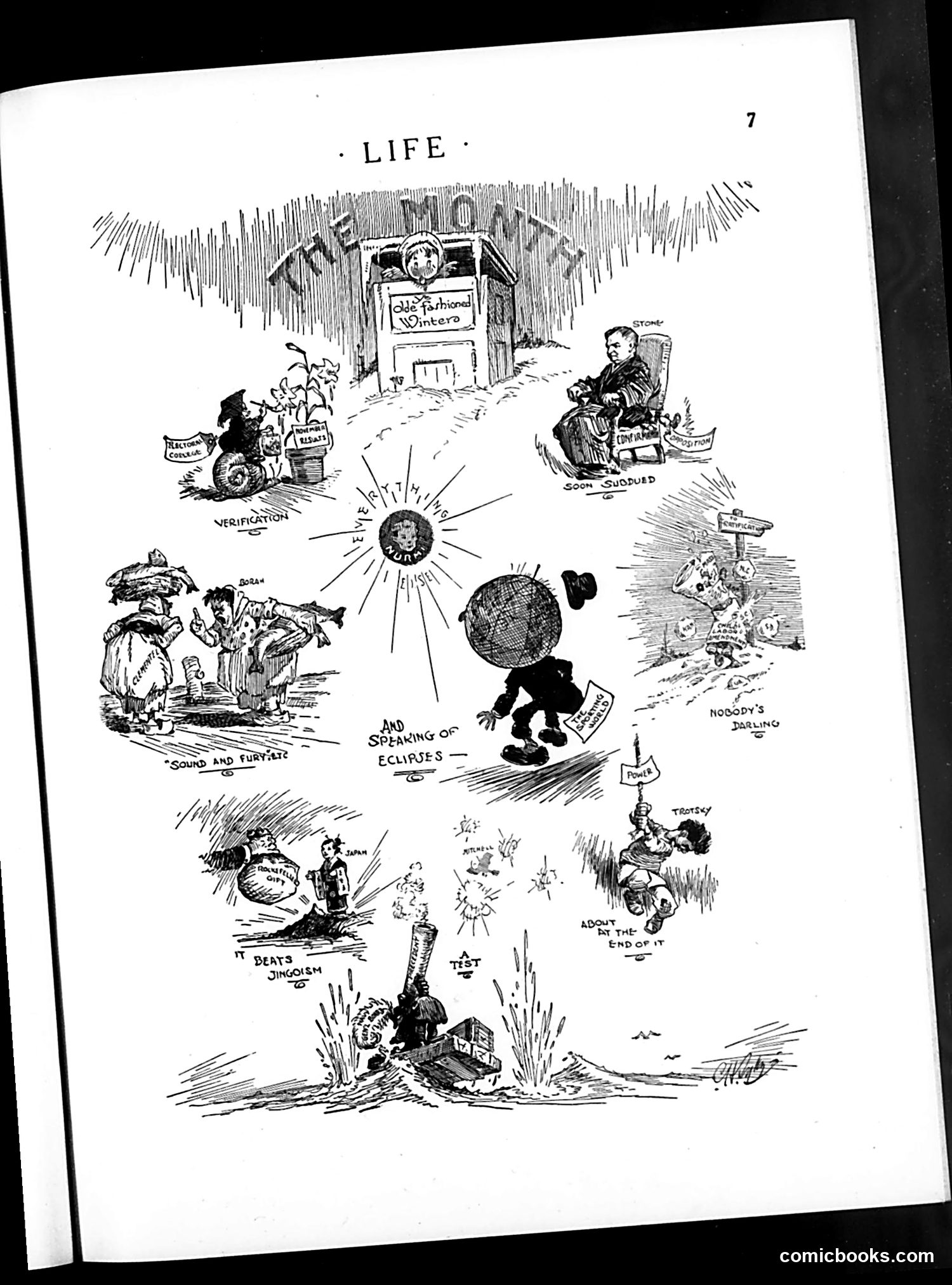
This page presents a wheel of interconnected satirical vignettes labeled "Life," with various scenes radiating from a central globe-headed figure at the hub. Each segment depicts contemporary social observations: - **"Verification"** and **"Sound and Fury"** appear to mock pretentious or empty rhetoric - **"Stony" and "Soon Subdued"** likely reference emotional responses or social behavior - **"Nobody's Darling"** and **"Trotsky"** suggest commentary on political figures or social outcasts - **"Speaking of Eclipses"** uses astronomical metaphor, possibly political - **"It Beats Jingoism,"** **"Toffy,"** and **"Added at the End of It"** reference various social follies The overall composition suggests Life magazine's characteristic approach: using humor and exaggeration to critique contemporary society, politics, and human nature through interconnected observations.
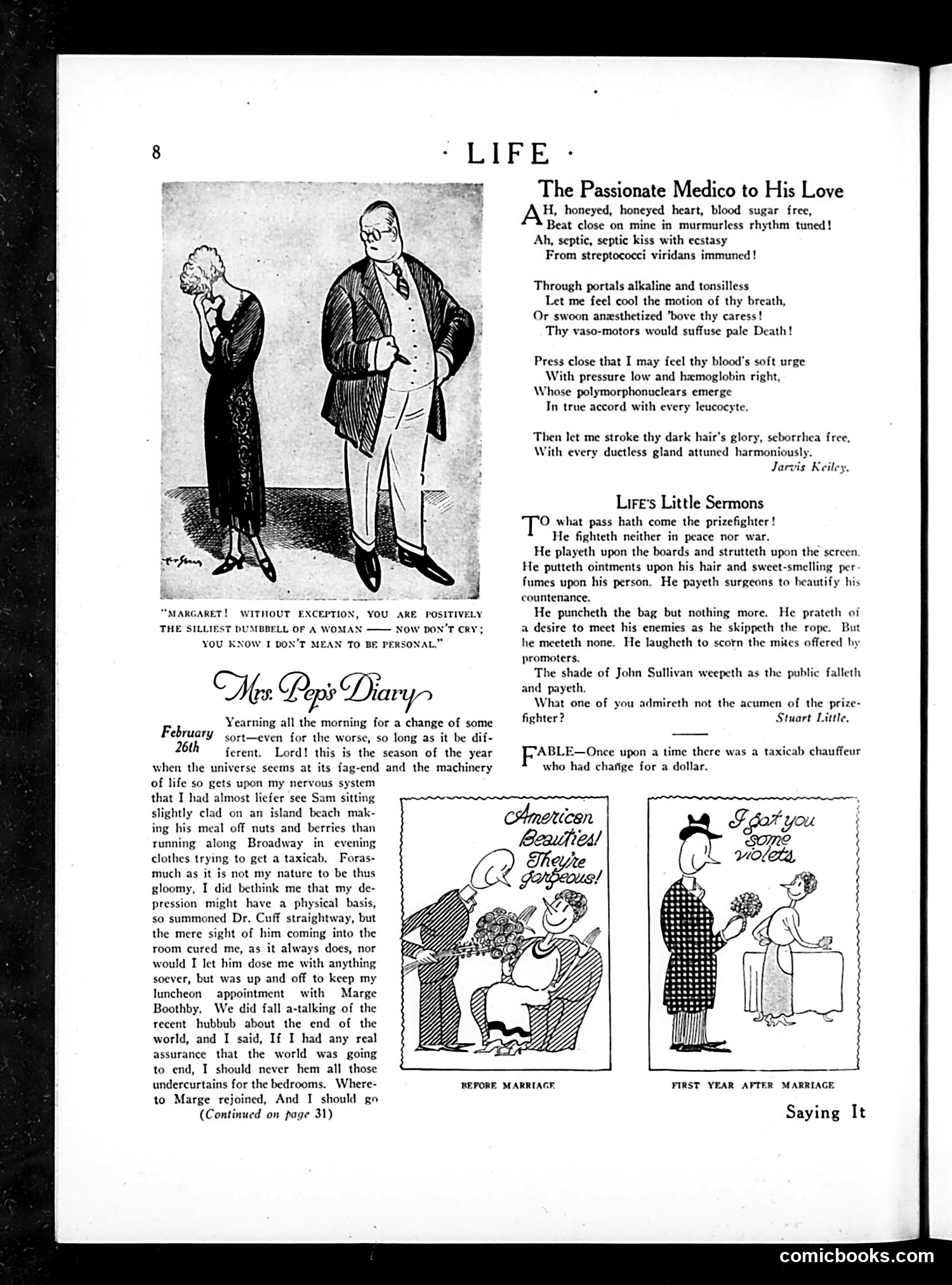
This *Life* magazine page contains three distinct pieces of satire: 1. **"The Passionate Medico to His Love"**: A poem mocking an overly clinical doctor who expresses romance through medical jargon (blood sugar, streptococci, hemoglobin) rather than genuine emotion. The satire targets the dehumanizing effect of professional expertise on personal relationships. 2. **"New Rep's Diary"**: A gossipy diary entry from February 26th depicting theatrical/social world complaints, suggesting the writer is self-absorbed and dramatic about minor social disappointments. 3. **"Saying It"**: Two cartoon panels contrasting marriage before and after. The first shows idealized romance; the second shows a wife giving flowers to her husband with resigned acceptance ("I Got You Some Violets"). The joke satirizes how marriage diminishes romantic enthusiasm over time.
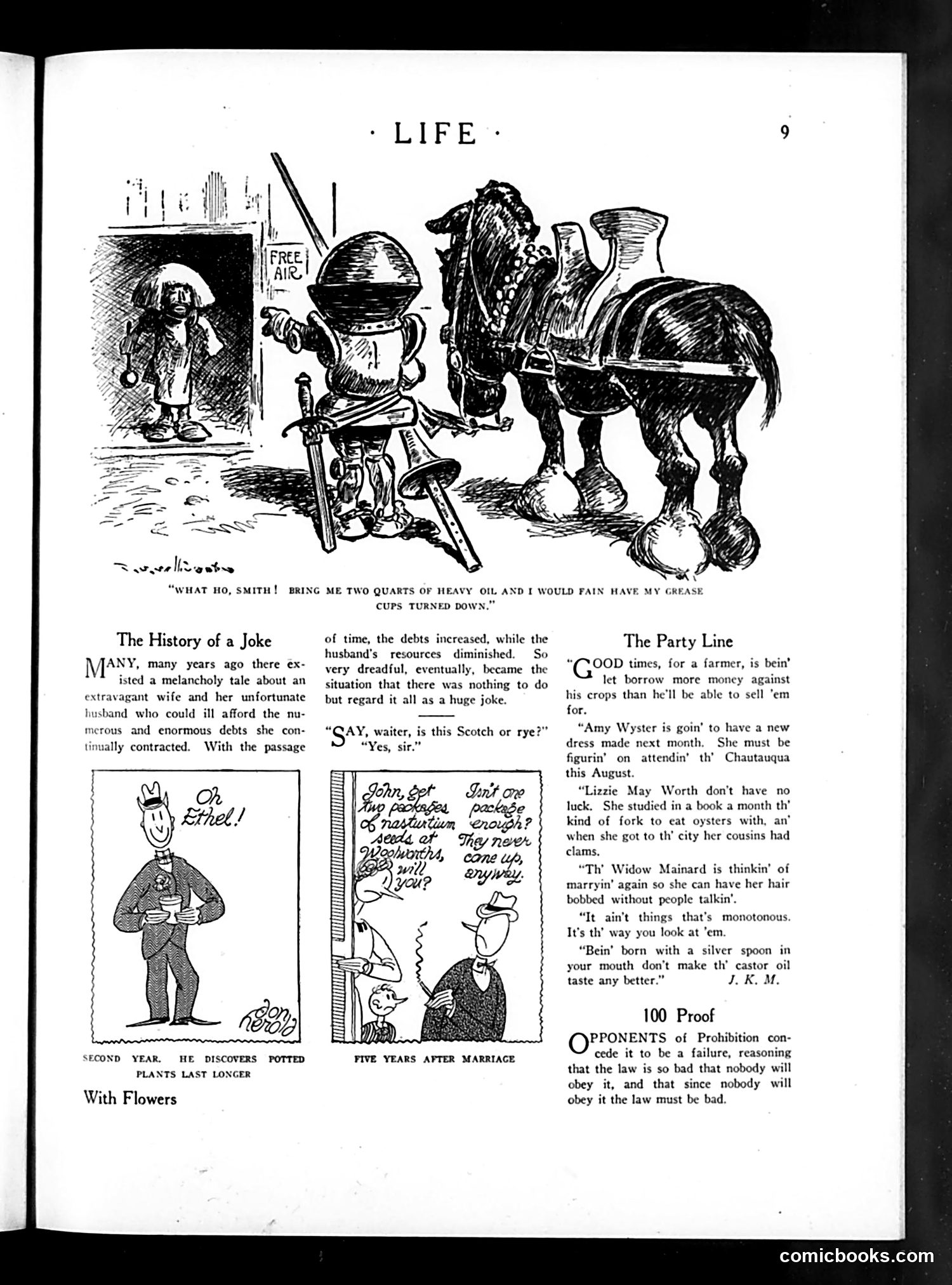
This *Life* magazine page contains satirical commentary on early 20th-century American social issues: **Top cartoon**: A man in a diving suit asks a blacksmith for heavy oil to grease his cups, saying he wants them "turned down." This appears to satirize Prohibition enforcement—the diving suit suggests he's "underwater" or hidden from authorities while seeking lubricant, likely a euphemism for alcohol acquisition during the dry era. **"The History of a Joke"**: Mocks a well-worn anecdote about a wife's debts bankrupting her husband, treating it as exhausted comedy. **"The Party Line"**: Rural gossip column featuring small-town scandals—borrowed money, new dresses, city visits, widow remarriage—poking fun at farm community social pretensions and provincialism. **"100 Proof"**: Argues Prohibition fails because people won't obey unjust laws.
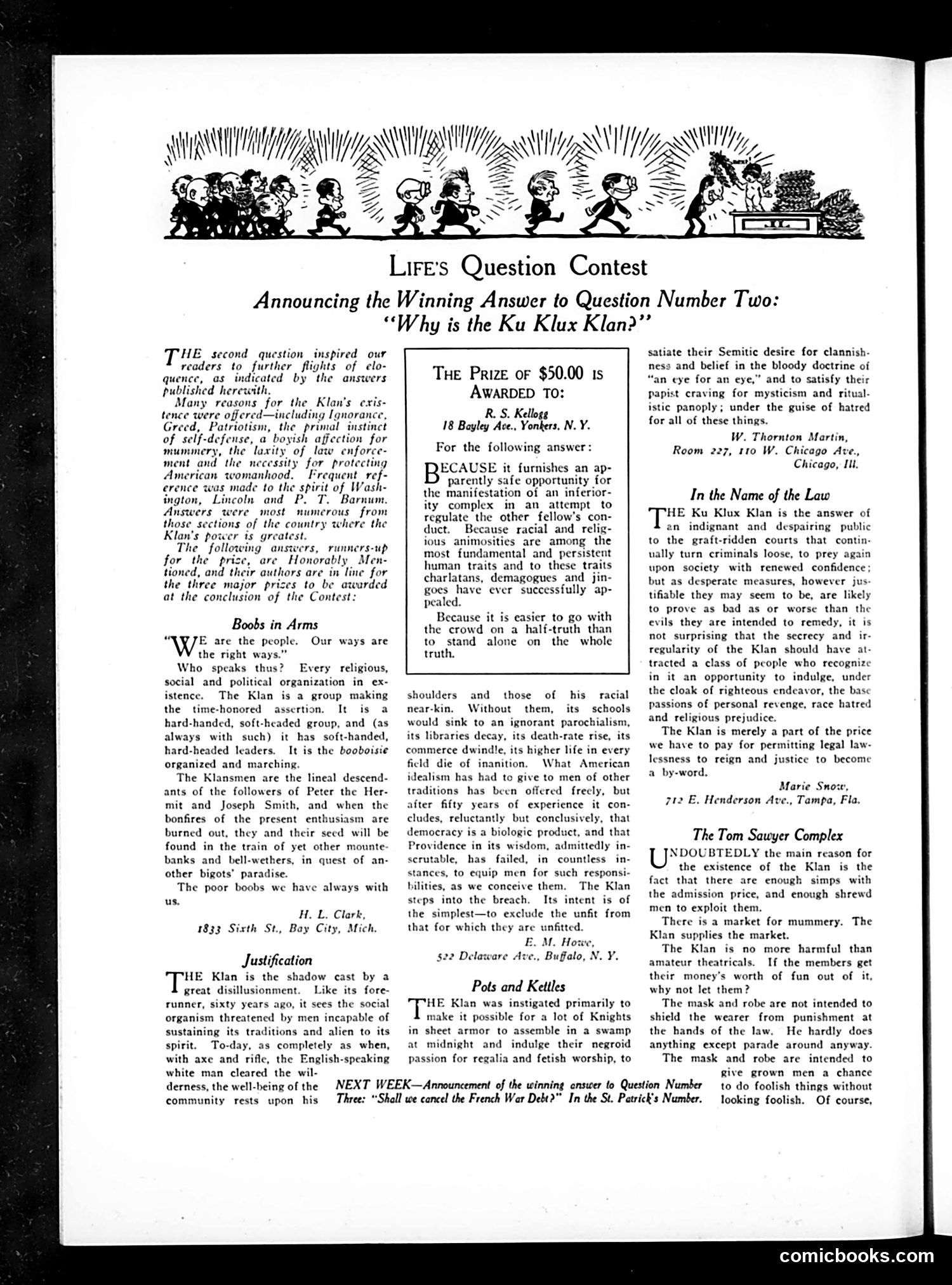
This page announces the winning answer to Life's satirical contest question about the KKK's existence. The winning $50 prize went to R.S. Kellogg for an answer arguing the Klan exists because it offers people a "half-truth" outlet for manifesting inferiority complexes and base human traits—essentially that it exploits human prejudices. Additional responses characterize the Klan as a tool for exclusion, racial hatred, and exploitation. The contributors frame it as a social problem rooted in human psychology and bigotry rather than any legitimate purpose. This reflects Life's role as a venue for political satire critiquing the Klan, a resurgent white supremacist organization during the 1920s. The contest structure allows readers to publicly condemn and ridicule the group's appeal and methods.
This page from *Life* magazine presents a contest and letters section rather than cartoons. The main feature is **Prize Question No. 6: "Do the Newspapers Encourage Crime?"**—a serious social inquiry asking readers whether media coverage glamorizes criminal activity and potentially incites further lawbreaking. The accompanying letters section includes reader responses to previous questions, with contributors discussing the **Ku Klux Klan**. Multiple letters address the Klan's activities and motivations, with some writers arguing it exists through "fear"—of Black labor, Catholic solidarity, and Jewish success—while others defend it as necessary organization. The contest structure and prize amounts ($300 first prize) indicate *Life*'s engagement with contemporary social debate rather than purely satirical content on this particular page.
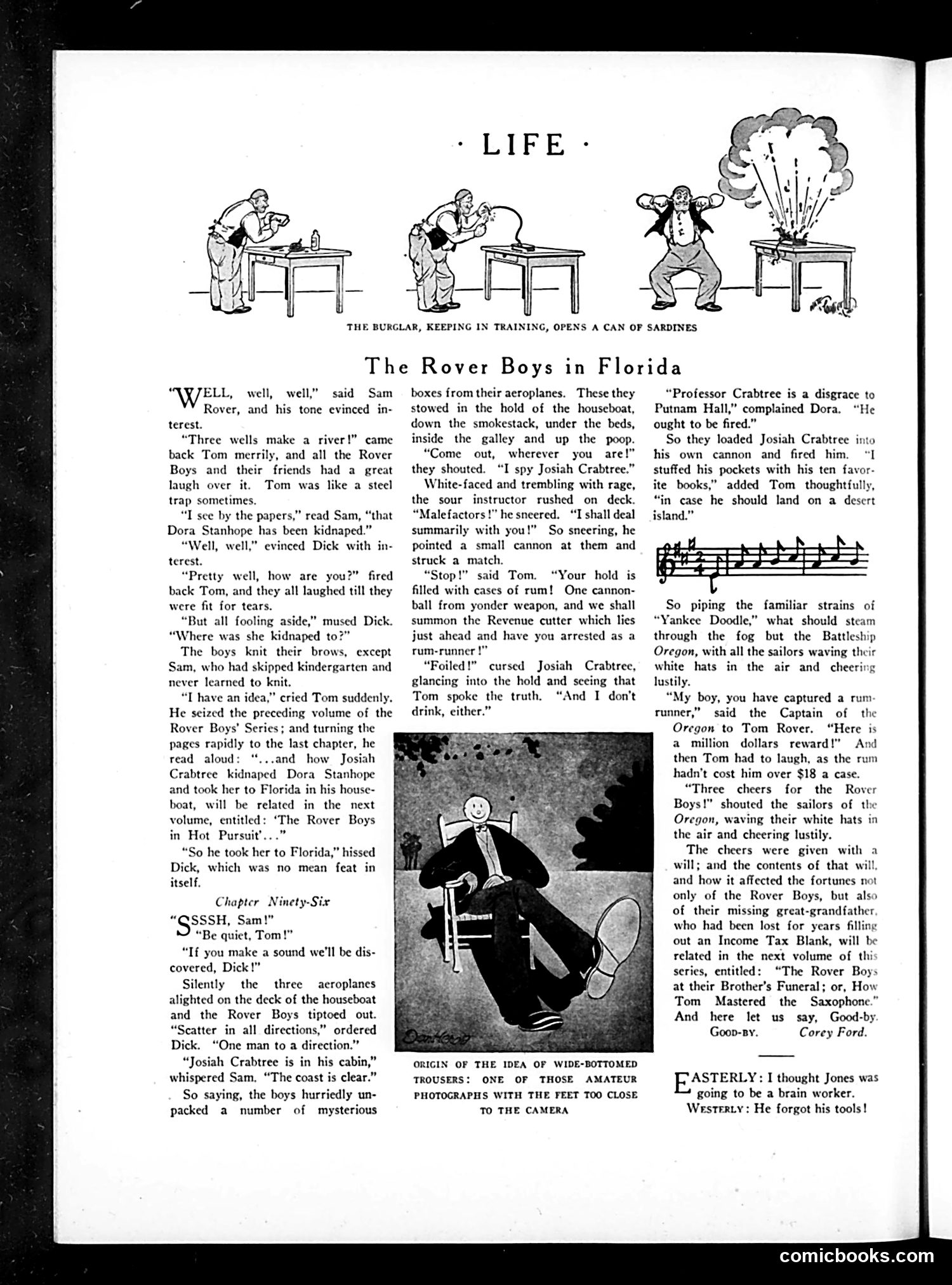
This page presents a serialized adventure story titled "The Rover Boys in Florida," Chapter Ninety-Six. The narrative follows three young protagonists involved in a dramatic pursuit involving smuggling, kidnapping, and treasure. At the top, a four-panel comic strip shows a burglar opening a can of sardines, which explodes comically—a visual gag about the unexpected contents. The main illustration depicts a person in formal dress sitting in an unusual pose, captioned as demonstrating "wide-bottomed trousers" with "feet too close to the camera"—a humorous commentary on amateur photography techniques. The text is typical adventure fiction aimed at young readers, emphasizing action, mystery, and moral conflict between heroes and villains like the antagonist Josiah Crabtree.
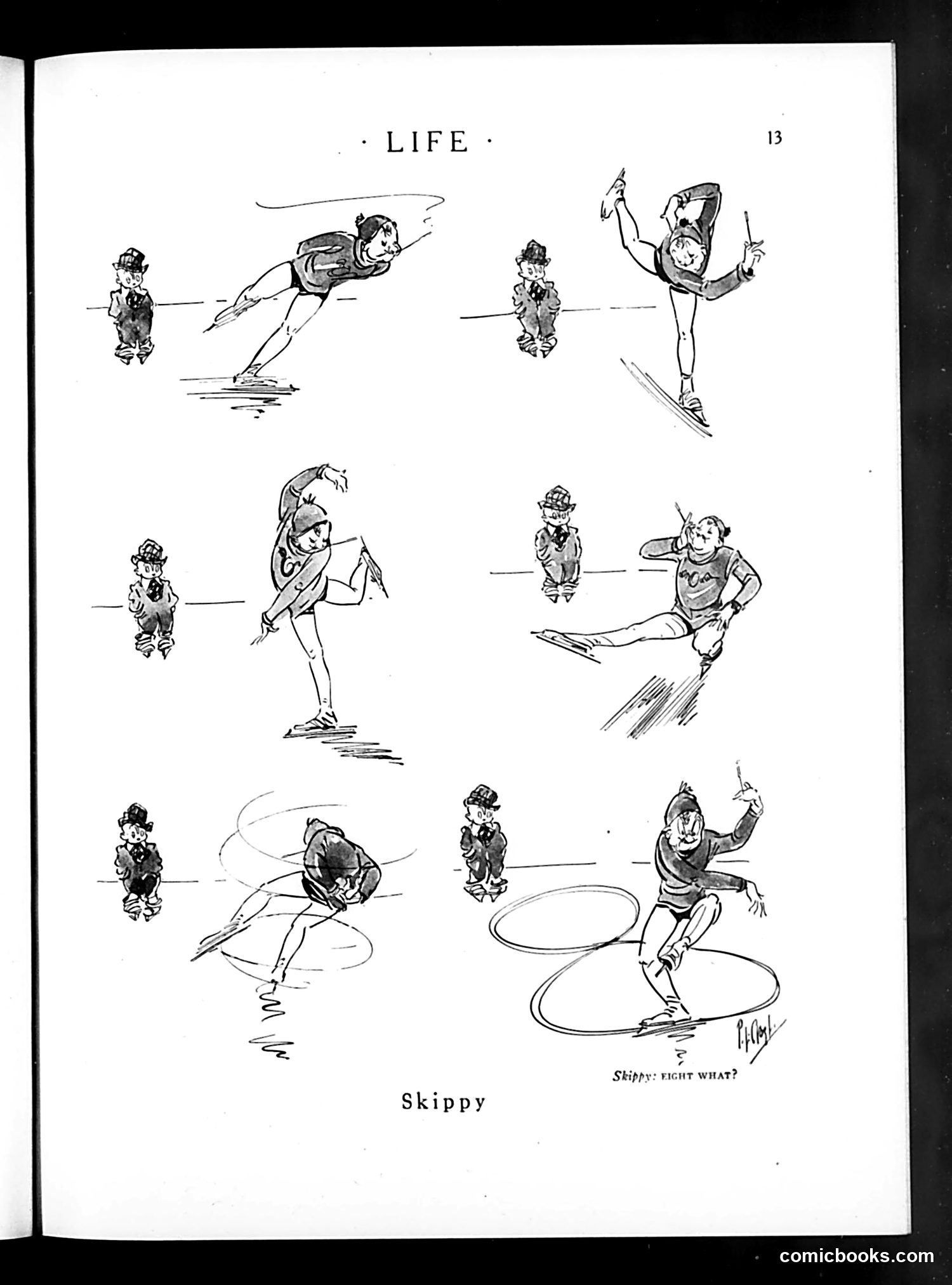
This page features a comic strip about "Skippy," a character shown in various childhood activities: surfing, skiing, roller-skating, hula-hooping, and other recreational pursuits. Each panel pairs a small, formally-dressed adult figure (appearing to represent authority or an older generation) with an active child performing the activity. The satire appears to mock generational disconnect—the rigid, bewildered adults seem confused by or disapproving of modern children's leisure activities and energetic play. The final caption "SKIPPY: FIGHT WHAT?" suggests the child's innocent incomprehension of adult concerns or expectations. The joke likely targets contemporary anxieties about youth culture and changing recreation styles in early-to-mid 20th century America, using the contrast between stuffy adults and carefree children for comedic effect.
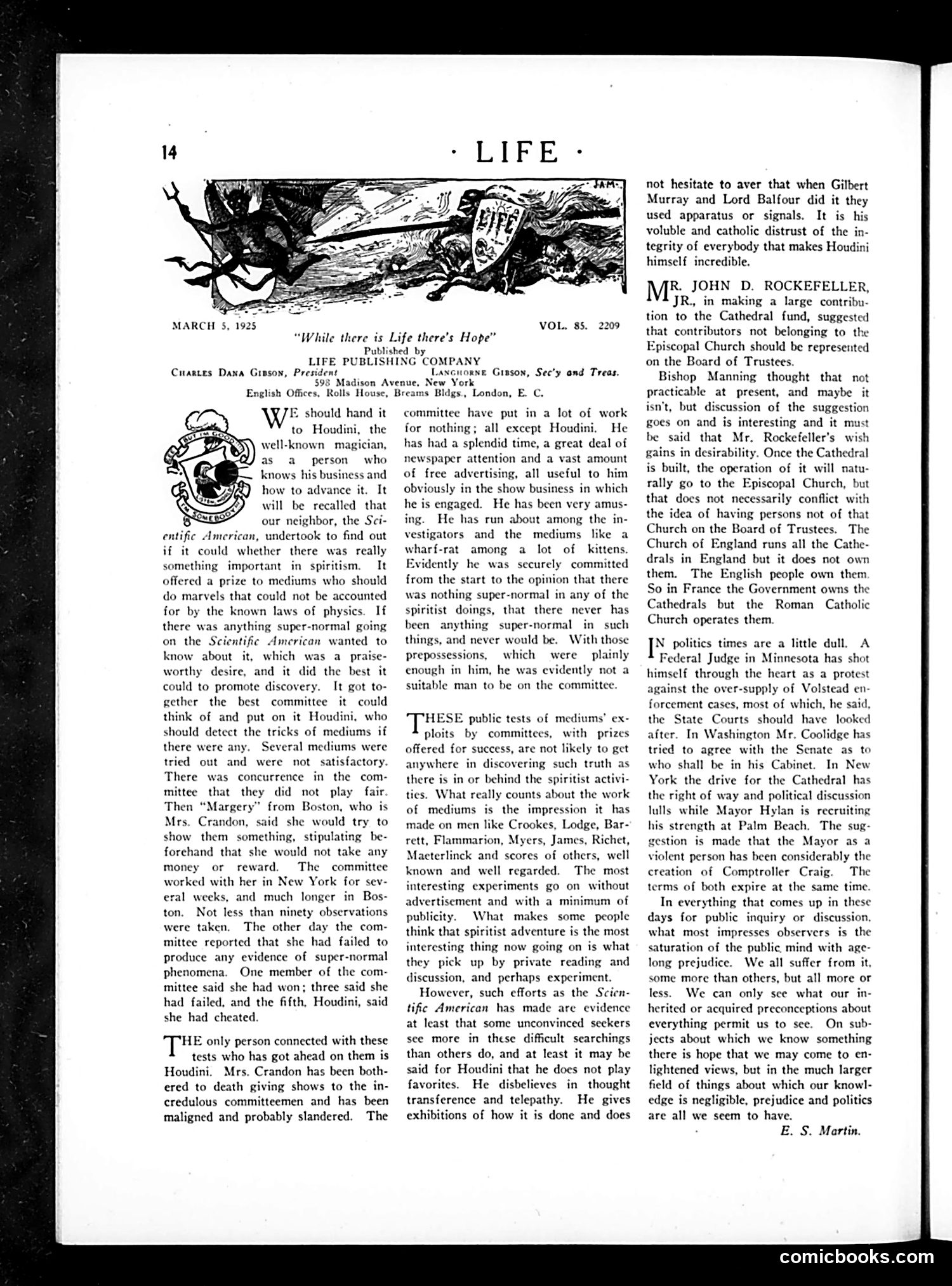
This page discusses **Houdini**, the famous magician and spiritualism skeptic. The cartoon header depicts a skeleton or death figure, referencing Houdini's escape artistry and illusions. The main article criticizes **spiritualist mediums** and their public demonstrations. The author argues that committees investigating mediums (like those led by "Mrs. Crandon") often failed to detect fraud. The text suggests Houdini, despite his showmanship, played an important role in exposing fraudulent spiritualist claims. The piece also discusses broader political topics (Federal Judge in Minnesota, Mayor Hylan in New York, Comptroller Craig) but these appear secondary to the primary focus on debunking spiritualist deception during the 1920s spiritualism craze. The satirical point: legitimate investigation of mediums requires skepticism, not gullibility.
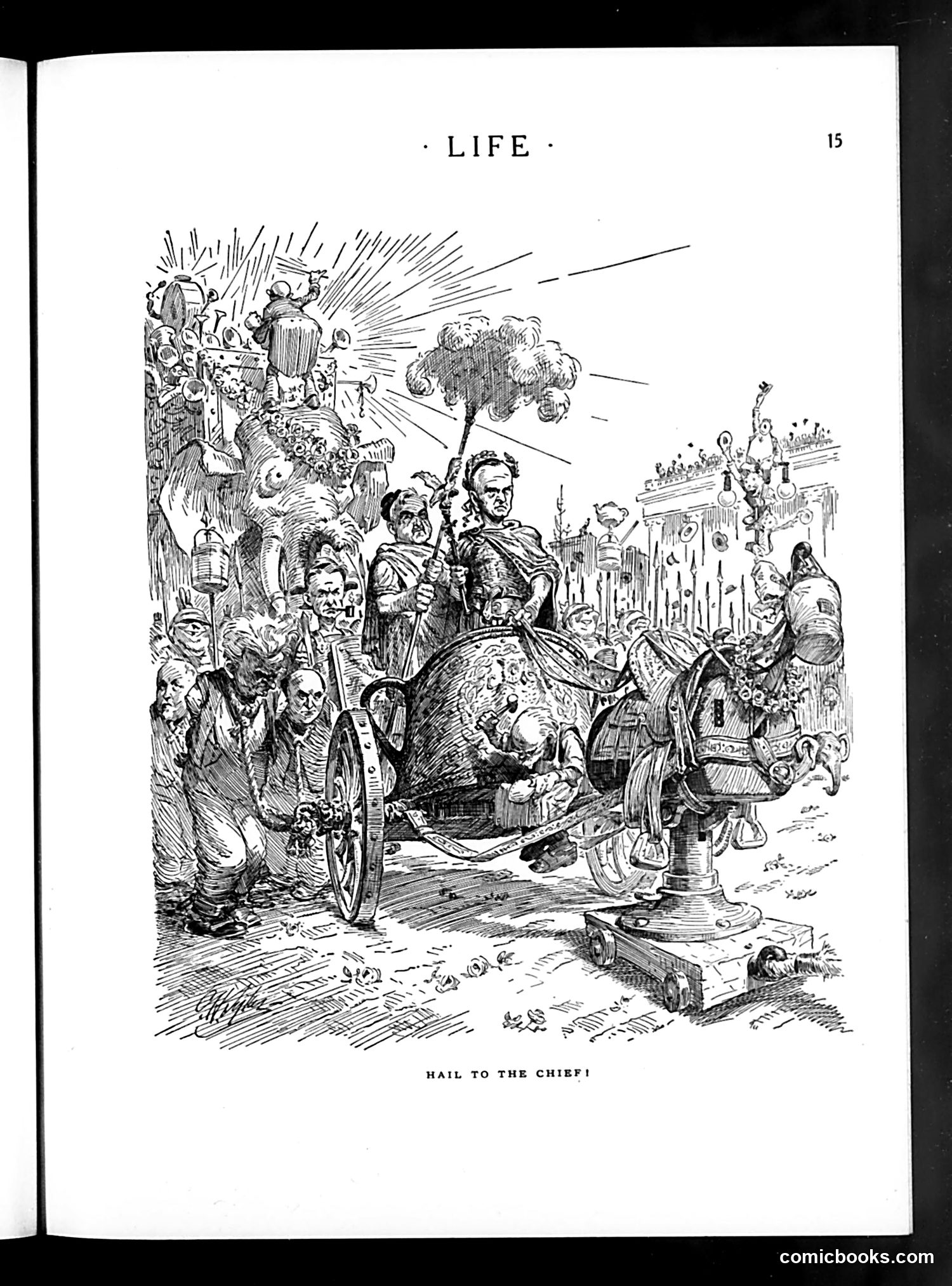
This political cartoon from *Life* magazine depicts a grand military procession with crowds hailing a central leader figure riding in an ornate carriage. The imagery suggests a monarchical or dictatorial celebration—ornate horses, uniformed soldiers, cheering masses, and elaborate pageantry surround the chief. The satire likely critiques American political leadership or ambition toward autocratic power. The exaggerated grandeur and the caption "Hail to the Chief!" mock the veneration of political authority, suggesting the cartoon questions whether democratic leadership has become too monarchical or cult-like. Without the publication date visible, the specific target remains unclear—it could reference late 19th or early 20th-century American politics and concerns about executive power or political personality cults. The ornate, old-world styling emphasizes the anachronistic nature of such adulation in a democratic society.
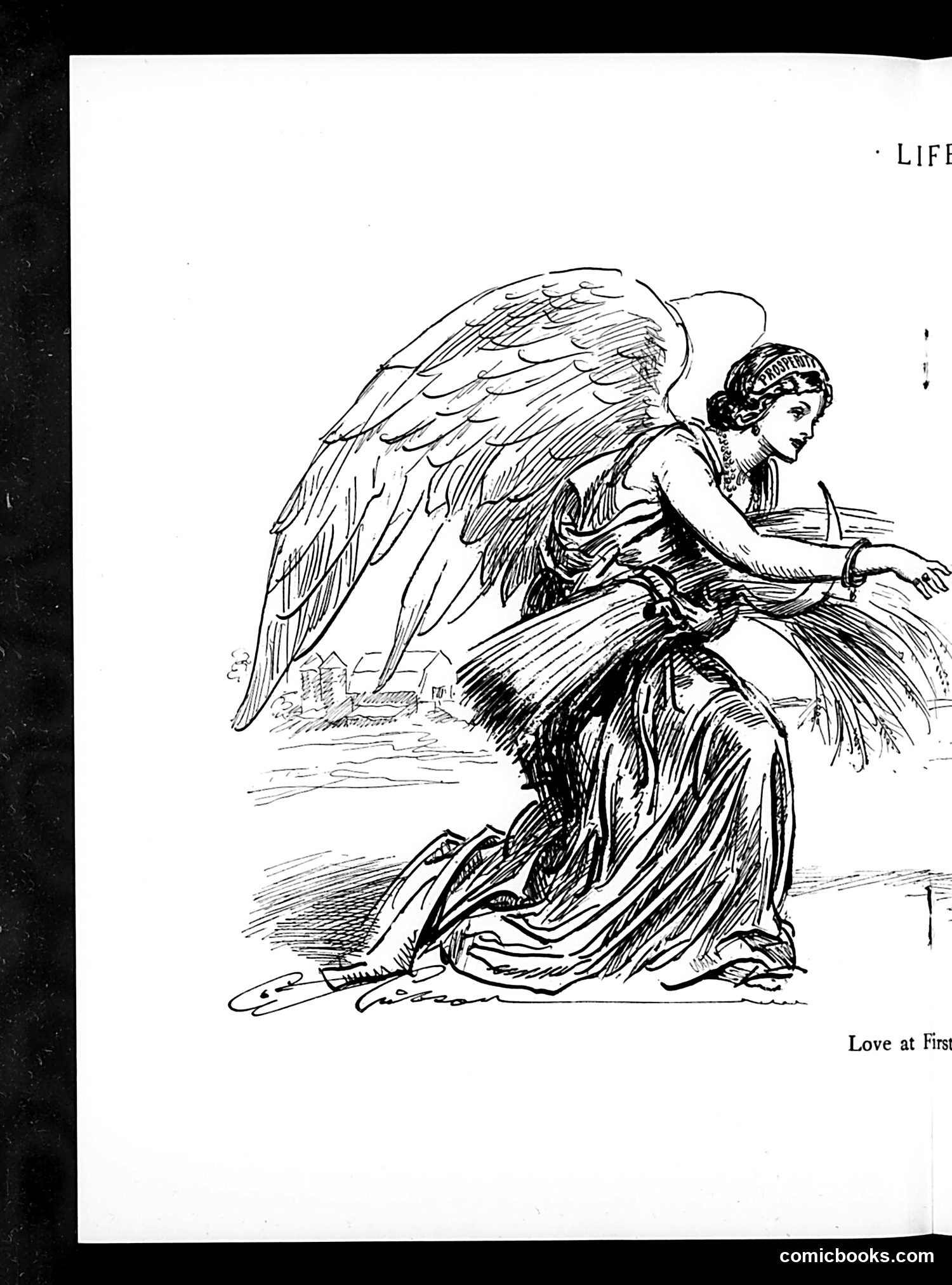
This appears to be an illustration from *Life* magazine depicting an allegorical or romantic scene. The image shows two figures: an winged angel or cupid-like figure (standing, with large detailed wings) and a kneeling or seated woman in classical/romantic dress below. The title "Love at First" suggests this is about romantic attraction or love at first sight. The winged figure likely represents Cupid, the classical symbol of love, while the woman below appears to be a mortal subject of love's arrow or influence. The artistic style—detailed pen-and-ink line work with classical subject matter—was typical of *Life's* satirical and illustrative content. Without additional context about the issue's date or surrounding articles, the specific satirical intent remains unclear, though it may comment on romance, relationships, or contemporary social attitudes toward love.
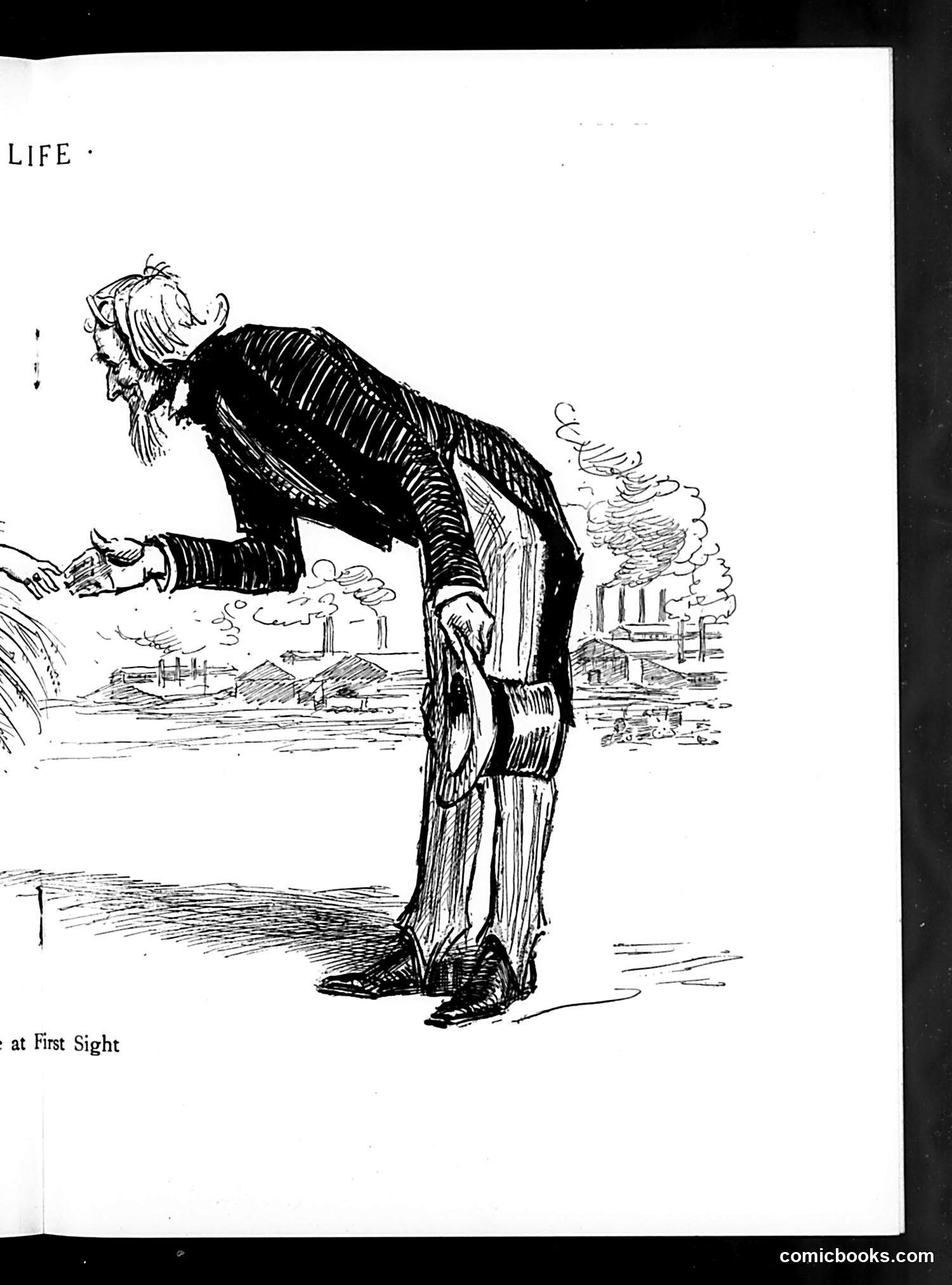
This page from *Life* magazine shows a political cartoon titled "at First Sight." The image depicts a well-dressed man in formal attire (suit and top hat) bending over to examine something on the ground with a magnifying glass. In the background, there's an industrial cityscape with smoking factories and what appears to be poverty or urban decay. The cartoon satirizes selective perception or willful blindness—the gentleman appears to be scrutinizing something minor while ignoring the larger social problems (industrialization, pollution, poverty) visible behind him. The satire suggests that the privileged or powerful focus on trivial matters while remaining indifferent to serious societal issues occurring around them. Without a visible date, the exact historical context remains unclear, though this reflects broader early-20th-century *Life* magazine social commentary.
This theater criticism compares live drama unfavorably to silent cinema. The author watched German film "The Last Laugh" (a prestigious, acclaimed silent film) before attending the Broadway play "Cape Smoke," and found the movie vastly superior—so much so that theater seems obsolete by comparison. The piece satirizes theater's "clumsy and phony" reliance on dialogue and painted scenery against cinema's visual storytelling power. The author jokes that in a century, legitimate theater will occupy the cultural position Punch and Judy puppet shows hold now—completely antiquated. The subsequent reviews critique specific Broadway productions: praising the Shubert brothers' musicals ("The Student Prince," "The Love Song") despite their reputation, and reviewing shows like "Puzzles of 1925" and "The Dove." The satire targets outdated theatrical conventions while acknowledging cinema's artistic ascendancy during the silent film era.
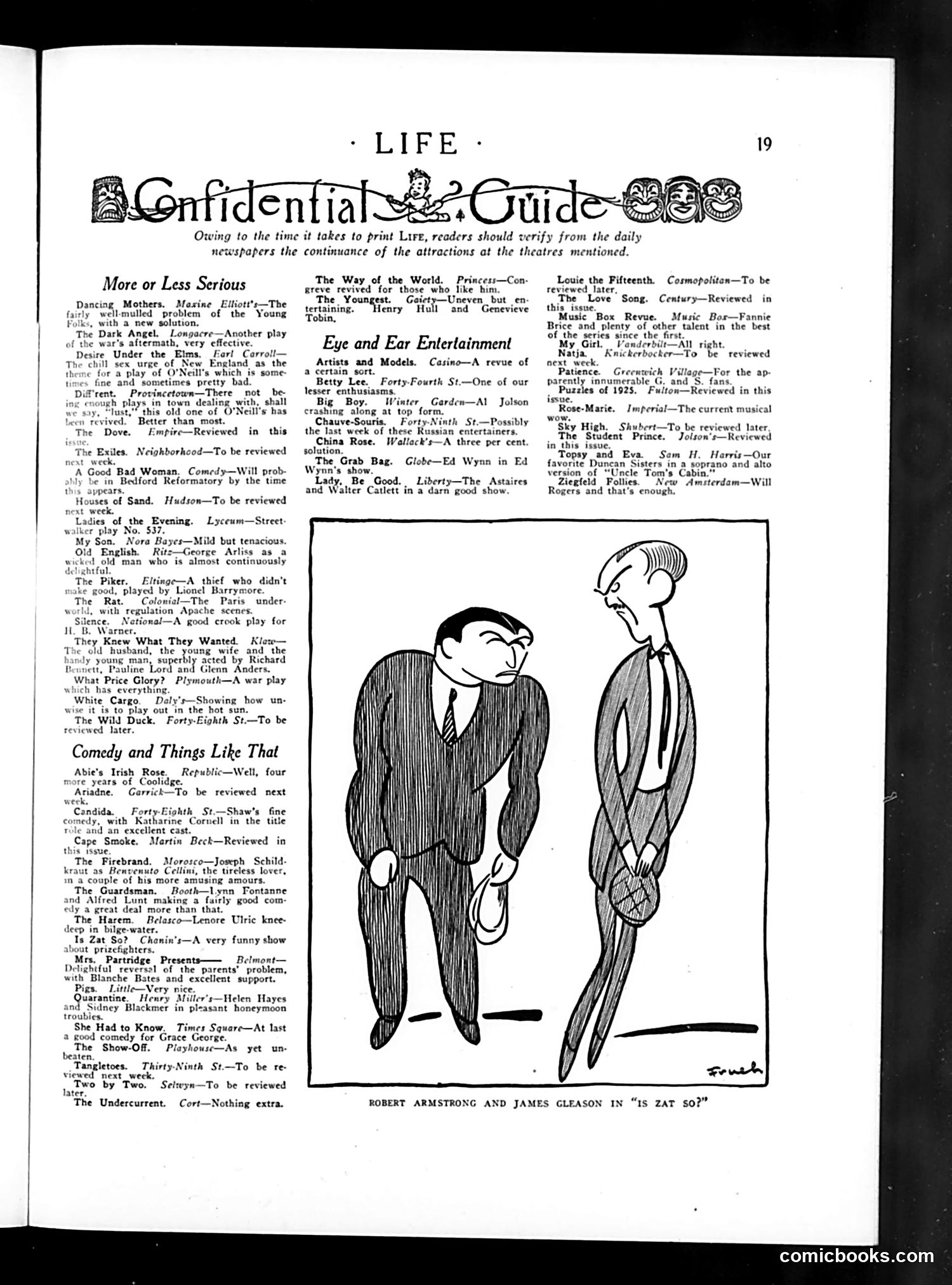
This cartoon illustrates a comedic scene from the 1923 play *"Is Zat So?"* (listed in the review section as "a very funny show about prizefighters"). The image shows two men in exaggerated physical comedy typical of early 20th-century theatre—one man appears to be striking or confronting the other in a slapstick manner. The humor derives from the play's subject matter: working-class prizefighters engaged in crude, physical comedy rather than sophisticated wit. For modern readers, this reflects the era's theatrical divide between "high" comedy (cerebral, refined) and "low" comedy (physical, violent). The exaggerated caricature style and aggressive posturing were standard entertainment conventions of the 1920s, representing the broad, bodily humor that appealed to popular audiences of that period. The accompanying theatre reviews emphasize sophisticated plays alongside such lowbrow fare, reflecting diverse theatrical tastes during this era.
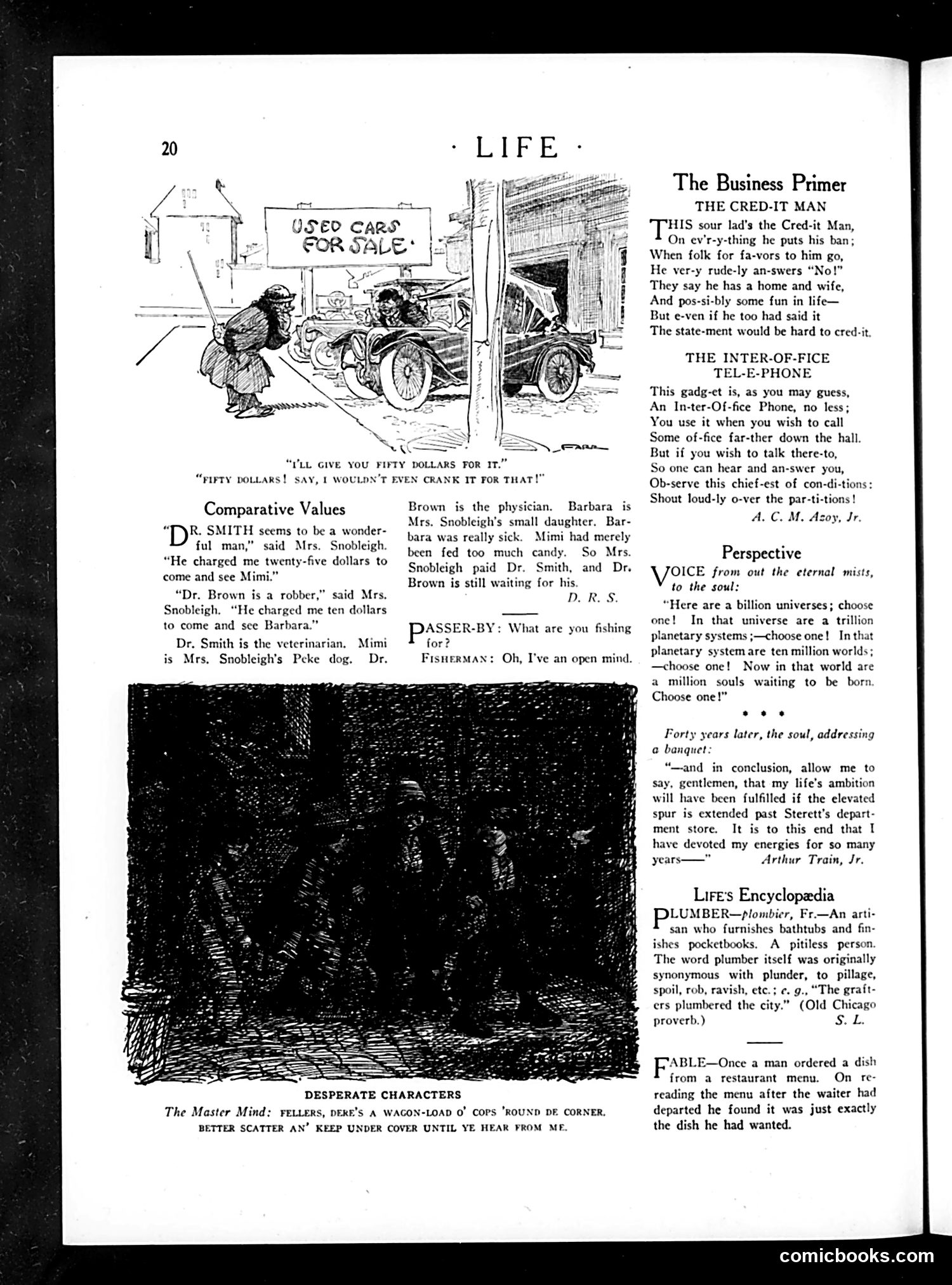
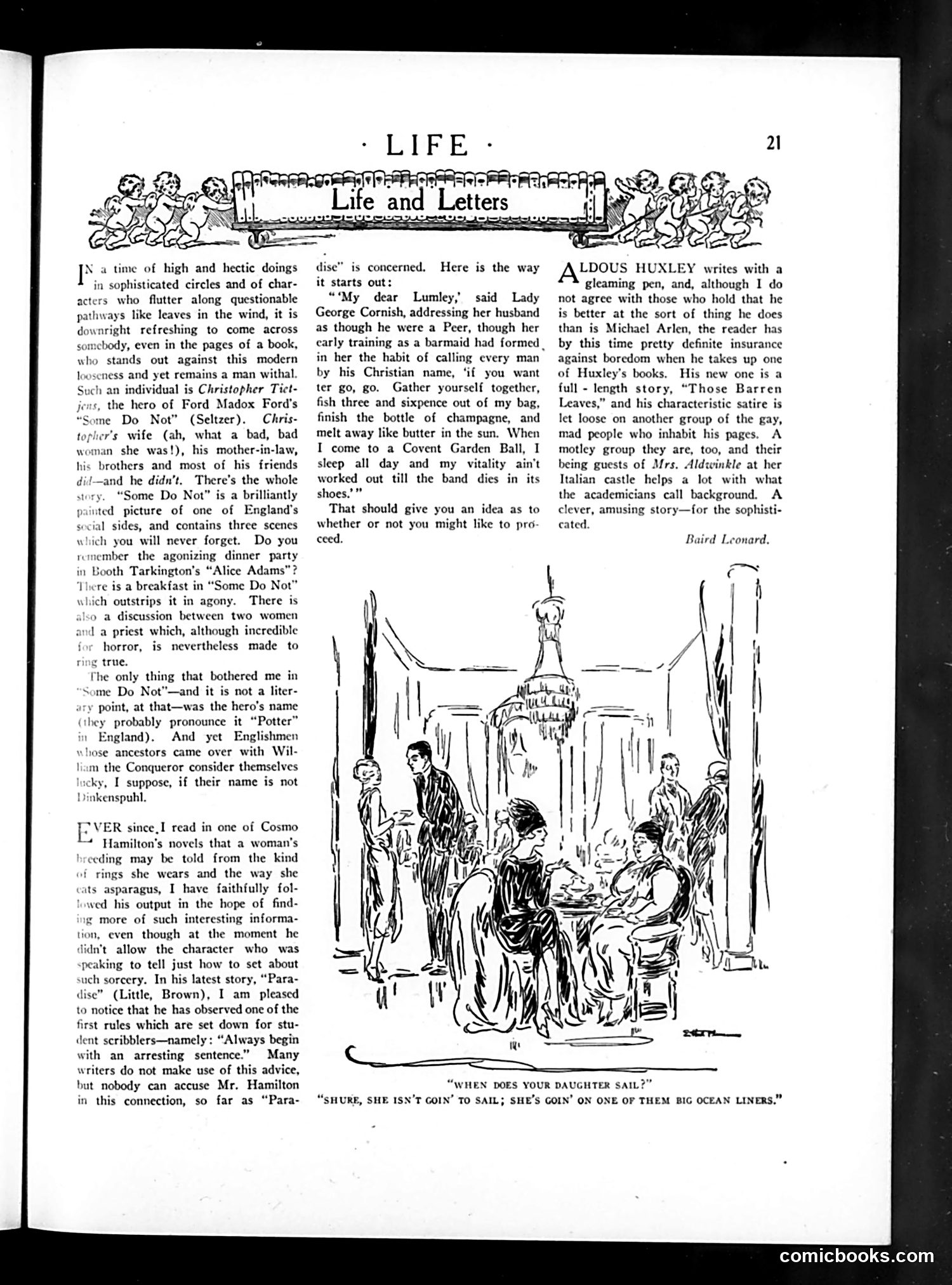
This is a book review section titled "Life and Letters" discussing contemporary literary works. The main cartoon depicts Irish immigrants at a dock, with one character explaining his daughter won't sail on a ship—she'll travel on an ocean liner. The humor relies on ethnic stereotype: the Irish brogue ("Shure") contrasts with the character's literal-minded misunderstanding of nautical terminology. He treats "sailing" and "ocean liner travel" as mutually exclusive, when "sailing" is simply a colloquial term for ocean travel by any vessel. The reviews discuss novels by Ford Madox Ford, Cosmo Hamilton, and Aldous Huxley, emphasizing their sophisticated portrayals of upper-class society. The cartoon's working-class Irish subject matter provides ironic contrast to the highbrow literary content surrounding it—a typical Life magazine strategy of juxtaposing refined culture with common vernacular humor for satirical effect.
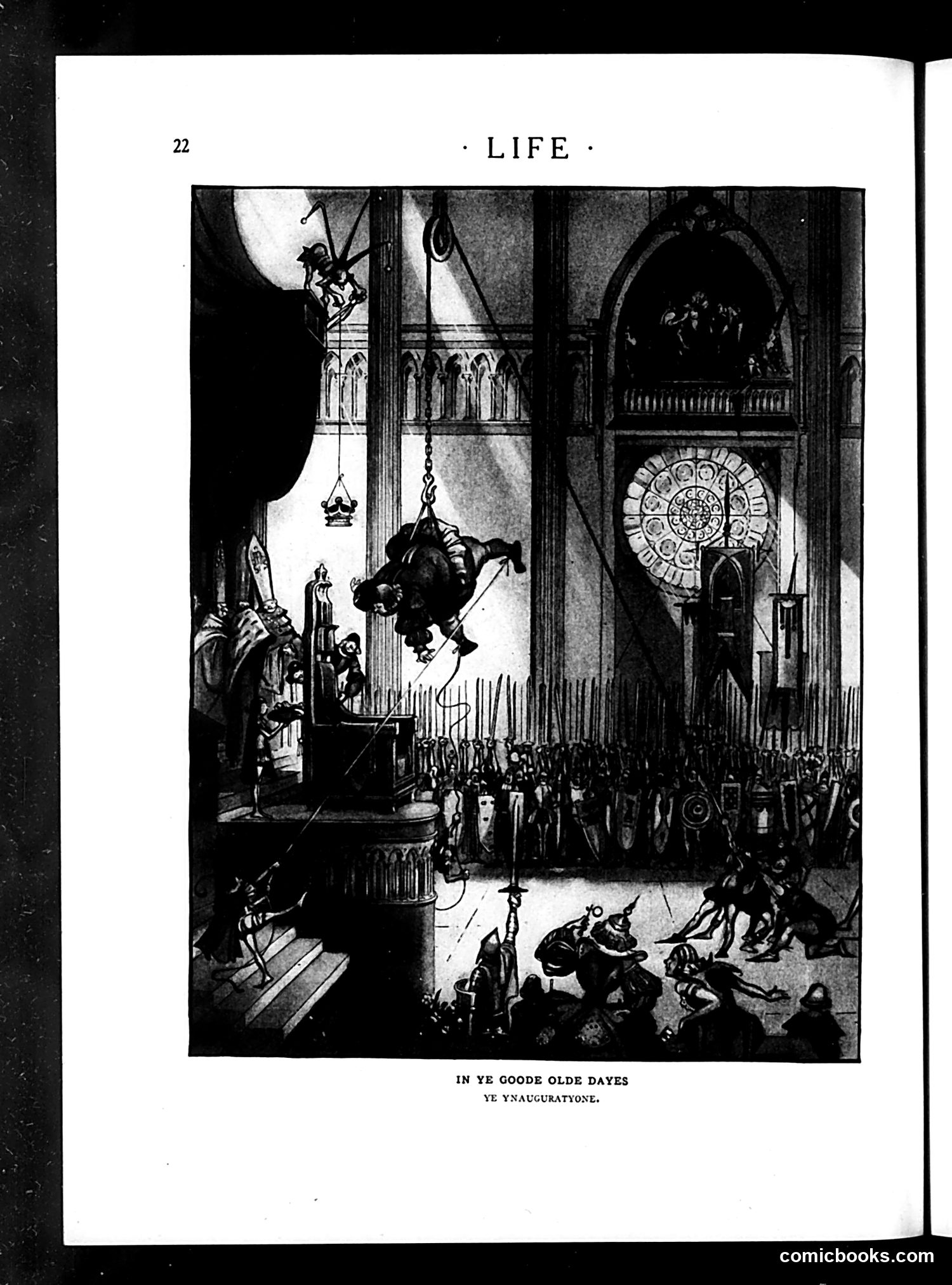
This satirical illustration depicts a medieval cathedral scene titled "Ye Inauguration," contrasting past and present. The image shows an ornate Gothic interior with crowds gathered below, while figures in elaborate period costume perform ceremonial actions above—including what appears to be figures suspended or elevated in dramatic fashion. The satire likely mocks contemporary political inaugurations by presenting them as pseudo-medieval spectacles with excessive pageantry and ceremony. By depicting the scene in archaic language and Gothic architectural grandeur, the artist suggests that modern inaugurations are theatrical performances mimicking ancient ritual rather than straightforward governmental proceedings. The exact political targets remain unclear without additional context about the publication date, but the humor centers on the absurdity of pomp and circumstance surrounding political transitions.
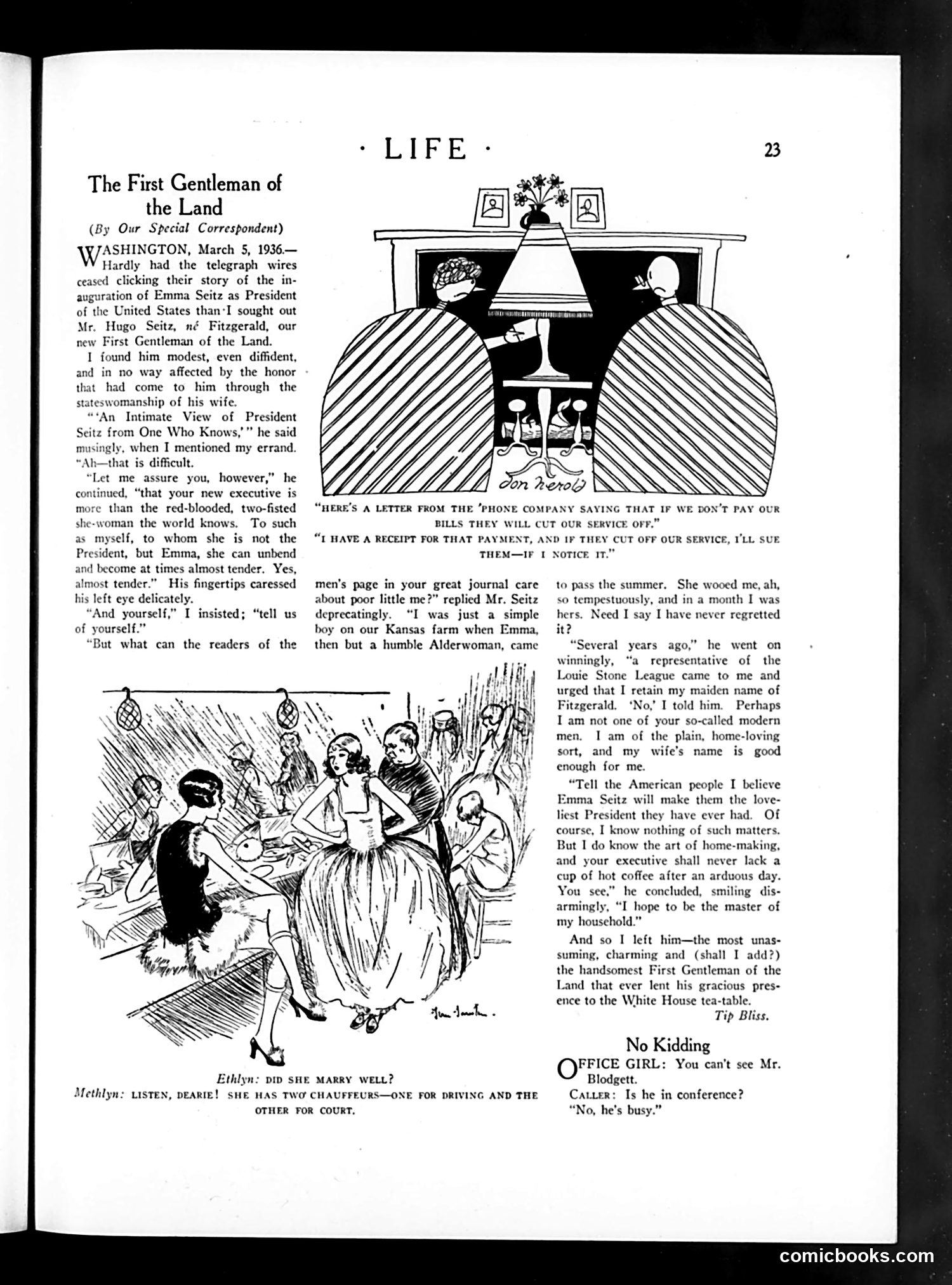
This satirical piece imagines a future where a woman, Emma Seitz, becomes U.S. President, and her husband Hugo becomes "First Gentleman." The satire works on multiple levels: **The central joke:** It reverses traditional gender roles by depicting the husband as a decorative, domestically-focused spouse—roles women historically occupied. He speaks of homemaking, serving coffee, and being "the master of my household" with gentle self-deprecation. **Contemporary references:** The 1936 date and Kansas farm background suggest this responds to actual female political figures gaining prominence in the New Deal era. The "Louie Stone League" reference appears to satirize women's rights organizations. **Subsidiary humor:** The cartoon showing a woman with "two chauffeurs—one for driving and the other for court" mocks nouveau-riche pretension. The phone company joke depicts marital conflict over bills. The piece uses gentle irony rather than outrage, presenting the scenario as almost charming—yet the very need for such satire reveals how unthinkable female political leadership still was in 1936.
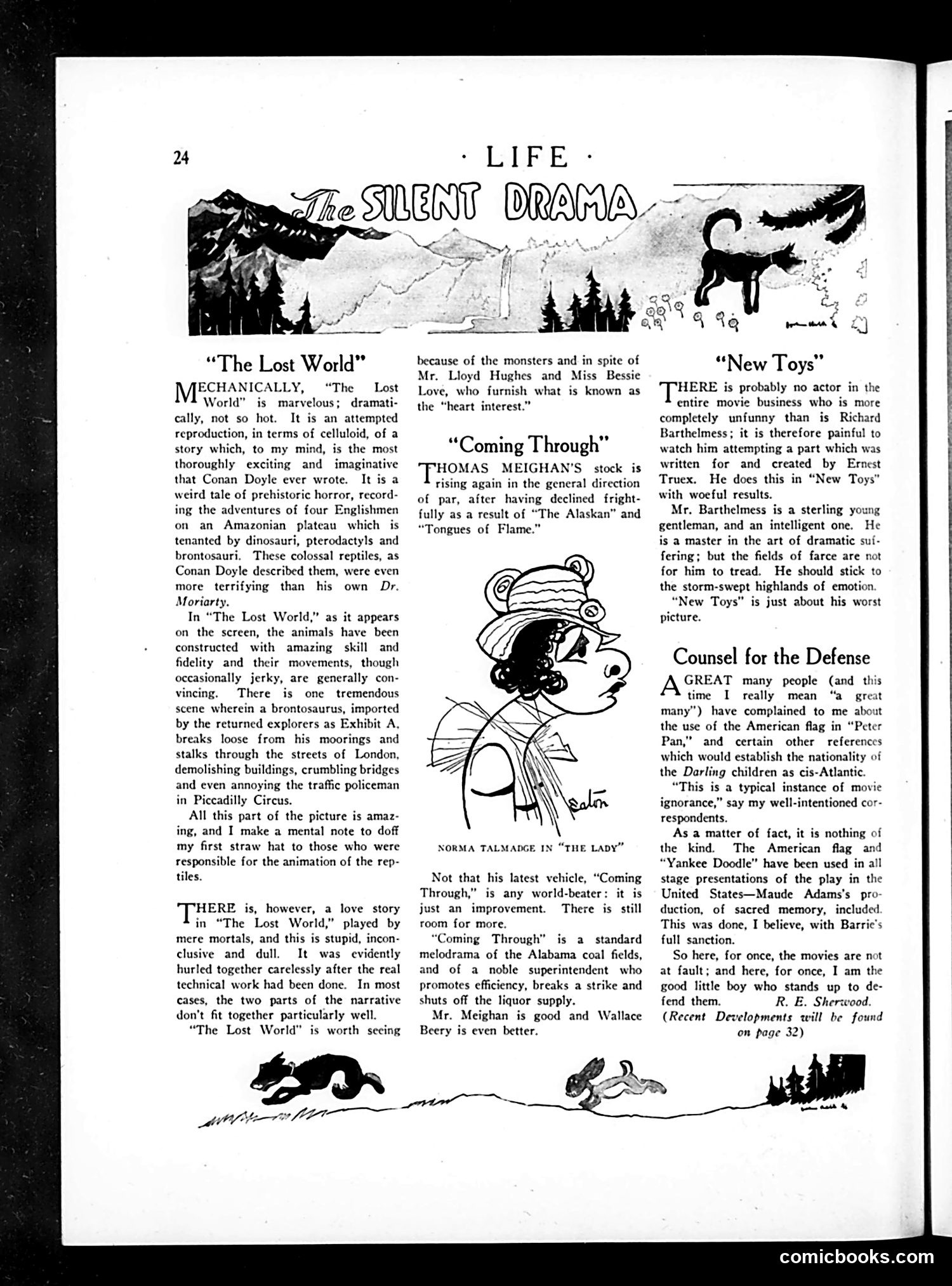
This page contains movie reviews from Life's "Silent Drama" section. The critic reviews four films: **"The Lost World"** (based on Conan Doyle's novel): Praised for its technically impressive dinosaur animation—particularly a brontosaur rampaging through London—but criticized for its weak romantic subplot featuring Lloyd Hughes and Bessie Love, which undermines the exciting prehistoric adventure. **"Coming Through"**: A modest melodrama about an Alabama coal-field superintendent (Thomas Meighan) who breaks a strike. The review notes Meighan's career is recovering after previous failures; Wallace Beery is praised. **"New Toys"**: Criticized for miscast lead Richard Barthelmess, who the reviewer argues lacks comedic ability and was wrong for a farce originally created by Ernest Truex. **"Counsel for the Defense"**: A sidebar defending Hollywood's use of American flags and "Yankee Doodle" in "Peter Pan," noting these elements appeared in stage versions with the playwright's approval—a rebuttal to viewer complaints about Americanizing British material.
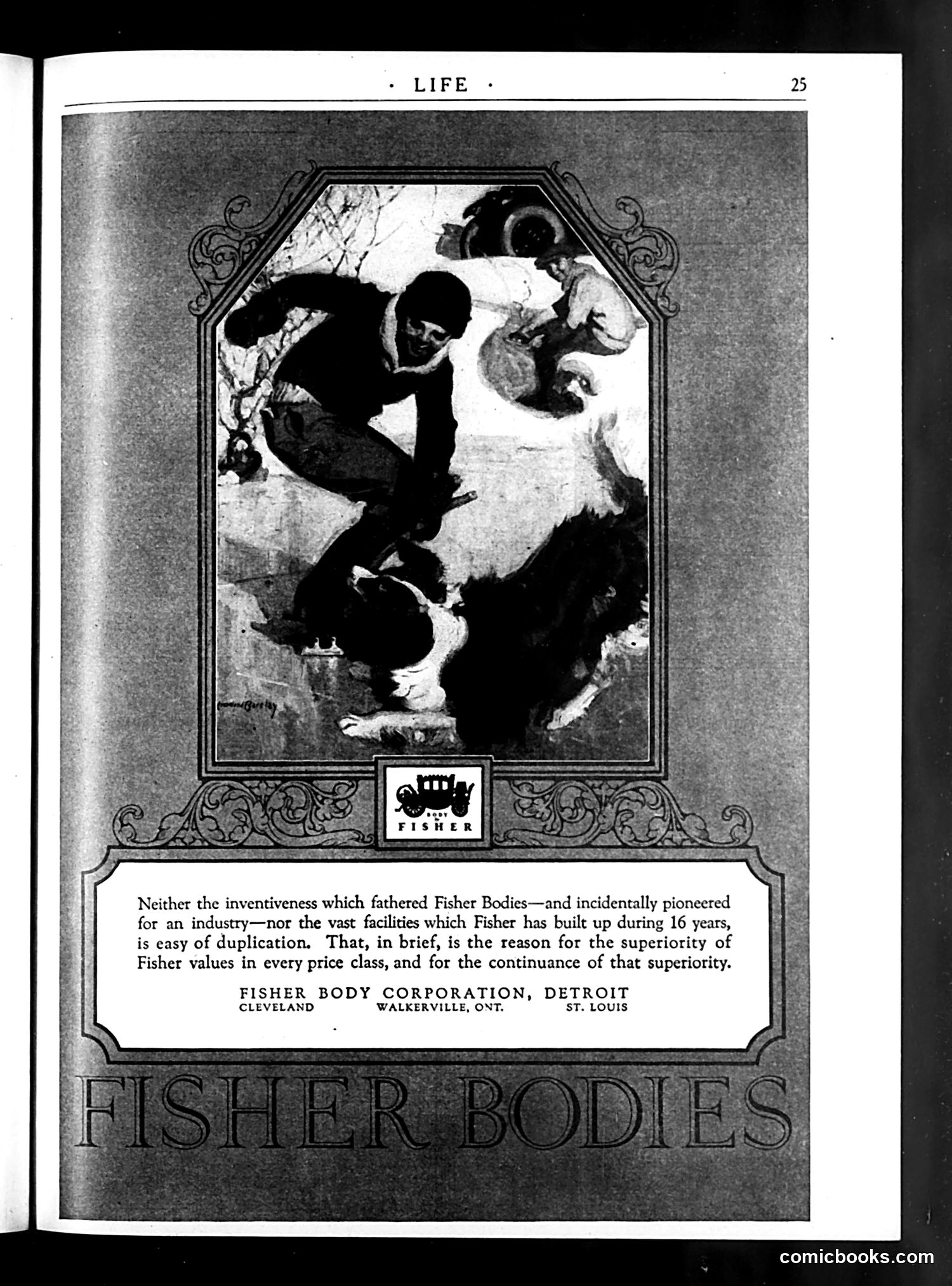
This is a **Fisher Body Corporation advertisement**, not political satire. The image shows workers manufacturing automobile bodies in a factory setting, depicting the industrial labor process. The text argues that Fisher Bodies' 16 years of accumulated expertise, innovation, and manufacturing infrastructure cannot be easily replicated by competitors, justifying their product superiority across all price ranges. The advertisement emphasizes **industrial capability and competitive advantage** through established facilities and experience rather than through any particular design innovation. Fisher Body Corporation was a major supplier of automobile bodies to General Motors and other manufacturers during this era. This appears in *Life* magazine as a full-page corporate advertisement promoting their manufacturing excellence to consumers.
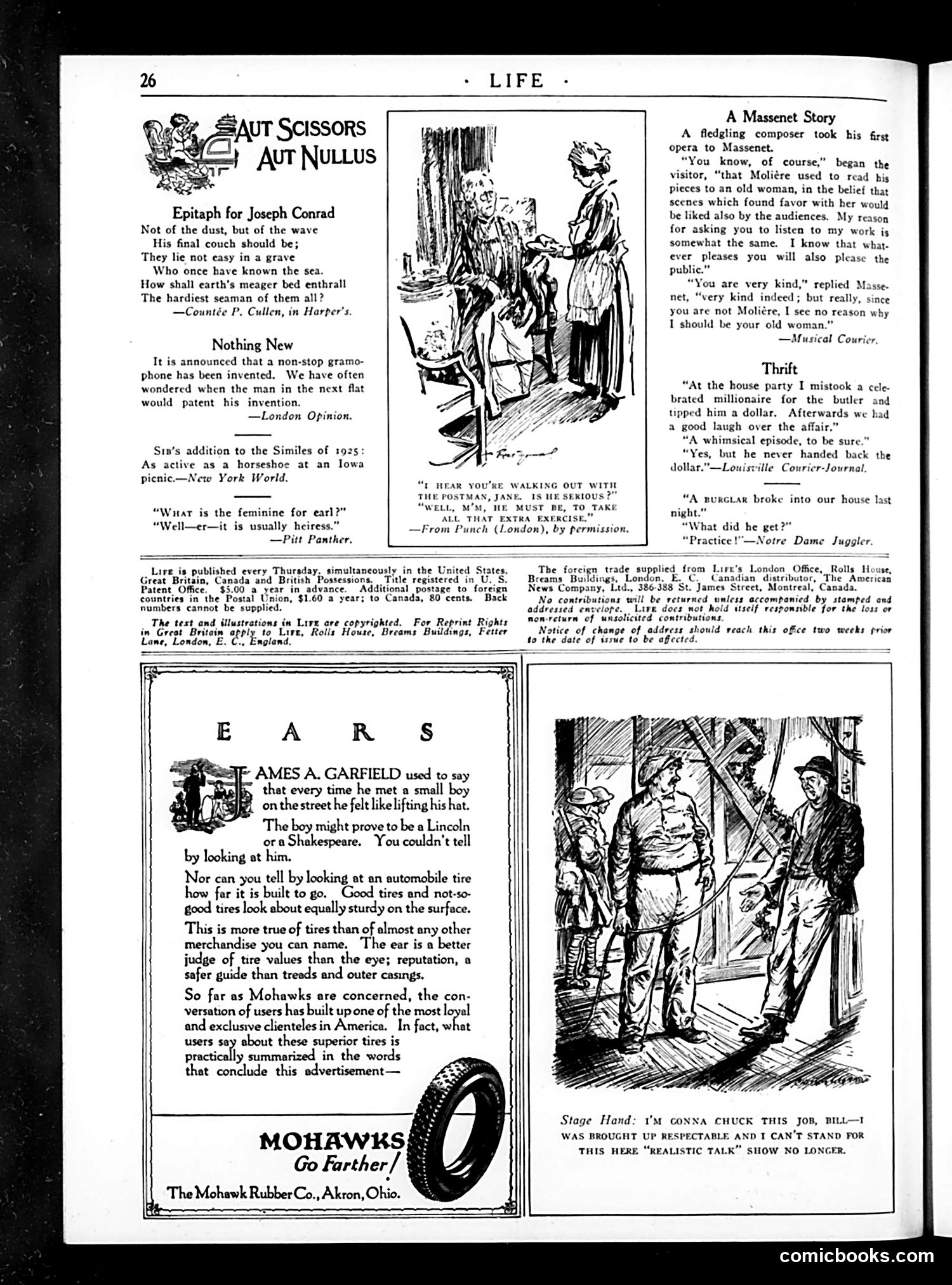
This page from *Life* magazine contains several short humor pieces typical of 1920s satirical journalism, plus a Mohawk tire advertisement. The cartoons and jokes are brief, disconnected pieces: - **"Epitaph for Joseph Conrad"**: A poetic tribute to the recently deceased author, emphasizing his connection to the sea. - **Short quips** mock modern inventions (gramophones), social awkwardness (mistaking a millionaire for a butler), and language (the feminine of "earl"). - **A Massenet anecdote**: Famous composer Massenet deflates an aspiring composer's flattery by noting he isn't Molière, so using him as a test audience makes no sense—a dry joke about artistic vanity. - **Bottom cartoon**: A stage worker quits because the "realistic talk" (likely profanity or harsh language) conflicts with his upbringing—satirizing working-class dignity amid theatrical crudeness. The **Mohawk tire ad** uses Garfield's metaphor about hidden potential in unknown children to argue tire quality can't be judged by appearance—reputation matters most. The page is primarily **humor and advertising**, not political satire.
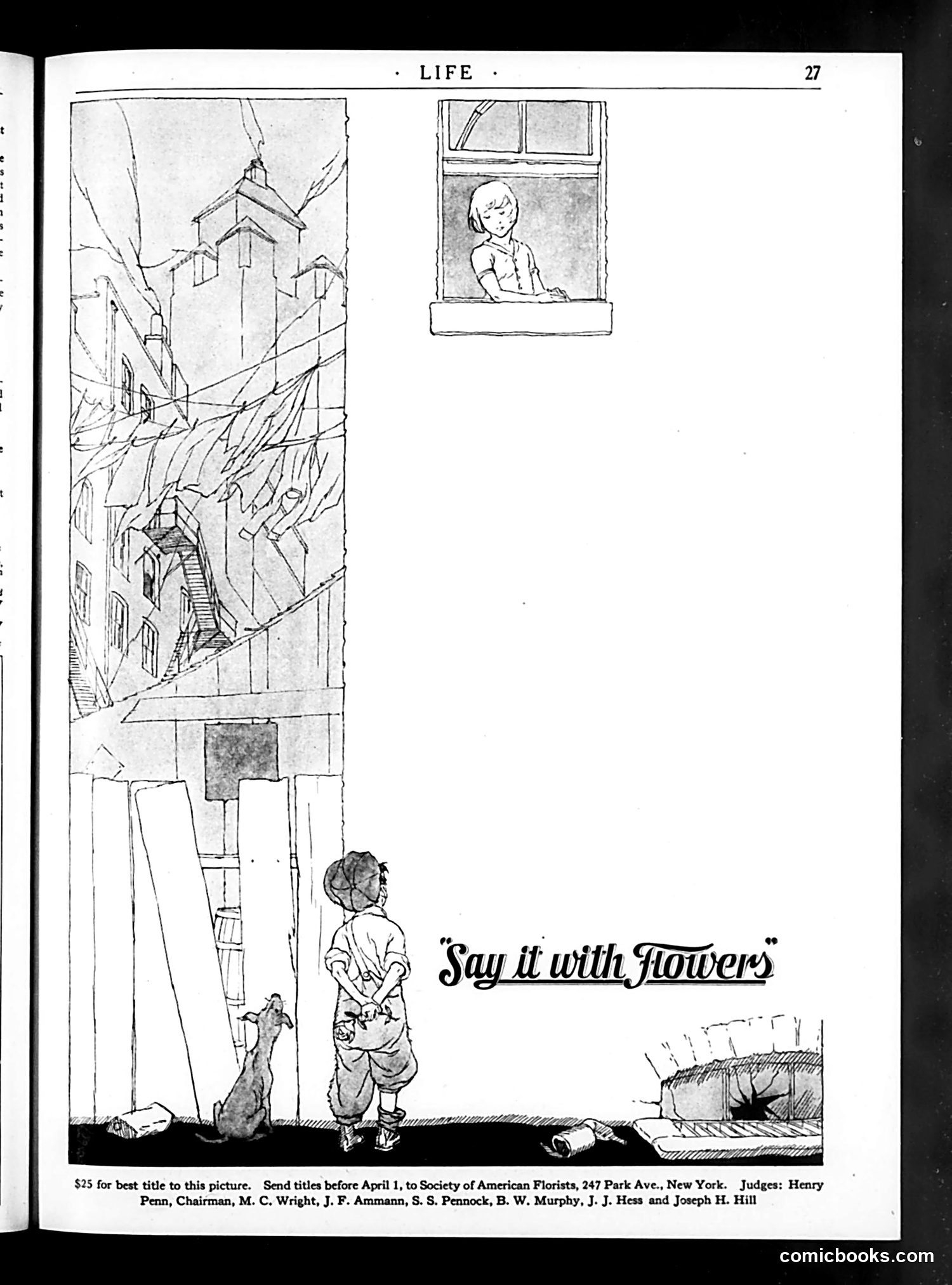
This is a contest entry page rather than satirical content. The illustration shows a young child and small dog standing outside a building, looking up at a window where another child appears. The title "Say it with Flowers" is a play on the florist industry's advertising slogan. The page announces a contest sponsored by the Society of American Florists, offering $25 for the best caption/title to the picture. Readers were invited to submit titles by April 1, with judges from the florist industry selected to determine winners. The illustration appears designed to evoke sentiment—a child wanting to communicate with another child via flowers—playing on the romantic or emotional appeal of floral gifts. This was a common advertising approach for promoting flower sales during the early-to-mid 20th century.
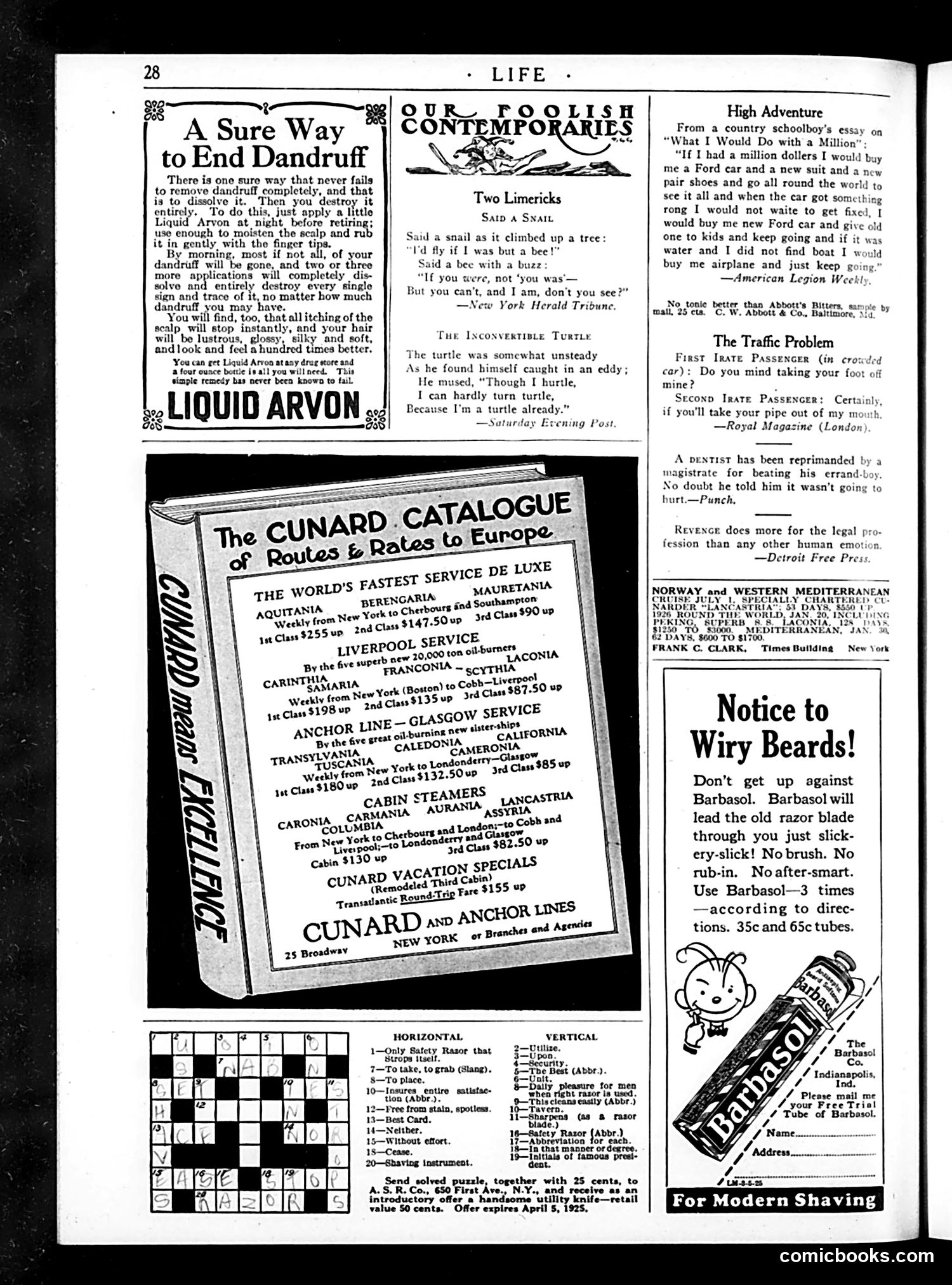
This page from *Life* magazine consists primarily of **advertisements and light humor**, not political satire. The content includes: **Advertisements**: Liquid Arvon (dandruff remedy), Cunard steamship catalog, Barbasol shaving cream, and a crossword puzzle offering a utility knife prize. **Humor Section** ("Our Foolish Contemporaries"): Two limericks mocking grammatical errors and circular logic—a snail criticizing a bee's grammar, a turtle confused about its own nature. This represents *Life's* typical gentle satirizing of everyday absurdities rather than political commentary. **Miscellaneous Jokes**: Brief one-liners about traffic etiquette, dentistry, and legal revenge—typical light magazine fare from the 1920s. There are **no political cartoons or caricatures** on this page. The magazine here functions as a general-interest publication mixing advertising with mild social humor rather than sharp political satire.
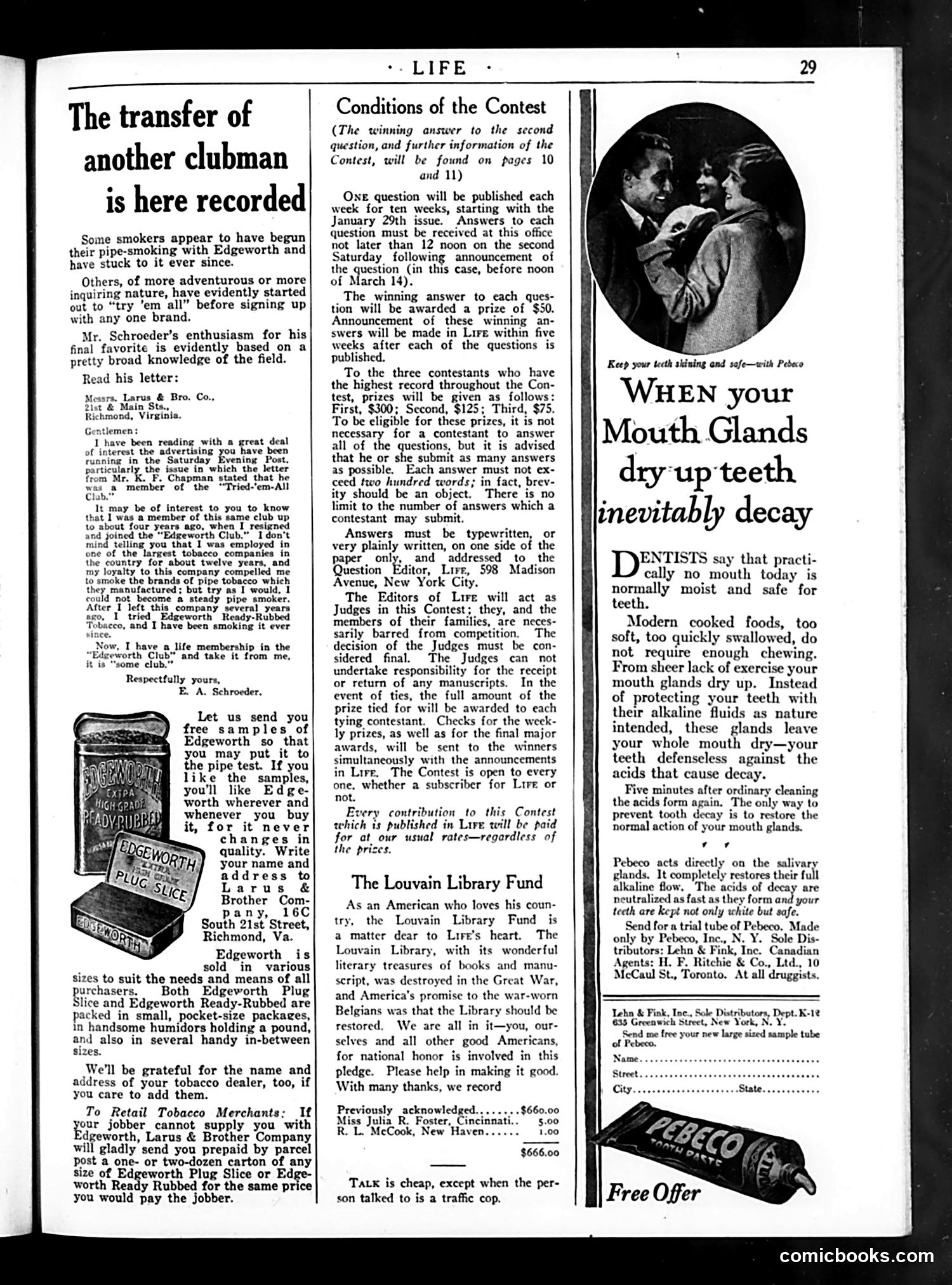
This page is primarily **advertising** rather than political satire. It features a testimonial advertisement for Edgeworth pipe tobacco, presenting a letter from "E. A. Schroeder," a former tobacco company employee who claims to have tried many pipe brands before settling on Edgeworth. The satire is subtle and commercial: the ad humorously invokes a fictional "Tried-'em-All Club" of smokers who experimented with various brands before becoming loyal Edgeworth customers. Schroeder's story—leaving the tobacco industry and immediately switching to a competing brand—functions as mock-heroic conversion narrative, elevating a consumer choice into a principled decision. The page also includes unrelated content: a contest announcement for Life magazine readers and an advertisement for Pebeco toothpaste claiming to prevent tooth decay by protecting salivary glands. The humor relies on early 20th-century consumer culture conventions, where brand loyalty was presented as a character virtue worthy of club membership.
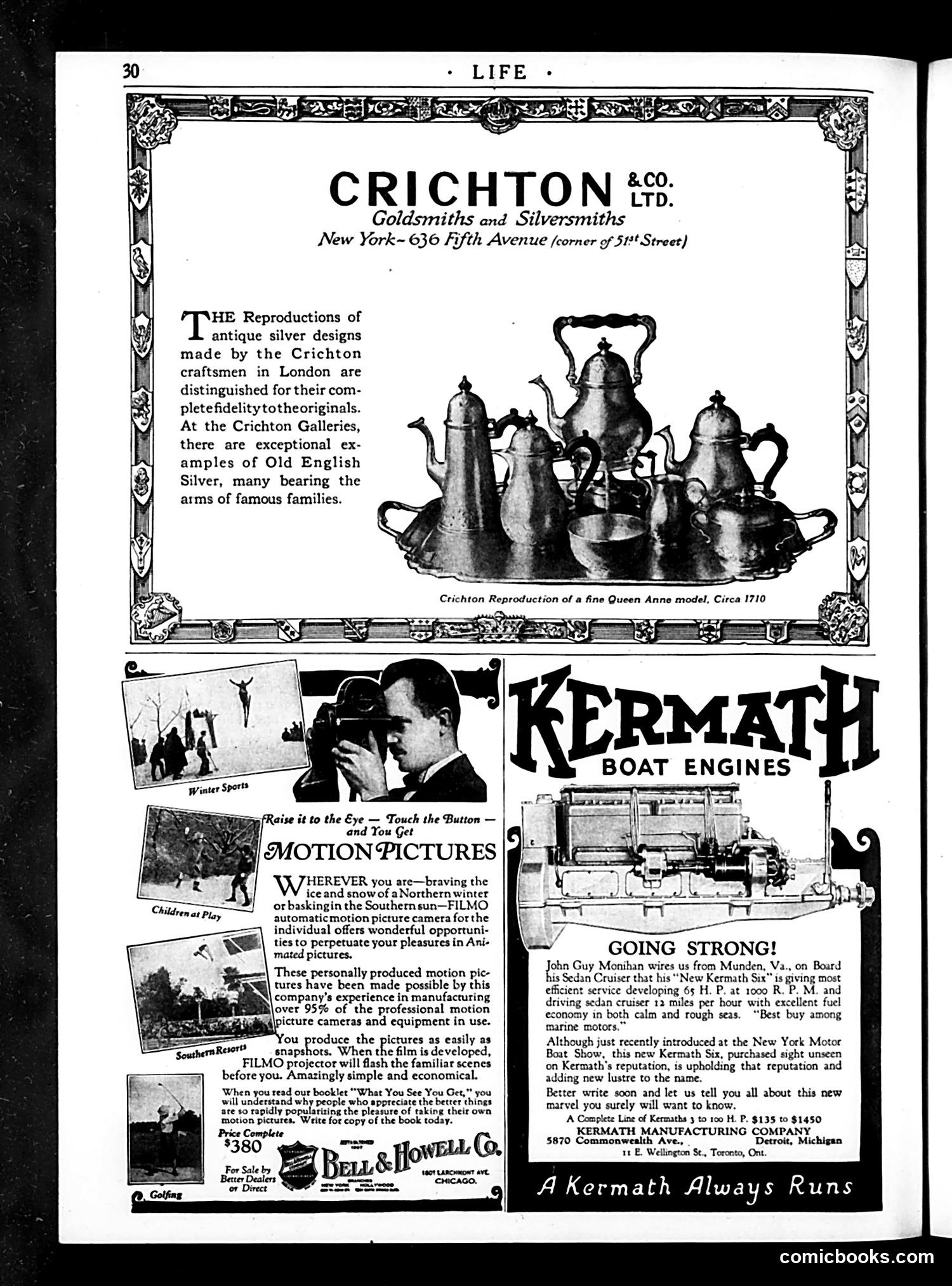
This page consists primarily of **advertisements, not editorial content or satire**. There are no political cartoons or jokes to decode. The page contains three ads: 1. **Crichton & Co.** (top): Promotes luxury silverware reproductions of antique English designs, marketed to wealthy buyers seeking Old English silver bearing family crests. 2. **Filmo Motion Picture Cameras** (center-left): Advertises affordable home movie cameras for consumers, emphasizing ease of use ("Raise it to the Eye—Touch the Button") and positioning amateur filmmaking as an accessible hobby. 3. **Kermath Boat Engines** (right): Features a customer testimonial praising a marine engine's reliability and fuel economy. The page reflects 1920s consumer culture and emerging technologies becoming available to middle and upper-class Americans. There is no satirical or political commentary present.
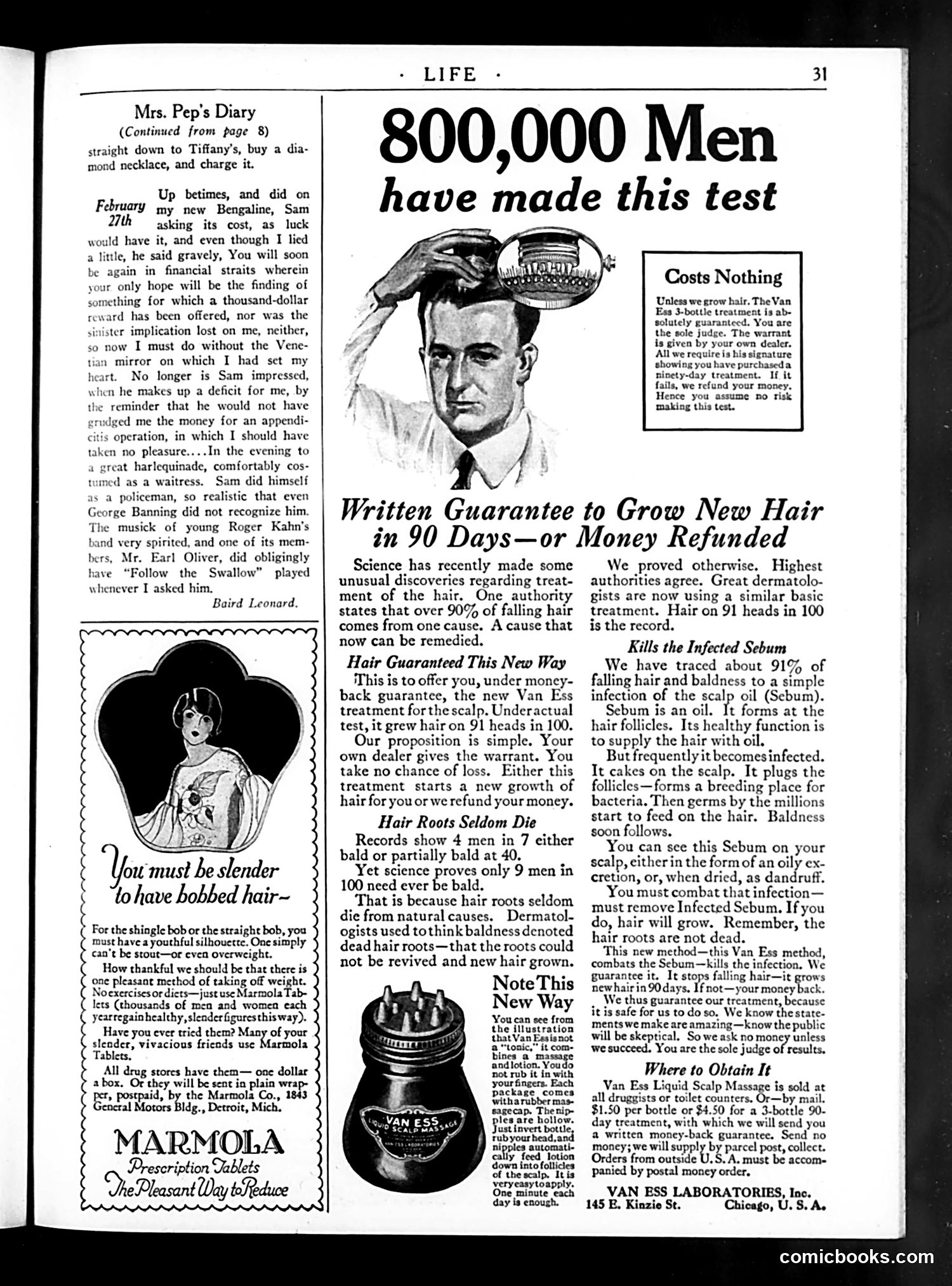
This page contains mostly **advertisements**, not political satire. The content reflects 1920s consumer anxieties about appearance and social status. **Left side:** "Mrs. Pep's Diary" continues a serialized humor column about a woman's domestic life and spending habits. The adjacent **Marmola ad** targets women, promoting weight-loss tablets by linking slenderness to fashionable "bobbed hair"—a 1920s marker of modernity. The copy implies women can't have the trendy short hairstyle if overweight. **Right side:** The dominant **Van Ess hair-growth advertisement** addresses male baldness anxiety. It claims 800,000 men have tested the product and promises hair regrowth in 90 days or money back. The pitch emphasizes scientific authority and the "new way" of treatment via massage cap, exploiting widespread concern about male pattern baldness while offering pseudo-scientific reassurance that hair roots "seldom die." Both ads reflect 1920s preoccupations with youth, appearance standards, and faith in commercial products to solve social anxieties.
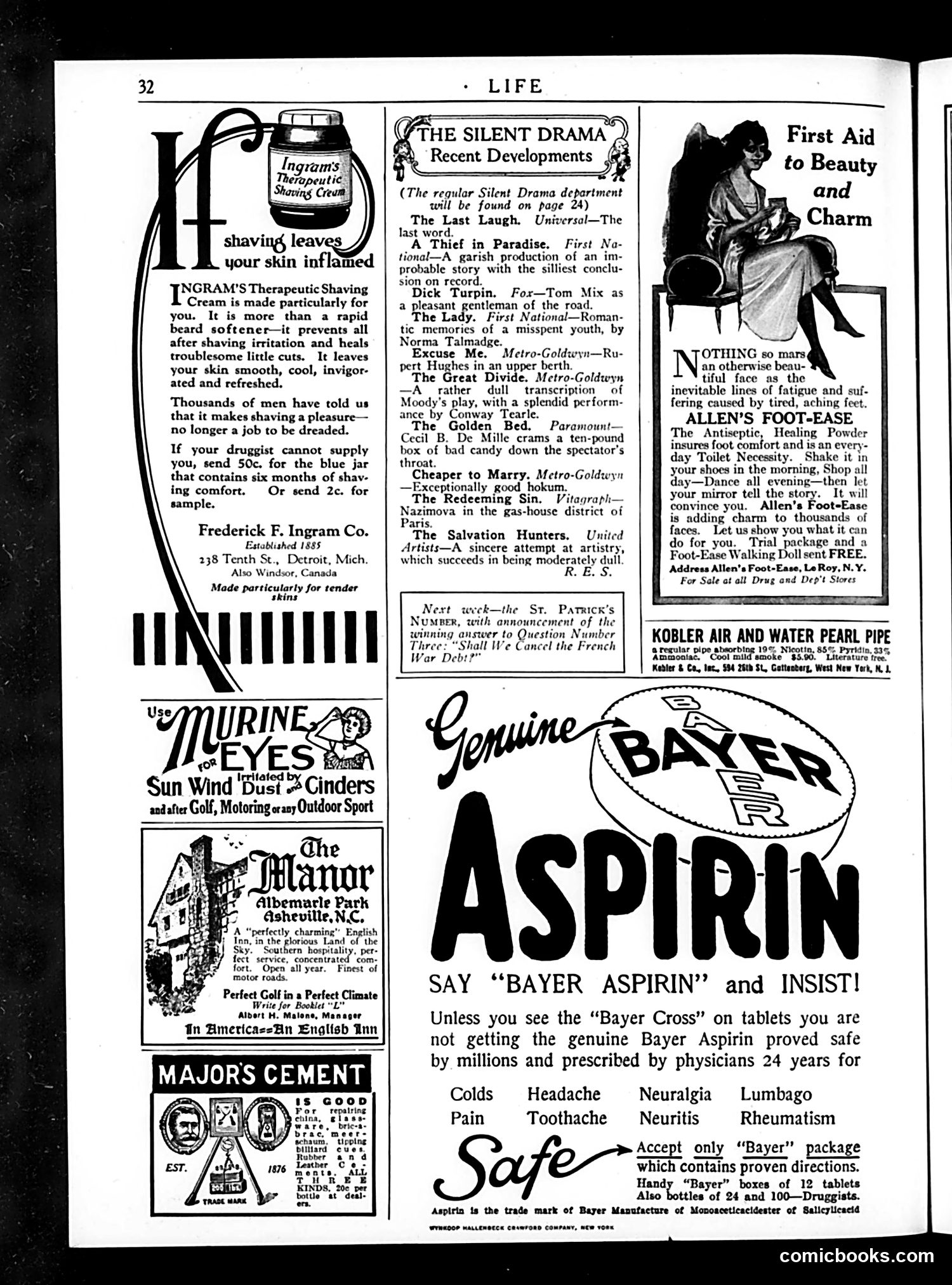
This page is primarily **advertising with minimal editorial content**. The advertisements represent typical 1920s consumer products: shaving cream, eye wash, hotel accommodations, cement, and pharmaceuticals. The only substantive editorial content is a brief **film review section** ("The Silent Drama: Recent Developments") listing current movies with terse, often sardonic descriptions. Notable: Cecil B. De Mille's *The Golden Bed* is mocked as "crams a ten-pound box of bad candy down the spectator's throat"—suggesting overwrought melodrama. A teaser announces next week's St. Patrick's Number will answer "Question Number Three: 'Shall We Cancel the French War Debt?'"—a **topical political reference** to post-WWI debt negotiations, framed humorously for a holiday issue. The **Bayer Aspirin advertisement** prominently emphasizes buying only genuine Bayer products bearing the "Bayer Cross," reflecting early trademark/authenticity concerns in pharmaceuticals. Overall, this reflects 1920s consumer culture and Life's mix of satire, entertainment coverage, and advertising.
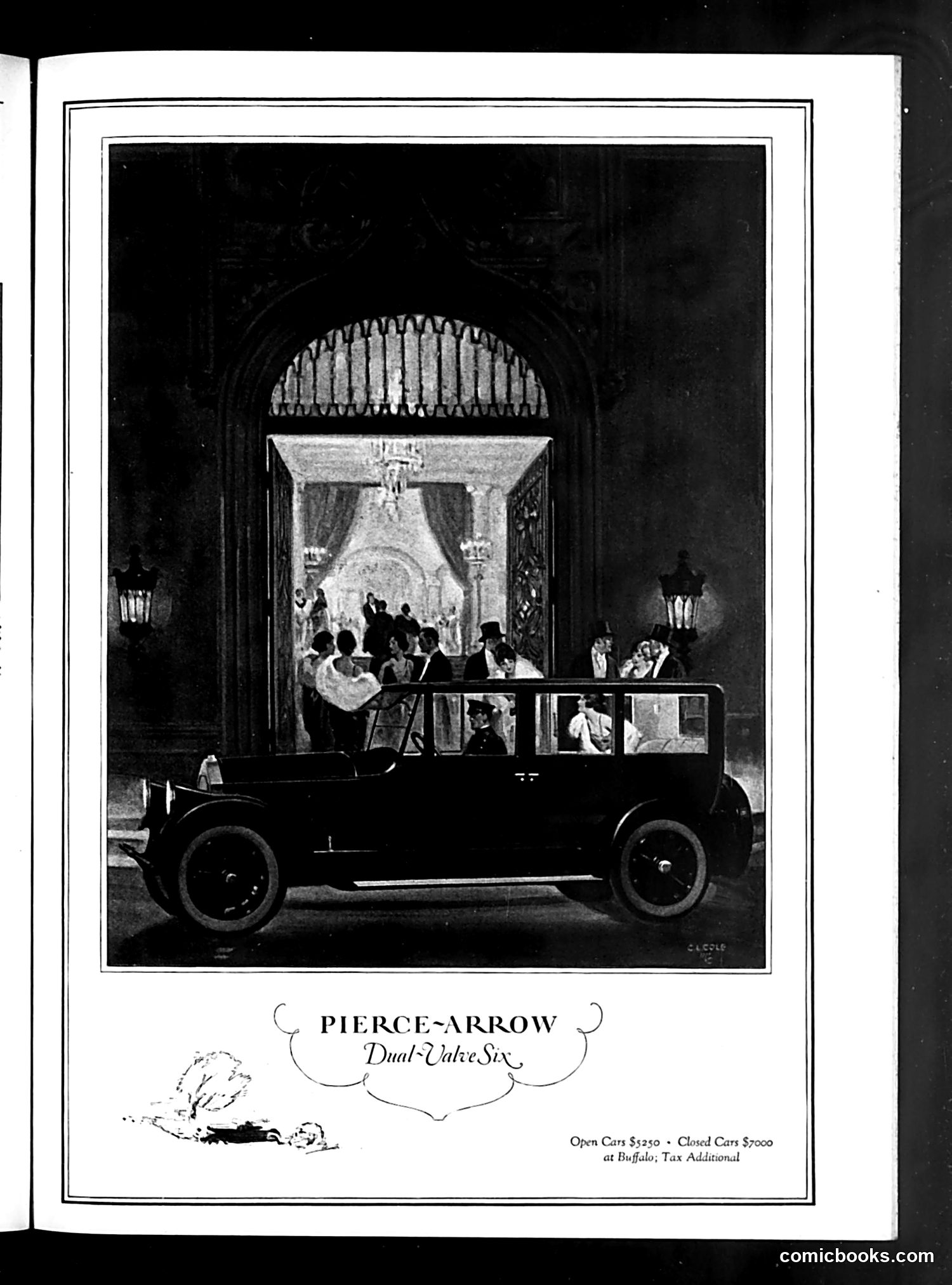
This is a **full-page automobile advertisement** for the Pierce-Arrow Dual-Valve Six luxury car, not a political cartoon or satire. The image depicts an elegant nighttime scene: a Pierce-Arrow automobile is parked outside what appears to be an upscale venue or theater, with well-dressed patrons visible through an ornate arched doorway. The composition emphasizes luxury and sophistication. The advertisement text indicates pricing: "Open Cars $2,550 - Closed Cars $3,000 at Buffalo, Tax Additional." This reflects the vehicle's positioning as a high-end product during what appears to be the 1920s era. The page serves purely as **commercial advertising** rather than satirical content, showcasing the aspirational lifestyle associated with owning a luxury automobile.
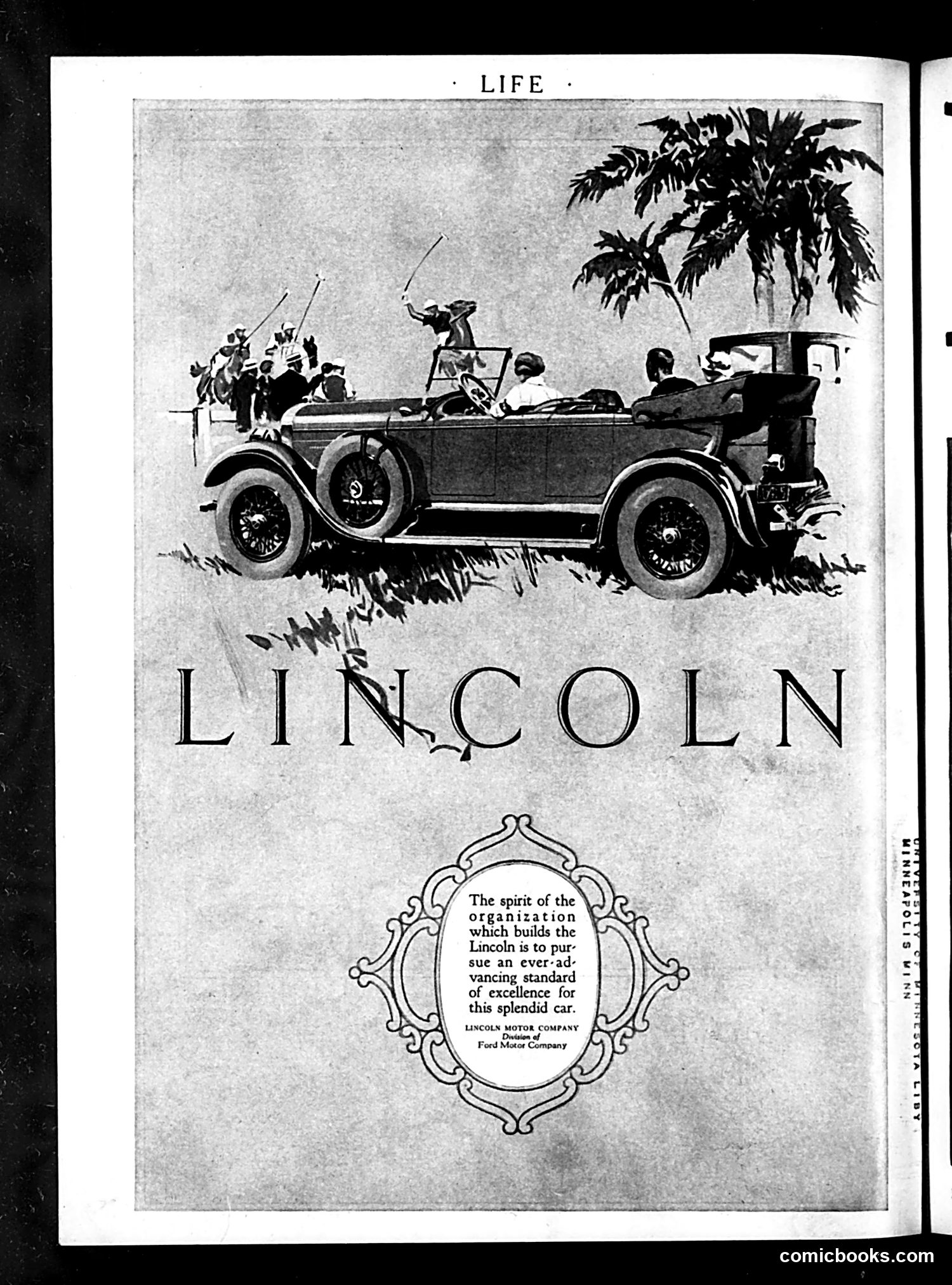
This is a **product advertisement** rather than political satire. It promotes the Lincoln automobile, made by Lincoln Motor Company (a Ford Motor Company division). The image shows a luxurious open-air touring car from the 1920s era, illustrated in an elegant style. Several well-dressed passengers enjoy the vehicle in a tropical setting with palm trees, suggesting leisure and sophistication. The tagline invokes "Lincoln"—a name choice referencing President Abraham Lincoln—to associate the car with qualities of excellence and advancement. The decorative cartouche below contains the manufacturer's claim that their organization maintains ever-improving standards for this "splendid car." This is straightforward commercial messaging targeting affluent buyers, using presidential associations and lifestyle imagery rather than humor or satire.