
Life, 1925-03-05 · page 26 of 36
Life — March 5, 1925 — page 26: what you’re looking at
What you’re looking at
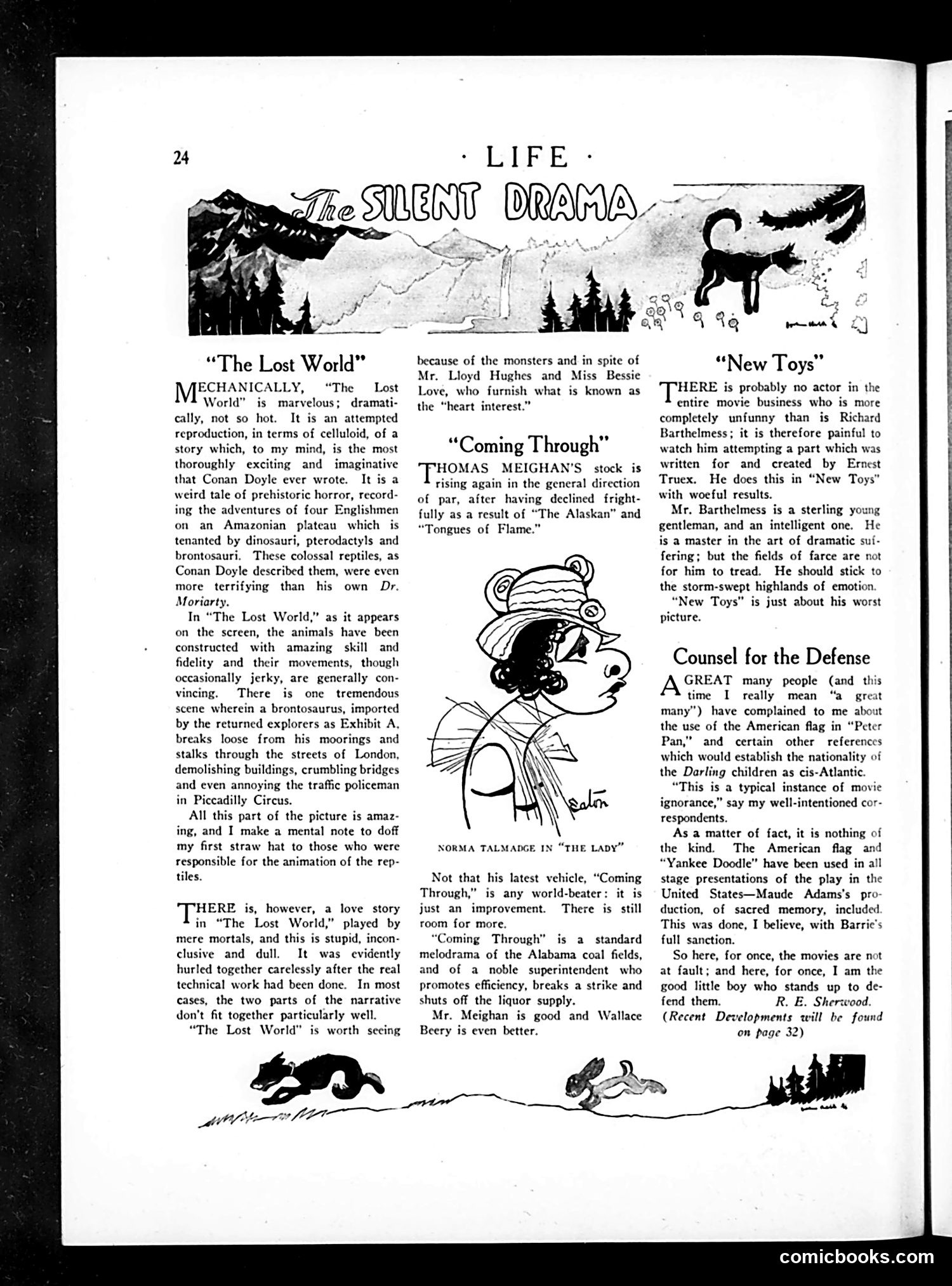
This page contains movie reviews from Life's "Silent Drama" section. The critic reviews four films: **"The Lost World"** (based on Conan Doyle's novel): Praised for its technically impressive dinosaur animation—particularly a brontosaur rampaging through London—but criticized for its weak romantic subplot featuring Lloyd Hughes and Bessie Love, which undermines the exciting prehistoric adventure. **"Coming Through"**: A modest melodrama about an Alabama coal-field superintendent (Thomas Meighan) who breaks a strike. The review notes Meighan's career is recovering after previous failures; Wallace Beery is praised. **"New Toys"**: Criticized for miscast lead Richard Barthelmess, who the reviewer argues lacks comedic ability and was wrong for a farce originally created by Ernest Truex. **"Counsel for the Defense"**: A sidebar defending Hollywood's use of American flags and "Yankee Doodle" in "Peter Pan," noting these elements appeared in stage versions with the playwright's approval—a rebuttal to viewer complaints about Americanizing British material.
📄 Transcribed text from this page (OCR, searchable)
Machine-transcribed from the original scan — historical spelling and the odd misread are preserved.
“The Lost World” ECHANICALLY, “The Lost World” is marvelous; dramati- cally, not so hot. It is an attempted reproduction, in terms of celluloid, of a story which, to my mind, is the most thoroughly exciting and imaginative that Conan Doyle ever wrote. It is a weird tale of prehistoric horror, record- ing the adventures of four Englishmen on an Amazonian plateau which is tenanted by dinosauri, pterodactyls and brontosauri. These colossal reptiles, as Conan Doyle described them, were even more terrifying than his own Dr. Moriarty. In “The Lost World,” as it appears on the screen, the animals have been constructed with amazing skill and fidelity and their movements, though occasionally jerky, are generally con- vincing. There is one tremendous scene wherein a brontosaurus, imported by the returned explorers as Exhibit A, breaks loose from his moorings and stalks through the streets of London, demolishing buildings, crumbling bridges and even annoying the traffic policeman in Piccadilly Circus. All this part of the picture is amaz- ing, and I make a mental note to doff my first straw hat to those who were responsible for the animation of the rep- tiles. HERE is, however, a love story in “The Lost World,” played by mere mortals, and this is stupid, incon- clusive and dull. It was evidently hurled together carelessly after the real technical work had been done. In most cases, the two parts of the narrative don’t fit together particularly well. “The Lost World” is worth seeing because of the monsters and in spite of Mr. Lloyd Hughes and Miss Bessie Love, who furnish what is known as the “heart interest.” “Coming Through” HOMAS MEIGHAN'’S stock is rising again in the general direction of par, after having declined fright- fully as a result of “The Alaskan” and “Tongues of Flame.” NORMA TALMADGE IN “THE LADY” Not that his latest vehicle, “Coming Through,” is any world-beater: it is just an improvement. There is. still room for more. “Coming Through” is a standard melodrama of the Alabama coal fields, and of a noble superintendent who promotes efficiency, breaks a strike and shuts off the liquor supply. Mr. Meighan is good and Wallace Beery is even better. “New Toys” "THERE is probably no actor in the entire movie business who is more completely unfunny than is Richard Barthelmess; it is therefore painful to watch him attempting a part which was written for and created by Ernest Truex. He does this in “New Toys” with woeful results. Mr. Barthelmess is a sterling young gentleman, and an intelligent one. He is a master in the art of dramatic suf- fering; but the fields of farce are not for him to tread. He should stick to the storm-swept highlands of emotion. “New Toys” is just about his worst picture. Counsel for the Defense GREAT many people (and this time I really mean “a great many”) have complained to me about the use of the American flag in “Peter Pan,” and certain other references which would establish the nationality of the Darling children as cis-Atlantic. “This is a typical instance of movie ignorance,” say my well-intentioned cor- respondents. As a matter of fact, it is nothing of the kind. The American flag and “Yankee Doodle” have been used in all stage presentations of the play in the United States—Maude Adams's pro- duction, of sacred memory, included. This was done, I believe, with Barrie's full sanction. So here, for once, the movies are not at fault; and here, for once, I am the good little boy who stands up to de- fend them. R. E. Sherwood. (Recent Developments will be found on page 32) comicbooks.com