
Life, 1925-03-05 · page 23 of 36
Life — March 5, 1925 — page 23: what you’re looking at
What you’re looking at
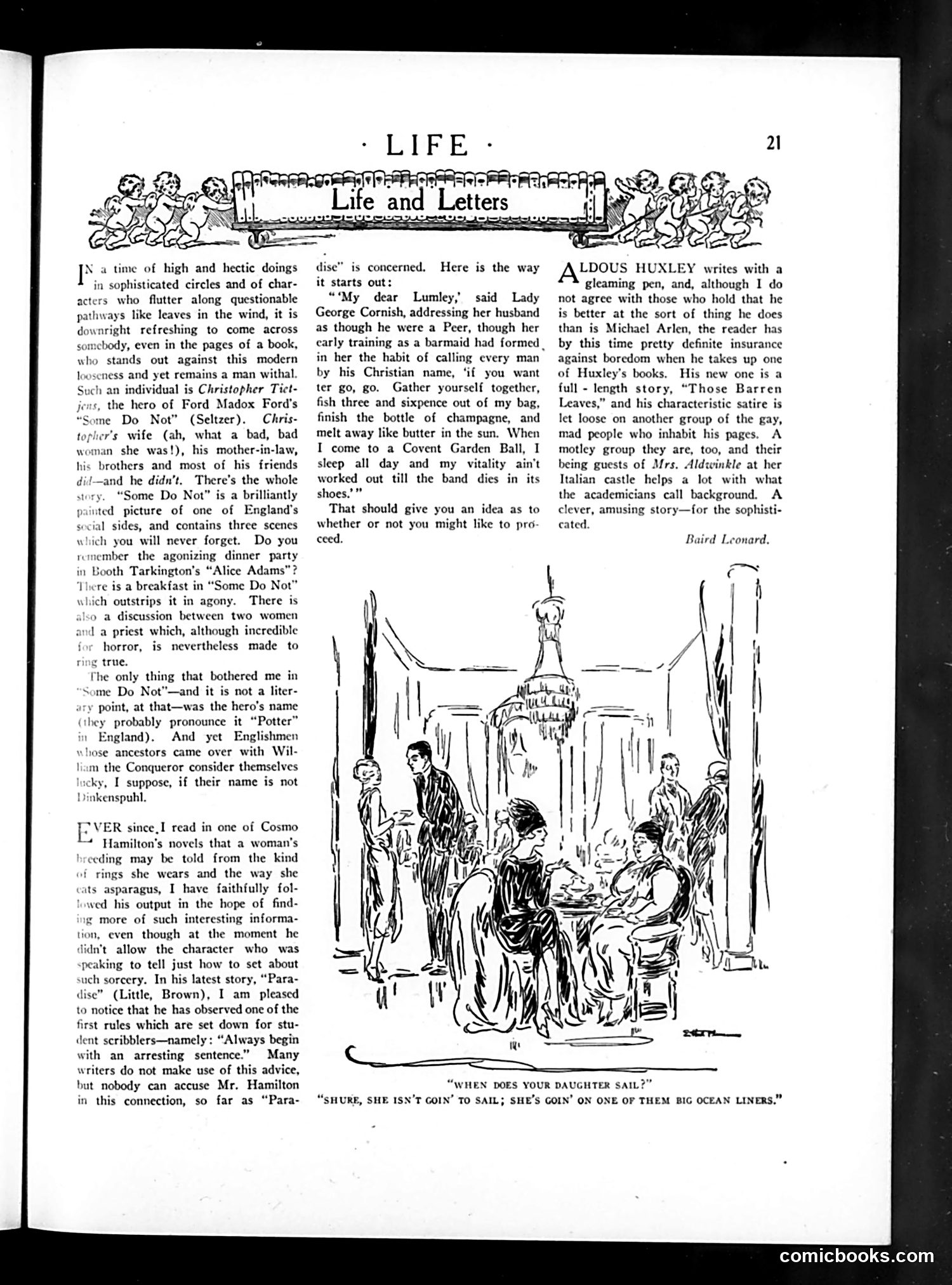
This is a book review section titled "Life and Letters" discussing contemporary literary works. The main cartoon depicts Irish immigrants at a dock, with one character explaining his daughter won't sail on a ship—she'll travel on an ocean liner. The humor relies on ethnic stereotype: the Irish brogue ("Shure") contrasts with the character's literal-minded misunderstanding of nautical terminology. He treats "sailing" and "ocean liner travel" as mutually exclusive, when "sailing" is simply a colloquial term for ocean travel by any vessel. The reviews discuss novels by Ford Madox Ford, Cosmo Hamilton, and Aldous Huxley, emphasizing their sophisticated portrayals of upper-class society. The cartoon's working-class Irish subject matter provides ironic contrast to the highbrow literary content surrounding it—a typical Life magazine strategy of juxtaposing refined culture with common vernacular humor for satirical effect.
📄 Transcribed text from this page (OCR, searchable)
Machine-transcribed from the original scan — historical spelling and the odd misread are preserved.
Is a time of high and hectic doings in sophisticated circles and of char- acters who flutter along questionable hways like leaves in the wind, it is right refreshing to come across body, even in the pages of a book, stands out against this modern ness and yet remains a man withal. an individual is Christopher Tict- s, the hero of Ford Madox Ford's ne Do Not” (Seltzer). Chris- 's wife (ah, what a bad, bad woman she was!), his mother-in-law, his brothers and most of his friends dit—and he didn’t, There’s the whole story. “Some Do Not” is a brilliantly painted picture of one of England's social sides, and contains three scenes which you will never forget. Do you remember the agonizing dinner party in Booth Tarkington’s “Alice Adams’ ‘There is a breakfast in “Some Do Not” which outstrips it in agony. There is © a discussion between two women nd a priest which, although incredible horror, is nevertheless made to ring true. Che only thing that bothered me in Some Do Not"—and it is not a liter- ary point, at that—was the hero's name y probably pronounce it “Potter” England). And yet Englishmen whose ancestors came over with Wil- liam the Conqueror consider themselves cky, I suppose, if their name is not Dinkenspuhl. ’VER since,I read in one of Cosmo Hamilton's novels that a woman's breeding may be told from the kind f rings she wears and the way she ats asparagus, I have faithfully fol- lowed his output in the hope of find- ¢ more of such interesting informa- tion, even though at the moment he didn’t allow the character who was peaking to tell just how to set about such sorcery. In his latest story, “Para- dise” (Little, Brown), I am_ pleased to notice that he has observed one of the first rules which are set down for stu- dent scribblers—namely: “Always begin with an arresting sentence.” Many writers do not make use of this advice, but nobody can accuse Mr. Hamilton in this connection, so far as “Para- dise” is concerned. Here is the way it starts out: “My dear Lumley, said Lady George Cornish, addressing her husband as though he were a Peer, though her carly training as a barmaid had formed , in her the habit of calling every man by his Christian name, ‘if you want ter go, go. Gather yourself together, fish three and sixpence out of my bag, finish the bottle of champagne, and melt away like butter in the sun. When I come to a Covent Garden Ball, I sleep all day and my vitality ain't worked out till the band dies in its shoes.’” That should give you an idea as to whether or not you might like to pro ceed. LDOUS HUXLEY writes with a gleaming pen, and, although I do not agree with those who hold that he is better at the sort of thing he does than is Michael Arlen, the reader has by this time pretty definite insurance against boredom when he takes up one of Huxley’s books. His new one is a full - length story, “Those Barren Leaves,” and his characteristic satire is let loose on another group of the gay, mad people who inhabit his pages. A motley group they are, too, and their being guests of Mrs. Aldwinkle at her Italian castle helps a lot with what the academicians call background. A clever, amusing story—for the sophisti- cated. Baird Leonard. “WHEN DOES YOUR DAUGHTER SAIL?” “SHURE, SHE ISN'T GOIN’ TO SAIL; SHE’S GOIN’ ON ONE OF THEM BIG OCEAN LINERS.” comicbooks.com