
A complete issue · 36 pages · 1925
Life — January 15, 1925
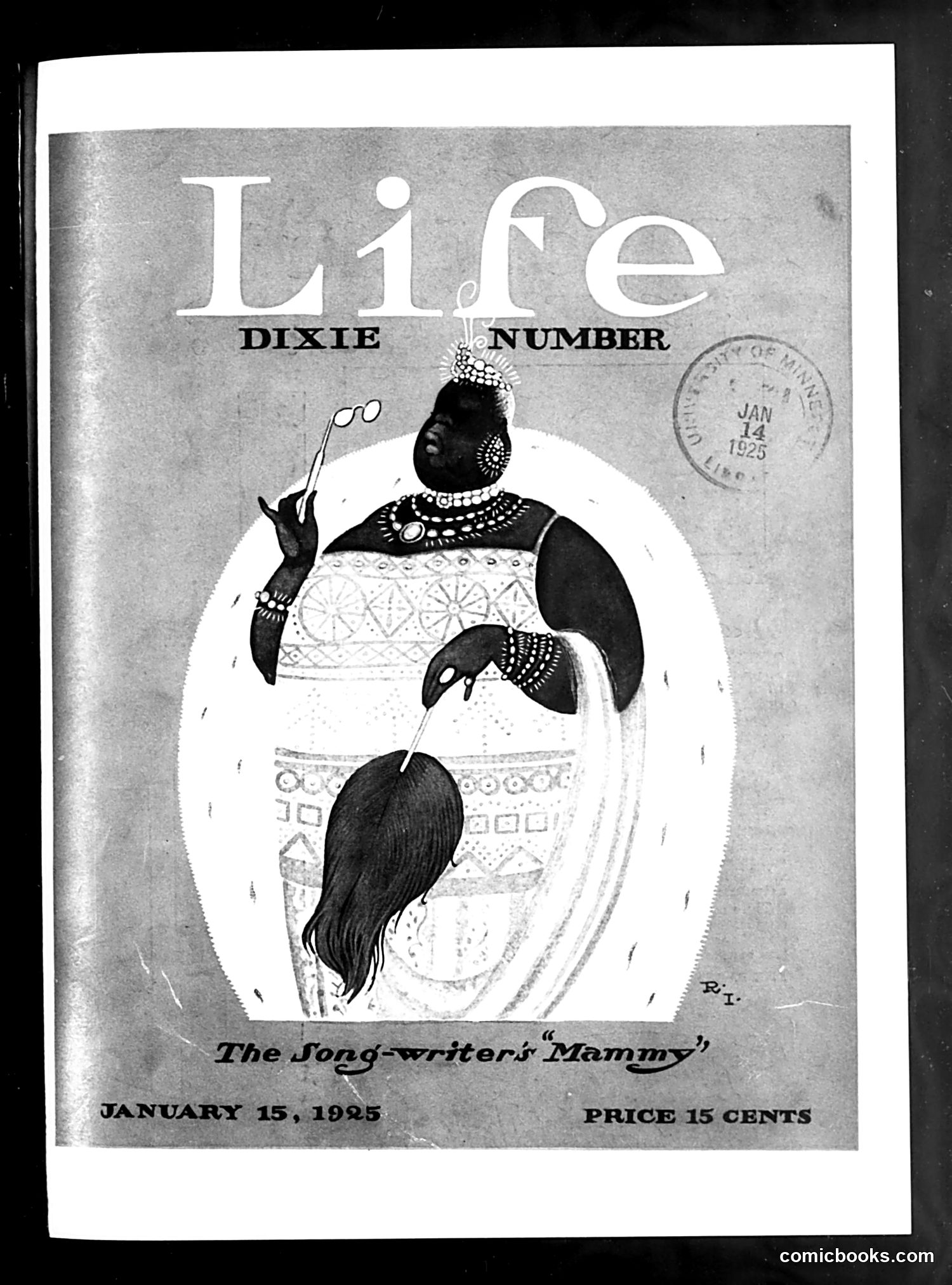
This is the cover of Life's "Dixie Number," featuring a satirical illustration titled "The Song-Writers' Mammy." The image depicts a large Black woman in exaggerated caricature, wearing ornate jewelry and a headwrap, with two smaller figures (likely representing songwriters or musicians) emerging from or positioned within her body. The satire targets how white Northern songwriters were profiting from and appropriating Southern Black musical traditions and imagery during the Jazz Age. The "Mammy" figure—a degrading stereotype common in early 20th-century entertainment—represents how Black Southern culture was being commercialized and distorted for white consumption. Life is mocking both the exploitative nature of this cultural appropriation and the stereotypical representations that enabled it.
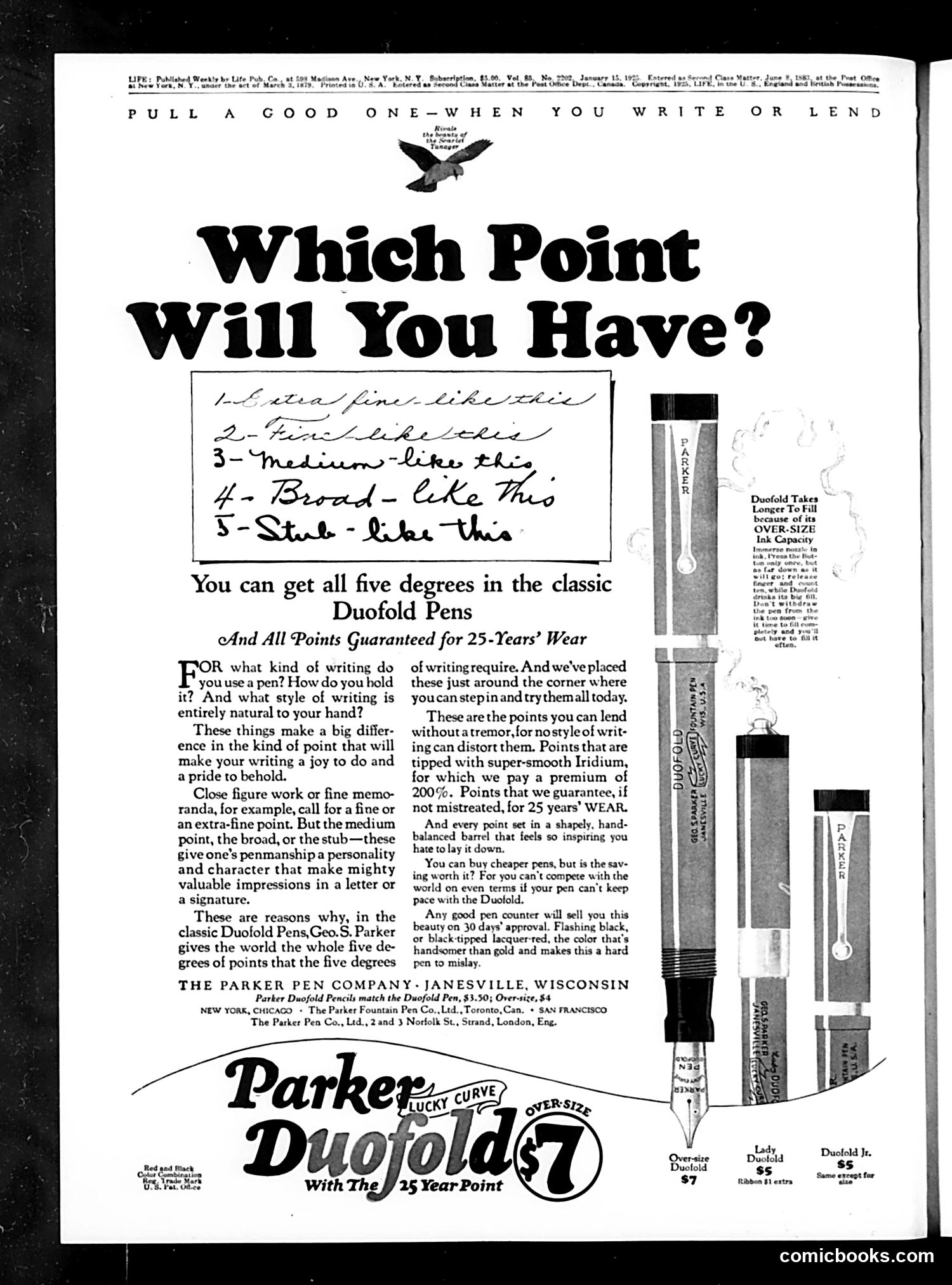
This page is **primarily advertising, not political satire**. It's a full-page advertisement for Parker Duofold pens from Life magazine (dated January 11, 1925, based on the header). The ad uses a humorous rhetorical device: "Which Point Will You Have?" refers to five different pen nib sizes (Extra Fine, Fine, Medium, Broad, Stub), not political points. The joke is that pen choice reflects personality and writing style—a common advertising technique. The accompanying text compares pen selection to personal character, arguing that Duofold pens' quality and point variety make them superior to competitors. The small illustration of "Duofold Takes Longer To Fill" appears to be a practical product feature explanation. This is straightforward commercial advertising with light humor, not political commentary.
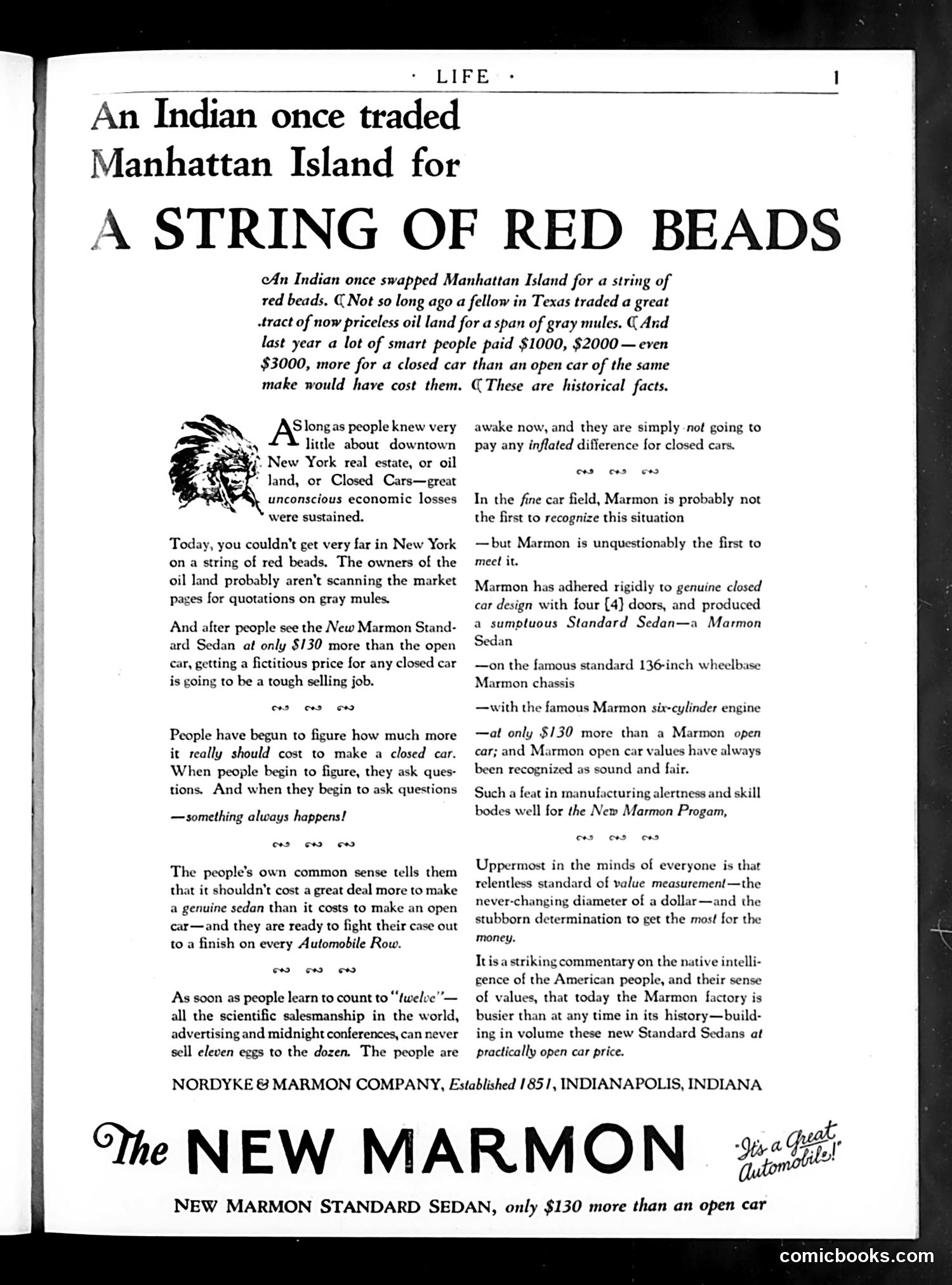
This is a Marmon automobile advertisement disguised as satirical commentary. The headline references the famous (likely apocryphal) story of Native Americans trading Manhattan Island for worthless beads—a parable about bad deals. The ad argues that consumers making purchasing decisions about closed versus open cars are making equally poor value judgments. The satirical point: people will pay $130 extra for a closed car without understanding the actual manufacturing costs, much like the "red beads" myth. The Native American head image accompanying the headline reinforces this comparison, suggesting modern consumers are being equally naive. The ad positions Marmon's Standard Sedan as the rational choice, using humor to mock consumer decision-making while promoting their vehicle as genuinely offering better value than competitors.
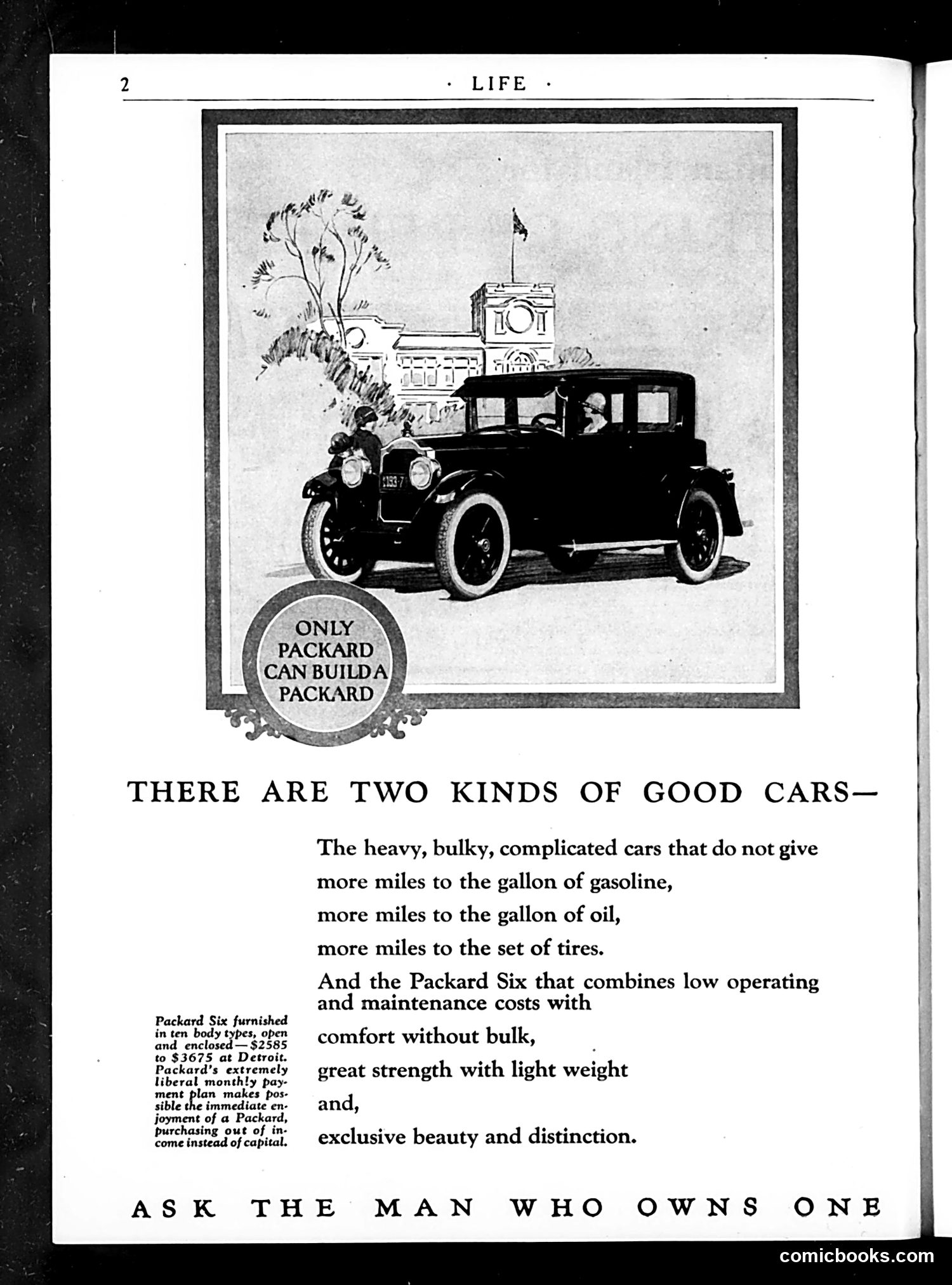
This is a **Packard automobile advertisement**, not political satire. The image shows a 1920s Packard Six automobile positioned in front of what appears to be a government building with a flag. The ad's argument contrasts two types of "good cars": heavy, complicated vehicles with poor fuel/oil/tire efficiency versus the Packard Six, which claims to offer "comfort without bulk, great strength with light weight and...exclusive beauty and distinction." The government building backdrop appears designed to convey legitimacy and prestige. The slogan "Only Packard can build a Packard" emphasizes exclusivity and brand superiority. This reflects 1920s advertising strategy: positioning luxury automobiles as aspirational status symbols while emphasizing practical efficiency—selling both prestige and economy simultaneously to prosperous readers of *Life* magazine.
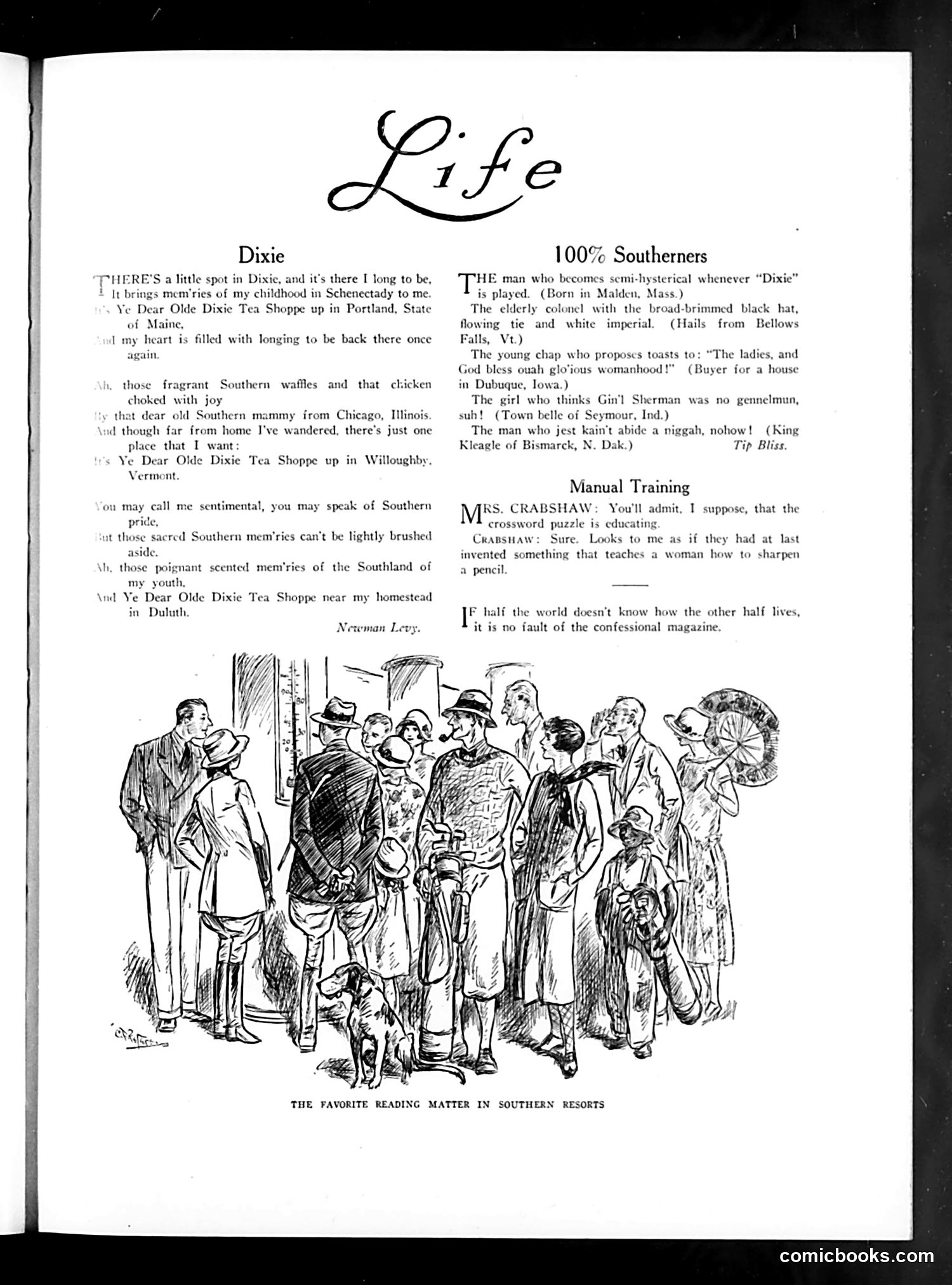
This page features two distinct satirical pieces about American regional culture: **"Dixie"** (left column): A nostalgic poem by Newman Levy mocking sentimental attachment to the Old South—specifically Southern food, memories, and romanticized "Old Dixie Tea Shoppe" tourism. It satirizes Northern migrants' idealized longing for Southern culture. **"100% Southerners"** (right column): Sharp one-liners mocking Southern stereotypes and dialects, including crude characterizations of Southern speech patterns and attitudes. **"Manual Training"** (middle section): A brief joke about crossword puzzles as "education." **The Cartoon** (bottom): Depicts well-dressed people and dogs gathered at what appears to be a Southern social gathering—captioned "The Favorite Reading Matter in Southern Resorts," suggesting satirical commentary on Southerners' reading habits or interests, though the specific reference is unclear. Overall, the page satirizes both Northern romanticization of the South and Southern culture itself.
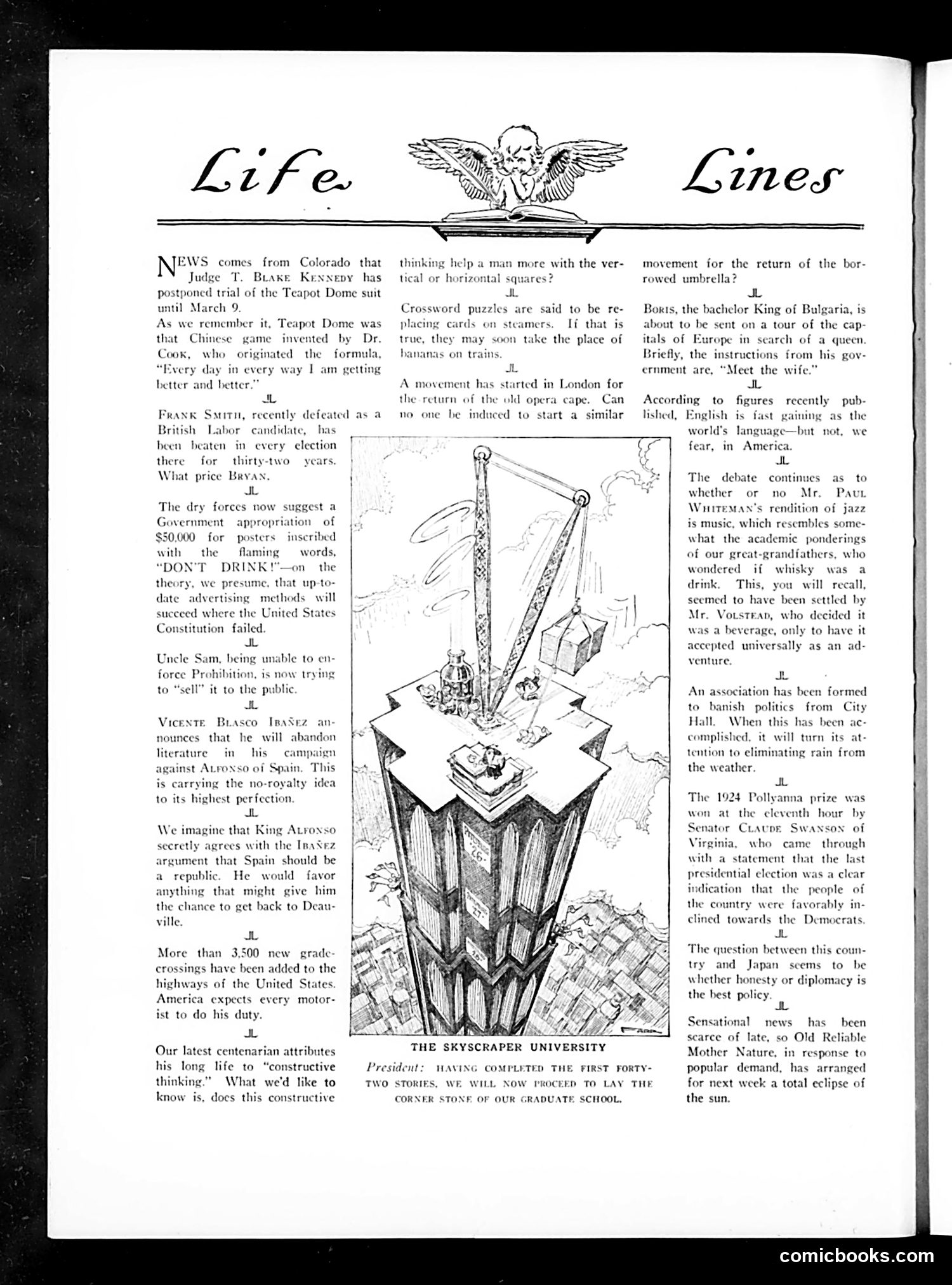
This satirical column page features a central cartoon titled "The Skyscraper University." The illustration depicts a massive, multi-story building being constructed with a crane on top, labeled with the caption that they've "completed the first forty-two stories" and will now "proceed to lay the corner stone of our graduate school." The joke satirizes American educational expansion and priorities: universities are building enormous physical structures (skyscrapers) before establishing fundamental academic foundations. It mocks the era's emphasis on impressive buildings over educational substance—a common criticism of 1920s American institutional growth. The surrounding text contains brief satirical items about contemporary politics, Prohibition enforcement, and cultural debates, typical of Life magazine's format mixing visual and written humor about current events.
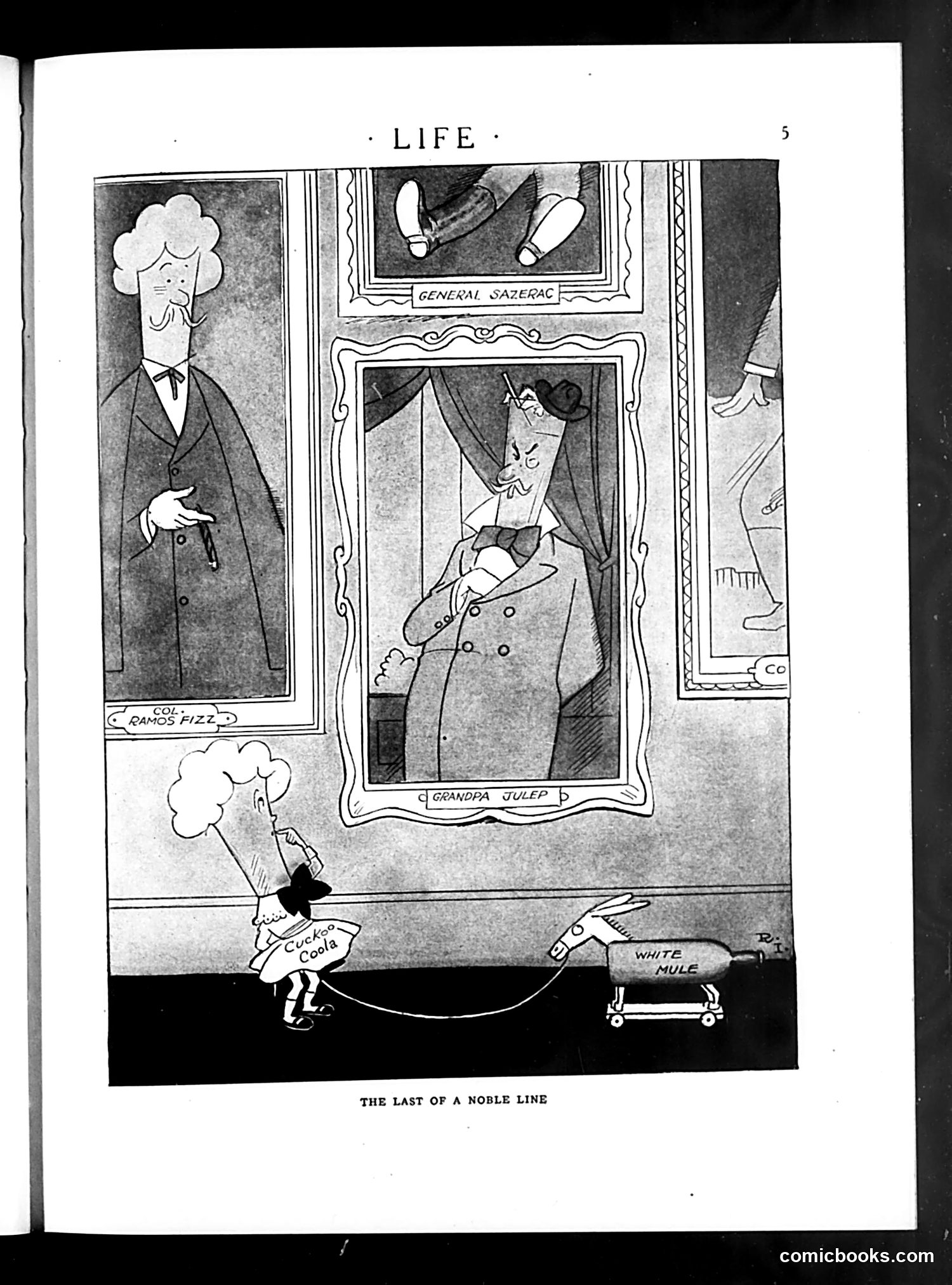
This satirical cartoon mocks the decline of aristocratic French families. The central panel labeled "GRANDPA JULEP" shows an elderly nobleman in formal dress. Surrounding frames identify other family members: "COL. RAMOS FIZZ" (upper left), "GENERAL SAZERAC" (top), and "CUCKOO COCOA" and "WHITE MULE" (bottom). The joke appears to be that these aristocratic names are actually cocktails and cheap liquors—playing on how French nobility names sound like drinks. The cartoon suggests that once-noble families have degraded into associations with alcohol and lowbrow culture. The caption "The Last of a Noble Line" reinforces this theme of aristocratic decline, presenting these formerly distinguished families as literally reduced to their drink-related identities.
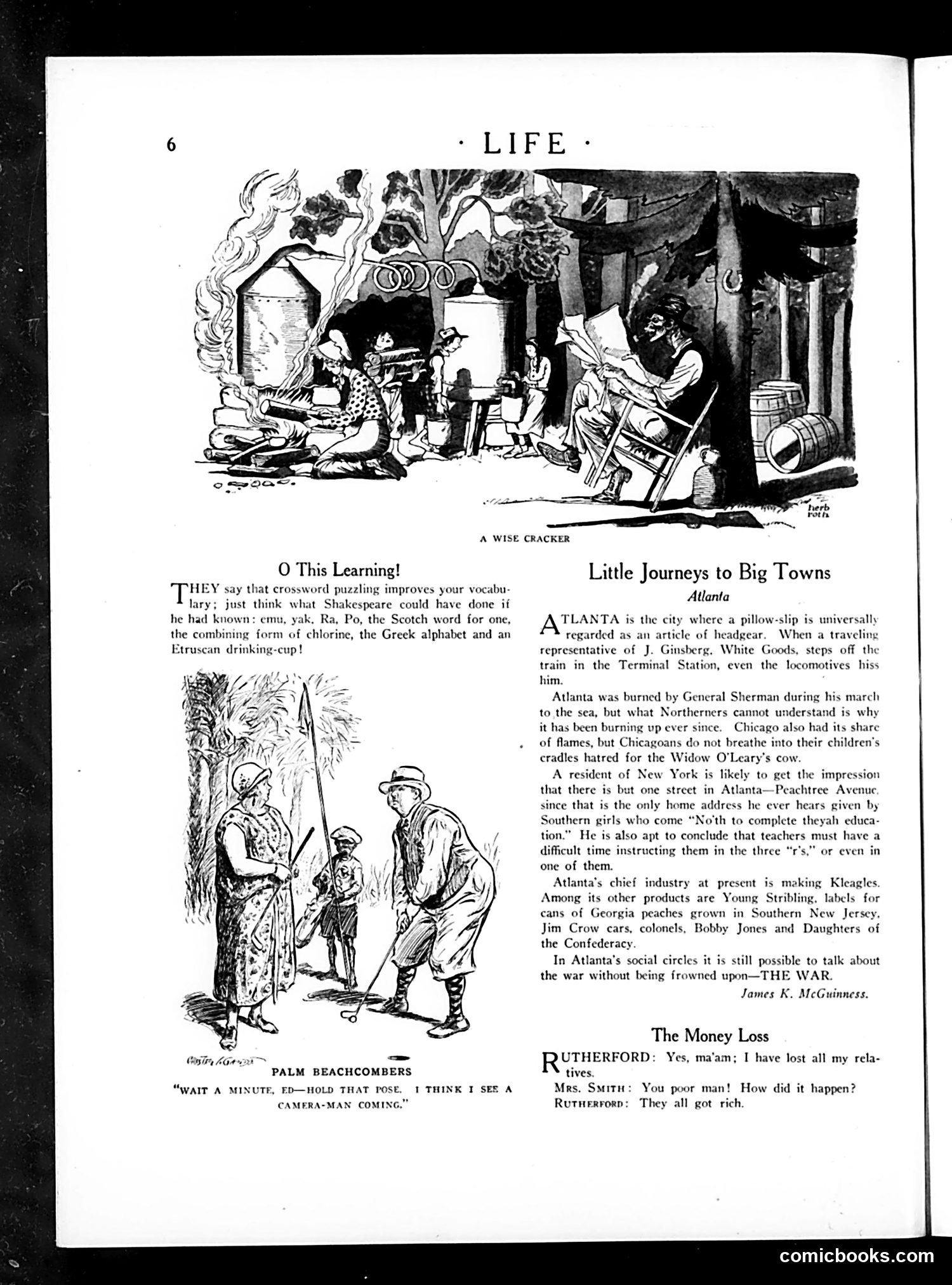
**"A Wise Cracker"** (top cartoon): A humorous illustration of someone cracking nuts, with text joking that crossword puzzles improve vocabulary—suggesting Shakespeare could have benefited from learning obscure words like "yak," "Ra," "Po," Scottish and Greek terms, and an "Etruscan drinking-cup." **"Palm Beachcombers"** (bottom cartoon): Three men examine a tree, with one saying "Wait a minute, Ed—hold that pose. I think I see a camera-man coming." This satirizes the artificial posing and vanity of wealthy Palm Beach residents performing for photographers. **"Little Journeys to Big Towns—Atlanta"**: A prose piece humorously describing Atlanta, mentioning Sherman's burning, Kleagles (KKK officers), and Confederate references, ending with a brief comedic dialogue about financial loss.
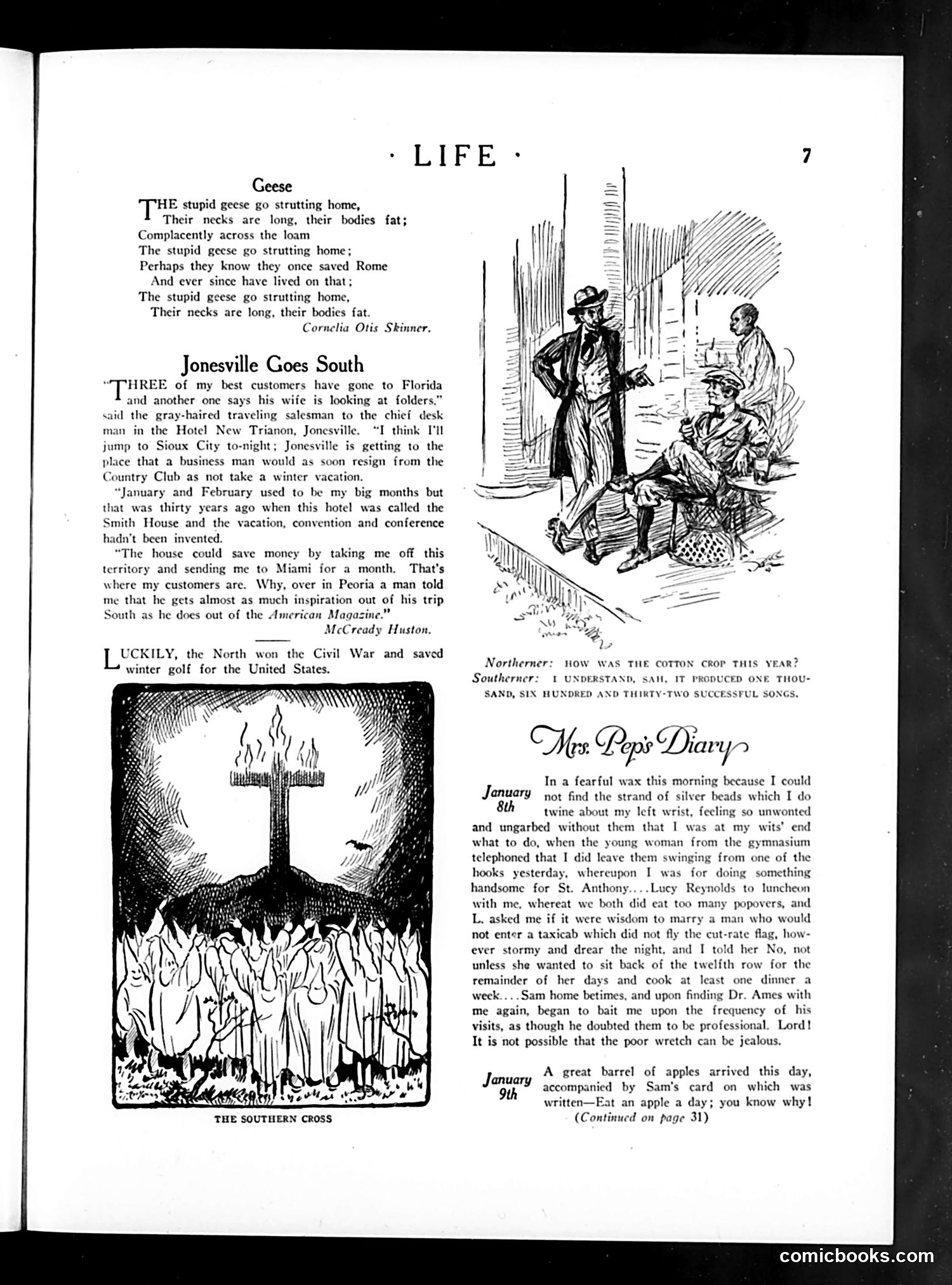
This page contains three separate pieces of satirical content: 1. **"Geese" poem** by Cornelia Otis Skinner: A humorous verse about geese returning home, likely satirizing human behavior through animal analogy (a common literary device). 2. **"Jonesville Goes South"** by McCready Huston: A satirical anecdote mocking a businessman's vacation pitch. A traveling salesman claims winter golf is available in Jonesville (likely Florida), contradicting the hotel manager's claim that January-February were slow months before the "invention" of winter vacation. The satire targets commercial tourism marketing and the business mentality of creating artificial demand. 3. **"The Southern Cross"** illustration: A woodcut depicting a burning cross, likely referencing post-Civil War Southern religious or racial imagery, though context is unclear without surrounding text. 4. **"Mrs. Pep's Diary"**: A serialized domestic humor column beginning January 8th.
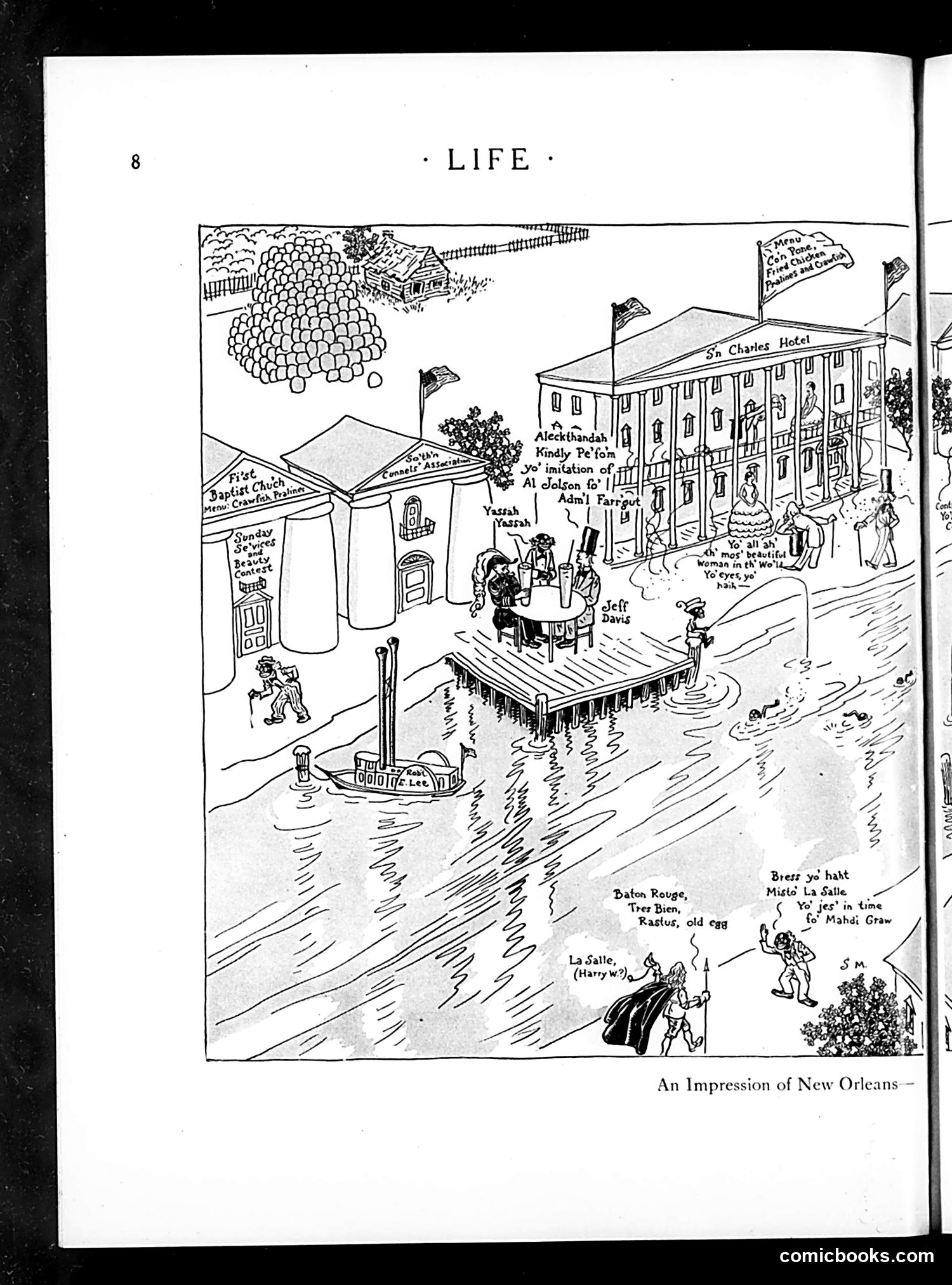
This is a satirical cartoon depicting New Orleans street life, likely from the early 20th century. The scene shows the St. Charles Hotel and Baptist Church alongside various labeled figures engaged in stereotypical behavior. The cartoon uses exaggerated dialect and caricature—including what appears to be racist depictions of African American and Creole figures speaking in broken English ("Yo' invitation of Al Clolsen fo' Admil Farragut," "Bress yo' hart Misto' La Salle"). The satire targets New Orleans' multicultural character, its Creole aristocracy, and perceived cultural chaos. References to "Voodoo," "Gris Gris," and "old egg" invoke stereotypes about folk practices. The crowded, chaotic composition itself seems to mock the city's disorder and diverse, competing populations and traditions.
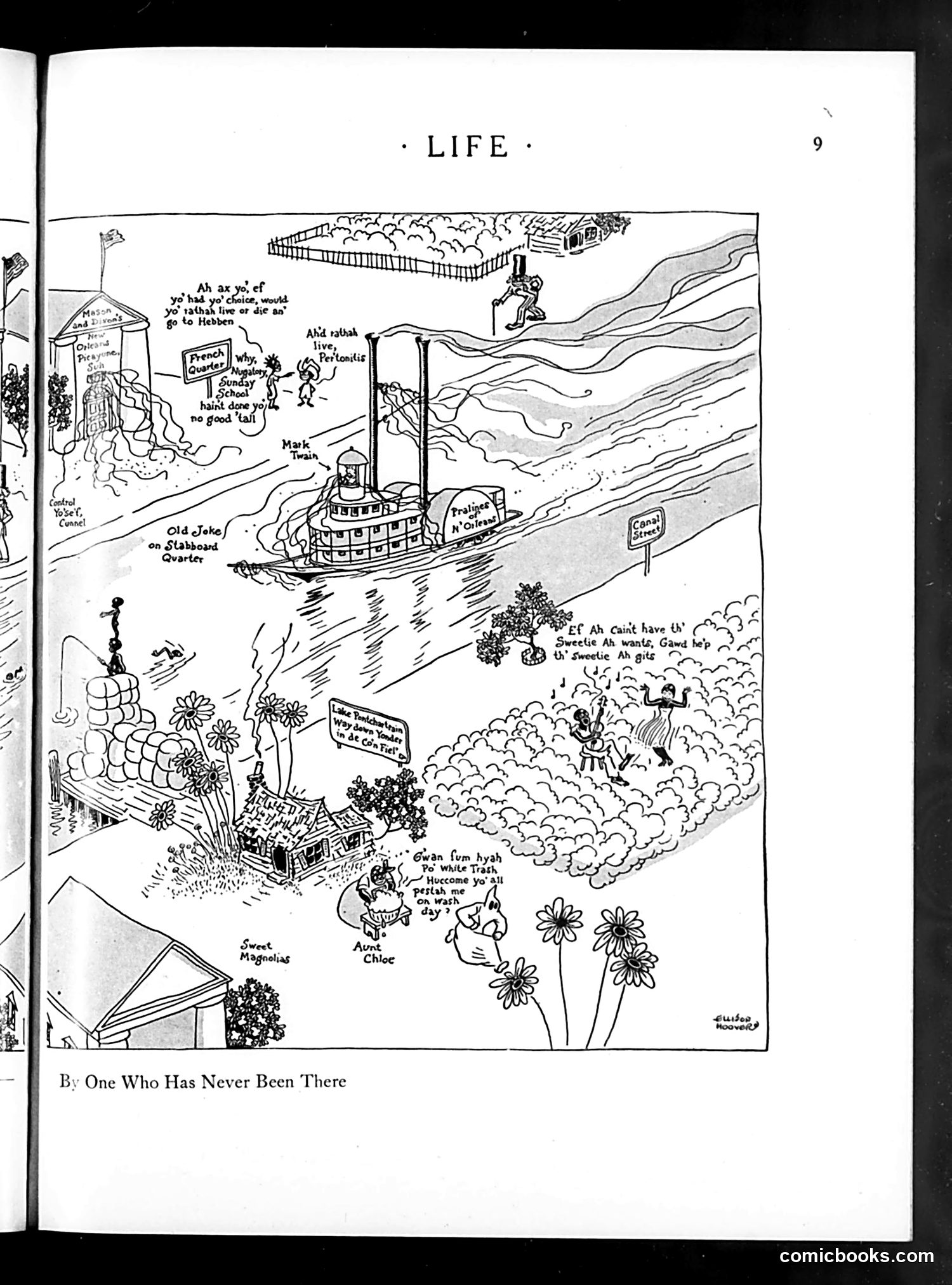
This is a satirical map-style illustration titled "By One Who Has Never Been There," depicting the Mississippi River region and antebellum Southern life. The cartoon identifies specific locations: "Old Jake" on a flatboat quarter, "Mark Twain," a French Quarter in New Orleans, and references to steamboat culture. The satire appears to mock romanticized or outsider perceptions of the South—the subtitle suggests the artist is depicting the region based on literary imagination rather than firsthand knowledge. References to "Huckleberry" and Mark Twain indicate this is likely satirizing popular fictional representations of the Mississippi River and Southern society, particularly Twain's romanticized depictions. The crude drawings and exaggerated dialect ("Ah git ah cain't have th' sweetie") reinforce how stereotypical or distorted such literary portrayals were.
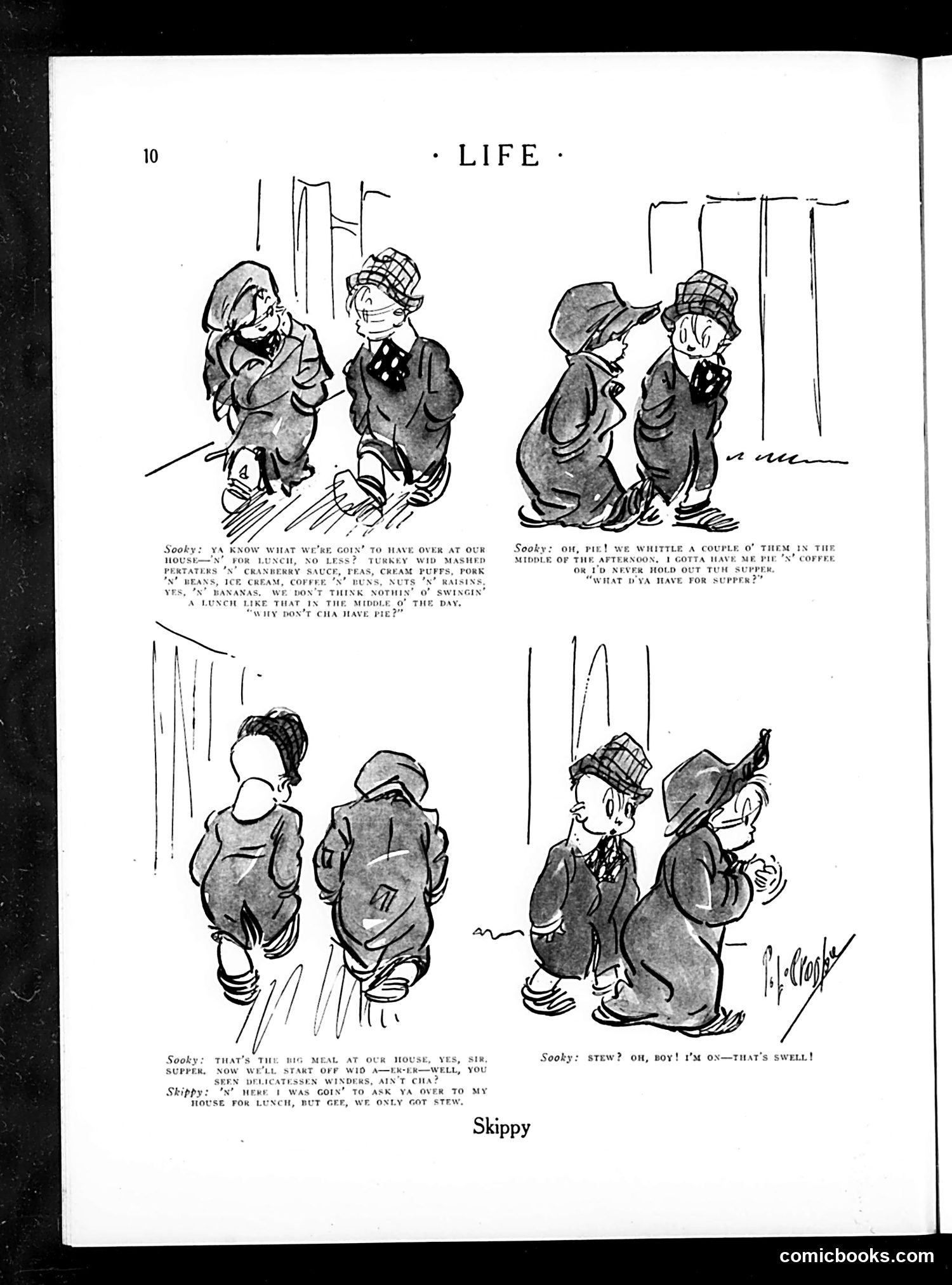
This is a comic strip by the artist Skippy (signature visible) depicting a humorous domestic scene. Two working-class characters—apparently a father and son or uncle and nephew—discuss meals and household economics. The joke centers on food scarcity or budgeting constraints. One character boasts about elaborate dishes available at "our house" for supper (listing fancy items like cranberry sauce, pork chops, and cream puffs), while the other reveals their household only has stew. The final panel shows mock excitement over stew, suggesting the characters are making light of financial hardship through exaggeration and false bravado. The cartoon likely reflects post-WWI economic conditions when working-class families struggled with limited food budgets, using humor to cope with scarcity.
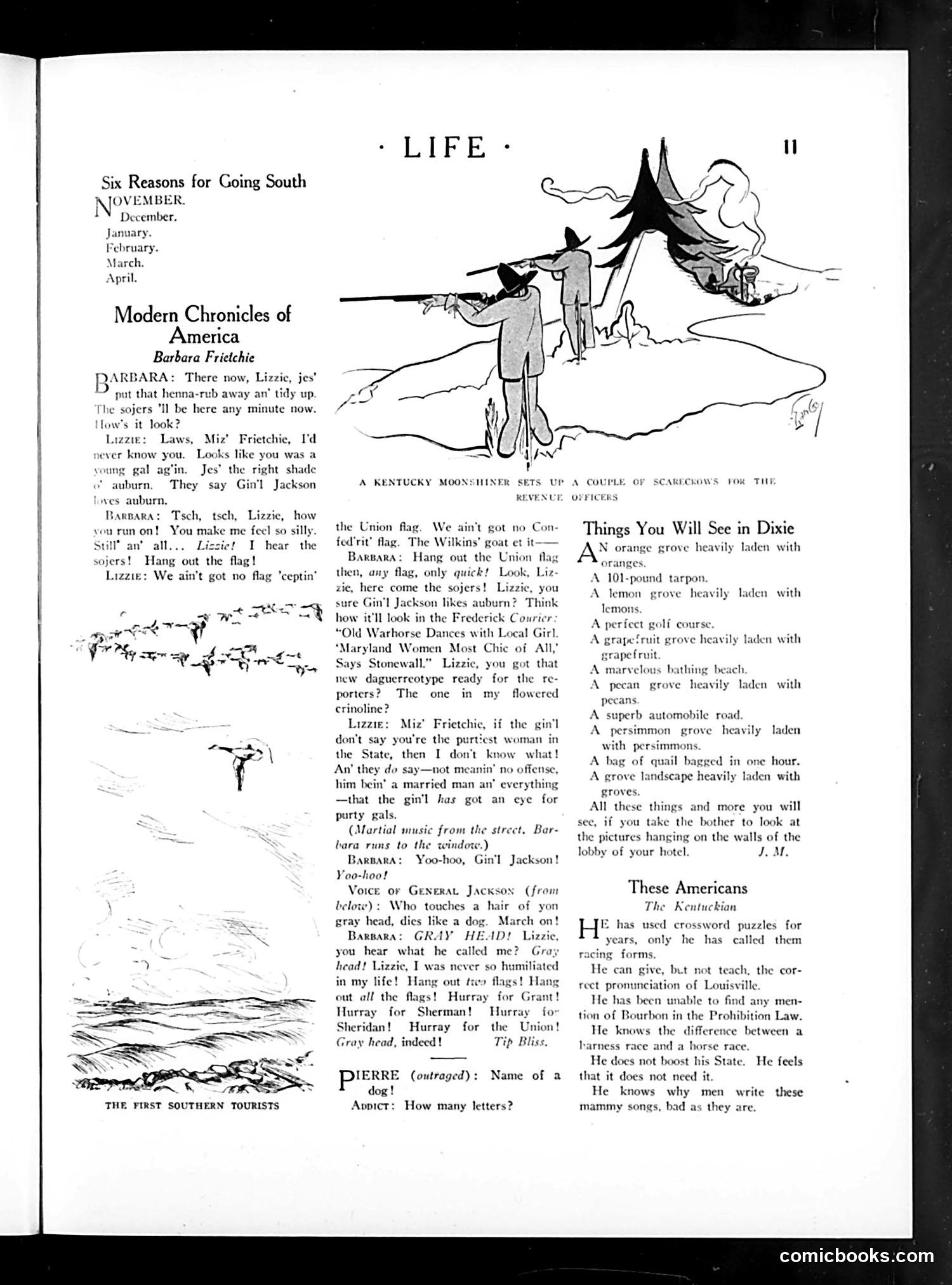
This page from *Life* magazine contains two main sections: **"Modern Chronicles of America" by Barbara Frietschie** depicts a humorous dialogue between two women—Lizzie and Barbara—about Southern fashion and social conventions. Barbara mocks Lizzie's attempt to adopt Southern belle style, joking about Auburn hair and Jackson, Mississippi references. The satire targets Northern women's pretensions about adopting Southern identity and fashion. **"Things You Will See in Dixie"** is a lighthearted list describing Southern attractions (orange groves, golf courses, bathing beaches, automobile roads). It's promotional travel humor. **The cartoon illustrations** show scarecrows and early tourists, labeled "The First Southern Tourists," satirizing Northern visitors to the South as naive or bumbling. The overall tone mocks North-South cultural differences with gentle, travel-focused humor typical of early 20th-century *Life* magazine satire.
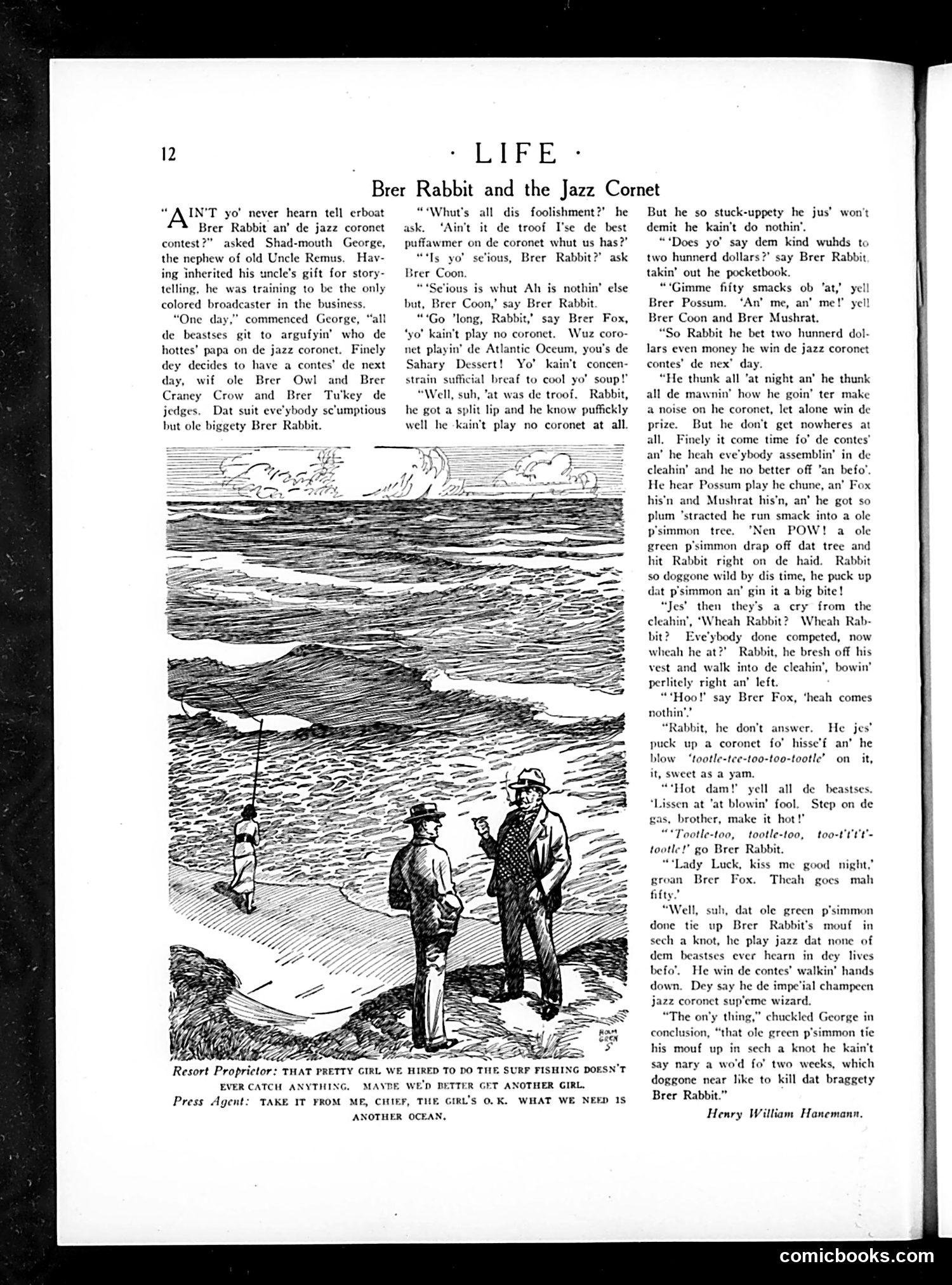
This is a humorous folk tale adaptation featuring characters from the Uncle Remus stories (Brer Rabbit, Brer Fox, etc.) reimagined in a contemporary jazz context. The narrative concerns a jazz cornet contest where Brer Rabbit initially claims superiority but ultimately cannot play the instrument. The satire appears to mock both the competitive boasting culture of jazz musicians and perhaps the exaggeration of folk tales themselves. The illustration shows figures fishing by the ocean, likely the setting where the musical dispute occurs. The bottom captions contain editorial jokes about surf fishing and hiring practices—typical Life magazine commentary on contemporary social situations, unrelated to the main story's themes. The piece combines African American folklore with modern jazz culture, a popular literary approach of the early 20th century.
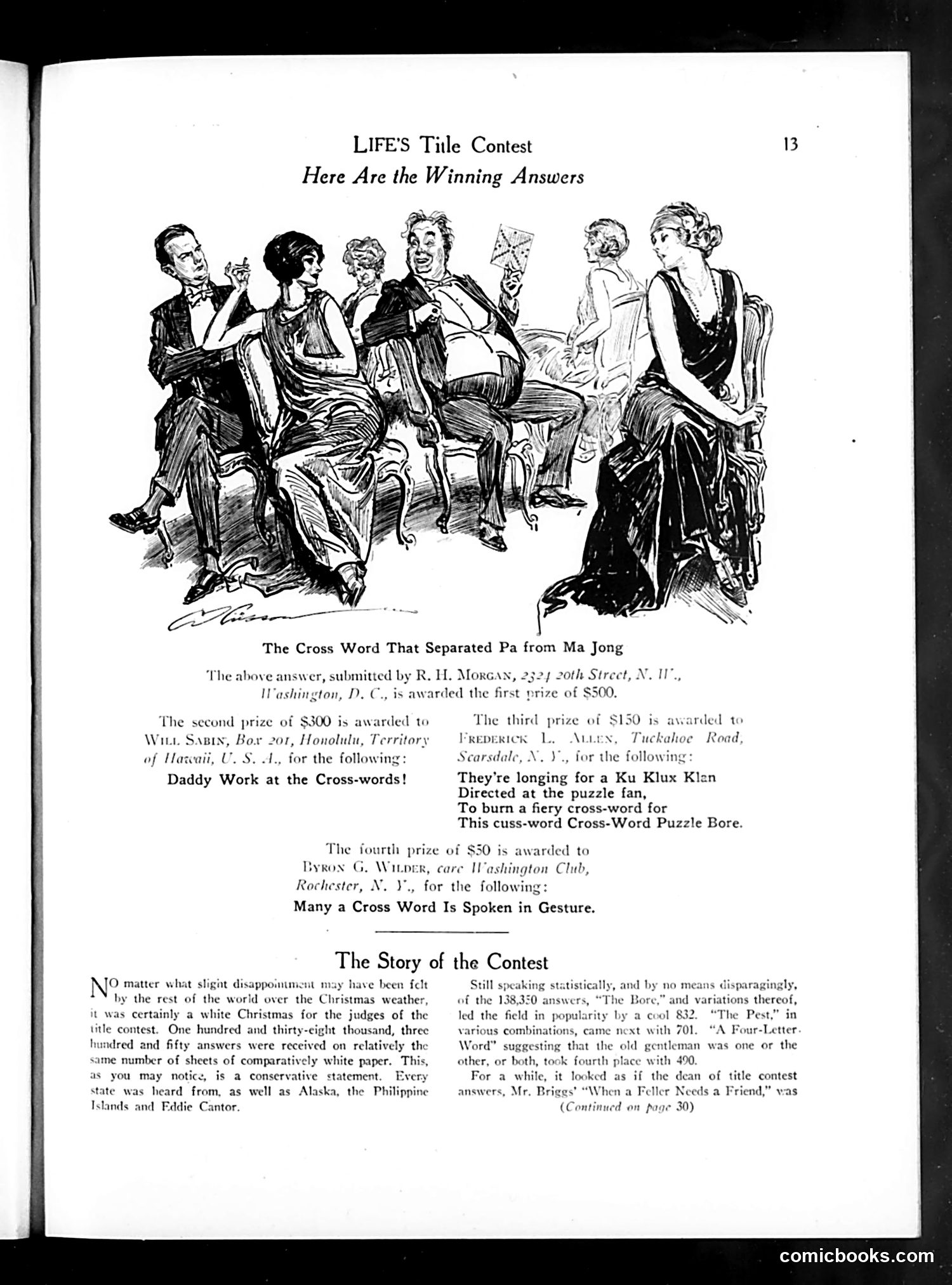
This page presents winning entries from a "Life's Title Contest" — a competition where readers submitted alternative titles for unspecified content (likely a cartoon or story). **The Main Illustration** shows a social gathering of well-dressed people in what appears to be early 20th-century style, seated and standing in conversation. The caption indicates the winning title was "The Cross Word That Separated Pa from Ma Jong." This references the then-popular parlor game **Mahjong**, which was a craze among American society in the 1920s-30s. The joke plays on "Ma Jong" (the game) versus "Ma" (mother), suggesting a crossword puzzle created marital discord by distracting couples from each other during leisure time. Four prize-winning titles are listed below, ranging from $500 to $50, demonstrating the contest's popularity.
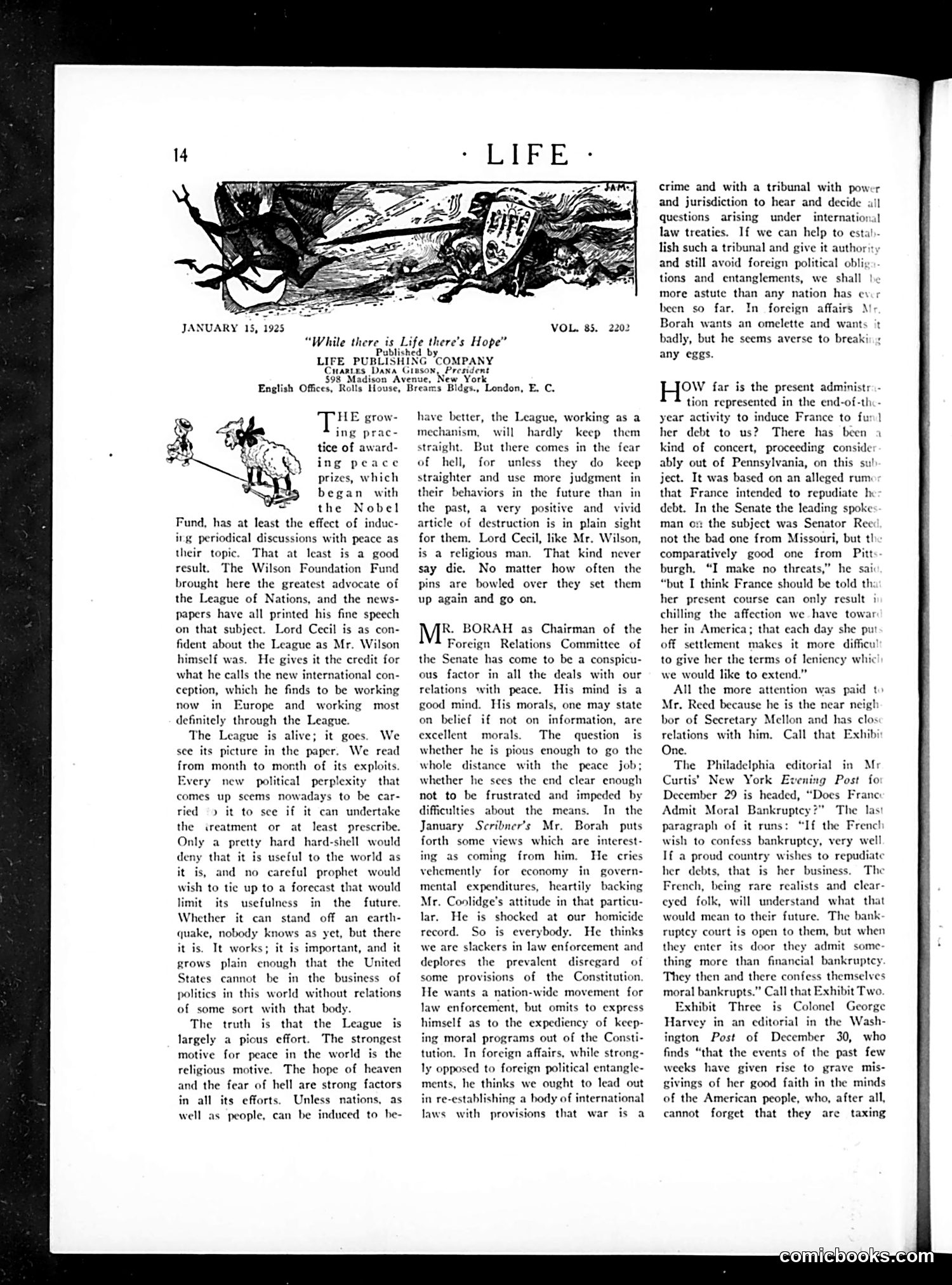
The page's masthead declares "While there is Life there's Hope," crediting Charles Dana Gibson as President. The prominent illustration (top left) appears to be a satirical political cartoon, though the image quality makes specific figures difficult to identify with certainty. The main text discusses the League of Nations and international peace efforts. It references Lord Cecil and Mr. Wilson's Foundation Fund supporting the League, and critiques Mr. Borah as Chairman of the Senate's Foreign Relations Committee for his skepticism about American involvement in international treaties and peace agreements. The article argues for stronger American engagement in maintaining international law and order, opposing isolationist sentiment prevalent in 1925 American politics.
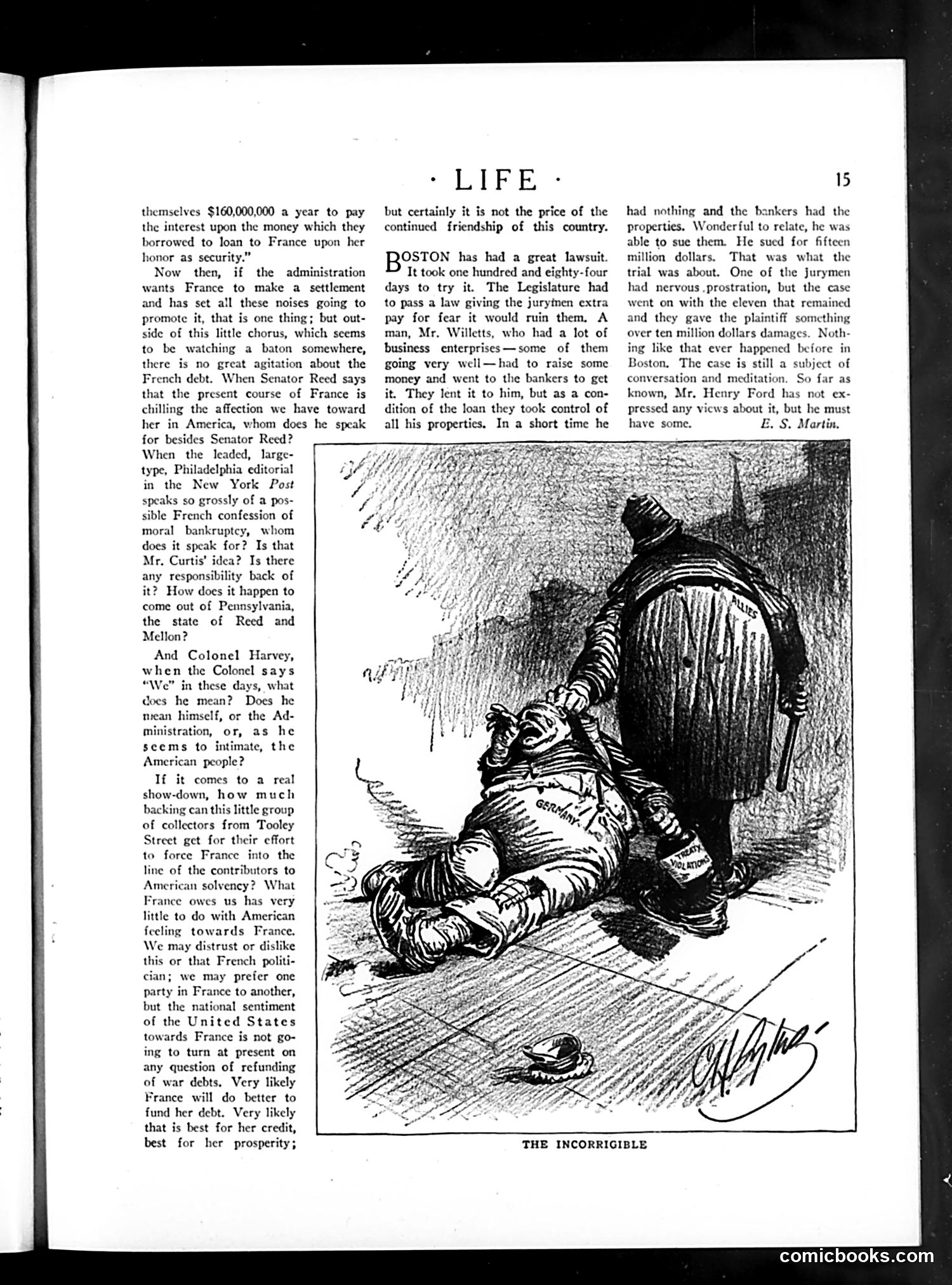
This cartoon satirizes French financial irresponsibility. The figure sprawled on the ground, labeled "The Incorrigible," appears to represent France, depicted as a dissipated, disreputable character. The accompanying text discusses France's war debts to America and criticizes French politicians for moral bankruptcy—specifically referencing a Boston lawsuit where businessmen lent money to France that was never repaid. The cartoon's message: France repeatedly defaults on obligations, earning the epithet "incorrigible" (incapable of reform). The text questions American backing of such an unreliable debtor and suggests France should prioritize repaying debts rather than expecting further American financial support. This reflects post-WWI tensions over European war debt repayment to the United States.
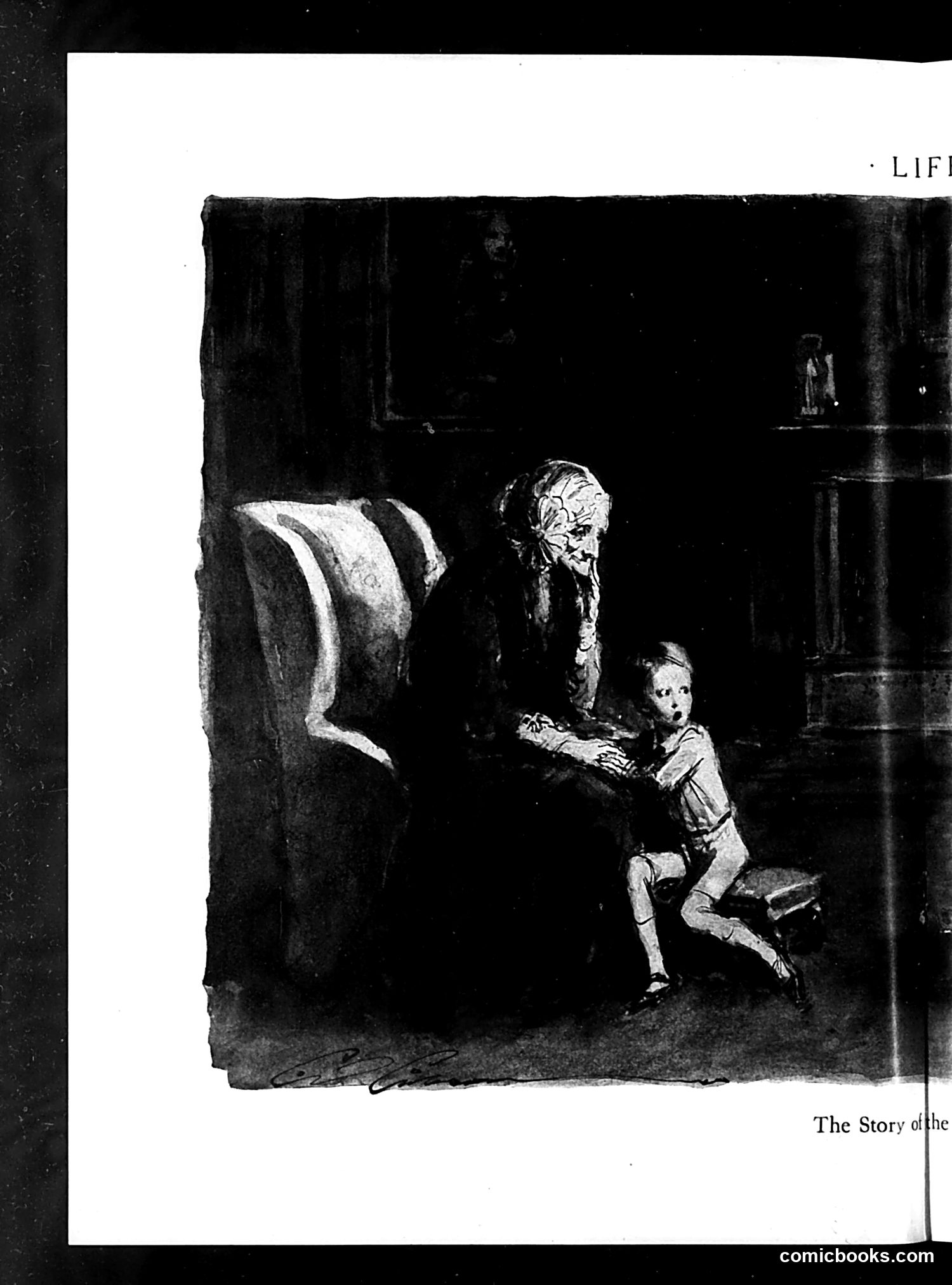
This appears to be a page header or title page from *Life* magazine showing an illustration titled "The Story of the..." (text cut off). The image depicts a dark interior scene with an elderly woman holding a candle and a young child, both appearing frightened or distressed. The woman's facial features are exaggerated in caricature style. Without the complete caption and full context visible on this page, I cannot definitively identify what specific social or political commentary this illustration intends. The dramatic lighting and expressions suggest it may be illustrating a cautionary tale or social critique, possibly related to poverty, neglect, or childhood vulnerability—common *Life* magazine satirical themes. However, the incomplete text prevents me from determining the specific subject or satirical point with certainty.
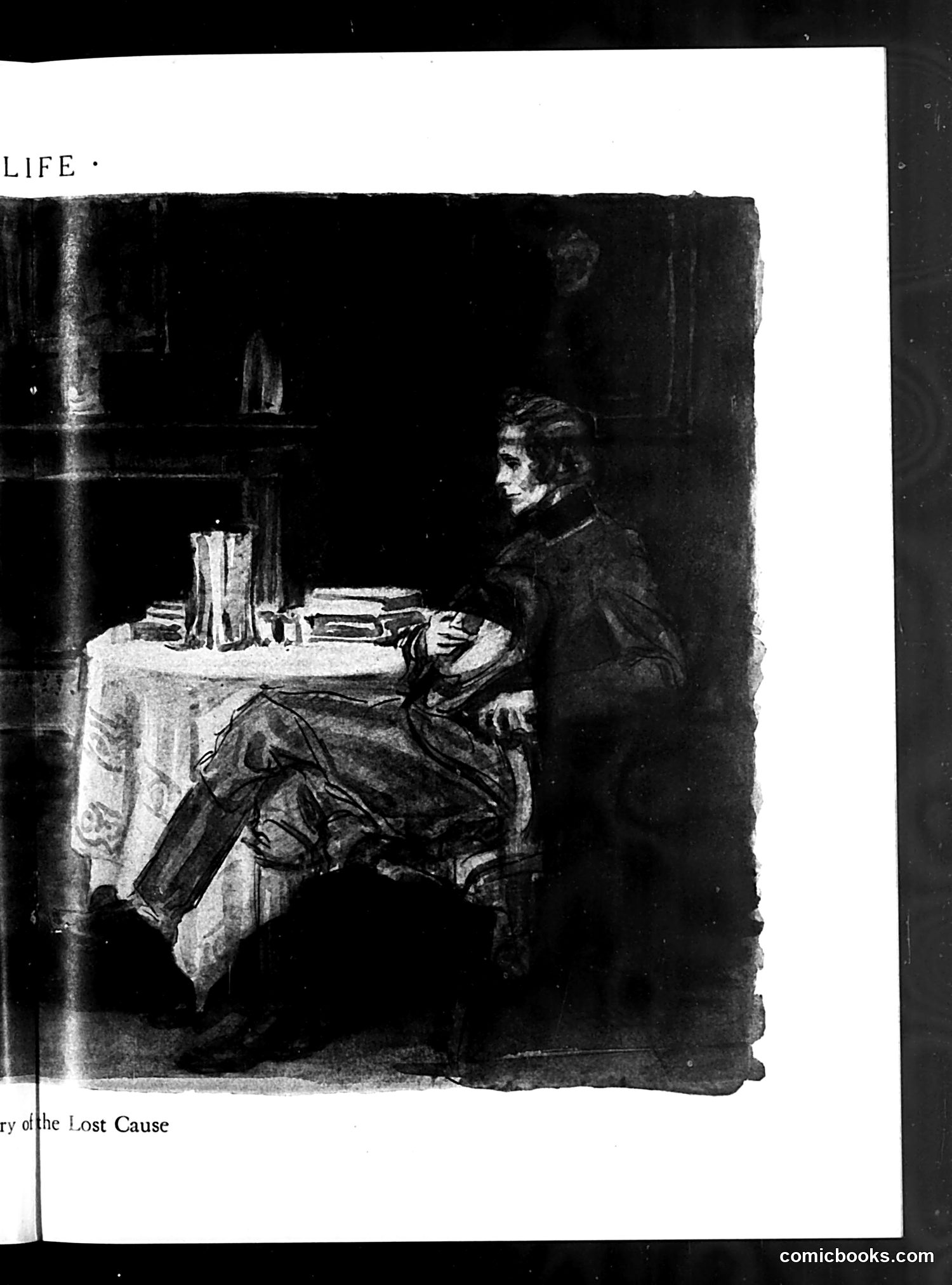
This appears to be a page from *Life* magazine showing an illustration titled "ry of the Lost Cause" (likely "Story of the Lost Cause," text cut off). The image depicts a solitary man in dark clothing, seated at a table with books and a candle, in a dimly lit interior. The figure appears to be studying or writing by candlelight—a romantic, melancholic scene. "The Lost Cause" was a post-Civil War narrative romanticizing the Confederacy. This illustration likely critiques or illustrates that nostalgic mythology—depicting someone clinging to outdated ideals or lost history. The candlelit study and solitary pose suggest intellectual devotion to a defunct cause, possibly mocking those who clung to antebellum ideals or Confederate mythology. Without the complete caption or publication date, the specific satirical target remains unclear, though the subject matter is distinctly American post-Civil War commentary.
This review satirizes Russian theatrical troupes performing in 1920s New York. The critic discusses Yasha Yushny's "Seeniaya Ptitza" (mockingly calling it "No. 14" to avoid repeating the unpronounceable title), comparing it unfavorably to the popular Chauve-Souris company. The satire targets Russians' inability to know when to stop performing. A pleasant four-verse polka song becomes tedious when extended to twenty-seven verses with repetitive choruses. Similarly, "The Barrel Organ" sketch—initially "a masterpiece of pathetic comedy"—devolves into slapstick when the performer adds exaggerated off-key singing and physical antics. The critic's recurring complaint reflects 1920s New York's "Russian fad": these companies were fashionable but repetitive. The joke is that Life can keep criticizing them because there's "no city ordinance" preventing their performances or the magazine's complaints—a resigned, sardonic acceptance of both the trend's persistence and the critic's own redundancy.
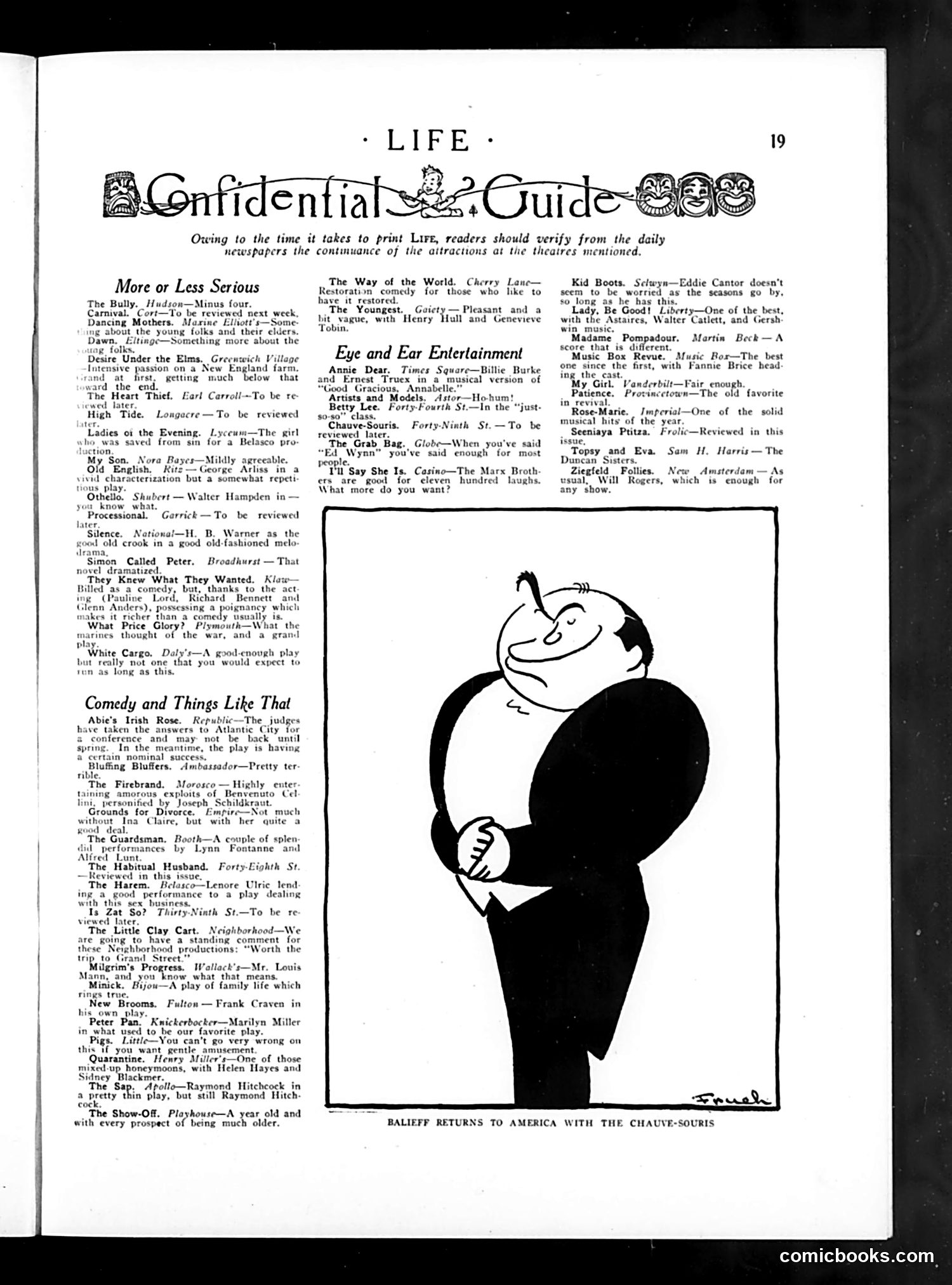
This is a theater review page from Life magazine's "Confidential Guide" section, listing Broadway shows with brief critical assessments. The large cartoon shows a portly, well-dressed man hugging himself contentedly, captioned "Ralliff Returns to America with the Chauvinsuiris" (likely a play on French theatrical terminology). The reviews cover serious dramas ("Desire Under the Elms," "They Knew What They Wanted"), comedies ("Abie's Irish Rose," "Peter Pan"), and musicals. The tone is gossipy and sardonic—the magazine calls "White Cargo" merely "good-enough," notes "Bluffing Bluffers" is "pretty terrible," and makes a running joke about "Abie's Irish Rose" having endless success despite judges' disapproval. The cartoon appears to mock a returning theatrical personality, suggesting pompous self-satisfaction. Without identifying the specific figure, it captures the page's overall tone: witty, theatrical, and mildly contemptuous of both performers and audiences.
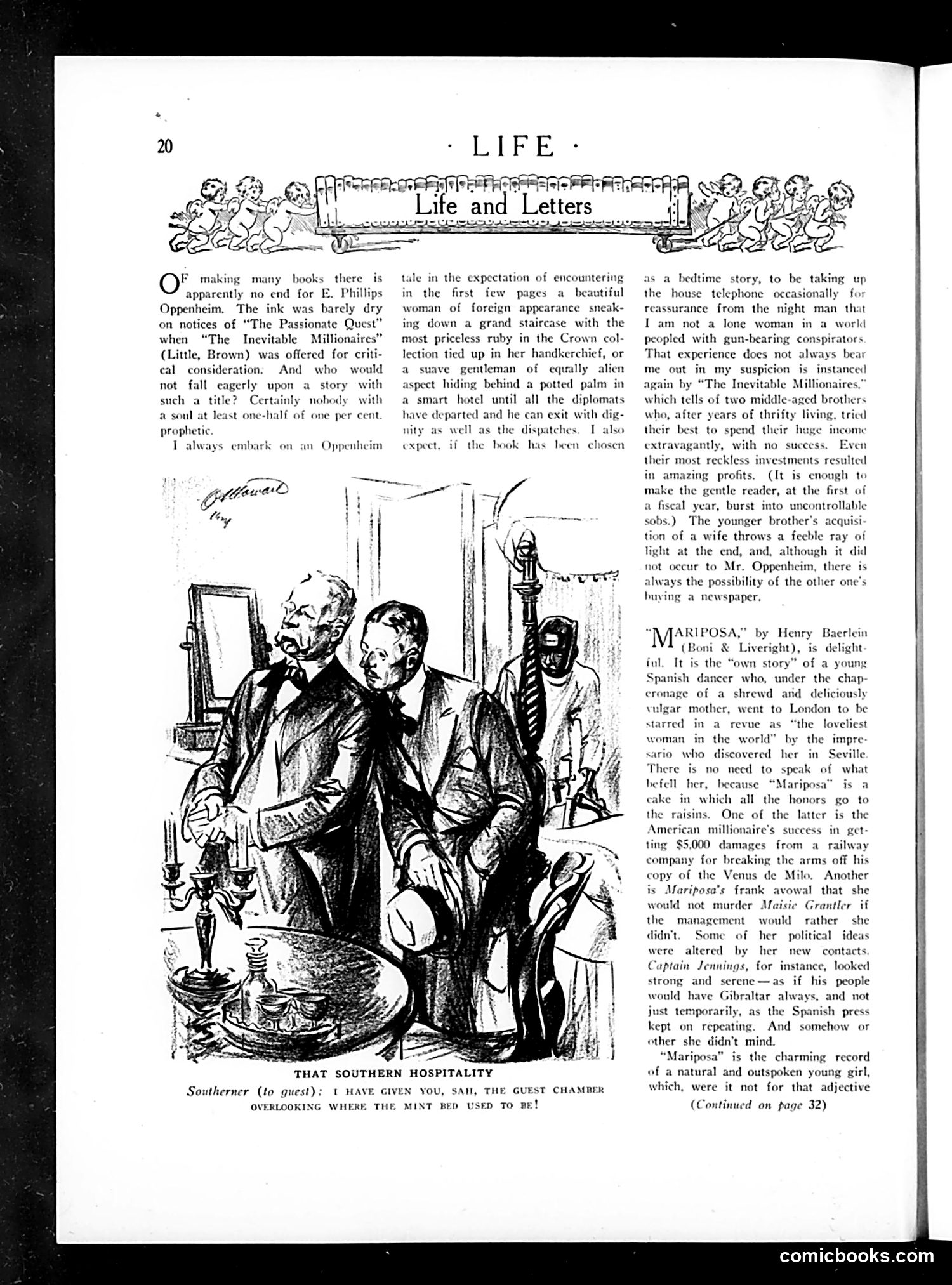
This page reviews popular fiction, with the main cartoon illustrating a joke about Southern hospitality. The cartoon depicts a host (labeled "Southerner") offering a guest accommodations with ironic pride—the guest chamber "overlooking where the mint bed used to be," suggesting the South's economic decline following the Civil War and Reconstruction era. The text reviews E. Phillips Oppenheim's prolific romance novels, mocking their predictable formulas: beautiful foreign women sneaking down staircases with stolen jewels, mysterious gentlemen hiding behind potted palms. The reviewer satirizes both Oppenheim's repetitive plotting and readers who consume such escapist fiction. The page also reviews "Mariposa" by Henry Baerlein, a Spanish dancer's memoir. The satirical tone suggests amusement at the book's melodramatic cast of characters, including an American millionaire who won the financial settlement mentioned in the text.
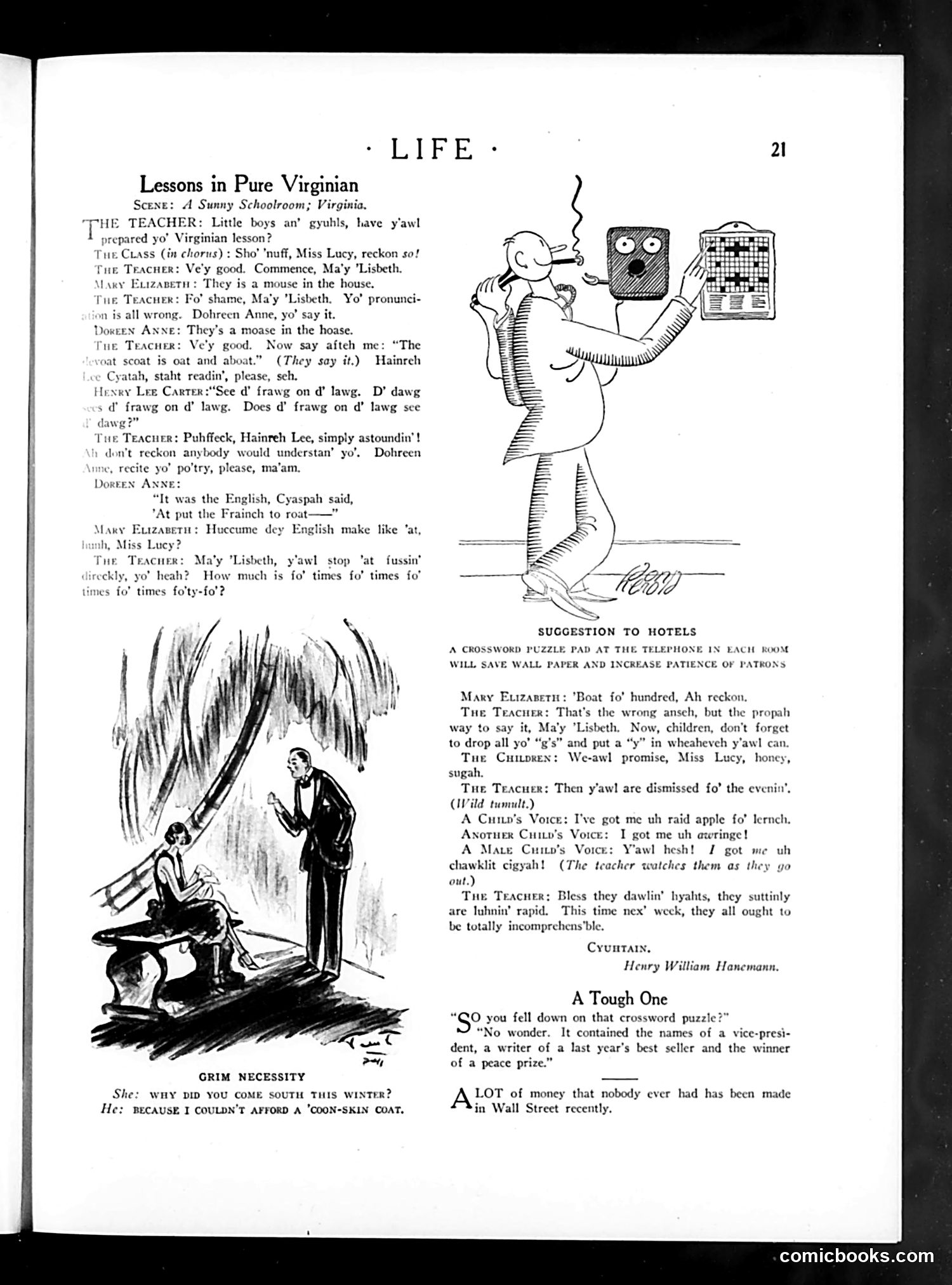
This sketch satirizes Southern American dialect and education. A Virginia schoolteacher corrects her students' pronunciation, demanding they adopt exaggerated rural Southern speech patterns—dropping g's, elongating vowels ("frawg" for "frog"), and inserting y's. The humor lies in the irony: the teacher is teaching *improper* English as "correct," replacing standard pronunciation with caricatured dialect. The piece mocks both regional speech affectations and a romanticized "pure Virginian" identity. By the sketch's end, the teacher proudly notes her students will soon be "totally incomprehens'ble"—the pedagogical goal is linguistic isolation, not education. This reflects early 20th-century Northern urban attitudes toward rural Southern culture as quaint, backward, and linguistically inferior—though Life magazine presented it as humorous rather than cruelly mocking.
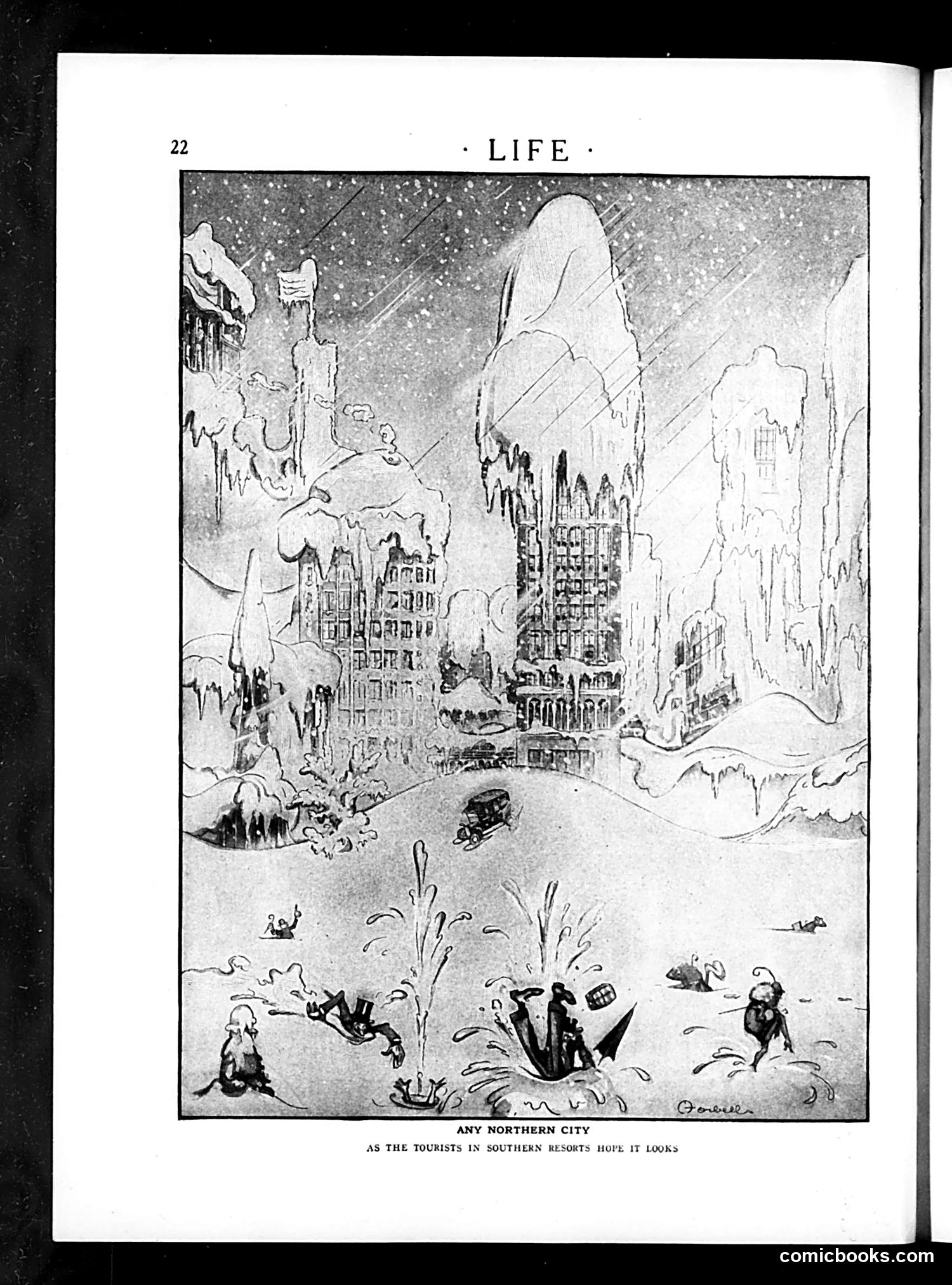
This satirical cartoon mocks Northern tourists visiting Southern resorts by depicting their romanticized fantasy of what Northern cities look like during winter. The image shows an ice-encased cityscape with frozen buildings, icicle formations, people bundled in heavy clothes, and evidence of extreme cold (vehicles struggling through snow). The joke targets the exaggeration Southerners heard from Northern visitors boasting about harsh winters back home. The cartoon suggests these tourists fantasize about impossibly dramatic winter conditions—essentially presenting a comically frozen, almost fairy-tale version of Northern urban life. The satire cuts both ways: mocking both Northern tourists' bragging and Southerners' assumed gullibility in believing such exaggerations. The caption's phrasing—how Southerners "hope it looks"—implies skepticism about these tall tales.
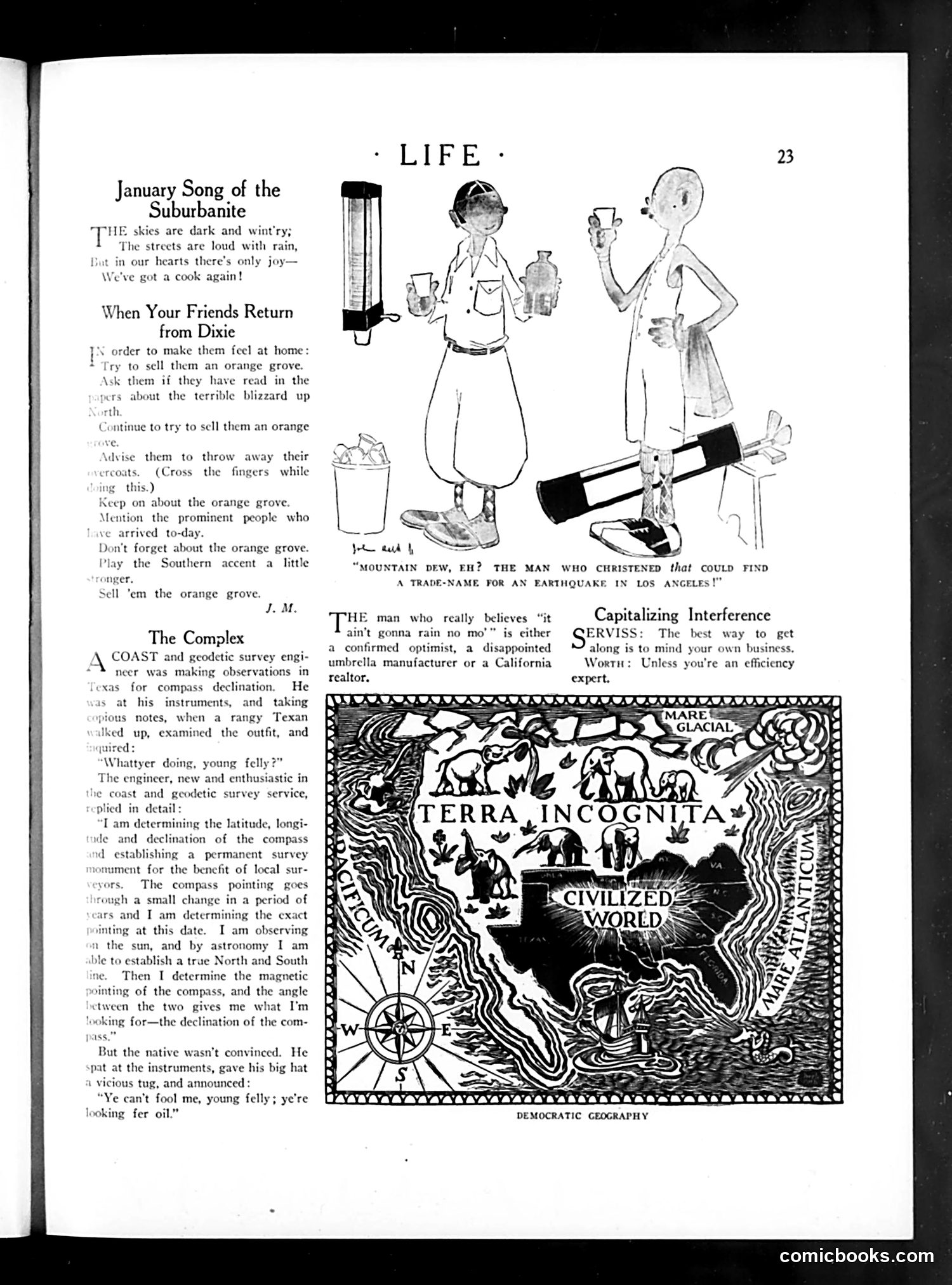
This page contains three satirical pieces typical of 1920s American humor: **"January Song of the Suburbanite"** mocks middle-class complacency—despite winter hardships, suburbanites are content merely because they've hired domestic help (a cook). **"When Your Friends Return from Dixie"** satirizes aggressive salesmanship and regional stereotyping. Northern acquaintances returning from the South are relentlessly pestered to buy Florida orange groves, a reference to the Florida land boom speculation craze of the era. The humor targets both pushy commerce and gullible investors. **"The Complex"** jokes on rural skepticism versus urban expertise. A Texas rancher dismisses a geodetic engineer's technical explanation of compass declination, insisting he's actually searching for oil—mocking rural suspicion of educated "outsiders" and the oil boom mentality. The "Terra Incognita" map cartoon contrasts the known "Civilized World" against unexplored regions, likely commentary on American geographic/cultural insularity. All reflect 1920s preoccupations: suburbanization, real estate speculation, rural-urban tension, and American economic expansion.
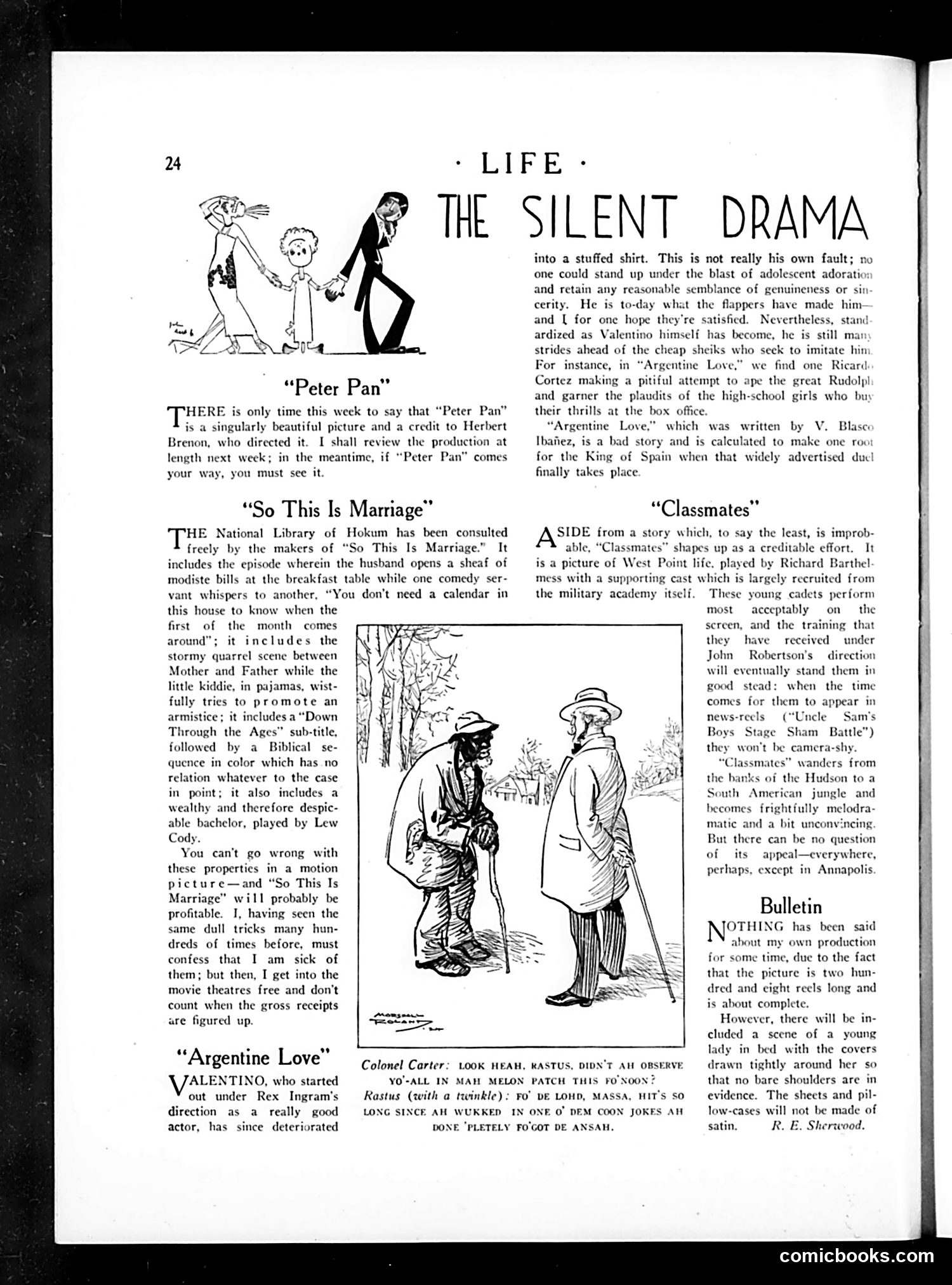
This page reviews four silent films while satirizing Hollywood conventions and contemporary taste. **"Peter Pan"** receives brief praise as "singularly beautiful." **"So This Is Marriage"** is mocked for recycling tired domestic comedy tropes: the husband discovering his wife's bills, marital quarrels while children suffer, and a random biblical flashback sequence. The reviewer admits exhaustion with these predictable formulas, though they reliably generate profits. **"Argentine Love"** criticizes Rudolph Valentino's over-sexualized image, noting that adolescent female admirers have reduced him to a manufactured "stuffed shirt." Ricardo Cortez's attempt to imitate Valentino is dismissed as pitiful. **"Classmates"** (a West Point military academy story) is praised for its young cast but criticized for unconvincing melodramatic plotting. The **cartoon** depicts two characters in period dress—likely from a film scene—in casual dialogue. The page reflects 1920s film criticism's tension between artistic integrity and profitable formula-repetition.
This page is **not a cartoon or satire** — it is a straightforward **advertisement for Medalist Cigars** by E.A. Kline and Company, a New York manufacturer established in 1895. The ad uses clever marketing language typical of early 20th-century advertising, playing on the appeal of quality and exclusivity. The headline "Medalist Cigars tempt—and satisfy the tempting" uses mild wordplay suggesting the product satisfies cravings. The copy emphasizes that "exacting men throughout the country smoke MEDALISTS," employing social proof and aspirational messaging — the implication being that discerning gentlemen prefer this brand. It promotes twelve sizes (15¢–25¢) available at upscale venues (hotels, clubs, restaurants), and mentions cheaper "Medalist Juniors" (20 for $1.00) in pocket cases. This represents standard pre-prohibition era cigar marketing aimed at affluent male consumers.
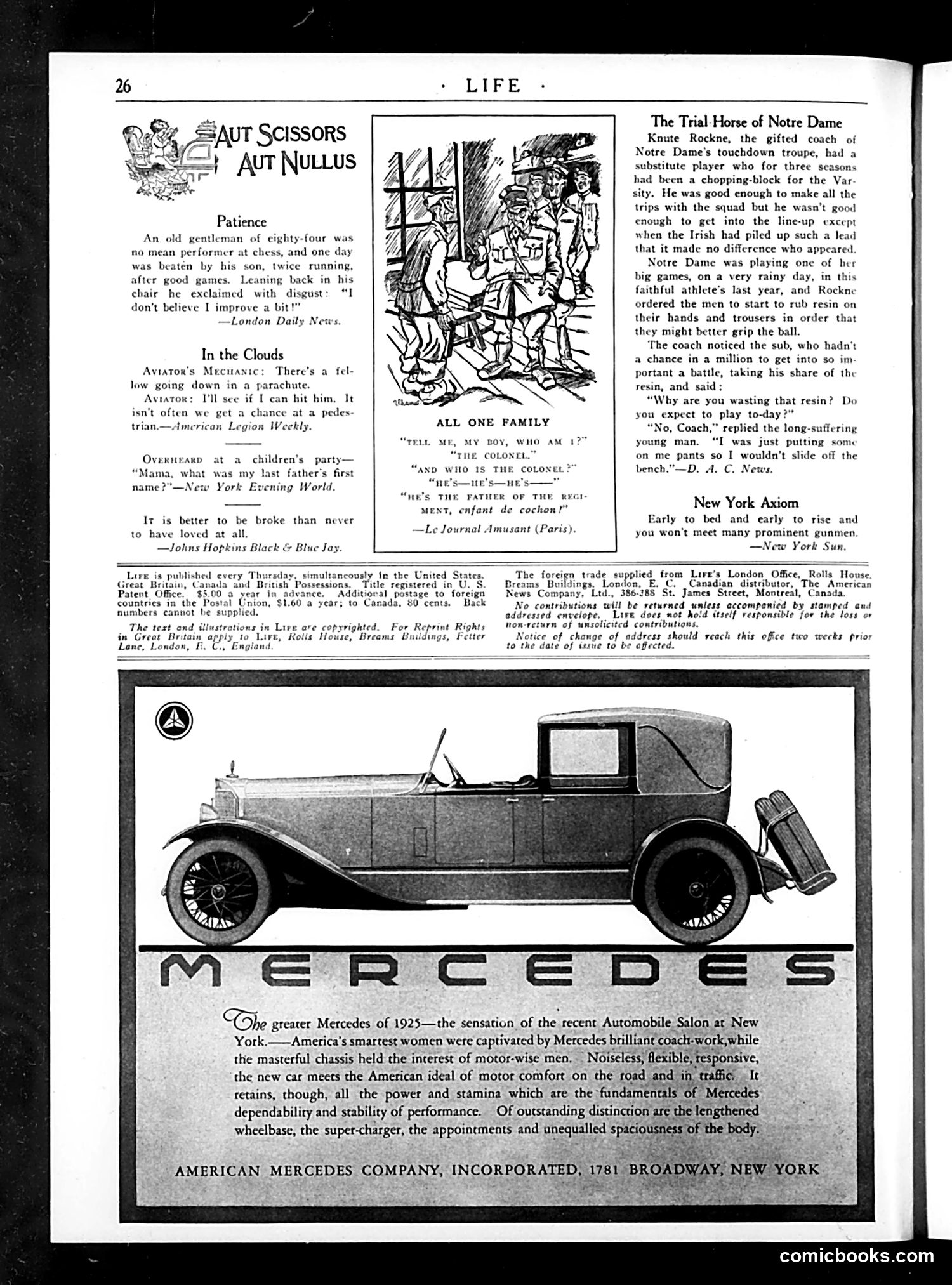
This page contains several brief satirical pieces typical of Life's humor section: **"Patience"** mocks an elderly chess player's complaint about not improving—the joke being his unrealistic expectations at eighty-four. **"In the Clouds"** presents dark humor about an aviator joking about shooting a parachutist, reflecting the era's cavalier attitude toward aviation dangers. **"All One Family"** appears to be a French joke about legitimacy and military hierarchy, playing on double meanings of "colonel" and paternity—likely satirizing class pretension. **"The Trial-Horse of Notre Dame"** humorously describes a perpetually benched Notre Dame football substitute so resigned to never playing that he prepares himself anyway. It gently mocks his futile optimism while praising his dedication under coach Knute Rockne's leadership. **"New York Axiom"** is a cynical quip about crime in 1920s New York—suggesting prominent criminals keep irregular hours. The page primarily consists of **Mercedes automobile advertising**, emphasizing luxury and performance for wealthy buyers. These short humor pieces fill space between advertisements typical of Life's format.
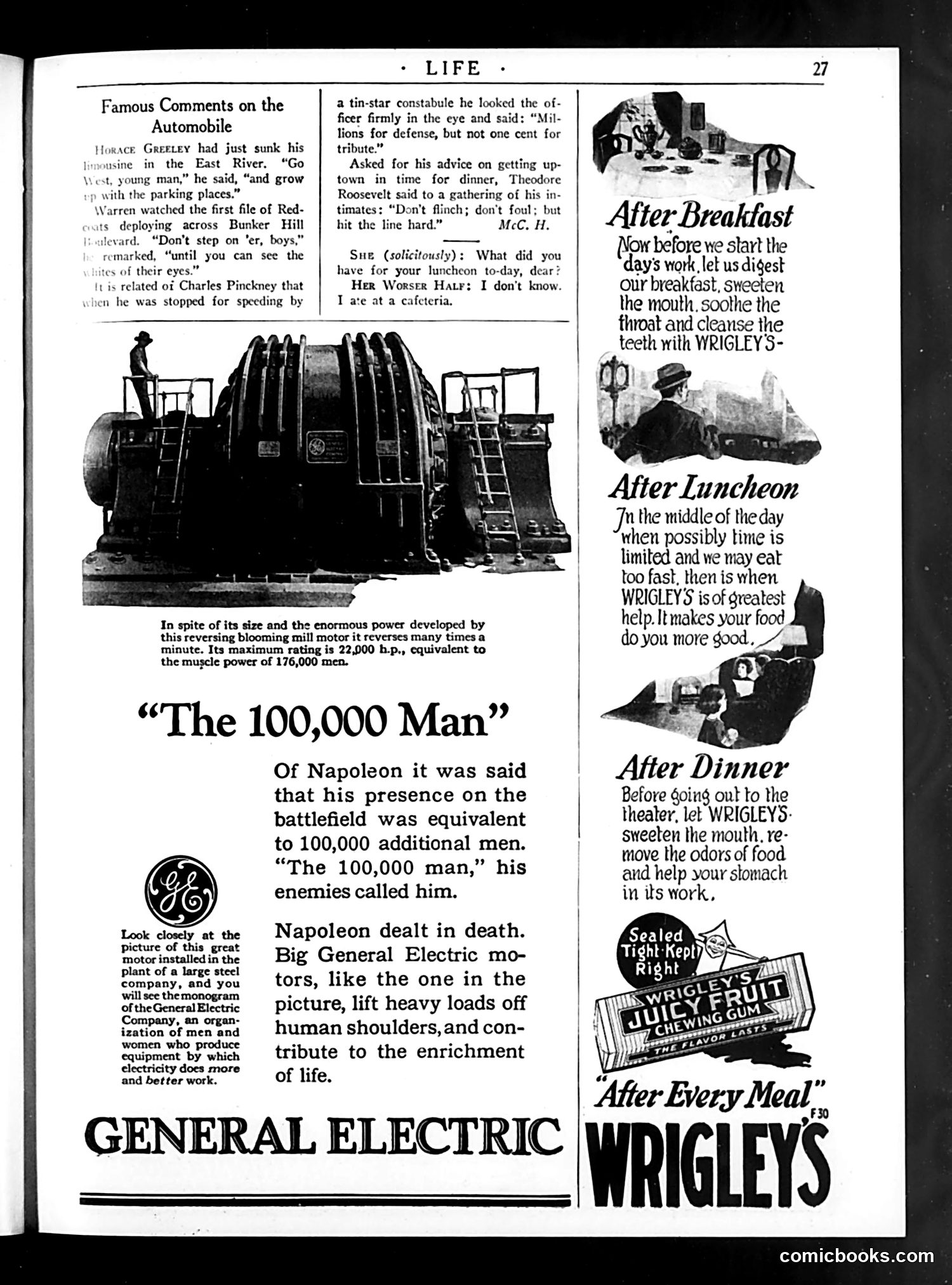
This page uses historical figures to promote General Electric motors. The left side presents famous Americans (Horace Greeley, Warren, Charles Pinckney, Theodore Roosevelt) making witty remarks about automobiles—satirizing early-1900s car culture anxieties like parking and speeding. The main advertisement compares a massive GE industrial motor (rated 22,000 h.p., equivalent to 176,000 men's muscle power) to Napoleon Bonaparte. The satire inverts Napoleon's legacy: where Napoleon was called "The 100,000 Man" for his destructive military presence, GE's motor is presented as the opposite—a "100,000 Man" that lifts human burdens and enriches life rather than dealing in death. The right side is a separate Wrigley's gum advertisement promoting chewing after meals. The underlying message: modern industrial machinery—not military conquest—represents progress and human advancement.
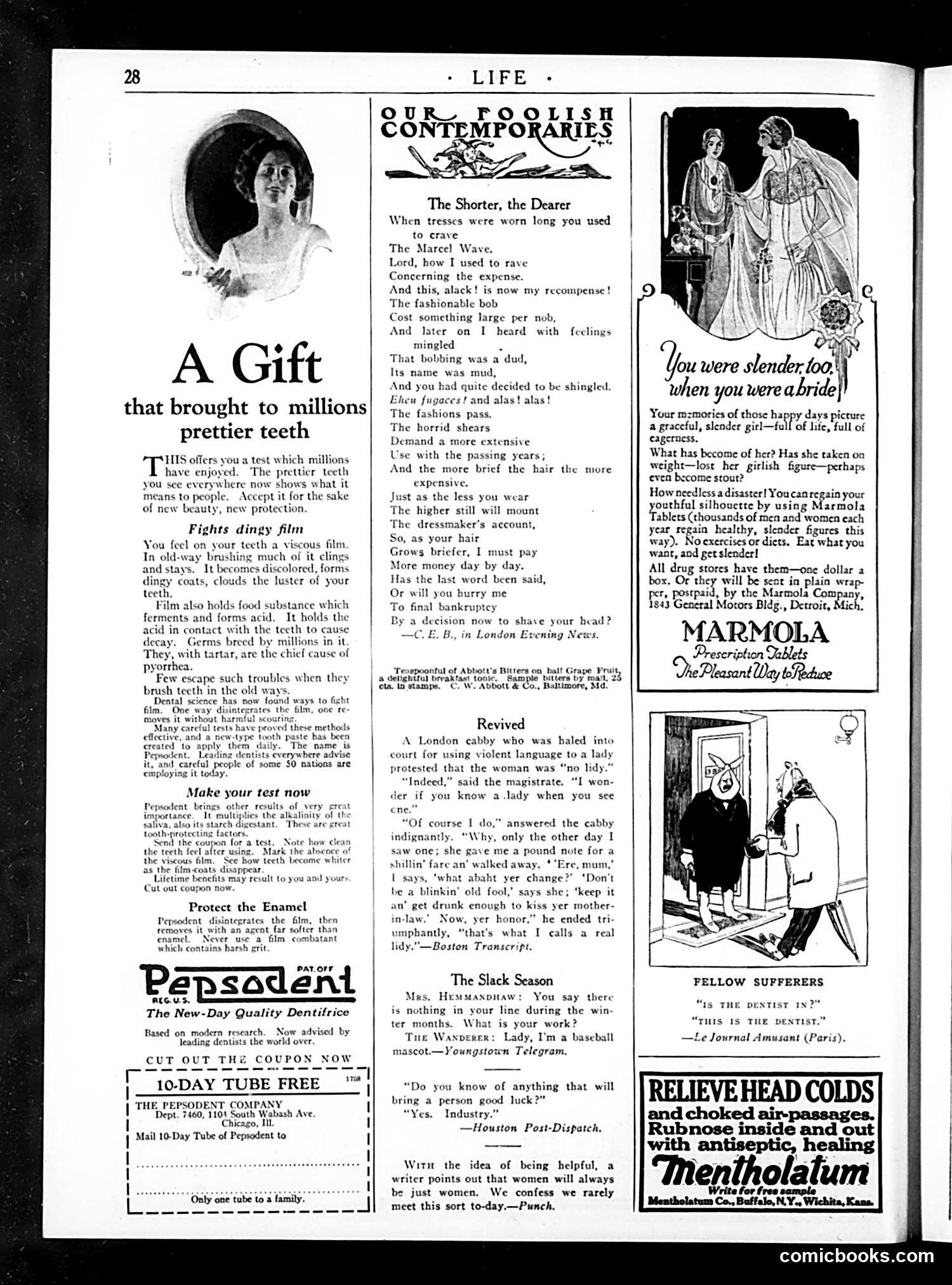
This page combines advertisements with humorous satirical content typical of early 20th-century Life magazine. **Main Advertisement**: Pepsodent toothpaste dominates the left side, promoting a "new-day" dentifrice based on removing "dingy film" from teeth. The ad targets consumer anxiety about appearance and dental health. **Satirical Poetry** ("The Shorter, the Dearer"): Mocks women's fashion trends. It laments how shorter hairstyles—the "bob" (fashionable women's haircut of the 1920s)—cost *more* at the salon than longer styles did, despite requiring less hair. The poet ruefully notes that as fashion demands briefer cuts, barber bills keep rising. This satirizes the absurdity of fashion economics and women's supposed slavery to changing trends. **"Revived" Anecdote**: A humorous London cabby story where a "real lady" supposedly gave excessive tips and told the cabby to get drunk rather than return change—inverting genteel behavior expectations for comic effect. The page reflects 1920s consumer culture, beauty standards, and gender dynamics through advertising and light satire.
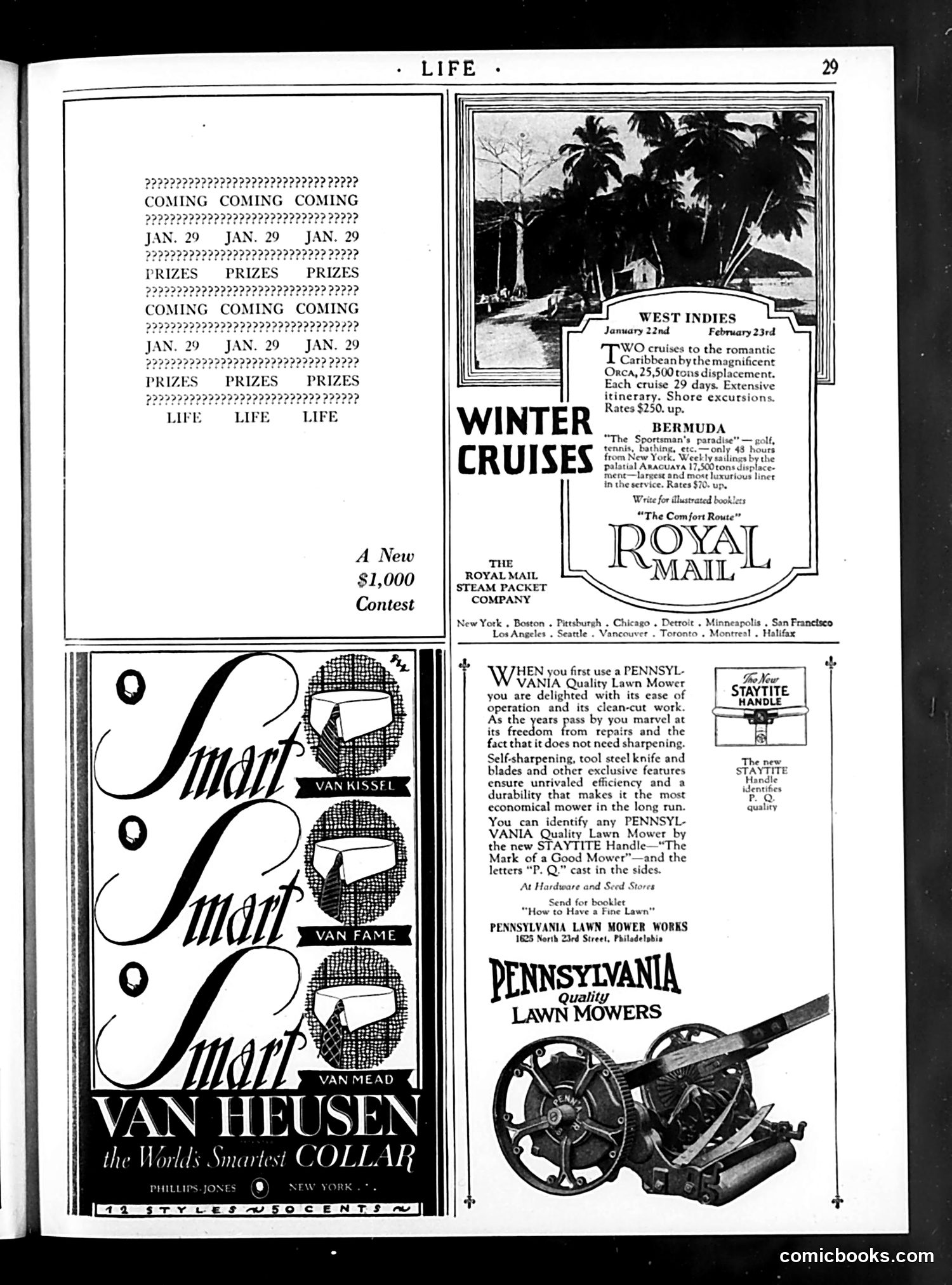
This is primarily an **advertising page** with minimal editorial content. The left side announces an upcoming "$1,000 Contest" (details unclear from OCR), while most of the page contains period product advertisements. The ads include: - **Royal Mail Steam Packet Company**: promoting Caribbean winter cruises to the West Indies and Bermuda - **Van Heusen Collar**: marketed as "the World's Smartest Collar" with three style variants (Van Kissel, Van Fame, Van Mead) - **Pennsylvania Lawn Mower Works**: highlighting their "Staytite Handle" and self-sharpening features These represent typical 1920s-30s luxury and consumer goods marketing—cruise lines targeting affluent readers, men's fashion accessories, and lawn care equipment. The page reflects the magazine's commercial function alongside its satirical editorial content.
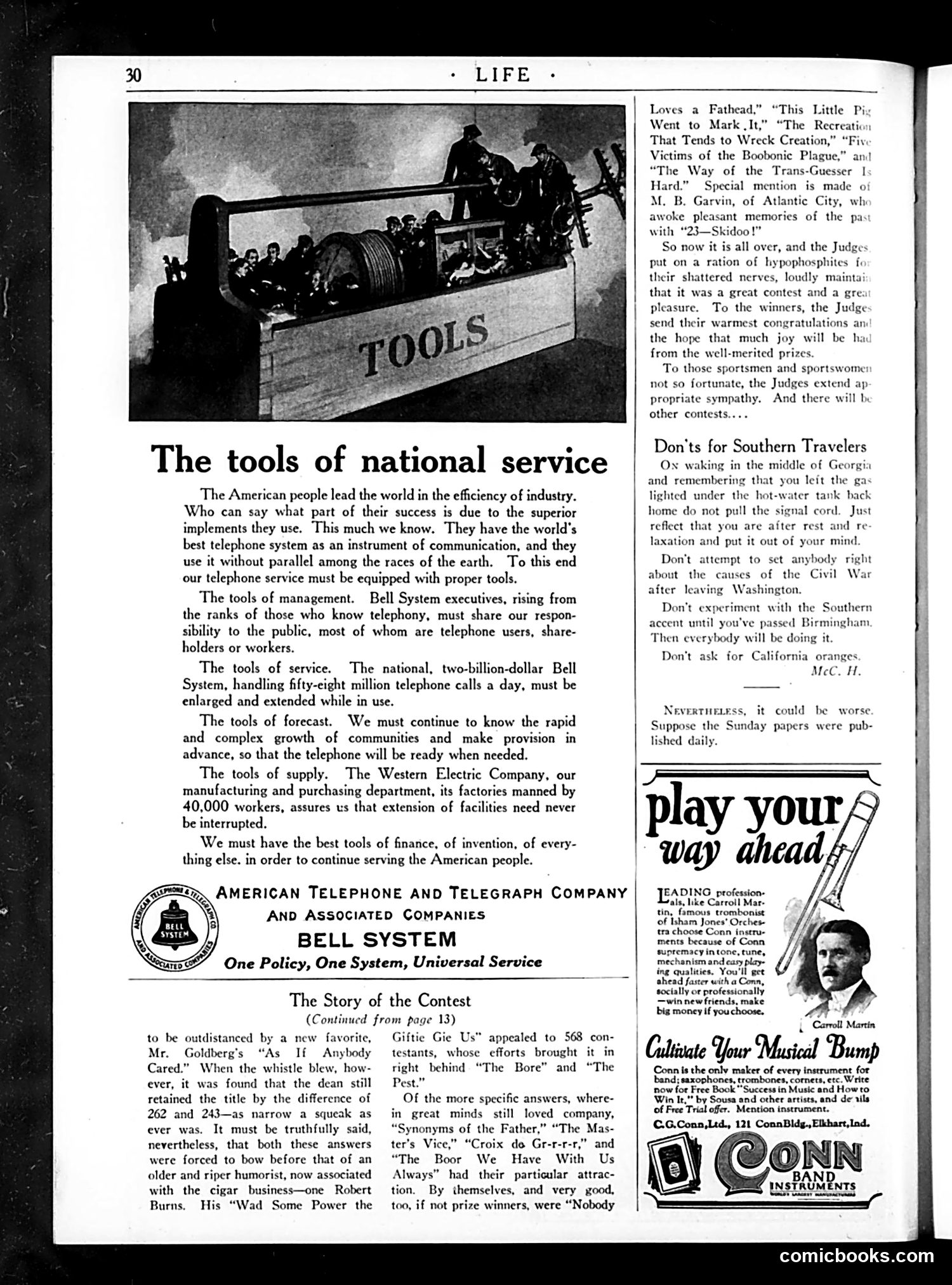
This page is primarily **advertising and contests**, not political satire. The main content is a Bell System advertisement promoting the telephone company's infrastructure as essential "tools of national service." It's corporate propaganda dressed as patriotic messaging, emphasizing America's industrial superiority and the Bell System's indispensability—a common approach during the early 20th century when monopolies like AT&T used nationalism to justify their dominance. Below that is a continuation of a **humorous contest** about insulting names for foolish people. Readers submitted answers; winners are announced. Notable entries include Robert Burns's "Wad Some Power the Giftie Gie Us" (appealing to 568 contestants) and other pun-based responses. The right column contains light travel advice ("Don'ts for Southern Travelers") and period advertisements, including a Conn Band Instruments ad featuring Carroll Martin. The page is representative of Life magazine's mix of advertising, contests, and light humor—not satirical political commentary.
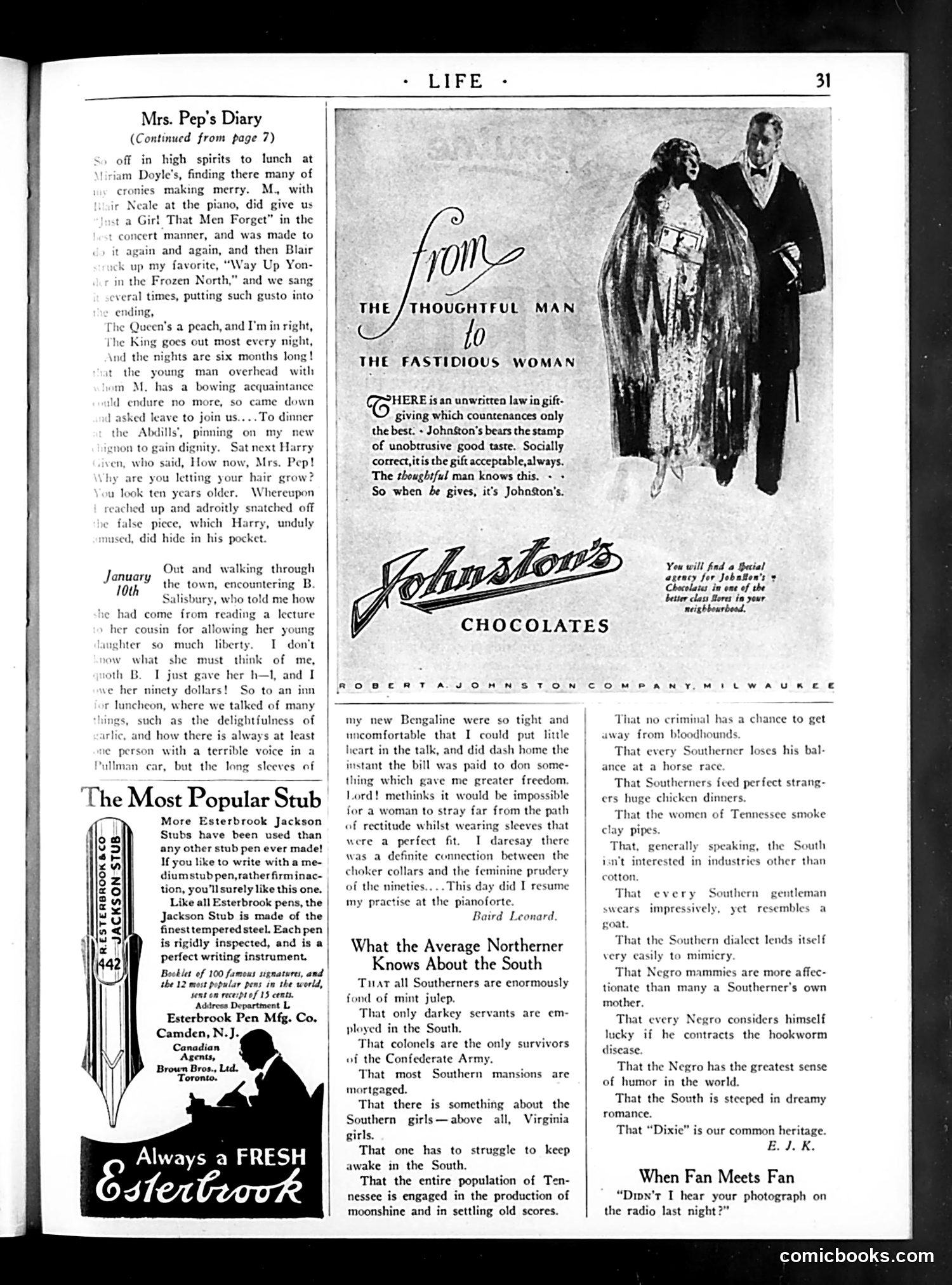
This Life magazine page mixes social commentary with period advertising. The main satirical content is "What the Average Northerner Knows About the South"—a humorous list of stereotypes Northerners held about the South, including: Southerners drink mint juleps constantly; only Black servants work there; only Civil War colonels remain; Southern mansions are mortgaged; Southern women are mysteriously attractive; the region is soporific; Tennessee produces moonshine and feuds; bloodhounds catch all criminals. The satire mocks Northern *ignorance* by listing absurd generalizations. The list appears designed to be both funny and critical of regional prejudice. The page also features Mrs. Pep's diary (a serial humor column) and advertisements including Johnston's Chocolates, positioned as gifts from "thoughtful" men to "fastidious" women—reflecting early 20th-century gender and class assumptions about courtship and consumption.
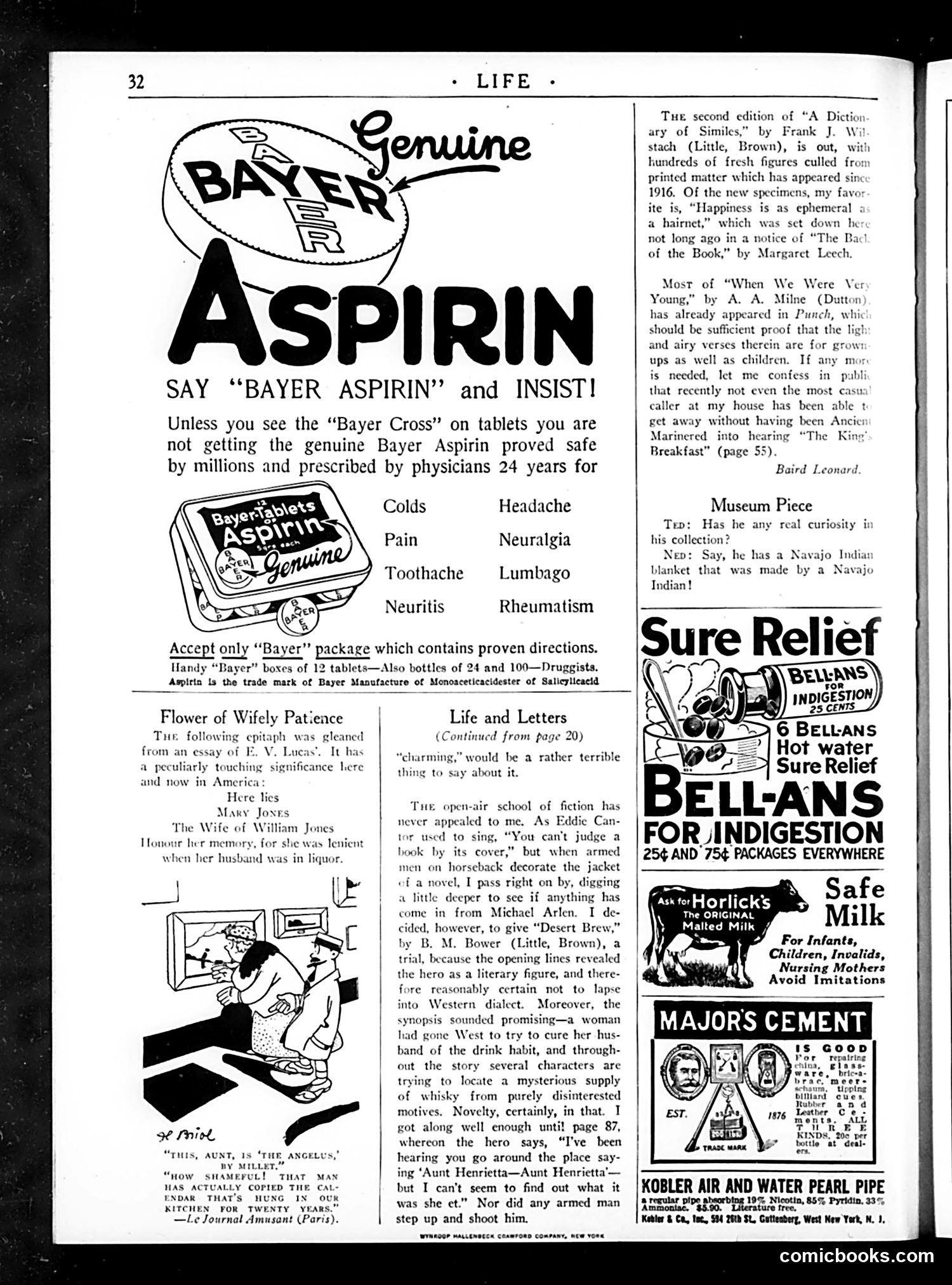
This page mixes advertisements with literary commentary typical of Life's satirical format. **The Bayer Aspirin ad** dominates the upper section, emphasizing the importance of the "Bayer Cross" trademark—a practical concern in an era before strict drug regulation, when counterfeit medicines were common. **The cartoon "Flower of Wifely Patience"** depicts a woman discovering her husband has copied a calendar that's hung in their kitchen for twenty years, presenting this as absurd plagiarism. The joke satirizes both pretentious art criticism (the reference to Millet's "The Angelus") and marital dynamics—mocking the husband's audacity in claiming originality for such a trivial act. **The "Life and Letters" section** reviews contemporary books, including B.M. Bower's "Desert Brew." The critic ridicules awkward Western dialect in literature, sarcastically noting that he continued reading only until encountering clumsy writing ("I've been hearing you...what was she et"), at which point he wished "an armed man" would shoot the character. The page reflects 1920s American popular culture: emerging pharmaceutical regulation concerns, literary snobbery, and marital humor.
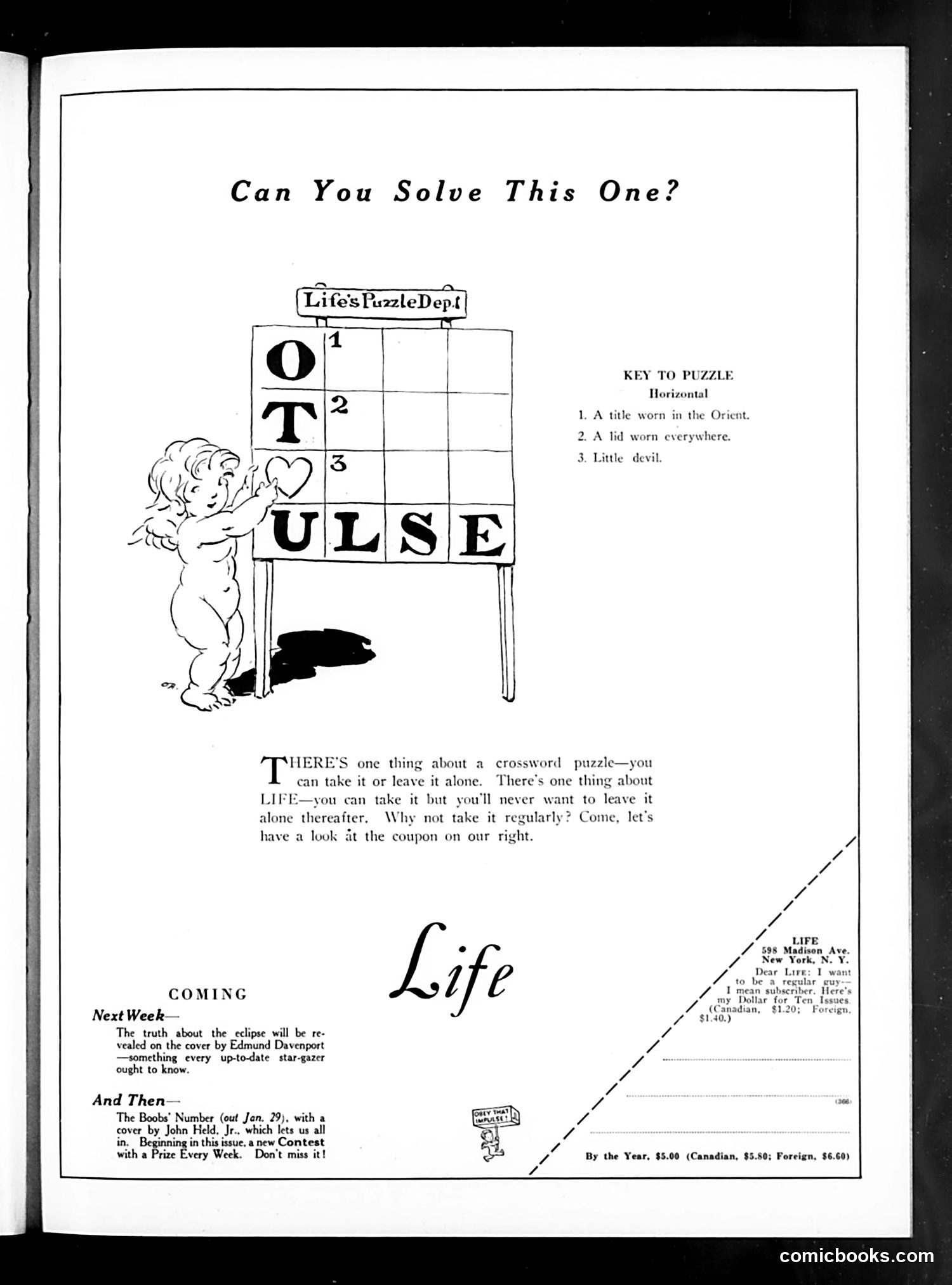
This is a **self-promotional advertisement** disguised as a crossword puzzle, not political satire. The page features a cupid figure pointing to an incomplete crossword grid spelling "PULSE" (vertically). The puzzle clues are deliberately vague ("A title worn in the Orient," "A lid worn everywhere," "Little devil"), making it unsolvable—this is intentional. The joke is meta: Life magazine argues that while crossword puzzles are optional entertainment you can "take or leave," Life magazine itself is essential reading you'll never want to abandon. The text explicitly states this comparison. Below, the magazine advertises upcoming content (Edmund Davenport covering an eclipse, John Held Jr.'s "Boobs' Number," and a new weekly contest) to encourage subscriptions. The coupon on the right facilitates ordering. This is purely **marketing content**, not commentary on current events or figures.
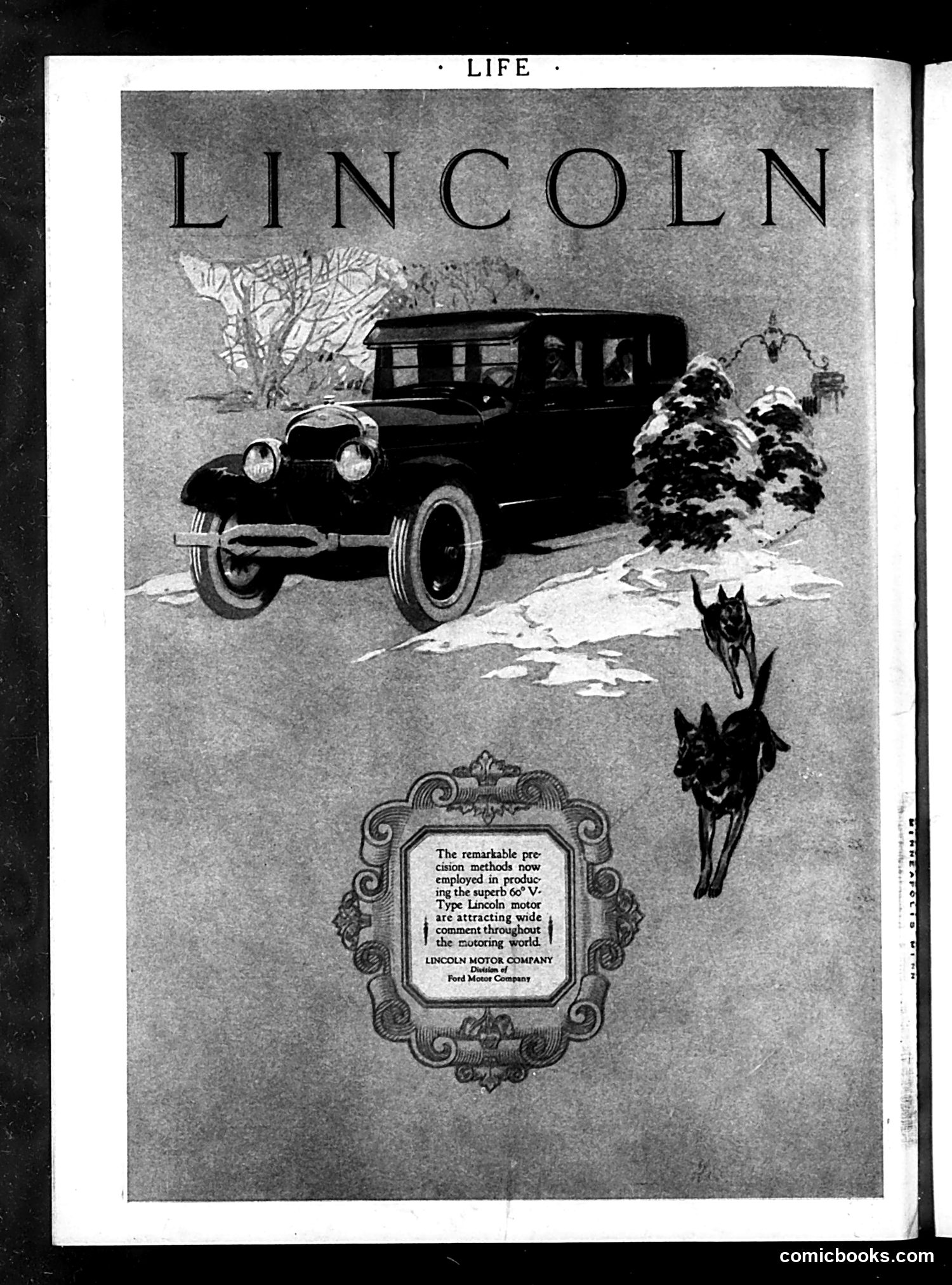
This is primarily a **product advertisement** for Lincoln automobiles, not political satire. The page features a luxury car in a winter landscape with evergreen trees and snow, accompanied by hunting dogs—imagery suggesting wealth, leisure, and outdoor pursuits. The text praises the "remarkable precision methods" used in manufacturing Lincoln's "60° V-Type" motor, claiming it attracts "wide comment throughout the motoring world." The ornate decorative frame and formal presentation reflect early 20th-century advertising style. The Lincoln Motor Company, mentioned as a "Division of Ford Motor Company," positions the vehicle as a premium product distinct from Ford's mass-market offerings. No political commentary or satire is evident here—this appears to be straightforward luxury automotive marketing aimed at affluent readers of *Life* magazine.