
Life, 1925-01-15 · page 17 of 36
Life — January 15, 1925 — page 17: what you’re looking at
What you’re looking at
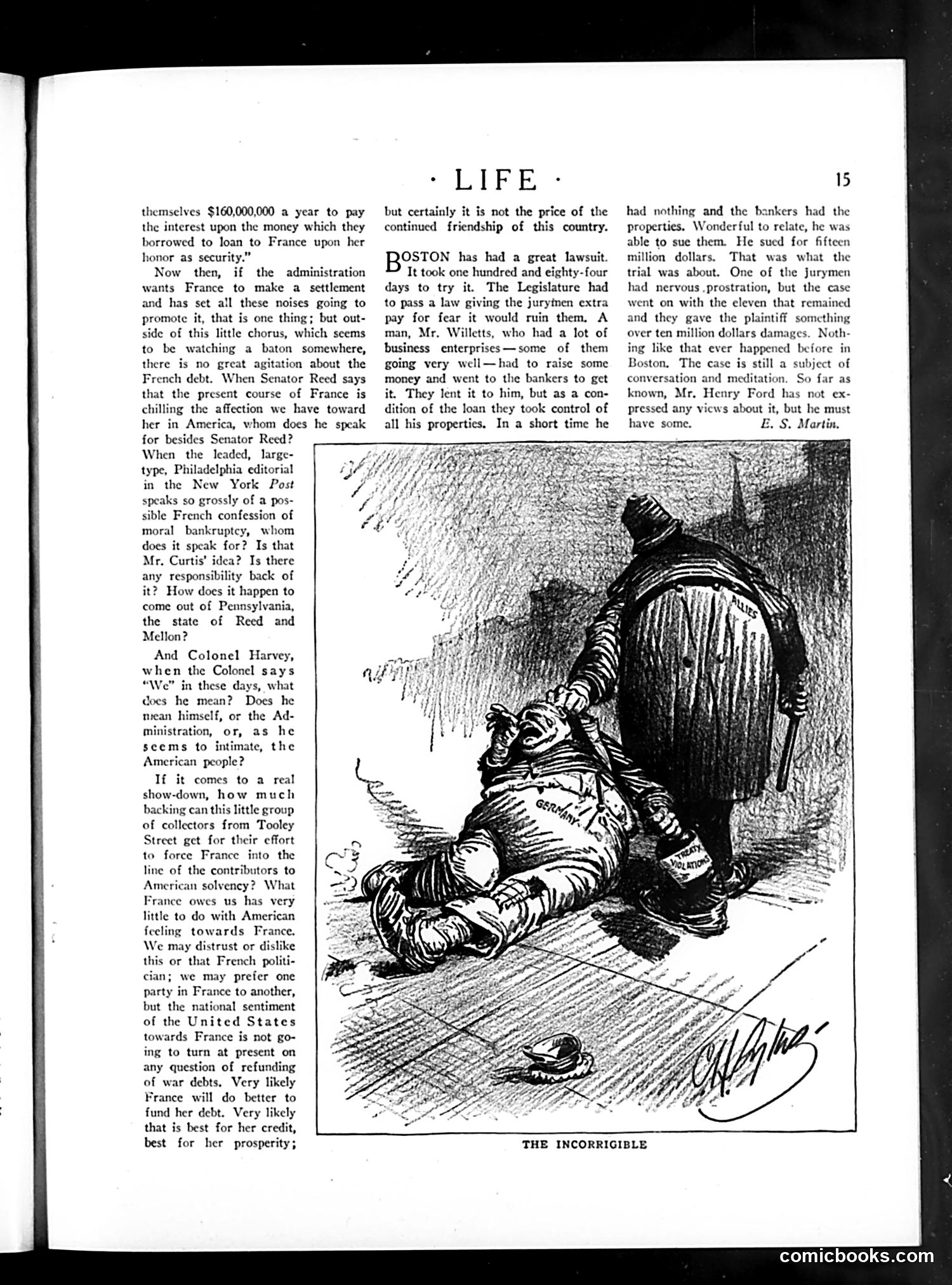
This cartoon satirizes French financial irresponsibility. The figure sprawled on the ground, labeled "The Incorrigible," appears to represent France, depicted as a dissipated, disreputable character. The accompanying text discusses France's war debts to America and criticizes French politicians for moral bankruptcy—specifically referencing a Boston lawsuit where businessmen lent money to France that was never repaid. The cartoon's message: France repeatedly defaults on obligations, earning the epithet "incorrigible" (incapable of reform). The text questions American backing of such an unreliable debtor and suggests France should prioritize repaying debts rather than expecting further American financial support. This reflects post-WWI tensions over European war debt repayment to the United States.
📄 Transcribed text from this page (OCR, searchable)
Machine-transcribed from the original scan — historical spelling and the odd misread are preserved.
themselves $160,000,000 a year to pay the interest upon the money which they borrowed to loan to France upon her honor as security.” Now then, if the administration wants France to make a_ settlement and has set all these noises going to promote it, that is one thing; but out- side of this little chorus, which seems to be watching a baton somewhere, there is no great agitation about the French debt. When Senator Reed says that the present course of France is chilling the affection we have toward her in America, whom does he speak for besides Senator Reed? When the leaded, large- type, Philadelphia editorial in the New York Post speaks so grossly of a pos- sible French confession of moral bankruptcy, whom does it speak for? Is that Mr. Curtis’ idea? Is there any responsibility back of it? How does it happen to come out of Pennsylvania, the state of Reed and Mellon? And Colonel Harvey, wh the Colonel says “We” in these days, what does he mean? Does he mean himself, or the Ad- ministration, or, as he seems to intimate, the American people? If it comes to a real show-down, how much backing can this little group of collectors from Tooley Street get for their effort to force France into the line of the contributors to American solvency? What France owes us has very little to do with American feeling towards France. We may distrust or dislike this or that French politi- ck we may prefer one party in France to another, but the national sentiment of the United States towards France is not go- ing to turn at present on any question of refunding of war debts, Very likely France will do better to fund her debt. Very likely that is best for her credit, best for her prosperity; - LIFE - but certainly it is not the price of the continued friendship of this country. OSTON has had a great lawsuit. It took one hundred and eighty-four days to try it. The Legislature had to pass a law giving the juryinen extra pay for fear it would ruin them, A man, Mr. Willetts, who had a lot of business enterprises—some of them going very well—had to raise some money and went to the bankers to get it. They lent it to him, but as a con- dition of the loan they took control of all his properties. In a short time he 15, had nothing and the bankers had the properties. Wonderful to relate, he was able to sue them. He sued for fifteen million dollars. That was what the trial was about. One of the jurymen had nervous .prostration, but the case went on with the eleven that remained and they gave the plaintiff something over ten million dollars damages. Noth- ing like that ever happened before in Boston, The case is still a subject of conversation and meditation. So far as known, Mr. Henry Ford has not ex- pressed any vicws about it, but he must have some. E. S. Martin. THE INCORRIGIBLE comicbooks.com