
Life, 1925-01-15 · page 3 of 36
Life — January 15, 1925 — page 3: what you’re looking at
What you’re looking at
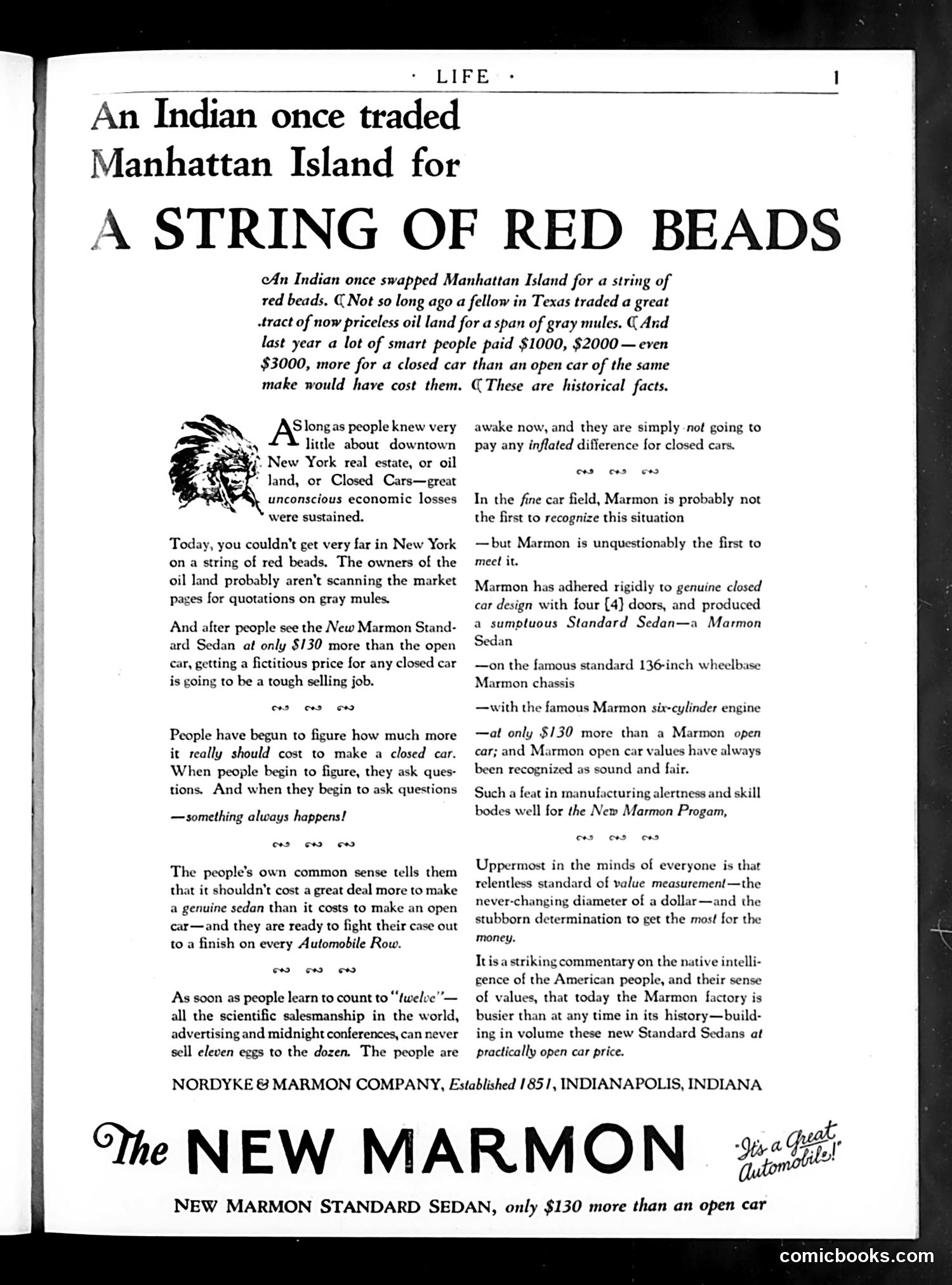
This is a Marmon automobile advertisement disguised as satirical commentary. The headline references the famous (likely apocryphal) story of Native Americans trading Manhattan Island for worthless beads—a parable about bad deals. The ad argues that consumers making purchasing decisions about closed versus open cars are making equally poor value judgments. The satirical point: people will pay $130 extra for a closed car without understanding the actual manufacturing costs, much like the "red beads" myth. The Native American head image accompanying the headline reinforces this comparison, suggesting modern consumers are being equally naive. The ad positions Marmon's Standard Sedan as the rational choice, using humor to mock consumer decision-making while promoting their vehicle as genuinely offering better value than competitors.
📄 Transcribed text from this page (OCR, searchable)
Machine-transcribed from the original scan — historical spelling and the odd misread are preserved.
LIFE - An Indian once traded Manhattan Island for A STRING OF RED BEADS An Indian once swapped Manhattan Island for a string of red beads. € Not so long ago a fellow in Texas traded a great tract of now priceless oil land for a span of gray mules. € And last year a lot of smart people paid $1000, $2000 — even $3000, more for a closed car make would have cost them. S longas people knew very little about downtown were sustained. Today, you couldn't get very far in New York ona string of red beads. The owners of the oil land probably aren't scanning the market pages for quotations on gray mules, And after people see the New Marmon Stand- ard Sedan at only $130 more than the open car, getting a fictitious price for any closed car is going to be a tough selling job. oo oe ow People have begun to figure how much more it really should cost to make a closed car. When people begin to figure, they ask ques- tions. And when they begin to ask questions —something always happens! ow em ew The people’s own common sense tells them that it shouldn't cost a great deal more to make a genuine sedan than it costs to make an open car—and they are ready to fight their case out to a finish on every Automobile Row. ow ow ow As soon as people learn to count to “twelve” — all the scientific salesmanship in the world, advertising and midnight conferences, can never sell eleven eggs to the dozen. The people are than an open car of the same These are historical facts. awake now, and they are simply not going to pay any inflated difference for closed cars. Oo Oo en In the fine car field, Marmon is probably not the first to recognize this situation —but Marmon is unquestionably the first to meet it. Marmon has adhered rigidly to genuine closed car design with four (4) doors, and produced a sumptuous Standard Sedan—a Marmon Sedan —on the famous standard 136-inch wheelbase Marmon chassis —with the famous Marmon six-cylinder engine —at only $130 more than a Marmon open car; and Marmon open car values have always been recognized as sound and fair. Such a feat in manufacturing alertness and skill bodes well for the New Marmon Progam, oO ew Uppermost in the minds of everyone is that relentless standard of value measurement—the never-changing diameter of a dollar—and the stubborn determination to get the most for the money. Teis a striking commentary on the native intelli- gence of the American people, and their sense of values, that today the Marmon factory is busier than at any time in its history—build- ing in volume these new Standard Sedans at practically open car price. NORDYKE & MARMON COMPANY, Established 1851, INDIANAPOLIS, INDIANA “he NEW MARMON Sts NEW MARMON STANDARD SEDAN, only $130 more than an open car comicbooks.com