
Life, 1925-01-15 · page 20 of 36
Life — January 15, 1925 — page 20: what you’re looking at
What you’re looking at
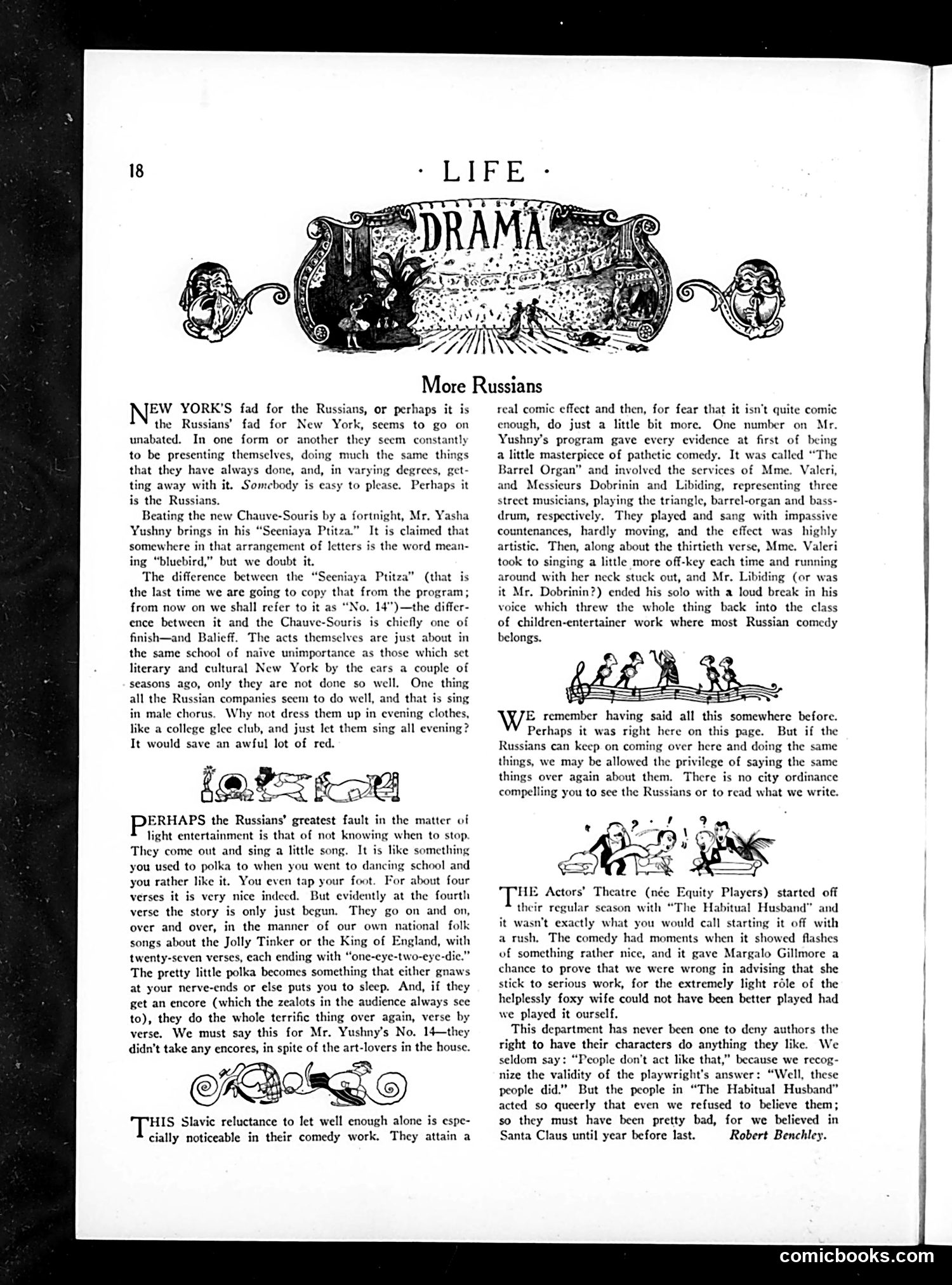
This review satirizes Russian theatrical troupes performing in 1920s New York. The critic discusses Yasha Yushny's "Seeniaya Ptitza" (mockingly calling it "No. 14" to avoid repeating the unpronounceable title), comparing it unfavorably to the popular Chauve-Souris company. The satire targets Russians' inability to know when to stop performing. A pleasant four-verse polka song becomes tedious when extended to twenty-seven verses with repetitive choruses. Similarly, "The Barrel Organ" sketch—initially "a masterpiece of pathetic comedy"—devolves into slapstick when the performer adds exaggerated off-key singing and physical antics. The critic's recurring complaint reflects 1920s New York's "Russian fad": these companies were fashionable but repetitive. The joke is that Life can keep criticizing them because there's "no city ordinance" preventing their performances or the magazine's complaints—a resigned, sardonic acceptance of both the trend's persistence and the critic's own redundancy.
📄 Transcribed text from this page (OCR, searchable)
Machine-transcribed from the original scan — historical spelling and the odd misread are preserved.
EW YORK’S fad for the Russians, or perhaps it is the Russians’ fad for New York, seems to go on unabated. In one form or another they secm constantly to be presenting themselves, doing much the same things that they have always done, and, in varying degrees, get- ting away with it. Somebody is easy to please. Perhaps it is the Russians. Beating the new Chauve-Souris by a fortnight, Mr. Yasha Yushny brings in his “Seeniaya Ptitza.” It is claimed that somewhere in that arrangement of letters is the word mean- ing “bluebird,” but we doubt it. The difference between the “Seeniaya Ptitza” (that is the last time we are going to copy that from the program; from now on we shall refer to it as “No, 14°)—the differ- ence between it and the Chauve-Souris is chiefly one of finish—and Balieff. The acts themselves are just about in the same school of naive unimportance as those which set literary and cultural New York by the ears a couple of seasons ago, only they are not done so well, One thing all the Russian companies seem to do well, and that is sing in male chorus. Why not dress them up in evening clothes, like a college glee club, and just Iet them sing all evening? It would save an awful lot of red. LORS fa PERHAPS the Russians’ greatest fault in the matter of light entertainment is that of not knowing when to stop. They come out and sing a little song. It is like something you used to polka to when you went to dancing school and you rather like it. You even tap your foot. For about four verses it is very nice indeed. But evidently at the fourth verse the story is only just begun. They go on and on, over and over, in the manner of our own national folk songs about the Jolly Tinker or the King of England, with twenty-seven verses, each ending with “one-eye-two-eye-dic.” The pretty little polka becomes something that cither gnaws at your nerve-ends or else puts you to sleep. And, if they get an encore (which the zealots in the audience always see to), they do the whole terrific thing over again, verse by verse. We must say this for Mr. Yushny’s No. 14—they didn’t take any encores, in spite of the art-lovers in the house. HIS Slavic reluctance to let well enough alone is espe- cially noticeable in their comedy work. They attain a More Russians real comic effect and then, for fear that it isn’t quite comic enough, do just a little bit more. One number on Mr. Yushny’s program gave every evidence at first of being a little masterpiece of pathetic comedy. It was called “The Barrel Organ” and involved the services of Mme. Valeri, and Messicurs Dobrinin and Libiding, representing three strect musicians, playing the triangle, barrel-organ and bass- drum, respectively, They played and sang with impassive countenances, hardly moving, and the effect was highly artistic, Then, along about the thirtieth verse, Mme. Valeri took to singing a little more off-key each time and running around with her neck stuck out, and Mr. Libiding (or was it Mr. Dobrinin?) ended his solo with a loud break in his voice which threw the whole thing back into the class of children-entertainer work where most Russian comedy belongs. WE remember having said all this somewhere before. Perhaps it was right here on this page. But if the Russians can keep on coming over here and doing the same things, we may be allowed the privilege of saying the same things over again about them. There is no city ordinance compelling you to sce the Russians or to read what we write. HE Actors’ Theatre (née Equity Players) started off their regular season with “The Habitual Husband” and it wasn’t exactly what you would call starting it off with a rush, The comedy had moments when it showed flashes of something rather nice, and it gave Margalo Gillmore a chance to prove that we were wrong in advising that she stick to serious work, for the extremely light role of the helplessly foxy wife could not have been better played had we played it ourself, This department has never been one to deny authors the right to have their characters do anything they like. We seldom say: “People don't act like that,” because we recog- nize the validity of the playwright’s answer: “Well, these people did.” But the people in “The Habitual Husband” acted so queerly that even we refused to believe them; so they must have been pretty bad, for we believed in Santa Claus until year before last. Robert Benchley. comicbooks.com