
Life, 1925-01-15 · page 16 of 36
Life — January 15, 1925 — page 16: what you’re looking at
What you’re looking at
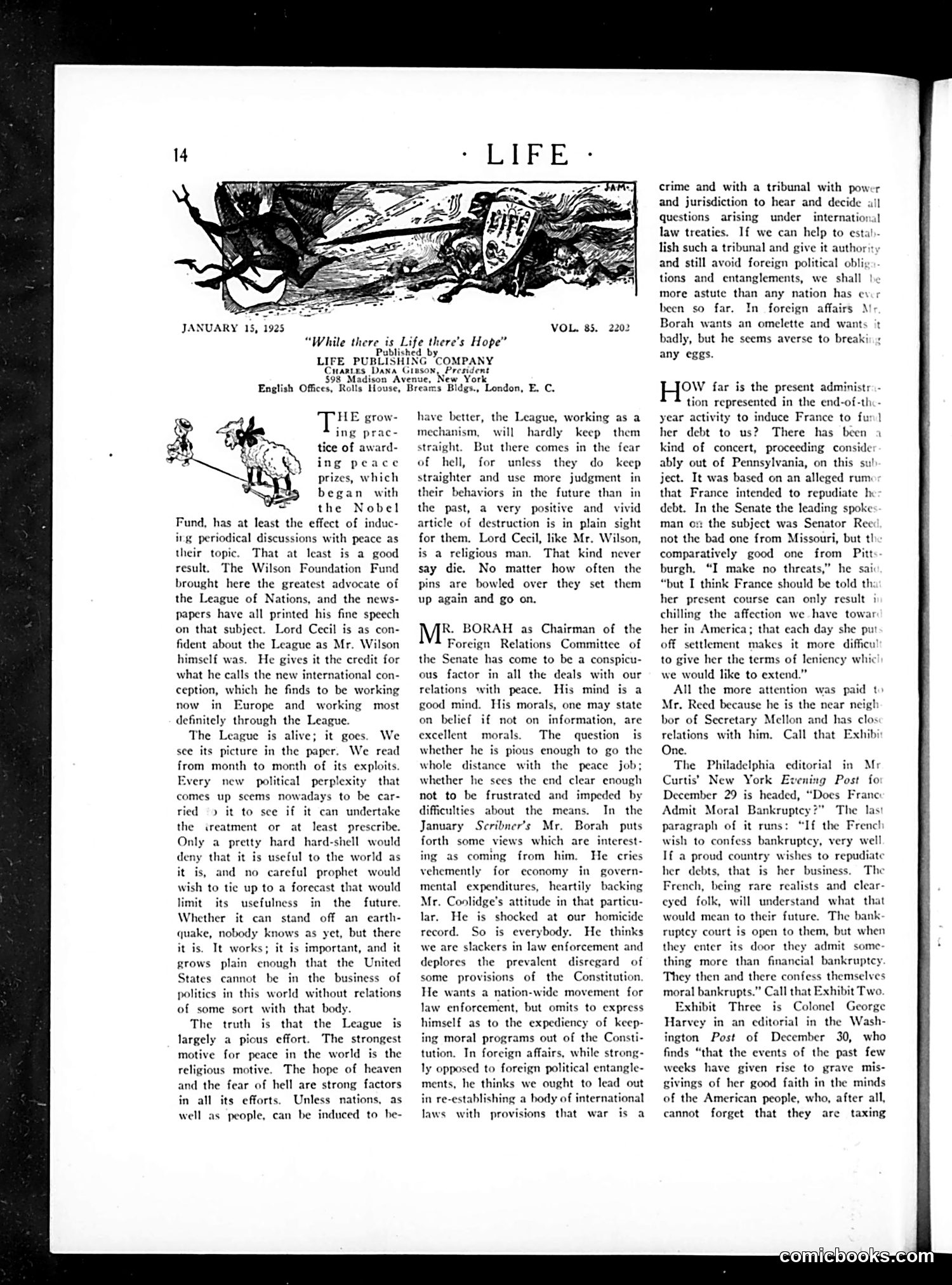
The page's masthead declares "While there is Life there's Hope," crediting Charles Dana Gibson as President. The prominent illustration (top left) appears to be a satirical political cartoon, though the image quality makes specific figures difficult to identify with certainty. The main text discusses the League of Nations and international peace efforts. It references Lord Cecil and Mr. Wilson's Foundation Fund supporting the League, and critiques Mr. Borah as Chairman of the Senate's Foreign Relations Committee for his skepticism about American involvement in international treaties and peace agreements. The article argues for stronger American engagement in maintaining international law and order, opposing isolationist sentiment prevalent in 1925 American politics.
📄 Transcribed text from this page (OCR, searchable)
Machine-transcribed from the original scan — historical spelling and the odd misread are preserved.
JANUARY 15, 1925 VOL. 85. 202 “While there is Life there's Hope” ublished by. LIFE PUBLISHING COMPANY Cuaries Dana G 98 Madison Ave: 5 English Offices, Rolls House, Brea THE grow: ing prac- tice of award- ing pe prizes, which began with the Nobel Fund, has at least the effect of induc- ing periodical discussions with peace as their topic. That at least is a good result. The Wilson Foundation Fund brought here the greatest advocate of the League of Nations, and the news- papers have all printed his fine speech on that subject. Lord Cecil is as con- fident about the League as Mr. Wilson himself was. He gives it the credit for what he calls the new international con- ception, which he finds to be working now in Europe and working most definitely through the League. The League is alive; it goes. We sce its picture in the paper. We read from month to month of its exploits. Every political perplexity that comes up scems nowadays to be car- ried > it to sce if it can undertake the «reatment or at least prescribe. Only a pretty hard hard-shell would deny that it is useful to the world as it is, and no careful prophet would wish to tie up to a forecast that would limit its usefulness in the future. Whether it can stand off an cearth- quake, nobody knows as yet, but there it is. It works; it is important, and it grows plain enough that the United States cannot be in the business of politics in this world without relations of some sort with that body. The truth is that the League is largely a pious effort. The strongest motive for peace in the world is the religious motive. The hope of heaven and the fear of hell are strong factors in all its efforts. Unless nations, as well as people, can be induced to he- ce new SON, President ue, New York 23 Bidgs., London, E. C. have better, the League, working as a mechanism, will hardly keep them straight. But there comes in the fear of hell, for unless they do keep straighter and use more judgment in their behaviors in the future than in the past, a very positive and vivid article of destruction is in plain sight for them. Lord Cecil, like Mr. Wilson, is a religious man. That kind never say die. No matter how often the pins are bowled over they set them up again and go on. R. BORAH as Chairman of the Foreign Relations Committee of the Senate has come to be a conspicu- ous factor in all the deals with our relations with peace. His mind is a good mind. His morals, one may state on belief if not on information, are excellent — moral: The question is whether he is. pi enough to go the whole distance with the peace job; whether he sees the end clear enough not to be frustrated and impeded by difficulties about the means. In the January Scribner’s Mr. Borah puts forth some views which are interest- ing as coming from him. He cries vehemently for economy in govern- mental expenditures, heartily backing Mr. Coolidge’s attitude in that particu- lar. He is shocked at our homicide record. So is everybody. He thinks we are slackers in law enforcement and deplores the prevalent disregard of some provisions of the Constitution. He wants a nation-wide movement for law enforcement, but omits to express himself as to the expediency of keep- ing moral programs out of the Consti- tution. In foreign affairs, while strong- ly opposed to foreign political entangle- ments, he thinks we ought to lead out in re-establishing a body of international laws with provisions that war is a crime and with a tribunal with pow and jurisdiction to hear and decide questions arising under internationa’ law treaties. If we can help to estal- lish such a tribunal and give it authority and still avoid foreign political ob! tions and entanglements, we shall | more astute than any nation has ey been so far. In foreign affairs Mr Borah wants an omelette and wants badly, but he seems averse to breaki any eggs. OW far is the present administr.- tion represented in the end-of-thi- year activity to induce France to fur her debt to us? There has been kind of concert, proceeding conside ably out of Pennsylvania, on this su! ject. It was based on an alleged rum: that France intended to repudiate hi debt. In the Senate the leading spoke man o:: the subject was Senator Ree not the bad one from Missouri, but tl comparatively good one from Pitt burgh. “I make no threats,” he sai “but I think France should be told th her present course can only result i chilling the affection we have towar her in America; that each day she put off settlement makes it more difficul to give her the terms of leniency whic we would like to extend.” All the more attention was paid t Mr. Reed because he is the near neigh bor of Secretary Mellon and has clos relations with him. Call that Exhib One. The Philadelphia editorial in Mr Curtis’ New York Evening Post fo December 29 is headed, “Does Franc: Admit Moral Bankruptcy?” The las! paragraph of it runs: “If the Frencl wish to confess bankruptcy, very well If a proud country wishes to repudiate her debts, that is her business. The French, being rare realists and clear- eyed folk, will understand what that would mean to their future. The bank- ruptey court is open to them, but when they enter its door they admit some- thing more than financial bankruptcy. They then and there confess themselves moral bankrupts.” Call that Exhibit Two. Exhibit Three is Colonel George Harvey in an editorial in the Wash- ington Post of December 30, who finds “that the events of the past few weeks have given rise to grave mis- givings of her good faith in the minds of the American people, who, after all, cannot forget that they are taxing