
A complete issue · 40 pages · 1924
Life — November 6, 1924
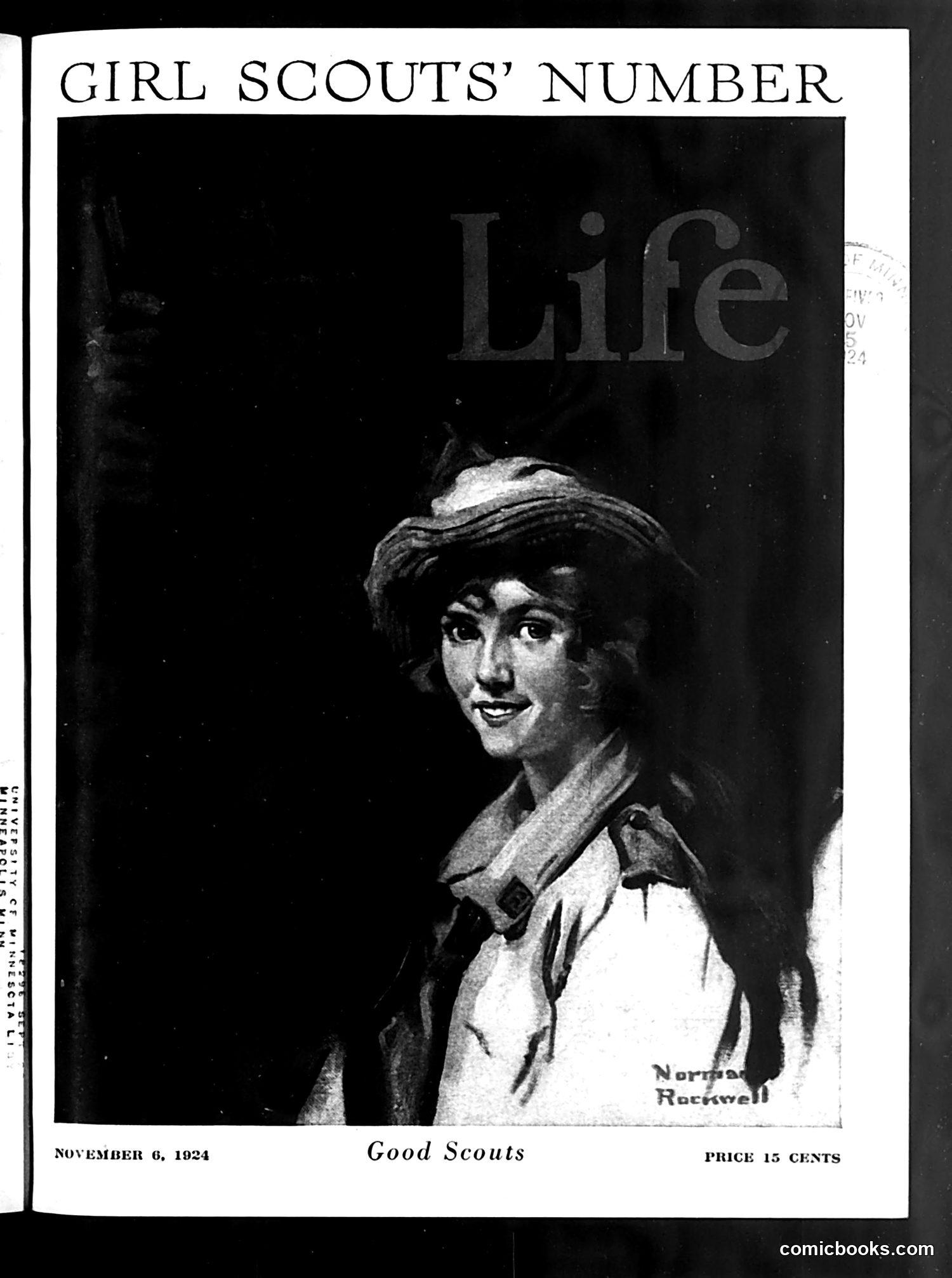
This is the cover of Life magazine's special Girl Scouts issue from November 6, 1924. The illustration is by Norman Rockwell, a renowned American illustrator famous for his depictions of American life and values. The cover features a young Girl Scout in uniform—complete with the characteristic hat, neckerchief, and badge—gazing confidently outward. The artwork celebrates the Girl Scouts organization during a period of significant growth for the youth movement in 1920s America. Rather than satire, this appears to be earnest coverage of the Girl Scouts, reflecting contemporary admiration for the organization's emphasis on character-building, outdoor skills, and civic responsibility for young women. The 15-cent price indicates this was a substantial special issue dedicated to the organization.
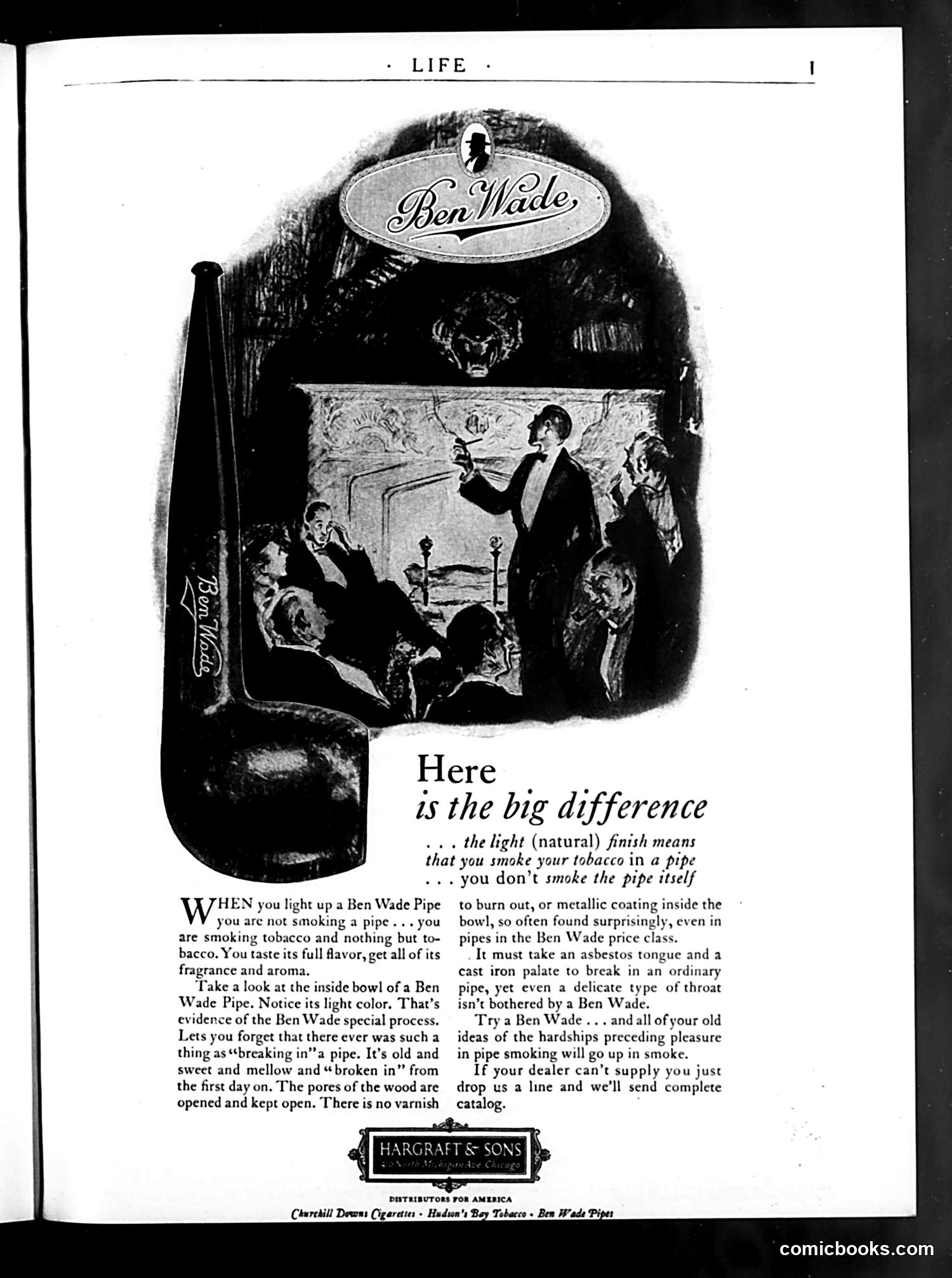
This page is primarily an **advertisement**, not satirical commentary. It promotes Ben Wade brand pipes through Hargraff & Sons distributors. The ad uses an illustration of men in formal attire gathered around a fireplace or social setting, likely depicting the aspirational lifestyle associated with pipe smoking—a gentleman's leisure activity. The text emphasizes that Ben Wade pipes have a "light (natural) finish" and require no varnish coating, positioning them as superior products that taste of pure tobacco rather than pipe materials. The advertisement appeals to male consumers by suggesting pipe smoking represents sophistication and social refinement, common marketing messaging for tobacco products in the early-to-mid twentieth century. The page contains no political satire or caricature—it is straightforward commercial messaging typical of Life magazine's advertising sections.
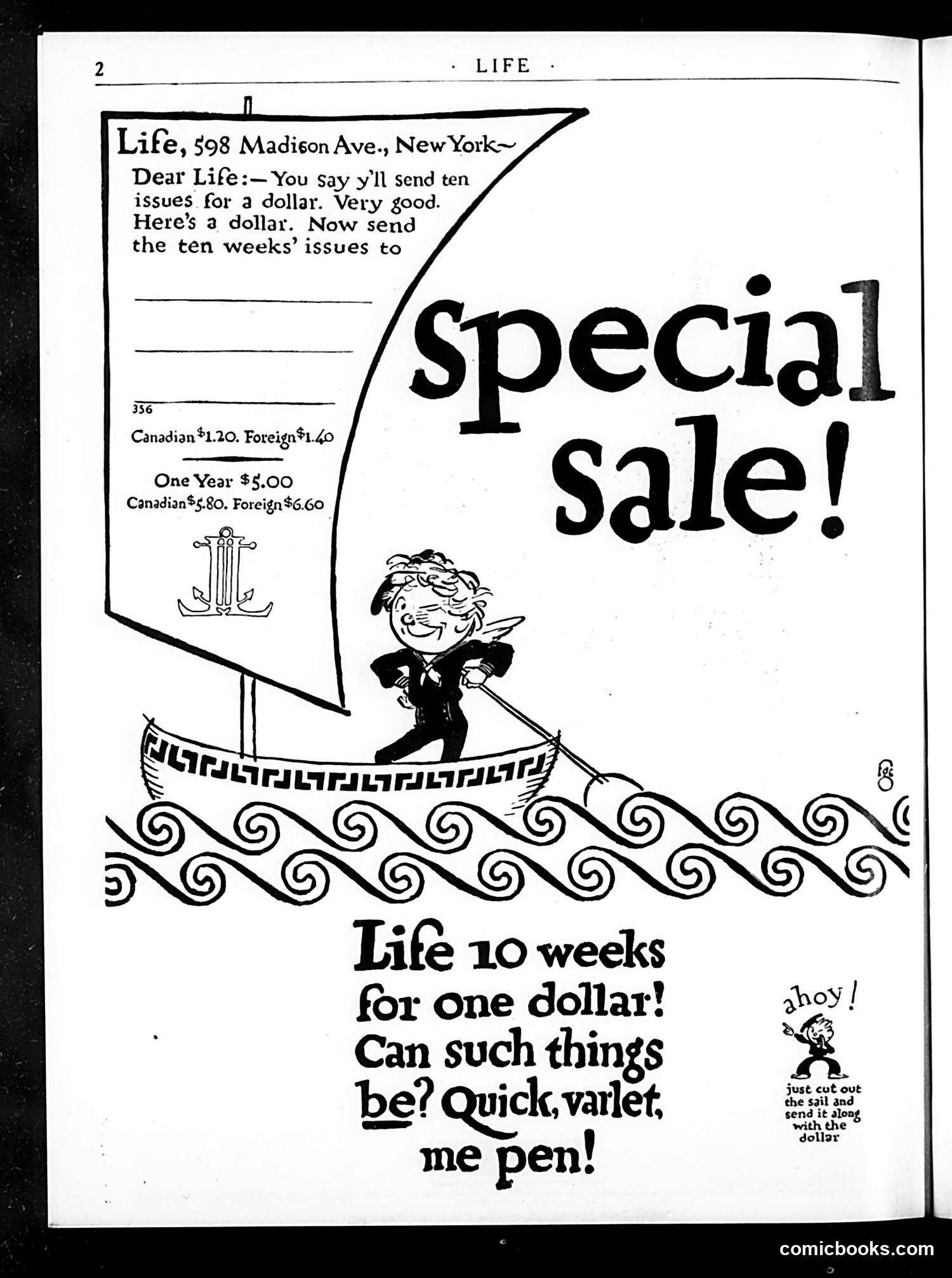
This page is primarily a **subscription advertisement** for *Life* magazine, not political satire. The main visual joke involves a caricatured figure (appearing to be a sailor or messenger) in a boat with Greek key-pattern decoration, enthusiastically promoting the magazine's special offer. The advertisement pitches a subscription deal: 10 weeks of *Life* for one dollar—a notably cheap rate that prompts the exaggerated reaction. The small figure in the bottom right corner reinforces this with "ahoy!" and instructions to "cut out the sail and send it along with the dollar." The Greek/classical maritime imagery and the character's animated excitement are meant to make the subscription offer seem exciting and absurdly good-value. This is straightforward commercial advertising rather than political commentary.
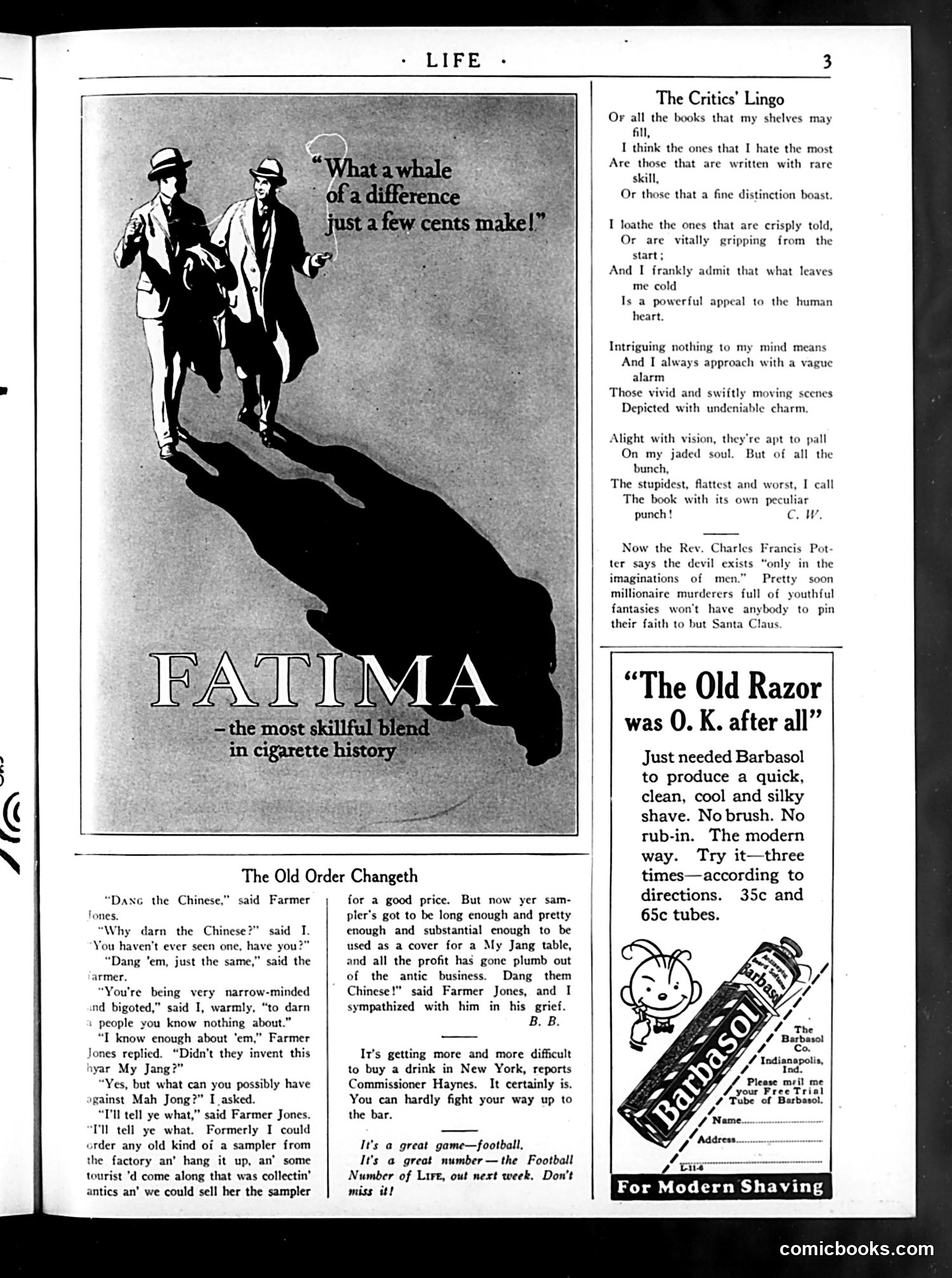
**Main Cartoon - "Fatima":** This advertisement uses a silhouette of a whale to advertise Fatima cigarettes. Two men comment that "a whale of a difference just a few cents make!" The joke plays on the phrase "what a whale of a difference" (meaning significant impact) while literally depicting a whale. This is straightforward advertising using visual pun rather than political satire. **"The Old Order Changeth":** A dialogue satirizes changing attitudes toward Chinese laborers and commerce in New York. Farmer Jones laments that Chinese workers and goods were once cheap and plentiful ("any old sampler"), but now they're scarce and expensive—"the profit has gone plumb out of the native business." The satire critiques economic protectionism and shifting labor/trade dynamics, likely referencing immigration restrictions or tariff debates of the era.
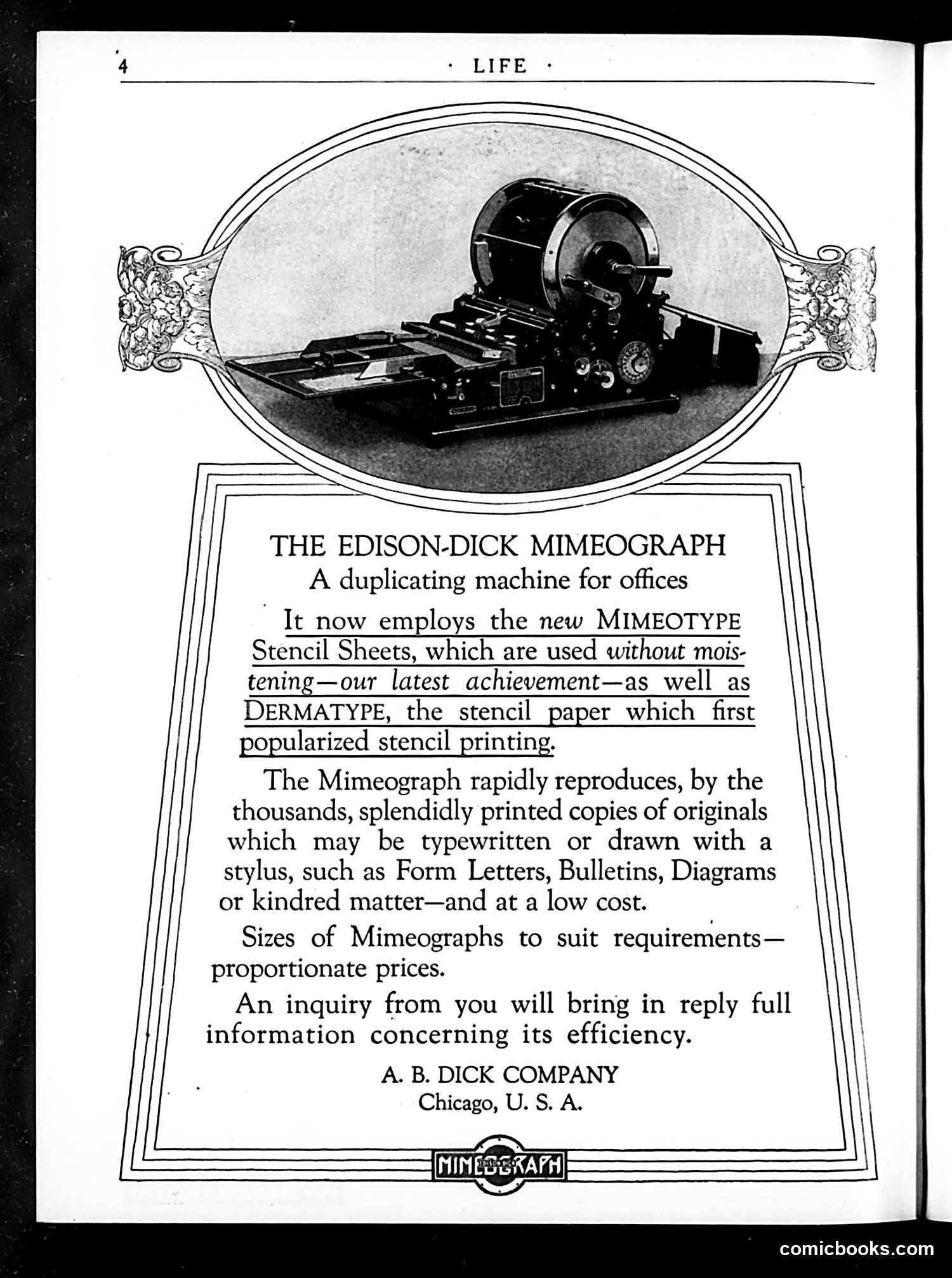
This page is **not a cartoon or satirical content**—it's a straightforward **advertisement** for the Edison-Dick Mimeograph machine, a duplicating device for offices. The ad emphasizes the machine's efficiency: it uses new "Mimeotype Stencil Sheets" that don't require moistening (presented as a recent innovation), and can rapidly produce thousands of copies of typewritten or hand-drawn documents like forms, bulletins, and diagrams at low cost. The ornamental border and product image suggest this targets business managers seeking cost-effective document reproduction. The A.B. Dick Company (Chicago) was a real office equipment manufacturer. For modern readers: mimeographs were pre-photocopier technology for making bulk copies—the predecessors to office machines we now consider obsolete.
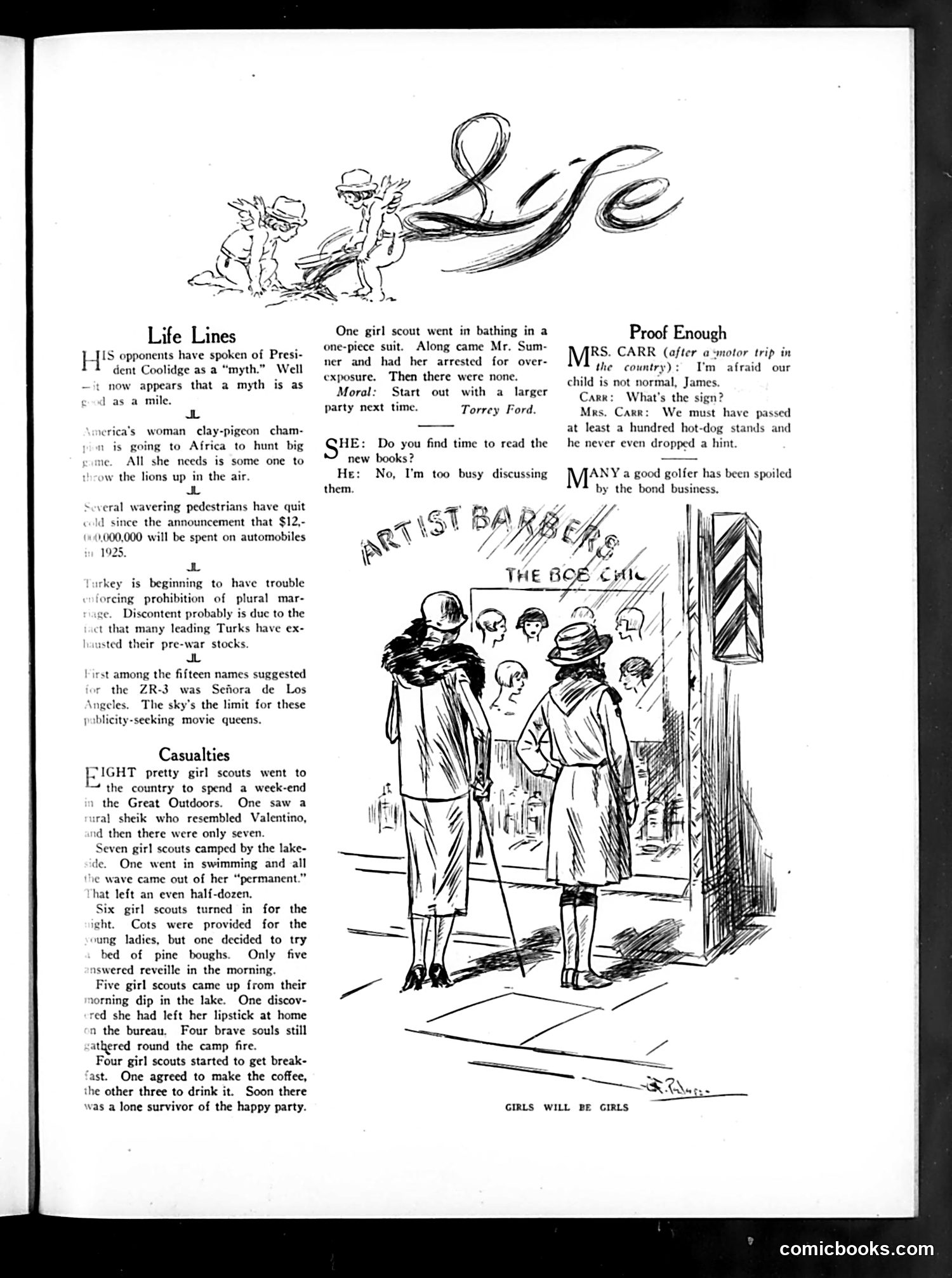
This page contains several humorous short pieces and a cartoon titled "Girls Will Be Girls." The main illustration depicts women outside an "Artist's Barber" shop, satirizing early 1920s women's fashion and social behavior. The "Life Lines" section offers brief jokes about contemporary topics: a myth about President Coolidge, a woman's hunting expedition, automobile spending ($12 million predicted), Turkish marriage law, and Los Angeles as a film industry destination. The cartoon's humor derives from the juxtaposition of women getting practical barber services (haircuts, shaves) at what appears to be a men's establishment—reflecting the era's changing gender norms and women's adoption of shorter, more practical hairstyles in the 1920s, which was considered socially provocative.
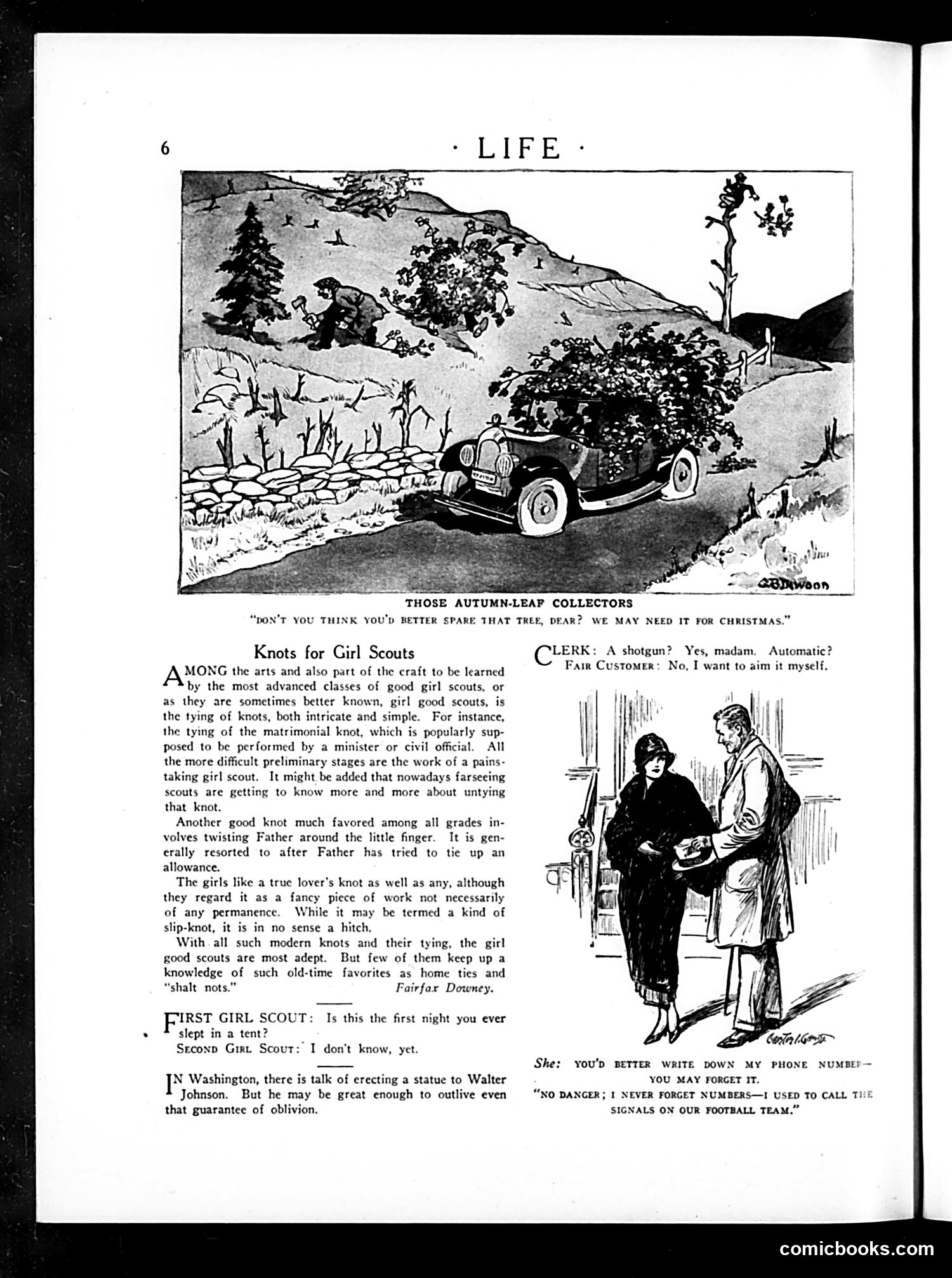
**Top Cartoon: "Those Autumn-Leaf Collectors"** This satirizes a couple in a car loaded with tree branches and foliage. The man suggests sparing a tree because "we may need it for Christmas." The joke mocks the trend of people aggressively harvesting autumn leaves as decorations—apparently so enthusiastically that they're stripping entire trees bare. The cartoon critiques this seasonal decorating practice as excessive and wasteful. **Bottom Section: "Knots for Girl Scouts"** An instructional article teaching girl scouts knot-tying skills, presented as legitimate craft education. A separate cartoon jokes about a woman reluctant to share her phone number with a man at what appears to be a gun shop, referencing outdated telephone etiquette and male persistence in courtship.
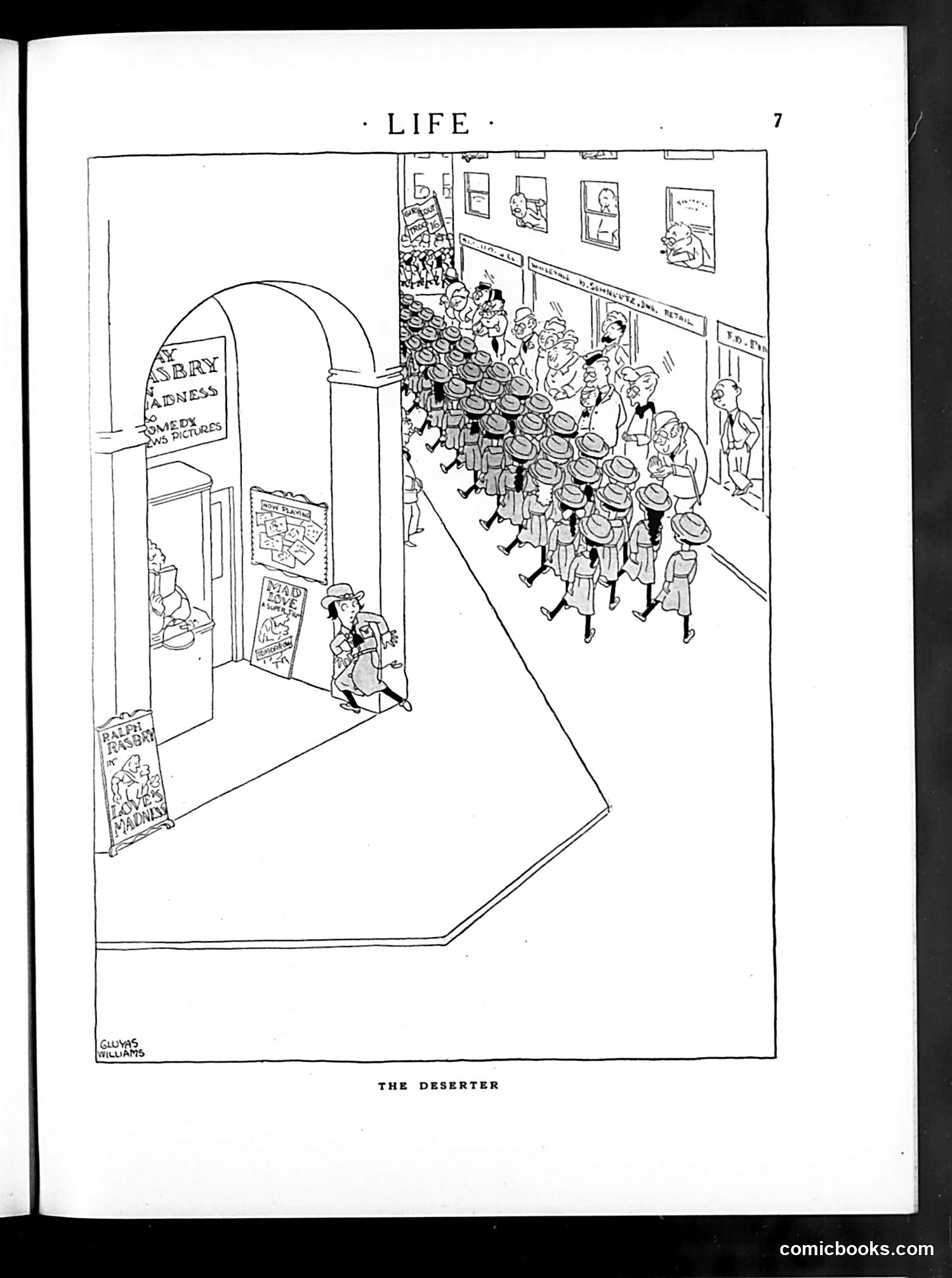
This cartoon by Gluyas Williams depicts a street scene where a large crowd of men wearing hats marches in formation down a street, while two figures stand outside what appears to be a "Baby Madness" or children's entertainment venue (visible signage on the left). The satire appears to comment on mass conformity or mobilization—the organized parade of identically-dressed men contrasts sharply with the deserter figure who has abandoned the group to pursue frivolous entertainment. The title "The Deserter" suggests criticism of someone abandoning civic duty or expected behavior to indulge in amusement. The specific historical context—whether referencing a particular 1920s-30s social movement, labor action, or military conscription—remains unclear without additional dating information, though the cartoon clearly satirizes the tension between social conformity and individual desire.
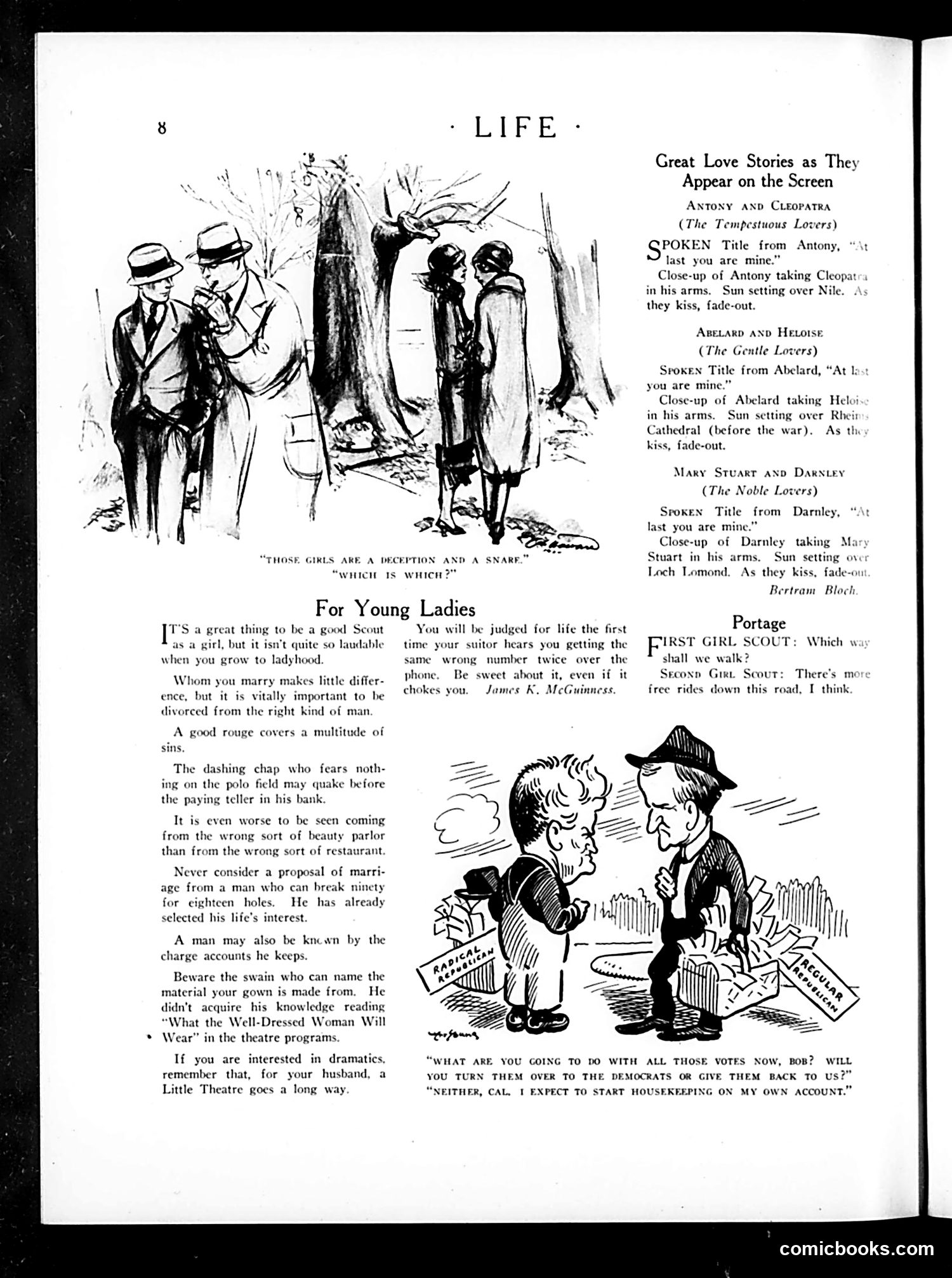
This page from *Life* magazine contains two distinct cartoons. The top illustration depicts two well-dressed men observing a couple embracing near water, captioned "Those girls are a deception and a snare. Which is which?" — a joke about indistinguishable romantic deception. The lower cartoon shows two men in hats exchanging papers labeled "Republican" and "Democrat," with dialogue about redistributing political affiliations: "What are you going to do with all those Democratic votes, Bob? Will you turn them over to the Democrats or give them back to us?" The response jokes about not starting independent housekeeping "on my own account." This satirizes political vote-trading, corruption, or party machine tactics of the era, suggesting politicians casually exchanged voter support regardless of principle.
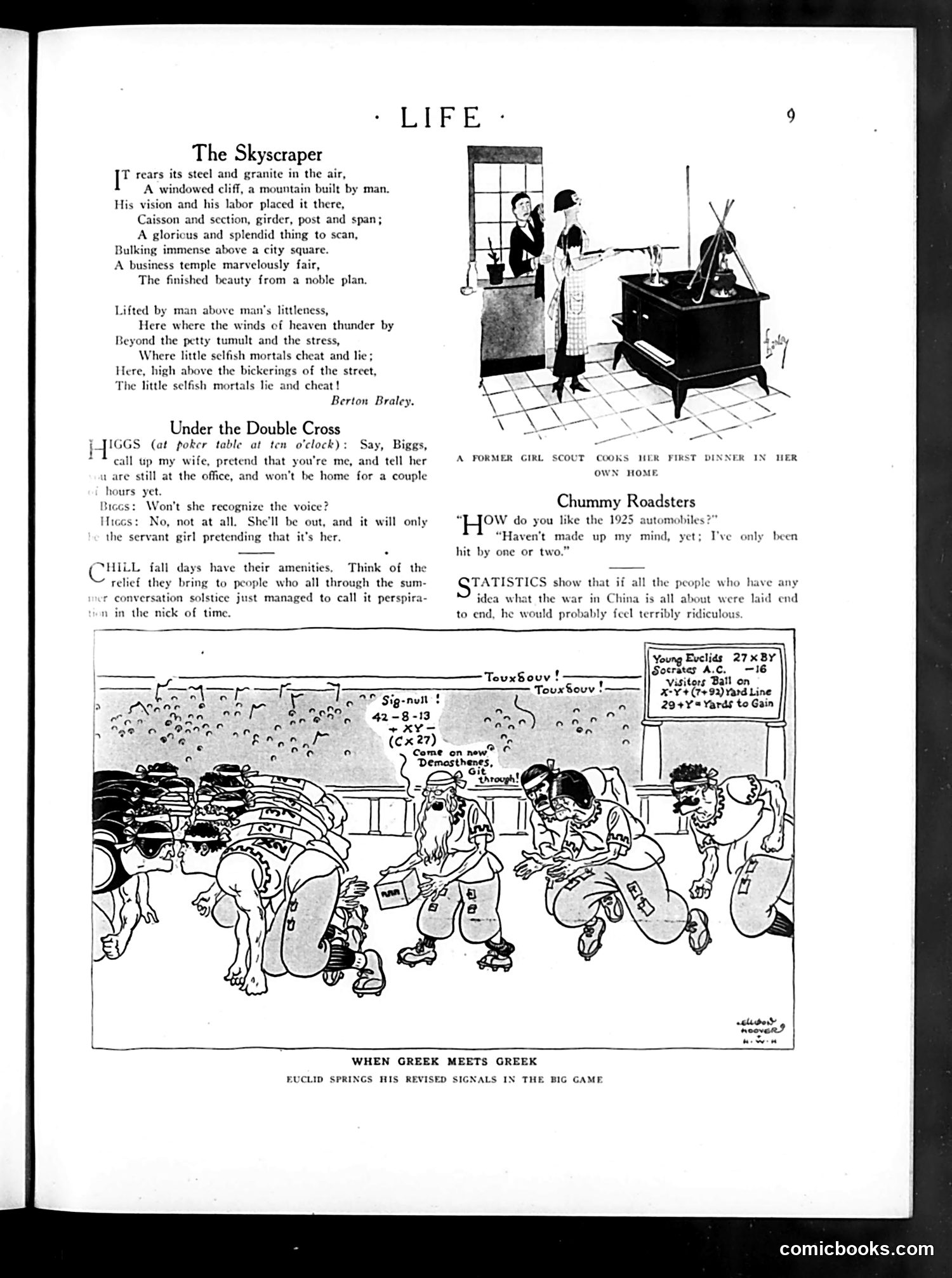
This page contains two main humorous pieces: **"The Skyscraper"** — A poem by Berton Braley celebrating modern architecture and urban achievement, praising the engineering feat of tall buildings rising above city streets. **"Under the Double Cross"** and **"Chunmy Roadsters"** — Brief comedic sketches about domestic life and automobiles, typical of Life's light humor. **"When Greek Meets Greek"** — A cartoon showing football players (indicated by the "Young Euclid" mathematics reference in the scoreboard) using hand signals during a game. The caption indicates this depicts coach Euclid Springs revising signals for the big game, suggesting confusion or deception in athletic strategy—a familiar sports satire theme about coaches outsmarting opponents through signal changes. The overall page reflects 1920s American optimism about progress, technology, and sports culture.
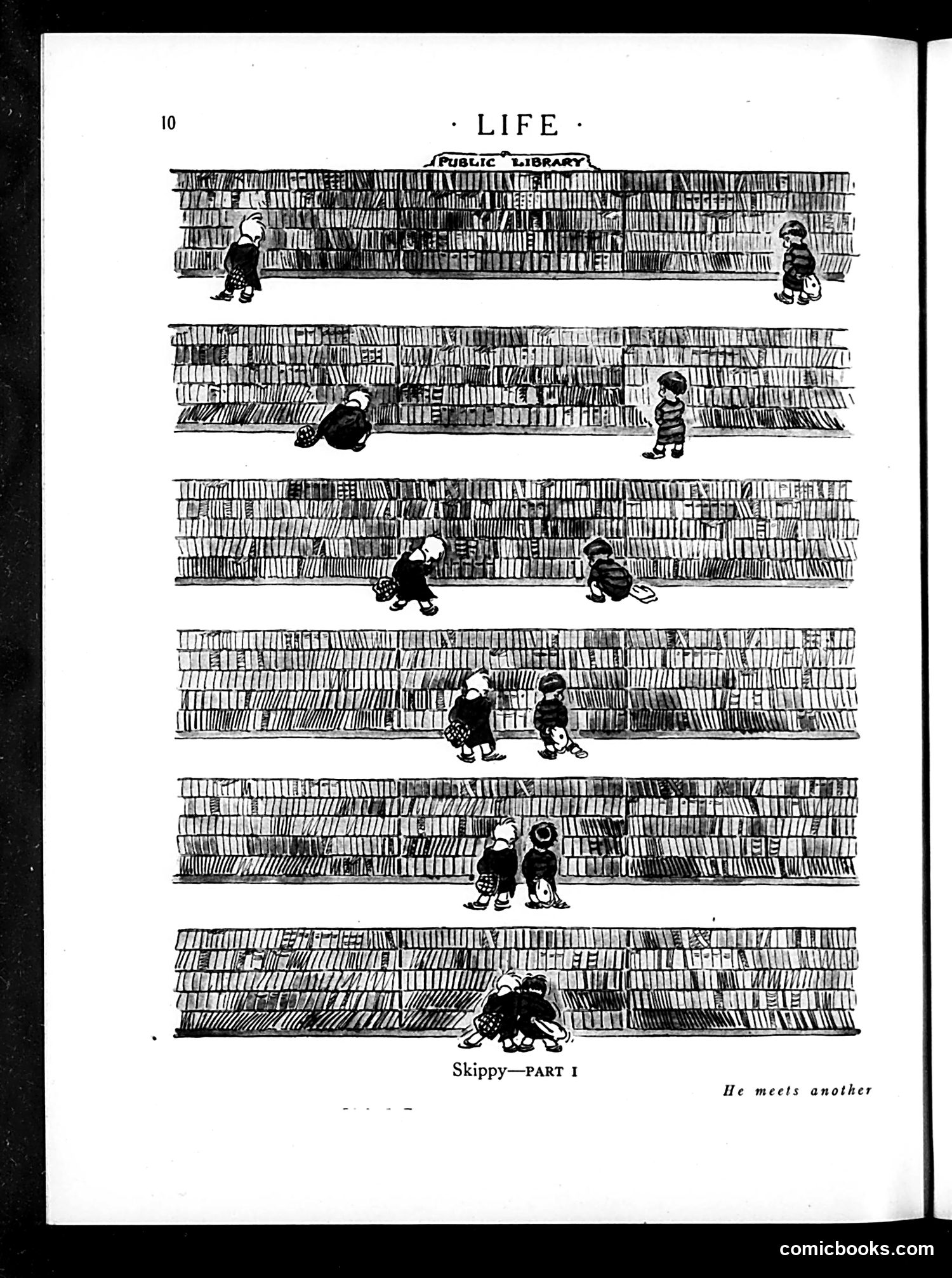
This is a comic strip sequence from *Life* magazine showing two small children encountering each other in front of a public library's towering bookshelves. The strip depicts their initial meeting, separation, and gradual approach across multiple panels. The humor appears to rely on the awkwardness and curiosity of childhood social interaction—how two strangers might cautiously approach one another in a public space. The library setting emphasizes the contrast between the massive, imposing architecture of knowledge and the tiny, timid figures of children discovering each other. "Skippy" was a popular comic strip about childhood adventures. Without additional context, the specific satirical point remains unclear, though it may comment on innocence, curiosity, or social anxiety.
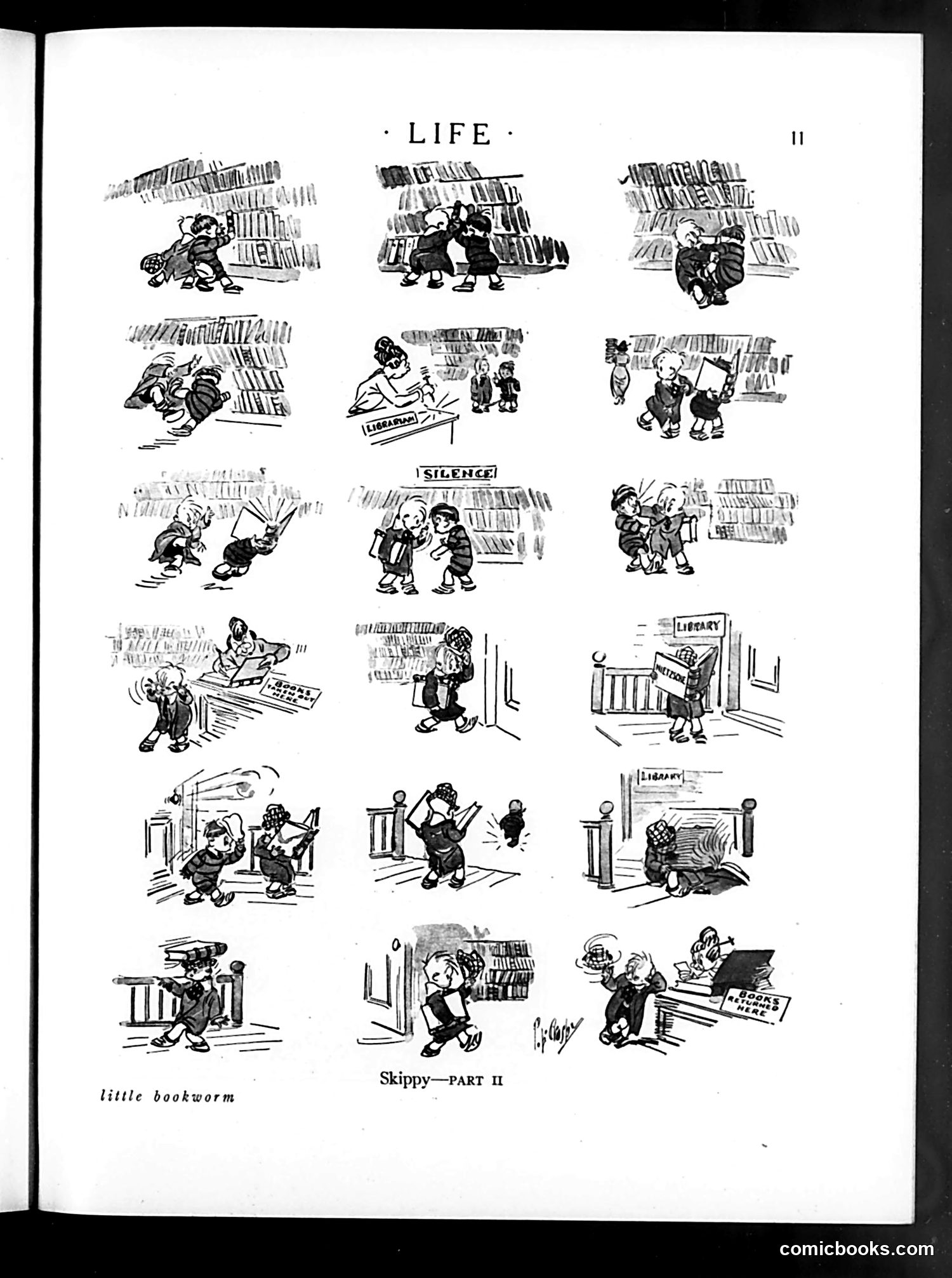
This is a comic strip series depicting a character named Skippy in various library and reading-related scenarios. The strip satirizes children's relationship with books and libraries through physical comedy—Skippy is shown tumbling into bookshelves, creating chaos among organized books, struggling with heavy volumes, and generally causing mayhem in what should be quiet library spaces. The repeated "SILENCE" sign emphasizes the library's strict rules, which Skippy repeatedly violates through energetic, disruptive behavior. The title "little bookworm" appears ironic, as Skippy's actual conduct suggests someone fundamentally unsuited to studious, orderly library life. The satire targets either children's natural restlessness or perhaps 1920s-30s attitudes about literacy and institutional discipline.
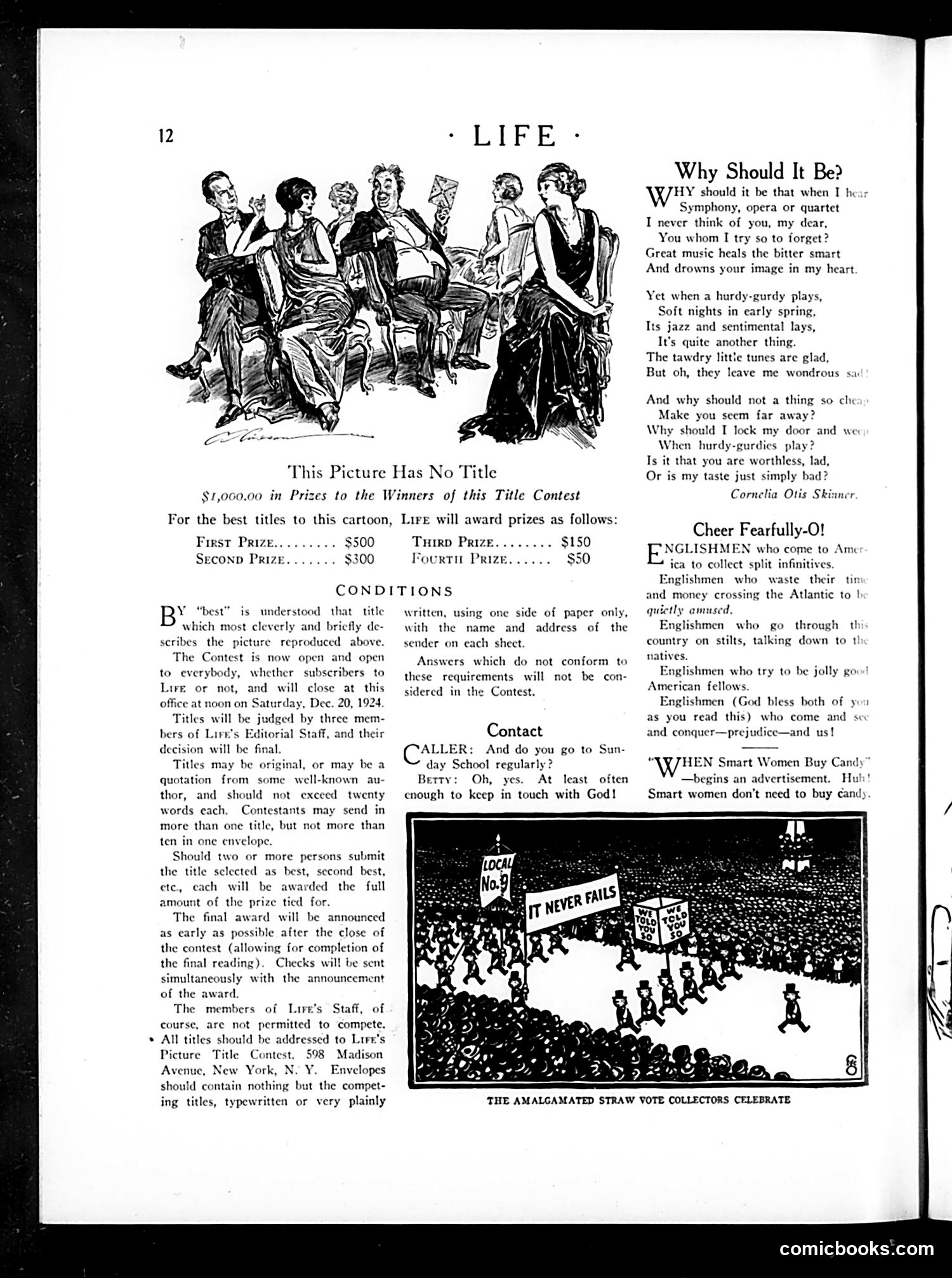
This page contains a **title contest** for the cartoon at top left, showing well-dressed people at what appears to be a social gathering or musical performance. Life magazine is soliciting reader submissions for witty captions, with prizes up to $500. The main cartoon (bottom) depicts "**The Amalgamated Straw Vote Collectors Celebrate**"—a large crowd of people parading with signs reading "IT NEVER FAILS" and other slogans. This appears to satirize **straw polls** (informal public opinion surveys), likely mocking their reliability or the enthusiasm of those conducting them. The era and style suggest this references 1920s-era polling practices, which were often unreliable compared to modern scientific methods. The page also includes unrelated advertisements and brief humor pieces.
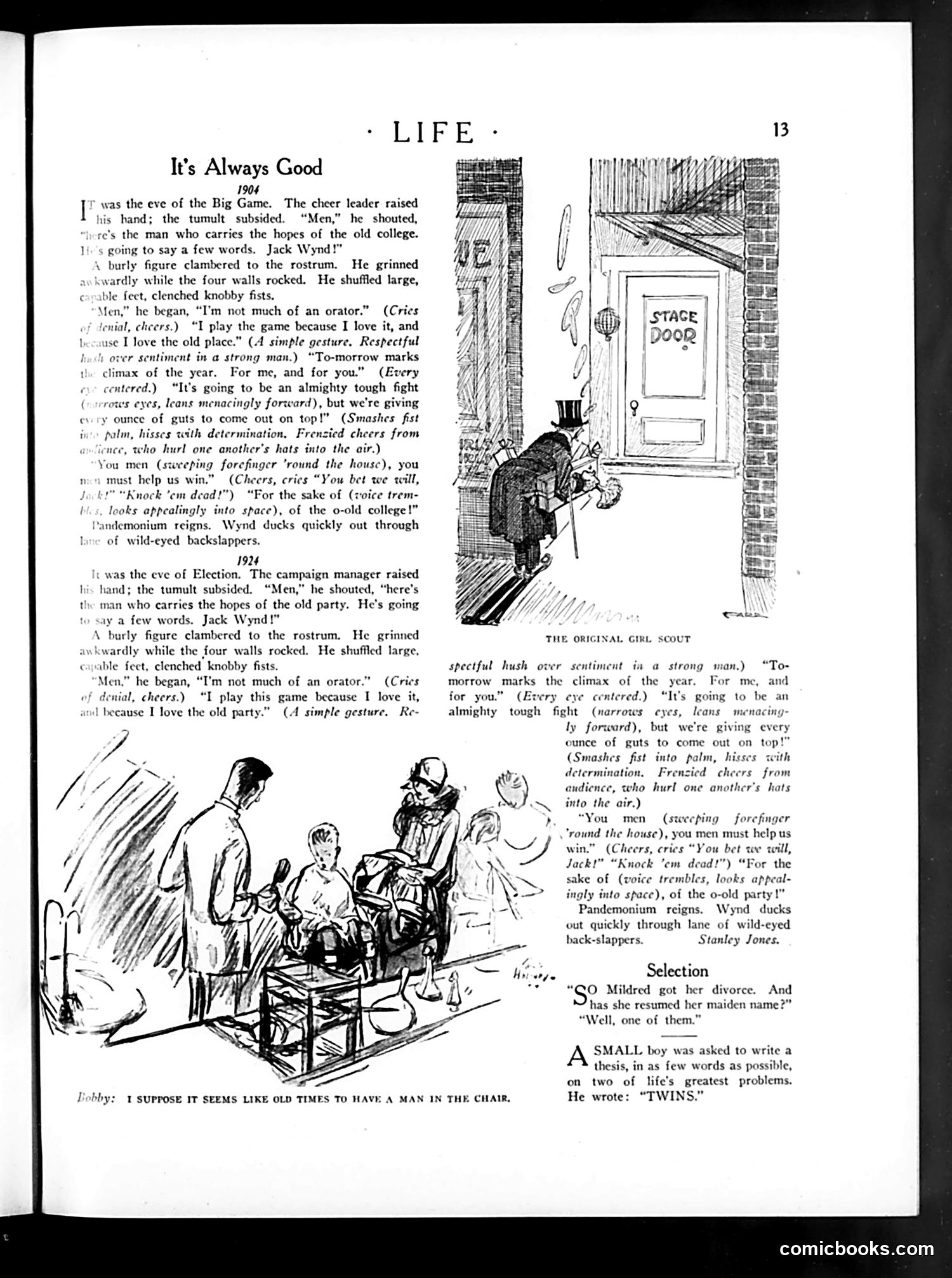
This page contains two distinct pieces of satire: **"It's Always Good" (1904 & 1924):** Two nearly identical cartoon sequences show a figure (Jack Wynd) giving rousing pep talks before major events—first a "Big Game" (college football), then an "Election." The repeated structure satirizes how politicians and organizers use identical inspirational rhetoric regardless of actual circumstances. The joke is that the same hollow motivational speech works in both contexts, suggesting political campaigns cynically mimic sports enthusiasm to manipulate audiences. **"Selection" and "Twins":** These are brief humorous anecdotes. The first jokes about divorce and maiden names; the second presents a boy's absurdist answer to a serious thesis question. These represent Life's lighter satirical content poking fun at human nature rather than specific political targets.
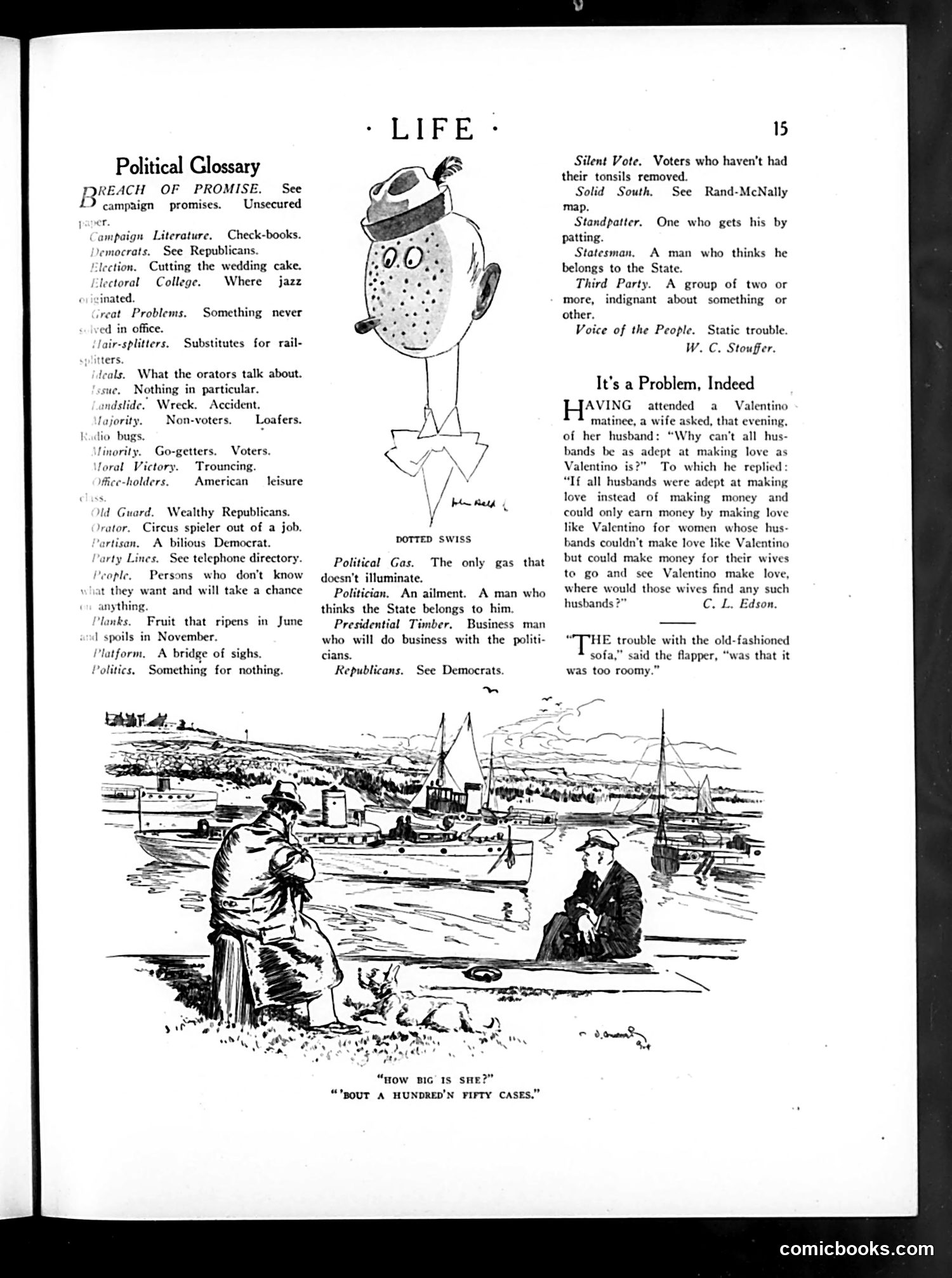
This page combines political satire with humor. The "Political Glossary" on the left mocks American electoral politics through cynical definitions—for instance, defining "Democrats" and "Republicans" as functionally identical, "Majority" as "Non-voters. Loafers," and "Politics" as "Something for nothing." The cartoon labeled "Dotted Swiss" shows a rotund figure spotted with dots, likely satirizing a political figure of the era (unclear which specific person). The lower cartoon, "How Big Is She? About a Hundred 'N Fifty Cases," depicts two figures at a harbor discussing a woman, with the "cases" reference appearing to allude to Prohibition-era bootlegging or smuggling—a major political issue of the 1920s-early 1930s. The satire connects politics, morality, and organized crime.
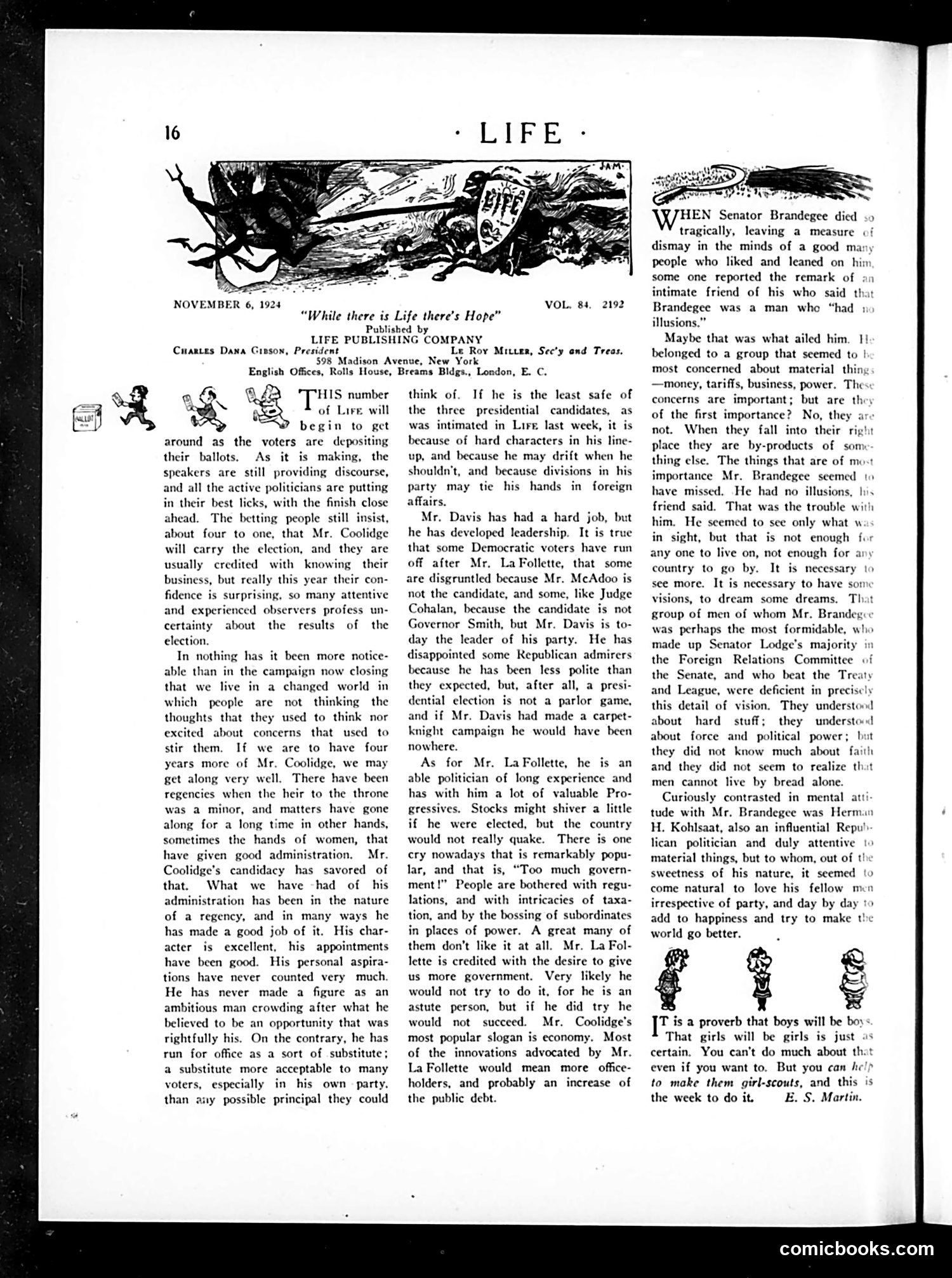
This page analyzes the 1924 U.S. presidential election between three candidates: President **Calvin Coolidge** (Republican), **John W. Davis** (Democrat), and **Robert La Follette** (Progressive). The article assesses each candidate's viability. Coolidge is characterized as a safe "regent" rather than ambitious leader—competent but potentially passive on foreign affairs. Davis, though facing Democratic defections to La Follette and disappointment over McAdoo and Smith not being nominated, has demonstrated actual leadership. La Follette, an experienced politician with Progressive support, advocates expanded government—directly opposing Coolidge's popular economy platform. The cartoons appear to satirize campaign fervor and voter behavior during the election's final days. The opening illustration and accompanying text suggest the piece is analyzing voter attitudes and the election's uncertain outcome, despite betting odds favoring Coolidge's reelection.
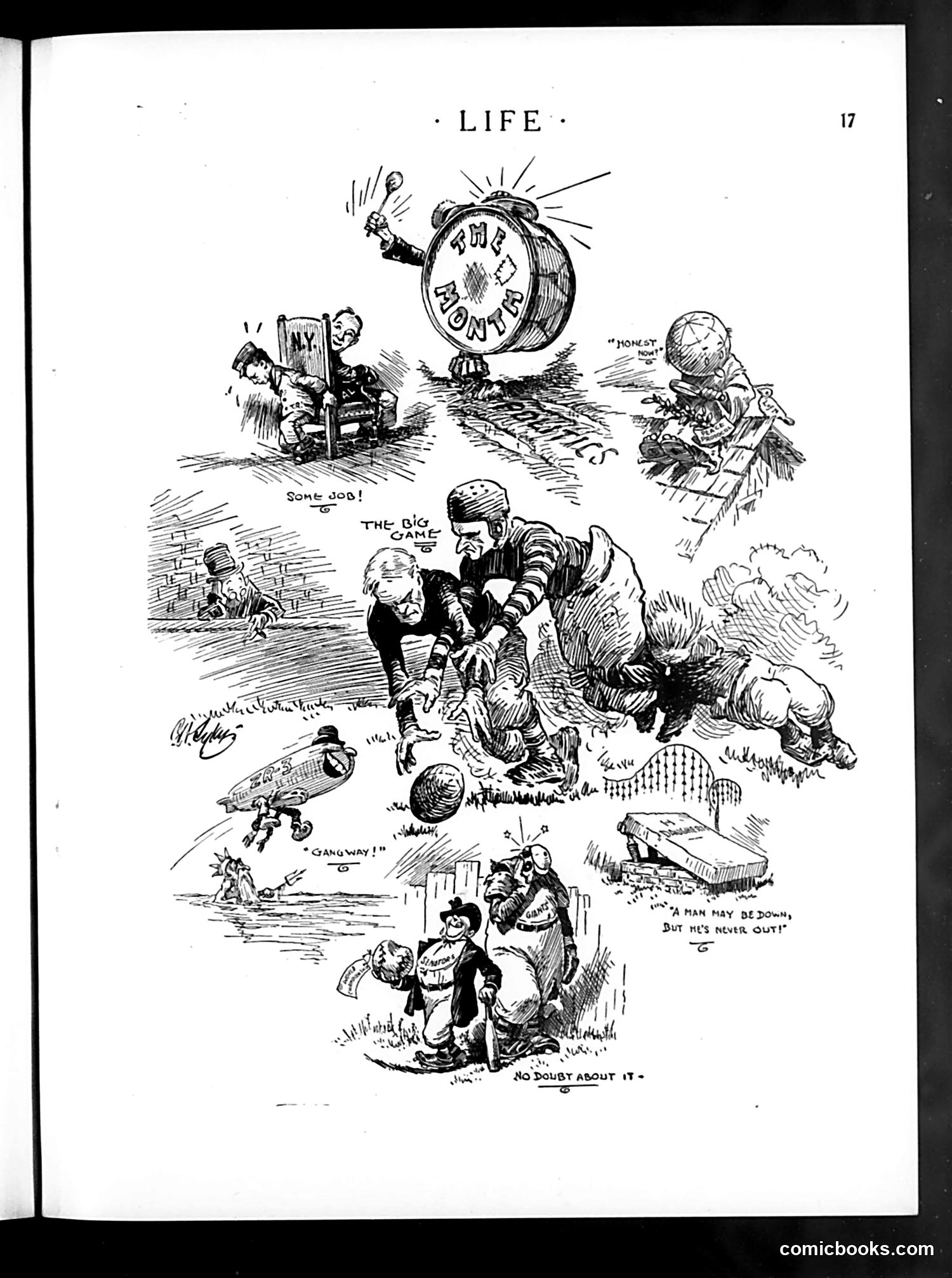
This page presents a satirical collage depicting various aspects of human perseverance and resilience. The central image shows "The Big Game"—adults and children engaged in competitive activities. Surrounding vignettes illustrate different life pursuits: a child at a desk labeled "Some doo!", someone calling "Gangway!", figures pursuing wealth or advancement, and athletic/recreational endeavors. The caption "A man may be down, but he's never out!" conveys the central theme: human determination despite setbacks. The alarm clock at top, labeled "The Prompter," suggests time's relentless pressure driving ambition. The overall message celebrates American optimism and the competitive spirit—the constant struggle and striving that defines "Life" itself. This reflects early-to-mid 20th-century values emphasizing perseverance, individualism, and the perpetual pursuit of success regardless of obstacles.
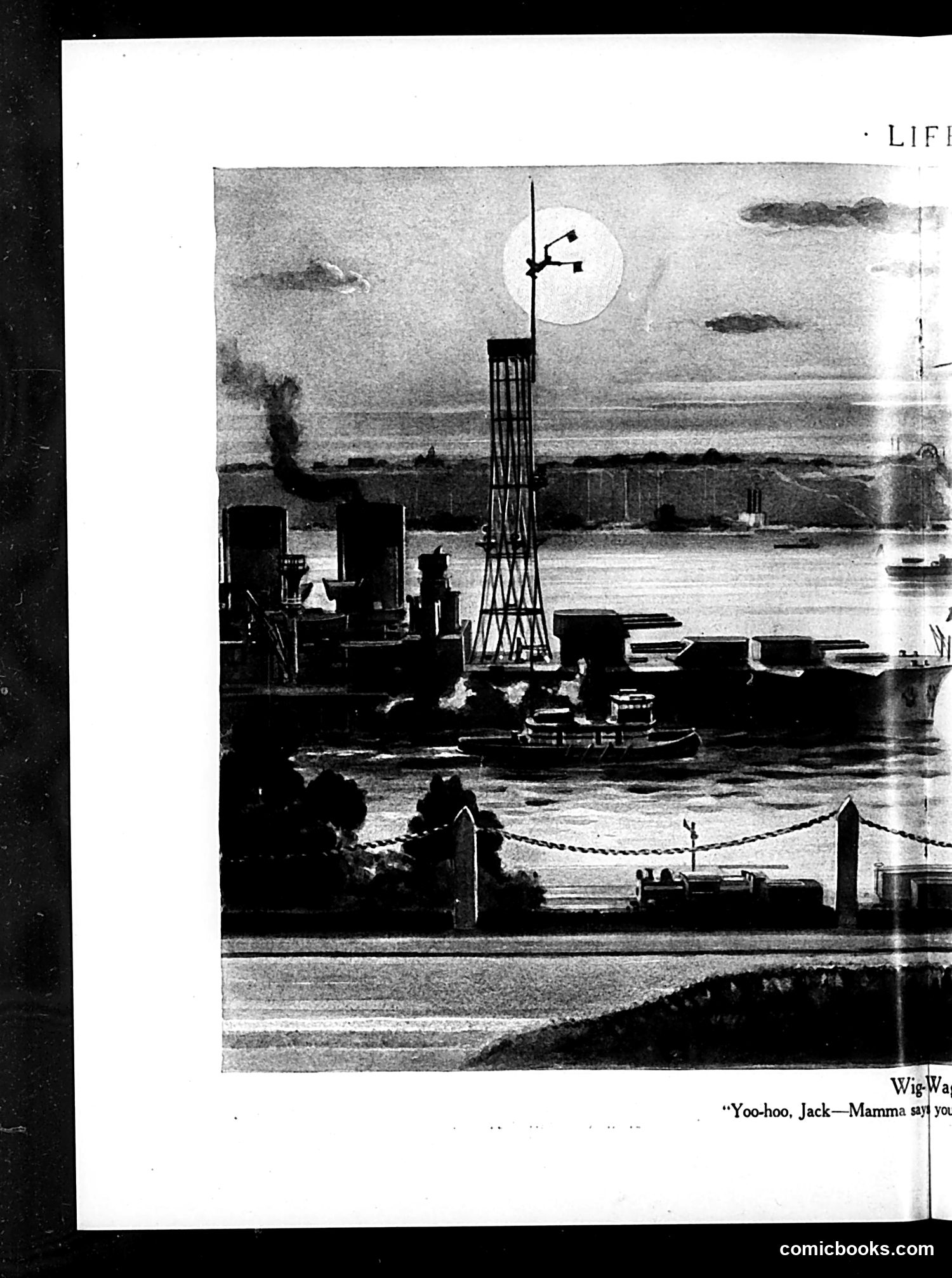
This appears to be a Life magazine cartoon depicting an industrial or maritime scene. A tall lattice tower with a clock dominates the composition, positioned on what looks like a dock or waterfront facility. Various boats and industrial structures surround it. The incomplete caption reads "Yoo-hoo, Jack—Mamma a[sks] you," suggesting domestic humor—likely a wife calling to her husband at work. The "Wig-Wa" text at bottom is unclear in meaning. Without the complete caption or publication date, the specific satirical target remains uncertain. However, the industrial setting and domestic interruption suggest commentary on workplace distractions or the intrusion of home life into work, a common Life magazine theme. More context would be needed to identify the precise reference or intended joke.
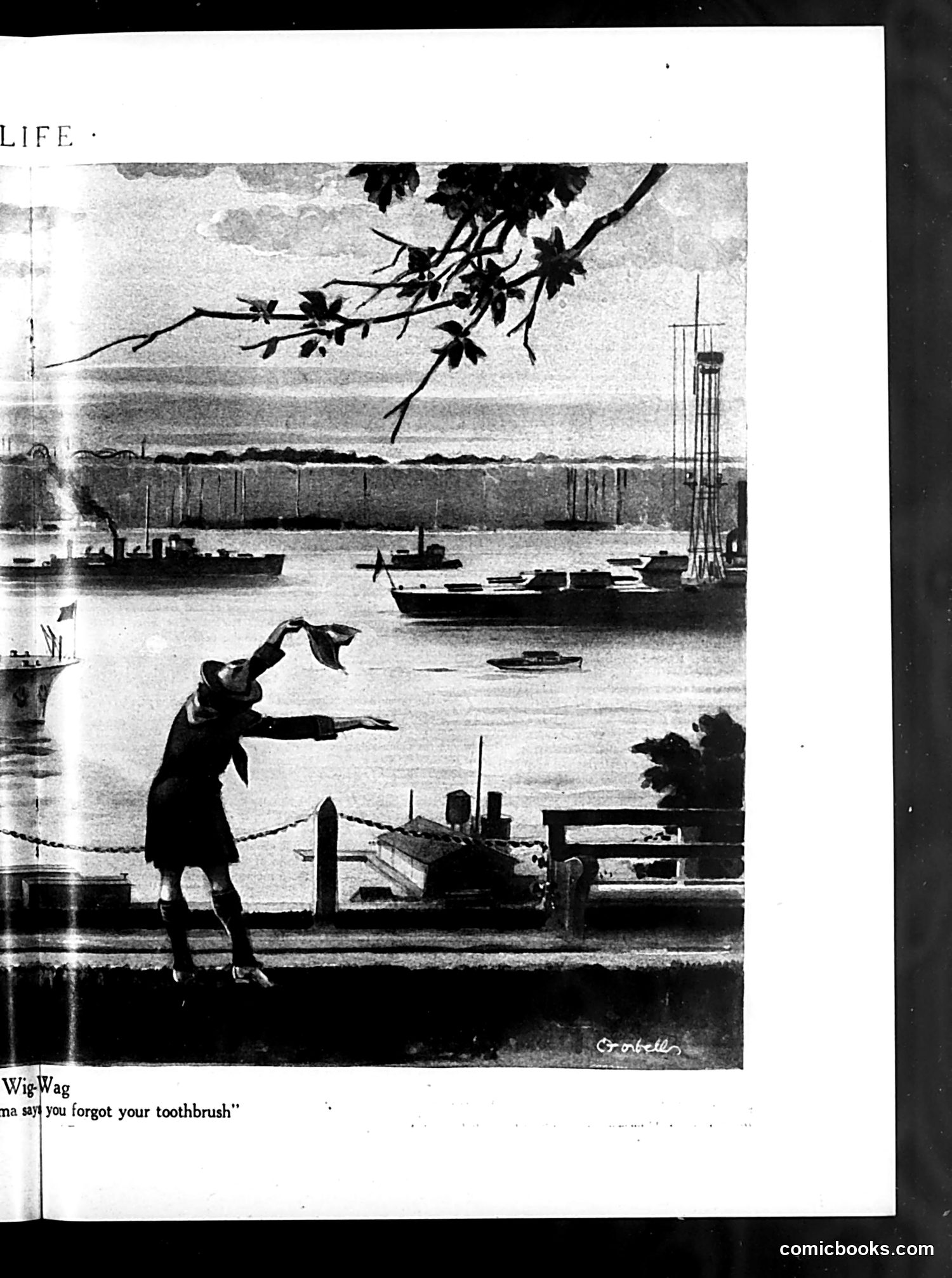
This cartoon depicts a woman on a riverbank waving what appears to be a piece of clothing (possibly a handkerchief or undergarment) toward boats in the water. The caption reads "ma says you forgot your toothbrush." The satire plays on a double meaning: the woman is ostensibly reminding someone they forgot their toothbrush, but her gesture of waving clothing suggests a more suggestive farewell—implying an illicit romantic encounter. The humor relies on the contrast between the innocent stated reason (dental hygiene) and the implied scandalous situation. The riverside setting with departing vessels reinforces the theme of someone leaving hastily. This appears to be early-to-mid 20th century social satire about romantic impropriety and moral looseness, typical of Life magazine's humor style.
This page reviews recent Broadway productions with satirical commentary typical of Life magazine's theatrical criticism. **The Belasco Feud**: The opening section mocks impresario David Belasco's threat to retire from theater after the Actors' Equity Association won labor concessions. Belasco reversed course, producing "Tiger Cats" on October 21—the text wryly notes this wasn't particularly newsworthy despite being front-page material. The satire targets Belasco's ego and theatrical grandstanding. **"Tiger Cats" Review**: The play stars Katharine Cornell, whom the critic praises while making a cheeky observation about her ears being visible—apparently a novelty on NYC stages. The plot involves a "bad wife" trying to prove her husband's love. **Other Productions**: Reviews of "The Firebrand" (starring Joseph Schildkraut and Frank Morgan in a Benvenuto Cellini comedy), "Comedienne," and "Ashes" follow, critiquing performances and scripts with characteristic snark. The text reflects 1920s theater culture: star power, producer egos, and comedic versus dramatic merit.
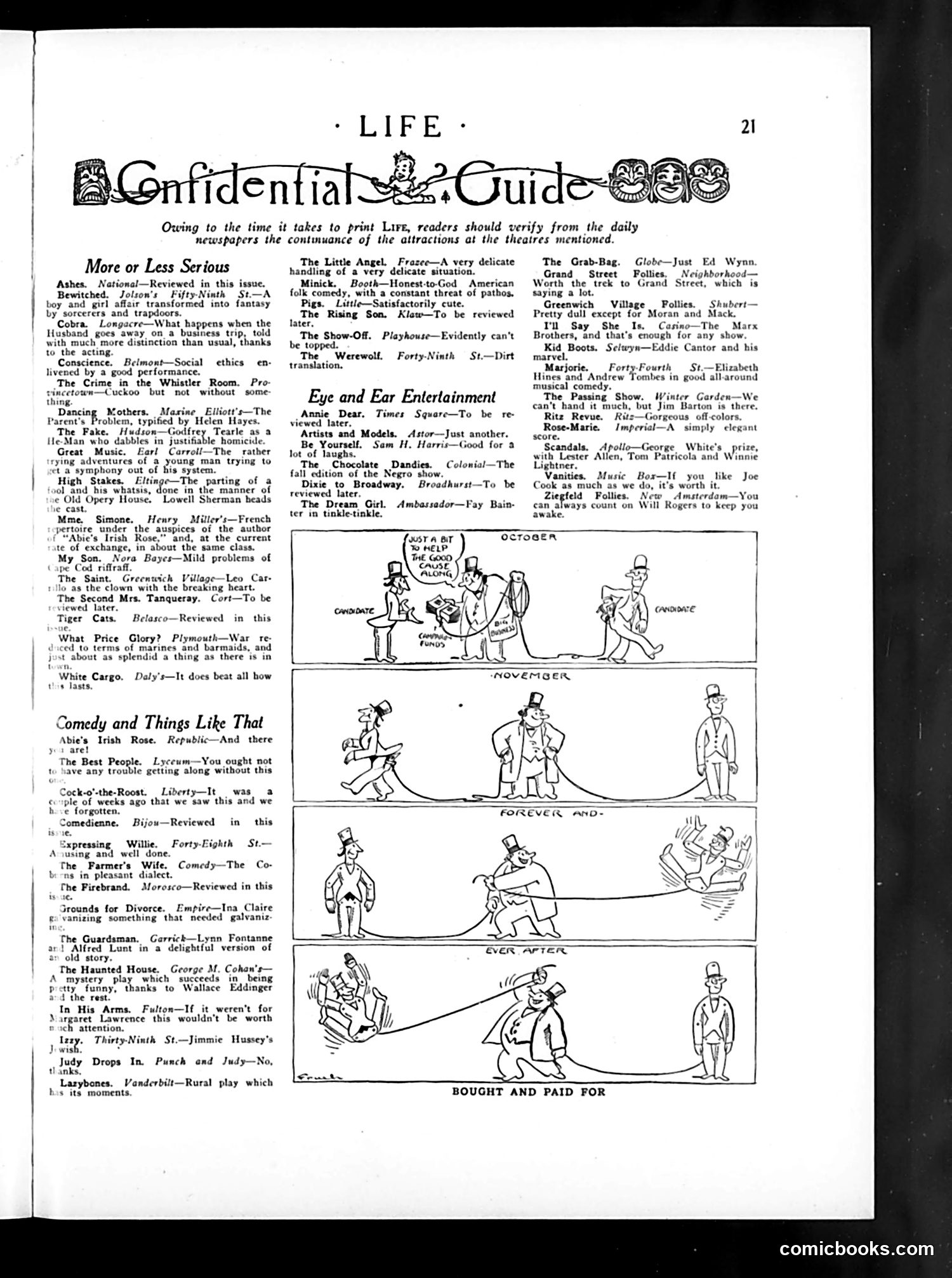
This page is primarily a **theater review guide** for New York City productions, likely from the early 1920s based on references to shows like "Abie's Irish Rose" and "What Price Glory?" The main content consists of two sections: 1. **Text listings** categorizing current Broadway/theater offerings—serious dramas, comedies, and entertainment acts (musical revues, vaudeville-style shows) 2. **Comic strip** titled "Bought and Paid For" (bottom half), divided into four panels labeled October, November, "Forever And—", and "Ever After," showing humorous domestic scenarios between a couple The strip appears to satirize **marriage and relationships**—likely depicting the arc from courtship negotiation through married life's realities. The specific joke requires seeing character expressions clearly, but the structure suggests commentary on how romantic relationships change over time, from transactional ("bought and paid for") to the mundane realities of "ever after." The overall page reflects Life's role as an entertainment guide with integrated humor rather than hard-hitting political satire.
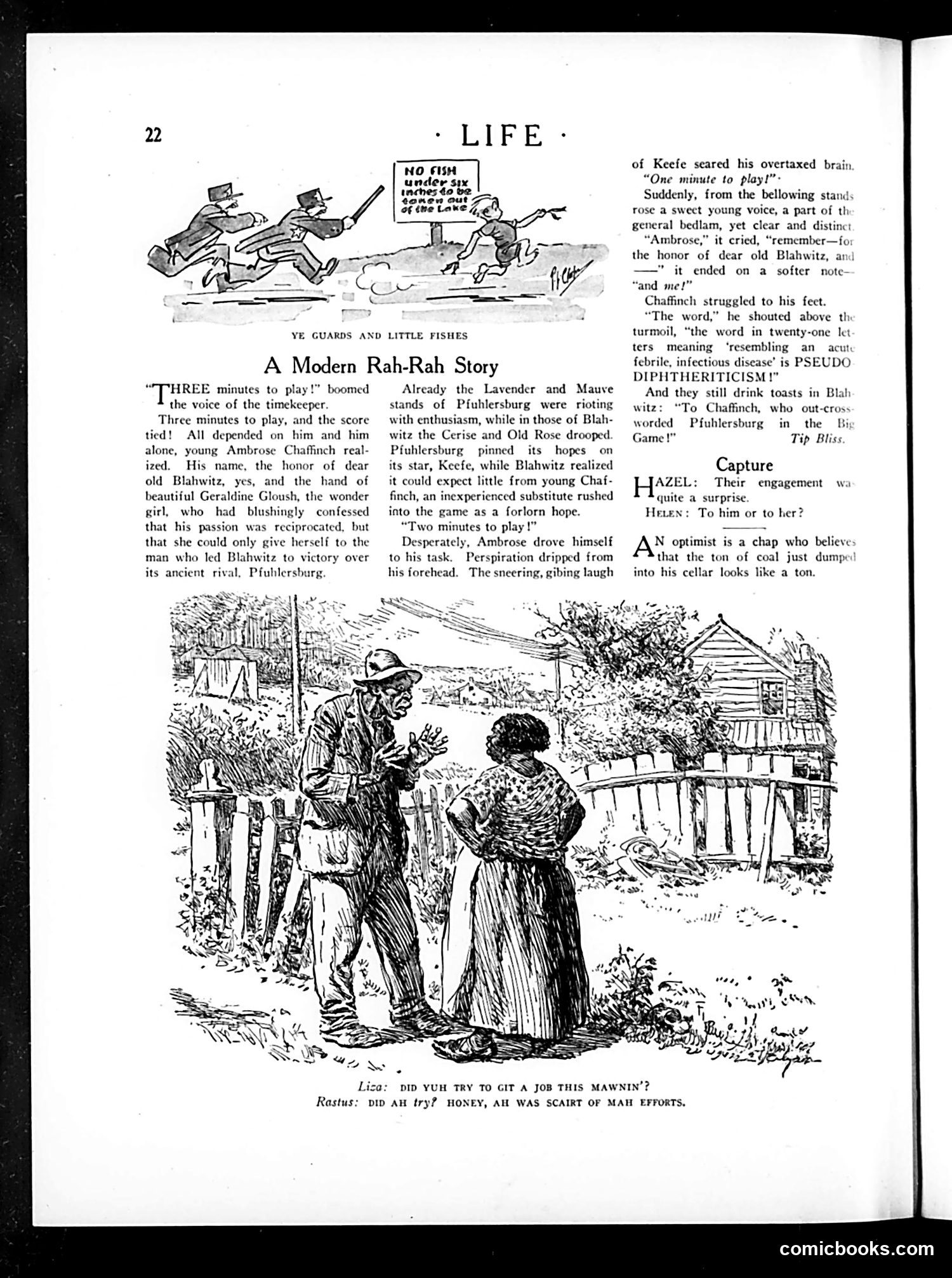
This page contains two satirical pieces from Life magazine: **"A Modern Rah-Rah Story"** (top) parodies overwrought college football drama. It mocks the absurd melodrama of school sports rivalries—where a substitute player's romantic prospects supposedly depend on winning, and his love interest shouts encouragement from the stands. The punchline subverts expectations: instead of athletic heroics, Chaffinch wins by shouting a correct answer to a vocabulary question ("pseudodiphtheriticism") mid-game. The satire targets both the excessive sentimentality around college sports and the pretentious intellectualism of the era. **Bottom section** contains brief jokes mocking racial stereotypes, including a dialogue between characters "Liza" and "Rastus" written in exaggerated dialect. This reflects period-typical racist humor that modern readers would find offensive; it's included here for historical accuracy about what Life published. The cartoons collectively satirize American cultural obsessions: competitive sports mania, romantic melodrama, and the pretentious intellectual posturing of the educated classes.
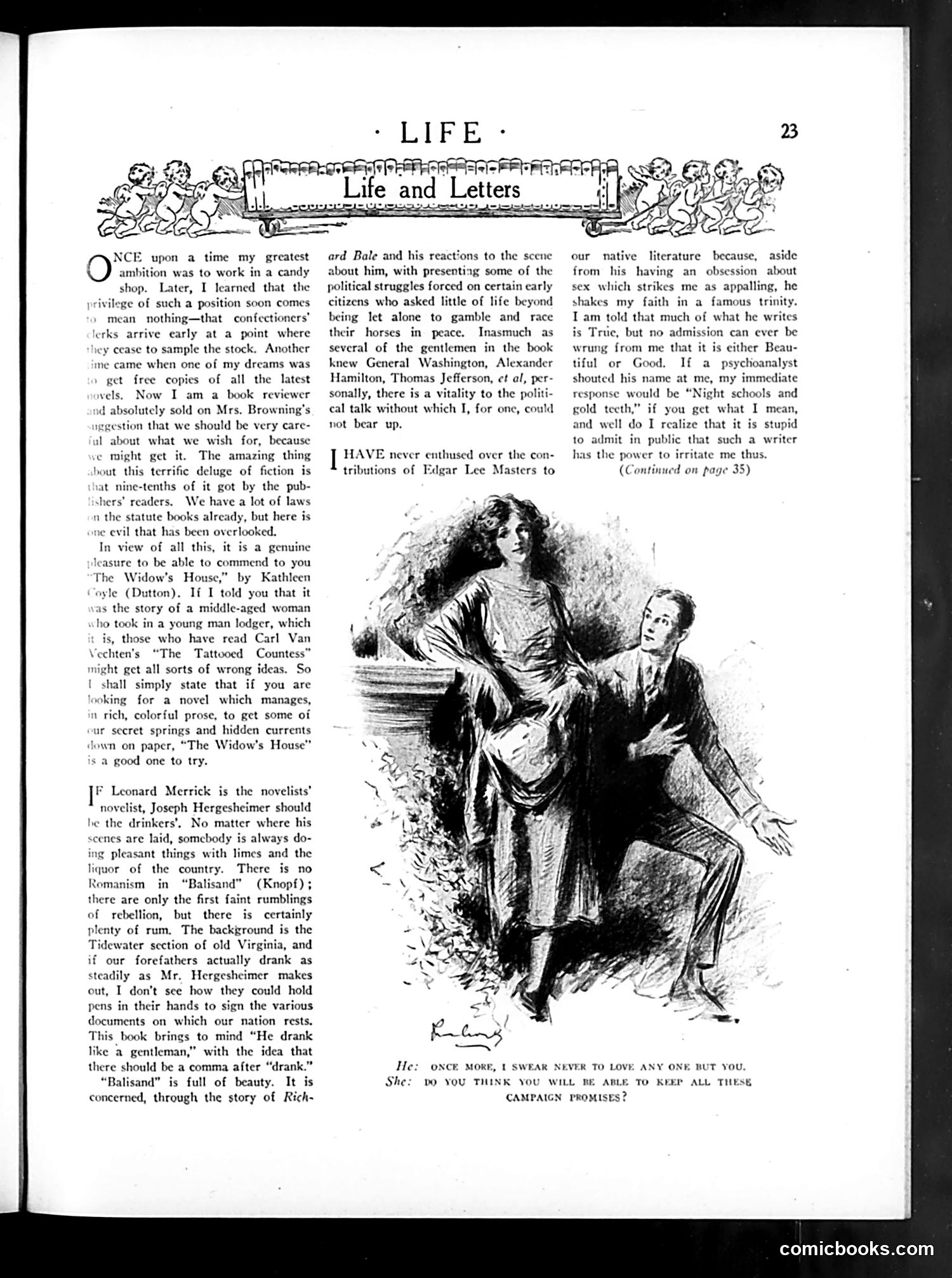
This is a book review column from *Life* magazine discussing contemporary fiction. The main text critiques novels by Kathleen Coyle, Joseph Hergesheimer, and Edgar Lee Masters, praising some while dismissing Masters' work as obsessed with sex and lacking beauty or goodness. The illustration depicts a romantic scene: a woman and man in what appears to be a dramatic moment, with the caption presenting dialogue about fidelity and campaign promises. The joke appears to be a cynical commentary on romantic vows—comparing a lover's promise to keep campaign promises, suggesting both are equally unreliable. This reflects early 20th-century satirical skepticism toward both politics and romantic commitment. The artwork style is typical of *Life*'s illustrated content from this era, using sketch-like technique to accompany literary discussion.
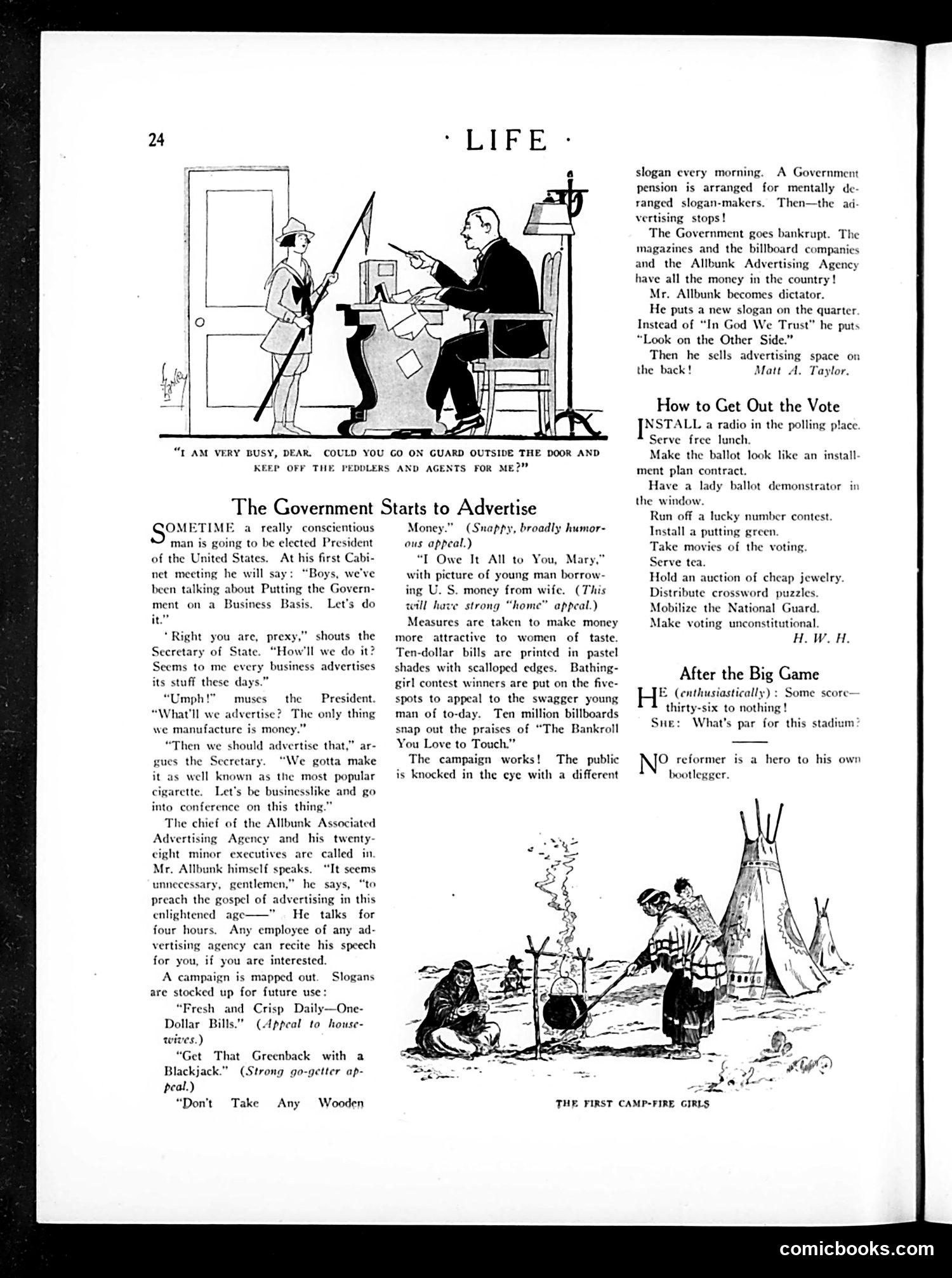
This satirical piece mocks the idea of applying business advertising methods to government—a concept that would have seemed absurd to 1920s readers. The cartoon depicts a newly elected President consulting the fictional "Allbunk Associated Advertising Agency" to market U.S. currency itself, treating money like a consumer product with slogans like "Fresh and Crisp Daily—One-Dollar Bills." The satire's sharp point: once advertising agencies gain control over government finances and messaging, the advertisers become more powerful than government itself. Mr. Allbunk becomes dictator, replaces "In God We Trust" with "Look on the Other Side," and sells advertising space on currency. This reflects genuine 1920s anxieties about corporate consolidation and the emerging power of mass advertising and public relations. The joke warns that treating government like a business enterprise—and ceding control to advertising interests—inverts proper power relationships, making private industry the real authority.
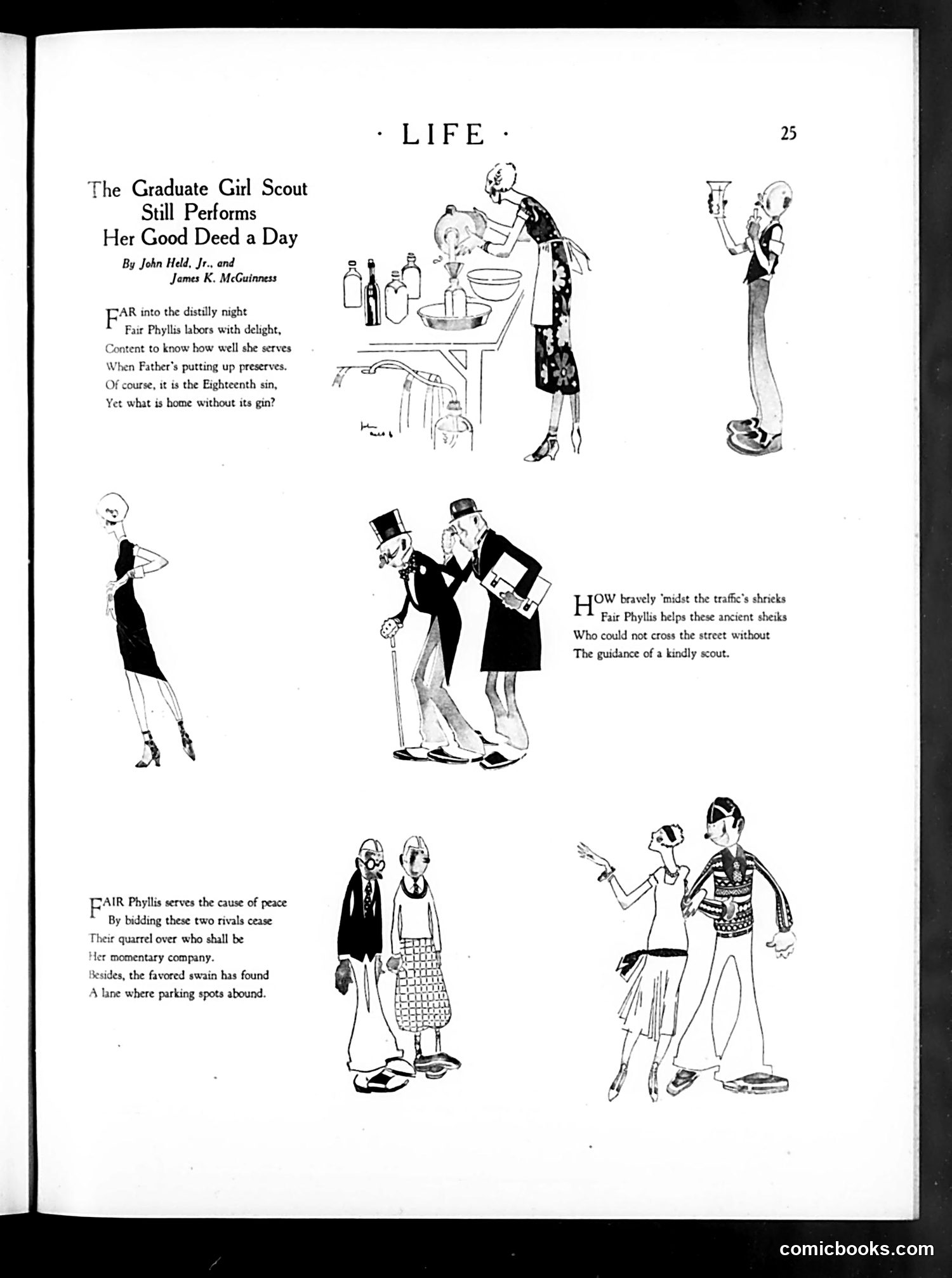
This satire by John Held Jr. mocks the Girl Scout organization by depicting "Fair Phyllis," a grown woman still performing good deeds, in scenarios that reveal social hypocrisies of the 1920s Prohibition era. The humor targets: 1. **Prohibition violation**: She helps her father with gin production ("the Eighteenth sin"—referencing the 18th Amendment banning alcohol), suggesting respectable families openly flouted the law. 2. **Helping elderly men**: She assists "ancient sheiks" (dated slang for older men attempting to seem young/attractive) crossing streets, mocking both their vanity and the absurdity of Girl Scout helpfulness applied to adults. 3. **Romance manipulation**: She resolves rival suitors' competition by offering her "momentary company," with one secured by finding parking—trivializing both courtship and her role as peacemaker. The cartoon satirizes how Girl Scout ideals about service clashed with actual 1920s social behavior among the wealthy.
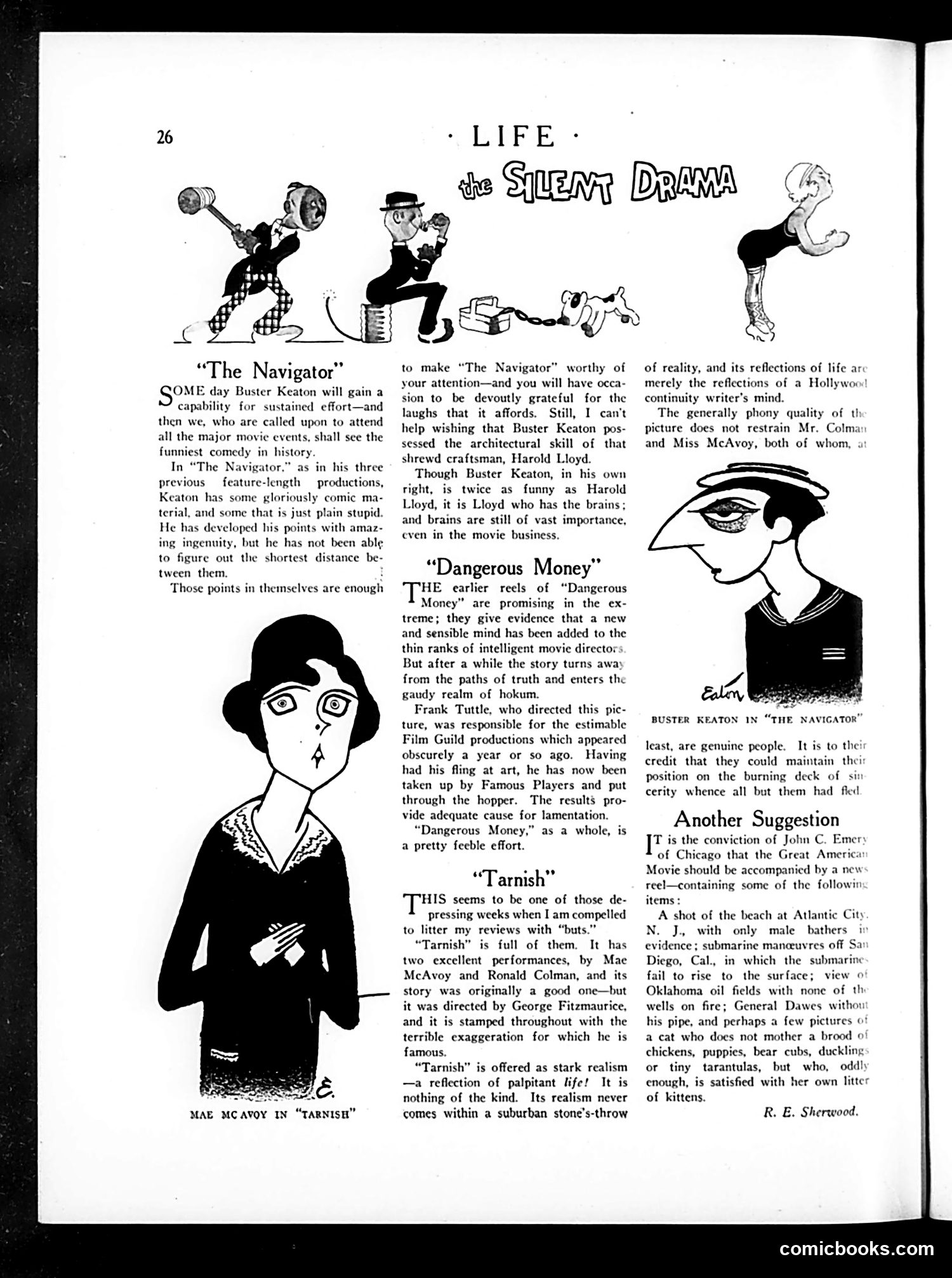
This page contains critical reviews of three 1920s silent films. The critic praises **Buster Keaton's "The Navigator"** for individual comic moments but faults Keaton's overall film structure—contrasting him unfavorably with Harold Lloyd, whom the reviewer sees as possessing superior directorial "brains." **"Dangerous Money,"** directed by Frank Tuttle, begins promisingly but deteriorates into melodramatic "hokum," suggesting Tuttle's commercial studio work (Famous Players) ruined his earlier artistic promise. **"Tarnish"** features strong performances by Mae McAvoy and Ronald Colman but suffers from director George Fitzmaurice's trademark exaggeration. The critic mocks its claim to realism, sarcastically noting it reflects only a "Hollywood continuity writer's mind." The final piece, "Another Suggestion," humorously proposes absurdist film reels—beaches with no bathers, submarines that malfunction—satirizing Hollywood's artificial sentimentality and manipulative conventions.
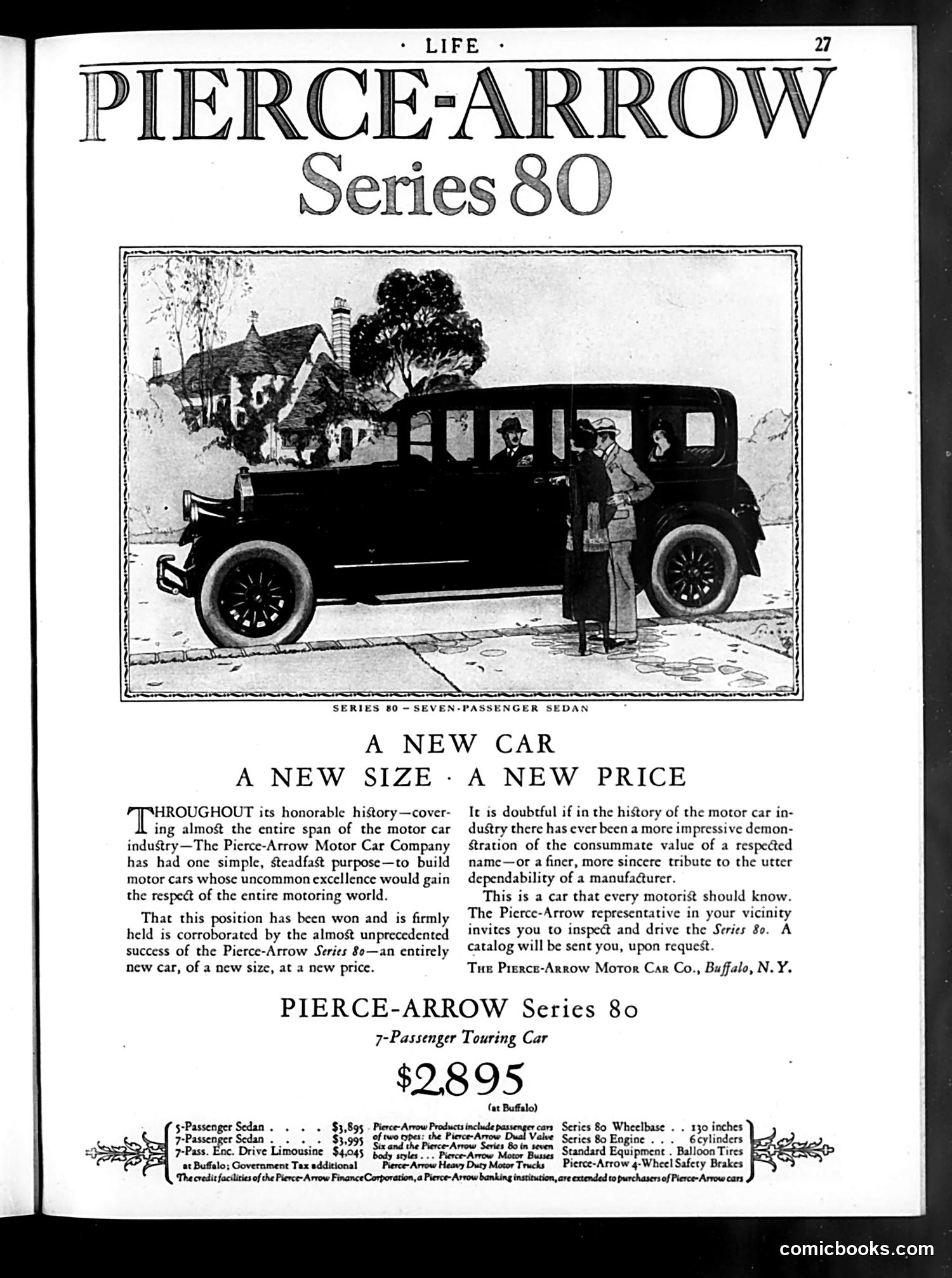
This is a **Pierce-Arrow automobile advertisement**, not a cartoon or satire. It appears on page 27 of *Life* magazine and promotes the Series 80 seven-passenger sedan at $2,895. The ad emphasizes Pierce-Arrow's reputation for quality and dependability throughout the automobile industry's history. The key selling point is that this new model offers "a new size" and "a new price"—positioning it as an accessible option from an established luxury brand, rather than a budget car. The illustration shows a well-dressed couple admiring the vehicle beside a prosperous home, targeting middle-to-upper-class buyers who valued both prestige and value. The technical specifications (6-cylinder engine, 130-inch wheelbase, balloon tires) and financing options indicate the car's modern features for the era. No satire or political commentary is present—this is straightforward period advertising aimed at Depression-era consumers with disposable income.
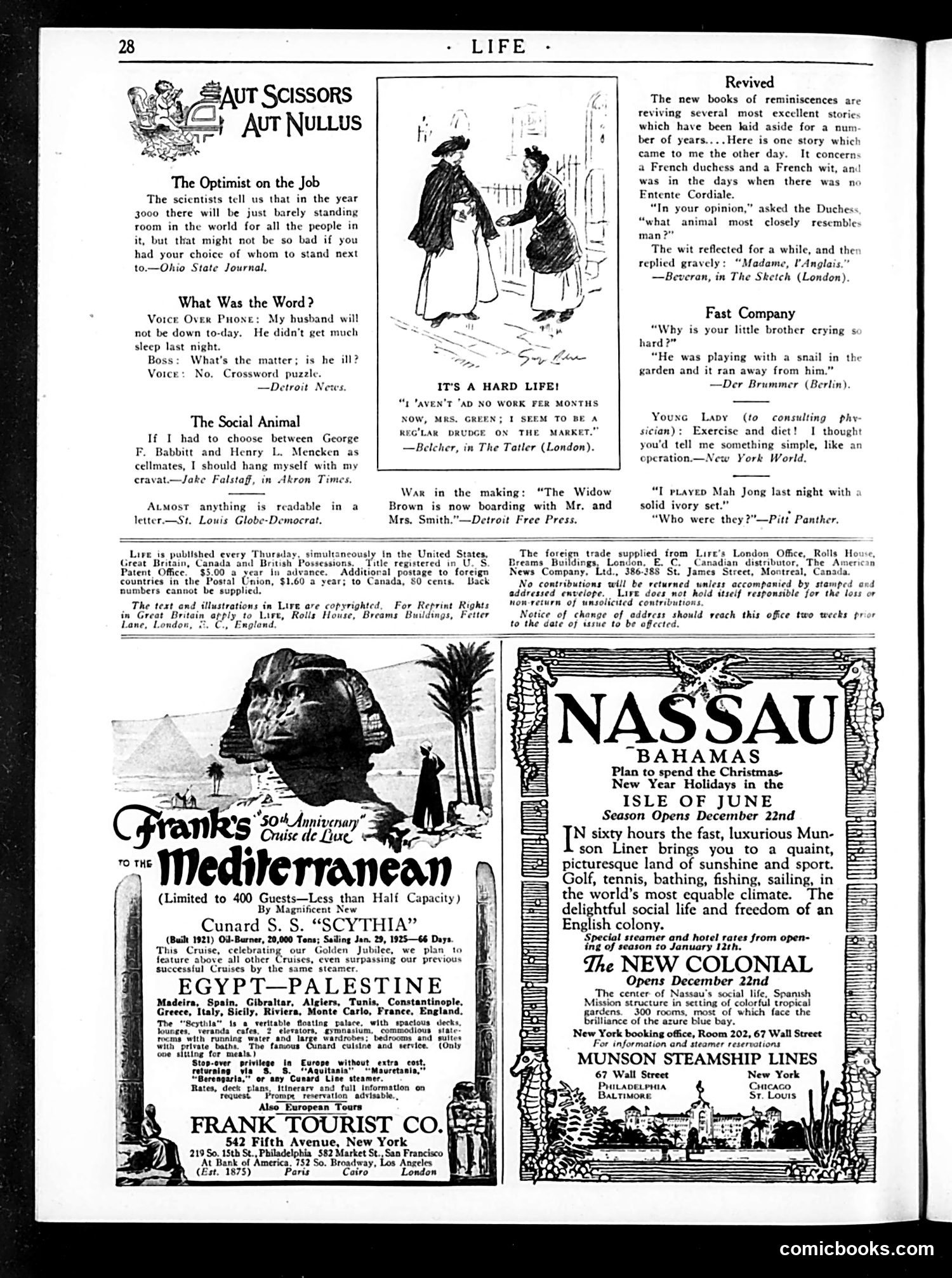
This page is primarily **humorous short jokes and advertisements** rather than political cartoons. The content reflects 1920s American humor and concerns: **The Jokes:** - "The Optimist on the Job" satirizes overpopulation fears (year 3000 prophecy) - "What Was the Word?" mocks the crossword puzzle craze (newly popular) - "It's a Hard Life!" revives old anecdotes; one involves French stereotypes (wit calling Englishmen ape-like) - "Fast Company" uses children's wordplay - "The Social Animal" contrasts social types (Babbitt, a conformist businessman, vs. Mencken, a cultural critic) - Other brief items joke about unemployment, health advice, and Mahjong (an Asian game becoming fashionable) **The Advertisements** promote luxury travel to Nassau and Mediterranean cruises—reflecting Jazz Age affluence and leisure tourism. The page captures 1920s preoccupations: new technologies (phones, puzzles), social anxieties (overpopulation, unemployment), and emerging middle-class entertainment and travel culture.
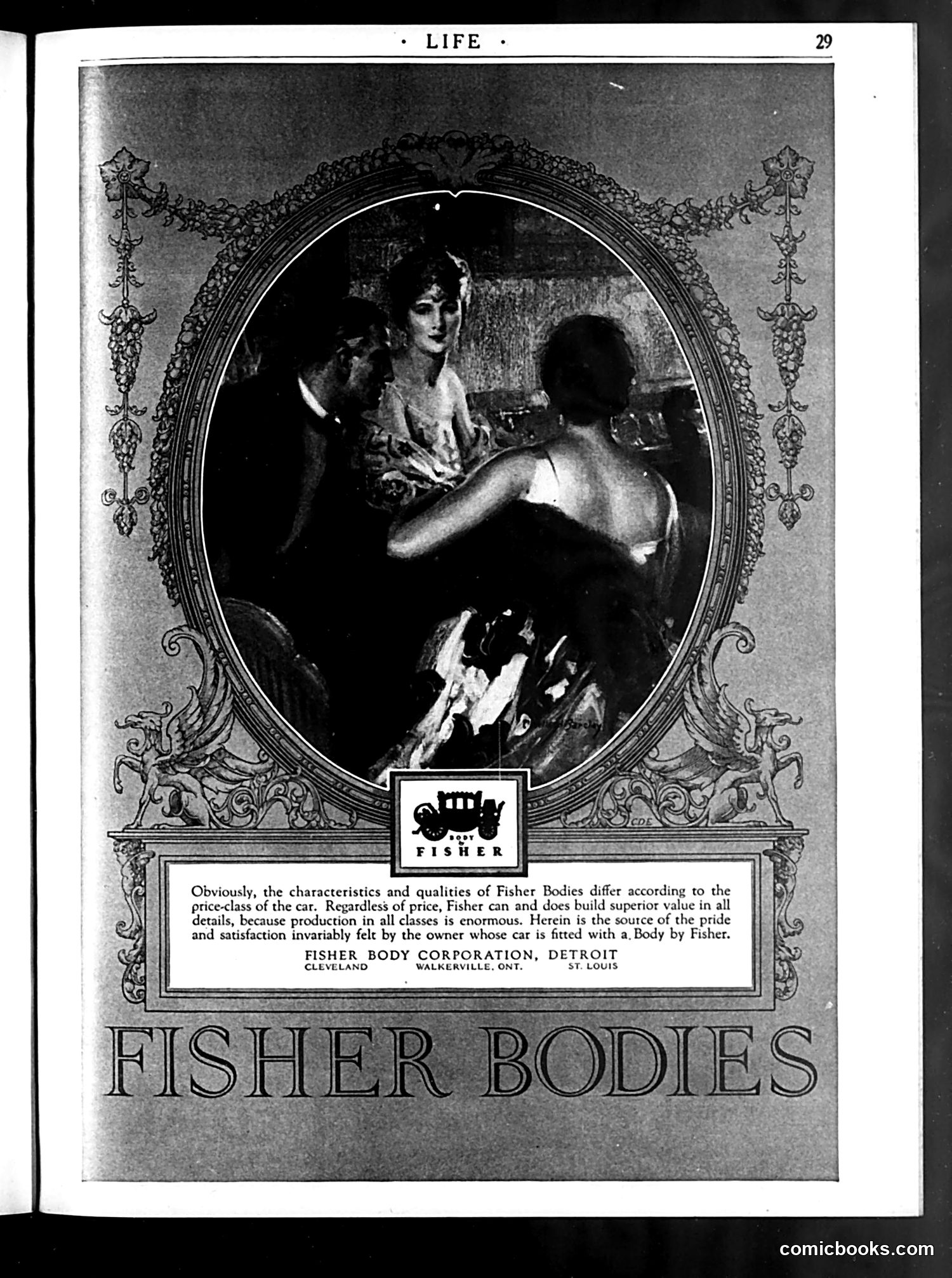
This is a **Fisher Bodies automobile advertisement**, not political satire. The page features an ornate oval-framed illustration of three figures in an intimate scene—apparently meant to evoke classical or romantic imagery. The ad's text claims that Fisher Bodies (car body manufacturer) provides "superior value" across all price classes due to massive production scale. The romantic imagery suggests that owning a Fisher Body-equipped automobile brings prestige and satisfaction to its owner—appealing to aspirational consumers. This represents typical 1920s advertising strategy: associating a utilitarian product (car bodies) with luxury, romance, and social status. The classical frame styling reinforces this upscale positioning for readers of *Life* magazine.
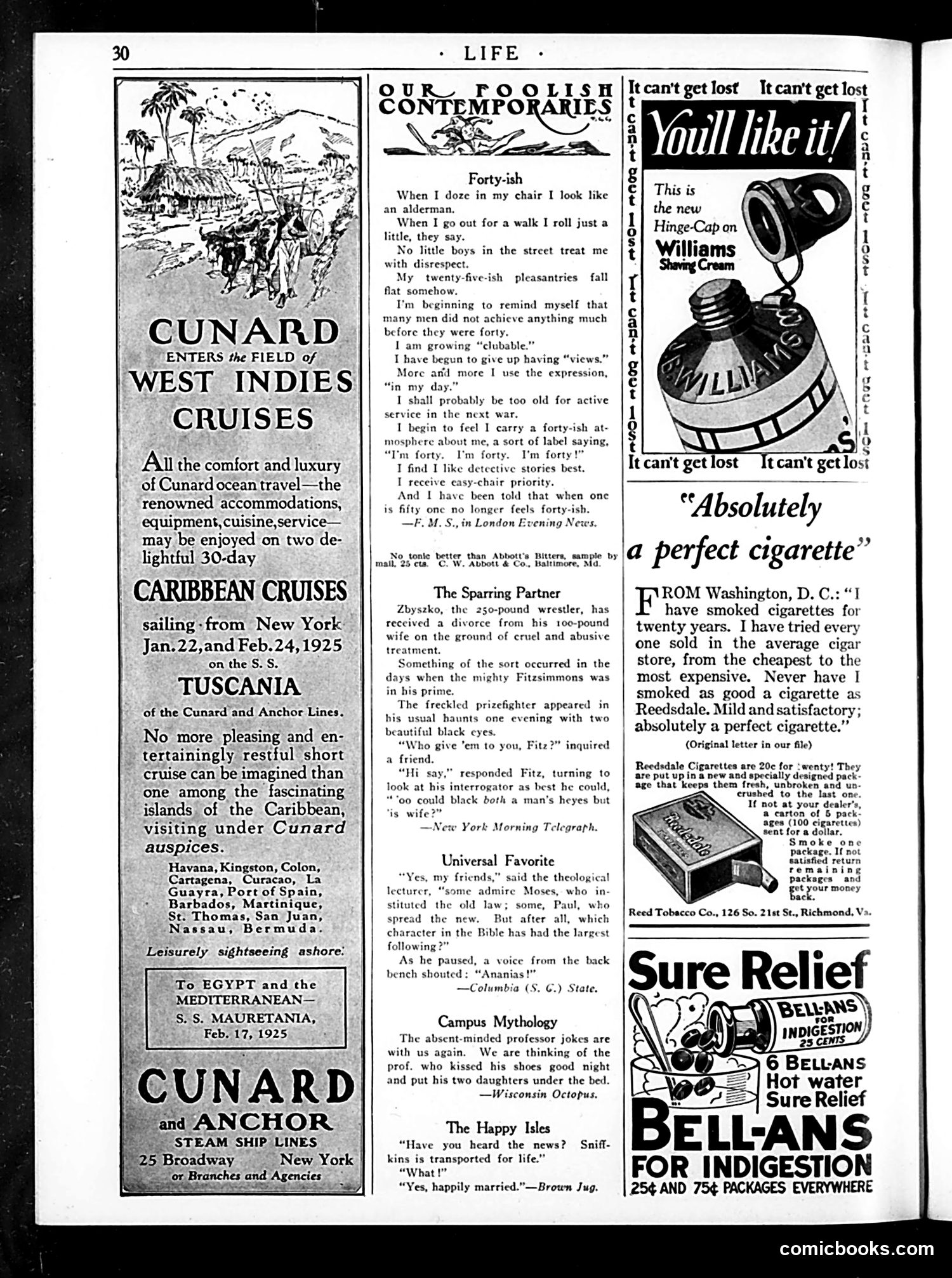
This page is primarily **advertisements and humor columns**, not political cartoons. The content includes: **Advertisements:** - Cunard cruise line promoting Caribbean voyages from New York (Jan-Feb 1925) - Williams Shaving Cream with a "Hinge-Cap" design - Reedsdale Cigarettes testimonial - Bell-Ans indigestion remedy **Humor Columns:** "Our Foolish Contemporaries" features brief satirical pieces on aging (a man describing feeling "forty-ish"), a wrestler's divorce, and a theological lecture joke. These are lighthearted social observations typical of 1920s magazine humor—poking fun at middle age, absent-minded professors, and courtroom situations. The page reflects 1920s consumer culture and gentle, domesticated satire rather than sharp political commentary. No specific political figures or events are referenced.
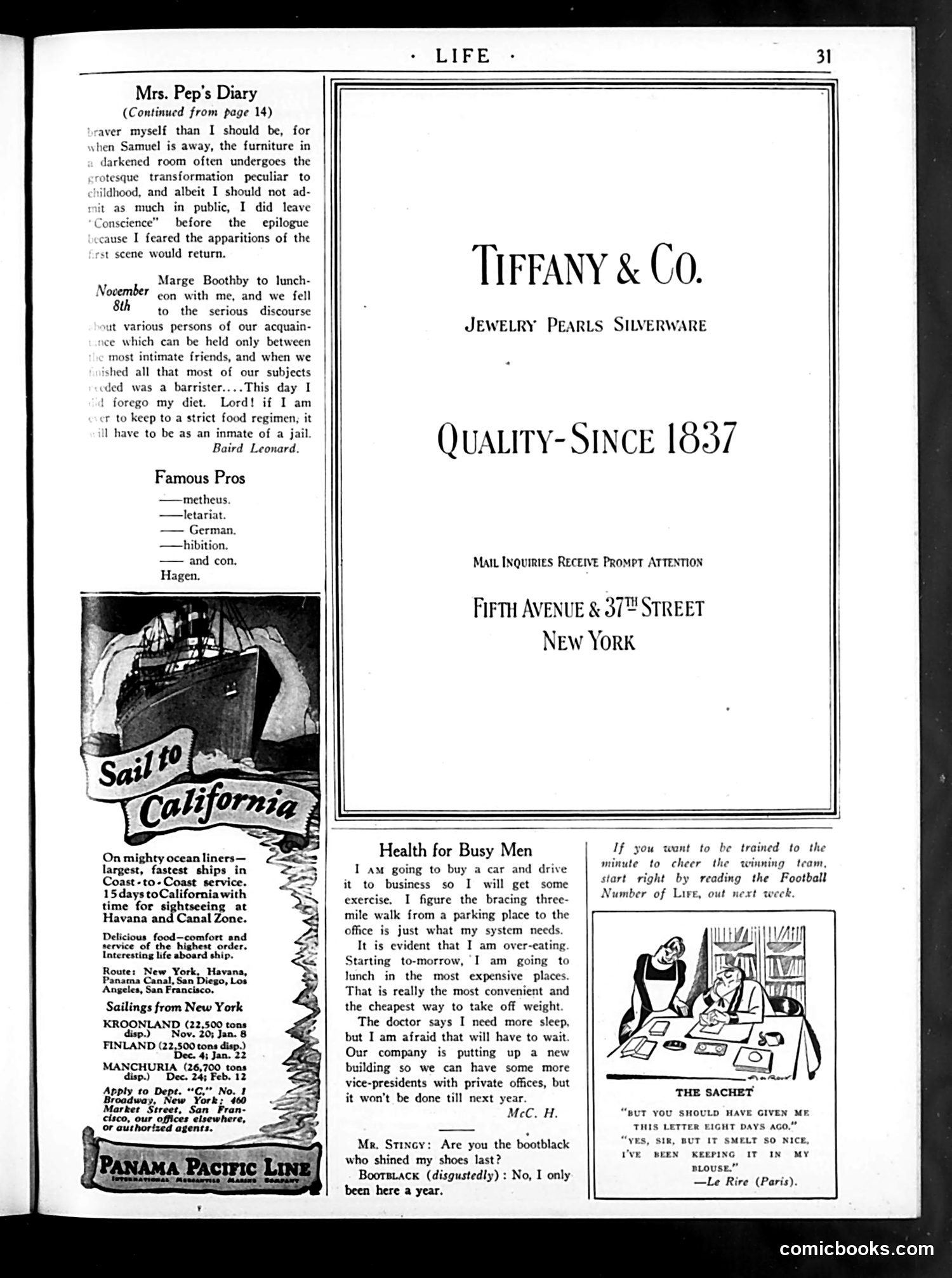
This page contains several distinct humor pieces. **Mrs. Pep's Diary** (top left) is a continuing social satire about a woman's domestic life, touching on marital anxieties and weight-loss struggles—common themes for satirizing middle-class concerns. The **"Famous Pros"** wordplay lists famous figures with prefixes removed (Prometheus → "metheus," Proletariat → "letariat"), a simple pun format typical of early 20th-century magazine humor. **"Health for Busy Men"** satirizes wealthy businessmen's self-deceptive lifestyle choices. The narrator claims driving to work and parking far away provides exercise, while lunching at expensive restaurants aids weight loss—obviously backwards logic mocking the wealthy's rationalization of indulgent habits. The final cartoon titled **"The Sachet"** (bottom right) shows a woman keeping a love letter in her blouse, attributed to *Le Rire*, a French satirical magazine. It jokes about romantic sentimentality. The page also features luxury advertisements (Tiffany & Co., Panama Pacific Line) targeting affluent readers—contextualizing the satirical targets as Life's own audience.
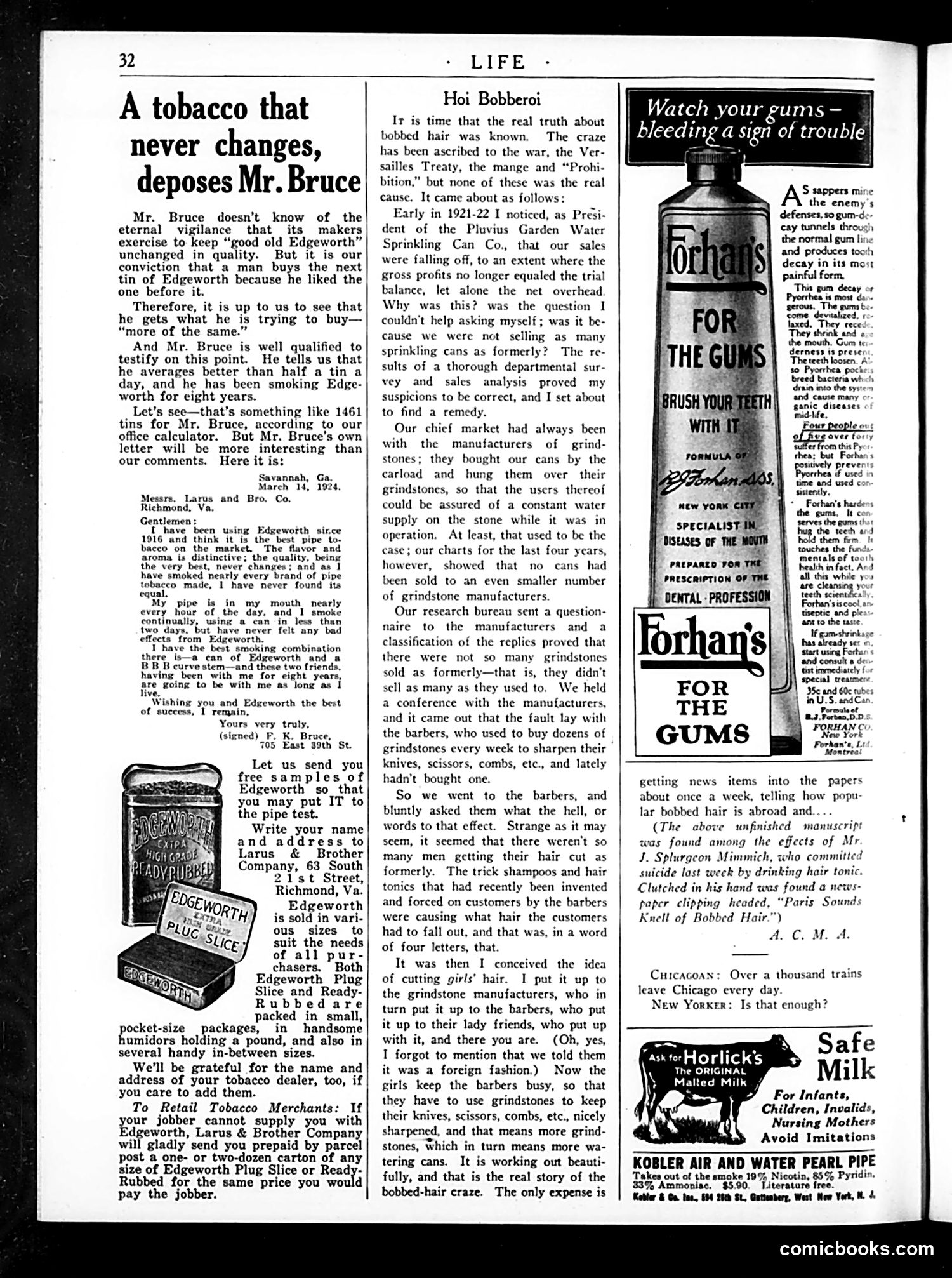
This humorous article offers a deliberately absurd alternative explanation for 1920s women's bobbed hair. Rather than attributing it to post-WWI social change, the Versailles Treaty, or Prohibition (the common theories), the author—claiming to be president of a water sprinkling can company—traces it to a business problem. His grindstone manufacturers' sales had declined because fewer men were getting their hair cut. Why? He discovered barbers were using new trick shampoos and hair tonics that damaged hair, forcing customers to cut it short. Women copied this "bobbed hair" trend, creating the craze. The satire mocks pseudo-scientific business analysis and absurdist corporate reasoning. By attributing a major cultural shift to a trivial industrial problem, *Life* magazine ridicules both the era's obsession with market research and breathless speculation about modern social trends—suggesting people were reading too much significance into simple fashion choices.
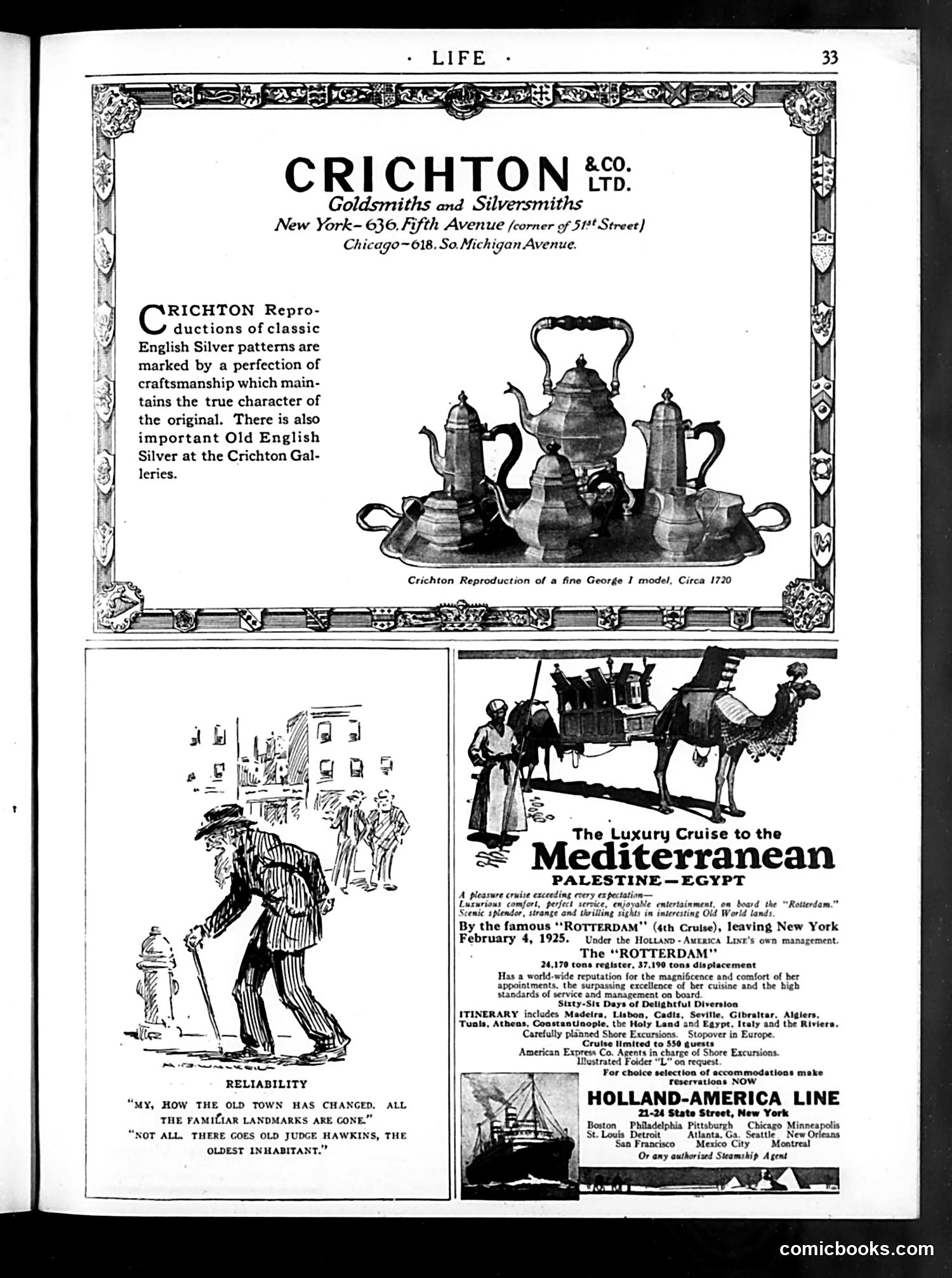
This page is primarily **advertising**, not satire. It features three distinct ads: 1. **Crichton & Co.** (top): A luxury silversmith/goldsmith company advertising reproductions of classic English silver patterns, with an image of an ornate tea service. 2. **Holland-America Line Mediterranean Cruise** (right): Promotes a February 1925 voyage on the Rotterdam to Palestine and Egypt, emphasizing luxury amenities and shore excursions. 3. **"Reliability" Cartoon** (bottom left): A small, gentle joke showing an elderly man observing urban change. When someone remarks that "all the familiar landmarks are gone," he responds, "Not all—there goes old Judge Hawkins, the oldest inhabitant." The humor relies on the pun that the judge himself is a "landmark" due to his age and long residence in town. The page reflects 1920s advertising targeting affluent readers interested in luxury goods and leisure travel.
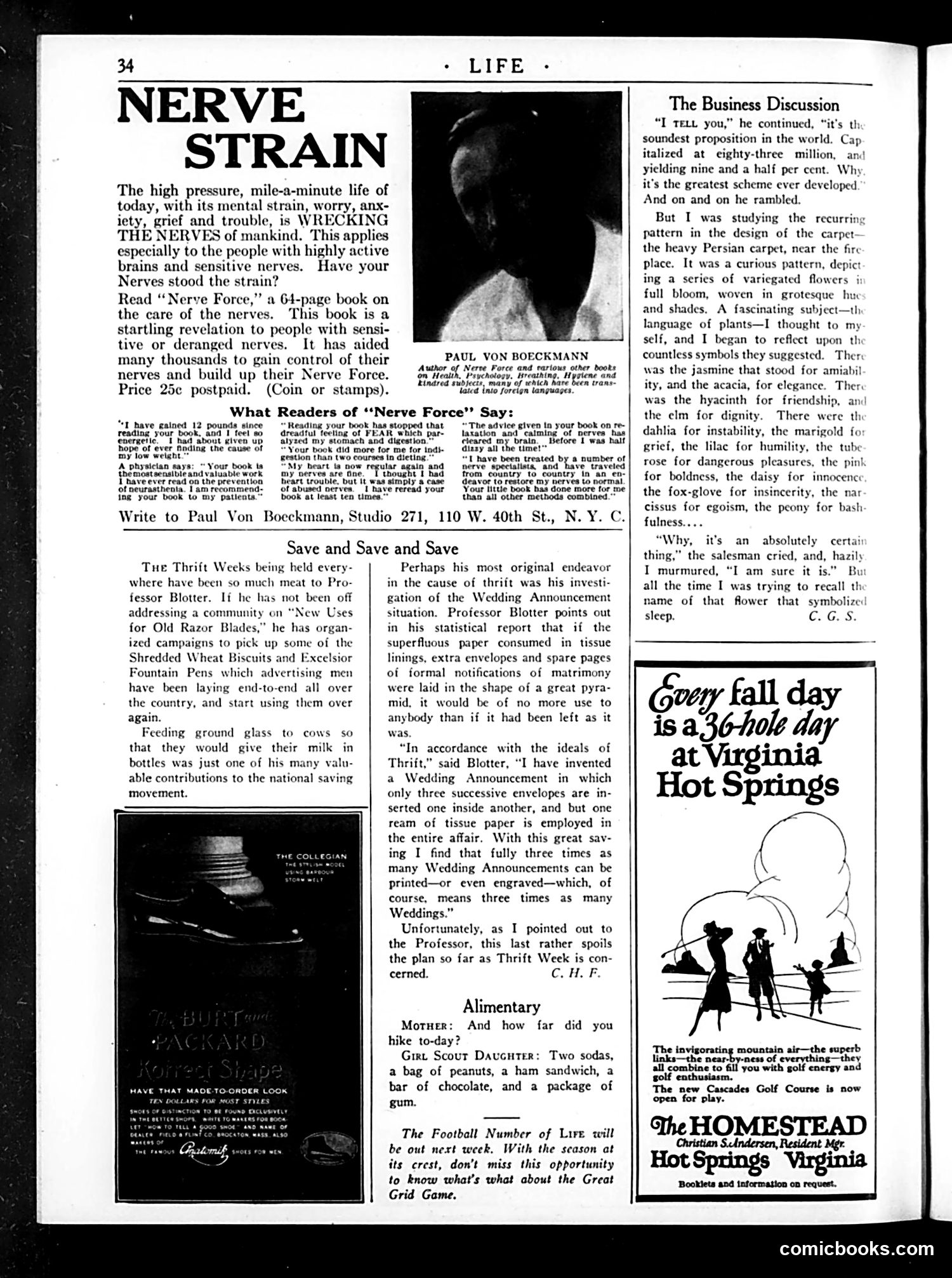
This page combines **health advertisement** with **satirical social commentary**. The main feature advertises Paul Von Boeckmann's "Nerve Force" book, claiming modern life's high pressure is "wrecking THE NERVES of mankind." Testimonials describe anxiety, digestive problems, and heart trouble—conditions now recognized as stress-related but then attributed to "nerve exhaustion," a popular diagnosis of the era. The satire appears in **"The Business Discussion"** and **"Save and Save and Save"** sections. The former mocks a businessman's tedious investment pitch while the narrator escapes into contemplating carpet patterns and flower symbolism—suggesting even intellectual distraction beats listening to capitalist schemes. The latter satirizes Professor Blotter's absurd "thrift" campaigns (feeding ground glass to cows, reusing razor blades), culminating in his investigation of wedding announcement waste. The humor lies in treating penny-pinching as almost religious zealotry during an era of economic consciousness. Together, these pieces suggest modern life creates psychological strain, yet the proposed solutions (nerve tonics, extreme penny-pinching) are equally neurotic.
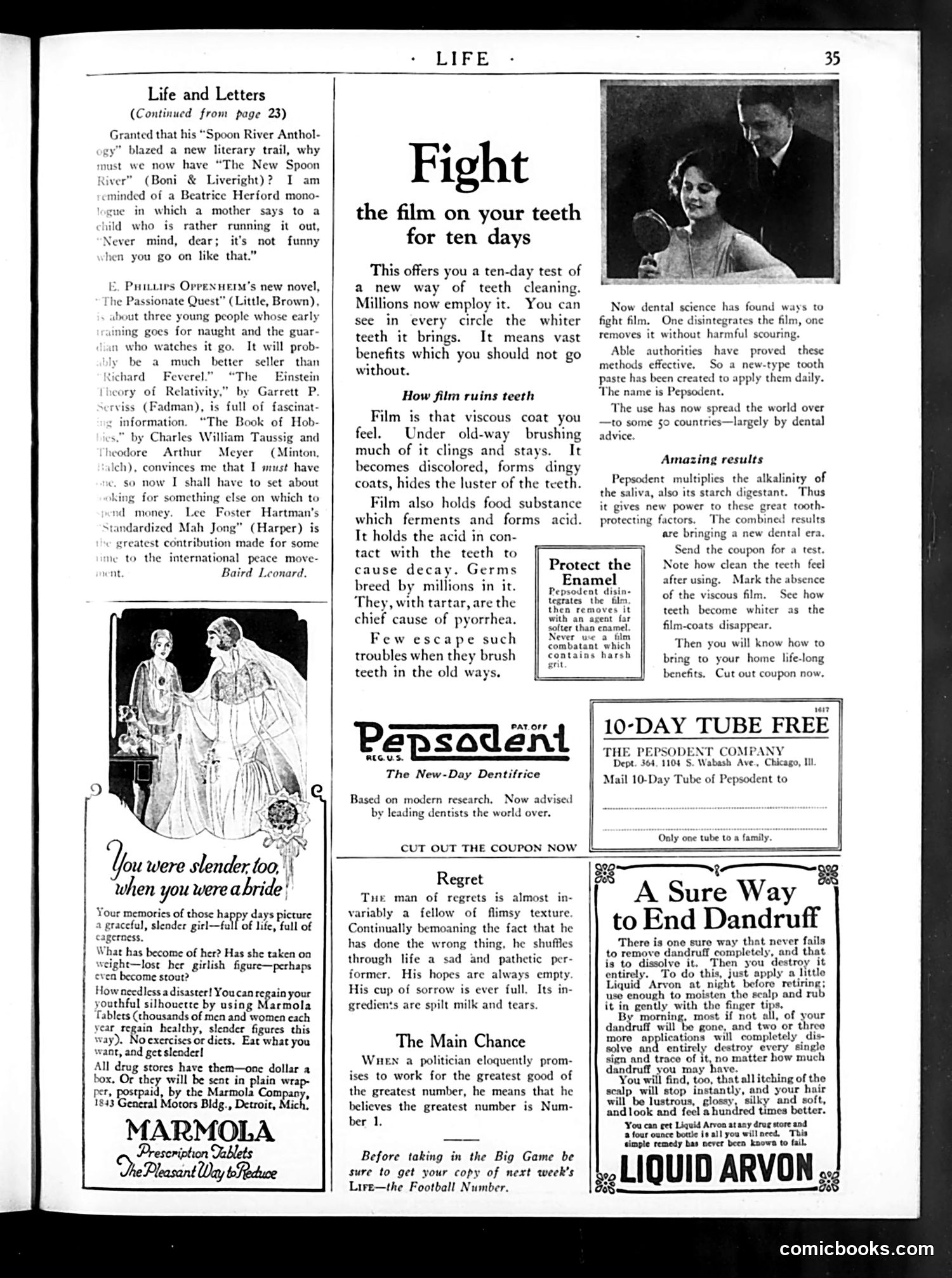
This page is primarily **advertising content** rather than political satire. It features three main advertisements: 1. **Marmola Tablets** (weight-loss product): Uses nostalgic messaging—"You were slender, too, when you were a bride"—to appeal to women concerned about post-marriage weight gain. The accompanying illustration shows a woman in a wedding dress. This reflects 1920s beauty standards and anxieties about female appearance. 2. **Pepsodent toothpaste**: A major advertisement promoting a "new-day" tooth-cleaning method targeting "film" on teeth. It claims scientific backing from dentists and emphasizes removing buildup without harsh scouring—marketing language typical of early 20th-century patent medicines. 3. **Liquid Arvon** (dandruff treatment): At bottom right. The page also contains a "Life and Letters" book review section discussing recent publications, including references to literary works like *Spoon River Anthology*. These advertisements reveal contemporary consumer anxieties about appearance, hygiene, and aging—particularly aimed at women.
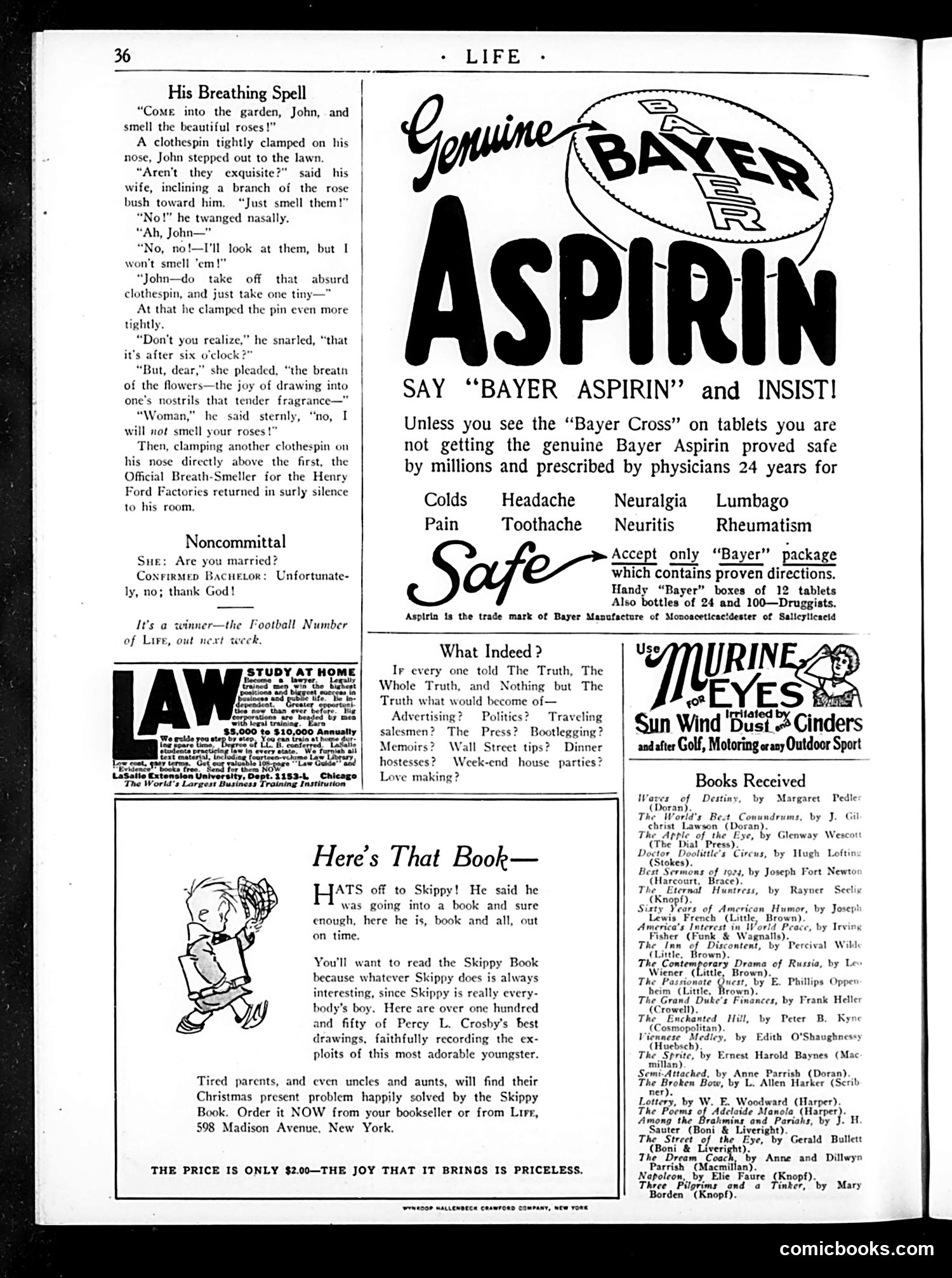
This page is primarily **advertising and book promotion** with two brief humorous pieces. **"His Breathing Spell"** satirizes the rigid work discipline imposed by Henry Ford's factories. A man wears clothespins on his nose to avoid smelling roses—a reference to Ford's famous efficiency obsession and control over workers' behavior. The joke is that even leisure time (a garden visit after 6 p.m.) becomes regimented; the man has become an "Official Breath-Smeller" bound by factory rules, unable to enjoy simple pleasures. **"Noncommittal"** is a one-liner joke: a confirmed bachelor says he's "unfortunately" unmarried, then adds "thank God!"—expressing relief at avoiding marriage. The remainder comprises **major advertisements** (Bayer Aspirin, LaSalle Extension University, Murine eye drops) and a book promotion for the "Skippy" comic strip collection. A satirical piece titled "What Indeed?" questions what would happen if people always told the complete truth, listing professions that rely on deception.
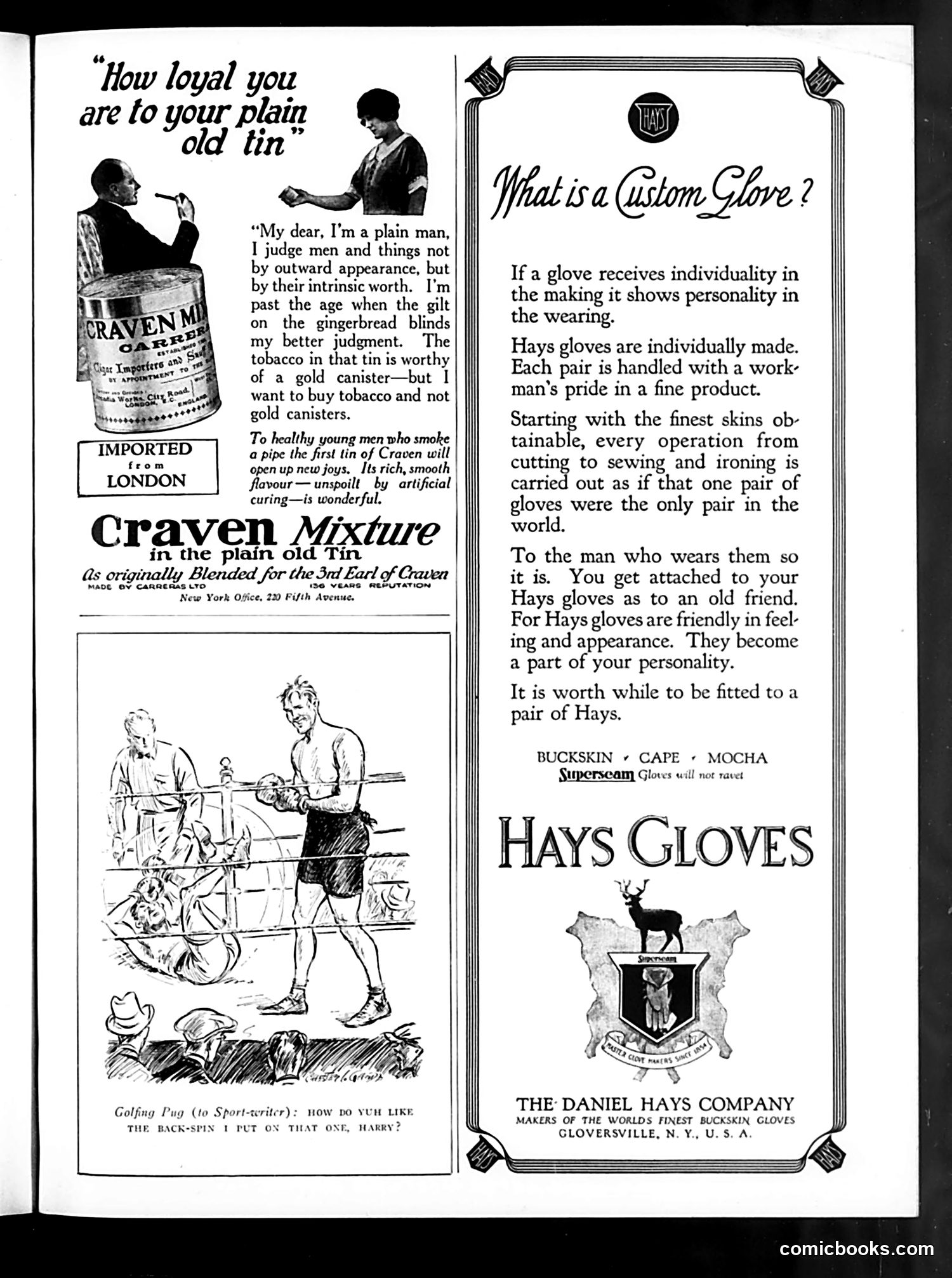
This page contains two unrelated advertisements rather than political satire. **Left side:** A Craven tobacco ad featuring a dialogue between two men. One man, sitting in what appears to be a tin container labeled "Craven Mixture," explains his philosophy of judging quality by intrinsic worth rather than fancy packaging. The pitch argues that Craven tobacco in a plain tin is superior to competitors selling unnecessarily ornate canisters—you're paying for tobacco, not decoration. Below is a golf cartoon joke featuring a "pug" (a dog) asking a sportswriter about a trick golf shot. **Right side:** A Hays Gloves advertisement emphasizing craftsmanship and personal attachment to well-made products. The copy suggests that individually-crafted gloves become like "old friends" through quality construction and care. Both ads reflect early 20th-century marketing emphasizing substance over style and artisanal production—themes appealing to masculine consumers of the era.
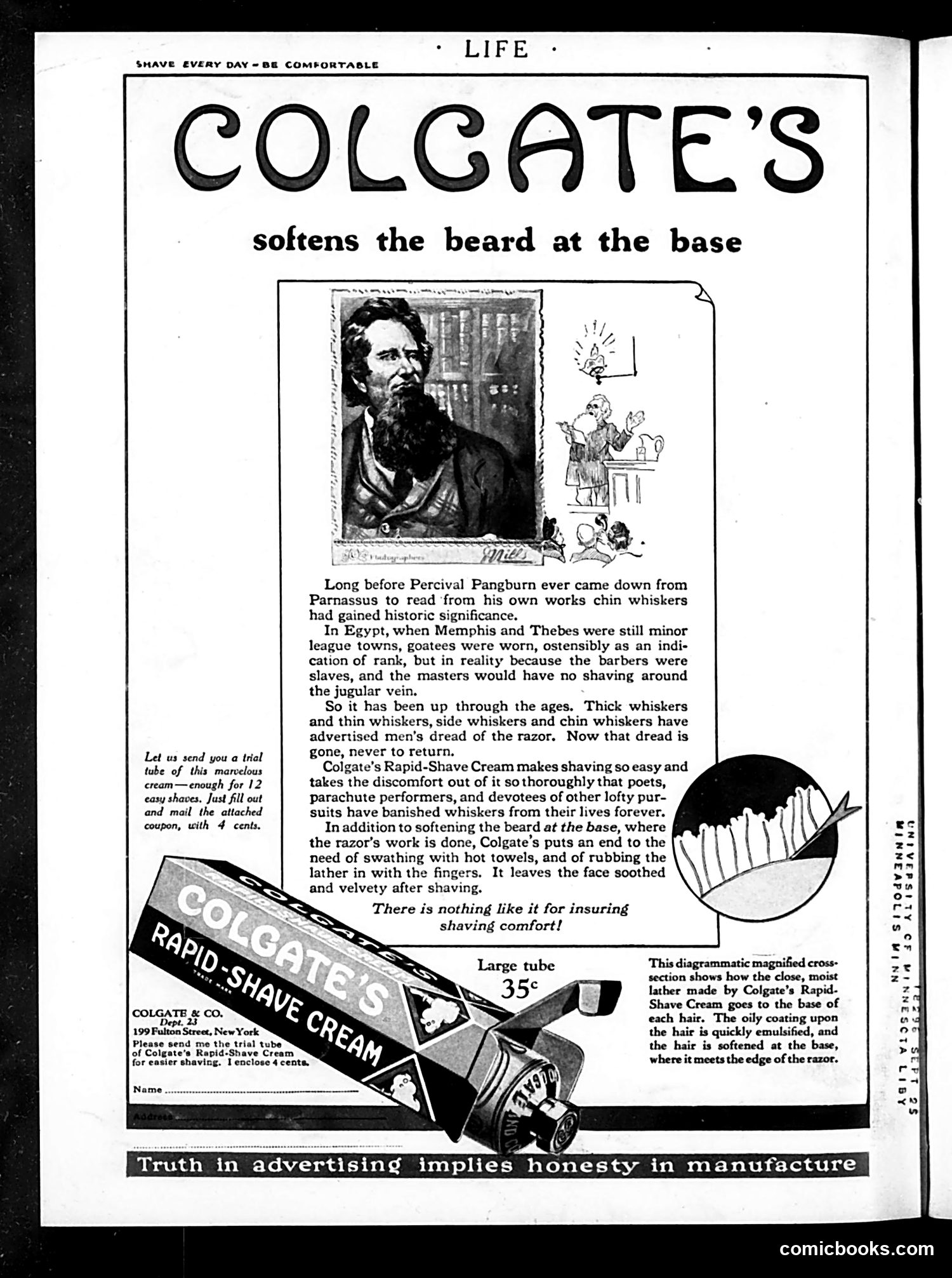
This is primarily a **product advertisement**, not political satire. The page promotes Colgate's shaving cream by claiming it softens beard hair at the base, making shaving easier and more comfortable. The historical framing references beards as symbols of power and fear of razors across civilizations—from ancient Egypt to modern times—to suggest that improved shaving technology has eliminated men's anxiety about grooming. The mention of "Percival Pangburn" (appears to be a invented or minor literary figure) and references to "poets" and "parachute performers" seem designed to appeal to cultured or adventurous men by suggesting that even refined individuals now embrace clean-shaven comfort. The technical diagram explains how the cream's oily coating softens hair at its base where the razor works. The trial offer (4 cents) and coupon are standard early 20th-century marketing tactics. The tagline "Truth in advertising implies honesty in manufacture" reflects Progressive Era consumer advocacy messaging.