
Life, 1924-11-06 · page 23 of 40
Life — November 6, 1924 — page 23: what you’re looking at
What you’re looking at
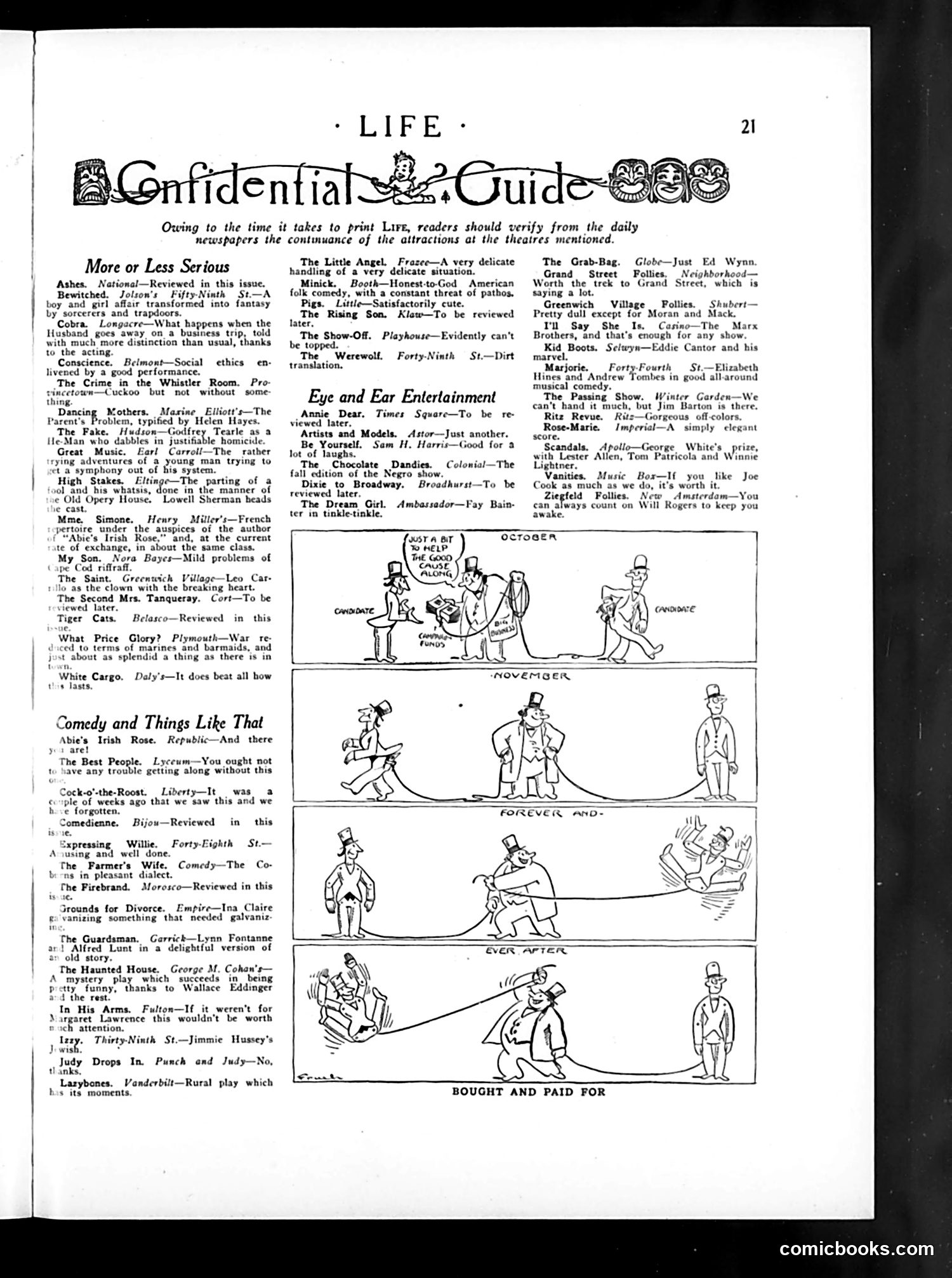
This page is primarily a **theater review guide** for New York City productions, likely from the early 1920s based on references to shows like "Abie's Irish Rose" and "What Price Glory?" The main content consists of two sections: 1. **Text listings** categorizing current Broadway/theater offerings—serious dramas, comedies, and entertainment acts (musical revues, vaudeville-style shows) 2. **Comic strip** titled "Bought and Paid For" (bottom half), divided into four panels labeled October, November, "Forever And—", and "Ever After," showing humorous domestic scenarios between a couple The strip appears to satirize **marriage and relationships**—likely depicting the arc from courtship negotiation through married life's realities. The specific joke requires seeing character expressions clearly, but the structure suggests commentary on how romantic relationships change over time, from transactional ("bought and paid for") to the mundane realities of "ever after." The overall page reflects Life's role as an entertainment guide with integrated humor rather than hard-hitting political satire.
📄 Transcribed text from this page (OCR, searchable)
Machine-transcribed from the original scan — historical spelling and the odd misread are preserved.
Owing to the time it takes to print Lire, readers should verify from the daily newspapers the continuance of the attractions at the theatres mentioned. More or Less Serious Ashes. National—Reviewed in this issue. Bewitched. Jolson’s Fifty-Ninth St.—A boy and girl affair transformed into fantasy by sorcerers and trapdoors. Cobra. Longacre—What happens when the Husband goes away on a business trip, told with much more distinction than usual, thanks to the acting. Conscience. Belmont—Social livened by a good performance. The Crime in the Whistler Room. Pro- ncetown—Cuckoo but not without some. thing Dancing Mothers. | Maxine Elliott's—The Parent's Problem, typified by Helen Hayes. The Fake. Hudson—Godfrey Tearle as a He-Man who dabbles in justifiable homicide. Great Music. Ear! Carrolf—The rather rying adventures of a young man trying to ta symphony out of his system. High Stakes. Eltinge—The parting of a vol and his whatsis, done in the manner of ¢ Old Opery House. Lowell Sherman heads ne cast, Mme, Simone. Henry Miller’s—French rtoire under the auspices of the author f “Abie’s Irish Rose,” and, at the current te of exchange, in about the same class. ethics en- My Son. Nora Bayes—Mild problems of pe Cod riffraff. The Saint. Greenwich Village—Leo Car- ilo as the clown with the breaking heart. The Second Mrs. Tanqueray. Cort—To be viewed later. Tiger Cats. Belasco—Reviewed in this What Price Glory? Plymouth—War re- ‘ed to terms of marines and barmaids, and bout as splendid a thing as there is in jost White Cargo. Daly's—It does beat all bow ths lasts. Comedy and Things Like That Abie's Irish Rose. Republic—And_ there yo are! The Best People. Lyceum—You ought not to have any trouble getting along without this Cock-o'-the-Roost. Liberty—It couple of weeks ago that we saw this an h.ce forgotten. Comedienne. Bijou—Reviewed in this . was a we cxpressing Willie. Forty-Eighth = St.— A vusing and well done. The Farmer's Wife. beens in pleasant dialect. The Firebrand. Morosco—Reviewed in tl se. Comedy—The Co- jrounds for Divorce. Empire—Ina Claire g: vanizing something that needed galvaniz i The Guardsman. Garrick—Lynn Fontanne ar! Alfred Lunt in a delightful version of an old story. The Haunted House. George M. Cohan's— A mystery play which succeeds in being petty funny, thanks to Wallace Eddinger aod the rest. In His Arms, Fulton—If it weren't for Margaret Lawrence this wouldn't be worth e och attention. 1 Ley. Thirty-Ninth St.—Jimmie Hussey's J wish. : Judy Drops In Punch and Judy—No, thanks, Lazybones. Vanderbilt—Rural play which hos its moments. The Little Angel. Frazee—A very delicate handling of a very delicate situation. Minick. Booth—Honest:to-God American folk comedy, with a constant threat of pathos. Pigs. Litthe—Satisfactorily cute. rh? Rising Son, Kiow—To be reviewed ater, The Show-Off. Playhouse—Evidently can't be topped. The Werewolf. Forty-Ninth St.—Dirt translation. Eye and Ear Entertainment Annie Dear. Times Square—To be re viewed later. Artists and Models. Astor—Just another. Be Yourself. Sam H. Harris—Good for a Jot of laughs. The Chocolate Dandies. fall edition of the Negro show. Dixie to Broadway. Broadhurst—To be reviewed later, Ambassador—Fay Bain- Colonial—The The Dream Girl. ter in tinkle-tinkle. The Grab-Bag. Globc—Just Ed Wynn. Grand Street Follies. Neighborhood— Worth the trek to Grand Street, which is saying a lot. Greenwich Village Follies. Shubert— Pretty dull except for Moran and Mack. I'l Say She Is. Casino—The Marx Brothers, and that’s enough for any show. Kid Boots. Selwyn—Eddie Cantor and his marvel, Marjorie. Forty-Fourth — St.—Elizabeth Hines and Andrew Tombes in good all-around musical comedy. The Passing Show. Winter Garden—We can't hand it much, but Jim Barton is there. Ritz Revue. Ritz—Gorgeous off-colors. Rose-Marie. Imperial—A simply elegant score. Scandals. Apollo—George White's prize, bh Lester Allen, Tom Patricola and Winnie Music Box—If{ you like Joe Cook as much as we do, it’s worth it, Ziegfeld Follies. New Amsterdam—You can always count on Will Rogers to keep you awake. - OCTOGER a FOREVER AND- BOUGHT AND PAID FOR comicbooks.com