
Life, 1924-11-06 · page 25 of 40
Life — November 6, 1924 — page 25: what you’re looking at
What you’re looking at
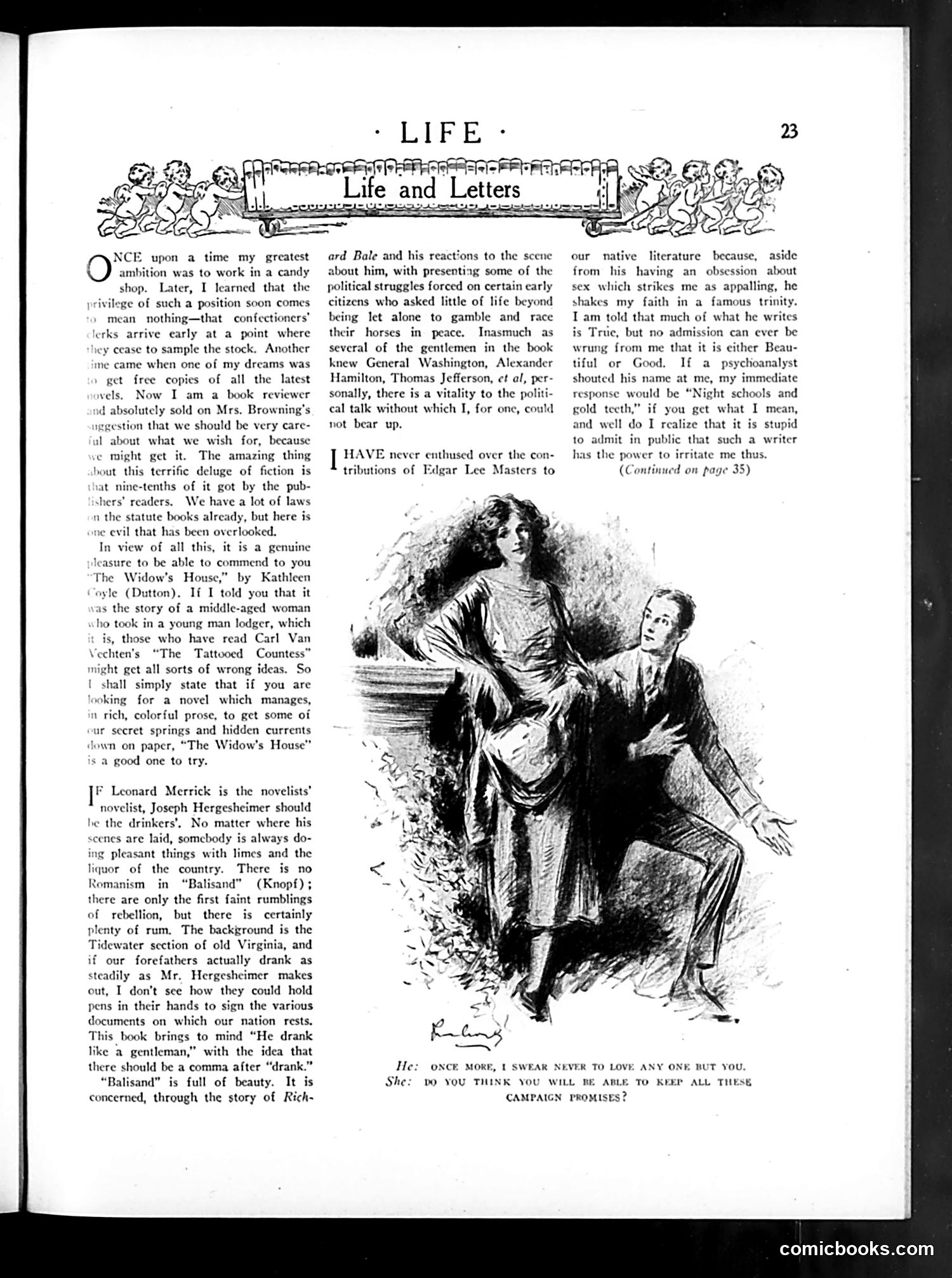
This is a book review column from *Life* magazine discussing contemporary fiction. The main text critiques novels by Kathleen Coyle, Joseph Hergesheimer, and Edgar Lee Masters, praising some while dismissing Masters' work as obsessed with sex and lacking beauty or goodness. The illustration depicts a romantic scene: a woman and man in what appears to be a dramatic moment, with the caption presenting dialogue about fidelity and campaign promises. The joke appears to be a cynical commentary on romantic vows—comparing a lover's promise to keep campaign promises, suggesting both are equally unreliable. This reflects early 20th-century satirical skepticism toward both politics and romantic commitment. The artwork style is typical of *Life*'s illustrated content from this era, using sketch-like technique to accompany literary discussion.
📄 Transcribed text from this page (OCR, searchable)
Machine-transcribed from the original scan — historical spelling and the odd misread are preserved.
p0e=staen=on00 upon a time my greatest jon was to work in a candy Later, I learned that the ilege of such a position soon comes nothing—that confectioners’ lerks arrive early at a point where cease to sample the stock. Another me came when one of my dreams was get free copies of all the latest vels. Now I am a book reviewer d absolutely sold on Mrs. Browning's iggestion that we should be very care- 11 about what we wish for, because c might get it. The amazing thing wut this terrific deluge of fiction is it nine-tenths of it got by the pub- shers’ readers. We have a lot of laws n athe statute books already, but here is ¢ evil that has been overlooked. Tn view of all this, it is a genuine Jeasure to be able to commend to you The Widow's House,” by Kathleen oyle (Dutton). If I told you that it as the story of a middle-aged woman ho took in a young man lodger, which is, those who have read Carl Van Vechten's “The Tattooed Countess” might get all sorts of wrong ideas. So shall simply state that if you are looking for a novel which manages, 1 rich, colorful prose, to get some of ur secret springs and hidden currents wn on paper, “The Widow's House” 1 good one to try. shop. mean F Leonard Merrick is the novelists’ novelist, Joseph Hergesheimer should he the drinkers’. No matter where his scenes are laid, somebody is always do- ing pleasant things with limes and the liquor of the country. There is no Romanism in “Balisand” (Knopf) ; there are only the first faint rumblings of rebellion, but there is certainly plenty of rum. The background is the Tidewater section of old Virginia, and if our forefathers actually drank as steadily as Mr. Hergesheimer makes out, I don't see how they could hold pens in their hands to sign the various documents on which our nation rests, This book brings to mind “He drank like a gentleman,” with the idea that there should be a comma after “drank.” “Balisand” is full of beauty. It is concerned, through the story of Rich~ LIF E =e\- AREER CRESS RRR Life and | Letters ard Bale and his reactfons to the scene about him, with presenting some of the political struggles forced on certain early citizens who asked little of life beyond being let alone to gamble and race their horses in peace. Inasmuch as several of the gentlemen in the book knew General Washington, Alexander Hamilton, Thomas Jefferson, et al, per- sonally, there is a vitality to the politi- cal talk without which I, for one, could not bear up. HAVE never enthused over the con- tributions of Edgar Lee Masters to He: She: ONCE MORE, po YoU THINK you I SWEAR NEVI WILL CAMPAIGN I our native literature because, aside from his having an obs about sex which strikes me as appalling, he shakes my faith in a famous trini I am told that much of what he writes s Tre, but no admission can ever be wrung from me that it is either Beau- tiful or Good. If a psychoanalyst shouted his name at me, my immediate response would be “Night schools and gold teeth,” if you get what I mean, and well do I realize that it is stupid to admit in public that such a writer has the power to irritate me thus. (Continued on page 35) jon ER TO LOVE BE ABLE ANY ONE BUT YoU, TO KEEP ALL THESE ROMISES ? comicbooks.com