
Life, 1924-11-06 · page 28 of 40
Life — November 6, 1924 — page 28: what you’re looking at
What you’re looking at
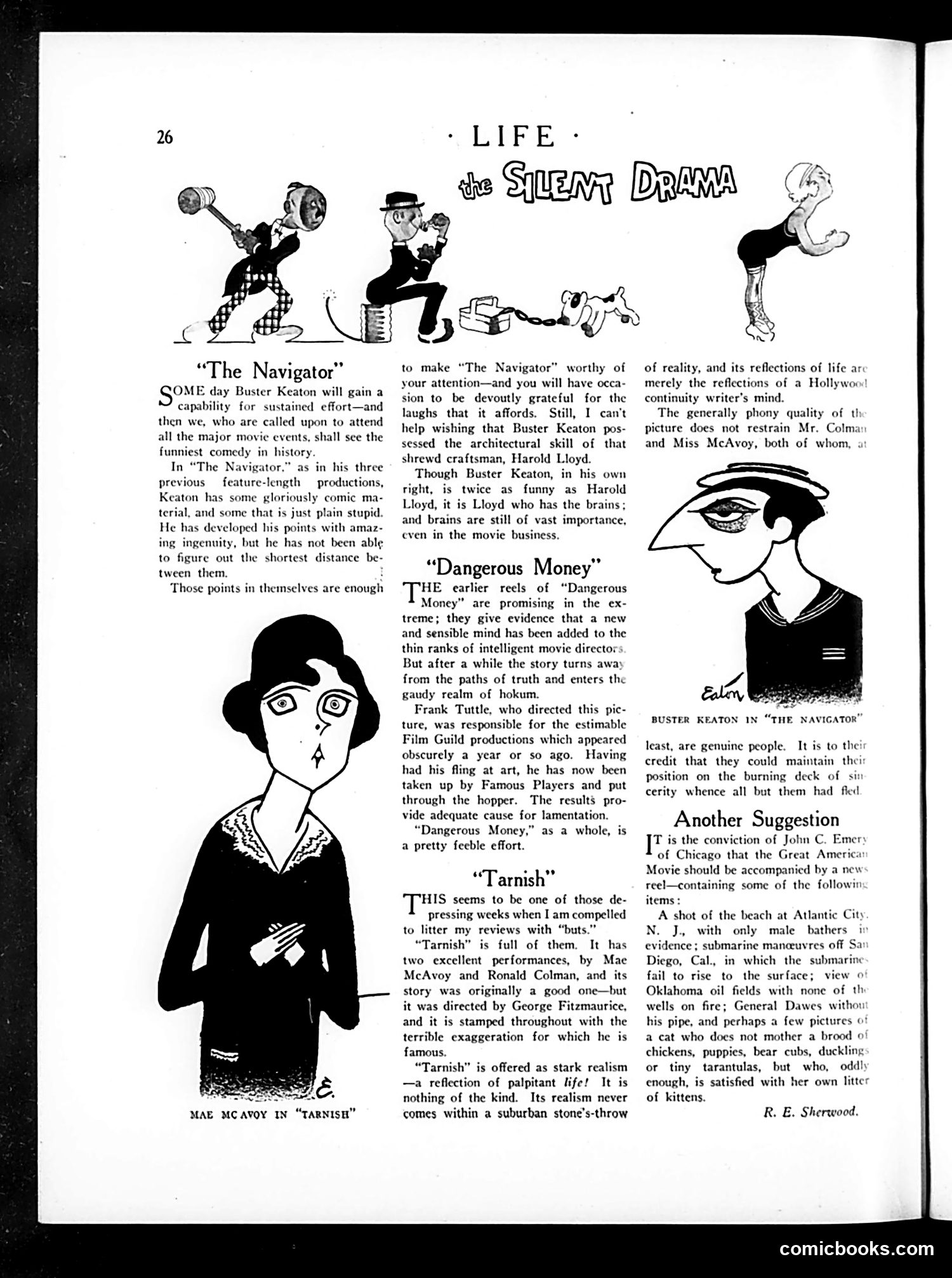
This page contains critical reviews of three 1920s silent films. The critic praises **Buster Keaton's "The Navigator"** for individual comic moments but faults Keaton's overall film structure—contrasting him unfavorably with Harold Lloyd, whom the reviewer sees as possessing superior directorial "brains." **"Dangerous Money,"** directed by Frank Tuttle, begins promisingly but deteriorates into melodramatic "hokum," suggesting Tuttle's commercial studio work (Famous Players) ruined his earlier artistic promise. **"Tarnish"** features strong performances by Mae McAvoy and Ronald Colman but suffers from director George Fitzmaurice's trademark exaggeration. The critic mocks its claim to realism, sarcastically noting it reflects only a "Hollywood continuity writer's mind." The final piece, "Another Suggestion," humorously proposes absurdist film reels—beaches with no bathers, submarines that malfunction—satirizing Hollywood's artificial sentimentality and manipulative conventions.
📄 Transcribed text from this page (OCR, searchable)
Machine-transcribed from the original scan — historical spelling and the odd misread are preserved.
“The Navigator” OME day Buster Keaton will gain a capability for sustained effort—and then we, who are called upon to attend all the major movie events, shall see the funniest comedy in history. In “The Navigator,” as in his three previous feature-length productions, Keaton has some gloriously comic ma- terial, and some that is just plain stupid. He has developed his points with amaz- ing ingenuity, but he has not been able to figure out the shortest distance be- tween them. i Those points in themselves are enough MAE MCAVOY IN “TARNISH” to make “The Navigator” worthy of your attention—and you will have occa- sion to be devoutly grateful for the laughs that it affords. Still, I can’t help wishing that Buster Keaton pos- sessed the architectural skill of that shrewd craftsman, Harold Lloyd. Though Buster Keaton, in own right, is twice as funny as Harold Lloyd, it is Lloyd who has the brains; and brains are still of vast importance, even in the movie business. “Dangerous Money” HE earlier reels of “Dangerous Money” are promising in the ex- treme; they give evidence that a new and sensible mind has been added to the thin ranks of intelligent movie director But after a while the story turns away from the paths of truth and enters the gaudy realm of hokum. Frank Tuttle, who directed this pic- ture, was responsible for the estimable Film Guild productions which appeared obscurely a year or so ago. Having had his fling at art, he has now been taken up by Famous Players and put through the hopper. The result’ pro- vide adequate cause for lamentation, “Dangerous Money,” as a whole, is a pretty feeble effort. “Tarnish” HIS seems to be one of those de- pressing weeks when I am compelled to litter my reviews with “buts.” “Tarnish” is full of them. It has two excellent performances, by Mae McAvoy and Ronald Colman, and its story was originally a good one—but it was directed by George Fitzmaurice, and it is stamped throughout with the terrible exaggeration for which he is famous. “Tarnish” is offered as stark realism —a reflection of palpitant life! It is nothing of the kind. Its realism never comes within a suburban stone’s-throw of reality, and its reflections of life ar: merely the reflections of a Hollywoo:! continuity writer’s mind. The generally phony quality of picture does not restrain Mr. Colmay and Miss McAvoy, both of whom, « Pee BUSTER KEATON IN “THE NAVIGATOR” least, are genuine people. It is to the credit that they could maintain thei position on the burning deck of sit cerity whence all but them had fled Another Suggestion T is the conviction of John C. Emer of Chicago that the Great America Movie should be accompanied by a new reel—containing some of the followir items : A shot of the beach at Atlantic City N. J., with only male bathers i evidence ; submarine manceuvres off Sa Diego, C: in which the submarine fail to rise to the surface; view o Oklahoma oil fields with none of th wells on fire; General Dawes withou his pipe, and perhaps a few pictures o! a cat who does not mother a brood « chickens, puppies, bear cubs, duckling or tiny tarantulas, but who, oddly enough, is satisfied with her own litter of kittens. R. E. Sherwood. comicbooks.com