
Life, 1924-11-06 · page 22 of 40
Life — November 6, 1924 — page 22: what you’re looking at
What you’re looking at
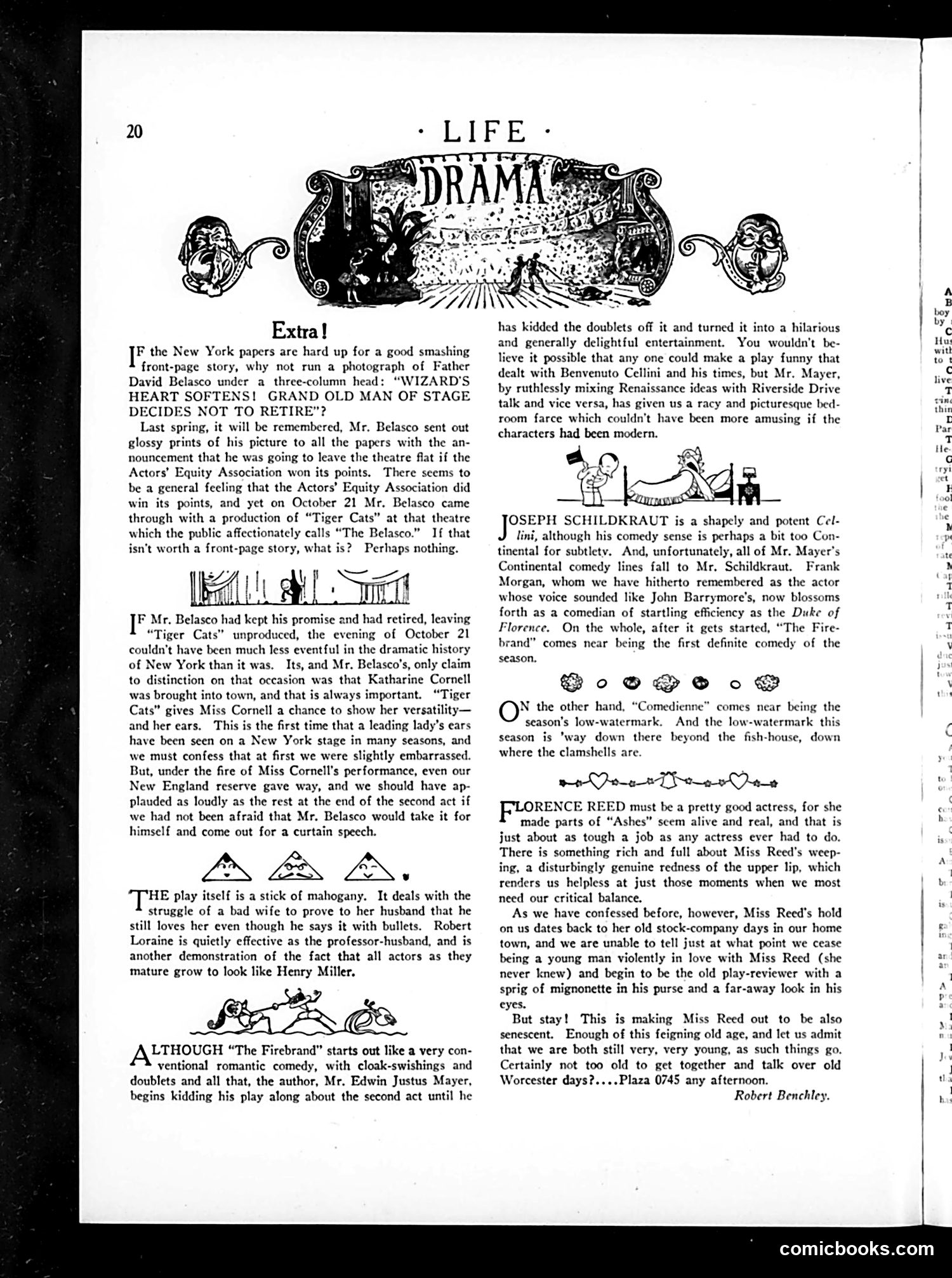
This page reviews recent Broadway productions with satirical commentary typical of Life magazine's theatrical criticism. **The Belasco Feud**: The opening section mocks impresario David Belasco's threat to retire from theater after the Actors' Equity Association won labor concessions. Belasco reversed course, producing "Tiger Cats" on October 21—the text wryly notes this wasn't particularly newsworthy despite being front-page material. The satire targets Belasco's ego and theatrical grandstanding. **"Tiger Cats" Review**: The play stars Katharine Cornell, whom the critic praises while making a cheeky observation about her ears being visible—apparently a novelty on NYC stages. The plot involves a "bad wife" trying to prove her husband's love. **Other Productions**: Reviews of "The Firebrand" (starring Joseph Schildkraut and Frank Morgan in a Benvenuto Cellini comedy), "Comedienne," and "Ashes" follow, critiquing performances and scripts with characteristic snark. The text reflects 1920s theater culture: star power, producer egos, and comedic versus dramatic merit.
📄 Transcribed text from this page (OCR, searchable)
Machine-transcribed from the original scan — historical spelling and the odd misread are preserved.
has kidded the doublets off it and turned it into a hilarious Cc and generally delightful entertainment. You wouldn't be- Hus F the NewYork papers are hard up for a good smashing lieve it possible that any one could make a play funny that bt front-page story, why not run a photograph of Father c dealt with Benvenuto Cellini and his times, but Mr. Mayer, David Belasco under a three-column head: “WIZARD'S Aan * ae = live HEART SOFTENS! GRAND OLD MAN OF STAGE by ruthlessly mixing Renaissance ideas with Riverside Drive aa = niecat sy =i: talk and vice versa, has given us a racy and picturesque bed- DECIDES NOT TO RETIRE”? une si hee eau thir La ing, it will be bered, Mr. Bel: room farce which couldn't have been more amusing if the L st spring, it will be remembered, Mr. Belasco sent out characters had t modern. Par glossy prints of his picture to all the papers with the an- ite nouncement that he was going to leave the theatre flat if the Cc Actors’ Equity Association won its points. There seems to ry be a general feeling that the Actors’ Equity Association did k win its points, and yet on October 21 Mr. Belasco came through with a production of “Tiger Cats” at that theatre which the public affectionately calls “The Belasco.” If that isn't worth a front-page story, what is? Perhaps nothing. OSEPH SCHILDKRAUT is a shapely and potent Cel- lini, although his comedy sense is perhaps a bit too Con- tinental for subtlety. And, unfortunately, all of Mr. Mayer's Continental comedy lines fall to Mr. Schildkraut. Frank a Morgan, whom we have hitherto remembered as the actor 7 whose voice sounded like John Barrymore's, now blossoms ‘ F Mr, Belasco had kept his promise and had retired, leaving rth as a comedian of startling efficiency as the Duke of ¥ “Tiger Cats” unproduced, the evening of October 21 Florence. On the whole, after it gets started, “The Fire- T couldn't have been much less eventful in the dramatic history and” comes near being the first definite comedy of the \ of New York than it was. Its, and Mr. Belasco's, only claim “250% ios to distinction on that occasion was that Katharine Cornell & o®@ Pp So = was brought into town, and that is always important. “Tiger : . . . . tho Cats” gives Miss Cornell a chance to show her versatility— IN the other hand, “Comedienne” comes near being the and her ears. This is the first time that a leading lady's ears season's low-watermark. And the low-watermark this , have been seen on a New York stage in many seasons, and season is ‘way down there beyond the fish-house, down ‘ we must confess that at first we were slightly embarrassed. where the clamshells are. y But, under the fire of Miss Cornell's performance, even our A - ; New England reserve gave way, and we should have ap- wo K)o ee Toa ee ‘ plauded as loudly ¥ the rest = the end of the second act if RENCE REED must be a pretty good actress, for she ft we tee not been afraid that Mr. Belasco wou ld take it for made parts of “Ashes” scem alive and real, and that is b himself and come out for a curtain speech. just about as tough a job as any actress ever had to do. There is something rich and full about Miss Reed's weep- ‘ Lo, GS. Fos T= play itself is a stick of mahogany. It deals with the struggle of a bad wife to prove to her husband that he still loves her even though he says it with bullets. Robert Loraine is quietly effective as the professor-husband, and is another demonstration of the fact that all actors as they mature grow to look like Henry Miller. LTHOUGH “The Firebrand” starts out like a very con- ventional romantic comedy, with cloak-swishings and doublets and all that, the author, Mr. Edwin Justus Mayer, begins kidding his play along about the second act until he ing, a disturbingly genuine redness of the upper lip, which renders us helpless at just those moments when we most need our critical balance. As we have confessed before, however, Miss Reed's hold on us dates back to her old stock-company days in our home town, and we are unable to tell just at what point we cease being a young man violently in love with Miss Reed (she never knew) and begin to be the old play-reviewer with a sprig of mignonette in his purse and a far-away look in his eyes. But stay! This is making Miss Reed out to be also senescent. Enough of this feigning old age, and let us admit that we are both still very, very young, as such things go. Certainly not too old to get together and talk over old Worcester days?....Plaza 0745 any afternoon. Robert Benchley. comicbooks.com