
Life, 1924-11-06 · page 18 of 40
Life — November 6, 1924 — page 18: what you’re looking at
What you’re looking at
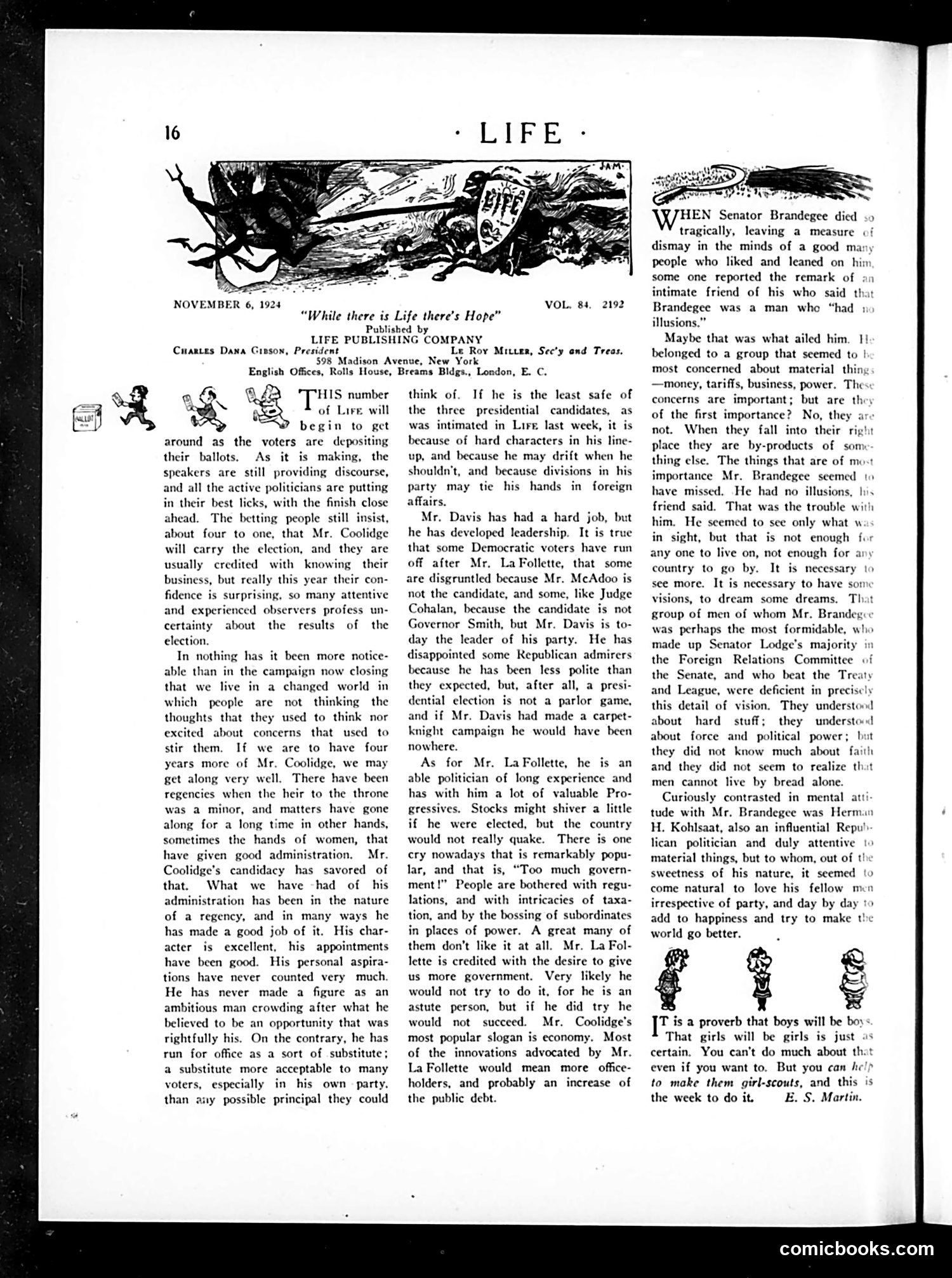
This page analyzes the 1924 U.S. presidential election between three candidates: President **Calvin Coolidge** (Republican), **John W. Davis** (Democrat), and **Robert La Follette** (Progressive). The article assesses each candidate's viability. Coolidge is characterized as a safe "regent" rather than ambitious leader—competent but potentially passive on foreign affairs. Davis, though facing Democratic defections to La Follette and disappointment over McAdoo and Smith not being nominated, has demonstrated actual leadership. La Follette, an experienced politician with Progressive support, advocates expanded government—directly opposing Coolidge's popular economy platform. The cartoons appear to satirize campaign fervor and voter behavior during the election's final days. The opening illustration and accompanying text suggest the piece is analyzing voter attitudes and the election's uncertain outcome, despite betting odds favoring Coolidge's reelection.
📄 Transcribed text from this page (OCR, searchable)
Machine-transcribed from the original scan — historical spelling and the odd misread are preserved.
MBER 6, 1924 “While there is Life there’s Hope” Published by LIFE PUBLISHING COMPANY Cuaates Dana Grason, President Le Roy Miter, Sec’y end Treas, 598 Madison Avenue, New York English Offices, Rolls House, Breams Bldgs., London, E. C. Q qa HIS number ay oS of Lire will =P begin to get around as the voters are depositing their ballots. As it is making, the speakers are still providing discourse, and all the active politicians are putting in their best licks, with the finish close ahead. The betting people still insist, about four to one, that Mr. Coolidge will carry the election, and they are usually credited with knowing their business, but really this year their con- fidence is surprising, so many attentive and experienced observers profess un- certainty about the results of the election. In nothing has it been more notice- able than in the campaign now closing that we live in a changed world in which people are not thinking the thoughts that they used to think nor excited about concerns that used to stir them. If we are to have four years more of Mr. Coolidge, we may get along very well, There have been regencies when the heir to the throne was a minor, and matters have gone along for a long time in other hands, sometimes the hands of women, that have given good administration. Mr. Coolidge’s candidacy has savored of that. What we have had of his administration has been in the nature of a regency, and in many ways he has made a good job of it. His char- acter is excellent, his appointments have been good. His personal aspira- tions have never counted very much. He has never made a figure as an ambitious man crowding after what he believed to be an opportunity that was rightfully his. On the contrary, he has run for office as a sort of substitute; a substitute more acceptable to many voters, especially in his own party, than any possible principal they could think of. If he is the least safe of the three presidential candidates, as was intimated in Lire last week, it is because of hard characters in his line- up, and because he may drift when he shouldn't, and because divisions in his party ie his hands in foreign affairs. Mr. Davis has had a hard job, but he has developed leadership. It is true that some Democratic voters have run off after Mr. La Follette, that some are disgruntled because Mr. McAdoo is not the candidate, and some, like Judge Cohalan, because the candidate is not Governor Smith, but Mr. Davis is to- day the leader of his party. He has disappointed some Republican admirers because he has been less polite than they expected, but, after all, a presi- dential election is not a parlor game, and if Mr. Davis had made a carpet- knight campaign he would have been nowhere. As for Mr. La Follette, he is an able politician of long experience and has with him a lot of valuable Pro- gressives. Stocks might shiver a little if he were elected, but the country would not really quake. There is one cry nowadays that is remarkably popu- lar, and that is, “Too much govern- ment!" People are bothered with regu- lations, and with intricacies of taxa- tion, and by the bossing of subordinates in places of power. A great many of them don’t like it at all. Mr. La Fol- lette is credited with the desire to give us more government. Very likely he would not try to do it, for he is an astute person, but if he did try he would not succeed. Mr. Coolidge’s most popular slogan is economy. Most of the innovations advocated by Mr. La Follette would mean more office- holders, and probably an increase of the public debt. may HEN Senator Brandegee died so tragically, leaving a measure of dismay in the minds of a good many people who liked and leaned on hit some one reported the remark of an intimate friend of his who said that Brandegee was a man who “had illusions.” Maybe that was what ailed him. 11 belonged to a group that seemed to | most concerned about material thing —money, tariffs, business, power. The concerns are important; but are they of the first importance? No, they not. When they fall into their right place they are by-products of som thing else. The things that are of most importance Mr. Brandegee seemed 1 have missed. He had no illusions, |i friend said. That was the trouble wit! him. He seemed to see only what w in sight, but that is not enough for any one to live on, not enough for any country to go by. It is necessary to see more. It is necessary to have some visions, to dream some dreams. TI group of men of whom Mr. Brandeg was perhaps the most formidable, who made up Senator Lodge’s majority in the Foreign Relations Committee of the Senate, and who beat the Treaty and League, were deficient in precisely this detail of vision. They understood about hard stuff; they understood about force and political power; bu they did not know much about faith and they did not seem to realize that men cannot live by bread alone. Curiously contrasted in mental att tude with Mr. Brandegee was Herman H. Kohlsaat, also an influential Repu! lican politician and duly attentive (o material things, but to whom, out of t! sweetness of his nature, it seemed (o come natural to love his fellow m irrespective of party, and day by day to add to happiness and try to make t! world go better. . is a proverb that boys will be boy< That girls will be girls is just as certain. You can't do much about thot even if you want to. But you can he!p to make them girl-scouts, and this is the week to do it. E. S. Martin. comicbooks.com