
A complete issue · 36 pages · 1924
Life — October 23, 1924
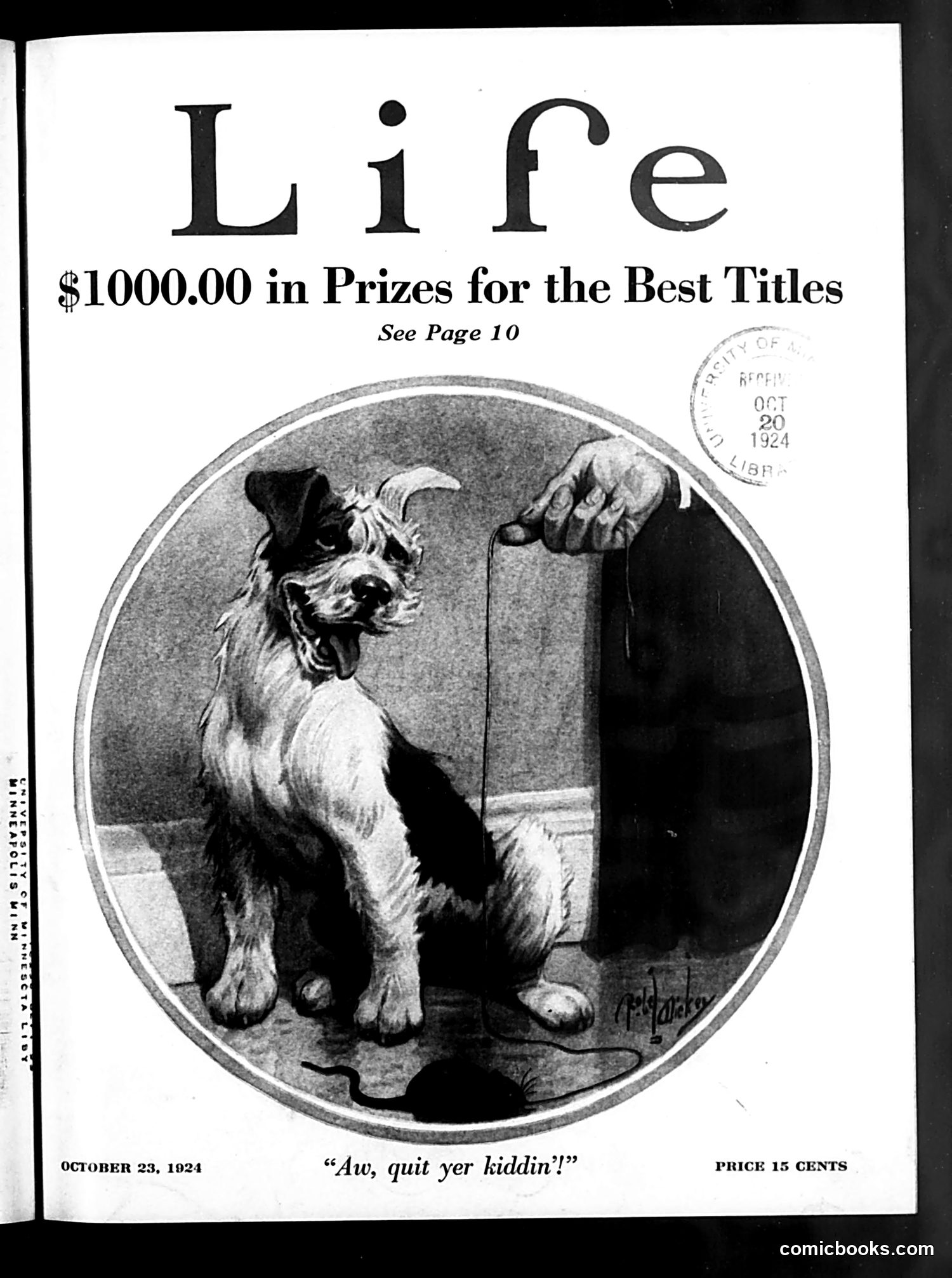
This is the October 23, 1924 cover of *Life* magazine. The central image shows a dog holding a mirror, with the caption "Ayo, quit yer kiddin'!" in dialect speech. The satire appears to be social commentary on vanity or self-deception—the dog gazing at its reflection while speaking in working-class vernacular suggests someone failing to recognize an unflattering truth about themselves. The mirror device is a traditional symbol for confronting reality. The cover also advertises "$1000.00 in Prizes for the Best Titles" (referencing page 10), indicating readers could submit alternative captions, making this an interactive contest for the magazine. The price was 15 cents. Without additional context about 1924 events, the specific target of this satire remains unclear, though it likely comments on a contemporary public figure or social trend.
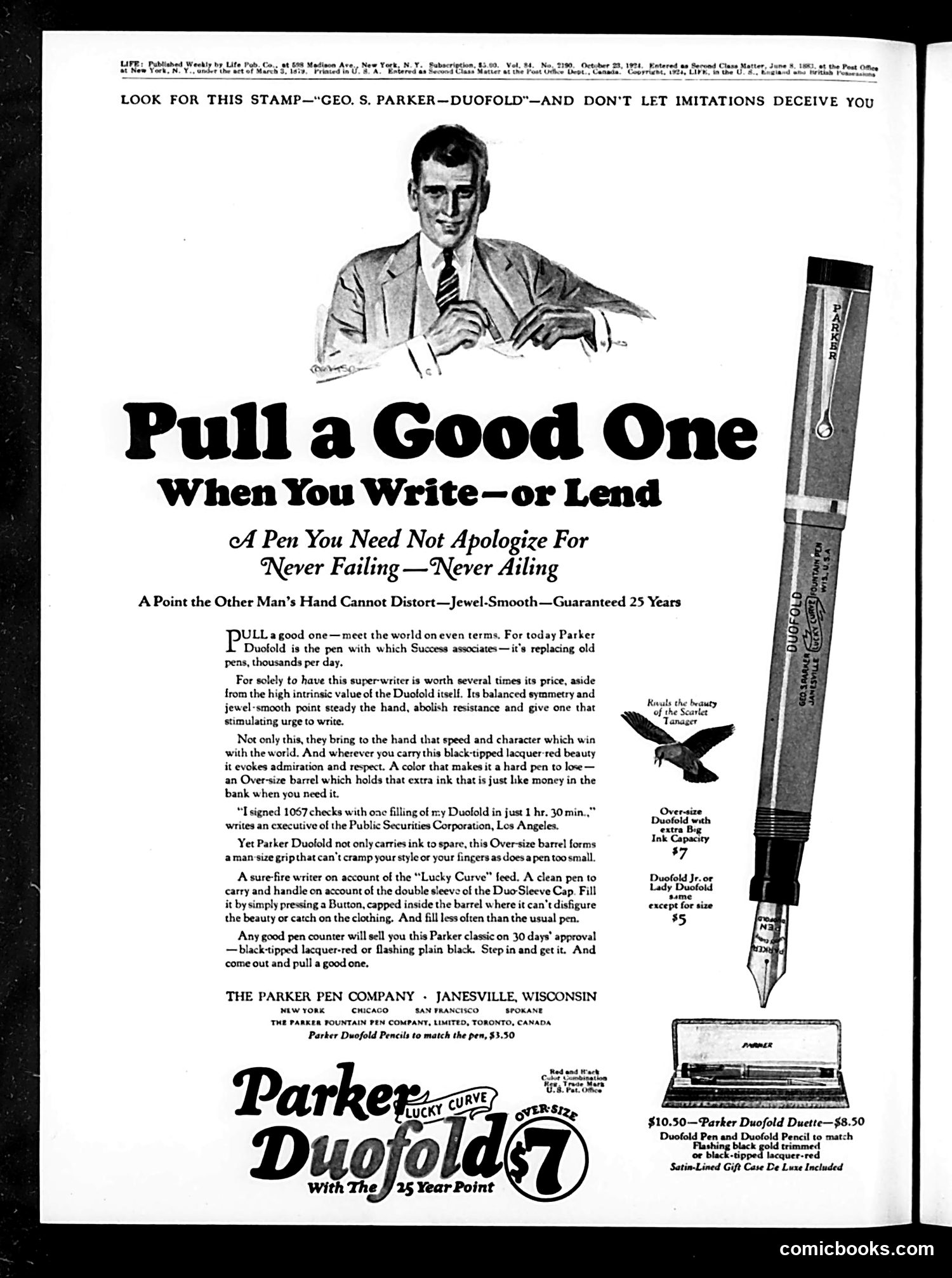
This page is primarily a **Parker Duofold pen advertisement**, not political satire. The ad features a well-dressed businessman demonstrating the Parker Duofold fountain pen, emphasizing its reliability and quality. The marketing pitch centers on the pen's durability ("Never Failing—Never Ailing"), its "25 Year Point" guarantee, and superior craftsmanship compared to competitors. The advertisement includes a testimonial from someone at the Public Securities Corporation in Los Angeles claiming to have signed 1,057 checks with one pen filling. Various pen models are displayed with prices ($5-$10.50). The only potentially humorous element is the tagline "Pull a Good One When You Write—or Lend," playing on the pen's brand name and suggesting its quality makes it worth lending to others—though this is straightforward advertising copy rather than satire.
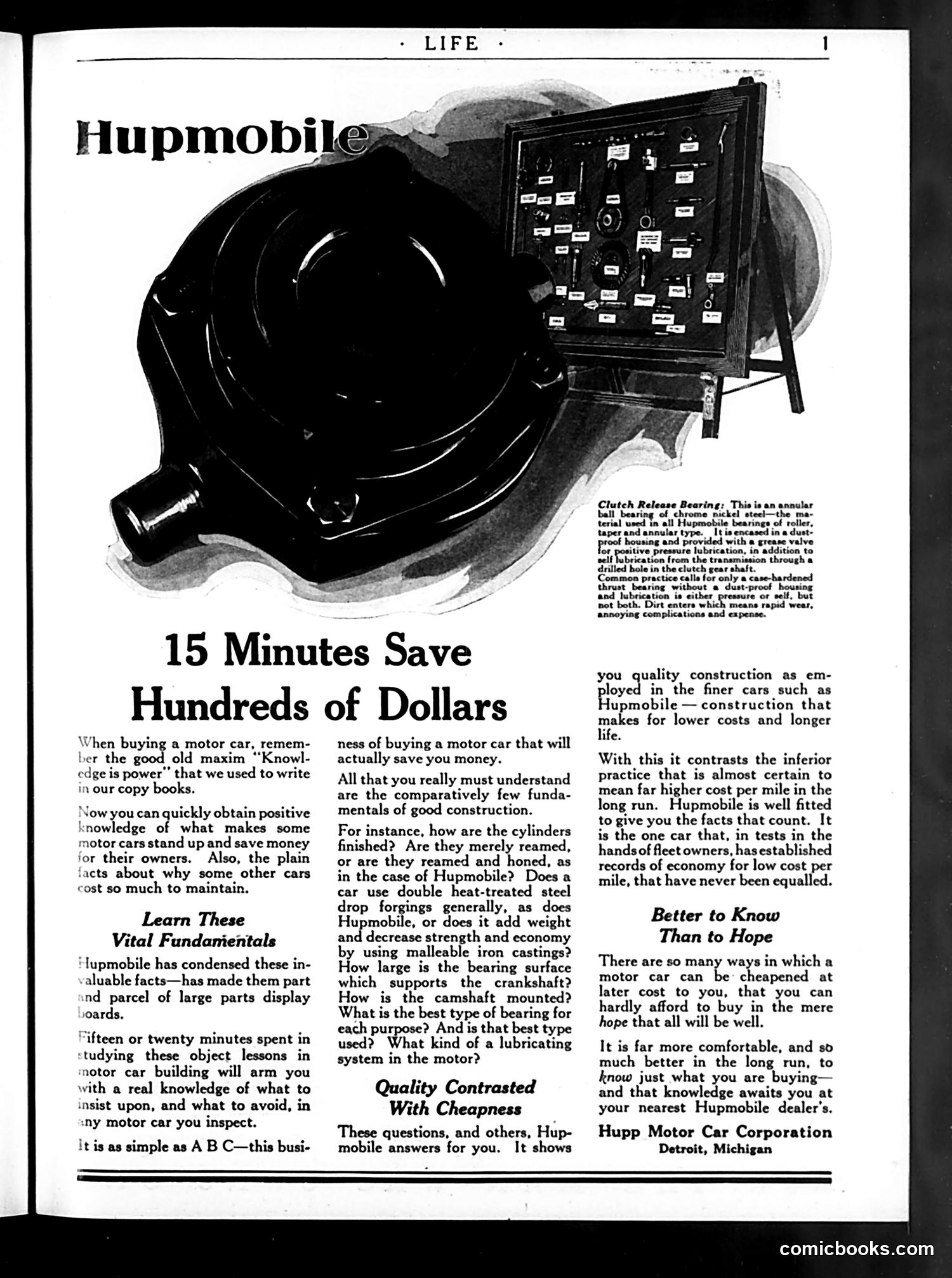
This is a **straightforward automobile advertisement**, not political satire. The Hupmobile Motor Car Corporation (Detroit, Michigan) uses an educational pitch to sell cars. The visual shows a car's internal bearing mechanism with a technical display board, illustrating the advertisement's central claim: understanding "fundamentals of good construction" saves money. The copy argues that 15 minutes studying motor car mechanics—examining cylinder finishing, bearing surfaces, drop forgings, and lubrication systems—enables buyers to make informed purchasing decisions. Hupmobile positions itself as offering superior quality and economy compared to competitors, claiming their construction results in "lower costs and longer life." This reflects early automotive-era marketing targeting educated consumers who could evaluate mechanical specifications, before mass-market car buying became standardized.
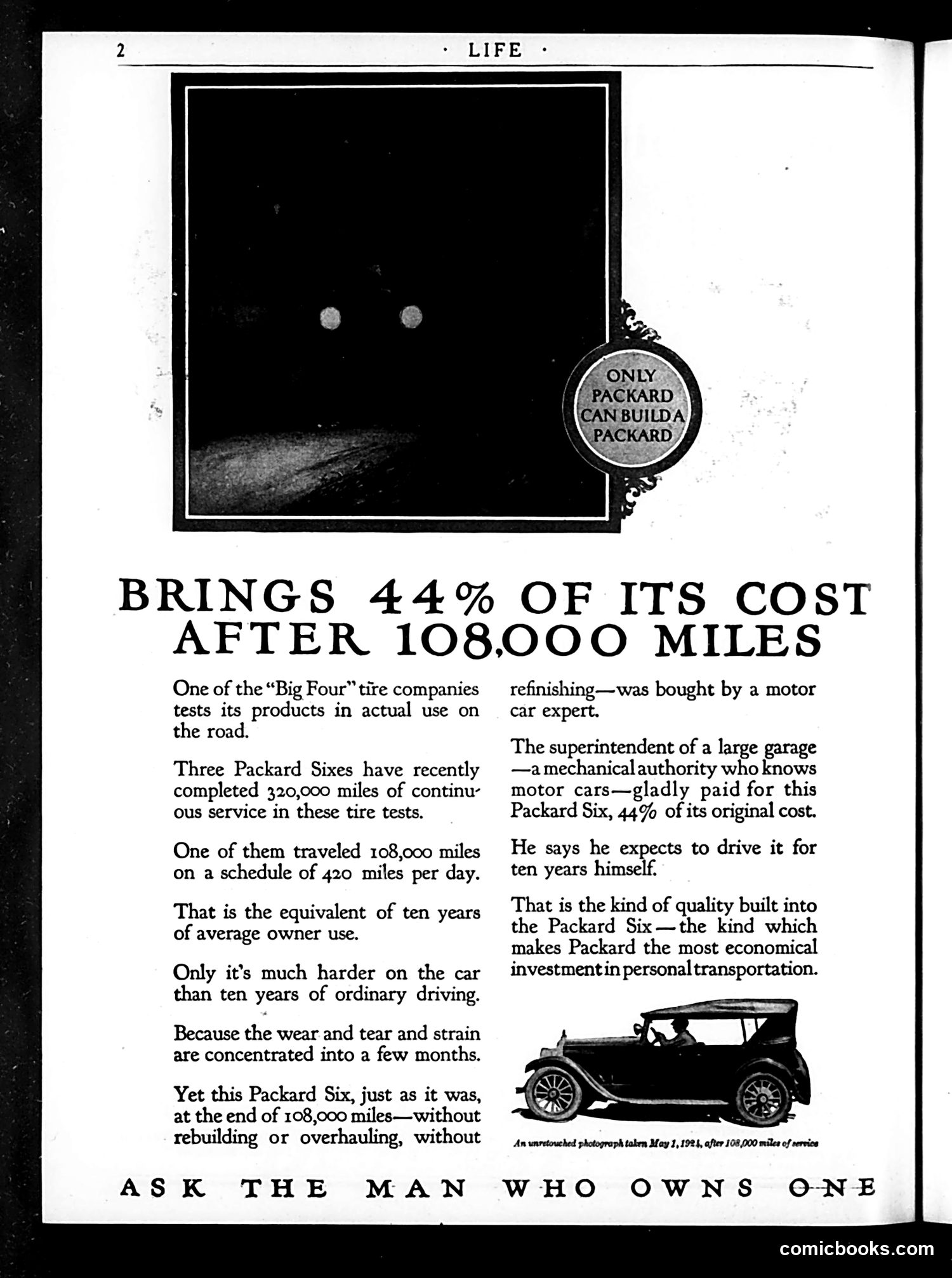
This is **advertising, not satire or political commentary**. It's a Packard automobile company advertisement from *Life* magazine promoting the Packard Six car model. The image shows a mysterious face with glowing eyes in darkness—a visual metaphor for the car's reliability and durability. The accompanying text emphasizes that one Packard Six completed 108,000 miles of continuous testing without requiring rebuilding or overhaul, yet retained 44% of its original resale value. The appeal targets practical buyers by citing testimony from a garage superintendent (positioned as an impartial expert) who praised the car's quality and longevity. The famous tagline "Only Packard can build a Packard" reinforces brand exclusivity. This represents early automotive advertising emphasizing engineering and durability as selling points.
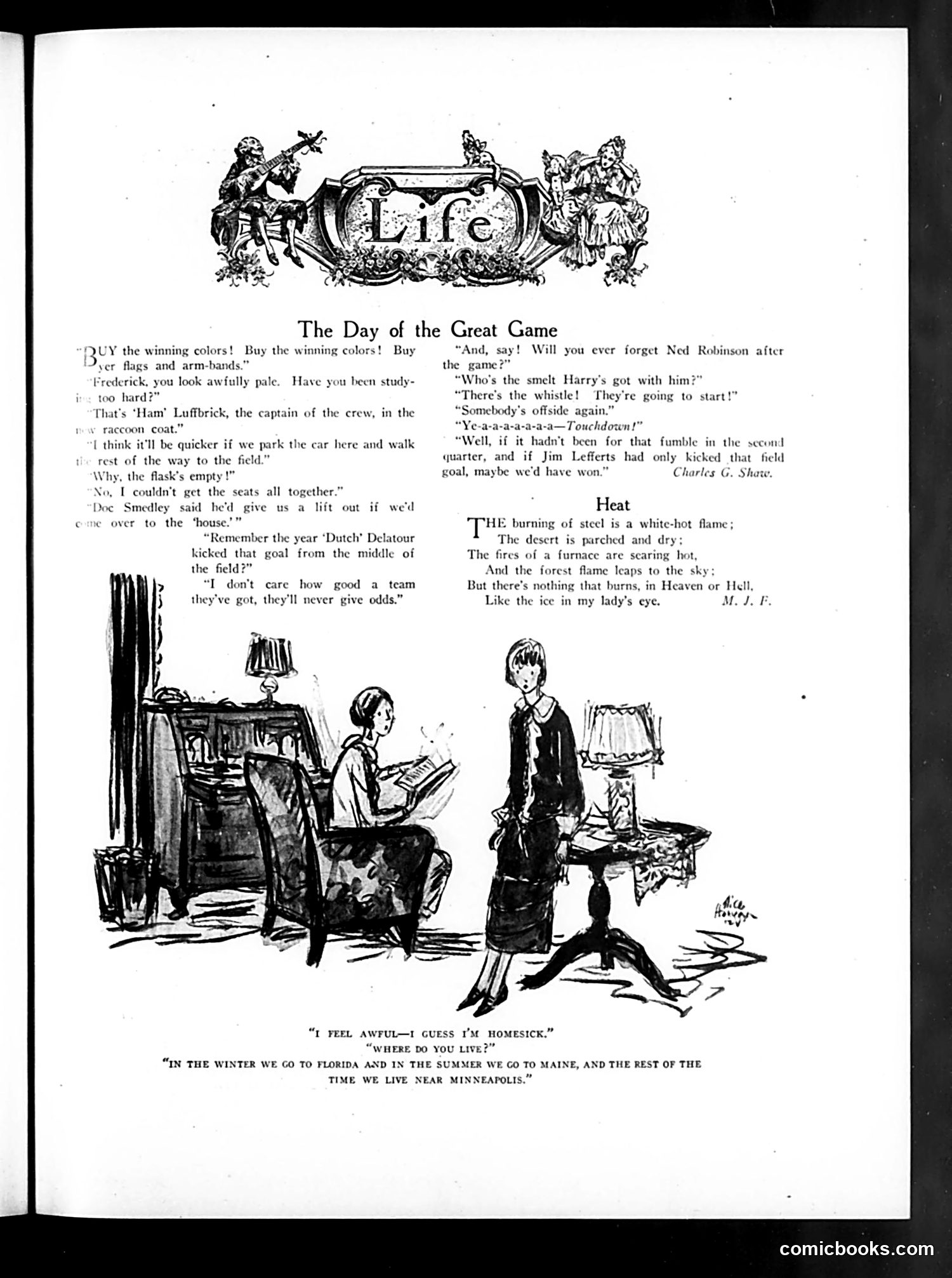
This page depicts early 20th-century American college football excitement. The dialogue captures enthusiastic fans discussing an upcoming game, mentioning players like "Ned Robinson" and "Jim Lefferts," and referencing a famous goal kicked by "Dutch Delatonr" from midfield. The illustration shows two women—one writing or reading, one standing—in a domestic interior, suggesting how thoroughly football dominated public conversation, even among those not directly participating. The accompanying poem "Heat" appears unrelated to the football content, focusing on romantic imagery ("ice in my lady's eye"). The lower caption reveals the cultural mobility of the era: families divided time between Florida winters and Maine summers, with Minneapolis as their home base—reflecting wealthy Americans' seasonal migration patterns.
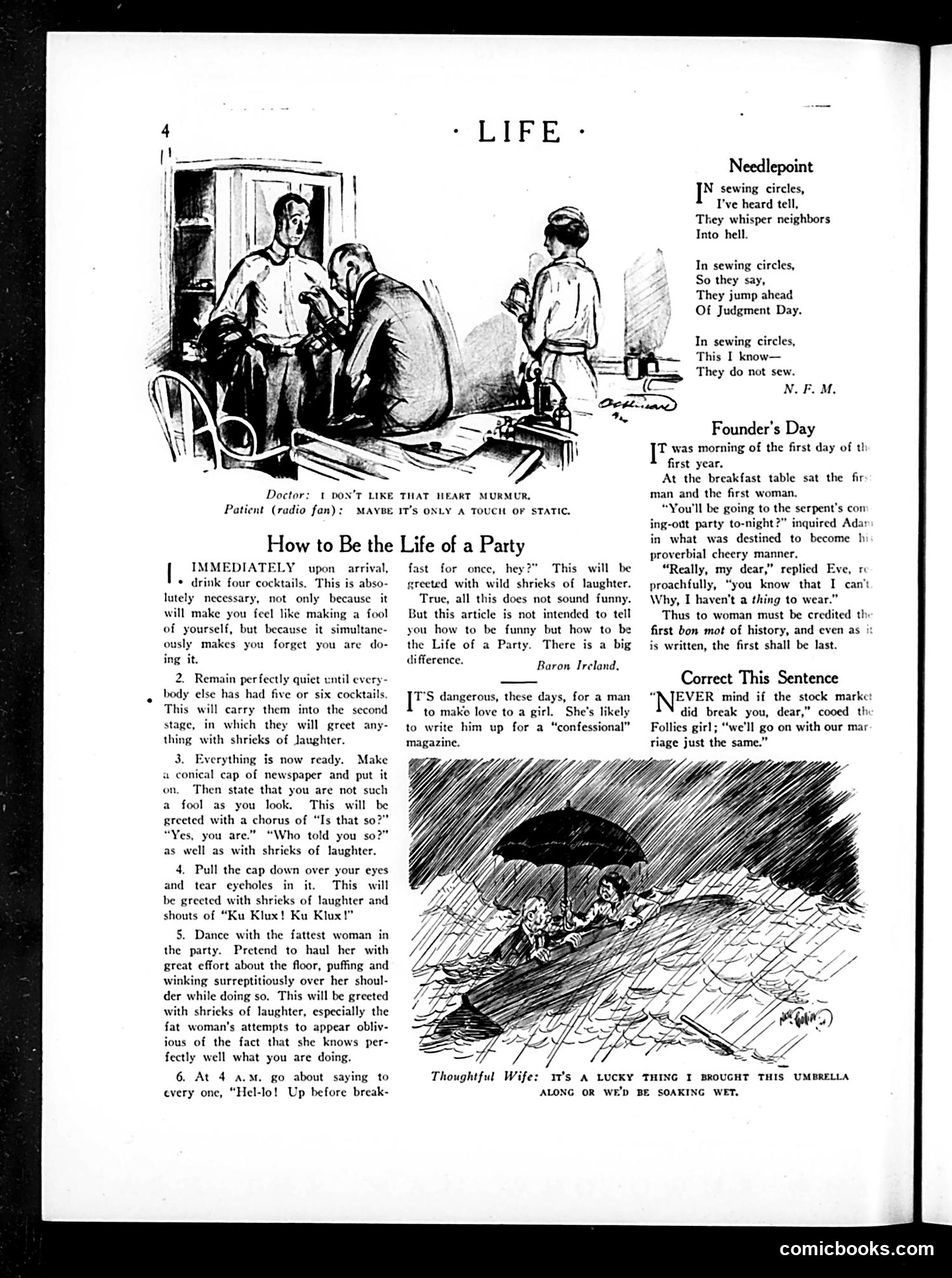
This page contains three distinct pieces of satire: 1. **"How to Be the Life of a Party"** (top left): A humorous guide offering six absurd tips for party success, including drinking heavily, remaining quiet until cocktails arrive, and dancing with the heaviest woman present while pretending great effort. The satire mocks both annoying party guests and the earnest "self-improvement" advice popular in magazines of the era. 2. **"Needlepoint"** (top right): A poem satirizing women's sewing circles, suggesting they're venues for gossip and moral judgment rather than productive work—"They do not sew." 3. **"Founder's Day"** and **"Correct This Sentence"** (bottom): Brief satirical pieces poking fun at institutional pomposity and grammatical pedantry. The overall tone reflects early-20th-century satirical humor targeting social pretension.
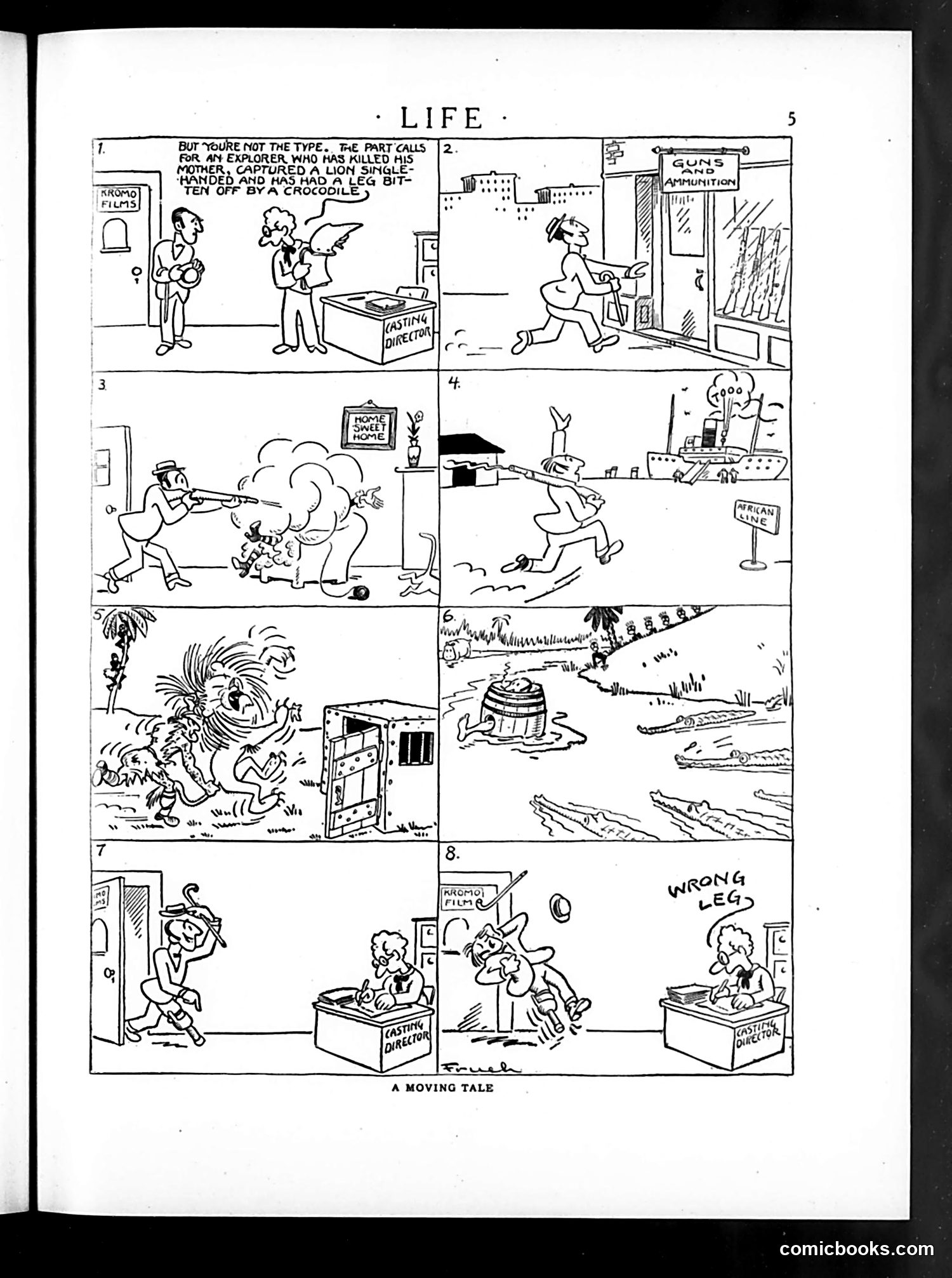
This eight-panel comic satirizes adventure filmmaking. Panel 1 introduces a casting director rejecting an actor as unsuitable for an explorer role. Panels 2-6 depict increasingly dangerous scenarios: the actor acquires guns and ammunition, runs toward a ship, hunts lions, and navigates crocodile-infested waters—suggesting "real" adventure. Panels 7-8 reveal the joke: the actor actually performs these stunts for a film set, not genuine exploration. He injures his leg doing the movie stunt work, and the final panel shows him labeled "WRONG LEG," suggesting he's now compensating incorrectly. The satire mocks how Hollywood's "authentic" adventure films required actors to perform genuine dangerous work, blurring the line between performance and reality.
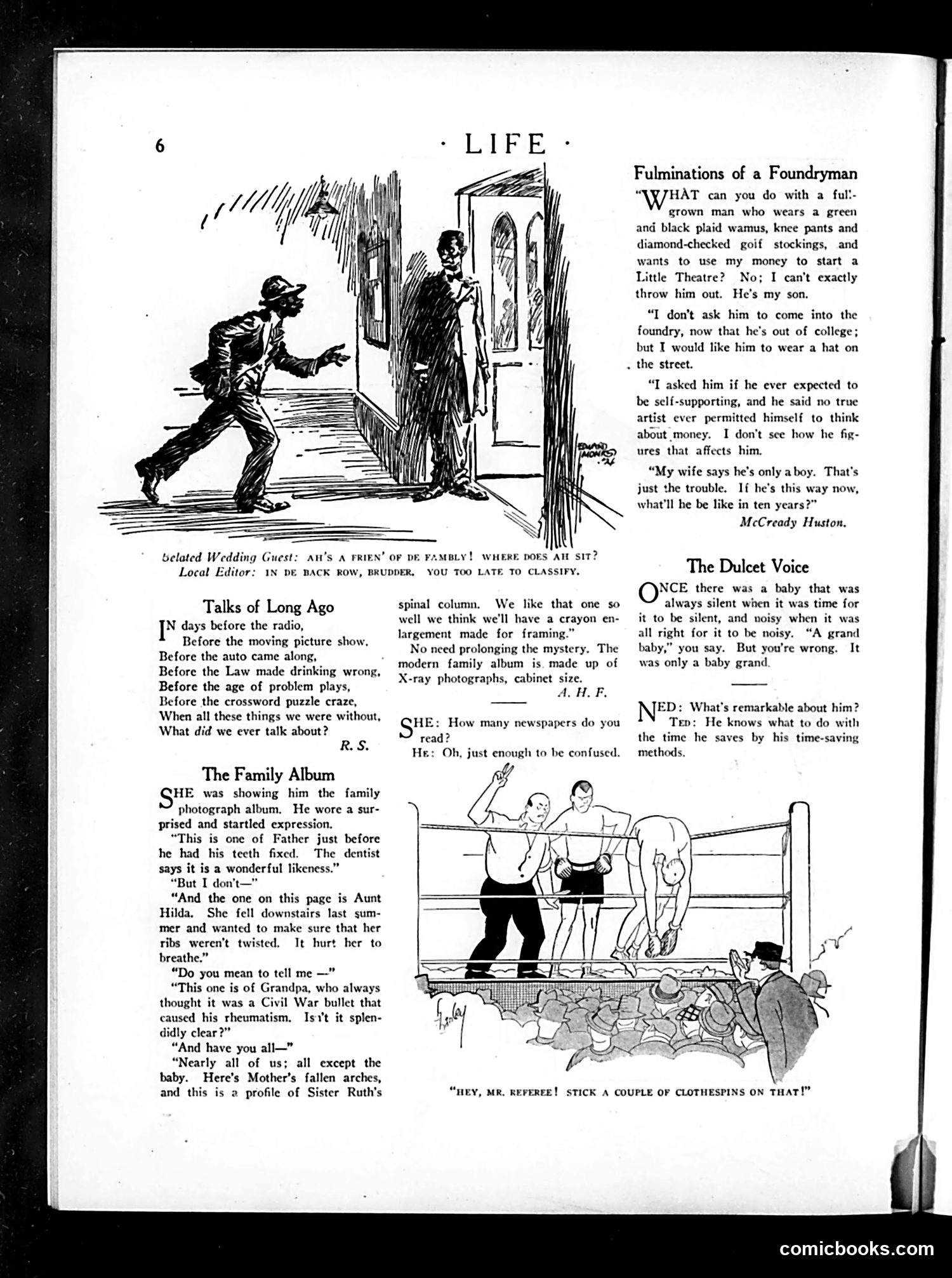
This page contains three separate humorous pieces satirizing early 20th-century American social life: 1. **"Belated Wedding Guest"** - A cartoon mocking someone arriving late to a social event, too disheveled to attend. 2. **"Fulminations of a Foundryman"** - A father's complaint about his son's artistic aspirations and bohemian lifestyle (green plaid suit, diamond-checked stockings). The satire targets wealthy parents frustrated by their sons rejecting practical careers for theater and artistic pursuits. 3. **"The Family Album"** - Shows a father annoyed during family photo-viewing, with humorous commentary about relatives' physical imperfections (fallen arches, rheumatism from Civil War wounds). 4. **Bottom cartoon** - A beach/poolside scene where someone shouts "Stick a couple of clothespins on that!" - likely mocking overly thin or poorly-built swimmers. The page satirizes family embarrassments and social pretension typical of the era.
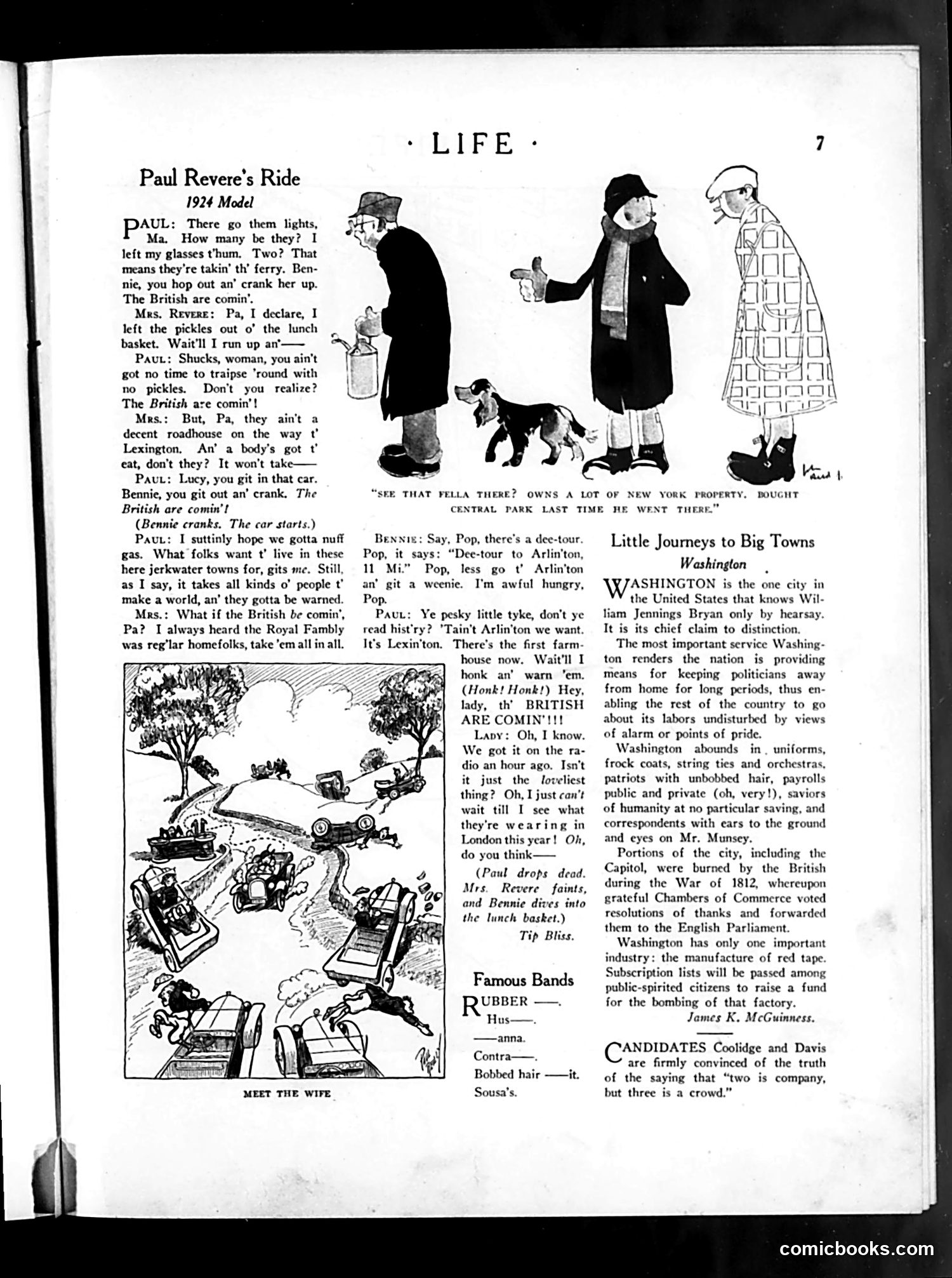
This comic strip satirizes the famous American Revolutionary War historical event through a 1920s automobile lens. Paul Revere's urgent midnight warning ("The British are coming!") is reimagined with modern cars instead of horses. The humor derives from applying contemporary technology to a sacred historical moment—the characters debate whether to take a ferry, discuss car troubles ("crank" the engine), and debate travel routes to Arlington and Lexington. The cartoon mocks how 1920s Americans approach historical narratives: filtered through modern convenience and practical concerns rather than patriotic grandeur. The lower panel ("Meet the Wife") depicts the chaotic parking and traffic that would result, further deflating the romantic legend with automotive-age reality and domestic comedy.
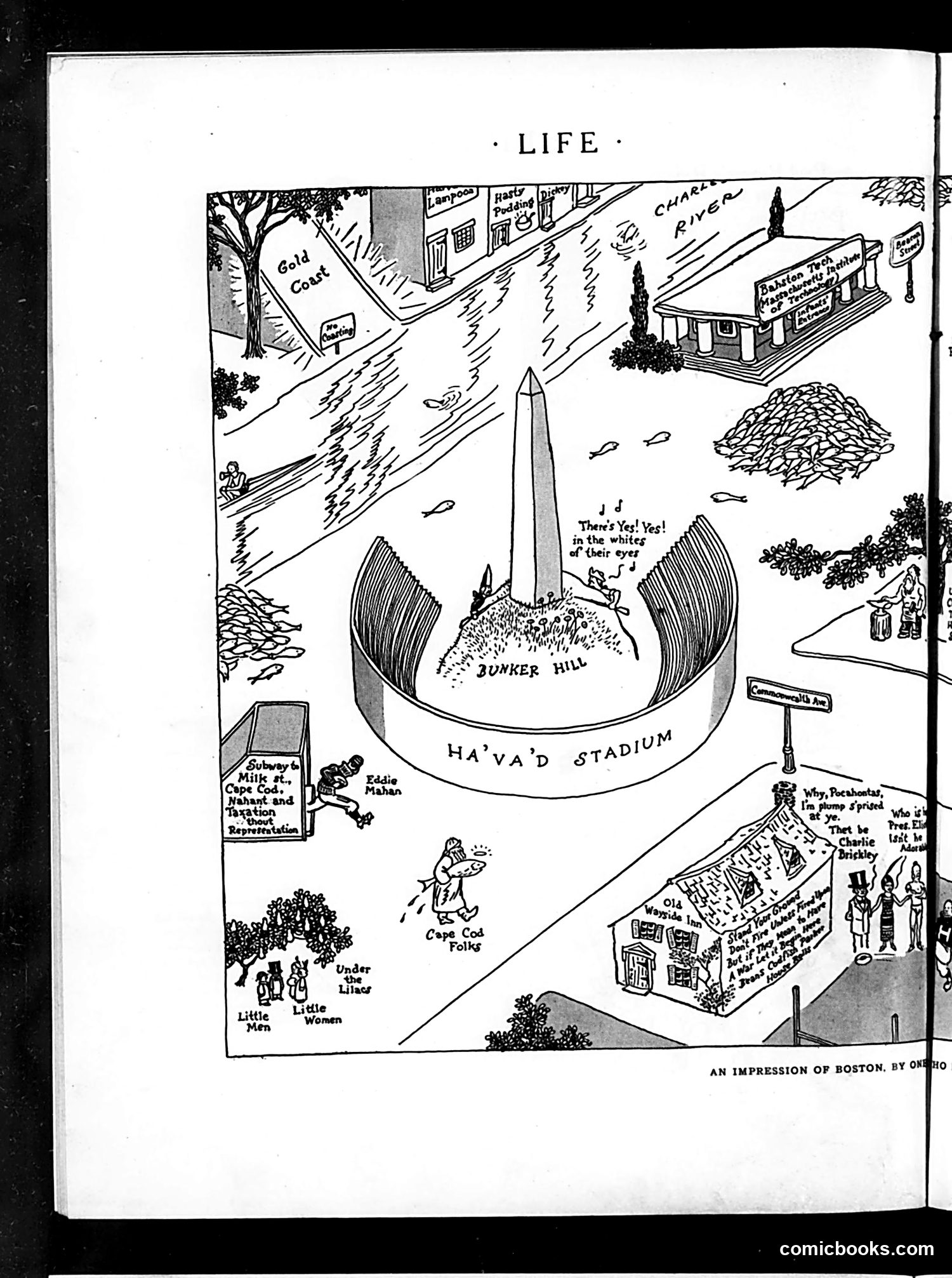
This is a satirical map of Boston labeled "An Impression of Boston" (credit to Oreno, visible at bottom). The cartoon depicts Boston's famous landmarks and cultural attractions with humorous exaggeration: **Key locations identified:** - Harvard Stadium (prominently featured with Bunker Hill monument) - The Charles River - Cape Cod Folk and other regional references - Literary/cultural allusions: "Little Women," "Under the Linden," "Gold Coast" The satire appears to mock Boston's self-image as an intellectual and cultured hub, emphasizing its literary traditions and Brahmin elite sensibilities. References to classical literature and famous Boston institutions suggest the cartoonist is gently poking fun at the city's pretentiousness and provincial pride in its historical and cultural significance.
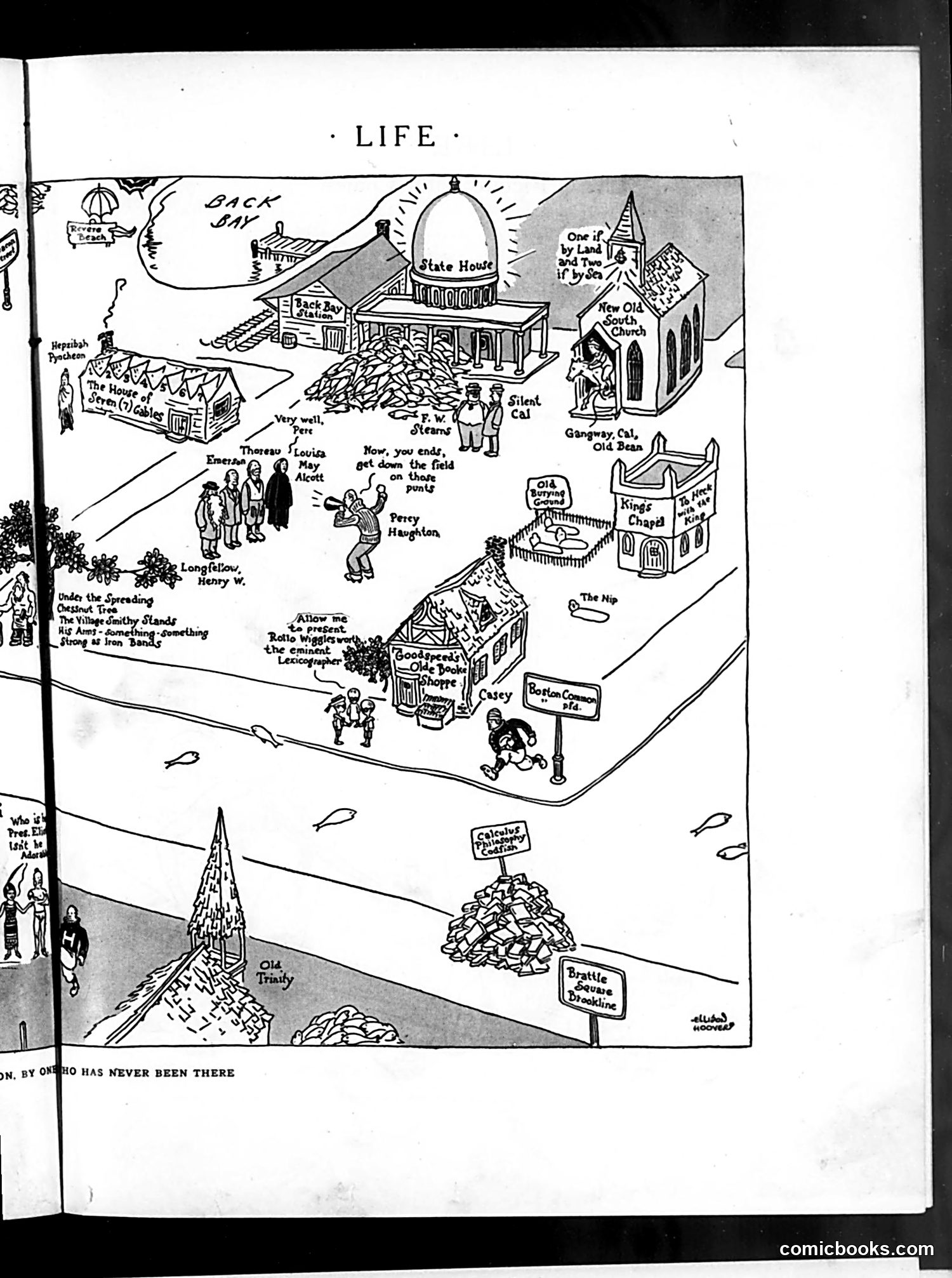
This is a satirical map-style cartoon titled "LIFE" depicting California tourist attractions and landmarks. The illustration shows a bird's-eye view of famous sites including the State House, various old missions and chapels (Old Town, Gangway, Rings Chapel), and historical buildings. The satire appears to target California's commercialization of its heritage—showing tourist destinations, gift shops ("Goodspeed's Old Book Shoppe"), and roadside attractions labeled with folksy names. References to specific figures like "Perry Haughton" and "Emerson Hough" (likely historical/cultural personalities) suggest commentary on California's mythmaking. The cartoon mocks how California packages and sells its past to visitors, reducing genuine historical sites to commercialized tourist stops. The style and labeling suggest early-to-mid 20th century tourism culture.
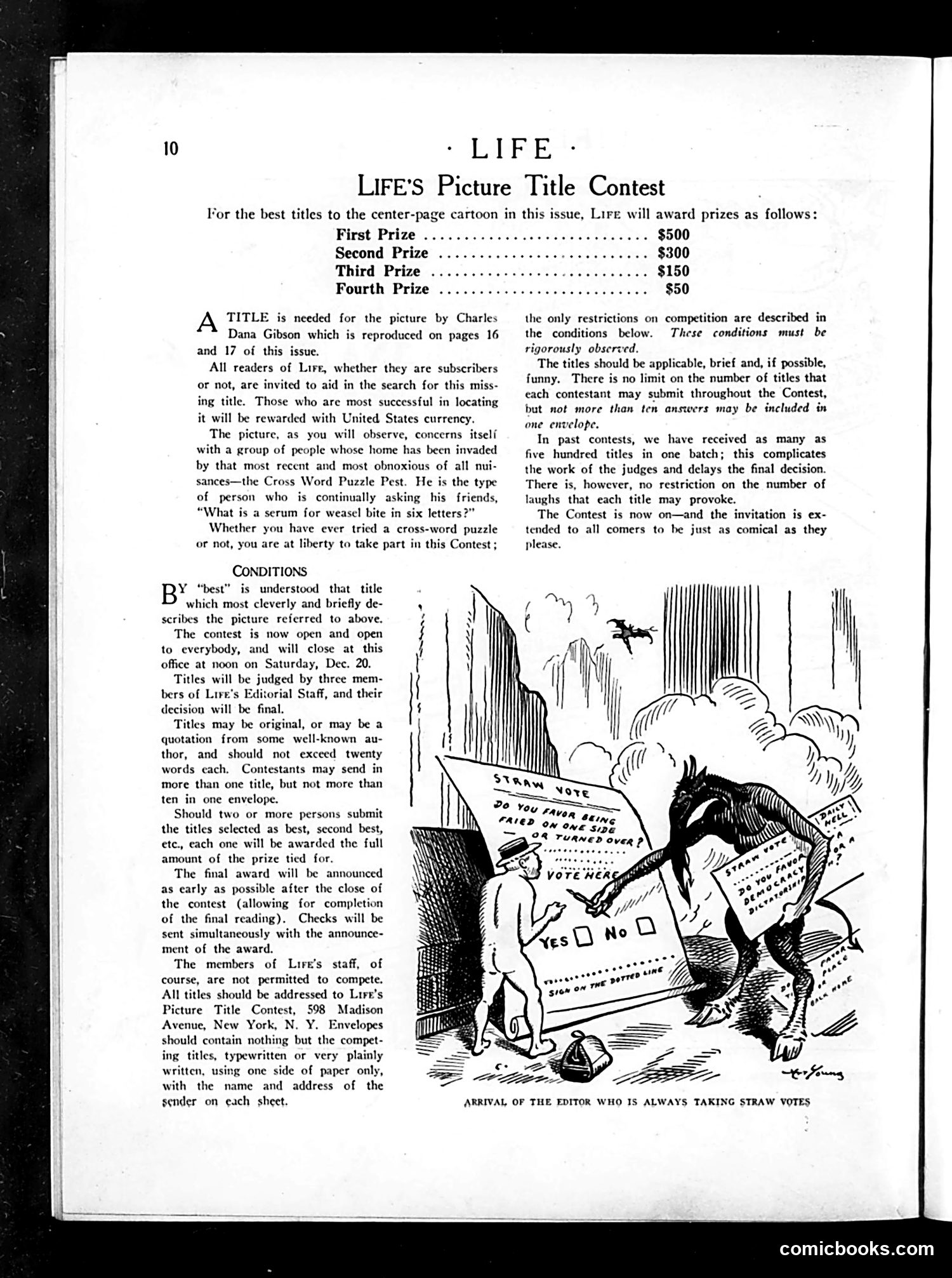
This page announces **Life magazine's contest** for humorous titles to accompany a center-page cartoon by Charles Dana Gibson (visible on pages 16-17). Prizes range from $500 to $50. The cartoon itself, captioned **"ARRIVAL OF THE EDITOR WHO IS ALWAYS TAKING STRAW VOTES,"** depicts an editor arriving amid chaotic voting activity. Figures hold ballots and voting materials marked "YES" and "NO," suggesting the cartoon satirizes editors who constantly poll their staff or the public rather than making decisive decisions themselves. The "straw vote" reference mocks informal, non-binding polls—implying indecisive leadership that relies on constant feedback rather than editorial authority. The humor targets editorial management style and workplace dynamics.
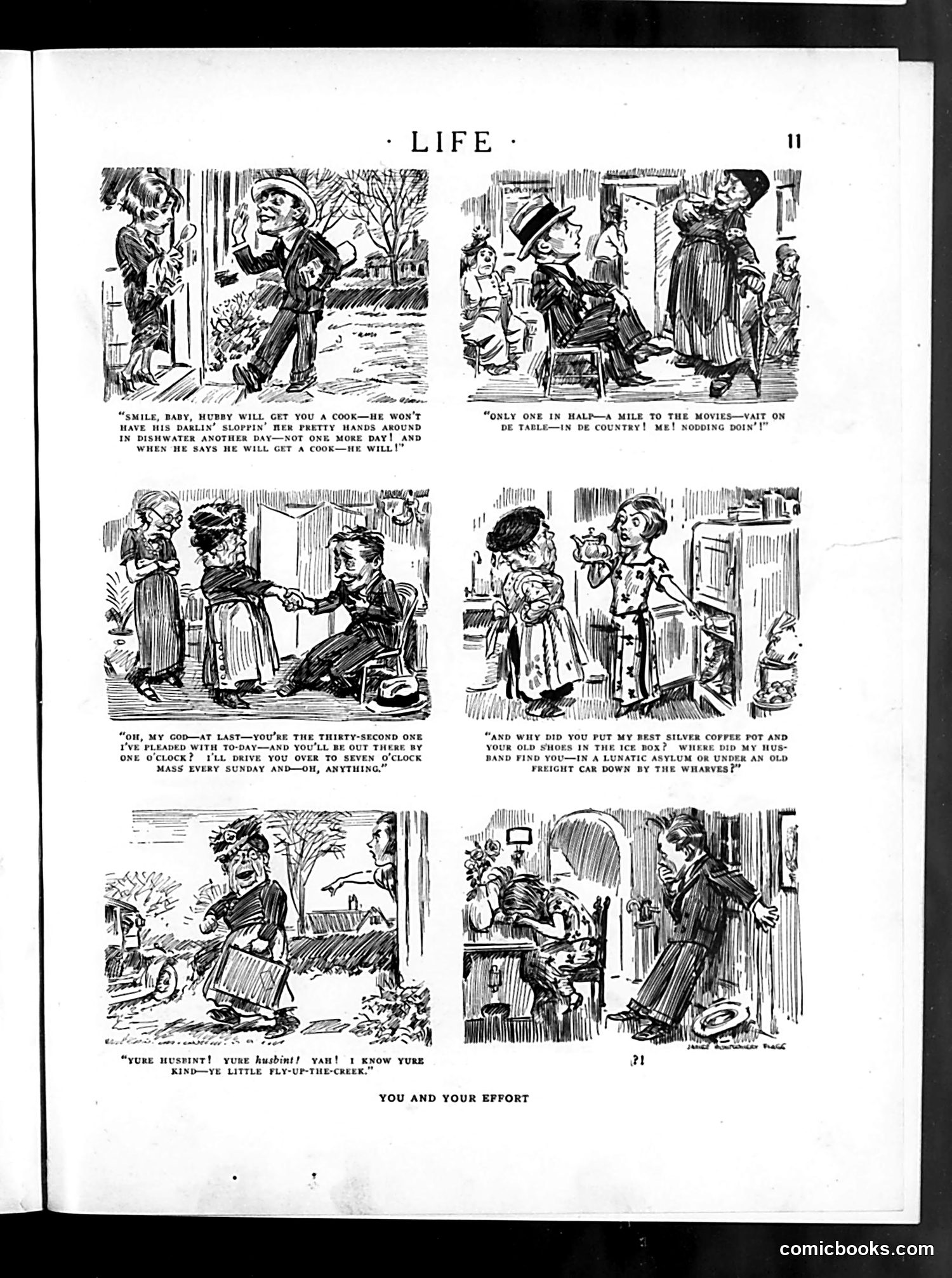
This page contains six cartoon vignettes satirizing domestic life and marriage, likely from the early 20th century. The scenarios depict husbands making excuses to avoid household duties—claiming they'll hire a cook "when" (never), boasting about avoiding dishwashing, complaining about a wife's shopping habits, and generally shirking domestic responsibility. The humor targets middle-class marital dynamics, specifically husbands' resistance to housework and their empty promises. One panel references the wife's excessive spending on domestic items found in questionable places. The final caption, "You and Your Effort," suggests ironic commentary on male domestic contribution—or lack thereof. The satire reflects contemporary frustrations about gender roles and household labor division.
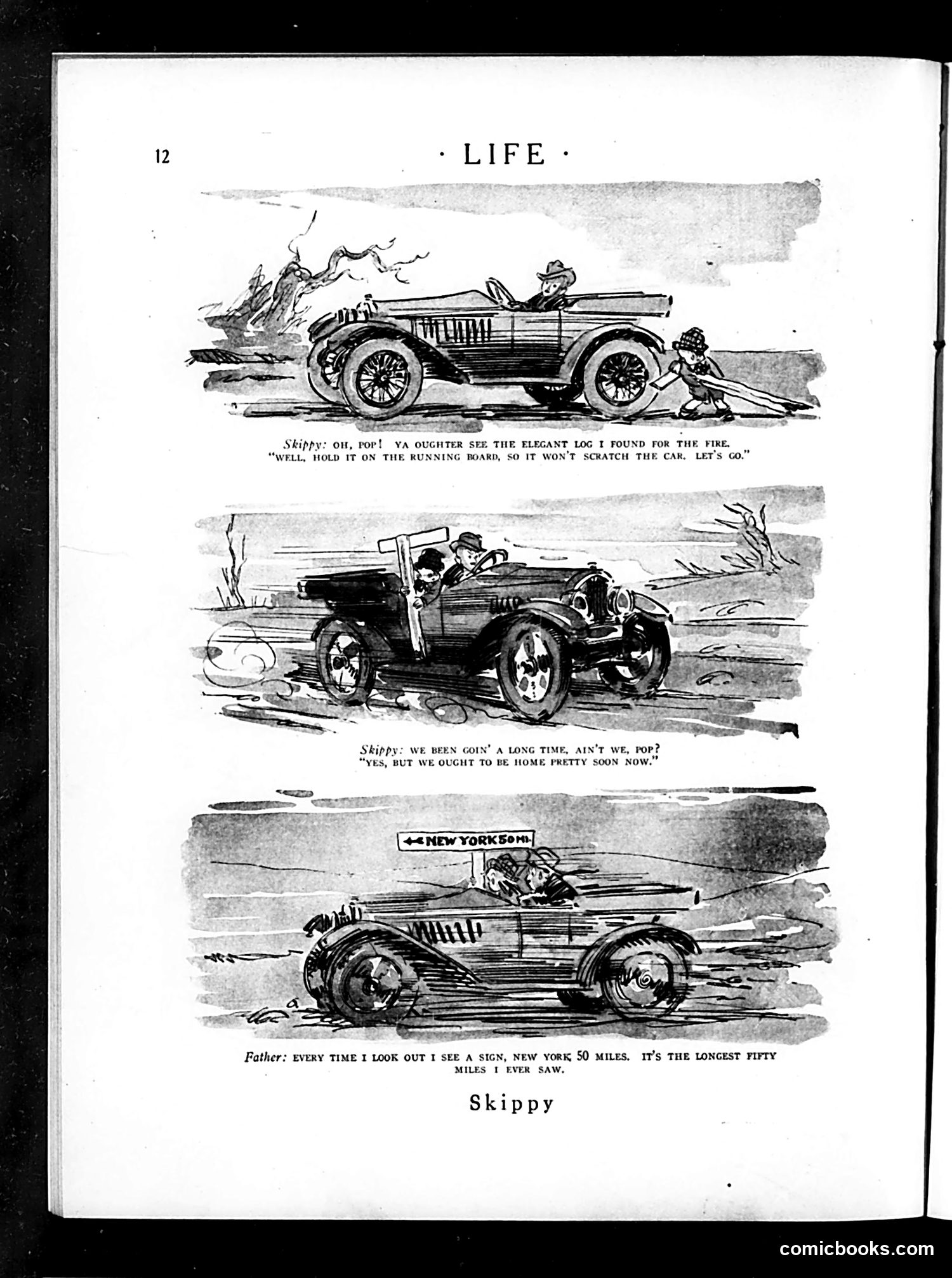
This is a three-panel comic strip titled "Skippy" featuring a father and son on a road trip in an early automobile. The humor relies on practical observations about early motoring: **Panel 1:** The son suggests using a fallen log on the car's running board to protect it from scratches during a campfire stop—showing child logic applied to car care. **Panel 2:** After extended driving, the father notes they've been traveling a long time and should head home soon. **Panel 3:** The father obsesses over a "New York 50 Miles" road sign, remarking it's the longest fifty-mile stretch he's ever seen—a relatable joke about how distance markers on long drives seem to take forever to reach. The strip satirizes family road-trip experiences and the tedium of early automobile travel.
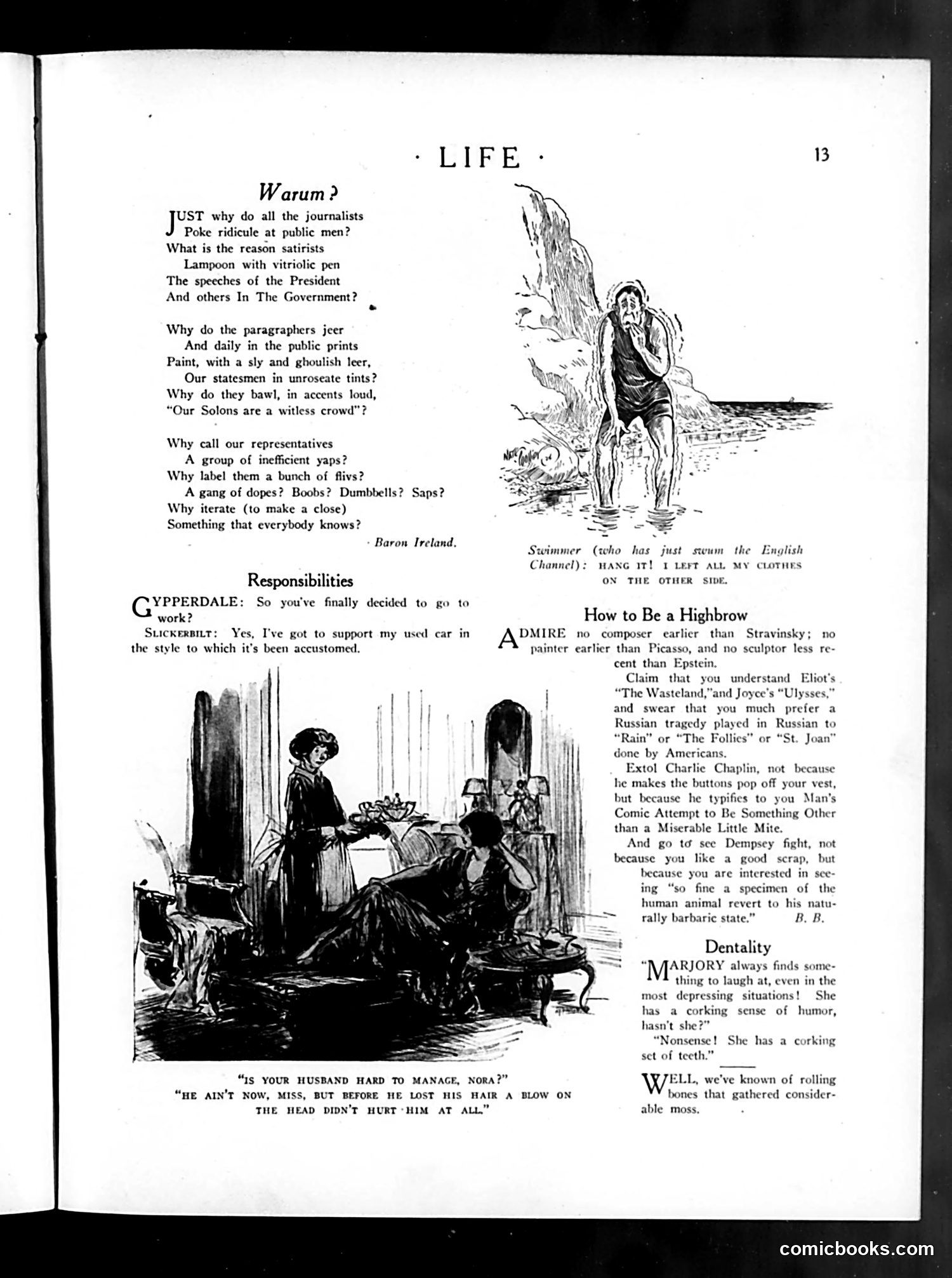
**"Warum?" poem** (top left): A satirical critique of American journalism and politics, questioning why journalists ridicule public figures, why satirists lampoon presidential speeches, and why politicians are mocked as incompetent ("inefficient yaps," "bunch of fives"). The poem by Baron Ireland protests excessive media mockery of government officials. **"Responsibilities" cartoon** (center): Shows a woman asking a reclining man if her husband is "hard to manage." He responds that he isn't now—but he was before "he lost his hair a blow on the head didn't hurt him at all." Dark satire suggesting domestic violence ("blow on the head") somehow improved his tractability. **Right-side sections** ("How to Be a Highbrow," "Dentality"): Brief satirical advice columns mocking pretentiousness and humor.
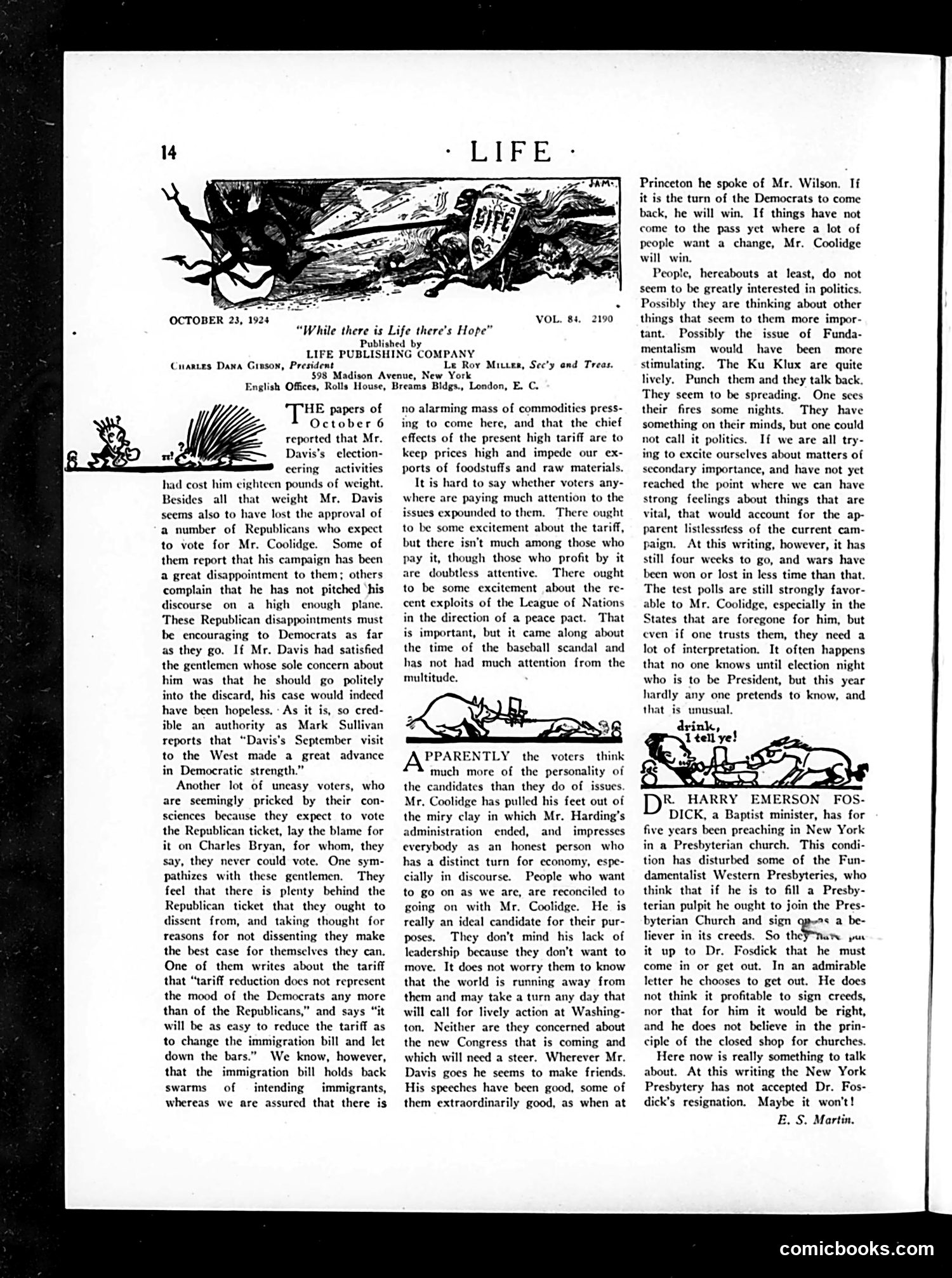
This page contains political commentary on the 1924 U.S. election. The main text discusses Mr. Davis's campaign and Republican voter concerns, referencing a "baseball scandal" (likely the Teapot Dome scandal under President Harding). The article critiques that voters focus more on candidates' personalities than policy issues. It notes Mr. Coolidge's appeal as an "honest person" despite lack of leadership, and expresses concern that voters aren't engaged with substantive matters like tariffs or the League of Nations. A separate piece discusses Dr. Harry Emerson Fosdick, a Baptist minister involved in Presbyterian church controversy. The cartoons (appearing to show figures in distress or confrontation) illustrate the election's stakes, though specific identities are unclear without additional context.
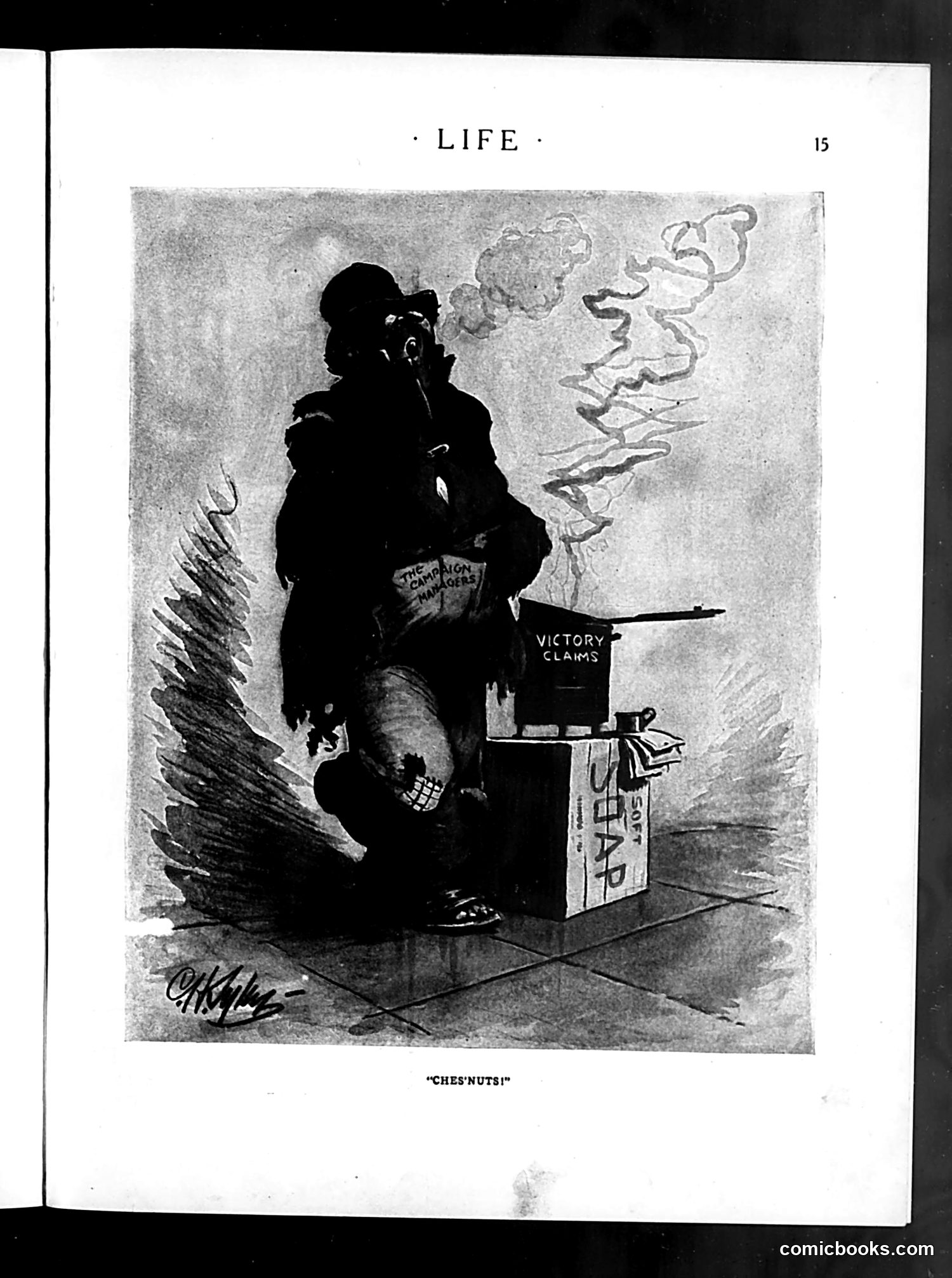
This satirical cartoon depicts a figure in military/official dress hunched over a box labeled "Victory Claims." The figure appears to be plucking or extracting items from the box while smoke or clouds emanate from above, suggesting ongoing conflict. The title "Ches'nuts!" is period slang meaning "old jokes" or "tired claims"—indicating the cartoonist is mocking repetitive or false assertions about military victory. The cartoon critiques what appears to be exaggerated or recycled victory announcements during wartime (likely WWI, given Life's publication era). The satire suggests officials are continuously making worn-out victory proclamations despite ongoing warfare, satirizing propaganda or public relations efforts that lack substance. The military figure represents government or military leadership making questionable claims.
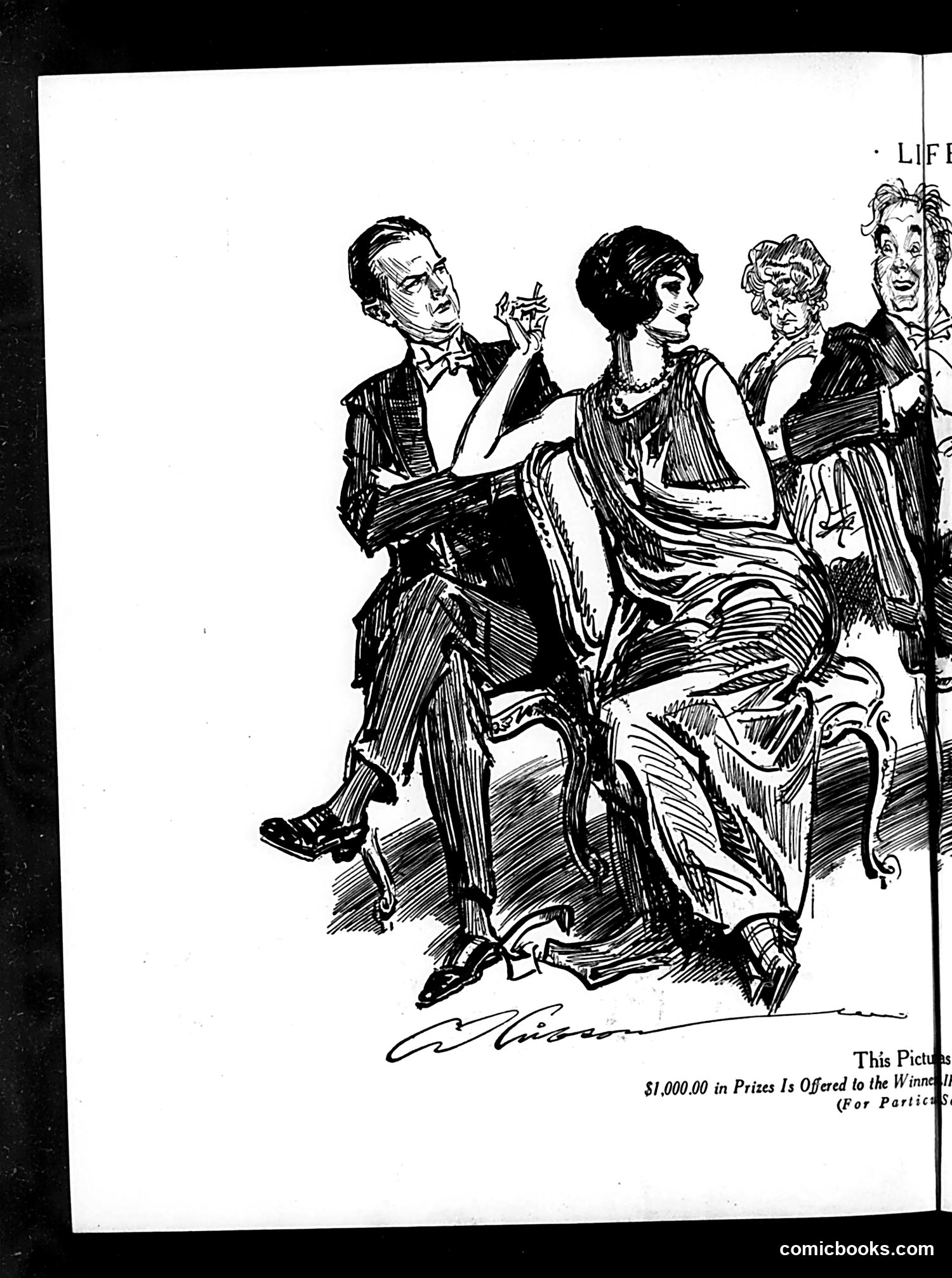
This is a pen-and-ink illustration showing five figures in early 20th-century formal attire in what appears to be a social gathering. The drawing uses exaggerated facial features typical of Life magazine's satirical style. The figures are depicted in various poses of interaction—one man adjusting his tie, a woman seated centrally, and others in animated conversation. The artist's signature appears at the bottom. The caption references "$1,000.00 in Prizes" for what seems to be a contest, though the full text is partially cut off. Without clearer context or identifying labels within the image itself, it's difficult to determine which specific political figures or social commentary this targets, though the caricatured style suggests mockery of high society or fashionable circles of the period.
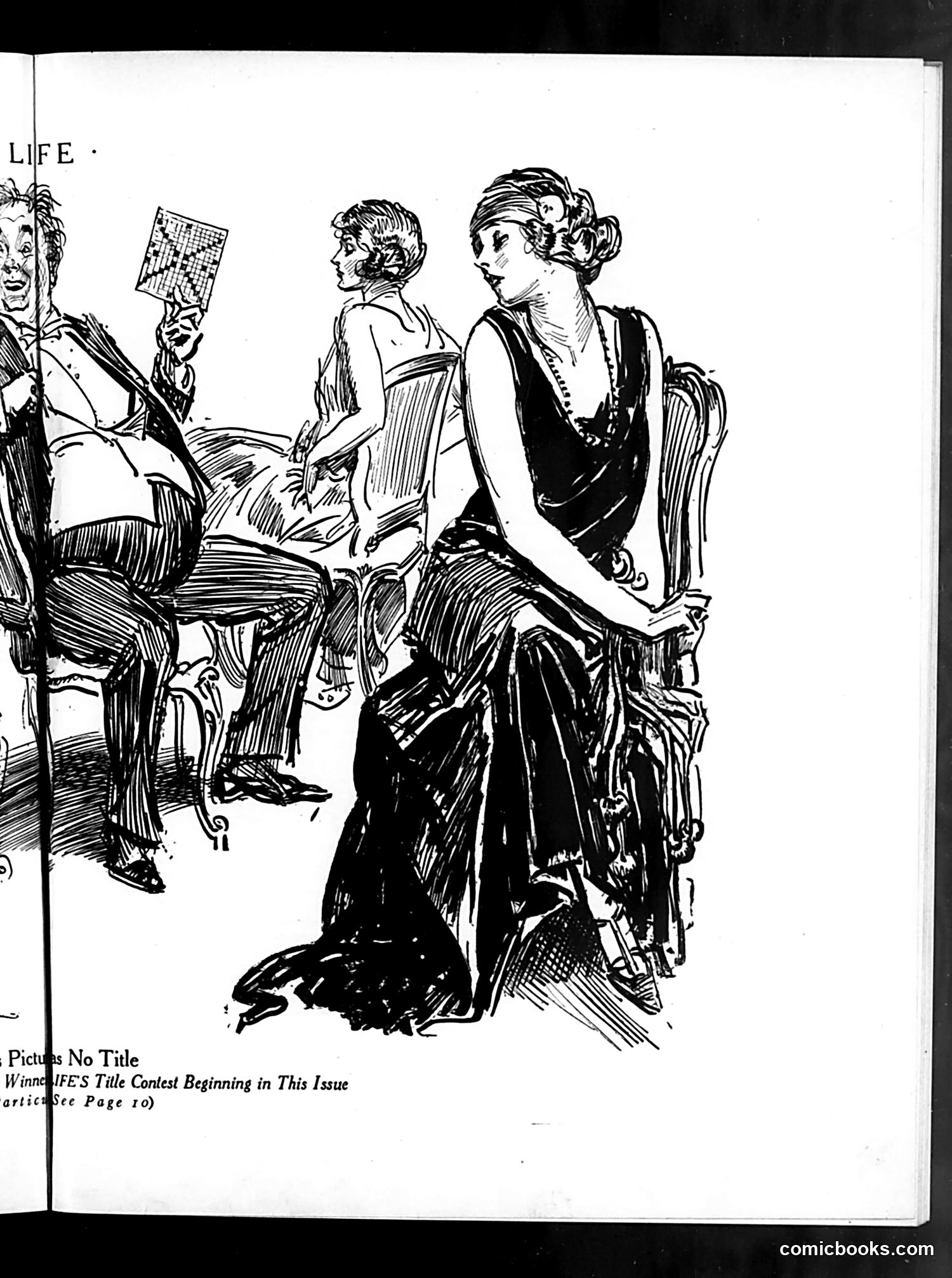
This page from *Life* magazine shows a sketch labeled "Pictures No Title" with a note about "LIFE'S Title Contest Beginning in This Issue" (see Page 10). The cartoon depicts three fashionably-dressed women in what appears to be an early 20th-century social setting. One woman on the left holds what looks like a checkerboard or game board, suggesting leisure activities among the upper classes. The illustration style and clothing suggest this is satirizing high-society women and their pastimes. The "title contest" indicates readers were invited to suggest captions for this untitled cartoon—a common *Life* magazine feature that engaged readers while poking fun at contemporary social situations, likely mocking the trivial concerns or vapid socializing of wealthy women during this era.
This page contains theater reviews from Life magazine's drama section. The critic discusses three Broadway plays with characteristic wit and skepticism: **"The Fake"** by Frederick Lonsdale—The reviewer criticizes Lonsdale for abandoning his trademark snappy dialogue, resulting in a thin play. Actor Godfrey Tearle delivers an absurdly clumsy "plant" (setup line) to a character he plans to murder, undermining the scene's credibility. **"Great Music"** by Martin Brown—Mocked for being written like a movie title rather than a play. The plot follows a musician's moral decline across exotic locations before he completes a symphony, accompanied by heavy-handed symbolism (leprosy, bad pianos). **"Bewitched"**—A fairy tale that the critic admits emotionally manipulated them despite recognizing it as "obvious applesauce," praising the writing by Sheldon and Howard for elevating simple material. The reviews exemplify Life's sardonic theatrical criticism, using humor to skewer pretentious or poorly-executed plays while occasionally crediting genuine craft.
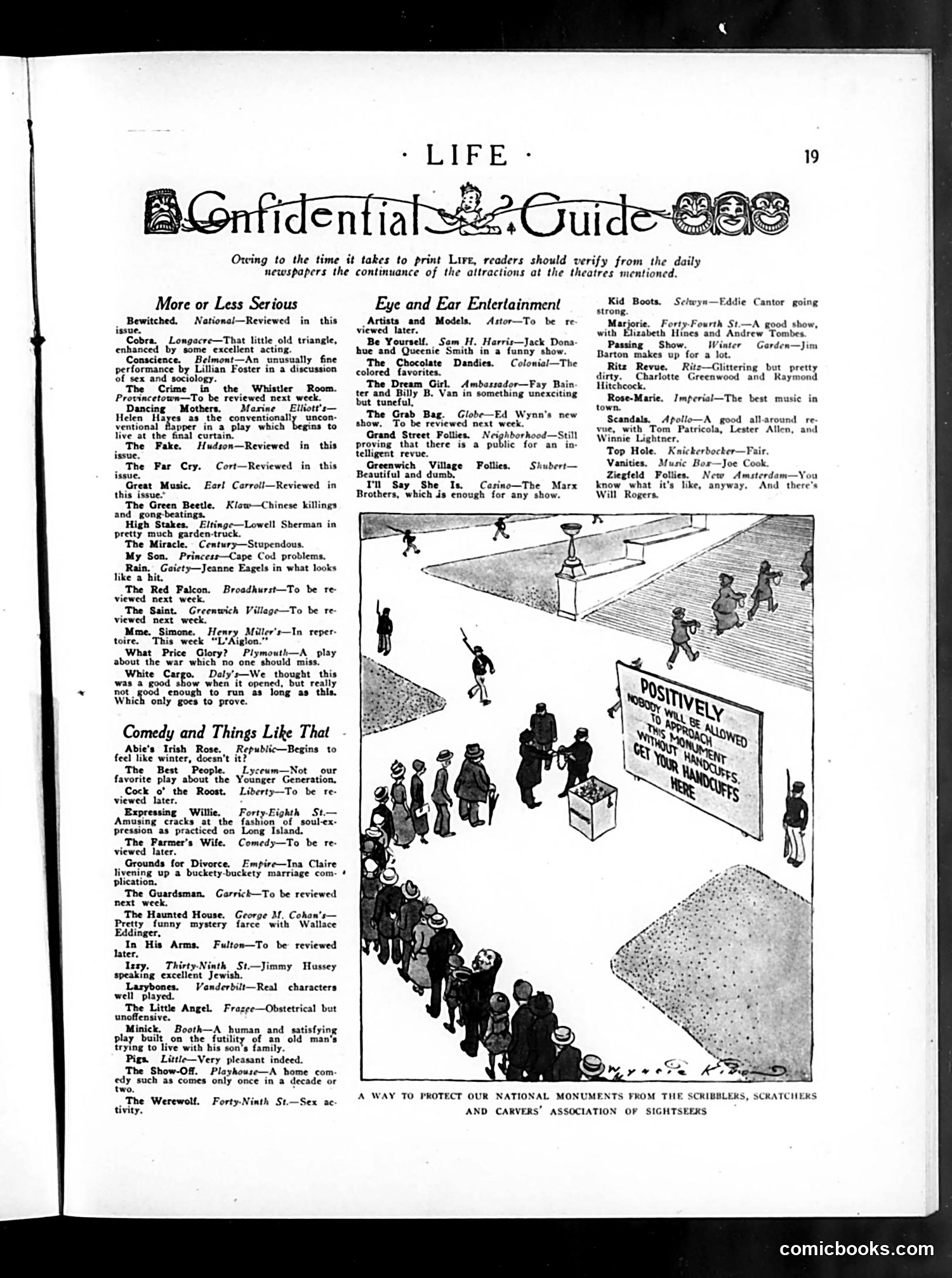
This page is primarily a **theatre guide and review column** for Broadway shows, with one notable cartoon at the bottom. ## The Cartoon The illustration depicts a crowd of sightseers at what appears to be a national monument, with a sign reading "POSITIVELY NO VISITORS ALLOWED WITHIN 10 FEET OF MONUMENT. KEEP YOUR HANDS OFF YOUR HANDKERCHIEFS." **The satire**: This mocks the Association of Sightseers and Carvers' problem of visitors damaging monuments through careless touching, scratching, and writing (hence "handkerchiefs"—likely souvenirs people would mark). The absurdly strict sign humorously suggests the only solution to protection is complete visitor exclusion. ## The Theatre Reviews The bulk of the page catalogs current Broadway productions, organized by tone: "More or Less Serious," "Comedy and Things Like That," and "Eye and Ear Entertainment." Notable shows mentioned include *Rain* (Jeanne Eagels), *What Price Glory?*, *Abie's Irish Rose*, and *Rose-Marie*. Reviews are brief, often sardonic (e.g., *Abie's Irish Rose*: "Begins to feel like winter, doesn't it?").
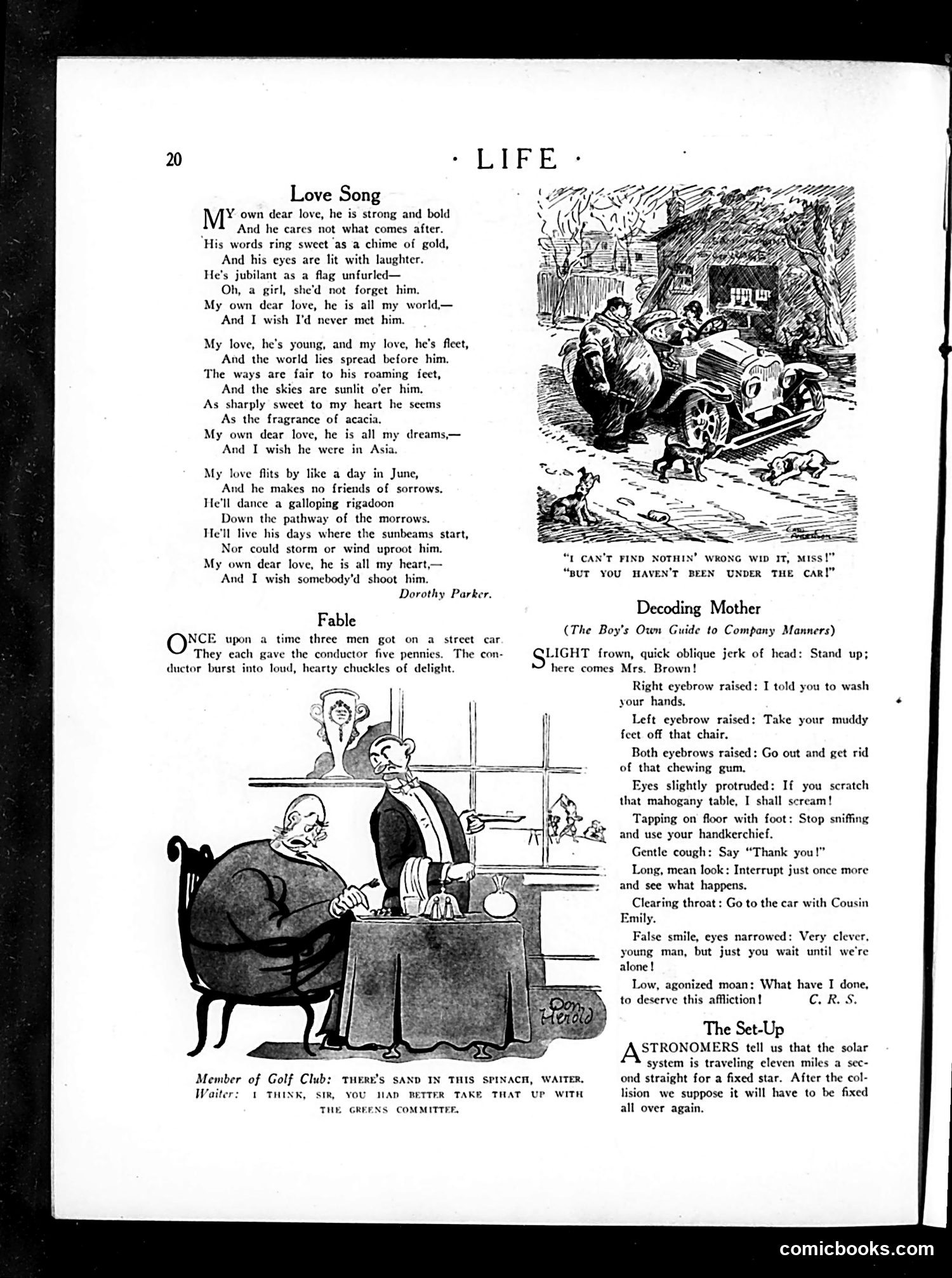
This page contains three distinct pieces of satire: 1. **"Love Song"** by Dorothy Parker: A poem expressing romantic ambivalence—the speaker loves her beau but wishes he'd leave or disappear. The accompanying illustration shows a couple in a car; the caption jokes about finding nothing wrong with the vehicle despite the woman's sarcasm. The satire mocks romantic idealization while acknowledging real relationship frustrations. 2. **"Fable"**: A brief joke about three men on a streetcar each giving the conductor five pennies, causing delight. The accompanying cartoon shows a waiter and diner discussing sand in spinach, with the waiter sarcastically suggesting the complaint go to the "greens committee"—likely satirizing bureaucratic absurdity and misplaced authority. 3. **"Decoding Mother"** and **"The Set-Up"**: Humorous guides explaining mothers' nonverbal cues and astronomical facts, using exaggerated tone to mock both parental behavior and pseudo-scientific explanations. The page's overall tone is lighthearted domestic and social satire typical of early 20th-century Life magazine humor.
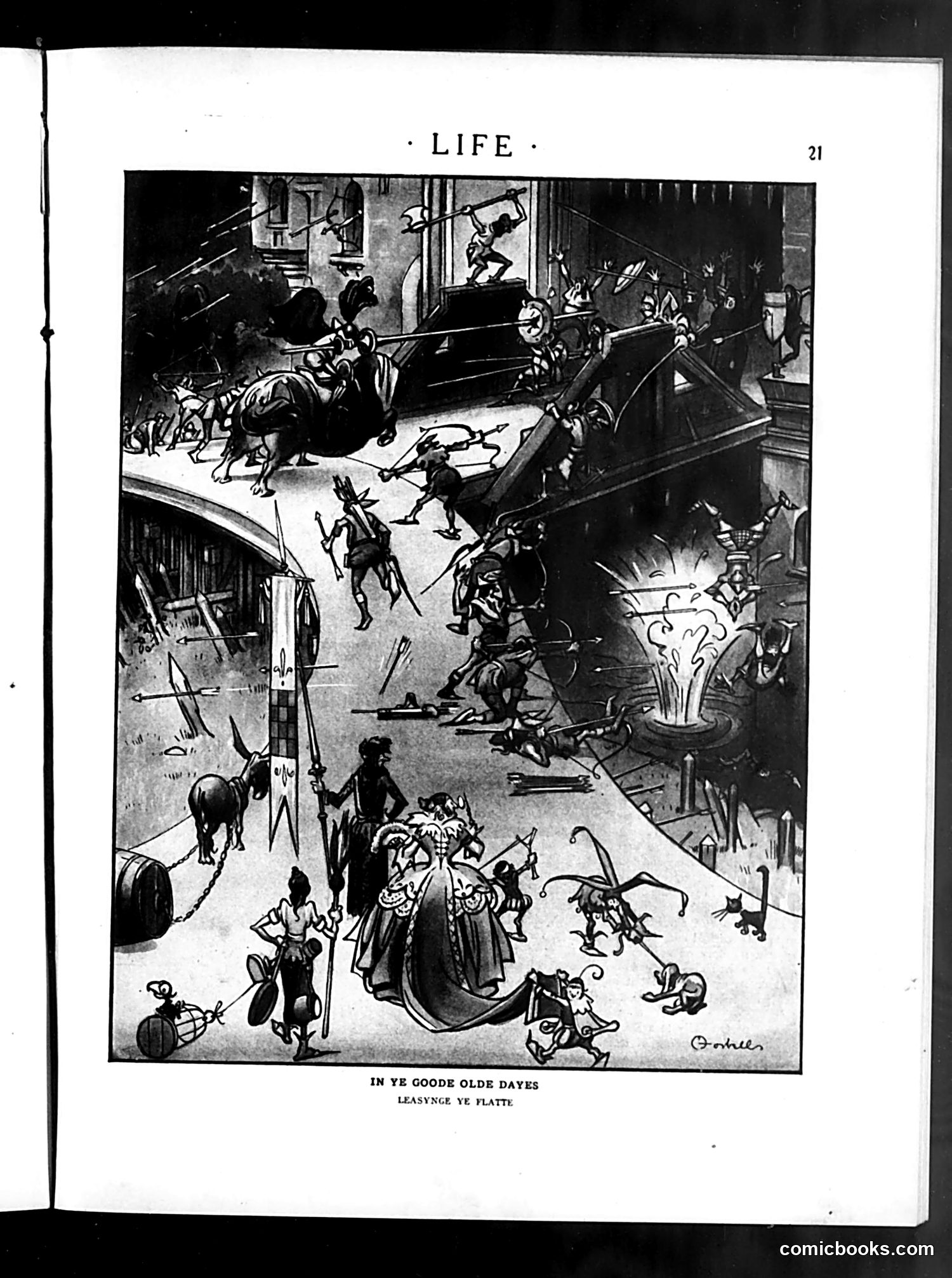
This is a satirical cartoon depicting a chaotic medieval or Renaissance street scene titled "In Ye Goode Olde Dayes" (In the Good Old Days), with the subtitle "Leasing Ye Platte" (likely a pun on "leasing" as in falsehood/lying). The image shows a bustling urban square with numerous figures engaged in various activities—some appear to be fighting, performing, or conducting business. There's a central figure in elaborate dress (possibly nobility or clergy) surrounded by commoners, animals, and general disorder. The satire likely mocks nostalgic romanticization of the past as "good old days." By depicting the period as actually chaotic, violent, and disorderly rather than idyllic, the cartoonist suggests such nostalgia is based on false memory or deliberate dishonesty about history. This was a common theme in early 20th-century satire questioning backward-looking sentiment.
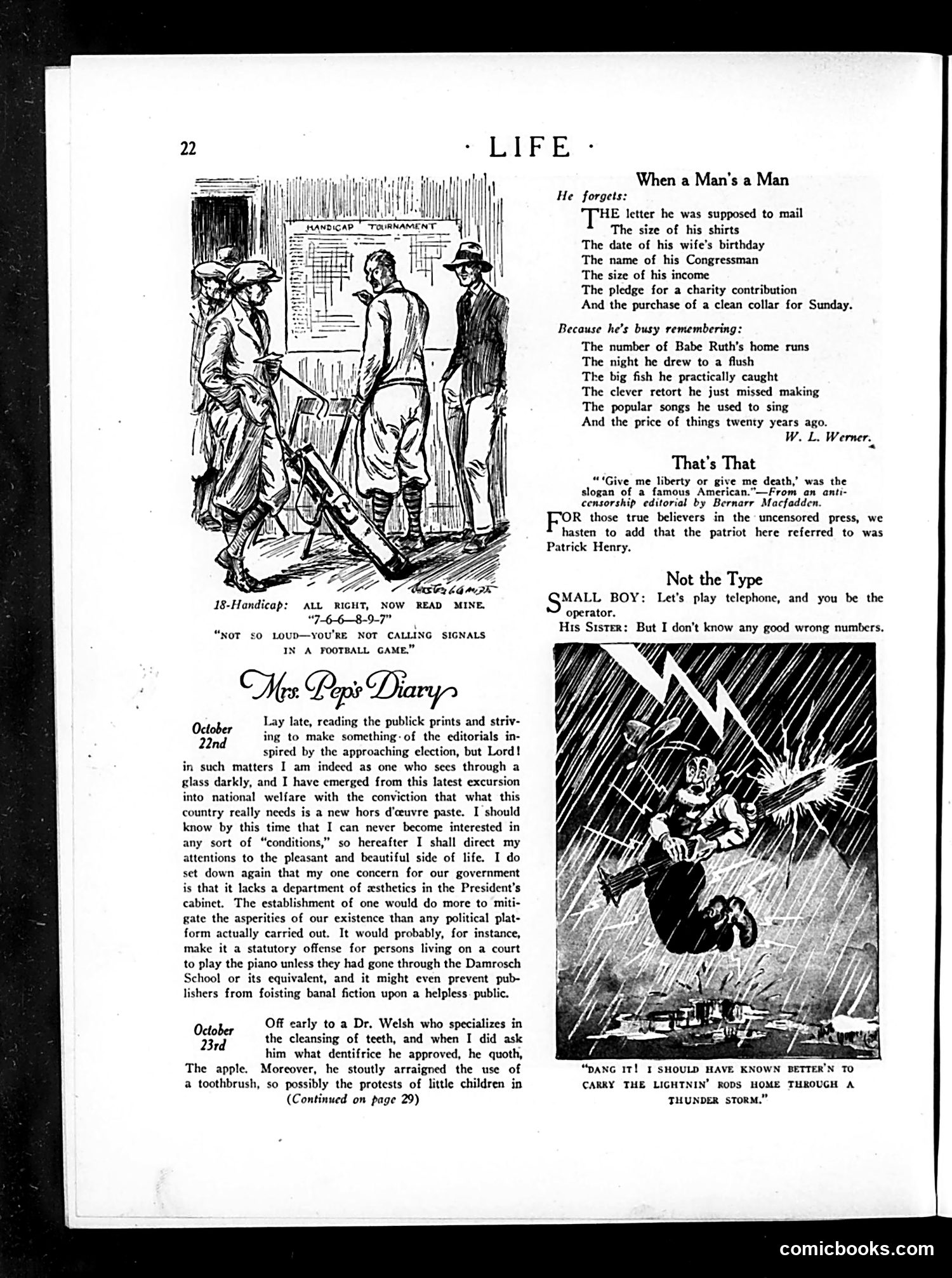
This page contains three satirical pieces from Life magazine's humor section: **"When a Man's a Man"** (by W.L. Werner) contrasts what men forget versus remember—wives' birthdays and civic duties versus sports statistics (Babe Ruth's home runs) and nostalgic trivia. It satirizes male priorities and selective memory. **"That's That"** mocks editorial pretension by citing Patrick Henry's famous "Give me liberty or give me death" quote about uncensored press, then correcting the attribution. It's gentle satire of editorial self-importance. **"Not the Type"** shows a golfer reading golf scores aloud as "calling signals" to a child playing telephone operator. The sister's reply—"I don't know any good wrong numbers"—jokes that wrong numbers are inherently bad, missing the father's joke entirely. **"Mrs. Pep's Diary"** entries humorously chronicle mundane life observations (a dentist recommending apples over toothbrushes). The bottom cartoon depicts someone caught in a thunderstorm carrying lightning rods, humorously illustrating poor judgment.
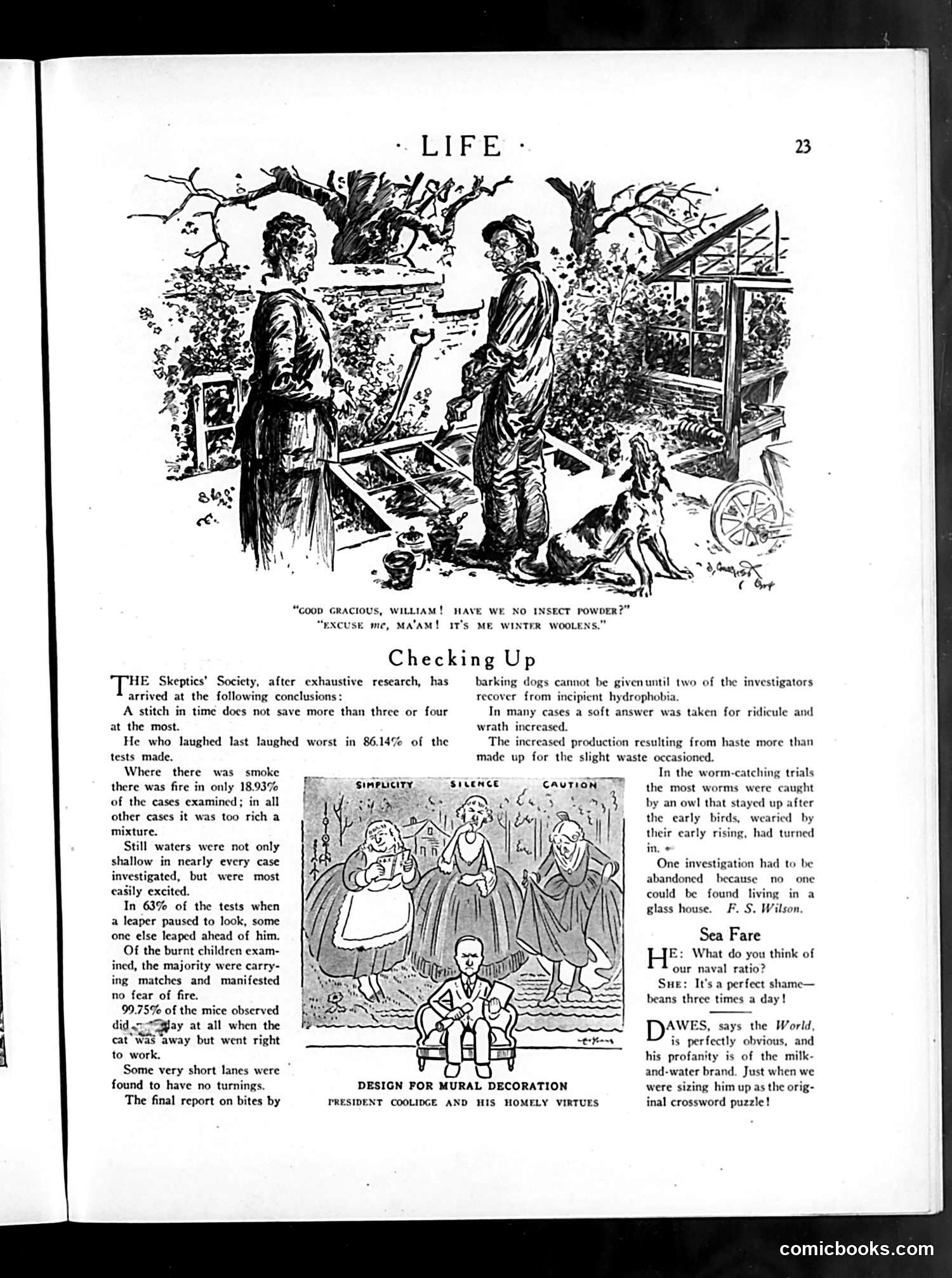
This page satirizes American folk wisdom and conventional sayings through a fake "Skeptics' Society" report debunking common proverbs. The "Checking Up" section humorously reverses expectations—"a stitch in time" saves only 3-4 stitches, "he who laughs last" actually laughed worst in 86% of cases, and "still waters" aren't shallow but easily excited. The satire mocks blind acceptance of clichés. The top cartoon shows a woman mistaking Winter Woolens (represented as a man) for an insect, asking about "insect powder"—a visual pun on the phrase's double meaning. The lower cartoon, captioned "Design for Mural Decoration: President Coolidge and His Homely Virtues," depicts figures embodying simplicity, silence, and caution—traits associated with President Calvin Coolidge's famously taciturn, austere public persona. This is gentle political satire of Coolidge's reputation for quiet restraint and plain living during the 1920s.
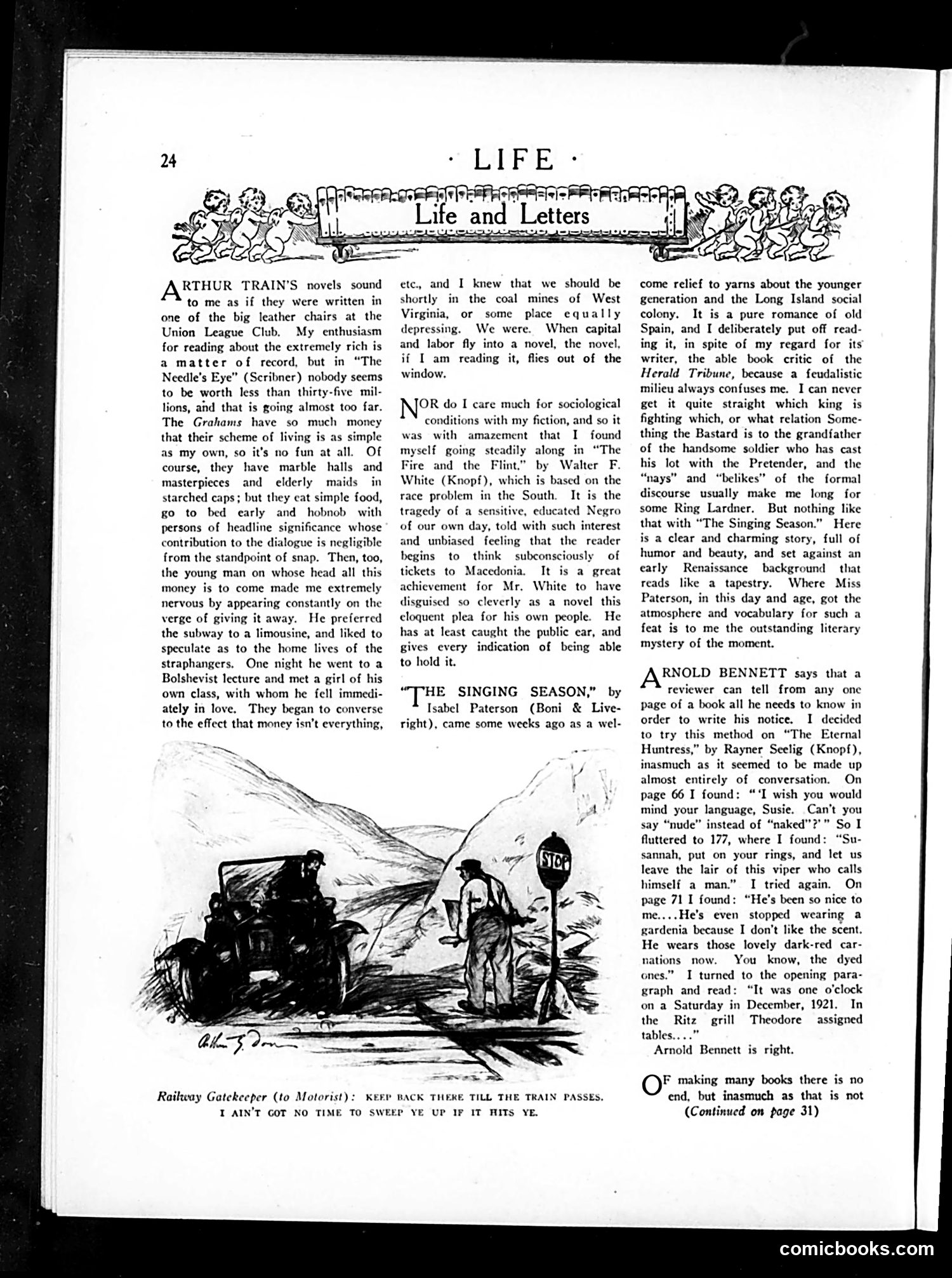
This is a literary review section from *Life* magazine's "Life and Letters" column. The page contains book reviews of contemporary novels, including Arthur Train's *The Needle's Eye*, Walter F. White's *The Fire and the Flint*, Isabel Paterson's *The Singing Season*, and Rayner Seelig's *The Eternal Huntress*. The accompanying cartoon depicts a railway gatekeeper stopping a motorist at a train crossing, with the gatekeeper declaring he has "no time" to sweep up debris if the train hits the vehicle—a darkly humorous commentary on workplace indifference and safety negligence. The reviews themselves are snobbishly written, with the critic dismissive of novels about wealthy characters or sociological themes, yet grudgingly praising White's nuanced treatment of racial issues in the American South as a literary achievement.
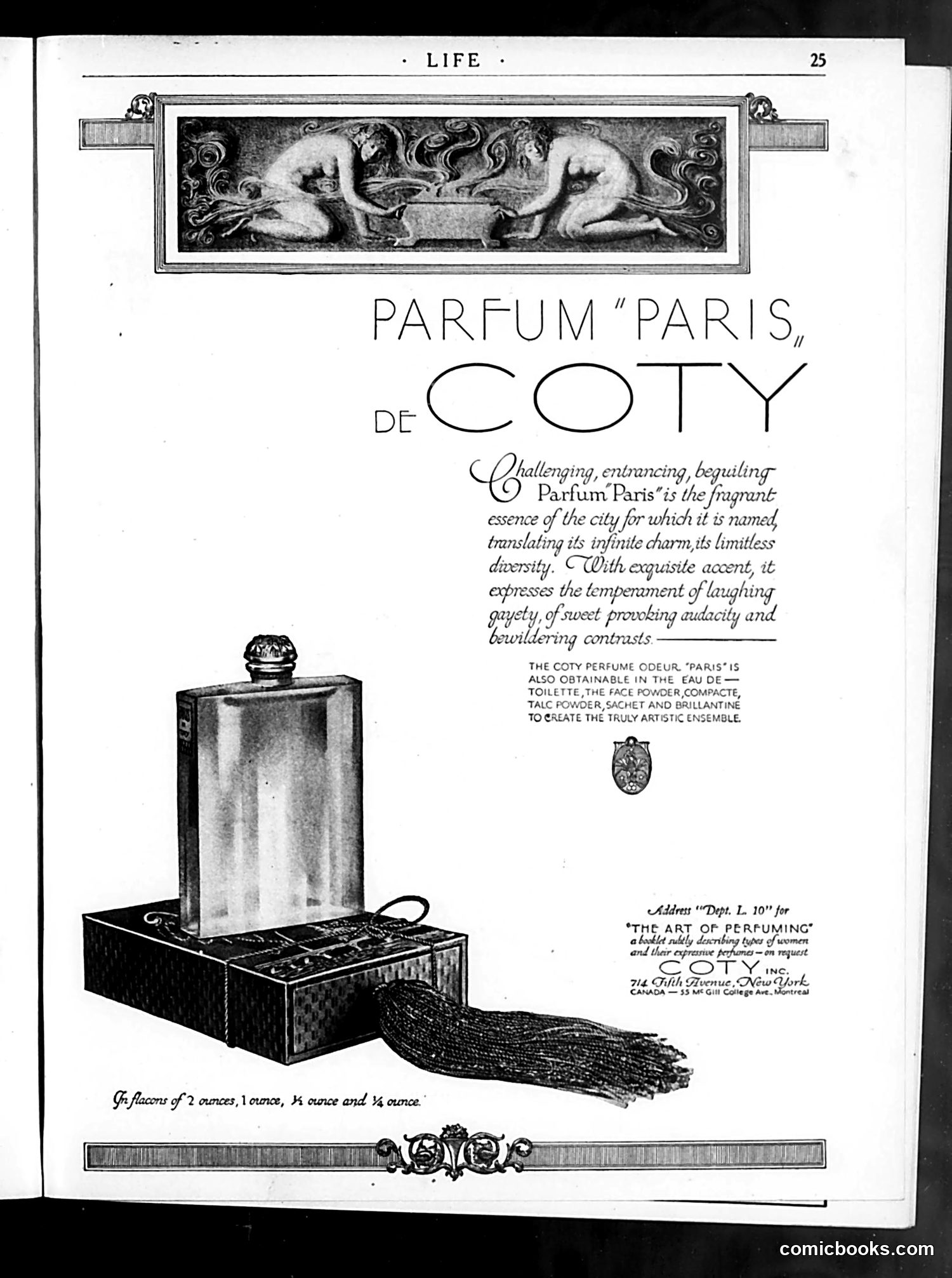
This is a **perfume advertisement**, not a political cartoon. It promotes Coty's "Parfum Paris" fragrance in Life magazine. The page features ornamental classical imagery (reclining nudes in the header) to convey luxury and sophistication. The elegant perfume bottle with tassel sits on an decorative base, emphasizing exclusivity and refinement. The text uses flowery language typical of 1920s advertising, describing the scent as capturing Paris's "infinite charm," "laughing gayety," and "sweet provoking audacity"—appealing to American consumers' fascination with European glamour and modernity during the Jazz Age. The advertisement notes the product's availability in multiple forms (perfume, eau de toilette, powder, talc) to create a complete grooming "ensemble." The address for "The Art of Perfuming" booklet targets affluent women interested in cosmetics and fashion. This reflects early 20th-century American consumer culture and the marketing of European sophistication to wealthy American audiences.
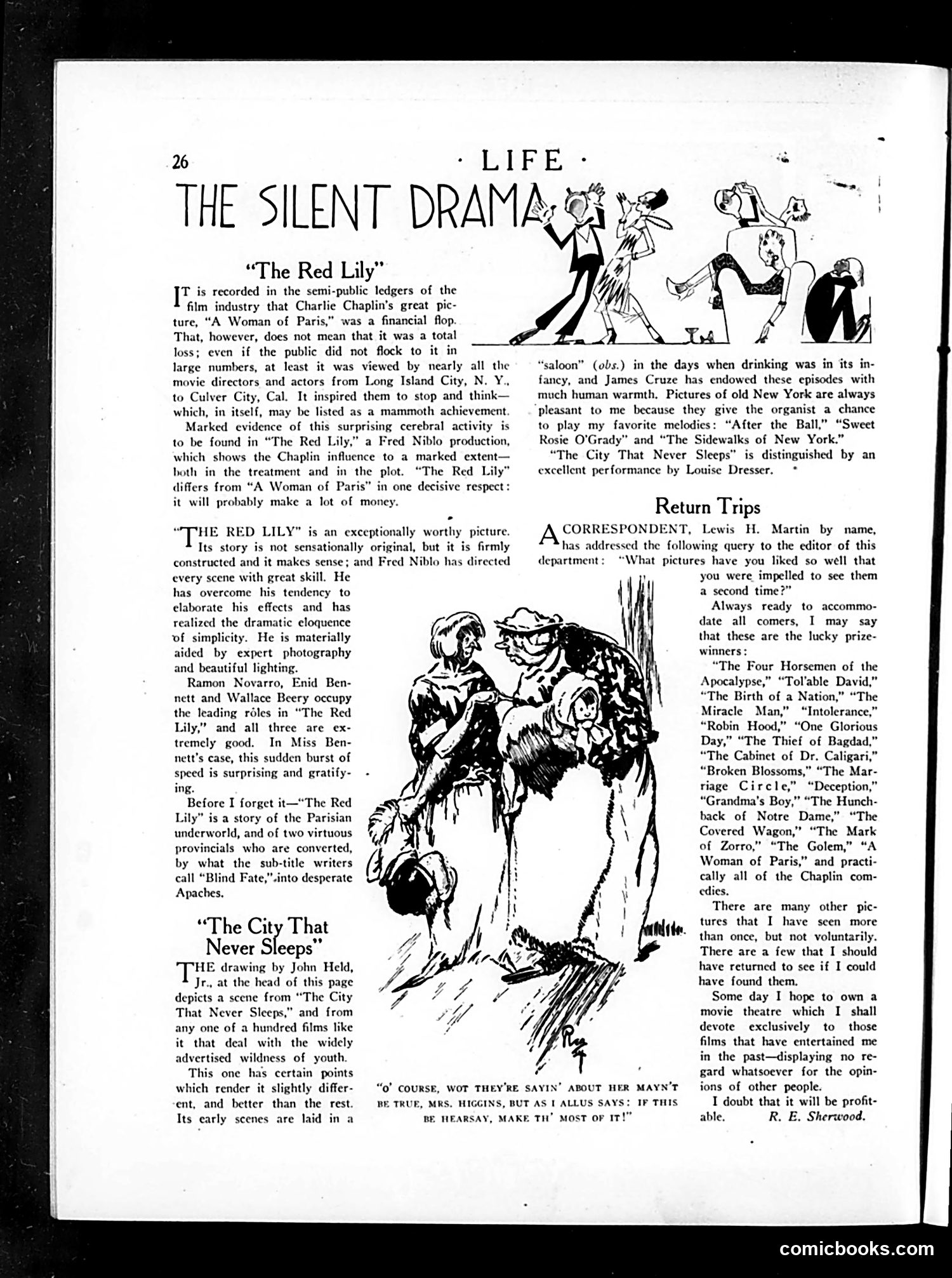
This page reviews contemporary silent films, primarily "The Red Lily" and "The City That Never Sleeps." The main cartoon by John Held Jr. (top right) depicts flapper-era youth in wild, exaggerated poses—characteristic of 1920s satire about young people's perceived moral looseness and jazz-age excess. The text discusses how "The Red Lily," directed by Fred Niblo, borrows heavily from Charlie Chaplin's "A Woman of Paris" but will likely succeed commercially where Chaplin's film failed. It's set in the Parisian underworld ("Apaches") and stars Ramon Novarro and Enid Bennett. The accompanying illustration shows dramatic scenes from the film. A "Return Trips" section humorously lists films the critic rewatched—including D.W. Griffith's "Birth of a Nation" and various Chaplin comedies—suggesting which silent-era pictures achieved lasting appeal. The captioned illustration ("'O' course, wot they're sayin'...") appears to be satirizing overhearing gossip in period settings.
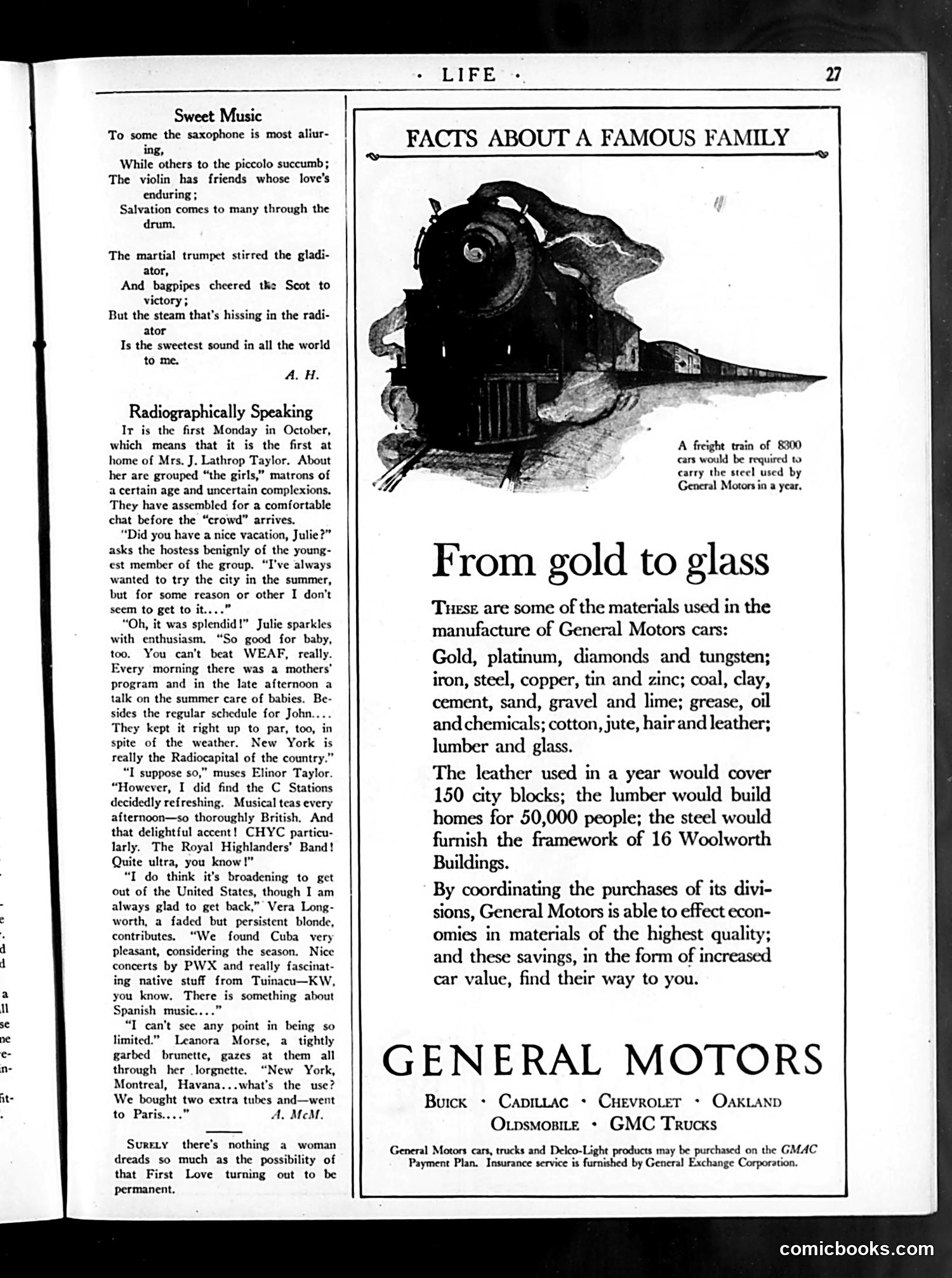
This page contains three distinct pieces of humor plus a General Motors advertisement. **"Sweet Music"** is a short poem contrasting musical instruments people enjoy with the speaker's preference for engine noise—the "steam hissing in the radiator." It's gentle satire on automotive culture's growing dominance in American life. **"Radiographically Speaking"** satirizes upper-middle-class women obsessed with radio as a status symbol. The characters—Mrs. Taylor, Julie, Elinor, Vera, and Leanora—boast about which radio stations they listened to during vacations in New York, Cuba, and Montreal, referencing actual early radio call letters (WEAF, CHYC, PWX, KW). The humor lies in treating radio reception and programming as markers of sophistication and worldliness, a joke about how newly popular radio broadcasting had become a social obsession. **The brief closing quip** about women fearing their first love becoming permanent is unrelated observational humor. The **General Motors advertisement** "From Gold to Glass" emphasizes the vast materials and scale involved in car manufacturing, positioned as economical and beneficial to consumers.
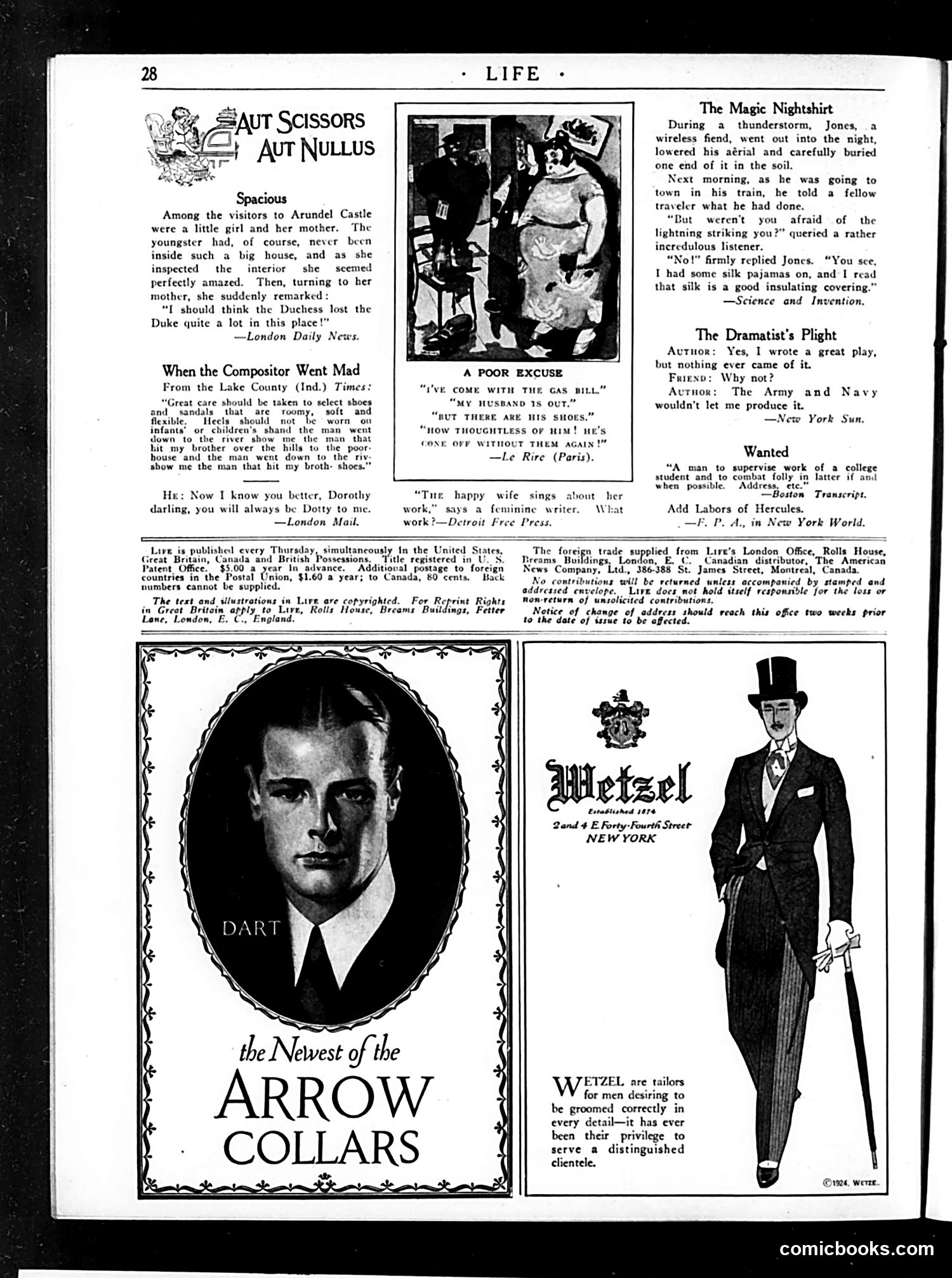
This page from *Life* magazine (appears to be 1920s-era) contains brief humorous anecdotes followed by advertisements. The "Aut Scissors Aut Nullus" section reprints short jokes from various newspapers: - A child's observation about Arundel Castle being so large the Duchess must have "lost" the Duke there (a play on "losing" someone in a vast space) - A compositor's mad typesetting error creating nonsensical text about shoes - A husband's excuse for being late involving gas (ambiguous/dark humor) - A man burying a wireless aerial during a storm, believing silk pajamas provide electrical insulation (mocking pseudoscientific logic) - A playwright unable to produce his work because the military won't permit it The satire targets everyday absurdities: spatial disorientation, printing mishaps, domestic excuses, and misguided scientific reasoning. The advertisements below—Arrow Collars and Wetzel tailors—target affluent male readers interested in proper grooming and fashion.
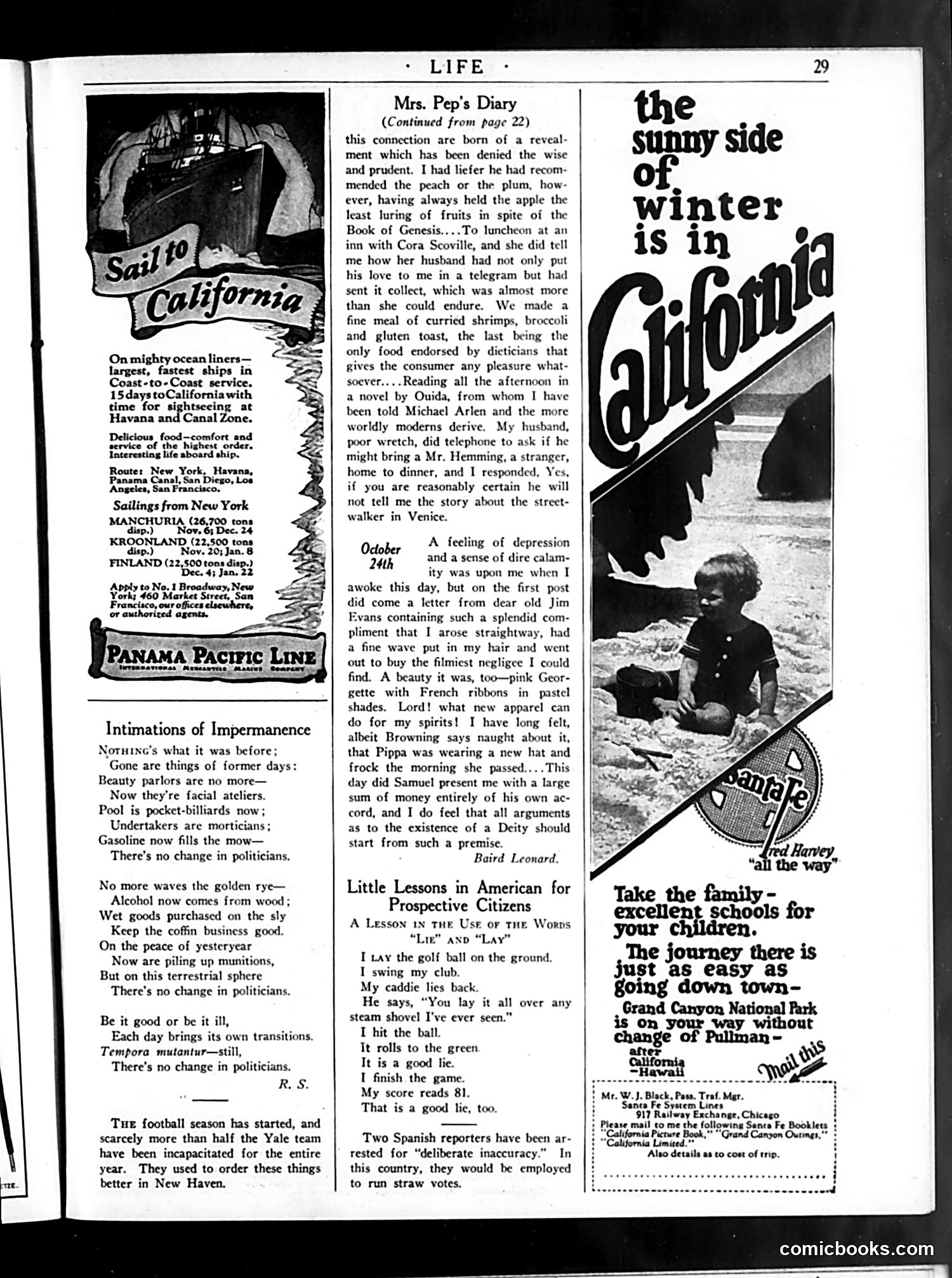
This page contains several distinct pieces of period satire: **"Intimations of Impermanence"** is a poem mocking 1920s social pretension—how Americans renamed ordinary things with fancier terms ("facial ateliers" for beauty parlors, "morticians" for undertakers). The joke is that while everything else changes, *politicians never do*, suggesting political stagnation despite modernity. **"Mrs. Pep's Diary"** satirizes wealthy, leisured women's vapid concerns: trivial romantic drama, fashion, and self-indulgent spending. The diary format mimics real society columns while exaggerating the protagonist's shallow materialism and emotional whiplash. **"Little Lessons in American"** is wordplay humor teaching immigrants proper English usage—specifically the confusion between "lie" and "lay." The joke relies on double-meaning: "good lie" works both as golf terminology and moral honesty. The **Yale football joke** sardonically notes that fewer players are injured than expected, implying Yale's football program is weak or poorly managed compared to "New Haven" tradition. The page is primarily **advertising** (Panama Pacific Line ship cruises), which was Life's revenue model.
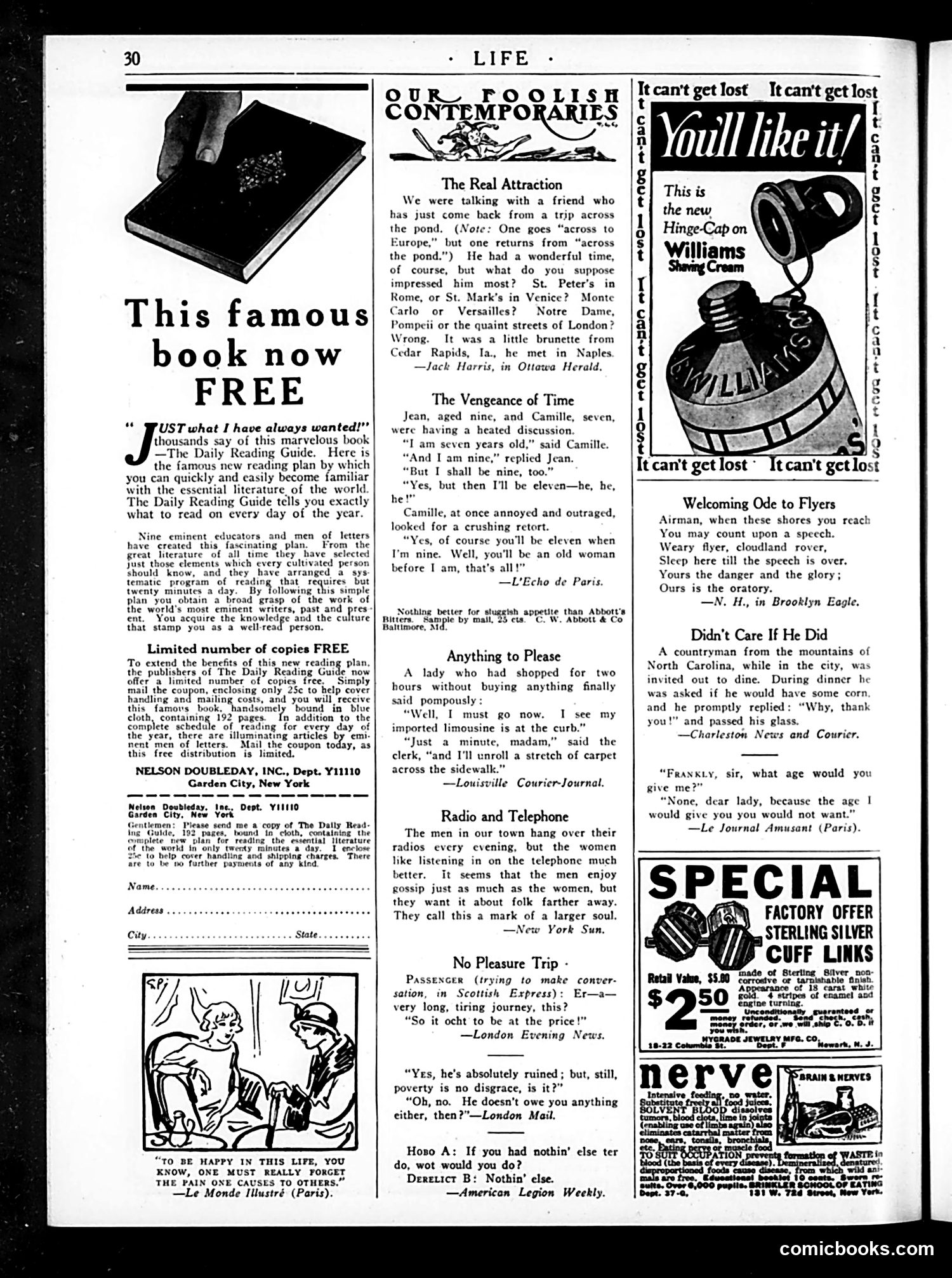
This page is primarily **advertising and humorous filler content** rather than political satire. The main elements are: **The "Daily Reading Guide" Advertisement**: Dominates the left side—a self-improvement book offer promising readers can become "cultured" by reading 20 minutes daily. The appeal to aspiring middle-class readers reflects early 20th-century anxiety about appearing educated. **"Our Foolish Contemporaries" Section**: A collection of brief humorous anecdotes mocking everyday situations: - A tourist impressed by a woman from Cedar Rapids rather than European landmarks (poking fun at romantic distraction) - Children's logic about aging (innocent humor) - A shopkeeper's obsequiousness to a wealthy customer (class commentary) - Gender differences about radio vs. telephone gossip (mild social observation) **The Cartoon** (bottom left): Shows a well-dressed man speaking to a woman, with a French quote about forgetting pain caused to others—likely satirizing callous behavior masked by politeness. The page reflects **1920s-30s sensibilities**: concerns with self-improvement, consumerism, and gentle mockery of social pretension rather than sharp political critique.
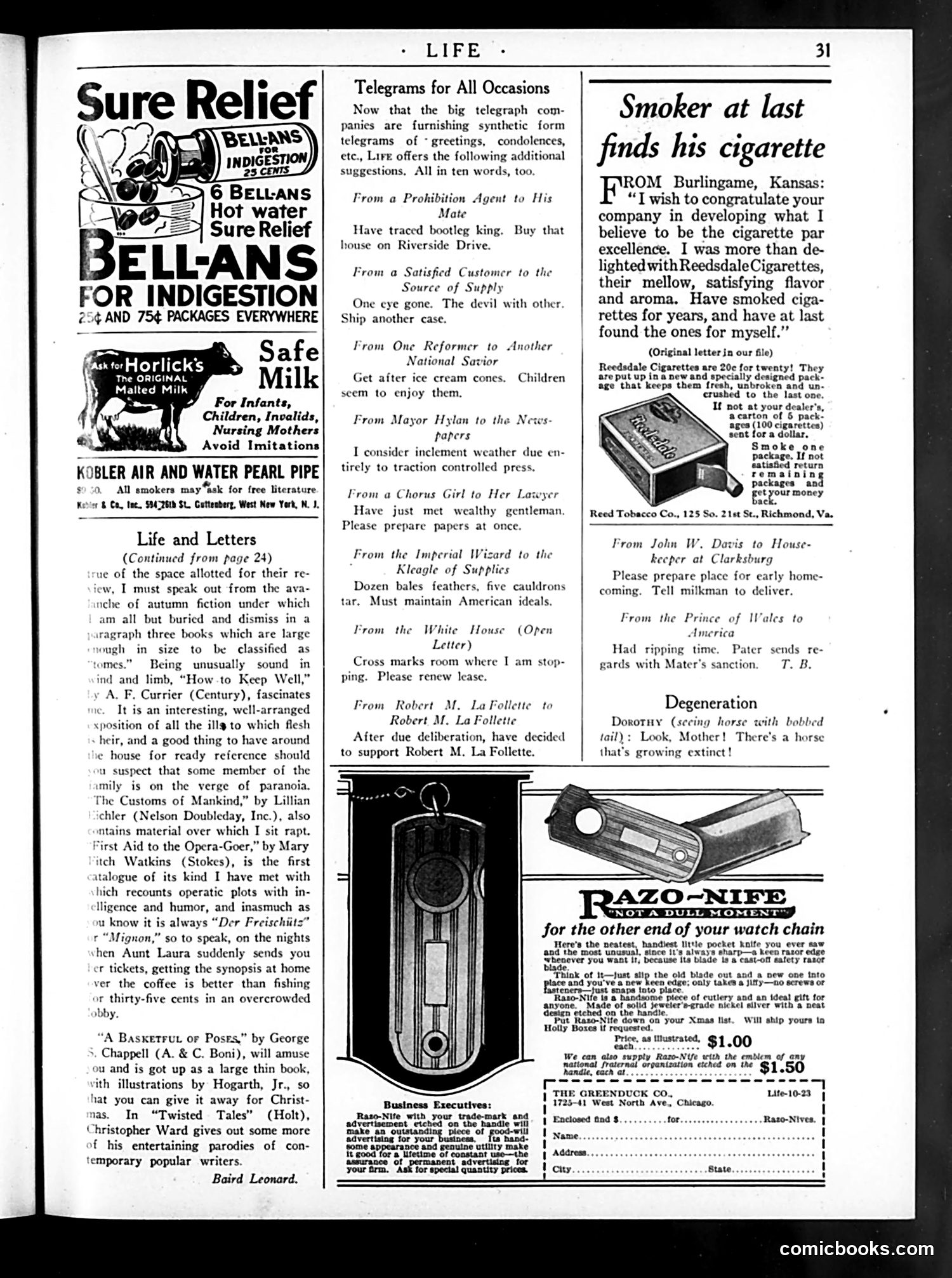
This page features **"Telegrams for All Occasions,"** a satirical column mocking contemporary American society through fake telegraph messages. The humor targets recognizable figures and issues of the era: - **Prohibition enforcement**: A federal agent brags about catching a bootlegger, implying widespread illegal alcohol distribution. - **Labor reform**: A factory owner cynically reports a worker losing an eye, casually ordering another to replace him—darkly mocking industrial negligence and worker exploitation. - **Political figures**: References to Mayor Hylan (NYC) and John W. Davis (Democratic presidential candidate) suggest they're either absent or expecting imminent changes. - **The Ku Klux Klan**: The "Imperial Wizard" and "Kleagle" (actual KKK titles) requesting feathers and cauldrons for maintaining "American ideals"—biting satire equating the KKK with un-American violence. - **Social decay**: The final cartoon shows bobbed-tail horses becoming "extinct," mocking frivolous fashion trends affecting even animals. The satire assumes readers recognize contemporary figures and institutions well enough to appreciate the mockery.
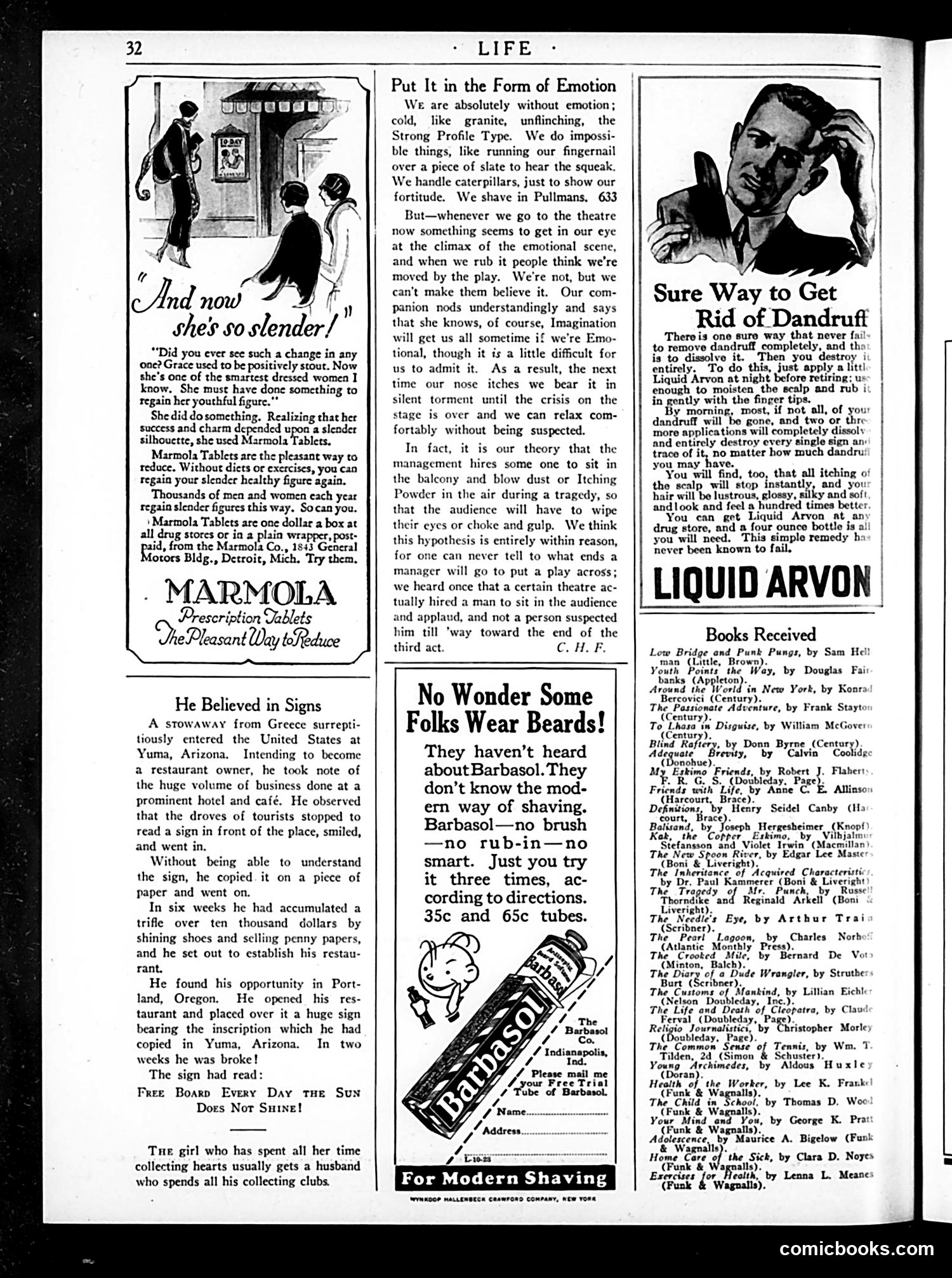
This page contains three distinct pieces of satire and humor rather than a single political cartoon. **"And Now She's So Slender"**: A brief comic vignette mocking the obsession with weight loss and female appearance. The joke satirizes women's social pressure to maintain slender figures for success and attractiveness, advertising Marmola diet tablets as the "solution." **"He Believed in Signs"**: A humorous anecdote about a Greek immigrant who, unable to read English, copies a sign that reads "Free Board Every Day the Sun Does Not Shine!" He opens a restaurant in Portland expecting similar success, only to immediately fail—the joke being the sign's impossible condition. **"Put It in the Form of Emotion"**: A satirical essay mocking emotionally repressed men who pride themselves on being "cold, like granite" yet find themselves unexpectedly moved at theatrical climaxes. The author humorously theorizes theaters deliberately blow itching powder to create the appearance of emotional response. The page is primarily **advertising-focused**, with prominent ads for Marmola tablets, Barbasol shaving cream, and Liquid Arvon dandruff treatment interspersed throughout.
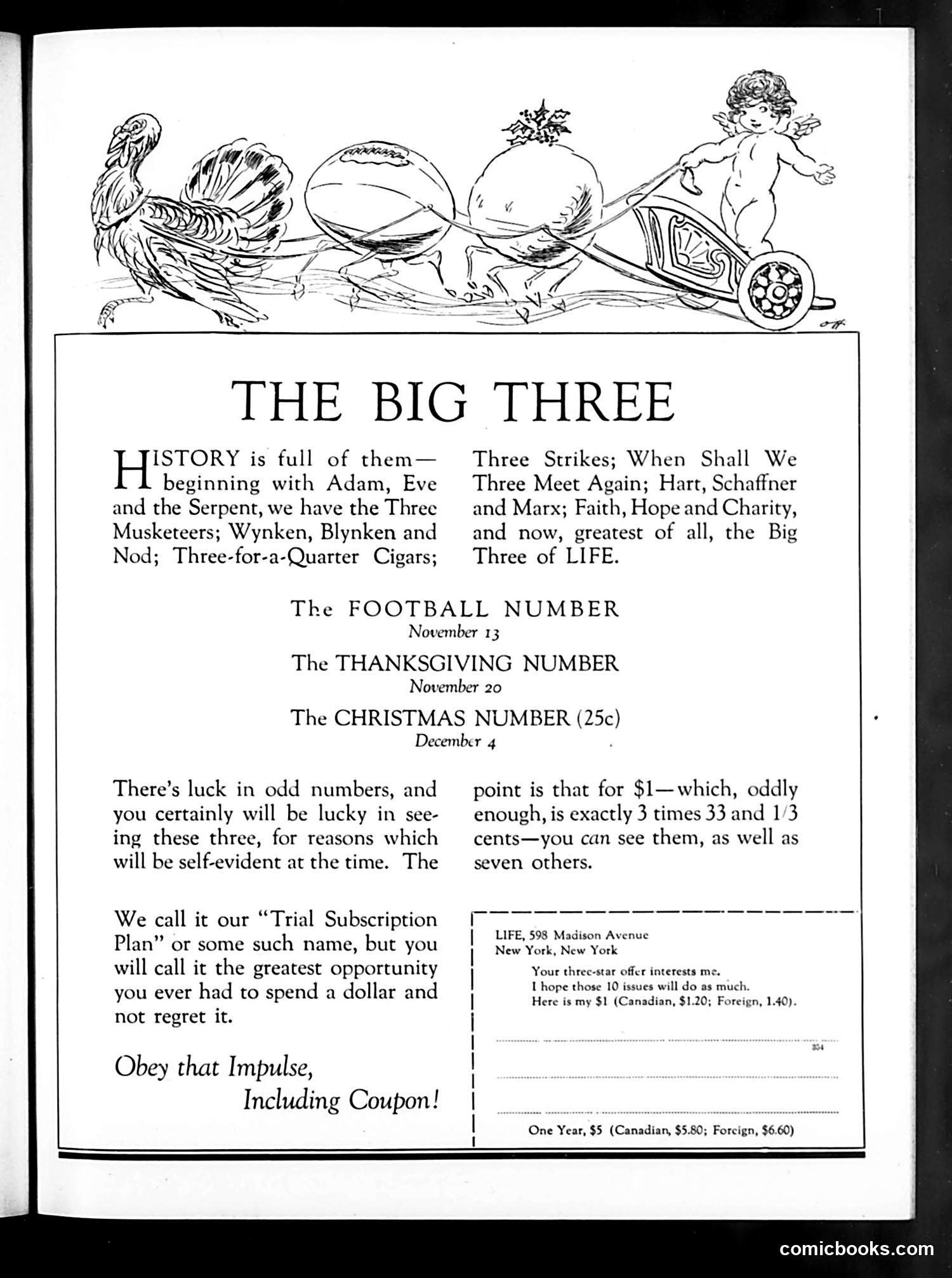
This is primarily a **subscription advertisement** for *Life* magazine disguised as editorial content. The "Big Three" refers to three special upcoming issues: Football (November 13), Thanksgiving (November 20), and Christmas (December 4). The whimsical illustration at top—a cherub in a cart pulled by a rooster and two large eggs—visualizes the "three" theme playfully. The text uses clever wordplay: it compares the magazine's "Big Three" to famous historical trios (Three Musketeers, Adam/Eve/Serpent) to make the offer seem momentous. The mathematical gimmick—$1 equals "exactly 3 times 33 and 1/3 cents"—is presented as lucky numerology to entice impulse purchases. Essentially, *Life* is pitching a discounted trial subscription ($1 for 10 issues) by wrapping it in humorous, slightly absurdist marketing language typical of early 20th-century advertising. The phrase "Obey that Impulse" directly targets consumer psychology.
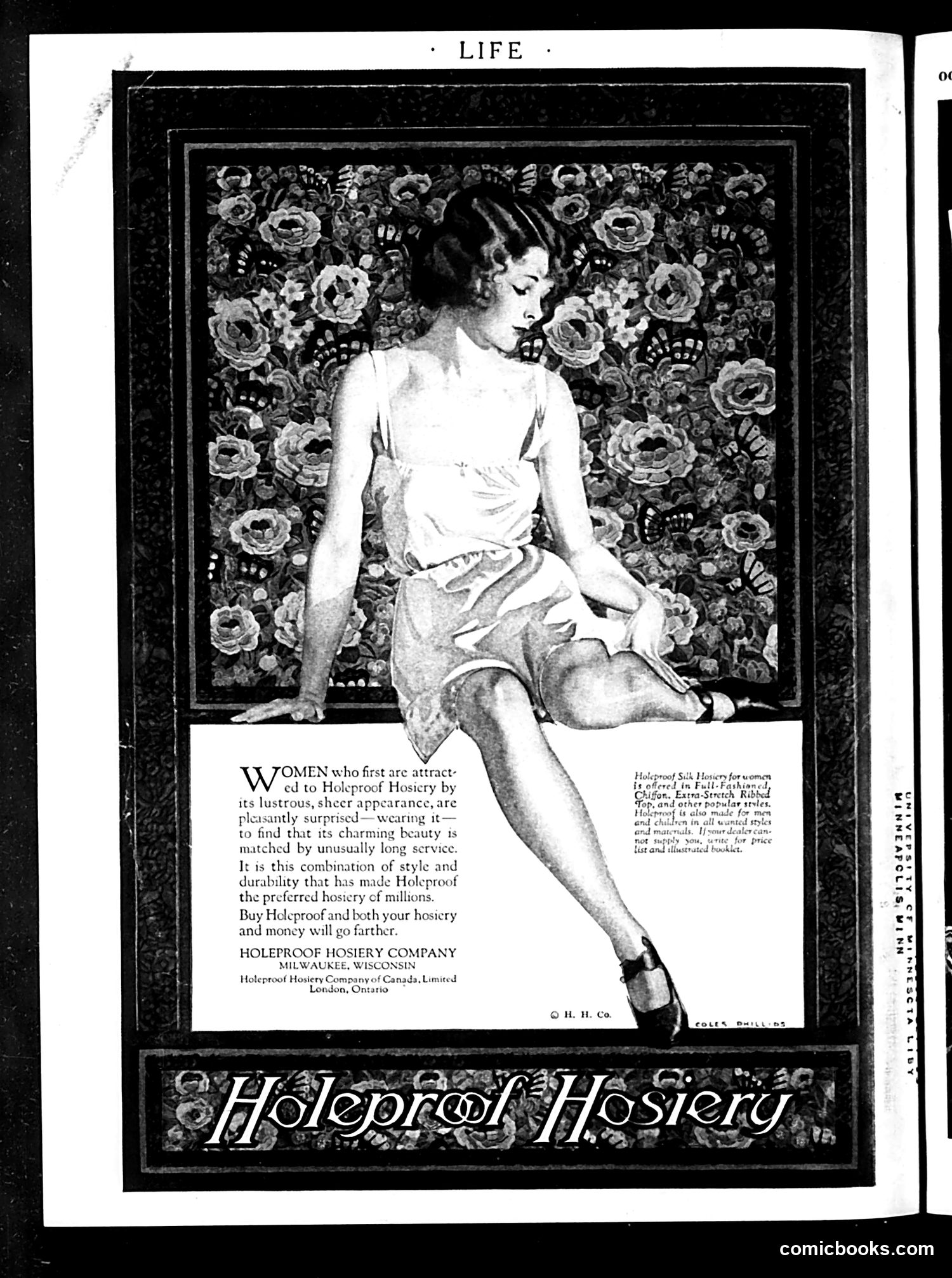
This is **not a cartoon or satire**—it's a straightforward **advertisement for Holeproof Hosiery**, a real company based in Milwaukee, Wisconsin. The page features a glamorous photograph of a woman in 1920s-style dress posed against a floral backdrop, displaying her legs and hosiery. The accompanying text emphasizes the product's combination of "style and durability," arguing that Holeproof's "unusually long service" makes it economical despite potentially higher cost. This represents typical early-20th-century advertising strategy: using attractive female imagery and lifestyle aspirations to market everyday products. There is no political commentary or satire intended—it's simply a *Life* magazine advertisement selling hosiery to women readers through appeals to beauty, quality, and value.