
Life, 1924-10-23 · page 28 of 36
Life — October 23, 1924 — page 28: what you’re looking at
What you’re looking at
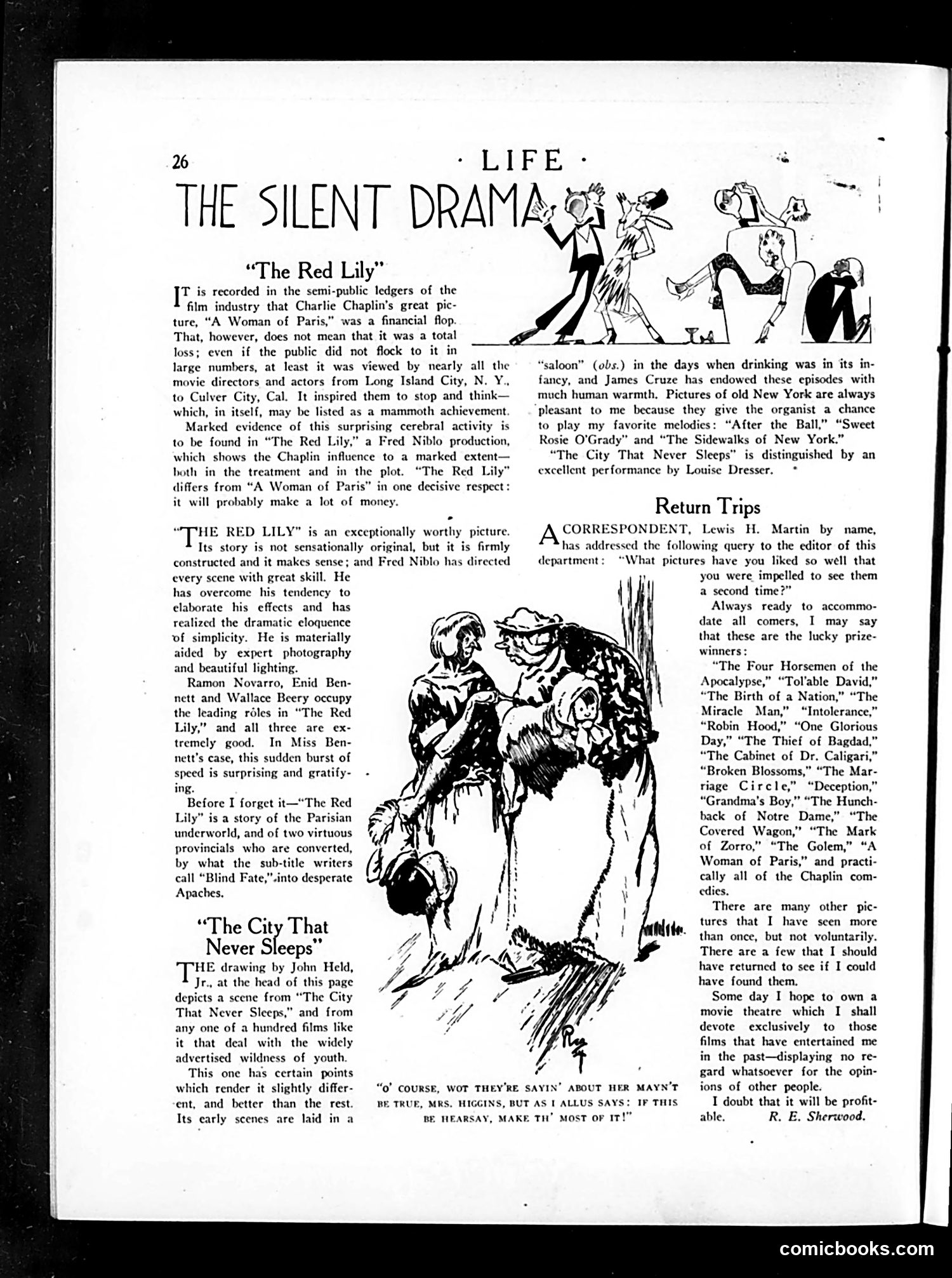
This page reviews contemporary silent films, primarily "The Red Lily" and "The City That Never Sleeps." The main cartoon by John Held Jr. (top right) depicts flapper-era youth in wild, exaggerated poses—characteristic of 1920s satire about young people's perceived moral looseness and jazz-age excess. The text discusses how "The Red Lily," directed by Fred Niblo, borrows heavily from Charlie Chaplin's "A Woman of Paris" but will likely succeed commercially where Chaplin's film failed. It's set in the Parisian underworld ("Apaches") and stars Ramon Novarro and Enid Bennett. The accompanying illustration shows dramatic scenes from the film. A "Return Trips" section humorously lists films the critic rewatched—including D.W. Griffith's "Birth of a Nation" and various Chaplin comedies—suggesting which silent-era pictures achieved lasting appeal. The captioned illustration ("'O' course, wot they're sayin'...") appears to be satirizing overhearing gossip in period settings.
📄 Transcribed text from this page (OCR, searchable)
Machine-transcribed from the original scan — historical spelling and the odd misread are preserved.
“LSE THE SILENT DRAMA, “The Red Lily” I. is recorded in the semi-public ledgers of the film industry that Charlie Chaplin's great pic- ture, “A Woman of Paris,” was a financial flop. That, however, does not mean that it was a total loss; even if the public did not flock to it in large numbers, at least it was viewed by nearly all the movie directors and actors from Long Island City, N. Y., to Culver City, Cal. It inspired them to stop and think— which, in itself, may be listed as a mammoth achievement Marked evidence of this surprising cerebral activity is to be found in “The Red Lily,” a Fred Niblo production, which shows the Chaplin influence to a marked extent— both in the treatment and in the plot. “The Red Lily” differs from “A Woman of Paris” in one decisive respect : it will probably make a lot of money. HE RED LILY” is an exceptionally worthy picture. Its story is not sensationally original, but it is firmly constructed and it makes sense; and Fred Niblo has directed every scene with great skill. He has overcome his tendency to elaborate his effects and has realized the dramatic eloquence ‘of simplicity. He is materially aided by expert photography and beautiful lighting. Ramon Novarro, Enid Ben- nett and Wallace Beery occupy the leading réles in “The Red Lily,” and all three are ex- tremely good. In Miss Ben- nett’s case, this sudden burst of speed is surprising and gratify- ing. Before I forget it—“The Red Lily” is a story of the Parisian underworld, and of two virtuous provincials who are converted, by what the sub-title writers call “Blind Fate,”.into desperate Apaches, “The City That ” Never Sleeps 'HE drawing by John Held, Jr., at the head of this page depicts a scene from “The City That Never Sleeps,” and from any one of a hundred films like it that deal with the widely advertised wildness of youth. This one has certain points which render it slightly differ- ent, and better than the rest. Its early scenes are laid in a " COURSE, WOT TH BE TRUE, MRS. HIG BE HEARSAY, MAKE TH’ MOST OF IT!” able. “saloon” (obs.) in the days when drinking was in its in- fancy, and James Cruze has endowed these episodes with much human warmth, Pictures of old New York are always pleasant to me because they give the organist a chance to play my favorite melodies: “After the Ball,” “Sweet Rosie O'Grady” and “The Sidewalks of New York.” “The City That Never Sleeps” is distinguished by an excellent performance by Louise Dresser. Return Trips CORRESPONDENT, Martin by name, has addressed the following query to the editor of this department: “What pictures have you liked so well that you were impelled to see them a second time?” Always ready to accommo- date all comers, I may say that these are the lucky prize- winners: “The Four Horsemen of the Apocalypse,” “Tol'able David,” “The Birth of a Nation,” “The Miracle Man,” “Intolerance,” “Robin Hood,” “One Glorious Day,” “The Thief of Bagda “The Cabinet of Dr. Caligari, “Broken Blossoms,” “The Mar- riage Circle, “Grandma's Boy,” back of Notre Dame,” “The Covered Wagon,” “The Mark of Zorro,” “The Golem,” “A Woman of Paris,” and practi- cally all of the Chaplin com- edies. There are many other pic- tures that I have seen more than once, but not voluntarily. There are a few that I should have returned to see if I could have found them. Some day I hope to own a movie theatre which I shall devote exclusively to those films that have entertained me in the past—displaying no re- gard whatsoever for the opin- ions of other people. I doubt that it will be profit- R. E, Sherwood. Lewis H. ABOUT HER MAYN'T > IP THIS comicbooks.com