
Life, 1924-10-23 · page 9 of 36
Life — October 23, 1924 — page 9: what you’re looking at
What you’re looking at
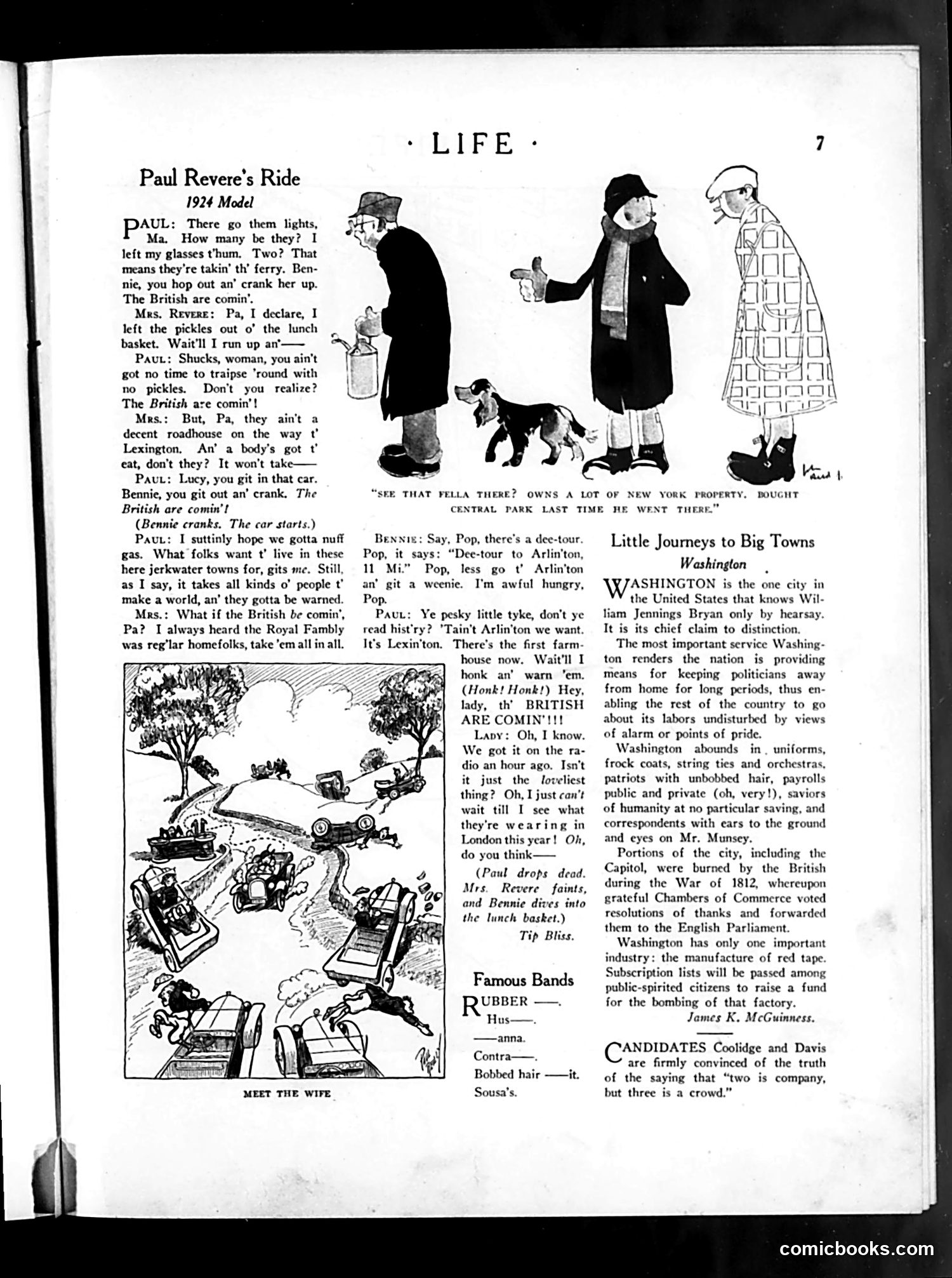
This comic strip satirizes the famous American Revolutionary War historical event through a 1920s automobile lens. Paul Revere's urgent midnight warning ("The British are coming!") is reimagined with modern cars instead of horses. The humor derives from applying contemporary technology to a sacred historical moment—the characters debate whether to take a ferry, discuss car troubles ("crank" the engine), and debate travel routes to Arlington and Lexington. The cartoon mocks how 1920s Americans approach historical narratives: filtered through modern convenience and practical concerns rather than patriotic grandeur. The lower panel ("Meet the Wife") depicts the chaotic parking and traffic that would result, further deflating the romantic legend with automotive-age reality and domestic comedy.
📄 Transcribed text from this page (OCR, searchable)
Machine-transcribed from the original scan — historical spelling and the odd misread are preserved.
Paul Revere'’s Ride 1924 Model PAvt: There go them lights, Ma. How many be they? I left my glasses t'hum. Two? That means they’re takin’ th’ ferry. Ben- nie, you hop out an’ crank her up. The British are comin’. Mrs. Revere: Pa, I declare, I left the pickles out o’ the lunch basket. Wait’ll I run up an‘—— Paut: Shucks, woman, you ain't got no time to traipse ‘round with no pickles. Don't you realize? The British are comin’! Mrs.: But, Pa, they ain't a decent roadhouse on the way t’ Lexington. An’ a body’s got t’ eat, don't they? It won't take— Paut: Lucy, you git in that car. Bennie, you git out an’ crank, The British are comin’! (Bennie cranks. The car starts.) Paut: I suttinly hope we gotta nuff gas. What folks want t’ live in these here jerkwater towns for, gits me. Still as I say, it takes all kinds o’ people t make a world, an’ they gotta be warned. Mrs.: What if the British be comin’, Pa? I always heard the Royal Fambly was reg’lar homefolks, take 'em all in all. MEET THE “SEE THAT FELLA THERE? OWNS A LOT OF NEW YORK PROPERTY, CENTRAL PARK LAST TIME Bennie: Say, Pop, there's a dee-tour Pop, it says: “Dee-tour to Arlin'ton, 11 Mi.” Pop, less go t’ Arlin’ton an’ git a weenie. I'm awful hungry, Pop. Paut: Ye pesky little tyke, don't ye read hist'ry? 'Tain’t Arlin'ton we want. It's Lexin'ton. There's the first farm- house now. Wait'll I honk an’ warn ‘em. (Honk! Honk!) Hey, lady, th’ BRITISH ARE COMIN’!!! Lavy: Oh, I know. We got it on the ra- dio an hour ago. it just the lo thing? Oh, I just can’t wait till I see what they're wearing in London this year! Oh, do you think—. (Paul drops dead. Mrs. Revere faints, and Bennie dives into the lunch basket.) Tip Bliss. Famous Bands RUBBER —_. Hus—. —anna. Contra—. Bobbed hair ——it. Sousa’s. OUGHT HE WENT THERE.” Little Journeys to Big Towns Washington ‘WASHINGTON is the one city in the United States that knows Wil- liam Jennings Bryan only by hearsay. It is its chief claim to distinction. The most important service Washing- ton renders the nation is providing means for keeping politicians away from home for long periods, thus en- abling the rest of the country to go about its labors undisturbed by views of alarm or points of pride. Washington abounds in, uniforms, frock coats, string ties and orchestras, patriots with unbobbed hair, payrolls public and private (oh, very!), saviors of humanity at no particular saving, and correspondents with ears to the ground and eyes on Mr. Munsey, Portions of the city, including the Capitol, were burned by the British during the War of 1812, whereupon grateful Chambers of Commerce voted resolutions of thanks and forwarded them to the English Parliament. Washington has only one important industry: the manufacture of red tape. Subscription lists will be passed among public-spirited citizens to raise a fund for the bombing of that factory. James K. McGuinness, CANDIDATES Coolidge and Davis are firmly convinced of the truth of the saying that “two is company, but three is a crowd.” comicbooks.com