
Life, 1924-10-23 · page 20 of 36
Life — October 23, 1924 — page 20: what you’re looking at
What you’re looking at
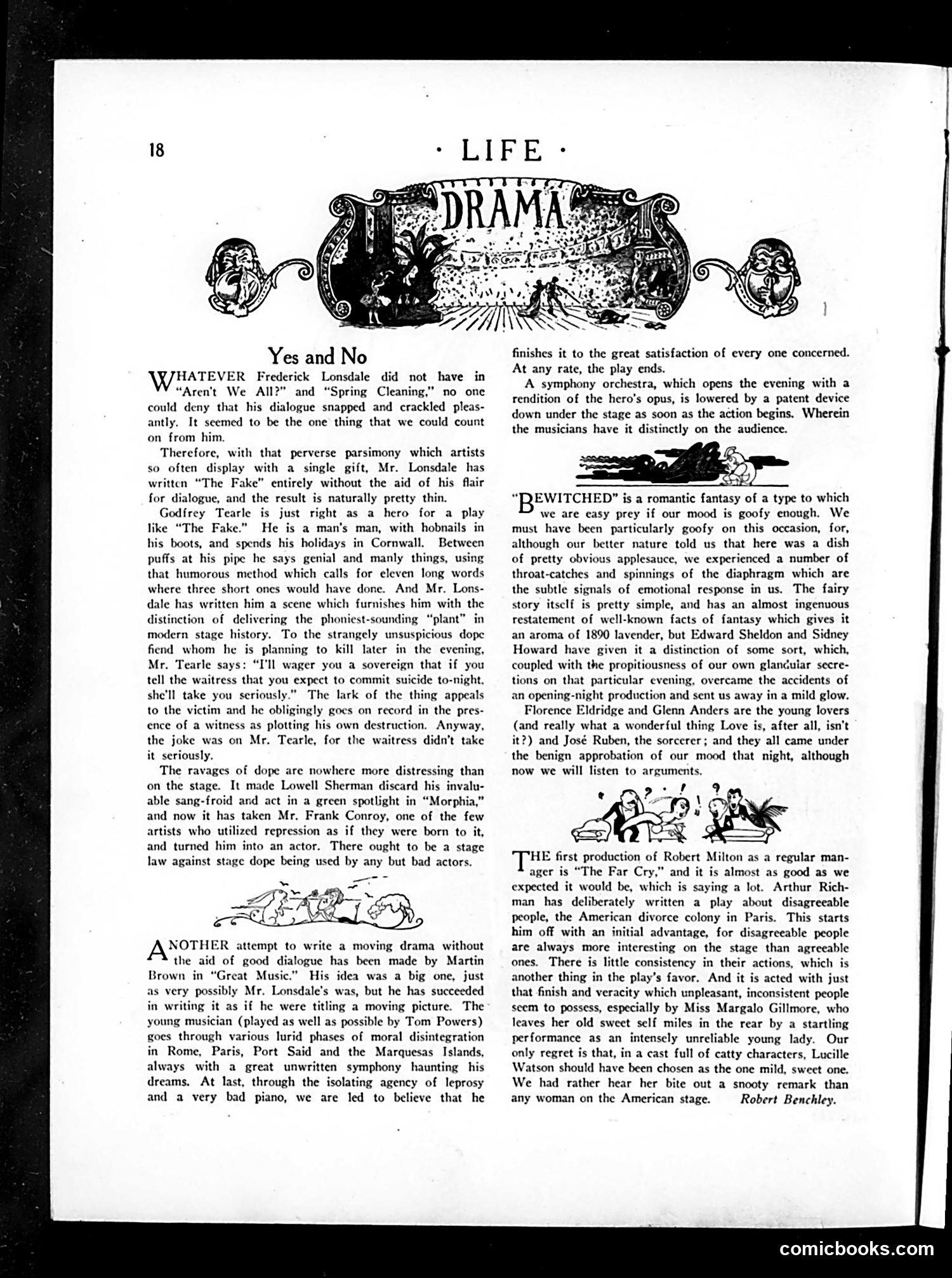
This page contains theater reviews from Life magazine's drama section. The critic discusses three Broadway plays with characteristic wit and skepticism: **"The Fake"** by Frederick Lonsdale—The reviewer criticizes Lonsdale for abandoning his trademark snappy dialogue, resulting in a thin play. Actor Godfrey Tearle delivers an absurdly clumsy "plant" (setup line) to a character he plans to murder, undermining the scene's credibility. **"Great Music"** by Martin Brown—Mocked for being written like a movie title rather than a play. The plot follows a musician's moral decline across exotic locations before he completes a symphony, accompanied by heavy-handed symbolism (leprosy, bad pianos). **"Bewitched"**—A fairy tale that the critic admits emotionally manipulated them despite recognizing it as "obvious applesauce," praising the writing by Sheldon and Howard for elevating simple material. The reviews exemplify Life's sardonic theatrical criticism, using humor to skewer pretentious or poorly-executed plays while occasionally crediting genuine craft.
📄 Transcribed text from this page (OCR, searchable)
Machine-transcribed from the original scan — historical spelling and the odd misread are preserved.
Yes and No HATEVER Frederick Lonsdale did not have in “Aren't We All?” and “Spring Cleaning,” no one could deny that his dialogue snapped and crackled pleas- antly. It seemed to be the one thing that we could count on from him. Therefore, with that perverse parsimony which artists so often display with a single gift, Mr. Lonsdale has written “The Fake” entirely without the aid of his flair for dialogue, and the result is naturally pretty thin. Godfrey Tearle is just right as a hero for a play like “The Fake.” He is a man’s man, with hobnails in his boots, and spends his holidays in Cornwall. Between puffs at his pipe he says genial and manly things, using that humorous method which calls for eleven long words where three short ones would have done. And Mr. Lons- dale has written him a scene which furnishes him with the distinction of delivering the phoniest-sounding “plant” in modern stage history. To the strangely unsuspicious dope fiend whom he is planning to kill later in the evening, Mr. Tearle says: “I'll wager you a sovereign that if you tell the waitress that you expect to commit suicide to-night, she'll take you seriously.” The lark of the thing appeals to the victim and he obligingly gocs on record in the pres- ence of a witness as plotting his own destruction. Anyway, the joke was on Mr. Tearle, for the waitress didn’t take it seriously. The ravages of dope are nowhere more distressing than on the stage. It made Lowell Sherman discard his invalu- able sang-froid and act in a green spotlight in “Morphia,” and now it has taken Mr. Frank Conroy, one of the few artists who utilized repression as if they were born to it, and turned him into an actor. There ought to be a stage law against stage dope being used by any but bad actors. ZR NOTHER attempt to write a moving drama without the aid of good dialogue has been made by Martin Brown in “Great Music.” His idea was a big one, just as very possibly Mr. Lonsdale's was, but he has succeeded in writing it as if he were titling a moving picture. The young musician (played as well as possible by Tom Powers) goes through various lurid phases of moral disintegration in Rome, Paris, Port Said and the Marquesas Islands, always with a great unwritten symphony haunting his dreams. At last, through the isolating agency of leprosy and a very bad piano, we are led to believe that he finishes it to the great satisfaction of every one concerned. At any rate, the play ends. A symphony orchestra, which opens the evening with a rendition of the hero’s opus, is lowered by a patent device down under the stage as soon as the action begins. Wherein the musicians have it distinctly on the audience. +2, “REWITCHED?” is a romantic fantasy of a type to which we are easy prey if our mood is goofy enough. We must have been particularly goofy on this occasion, for, although our better nature told us that here was a dish of pretty obvious applesauce, we experienced a number of throat-catches and spinnings of the diaphragm which are the subtle signals of emotional response in us. The fairy story itsclf is pretty simple, and has an almost ingenuous restatement of well-known facts of fantasy which gives it an aroma of 1890 lavender, but Edward Sheldon and Sidney Howard have given it a distinction of some sort, which, coupled with the propitiousness of our own gland tions on that particular evening, overcame the accidents of an opening-night production and sent us away in a mild glow. Florence Eldridge and Glenn Anders are the young lovers (and really what a wonderful thing Love is, after all, isn't it?) and José Ruben, the sorcerer; and they all came under the benign approbation of our mood that night, although now we will listen to arguments, e Pelee? SEE HE first production of Robert Milton as a regular man- ager is “The Far Cry,” and it is almost as good as we expected it would be, which is saying a lot. Arthur Rich- man has deliberately written a play about disagreeable people, the American divorce colony in Paris. This starts him off with an initial advantage, for disagreeable people are always more interesting on the stage than agreeable ones. There is little consistency in their actions, which is another thing in the play’s favor. And it is acted with just that finish and veracity which unpleasant, inconsistent people seem to possess, especially by Miss Margalo Gillmore, who leaves her old sweet self miles in the rear by a startling performance as an intensely unreliable young lady. Our only regret is that, in a cast full of catty characters, Lucille Watson should have been chosen as the one mild, sweet one. We had rather hear her bite out a snooty remark than any woman on the American stage. Robert Benchley. comicbooks.com