
Life, 1924-10-23 · page 16 of 36
Life — October 23, 1924 — page 16: what you’re looking at
What you’re looking at
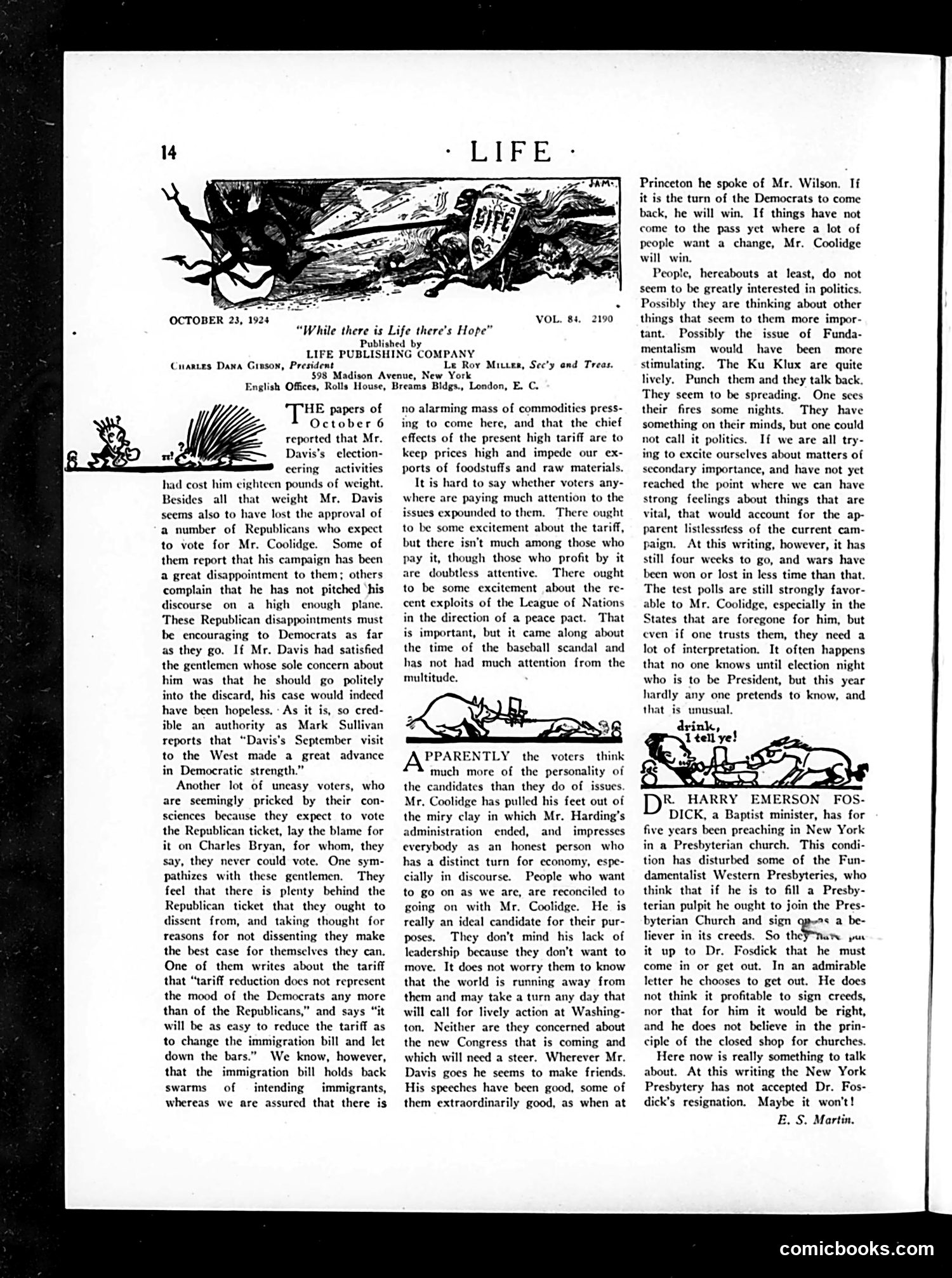
This page contains political commentary on the 1924 U.S. election. The main text discusses Mr. Davis's campaign and Republican voter concerns, referencing a "baseball scandal" (likely the Teapot Dome scandal under President Harding). The article critiques that voters focus more on candidates' personalities than policy issues. It notes Mr. Coolidge's appeal as an "honest person" despite lack of leadership, and expresses concern that voters aren't engaged with substantive matters like tariffs or the League of Nations. A separate piece discusses Dr. Harry Emerson Fosdick, a Baptist minister involved in Presbyterian church controversy. The cartoons (appearing to show figures in distress or confrontation) illustrate the election's stakes, though specific identities are unclear without additional context.
📄 Transcribed text from this page (OCR, searchable)
Machine-transcribed from the original scan — historical spelling and the odd misread are preserved.
OCTOBER 23, 1924 VOL. 84. 2190 “While there is Life there’s Hope” Published by LIFE PUBLISHING COMPANY Cuaates Dana Grason, President Le Roy Mitier, Sec’y and Treas. $98 Madison Avenue, New York English Offices, Rolls House, Breams Bldgs., London, E. C. HI Risto papers of October 6 reported that Mr. nt Davis's _election- ecring activities had cost him cighteen pounds of weight. Besides all that weight Mr. Davis seems also to have lost the approval of a number of Republicans who expect to vote for Mr. Coolidge. Some of them report that his campaign has been a great disappointment to them; others complain that he has not pitched ‘his discourse on a high enough plane. These Republican disappointments must be encouraging to Democrats as far as they go. If Mr. Davis had satisfied the gentlemen whose sole concern about him was that he should go politely into the discard, his case would indeed have been hopeless. As it is, so cred- ible an authority as Mark Sullivan reports that “Davis's September visit to the West made a great advance in Democratic strength.” Another lot of uneasy voters, who are seemingly pricked by their con- sciences because they expect to vote the Republican ticket, lay the blame for it on Charles Bryan, for whom, they say, they never could vote. One sym- pathizes with these gentlemen. They feel that there is plenty behind the Republican ticket that they ought to dissent from, and taking thought for reasons for not dissenting they make the best case for themselves they can. One of them writes about the tariff that “tariff reduction docs not represent the mood of the Democrats any more than of the Republicans,” and says “it will be as easy to reduce the tariff as to change the immigration bill and let down the bars.” We know, however, that the immigration bill holds back swarms of intending immigrants, whereas we are assured that there is no alarming mass of commodities press- ing to come here, and that the chief effects of the present high tariff are to keep prices high and impede our ex- ports of foodstuffs and raw materials. It is hard to say whether voters any- where are paying much attention to the issues expounded to them. There ought to be some excitement about the tariff, but there isn't much among those who pay it, though those who profit by it are doubtless attentive. There ought to be some excitement about the re- cent exploits of the League of Nations in the direction of a peace pact. That is important, but it came along about the time of the baseball scandal and has not had much attention from the multitude. a PPARENTLY the voters think much more of the personality of the candidates than they do of issues. Mr. Coolidge has pulled his feet out of the miry clay in which Mr. Harding’s administration ended, and impresses everybody as an honest person who has a distinct turn for economy, espe- cially in discourse. People who want to go on as we are, are reconciled to going on with Mr. Coolidge. He is really an ideal candidate for their pur- poses. They don’t mind his lack of leadership because they don’t want to move. It does not worry them to know that the world is running away from them and may take a turn any day that will call for lively action at Washing- ton, Neither are they concerned about the new Congress that is coming and which will need a steer. Wherever Mr. Davis goes he seems to make friends. His speeches have been good, some of them extraordinarily good, as when at Princeton he spoke of Mr. Wilson. If it is the turn of the Democrats to come back, he will win, If things have not come to the pass yct where a lot of people want a change, Mr. Coolidge will win. People, hereabouts at least, do not seem to be greatly interested in politics. Possibly they are thinking about other things that seem to them more impor- tant. Possibly the issue of Funda- mentalism would have been more stimulating. The Ku Klux are quite lively, Punch them and they talk back. They seem to be spreading. One sces their fires some nights. They have something on their minds, but one could not call it politics. If we are all try- ing to excite ourselves about matters of secondary importance, and have not yet reached the point where we can have strong feelings about things that are vital, that would account for the ap- parent listlesstfess of the current cam- paign. At this writing, however, it has still four weeks to go, and wars have been won or lost in less time than that. The test polls are still strongly favor- able to Mr. Coolidge, especially in the States that are foregone for him, but even if one trusts them, they need a lot of interpretation. It often happens that no one knows until election night who is to be President, but this year hardly any one pretends to know, and that is unusual. drink, tell ye! R. HARRY EMERSON FOS- DICK, a Baptist minister, has for five years been preaching in New York in a Presbyterian church. This condi- tion has disturbed some of the Fun- damentalist Western Presbyteries, who think that if he is to fill a Presby- terian pulpit he ought to join the Pres- byterian Church and sign as a be- liever in its creeds. So the he pu it up to Dr. Fosdick that he must come in or get out. In an admirable letter he chooses to get out. He does not think it profitable to sign creeds, nor that for him it would be right, and he does not believe in the prin- ciple of the closed shop for churches. Here now is really something to talk about. At this writing the New York Presbytery has not accepted Dr. Fos- dick’s resignation. Maybe it won't! E, S. Martin. comicbooks.com