
Life, 1924-10-23 · page 26 of 36
Life — October 23, 1924 — page 26: what you’re looking at
What you’re looking at
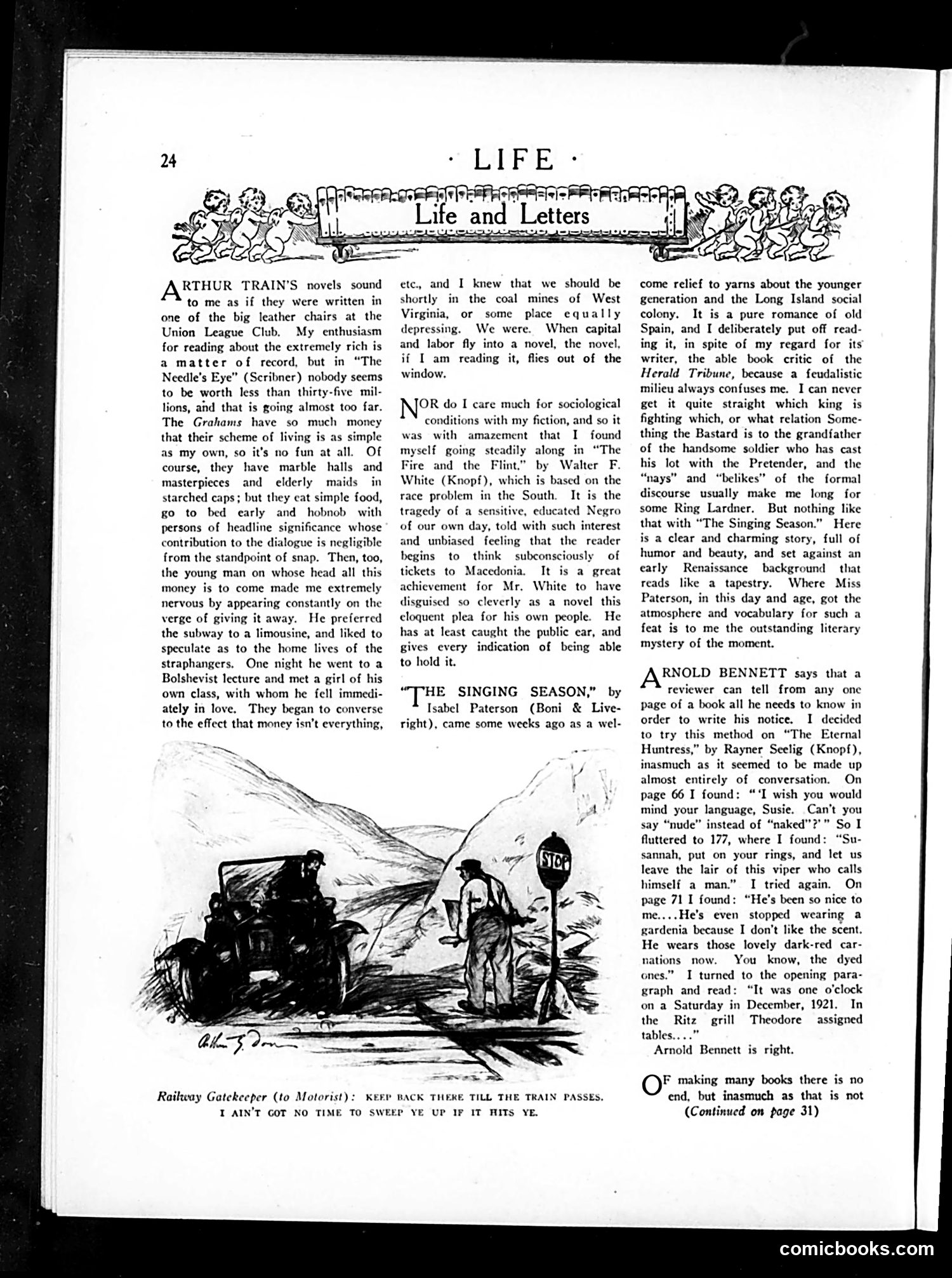
This is a literary review section from *Life* magazine's "Life and Letters" column. The page contains book reviews of contemporary novels, including Arthur Train's *The Needle's Eye*, Walter F. White's *The Fire and the Flint*, Isabel Paterson's *The Singing Season*, and Rayner Seelig's *The Eternal Huntress*. The accompanying cartoon depicts a railway gatekeeper stopping a motorist at a train crossing, with the gatekeeper declaring he has "no time" to sweep up debris if the train hits the vehicle—a darkly humorous commentary on workplace indifference and safety negligence. The reviews themselves are snobbishly written, with the critic dismissive of novels about wealthy characters or sociological themes, yet grudgingly praising White's nuanced treatment of racial issues in the American South as a literary achievement.
📄 Transcribed text from this page (OCR, searchable)
Machine-transcribed from the original scan — historical spelling and the odd misread are preserved.
RTHUR TRAIN’S novels sound to me as if they were written in one of the big leather chairs at the Union League Club. My enthusiasm for reading about the extremely rich is a matter of record, but in “The Needle’s Eye” (Scribner) nobody seems to be worth less than thirty-five mil- lions, and that is going almost too far. The Grahams have so much money that their scheme of living is as simple as my own, so it’s no fun at all. Of course, they have marble halls and masterpieces and elderly maids in starched caps; but they eat simple food, go to bed early and hobnob with persons of headline significance whose contribution to the dialogue is negligible from the standpoint of snap. Then, too, the young man on whose head all this money is to come made me extremely nervous by appearing constantly on the verge of giving it away. He preferred the subway to a limousine, and liked to speculate as to the home lives of the straphangers, One night he went to a Bolshevist lecture and met a girl of his own class, with whom he fell immedi- ately in love. They began to converse to the effect that money isn’t everything, Railway Gatekeeper (to Motorist): I AIN'T GOT NO TIM etc, and I knew that we should be shortly in the coal mines of West Virginia, or some place equally depressing. We were. When capital and labor fly into a novel, the novel, if I am reading it, flies out of the window. OR do I care much for sociological conditions with my fiction, and so it was with amazement that I found myself going steadily along in “The Fire and the Flint.” by Walter F. White (Knopf), which is based on the race problem in the South. It is the tragedy of a sensitive, educated Negro of our own day, told with such interest and unbiased feeling that the reader begins to think subconsciously of tickets to Macedonia. It is a great achievement for Mr. White to have disguised so cleverly as a novel this eloquent plea for his own people. He has at least caught the public car, and gives every indication of being able to hold it. HE SINGING SEASON,” by Isabel Paterson (Boni & Live- right), came some weeks ago as a wel- KEEP BACK THERE TILL THE TRAIN PASSES. TO SWEEP YE UP IF IT FITS YE. come relief to yarns about the younger generation and the Long Island social colony. It is a pure romance of old Spain, and I deliberately put off read- ing it, in spite of my regard for its writer, the able book critic of the Herald Tribune, because a feudalistic milieu always confuses me. I can never get it quite straight which king is fighting which, or what relation Some- thing the Bastard is to the grandfather of the handsome soldier who has cast his lot with the Pretender, and the “nays” and “belikes” of the formal discourse usually make me long for some Ring Lardner. But nothing like that with “The Singing Season.” Here is a clear and charming story, full of humor and beauty, and set against an early Renaissance background — that reads like a tapestry. Where Miss Paterson, in this day and age, got the atmosphere and vocabulary for such a feat is to me the outstanding literary mystery of the moment. ABNOLD BENNETT says that a reviewer can tell from any one page of a book all he needs to know in order to write his notice. I decided to try this method on “The Eternal Huntress,” by Rayner Seelig (Knopf), inasmuch as it seemed to be made up almost entirely of conversation. On page 66 I found: “‘I wish you would mind your language, Susie. Can't you say “nude” instead of “naked"?'” So I fluttered to 177, where I found: “Su- sannah, put on your rings, and let us leave the lair of this viper who calls himself a man.” I tried again. On page 71 I found: “He's been so nice to me....He's even stopped wearing a gardenia because I don't like the scent. He wears those lovely dark-red car- nations now. You know, the dyed ones.” I turned to the opening para- graph and read: “It was one o'clock on a Saturday in December, 1921, In the Ritz grill Theodore assigned tables...” Arnold Bennett is right. OF making many books there is no end, but inasmuch as that is not (Continued on page 31) comicbooks.com