
A complete issue · 41 pages · 1924
Life — October 2, 1924
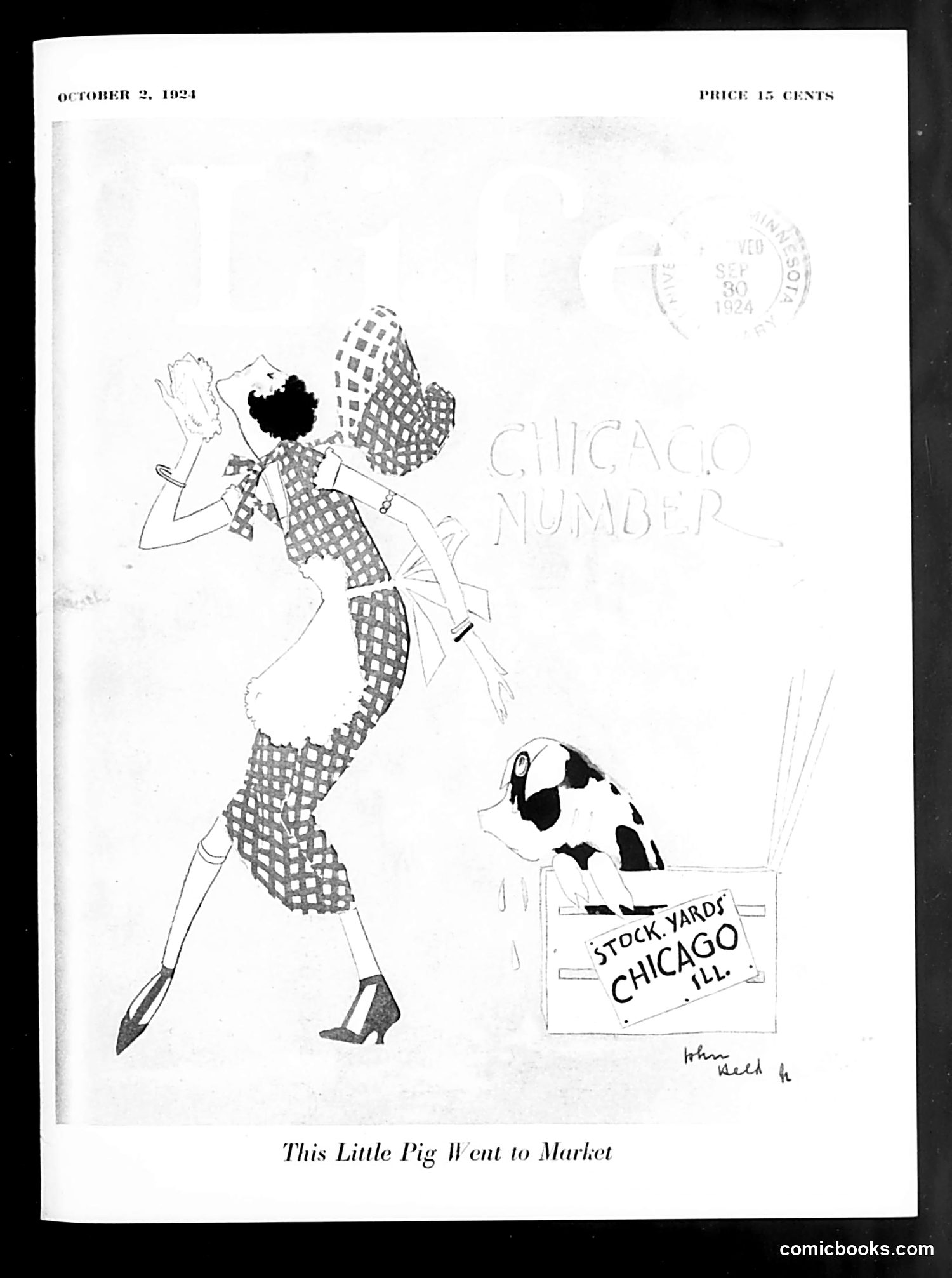
This satirical illustration plays on the nursery rhyme to mock the meatpacking industry, specifically Chicago's famous stockyards. The fashionable flapper woman—dressed in the checkered pattern of butcher's cuts—*is* the pig being sent to market. Her cheerful pose and stylish appearance contrast sharply with her fate: she's literally being packaged for sale, as shown by the crate labeled "STOCK YARDS CHICAGO ILL." The satire likely critiques how women were objectified and "marketed" in 1920s consumer culture, or possibly comments on labor exploitation in the meatpacking industry. The innocent nursery rhyme framing makes the dark humor particularly pointed—what seems charming on its surface masks something sinister.
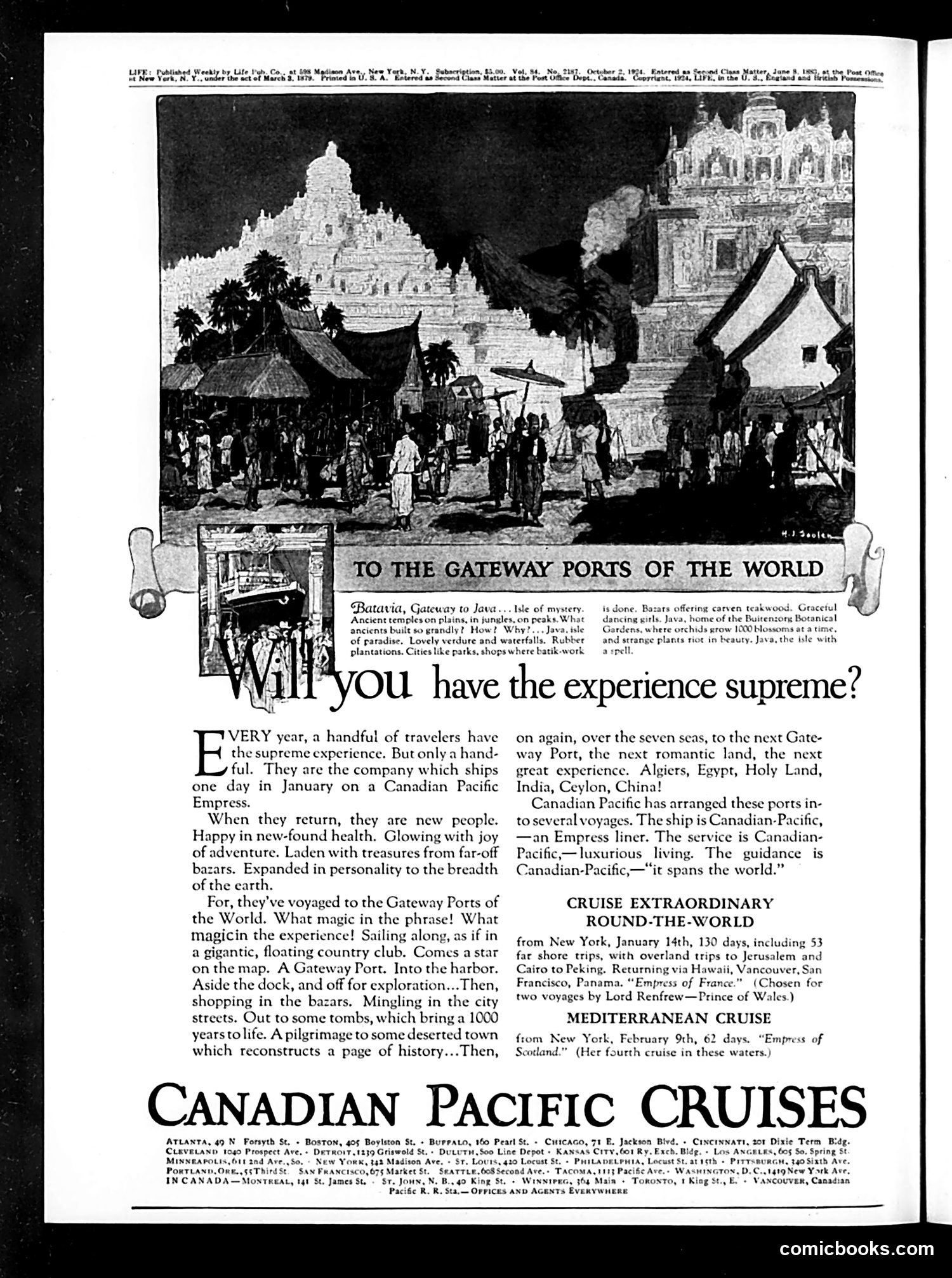
This page is primarily **advertising, not satire or political commentary**. The image illustrates exotic "Gateway Ports of the World"—featuring Batavia (Jakarta), Java, with ornate temples and bazaars. The accompanying text promotes **Canadian Pacific cruise voyages** departing January 16th for a 130-day round-the-world journey visiting ports including Algeria, Egypt, India, Ceylon, and China. The appeal is **aspirational travel marketing**: promising transformative experiences ("they are new people"), exotic shopping at "far-off bazaars," and encounters with ancient history and unfamiliar cultures. This reflects early 20th-century leisure tourism for wealthy travelers. There's no political satire here—just period advertising using romantic Orientalist imagery to sell luxury cruises.
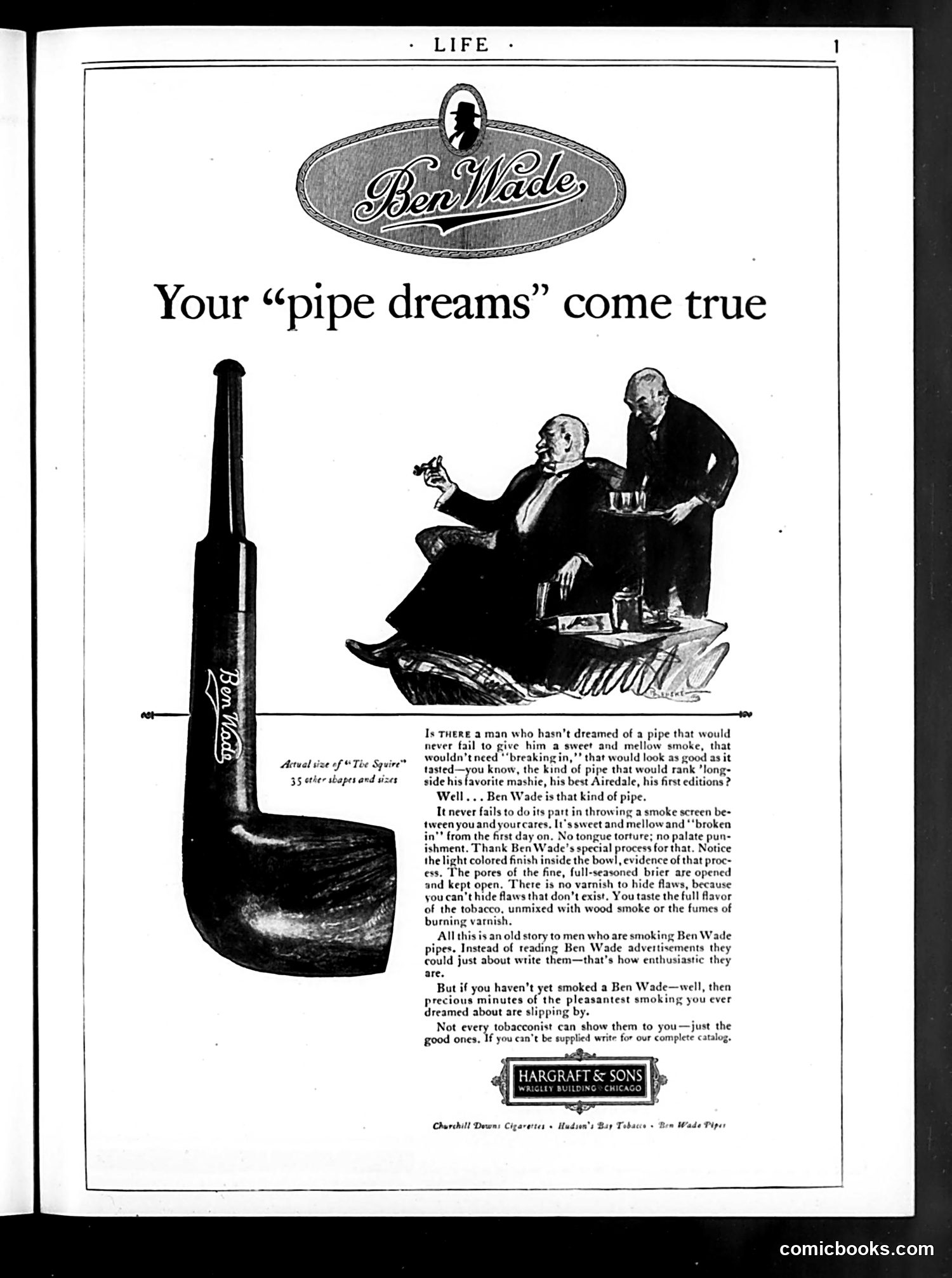
This is primarily a **commercial advertisement**, not satire. It promotes Ben Wade pipes, manufactured by Hargraff & Sons of Chicago. The ad uses aspirational imagery: two well-dressed men in what appears to be a luxury setting, with one smoking contentedly. The accompanying text appeals to male fantasy—describing the "pipe dreams" that supposedly come true with Ben Wade products. The marketing copy emphasizes the pipe's quality: smooth smoke, proper "breaking in," and full flavor without wood smoke or burning. It suggests that Ben Wade pipes deliver the "pleasant smoking" experience every man dreams about. The page represents typical early 20th-century advertising strategy: using social status imagery and emotional appeal to sell consumer goods to middle-class men.
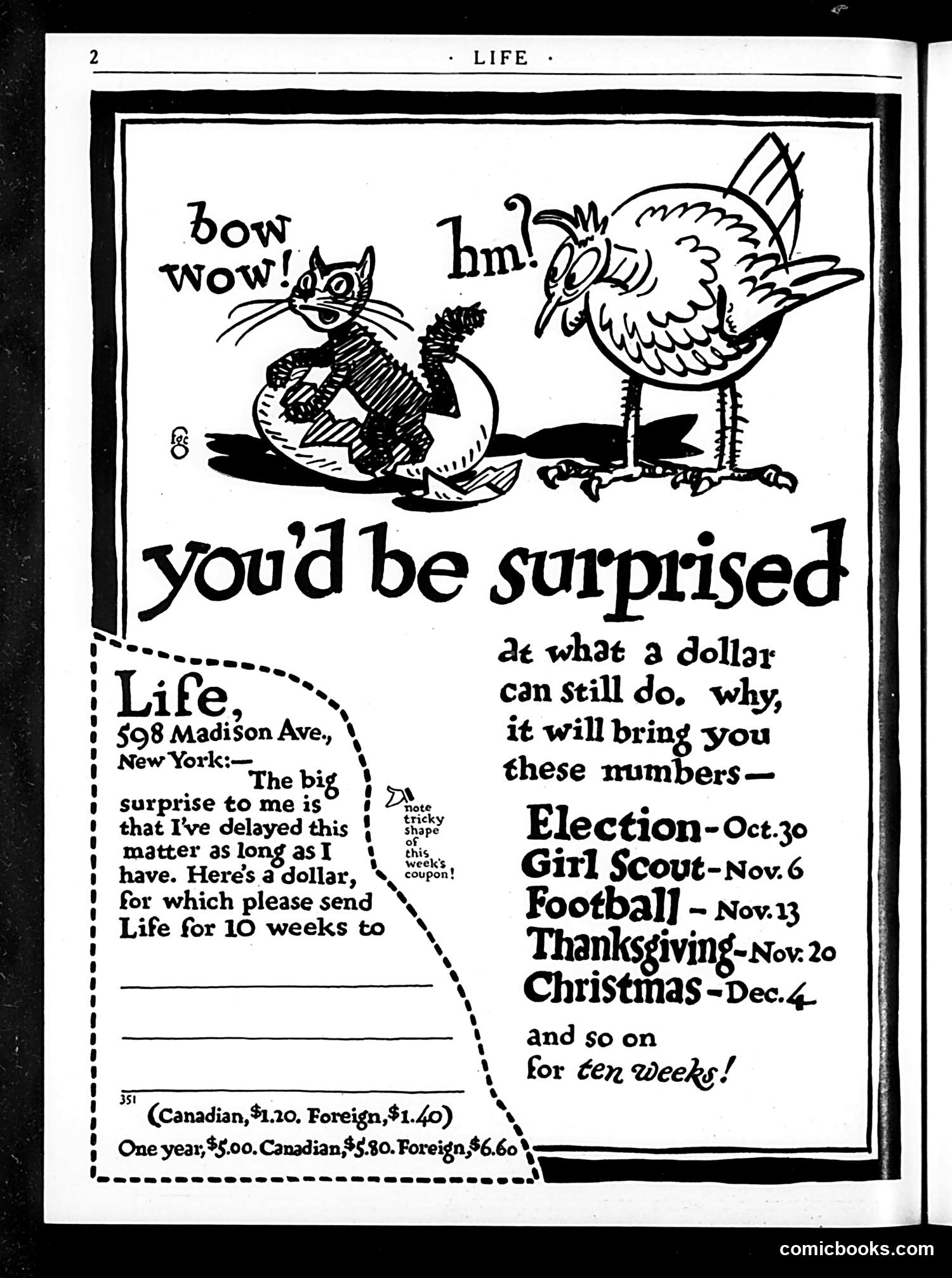
This is primarily a **subscription advertisement** for *Life* magazine, not a political cartoon. The illustration shows a cat emerging from an egg saying "bow wow!" while a bird responds "hm!" — a visual joke about confusion or mistaken identity. The ad's humor plays on the phrase "you'd be surprised" at what a dollar can accomplish. It lists upcoming seasonal events (Election, Girl Scouts, Football, Thanksgiving, Christmas) through which a ten-week subscription supposedly justifies the dollar's value. The accompanying coupon invites readers to send one dollar for a 10-week subscription to *Life*, priced at $1.20 in Canada and $1.40 internationally. This reflects early 20th-century magazine marketing, when subscriptions were remarkably affordable — a promotional strategy emphasizing value during economically challenging times.
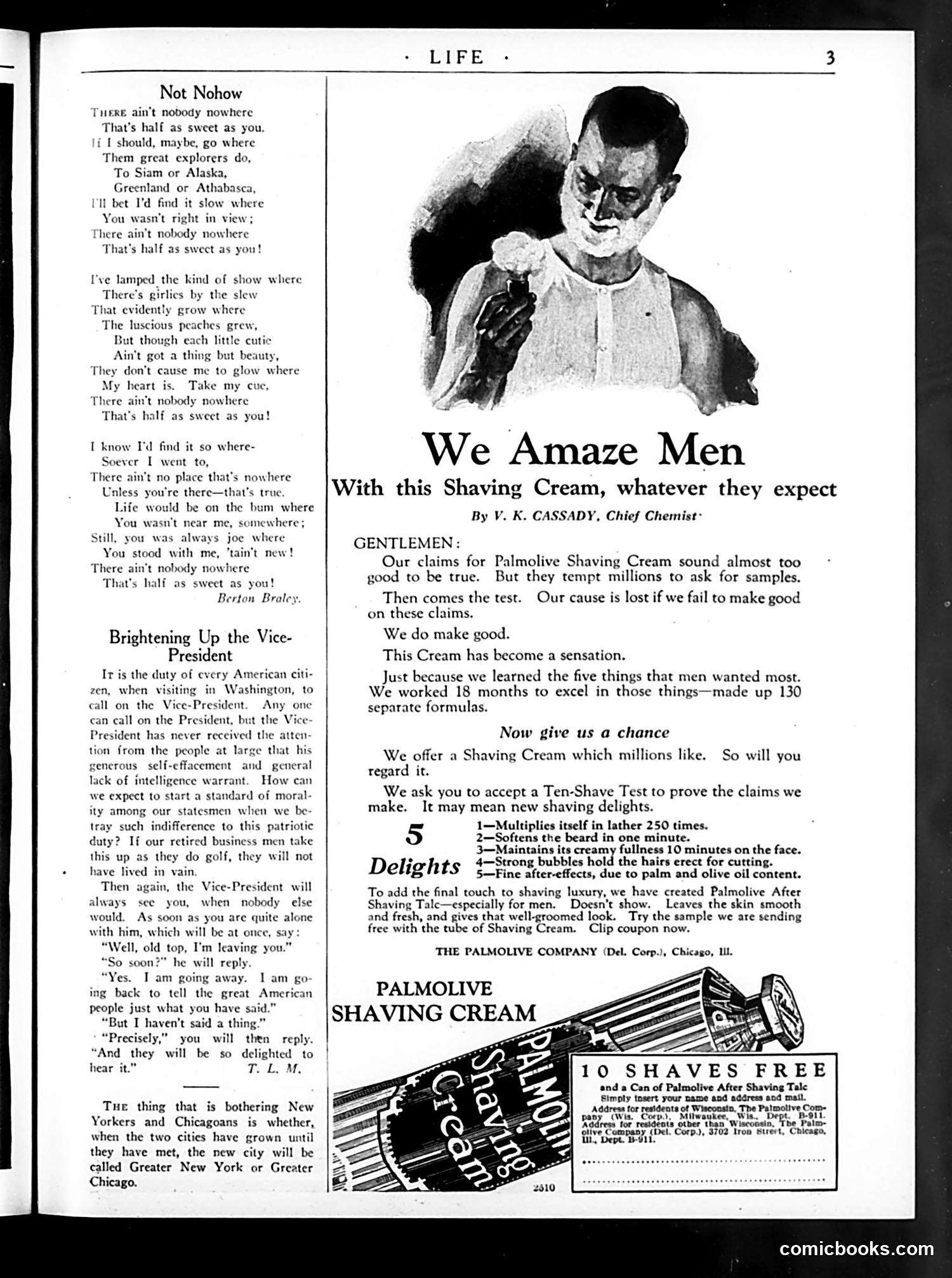
This page contains two distinct items: **"Not Nohow" (Left Column):** A poem by Berton Braley expressing romantic devotion, insisting no place on Earth—despite exotic destinations like Siam or Alaska—compares to being with the beloved. It's sentimental verse typical of the era. **"Brightening Up the Vice-President" (Center):** Political satire suggesting Americans should visit the Vice-President, as he receives little attention or respect. The piece humorously proposes this would boost his morale and general intelligence—implying Vice-Presidents were traditionally overlooked and underestimated political figures. **"We Amaze Men" (Right):** A Palmolive Shaving Cream advertisement claiming superior lathering and skin benefits, offering a ten-shave sample trial. The page is primarily advertising with light political and romantic humor.
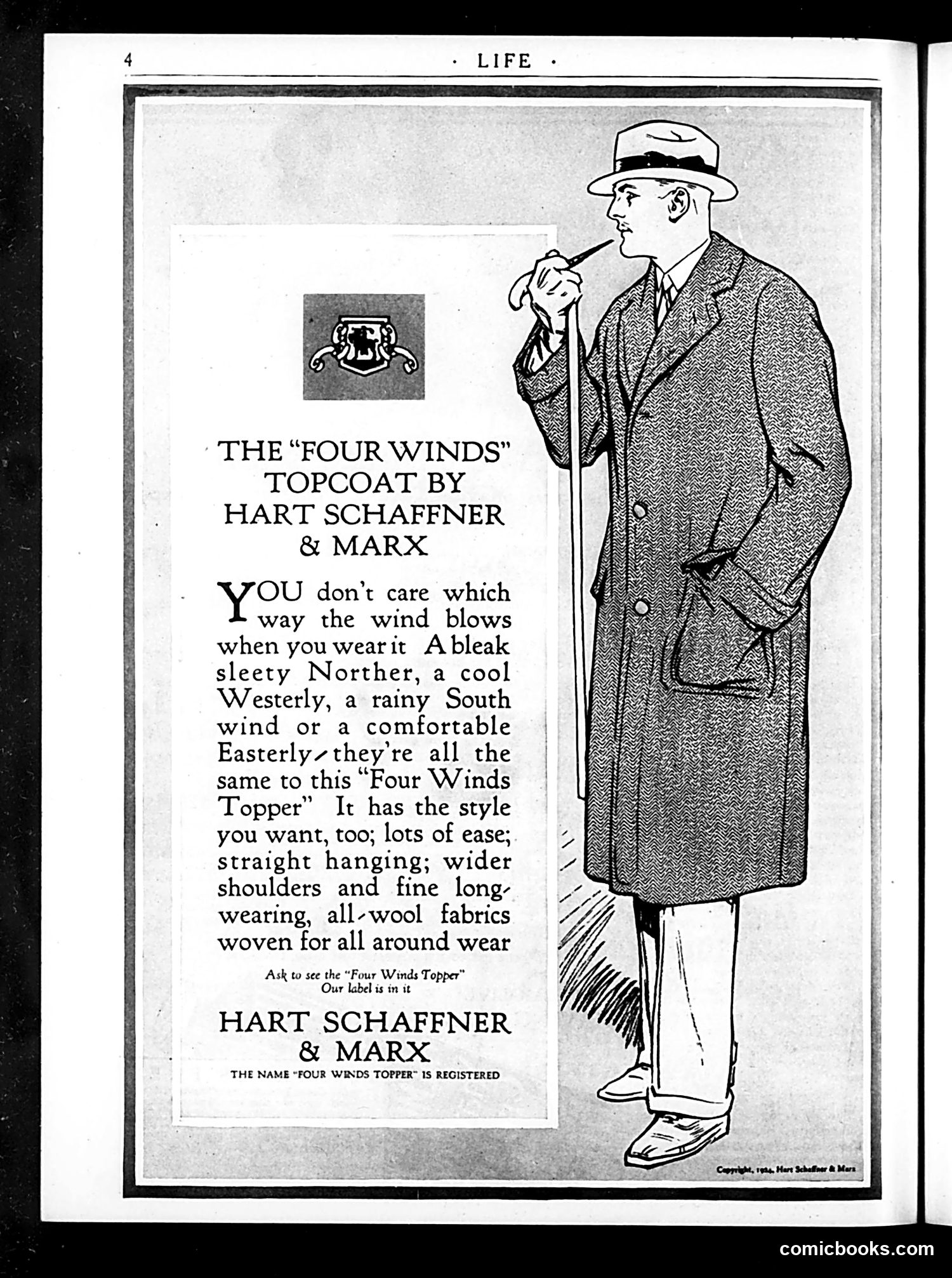
This is **not a political cartoon or satire**—it's a straightforward advertisement for men's outerwear. The page advertises the "Four Winds Topcoat" by Hart Schaffner & Marx, a prominent American menswear manufacturer. The illustrated figure is a well-dressed man modeling the coat, drawn in a typical 1920s advertising style. The ad's pitch emphasizes practical versatility: the topcoat works regardless of weather conditions (north, west, south, or east winds). Key selling points include ease of wear, comfort, straight hanging, wide shoulders, fine wool construction, and all-around durability. This represents standard commercial advertising from Life magazine's era, when the publication mixed humor and satire with paid product advertisements. No political or satirical content is present.
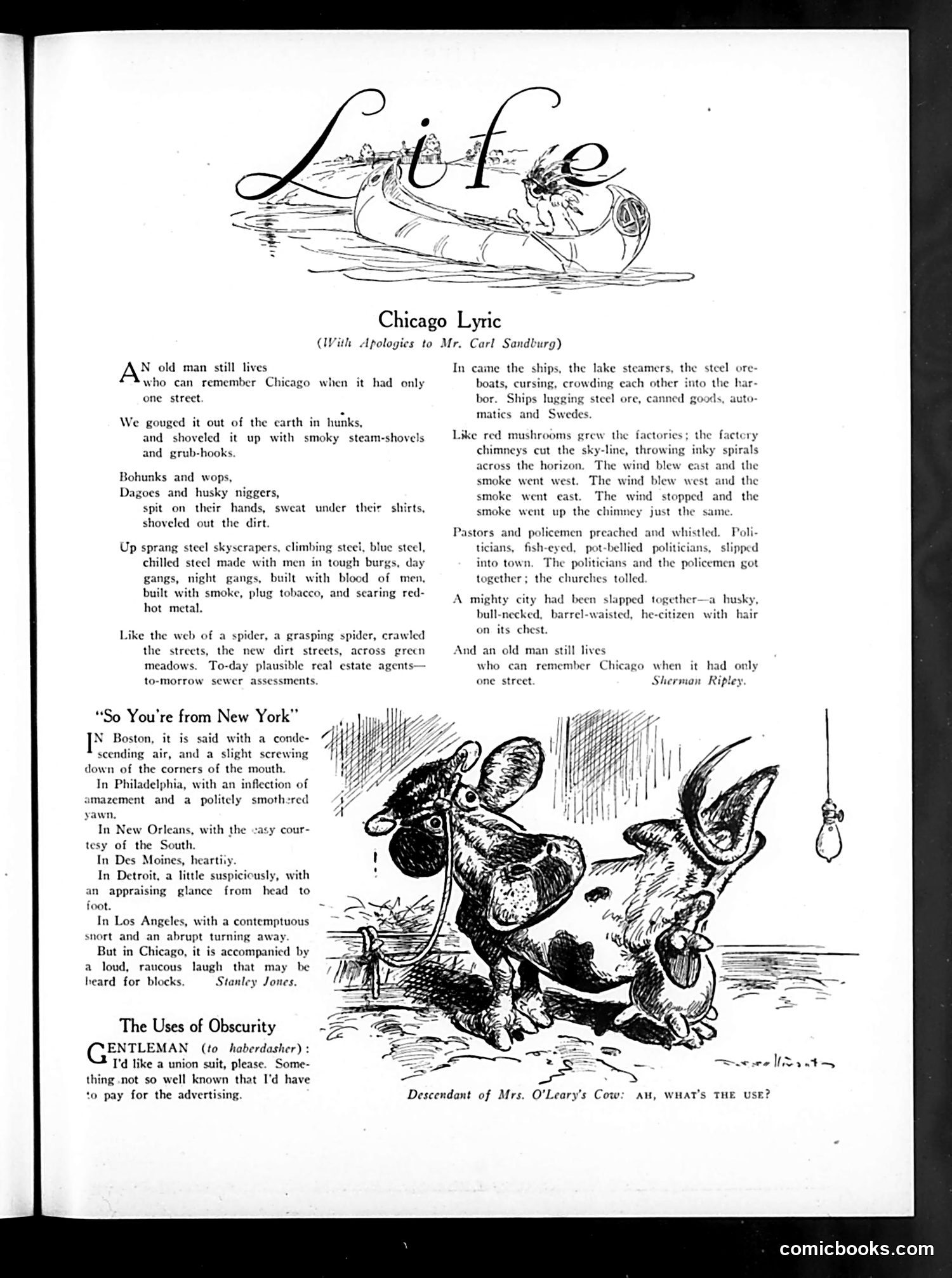
This page contains two satirical pieces about American regional dialects and urban character: **"Chicago Lyric"** (with apologies to Carl Sandburg) is a parody of Sandburg's famous poem "Chicago." Where Sandburg celebrated the city's industrial strength, this version mocks Chicago's rough, unrefined character—its boisterous workers, polluted air, and chaotic growth. **"So You're from New York"** catalogs regional stereotypes: Boston's affected speech, Philadelphia's vulgarity, New Orleans' courtesy, Detroit's suspicion, Los Angeles' pretension, but Chicago's distinguishing feature is its *loudness*. **"The Uses of Obscurity"** presents a brief joke where a gentleman asks a haberdasher for an obscure union suit, hoping its obscurity means less advertising payment required. The cartoons and text collectively satirize American regionalism and urban culture of the early 20th century.
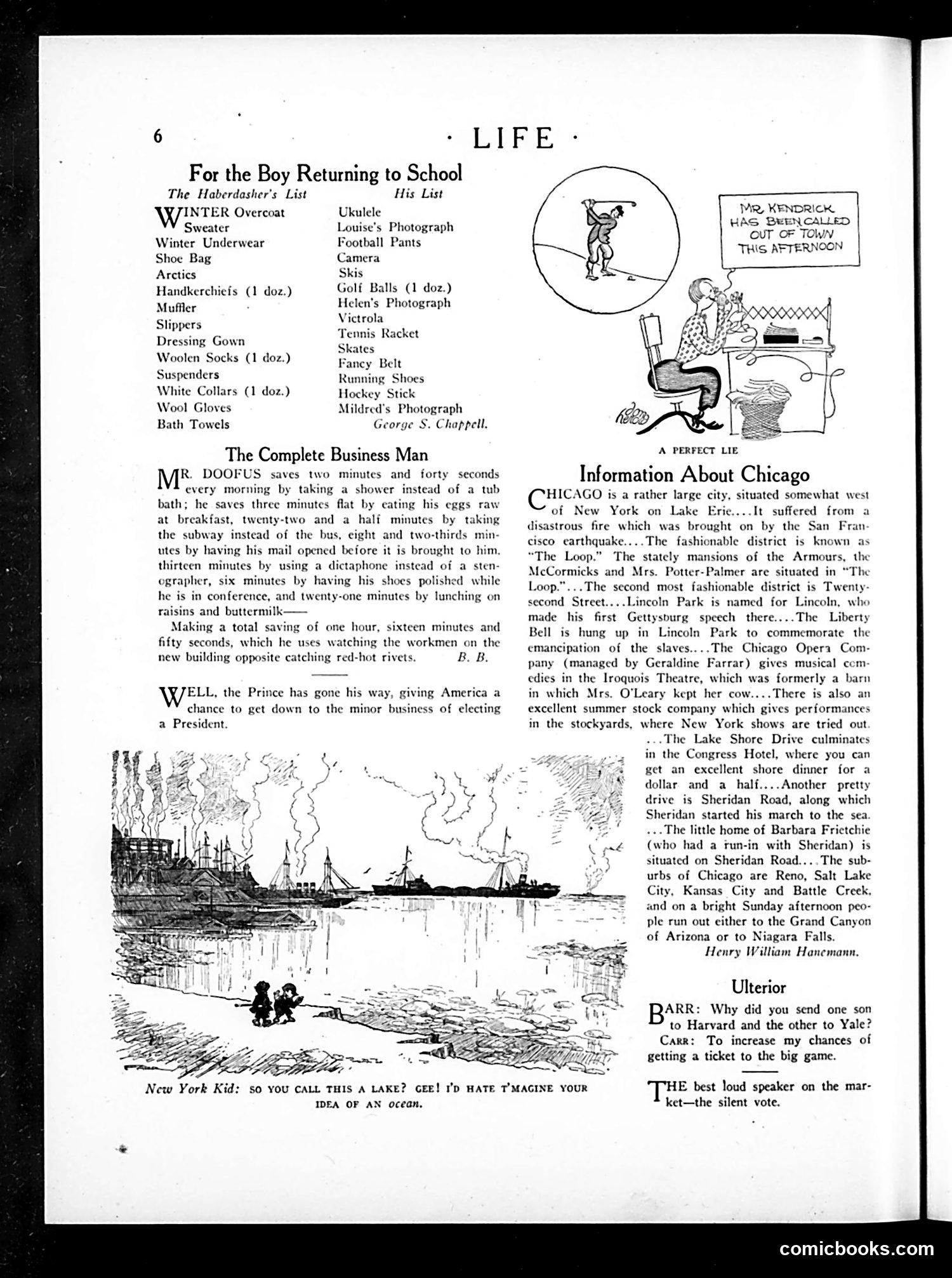
This page contains several satirical pieces rather than a single unified cartoon: 1. **"The Complete Business Man"** depicts a businessman saving time through increasingly absurd shortcuts—eating raw eggs, taking the subway instead of walking, using a dictaphone. The satire mocks corporate efficiency obsession and the modern businessman's lifestyle. 2. **"A Perfect Lie"** shows a man telling his wife he's been called out of town, while fantasizing about golfing. The joke targets marital deception and hypocrisy. 3. **"Information About Chicago"** provides genuine tourist information about the city. 4. The bottom cartoon, captioned "New York Kid," depicts children observing a large body of water, making a joke about provincial New York attitudes toward geography. The page reflects early 20th-century American satirical humor targeting business culture and urban pretension.
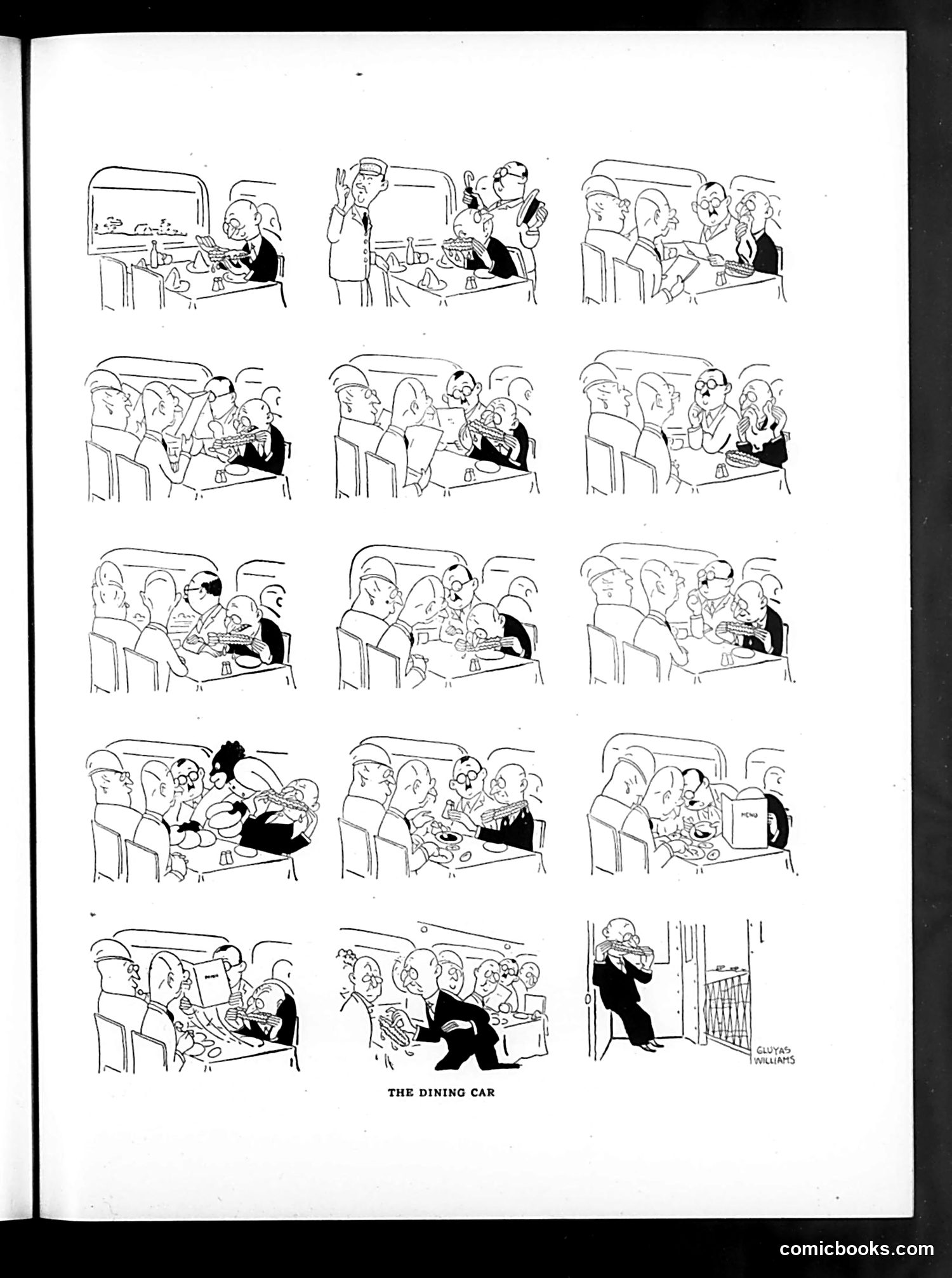
This multi-panel comic by Gluyas Williams depicts the progression of a meal service in a railroad dining car. The humor centers on the escalating chaos and disorder as the train rocks and sways—passengers struggle to eat, food and dishes slide around the table, and refined dining decorum completely breaks down. The satire targets the contradiction between the *promise* of elegant train travel and the *reality* of dining while in motion. Early panels show passengers attempting formal etiquette; later panels show them increasingly disheveled, food scattered, dignity abandoned. The final panel shows a passenger fleeing the car entirely. This reflects early 20th-century frustration with railroad dining car experiences—the gap between luxury marketing and practical discomfort during actual train journeys.
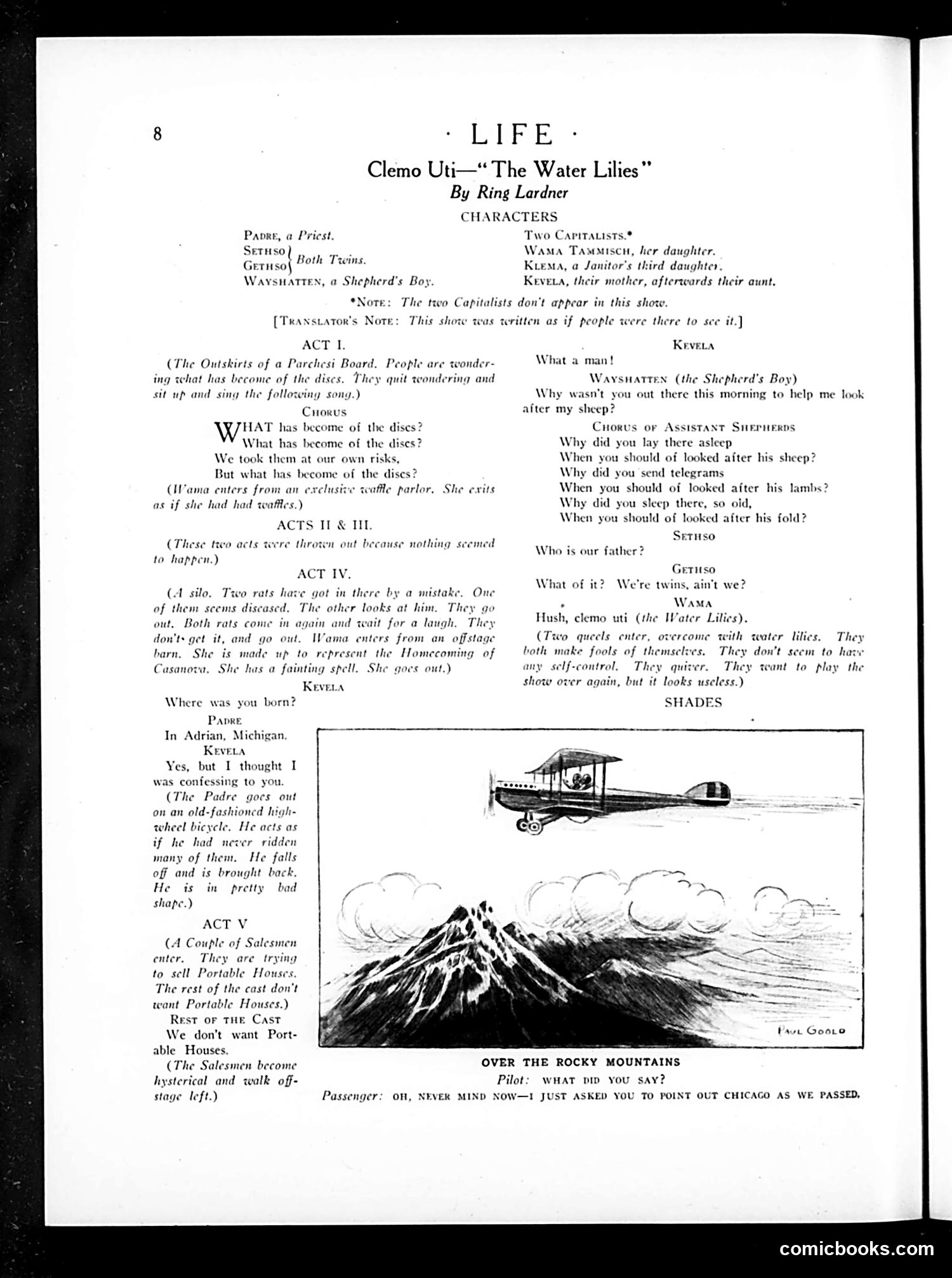
This page presents a theatrical review of "Clemo Uti—'The Water Lilies'" by Ring Lardner, a satirical play mocking avant-garde theater. The plot synopsis describes nonsensical, plotless acts that go nowhere—characters enter and exit pointlessly, rats appear inexplicably, and nothing coherent happens. The humor targets experimental theater of the era that prioritized abstract or symbolic staging over narrative. The illustration "Over the Rocky Mountains" shows a pilot and passenger, with the passenger asking to identify Chicago—a mundane, practical question that contrasts with the play's absurdist pretensions. The satire suggests that modern experimental theater is laughably meaningless, more concerned with appearing artistic than actually entertaining or communicating anything substantive to audiences.
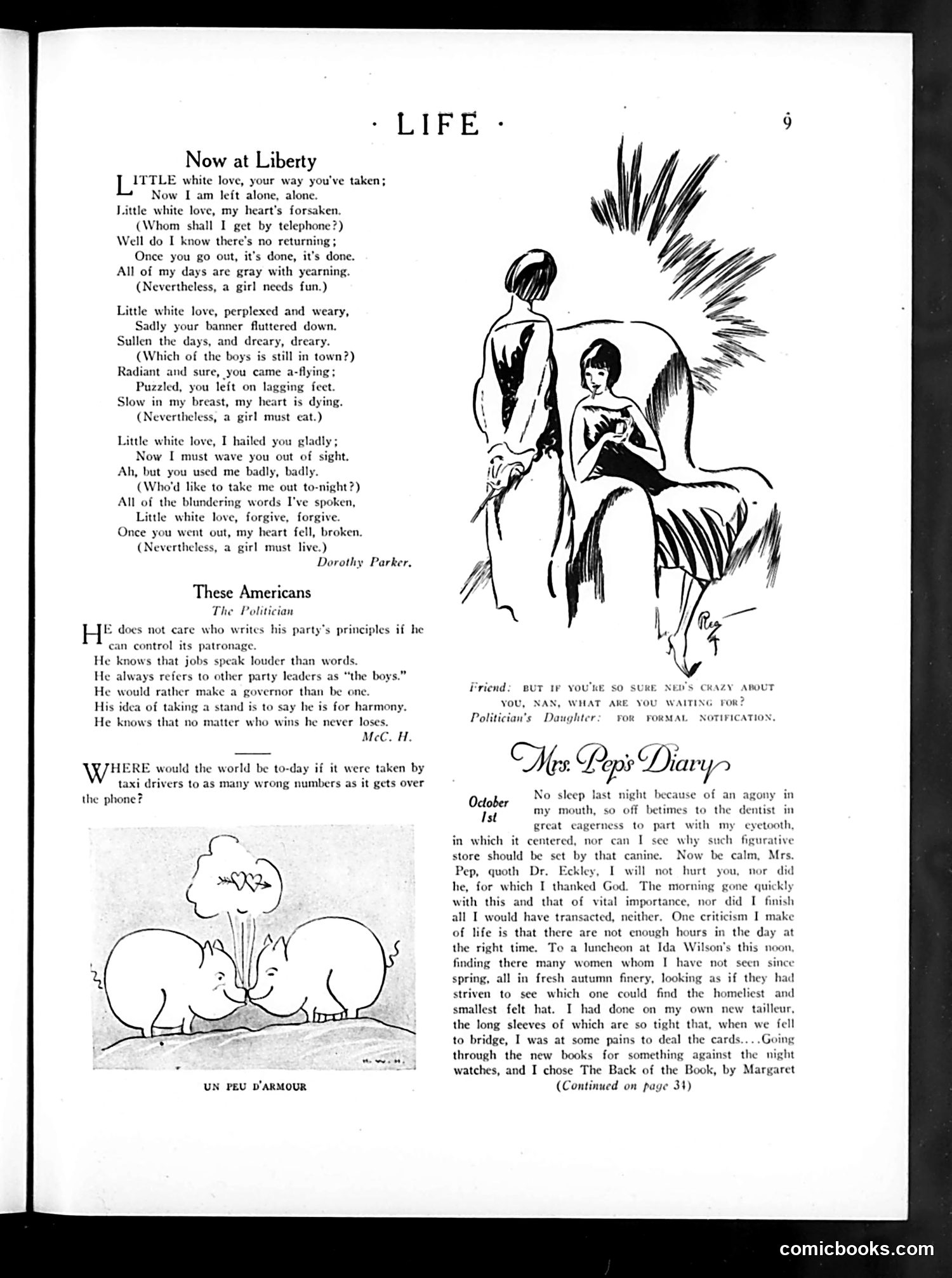
This page contains poetry and social commentary from early 20th-century *Life* magazine. **"Now at Liberty"** by Dorothy Parker is a melancholic poem about romantic abandonment—a woman left behind after her lover departs, with sardonic asides like "(Nevertheless, a girl needs fun.)" The accompanying illustration shows two figures in an intimate moment, likely depicting the poem's romantic theme. **"These Americans"** satirizes a calculating politician who prioritizes patronage and party loyalty over principles, dismissing ideology as secondary to practical control. **"Un Peu d'Armour"** is a humorous cartoon showing elephants in an affectionate pose, playing on the French title's reference to love/affection. **"Mrs. Pep's Diary"** begins a domestic humor column documenting daily life observations. The page blends romantic sentiment, political satire, and domestic humor typical of *Life*'s editorial mix.
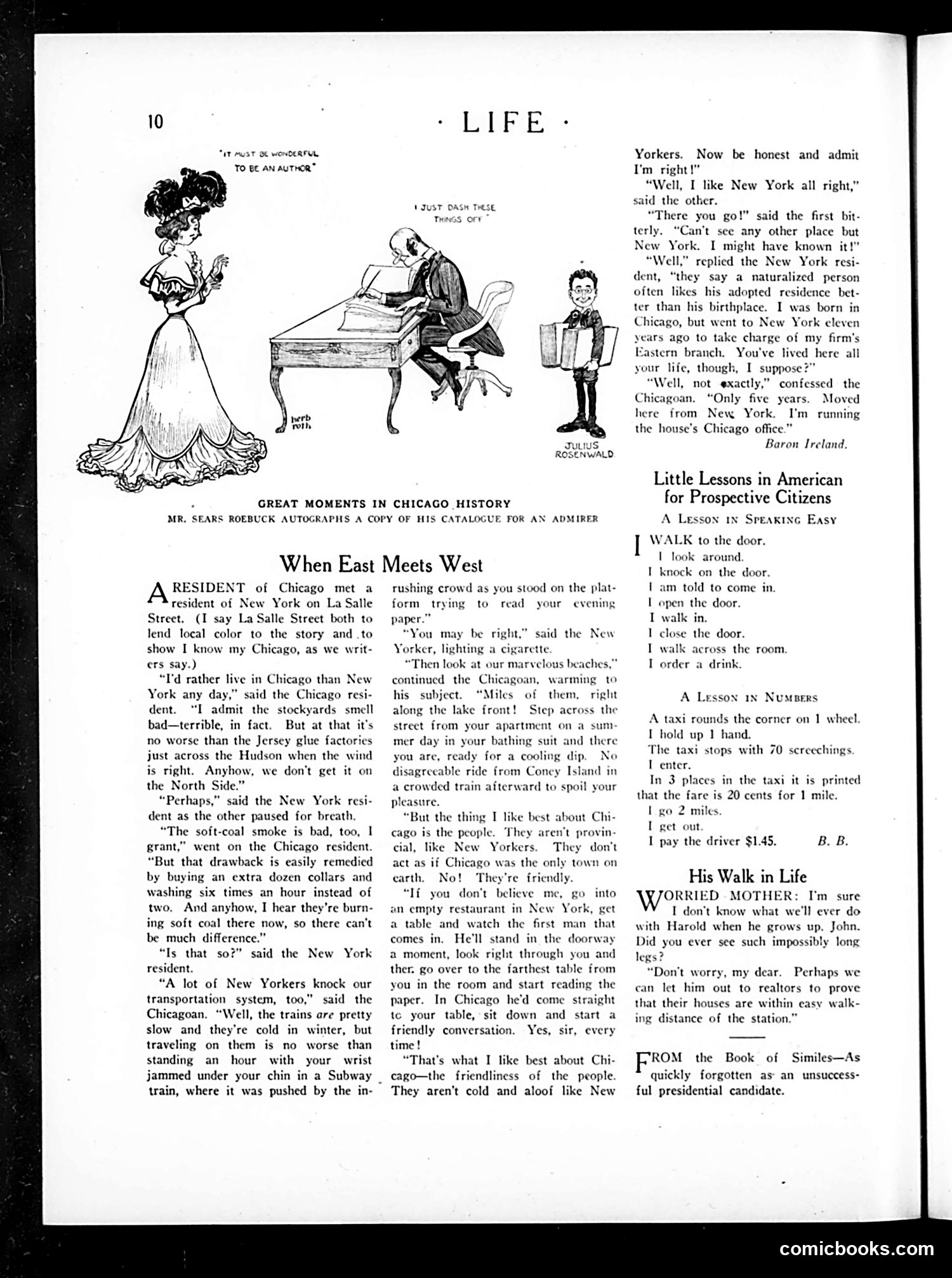
This page contains satirical humor comparing Chicago and New York residents. The main cartoon, "When East Meets West," depicts a conversation between a Chicago resident and a New Yorker on La Salle Street. The satire hinges on regional stereotypes: The New Yorker is portrayed as cold, aloof, and dismissive of other cities, while the Chicagoan is presented as friendlier and more hospitable. The Chicago resident argues their city's people are superior because they're genuinely warm and welcoming, whereas New Yorkers are self-absorbed and rude. The accompanying illustrations show Mr. Sears Roebuck autographing a catalog, and include humorous "Little Lessons in American" teaching basic etiquette and taxi mechanics—gentle mockery of practical, straightforward Midwestern values versus Eastern sophistication.
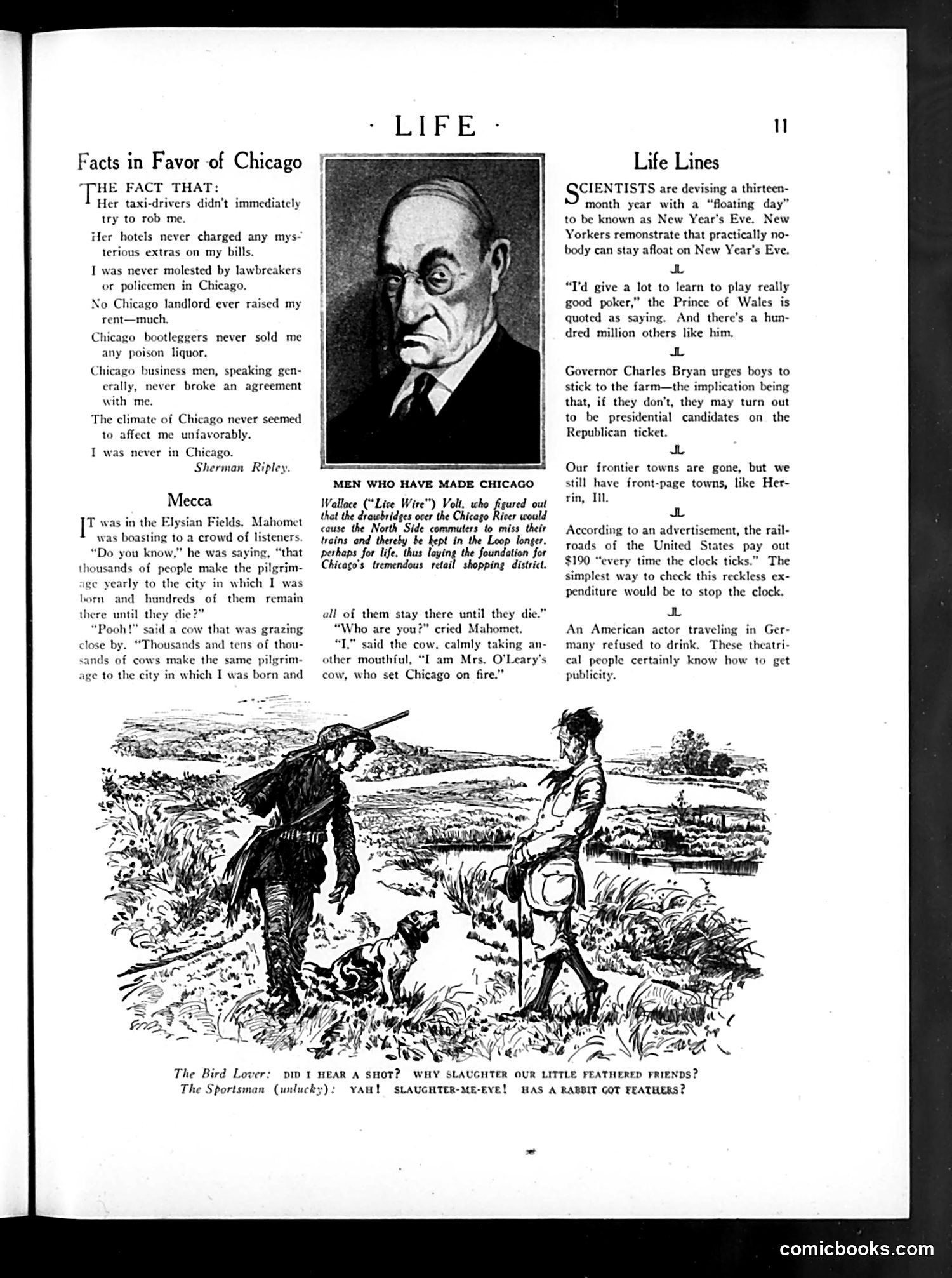
This page contains two distinct sections: **Top Section:** "Facts in Favor of Chicago" and "Mecca" present humorous anecdotes praising Chicago's business ethics and popularity as a pilgrimage destination. A portrait shows Wallace ("Lias Wire") Voll, described as having "figured out that the skyscrapers over the Chicago River would be a good place to dry the [electric] trains." **Bottom Cartoon:** Shows two figures in a rural setting—a "Bird Lover" confronting a "Sportsman" (hunter). The joke satirizes their conflicting values: the bird lover objects to shooting birds, while the sportsman dismissively claims he shot a rabbit with feathers, mocking the lover's sentimentality about wildlife. The satire reflects early 20th-century tensions between conservation-minded urbanites and traditional hunting culture.
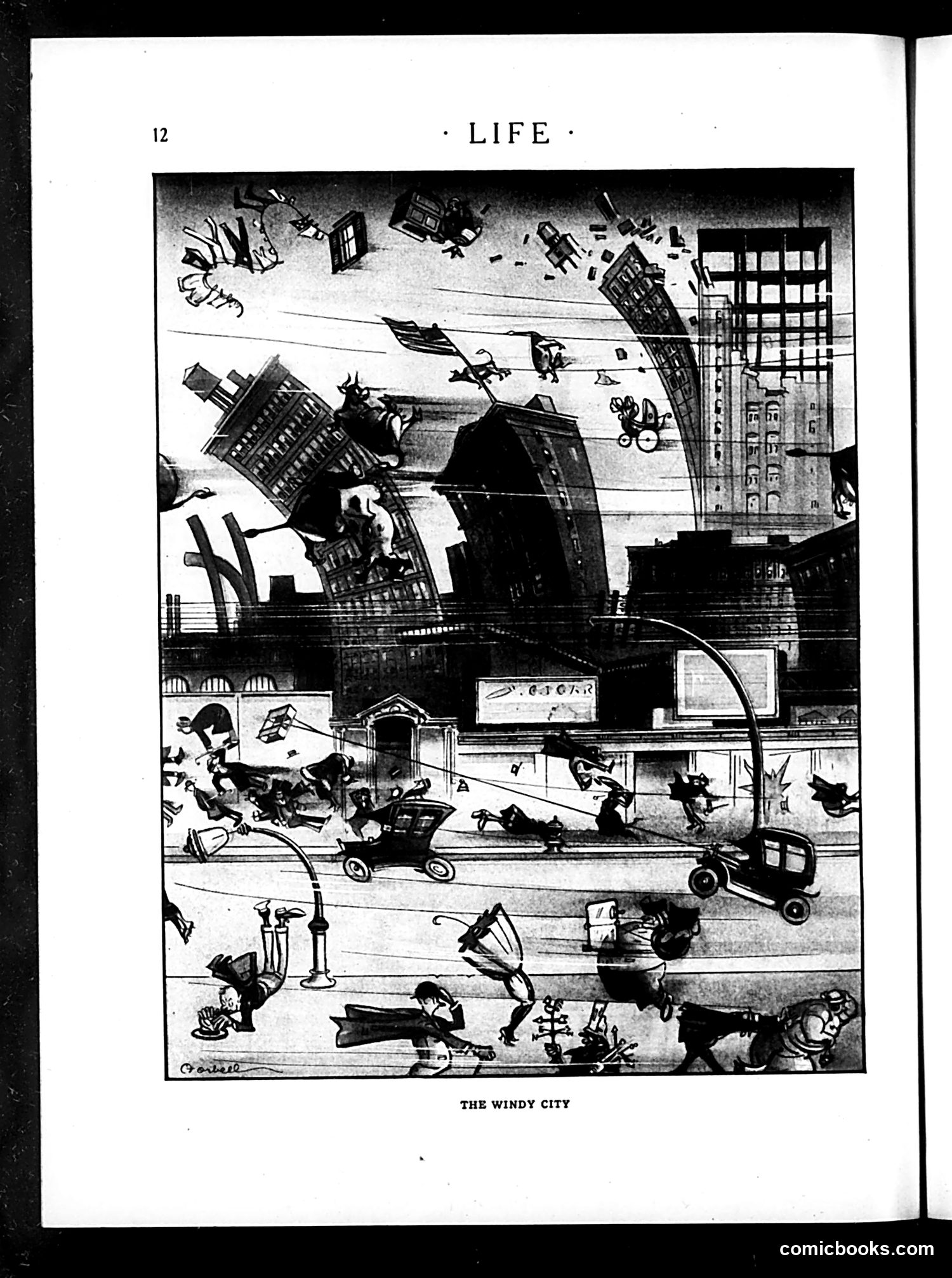
This is a humorous illustration satirizing Chicago, famously nicknamed "the Windy City." The cartoon depicts wind as a chaotic force literally tearing through the urban landscape—buildings tilt and topple, people are blown about, hats and debris fly everywhere, and vehicles overturn. The satire works on two levels: it's a literal visual joke about Chicago's notorious strong winds, while also playing on the colloquial meaning of "windy" as referring to excessive talk or boasting. The chaos suggests the city's reputation for turbulent, aggressive character and bombastic personality during the early 20th century. The detailed, dynamic composition captures the frenetic energy of urban life being disrupted by this irresistible natural force.
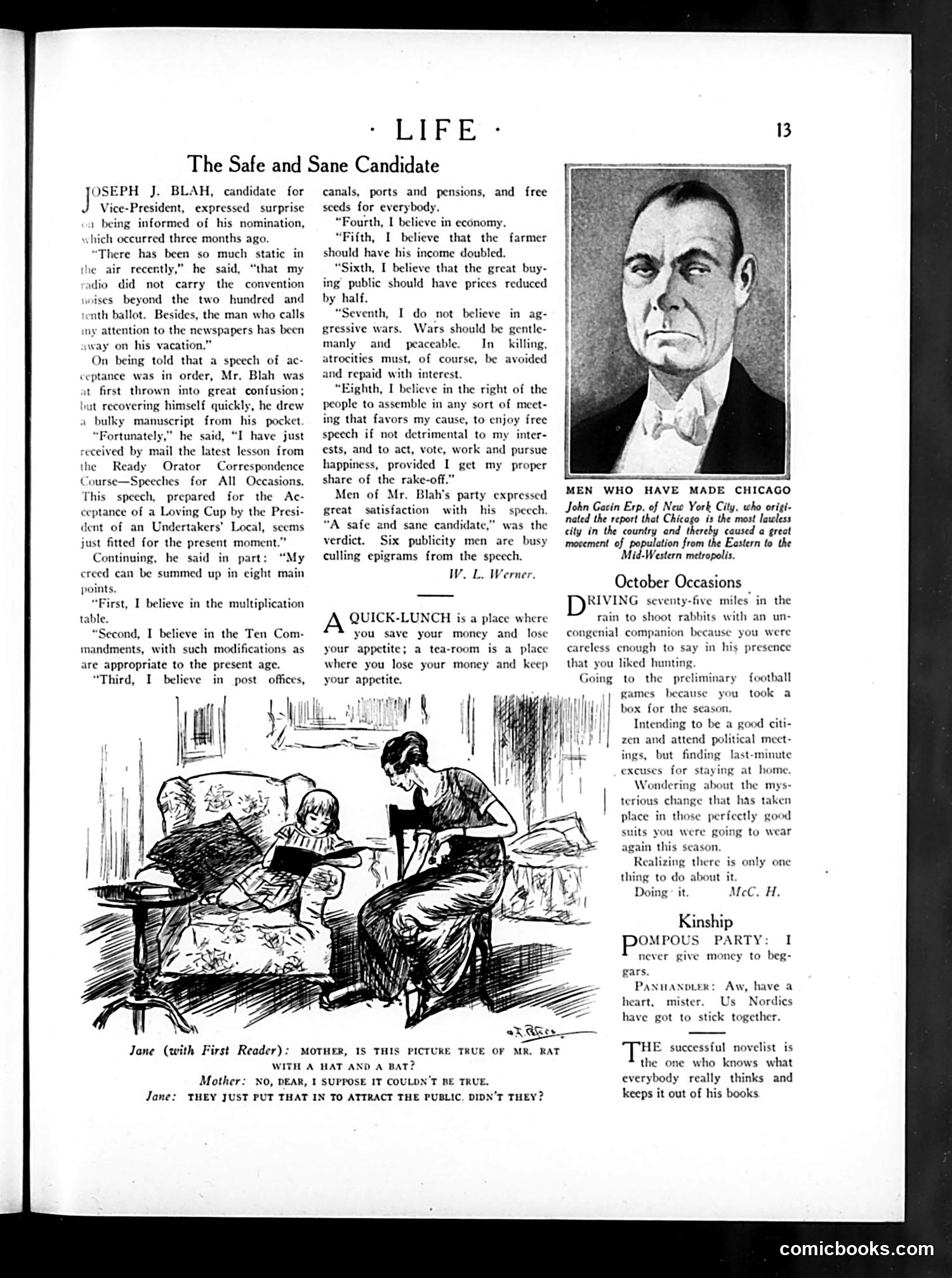
This page satirizes Joseph J. Blah, a Vice-Presidential candidate who expressed eight points of platform, including beliefs in economy, doubling farmers' income, reducing prices, and genteel warfare. The satire mocks his vague, contradictory platitudes—promising everything to everyone without substance. The cartoon below depicts a domestic scene where a mother and child discuss a picture of "Mr. Rat with a hat and a bat." The child questions why such an absurd image would be published, and the mother cynically responds that it's designed "to attract the public"—a meta-commentary suggesting that Blah's equally nonsensical campaign platform succeeds through spectacle rather than meaningful policy.
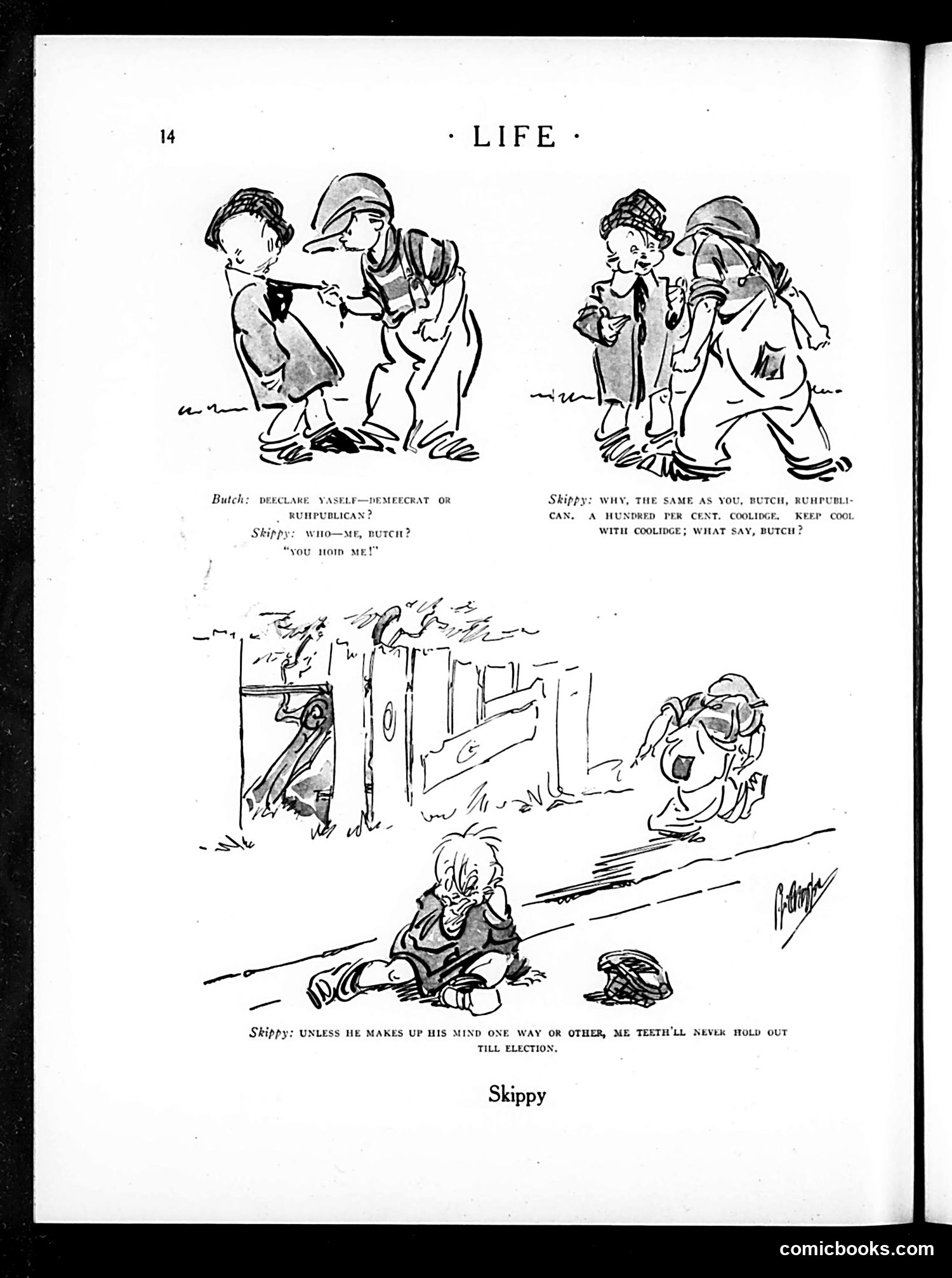
This page features three comic strips about a character named Skippy (a boy), depicting political satire circa the 1920s-30s. In the top panels, Skippy and another boy discuss whether to declare oneself a "Democrat or Republican," with references to keeping "cool" with coolidge—likely referencing President Calvin Coolidge's 1924 campaign. The lower panel shows Skippy sitting dejected, with text stating: "Unless he makes up his mind one way or other, me teeth'll never hold out till election." This suggests an adult (possibly a parent or authority figure) is so undecided about political allegiance that they're literally grinding their teeth in frustration. The satire mocks the difficulty of choosing between political parties and the anxiety such indecision causes.
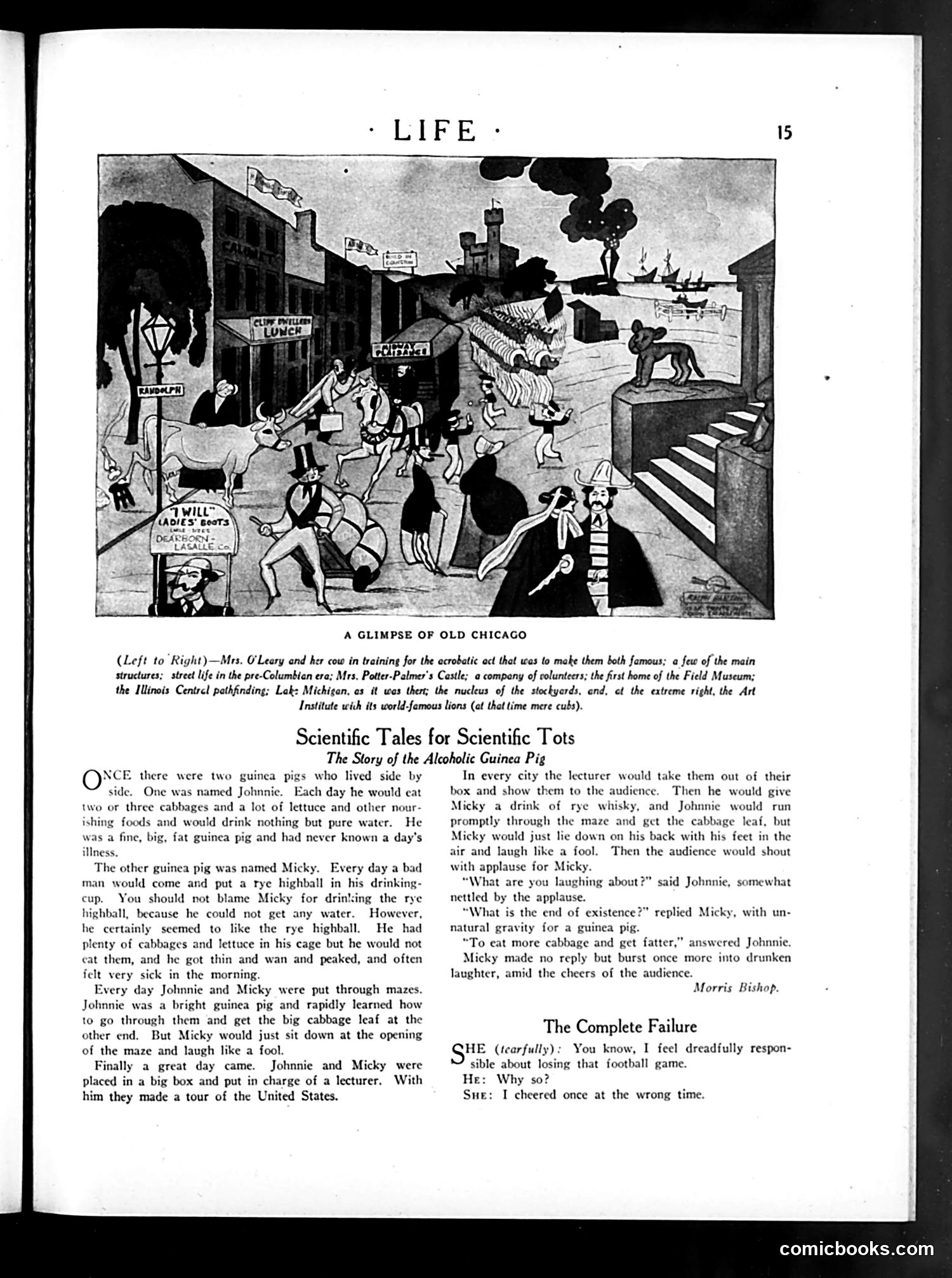
This cartoon satirizes turn-of-the-century Chicago's reputation for vice and disorder. The street scene depicts acrobats, circus performers, and revelry alongside signs advertising saloons and entertainment venues. The caption references "the pre-Columbian era" and notes Mrs. Potter-Palmer's Castle, the Field Museum, and the Art Institute—suggesting contrast between Chicago's cultural institutions and its seedier street life. The scene mocks Chicago's chaotic public spaces and apparent moral laxity, portraying the city as a circus where acrobats and drunken behavior dominate. This reflects widespread contemporary anxiety about urban corruption, particularly in rapidly industrializing American cities, where wealthy institutions coexisted with visible poverty, vice, and disorderly conduct.
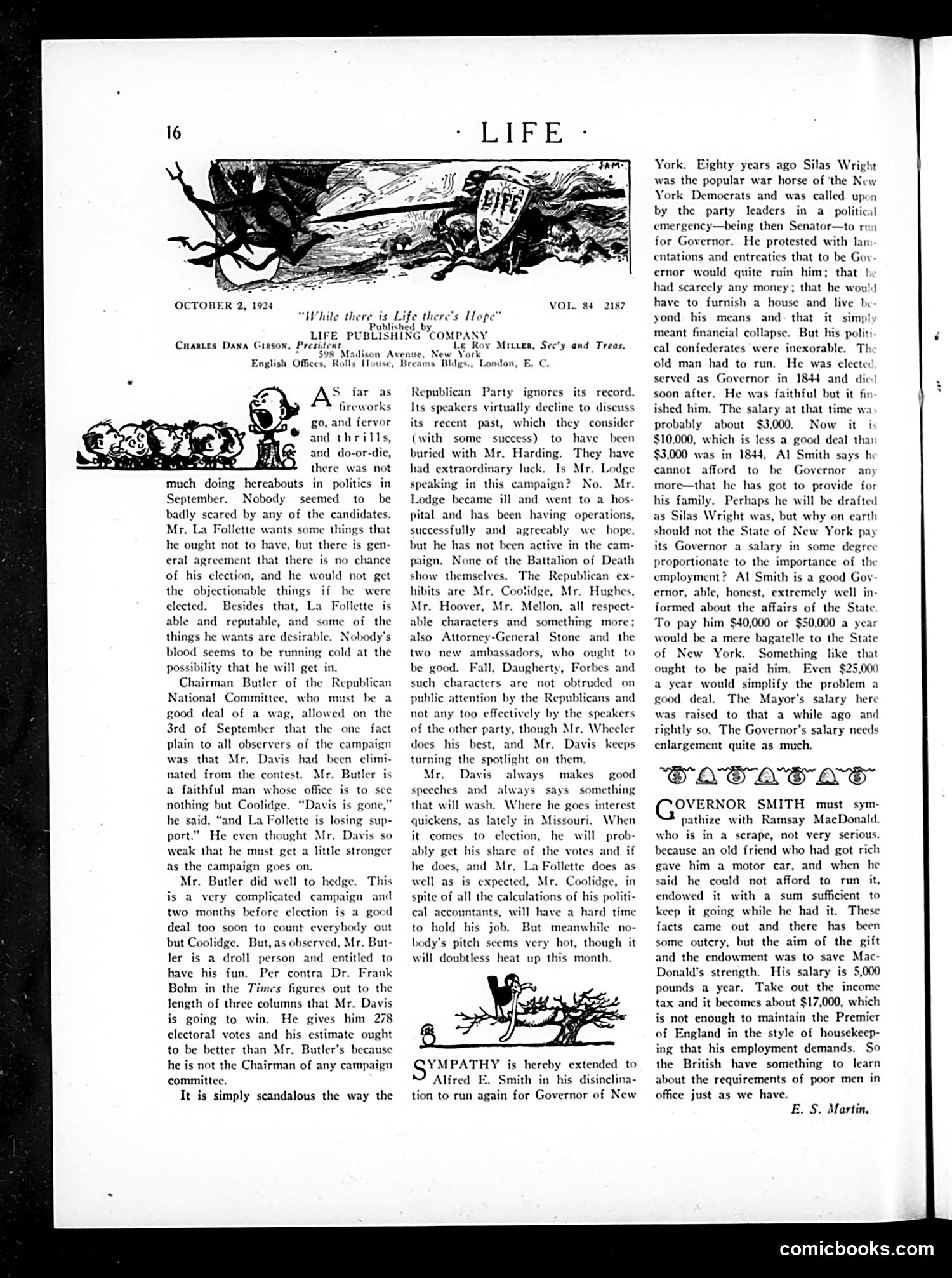
This *Life* editorial discusses the 1924 U.S. presidential campaign, which featured Republican Calvin Coolidge, Democrat John W. Davis, and Progressive Robert La Follette. The satire targets the **Republican Party's deliberate avoidance of its recent scandals**—particularly those from the Harding administration (Teapot Dome, etc.). The author notes Republicans won't discuss this record and conveniently keeps tainted figures like Fall and Daugherty offstage, instead featuring respectable figures like Coolidge, Hoover, and Mellon. The piece mocks **Chairman Butler's overconfidence**, claiming Davis is "eliminated" when the race remains uncertain. The cartoons (showing animals and figures) appear to satirize political maneuvering. A secondary item sympathizes with **Al Smith** declining to run for New York Governor, drawing a parallel to Silas Wright facing similar pressure decades earlier—commenting on how party machinery pressures candidates. The overall tone suggests frustration with calculated political theater and the Republicans' successful image rehabilitation despite recent scandals.
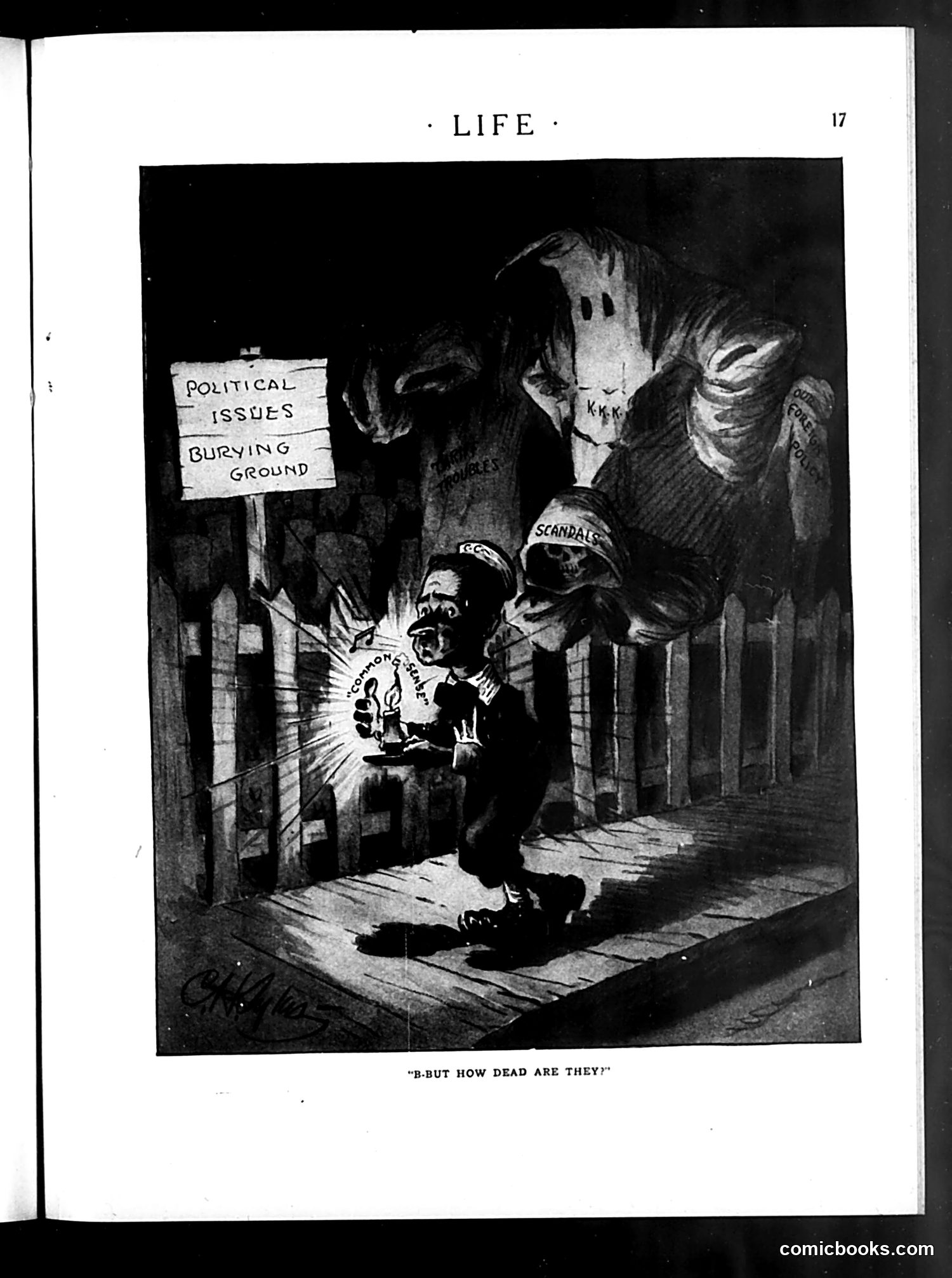
This Life magazine cartoon satirizes American political dysfunction. A small figure holding a torch labeled "Conscience" stands in a cemetery-like setting marked "Political Issues Burying Ground." Looming ghostly figures labeled with "KKK" and "Scandal" tower menacingly overhead, while skeletal hands reach down. The caption—"B-but how dead are they?"—suggests the cartoon's central critique: that despite America's claim to bury its worst problems (racial violence, political corruption), these issues remain dangerously alive and threatening. The figure's small torch represents ineffectual attempts at moral opposition against powerful, resurgent forces. This appears to be Depression-era or post-WWII commentary on America's failure to permanently eliminate systemic evils, particularly racist organizations and political malfeasance that resurface cyclically.
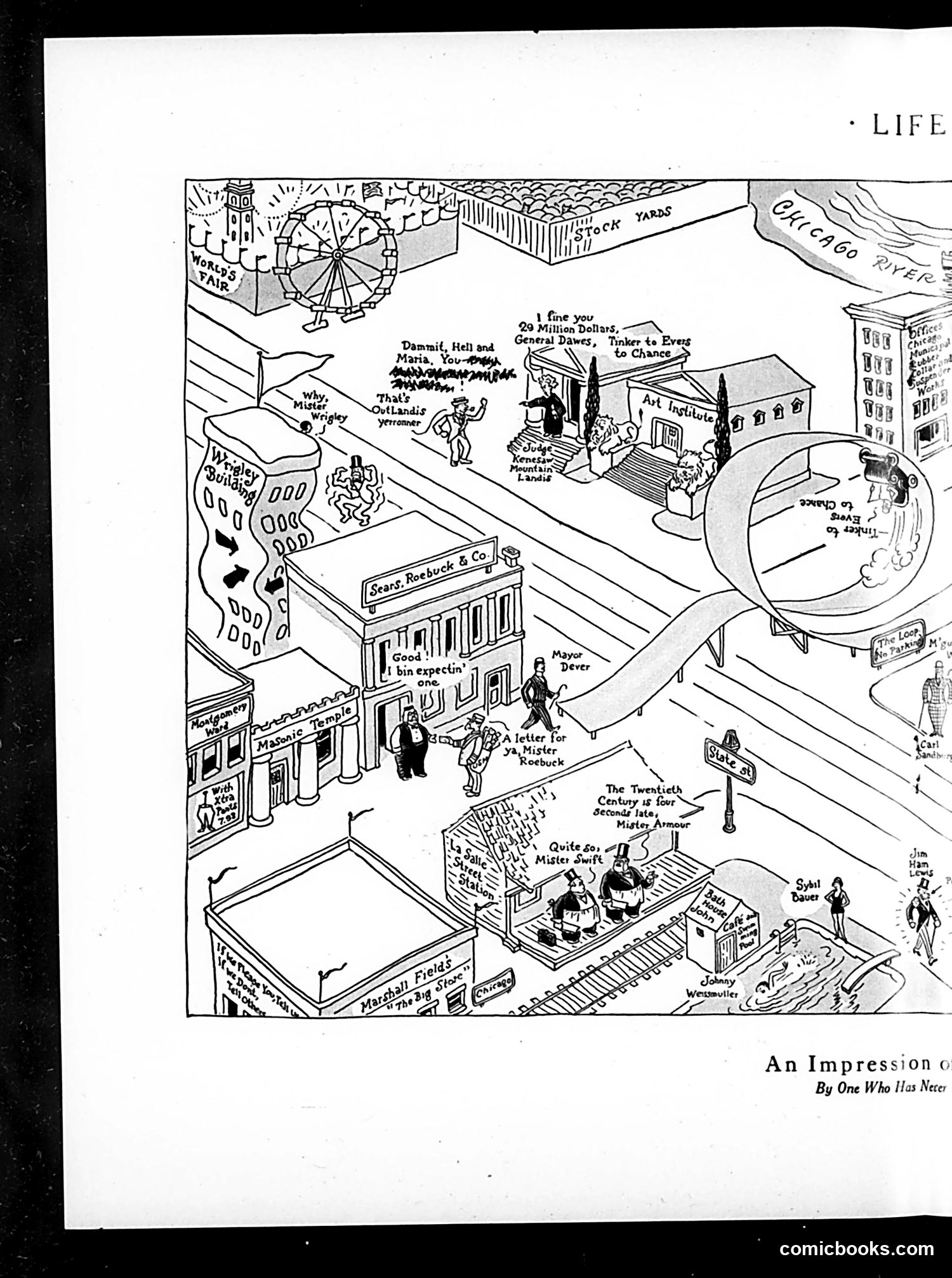
This is an isometric map-style cartoon titled "An Impression of [Chicago]" depicting the city as a satirical landscape. The cartoon illustrates various Chicago landmarks and figures engaged in corrupt or questionable activities: **Key figures identified:** - Mayor Dever (labeled) - General Dawes (mentioned in dialogue) - Various caricatured businessmen and politicians **The satire critiques:** - Municipal corruption and graft ("fine you 29 Million Dollars") - Organized crime and bootlegging (Prohibition-era reference) - Political favoritism and deal-making among elites - The clash between civic institutions (Art Institute, stock yards) and underworld operations The casual tone of characters discussing millions in fines and corrupt exchanges suggests widespread acceptance of dishonesty in 1920s Chicago governance. This reflects the city's notorious reputation during Prohibition for organized crime, police corruption, and political malfeasance—likely the context for this satirical bird's-eye view.
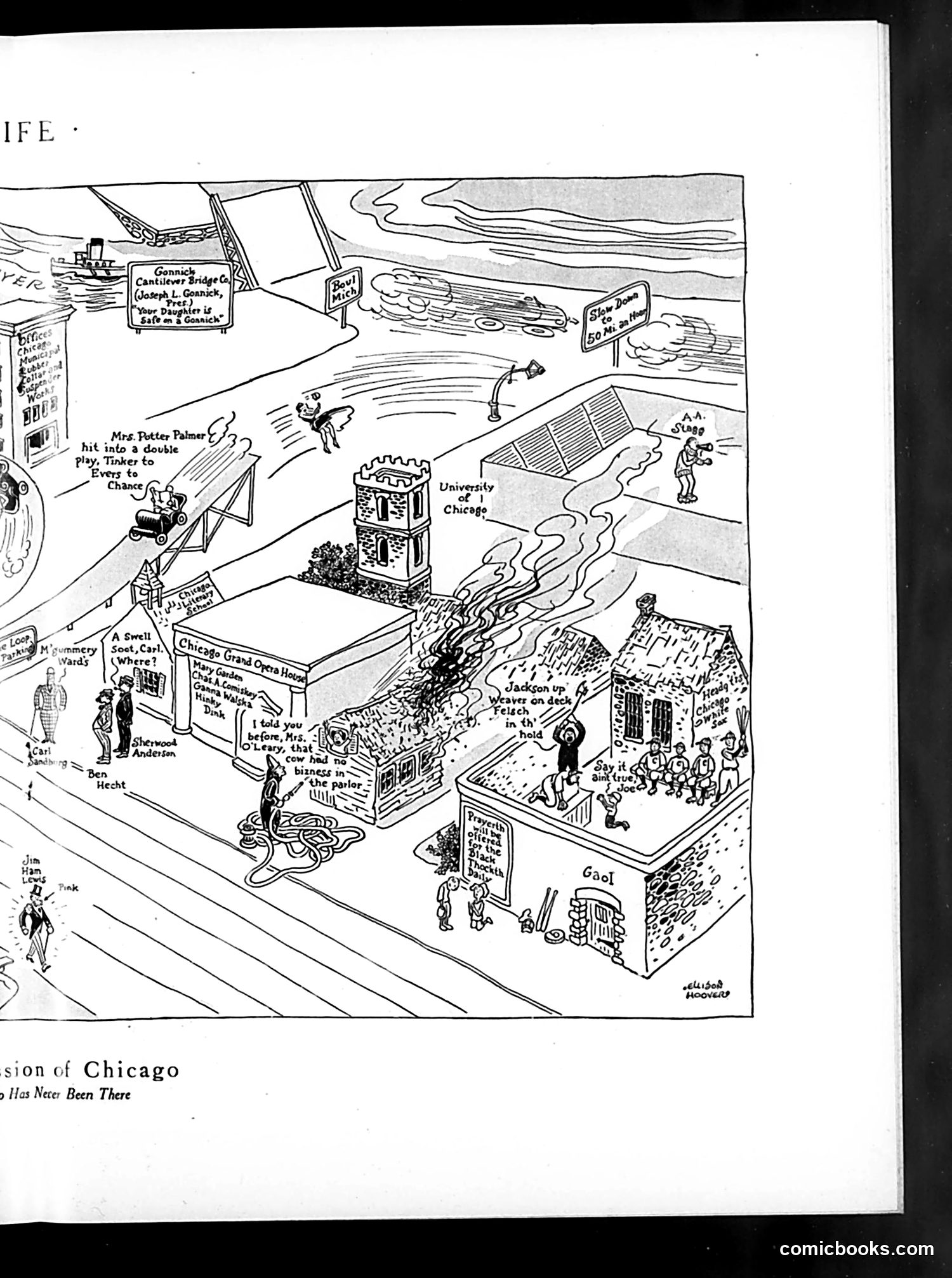
This is a bird's-eye-view cartoon map of Chicago depicting various social scenes and notable figures. The central landmark is the University of Chicago. Scattered throughout are labeled vignettes showing Chicago society and culture: Mrs. Potter Palmer (a prominent society figure) playing baseball, a reference to the famous "Tinkers to Evers to Chance" baseball double-play, the Chicago Grand Opera House, and various other Chicago institutions and personalities. The satire appears to mock Chicago's aspirations to cultural sophistication and high society while showing the city's actual mix of entertainment, sports, and commercial life. The title suggests irony about someone never having visited despite Chicago's prominence. The cartoon captures turn-of-the-century Chicago's self-image as a dynamic, culturally significant American city.
This is a theater review column critiquing Broadway shows, specifically Earl Carroll's "Vanities" revue. The author argues the production itself was mediocre, but defends the performers—particularly comedian Joe Cook and singer Sophie Tucker—against an unresponsive, hostile audience. The piece uses "tough audience" as theater slang for spectators who sit with arms crossed, demanding to be entertained rather than meeting performers halfway. The author sympathizes with the backstage cast facing an "impossible job" against psychological indifference. The column also briefly praises the musical "Rose-Marie" (featuring Mary Ellis and Dennis King) as an assured success. The cartoons appear decorative rather than satirical—theatrical mastheads typical of entertainment sections. No political commentary is evident; this is pure show-business gossip and criticism aimed at theater-going readers.
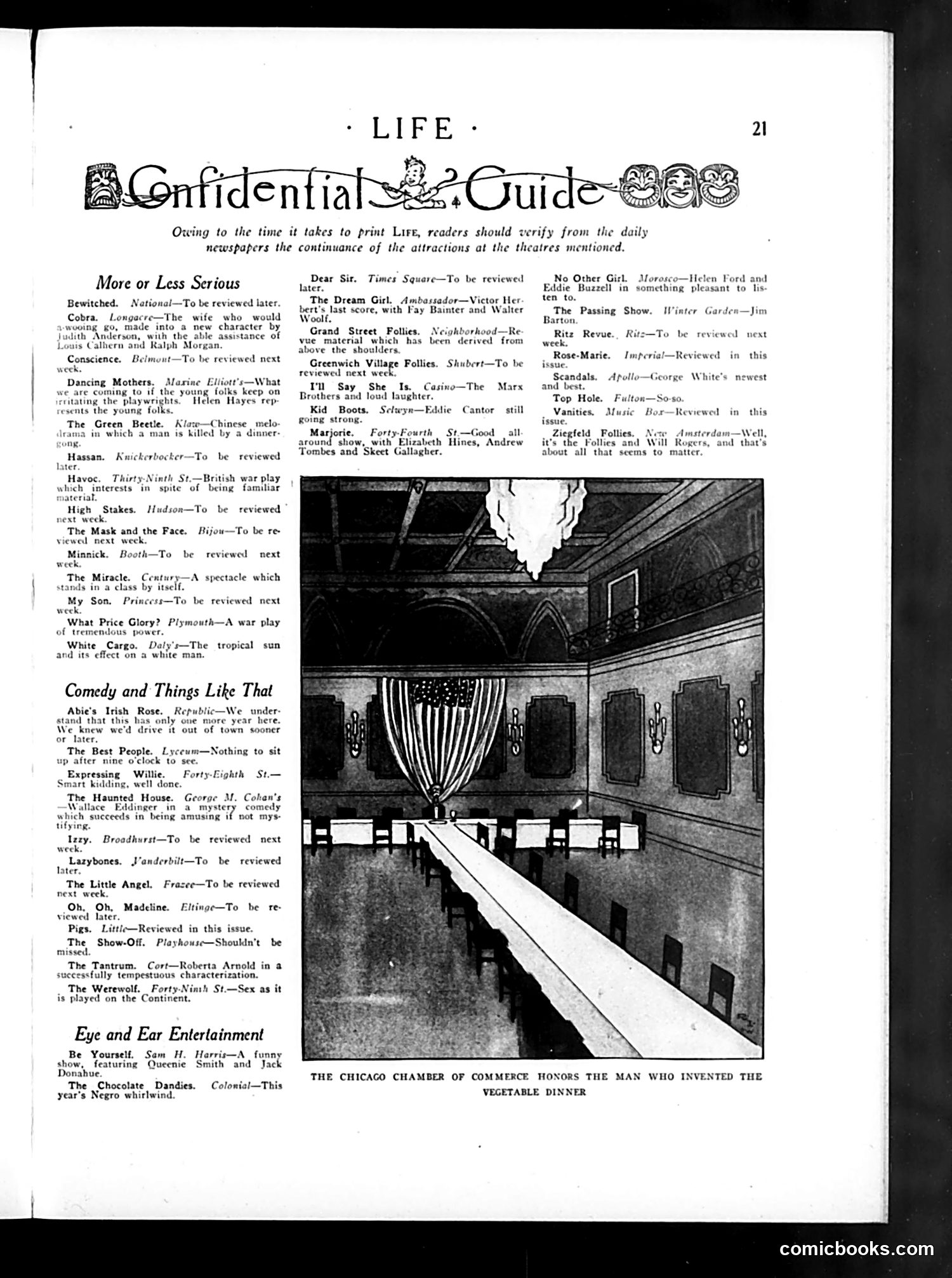
This is a theater listings and reviews page from Life magazine, not primarily a political cartoon. The main image shows an elegant dining room or ballroom with draped curtains and a long table—it illustrates a caption about the Chicago Chamber of Commerce honoring "the man who invented the vegetable dinner." This is likely satire about vegetarianism or dietary reform movements that were gaining attention in the 1920s. The joke appears to be mocking the idea of treating the inventor of vegetable-based dining as worthy of formal civic honor—suggesting such a movement was either newfangled, pretentious, or absurdly celebrated by Chicago's business establishment. The page itself consists mostly of brief theater reviews for Broadway productions of the era (featuring stars like Eddie Cantor and the Marx Brothers), organized by tone: "More or Less Serious," "Comedy and Things Like That," and "Eye and Ear Entertainment."
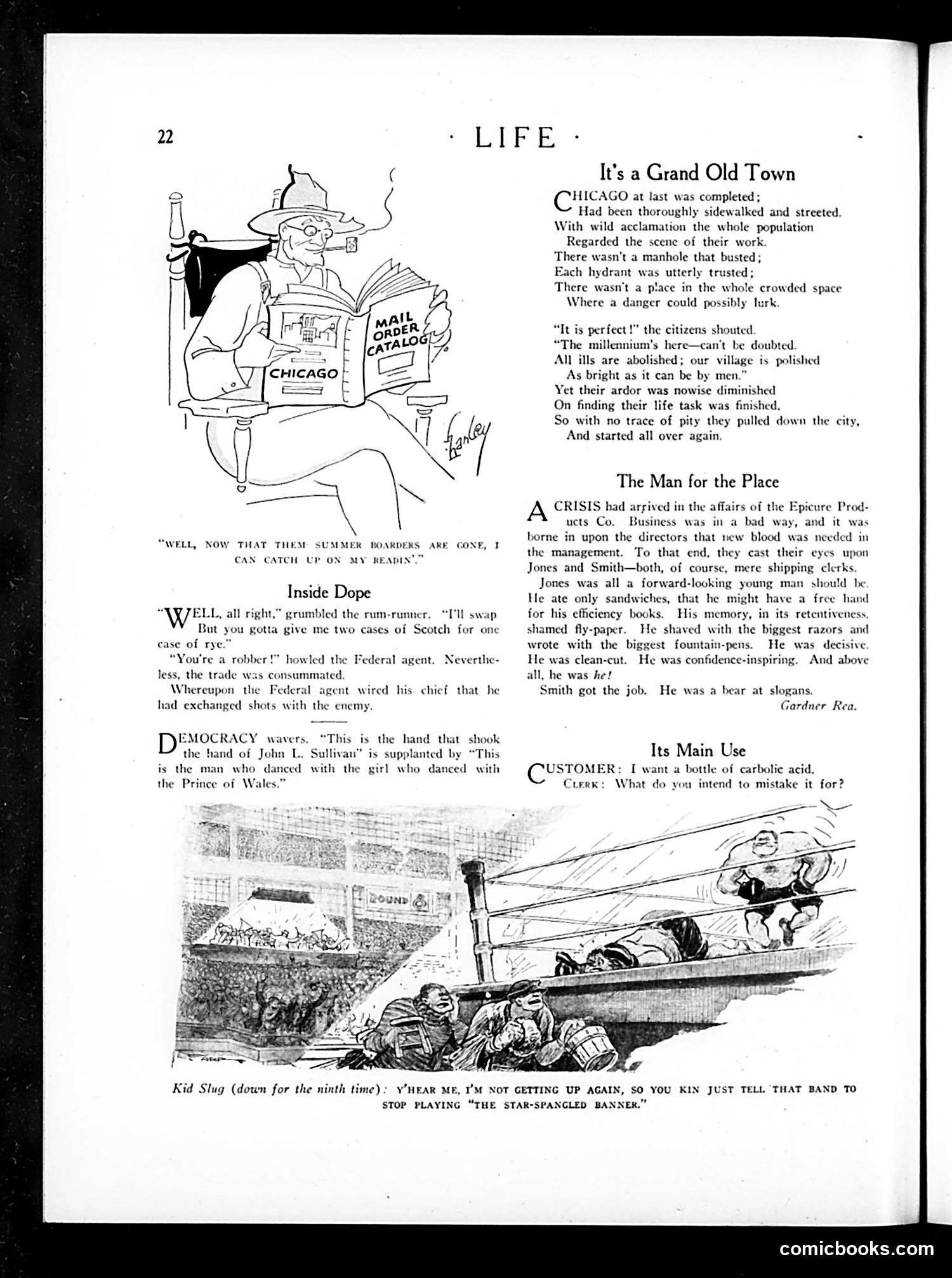
**Top Cartoon ("It's a Grand Old Town"):** Satirizes Chicago's rapid reconstruction after completing major infrastructure. The poem celebrates the city's efficiency—"All ills are abolished," "village is polished"—but mocks this hubris by noting citizens immediately "pulled down the city, / And started all over again," suggesting Chicago's obsession with constant rebuilding and self-destruction. **"Inside Dope":** A Prohibition-era joke about a rum-runner negotiating with a Federal agent, playing on the irony that despite alcohol being illegal, criminal trade continued openly. **"The Man for the Place":** Profiles a business manager named Jones hired during a company crisis, praising his efficiency and decisiveness. **Bottom Cartoon ("Kid Slug"):** Baseball humor about a persistent player, asking the band to stop playing "The Star-Spangled Banner" so he can continue batting.
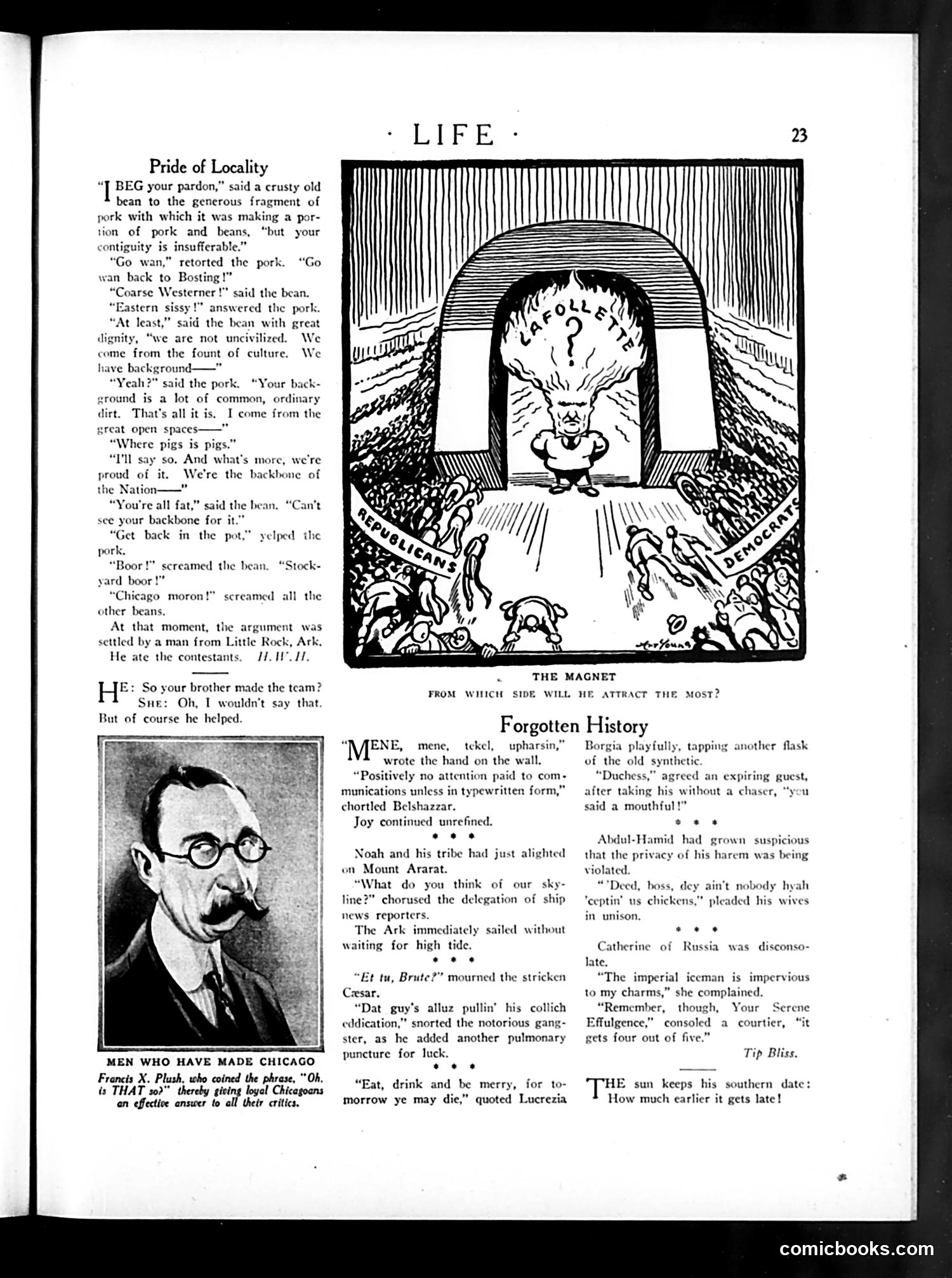
This cartoon depicts a figure labeled "FOLLETTE" (likely Senator Robert La Follette) inside a tunnel or cave, attracting various political factions from both sides—labeled "REPUBLICANS" and "DEMOCRATS"—like a magnet. The accompanying dialogue satirizes regional pride and political allegiances. The central figure (a man from Little Rock, Arkansas) settles a debate about who represents the true backbone of the nation, suggesting political fracturing. The cartoon critiques La Follette's political magnetism and cross-party appeal during the Progressive Era, likely referencing his 1924 presidential campaign when he drew support from both major parties' dissidents. The image suggests he's pulling apart the traditional two-party system.
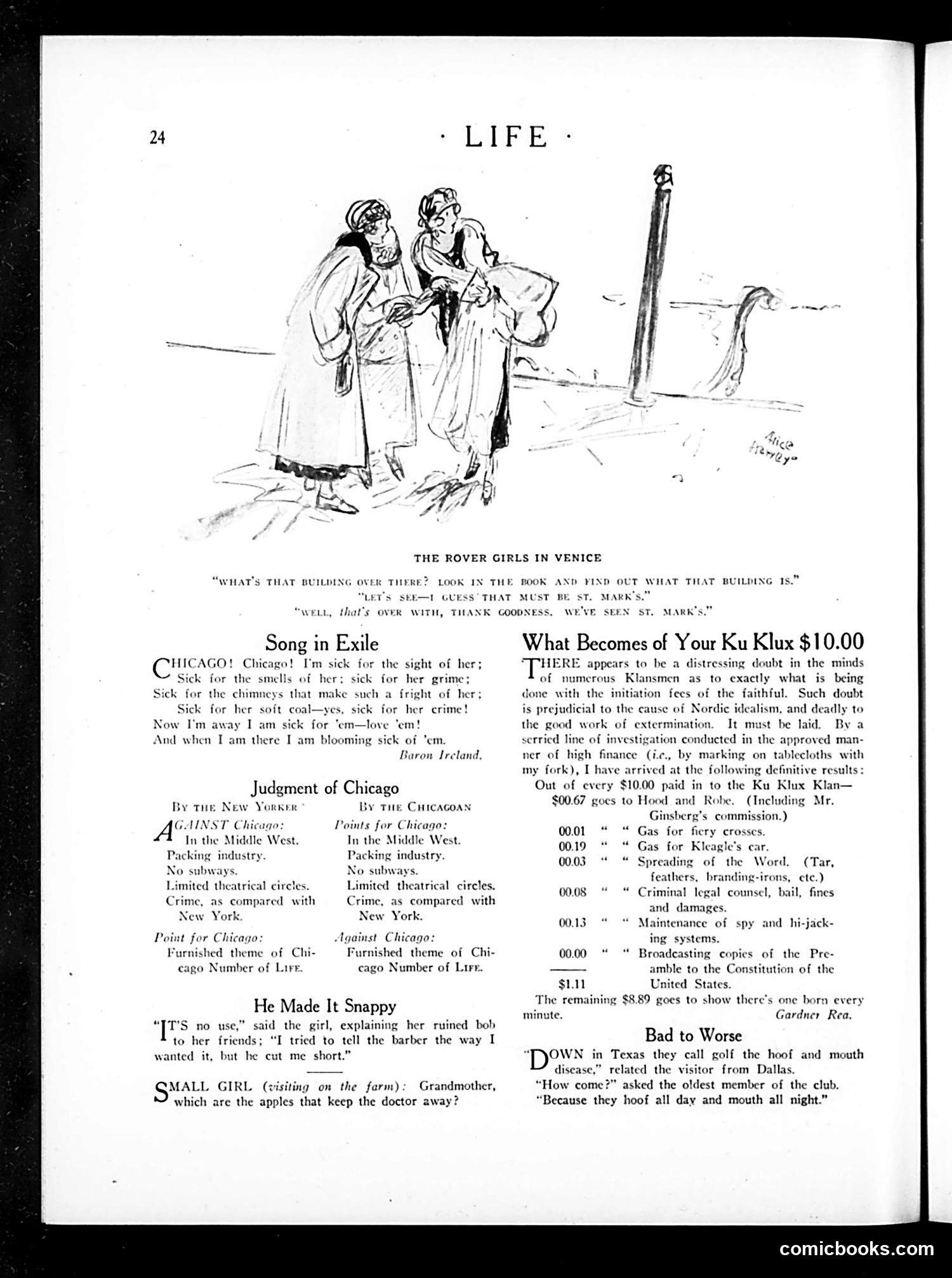
The main cartoon, "The Rover Girls in Venice," depicts two female tourists examining a building. The joke plays on tourist ignorance: they mistake an ordinary structure for St. Mark's Basilica, a famous Venetian landmark. The humor targets casual travelers who lack genuine knowledge of the places they visit. Below are several short humorous pieces and poems mocking Chicago, including "Judgment of Chicago" (comparing Chicago unfavorably to New York) and "He Made It Snappy" (a barber-shop anecdote). The page also contains "What Becomes of Your Ku Klux $10.00"—a satirical breakdown of KKK fundraising, suggesting financial misuse and corrupt practices. This directly mocks the organization's finances and operations during the 1920s Klan resurgence.
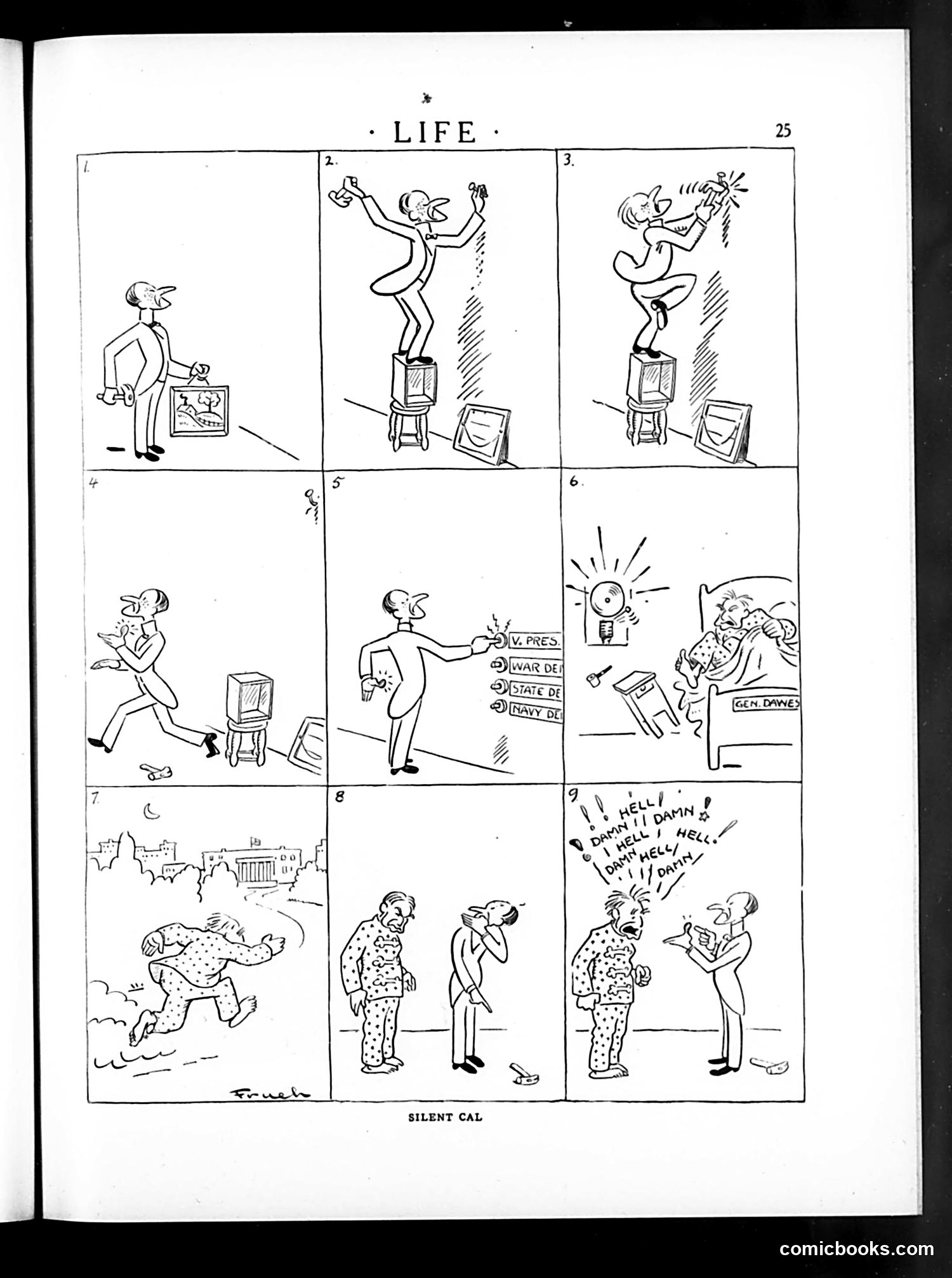
This page contains two separate comics. The top comic (panels 1-6) depicts a man with a television set, progressing from holding it casually to standing on a chair while it electrifies him—satirizing television's mesmerizing, almost dangerous hold on viewers. The joke suggests TV addiction is literally shocking. The bottom comic, titled "Silent Cat," shows a domestic dispute where a woman's complaints ("Hell! Damn! Hell! Damn!") are visible in speech but the man appears oblivious. The satire targets selective hearing in relationships—husbands ignoring wives' complaints, with the "silent cat" reference suggesting the man's unresponsiveness to verbal assault. Both comics mock mid-20th-century American domestic life and technology.
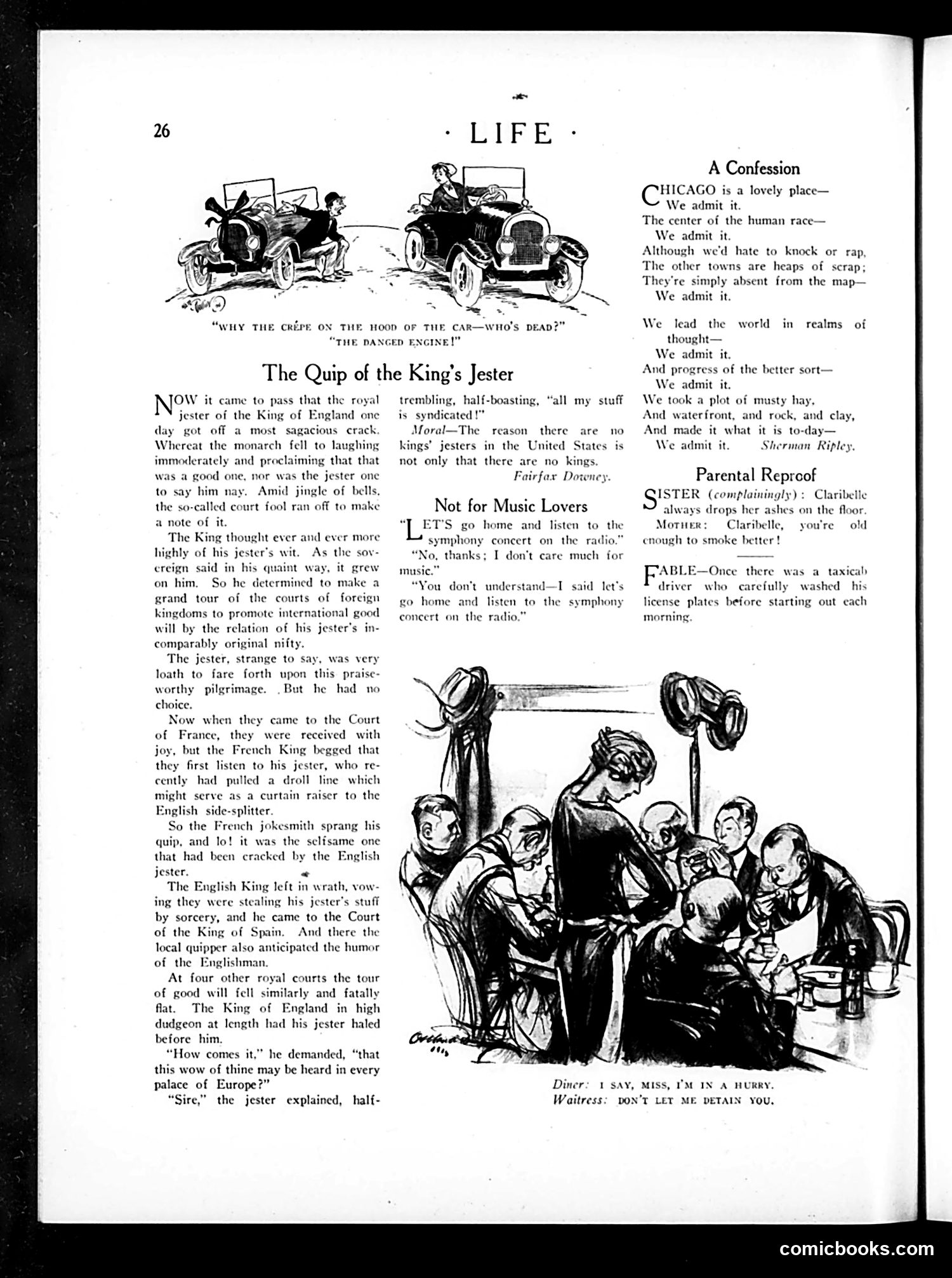
This page contains three distinct pieces: 1. **"The Quip of the King's Jester"** - A satirical story about how England's king, jealous of his jester's wit, sends him on a tour of foreign courts to "steal" the jester's best material and spread it throughout Europe. The text mocks the premise that kings need jesters, contrasting England and America (where there are "no kings"). 2. **"A Confession"** - A humorous poem defending Chicago's merits while admitting other American cities are "heaps of scrap" and absent from maps. 3. **Bottom cartoon** - Shows a waitress telling a diner she's in a hurry, with the diner responding he's also in a hurry. This illustrates the fast-paced, rushing nature of modern life. The page satirizes American pride, urban hierarchy, and contemporary social impatience through humor and light mockery.
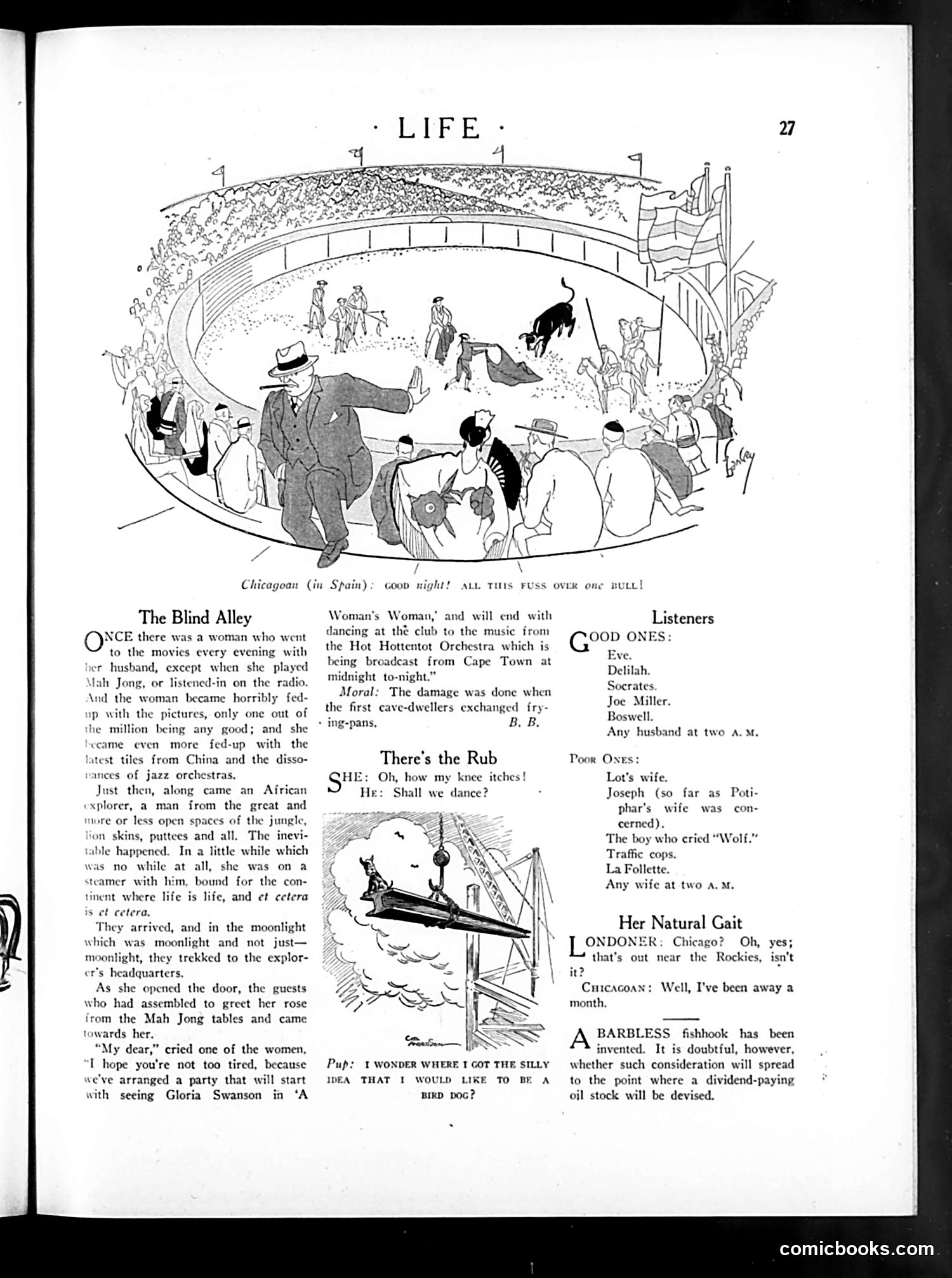
This page contains three distinct humor pieces from *Life* magazine: **"The Blind Alley"** (left column): A satirical story mocking women's enthusiasm for cinema and radio entertainment. The narrative follows a woman who becomes obsessed with movies and radio broadcasts, neglecting her marriage. The story's moral criticizes women's passive consumption of mass entertainment as damaging to domestic life. **"There's the Rub"** (center cartoon): Shows a couple in formal dress where the woman complains about her knee itching while asking if they should dance. The cartoon, credited to "Cesare," appears to jest about physical discomfort interrupting romance or socializing. **The remaining items** list various humorous observations about "Good Listeners" (people named), "Poor Oxen," and "Her Natural Gait"—brief satirical quips typical of *Life*'s format during this era. The page reflects 1920s-30s attitudes about gender, consumerism, and domestic life.
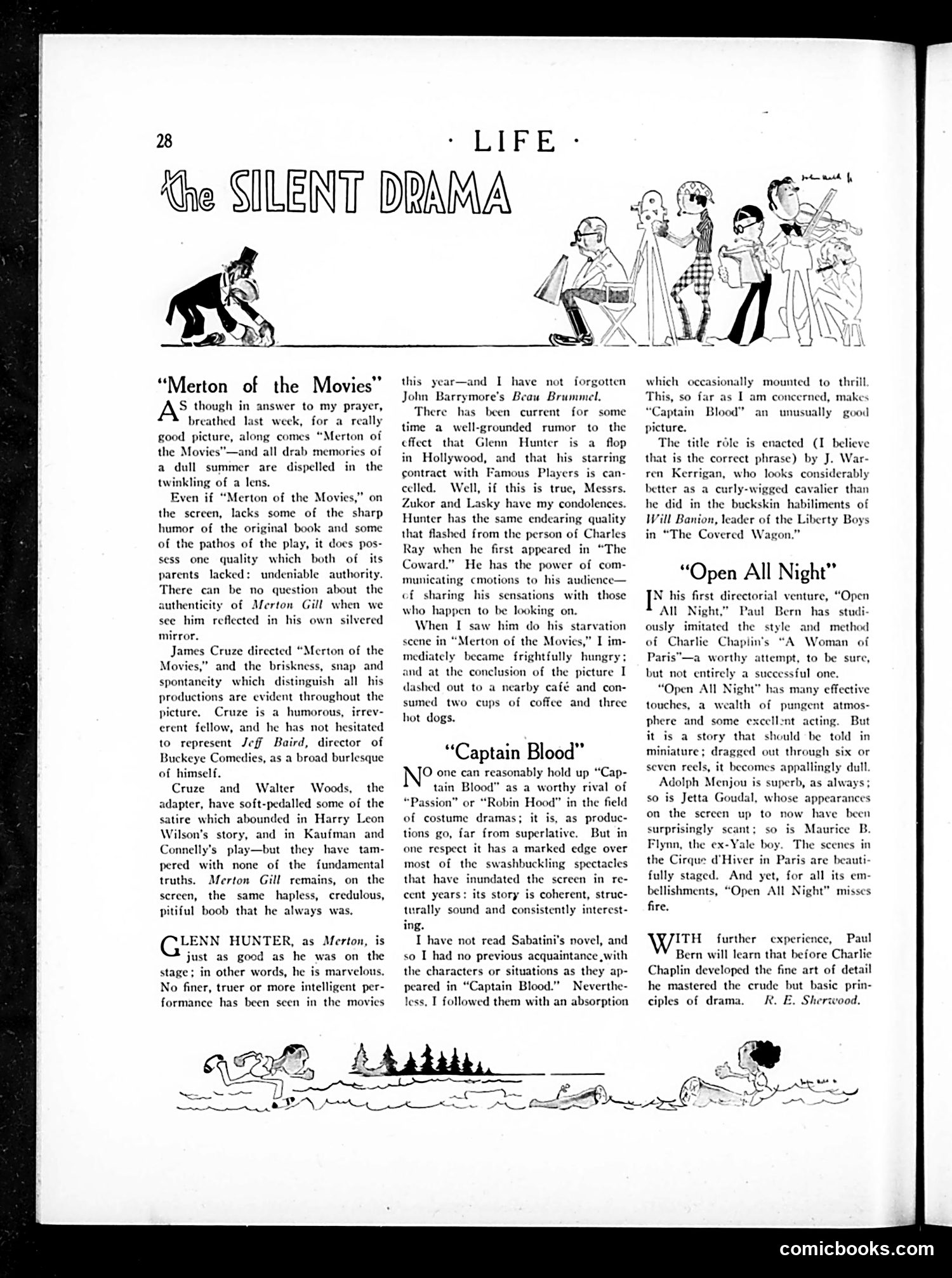
This page reviews silent films, a genre where actors communicated entirely through gesture and expression. The header illustration shows a film director (left) and various performers in costume (right), establishing the topic. The reviews critique specific films: "Merton of the Movies" (starring Glenn Hunter), "Captain Blood," and "Open All Night" (directed by Paul Bern, starring Adolphe Menjou). The critic praises Glenn Hunter's authenticity and emotional communication on screen, calling him "marvelous." The reviews assess how well silent actors convey narrative and feeling without dialogue—the central challenge of the medium. The satire is gentle, focused on evaluating artistic merit rather than mocking the films themselves.
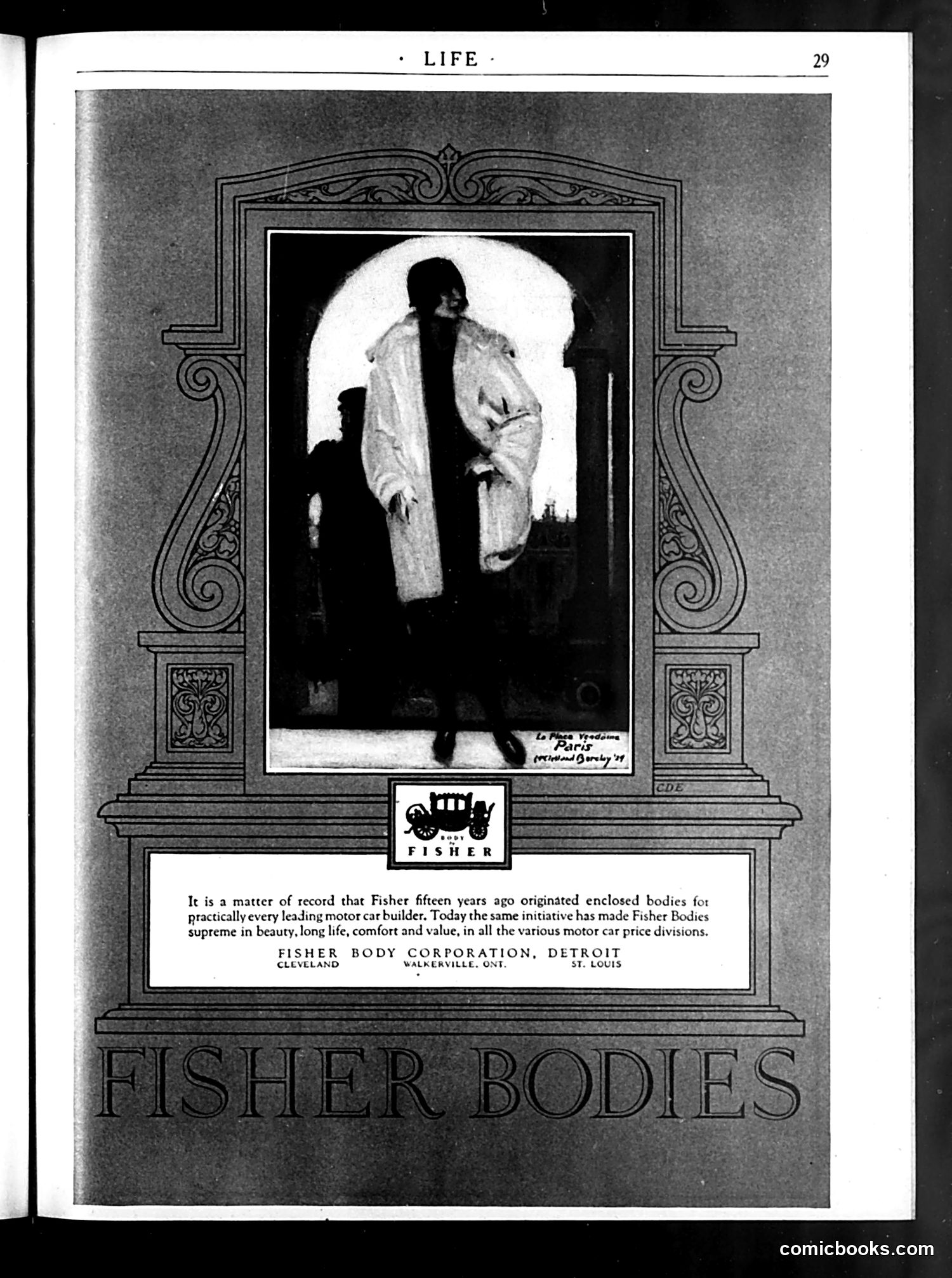
This is a **full-page advertisement**, not satirical content. It promotes Fisher Body Corporation, a major automobile body manufacturer based in Detroit, Cleveland, and Walkerville, Ontario. The ad features a glamorous photograph of a woman in an elegant fur coat, positioned within an ornate decorative frame. The accompanying text claims that Fisher originated enclosed automobile bodies fifteen years prior and now supplies bodies for "practically every leading motor car builder," emphasizing their product's superiority in "beauty, long life, comfort and value" across all price divisions. This represents early automotive advertising, highlighting how luxury and craftsmanship in car design had become major selling points for manufacturers during this era.
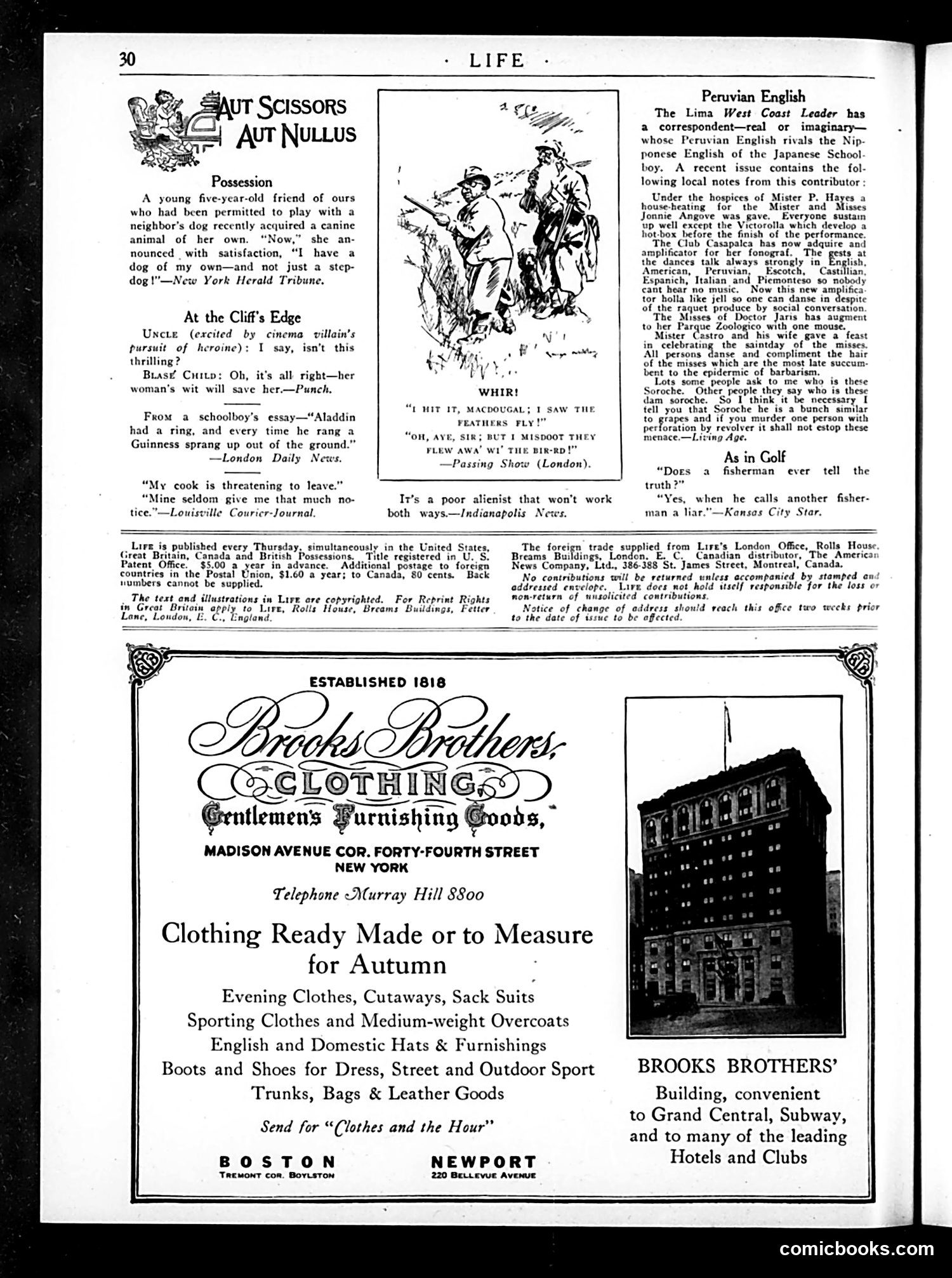
This page is primarily **advertising and humor sections** rather than a political cartoon. The main content includes: **"Aut Scissors Aut Nullus" column**: Light satirical pieces on domestic life—a child acquiring a neighbor's dog, and cinema-related wit. These are genteel humor anecdotes for middlebrow readers. **"At the Cliff's Edge"**: A brief comedic exchange about a woman's wit saving herself, with quotes from various newspapers providing humorous observations. **"As in Golf"**: A short joke about lying. **Brooks Brothers Advertisement**: The page's largest feature—a substantial display ad for the clothing company, established 1818, advertising autumn wear at their Madison Avenue location in New York. The page reflects *Life* magazine's dual purpose: satirical humor for educated readers alongside luxury advertising targeting the same affluent demographic.
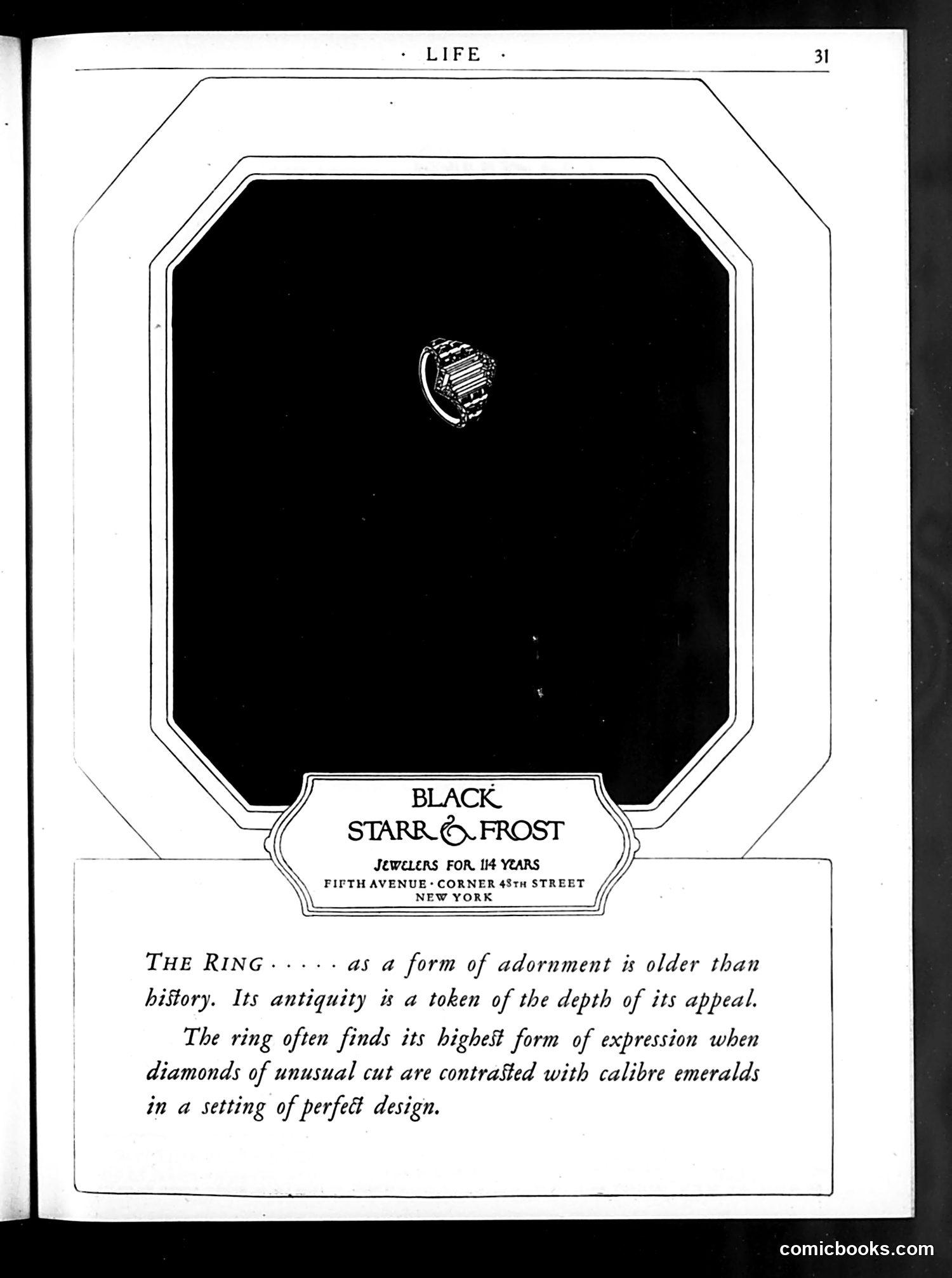
This is an **advertisement page**, not a cartoon. It's a Black Starr & Frost jewelry advertisement from their Fifth Avenue location in New York. The page features a large black background with a small ring illustration at the center, creating dramatic contrast to showcase the jewelry. The text below is promotional copy explaining the ring's appeal and design philosophy. It emphasizes the ring's historical significance as an adornment form and its aesthetic value when diamonds are paired with emeralds in careful design. There is no political satire or social commentary present. This is a straightforward luxury goods advertisement targeting wealthy readers of *Life* magazine, appealing to taste and tradition rather than making any satirical point.
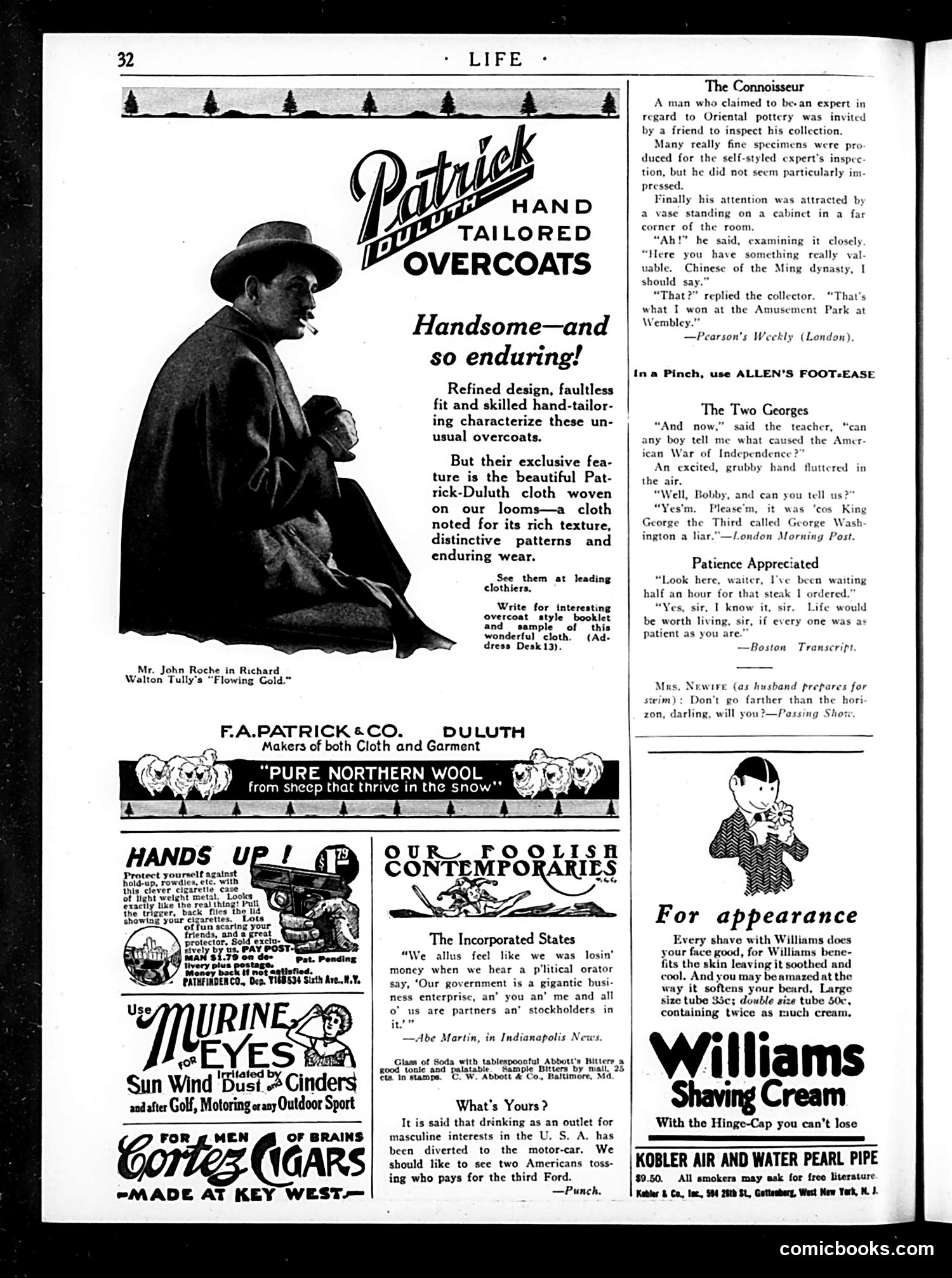
This is primarily an **advertising page** from Life magazine, dominated by a large Patrick overcoat advertisement featuring a man in a bowler hat and coat. The right column contains brief humorous anecdotes under headers like "The Connoisseur," "The Two Georges," and "Patience Appreciated"—typical of Life's satirical filler content. These are light social humor pieces: one mocks a collector's dubious Chinese pottery, another presents a student's confused answer about American history (confusing "King George the Third" with "George Washington"). The remaining space showcases various period advertisements: Murine eye drops, Cortez cigars, Williams Shaving Cream, and other products. **No significant political cartoons appear on this page.** The content is primarily commercial with lightweight social satire scattered throughout.
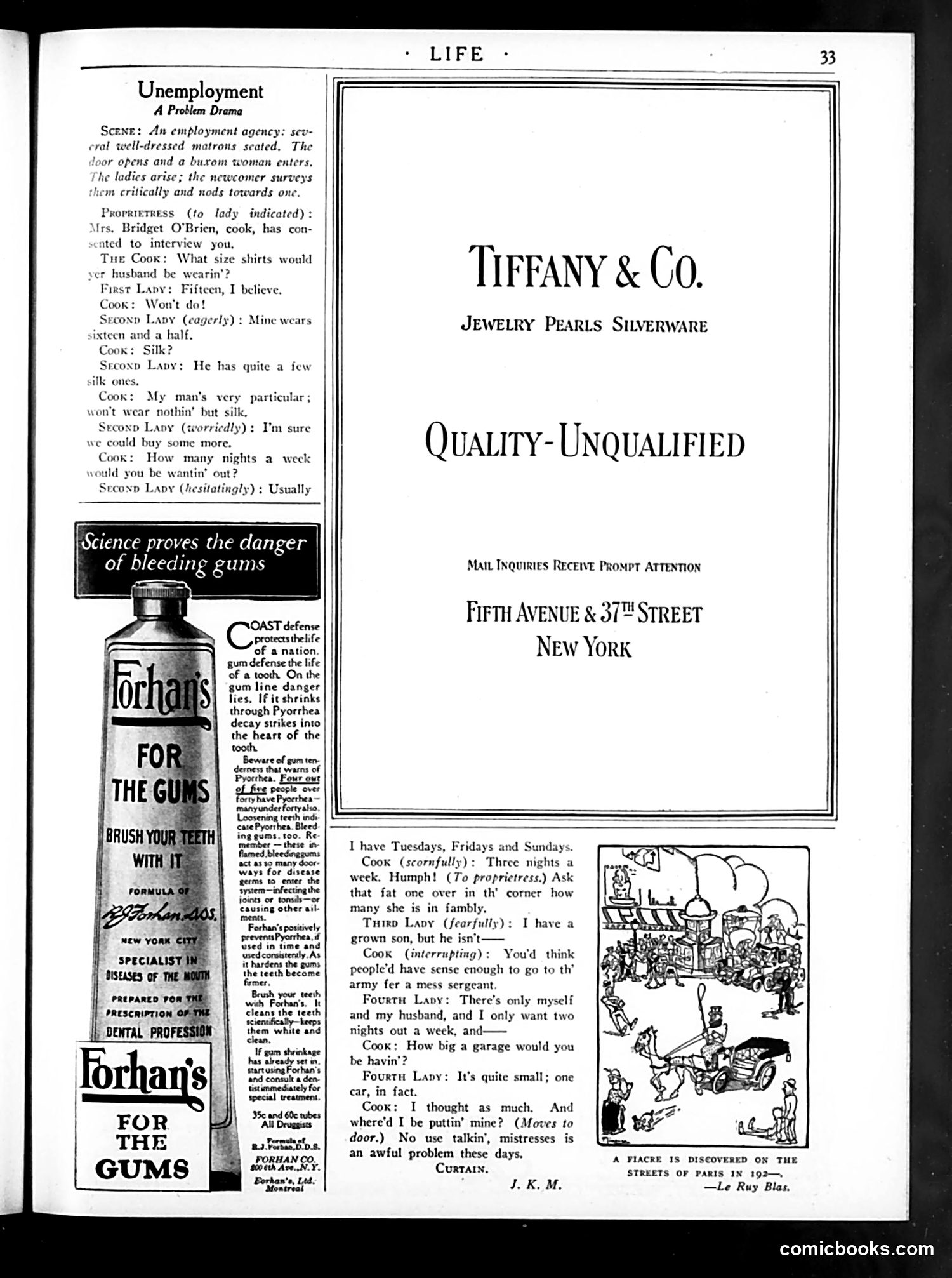
This page combines a satirical drama sketch about unemployment with period advertisements. The sketch "Unemployment: A Problem Drama" depicts an employment agency interview. A cook seeking work is interviewed by a proprietress and several ladies. The humor comes from the cook's frank, working-class responses contrasting with the ladies' anxious middle-class concerns—they ask about wages, work hours, and appropriate attire while the cook cuts through pretense. The satire comments on class friction and the gap between employers' expectations and workers' realities during what appears to be an economic hardship period. The page also features advertisements for Tiffany & Co. jewelry and Forhan's gum treatment product, typical of Life magazine's mixed-content format combining social commentary with commerce.
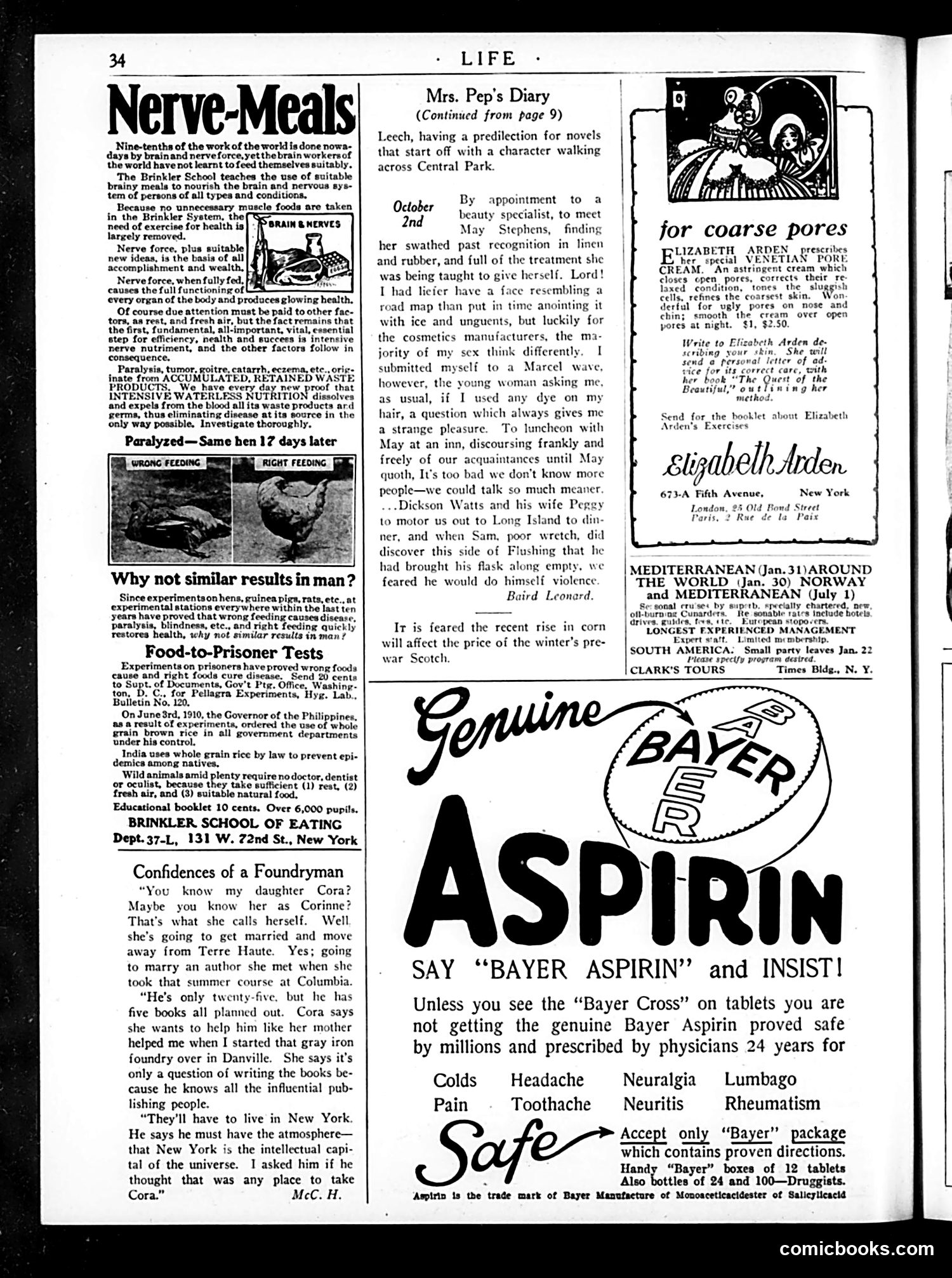
This page is primarily **advertising and lifestyle content**, not political satire. The dominant feature is a large **Bayer Aspirin advertisement** emphasizing the importance of buying genuine "Bayer" branded aspirin, identifiable by the "Bayer Cross" trademark on tablets. The ad addresses consumer anxiety about counterfeit medicines—a real concern in this era before strict pharmaceutical regulation. The page also contains articles on nutrition ("Nerve-Meals"), beauty advice from "Mrs. Pep's Diary," and a humorous personal essay titled "Confidences of a Foundryman" about a man's daughter Cora moving to New York. No political cartoons are present. The content reflects 1920s consumer culture and period concerns about product authenticity and health.
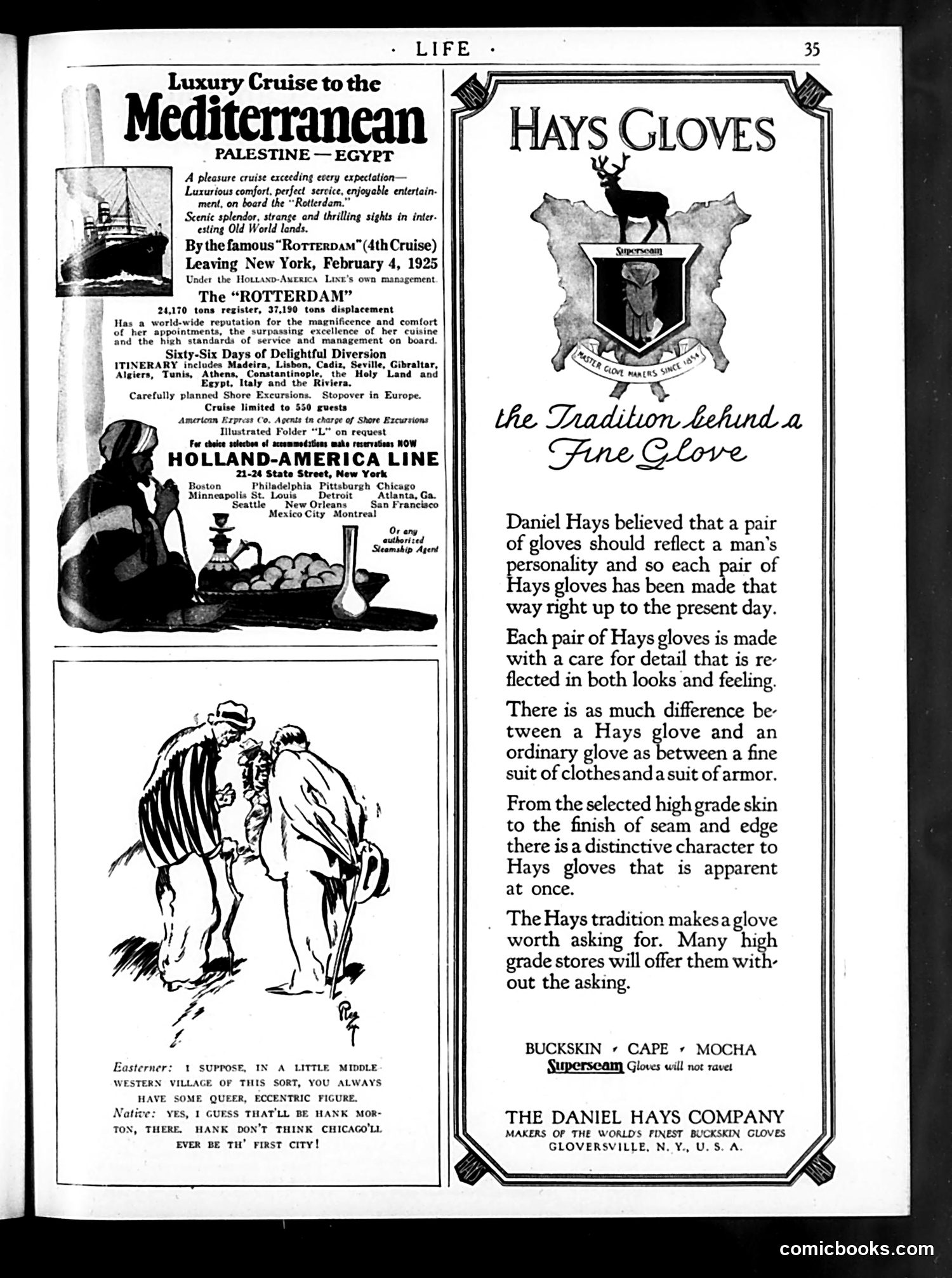
This page contains two distinct advertisements rather than political satire. **Left side:** An ad for the Holland-America Line cruise ship "Rotterdam," promoting a Mediterranean voyage departing New York February 4, 1925. It includes a sketch captioned "Easterner" that appears to be gentle humor about regional American differences—depicting what seems to be a Midwesterner or rural figure alongside an Easterner, with text suggesting the Easterner finds the Midwesterner's behavior peculiar or unsophisticated. **Right side:** A full-page advertisement for Hays Gloves, emphasizing quality craftsmanship. The ad uses a deer logo and states that Hays gloves reflect personality through careful detail and high-grade materials. Neither section contains political commentary or significant satirical content—this is primarily a commercial advertising page from *Life* magazine's 1925 issue.
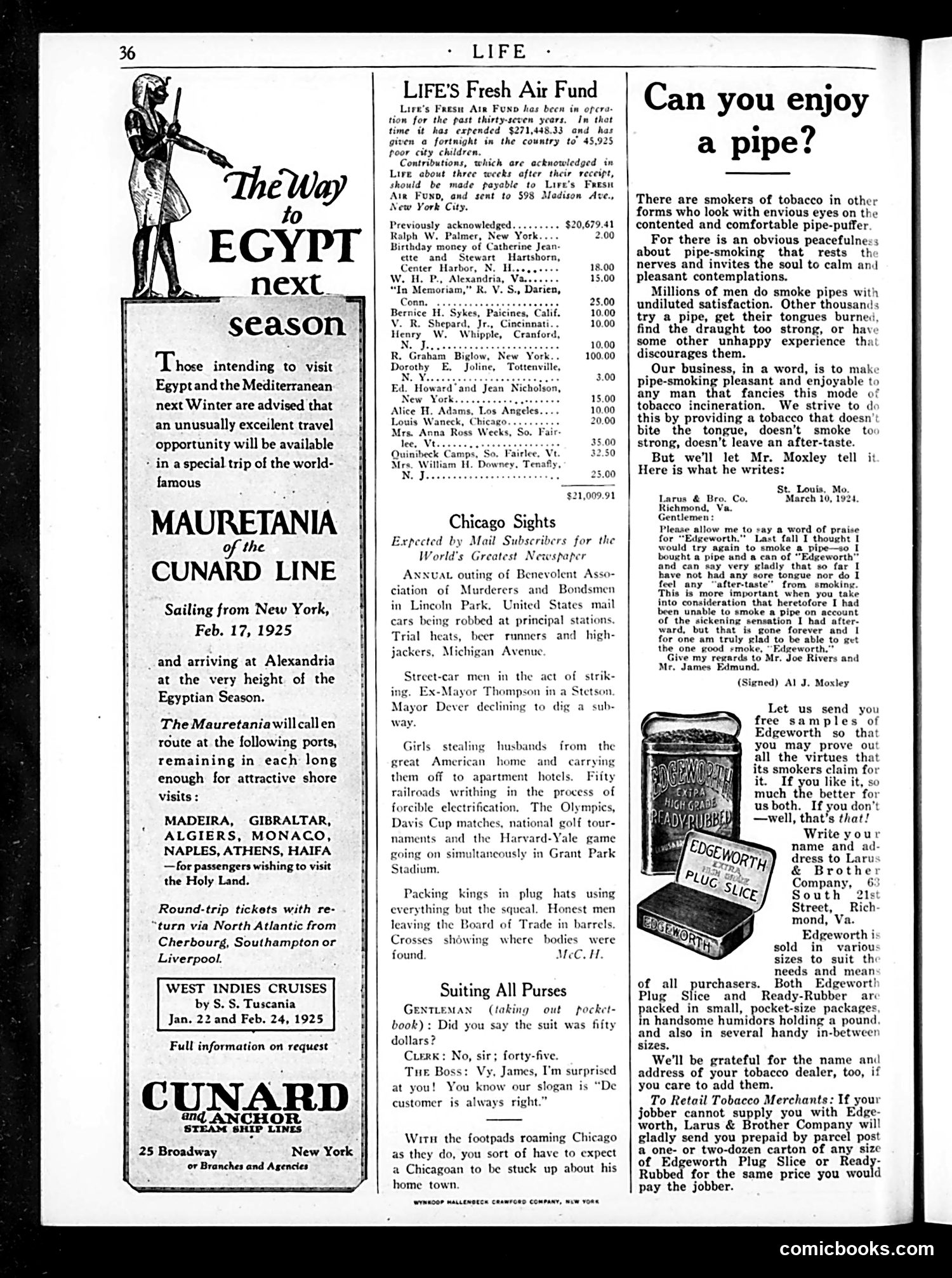
This page is primarily **advertising and miscellaneous content** rather than political satire or editorial cartoons. The main elements are: 1. **Travel ads** for the Cunard Line (Egypt cruises, West Indies trips) and Mauretania cruise ship 2. **"Chicago Sights"** - a humorous column describing urban observations (stolen husbands, railroad strikes, etc.) - appears to be light social commentary on 1920s city life rather than sharp satire 3. **"Can you enjoy a pipe?"** - an advertisement for Edgeworth tobacco/pipe products, featuring a testimonial letter from "Al J. Mosley" claiming pipes don't burn tongues or leave unpleasant aftertaste The Mosley letter functions as **advertising copy disguised as reader testimony**, a common 1920s marketing technique. The content is essentially commercial, not politically satirical.
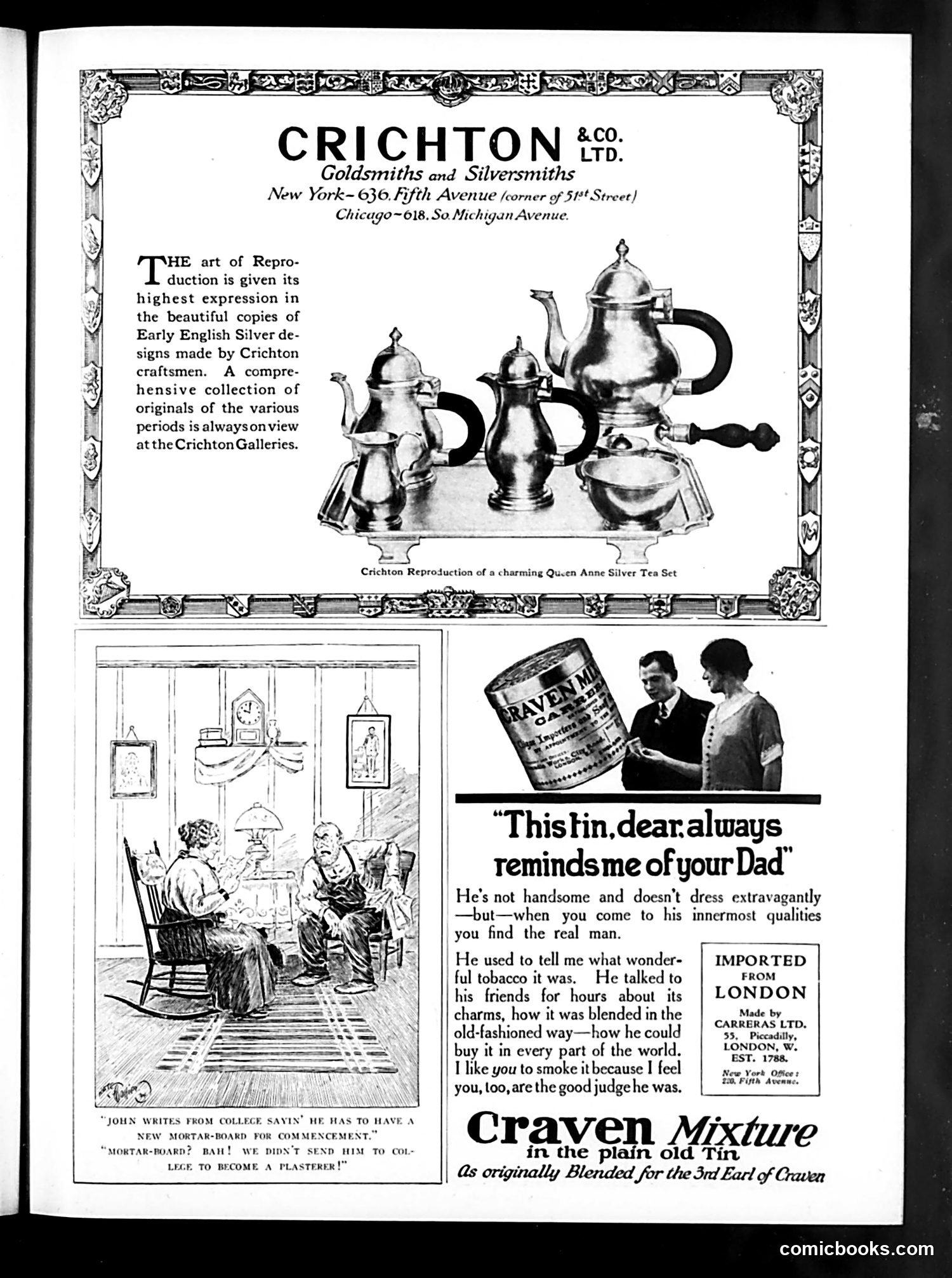
This page contains two advertisements with no political cartoon content. **Top:** Crichton & Co., a New York goldsmith/silversmith, advertises reproductions of Early English silver designs, showing a Queen Anne-style tea set. **Bottom:** Two separate ads—a domestic scene captioned "John writes from college sayin' he has to have a new mortar-board for commencement" (humor about college expense), and a Craven Mixture tobacco advertisement claiming the product was "originally Blended for the 3rd Earl of Craven." The tobacco ad uses nostalgia and aristocratic association as marketing, suggesting refined "old-fashioned" quality to appeal to consumers seeking authenticity and tradition. Neither contains satire or political commentary—this is a straightforward advertising page from Life magazine.
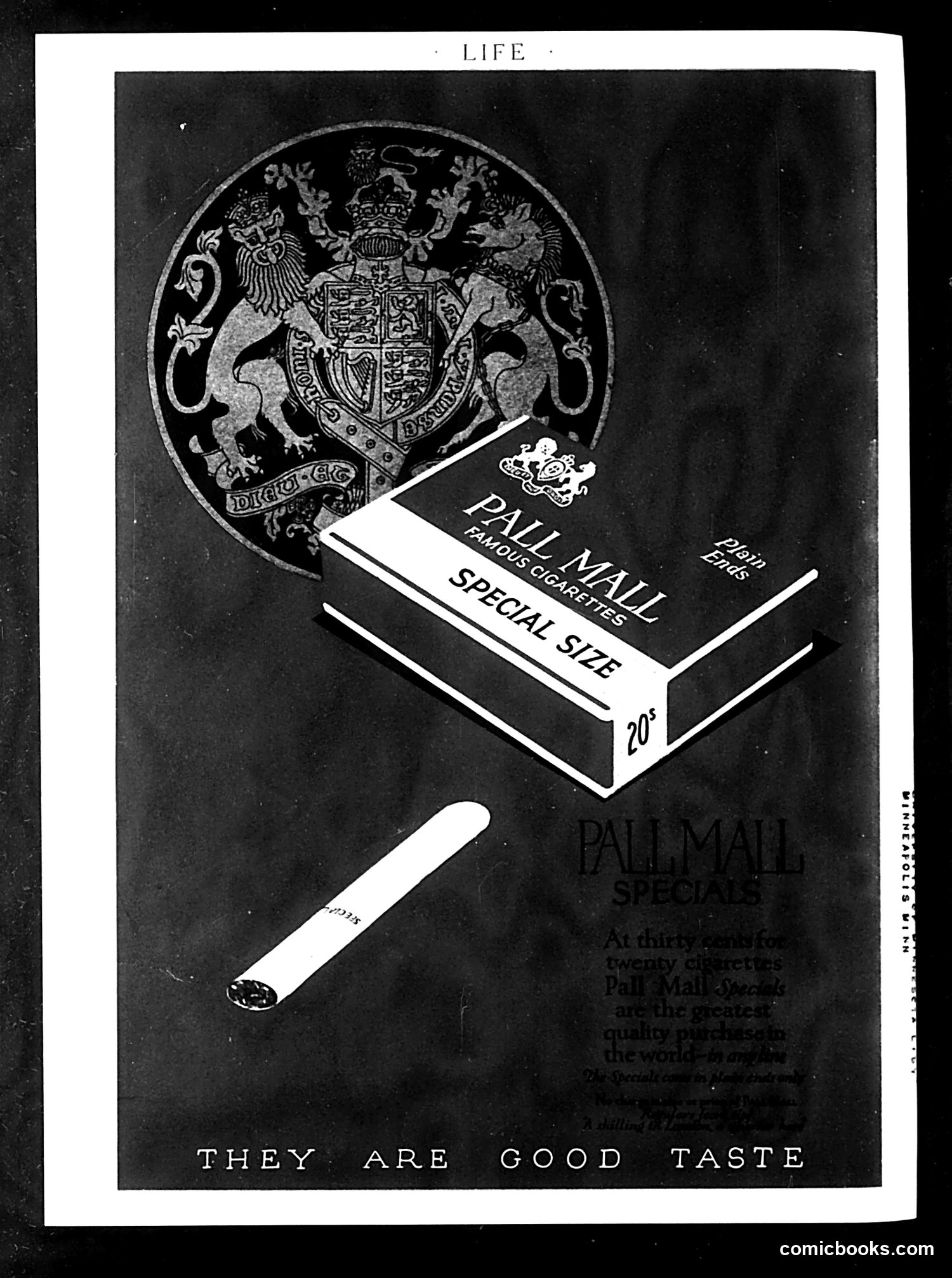
This is a cigarette advertisement for Pall Mall, not political satire. The ad features the British Royal Coat of Arms prominently displayed above a box of Pall Mall "Special Size" cigarettes (priced at 20 cents) and a single cigarette. The advertisement claims that "At thirty cigarettes for twenty cigarettes Pall Mall Specials are the greatest quality purchase in the world." The tagline reads "THEY ARE GOOD TASTE." The royal heraldry appears designed to convey prestige and quality through association with British tradition and authority. This is straightforward commercial advertising from Life magazine's pages, using symbols of established legitimacy to market the product to American consumers.
I can see this is a page from Life magazine, but the image is extremely dark and low contrast, making it nearly impossible to discern specific cartoon details, figures, text, or captions clearly enough to provide accurate interpretation. What I can observe: there appears to be some text along the left margin and a watermark reading "comicbooks.com" in the bottom right. The page seems to contain illustrative content in the right portion, but the details are too obscured to identify specific political figures, caricatures, or satirical commentary with confidence. To properly analyze this page's historical and satirical meaning for a modern reader, a clearer, higher-contrast image would be necessary.