
Life, 1924-10-02 · page 17 of 41
Life — October 2, 1924 — page 17: what you’re looking at
What you’re looking at
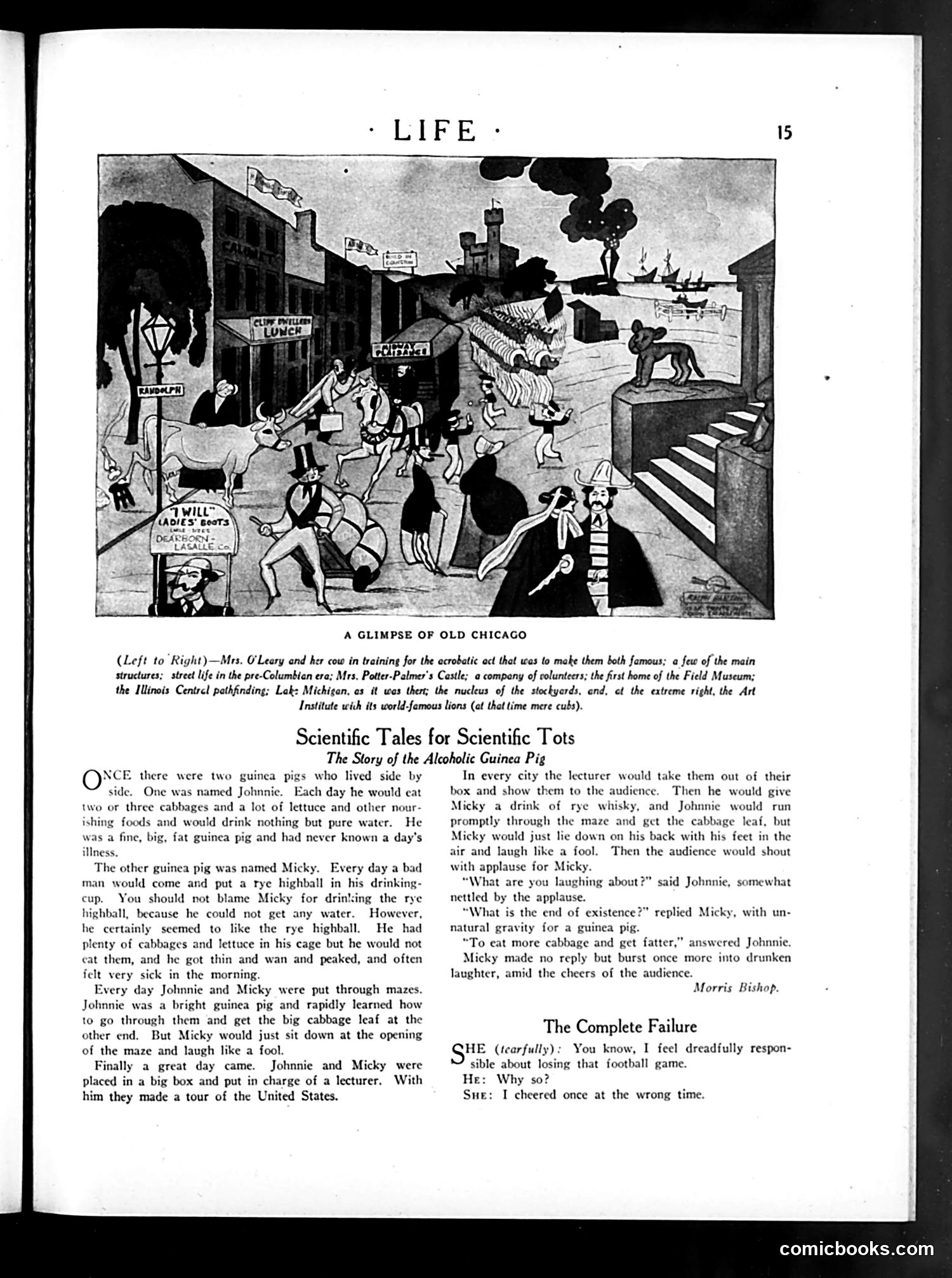
This cartoon satirizes turn-of-the-century Chicago's reputation for vice and disorder. The street scene depicts acrobats, circus performers, and revelry alongside signs advertising saloons and entertainment venues. The caption references "the pre-Columbian era" and notes Mrs. Potter-Palmer's Castle, the Field Museum, and the Art Institute—suggesting contrast between Chicago's cultural institutions and its seedier street life. The scene mocks Chicago's chaotic public spaces and apparent moral laxity, portraying the city as a circus where acrobats and drunken behavior dominate. This reflects widespread contemporary anxiety about urban corruption, particularly in rapidly industrializing American cities, where wealthy institutions coexisted with visible poverty, vice, and disorderly conduct.
📄 Transcribed text from this page (OCR, searchable)
Machine-transcribed from the original scan — historical spelling and the odd misread are preserved.
A GLIMPSE OF OLD CHICAGO (Left to Right)—Mrs, O'Leary and her cow in training for the acrobatic act that was to make them both famous; a few of the main structures; street life in the pre-Columbian era; Mrs, Potter-Palmer's Castle; a company of colunteers; the first home of the Field Museum; the Illinois Centrel pathfinding; Lak: Michigan, os it was thert; the nucleus of the stockyards, end, cf the extreme right, the Art Institute with its world-femous lions (at that Lime mere cubs). Scientific Tales for Scientific Tots The Story of the Alcoholic Guinea Pig ‘CE there were two guinea pigs who lived side by side. One was named Johnnie. Each day he would cat two or three cabbages and a lot of lettuce and other nour- ishing foods and would drink nothing but pure water. He was a fine, big, fat guinea pig and had never known a day's illness. The other guinea pig was named Micky. Every day a bad man would come and put a rye highball in his drinking- cup. You should not blame Micky for drinking the rye highball, because he could not get any water. However, he certainly seemed to like the rye highball. He had plenty of cabbages and lettuce in his cage but he would not eat them, and he got thin and wan and peaked, and often felt very sick in the morning. Every day Johnnie and Micky were put through mazes. Johnnie was a bright guinea pig and rapidly learned how to go through them and get the big cabbage leaf at the other end. But Micky would just sit down at the opening of the maze and laugh like a fool. Finally a great day came. Johnnie and Micky were placed in a big box and put in charge of a lecturer. With him they made a tour of the United States. In every city the lecturer would take them out of their box and show them to the audience. Then he would give Micky a drink of rye whisky, and Johnnie would run promptly through the maze and get the cabbage leaf, but Micky would just lie down on his back with his feet in the air and laugh like a fool. Then the audience would shout with applause for Micky. “What are you laughing about?” said Johnnie, somewhat nettled by the applause. “What is the end of existence?” replied Micky, with un- natural gravity for a guinea pig. “To eat more cabbage and get fatter,” answered Johnnie. Micky made no reply but burst once more into drunken laughter, amid the cheers of the audience. Morris Bishop. The Complete Failure SHE (tearfully): You know, I feel dreadfully respon- sible about losing that football game. He: Why so? Sue: I cheered once at the wrong time. comicbooks.com