
Life, 1924-10-02 · page 11 of 41
Life — October 2, 1924 — page 11: what you’re looking at
What you’re looking at
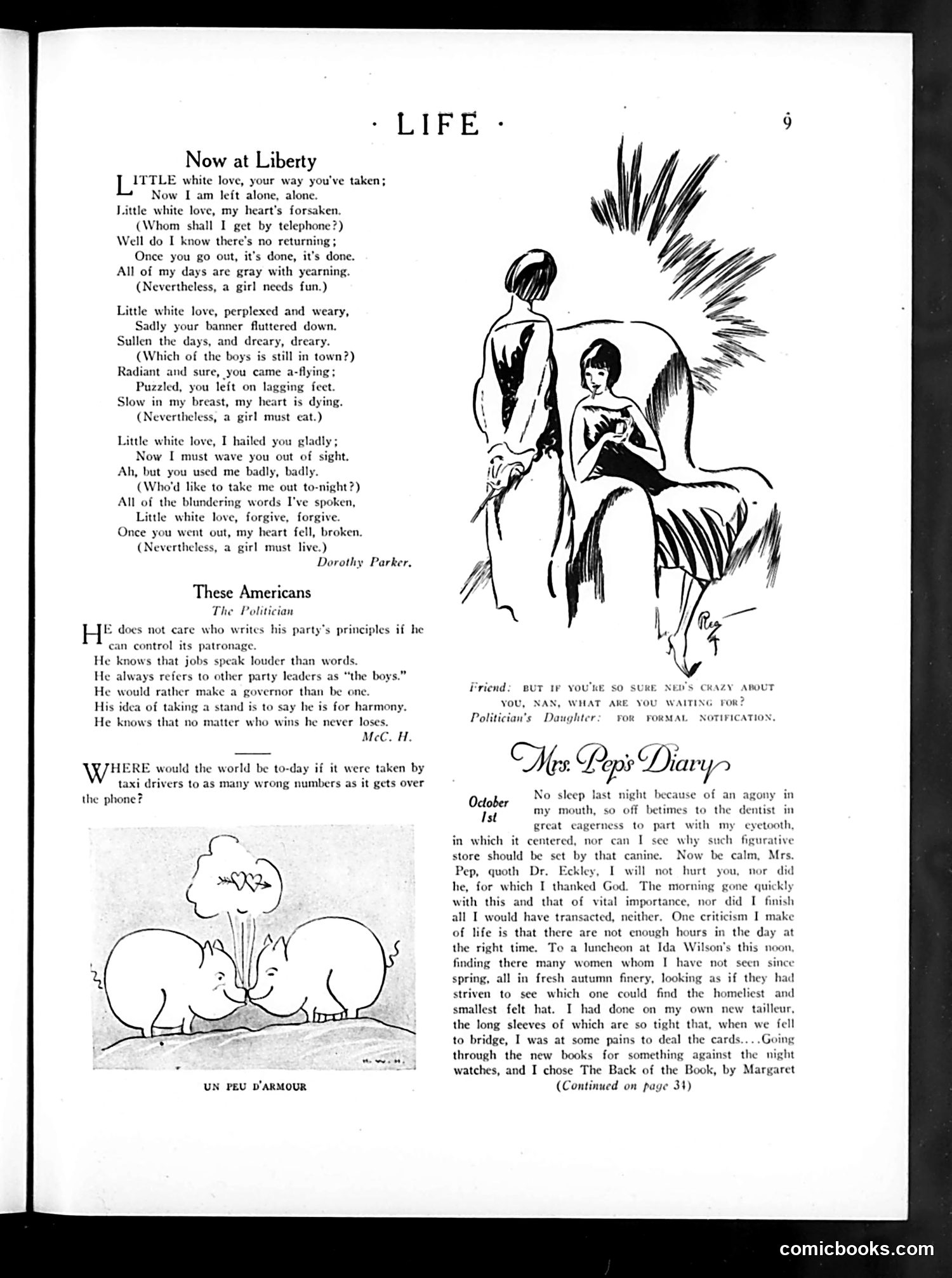
This page contains poetry and social commentary from early 20th-century *Life* magazine. **"Now at Liberty"** by Dorothy Parker is a melancholic poem about romantic abandonment—a woman left behind after her lover departs, with sardonic asides like "(Nevertheless, a girl needs fun.)" The accompanying illustration shows two figures in an intimate moment, likely depicting the poem's romantic theme. **"These Americans"** satirizes a calculating politician who prioritizes patronage and party loyalty over principles, dismissing ideology as secondary to practical control. **"Un Peu d'Armour"** is a humorous cartoon showing elephants in an affectionate pose, playing on the French title's reference to love/affection. **"Mrs. Pep's Diary"** begins a domestic humor column documenting daily life observations. The page blends romantic sentiment, political satire, and domestic humor typical of *Life*'s editorial mix.
📄 Transcribed text from this page (OCR, searchable)
Machine-transcribed from the original scan — historical spelling and the odd misread are preserved.
- LIFE, * Now at Liberty ITTLE white love, your way you've taken; Now I am left alone, alone. Little white love, my heart's forsaken. (Whom shall I get by telephone?) Well do I know there's no returning ; Once you go out, it’s done, it’s done. All of my days are gray with yearning. (Nevertheless, a girl needs fun.) Little white love, perplexed and weary, Sadly your banner fluttered down. Sullen the days, and dreary, dreary. (Which of the boys is still in town?) Radiant and sure, you came a-flying; Puzzled, you left on lagging feet. Slow in my breast, my heart is dying. (Nevertheless, a girl must eat.) Little white love, I hailed you gladly; Now I must wave you out of sight. Ah, but you used me badly, badly. (Who'd like to take me out to-night?) All of the blundering words I've spoken, Little white love, forgi' forgive. Once you went out, my heart fell, broken. (Nevertheless, a girl must live.) Dorothy Parker, These Americans The Politician E does not care who writes his party’s principles if he can control its patronage. He knows that jobs speak louder than words. He always refers to other party leaders as “the boys.” He would rather make a governor than be one. His idea of taking a stand is to say he is for harmony. He knows that no matter who wins he never lose: McC. H. HERE would the world be to-day if it were taken by taxi drivers to as many wrong numbers as it gets over the phone? UN PEU D'ARMOUR Friend: But iv You'kE SO SURE NED'S CRAZY AROUT YOU, NAN, WHAT ARE YOU WAITING FoR? Politician’s Daughter: ror rorMat Gg : Ces Lops Diary No sleep last night because of an agony in my mouth, so off betimes to the dentist in great cagerness to part with my eyetooth, in which it centered, nor can I see why such figurative store should be sect by that canine. Now be calm, Mrs. Pep, quoth Dr. Eckley, I will not hurt you, nor did he, for which I thanked God. with this and that of vital importance, nor did I finish all I would have transacted, neither. One criticism I make of life is that there are not enough hours in the day at the right time. To a luncheon at Ida Wilson's this noon, finding there many women whom I have not seen since spring, all in fresh autumn finery, looking as if they had striven to see which one could find the homeliest and smallest felt hat. I had done on my own new tailleur, the long sleeves of which are so tight that, when we fell to bridge, I was at some pains to deal the cards....Going through the new books for something against the night watches, and I chose The Back of the Book, by Margaret (Continued on page 34) NOTIFICATION, October Ist The morning gone quickly comicbooks.com