
Life, 1924-10-02 · page 18 of 41
Life — October 2, 1924 — page 18: what you’re looking at
What you’re looking at
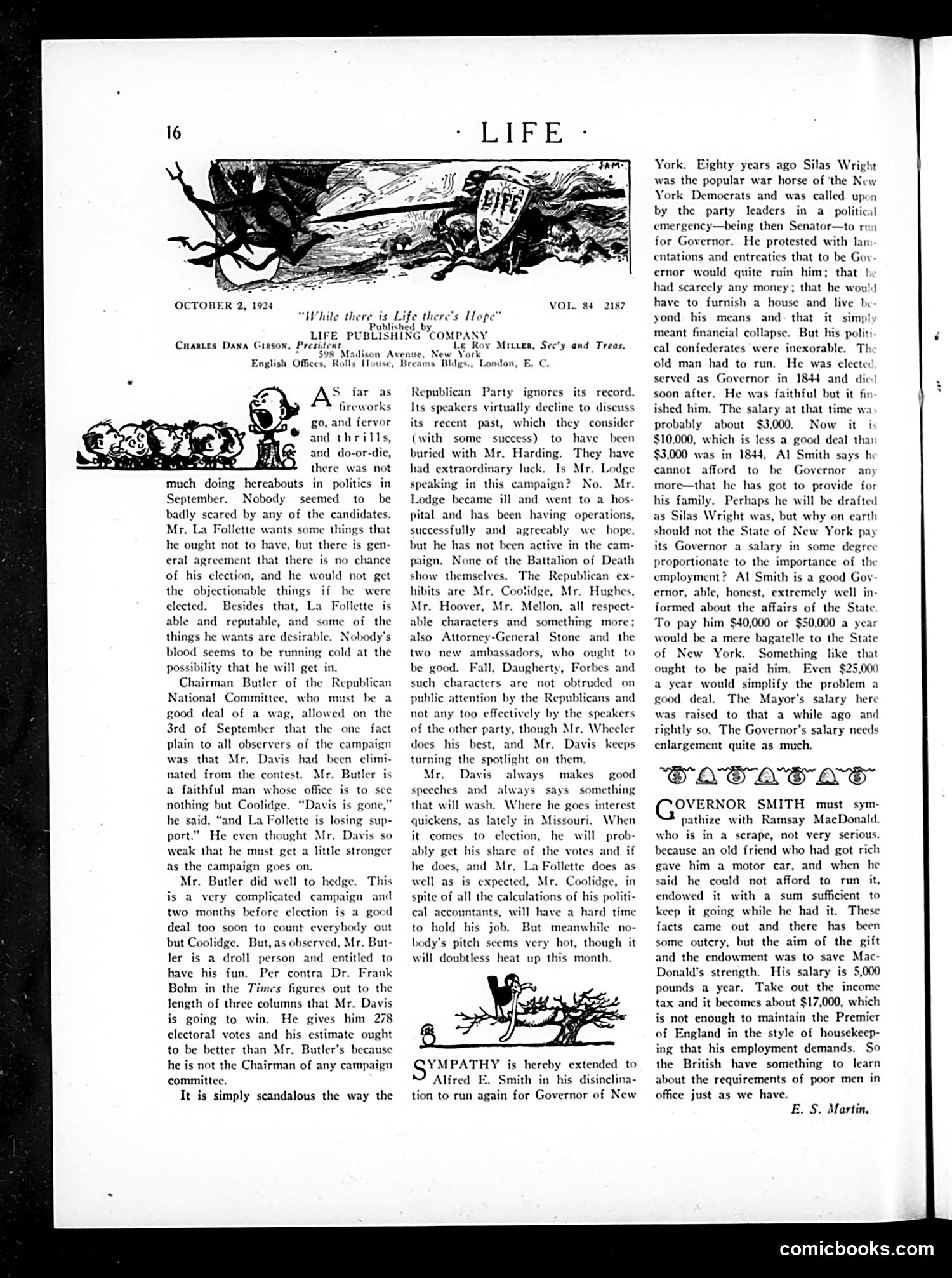
This *Life* editorial discusses the 1924 U.S. presidential campaign, which featured Republican Calvin Coolidge, Democrat John W. Davis, and Progressive Robert La Follette. The satire targets the **Republican Party's deliberate avoidance of its recent scandals**—particularly those from the Harding administration (Teapot Dome, etc.). The author notes Republicans won't discuss this record and conveniently keeps tainted figures like Fall and Daugherty offstage, instead featuring respectable figures like Coolidge, Hoover, and Mellon. The piece mocks **Chairman Butler's overconfidence**, claiming Davis is "eliminated" when the race remains uncertain. The cartoons (showing animals and figures) appear to satirize political maneuvering. A secondary item sympathizes with **Al Smith** declining to run for New York Governor, drawing a parallel to Silas Wright facing similar pressure decades earlier—commenting on how party machinery pressures candidates. The overall tone suggests frustration with calculated political theater and the Republicans' successful image rehabilitation despite recent scandals.
📄 Transcribed text from this page (OCR, searchable)
Machine-transcribed from the original scan — historical spelling and the odd misread are preserved.
OCTOBER 2, 1924 VOL. 84 2187 “While there is Life there's Hope” Published by . LIFE Cartes Dana Grasox, Presid AS. i 3s fireworks go, and fervor and thrill and do-or-die, there was not much doing hereabouts in politics in September. Nobody seemed to be badly scared by any of the candidates. Mr. La Follette wants some things that he ought not to have, but there is gen- eral agreement that there is no chance of his election, and he would not get the objectionable things if he were elected. Besides that, La Follette is able and reputable, and some of the things he wants are desirable. Nobody's blood seems to be running cold at the possibility that he will get in. Chairman Butler of the Republican National Committee, who must be a good deal of a wag, allowed on the 3rd of September that the one fact plain to all observers of the campaign was that Mr. Davis had been climi- nated from the contest. Mr. Butler is a faithful man whose office is to sce nothing but Coolidge. “Davis is gone,” he said, “and La Follette is losing sup- port.” He even thought Mr. Davis so weak that he must get a little stronger as the campaign goes on. Mr. Butler did well to hedge. This is a very complicated campaign and two months before election is a good deal too soon to count everybody out but Coolidge. But, as observed, Mr. But- ler is a droll person and entitled to have his fun. Per contra Dr. Frank Bohn in the Times figures out to the length of three columns that Mr, Davis is going to win. He gives him 278 electoral votes and his estimate ought to be better than Mr. Butler’s because he is not the Chairman of any campaign committee. It is simply scandalous the way the PUBLISHING COMPANY L nt 98 Madison Avenu 5 New English Offices, Rolls House, Breams Bld, Roy Mriter, Sec'y and Treas. London, E. C. Republican Party ignores its record. Its speakers virtually decline to discuss its recent past, which they consider (with success) to have buried with Mr. Harding. They have had extraordinary luck. Is Mr. Lodge speaking in this campaign? No. Mr. Lodge became ill and went to a hos- pital and has been having operations, successfully and hope, but he has not been active in the cam- paign. None of the Battalion of Death show themselves. The Republican ex- hibits are Mr. Cootidge, Mr. Hughes, Mr. Hoover, Mr. Mellon, all respect- able characters and something more also Attorney-General Stone and some heen agreeably we two new ambassadors, who ought to be good. Fall, Daugherty, Forbes and such characters are not obtruded on public attention by the Republicans and not any too effectively by the speakers of the other party, though Mr. Wheeler does his best, and Mr. Davis keeps turning the spotlight on them. Mr. Davis always makes good speeches and always something that will wash. Where he goes interest quickens, as lately in Missouri. When it comes to election, he will prob- ably get his share of the votes and if he does, and Mr, La Follette does as well as is expected, Mr. Coolidge, in spite of all the calculations of his politi- cal accountants, will have a hard time to hold his job. But meanwhile no- hody’s pitch seems very hot, though it will doubtless heat up this month. says YMPATHY is hereby extended to Alfred E, Smith in his disinclina- tion to run again for Governor of New York. Eighty years ago Silas Wright was the popular war horse of ‘the New York Democrats and was called upon by the party leaders in a_ political emergency—being then Senator—to run for Governor. He protested with lan entations and entreaties that to be Gov ernor would quite ruin him; that | had scarcely any money; that he wou!d have to furnish a house and live be yond his means and. that it simply meant financial collapse. But his politi cal confederates were inexorable. Th old man had to run. He was electe served as Governor in 1844 and dic! soon after. He was faithful but it fin ished him. The salary at that time wa probably about $3,000. Now it $10,000, which is less a g $3,000 was in 1844. Al S cannot afford to be Governor any more—that he has got to provide for his family. Perhaps he will be drafted as Silas Wright was, but why on earth should not the State of New York pay its Governor a salary in some degree proportionate to the importance of the employment? Al Smith is a good Gov- ernor, able, honest, extremely well in- formed about the affairs of the State. To pay him $40,000 or $50,000 a y would be a mere bagatelle to the State of New York. Something like that ought to be paid him. en $25,000 a year would simplify the problem a good deal. The Mayor's salary here was raised to that a while ago and rightly so, The Governor's salary needs enlargement quite as much. SCLQSLQS AS OVERNOR SMITH must sym- pathize with Ramsay MacDonald who is in a scrape, not very serious, beeause an old friend who had got rich gave him a motor car, and when he said he could not afford to run it, endowed it with a sum sufficient to keep it going while he had it. These facts came out and there has been some outcry, but the aim of the gift and the endowment was to save Mac- Donald’s strength. His salary is 5,000 pounds a year. Take out the income tax and it becomes about $17,000, which is not enough to maintain the Premier of England in the style of housekeep- ing that his employment demands. So the British have something to learn about the requirements of poor men in office just as we have. E. S. Martin. comicbooks.com