
Life, 1924-10-02 · page 22 of 41
Life — October 2, 1924 — page 22: what you’re looking at
What you’re looking at
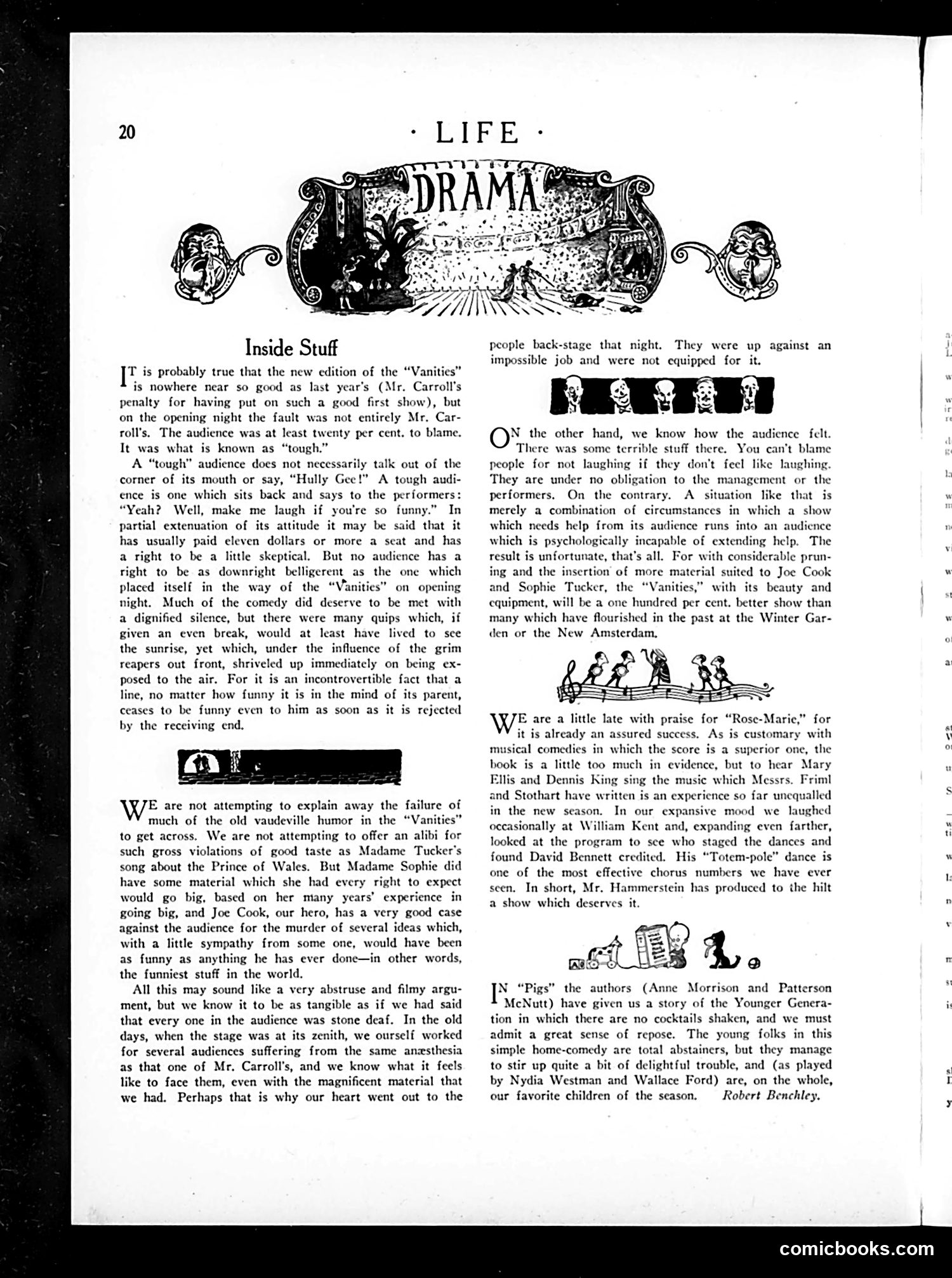
This is a theater review column critiquing Broadway shows, specifically Earl Carroll's "Vanities" revue. The author argues the production itself was mediocre, but defends the performers—particularly comedian Joe Cook and singer Sophie Tucker—against an unresponsive, hostile audience. The piece uses "tough audience" as theater slang for spectators who sit with arms crossed, demanding to be entertained rather than meeting performers halfway. The author sympathizes with the backstage cast facing an "impossible job" against psychological indifference. The column also briefly praises the musical "Rose-Marie" (featuring Mary Ellis and Dennis King) as an assured success. The cartoons appear decorative rather than satirical—theatrical mastheads typical of entertainment sections. No political commentary is evident; this is pure show-business gossip and criticism aimed at theater-going readers.
📄 Transcribed text from this page (OCR, searchable)
Machine-transcribed from the original scan — historical spelling and the odd misread are preserved.
Inside Stuff T is probably true that the new edition of the “Vanities” is nowhere near so good as last year's (Mr. Carroll's penalty for having put on such a good first show), but on the opening night the fault was not entirely Mr. Car- roll’s, The audience was at least twenty per cent. to blame. It was what is known as “tough.” A “tough” audience does not necessarily talk out of the corner of its mouth or say, “Hully Gee!” A tough audi- ence is one which sits back and says to the performers: “Yeah? Well, make me Jaugh if you're so funny.” In partial extenuation of its attitude it may be said that it has usually paid eleven dollars or more a seat and has a right to be a little skeptical. But no audience has a right to be as downright belligerent as the one which placed itself in the way of the nities” on opening night. Much of the comedy did deserve to be met with nified silence, but there were many quips which, if given an even break, would at least have lived to see the sunrise, yet which, under the influence of the grim reapers out front, shriveled up immediately on being ex- posed to the air. For it is an incontrovertible fact that a line, no matter how funny it is in the mind of its parent, ceases to be funny even to him as soon as it is rejected by the receiving end. WE are not attempting to explain away the failure of much of the old vaudeville humor in the “Vanities” to get across. We are not attempting to offer an alibi for such gross violations of good taste as Madame Tucker's song about the Prince of Wales. But Madame Sophie did have some material which she had e right to expect would go big, based on her many years’ experience in going big, and Joe Cook, our hero, has a very good case against the audience for the murder of several ideas which, with a little sympathy from some one, would have been as funny as anything he has ever done—in other words, the funniest stuff in the world. All this may sound like a very abstruse and filmy argu- ment, but we know it to be as tangible as if we had said that every one in the audience was stone deaf. In the old days, when the stage was at its zenith, we ourself worked for several audiences suffering from the same anzsthesia as that one of Mr, Carroll’s, and we know what it feels like to face them, even with the magnificent material that we had. Perhaps that is why our heart went out to the people back-stage that night. They were up against an impossible job and were not equipped for it. N the other hand, we know how the audience felt. There was some terrible stuff there. You can't blame people for not laughing if they don't feel like laughing. They are under no obligation to the management or the performers. On the contrary. A situation like that is merely a combination of circumstances in which a show which needs help from its audience runs into an audience which is psychologically incapable of extending help. The result is unfortunate, that’s all. For with considerable prun- ing and the insertion of more material suited to Joe Cc and Sophie Tucker, the “Vanities,” with its beauty and equipment, will be a one hundred per cent. better show than many which have flourished in the past at the Winter Gar- den or the New Amsterdam, WE are a little late with praise for “Rose-Marie,” for it is already an assured success. As is customary with musical comedies in which the score is a superior one, the book is a little too much in evidence, but to hear Mary Ellis and Dennis King sing the music which Messrs. Friml and Stothart have written is an experience so far uncqualled in the new season. In our expansive mood we laughed occasionally at William Kent and, expanding even farther, looked at the program to sce who staged the dances and found David Bennett credited. His “Totem-pole” dance is one of the most effective chorus numbers we have ever seen. In short, Mr. Hammerstein has produced to the hilt a show which deserves it. I “Pigs” the authors (Anne Morrison and Patterson McNutt) have given us a story of the Younger Genera- tion in which there are no cocktails shaken, and we must admit a great sense of repose. The young folks in this simple home-comedy are total abstainers, but they manage to stir up quite a bit of delightful trouble, and (as played by Nydia Westman and Wallace Ford) are, on the whole, our favorite children of the season. Robert Benchley, comicbooks.com a