
A complete issue · 36 pages · 1924
Life — August 21, 1924
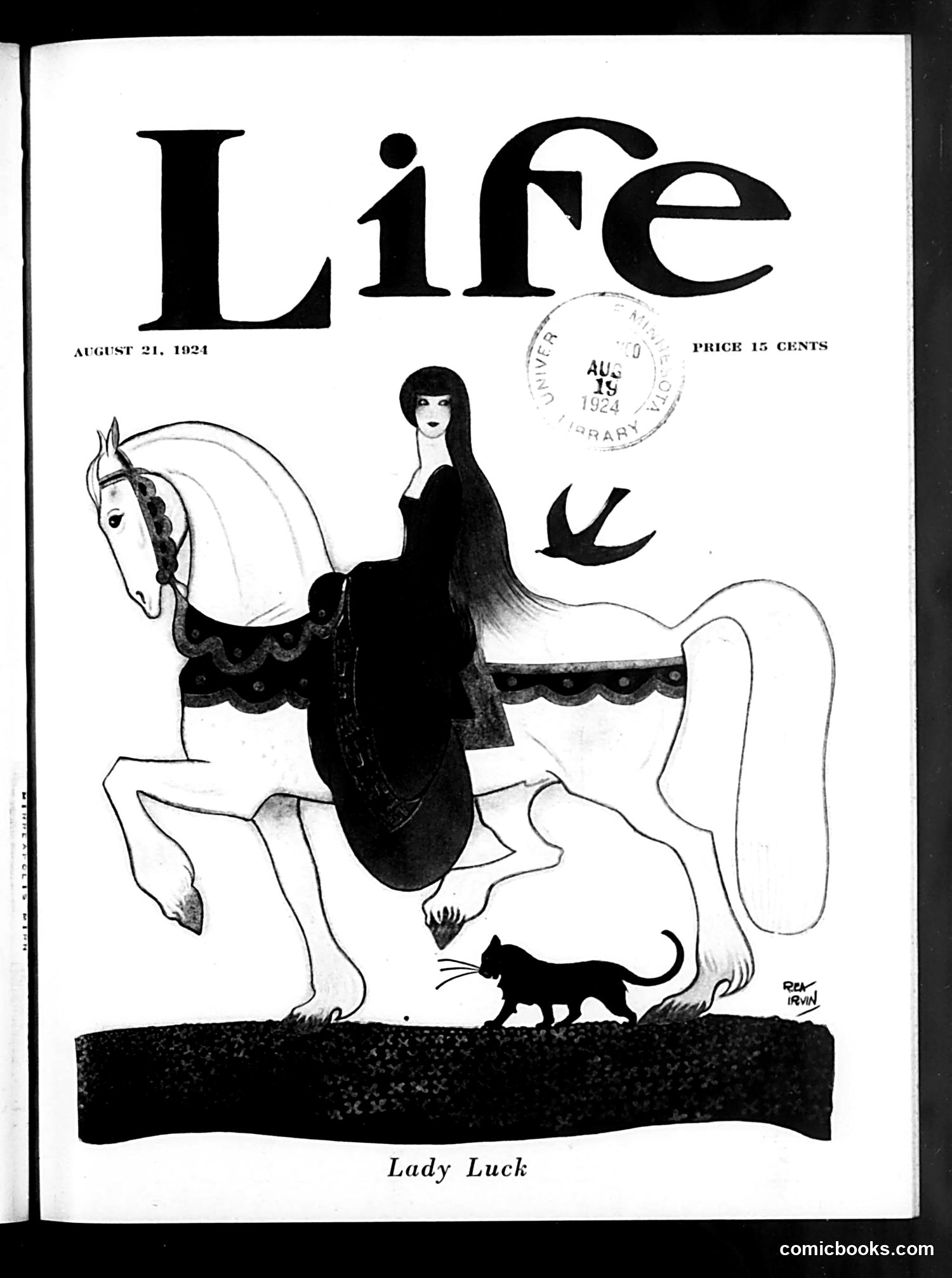
This cover illustrates the concept of "Lady Luck" through Art Deco-style imagery popular in the 1920s. A fashionably dressed woman with long dark hair rides a rearing white horse, accompanied by symbolic good-luck charms: a black cat and a swallow (bird). The composition suggests fortune's capricious nature—the prancing horse conveys unpredictability, while the traditional luck symbols (cat, bird) reflect superstitions common to the era. The satire likely comments on American optimism and consumerism during the prosperous post-WWI 1920s, when belief in luck and chance coexisted with rapid social change. The stylized, elegant presentation suggests both the allure and frivolity of pursuing fortune during this period of economic expansion and cultural transformation.
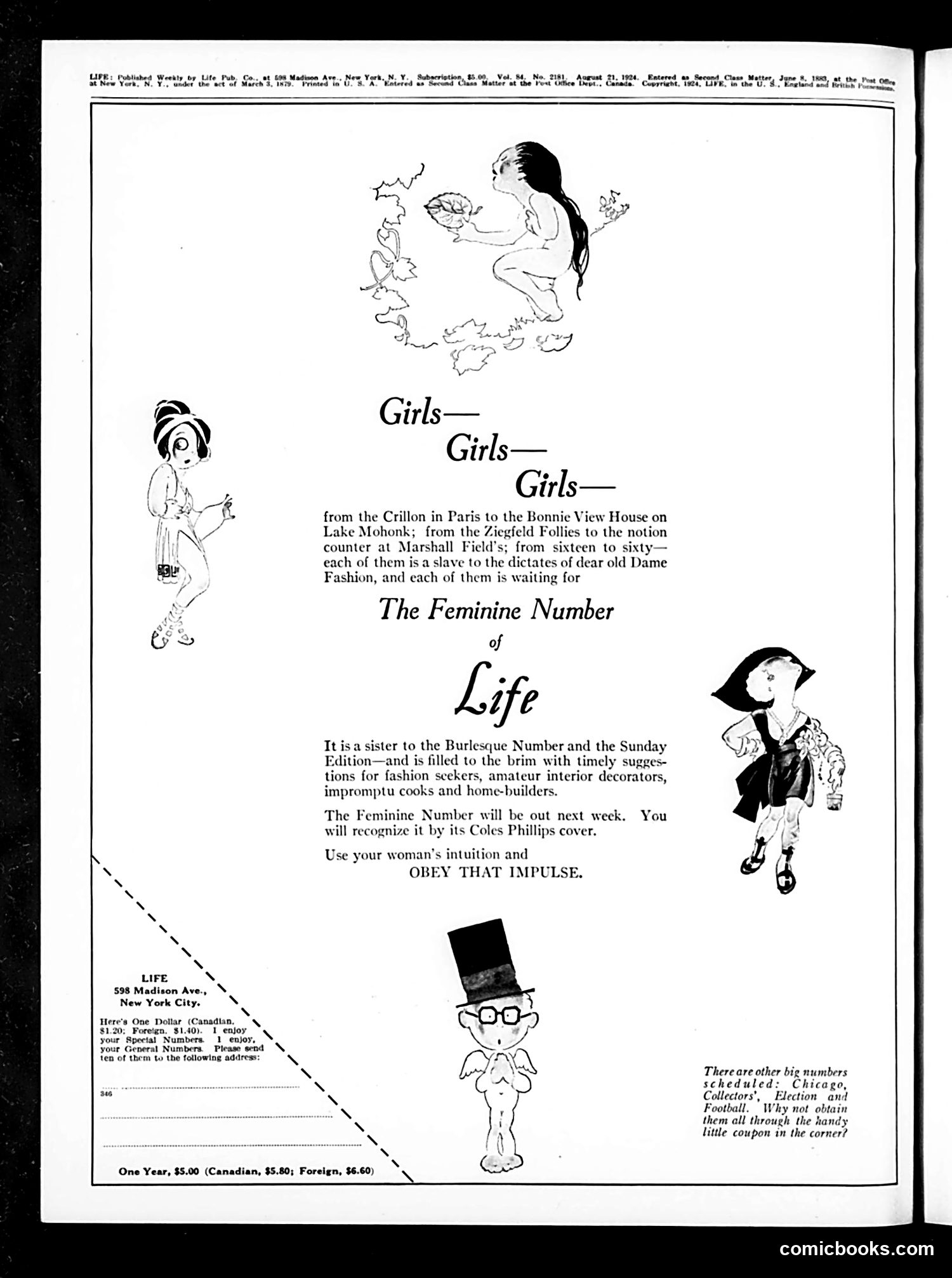
This is primarily a **advertisement for Life's upcoming "Feminine Number"** rather than political satire. The page promotes a special women-focused issue with fashion, home decoration, and lifestyle content. The illustrated figures represent different types of women readers: a fashionable Parisian woman (left), a modern working woman (right), and various character sketches. The text references popular entertainment venues (Crillon in Paris, Marshall Field's) to suggest the magazine reaches women across diverse social settings. The phrase "OBEY THAT IMPULSE" is a marketing call-to-action encouraging women to purchase the issue. The reference to a "Coles Phillips cover" indicates a known illustrator of the era. The subscription cost ($5.00) and office address (598 Madison Ave.) are standard advertising details. This represents early 1920s **consumer marketing directed at women**, emphasizing fashion and domesticity.
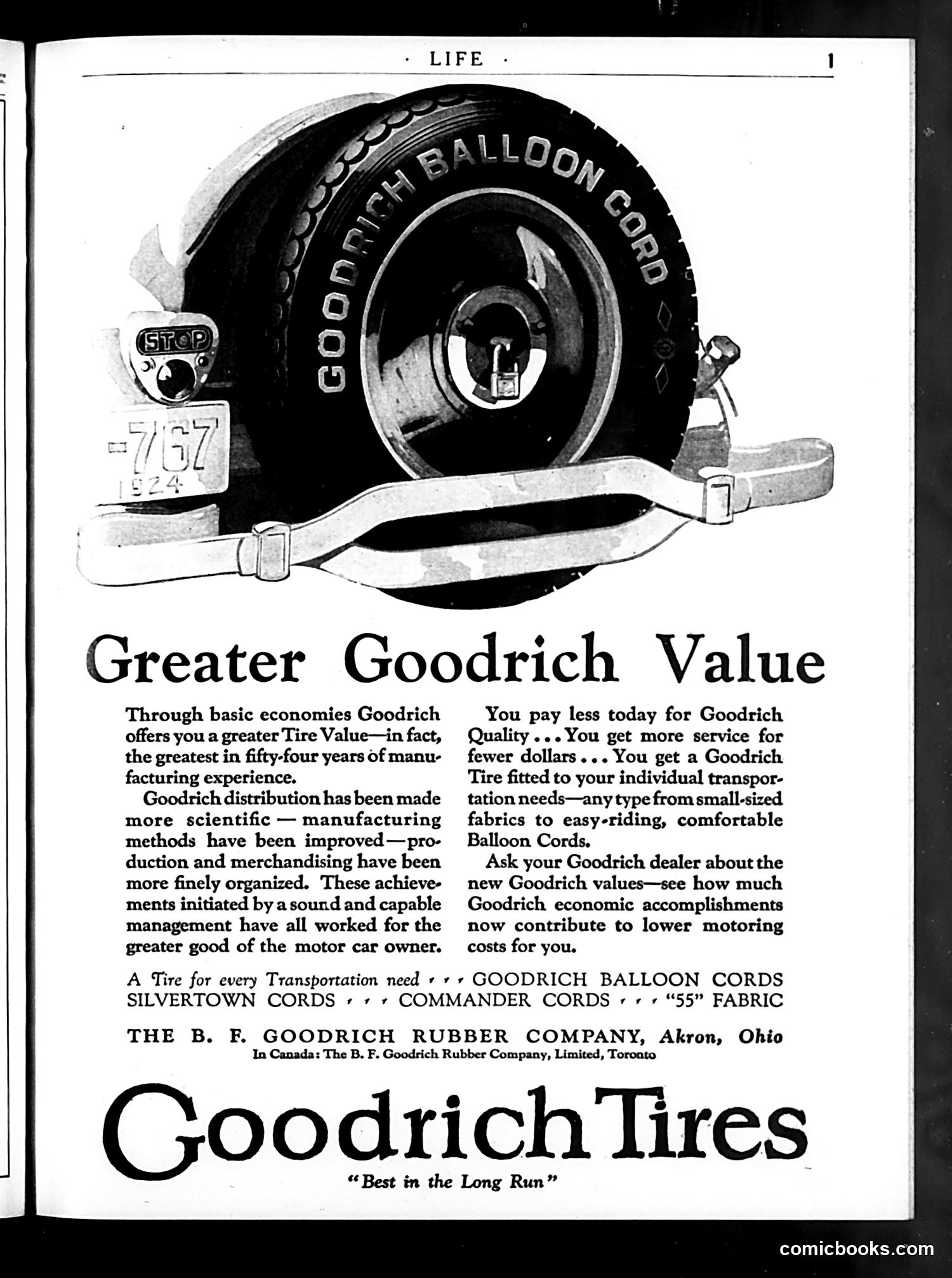
This is **not a cartoon or satire page**—it's a straightforward **Goodrich Tire advertisement** from Life magazine. The image shows a large tire being held in a hand, emphasizing the product's value and quality. The "STOP" sign visible on the vehicle in the background references automotive safety, which was an emerging concern in early automotive advertising. The ad's messaging emphasizes "Greater Goodrich Value" through improved manufacturing, distribution, and economics—claiming customers pay less while receiving better service and durability. The copy references various tire types: "Balloon Cords," "Silvertown Cords," and "Commander Cords." The company was B.F. Goodrich Rubber Company, based in Akron, Ohio, with Canadian operations in Toronto. This represents standard 1920s product advertising rather than political or social satire.
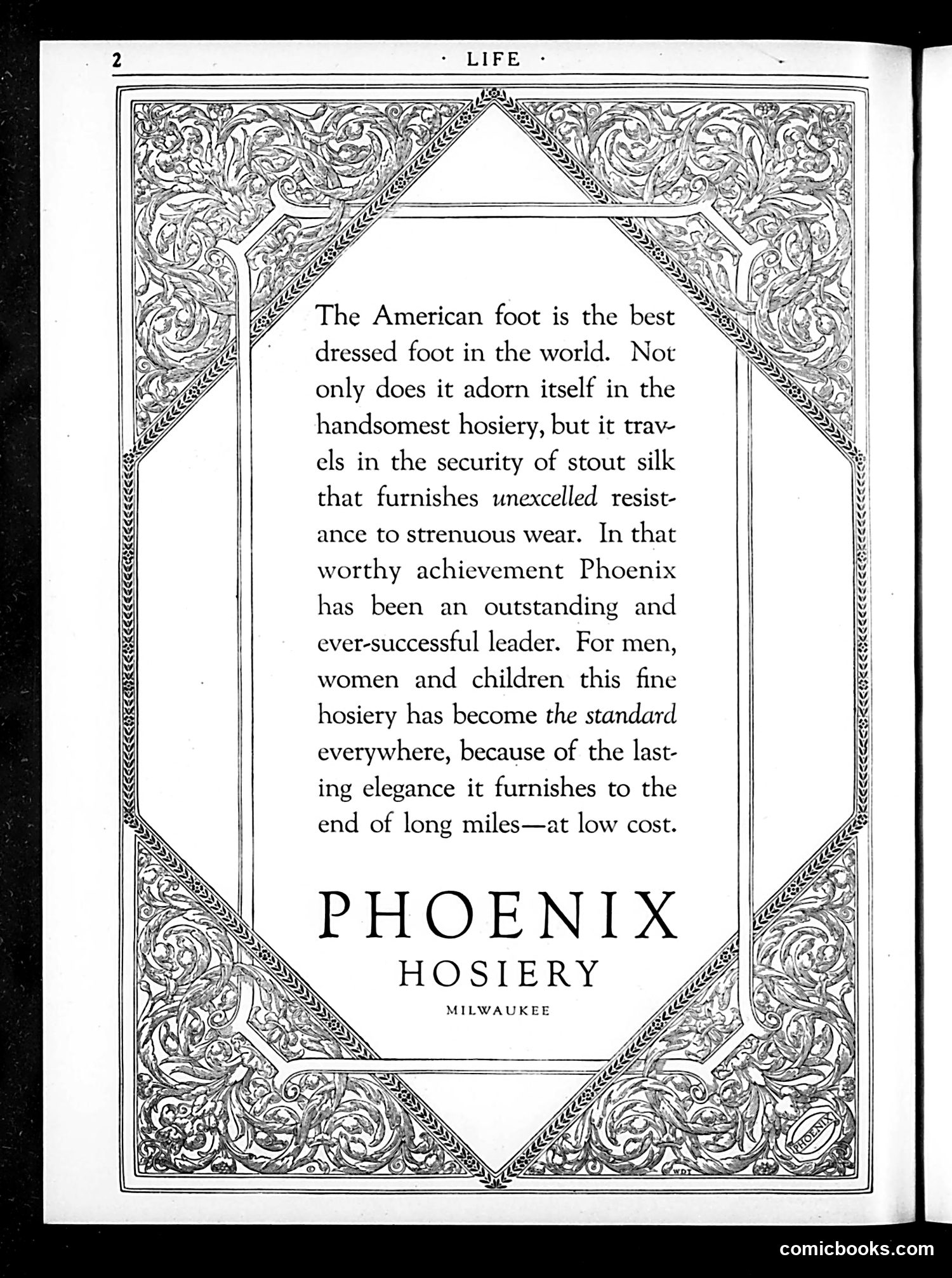
This page is **advertising, not satire or political commentary**. It's a full-page advertisement for Phoenix Hosiery from Milwaukee, appearing in *Life* magazine. The ad makes nationalistic claims about American superiority, asserting that "The American foot is the best dressed foot in the world" and praising Phoenix brand hosiery for its durability and elegance. It targets all demographics: "For men, women and children." The ornamental border and formal layout were typical of early 20th-century magazine advertising. The word "unexcelled" is italicized for emphasis. **No cartoon or political figures are present.** This is purely a commercial advertisement using patriotic appeals and product claims to market silk hosiery to American consumers at an affordable price point.
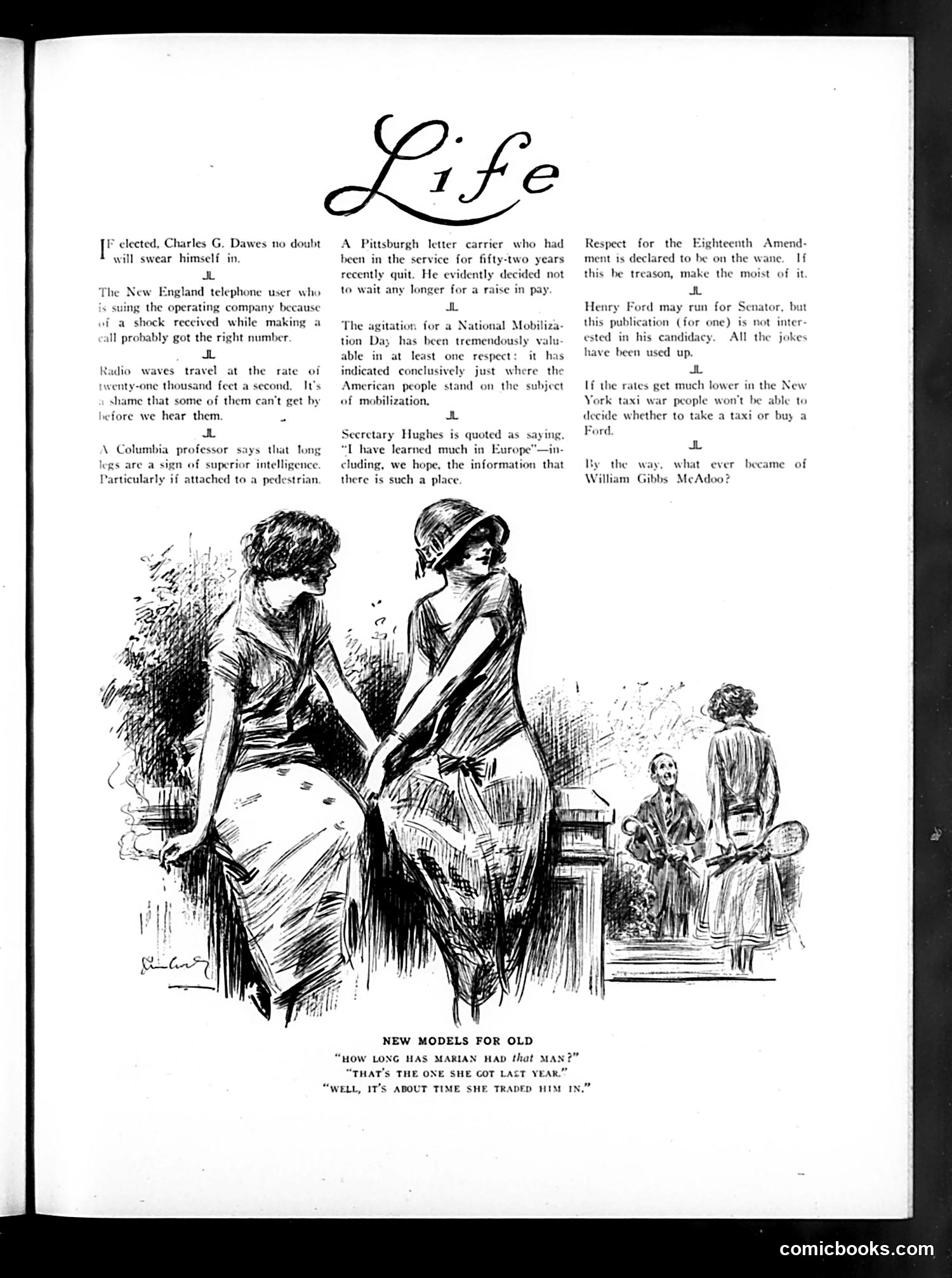
The main cartoon satirizes women's changing relationship status and marriage prospects. Two women discuss a third woman named Marian, asking how long she's had "that man" — implying a romantic partner. One responds "that's the one she got last year," and the other quips "well, it's about time she traded him in." The satire mocks the casual, commodified attitude toward romantic partners — treating men like replaceable consumer goods ("trading in" like a used car). This reflects 1920s-era social commentary on shifting gender dynamics and women's increasing independence and consumer power during the post-WWI period. The cartoon's title suggests women are adopting new romantic "models" by discarding old ones.
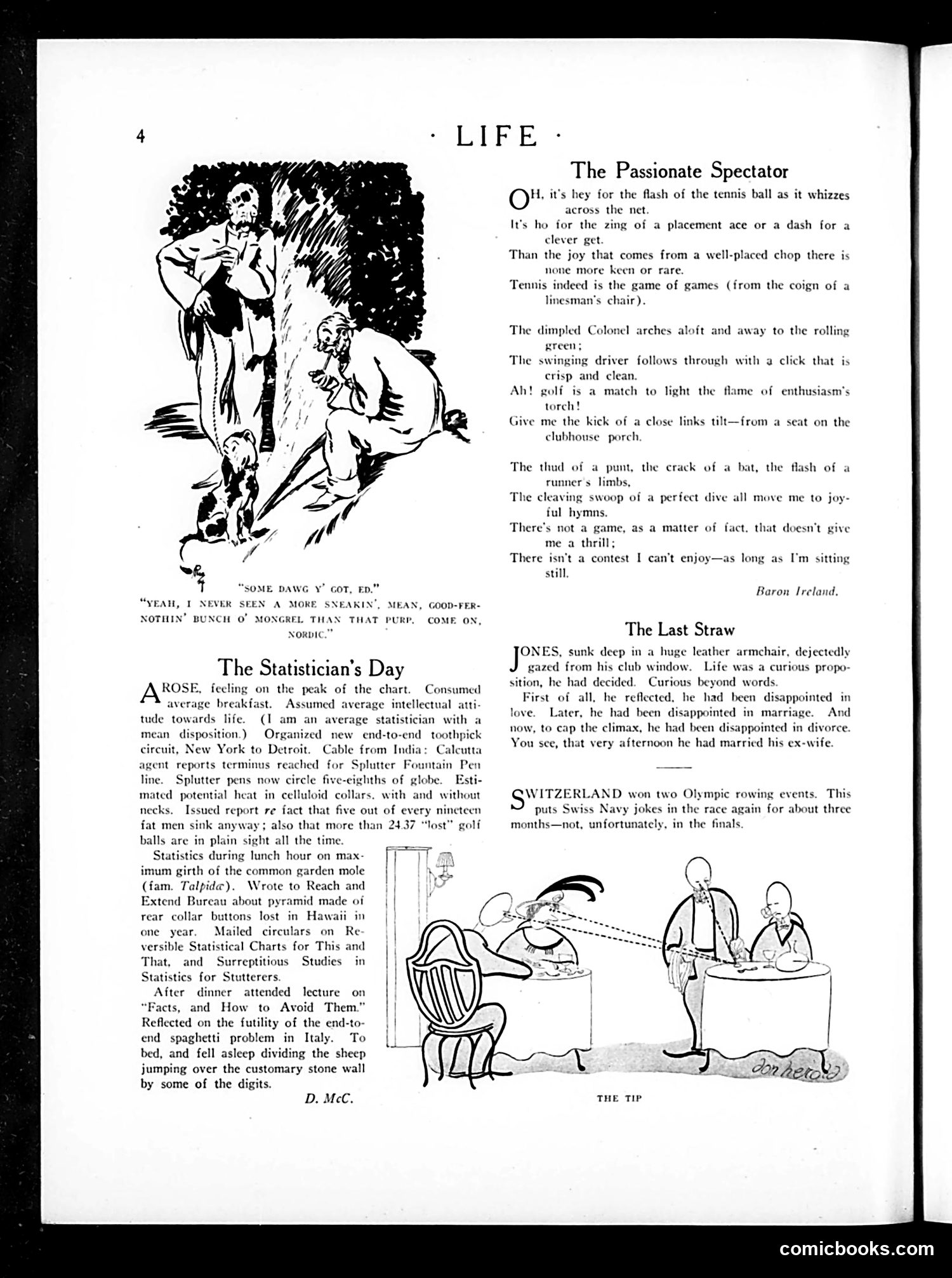
This page contains three pieces of satirical content: **"The Statistician's Day"** mocks obsessive data collection. A character consumed with statistics arrives at the breakfast table already laden with charts and averages, then proceeds to organize his entire day around metrics—calculating potential heat in shirt collars, studying spaghetti problems in Italy, and measuring garden moles. The satire targets the era's growing faith in statistical analysis as a solution to all problems. **"The Passionate Spectator"** celebrates sports enthusiasm, particularly tennis and golf, as sources of joy beyond mere competition. **"The Last Straw"** and **"The Tip"** cartoon appear to be brief joke pieces, though their specific references are unclear from the visible text. The page reflects 1920s-era anxieties about quantification and rationalization of daily life.
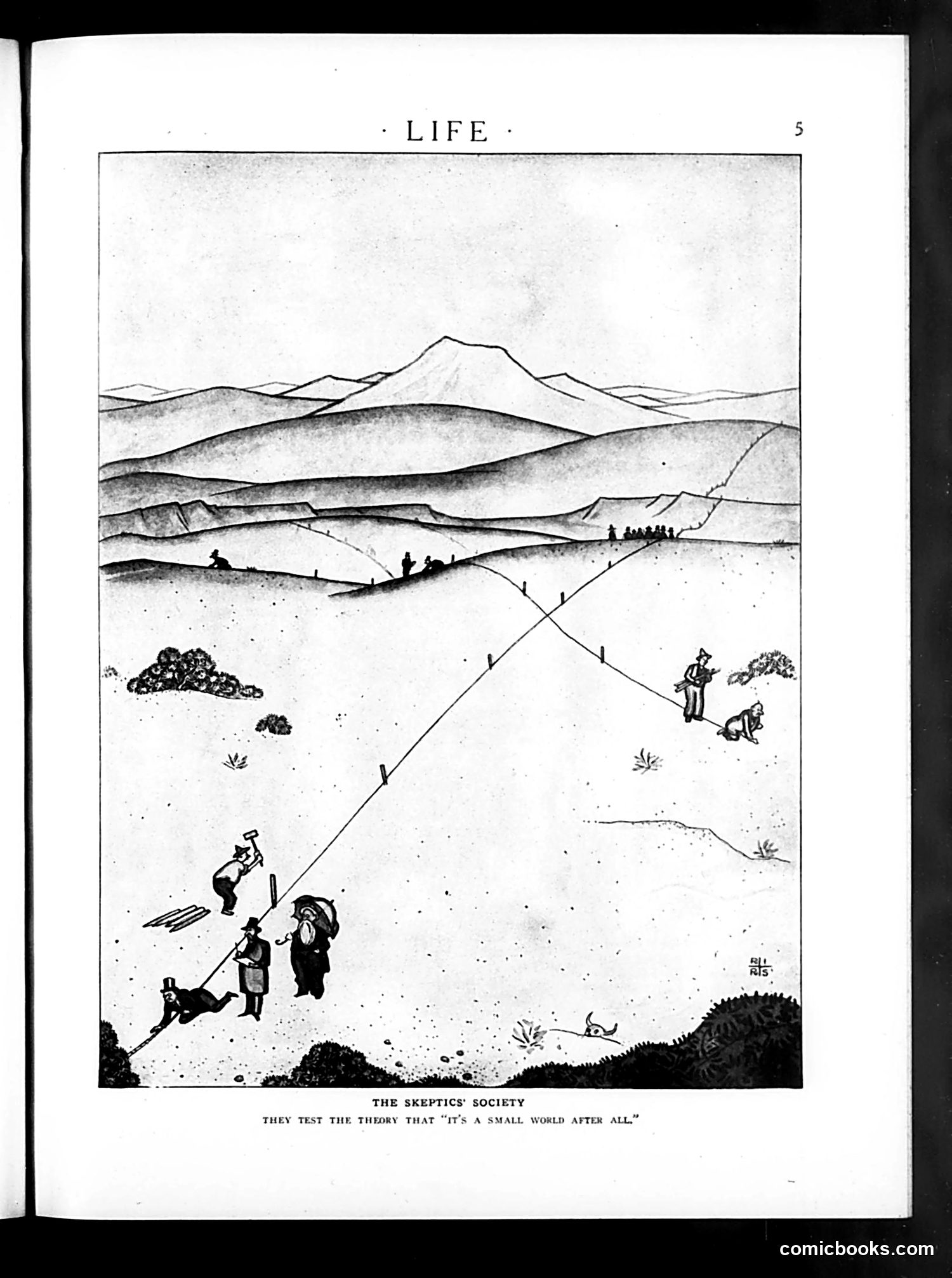
This is a single-panel cartoon titled "The Skeptics' Society" with the subtitle "They Test the Theory That 'It's a Small World After All.'" The illustration shows a group of people in a vast landscape, connected by lines that appear to form a small geometric shape—likely representing the globe or world. The figures are scattered across rolling hills and plains, measuring or testing the spatial relationship between distant points. The satire mocks the common phrase "it's a small world"—a cliché expressing how interconnected or coincidental life feels. By literally depicting skeptics measuring the actual distance between people across a landscape, the cartoon humorously suggests the phrase is figurative rather than factual. The joke plays on taking an idiom literally, questioning whether our sense of proximity is genuine or merely psychological.
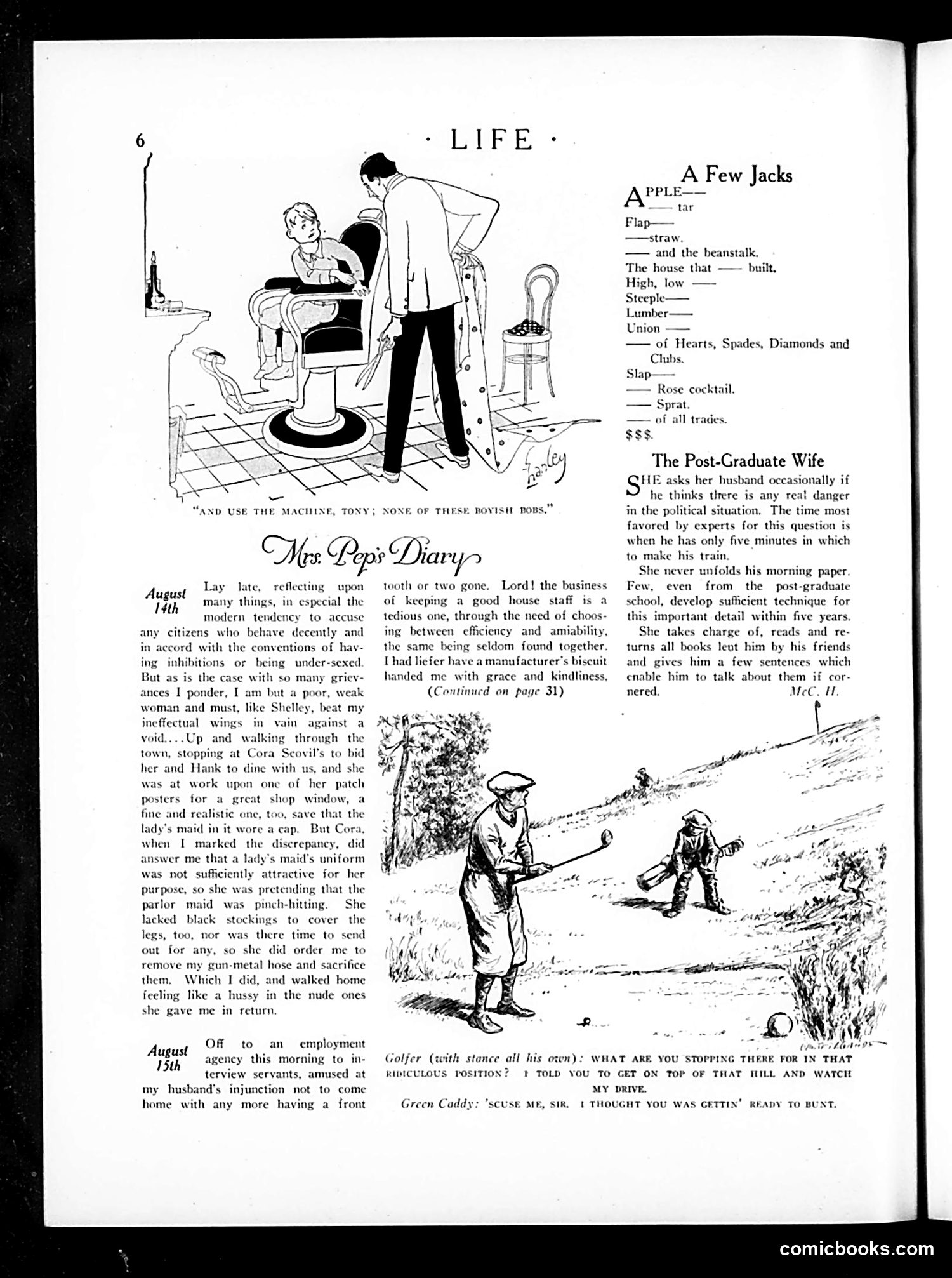
This page features satirical content targeting early 20th-century social conventions: **"Mrs. Pep's Diary"** mocks gender expectations and marital dynamics. The entry describes a woman's frustration with her maid's uniform inadequacy—she's upset the uniform wasn't visibly shabby enough to signal servant status to neighbors. This satirizes class consciousness and the performative nature of social hierarchy, suggesting women obsessed with displaying their domestic staff's subordinate position to maintain their own social standing. **"The Post-Graduate Wife"** jokes about educated women in marriages, implying they use intellectual techniques to manipulate husbands into discussing politics—suggesting their education made them meddlesome rather than genuinely informed. The golf cartoon at bottom features period-typical comedic banter between golfer and caddy about proper playing positions.
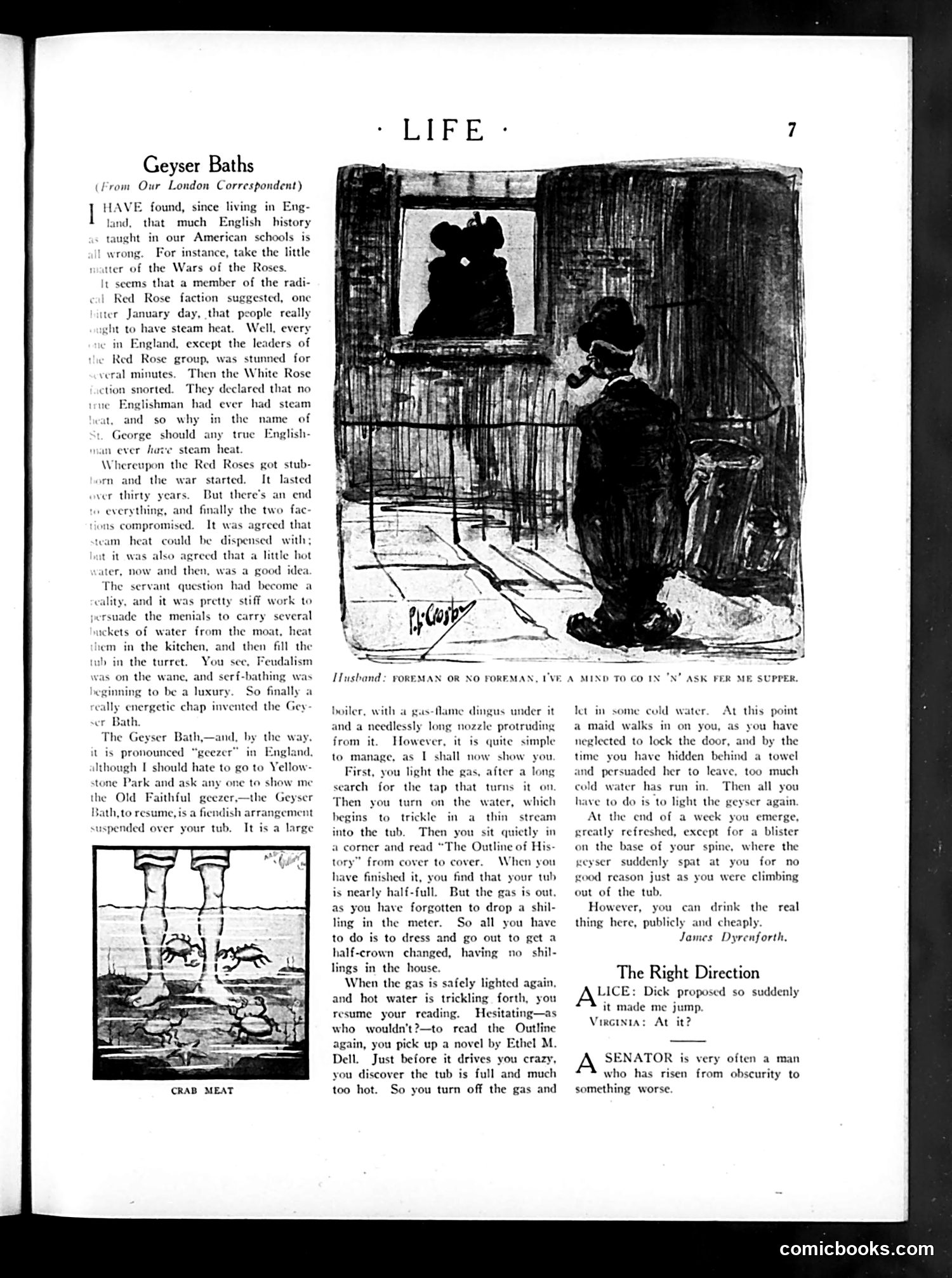
This page contains two distinct pieces. The main article "Geyser Baths" humorously describes the mechanics of English hot-water heating systems, comparing them to geysers. The accompanying cartoon labeled "Crab Meat" shows two figures in what appears to be a bathing scene, likely illustrating the article's subject matter about obtaining hot water. Below that, "The Right Direction" is a brief comic dialogue between characters named Alice, Virginia, and a Senator. Virginia reports that Dick proposed suddenly, and Alice responds that "a Senator is very often a man who has risen from obscurity to something worse"—a satirical jab at politicians' poor character or incompetence. The humor relies on the cynical observation that political advancement doesn't improve moral character.
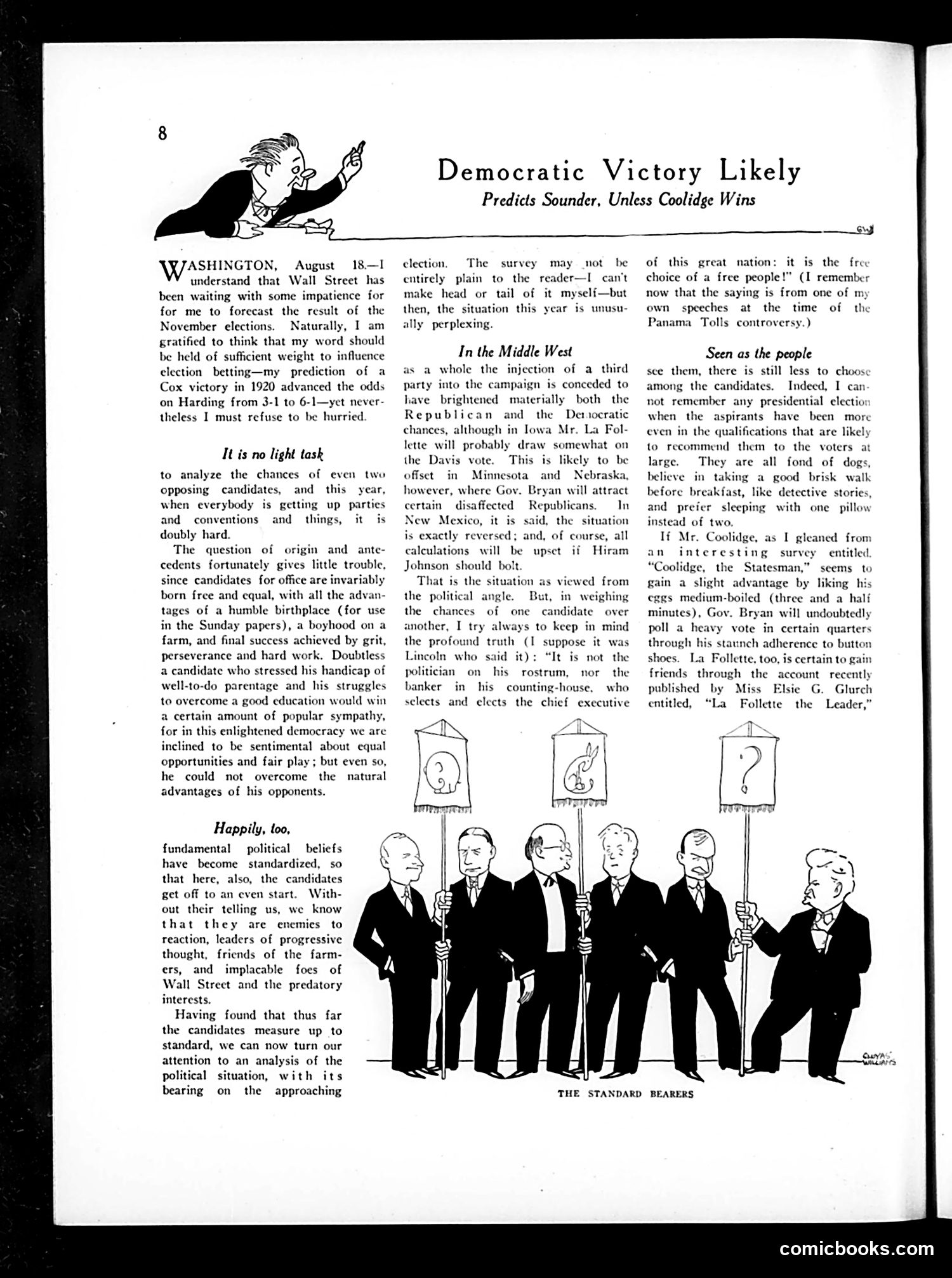
This page analyzes the 1920 U.S. presidential election prospects. The author predicts a Democratic victory unless Republican candidate Warren G. Harding wins, discussing regional political dynamics in the Midwest. The cartoon "The Standard Bearers" at bottom depicts six men holding banners with question marks—symbolizing uncertainty about the candidates' positions or identities. This satirizes that voters don't know what these politicians actually stand for. The text references Calvin Coolidge (Massachusetts governor), William Jennings Bryan, and La Follette as political figures of interest. The piece critiques how fundamental democratic principles—fair play and equal opportunity—are compromised by candidates' advantages and disadvantages beyond their control or merit.
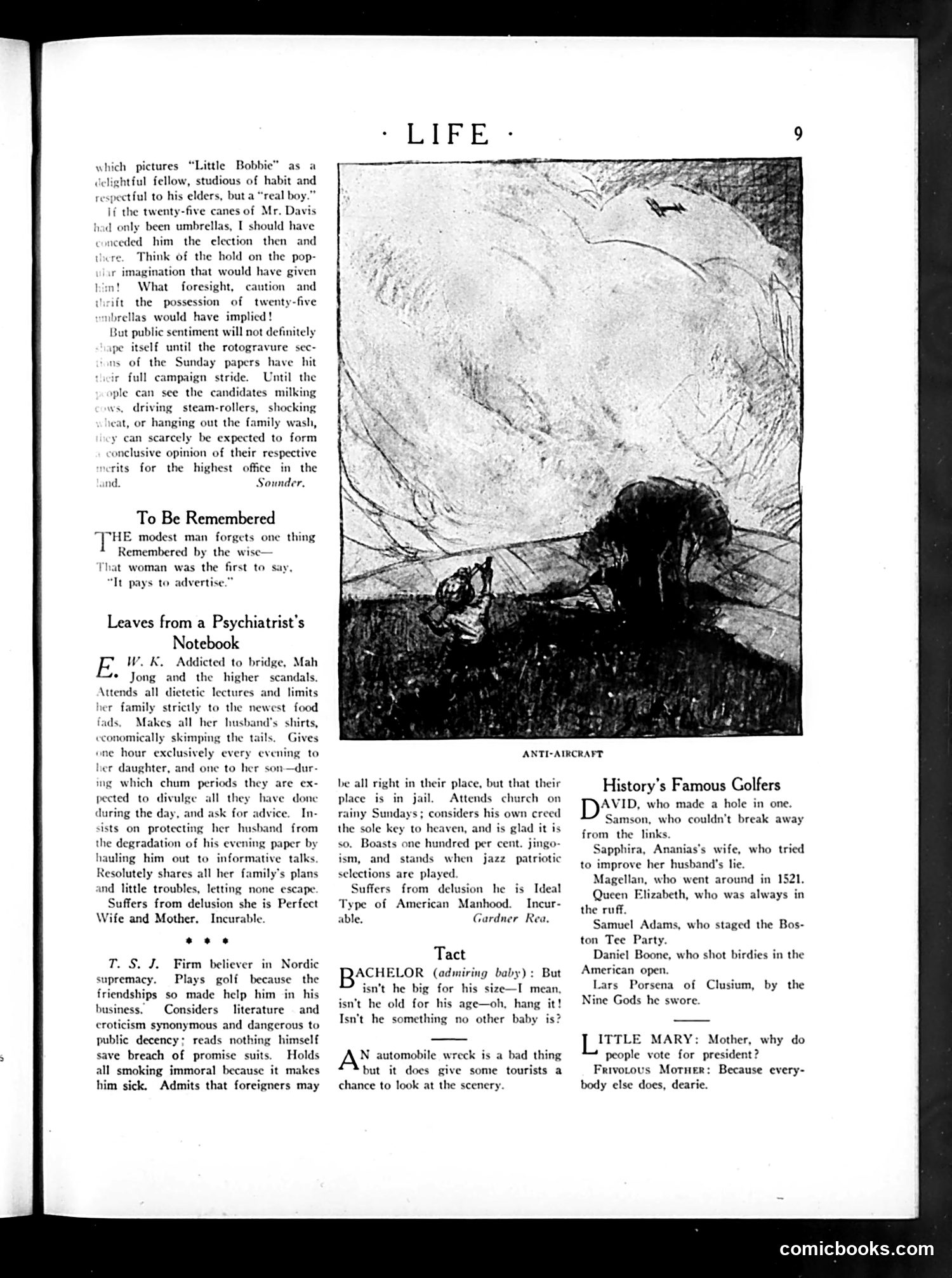
The image labeled "Anti-Aircraft" depicts a woman in bed using an umbrella to defend herself against what appears to be an airplane or aircraft overhead. This is visual satire about domestic life during an era of aviation anxiety. The cartoon plays on the double meaning of "anti-aircraft"—typically military defense against planes—reimagined as household protection. The humor lies in the absurdity of using a simple umbrella as defense, suggesting either the futility of civilian preparedness or mocking exaggerated fears about aircraft hazards. The surrounding text includes sections titled "To Be Remembered," "Leaves from a Psychiatrist's Notebook," and jokes about famous historical figures. Without a visible date, the cartoon's specific historical context remains unclear, though it likely reflects early-to-mid 20th century concerns about aviation.
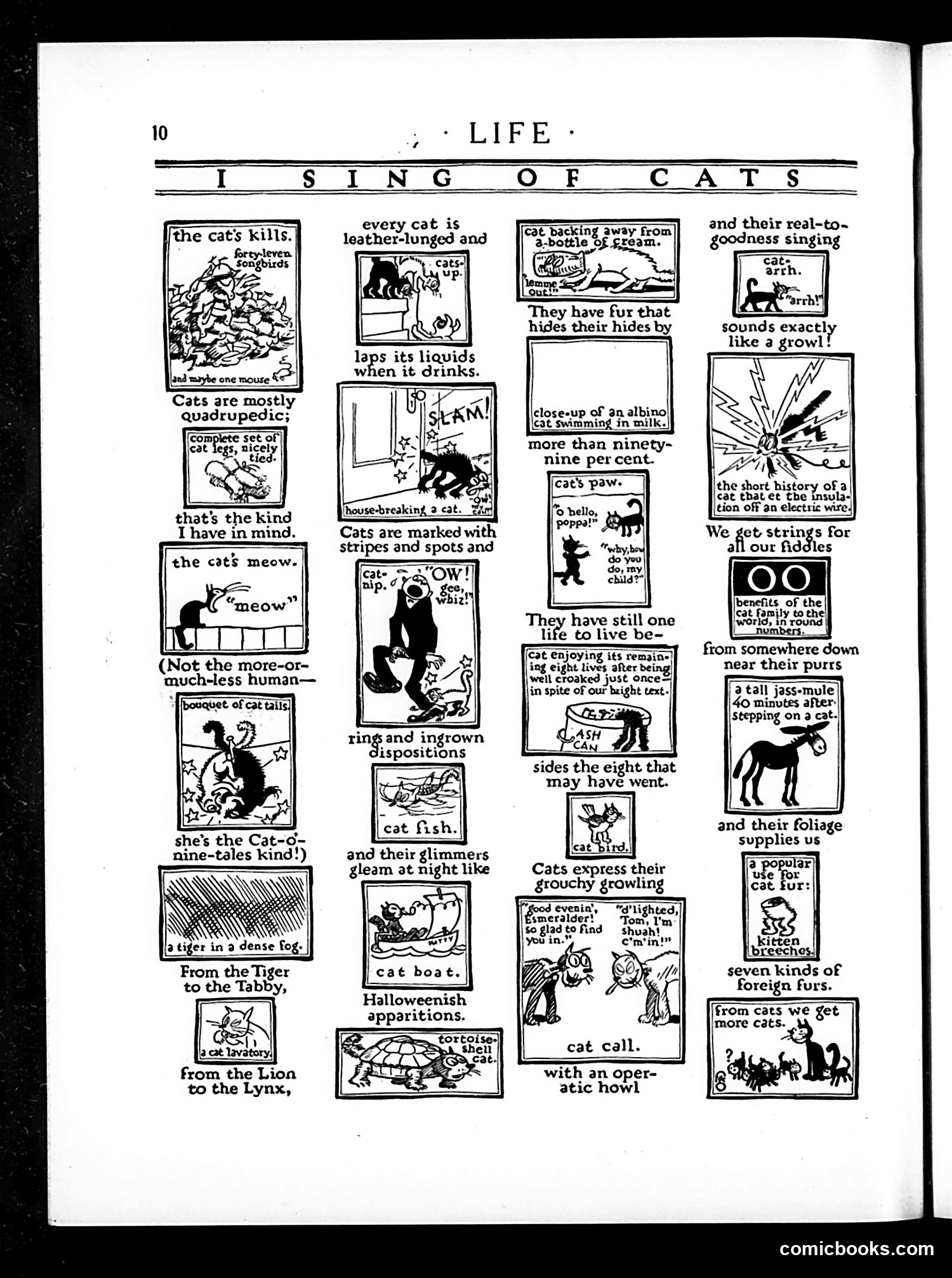
This is a humorous illustrated essay celebrating cat characteristics through a series of small comic panels and witty captions. The page uses visual gags and wordplay to describe feline behavior: - **The humor relies on** physical descriptions (cats' flexible spines, reflective eyes) and behavioral quirks (drinking by lapping, vocalizing through meowing and "cat calls") - **Social observations** compare cats to other animals (tigers, lynxes) and playfully mock cat ownership ("from cats we get more cats") - **The satire targets** human attitudes toward pets, anthropomorphizing cats while acknowledging their indifference to humans ("more-or-much-less human") The page contains no political content—it's purely light entertainment about cats, typical of Life's satirical approach to everyday domestic life in the early 20th century.
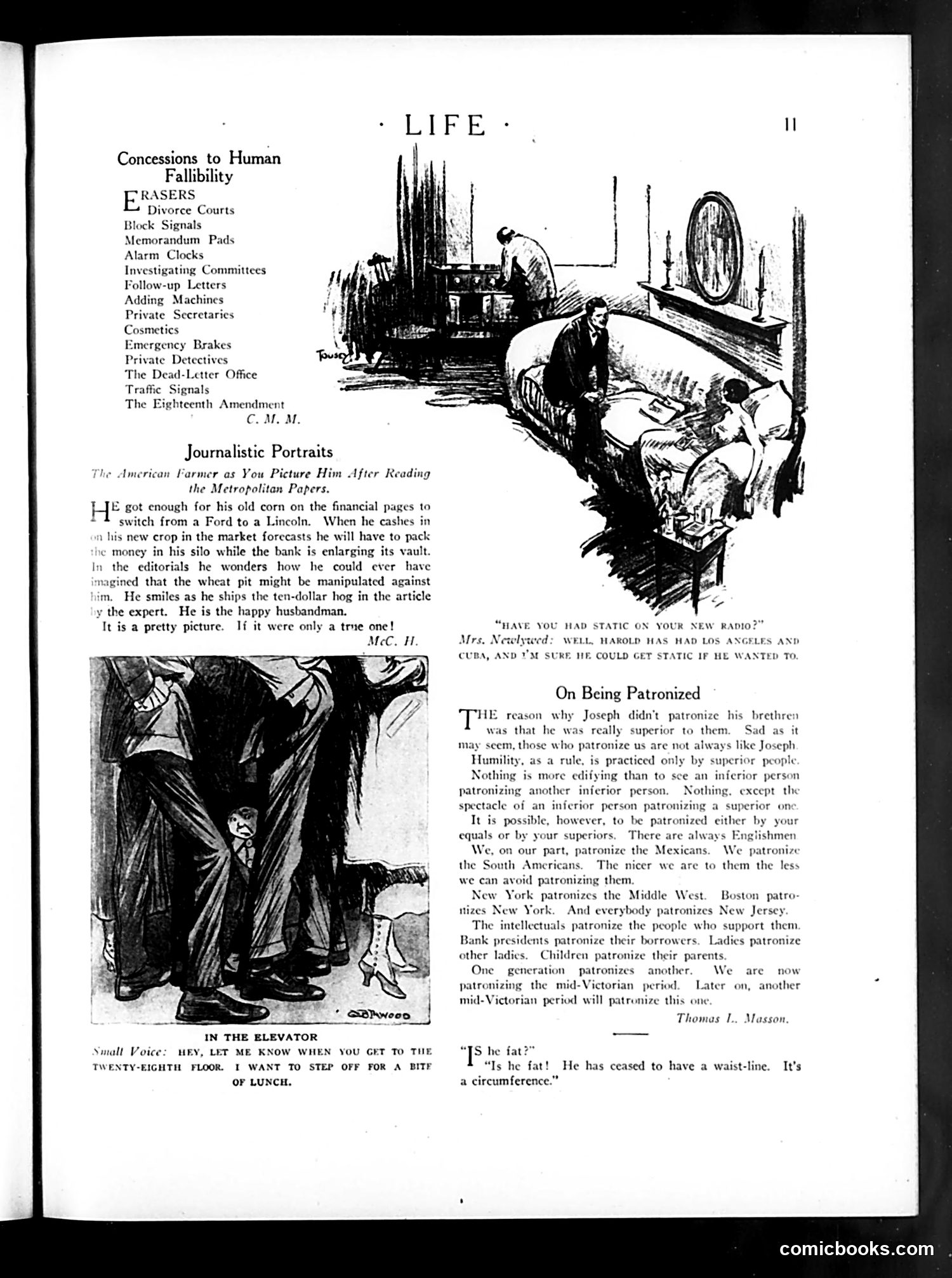
This cartoon satirizes class consciousness and workplace hierarchy in early 20th-century America. The sketch shows an elevator operator speaking to a passenger, demanding to know when the passenger will leave so he can take a lunch break—specifically requesting to "step off for a bite of lunch" at the twenty-eighth floor. The humor derives from the operator's assertive demand for his own needs, which violates the expected deference of service workers toward passengers of apparently higher social standing. The cartoon mocks both rigid class distinctions and workers' growing willingness to assert their rights, presenting this as an amusing breach of proper social etiquette rather than legitimate labor concern.
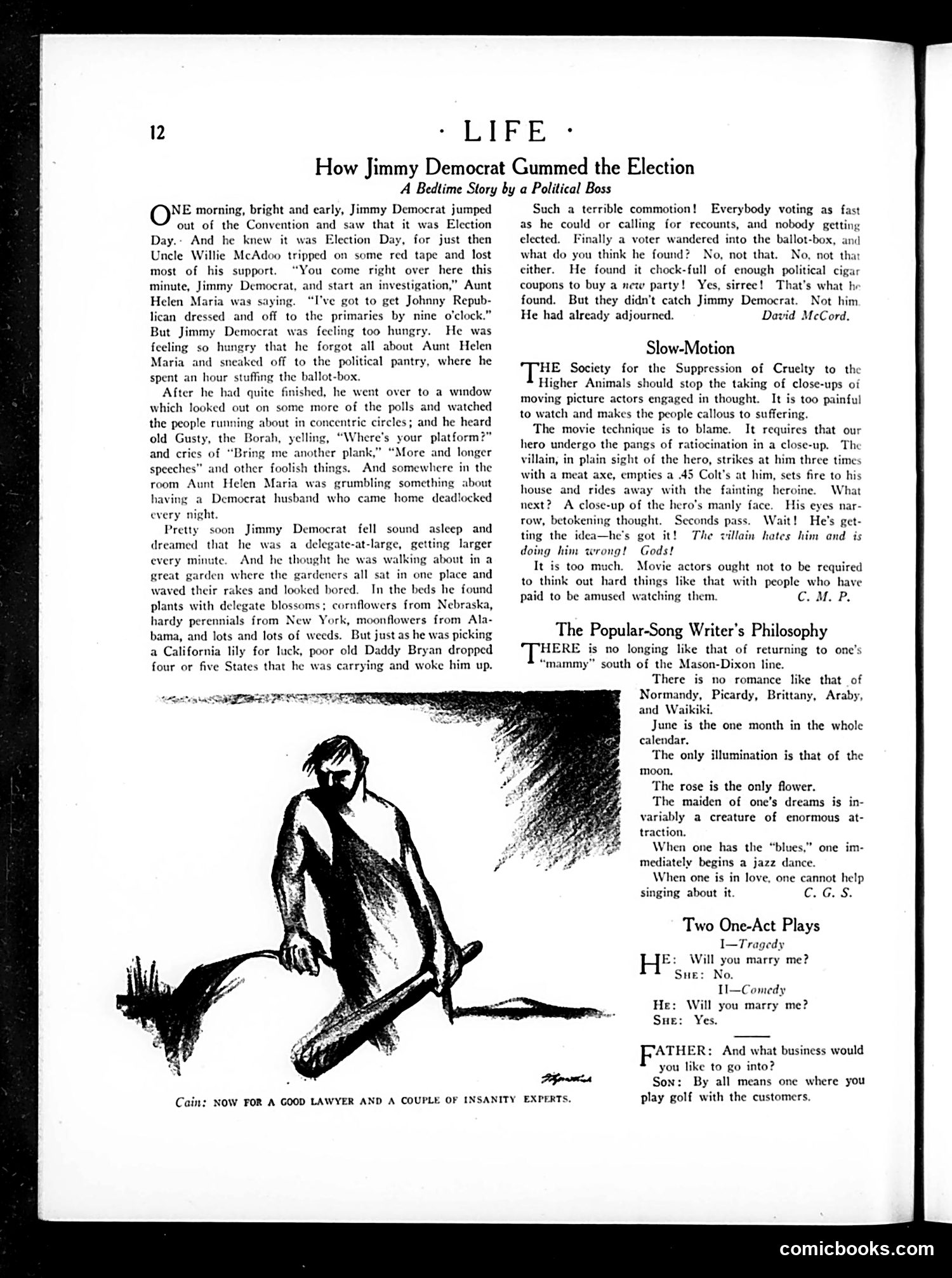
This satirical story mocks a character named "Jimmy Democrat" who blunders through Election Day. The narrative suggests he bungled his own political efforts—he forgot to vote, got distracted by various activities (sneaking food, observing gardeners), and ultimately discovered he'd been carrying unused cigars meant to "buy a new party." The joke appears to be critiquing Democratic incompetence or disorganization during elections. The accompanying illustration depicts a disheveled figure sitting dejectedly, captioned "Cain: now for a good lawyer and a couple of insanity experts," reinforcing the theme of bumbling failure. The satire targets Democratic political ineffectiveness through comic exaggeration rather than specific historical figures.
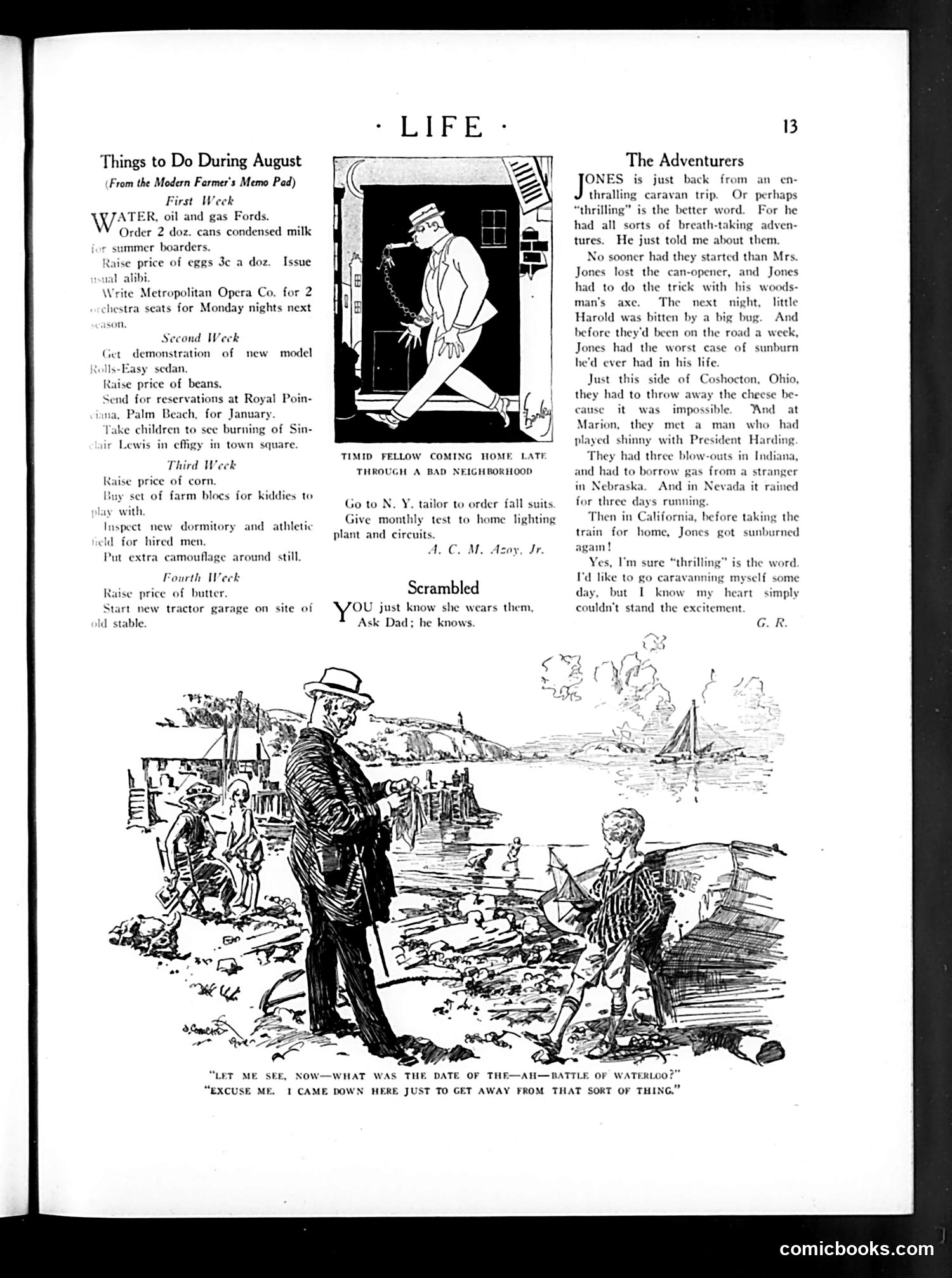
This page contains practical farm advice ("Things to Do During August"), a brief humorous story titled "The Adventurers" about a man named Jones returning from a calamitous caravan trip, and a cartoon labeled "Scrambled." The main cartoon depicts a well-dressed man questioning a young boy at a beach or seaside location. The man asks about the "Battle of Waterloo" while the boy responds he came down "just to get away from that sort of thing"—suggesting the boy is fleeing educational or historical lectures. The humor lies in the contrast between adult preoccupation with historical facts and a child's desire for carefree leisure. This reflects early-20th-century tensions between rigorous Victorian education and modern childhood autonomy.
This Life magazine page (August 21, 1924) contains political commentary rather than cartoons. The text discusses upcoming Irish elections and their implications for Irish-American voters in the U.S. The article argues that Irish Republicans and other political groups in Ireland want Irish-American voters to remain satisfied with Irish independence while staying out of American politics. The text criticizes the *Irish World* newspaper for maintaining the "fight with England" narrative. The piece also addresses Secretary of State Charles Evans Hughes and mentions Brother Charles Davis's efforts to maintain harmony between British and American interests, while noting President Coolidge's administration's diplomatic work in Europe. The commentary reflects 1920s tensions between Irish-American political interests and official U.S. foreign policy toward Britain.
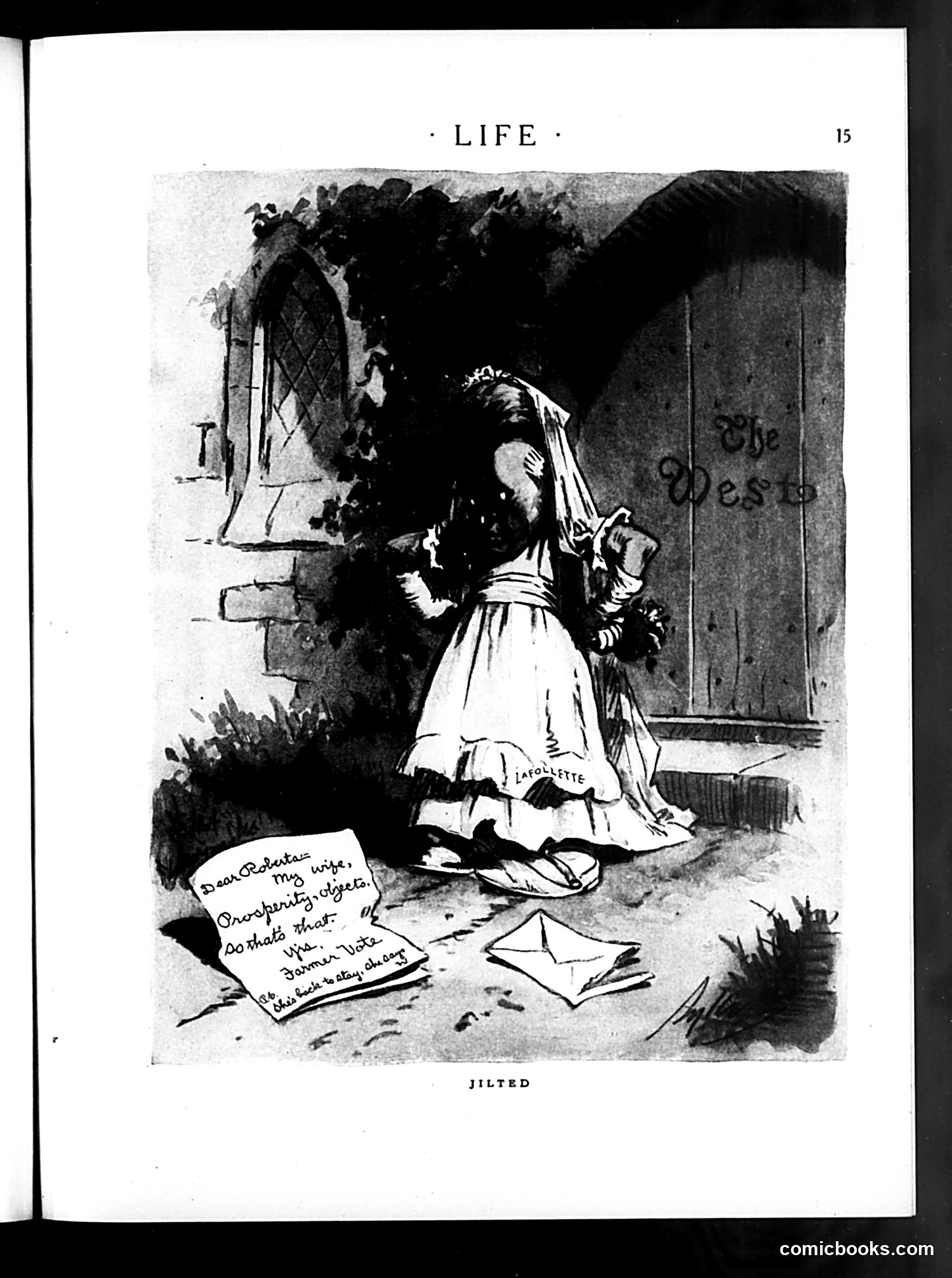
This cartoon depicts a young woman in distress, kneeling amid scattered love letters and romantic correspondence. The title "Jilted" indicates she's been abandoned by a romantic partner. The visible text on the letters includes phrases like "Dear Beatrice" and references to "my wife" and "prosperity streets," suggesting the correspondence reveals infidelity or deception—the man she loved was apparently already married or involved with another woman. The scene's theatrical setting (Gothic archway, ivy) emphasizes the melodrama of romantic betrayal. This is classic early-20th-century satirical commentary on the vulnerability of unmarried women to romantic deception, a common theme in Life magazine's social humor addressing courtship and gender relations of the era.
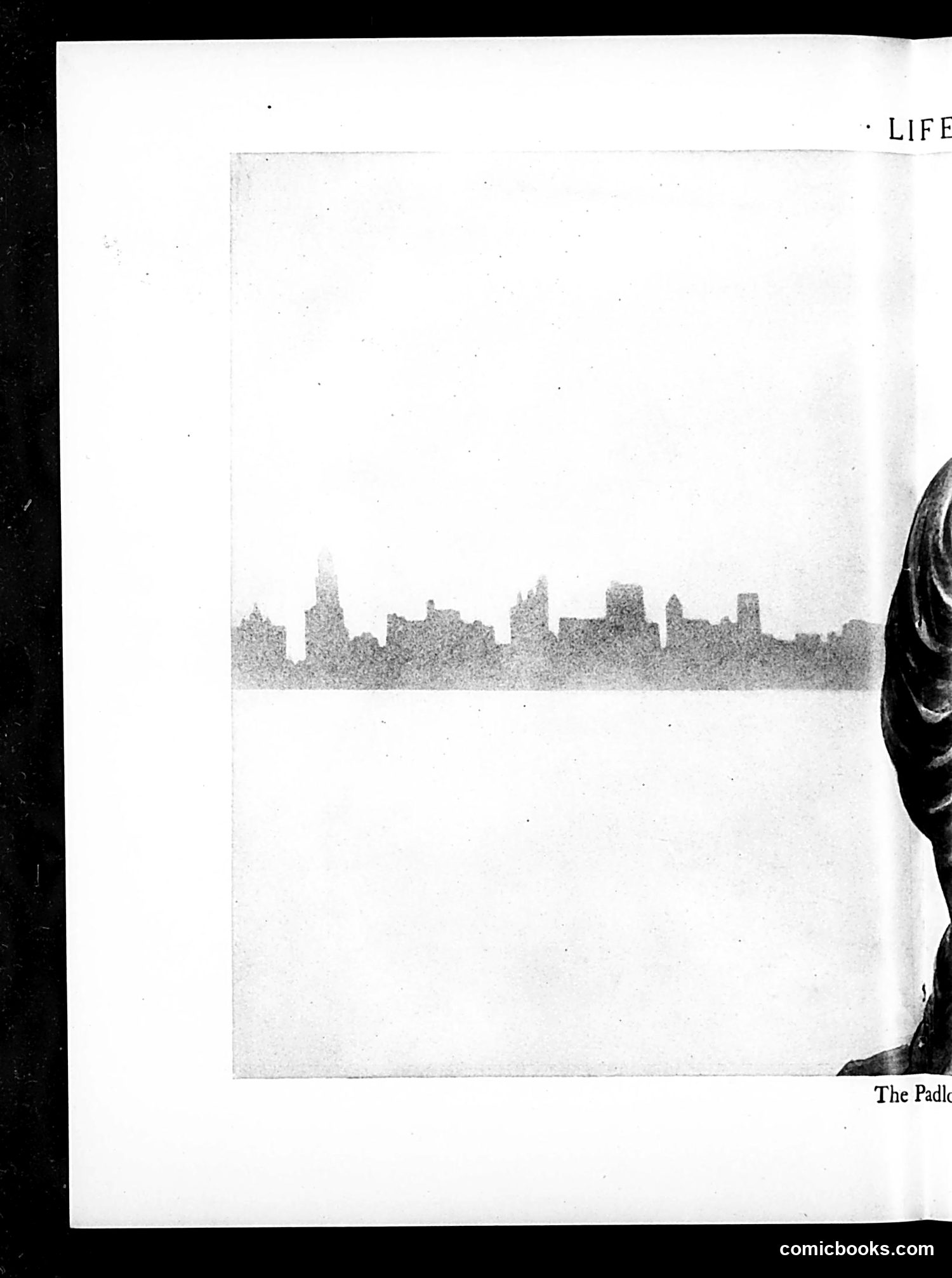
This page appears to be from Life magazine and shows a skyline silhouette of what looks like a major American city (likely New York, based on the distinctive building shapes). The image is quite minimal—mostly white space with a grainy, atmospheric cityscape in the center. The text at the bottom reads "The Padl" (likely incomplete or cut off, possibly "The Paddle" or another word). Without more visible text or clearer context on this page, it's difficult to determine the specific satirical point or what political/social commentary this image was intended to convey. The skyline itself may be symbolic, but the meaning requires additional context from surrounding pages or a clearer caption.
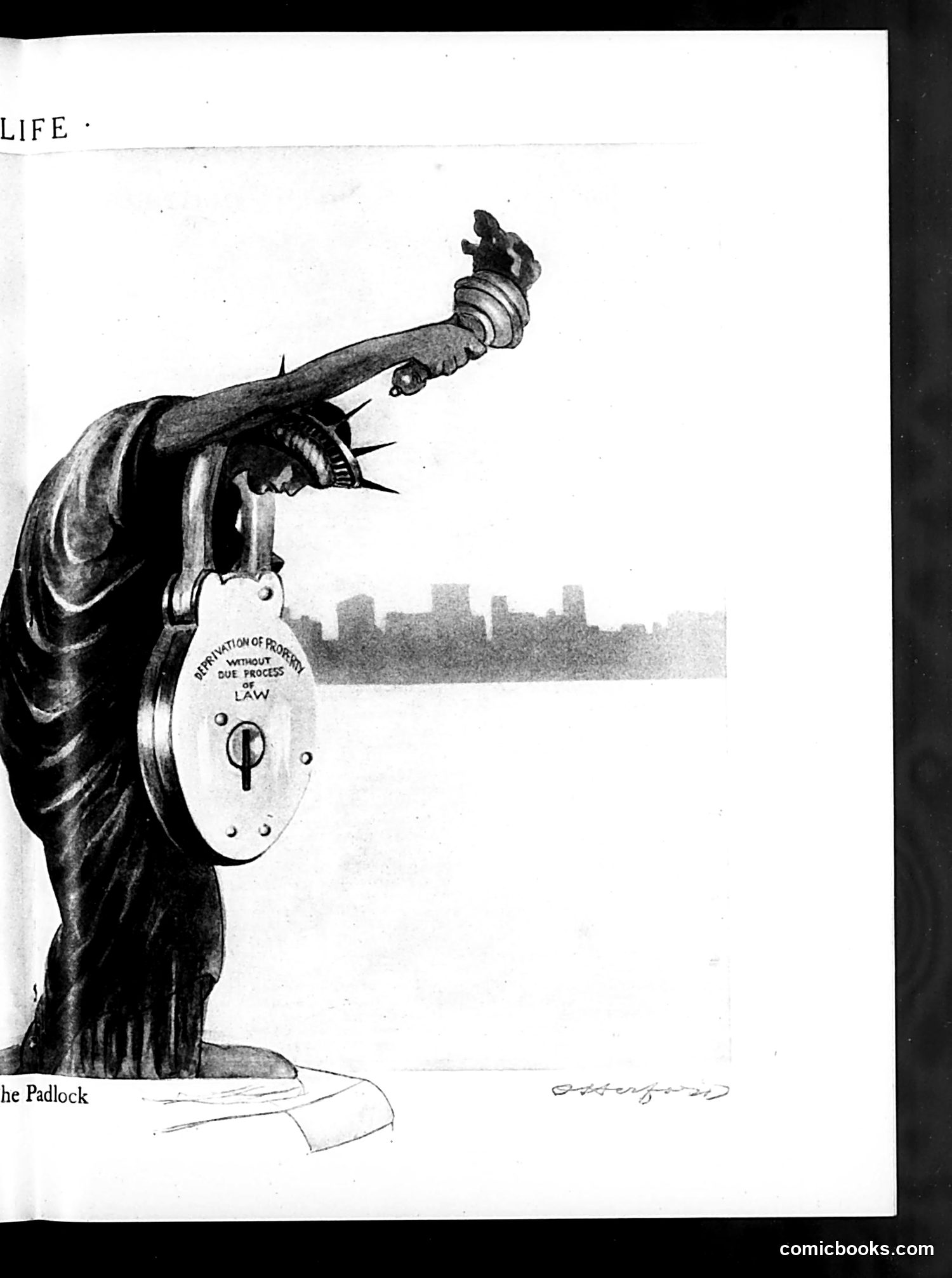
This appears to be a political cartoon satirizing the deprivation of civil rights. Lady Liberty (identifiable by her torch and crown) holds a massive padlock inscribed with "DEPRIVATION OF PROPERTY WITHOUT DUE PROCESS OF LAW." The torch points toward a city skyline, suggesting American urban society. The cartoon critiques what it portrays as unconstitutional government action—specifically the denial of property rights and legal due process protections. The personification of Lady Liberty as the victim emphasizes that fundamental American freedoms are being violated or "locked away." Without the publication date visible, the specific historical reference remains unclear, but the imagery suggests protest against government overreach regarding constitutional guarantees. The satire contrasts American ideals of liberty with alleged authoritarian practices.
This is an editorial piece by Robert C. Benchley, Life's drama critic, addressing readers about theater criticism and expectations. The page contains no political cartoons—rather, it's satirical commentary on theatergoers themselves. **The Satire's Target:** Benchley mocks readers who take theater reviews as gospel truth, then blame the critic when they dislike a show. He ridicules their logic by comparing it to someone reading "corn on the cob is great food," trying it, disliking it, then accusing the food writer of bribery. **Key Points:** Benchley establishes that his column is "unreliable, inconsistent and temperamental"—intentionally humorous rather than authoritative. He also humorously insults readers' intelligence ("two-thirds of you sent back to the seventh grade"). The tone is self-aware and comedic, openly admitting critics may be biased or wrong, while suggesting readers bear responsibility for their own theater choices. The illustration shows five faces in silhouette—likely representing types of readers or critics, though their specific identities remain unclear from the image alone.
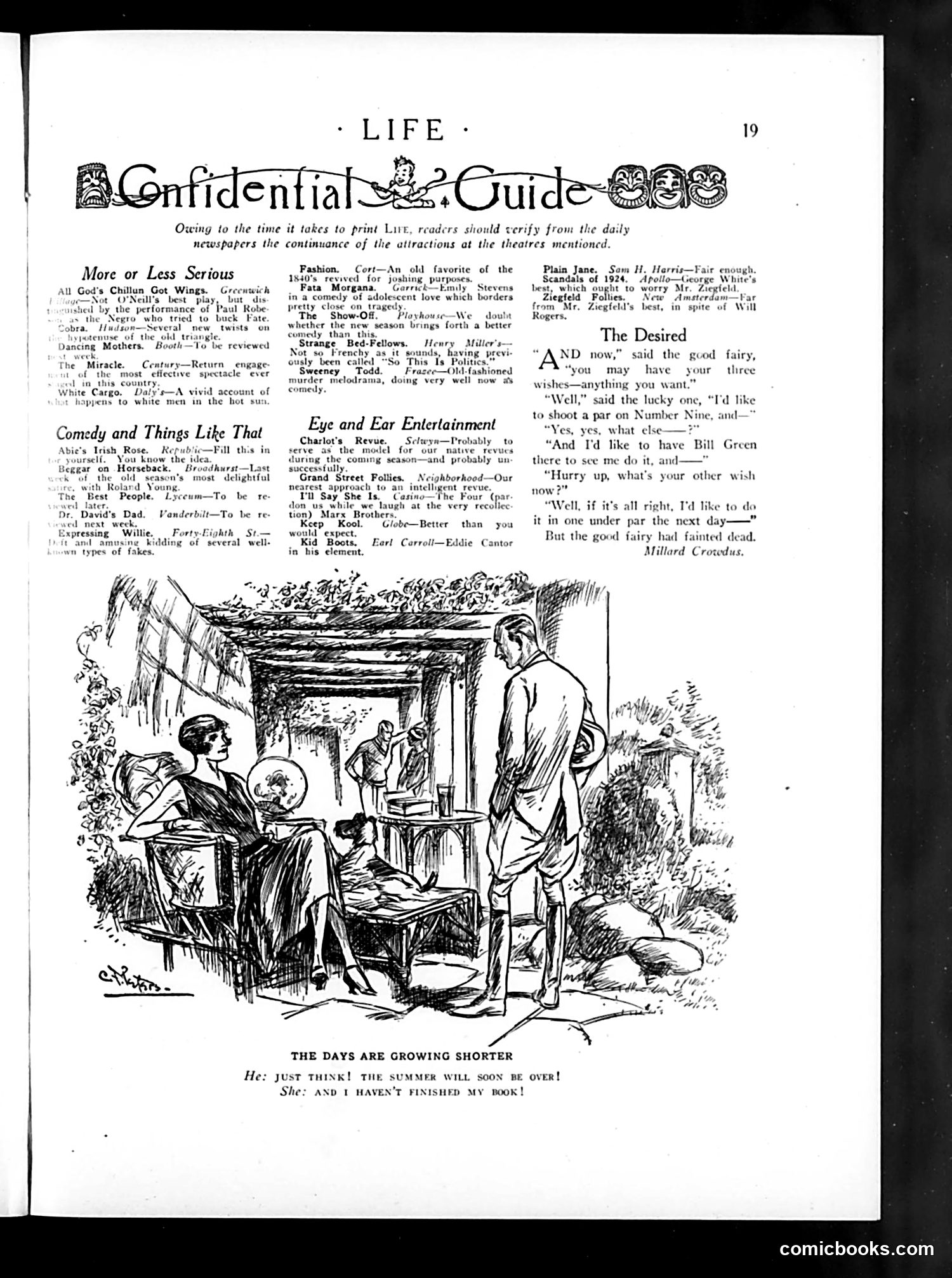
This page from *Life* magazine combines theatrical reviews with humorous cartoons and satirical commentary typical of the 1920s. **The Main Cartoon ("The Days Are Growing Shorter"):** depicts a couple at a seaside cottage. The man laments summer's end; the woman counters that she hasn't finished her book. The joke satirizes gender roles and leisure—it presents the contrast between male concern with seasonal activities versus female absorption in reading, likely poking fun at both partners' preoccupations. **The "Desired" Story:** A brief fairy-tale satire where a woman wishes for three things: to shoot par on a golf hole and do it in one under par the next day. The punchline—the fairy faints—mocks the absurdity of the wish, perhaps satirizing women's newfound interest in golf during the 1920s. **Theater Reviews:** The page lists Broadway productions with brief critical comments, including plays featuring Paul Robeson and the Marx Brothers, reflecting 1920s theatrical offerings and contemporary entertainments.
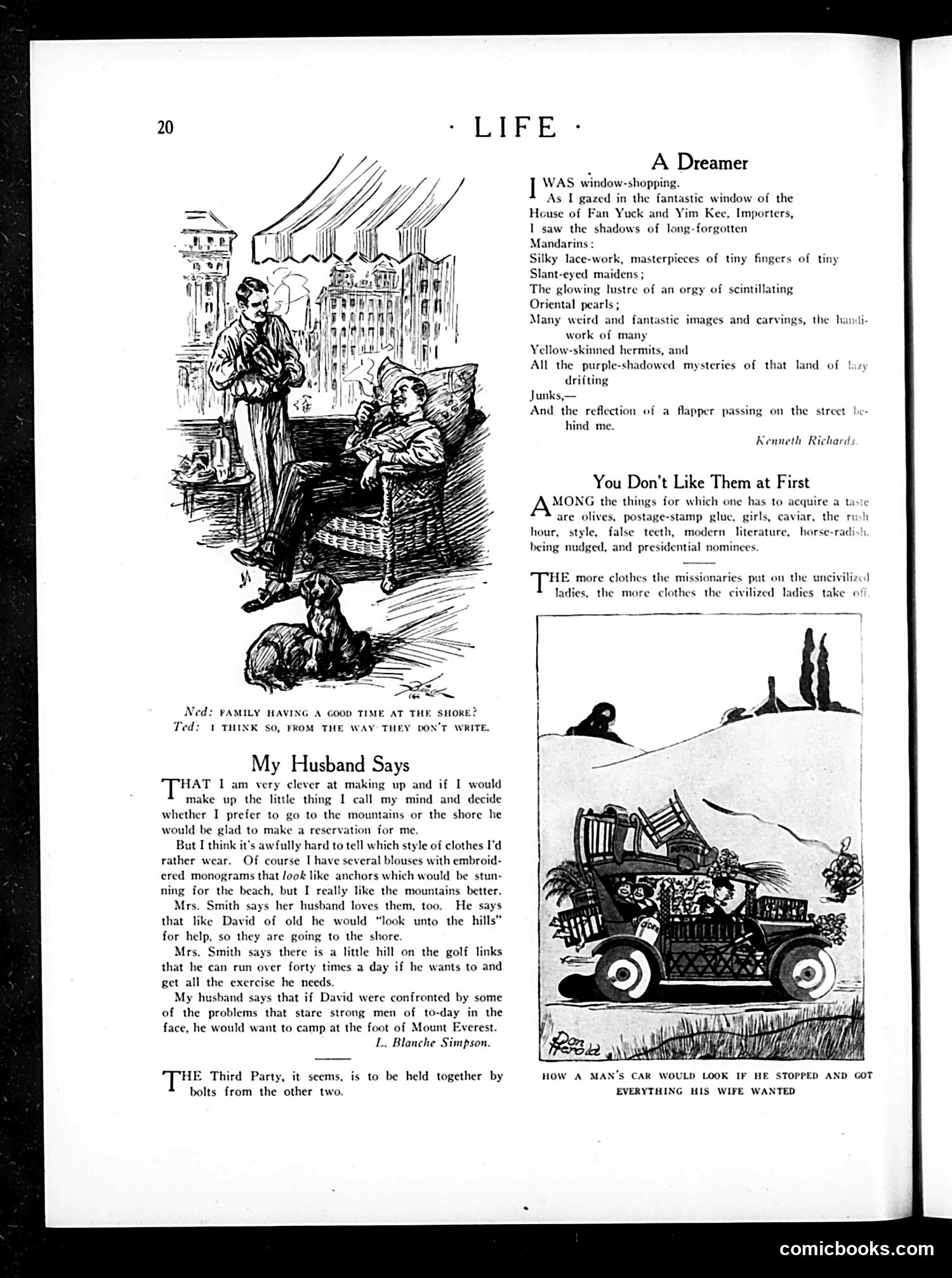
This page contains early 20th-century American humor pieces satirizing contemporary social customs. **"A Dreamer"** (Richards): Mocks romanticized views of Asian exoticism. A window-shopper admires imported Chinese luxury goods and "Oriental mysteries," only to have the fantasy disrupted by seeing a modern American "flapper" reflected in the glass—contrasting exotic romanticism with contemporary reality. **"You Don't Like Them at First"**: A brief social commentary suggesting that refined tastes (olives, caviar, modern literature) require acquired appreciation—including presidential nominees, implying skepticism about current political leadership. **"My Husband Says"** (Simpson): Satirizes married couples' decision-making, particularly wives' indecision about vacation destinations and clothing choices. The humor targets women's perceived inability to commit to preferences, while husbands remain patient (or resort to religious/mountain references). **The car cartoon**: Illustrates marital compromise by depicting an absurdly overloaded automobile—visual joke suggesting a husband who granted his wife "everything" she wanted would end up with an impractical, comically cluttered vehicle. All pieces reflect period gender dynamics and marital stereotypes typical of 1920s-era humor.
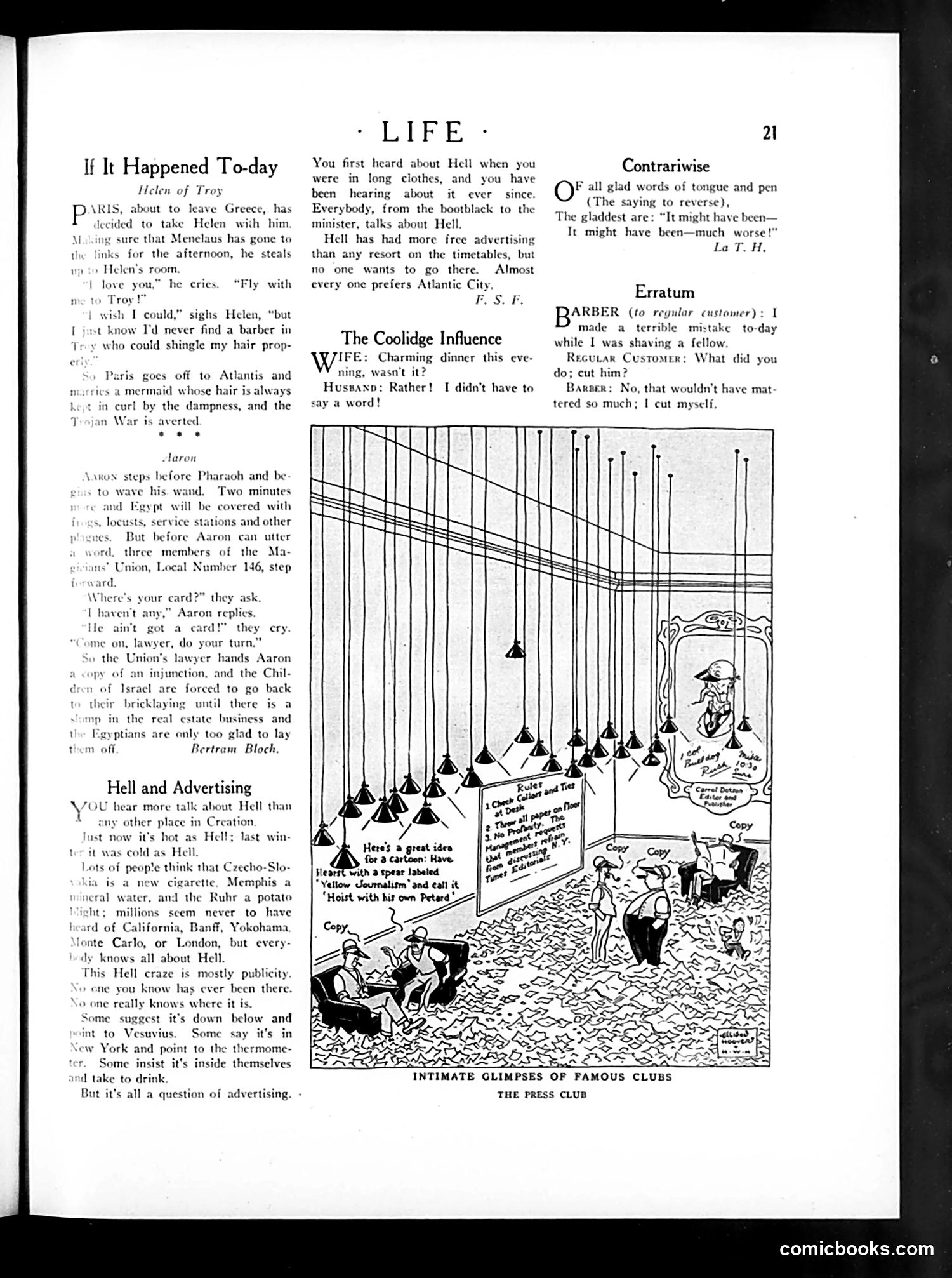
This page contains several satirical pieces mocking contemporary society through classical and biblical retellings: **"If It Happened To-day"** presents three humorous scenarios imagining famous historical events in modern times. The "Helen of Troy" segment jokes that Helen refuses to elope because she can't find a good barber—satirizing modern women's vanity and the prevalence of beauty services. The "Aaron" piece mocks labor unions by suggesting even Moses couldn't part the Red Sea without union authorization and proper cards. These pieces ridicule modern bureaucracy and commercial culture by imposing them on ancient narratives. **"Hell and Advertising"** satirizes how Hell has become culturally ubiquitous through constant talk and reference, receiving more "advertising" than actual vacation destinations, yet nobody wants to visit it. This critiques American advertising's pervasiveness and irrationality. **"The Coolidge Influence"** appears to joke about President Coolidge's famously taciturn nature, suggesting one needn't speak at dinner parties. The large cartoon at bottom illustrates "The Press Club," depicting journalists in a crowded, chaotic setting—likely satirizing newspaper culture.
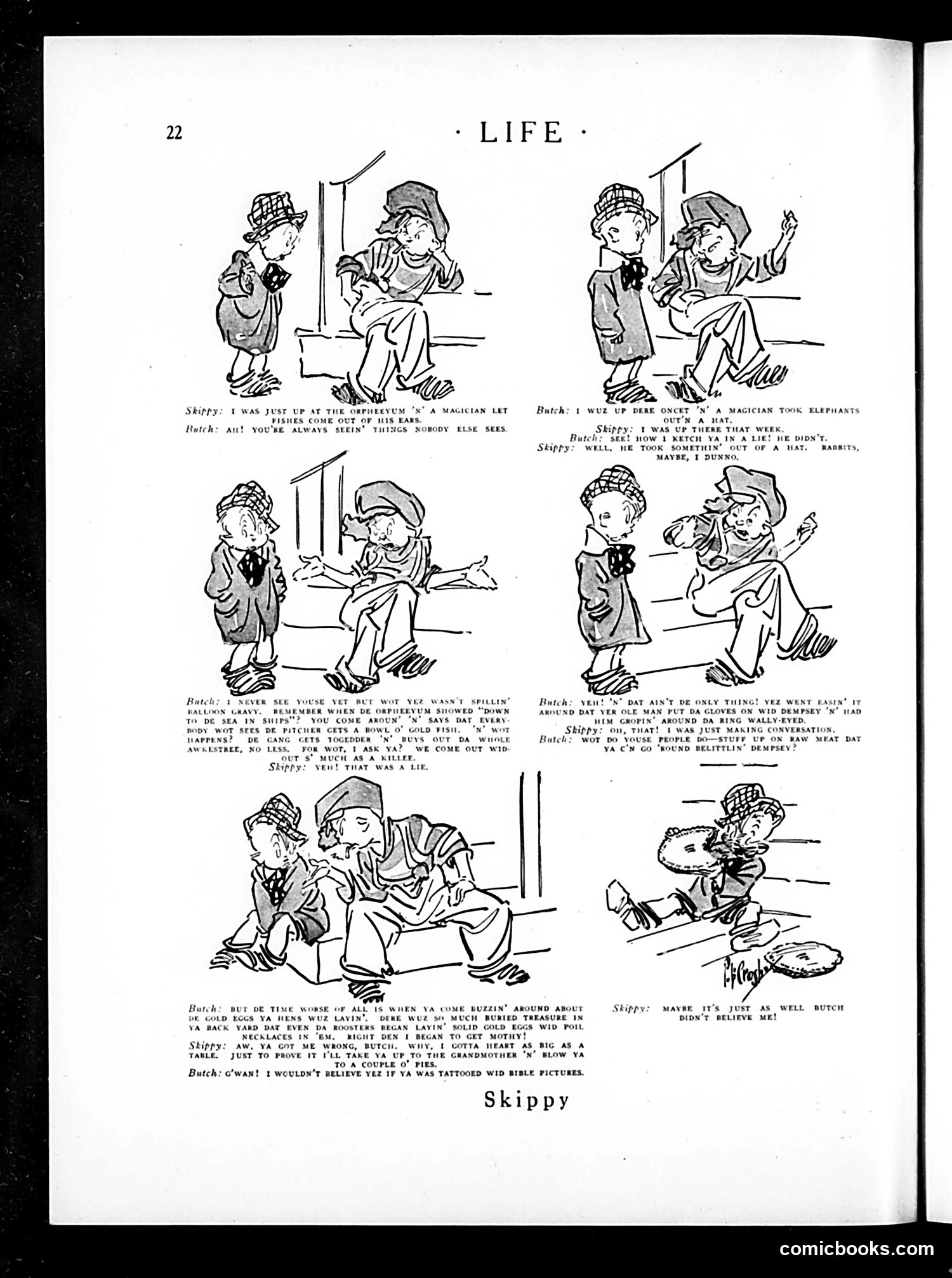
This is a humorous comic strip about two young boys, Skippy and Butch, engaging in a classic childhood dynamic: one boy (Skippy) is a chronic exaggerator and liar, while the other (Butch) has grown skeptical of his tall tales. Skippy boasts about seeing magic tricks at the Orpheum theater and claims his family has buried treasure and gold-laying chickens in their yard. He even fabricates a story about his father fighting boxer Jack Dempsey. Butch repeatedly calls him out, declaring he wouldn't believe Skippy "if ya was tattooed wid bible pictures." The satire targets not specific political figures but rather universal childhood behavior—the compulsive storyteller who embellishes experiences to impress peers, and his friend's justified distrust. The thick working-class dialect and references to contemporary entertainments (vaudeville, Dempsey boxing) ground it in early 20th-century American urban life. The joke's appeal lies in its relatability across generations.
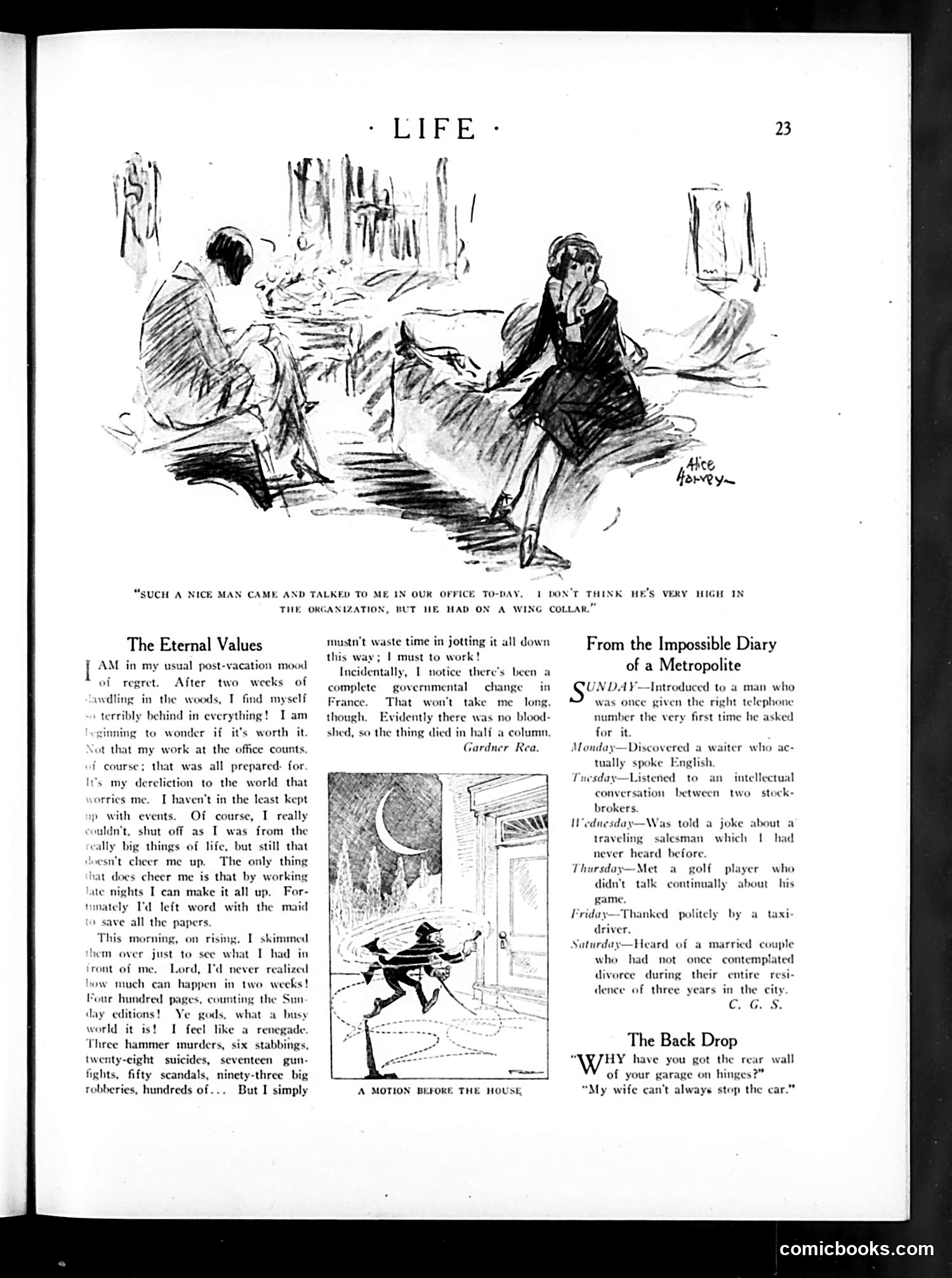
This page contains several satirical pieces mocking urban life and bureaucratic absurdity: **Main Cartoon (top):** A woman tells a colleague that a visitor "had on a wing collar"—implying his formal dress was his only qualification despite lacking organizational competence. This mocks how superficial appearance can substitute for actual merit in office culture. **"The Eternal Values":** A writer returning from vacation is overwhelmed by two weeks of accumulated newspapers cataloging disasters (murders, suicides, robberies). The satire critiques both the sensationalism of news coverage and modern anxiety about staying informed—he notes a complete French government change "won't take me long" because it caused no bloodshed, suggesting the press only values violent, dramatic events. **"Impossible Diary":** Lists absurdly improbable urban encounters (a taxi driver, English-speaking waiter, non-gossiping golfer), mocking metropolitan life's general incompetence and unpleasantness. **"The Back Drop":** A husband explains his garage door on hinges accommodates his wife's poor parking skills—a domestic joke about women drivers. The page's unifying theme: modern life's frustrations, incompetence, and sensationalism.
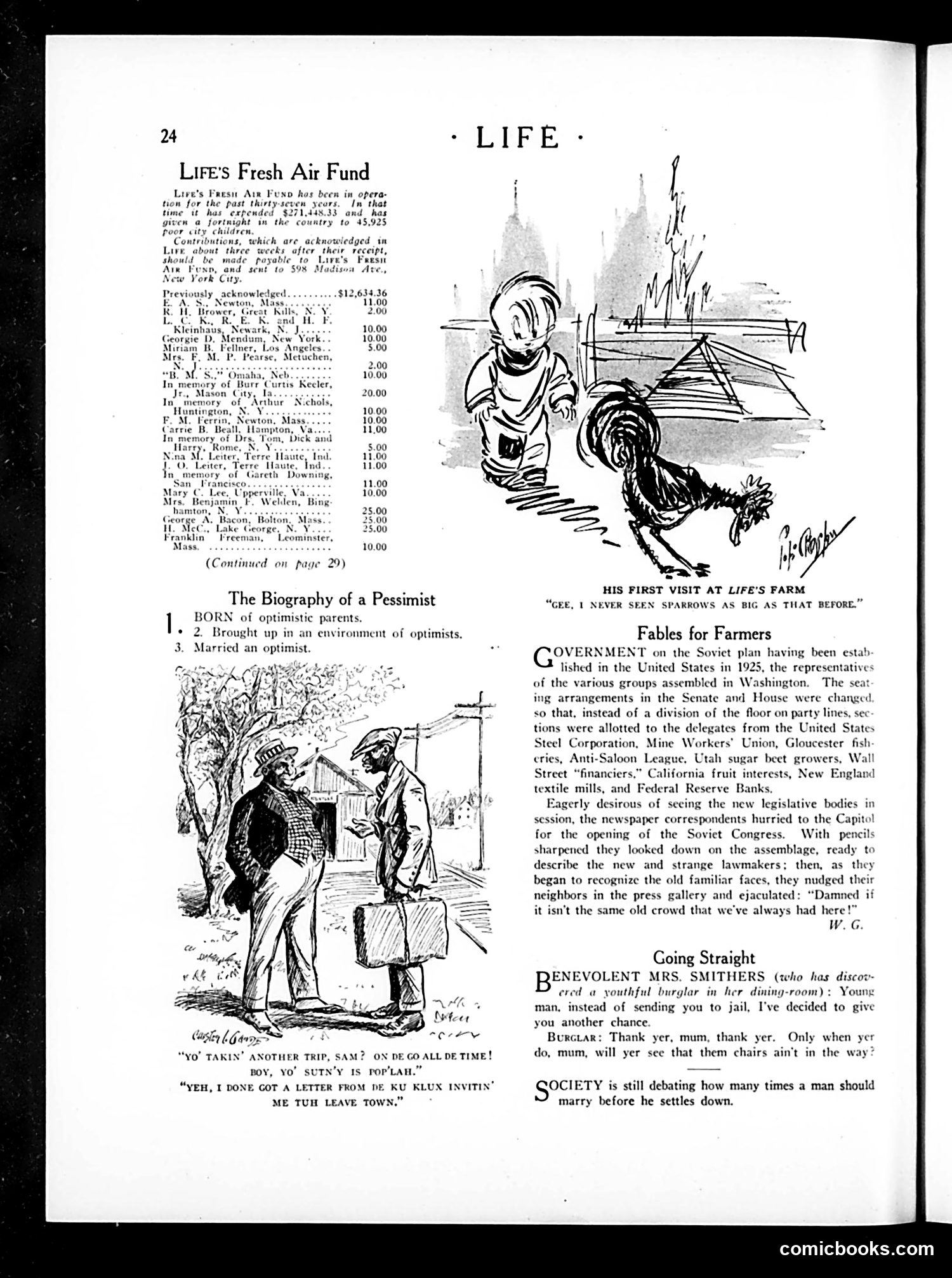
This page contains several satirical pieces targeting 1920s American society: **"The Biography of a Pessimist"** (left cartoon): A three-panel joke about how pessimism runs in families—born to optimists, raised by optimists, marries an optimist, yet remains pessimistic regardless. The accompanying illustration shows two men discussing travel. **"His First Visit at Life's Farm"** (top right): A Black man (drawn in period racist caricature style) expresses amazement at seeing large sparrows, suggesting rural naiveté. This reflects the era's offensive comedic stereotyping. **"Fables for Farmers"** (center-right): A satirical piece mocking a hypothetical Soviet-style government established in America by 1925. It jokes that despite reorganizing Congress by industry groups rather than political parties, "the same old crowd" of familiar politicians remain in power—suggesting that structural reform cannot dislodge entrenched power. **"Going Straight"** and **"Society"** (bottom): Brief humorous observations about crime and marriage trends. The page reflects Life's role as a satirical magazine targeting politics, social pretension, and contemporary events.
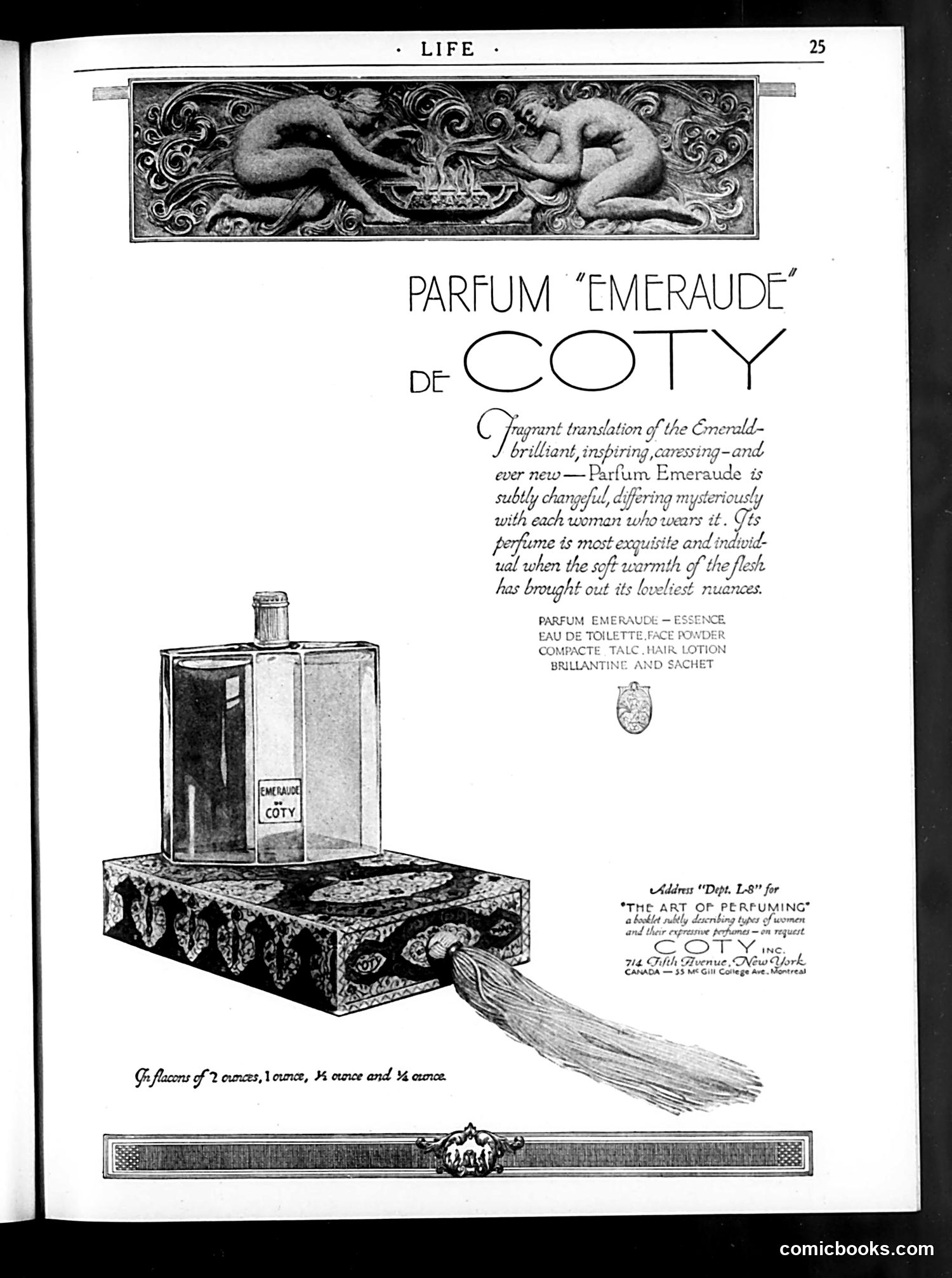
This is **a perfume advertisement**, not a cartoon or satire. It promotes "Parfum Emeraude" by Coty, a real fragrance brand. The page features ornamental classical imagery (cherubs at top) and an elaborate decorative bottle presentation on a tasseled cushion—typical luxury advertising aesthetics of the early 20th century. The text uses flowery, mystical language common to perfume marketing, claiming the scent "differs mysteriously with each woman who wears it" and becomes "most exquisite" when warmed by skin. There is no political commentary or satirical intent here. This is straightforward commercial advertising in *Life* magazine, which regularly published both humor and advertisements. The decorative, sensual presentation reflects period conventions for marketing luxury goods to women, emphasizing mystery, individuality, and feminine allure.
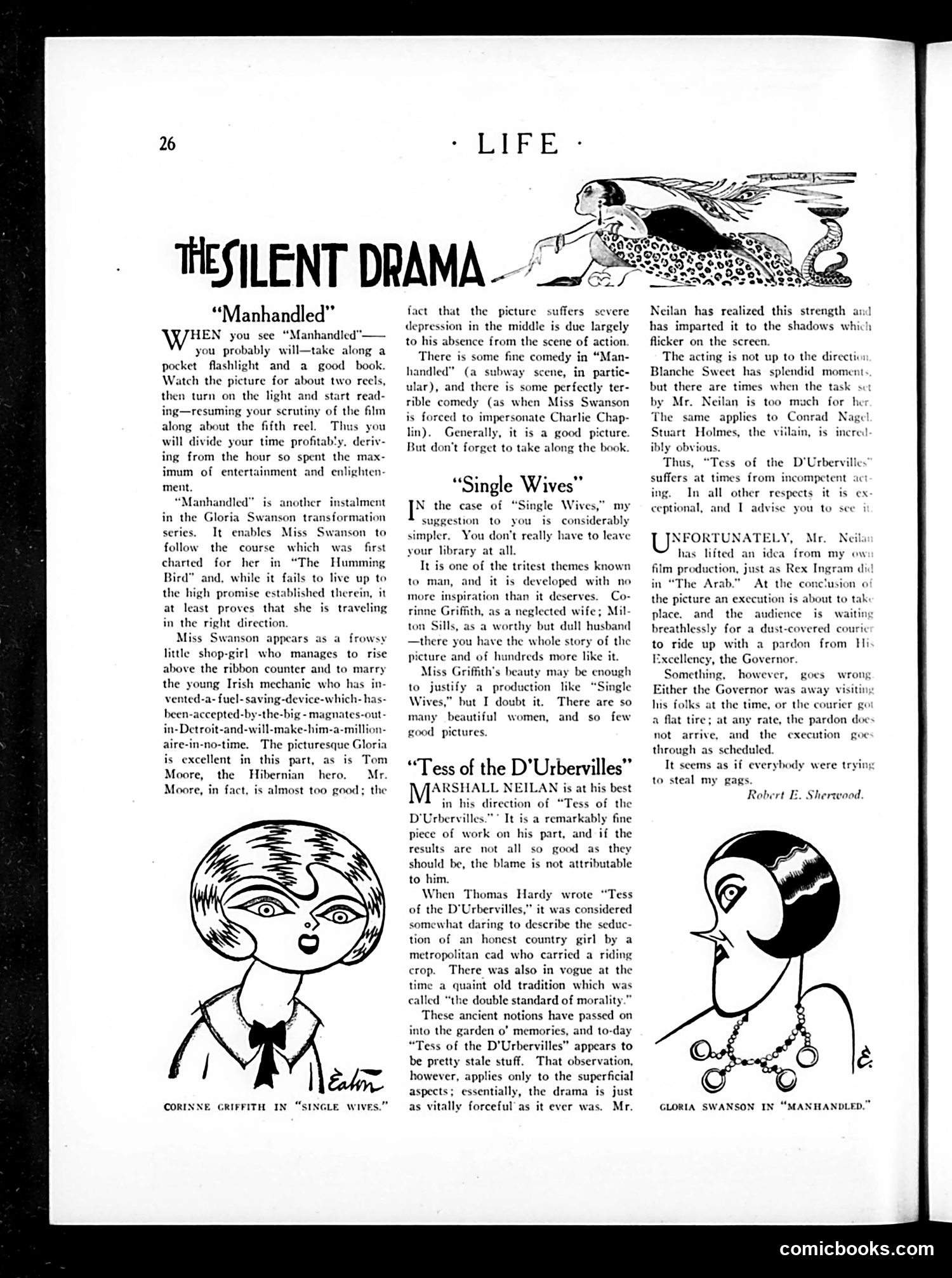
This page reviews three silent films, with particular emphasis on **Gloria Swanson's "Manhandled."** The reviewer jokes that audiences should bring a flashlight and book—suggesting the film is so dull that you can read during the middle sections without missing anything important. The other reviews are briefer: "Single Wives" is dismissed as tiresome melodrama with a neglected-wife plot, despite star Corinne Griffith's beauty. "Tess of the D'Urbervilles," directed by Marshall Neilan and starring Blanche Sweet, receives qualified praise for direction but criticism for uneven acting. The cartoons show caricatured head studies of actresses in period style—typical Life magazine illustration. The broader satire targets Hollywood's formula filmmaking: beautiful actresses recycled through predictable plots. The reviewer's sardonic tone reflects 1920s highbrow skepticism toward commercial cinema, even while acknowledging Swanson's talent.
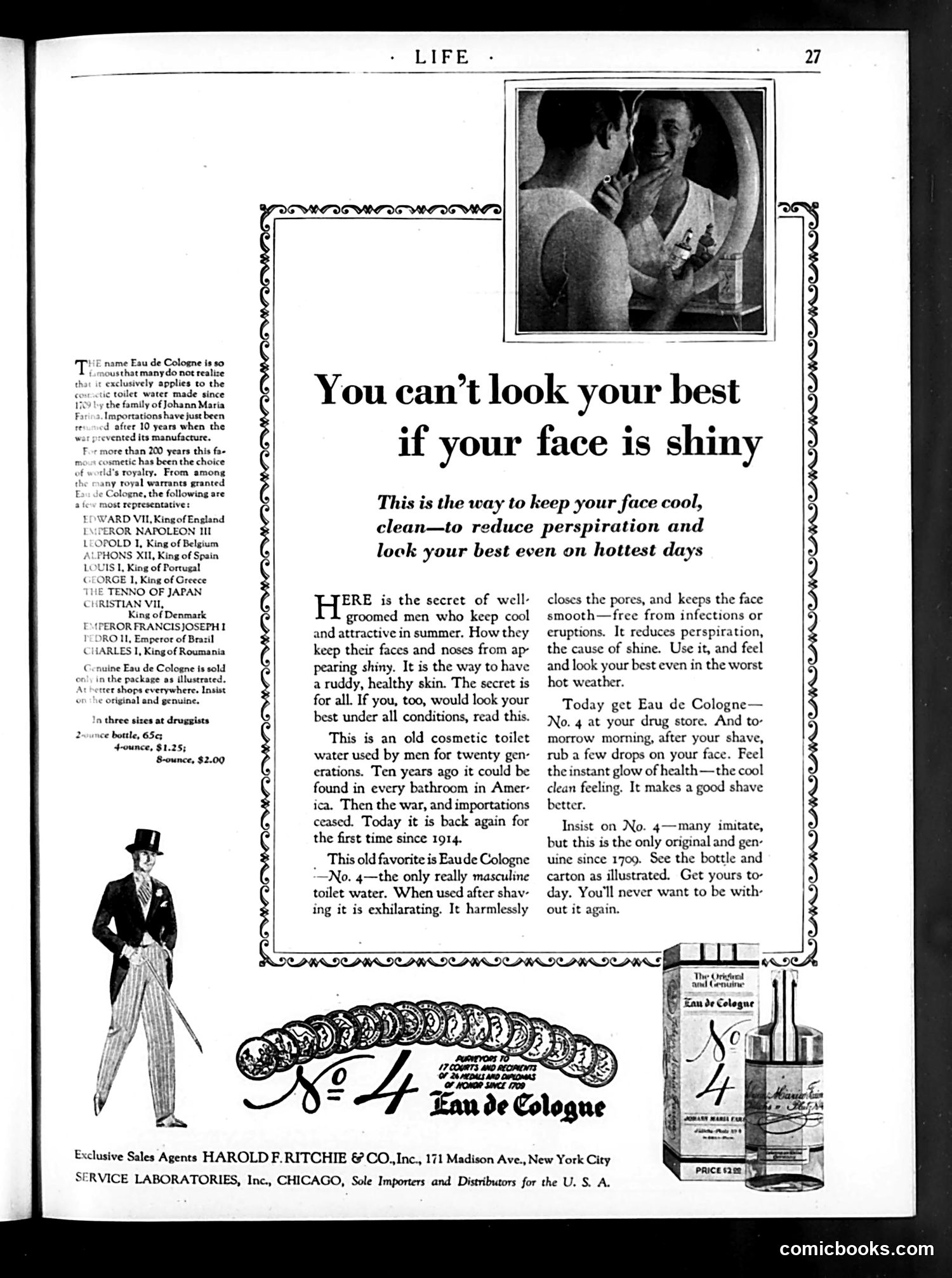
This is primarily a **product advertisement**, not political satire. The page promotes Eau de Cologne No. 4, a men's toilet water, capitalizing on its return to the American market after a decade-long absence due to World War I import restrictions. **Key selling points highlighted:** - Reduces facial shine and perspiration ("you can't look your best if your face is shiny") - Used by European royalty for 200+ years (lists kings of England, Belgium, Spain, Portugal, Greece, Japan, Denmark, and emperors) - Original formula since 1709 - Practical benefits: closes pores, prevents infections, improves shaving **The imagery** shows a well-groomed man in formal attire (top hat, cane) and a bathroom mirror scene, reinforcing masculine grooming. The advertisement's nostalgia—emphasizing pre-war availability and royal prestige—exploits post-WWI consumers' desire for restored European sophistication and normalcy. This reflects 1920s advertising's emphasis on personal hygiene, class aspiration, and masculine self-presentation.
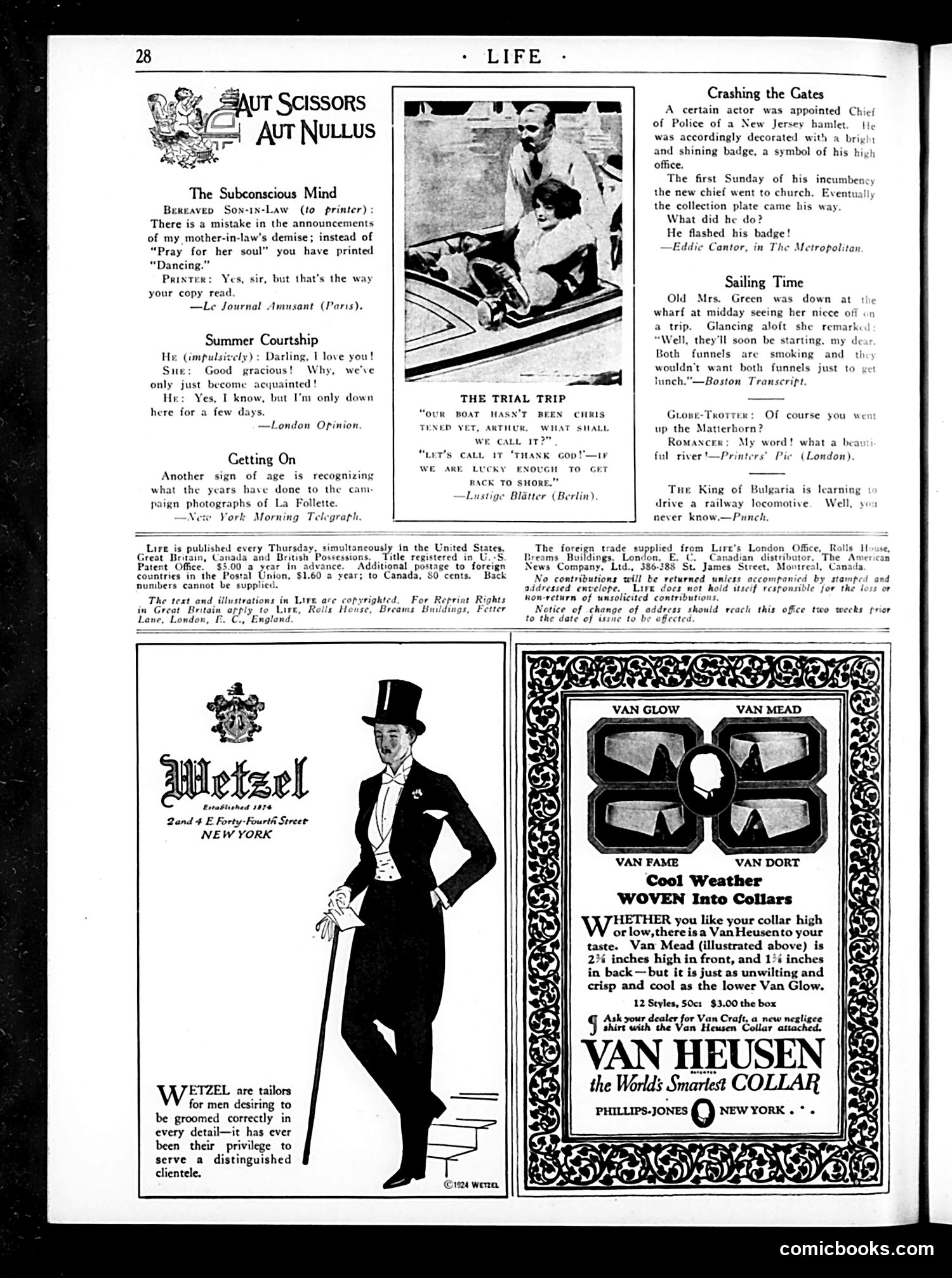
This page from Life combines satirical anecdotes with period advertisements. The humor pieces are brief social observations typical of early 20th-century magazines: **"Crashing the Gates"** jokes about an actor appointed police chief in New Jersey who, attending church his first Sunday, removes his badge to donate it to the collection plate—satirizing vanity and performative authority. **"The Trial Trip"** features a couple christening their boat, deciding to name it "Thank God"—if they're lucky enough to return to shore. It mocks nautical anxiety and optimism. **"Summer Courtship"** plays on impulsive romantic declarations with only brief acquaintance. The page is largely dominated by **advertisements**: Wetzel tailors (emphasizing precision tailoring for gentlemen), and Van Heusen collars (promoting various collar styles for different preferences). These ads reflect 1920s-era men's fashion marketing. The references to Eddie Cantor and various publications (Boston Transcript, Punch) indicate this draws humor from contemporary sources. The overall tone is lighthearted social commentary aimed at middle-class readers.
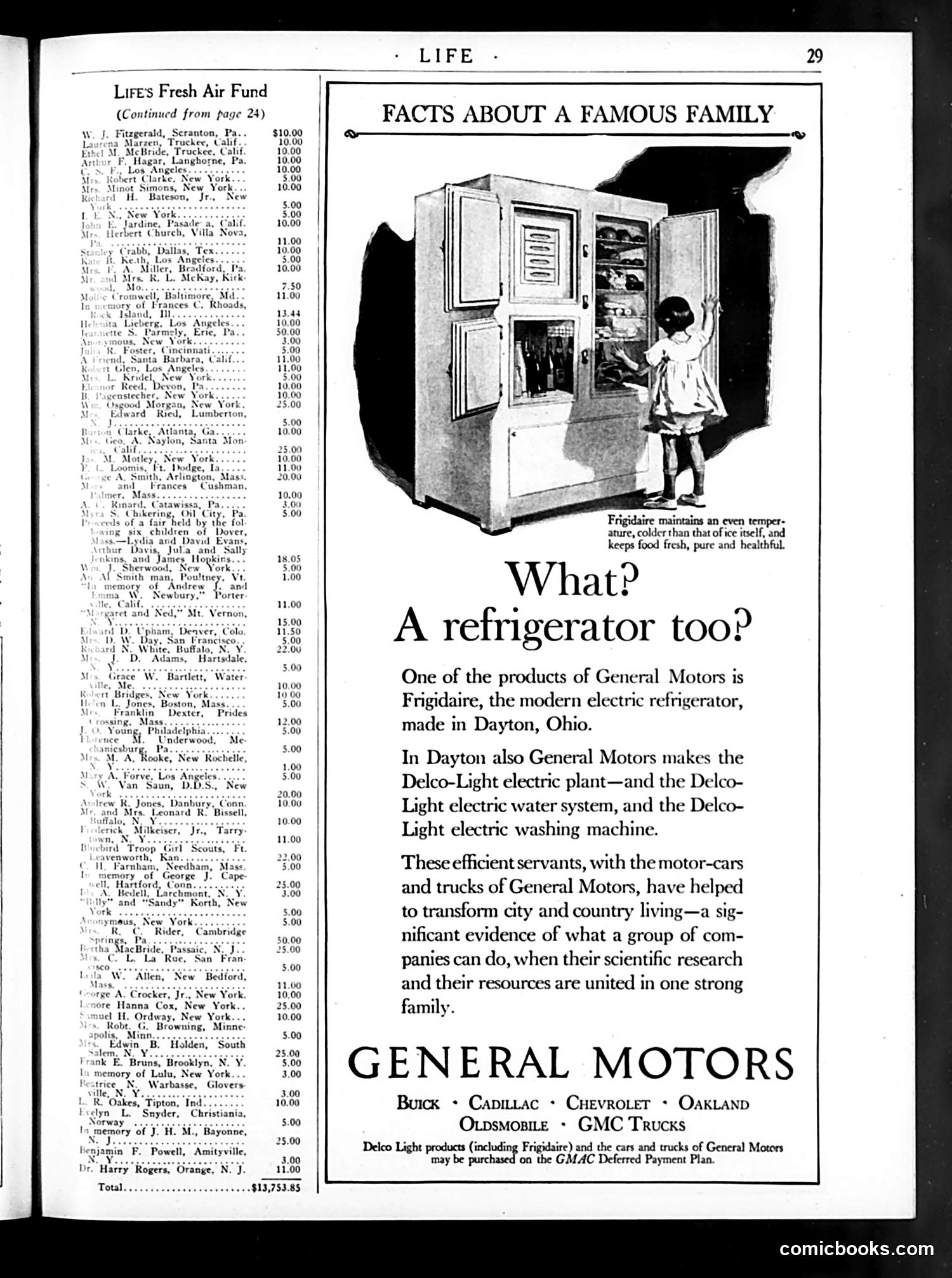
This page is primarily a **General Motors advertisement** disguised as editorial content, not a political cartoon. The advertisement features an illustration of a Frigidaire electric refrigerator with a child examining its open doors. The accompanying text promotes General Motors' diverse product line—Frigidaire refrigerators, Delco-Light electric plants and water systems, washing machines, and automobiles—presenting them as evidence of what unified scientific research and corporate resources can accomplish. The rhetorical strategy frames General Motors as a "family" of companies transforming "city and country living." The left column shows LIFE's Fresh Air Fund donation list (charitable contributions), creating editorial legitimacy for the commercial message. This represents early 1920s corporate advertising strategy: positioning consumer appliances and automobiles as markers of modernization and improved living standards, while celebrating American industrial consolidation.
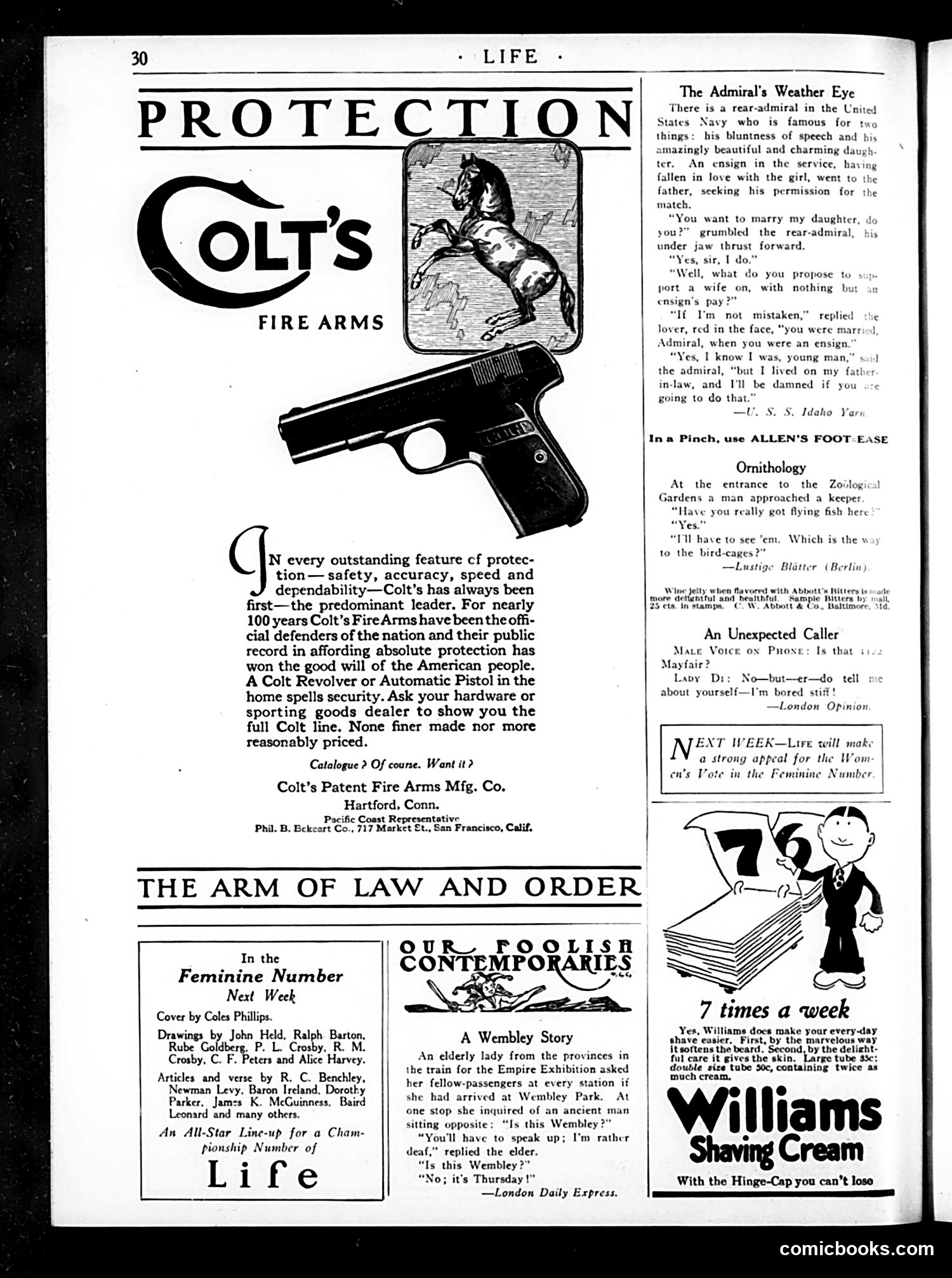
This page mixes advertisements with humor pieces typical of early 20th-century Life magazine. **Main Content:** "The Admiral's Weather Eye" is a joke about a rear-admiral's hypocrisy. A young naval ensign seeks permission to marry the admiral's daughter but lacks financial means. The admiral refuses, claiming he couldn't support a wife on an ensign's salary. The ensign points out the admiral *himself* married as an ensign. The admiral's angry response—he lived off his father-in-law and won't allow the suitor to do the same—reveals his unwillingness to admit to similar humble circumstances. The humor lies in the admiral's bluff being called. Other brief jokes mock absurd questions ("flying fish" at a zoo) and social pretension (a naval officer bored by conversation). **Advertising:** The Colt's firearms advertisement emphasizes the brand's 100-year history and reliability for home security and law enforcement. Williams Shaving Cream advertises efficacy and value. **Context:** Life was known for satirizing social hypocrisy and class pretension through short anecdotes and humorous observations.
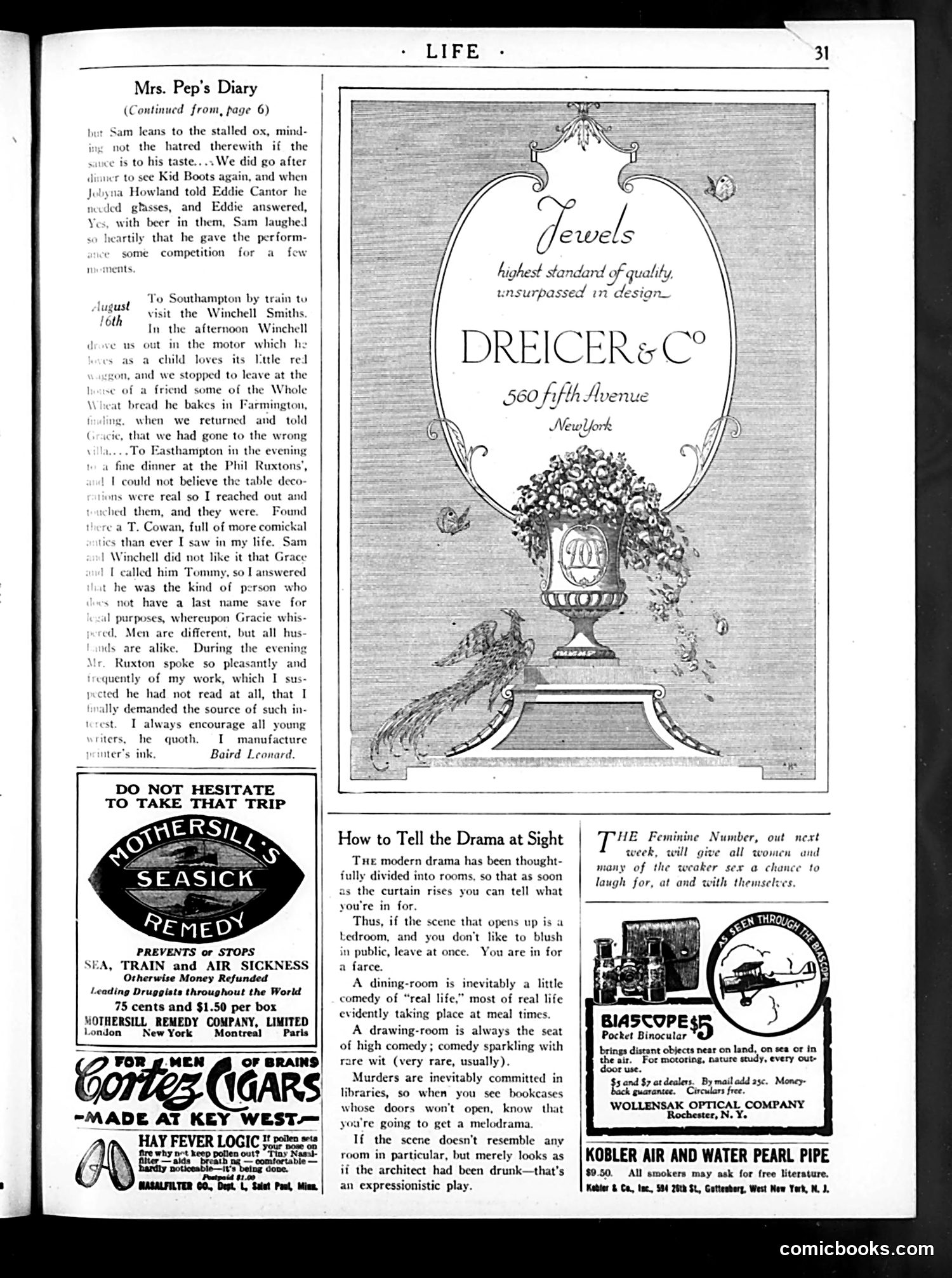
This page features a serialized humorous diary entry by "Mrs. Pep" describing her social outings in what appears to be the 1920s. She recounts visits to see the musical *Kid Boots* (starring Eddie Cantor), trips to Southampton, and dinner parties with the Winchell Smiths and Phil Ruxtons. The humor derives from her observations of society figures and their pretensions—particularly a character named T. Cowan whom she finds excessively comical, and her playful skepticism about a host's excessive compliments regarding her writing. The entry ends with a quip from Baird Leonard about manufacturing printer's ink, emphasizing literary life among the leisure class. The page is primarily dominated by period advertisements (Mothersill's seasickness remedy, cigars, hay fever devices, jewelry) and an article titled "How to Tell the Drama at Sight," which satirically categorizes stage plays by their settings—bedrooms mean farce, dining-rooms mean comedy, libraries mean melodrama.
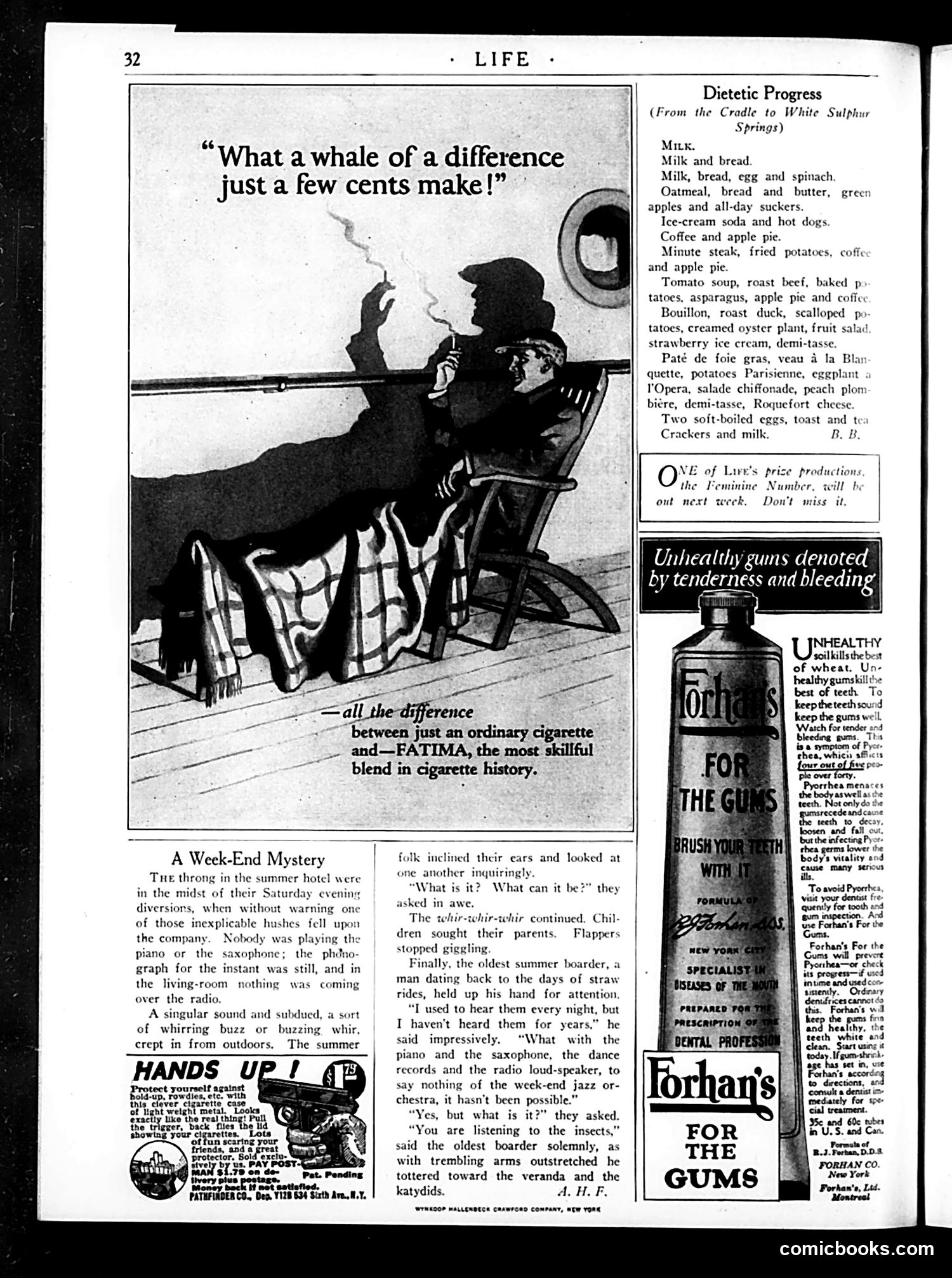
This page contains multiple advertisements and satirical content typical of early 20th-century Life magazine: **Main Cigarette Advertisement:** The large illustration depicts a man relaxing on a beach chair, promoting Fatima cigarettes. The tagline claims that small price differences create major quality distinctions—a common marketing strategy of the era that appealed to consumers' desires for sophistication at modest cost. **"A Week-End Mystery":** This brief humorous story plays on the novelty of modern technology. Summer hotel guests are startled by an unfamiliar sound—eventually revealed to be insects (katydids). The joke satirizes how contemporary noise (radio, phonographs, orchestras) has made people forget natural sounds. An elderly boarder represents pre-modern memory. **Right Column:** Contains "Dietetic Progress," a satirical chart tracking changing diets from infancy through adulthood, and advertisements for dental products (Forhan's toothpaste and "For the Gums" product), which address gum disease concerns common to the period. The page reflects early 20th-century concerns: consumer culture, technological novelty, and health anxieties.
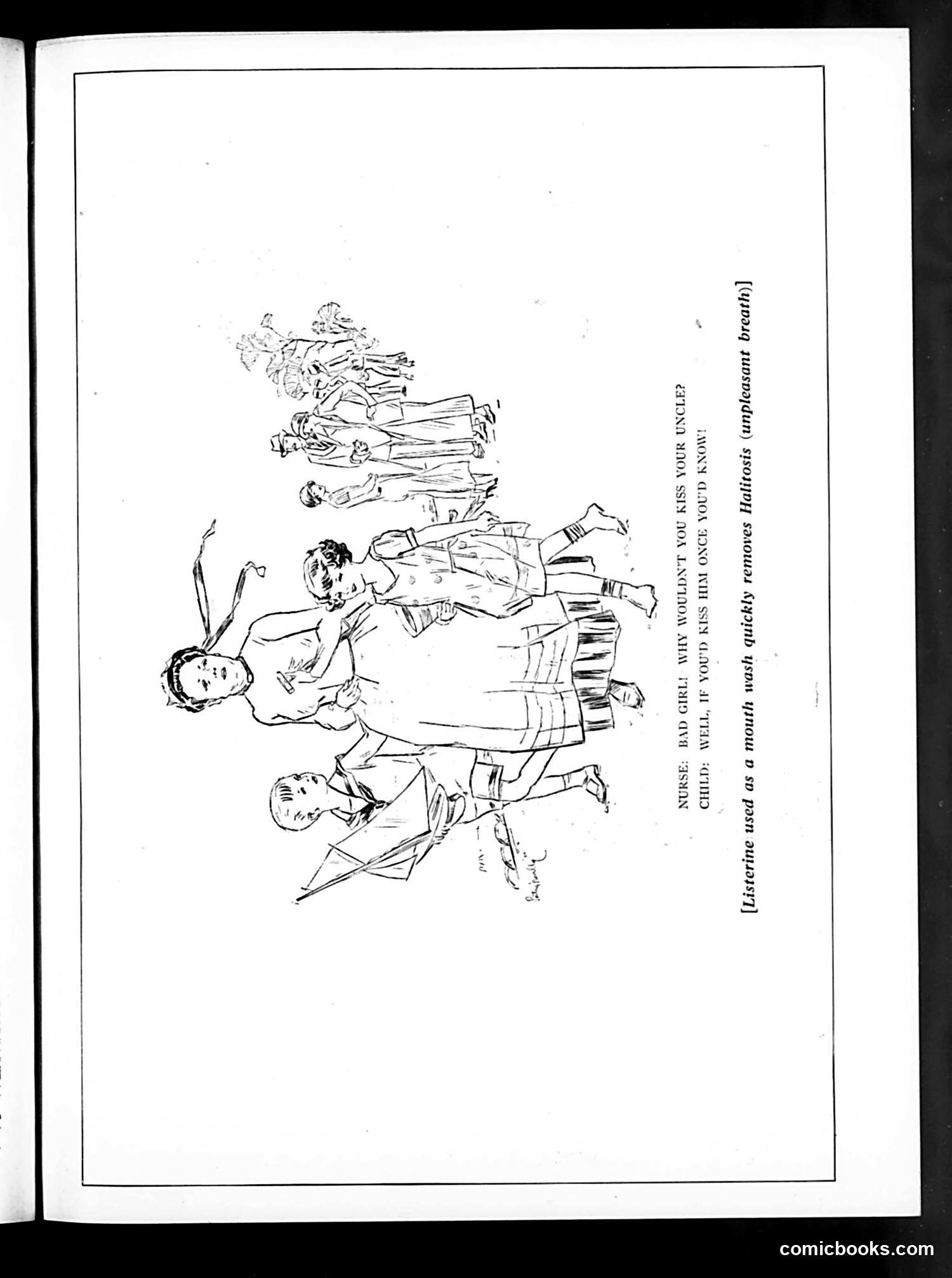
I cannot reliably interpret this page. The OCR text appears heavily corrupted and reads backwards or scrambled, making it illegible. The image itself shows a sketch-style illustration of what appears to be figures in period clothing, with several people depicted, but without legible caption text I cannot confidently identify who they represent or what political/social satire is intended. To properly explain this cartoon's meaning to a modern reader, I would need either: clearer OCR text, the original caption, or additional context about the publication date and Life magazine's editorial focus during that period. I cannot responsibly guess at the satirical point without these supporting details.
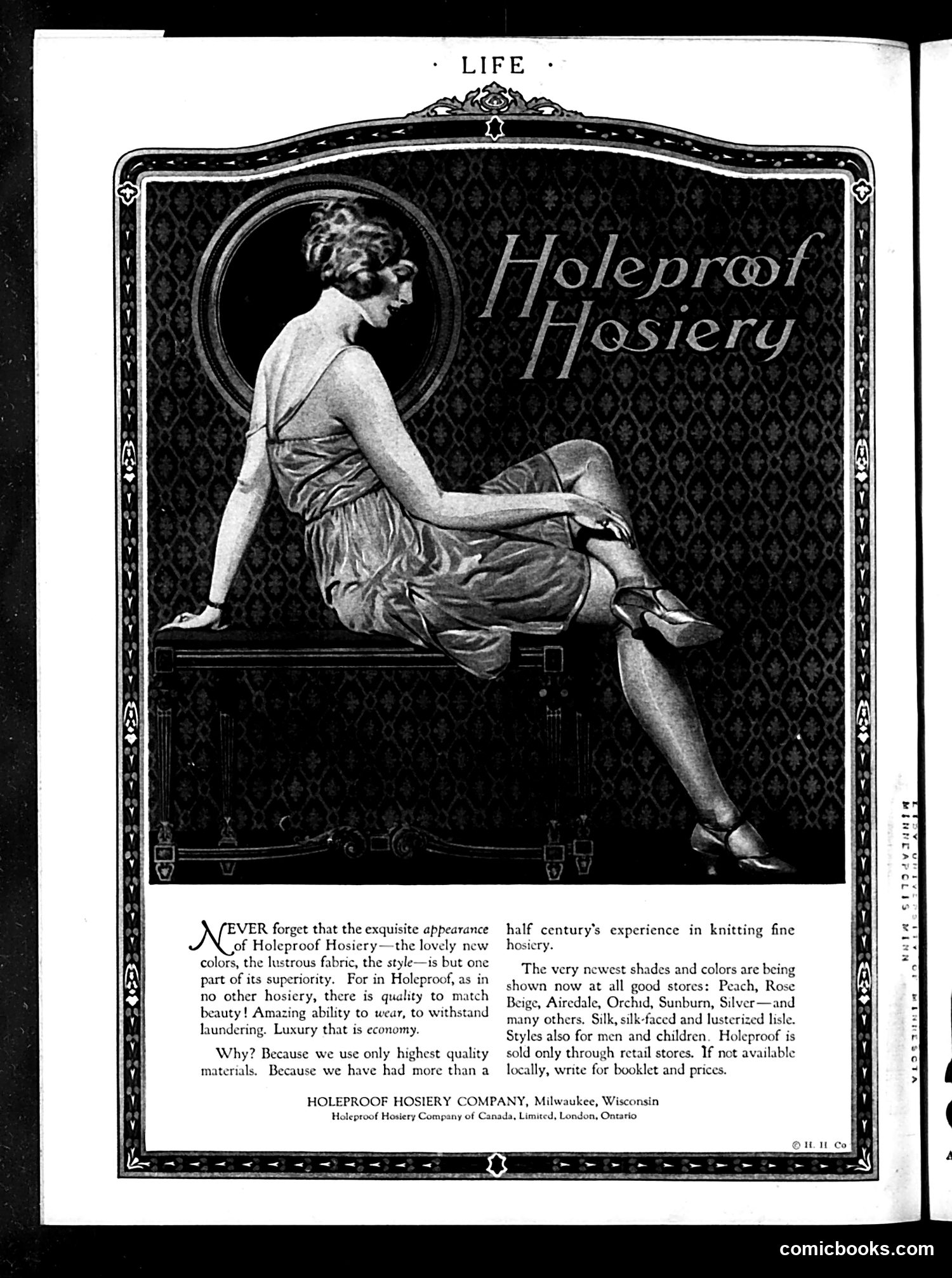
This is a **straightforward product advertisement**, not satire or political commentary. It promotes Holeproof brand hosiery (stockings) from Milwaukee, Wisconsin, featuring an elegant woman in period dress seated and displaying her legs and footwear. The ad emphasizes quality and durability—the brand name itself promises stockings that are "holeproof" (won't develop runs or holes). The marketing pitch highlights new fashion colors (Peach, Rose, Beige, Orchid, Sunburn, Silver) and materials (silk, silk-faced, lusterized Isle). The ornate Art Deco-style border and refined illustration reflect early 20th-century advertising aesthetics. This appears to be a typical **LIFE magazine advertisement** from the 1920s-1930s era, when the magazine mixed satirical content with fashion and consumer product ads aimed at middle and upper-class readers.