
Life, 1924-08-21 · page 28 of 36
Life — August 21, 1924 — page 28: what you’re looking at
What you’re looking at
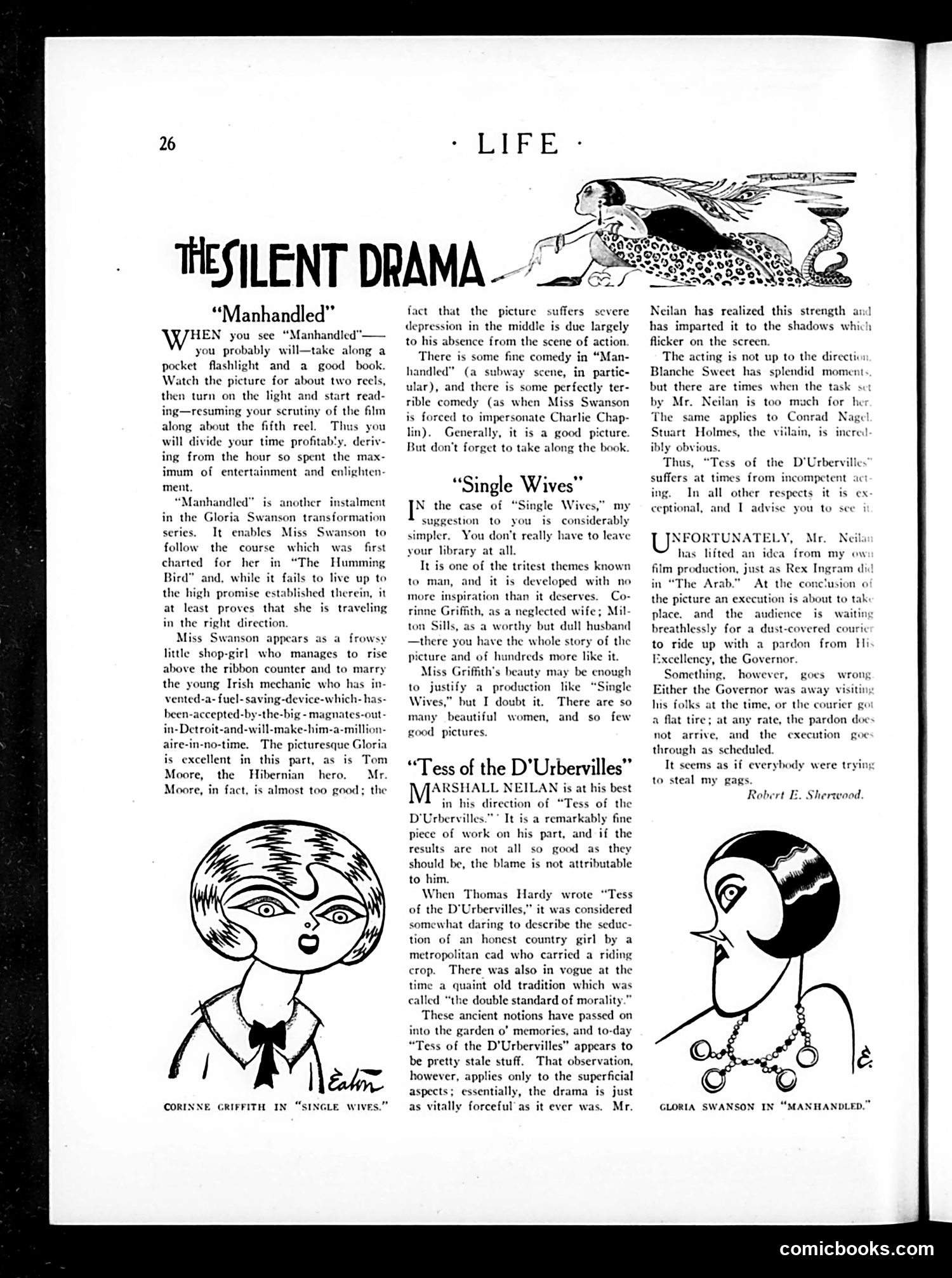
This page reviews three silent films, with particular emphasis on **Gloria Swanson's "Manhandled."** The reviewer jokes that audiences should bring a flashlight and book—suggesting the film is so dull that you can read during the middle sections without missing anything important. The other reviews are briefer: "Single Wives" is dismissed as tiresome melodrama with a neglected-wife plot, despite star Corinne Griffith's beauty. "Tess of the D'Urbervilles," directed by Marshall Neilan and starring Blanche Sweet, receives qualified praise for direction but criticism for uneven acting. The cartoons show caricatured head studies of actresses in period style—typical Life magazine illustration. The broader satire targets Hollywood's formula filmmaking: beautiful actresses recycled through predictable plots. The reviewer's sardonic tone reflects 1920s highbrow skepticism toward commercial cinema, even while acknowledging Swanson's talent.
📄 Transcribed text from this page (OCR, searchable)
Machine-transcribed from the original scan — historical spelling and the odd misread are preserved.
TESILENT DRAMA —’ “Manhandled” WHEN you see “Manhandled”. you probably will—take along a pocket flashlight and a good book. Watch the picture for about two reels, then turn on the light and start read- ing—resuming your scrutiny of the film along about the fifth reel. Thus you will divide your time profitably, deriv- ing from the hour so spent the max- imum of entertainment and enlighten- ment. “Manhandled” is another instalment in the Gloria Swanson transformation series. It enables Miss Swanson to follow the course which was first charted for her in “The Humming Bird” and, while it fails to live up to the high promise established therein, it at least proves that she is traveling in the right direction. Miss Swanson appears as a frowsy litle shop-girl who manages to rise above the ribbon counter and to marry the young Irish mechanic who has in- vented-a- fuel- saving-device-which- has- been-accepted-by-the-big - magnates-out- in-Detroit-and-will-make-him-a-million- aire-in-no-time. The picturesque Gloria is excellent in this part, as is Tom Moore, the Hibernian hero. Mr. Moore, in fact, is almost too good; the fact that the picture suffers severe depression in the middle is due largely to his absence from the scene of action. There is some fine comedy in “Man- handled” (a subway scene, in. partic- ular), and there is some perfectly ter- rible comedy (as when Miss Swanson is forced to impersonate Charlie Chap- lin). Generally, it is a good picture. But don't forget to take along the be “Single Wives” N the case of “Single Wives,” my suggestion to you is y simpler. You don't really have to leave your library at all. It is one of the tritest themes known to man, and it is developed with no more inspiration than it deserves. Co- rinne Griffith, as a neglected wife; Mil- ton Sills, as a worthy but dull husband —there you have the whole story of the picture and of hundreds more like it. Miss Griffith's heauty may be enough to justify a production like “Single Wives,” but I doubt it. There are so many beautiful women, and so few good pictures, “Tess of the D'Urbervilles” ARSHALL NEILAN is at his best in his direction of “Tess of the D'Urbervilles.” * It is a remarkably fine piece of work on his part, and if the results are not all si should be, the blame i: to him. When Thomas Hardy wrote “Tess of the D'Urbervilles,” it was considered somewhat daring to describe the seduc- tion of an honest country girl by a metropolitan cad who carried a riding crop. There was also in vogue at the time a quaint old tradition which was called “the double standard of morality.” These ancient notions have passed on into the garden o' memories, and to-day “Tess of the D'Urbervilles” appears to be pretty stale stuff. That observation, however, applies only to the superficial aspects; essentially, the drama is just as vitally forceful’ as it ever was. Mr. considera good as they not attributable Neilan has realized this strength and has imparted it to the shadows which flicker on the screen. The acting is not up to the direction Blanche Sweet has splendid moment. but there are times when the task set by Mr. Neilan is too mach for he The same applies to Conrad Nagel Stuart Holmes, the viilain, is incre ibly obvious. Thus, “Tess of the D'Urbervilles suffers at times from incompetent act ing. In all other respects it is ex ceptional, and I advise you to sce i NFORTUNATELY, Mr. Neila has lifted an idea from my ow film production, just as Rex Ingram did in “The Arab.” At the conctusic the picture an execution is about to tak place. and the audience is waiting breathlessly for a dust-covered couric to ride up with a pardon from Hi Excellency, the Governor. Something, however, goes Either the Governor was a his folks at the time, or the courier go! a flat tire any rate, the pardon does not arrive, and the execution goe through as scheduled. Tt seems as if everybody were tryiv to steal my ga wrong y visiting Robert E. Sherwood. GLORIA SWANSON IN “MANHANDLED.” comicbooks.com