
A complete issue · 36 pages · 1924
Life — August 14, 1924
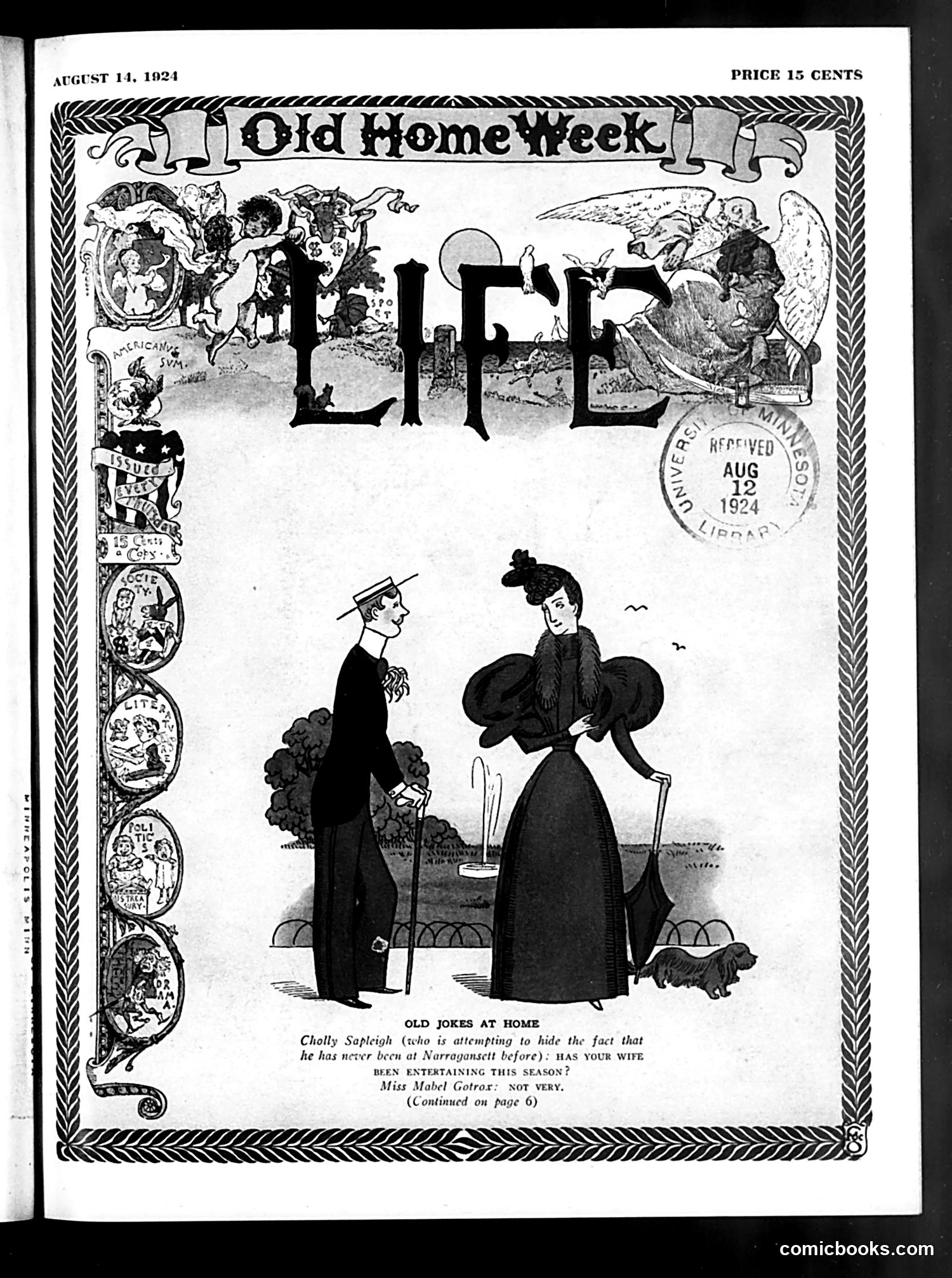
This is the cover of *Life* magazine's "Old Home Week" issue. The main cartoon, titled "Old Jokes at Home," depicts two well-dressed figures in conversation outdoors. The caption indicates one character, Chelly Sapleigh, is attempting to conceal that he's never visited Narragansett before, while asking his wife (Miss Mabel Gatroe) if she's been entertained this season—to which she replies "Not very." The joke satirizes social pretense: a man fabricating familiarity with a fashionable location (Narragansett, a Rhode Island resort town) while making small talk with his wife. It's commentary on upper-class social performance and the awkwardness of maintaining false impressions within marriage. The ornamental border and classical imagery frame this as genteel satire aimed at *Life's* educated, affluent readership.
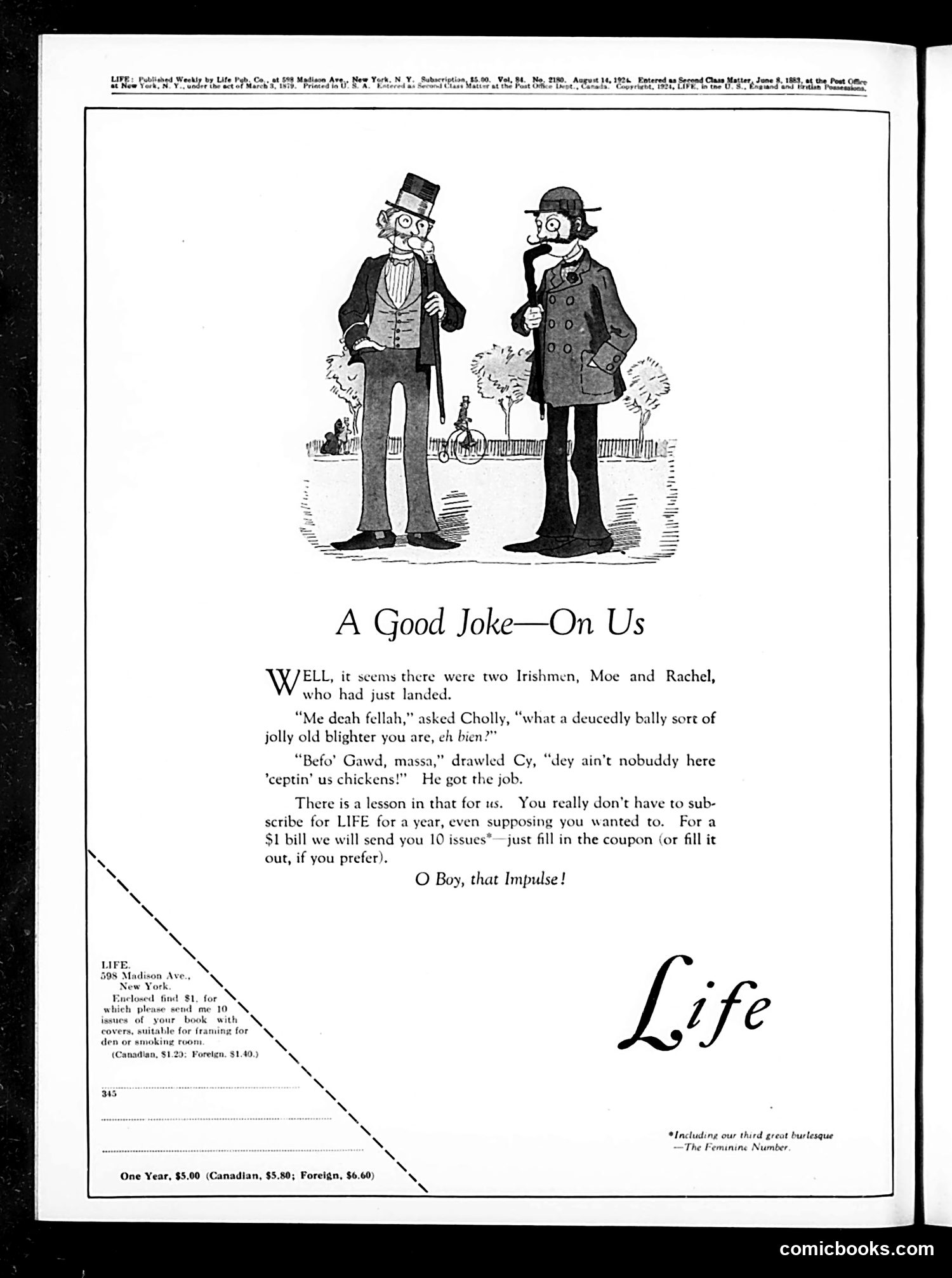
This is a Life magazine advertisement (August 14, 1924) disguised as humor. Two caricatured Irish immigrant figures ("Moe and Rachel") are depicted discussing a subscription offer. The joke mocks Irish immigrants' speech patterns and stereotypes them as unsophisticated. The satirical "lesson" suggests that Life magazine readers—presumably educated, middle-class Americans—are foolish to NOT subscribe when the offer is so cheap ($1 for 10 issues). The humor relies on ethnic stereotyping: the Irish characters represent naïveté, while the advertisement positions subscribers as equally foolish for passing up the deal. This reflects 1920s attitudes toward Irish immigrants as outsiders, while simultaneously using that stereotype to sell magazines to the magazine's actual target audience.
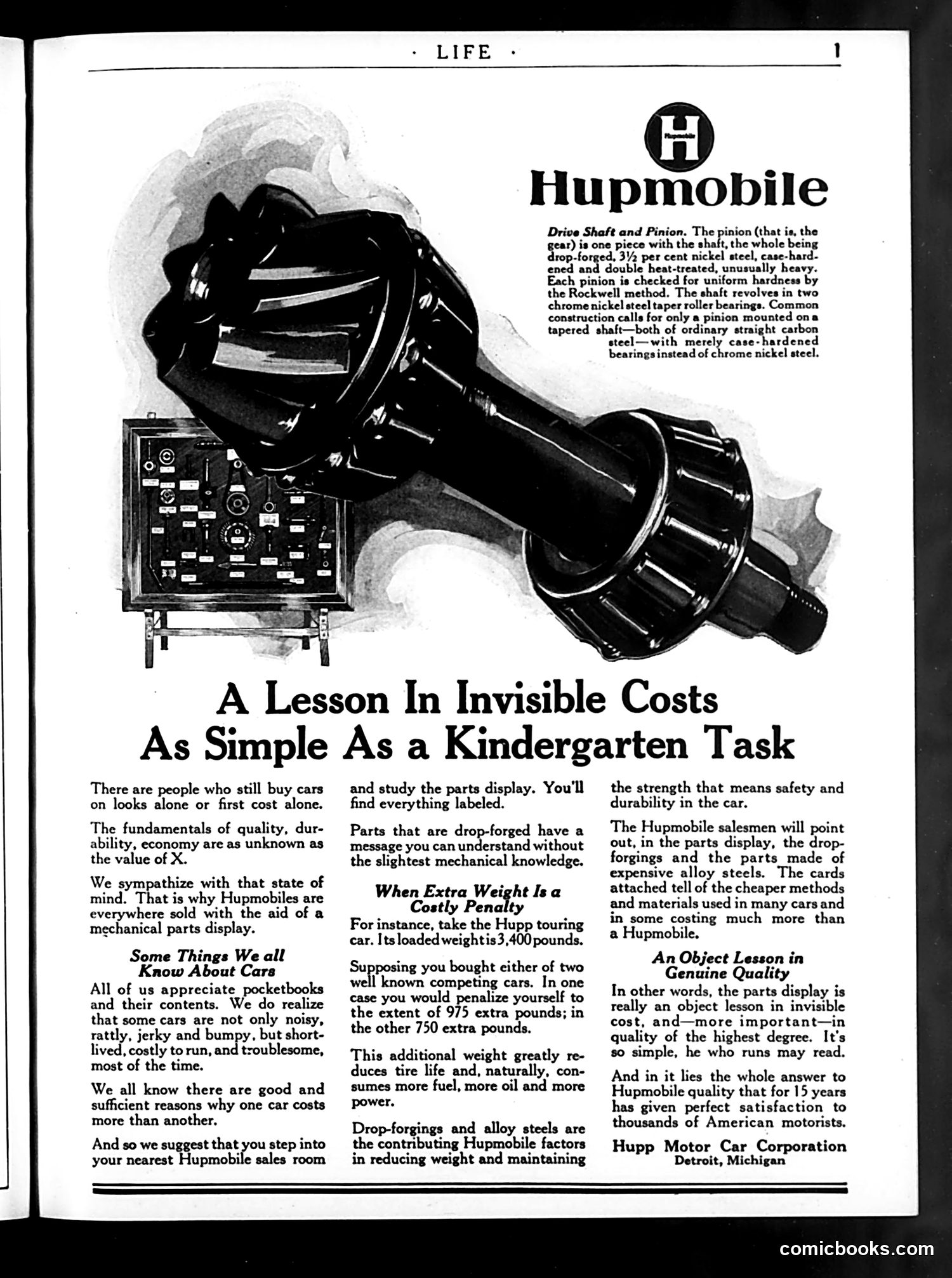
This is **not satire or political cartoon**, but rather a **straight automobile advertisement** from Life magazine's advertising pages. The Hupmobile company uses technical imagery—a large mechanical gear assembly and engine parts—to educate readers about manufacturing quality. The ad's central claim is that invisible engineering costs (materials, precision manufacturing, drop-forged steel components) justify the car's price, even if cheaper competitors exist. The headline ironically compares understanding automotive engineering to "a kindergarten task," suggesting that once buyers see the parts display explaining Hupmobile's superior construction, the quality justification becomes simple and obvious. This represents early 20th-century advertising strategy: educating consumers about mechanical specifications to justify premium pricing.
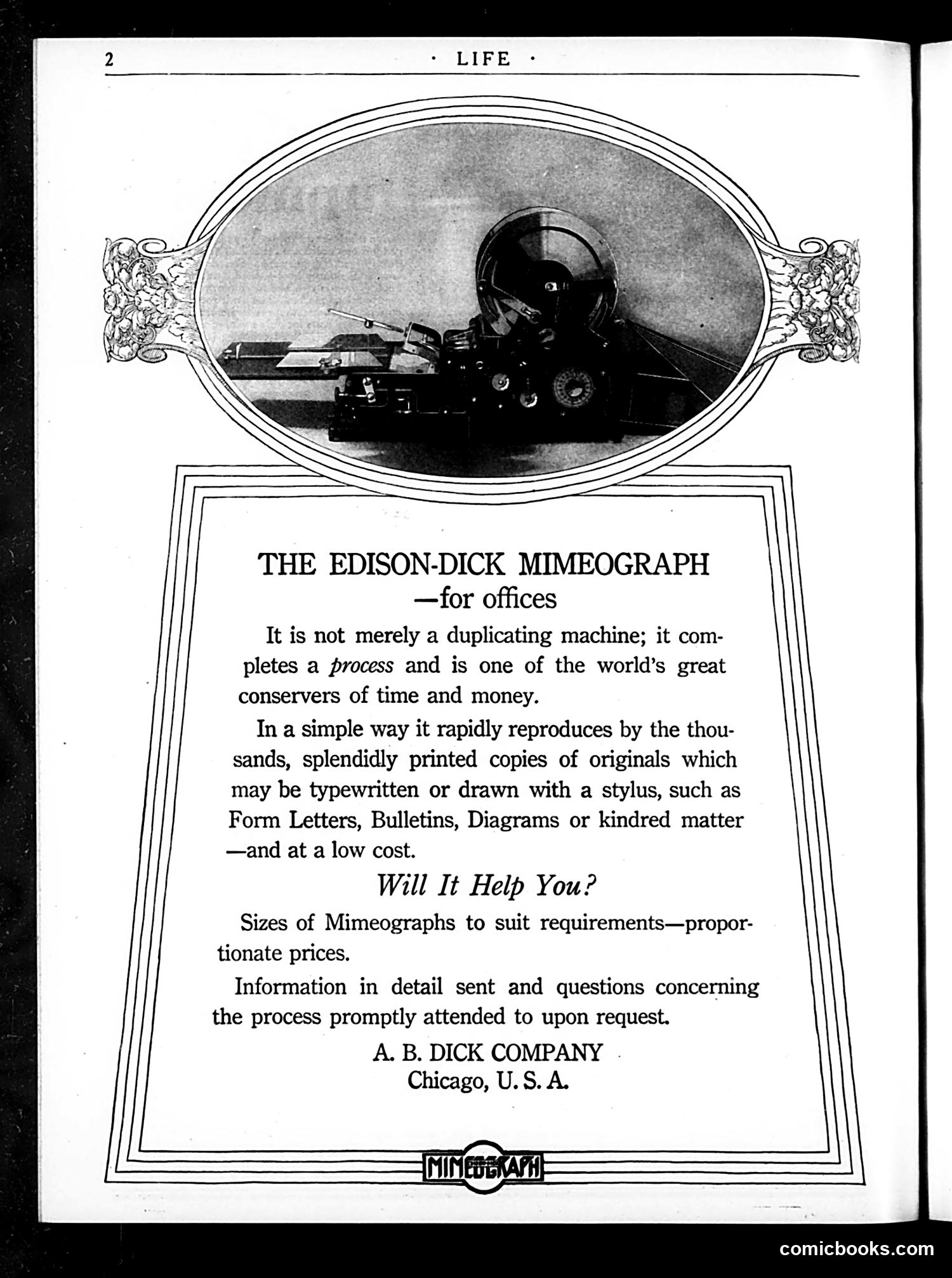
This page is primarily **advertising, not satire or editorial content**. It features an advertisement for the Edison-Dick Mimeograph, a duplicating machine marketed for office use. The image shows the mechanical mimeograph device itself. The ad copy emphasizes that this machine does more than simply copy—it "completes a process" and conserves "time and money" by rapidly reproducing documents like form letters, bulletins, and diagrams "at a low cost." The A.B. Dick Company (Chicago) positions the mimeograph as a business productivity tool. The decorative border and formal layout are typical of early 20th-century magazine advertising design. There is no political cartoon or satire present on this page—it is straightforward commercial promotion.
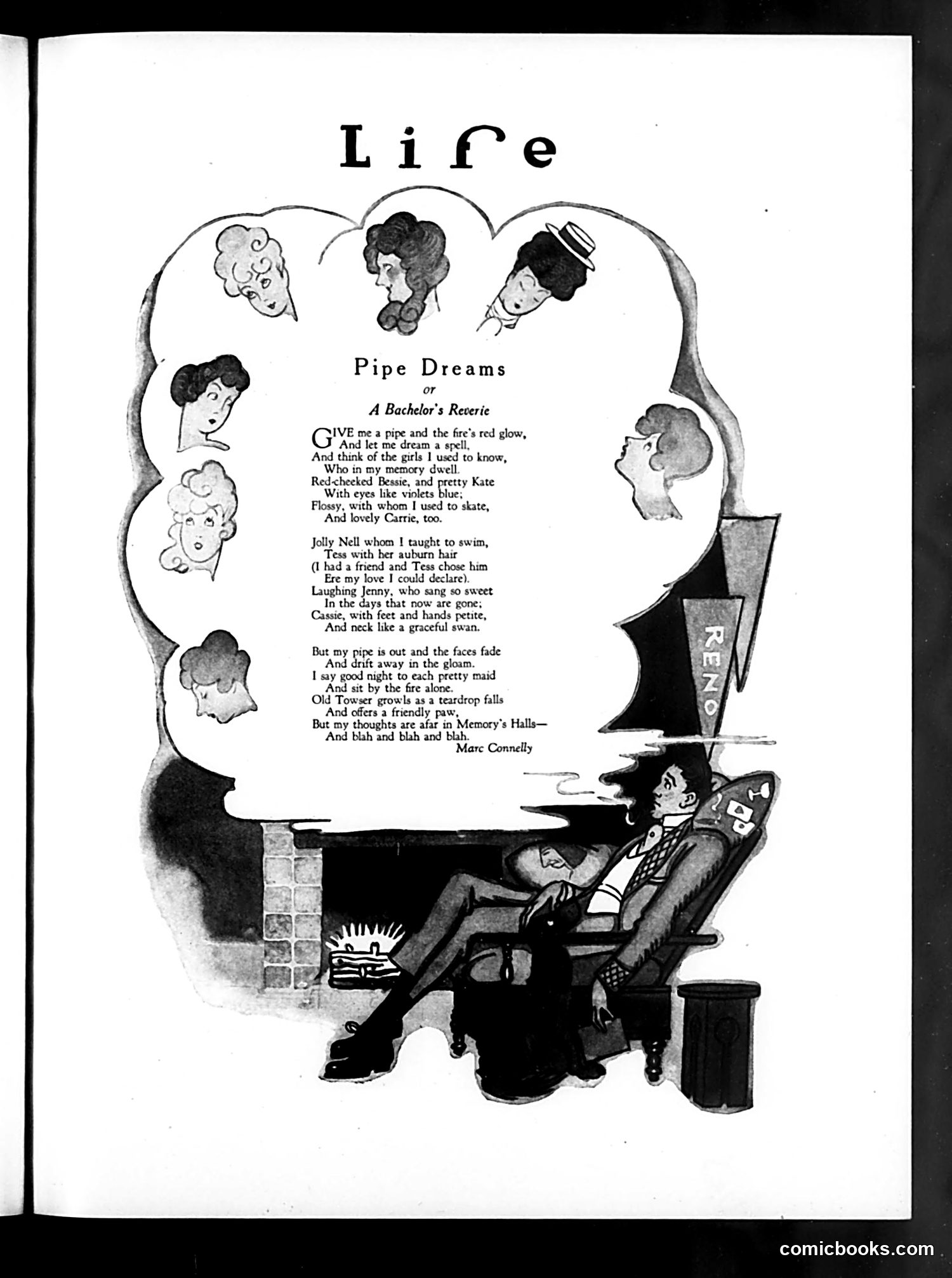
This is a poem by Marc Connelly accompanying a satirical illustration. A man sits by a fireplace smoking a pipe, and the smoke forms a large pipe-shaped bubble containing six female heads—representing women from his past or imagination. The poem is nostalgic, romantic satire: the bachelor recalls various women (Bessie, Kate, Flosey, Carrie, Jenny, Tess, and Cassie) as idealized memories. However, the final lines mock his reverie—his pipe is "out" and the "faces fade," suggesting these romantic visions are merely fleeting fantasies. He resignedly bids them goodnight while sitting alone by the fire. The joke is on the bachelor's self-delusion: his romantic memories are literally just smoke.
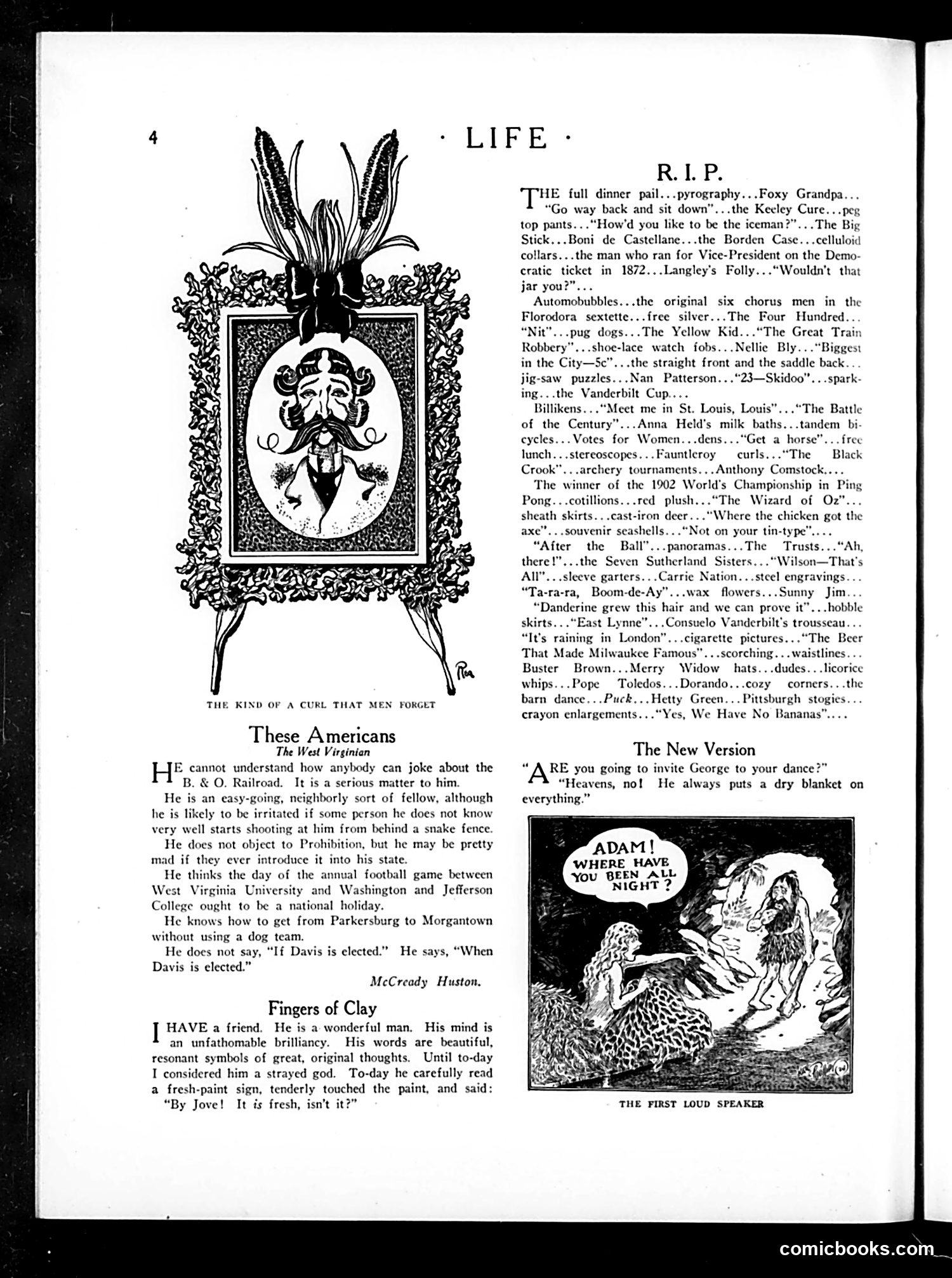
**R.I.P. Section:** This is a satirical obituary-style listing of vanishing American cultural items and phenomena—from "Foxy Grandpa" comics to the "Battle of the Century" boxing match. It mourns the passing of distinctive American institutions and entertainments, suggesting rapid cultural change. **"These Americans" Essay:** The piece critiques American regionalism, using a West Virginia railroad dispute as its example. It argues that Americans have strong local loyalties (knowing regional details like football rivalries, travel routes) but weak national consciousness. The author suggests this parochialism is both admirable and limiting. **Cartoon ("The First Loud Speaker"):** A humorous domestic scene where a woman interrogates her husband Adam about his nighttime whereabouts, introducing the concept of "loud speakers"—likely early public address or radio technology disrupting private life.
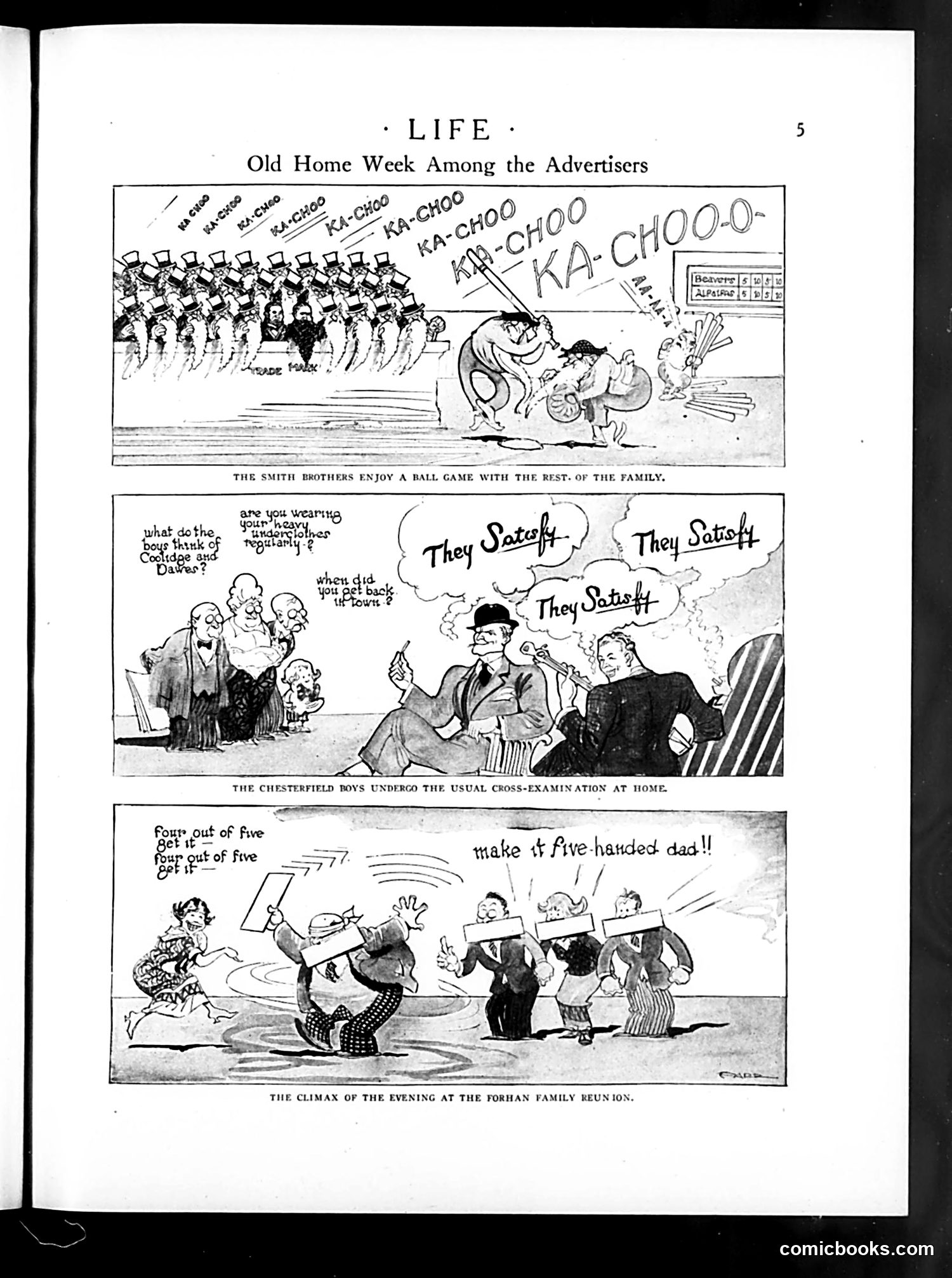
This "Old Home Week Among the Advertisers" page features three comic strips satirizing early 1900s family life and advertising culture. The top strip shows a massive "KA-CHOO" sneeze from what appears to be an advertiser, with children lined up chanting the product name—mocking how advertising jingles infiltrate daily life. The middle strip titled "The Chesterfield Boys Undergo the Usual Cross-Examination at Home" depicts parents questioning boys about their whereabouts, with repeated "They Satisfy" speech bubbles—likely referencing Chesterfield cigarette advertising slogans, satirizing how commercial catchphrases replace genuine conversation. The bottom strip, "The Climax of the Evening at the Forhan Family Reunion," shows people playing baseball with the caption "four out of five get it"—apparently mocking medical/product claims using statistical language ("four out of five") in absurd contexts. The overall theme critiques aggressive advertising's invasion of American domestic and social life.
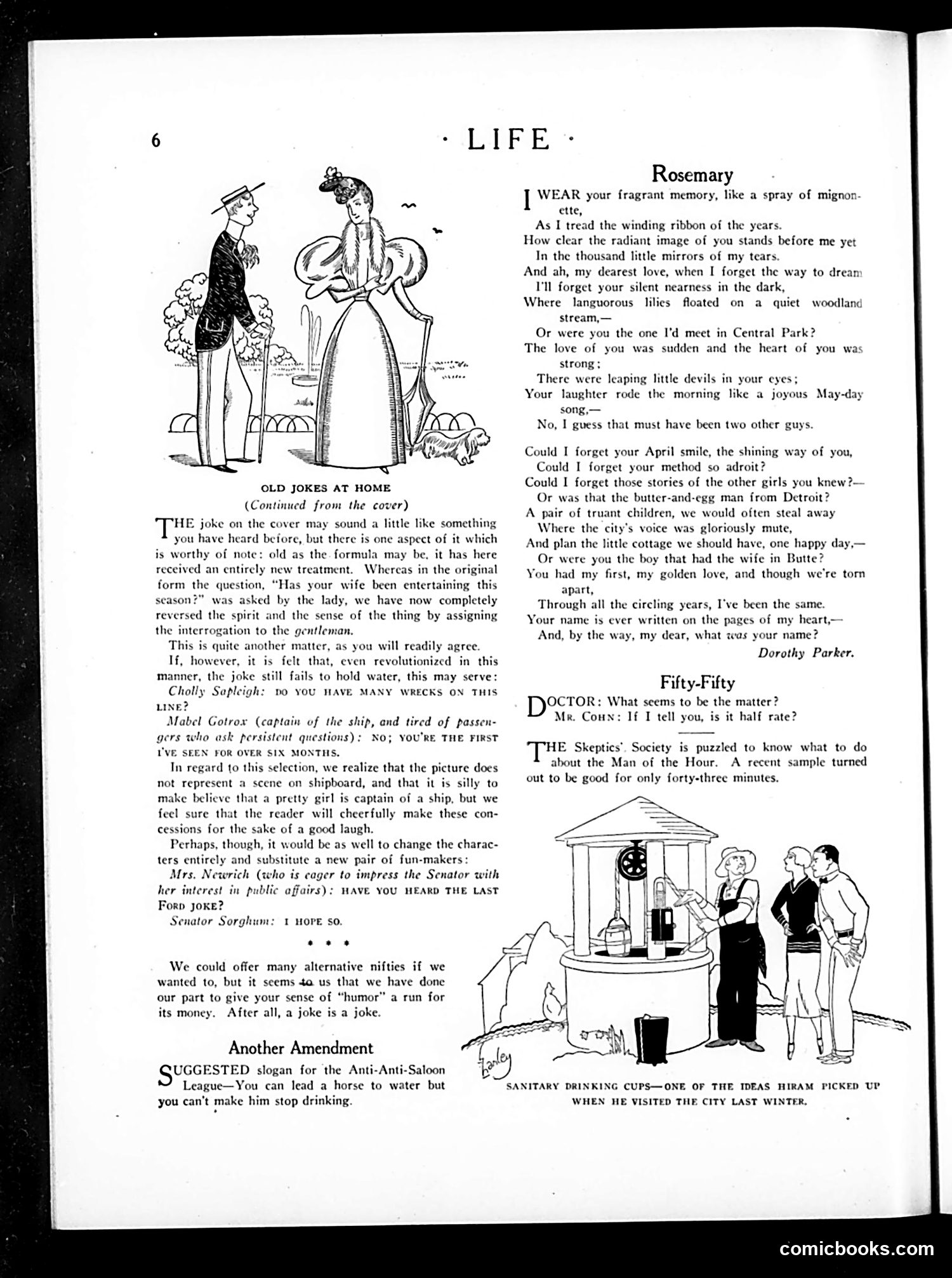
This page contains three distinct pieces: 1. **"Old Jokes at Home"**: A humorous section continuing from the cover, presenting tired jokes with new treatments. One involves a ship's captain and a passenger asking repetitive questions—the joke being that the questioner is the first person the captain has encountered in months. 2. **"Rosemary"**: A sentimental poem by Dorothy Parker addressed to someone named Rosemary, reflecting on a past romantic relationship and shared memories. 3. **"Fifty-Fifty"**: A brief joke about The Skeptics' Society puzzled by "the Man of the Hour," a person only good for forty-three minutes. The page also includes illustrations of fashionable figures and a sketch of people at what appears to be a public drinking fountain, captioned as "sanitary drinking cups" observed during a city visit.
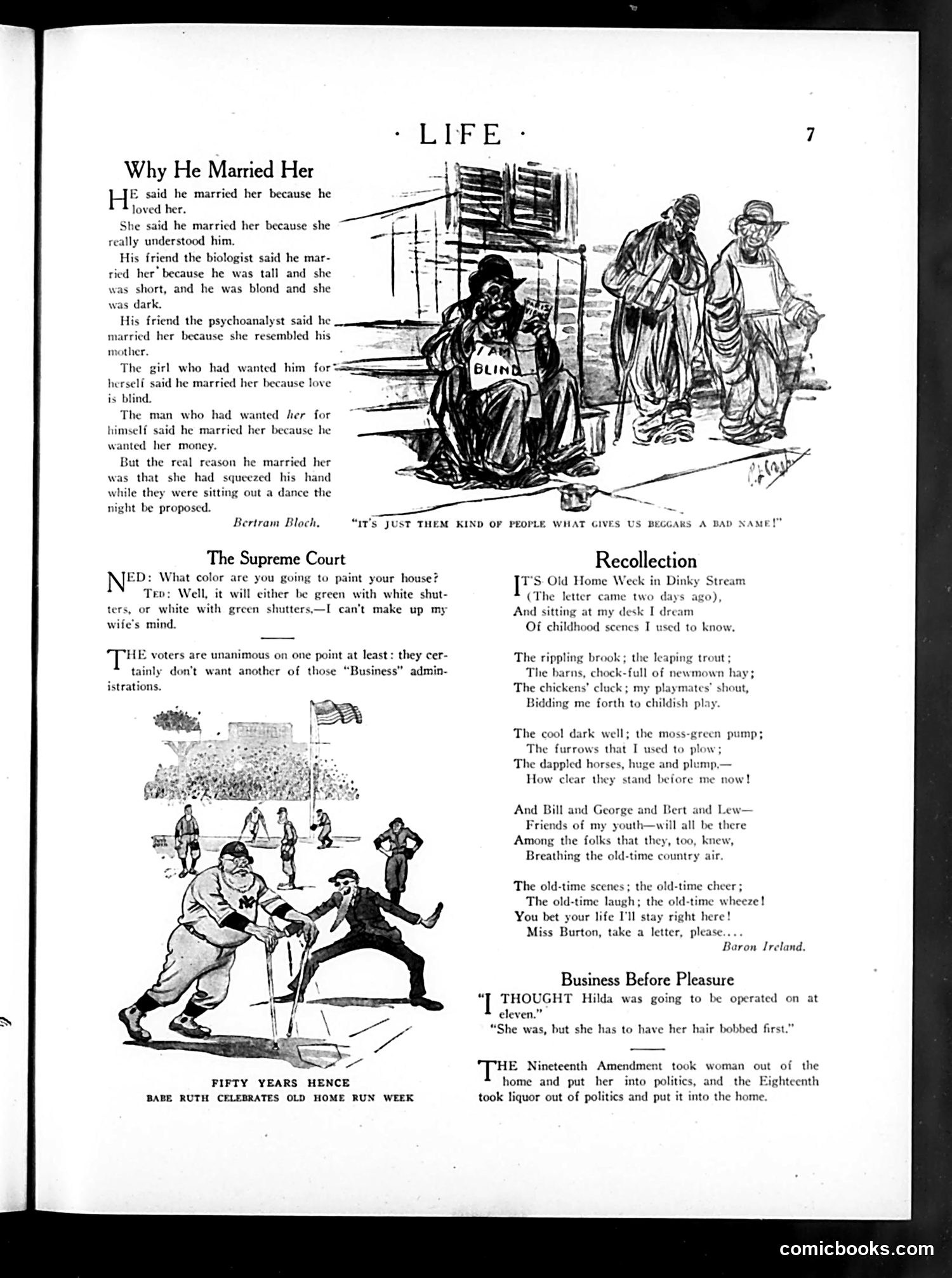
**"Why He Married Her"** presents cynical reasons for marriage: love, misunderstanding, biology, psychoanalysis, and money. The punchline reveals the "real reason"—he proposed while dancing, a moment of impulse. **"The Supreme Court"** jokes about indecision: when asked about house paint colors, the husband cannot choose, blaming his wife's uncertainty. **"Recollection"** is a nostalgic poem about childhood in rural Ireland, referencing streams, farms, and old friendships. **"Fifty Years Hence"** cartoon depicts Babe Ruth (baseball legend) celebrating an old home run, satirizing how his achievements will be remembered decades later. **"Business Before Pleasure"** references the Nineteenth Amendment, suggesting women entering politics/voting shifted their domestic priorities—a commentary on changing gender roles post-suffrage.
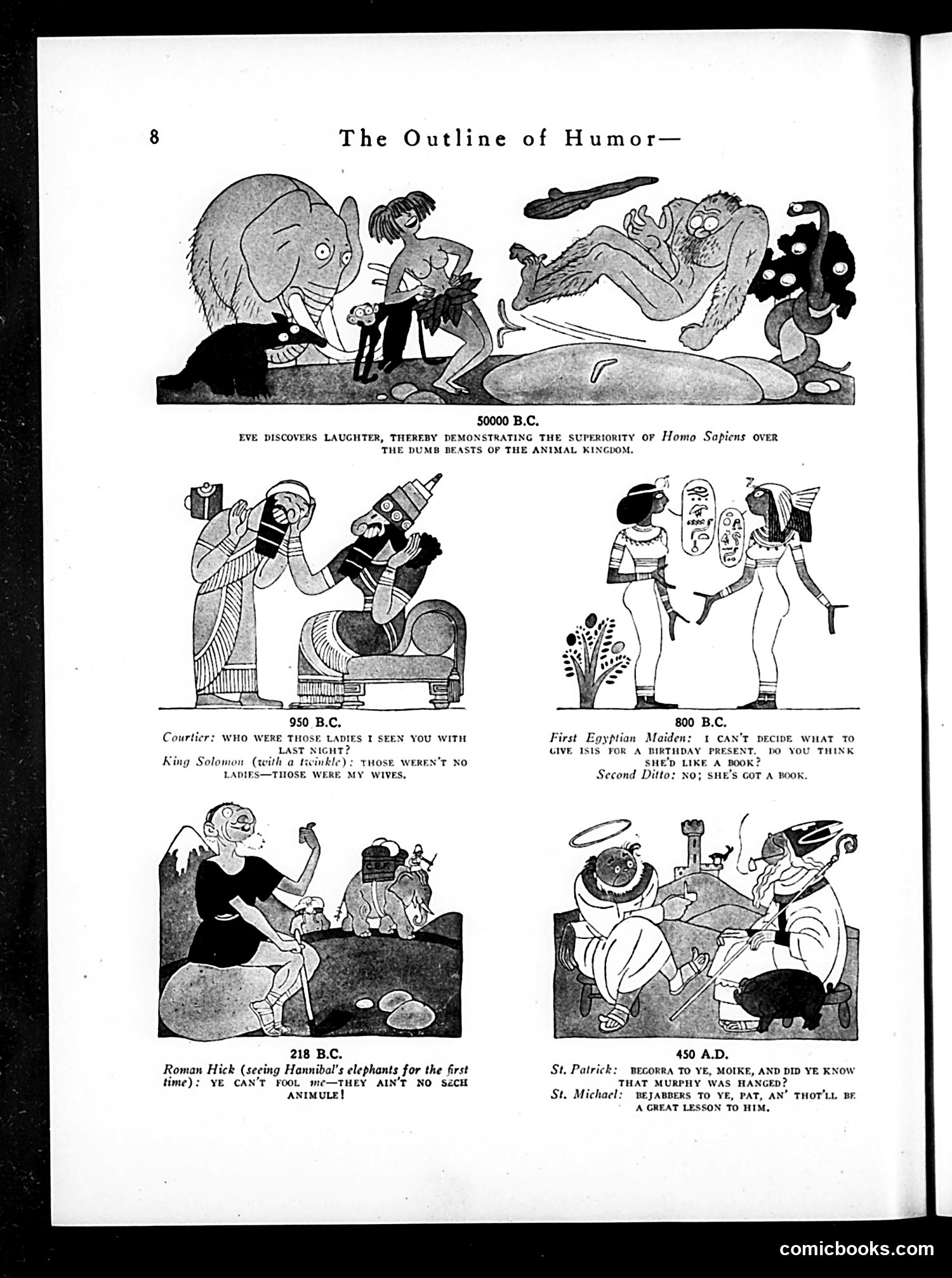
This page presents a humorous timeline showing how laughter and humor have evolved across human history. Each panel satirizes a different era: - **50000 B.C.**: Primitive humans discovering laughter while observing animals - **950 B.C.**: King Solomon confronted about his many wives (biblical reference) - **800 B.C.**: Egyptian women debating book preferences as a birthday gift - **218 B.C.**: Roman Hick seeing Hannibal's elephants for the first time - **450 A.D.**: St. Patrick and St. Michael joking about hanging Murphy as a lesson The cartoons use anachronistic humor—applying modern sensibilities and concerns (like birthday gifts, wives' jealousy) to ancient times. The satire suggests that human nature and comedic instincts remain constant across millennia, even as civilizations change.
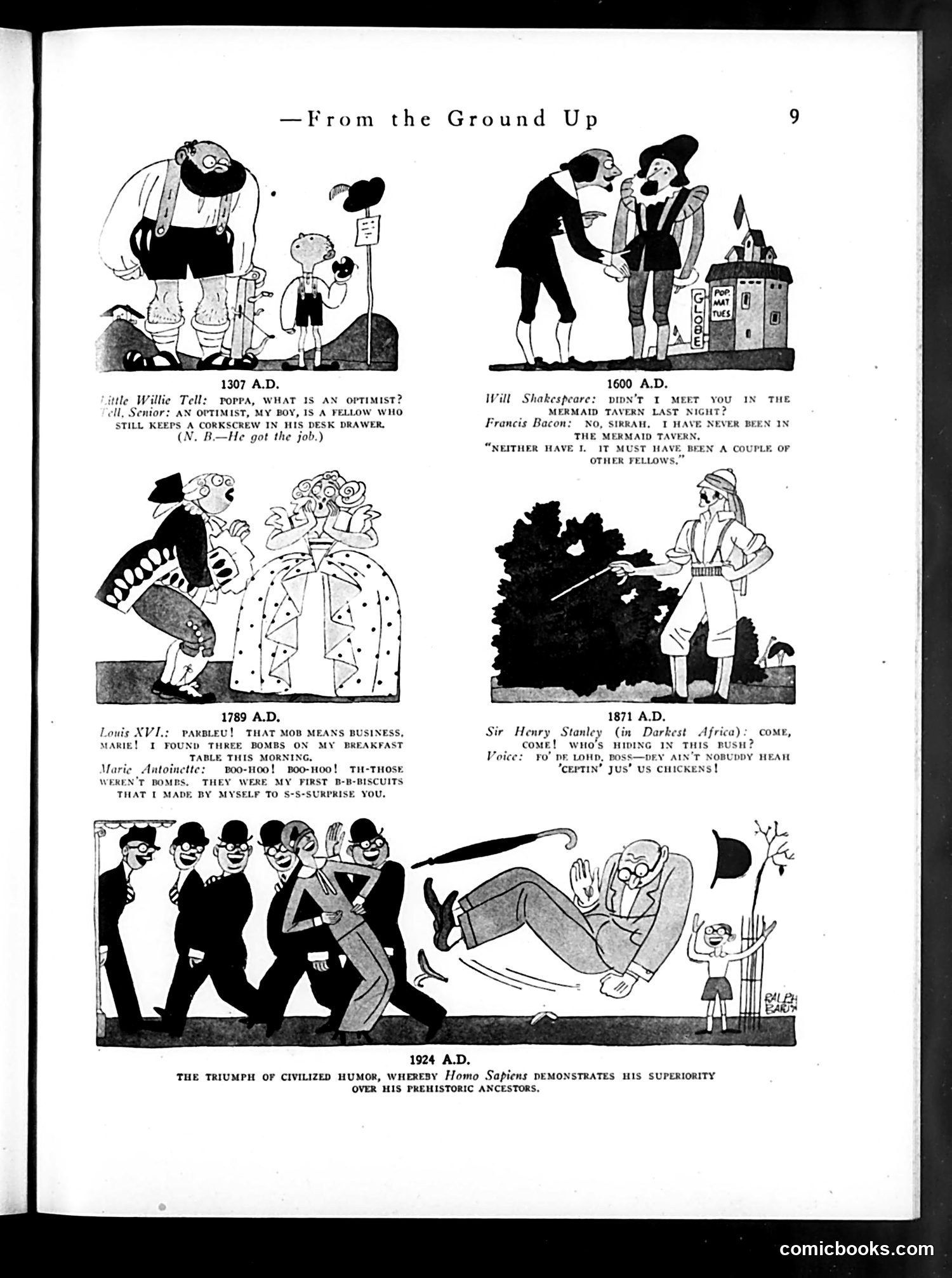
This page presents five historical vignettes satirizing human progress and civilization. Each panel depicts a famous historical figure in an absurd situation that deflates their dignity: **1307 A.D.**: Little Willie Tell demonstrates optimism by keeping a corkscrew in his desk drawer. **1600 A.D.**: Will Shakespeare and Francis Bacon deny meeting at the Mermaid Tavern, blaming other fellows instead. **1789 A.D.**: Louis XVI and Marie Antoinette discuss bombs at breakfast. **1871 A.D.**: Sir Henry Stanley encounters someone hiding in bushes during his African expedition. **1924 A.D.**: The final panel shows "civilized humor" triumphing over prehistoric ancestors—five modern men with an umbrella demonstrating superiority. The overarching message satirizes the era's belief in linear human progress and civilization's supposed superiority, suggesting modern behavior isn't meaningfully advanced.
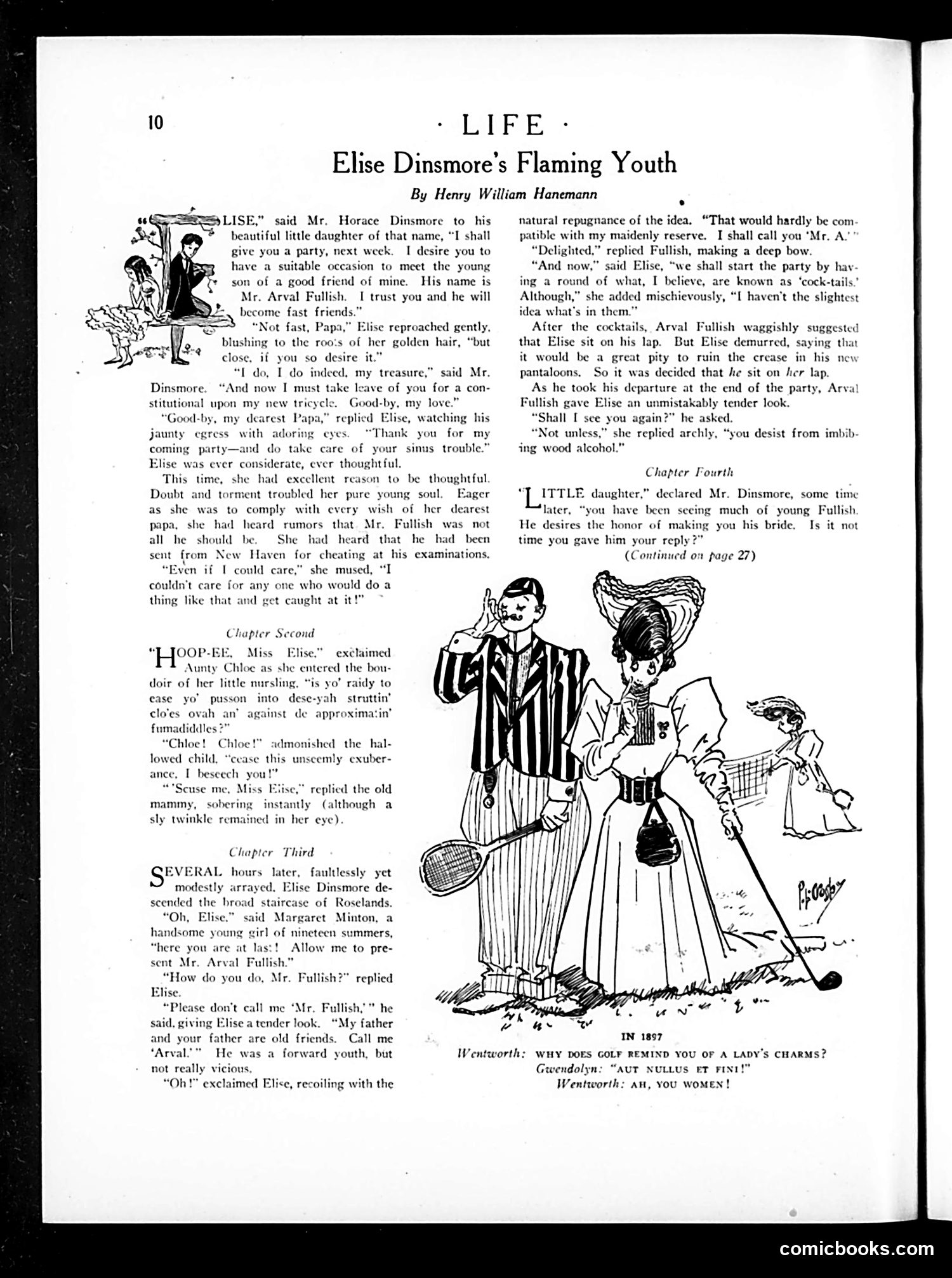
This satirical story mocks the "flaming youth" trend of the 1920s—young people, especially women, rebelling against Victorian propriety through modern behaviors like smoking, drinking, and casual dating. The narrative follows young Elise, whose father Mr. Dinsmore attempts to maintain strict parental control. Her suitor Arval Fullish represents the modern young man. The humor derives from generational conflict: Elise's father forbids her socializing, while she pursues independent activities (tennis, parties, drinking). The accompanying illustration depicts fashionable young people in 1920s attire—the woman in a modern dress with a tennis racket, embodying the "new woman" challenging traditional gender roles and parental authority. The satire targets both rebellious youth and anxious parents attempting to police their behavior.
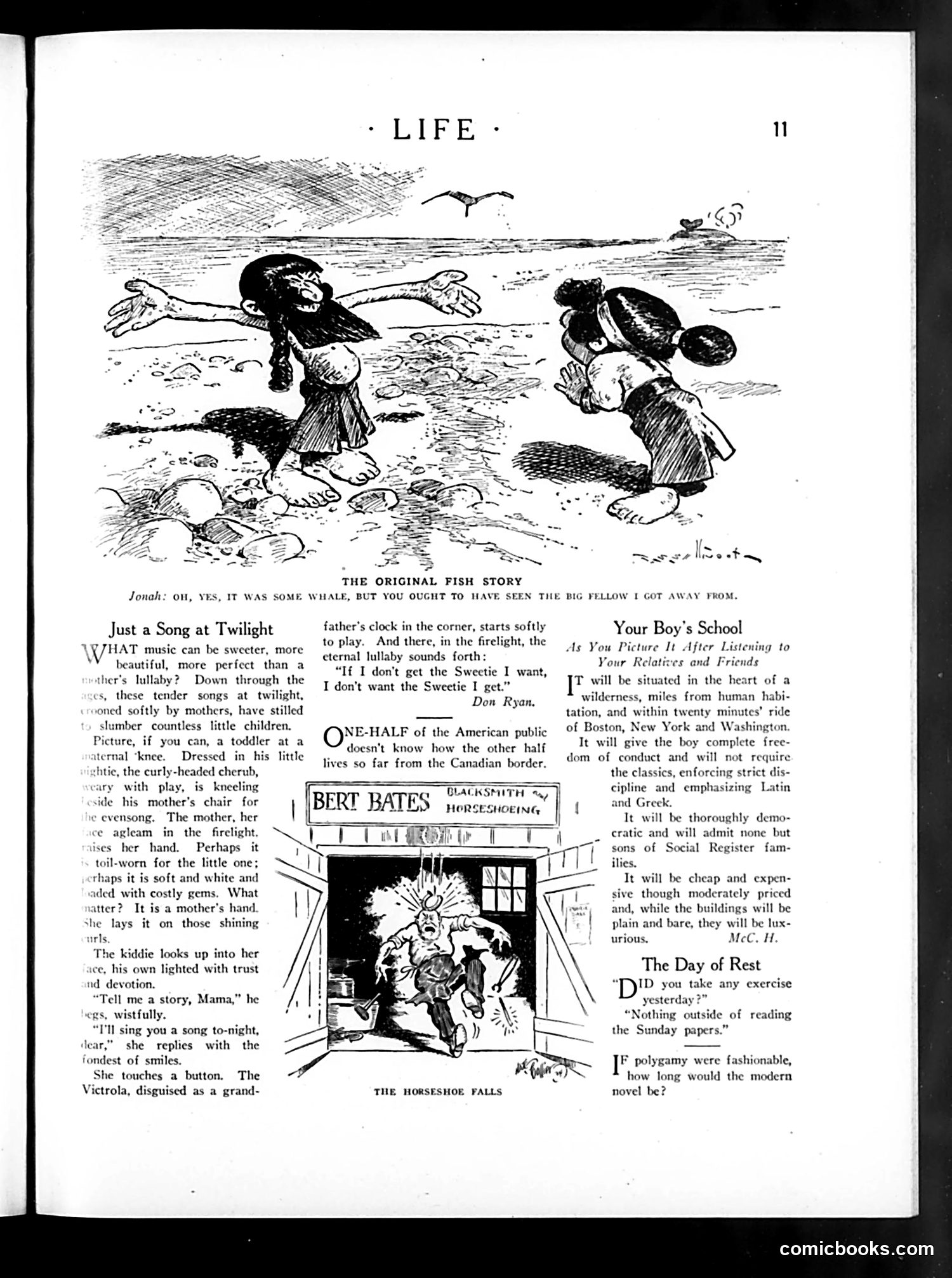
This page contains three distinct pieces: **"The Original Fish Story"** (top): A cartoon showing two children on a beach. One claims to have caught a whale but lost it—a visual gag about exaggerated fishing tales and children's storytelling. **"Just a Song at Twilight"** (left): Sentimental prose about mothers singing lullabies to children, illustrated with a Victrola (record player). It's nostalgic commentary on traditional domesticity and motherhood. **"Your Boy's School"** and **"The Day of Rest"** (right): Advertisements or editorial pieces discussing progressive education and leisure. The latter satirizes Sunday rest culture, questioning if modern polygamy would make novels longer—a somewhat oblique social commentary. **"The Horseshoe Falls"** (center): An illustration of what appears to be a blacksmith shop with fantastical imagery. The page mixes sentimental family content with gentle social satire typical of *Life* magazine's approach.
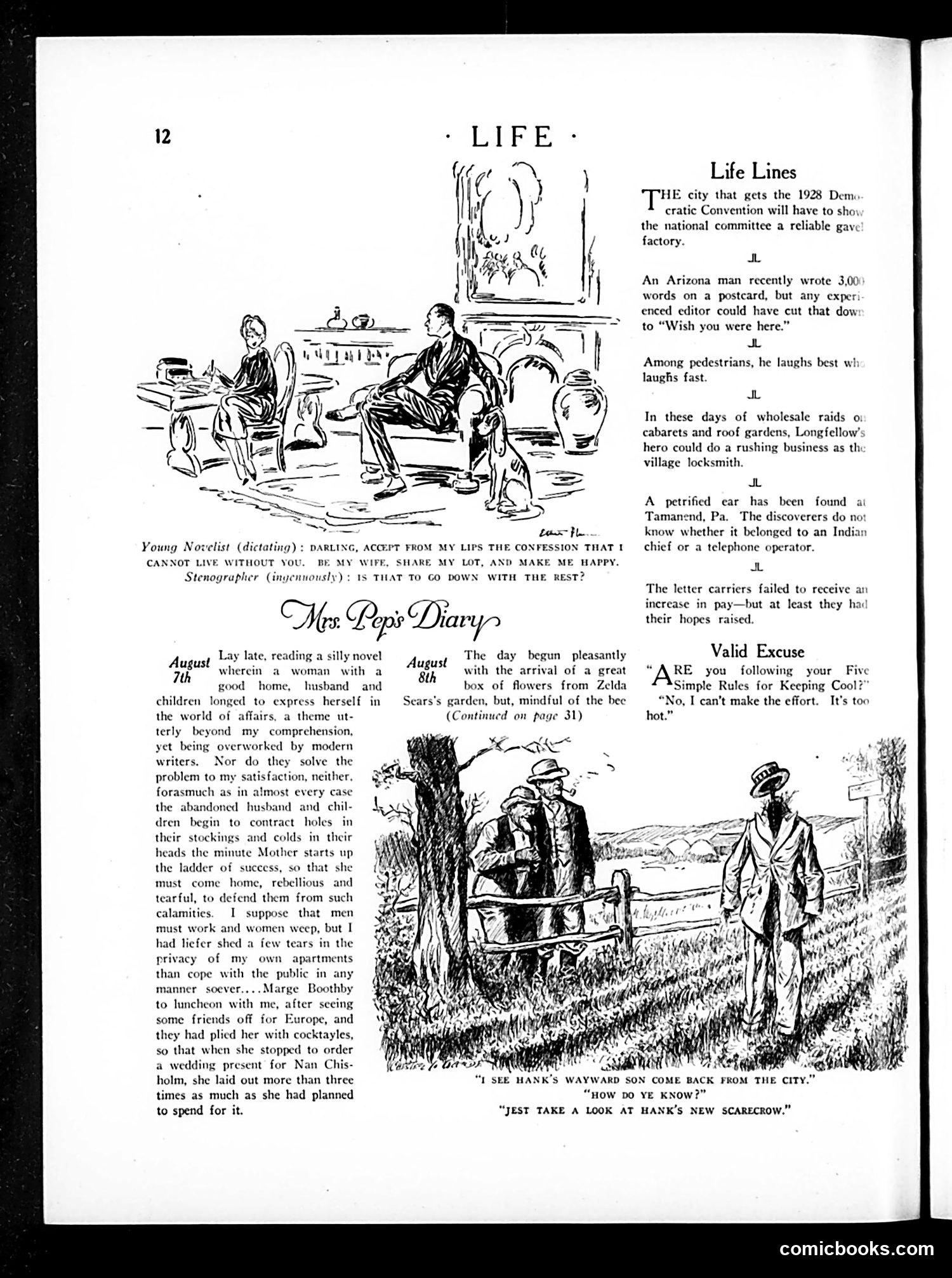
This page contains satirical commentary and fiction rather than political cartoons. The top illustration shows a domestic scene where a young novelist dictates overly romantic prose to his stenographer while his wife looks on—satirizing melodramatic literary conventions of the era. "Mrs. Peps Diary" (August 7th-8th) mocks sentimental Victorian literature through a woman's account of reading such a novel. The satire targets how such works portray abandoned husbands and suffering children unrealistically. The bottom illustration, captioned "Just take a look at Hank's new scarecrow," appears to joke about rural life, though the specific reference is unclear from the visible text. The "Life Lines" column contains brief, unrelated social observations typical of magazine humor sections.
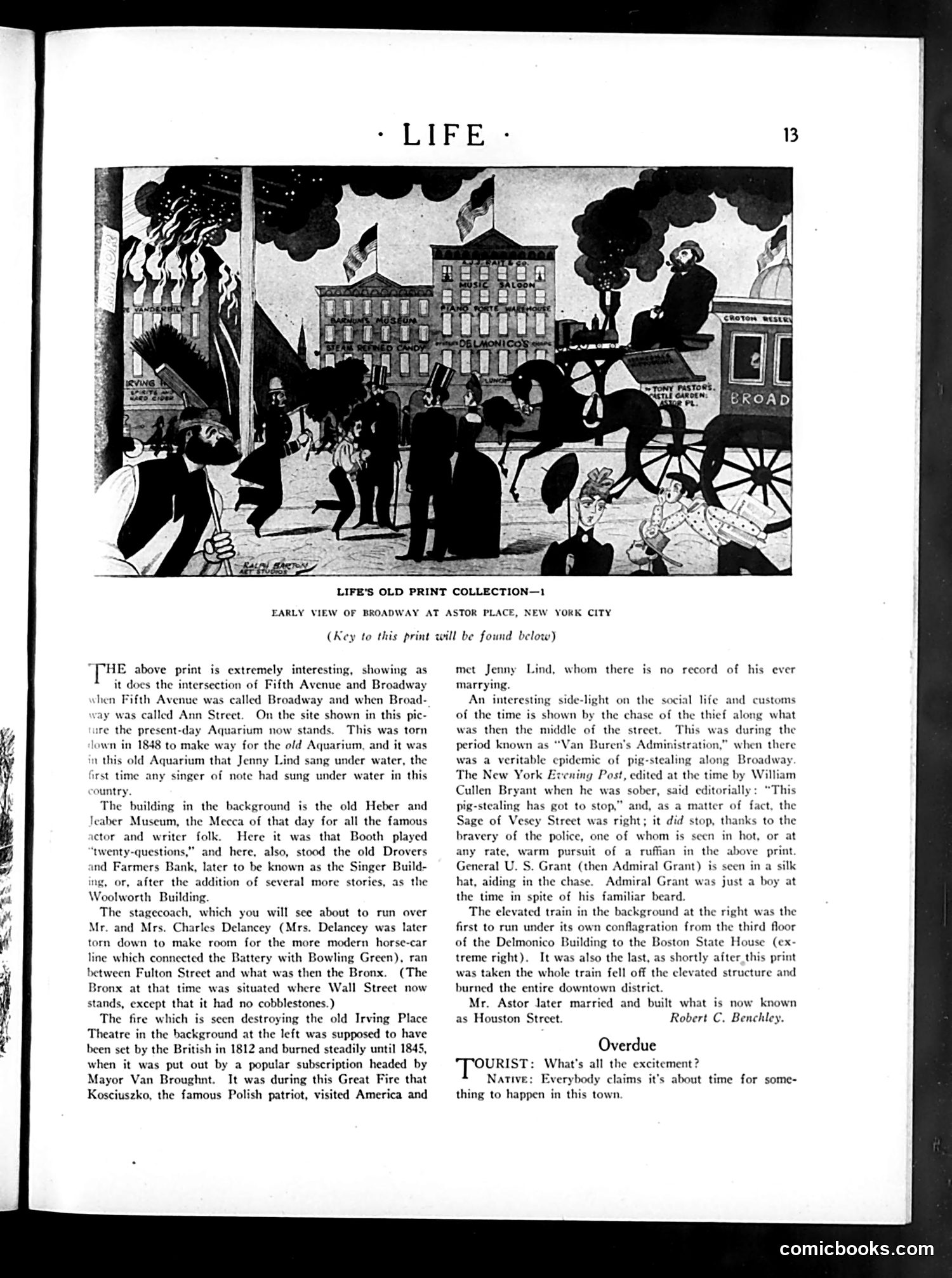
This page features "Life's Old Print Collection—1," showing an early 19th-century engraving of Broadway at Astor Place in New York City. The print depicts the intersection when Fifth Avenue was called "Broadway" and depicts the old Aquarium location. The accompanying text by Robert C. Benchley provides historical context: it identifies notable figures like Jenny Lind (a famous singer), General U.S. Grant, and references the Great Fire of 1812. The text discusses period details—pig-stealing along Broadway, the Heber and Jeaber Museum, and the elevated train at Delmonico Building. This isn't satirical commentary but rather historical documentation and explanation for modern readers, allowing them to understand the urban geography and social life of early New York City through an archival print.
The page features a political cartoon titled **"While there is Life there's Hope"** depicting a figure labeled "LIFE" (the magazine itself) as a bird or phoenix-like creature emerging from or struggling with debris and obstacles. The accompanying text discusses a lawyer named **Mr. Davis** (likely John W. Davis, 1924 Democratic presidential candidate) and his nomination. The article critiques Davis's qualifications, noting he was nominated partly due to his connection to powerful clients like J.P. Morgan, rather than exceptional legal merit. The satire suggests Life magazine itself represents hope and resilience amid political and social challenges of the era. The piece questions whether mere client connections, rather than genuine ability, determine success in American law and politics—a commentary on corruption and privilege in the 1920s.
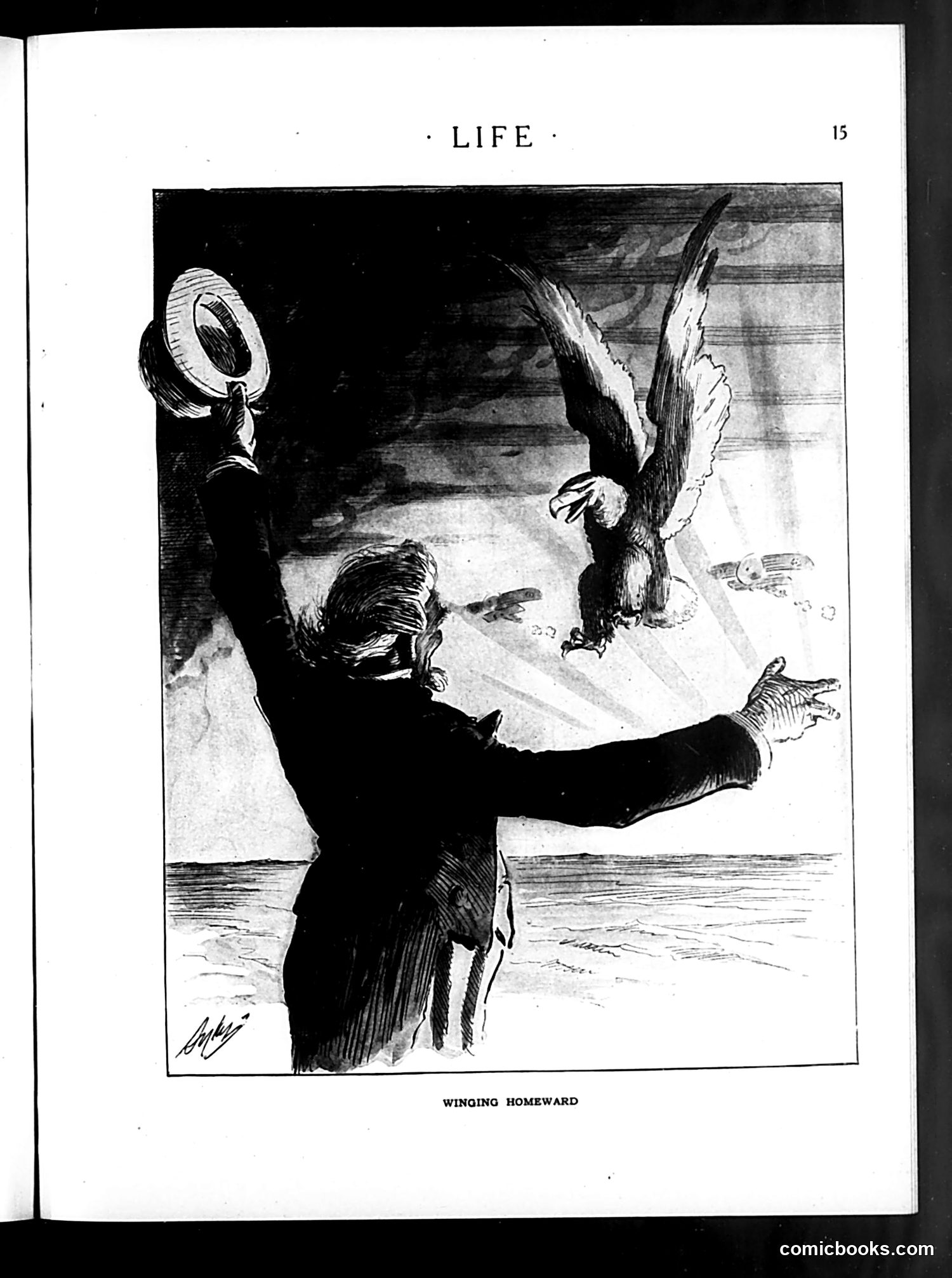
This cartoon depicts a man in formal attire (tuxedo and top hat) being carried by two eagles returning toward shore. The title suggests someone important is coming home. Without additional context, the specific identity of the figure is unclear—though the formal dress suggests a person of prominence or wealth. The two eagles carrying him homeward likely represent patriotic or protective symbolism. The satire probably comments on either: - A wealthy or political figure's return from abroad - Someone being rescued or restored to favor - Ironic commentary on an important person's journey The artistic style and "LIFE" magazine attribution date this to the early 20th century, when such patriotic imagery was common in American satire. More specific context about the historical moment would clarify the target.
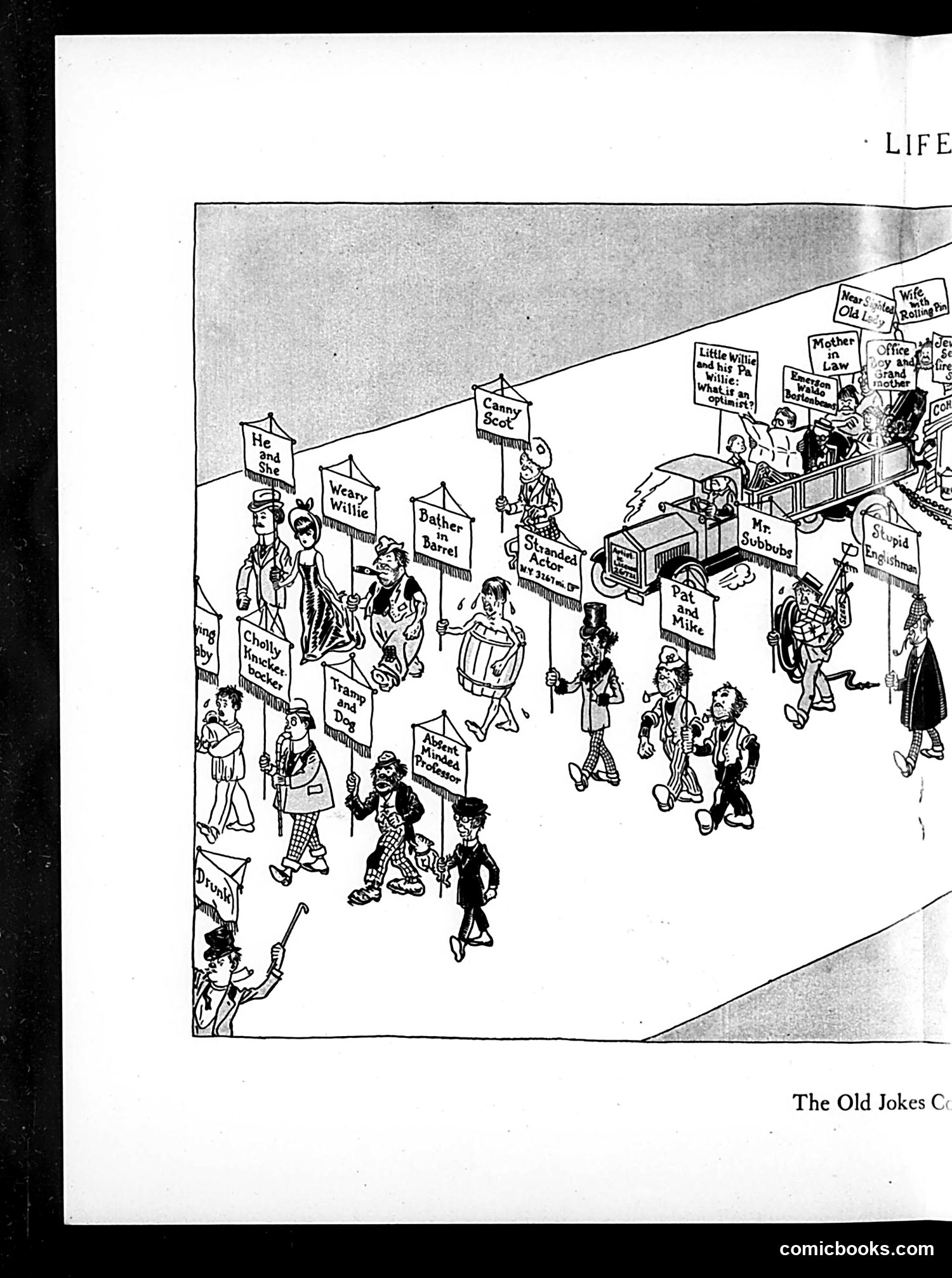
This appears to be a satirical procession illustration showing various stock characters from traditional comedy and vaudeville, each carrying signs with their associated jokes or comedic types. Visible signs include "Weary Willie," "Canny Scot," "Dather in a Barrel," "Canoed Irishman," and others—stereotypical ethnic and character-based comedy archetypes popular in early 20th-century American entertainment. The cartoon satirizes the entertainment industry's reliance on tired, recycled comedic formulas and racial/ethnic stereotypes. By depicting these "characters" as a parade or procession—essentially a business operation ("Co." suggests a company)—the cartoonist mocks how comedians mechanically deployed these worn-out tropes. The satire suggests these old jokes have become an institutional, profitable enterprise despite their staleness. This reflects early-1900s Life magazine's skepticism toward vaudeville's lazy comedic practices.
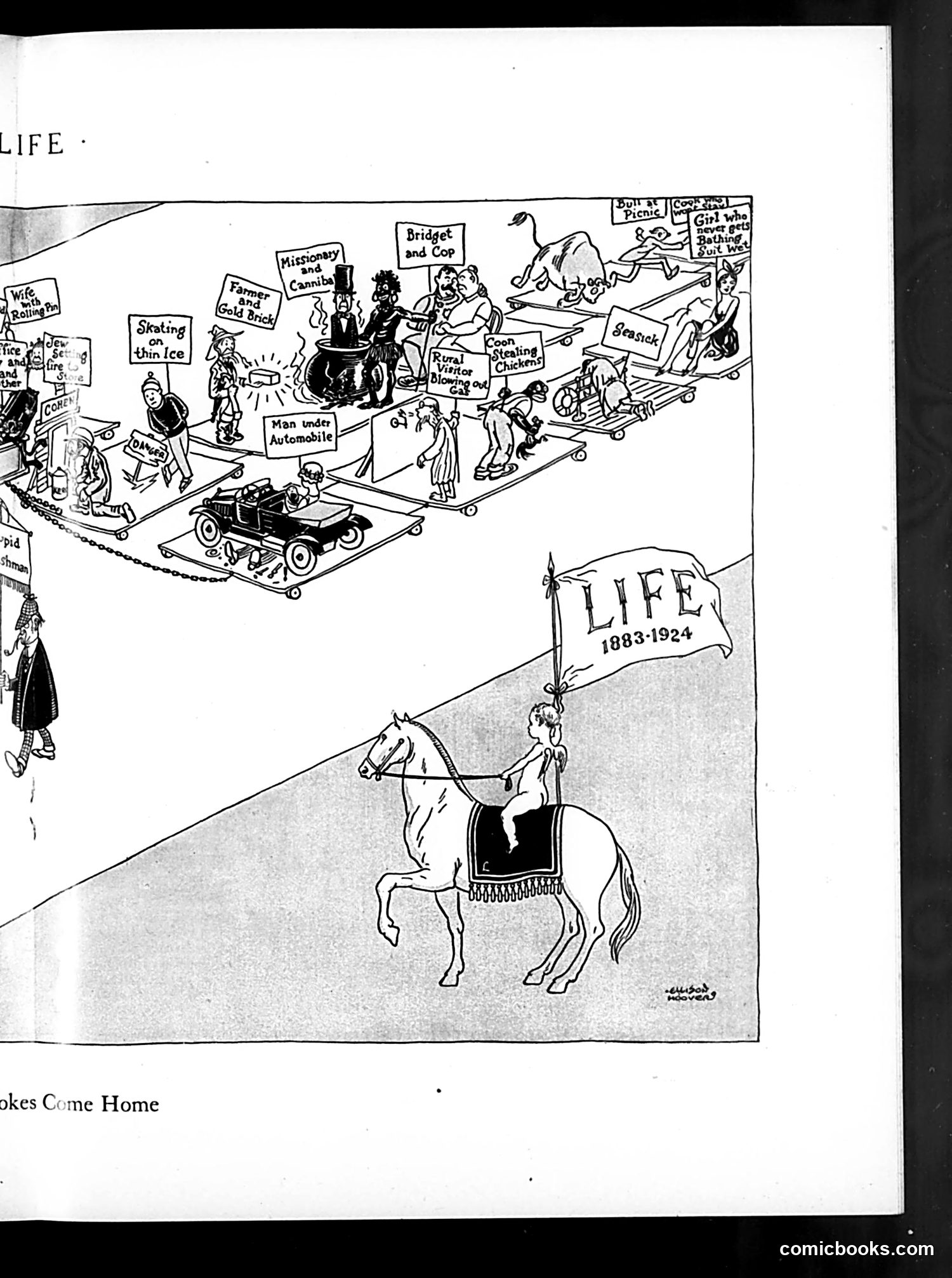
This is a satirical illustration depicting "Life" magazine's 41-year history from 1883-1924. The upper panel shows a "train of life" with various labeled cars representing contemporary American activities and entertainments: "Skating on Thin Ice," "Missionary Cannibal," "Bridget and Cop," "Man under Automobile," "Cow Milking Chickens," and others—likely satirizing popular pastimes, social scandals, and mishaps of the era. The lower panel shows a figure on horseback carrying a flag labeled "LIFE 1883-1924," suggesting the magazine's journey through four decades. The cartoonist (signature appears to be present) uses the train metaphor to humorously chronicle American life's chaos and follies, with each labeled car representing recognizable social situations contemporary readers would understand as satire on modern American culture and its absurdities.
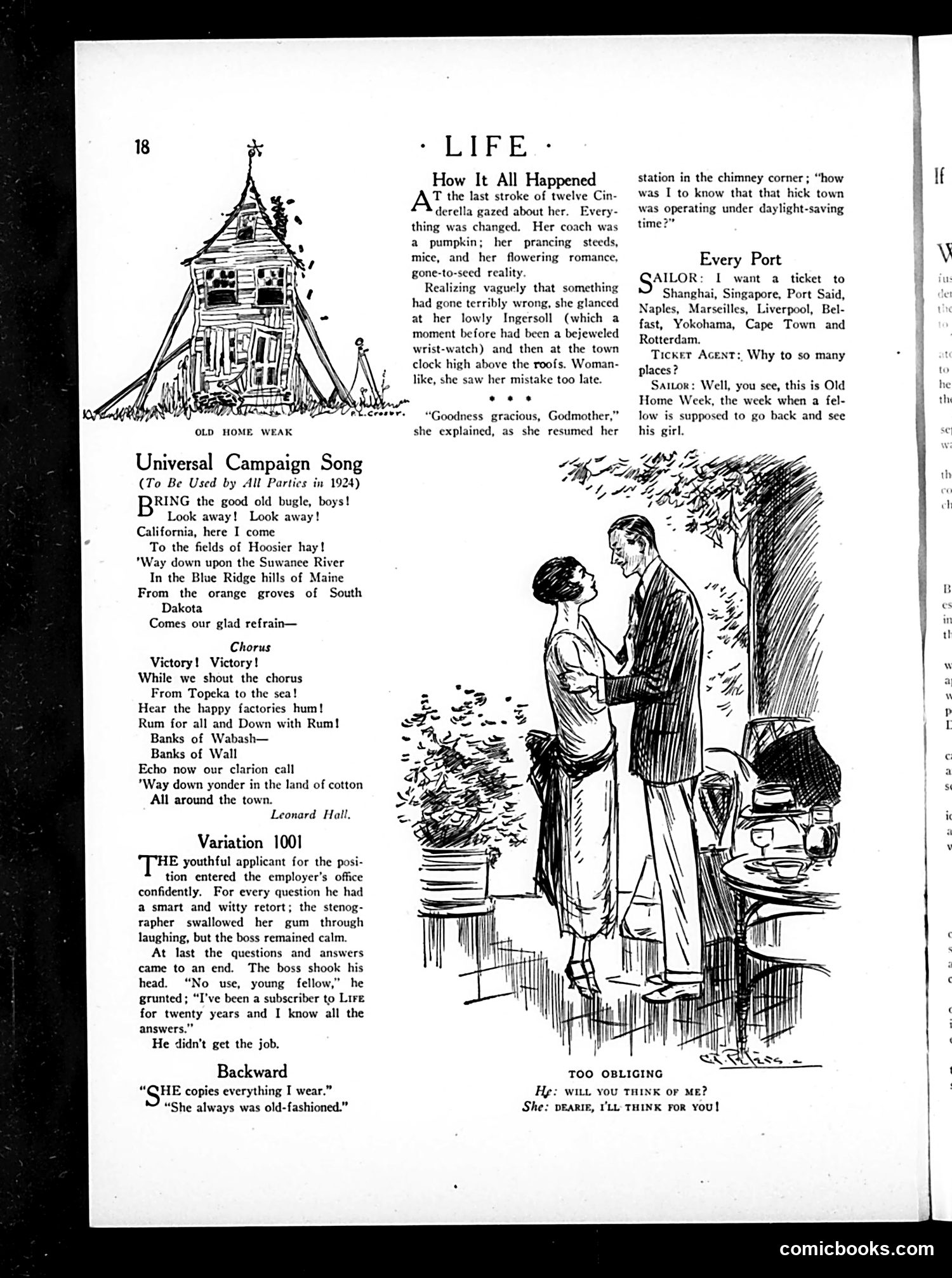
This Life magazine page contains several satirical pieces: **"How It All Happened"** modernizes Cinderella by having her check an "Ingersoll" (cheap pocket watch) instead of realizing midnight has passed. The joke: even magical transformations can't overcome practical reality—and she blames a small town for using daylight-saving time. **"Universal Campaign Song"** mocks 1924 political campaigns by creating absurdist lyrics mixing contradictory regional references and impossibilities ("orange groves of South Dakota," "Rum for all and Down with Rum"). It satirizes how politicians appeal to every region regardless of consistency. **"Variation 1001"** jokes that a job applicant loses a position because the boss—a Life magazine subscriber for 20 years—"knows all the answers," meaning Life's humor has made him too witty to be impressed. **"Too Obliging"** shows a woman so eager to please she promises to think *for* her boyfriend rather than think *of* him—gentle satire on female subservience. All pieces reflect 1920s concerns: modernization, politics, and gender roles.
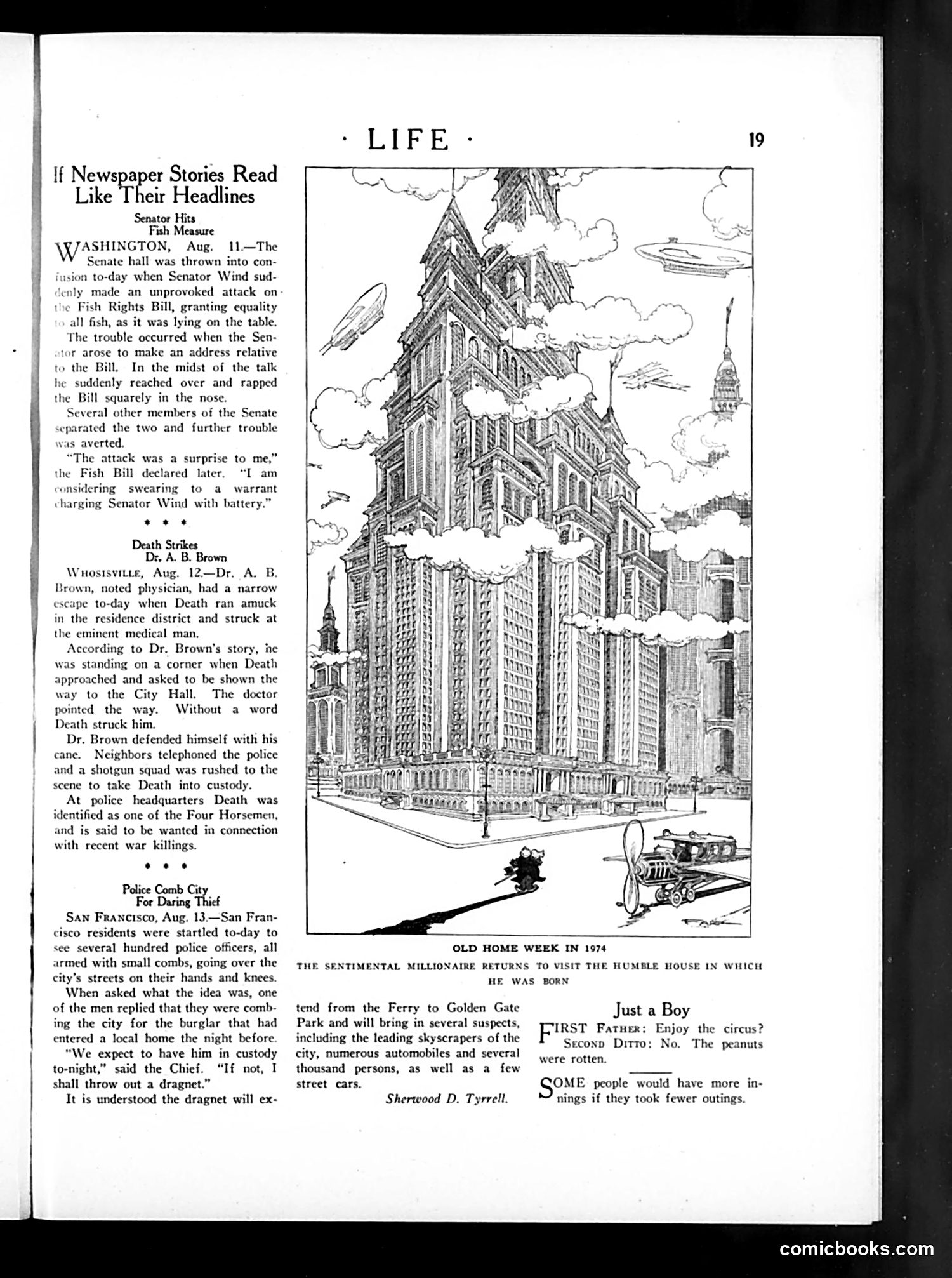
This page satirizes sensationalist newspaper headlines by imagining what would happen if stories literally matched their exaggerated titles. **"Senator Hits Fish Measure"** plays on the ambiguous headline: instead of a senator criticizing a legislative bill about fish rights, he physically attacks the bill as if it were a person, even "rapping the Bill squarely in the nose." **"Death Strikes Dr. A. B. Brown"** literalizes another headline cliché: Death appears as an actual entity (identified as one of the Four Horsemen) who physically assaults the doctor, rather than the doctor simply dying. **"Police Comb City For Daring Thief"** imagines police officers literally *combing* the streets on hands and knees, treating "comb" as a verb rather than understanding it as slang for searching. The humor targets 1920s tabloid journalism's melodramatic, punny headlines that could be misread by taking them literally. The accompanying illustrations (skyscraper cityscape and vintage automobiles) reinforce the absurdist premise. This is classic early 20th-century satirical humor mocking media sensationalism.
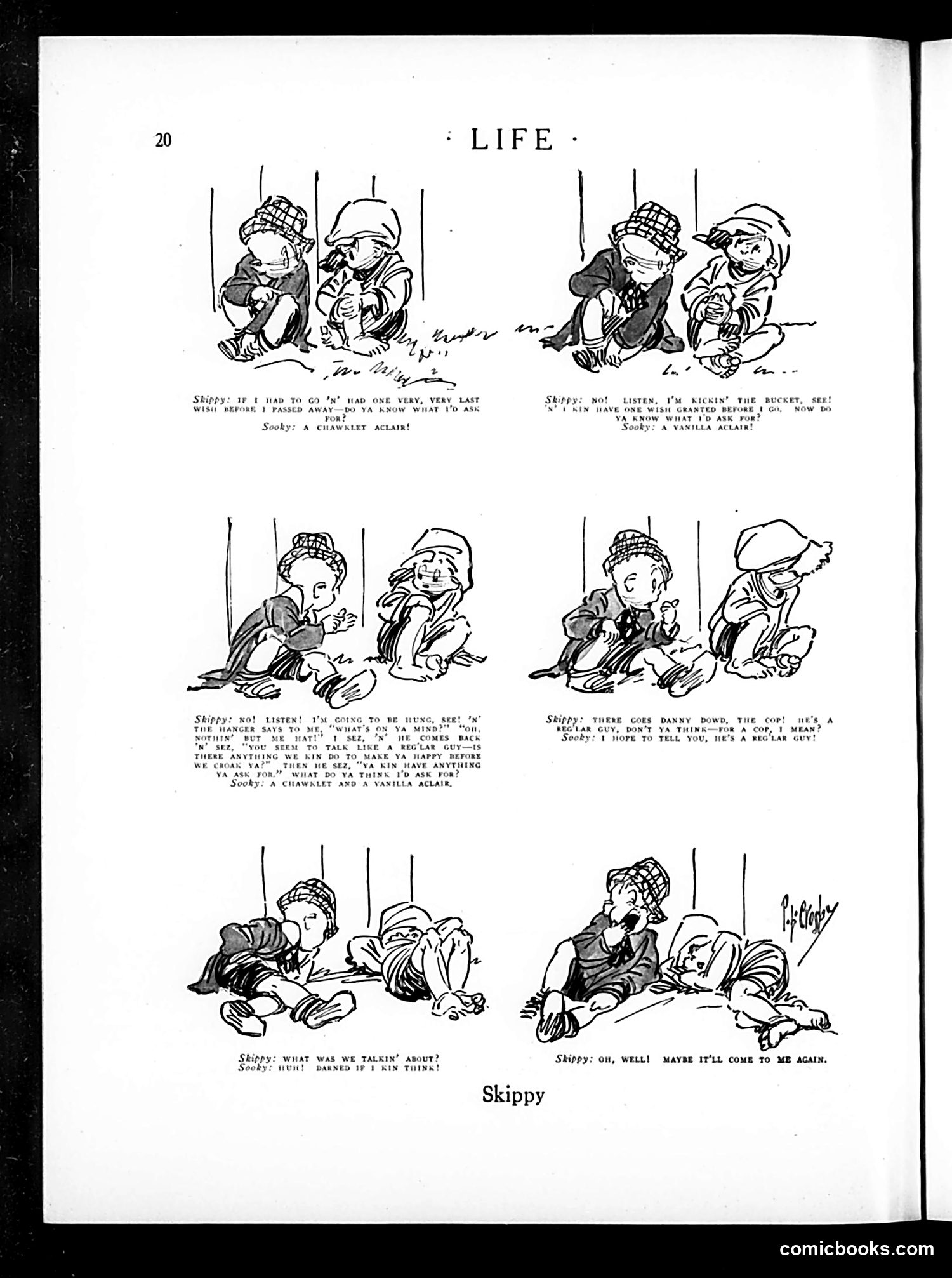
This is a comic strip featuring two young boys, Skippy and Sooky, in a humorous dialogue about wishes and desires. The strip uses the vernacular speech patterns typical of early-20th-century urban youth—phonetic spellings like "chawklet" (chocolate), "aclair," and "reg'lar guy." The joke plays on childish materialism and whimsy: when given fantastical wishes (meeting a cop, being granted one wish), the boys' imaginations immediately default to simple candy desires rather than grander ambitions. The final panel's punchline—"maybe it'll come to me again"—suggests the fleeting, distracted nature of childhood thinking. The satire gently mocks how children's priorities seem trivial to adults, while also capturing authentic child psychology. There are no overt political references; this appears to be lighthearted domestic humor focused on child characters and their innocent, candy-focused worldview.
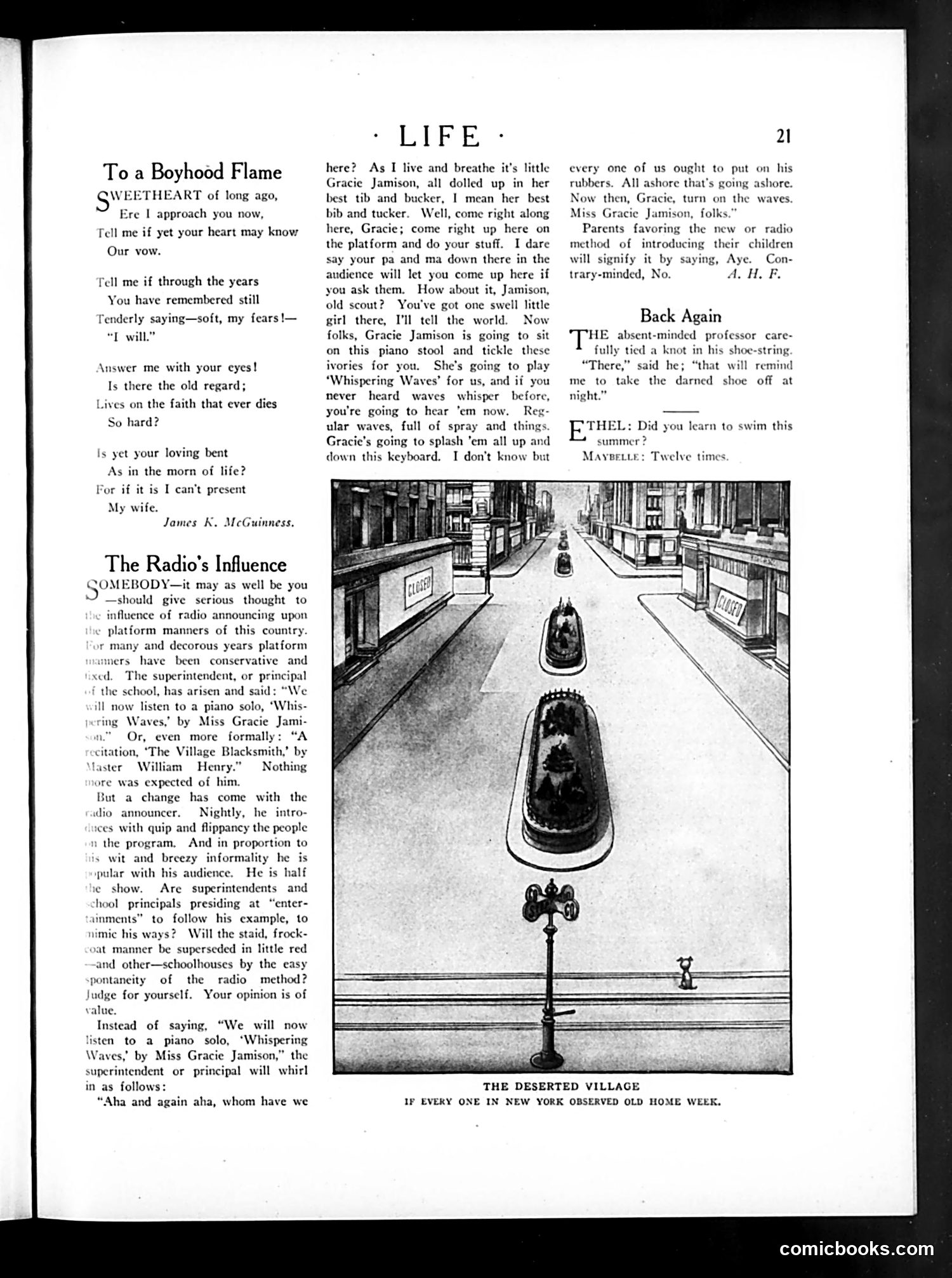
This page satirizes how radio announcers' informal, flashy style is influencing formal public speakers, particularly school principals and superintendents introducing performers at events. **The Setup:** Traditionally, school officials introduced programs with staid, formal language ("We will now listen to a piano solo..."). Radio announcers, by contrast, use quips, breezy informality, and showmanship to entertain audiences. **The Satire:** The article imagines a principal adopting radio-announcer mannerisms when introducing a student pianist named Gracie Jamison. Instead of formal decorum, he uses slang ("old scout," "swell little girl"), rambling commentary, and exaggerated descriptions ("splash 'em all up and down this keyboard"). **The Point:** The author worries radio's casual, entertainmentfirst approach is eroding traditional institutional formality and dignity. The absurd example (suggesting audiences wear rubber boots) underscores how inappropriate this style is for schools. This reflects 1920s-30s anxieties about mass media's cultural influence on established institutions and decorum.
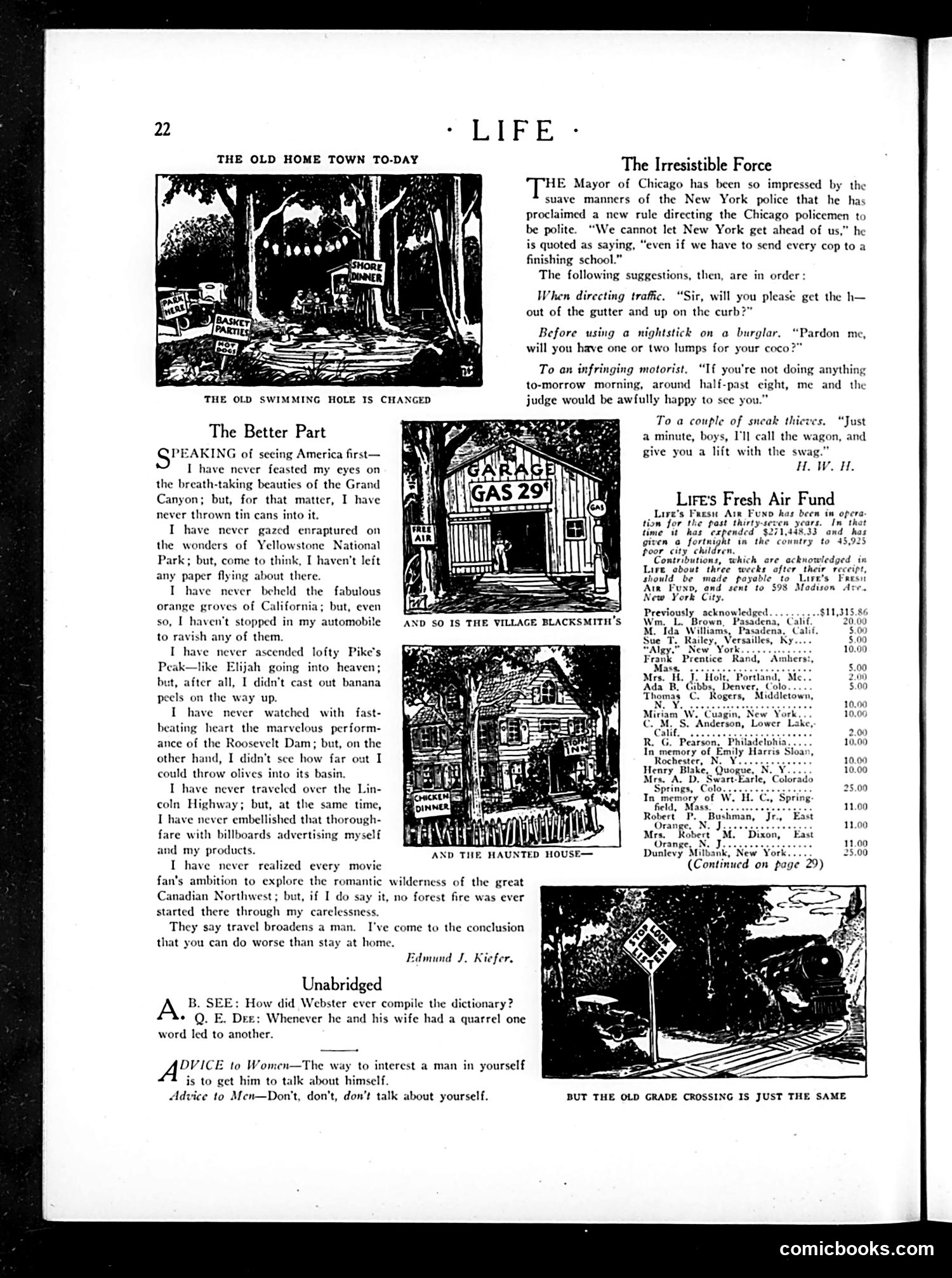
This page contains satirical commentary on American civic behavior and municipal politics circa the 1920s. **"The Better Part"** (by Edmund J. Kiefer) satirizes Americans who visit natural wonders while littering and vandalizing them—throwing tin cans in the Grand Canyon, leaving paper at Yellowstone, discarding banana peels on Pike's Peak. The joke: the author hasn't traveled to these sites, but at least *he* hasn't polluted them. The satire suggests that staying home is preferable to being an inconsiderate tourist. **"The Irresistible Force"** mocks Chicago's mayor, who reportedly proclaimed a new politeness policy for police to match New York's standards. The humorous "suggestions" imagine absurdly polite phrasing for rough police actions—asking burglars if they want "lumps" before using nightsticks, or inviting speeders to court "at half-past eight." The page also includes **Life's Fresh Air Fund**, a genuine charitable program sending poor city children to the countryside, with donor acknowledgments listed. The cartoons at top and bottom illustrate "The Old Home Town," with captions suggesting suburban/rural life hasn't fundamentally changed.
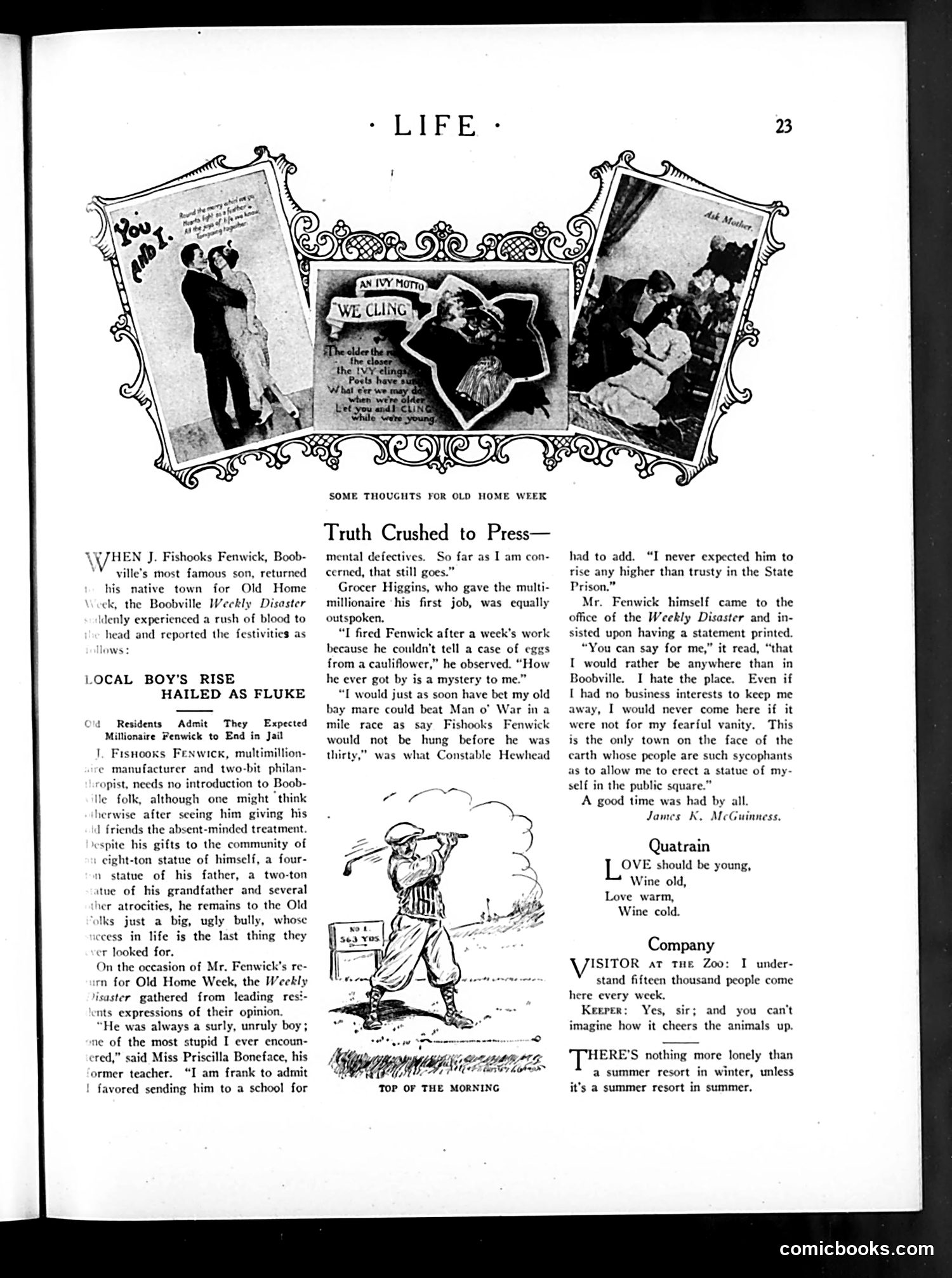
This is satirical commentary on small-town hypocrisy and social climbing. J. Fishooks Fenwick, a self-made millionaire from the fictional town "Boobville," returns for Old Home Week. The joke: his hometown's leading citizens—his former teacher, employer, and local constable—all testify he was stupid, lazy, and destined for prison. Yet Fenwick has become wildly successful and now erects statues of himself throughout town. The satire cuts both ways. The townspeople are portrayed as small-minded and envious, yet Fenwick himself admits his only reason for returning is "fearful vanity"—acknowledging his hometown consists of "sycophants" willing to honor his statues. The cartoon mocks both provincial narrow-mindedness and nouveau-riche egotism, suggesting success sometimes comes to the undeserving, while those left behind resent it bitterly.
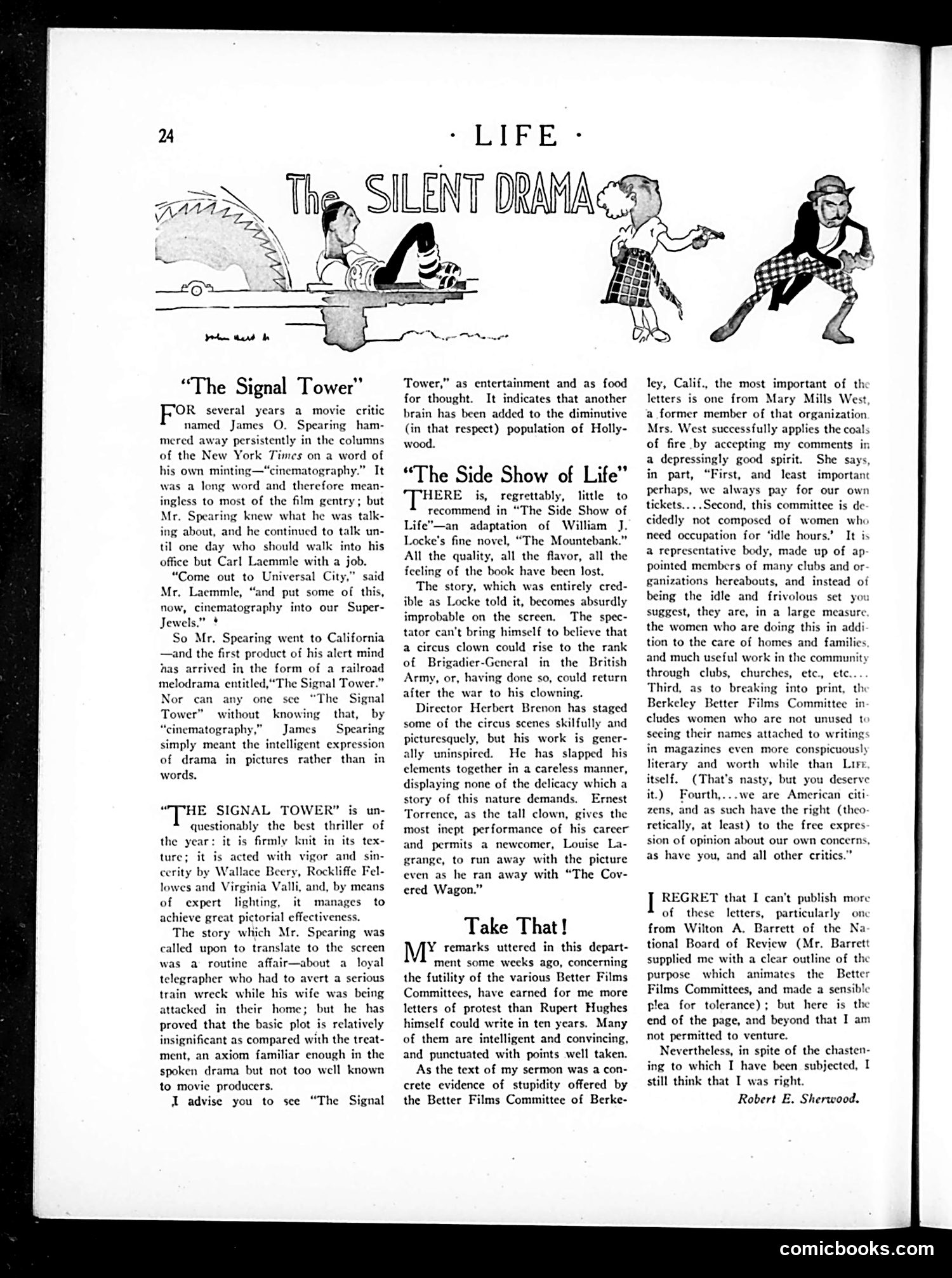
This page reviews three silent films and responds to criticism. **"The Signal Tower"** is praised as the year's best thriller, directed by critic James O. Spearing (hired by Carl Laemmle). The review celebrates Spearing's concept of "cinematography"—intelligent visual storytelling rather than mere plot. The film stars Wallace Beery and others in a routine railroad-melodrama plot (loyal telegrapher prevents train wreck during home attack), but Spearing's skilled treatment elevates it. **"The Side Show of Life,"** adapted from William J. Locke's novel, is criticized for losing the source material's quality. Director Herbert Brenon's careless staging makes the implausible plot (circus clown becomes British general) unbelievable. Ernest Torrence's poor performance is overshadowed by newcomer Louise Lagrange. **"Take That!"** addresses angry letters protesting the critic's earlier dismissal of Better Films Committees. Mary Mills West, a former committee member, responds graciously, defending the organization's work improving cinema standards.
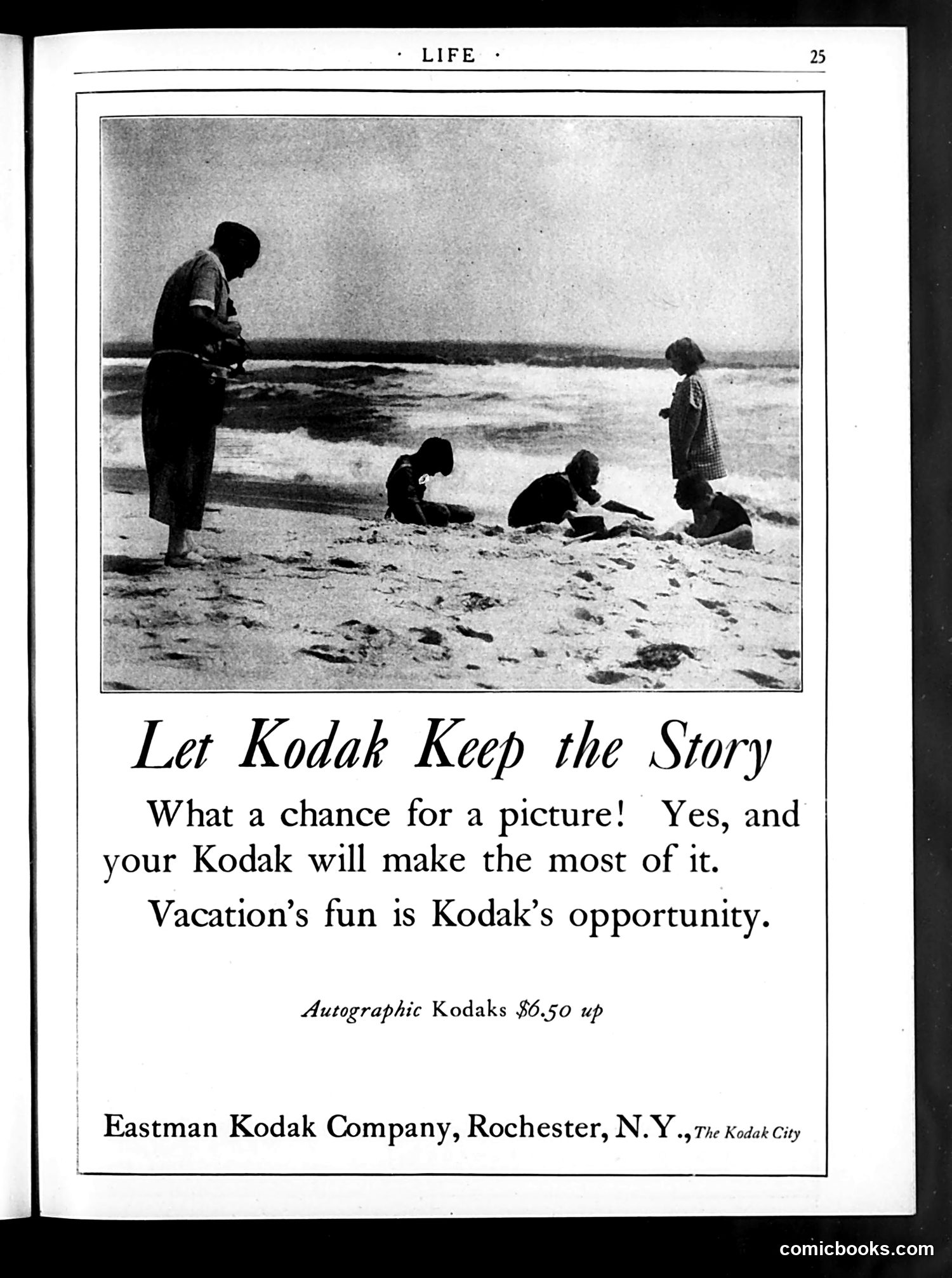
This is a **Kodak advertisement**, not a political cartoon or satire. It promotes Autographic Kodak cameras by depicting a beach vacation scene: an adult supervising children playing in sand near water. The ad's appeal is straightforward consumer marketing rather than satire. The headline "Let Kodak Keep the Story" emphasizes photography's role in preserving vacation memories—a central selling point of early 20th-century consumer cameras. The tagline "Vacation's fun is Kodak's opportunity" directly links leisure activities to camera use. The pricing ($6.50 up) and company attribution (Eastman Kodak Company, Rochester, N.Y.) confirm this is period advertising. The "Autographic" feature allowed users to write notes directly on film negatives, a notable innovation for the era. There is no satire, political content, or caricature present on this page.
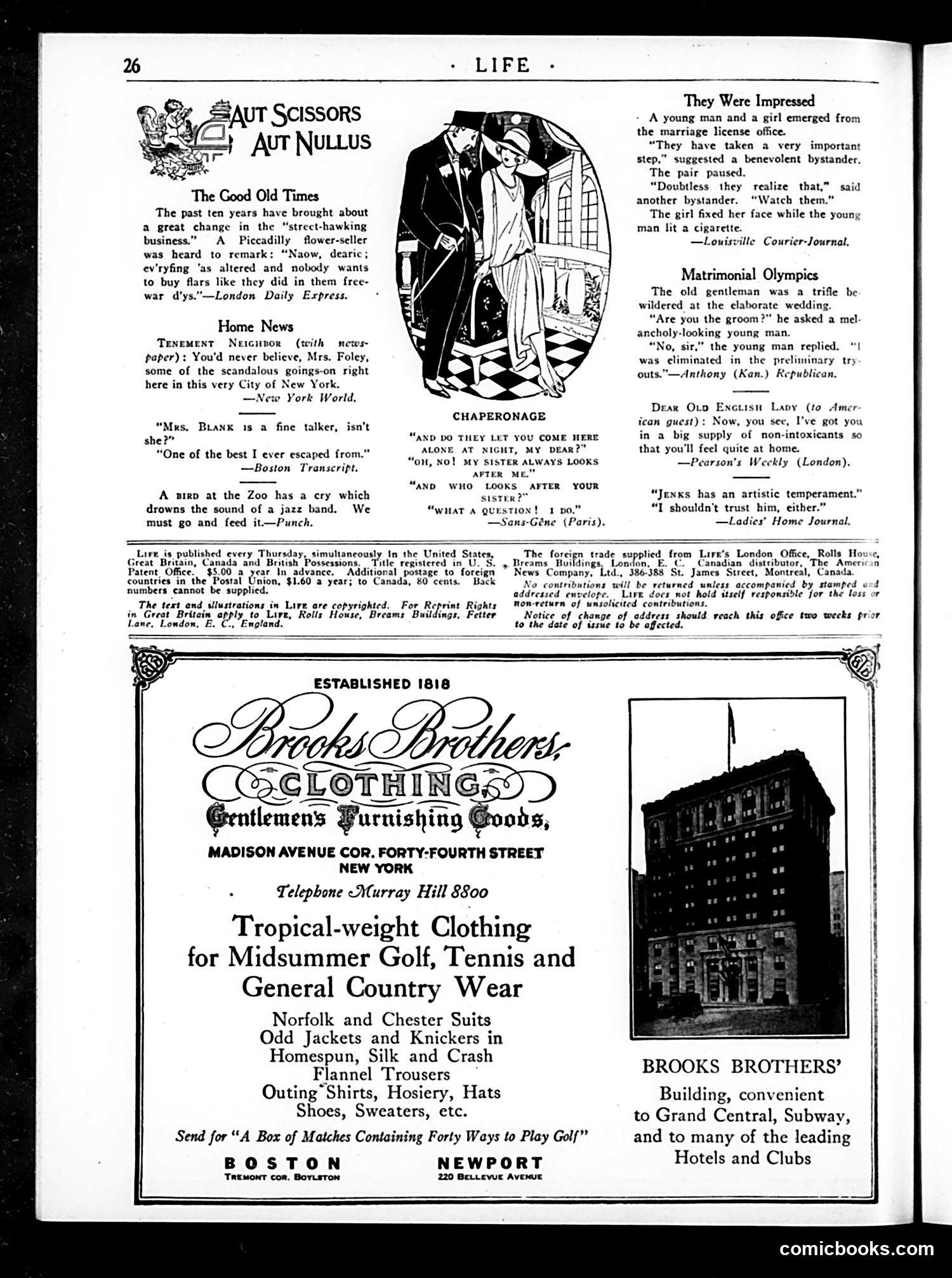
This page contains several brief satirical humor pieces typical of Life magazine's format, plus advertising. **The Cartoons/Jokes:** The main cartoon, "Chaperonage," depicts a young couple with a chaperone and plays on changing social mores post-WWI. A chaperone questions whether the girl comes out alone at night; she replies her sister always accompanies her. When asked who looks after the sister, she cheekily responds "What a question! I do!"—implying the sister needs no supervision, highlighting how social restrictions on unmarried women were relaxing in the 1920s. Other brief pieces mock modern romance and marriage: one notes a young couple leaving the marriage license office are impressive because they immediately light cigarettes rather than celebrating; another jokes about a groom being "eliminated in preliminary tryouts" at his own wedding. **Context:** These jokes reflect post-WWI social upheaval, particularly loosening Victorian restrictions on women's behavior and changing courtship rituals—themes Life frequently satirized for its urban, sophisticated readership. The page is otherwise dominated by a Brooks Brothers clothing advertisement.
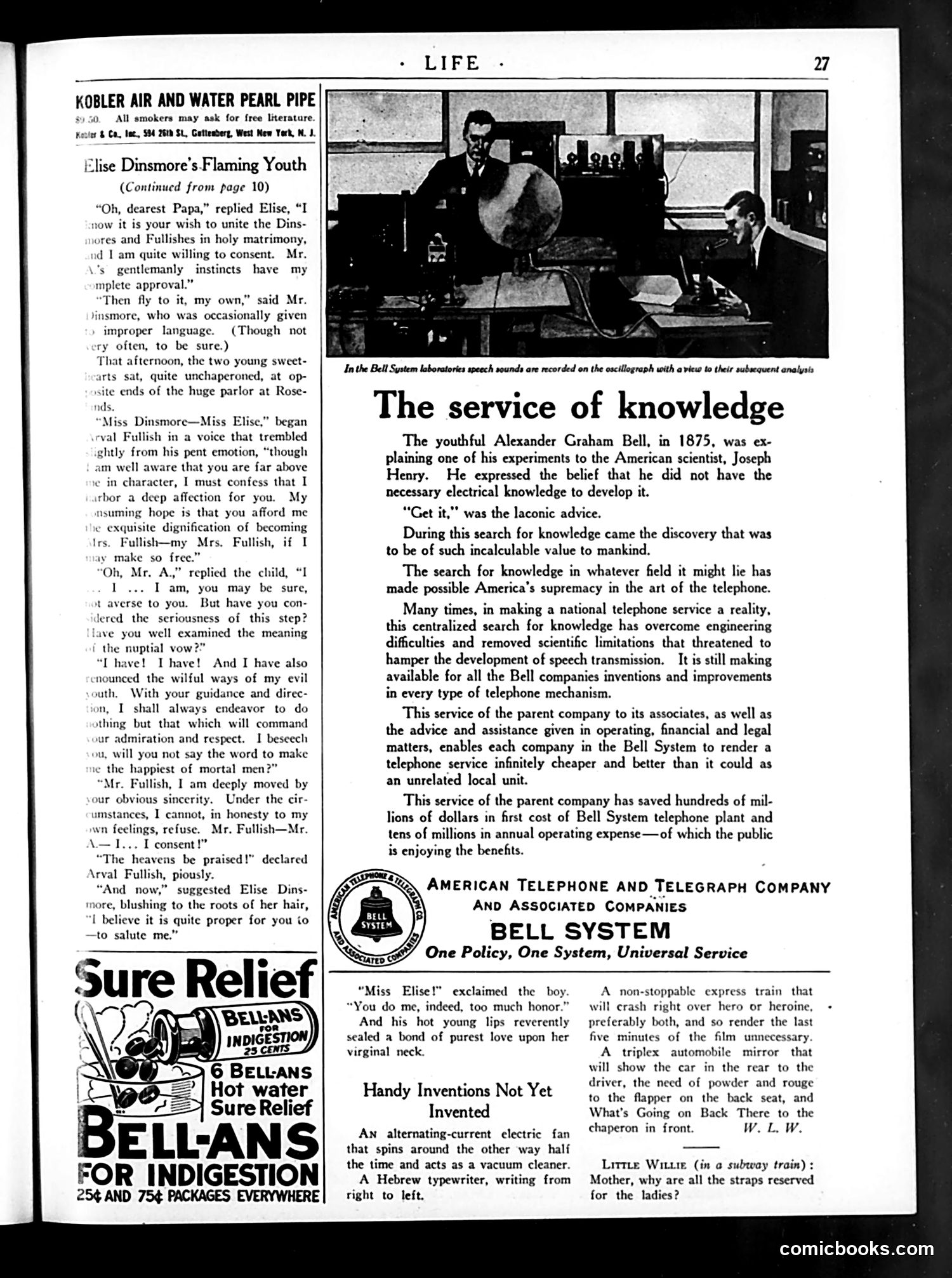
This page contains two distinct elements: **"Elise Dinsmore's Flaming Youth"** is a serialized romantic story (continued from earlier) depicting a proper Victorian-era courtship between young characters. The humor appears satirical—the dialogue is exaggeratedly formal and sentimental, with the male suitor using flowery language ("exquisite dignification"). This likely parodies contemporary romance fiction's melodramatic conventions. **"The Service of Knowledge"** is a Bell System advertisement celebrating Alexander Graham Bell's 1875 research with scientist Joseph Henry. It credits Bell's pursuit of knowledge—specifically electrical knowledge—with enabling the telephone's invention. The ad argues that Bell's parent company provides similar research services to associated telephone companies, saving money and improving service nationally. The photograph shows Bell System laboratory work with sound recording equipment, illustrating the company's ongoing research claims. The page also contains a **Bellans indigestion remedy advertisement** (unrelated commercial content).
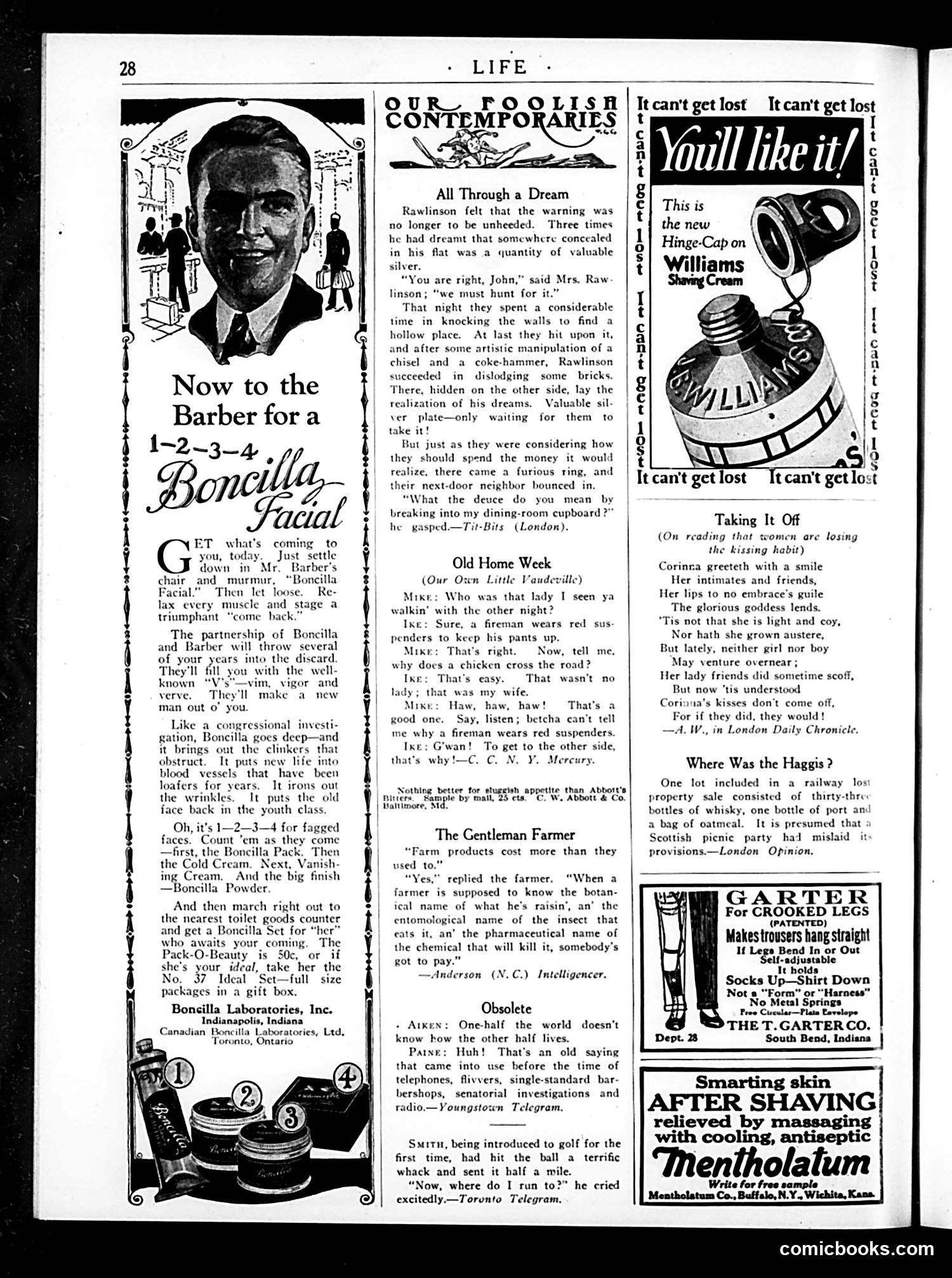
This page is primarily **advertising and humor content** from Life magazine's satirical section. The dominant feature is a **Boncilla facial advertisement** (left column), promoting a multi-step skincare regimen as a "comeback" treatment for aging men. The numbered steps (1-2-3-4) promise to restore youth and vigor—language typical of early 20th-century beauty marketing's exaggerated claims. The remaining content consists of **short humorous anecdotes**: - "All Through a Dream": A couple finds hidden silver in their wall, only to realize they've broken into their neighbor's cupboard—a joke about mistaken identity and misplaced hope. - "Old Home Week": A vaudeville-style joke where two men trade nonsensical answers to classic riddles, deliberately talking past each other—humor based on deliberate miscommunication. - "The Gentleman Farmer" and other brief jokes satirize modern complications in farming and outdated sayings. Right-side advertisements promote **Williams Shaving Cream** and **Garter socks**, typical male grooming products of the era.
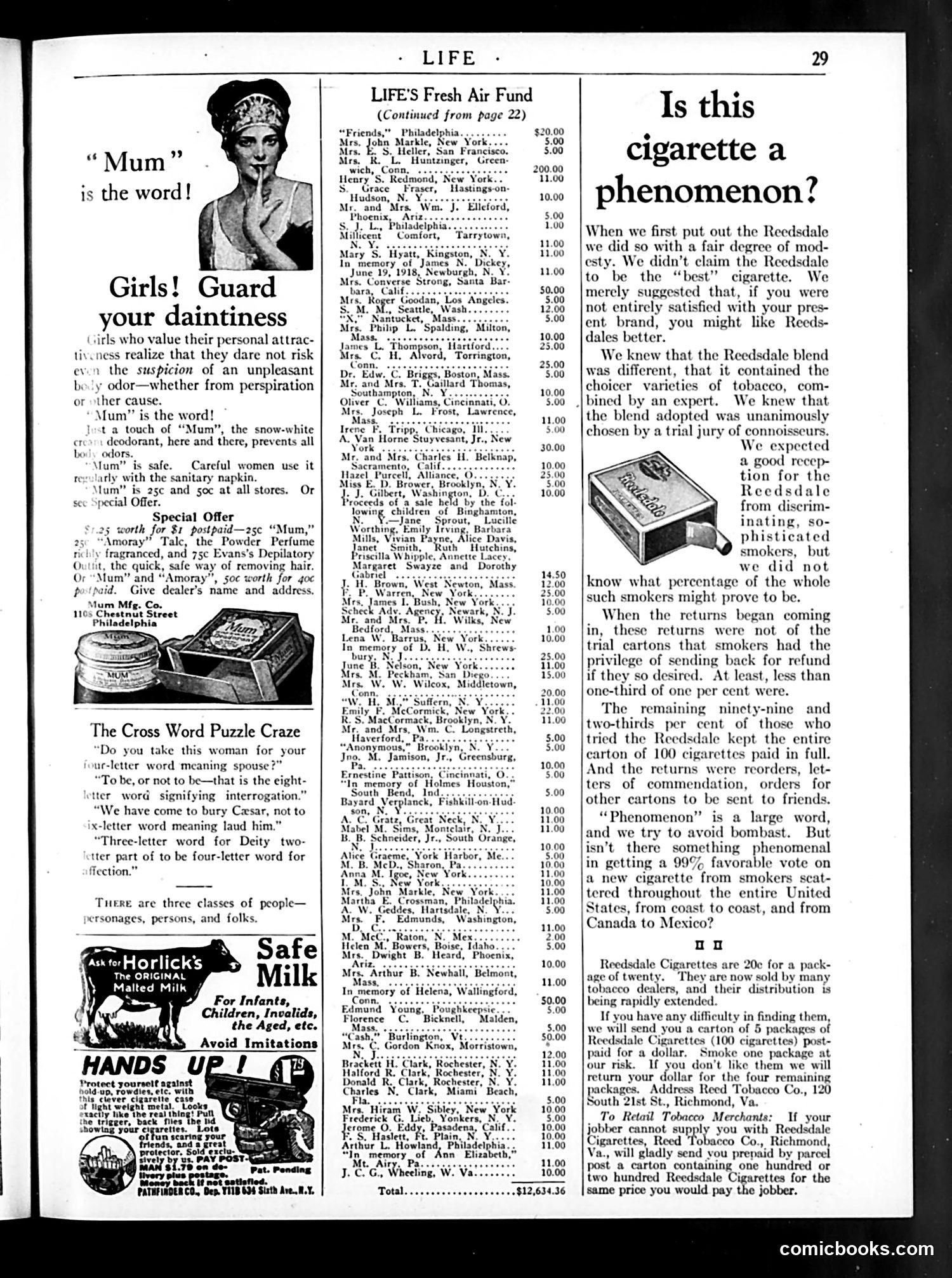
This page contains **primarily advertisements and donor listings**, not political cartoons. The main content includes: 1. **"Mum" deodorant ad** (top left): Appeals to women's vanity/insecurity about body odor, specifically suggesting use with sanitary napkins—reflecting early 20th-century attitudes about feminine hygiene as a social embarrassment requiring concealment. 2. **"Crossword Puzzle Craze" joke** (center): Satirizes the 1920s crossword puzzle fad by rewriting famous literary/historical quotes as clue definitions. The humor lies in the absurdity of treating canonical phrases as mere word-puzzle fodder. 3. **Horlick's Malted Milk and cigarette ads** (bottom): Standard product advertisements. 4. **"Fresh Air Fund" donor list**: Lists charitable contributions, likely for children's welfare. The page reflects 1920s consumer culture and emerging anxieties about personal hygiene marketing, alongside the contemporary crossword puzzle craze that swept America during this era.
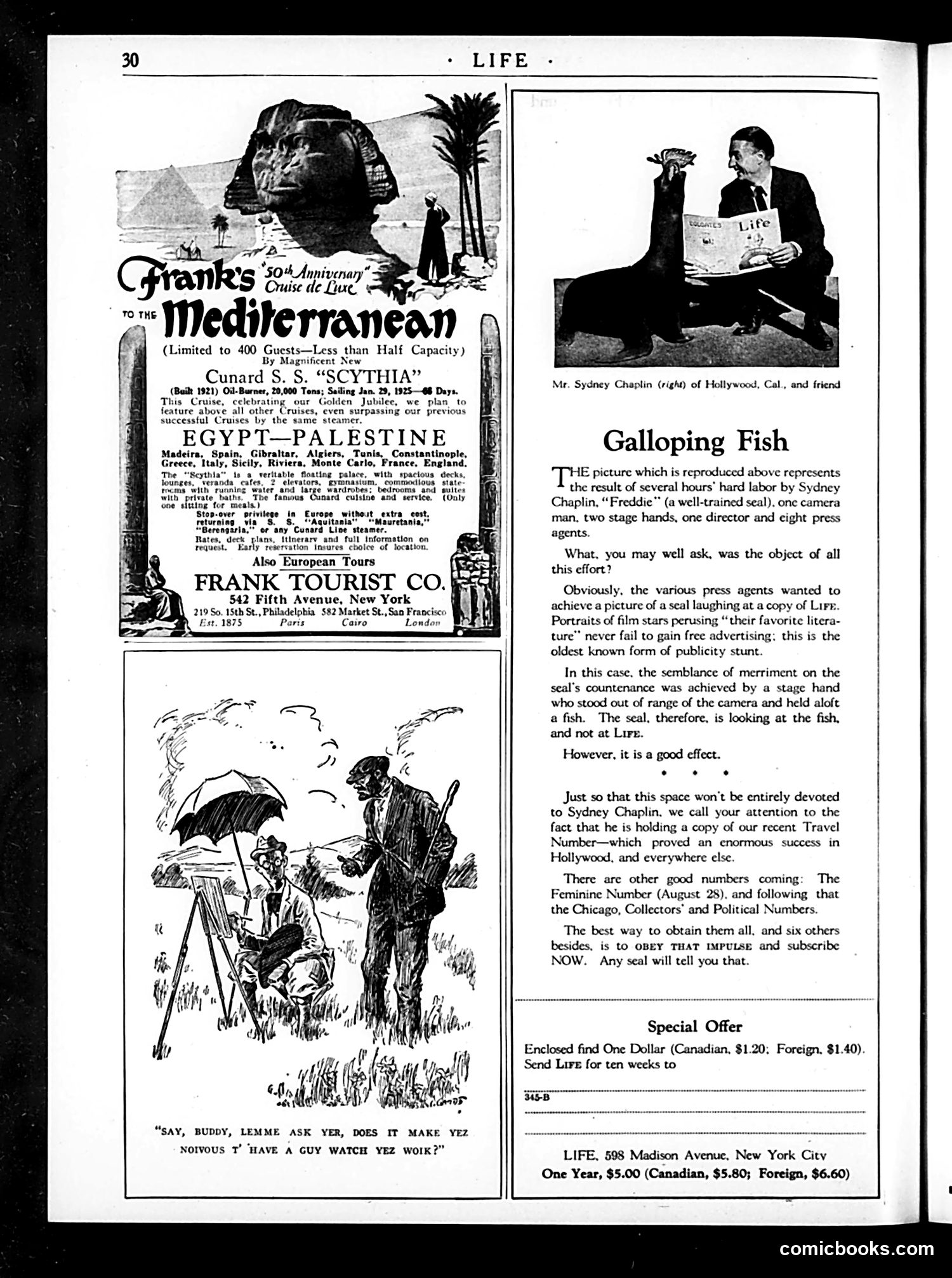
This page mixes cruise ship advertising with satirical commentary on Hollywood publicity stunts. The main feature ridicules actor Sydney Chaplin (brother of Charlie) and his press agents for staging an elaborate photo of a trained seal ("Freddie") supposedly laughing while reading Life magazine. Life's editors mock this as the "oldest known form of publicity stunt"—fabricated celebrity endorsements. The joke: the seal isn't actually amused by the magazine; it's only looking at a fish held off-camera by a stage hand. The satire exposes how press agents manipulate images to create false advertising. The bottom comic cartoon, depicting working-class men in period dialect, appears unrelated to this feature. The article cleverly uses self-promotion—advertising Life's Travel Number that Chaplin holds—while simultaneously exposing the dishonesty of such promotional tactics.
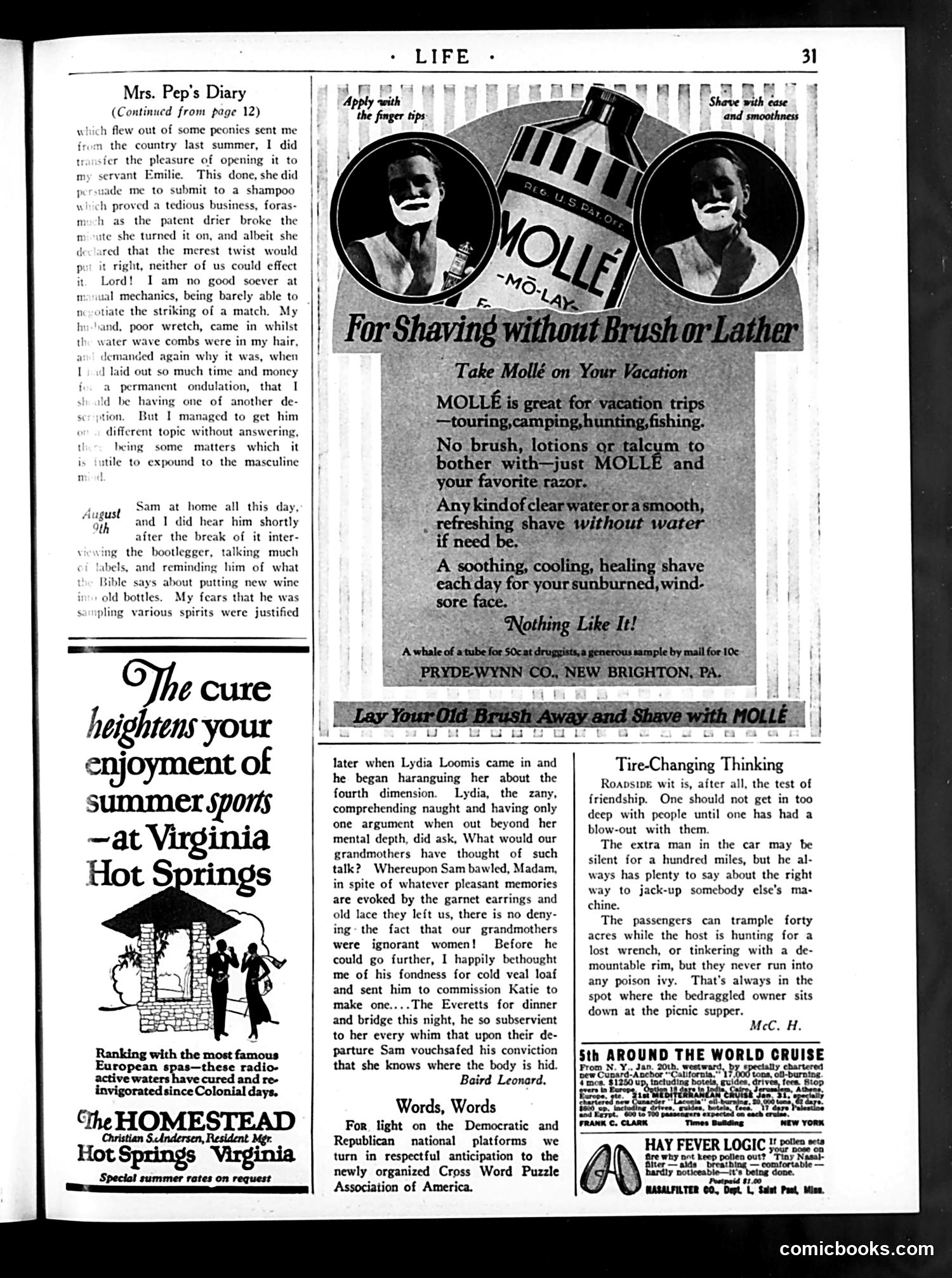
This page contains primarily **advertising and humor columns** rather than political cartoons. **Main content:** 1. **"Mrs. Pep's Diary"** — A humorous domestic narrative satirizing upper-middle-class married life. Mrs. Pep complains about household servants, her husband Sam's drinking (he's calling the bootlegger—a reference to Prohibition-era illegal alcohol suppliers), and his pretentious philosophical discussions with a guest about the "fourth dimension." The satire mocks both marital dynamics and the intellectual pretensions of the era. 2. **Advertisement for Mollé shaving cream** — A period product ad promoting convenience for vacation travel. 3. **"Tire-Changing Thinking"** — Humorous observations about roadside etiquette and personality quirks during car troubles. 4. **"Words, Words"** — A brief joke about the newly popular crossword puzzle craze being consulted for clarity on Democratic and Republican political platforms—satirizing both the vagueness of politics and the era's crossword obsession. The page captures 1920s social satire: Prohibition, gender relations, and emerging consumer culture.
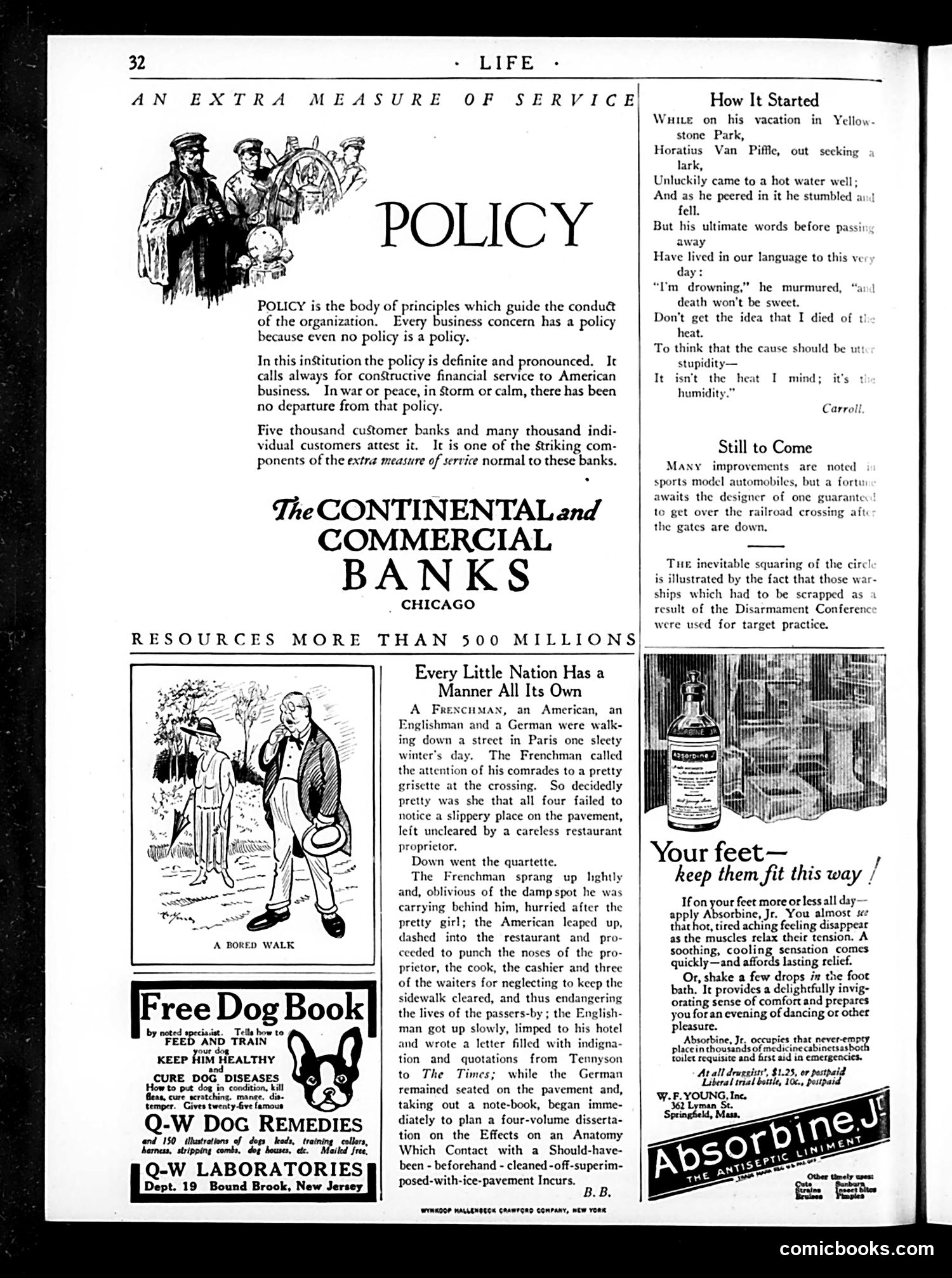
This page combines corporate advertising with satirical humor typical of *Life* magazine's format. **The main cartoon** ("Every Little Nation Has a Manner All Its Own") illustrates national stereotypes through four men slipping on ice in Paris. The joke relies on exaggerated ethnic characterizations: the Frenchman chases a pretty woman, the American immediately gets violent and punches restaurant staff, the Englishman writes a formal complaint letter citing poetry, and the German begins writing a scholarly dissertation. Each represents a crude caricature of national behavior—French romanticism, American aggression, British formality, and German intellectualism. **The context**: This reflects early 20th-century attitudes toward European nations, written likely during or after WWI when such stereotypes were common currency in American humor. The page is primarily **advertising** for The Continental and Commercial Banks (Chicago), with additional ads for dog remedies and foot powder. The "Policy" essay at top is corporate messaging dressed as editorial content.
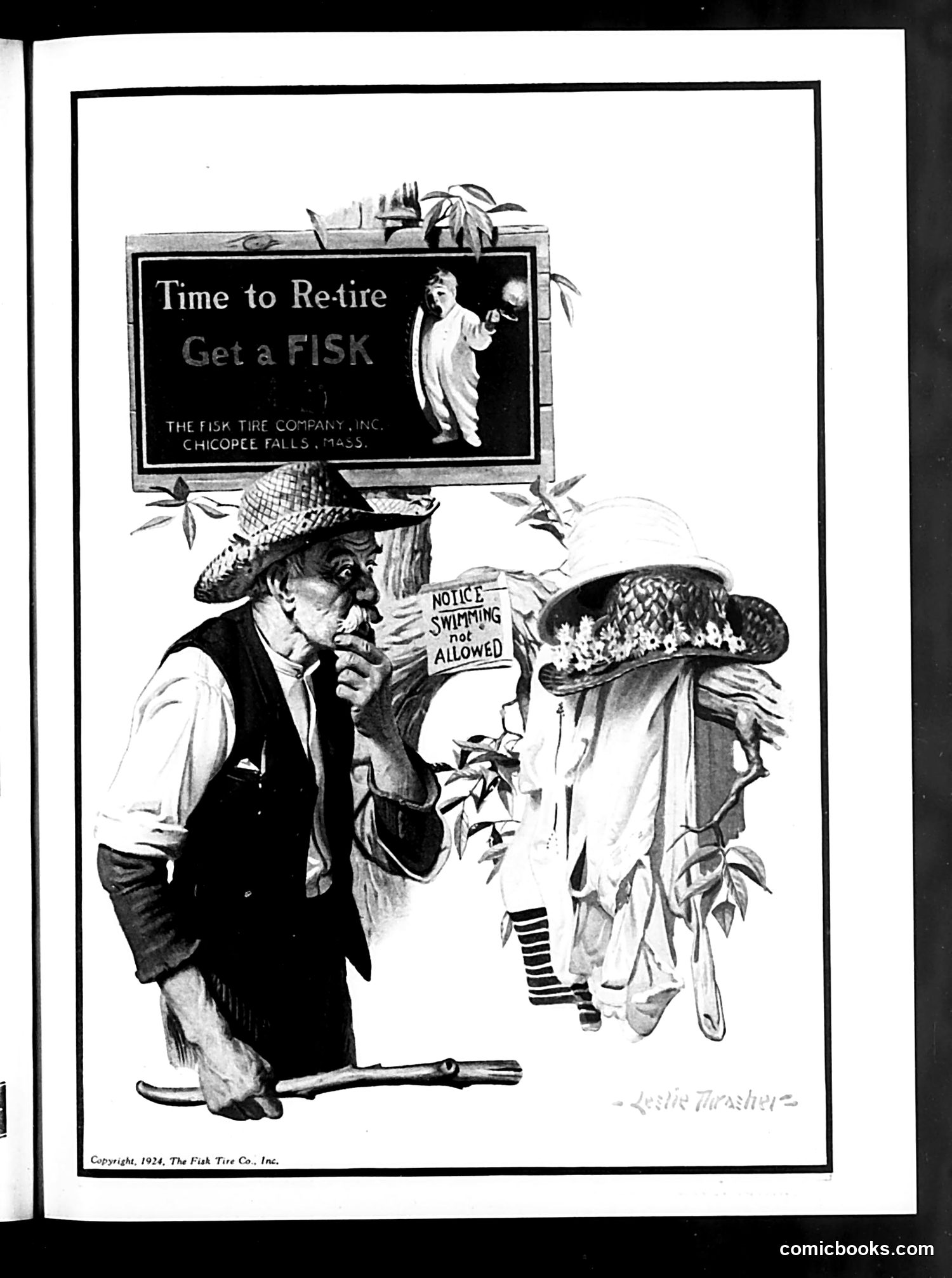
This 1924 advertisement for Fisk Tire Company uses satirical humor to promote retirement and leisure. The cartoon depicts an elderly man being confronted by two figures representing leisure activities—one appears to be a fisherman or swimmer (related to the "swimming not allowed" notice visible), the other a hunter or outdoorsman. The billboard above advertises "Time to Re-tire / Get a FISK" tire. The joke conflates "retire" (stop working) with "re-tire" (replace tires), suggesting that retirement is the time to enjoy fishing and outdoor pursuits. The Fisk company cleverly positions their product as enabling this leisure lifestyle. The caricatured old man represents the target audience—workers who could contemplate retirement with proper financial planning, using Fisk tires for recreational adventures rather than work commutes.
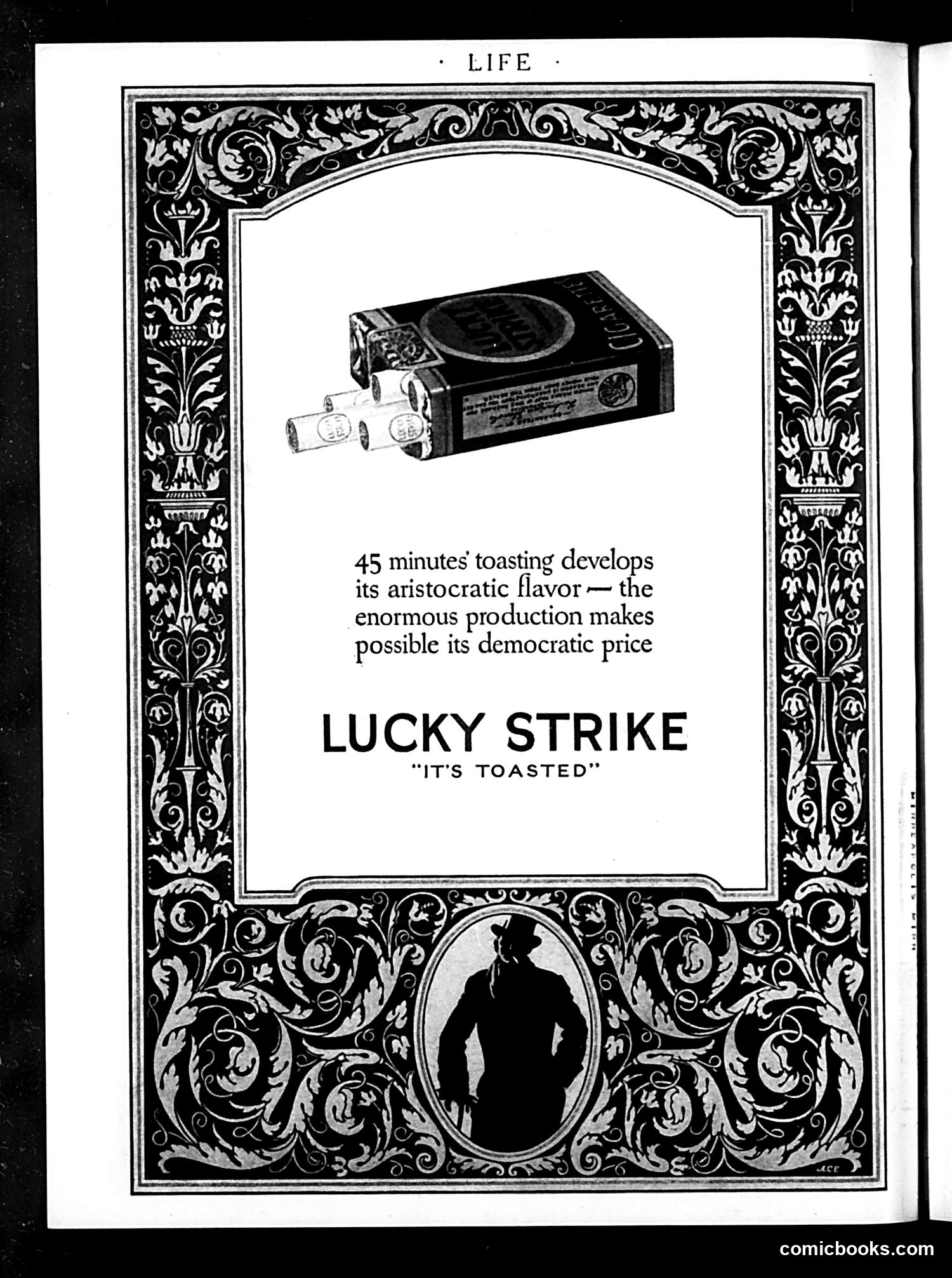
This is a **cigarette advertisement**, not political satire. It promotes Lucky Strike cigarettes using class-based marketing language popular in early 20th-century advertising. The ad's key claim: 45 minutes of toasting produces "aristocratic flavor" while "enormous production" keeps the price "democratic"—meaning affordable to ordinary people, not just the wealthy. The ornate decorative border and silhouetted gentleman figure at the bottom are designed to convey sophistication and upscale appeal. The tagline "It's Toasted" was Lucky Strike's actual marketing slogan, emphasizing a supposed manufacturing advantage. The humor or appeal lies in democratizing luxury—suggesting working-class consumers could enjoy "aristocratic" quality at ordinary prices. This reflects Depression-era marketing that positioned mass-produced goods as accessible luxury rather than cheap alternatives.